1. INTRODUCTION
Although never-married childless people have formed a relatively large part of the north-western European population for a long time, they have been and still are remarkably invisible in both historical and sociological research. The focus has been on families and married couples and when it comes to the situation of the elderly, scholars have mainly discussed the importance of children for the care of their elderly parents. Moreover, unmarried women have also been neglected in the political debate.Footnote 1 Married people can even be seen as the norm and the never-married as the deviant others, a notion that has coloured social studies of childless people.Footnote 2
At the beginning of the twentieth century, one of the most dominant images of the spinster was that of a pitiful woman with difficulties in the marriage market. She was often described as lonely, frustrated and selfish.Footnote 3 At the same time, however, these notions of never-married women were steadily subverted and more positive characteristics were emphasised, such as being independent and having the power to control one's life.Footnote 4 Even if these women did not start a family of their own, they came to be important to their extended kin. Some stayed at home looking after old parents. Others were supposed to support nephews and nieces economically and emotionally. Some would even replace a sister who had died at childbirth as a foster mother, especially before the twentieth century when maternal mortality was a serious problem.Footnote 5 This leads to the question of reciprocity. Could elderly never-married women expect to receive support from relatives when they were no longer able to support themselves?
One way to study never-married elderly women's access to assistance is to focus on residence patterns. George Alter and Irene Artæus both studied this category of women in the early nineteenth century; Artæus in Sweden and Alter in Belgium. They found that co-residence with relatives was an important pattern, especially among the wealthier groups. Residing with non-kin was quite common among the lower social strata.Footnote 6 Ann-Kristin Högman and Ulla Rosén noted high percentages of both elderly unmarried and widowed women living on their own in some Swedish towns. These living arrangements could be observed throughout the nineteenth century and in the early twentieth century.Footnote 7 The Swedish conditions, however, do not seem to correspond with studies of the elderly's living conditions in urban areas in the NetherlandsFootnote 8 and the United States. These studies showed high rates of intergenerational co-residence in the late nineteenth and early twentieth centuries, underlining the great importance of family networks in urban areas.Footnote 9 However, the twentieth century saw a dramatic decline in intergenerational co-residence in the United States. Steven Ruggles attributes this principally to increasing options among members of the younger generation to support themselves.Footnote 10 Other scholars have suggested that the improving economy of the elderly enabled them to afford to live alone, although the debate continues.Footnote 11 How can the high rates of elderly women living alone both in pre-industrial and industrial Sweden be explained? Were they for some reason abandoned by relatives and friends or did they have relatively good opportunities to support themselves?
In their contemporary study of elderly childless men and women, Clare Wenger, Anne Scott and Nerys Patterson question the picture of the old spinster being worst off because childless men, both unmarried and widowed, seem to have had more fragile social networks than never-married women had.Footnote 12 This also appears to be the case in Swedish towns in the early twentieth century, at least if we study the rates of dependency on poor relief. Statistics show that elderly unmarried men and widowers were those most in need of support.Footnote 13
One of the consequences of the north-western European marriage pattern was a large number of women and men spending at least a period of their lives outside of their families of origin as servants. Their labour could be used effectively in rural households in need of their services.Footnote 14 Also in urban areas domestic service was a typical occupation for unmarried young women as well as an alternative for the relatively large group of women who remained unmarried.Footnote 15 Others preferred manufacturing jobs over working as maids. Other options were working in laundries, as seamstresses or taking in lodgers. Women belonging to wealthier families could often work as teachers, office workers, telegraphists and nurses, jobs higher up in the social hierarchy.Footnote 16 However, a limited female labour market in combination with small possibilities of saving for old age reduced older women's livelihood opportunities at the end of their lives.Footnote 17 Elles Bulders has shown that the combination of various income sources was essential for the survival of the elderly.Footnote 18
Our knowledge is still inadequate regarding the livelihood strategies of the large group of elderly never-married women growing old at the beginning of the twentieth century. Thus, it is of utmost interest to investigate the importance of their different income strategies at the beginning of the twentieth century: a time when the proportion of older never-married reached its peak, the social responsibility of the state was minimal, and children were supposed to be the main caregivers for the older population.
2. DEMOGRAPHIC CHANGE
A century ago, Sweden showed high rates of never-married women, together with countries such as Iceland, Norway, Portugal, Ireland, Belgium and Switzerland. Relatively high proportions of non-married people have characterised the Swedish population at least since the beginning of the eighteenth century.Footnote 19 In his famous article published in the 1960s, statistician John Hajnal argued that a unique marriage pattern had dominated the western parts of Europe for centuries. This pattern was characterised by a large proportion of never-married people as well as couples marrying relatively late in life. Late marriages also meant smaller households because married sons and daughters formed households of their own. In contrast, the eastern European marriage pattern showed a lower marriage age, a small percentage of people never marrying, and higher rates of extended households. A similar pattern could also be seen in many non-European countries.Footnote 20 From the 1980s onwards, historians and anthropologists have criticised this macro model for being too simplistic, as deviations from this pattern have been detected in west and east.Footnote 21 However, the main critique concerned differences and similarities in family patterns in general and did not particularly focus on the demography of the never-married.
The proportion of never-married men and women rose during the nineteenth century. In Sweden, the rise is mainly explained by large birth cohorts at the beginning of the century together with an impoverished population leading to weakened marriage possibilities. Furthermore, reluctance to marry below oneself on the social scale was widespread among the higher echelons of society.Footnote 22 In 1800, the proportion of never-married women and men in the 45–49 years age group was 11.7 per cent and 6.9 per cent, respectively. In 1900, the corresponding proportions had almost doubled to 19.4 per cent and 13.5 per cent. The percentage of never-married women was even higher in urban areas. This female surplus was mainly due to the fact that the city lights attracted more women than men.Footnote 23 Focusing on the situation of persons aged 65 years old and over, 27 per cent of the women and 13.5 per cent of the men living in the city of Gothenburg were never-married in 1930. The proportions were almost as high as in Stockholm, where the corresponding proportions were 29 and 14.5 per cent.Footnote 24 The choice of the city of Gothenburg as a focus of the present study is mainly decided by its high percentage of never-married elderly women in combination with well-documented income sources for this category of elderly people.
At this time, Sweden also had a relatively old population. The country had, together with France, the highest proportions of persons over 65 years old in the western world, with 8.3 and 8.2 per cent each in 1900. The corresponding percentages in the United States and England–Wales were 4.0 and 4.7 per cent. One part of the explanation for the ageing Swedish population was the higher life expectancy at the age of 50 years compared with the three countries mentioned earlier.Footnote 25 However, more significant explanations for the ageing population were large birth cohorts in the early nineteenth century and high rates of emigration among younger men and women, in combination with decreasing birth rates, in the late nineteenth century.Footnote 26
3. INCOME STRATEGIES
This significant demographic pressure created a need for social solutions. An increasing proportion of elderly childless women meant a greater strain on the already limited female labour market as well as on community support. How did these women manage to make ends meet in a society where state intervention in social issues was minimal and the liberal idea of self-help dominated? Poverty was to a large extent seen as an individual problem and saving was one of the key elements in this ideology. Kristina Lilja and Dan Bäcklund noted that it was hard for workers to save for old age, but found savings to be more common among the childless elderly compared with those who had children to support.Footnote 27 Was this also the case for the childless women focused on in the present study? However, this might have been a problem since women did not have the same opportunities as men to earn a living throughout their lifetimes.
Generally, it is quite difficult, if not almost impossible, to find information about the different kinds of tasks that women historically have performed to make a living. Fortunately, for this study the informative source material enables us to obtain detailed information about employment as well as other means of support important for elderly never-married women.
The contemporary author Gerda Meyersson has depicted women's work in industrial areas although her focus is not specifically on older women. She describes her impressions, formed through visits to various workplaces employing women in Stockholm at the beginning of the twentieth century. Many women had sewing, washing and cleaning jobs while others did subcontracted jobs at home. Weaving, knitting, silver polishing and making matchboxes were some of their tasks. According to Meyersson, these home workers were the worst off of the female workers. They had long unregulated working hours and often worked in small dark rooms.Footnote 28
Some elderly women were engaged in petty commerce.Footnote 29 This can be characterised as involving the kind of tasks that the British historian John Benson refers to as ‘penny capitalism’, which was a common way of earning a living for working-class men and women in combination with wage labour throughout the nineteenth and twentieth centuries. Benson offers the following definition of his concept:
Nonetheless, it remains possible to define the penny capitalist as a working man or woman who went into business on a small scale in the hope of profit (but with the possibility of loss) and made him- (or her)self responsible for every facet of the enterprise.Footnote 30
Although Sweden in 1913 was the first country to legislate on a national pension system for all citizens regardless of occupation and income, pensions were small and far from covering the costs of daily life and apart from self-support other sources were important for the income of the elderly.Footnote 31 Furthermore, women generally were paid less than men and therefore received smaller pensions, rationalised by the facts that women lived longer and disability was not as devastating for women. The Old Age Committee stated that:
…women are not in need of support to the same extent as men are because disability for a man is worse than for a woman. For a disabled man it is often more difficult to find suitable employment or refuge with a relative compared to a woman in the corresponding situation. Particularly those who during their lifetime have fulfilled the important societal task of being a wife and mother or have been working at home would be able to co-reside with their children. The mother is closer to her children than their father is, moreover to other relatives. She is also a better person to perform household work, despite her disability.Footnote 32
The Old Age Committee obviously did not have never-married childless women in mind since they just mentioned the mothers. To what extent did pensions contribute to the income pooling of women who lacked children – possibly the most important support in old age?
Increasing social problems reinforced the need for a better organisation of different sources of support for the poor. The idea was to improve the coordination of poor-relief authorities, charity organisations and support from single caregivers.Footnote 33 How were these ideas implemented in the care of elderly women?
4. SOURCE MATERIAL AND METHODS
The present study is based on application forms provided by the Sociala centralbyrån (Central Bureau for Social Questions), which controlled and coordinated support from different charity organisations. One of these 127 funds was the Clasefond (Clase Foundation), founded in 1926. Support from this donation was given to never-married poor women aged 60 years old and over. It was founded according to the will of the businessman Clas A. Clase in 1911, stating that the fund would guarantee 40 women a support of 300 Swedish crowns per year. However, the funding was linked to certain requirements. Women who applied for support had to declare that they had been self-supporting and lived a decent and strenuous life. They had to testify that they were never-married and childless. Their information was to be verified by an excerpt from the parish register affirming that they were telling the truth. Moreover, two married women who had known the applicant for a long time had to confirm that the data were correct.
Thus, the officials in charge of the funds emphasised characteristics such as good morals and self-control in their assessment of applicants. Only hard-working decent women were entitled to support. This attitude was typical of the ideology that characterised social work at the time. Separating the worthy poor from the unworthy was a general social policy.
The questionnaire answers contain detailed information about past and ongoing employment as well as income from work and room rentals. Furthermore, support from relatives, poor relief, donations, pensions and savings was registered. There is also information on rental costs, housing conditions, household structure and the women's state of health. Lotta Vikström discussed the discrepancies between the female occupations found in parish records and equivalents in local newspapers, patient records and business statistics, showing an under-registration of women's work in the former mentioned sources, whereas the additional sources showed a diversity of occupations.Footnote 34 The source material of the present study is very informative and gives a detailed picture of elderly non-married women's income strategies. However, we may suspect that important information concerning ready money and support from relatives and friends was easy to withhold. But apart from that, it seems that the authorities were able to control most of the information. If the applicants had omitted to mention any kind of support, the officials noted the mistake and the data were corrected.
4.1. Research design
The present study is based on a prosopographical approach, that is, collecting and investigating collective biographical information on a cohort of people with common characteristics. This method makes it possible to analyse the social positions and strategies of many individuals and groups focusing on a defined collective, in this case the group of never-married elderly women. One advantage of this method is the possibility of linking the actions of ordinary individuals to changes in the wider society.Footnote 35
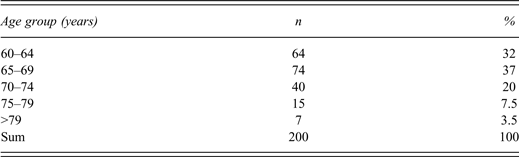
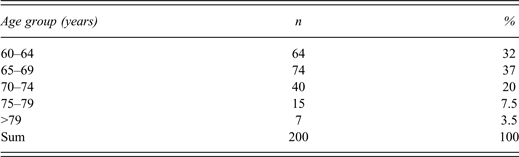
Altogether 500 women aged 60 years old and over applied for support from the Clasefond in 1926, meaning that approximately 12 per cent of all never-married women in this age group living in Gothenburg tried to receive a grant from this donation.Footnote 36 This study focuses on 200 of these women, namely the first 200 who applied for support when the foundation was established in 1926 (see Table 1). All of the women lived in the central areas of the city and had applied for relief on the grounds of illness or infirmity. Each applicant stated that she had difficulties making ends meet. In order to find out whether these women represent a broader cross-section of never-married women, their social belonging and residence patterns were compared with those of all the never-married women residing in one of the central parishes in Gothenburg (Domkyrkoförsamlingen).
Age of recipients of relief from the Clasefond in 1926
Source: FXIV, Utredningar rörande Claseska fonden, volume 1–2, 1926. Sociala Centralbyrån, Gothenburg.
A quantitative analysis was performed of the applicants’ age, previous occupations, sources of income and household structure. Furthermore, this article contains elements of life-course analysis focusing on some individual case examples drawn from the applications. Brief descriptions of some of the women's earlier income strategies and reasons for leaving the labour market will be presented in order to reach a deeper understanding of the living conditions of these women. Studies of individual life-courses enable a discussion about causes and consequences from a dynamic perspective.Footnote 37
4.2. Transitions into old age
Monique Stavenuiter examined ‘self-images’ of Dutch women applying for entrance to the almshouse during the late nineteenth and early twentieth centuries. These aspects are interesting because they tell us not only how elderly women presented themselves in critical situations but also when they considered themselves to be old. Most of them referred to decline of income and loss of status as important reasons for entering the institution. She noted that only one-fifth of the women mentioned their advanced age as an important reason for being admitted to the almshouse. Interestingly, she found that some of these women were only in their fifties when they saw themselves as too old for the labour market. Younger workers were preferred.Footnote 38
In the present study, only a few women considered themselves old at the age of 60 years (the age limit for application was 60 years old) but most of the women aged 75 years or older labelled themselves as old. The majority were younger than 70 years old when they applied for support from the Clasefond (see Table 1). The most common reason was illness, followed by the loss of strength and old age. Quite a few had retired many years before the time of application, some of them when they were only in their fifties. This indicates a great need of support among these elderly women as well as an everyday-life insecurity. Now they had found a new option for making ends meet.
5. LIVELIHOOD OPPORTUNITIES LATE IN LIFE
5.1. Employment
Domestic service was generally still the dominant female occupation in the nineteenth and early twentieth centuries. Furthermore, women were employed in different industrial branches. Several of them worked in the textile industry and others were employed in the tobacco, perfume, soap and candle industries. Furthermore, quite a few worked at home at various tasks.Footnote 39 Another important economic sector in the wake of industrialisation and increasing bureaucratisation was that of service. This expansion led to a greater demand for labour. Many never-married women were involved in some of the occupations that became available to the female part of the population. For instance, women found employment in post offices, telegraph stations, schools and hospitals.Footnote 40 In 1920, 30 per cent of the industrial labour force in Gothenburg consisted of women. Most of them were young and worked in the textile, food and graphics sectors. The majority of the seamstresses worked in factories but quite a few worked at home.Footnote 41
Almost all of the never-married elderly women in the present study had been working outside their home, except 10 who had co-resided with their parents and taken care of them for a long time. Most women had been able to support themselves for the major part of their lives but when rheumatism, cataracts and other ailments began to set in, they found it impossible to get employment. Half of them still had some income from work at the time of application, but generally wages were modest. The average income per month was 44 Swedish crowns but 60 per cent earned less than this sum. A great part of their income was spent on housing, since the average rent was 20 crowns. The size of their income can be compared with the wages of a male industrial worker, who at this time earned 220 crowns per month.
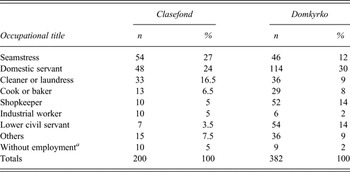
Table 2 provides the titles of the occupations that these women held, either at the time of application or earlier in life. There are some differences when the applicants' social belonging is compared with that of elderly never-married women residing in the Domkyrko parish. For instance, the percentage of seamstresses, cleaners and laundresses is higher among the applicants, indicating a higher degree of social vulnerability.
Occupational titles among women applying for support from the Clasefond in 1926, and among women over 60 years old residing in Domkyrko parish in Gothenburg in 1930

a These women had been living with their parents.
Sources: FXIV, Utredningar rörande Claseska fonden, volume 1–2, 1926. Sociala Centralbyrån, Gothenburg; Census of Gothenburg, 1930. The latter source gives information on the women living the Domkyrko parish.
More than one-quarter of the women were or had been seamstresses. Sometimes they had specialised in some kind of sewing such as making cravats or caps. Many of these tasks could be performed at home, meaning that they could continue this work when they grew older if they did not lose visual acuity, were disabled or ill. Another large group was domestic servants. One of them was Anna Karlsson, who at the age of 63 years old made an application for support. She wrote:
Because of losing strength and neither having relatives nor being able to support myself, nor any longer the strength to perform heavier tasks, I venture humbly to apply for the benevolence of the board referring to my long and faithful duty.Footnote 42
Anna had been a servant for 42 years and was at the time working for a family that she had known for a long time. She worked in their household a couple of times a month to earn some kind of income. This was a pattern for several of the older women who received a small wage and sometimes food and housing in return for doing some cleaning, washing, cooking and baking in one or several households. These tasks were also important sources of income for other groups of women apart from the ‘faithful old servants’.
Only 5 per cent worked or had been working in the industrial sector. Two had been employed in the tobacco industry and three in the textile industry. Unfortunately, there was no information about the kind of industries where the other women had worked. Some of these women had been employed for approximately 40 years. All of them were at the time of application ill or decrepit and most of them had left work between the ages of 50 and 60 years.
Approximately one-fifth of those belonging to the cohort can be classified as middle-class. Some of them had been lower civil servants and had titles such as teacher and clerk. Another group was shopkeepers. Ingrid Helena Abrahamsson had been a shopkeeper for 30 years but for several years her business had been unprofitable. She had lived on savings and some support from a relative. However, now she was old and weak and had spent all her savings. She lived on her own and only had a small pension, which was half the amount of her rent.
Sometimes rental costs could be used as an important income source. In the 1920s there was a housing shortage in Gothenburg and other larger cities because of rapid industrial expansion, limited housing development during the First World War, and a decreasing number of emigrants to North America. Furthermore, the number of active people on the labour market increased markedly. This lack of housing made lodging very common and overcrowding was widespread.Footnote 43 Statistics show that approximately one-quarter of the flats in Gothenburg were overcrowded.Footnote 44
This housing shortage proved to be an asset for old, never-married women. It is a well-known fact that boarding and lodging have been important sources of income in industrial areas but it has been difficult to obtain information on the size of the income since this was not taxed. One-quarter of the women studied had this income strategy. This kind of income was mostly used as a complement to other sources of income such as work, savings or pensions. The majority of the women had a small flat; this would comprise either one room and a kitchen, or just one room with a stove. This standard of living was shared with other citizens. Of the inhabitants of Gothenburg, 51 per cent lived in a flat consisting of one room and a kitchen and 10 per cent only had access to one small room.Footnote 45 Two-thirds of those who obtained their income from boarding and lodging had one room and a kitchen only. Such a small flat housed both the landlady and one or more boarders and/or lodgers. The income from this source was on an average 20 crowns per month. One of the landladies was Sofia Lundgren, aged 68 years old. She had been a cook but had left her job 10 years earlier because of illness. Her culinary skills were still useful in feeding her three or four boarders.
5.2. Long-term savings
As mentioned earlier, there was a general perception that charity organisations and poor-relief authorities should only give minimal support for a short period to men and women who were struck by poverty, illness and unemployment. The reason was to force the recipient to support herself/himself again as soon as possible, thus preventing a long-term dependence, which was considered to be harmful to both the individual and society at large.Footnote 46 However, this vision seems to have been difficult to implement. Contemporary investigations showed that it was very hard for working-class men and women to save for old age.Footnote 47 The question is whether this situation was different for the women in Gothenburg in the middle of the 1920s.
Several of the women who applied for support from the Clasefond had probably been able to live on their savings earlier in life. Many of these childless women had no protective network and therefore had to turn to public institutions asking for help when their savings were spent and they were no longer able to put aside a sum of money. At the time of application, one-third of the women in the cohort had some bank savings. Most of them only had a small amount and were worried about how to make ends meet. However, there were large differences in the amounts saved. There was, for example, a woman who had assets amounting to the remarkable sum of 10,000 crowns. The average savings were around 1,000 crowns. Some of the women mentioned that they had planned to use their last savings to pay for their own funeral. The thought that poor relief would finance their funeral was for many women both frightening and humiliating. Although the savings were quite small we can assume that it was somewhat easier for these childless women to save for their old age compared with women with children, as Lilja and Bäcklund pointed out.Footnote 48
5.3. Old age pensions
Another important source of income was old age pensions. The national pension system stated that all individuals between the ages of 16 and 66 years old were obliged to pay an annual income-related fee which laid the foundation for their future pension. People aged 67 years old and older were entitled to this pension. Younger men and women also had the right to a certain pension for the disabled in the case of work incapacity. Furthermore, means-tested municipal pensions were available from 1919 onwards.Footnote 49 More than half of the women in the present study were entitled to national old age pensions and almost one-fifth of this group also received municipal pensions. The sums were mostly small, on average 23 crowns per month. One-fifth received less than 10 crowns. Those who had a combination of old age and municipal pensions obtained sums between 40 and 90 crowns per month.
Moreover, a handful of the women received pensions from their former employers. One was Amanda Svensson, aged 69 years old, who had worked for 28 years as a textile worker but was forced to leave her job because of illness. She received a small pension from her former employer in combination with an even smaller sum from the national pension insurance. These contributions hardly covered the cost of the rent of her small flat. Hilma Larsson, aged 69 years old, also received support from her former employer. She had been working for 44 years in the tobacco industry but at the age of 60 years she left work because of old age.
5.4. Poor relief
The authorities needed to put more pressure on the recipients of poor relief and were expected to divide them into worthy and unworthy poor. Worthy individuals were sober, decent, reliable and hardworking, whereas the unworthy were attributed negative qualities such as drunkenness, lechery, unreliability and sloth.Footnote 50
In Gothenburg several attempts were made to coordinate municipal poor relief with charity. A philanthropic association was founded in the 1860s. Its female members visited poor people and supported them with a small sum of money, food and clothing. However, the association was dissolved after being criticised by the poor-relief authorities for being too generous, meaning that dependence instead of self-help was encouraged.Footnote 51 At the turn of the century the so-called Elberfeld system was introduced with the consequence that voluntary guardians were engaged to visit the relief receivers to be able to assess the need for poor relief, and to verify that aid was correctly used. The director of the poor-relief authorities had overall responsibility for the organisation. Once again the authorities considered the system to be not sufficiently restrictive.Footnote 52 Poor relief was again reorganised when the Poor Law of 1918 was implemented. Salaried civil servants replaced the older voluntary guardians in 1920.Footnote 53Sociala Centralbyrån was founded in 1926. The establishment of this organisation can be seen as a further component in the professionalisation of the welfare system in Gothenburg. This association coordinated public poor relief with various funds and kept records of beneficiaries.Footnote 54
Only 15 never-married elderly women out of the sample were dependent on poor relief, which is quite surprising since several women lived on small means. Those receiving poor relief had small pensions and either lacked employment or had a minimal wage. One important explanation for the low proportion of relief-takers could be that many of these women received a municipal pension instead of poor relief. The results are in line with national statistics from the Arbetarförsäkringskommitten (National Workers' Insurance Committee), showing a lower dependence on poor relief among urban elderly never-married women compared with the corresponding category of men.Footnote 55
5.5. Support from social institutions
Gothenburg has been called the centre of charity because various donors funded public spending and social institutions. Several of these institutions created in the 1800s and early 1900s were directed to middle-class women referred to as pauvres honteux, meaning that they had become poor late in life. The Swedish historian Birgitta Jordansson argues that traditional charity supported paupers belonging to the same social class as the members of the charity organisations. The choice to support pauvres honteux is one example. These associations also helped old, faithful domestic servants, which Jordansson takes as evidence that this group of relief-takers can also be seen as belonging to the bourgeois family. She points to a change taking place connected to the spread of social liberal ideas, meaning that support was mainly extended to poor working-class women and their children.Footnote 56 The founding of the Clasefond can be seen as an example of the latter kind of funding, which was aimed at broader social categories of women.
The merchant Gustaf Mankell published a petition in one of the local newspapers pointing to the situation of women as pauvres honteux and asking the public to support these women whose small pensions did not cover their expenses. Föreningen för pauvres honteux (the Association for Pauvres Honteux) was founded in Gothenburg in December 1920. The society was financed by whip-rounds, cabarets, concerts, dance events and Christmas markets. Some funds for this purpose contributed to rental costs and others founded homes for the group of pauvres honteux.Footnote 57
Middle-class women requesting support from the Clasefond were few. Some of them had been shopkeepers but due to illness or old age had to give up their businesses. Others mentioned lack of customers as their reason for needing support. Most of them belonged to the category of civil servants even though there were other occupations represented, such as teacher, clerk or directress. These women all lived in homes that were financed by donations and they did not pay any rent. Furthermore, some of them also received monthly support from certain funds. There were also special funds for old faithful domestic servants. For instance, more than one-third of the domestic servants in the study received support from a special fund aimed at these women and there was even a home for domestic servants, founded in 1911.
Altogether, there were about 15 different funds, which supported quite a few women. Most of the donations benefitted special groups of people, for instance pauvres honteux, artisans, domestic servants, or the very poor or blind. Approximately one-third of the women studied received a small sum from one of the various funds. On average they received a sum of approximately 10 crowns per month.Footnote 58
5.6. Co-residence
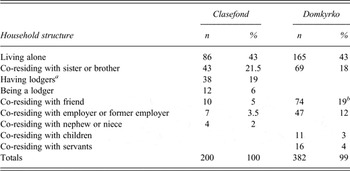
In addition to trying to find different sources of income, another strategy was to reduce expenses. One way was to share the costs of housing (see Table 3). It was worth a great deal to the women to share the rent and the cost of food and heating. Moreover, in many cases it may have been much nicer to share everyday life with another person. More than one-fifth of the applicants lived with sisters or brothers, usually with one sister. Either they shared the costs of rent or one of the sisters paid the whole rent and cared for the other. The 69-year-old former seamstress Hulda Lindgren belonged to the latter group. After having taken care of her old mother for eight years she now cared for her sick sister with whom she co-resided. Since Hulda felt that she no longer had the strength to support her sister and lacked savings, she was forced to apply for economic support. She and her sister had been able to support themselves as seamstresses for 30 years but because neither of them was any longer able to work, they lacked the means to make a living. In contrast to Alter's and Artæus's studies, where the wealthier women formed the majority of those who co-resided with sisters, the majority of the women in the present study were seamstresses and domestic servants.Footnote 59 However, the comparison can be misleading, since a minority of the women who applied for support were middle class. Still, it can be concluded that this type of co-residence was not unusual among working-class women.
Household structure of the applicants to the Clasefond in Gothenburg in 1926, and of women over 60 years old residing in the Domkyrko parish in Gothenburg in 1930

a Some women both co-resided with sisters and had lodgers but the women belonging to this group only co-resided with lodgers.
b This category contains both co-residence with friends, nephews and nieces as well as having or being lodgers, because of difficulties in separating these different residence patterns in the census.
Sources: FXIV, Utredningar rörande Claseska fonden, volume 1–2, 1926. Sociala Centralbyrån, Gothenburg; Census of Gothenburg, 1930. The latter source gives information on the women living the Domkyrko parish.
Some of the old women shared households with a relative who was not a sibling and it was also quite common to co-reside with an unrelated person either as the lodger, the landlady, or with friends. However, almost half of the applicants lived alone, and this was also the case of the elderly women in the Domkyrko parish. Support from relatives or friends seems to have been almost non-existent. A couple of the applicants wrote that they received some assistance from relatives in America and a handful from former employers. We need to be critical and examine the sources and ask whether these women were trying to withhold some of their income. This kind of income source could easily be hidden from the otherwise meticulous control of the Sociala Centralbyrån. Nonetheless, it is reasonable to suppose that support from relatives and friends was probably very limited and far from covering expenses. More than two-thirds of the women in the sample were born outside of Gothenburg, which may lead us to assume that many of them did not have relatives in the vicinity and their opportunities for co-residence may also have been restricted. The high proportion of women living alone was almost twice that of the never-married women living in Verviers.Footnote 60 The household structure of the present study is more in line with previous studies of living conditions among Swedish elderly women in urban areas.Footnote 61
5.7. Income packages
This study shows the importance of income packages. A vast majority combined various sources to be able to make ends meet. Approximately one-fifth had only one type of income, of which the most common were wages or pensions. However, these women's applications to the Clasefond reveal the need of further contributions. The combination of two or three sources of income was most common, although sometimes the elderly women had to find income from many different sources. Mathilda Johansson had worked as a seamstress for 41 years and now found it difficult to obtain any employment. She combined her low income from work with a small pension. In addition, she received a contribution for the rent from a family that co-resided with her periodically. She was also one of those who had a small amount of savings on which to live.
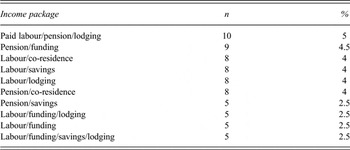
Table 4 shows the most common forms of income package. Although there were many more combinations, Table 4 demonstrates the necessity for these elderly women to find different ways of supporting themselves. The poorest women were sometimes fortunate enough to receive support from relatives or friends but five women declared that they had no income or support at all. The 74-year-old Augusta Charlotta Carlsdotter was a former industrial worker, who had no income, pension or savings registered. She lived on her own in a small room and had no relatives to support her. Most probably she received support from the fund for the very poor, at least if she belonged to the group of worthy poor. However, the fact that she did not have a guaranteed security in the form of a sufficiently high old age pension meant that she was dependent on other people's good will in order to ensure a livelihood.
Most common forms of income package among the applicants to the Clasefond in Gothenburg in 1926

Source: FXIV, Utredningar rörande Claseska fonden, volume 1–2, 1926. Sociala Centralbyrån, Gothenburg.
6. CONCLUSIONS
The present study has shown the great need of support among many never-married elderly women when the welfare state was still in its infancy. They had to engage in a variety of work to make ends meet and the combination of income sources was crucial when pensions were minimal. These women, mostly employed in textile production and domestic services, tried to keep on working although failing health and growing weakness reduced their work performance and employment. It was fairly common for the large group of seamstresses to continue doing petty work at home. The textile industry was one of the dominant industries in Gothenburg and, as in many other textile towns, an important source of income for women in general. Furthermore, old domestic servants had the opportunity to step in at times when their former employers needed their help. Most of the women had been employed for a long period of their lives in sectors that were important for both young and old women. Luckily for these women, overcrowding was a great problem in Gothenburg as it was in many other industrial urban areas. Thus, it was easy to find boarders and lodgers and letting rooms became an important income strategy. Having boarders and lodgers can in some cases be seen as examples of the penny capitalism that Benson discussed.
Many women were in their sixties when they were forced to apply for support and quite a few had left work already in their fifties, either because of illness or because they were not attractive on the labour market. Since the pension system had been introduced approximately a decade before the focus year of the study, many women received a pension, either from the national or the municipal pension system. Those under the age of 67 years old were, however, not entitled to national old age pensions. Furthermore, pensions were too small to make these women self-supporting. Surprisingly, very few women received poor relief. It is likely that different kinds of income sources covered a minimum subsistence. Moreover, as poor relief authorities were also in charge of the municipal pensions, this kind of support often replaced poor relief, meaning that the elderly did not have to feel humiliated as they would if they were solely dependent on poor relief.
Furthermore, contributions from one of the many donor-sponsored institutions aimed at Gothenburg's impoverished citizens proved to be an important part of the income package. Several funds were aimed at certain elderly women such as the pauvres honteux or domestic servants. These funds can be seen as one type of solution to the social pressure coming from the growing number of elderly in need of support. As Jordansson noted, these groups were seen as part of the bourgeois family and therefore entitled to support. However, there were women outside these social groups who received assistance from other funds, probably founded because of the demographic and economic pressures of the time.
One important long-term strategy for income packages was savings. This strategy was also one of the most significant components in the ideology of self-help that permeated welfare work of the time. A majority lacked savings but several of these never-married women had probably had a history of savings consumed when they had to give up working because of fatigue and lack of work. This picture confirms the report from the Arbetarförsäkringskomitén, which stated that few working-class men and women were able to put aside a sum late in life. However, the present study also shows that it was not impossible for domestic servants, seamstresses and cleaners to save some money for old age, probably because of Gothenburg's differentiated labour market.
Kinship, and sometimes non-kinship, was significant to one kind of long-term support, co-residence. This strategy of reducing costs was probably successful. We have seen the importance of sisters and brothers, although support from other relatives was negligible. These results are to a great extent consistent with those of Artæus and Alter, who also found that it was common for never-married women to co-reside mostly with sisters. However, there is one important difference. A majority of the women in the present study lived alone, which is more in line with earlier studies of household structure among the Swedish urban elderly. Compared with some Dutch and American urban areas, it was much more common for Swedish women to live on their own. Furthermore, only a few of them had relatives who were able to contribute with a temporary money supply. They might have had neighbours and friends who were able to assist them in some way when they were in distress or in need of support but the available sources do not provide us with such information.
Some scholars have suggested that there was a higher degree of individualism in Scandinavia compared with many other countries. There seems to have been a wish to liberate the individual citizen from dependency within the family and in civil society, with a preference for loosely knit social networks in which individuals were expected to take care of themselves and their closest family members. This does not automatically imply that children did not care for their elderly parents but it seems likely that children and parents may have preferred to maintain relationships of ‘intimacy at a distance’.Footnote 62
Another issue for further investigation is whether the living conditions of never-married elderly women in large urban areas differed from the situation of those living in the countryside. City life seems to have had many advantages to never-married elderly women although in many ways they lived insecure lives. National statistics show that urban never-married women were least dependent on poor relief compared with the corresponding proportion of urban men as well as men and women living in rural areas. The possibilities for self-support might have been greater since the city's industrial character meant a more differentiated labour market. Furthermore, the existence of a significant middle class meant a relatively high demand for household work, which was an important contributor to income packages. Life in urban environments also meant access to many donor-supported institutions supporting the embryonic welfare sector. An additional interesting comparison is with the situation of never-married elderly men. Men were expected to be the breadwinners and funds targeting men were few. Moreover, a common belief was that women had wider social networks than men. These differences call for a study of the survival strategies of the corresponding category of men. National statistics show that urban never-married men were those most dependent on poor relief.
The study as a whole has shown the social vulnerability of these women in a society where poverty, to a great extent, was considered to be self-inflicted and when the welfare state was still in its infancy. Although the city's varied labour market helped them keep their heads above water, new funds emerged that were specifically aimed at unmarried women, such as the Clasefond. This initiative was a response to demographic and social change, with implications for elderly care.
ACKNOWLEDGEMENTS
I would like to thank Clary Krekula, Karlstad Studies on Age, Ageing, and Demography (KSAAD) for her insightful comments. Furthermore, I am grateful to the editors and the anonymous referees at Continuity and Change for their helpful critiques on the first drafts of my article.