








1 Introduction
Throughout, rings will contain an identity but may not be commutative. For any element x of a ring, we assume
 $x^0 = 1$
.
Conditions on elements of a ring so that it is a matrix ring have a long history. For instance, Robson [Reference Robson11, Theorem 2.2] proved that a ring R is an
 $n \times n$
matrix ring if and only if there exist elements
 $x, \, a_1, \, a_2, \ldots , a_n \in R$
satisfying the conditions
 $x^n = 0$
and
 $a_1x^{n-1} + xa_2x^{n-2} + \cdots + x^{n-1}a_n = 1$
. Later, Lam and Leroy [Reference Lam and Leroy10, Theorem 4.1] gave a number of conditions similar to Robson’s condition. Fuchs [Reference Fuchs4, Theorem 1] proved that for
 $n \geq 2$
, R is an
 $n \times n$
matrix ring if and only if there exist elements
 $x,\,y \in R$
such that
 $x^n = 0$
,
 $y^2 = 0$
,
 $x + y$
is a unit and
 $Ry \cap l_{R}(x^{n-1}) = 0$
. In [Reference Agnarsson, Amitsur and Robson1, Theorem 1.7] Agnarsson et al. proved that R is an
 $(m+n) \times (m+n)$
matrix ring, for some positive integers m and n, if and only if there exist
 $a, \,b,\, x\in R$
such that
 $x^{m+n} = 0$
and
 $ax^m + x^nb = 1$
. They called this a three-element relation and showed in [Reference Agnarsson, Amitsur and Robson1, Theorem 2.1] that it does not work if we take
 $a = b$
. There is a nice exposition of such results in [Reference Lam9, Ch. 7].
In the main result of this paper, we prove that R is an
 $n \times n$
matrix ring if and only if there exists a (von Neumann) regular element x such that
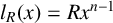
 $l_R(x) = Rx^{n-1}$
, where
 $l_R(x) = \{a \in R: ax = 0\}$
. Our condition is easier to verify as, unlike most of the conditions in the literature, it involves only one element x. This is also evidenced by the various applications of our main result in Section 3. In addition to proving some new results, we also provide easier proofs of some of the known results. For instance, we prove that the condition
 $y^2 = 0$
in Fuchs’ theorem cited above is extraneous and the condition
 $x+y$
is a unit can be replaced with the weaker condition
 $Rx+Ry = R$
. We also prove that if I is an ideal of ring R, then
 $( \begin {smallmatrix} R & I \\ R & R \end {smallmatrix} )$
is a
 $2 \times 2$
matrix ring if and only if
 $R/I $
is. This explains why for
 $H = \mathbb {Z}\langle i,j,k \rangle $
, the integer quaternion ring, and n an odd integer, the ring
 $( \begin {smallmatrix} H & nH\\H & H \end {smallmatrix} )$
is a
 $2 \times 2$
matrix ring as proved by Robson [Reference Robson11, Theorem 1.5] and Chatters [Reference Chatters3, Theorem 2.4]. We also give easier proofs of the results of Agnarsson et al. [Reference Agnarsson, Amitsur and Robson1] and Robson [Reference Robson11] (see Theorems 3.4 and 3.6).
2 Main result
In this section, we prove the main result of the paper (Theorem 2.4). We first list some well-known facts. Recall that an element
 $x \in R$
is called regular if
 $x \in xRx$
.
Lemma 2.1. For a regular element
 $x\in R$
, the following conditions are equivalent:
-
(i)
 $x\in R$
is unit-regular;
-
(ii) as left R-modules,
$R/Rx \cong l_R(x)$
; -
(iii) if
$Rx + Ry = R$
for some
$y \in R$
, then there exists an
$r \in R$
such that
$x +ry$
is a unit (that is, the stable range of x is one).


Proof. Proof of the equivalence of conditions (i) and (iii) can be found in [Reference Khurana and Lam7, Theorem 3.5] and that of (i) and (ii) in [Reference Goodearl6, Theorem 4.1] (although the result is proved globally, the same proof works elementwise).
Lemma 2.2 (See [Reference Lam8, Proposition 21.20]).
For two idempotents e and f of a ring R the following conditions are equivalent:
-
(1)
$eR \cong fR$
as right R-modules; -
(2)
$Re \cong Rf$
as left R-modules; -
(3) there exist elements
$a,\,b\in R$
such that
$ab = e$
and
$ba = f$
.


In this case, we will call the idempotents e and f isomorphic.
Lemma 2.3. Let
 $x \in R$
,
 $m,\,n$
be positive integers and
 $i,\,j$
be nonnegative integers such that
 $i + j = n+ m $
. Then the following hold:
-
(1)
$ l_R(x^m) = Rx^n $
implies that
$ l_R(x^i)= Rx^{j} $
; -
(2)
$1 \in Rx^m + x^nR$
implies that
$1 \in Rx^i+ x^jR$
.


Proof. (1) Suppose
 $ l_R(x^m) = Rx^n $
. It is enough to show that
 $l_R(x^{m-1}) \subseteq Rx^{n+1}$
if
 $m> 1$
and
 $l_R(x^{m+1})\subseteq Rx^{n-1}$
if
 $n> 1$
.
Suppose
 $m> 1$
and
 $k \in l_R(x^{m-1}) \subseteq l_R(x^{m}) = Rx^n$
. Then
 $k = rx^n$
for some
 $r \in R$
. Now
 $ 0 = kx^{m-1} = rx^nx^{m-1} = rx^{n-1}x^m$
, so
 $rx^{n-1} \in l_R(x^m) = Rx^n$
. If
 $rx^{n-1} = sx^n$
for some
 $s \in R$
, then
 $k = rx^n = sx^{n+1}$
.
Now suppose
 $n>1$
and
 $t \in l_R(x^{m+1})$
. Then
 $tx \in l_R(x^m) = Rx^n$
implies that
 $tx = bx^n$
for some
 $b \in R$
. Then
 $t - bx^{n-1} \in l_R(x) \subseteq l_R(x^m) = Rx^n$
. Thus,
 $t \in Rx^{n-1}$
.
(2) Suppose
 $1 \in Rx^m + x^nR$
. It is enough to show that
 $1 \in Rx^{m+1}+ x^{n-1}R$
assuming
 $n> 1$
. If
 $1 = rx^m + x^ns$
, for some
 $r,\,s \in R$
, then
 $$ \begin{align*} 1 & = rx^{m-1}(rx^m + x^ns)x +x^ns = rx^{m-1}rx^{m+1} + rx^mx^{n-1}sx + x^ns \\ & = rx^{m-1}rx^{m+1} + (1-x^ns)x^{n-1}sx + x^ns \in Rx^{m+1}+ x^{n-1}R.\\[-34pt] \end{align*} $$
Theorem 2.4. A ring
 $R $
is an
 $n \times n$
matrix ring if and only if there exists a regular element x in R such that
 $l_R(x) = R{x^{n-1}}.$
Moreover, if a regular element x with
 $l_R(x) = R{x^{n-1}}$
exists, then
 $R \cong \mathbb {M}_n(\operatorname {\mathrm {End}}_R(Rx^{n-1}))$
.
Proof. Suppose
 $R \cong \mathbb {M}_n(S)$
for some ring S. Let
 $x = E_{21} + E_{32}+\cdots +E_{n,n-1}$
. It is easy to see that x is regular and
 $l_R(x) = R{x^{n-1}}$
.
Conversely, suppose that
 $x\in R$
is regular and
 $l_R(x) = R{x^{n-1}}$
. By Lemma 2.3(1),
 $l_R(x^{n-1}) = Rx$
. Thus,
 $$ \begin{align*}R/Rx = R/ l_R(x^{n-1}) \cong Rx^{n-1} = l_R(x).\end{align*} $$
It follows that x is unit-regular by Lemma 2.1. As x is regular, there exists
 $a\in R$
such that
 $x = xax$
. As
 $Rx \oplus R(1-ax) = R$
, by Lemma 2.1, there exists
 $y \in R(1-ax)$
and a unit u such that
 $x+ y = u^{-1}$
. Since
 $y \in R(1-ax)$
and
 $Rx \cap R(1-ax) = 0$
, it follows that
 $Rx \cap Ry = 0$
. Also,
 $l_R(x^{n-1}) = Rx$
, so
 $Ry \cap l_R(x^{n-1}) = 0.$
Now
 $ux + uy = 1$
implies that
 $yuy-y = -yux \in Ry \cap Rx = 0$
. So
 $$ \begin{align*}0 = yux^{n-1} = yu(ux+uy)x^{n-1} = yu^2yx^{n-1} \Rightarrow yu^2y \in Ry \cap l_R(x^{n-1}) = 0.\end{align*} $$
This also implies that
 $0 = yu^2y = yuuy = yu(1-ux)$
. Since
 $yux = 0$
,
 $$ \begin{align*}0 = yu(1-ux)x = yu^2x^2.\end{align*} $$
If
 $n-1 \geq 2$
, then
 $$ \begin{align*}0 = yu^2x^{n-1} = yu^2(ux+uy)x^{n-1} = yu^3yx^{n-1} \Rightarrow yu^3y \in Ry \cap l_R(x^{n-1}) = 0.\end{align*} $$
This also implies that
 $0 = yu^3y = yu^2uy = yu^2(1-ux)$
. As
 $yu^2x^2 =0$
,
 $$ \begin{align*}0 = yu^2(1-ux)x^2 = yu^3x^3.\end{align*} $$
Proceeding similarly, for every
 $i \geq 1$
and
 $j \geq 2$
,
 $$ \begin{align*}yu^ix^i = 0 \quad\mbox{and}\quad yu^{\hspace{1.5pt}j}y = 0.\end{align*} $$
Now
 $1= yu + xu = yu + x(yu + xu)u = yu + xyu^2 + x^2u^2 = yu + xyu^2 + x^2(yu+xu)u^2 = yu + xyu^2 + x^2yu^3 + x^3u^3$
. As
 $x^n = 0$
, proceeding similarly, we will finally have
 $$ \begin{align*}yu + xyu^2 + x^2yu^3 + \cdots + x^{n-1}yu^n = 1.\end{align*} $$
As
 $yu^ix^i = 0 \mbox { and } yu^{\hspace{1.5pt}j}y = 0$
, for every
 $i \geq 1$
and
 $j \geq 2$
, it is clear that
 $$ \begin{align*}\{yu, xyu^2, x^2yu^3,\ldots, x^{n-1}yu^n\} \end{align*} $$
is a complete set of pairwise orthogonal idempotents. Finally, we show that all these idempotents are isomorphic and
 $Ryu \cong Rx^{n-1}$
. As
 $yu^2y = 0$
, by Lemma 2.2,
 $$ \begin{align*}xyu^2 \cong yu^2x = yuux = yu(ux +uy) = yu.\end{align*} $$
As
 $yu^3y = 0$
, by Lemma 2.2,
 $$ \begin{align*}x^2yu^3 \cong xyu^3x = xyu^2(uy + ux) = xyu^2.\end{align*} $$
Similarly, we see that all of these idempotents are isomorphic. Thus,
 $R \cong \mathbb {M}_n(S)$
for some ring
 $S \cong \operatorname {\mathrm {End}}_R(Ryu)$
. We finally show that
 $Ryu \cong Rx^{n-1}$
. Note that
 $x^{n-1}yu^nR = x^{n-2}xyR = x^{n-2} xR = x^{n-1}R$
implies that
 $Rx^{n-1}yu^n \cong Rx^{n-1}$
. And so
 $Ryu \cong Rx^{n-1}yu^n \cong Rx^{n-1}$
.
Remark 2.5. It is not difficult to write down matrix units of R in the previous result provided we know the elements y and u. If we put
 $e_i = x^{i-1}yu^i$
, then, as seen above,
 $\{e_1, e_2,\ldots , e_n\}$
is a complete orthogonal set of pairwise isomorphic idempotents. If we take
 $E_{1i} = yu^i$
and
 $E_{i1} = x^{i-1}yu$
, then
 $E_{1i}E_{i1} = e_1$
and
 $E_{i1}E_{1i} = e_i$
. Now putting
 $E_{ii} = e_i$
and
 $E_{ij} = E_{i1}E_{1j}$
, we have all the matrix units for R in the previous result.
Corollary 2.6. A regular ring R is an
 $n \times n$
matrix ring if and only if
 $l_R(x) = Rx^{n-1}$
for some element
 $x\in R$
.
3 Applications
In this section, we give several applications of Theorem 2.4. The first part of the following result strengthens Fuchs’ theorem [Reference Fuchs4, Theorem 1], where the result was proved assuming extra conditions
 $y^2 = 0$
and
 $x+y \in {\textrm {U}}(R)$
.
Theorem 3.1. Let R be a ring with elements x and y such that
 $x^n = 0$
.
-
(1) If
$Rx+Ry = R$
and
$Ry \cap l_{R}(x^{n-1}) = 0$
, then R is an
$n \times n$
matrix ring. -
(2) If
$Rx^{n-1}+Ry = R$
and
$Ry \cap l_R(x) = 0$
, then R is an
$n \times n$
matrix ring.


Proof. (1) Since
 $Rx \subseteq l_{R}(x^{n-1})$
,
 $Ry + Rx = R$
and
 $Ry \cap l_{R}(x^{n-1}) = 0$
,
 $$ \begin{align*} Ry \cap Rx \subseteq Ry \cap l_{R}(x^{n-1}) = 0 \quad\mbox{and}\quad R = Ry + Rx \subseteq Ry + l_R(x^{n-1}). \end{align*} $$
Thus,
 $$ \begin{align*}R = Ry \oplus Rx = Ry \oplus l_{R}(x^{n-1}).\end{align*} $$
This implies
 $Rx = l_{R}(x^{n-1})$
and x is regular. So
 $l_R(x) = R{x^{n-1}}$
by Lemma 2.3(1) and the result follows from Theorem 2.4.
(2) As
 $Rx^{n-1} \subseteq l_R(x)$
, so
 $Ry \cap Rx^{n-1} \subseteq Ry \cap l_R(x) = 0$
. Thus,
 $$ \begin{align*}R = Ry \oplus Rx^{n-1}.\end{align*} $$
Also, as
 $R = Ry \oplus Rx^{n-1} \subseteq Ry + l_R(x)$
and
 $Ry \cap l_R(x) = 0$
, so
 $$ \begin{align*}R = Ry \oplus l_R(x).\end{align*} $$
Now since
 $R = Ry \oplus Rx^{n-1} = Ry \oplus l_R(x)$
and
 $Rx^{n-1} \subseteq l_R(x)$
, it follows that
 $Rx^{n-1} =l_R(x)$
and
 $x^{n-1}$
is regular. So
 $l_R(x^{n-1})$
is a summand of
 $_RR$
. As
 $Rx^{n-1} =l_R(x)$
, by Lemma 2.3(1),
 $l_R(x^{n-1}) = Rx$
is a summand of
 $_RR$
. So x is a regular element and the result follows from Theorem 2.4.
As another application, we provide a quick proof of the following result of Fuchs et al. [Reference Fuchs, Maxson and Pilz5, Theorem III.2].
Theorem 3.2. If
 $x,\,y \in R$
are such that
 $x^2 = 0$
,
 $y^2 = 0$
and
 $x + y$
is a unit, then R is a
 $2 \times 2$
matrix ring.
Proof. Note that
 $Rx \oplus Ry = R$
implying that x is regular. Also,
 $Rx \subseteq l_R(x)$
implies that
 $l_R(x) + Ry = R$
. If
 $ry \in Ry \cap l_R(x)$
and
 $x+y = u$
, then
 $ryu = ry(x+y) = 0$
. Thus,
 $Ry \cap l_R(x)=0$
. So
 $l_R(x) \oplus Ry = R$
implying that
 $Rx = l_R(x)$
. Thus the result follows from Theorem 2.4.
Let
 $H = \mathbb {Z}\langle i, j, k \rangle $
be the integer quaternion ring and let n be an integer. Robson [Reference Robson11, Theorem 1.5] and Chatters [Reference Chatters3, Theorem 2.4] proved that
 $ ( \begin {smallmatrix} H & nH\\H & H \end {smallmatrix} )$
is a
 $2 \times 2$
matrix ring if and only if n is odd (see also [Reference Chatters2, Question 2.9]). As another application of our main result, we prove the following general result.
Theorem 3.3. Let I be an ideal of a ring R. Then
 $( \begin {smallmatrix} R & I \\ R & R \end {smallmatrix} )$
is a
 $2 \times 2$
matrix ring if and only if
 $R/I$
is so.
Proof. Let
 $S:= ( \begin {smallmatrix} R & I \\ R & R \end {smallmatrix} )$
. As
 $ J= ( \begin {smallmatrix} R & I\\R& I \end {smallmatrix} )$
is an ideal of S and
 $S/J \cong R/I$
, it is clear that if S is a
 $2 \times 2$
matrix ring, then so is
 $R/I$
.
Conversely, suppose that
 $\overline {R} := R/I$
is a
 $2 \times 2$
matrix ring. If we denote the element
 $a+I$
of
 $R/I$
by
 $\overline {a}$
, then by Theorem 2.4 there exist elements
 $x,\, y \in R$
such that
 $$ \begin{align*}\overline{xyx} = \overline{x}, \quad l_{\overline{R}}(\overline{x}) = \overline{R}\overline{x}.\end{align*} $$
As
 $l_{\overline {R}}(\overline {x}) = \overline {R}(\overline {1-xy}) = \overline {R}\overline {x}$
, there exists
 $z \in R$
such that
 $$ \begin{align*}1-xy - zx \in I.\end{align*} $$
Note that
 $X = ( \begin {smallmatrix} -x& -x^2\\1 & x \end {smallmatrix} ) \in S$
and
 $X^2 = 0$
. We show that X is regular in S and
 $l_S(X)\subseteq SX$
. Then it will follow from Theorem 2.4 that S is a
 $2 \times 2$
matrix ring. Note that
 $XE_{12} X = X$
. As
 $1-xy-zx \in I$
,
 $$ \begin{align*}Y = E_{12} + XyE_{12} -zE_{12}X = \left( \begin{array}{cc} -z & 1-xy-zx\\0 & y \end{array} \right) \in S.\end{align*} $$
Since
 $X^2 = 0$
and
 $XE_{12}X = X$
, it follows that
 $XYX = X$
, implying that X is regular in S. Lastly, suppose that
 $ ( \begin {smallmatrix} a & b\\ c & d \end {smallmatrix} ) \in l_S(X)$
. Now
 $ ( \begin {smallmatrix} a & b\\ c & d \end {smallmatrix} )X = 0$
implies that
 $$ \begin{align*}a x = b \in I \quad\mbox{and}\quad d = c x.\end{align*} $$
So
 $\overline {a} \in l_{\overline R} (\overline {x}) = \overline {R}\overline {x}$
which implies that
 $a - rx \in I$
for some
 $r \in R$
. Thus,
 $$ \begin{align*} \left( \begin{array}{cc} a & b\\ c & d \end{array} \right) = \left( \begin{array}{cc} a & a x\\ c& c x \end{array} \right) = \left( \begin{array}{cc} -r & a-rx\\ 0 & c \end{array} \right)X \in SX. \\[-42pt] \end{align*} $$
Suppose n is an odd integer. It is well known that
 $-1 \in \mathbb {Z}_n$
is a sum of two squares, say
 $a^2 + b^2 \equiv -1 \pmod n$
. If
 $x = i + aj + bk$
and
 $y = i - aj - bk$
, then in
 $H/nH$
,
 $$ \begin{align*}\overline{x}^2 = \overline{0}, \quad \overline{y}^2 = \overline{0} \quad\mbox{and}\ \overline{x} + \overline{y} = \overline{2i} \in {\textrm{U}}(H/nH).\end{align*} $$
So by Theorem 3.2,
 $H/nH$
is a
 $2 \times 2$
matrix ring and thus by Theorem 3.3,
 $ ( \begin {smallmatrix} H & nH\\H & H \end {smallmatrix} )$
is a
 $2 \times 2$
matrix ring thereby retrieving the results of Robson [Reference Robson11, Theorem 1.5] and Chatters [Reference Chatters3, Theorem 2.4].
As another application of our main result, we give a quick proof of the main result of Agnarsson et al. [Reference Agnarsson, Amitsur and Robson1, Theorem 1.7] (see also [Reference Lam9, Theorem 17.10]).
Theorem 3.4. Let R be a ring and m, n be fixed positive integers. Then R is an
 $(m+n) \times (m+n)$
matrix ring if and only if there exist
 $a, \,b,\, x\in R$
such that
 $$ \begin{align*}x^{m+n} = 0 \quad\mbox{and}\ ax^m + x^nb = 1.\end{align*} $$
Proof. Suppose there exist
 $a, \,b,\, x\in R$
such that
 $x^{m+n} = 0$
and
 $ax^m + x^nb = 1$
. Clearly
 $Rx^m \subseteq l_{R}(x^n)$
. If
 $r\in l_{R}(x^n)$
, then
 $r = r(ax^m +x^nb) = rax^m \in Rx^m$
implying that
 $ l_{R}(x^n) = Rx^m$
. So
 $l_R(x) = Rx^{m+n-1}$
by Lemma 2.3(1). Also by Lemma 2.3(2), there exist
 $c,\, d \in R$
such that
 $cx + x^{m+n-1}d = 1$
implying that
 $xcx = x$
. So R is an
 $(m+n) \times (m+n)$
matrix ring by Theorem 2.4.
Conversely, suppose that R is an
 $(m+n) \times (m+n)$
matrix ring. By Theorem 2.4, there exists a regular element
 $x \in R$
, such that
 $l_R(x) = Rx^{m+n-1}$
. If
 $xyx = x$
, for some
 $y\in R$
, then
 $l_R(x) = R(1-xy) = Rx^{m+n-1}$
. So
 $1\in Rx^{m+n-1} + xR$
and by Lemma 2.3(2),
 $ 1\in Rx^m + x^nR$
.
Remark 3.5. In the proof of the Theorem 3.4, we have proved that the necessary and sufficient condition of Agnarsson et al. [Reference Agnarsson, Amitsur and Robson1, Theorem 1.7] is equivalent to that of our Theorem 2.4. In hindsight, this might be regarded as a quicker proof of Theorem 2.4. However, we have given precedence to our derivation because it is independent of the result of Agnarsson et al. [Reference Agnarsson, Amitsur and Robson1, Theorem 1.7].
As another application of our main result, we give an easier proof of the sufficiency part of Robson [Reference Robson11, Theorem 2.2].
Theorem 3.6. Let R be a ring and
 $x, \, a_1, \, a_2, \ldots , a_n \in R$
such that
 $x^n = 0$
and
 $$ \begin{align*}a_1x^{n-1} + xa_2x^{n-2} + \cdots + x^{n-1}a_n = 1.\end{align*} $$
Then R is an
 $n \times n$
matrix ring.
Proof. On multiplying
 $1= a_1x^{n-1} + xa_2x^{n-2} + \cdots + x^{n-1}a_n $
on the left by x, we have
 $x = xa_1x^{n-1} + x^2a_2x^{n-2} + \cdots + x^{n-1}a_{n-1}x \in xRx$
implying that x is regular. If
 $y \in l_R(x)$
, then on multiplying
 $1 = a_1x^{n-1} + xa_2x^{n-2} + \cdots + x^{n-1}a_n$
on the left by y, we have
 $y = ya_1x^{n-1} \in Rx^{n-1}$
. So
 $l_R(x) = Rx^{n-1}$
and, by Theorem 2.4, R is an
 $n \times n$
matrix ring.
Acknowledgements
We are thankful to Pace P. Nielsen for two proofs of the result that
 $-1$
is a sum of two squares in
 $\mathbb {Z}_n$
if n is odd, and for a lot of perceptive suggestions and corrections that improved the quality of the paper substantially. We are also thankful to the referee for several corrections.


