Introduction
Antarctic tourism has occurred for over 30 years, yet few studies have investigated the psychological and affective influence of tourists’ experiences with Antarctica and its biodiversity. Mass media, writings from the early explorers, and modern film all portray Antarctica as a rugged, austere, and yet stunningly beautiful continent with charismatic fauna including several species of penguin, whales, and seals; and describe firsthand experiences as delightful, beautiful, challenging, humbling, and even awe inspiring. This study explores the range of psychological and affective outcomes associated with the Antarctic tourism experience by examining tourists’ judgments regarding their satisfaction with a range of tour attributes as well as a qualitative analysis of responses to an open ended question which asked: “How did this Antarctic experience affect you?” For this analysis, we used Kellert's (Reference Kellert1996) environmental values typology to categorise and explore the wide range of potential outcomes. These open ended responses were also used to examine the presence of ‘awe.’ Eight tours offered by four Antarctic tour operators that provided ship based cruises and one operator that provided expeditionary sea kayaking trips to the Antarctic Peninsula were included in the study. These operators are mandated to familiarise their tourists with the visitor guidelines of the 1994 Kyoto recommendations on the guidance for visitors to the Antarctic (ATCP 1994; Splettstoesser Reference Splettstoesser, Dingwall and Walton1996). As members of the International Association of Antarctica Tour Operators (IAATO), they are also expected to ‘enhance public awareness and concern for the conservation of the Antarctic environment and its associated ecosystems’ and to ‘create a corps of ambassadors for the continued protection of Antarctica by offering the opportunity to experience the continent first hand’ (IAATO 2004a). Therefore we explored the immediate effects of Antarctica tour participation on tourists’ satisfaction with their experience and self reported outcomes such as heightened moral concern for Antarctica, increased awareness of Antarctica and its environmental threats, enhanced emotional connection to Antarctica and its wildlife, and feelings of awe.
Tourism in Antarctica
Sea based tourism (that is cruises) accounts for roughly 99% of all tourism to Antarctica (IAATO 2004b) and is considered one of the fastest growing tourism markets in the world. From November 2000 to March 2001, 12,248 tourists visited Antarctica on 21 vessels (IAATO 2004b). In 2003 to 2004, 19,771 seaborne tourists made landings on the continent (IAATO 2004b). In 2009–2010, over 36,000 tourists visited Antarctica (IAATO 2010). Traditionally, Antarctic cruises have offered shore excursions to view the wildlife and dramatic scenery. The physical challenge and risk involved in these wildlife viewing excursions is generally quite low. As the industry has matured and competition has increased in the Antarctic tourism market, operators have increasingly developed special programmes and itineraries to attract a range of clientele. These include trips which offer a heightened emphasis on birding, human history, as well as several physically challenging and more risky undertakings such as sea kayaking, camping, mountaineering, and scuba diving.
Despite the growth of tourism in Antarctica, little is known about the psychological effects of participation in the Antarctic tourism experience (Mason and Legg Reference Mason and Legg1999; Mason Reference Mason2005; Stewart and others Reference Stewart, Draper and Johnston2005). Past research investigating the Antarctic tourism experience focused on attitudes and behaviour pertaining to climate change (Eijgelaar and others Reference Eijgelaar, Thaper and Peters2010); knowledge, attitudes, and behaviour pertaining to Antarctica, its management, and ambassadorship (Powell and others Reference Powell and Ham2008); and perceptions of environmental impacts and ethics (Bauer Reference Bauer2001; Davis Reference Davis1995; Powell and others Reference Powell and Ham2008). While some studies have investigated tourists’ psychological and cognitive outcomes associated with the Antarctic experience, few have explored the potential of the tourist experience for influencing emotional, cognitive, and spiritual outcomes. The purpose of the present study was to explore this potential. As Mason (Reference Mason2005) and Stewart and others (Reference Stewart, Draper and Johnston2005) noted, research focusing on Antarctic tourists and their experience has provided little insight into their feelings of satisfaction or a broader understanding regarding the range of potential psychological and cognitive outcomes.
Interactional theory
Nature based tours, such as in Antarctica, often provide immersive nature experiences, and their guides frequently offer environmental interpretation to complement this experience. Providing professional interpretation in conjunction with these immersive nature experiences has the potential to improve the experiential product, and facilitate deeper understanding of and connection with nature (for example Ham Reference Ham2009; Ham and Weiler Reference Ham, Weiler, Harris, Griffin and Williams2002a). Additionally, characteristics of the individual tourist as well as other members of the tour may influence the type and quality of benefits received (for example Stern and others Reference Stern, Dietz and Kalof1993). Because of the interplay between the physical and social environment, the Antarctic tourism experience and associated outcomes can be viewed as part of an interactional system (Powell and others Reference Powell, Kellert and Ham2009). Applied to Antarctica tourism, an interactional approach suggests that the experiential outcomes tourists derive from their nature/touristic experience are shaped by an interaction between the tourists’ characteristics and motivations for visitation, and the tour and site characteristics (Altman and Rogoff Reference Altman, Rogoff, Stokols and Altman1987; Archer and Wearing Reference Archer and Wearing2003; Arnould and Price Reference Arnould and Price1993; Knopf Reference Knopf, Altman and Wohlwill1983; Powell and others Reference Powell, Kellert and Ham2009; Wearing and Wearing Reference Wearing and Wearing2001). Although not directly tested in this research, interactional theory provides a lens with which to investigate and discuss the potential range of outcomes tourists may receive from this interplay between the social, tour, and site characteristics that will be referred to in this paper as the Antarctic tourism environment.
Potential outcomes
Perceptions of quality and satisfaction
Visitors’ feelings of satisfaction and perceptions of quality are standard metrics for evaluating the success of a product, service, or programme. In sustainable nature based tourism, environmental health, product quality, customer satisfaction, and long term profitability are intricately linked; thus the industry has strong self interested concerns over these factors (Powell and Ham Reference Powell and Ham2008). Research indicates that many factors influence nature based tourists’ perceptions of quality and feelings of satisfaction. Guides, infrastructure, management, host environment, weather, interpretation, itinerary quality, as well as tourist expectations, all may affect customer satisfaction (Baker and Crompton Reference Baker and Crompton2000; Bowen Reference Bowen2001; Ham and Weiler Reference Ham and Weiler2002b; Otto and Ritchie Reference Otto and Ritchie1996). For nature based tourism operators, achieving customer satisfaction represents the success of a given trip and drives long term profitability. Tourist's perceptions of satisfaction and quality also provide the best indicators for customer loyalty and certain behavioural intentions such as willingness to recommend or return to a destination (Baker and Crompton Reference Baker and Crompton2000; Bigne and others Reference Bigne, Sanchez and Sanchez2001; Dabholkar and others Reference Dabholkar, Shepherd and Thorpe2000; Ham and Weiler Reference Ham and Weiler2002b; Otto and Ritchie Reference Otto and Ritchie1996). To investigate customer satisfaction, we used seven questions to examine tourists’ level of satisfaction and perceptions of quality regarding aspects of the tour and three questions that examined intentions to recommend and return to the destination.
Affective outcomes: Kellert's typology
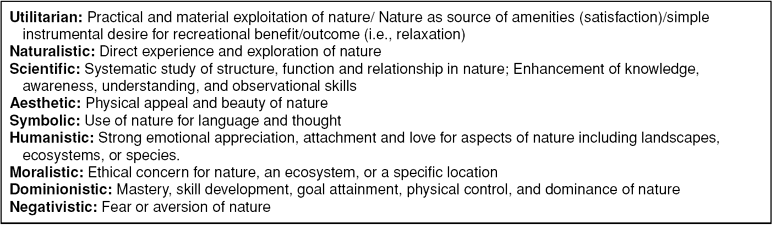
Theoretically, experiences in a healthy and functioning environment, such as Antarctica, provide a myriad of outcomes (Kellert Reference Kellert1996; Kellert and Wilson Reference Kellert and Wilson1993). One conceptual framework for categorising this range of outcomes is Kellert's typology of environmental values (Kellert Reference Kellert1996; Kellert Reference Kellert2005). This typology is a conceptual framework of ‘nine basic ways people attach meaning to and derive benefits from nature’ (Kellert Reference Kellert2005: 34) and has been used for investigating and discussing the range of attitudes toward the natural world and outcomes that people receive from particular experiences (for example Kellert Reference Kellert1996; Kellert Reference Kellert and Dallmeyer2000; Reynolds and Braithwaite Reference Reynolds and Braithwaite2001; Rauwald and Moore Reference Rauwald and Moore2002). To code Antarctic tourists’ responses to the open ended question, ‘How did this Antarctic experience affect you?’ we used the following list of outcomes and the corresponding working definition for the Antarctic context (Table 1).
Kellert's typology and definitions for Antarctic context
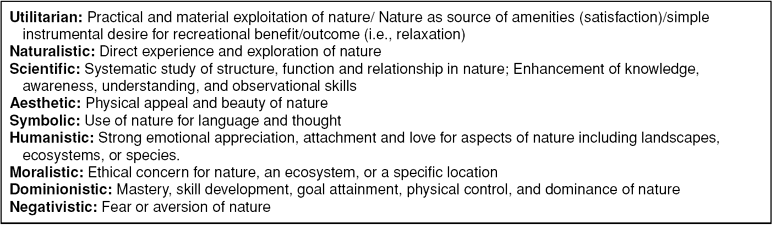
Utilitarian A utilitarian response denotes that nature should benefit humans through practical and material exploitation (Kellert Reference Kellert1996: 10). In the nature based tourism context, nature is seen as a source of amenities. People with a strong utilitarian perspective may communicate a desire for simple instrumental recreational benefits such as relaxation or satisfaction from the nature based tourism/Antarctic experience.
Naturalistic A naturalistic response reflects humankind's desire for ‘direct experiences with nature and wildlife’ (Kellert Reference Kellert1996: 11–13). A strong naturalistic outcome may indicate not only desire, but also a high level of comfort with immersive experiences in nature. Outcomes include a strong desire to return to Antarctica and experience wilderness settings.
Scientific A scientific outcome refers to the desire to develop awareness and a further understanding of ecological and natural phenomena through interpretation, reading, scientific inquiry, and direct observation (Kellert Reference Kellert1996: 13–14). In this context, a scientific outcome may indicate an enhanced level of awareness, knowledge, or understanding regarding Antarctica and its conservation threats as well as the ‘physical and mechanical functioning of living diversity’ and natural processes (Kellert Reference Kellert1996: 14). This aligns with IAATO's goal to ‘enhance public awareness and concern for the conservation of the Antarctic environment and its associated ecosystems’ (IAATO 2004a).
Aesthetic Aesthetic responses reflect the potential ‘strong emotional feelings of intense pleasure evoked from experiencing the physical splendor of the natural world’ (Kellert Reference Kellert1996: 15).
Symbolic This value reflects nature as a source of imagery for language, art, and thought (Kellert Reference Kellert1996). In this context a symbolic outcome may include recounting stories from the direct experience as well as myths and legends about the Antarctic environment.
Humanistic A humanistic outcome describes strong emotional appreciation, attachment and love for aspects of nature including landscapes, ecosystems, or species (Kellert Reference Kellert1996: 21–22). In the Antarctic context, outcomes include an appreciation or a strong attachment to the Antarctic continent and its wildlife.
Moralistic A moralistic response reflects an ethical concern for the diversity of life and the ecological web when making resource decisions (Kellert and Wilson Reference Kellert and Wilson1993: 53–56). Also associated with a moralistic outcome is the desire to protect and conserve the natural world, or in this context, Antarctica. A moralistic response corresponds with the IAATO's goals of ‘enhancing public awareness and concern for the conservation of the Antarctic environment and its associated ecosystems’ and ‘creating a corps of Ambassadors for the continued protection of Antarctica by offering the opportunity to experience the continent first hand’ (IAATO 2004a).
Dominionistic This outcome reflects a desire to test oneself in naturalistic settings. Outcomes include feelings of mastery, skill development, goal attainment, physical control, and dominance of nature (Kellert Reference Kellert1996).
Negativistic Negativistic responses describe ‘feelings of fear, aversion, and dislike’ potentially experienced when encountering wildlife and natural landscapes such as Antarctica and the Southern Ocean (Kellert Reference Kellert1996: 25).
Awe: peak, optimal, extraordinary, or spiritual experiences
Beyond the range of outcomes categorised using Kellert's typology, we also investigated the potential for Antarctic tourists to experience awe. Awe is thought to arise from an interplay of a range of types of experiences. In narratives about extreme outdoor adventure one can regularly find authors struggling to describe these sublime, spiritual, and influential moments. Psychological literature supports the notion that these types of experiences, often called peak, spiritual, optimal, or extraordinary, exist and indeed affect individuals in dramatic ways (Csikszentmihalyi Reference Csikszentmihalyi1990; Maslow Reference Maslow1964; Otto Reference Otto1958). Often the outcome of these experiences is called ‘awe’. Otto describes awe as:
a harmony of contrasts; it is at once daunting, and yet again singularly attracting, in its impress upon the mind. It humbles and at the same time exalts us, circumscribes and extends us beyond ourselves, on the one hand releasing in us a feeling analogous to fear, and on the other rejoicing us (Otto Reference Otto1958: 41).
While primarily exploratory, psychologists investigating these awe type experiences have found that awe can occur under many circumstances (Hood Reference Hood1978), particularly in nature based settings (Davis and others Reference Davis, Lockwood and Wright1991; Greeley Reference Greeley1974; Hood Reference Hood1977; Keltner and Haidt Reference Keltner and Haidt2003; Ketutzer Reference Ketutzer1978; Laski Reference Laski1961; Wuthnow Reference Wuthnow1978). These studies suggest that nature-based tourism, such as an Antarctic tourism experience, may have a strong potential for delivering extremely powerful, peak, and awe related experiences (additionally supported by Walker and others Reference Walker, Hull and Roggenbuck1998). Recent nature based tourism literature also revealed five possible sub-dimensions or characteristics of awe experiences: 1) a spiritual connection with nature 2) transformative experiences 3) goal clarification, 4) a refinement of the nature-human relationship, 5) and a sense of feeling humbled.
A spiritual connection Researchers have found that many outdoor experiences, such as wilderness travel, elicit a strong spiritual response (for example Fox Reference Fox, Miles and Priest1999; Fredrickson and Anderson Reference Fredrickson and Anderson1999; Stringer and McAvoy Reference Stringer and McAvoy1992). This research and others suggest that the expansiveness of a landscape contributes to a sense of awe and a spiritual experience (Brown and Raymond Reference Brown and Raymond2007; Heintzman Reference Heintzman2010; Heintzman and Mannell Reference Heintzman and Mannell2003; Koecni Reference Koecni2005). Therefore, it seems logical that in an environment as vast, novel, and extreme as Antarctica that some tourists may experience a strong spiritual response.
Transformative experience Experiences of awe (some associated with a spiritual connection) are often expressed in terms of a transformative or life changing event. This is supported by the fact that awe experiences are easily recalled years after the on site experience, and that people remark they have been ‘forever changed’ (for example Arnould and Price Reference Arnould and Price1993). Specifically, ‘renewal of self’ and ‘individual transformation’ were found as potential outcomes of extraordinary and awe type experiences (Arnould and Price Reference Arnould and Price1993; Laing and Crouch Reference Laing and Crouch2009). However, some awe experiences may fall short of transformative but may include varying levels of individual goal clarification.
Goal clarification When individuals encounter natural environments that inspire awe, they are often able to relax, and reflect, often leading to a reassessment of goals and priorities (McDonald and others Reference McDonald, Wearing and Ponting2009). Koecni (Reference Koecni2005), Lowenstein (1999), and Pomfret (Reference Pomfret2006) further support this notion and suggest that an awe experience may facilitate the development of new meanings for life and provide new perspectives about an individual's existence.
Refinement of the nature-human relationship Many individuals recollecting awe experiences in a nature based tourism setting indicate a strong and explicit connection with nature (Ketutzer Reference Ketutzer1978; Laski Reference Laski1961; Wuthnow Reference Wuthnow1978; Arnould and Price Reference Arnould and Price1993; Farber and Hall Reference Farber and Hall2007; and see McDonald and others 2009 for a thorough review). Additionally, substantial evidence exists suggesting that wildlife encounters may elicit strong emotional responses (Kellert Reference Kellert1996) and that viewing large marine mammals (for example whales) may produce feelings of being ‘at one’ with wildlife or nature during an awe experience (DeMares Reference DeMares2000).
A sense of feeling humbled Feelings of humility or insignificance may also be closely associated with awe experiences occurring in grand, austere, and powerful landscapes and seascapes (Gallagher 1993; Koecni Reference Koecni2005; Williams and Harvey Reference Williams and Harvey2001). Similarly, experiences with wildlife such as cetaceans and other charismatic fauna have also been found to elicit feelings of humility and insignificance associated with these awe type experiences (Curtin Reference Curtin2009; DeMares Reference DeMares2000).
We used these five descriptions of awe to identify and code the responses of Antarctic tourists’ to the open-ended question: ‘How did this Antarctic tourism experience affect you?’
Methods
The investigation presented in this paper was part of a larger study that examined a range of outcomes including knowledge of Antarctica (objective and subjective measures), environmental behaviours and future intentions, attitudes toward Antarctica management, and satisfaction. Results from other aspects of this study can be found in Powell and others (Reference Powell and Ham2008). For this component of the study, we used a six page questionnaire containing primarily quantitative questions to examine tourists’ assessments of satisfaction with their Antarctic tourism experience. Additionally, we used an open-ended question (that is ‘How did this Antarctic tourism experience affect you?’) to provide insight into potential affective, cognitive, psychological, and spiritual outcomes.
Sample and Procedures
The objectives of this research were (1) to investigate the immediate influence of Antarctic tour participation on tourists’ perceptions of satisfaction and quality; and (2) to explore further the range of psychological outcomes resulting from an interaction with the Antarctic tourism environment by analysing responses to an open ended question using Kellert's typology of environmental values and five dimensions of awe.
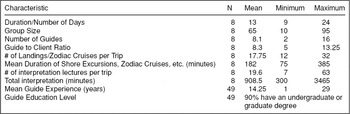
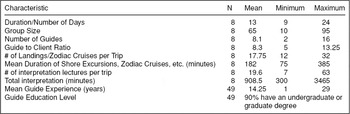
Four Antarctic operators which were members of IAATO in 2002 agreed to participate in the study. One operator that conducted expeditionary sea kayak trips and which was not a member of IAATO also agreed to participate. From the five participating Antarctic operators, eight commercial tours to the Antarctic Peninsula were investigated during the 2002–2003 season. From these eight trips, 269 of the 371 potential respondents completed a survey on the last night of their cruise, yielding a response rate of 72.5%. To investigate trip characteristics, trip leaders and guides were interviewed prior to each departure using a standardised open ended questionnaire. In addition, the researchers or a participating trip leader recorded six specific daily operational details during the trip (Table 2).
Summary table of Antarctic trip and guide characteristics
Results
Tour characteristics
In an effort to describe the Antarctic tourism environment, eleven operational and guide characteristics were collected. The eight Antarctic trips under investigation ranged from 9 to 24 days in length with a mean of 13 days (Table 2). Trips varied in length due to itinerary. Two cruises traveled not only to the Antarctic Peninsula but also to the Falkland Islands and South Georgia, which extended the duration of the trip. Group sizes ranged from a minimum of 10 passengers to a maximum of 95 with a mean of 65. One trip had a dramatically smaller group size due to its expeditionary style, although this trip relied on a larger ship to transport the group to and from the Antarctic Peninsula and therefore was a component of a larger trip during the 4 days crossing and re-crossing the Drake Passage. The number of guides per trip ranged from a minimum of 2 on an expeditionary sea kayaking trip to a maximum of 16 on one of the specialised bird watching voyages with a mean of 8.1 guides per Antarctic trip. Trips that offered special activities, such as mountaineering, diving, expert bird watching, and/or sea kayaking generally employed more guides than standard wildlife viewing cruising trips. On the investigated trips, the mean guide to client ratio was one guide to 8.3 Antarctic tourists. The guides averaged 14.25 years of guiding experience. Approximately 90% of the 49 guides who led the investigated trips had graduated college and 57.1% of the guides had a graduate degree.
The following data were collected by the researcher or the trip leader of selected trips. These Antarctic trips took a mean of 18 shore excursions or zodiac cruises per trip and spent an average of 54 hours and 4 minutes on these activities off of the ship. These excursions varied in duration and physicality. Shore excursions or zodiac cruises lasted on average 3 hours and 2 minutes and usually were conducted to explore penguin colonies, historical sites, or gain a vantage of the Antarctic coastline.
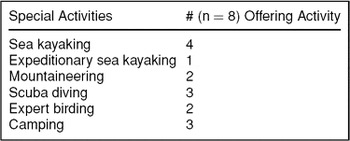
Guides and naturalists also provide environmental interpretation while leading Antarctic trips. Freeman Tilden, author of Interpreting our heritage, defines interpretation as ‘an educational activity which aims to reveal meanings and relationships through the use of original objects, by firsthand experience, and by illustrative media, rather than simply to communicate factual information’ (Tilden Reference Tilden1977: 8). For this study ‘interpretation lectures’ were defined as moments during the studied trips when guides provided interpretation to all visitors on the trip. Certainly guides provided additional interpretation of Antarctica's natural and human history to individuals when opportunities arose or when participants asked questions, but for this study these individual encounters were excluded due to the difficulty in effectively recording data. Leaders of each trip provided on average 19.6 interpretation lectures and over 15 hours of interpretation per trip. Finally, some trips also offered mountaineering, diving, and/or sea kayaking as an optional activity (Table 3). These specialty activities often required previously acquired skills and experience as well as considerable fitness.
Special Activities on Tours

Tourist characteristics
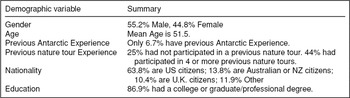
57% of respondents were male. The mean age of respondents was 51.5. For 93.3% of the participants, this was their first trip to Antarctica; however 51.8% of respondents reported participating in three or more previous nature tours. The majority of respondents claimed the USA as their country of citizenship (64%) and 13.8% reported their nationality as Australian or New Zealander. Most tourists (86.9%) reported having a college or professional/graduate degree (Table 4).
Summary of demographic data

Satisfaction and perceptions of quality
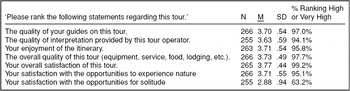
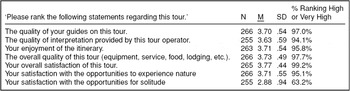
For this study, we used seven questions to measure satisfaction and perceptions of quality regarding different aspects of the tour. We also used three questions to investigate respondents’ intentions to recommend and return to the destination. For the first seven questions (Table 5), respondents replied to the statement: ‘Please rank the following statements regarding this tour.’ The answer choices were: ‘very high; high; moderate; low; and no opinion.’ To investigate the three behavioural intentions (Table 6), respondents were asked to reply to the following statement: ‘Please indicate the likelihood that you will participate in the following activities.’ The answer options were: ‘very likely; likely; unlikely; very unlikely; and no opinion.’
Satisfaction mean scores
Mean scores of willingness to recommend and return to Antarctica

Responses to ‘overall satisfaction’ had the highest mean score with 77.4% ranking their satisfaction level as very high and 21.9% ranking their satisfaction level as high. In addition, respondents had a very high ‘willingness to recommend the destination’ mean score. Approximately 76% of respondents indicated they were very likely to recommend this destination, and 36% indicated they were very likely or likely to return to Antarctica. The lowest satisfaction mean score pertained to opportunities for solitude with 63.2% ranking their satisfaction level as high or very high.
Results of qualitative analysis
The open ended question, ‘How did your Antarctic experience affect you?’ was coded independently by two researchers without knowledge of each other's assigned codes. A three step process was used for coding. First, to fit the context of Antarctica, the researchers agreed upon refined definitions and the corresponding outcomes associated with both Kellert's typology of nine values (Table 1) and the 5 dimensions of awe. Second, each researcher coded the open ended responses by identifying the presence of different outcomes and dimensions of awe. During this step, we conducted a full content analysis, which allowed an individual's response to be coded into multiple Kellert outcome categories, and into multiple dimensions of awe (all that were deemed present). During the third step, we evaluated the level of agreement on each response and assigned final outcome categories.
During a qualitative analysis, two researchers often perform an independent analysis of the data similar to that used in this study to increase the validity of the results (Creswell Reference Creswell2007). In this study, the two researchers who analysed the data initially agreed on 95.4% of all responses coded into Kellert's typology of values and 98.9% of all the responses coded as awe. The two researchers discussed the discrepancies until a final consensus was reached.
Affective outcomes: Kellert's typology
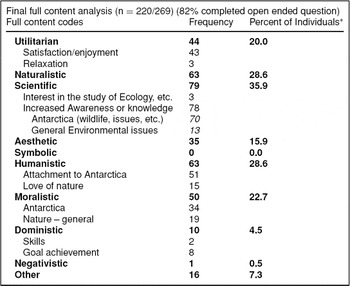
220 (82%) Antarctic tourists responded to the open ended question ‘How did your Antarctic experience affect you?’ Using Kellert's typology, we identified and categorised 345 outcomes that corresponded to 8 of Kellert's categories. 72% of respondents communicated more than one outcome. We also developed sub-dimensions for 5 of Kellert's categories to refine our coding (see Table 7).
Kellert's typology: frequency and percent of individuals with responses

* Adds up to over 100% because percentage reflects the number of respondents that communicated the theme. One respondent may have had multiple outcomes.
Utilitarian The results of the coding and analysis indicate that of the 220 individuals that completed the question, 20% revealed that they had a utilitarian outcome. A utilitarian outcome reflected that nature, in this case the Antarctic environment, was a source of amenities and provided satisfaction and/or relaxation (see Table 7). Examples of responses reflecting a simple desire for a recreational outcome such as satisfaction or relaxation include, ‘good holiday,’ ‘It has given me time to relax. . .’ or ‘Able to relax and enjoy nature’. Several respondents mentioned the pleasure derived from their experience ‘gave me a lot of pleasure but didn't radically change my opinions’ and ‘I don't think it made any fundamental changes in my interest or attitudes, but it is an experience that I will always remember fondly.’
Naturalistic Approximately 29% of respondents communicated a desire for direct experiences with nature, wildlife, and wilderness. Several respondents mentioned a strong ‘desire to experience this amount of natural wilderness again.’ Naturalistic responses also communicated an enhanced desire for additional travel. For example:
[I have a] ‘desire to see other remote areas of the world in order to experience the vast diversities on our planet in terms of the scenery, wildlife, and people.’
‘It deepened my interest in natural travel.’
Scientific The scientific outcomes focused on a desire for studying ecology and natural history and/or an enhancement of knowledge, awareness, and understanding of Antarctica or general environmental issues (Table 7). Most of the scientific responses focused on how the experience increased knowledge and awareness of Antarctica and its wildlife. Examples of this include:
‘Improved my knowledge and understanding of Antarctica.’
‘Have gained a greater awareness and understanding of [this] unique and isolated environment.’
Others focused on a general awareness of environmental issues such as climate change.
‘It added to my perspective of the world as a whole and how diverse the world truly is.’
‘Has increased by a large degree my knowledge of the on- going impact of man on populations of animals.’
Finally, a few individuals indicated an intention or desire to study the natural history of Antarctica.
‘I'll always remember the excitement of discovering the variety of ice and glacier formations and observing the penguins and seals. Perhaps I'll spend additional time studying penguins.’
Another respondent remarked:
‘Very strongly! But it will take time to digest much of it. I tend to do more “studying” after the trip.’
Aesthetic 16% of respondents remarked on the beauty and physical appeal of Antarctica and its wildlife and the pleasure derived from this experience. Examples include:
‘Antarctica is achingly beautiful.’
‘It brought home how beautiful and special the area is.’
‘It gave me a firsthand opportunity to appreciate how vast this wilderness is. Its stark beauty and unique grandeur far exceeds its rumor.’
‘Allowed me to really appreciate another side of nature I haven't seen before. I had some of the most incredible experiences and seen some of the most beautiful places I've seen in my life.’
Several Antarctic tourists referred to an extreme aesthetic response that led to feelings of awe.
‘A quiet awe has been instilled with the immense beauty of the land.’
Humanistic We coded responses that communicated an appreciation, attachment, and love for aspects of nature including the Antarctic landscape, ecosystems, or specific wildlife species as having a humanistic outcome with ‘an attachment to Antarctica.’ Other responses that referred to feelings of appreciation and attachment to nature in general, were coded as an enhanced ‘love of nature.’ Approximately 29% of responses referred to enhanced appreciation for Antarctica or nature in general. Most of these referenced their appreciation for Antarctica:
‘Gave me a deep love for the whole life systems we saw, particularly the penguins.’
‘I . . .felt such deep connections and compassion for these animals, as so much about them seemed almost human to me.’
‘a greater appreciation of the continent and its diversity.’
Respondents also communicated a heightened general appreciation for nature and biodiversity:
‘It furthered my appreciation of the diversity of life on this planet and the beauty and fragility of our planet.’
‘Greater appreciation of environmental issues and diversity of species.’
Moralistic 23% of responses referred to an enhanced sense of moral obligation and concern regarding Antarctica and the environmental issues the continent faces or a heightened moral concern for nature in general. Examples of responses that reflect the development of enhanced moral concern for Antarctica include:
‘Revealed threat of long line fishing. Revealed fish species threatened by overfishing. Increased my respect for nature's ability to adapt to a hostile environment. Increased the remorse I feel for the slaughter of fish and marine mammals by humans.’
‘Greater appreciation for nature: the balances in nature and the need for serious regulations to protect that balance i.e. protect krill, etc. to maintain the food chain.’
‘It has made me more aware of what a special environment Antarctica is and that the people of the world must worry about its protection to maintains its status.’
‘It made me think much more about global warming and Antarctic conservation issues generally.’
‘It's made me much more aware of how fragile life is down here and how people and their actions can affect this area.’
‘It's certainly made me more aware of the fragile state of Antarctica and has impressed in me the potential hazards that tourism can have for the local wildlife.’
Moralistic responses that pertained to general concern for nature conservation included:
‘Convinced me to give more money to environmental agencies for protection.’
‘Even more awareness of how valuable nature is and how easily it can be destroyed or influenced from the outside.’
Dominionistic Responses that reflected a dominionistic outcome communicate feelings of mastery, skill development, and goal attainment. Trips that offered special activities such as mountaineering, diving, and sea kayaking, as well as photography or other skill based and challenging activities may have elicited this type of response. One respondent that participated in a mountaineering trip stated:
‘It helped me test my skills and move out of my comfort zone.’
A more consistent dominionistic response focused on attaining a goal such as completing a trip to Antarctica.
‘Fulfilled an ambition to visit Antarctica as an example of a wild, largely untouched destination with magnificent scenery and wildlife.’
‘Allowed me to accomplish a life's dream of visiting the southern continent to view the unique animals and the wondrous landscapes.’
Negativistic A negativistic response communicates a level of discomfort and fear felt toward direct encounters with Antarctica and the natural world. Only one described the power of the Antarctic environment:
‘It put me in close contact with nature at its most raw and savage and at its most majestic and serene. I was overwhelmed.’
Awe
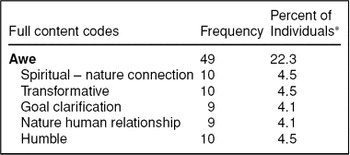
Beyond the range of outcomes categorized using Kellert's typology, we also investigated the potential for Antarctic tourists to experience awe (Table 8). Awe is thought to arise from an interplay of a range of types of experiences, and the literature suggests five possible sub-dimensions of awe: 1) a spiritual connection 2) transformative experiences 3) goal clarification, 4) a refinement of the nature-human relationship, 5) and a sense of feeling humbled. We used these 5 dimensions of awe to identify and code the responses of Antarctic tourists’ to the question: ‘How did this Antarctic tourism experience affect you?’ The results of our investigation suggest that over 20% of respondents described feeling or experiencing a sense of awe as a result of their Antarctic experience (Table 8). Some respondents indicated that they experienced awe but provided only a limited response that could not be further coded into any specific sub-dimension. For example, several respondents simply mentioned that they had experienced ‘a deep and awe-inspiring experience.’ However, other respondents provided much more detail and indicated that they not only experienced awe, but that their awe experience also produced an enhanced spiritual connection. The following quotes are representative of a strong spiritual connection with nature:
‘It was the fulfillment of a lifelong dream, one that I wasn't sure would ever be realised. The experience was a spiritual one, especially in times when I was alone.’
‘Re-connected me to nature in a profound way. Reminded me of how amazing life is, especially how it has adapted to such an extreme environment.’
Some respondents also felt the experience was personally transformational. Some responses relaying this notion of a transformational experience include:
‘A mind blowing, life changing experience.’
‘It affected me a great deal. I feel a more whole individual after having seen the continent.’
‘I have learned what Antarctica really is and this has changed the rest of my life.’
Awe: frequency and percentage of individuals with responses

* Reflects percentage of respondents that communicated the theme.
Many other respondents indicated that the experience promoted goal clarification or a re-evaluation of their life. Examples of responses that reflect goal clarification include:
‘Profound awe at the natural beauty in abundance. Learned about state of science, research, and tourism. Broadened my view of the world. I hope to focus on my own life more carefully.’
‘Reminded me to think about perspective and be passionate about the things that are important to me. I'm in awe of the wonders of nature and the lessons to be learnt from nature.”
‘I became much more aware of the amount of wildlife in Antarctica and the beauty of the landscape and icebergs and the fragileness of it all! I feel that human intrusion on it cannot help but have an effect on it. It has made me want to stop working 80 hours a week so I can explore the natural beauty closer to home.’
Not all respondents indicated that the experience was transformative or clarified their goals. Some respondents commented that awe did occur, and that the experience ultimately prompted a clarification or re-defining of human's relationship with nature. For example:
‘It has given me a feeling for the remoteness and sheer size of Antarctica. I'm amazed at the immense natural forces that are at work here. No film or words can describe what we have seen. I'm left with a sense of awe.’
‘Helped reinforce the delicate balance of nature and humans.’
‘Overwhelming enjoyable. A taste of how vast the place is has restored my equilibrium of humankind vs. planet.’
‘To experience one more beautiful place beyond your imagination makes the journey worthwhile. It makes me realise that we are so small compared to nature. I feel lucky to have been able to come here.’
Similar to a re-defining of our relationship with the natural world is a sense of feeling humbled during the awe experience. Examples of responses indicative of a ‘sense of feeling humbled’ or feeling overwhelmed by the experience include:
‘Films in no way convey the wonder of being there. I am torn between wanting to share and wanting to protect this environment at all costs. It has been a magic trip, humbling and awe inspiring. I wish I had prepared better.’
‘It put me in close contact with nature at its most raw and savage and at its most majestic and serene. I was overwhelmed!’
‘It was a humbling experience to be one of the privileged to see a place so beautiful. Also, to be in the close proximity of wildlife and not be afraid because it has never known human cruelty.’
Discussion and conclusion
This study sought to explore the outcomes resulting from an interaction with the ‘Antarctic tourist environment.’ We used ten quantitative questions to examine tourists’ assessments of satisfaction and quality and one open ended question to provide insight into the range of potential affective, cognitive, psychological, and spiritual outcomes.
Descriptive statistics pertaining to the ‘Antarctic tourism experience’ indicate that these tours provided over 53 hours of direct and immersive outdoor experiences complemented by over 15 hours of environmental interpretation. The results imply that respondents were very satisfied with their overall experience immediately after participation. Over 90% of respondents also indicated that they would recommend Antarctica as a destination, which is considered one of the strongest indicators of tourists’ satisfaction. Opportunities for solitude received the lowest rating, though nearly two-thirds rated their satisfaction level as high or very high. However, when interpreting the results from individual satisfaction questions, one should consider their general nature and the fact that they did not take into account the contextual factors and trade offs involved in managing visitation and operating ships in geographically isolated places such as Antarctica. The questions do however give an indication of the Antarctic tourists’ satisfaction levels and perceptions of quality regarding their tour as well as specific elements of the trip.
Results of our qualitative analysis of open ended responses suggest that the ‘Antarctic tourism experience’ is complex and delivers a wide range of psychological, emotional, and spiritual outcomes. Using Kellert's typology, we identified and categorised 345 outcomes corresponding to 8 of Kellert's categories. Approximately 72% of individuals reported multiple outcomes as a result of their Antarctic experience. A number of tourists indicated that their experience enhanced their awareness and knowledge of Antarctica and its environmental issues (scientific), developed emotional attachments (humanistic), and built moral concern for the continent and its wildlife (moralistic). These findings suggest that these IAATO members are relatively successful at ‘enhancing public awareness and concern for the conservation of the Antarctic environment.’ The results also suggest that they may also be ‘creating a corps of ambassadors for the continued protection of Antarctica by offering the opportunity to experience the continent first hand.’
The phenomenon of awe has proven an elusive concept for researchers to examine through closed ended and quantitative approaches. The qualitative analysis employed in this study proved successful in exploring awe experiences. Specifically, the results of our analysis of awe demonstrated that five distinct sub-dimensions of an awe outcome exist. These include 1) an enhanced spiritual connection with nature 2) transformative experiences 3) goal clarification, 4) a refinement of the nature-human relationship, 5) and a sense of feeling humbled. Similar to the results using Kellert's typology, many respondents indicated that when they experienced awe, they experienced multiple sub-dimensions of awe. Our analysis of the open ended responses also suggest that many individuals experienced ‘awe’ in conjunction with powerful and positive aesthetic, moralistic, naturalistic, scientific, humanistic, dominionistic, and negativistic outcomes.
One limitation of our qualitative analysis is that we relied on tourists’ responses to an open ended question. As such, we are more confident in our identification of the presence of particular outcomes and less confident in noting their absence. Tourists’ failure to describe a particular outcome does not mean it was absent. This may have led to an under identification of certain outcomes. In particular, we suspect that many of those traveling to Antarctica, given its inhospitable qualities, at one point or another may have experienced some fear and anxiety (a negativistic outcome). Similarly, we also hypothesise that a symbolic outcome may be a significant part of the Antarctic experience, but our data did not capture this desire to share the stories from one's Antarctic experience, as well as the myths and legends associated with the region.
Our results provide insight into the potential outcomes that an immersive experience in the natural world complemented by interpretation may produce. Specifically, the results of this study begin to shed light onto the potential range of psychological and affective outcomes associated with nature based tourism in unique environments, and further contribute to our understanding of awe experiences. Future research should further examine this range of outcomes and the relationship to site and trip characteristics in more depth as the impact of an Antarctic tourism experience seems to be powerful, rich, and extremely complex.
(The data gathered from the eight Antarctic voyages should only be generalised to commercial tourists who participated in Antarctic cruises with the participating tour operators. During the 2002–2003 Antarctic tourism season, approximately 124 cruises embarked on 24 vessels carrying 13,443 tourists operated by 26 operators and their sub contractors (IAATO 2004b)).
Acknowledgements
The authors would like to acknowledge the Canon National Parks science scholars program, the Yale Institute for Biospheric Studies, and the USDA Cooperative State Research, Education, and Extension Service (Hatch project #0209766) for their financial support. Finally the authors would like to thank the participating operators and their tourists for their cooperation and participation in this independent research and the two anonymous referees whose comments improved this article.