Introduction
Viral diseases cause significant financial loss in cattle production systems in addition to widespread animal suffering in the face of disease outbreaks. Despite the importance of viral pathogens as primary and secondary etiologic agents in cattle, no antiviral products are commercially licensed for use in cattle within the USA. Currently, the use of inactivated or attenuated vaccines represents the only targeted control measure against viral pathogens available to producers and veterinarians. Even when coupled with sound management practices and robust biosecurity/biocontainment procedures, vaccination is often insufficient to prevent or halt the spread of disease agents. Factors that may hinder the efficacy of current vaccines include poor cross-reactivity of the vaccine strain to the infecting viral strain, improper handling of the vaccine, inadequate response to vaccination by the patient due to poor nutrition or health, mutation of the target virus and evasive or defensive strategies by the viral agent. A rapid onset of protection after vaccination is especially critical for disease containment in outbreak situations, particularly for diseases with regulatory or trade concerns. Although vaccines are important tools for the control of many bovine viral pathogens, in some situations they have proven insufficient to control the associated diseases, despite decades of use.
Increases in global commerce and average herd size, urbanization and alterations in global climate patterns also facilitate the spread of pathogenic viruses, or the introduction of new viral species, into regions previously free of such pathogens, creating the potential for widespread morbidity and mortality in naïve cattle populations. The spread of bluetongue virus (BTV) through much of Europe in 2006 (Toussaint et al., Reference Toussaint, Sailleau, Mast, Houdart, Czaplicki, Demeestere, VandenBussche, van, Goris, Breard, Bounaadja, Etienne, Zientara and De2007) and the emergence of Schmallenberg virus both in cattle and small ruminant populations (Gibbens, Reference Gibbens2012) serve as poignant examples of the need for rapid control measures to limit the potential losses caused by viral pathogens. Antiviral drugs remain a potential stop-gap measure where vaccination has not been practiced or has proven ineffective. Antiviral compounds can, in theory, provide immediate protection against viral challenge and potentially can be used against a variety of related viruses depending on the viral target of the compound (Newcomer et al., Reference Newcomer, Marley, Ridpath, Neill, Boykin, Kumar and Givens2012b).
The judicious use of antiviral compounds has the potential to rapidly control the spread of bovine viral pathogens, limiting economic losses and animal death and suffering. However, in vivo demonstration of efficacy is lacking for most of the compounds shown to have antiviral activity. The aim of this literature review is to describe the current and future uses of antivirals in bovine medicine as they relate to several key viral pathogens, namely bovine viral diarrhea virus (BVDV), foot and mouth disease virus (FMDV) and bovine herpesvirus (BHV); it is for these pathogens that antiviral applications have been the most widely studied and for which the commercial products will likely be developed first. The clinical signs of disease and the potential targets for each virus are discussed and the current knowledge of antivirals for each agent is reviewed. Additionally, efforts to identify effective antivirals against other bovine viral pathogens are summarized.
Bovine viral diarrhea virus
Clinical signs
Acute BVDV infection occurs in animals worldwide when seronegative animals are exposed to the virus, most commonly through the respiratory mucosa. Subsequent primary viremia results in widespread dissemination of the virus and a myriad of clinical signs. Bovine viral disease (BVD) may be manifested in the respiratory, gastrointestinal, reproductive, cardiovascular, lymphatic, immunologic, integumentary or central nervous systems of affected cattle (Walz et al., Reference Walz, Grooms, Passler, Ridpath, Tremblay, Step, Callan and Givens2010). However, reproductive losses associated with BVDV infection are thought to have the largest negative economic impact for dairy and cow–calf operations. The contribution of BVDV infection to respiratory disease is not well understood but is thought to be due to its immunosuppressive qualities that enhance the pathogenesis of other viral or bacterial pathogens. Consequently, BVDV has been implicated along with other pathogens (e.g., Pasteurella multocida, Manheimia hemolytica, parainfluenza-3 virus and bovine respiratory syncytial virus) in the pathogenesis of the bovine respiratory disease complex (BRDC) (Ridpath, Reference Ridpath2010a). Acute BVDV infection may also result in severe thrombocytopenia and hemorrhage with high resultant mortality.
Viral strains of BVDV are classified into either cytopathic (CP) or noncytopathic (NCP) biotypes based on the presence or absence, respectively, of vacuolation and cell death in cultured epithelial cell lines following infection. Biotypes are not an accurate predictor of pathogenicity as both have been responsible for severe disease outbreaks. However, infection of naïve pregnant cattle before development of fetal immunocompetence (generally by 125 days of gestation) with NCP strains of BVDV can result in persistently infected (PI) calves that may not show signs of disease but continuously shed virus and are important in the epidemiologic aspects of BVDV propagation (Brock, Reference Brock2003). Approximately 0.3% of the animals entering the feedlot are thought to be PI animals (Loneragan et al., Reference Loneragan, Thomson, Montgomery, Mason and Larson2005) and serve to expose their naïve penmates to the virus, increasing the incidence of BRDC. Superinfection of PI calves with homologous CP strains of BVDV may result in mucosal disease, an uncommon but generally fatal event.
Antiviral targets
Potential antiviral targets for BVDV are numerous. The RNA-dependent RNA polymerase (RdRP), nonstructural protein (NS) 5B (NS5B), is well characterized and the most frequent target of antiviral compounds (Choi et al., Reference Choi, Groarke, Young, Kuhn, Smith, Pevear and Rossmann2004). Several compounds with demonstrated in vitro activity against BVDV have been shown to exert their effect through antagonism of this RdRP (Manfredini et al., Reference Manfredini, Angusti, Veronese, Durini, Vertuani, Nalin, Solaroli, Pricl, Ferrone, Mura, Piano, Poddesu, Cadeddu, La Colla and Loddo2004; Angusti et al., Reference Angusti, Manfredini, Durini, Ciliberti, Vertuani, Solaroli, Pricl, Ferrone, Fermeglia, Loddo, Secci, Visioli, Sanna, Collu, Pezzullo and La2008; Tonelli et al., Reference Tonelli, Boido, La Colla, Loddo, Posocco, Paneni, Fermeglia and Pricl2010; Newcomer et al., Reference Newcomer, Neill, Marley, Ridpath and Givens2013b; Musiu et al., Reference Musiu, Purstinger, Stallinger, Vrancken, Haegeman, Koenen, Leyssen, Froeyen, Neyts and Paeshuyse2014). NS3, which has helicase and serine protease domains, is a necessary component of the replication complex required for viral RNA replication, thus making this protein another specific target for antiviral therapy (Chaudhuri et al., Reference Chaudhuri, Lee, Truong, Torres, Patel and Johnson2012; Lawitz et al., Reference Lawitz, Sulkowski, Jacobson, Kraft, Maliakkal, Al-Ibrahim, Gordon, Kwo, Rockstroh, Panorchan, Miller, Caro, Barnard, Hwang, Gress, Quirk and Mobashery2013). Additionally, a nonspecific target of antiviral drugs is the endoplasmic reticulum (ER) glucosidases, which are essential for virion processing and packaging (Alonzi et al., Reference Alonzi, Dwek and Butters2009). Inhibition of inosine-monophosphate dehydrogenase (IMPDH) has also been targeted by in vitro studies (Stuyver et al., Reference Stuyver, Lostia, Patterson, Clark, Watanabe, Otto and Pankiewicz2002; Buckwold et al., Reference Buckwold, Wei, Wenzel-Mathers and Russell2003; Yanagida et al., Reference Yanagida, Baba and Baba2004). In addition to known targets, the mechanisms of action of several compounds with demonstrated antiviral efficacy against BVDV remain to be elucidated, potentially leading to the identification of additional targets.
In vitro results
More compounds with demonstrated in vitro antiviral efficacy have been identified for BVDV than any other bovine virus, because BVDV serves as the de facto surrogate model for the evaluation of antiviral therapeutics effective against hepatitis C virus. However, because most compounds have not been identified with the intention of commercial veterinary development, significant research will be necessary before marketable products for the practitioner are available. The reader is referred to the recently published systematic reviews for a thorough listing of the numerous compounds identified to possess the specific or nonspecific in vitro antiviral activity against BVDV (Finkielsztein et al., Reference Finkielsztein, Moltrasio, Caputto, Castro, Cavallaro and Moglioni2010; Newcomer and Givens, Reference Newcomer and Givens2013). Along with the identification of effective in vitro compounds, knowledge of their respective mechanisms of action will be of benefit in the development of commercial products. Known mechanisms of action for the described compounds include chain termination (Hollecker et al., Reference Hollecker, Choo, Chong, Chu, Lostia, McBrayer, Stuyver, Mason, Du, Rachakonda, Shi, Schinazi and Watanabe2004), inhibition of the IMPDH enzyme (Yanagida et al., Reference Yanagida, Baba and Baba2004), inhibition of ER glucosidases (Alonzi et al., Reference Alonzi, Dwek and Butters2009), inhibition of the RdRP (Angusti et al., Reference Angusti, Manfredini, Durini, Ciliberti, Vertuani, Solaroli, Pricl, Ferrone, Fermeglia, Loddo, Secci, Visioli, Sanna, Collu, Pezzullo and La2008) and interaction with virus or host-cell proteins (Stuyver et al., Reference Stuyver, Whitaker, McBrayer, Hernandez-Santiago, Lostia, Tharnish, Ramesh, Chu, Jordan, Shi, Rachakonda, Watanabe, Otto and Schinazi2003). Antisense oligonucleotide therapy inhibits viral replication by interference with the translational machinery through the use of small interfering RNA (siRNA) or short-hairpin RNA (shRNA) (Pratt and MacRae, Reference Pratt and MacRae2009). Antisense therapy has proven effective at inhibiting BVDV in cell culture when using siRNA and shRNA targeting the 5′ UTR and certain conserved regions of the BVDV genome encoding structural (Mishra et al., Reference Mishra, Rajukumar, Kalaiyarasu, Behera, Nema and Dubey2011) or NS (Lambeth et al., Reference Lambeth, Moore, Muralitharan and Doran2007) proteins or a combination of both (Ni et al., Reference Ni, Hu, Qiao, Yu, Wang, Tong, Zhang and Chen2012). While in vitro data abound on BVDV antivirals, in very few cases has this translated into in vivo demonstrations of efficacy.
In vivo results
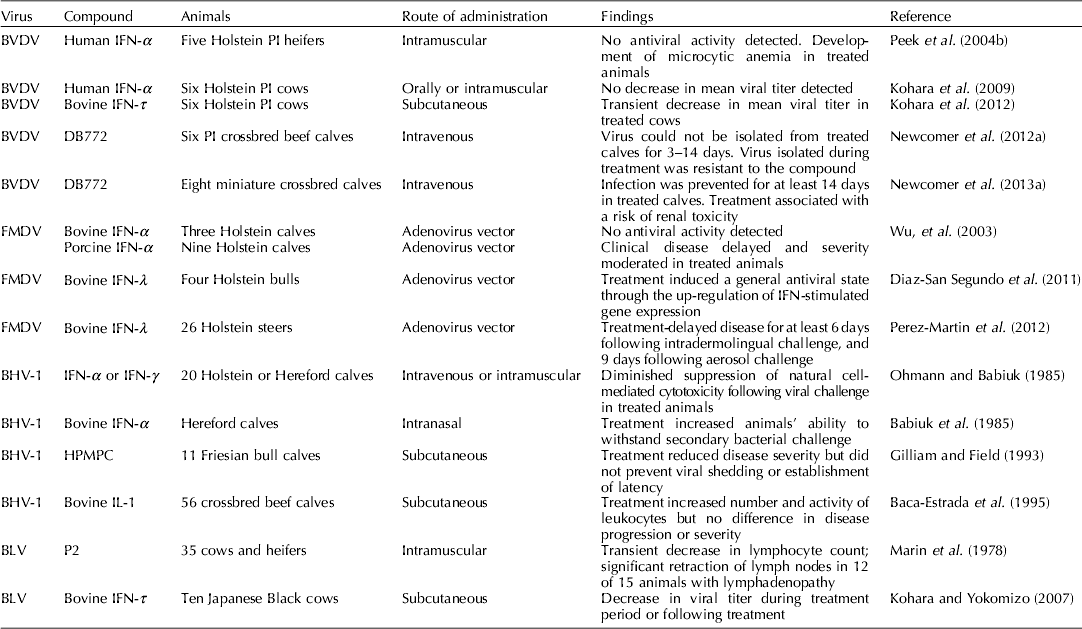
Owing to the consistently high levels of viremia and viral shedding, PI animals represent the most robust in vivo test of a novel antiviral compound. Treatment with a specific antiviral compound (DB772) markedly reduced viremia in four PI crossbred beef calves (Newcomer et al., Reference Newcomer, Marley, Galik, Walz, Zhang, Riddell, Dykstra, Boykin, Kumar, Cruz-Espindola, Boothe, Joiner and Givens2012a). Antiviral administration resulted in transiently decreased viral titers in all treated calves to below levels detectable by virus isolation techniques, but resulted in the rapid selection of resistant isolates in three of the four calves (Table 1). Furthermore, when used prophylactically, the compound successfully prevented infection in naïve calves but left them susceptible to subsequent challenge after protective levels of the compound had waned (Newcomer et al., Reference Newcomer, Marley, Galik, Zhang, Riddell, Boykin, Kumar, Kuhnt, Gard and Givens2013a). In the latter study, administration of the compound was associated with azotemia and signs of renal toxicity which had not been seen in previous live animal studies. Earlier, DB772 and related aromatic cationic molecules had been used to eliminate BVDV infection in contaminated bovine fetal fibroblast cells, infected cell lines and embryo culture media (Givens et al., Reference Givens, Stringfellow, Dykstra, Riddell, Galik, Sullivan, Robl, Kasinathan, Kumar and Boykin2004, Reference Givens, Galik, Riddell, Dykstra, Brock and Stringfellow2005). Heifers born from embryos cultured in media containing the compound were healthy and had normal reproductive capacity (Givens et al., Reference Givens, Stringfellow, Riddell, Galik, Carson, Riddell and Navarre2006, Reference Givens, Marley, Riddell, Galik and Stringfellow2009). Further study must be directed at alleviating concerns of toxicity and developing a more user-friendly formulation practical for wide-scale commercial use.
A list of published antiviral studies involving live cattle

BHV-1, bovine herpesvirus 1; BLV, bovine leukemia virus; BVDV, bovine viral diarrhea virus; FMDV, foot and mouth disease virus; IFN, interferon; IL, interleukin.
Interferons (IFN) of both human (HuIFN) and bovine (BoIFN) origin have been widely studied as nonspecific antiviral compounds in relation to BVDV. Both CP and NCP biotypes of BVDV are considered highly susceptible to in vitro IFN treatment (Peek et al., Reference Peek, Bonds, Gangemi, Thomas and Schultz2004a). However, in vivo efficacy has been difficult to demonstrate. Viral load in PI cattle decreased slightly after subcutaneous treatment with BoIFN-τ when animals were treated with 106 U/kg ten times over the course of a 2-week period (Kohara et al., Reference Kohara, Nishikura, Konnai, Tajima and Onuma2012). The decrease in viral titer was not sustained following cessation of treatment, nor was it evident at lower dosages or when using HuIFN-α (Kohara et al., Reference Kohara, Nishikura, Tajima, Onuma and Yokomizo2009). Similar results were seen in an earlier study in which five Holstein PI heifers were treated with recombinant human IFN-α every other day for 84 days (Peek et al., Reference Peek, Bonds, Schaele, Weber, Friedrichs and Schultz2004b). Treatment did not result in demonstrable antiviral activity but did lead to the development of microcytic anemia during the treatment period, secondary to the production of anti-IFN antibodies.
An antiviral compound with in vitro activity against BVDV has been studied extensively in pigs for control of the closely related classical swine fever virus (CSFV) (Paeshuyse et al., Reference Paeshuyse, Leyssen, Mabery, Boddeker, Vrancken, Froeyen, Ansari, Dutartre, Rozenski, Gil, Letellier, Lanford, Canard, Koenen, Kerkhofs, Donis, Herdewijn, Watson, De, Puerstinger and Neyts2006). When fed to piglets for 15 consecutive days at a daily dose of 75 mg/kg, beginning 1 day before the experimental challenge with CSFV, 5-[(4-Bromophenyl)methyl]-2-phenyl-5H-imidazo[4,5-c]pyridine (BPIP), resulted in a significant reduction in mean viral genome loads, duration of viremia and mean CSFV antibody titers compared to untreated cohorts (Vrancken et al., Reference Vrancken, Haegeman, Paeshuyse, Puerstinger, Rozenski, Wright, Tignon, Le Potier, Neyts and Koenen2009b). A follow-up pilot study involving four BPIP-treated pigs revealed a 50% reduction in CSFV transmission to untreated sentinel pigs compared to untreated controls (Vrancken et al., Reference Vrancken, Haegeman, Dewulf, Paeshuyse, Puerstinger, Tignon, Le Potier, Neyts and Koenen2009a). Oral administration of the compound through the feed allows easy dosing with minimal labor input. However, it is unknown if the compound can be fed to ruminants and retain its efficacy. If so, the compound holds promise for using in disease-free regions for reemergence of disease, or potentially in feedlot situations where naïve animals have a high probability of being exposed to PI animals shedding infectious virus.
Antiviral applications in BVDV control
The use of prophylactic antiviral agents in veterinary medicine is still in the developmental stage, but the possibility of using such compounds in the control of BVDV is attractive, especially in situations where almost immediate protection is needed. BVDV is one of the most costly pathogens seen in feedlots and is currently controlled primarily through vaccination at arrival (Campbell, Reference Campbell2004). However, the lapse between the time of vaccination and onset of protection provides a window for viral transmission. In a recent study, prophylactic administration of an antiviral compound to seronegative calves protected from experimental challenge <24 h following the initial administration of the compound (Newcomer et al., Reference Newcomer, Marley, Galik, Zhang, Riddell, Boykin, Kumar, Kuhnt, Gard and Givens2013a). Consequently, antivirals could be used as a stop-gap measure to prevent infection in naïve calves. Similarly, several regions within the USA or abroad have embarked on BVDV eradication or control programs (Ridpath, Reference Ridpath2010b). Some regions no longer allow vaccination, leaving herds susceptible if biosecurity procedures are broken; in such cases metaphylactic administration of effective compounds could be used to limit viral transmission and subsequent animal losses.
Antivirals could also be used to limit the spread of BVDV through contaminated biologicals. The absence of cytopathogenicity allows undetected spread of the virus if proper testing is not performed on commercial products. The spread of HoBi virus, a virus closely related to BVDV, may have occurred through undetected contaminated biologicals (Schirrmeier et al., Reference Schirrmeier, Strebelow, Depner, Hoffmann and Beer2004). Vaccines and other biologicals in both veterinary and human medicines have been found to be contaminated with BVDV (Giangaspero, Reference Giangaspero2013). Contaminated biologicals can result in iatrogenic infections in susceptible species, erroneous diagnostic assay results and ruined experimental results. However, antivirals have been used to successfully treat and prevent infection in contaminated cell lines and culture media (Givens et al., Reference Givens, Stringfellow, Dykstra, Riddell, Galik, Sullivan, Robl, Kasinathan, Kumar and Boykin2004, Reference Givens, Galik, Riddell, Dykstra, Brock and Stringfellow2005). Thus, antivirals could provide an additional layer of protection from undetected infection in contaminated biologicals.
Foot and mouth disease virus
Clinical signs
Foot and mouth disease (FMD) is an acute, highly contagious disease affecting cloven-hoofed livestock. Transmission of the virus is primarily through direct contact with infected animals, fomites or aerosol transmission although a variety of transmission methods are capable of allowing the virus to spread. The onset of clinical disease is often signaled by a sudden onset of pyrexia and anorexia. Fever is often in the range of 103–106°F. Vesicular lesions appear in the mouth, udder and interdigital areas that soon rupture and slough, leaving large, painful, ulcerations and erosions. Abortion may occur in pregnant animals. Morbidity is high in susceptible populations while mortality is generally low. However, cardiac lesions in young stock may result in elevated mortality. The direct economic impact of FMD is due to its rapid spread and resultant weight loss and agalactia in affected animals. Perhaps more significantly, the impact of an outbreak on trade from a country previously free of the disease may reach into the billions of dollars due to trade limitations. Consequently, in countries free of the disease, outbreak prevention or containment if necessary, are of primary importance.
Antiviral targets
Initial research into FMDV antiviral therapy focused on nonspecific therapeutics; FMDV-specific targets have subsequently been identified in conjunction with the increased knowledge of the viral genome and translated proteins. The FMDV genome consists of a single positive-stranded RNA molecule with a single-open reading frame sandwiched by two untranslated regions (UTRs). A lone polyprotein subject to co-translational processing yields 11–12 final cleavage products. The most commonly identified target is the three-dimensional (3D) gene that encodes the RdRP (Du et al., Reference Du, Gao, Luo, Zhang, Cong, Shao, Lin, Cai and Chang2011; Rai et al., Reference Rai, Schafer, Singh, McIntosh, Sarafianos and Rieder2013) or the RdRP protein itself (Joyappa et al., Reference Joyappa, Sasi, Ashok, Reddy and Suryanarayana2009; Durk et al., Reference Durk, Singh, Cornelison, Rai, Matzek, Leslie, Schafer, Marchand, Adedeji, Michailidis, Dorst, Moran, Pautler, Rodriguez, McIntosh, Rieder and Sarafianos2010). Cleavage of the translated protein is achieved through the action of three virally encoded proteases, Lpro, 2Apro and 3Cpro. These proteases represent an additional FMDV-specific antiviral target (Kleina and Grubman, Reference Kleina and Grubman1992; Curry et al., Reference Curry, Roque-Rosell, Zunszain and Leatherbarrow2007; Kim et al., Reference Kim, Lee, Lee, Ko, Lee, Kweon, Kim and Park2010). The viral helicase is another viral enzyme which could be targeted for antiviral therapy (Norder et al., Reference Norder, De Palma, Selisko, Costenaro, Papageorgiou, Arnan, Coutard, Lantez, De Lamballerie, Baronti, Sola, Tan, Neyts, Canard, Coll, Gorbalenya and Hilgenfeld2011). RNA interference (RNAi) targeting the gene-encoding structural protein VP1 successfully inhibited viral replication in vitro and in suckling mice (Chen et al., Reference Chen, Yan, Du, Fei, Liu, Ni, Sheng and Zheng2004; Lv et al., Reference Lv, Guo, Zhang, Wang, Li, Zhu and Sun2009; Cong et al., Reference Cong, Cui, Chen, Zuo, Lu, Yan and Zheng2010; Wang et al., Reference Wang, Liu, Wu, Wu, Yu, He, Yang, Xie, Xia and He2013). The strategy has also been used to target two translation start codon regions and a domain of the internal ribosome entry site contained within the 5′ UTR (Vagnozzi et al., Reference Vagnozzi, Stein, Iversen and Rieder2007). Additional targets will likely be identified with future research.
In vivo results
Unlike BVDV antiviral drugs, many compounds effective against FMDV have undergone some degree of in vivo testing, including nonspecific antiviral agents (e.g., IFN) and specific antiviral strategies (e.g., RNAi); these will be discussed in the following section. The testing of FMDV-specific antivirals began in 1987 with the nucleoside analog ribavirin, when the drug was used to clear acutely and persistently infected baby hamster kidney (BHK-21) cell cultures of the virus (de la Torre et al., Reference de la Torre, Alarcon, Martinez-Salas, Carrasco and Domingo1987). The antiviral effect of ribavirin is through direct mutagenesis leading to a loss in viral fitness (Airaksinen et al., Reference Airaksinen, Pariente, Menendez-Arias and Domingo2003; Pariente et al., Reference Pariente, Airaksinen and Domingo2003; Gu et al., Reference Gu, Zheng, Zhang, Shi, Li and Qu2006). Related mutagenic agents are also effective against FMDV in vitro although the efficacy is affected by the fitness of the viral isolate (as reviewed by Pariente et al., Reference Pariente, Sierra and Airaksinen2005). In vitro extinction of high-fitness isolates in one study could only be accomplished with the use of mutagens and inhibitors with different antiviral effects (Pariente et al., Reference Pariente, Sierra and Airaksinen2005). Consequently, antivirals with different mechanisms of action are desired. Several drugs that inhibit, or are suspected to inhibit, the RdRP have shown promise in vitro but, to our knowledge, have not undergone in vivo testing (Goris et al., Reference Goris, De, Toussaint, Musch, Neyts and De2007; Durk et al., Reference Durk, Singh, Cornelison, Rai, Matzek, Leslie, Schafer, Marchand, Adedeji, Michailidis, Dorst, Moran, Pautler, Rodriguez, McIntosh, Rieder and Sarafianos2010; Rai et al., Reference Rai, Schafer, Singh, McIntosh, Sarafianos and Rieder2013). The aziridines have also been used to inactivate FMDV by an unknown mechanism of action (Burrage et al., Reference Burrage, Kramer and Brown2000). Recently, the IFN-induced bovine Mx1 protein was shown to inhibit, but not completely eliminate, FMDV replication in BHK-21 cells (Cai et al., Reference Cai, Meng, Qiao, Huang, Zhang, Wang, Wang and Chen2013). The Mx1 proteins are known to exert an antiviral effect against several RNA viruses but their in vivo uses have yet to be assessed.
In vivo results
While several anti-FMDV agents have been tested in vivo, very few have undergone testing in cattle; guinea pigs and suckling mice often serve as models for FMD pathogenesis and antiviral testing. Adaptation of the virus to guinea pigs does not preclude infection in swine but results must be extrapolated to cattle with care as virus receptors may be dissimilar between natural hosts (Nunez et al., Reference Nunez, Molina, Baranowski, Domingo, Clark, Burman, Berryman, Jackson and Sobrino2007). In 1977, a report detailed the use of IFN inducers to enhance the immunologic response to FMD vaccination in swine and guinea pigs (Cunliffe et al., Reference Cunliffe, Richmond and Campbell1977). More recently, IFN inducers have been used alone or in combination with IFN to protect swine from FMDV challenge (Dias et al., Reference Dias, Moraes, Weiss, Diaz-San Segundo, Perez-Martin, Salazar, de los Santos and Grubman2012) or as adjuvants for a multi-epitope protein vaccine (Cao et al., Reference Cao, Lu, Li, Fan, Sun, Bao, Fu, Li, Bai, Chen, Xie and Liu2013a, Reference Cao, Lu, Li, Sun, Li, Li, Bai, Fu, Bao, Zhou, Xie, Chen and Liub). Thus, IFN therapy has been widely examined as a strategy to control FMD. Swine inoculated with 109 plaque-forming units (PFU) of human adenovirus-expressing porcine-type I IFN were completely protected from clinical disease when challenged with FMDV the subsequent day (Chinsangaram et al., Reference Chinsangaram, Moraes, Koster and Grubman2003). A combination of types I and II porcine IFN acts synergistically to inhibit FMDV replication in cell culture and treated swine (Moraes et al., Reference Moraes, de los Santos, Koster, Turecek, Wang, Andreyev and Grubman2007). However, IFN types I and II are less effective at inhibiting FMD in cattle than in swine. Inoculations of 1010 PFU adenovirus-expressed porcine IFN delayed onset of disease following challenge and moderated disease virulence but provided incomplete protection (Wu et al., Reference Wu, Brum, Caron, Koster and Grubman2003). Therefore, attention has turned to the more recently discovered bovine IFN-type III for potential use in FMD control. Using an adenovirus vector to express the molecule in cattle induces a systemic antiviral state and up-regulated IFN-stimulated gene expression (Diaz-San Segundo et al., Reference Diaz-San Segundo, Weiss, Perez-Martin, Koster, Zhu, Grubman and de los Santos2011). Infection in treated animals was delayed at least 6 days post-challenge and resulted in a less severe clinical syndrome, although complete clinical protection was not afforded. Thus, in cattle, IFN therapy will likely be most effective in combination with other antiviral strategies. Adenovirus-expressed IFN has been used advantageously in combination with other antiviral agents in suckling mice (Kim et al., Reference Kim, Park, Lee, Kim, Ko, Lee and Cho2012) and with a subunit vaccine in swine (Moraes et al., Reference Moraes, Chinsangaram, Brum and Grubman2003), which may be a promising strategy for cattle (Grubman, Reference Grubman2005; Pacheco et al., Reference Pacheco, Brum, Moraes, Golde and Grubman2005). The combined application of IFN and other antiviral strategies will likely enhance their inhibitory effect on FMDV by acting through different mechanisms of action. The potential for the use of IFN in combination with effective vaccines is promising, as IFN therapy has the potential to provide immediate protection from infection and vaccinal protection could provide longer-lasting protection that has not been realized with IFN therapy.
Antisense therapy has also been proposed as a strategy for FMDV control. Several conserved regions of the genome have been effectively targeted to inhibit viral replication in porcine cell cultures, including the UTRs (Vagnozzi et al., Reference Vagnozzi, Stein, Iversen and Rieder2007), the VP1 gene (Chen et al., Reference Chen, Yan, Du, Fei, Liu, Ni, Sheng and Zheng2004; Lv et al., Reference Lv, Guo, Zhang, Wang, Li, Zhu and Sun2009; Wang et al., Reference Wang, Liu, Wu, Wu, Yu, He, Yang, Xie, Xia and He2013), the 2B coding region (de los Santos et al., Reference de los Santos, Wu, de Avila and Grubman2005; Kim et al., Reference Kim, Lee, Lee, Ko, Lee, Kweon, Kim and Park2010), the 3D gene (Du et al., Reference Du, Gao, Luo, Zhang, Cong, Shao, Lin, Cai and Chang2011) and the internal ribosome entry site (Chang et al., Reference Chang, Dou, Bao, Luo, Liu, Mu, Liu, Liu and Cai2014). Pretreatment with siRNA targeting these same regions inhibited, but did not prevent, infection following FMDV challenge in suckling mice (Chen et al., Reference Chen, Yan, Du, Fei, Liu, Ni, Sheng and Zheng2004; Pengyan et al., Reference Pengyan, Yan, Zhiru and Chuangfu2008; Cong et al., Reference Cong, Cui, Chen, Zuo, Lu, Yan and Zheng2010; Jiao et al., Reference Jiao, Gong, Du, Liu, Guo, Chen, Miao, Jin, Chang, Zeng and Zheng2013) and guinea pigs (Joyappa et al., Reference Joyappa, Sasi, Ashok, Reddy and Suryanarayana2009). Suckling mice treated before and after viral challenge had higher survivability than mice that were treated only before viral challenge, indicating the potential for therapeutic applications of RNAi (Kim et al., Reference Kim, Lee, Park, Ko, Joo, Kim and Park2008). However, studies in swine and cattle are largely lacking. Three of six swine inoculated with 4–8×10⁹ PFU of an adenovirus expressing two shRNAs, targeting NS and structural protein-coding regions, were protected from clinical disease, and signs were limited or delayed in the remaining animals (Chen et al., Reference Chen, Liu, Jiao, Yan, Wei, Chen, Fei, Liu, Zuo, Yang, Lu and Zheng2006). While promising, the potential of RNAi to control FMD in cattle is not likely to be realized in the relatively near future as the strategy has yet to be approved for use in veterinary (or human) medicine.
Antiviral applications in FMD control
Although mortality with FMD is relatively low, the highly contagious nature of the virus results in rapid transmission and high morbidity amongst naïve populations. Consequently, countries free of FMD are willing to expend considerable resources to prevent introduction of the disease and maintain access to export markets in other countries free of the disease (Goris et al., Reference Goris, Vandenbussche and De2008). The cost–benefit ratio for developing effective antiviral strategies is more favorable in countries currently free of the disease that desire to maintain their established trade status. Thus, the most likely application for antiviral usage to control FMD is as a stop-gap measure in the face of outbreaks in areas previously free of the disease. In stochastic modeling studies of outbreak containment for another highly contagious livestock disease, prophylactic antiviral administration was superior or equivalent to any singular containment strategy, or combination thereof, including vaccination, depopulation and preemptive culling (Ribbens et al., Reference Ribbens, Goris, Neyts and Dewulf2012; Backer et al., Reference Backer, Vrancken, Neyts and Goris2013). Complete clinical protection from current vaccines is only realized after at least 7 days post-immunization. Antiviral compounds can provide near immediate protection and could be employed to contain an outbreak before vaccinal protection is achieved. While most antivirals do not provide a long duration of protection, it may be sufficient to protect the animal from natural challenge until the onset of vaccinal protection (Cao et al., Reference Cao, Lu, Li, Sun, Li, Li, Bai, Fu, Bao, Zhou, Xie, Chen and Liu2013b). Vaccines that are not affected by the antiviral compound would allow for concurrent administration, with immediate short-term protection afforded by the antiviral drug and long-term protection afforded by the vaccine. The combined application of adenovirus-expressed IFN and subunit vaccines to provide rapid protection in swine and cattle is particularly promising if the positive early results are maintained in larger field trials (Moraes et al., Reference Moraes, Chinsangaram, Brum and Grubman2003; Pacheco et al., Reference Pacheco, Brum, Moraes, Golde and Grubman2005).
Bovine herpesvirus
Clinical signs
Bovine herpesvirus-1 (BHV-1) causes a variety of disease syndromes in cattle worldwide, including respiratory disease, conjunctivitis, reproductive disease and abortion. As a respiratory pathogen, BHV-1 causes infectious bovine rhinotracheitis (IBR) with clinical signs varying from mild to severe. Symptoms include pyrexia, tachypnea, anorexia and the presence of nasal discharge. Perhaps more importantly, BHV-1 infection predisposes to secondary bacterial infection and the development of BRDC which is estimated to cost the US cattle industry at least $1 billion annually (Jones and Chowdhury, Reference Jones and Chowdhury2010). Additionally, BHV-1 is a leading cause of abortion in cattle (Nandi et al., Reference Nandi, Kumar, Manohar and Chauhan2009). Less commonly, breeding cows and bulls infected with the virus may develop infectious pustular vulvovaginitis or infectious balanoposthitis, respectively. Conjunctivitis may occur with respiratory disease or by itself. Bovine herpesvirus-5 (BHV-5) is capable of causing viral encephalitis in calves (Cascio et al., Reference Cascio, Belknap, Schultheiss, Ames and Collins1999) but is less appreciated clinically than BHV-1 infection.
Antiviral targets
BHV belongs to the Alphaherpesvirinae subfamily, which also includes herpes simplex viruses 1 and 2 and varicella-zoster virus that can be treated in human patients with commercially available antiviral drugs. Therefore, effective antivirals against BHV are likely to work against the same viral targets to which human antivirals are directed. Nucleoside analogs are currently the primary means of treating human herpesvirus infections. Once phosphorylated by the viral thymidine kinase, the analogs are incorporated into growing DNA strands and act as premature chain terminators, stopping elongation of the viral DNA (De et al., Reference De, Holy, Rosenberg, Sakuma, Balzarini and Maudgal1986). Both cellular and viral protein kinases may be specifically targeted to inhibit herpesvirus replication (Akula et al., Reference Akula, Hurley, Wixon, Wang and Chase2002; Li and Hayward, Reference Li and Hayward2013). Other proposed targets include the helicase–primase complex (Field and Mickleburgh, Reference Field and Mickleburgh2013), glycosylation of viral proteins (Misra et al., Reference Misra, Nelson and Babiuk1983) and virion assembly (Narute et al., Reference Narute, Raut, Saini, Rai and Gupta2009; Baines, Reference Baines2011). Extrapolation of results in human medicine to the control of BHV must be done cautiously. As a food animal species, extralabel drug use in cattle is allowed only under certain conditions. Thus, the safety and efficacy of current drugs must be demonstrated and licensure approved before their use in cattle can be condoned.
Experimental results
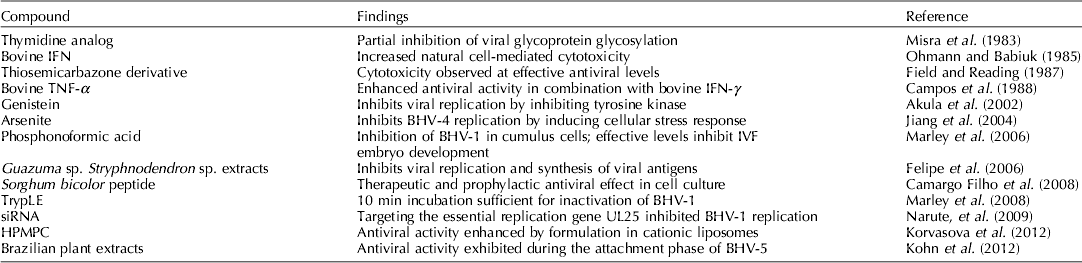
Despite the presence of licensed and commercially available antivirals for human herpesvirus infections, reports of effective compounds against BHV are relatively few. IFNs were one of the first compounds examined for anti-BHV activity (Table 2). Bovine blood leukocytes exposed to IFN have enhanced cytotoxicity to target cells, both in vitro and in vivo, which results in a reduction of viral yield and protection from virus-induced cytopathology (Ohmann and Babiuk, Reference Ohmann and Babiuk1985; Campos et al., Reference Campos, Ohmann, Hughes, Babiuk and Lawman1988). Furthermore, when calves were administered either IFN-α or IFN-γ prior to BHV-1 infection, the expected decrease in natural cell-mediated cytotoxicity following infection was not seen or was moderated. Intranasal or intramuscular treatment of calves with doses of IFN as low as 1 mg/animal before BHV-1 challenge reduced disease severity, duration, lesions scores and weight loss (Babiuk et al., Reference Babiuk, Ohmann, Gifford, Czarniecki, Scialli and Hamilton1985, Reference Babiuk, Lawman and Gifford1987; Czarniecki et al., Reference Czarniecki, Anderson, Fennie, Bielefeldt and Babiuk1985). However, treatment did not limit viral shedding and efficacy was limited if treatment did not precede viral exposure, which poses a challenge for field use. Another immunomodulator, bovine interleukin-1, increased the number of peripheral blood polymorphonuclear cells and increased the phagocytic activity of monocytes in cattle administered five doses of 300 ng kg−1 (Baca-Estrada et al., Reference Baca-Estrada, Godson, Hughes, Van, Van, Harland, Shuster, Daley and Babiuk1995). However, the treatment did not alter disease progression when calves were challenged with BHV-1 and Pasteurella haemolytica. Thus, immunoregulatory molecules, although potentially efficacious, will most likely be effective only in a combined antiviral regimen.
List of published studies with demonstrated antiviral activity against bovine herpesvirus (BHV)
IFN, interferon; TNF, tumor necrosis factor.
Very few targeted antiviral agents have proven effective against BHV in vivo. Proof of the concept of viral inhibition using RNAi has been demonstrated but remains largely untested (Narute et al., Reference Narute, Raut, Saini, Rai and Gupta2009). Nucleoside analogs have shown some promise in vitro but have not been effective in vivo (Misra et al., Reference Misra, Nelson and Babiuk1983; Salvatori et al., Reference Salvatori, Volpini, Vincenzetti, Vita, Costanzi, Lambertucci, Cristalli and Vittori2002). In vitro studies have demonstrated the antiviral activity of several plant products against BHV-1 (Simoni et al., Reference Simoni, Munford, Felicio and Lins1996; Felipe et al., Reference Felipe, Rincao, Benati, Linhares, Galina, de Toledo, Lopes, de Mello and Nozawa2006; Camargo Filho, I et al., Reference Camargo Filho, Cortez, Ueda-Nakamura, Nakamura and Dias Filho2008) or BHV-5 (Kohn et al., Reference Kohn, Queiroga, Martini, Barata, Porto, Souza and Arns2012), but it is unlikely that these will yield commercial products in the near future. One study demonstrated the ability of genistein to inhibit BHV-1 replication in cultured cells by inhibiting tyrosine kinase (Akula et al., Reference Akula, Hurley, Wixon, Wang and Chase2002). Genistein is a phytoestrogen and isoflavone found in several plants, including soybeans. The authors hypothesized that feeding cattle soya products with high levels of genistein during periods of stress may be beneficial, although this has yet to be demonstrated in field trials. Several herpesvirus antivirals licensed for human medicine have been evaluated for use in veterinary patients, including cats (Groth et al., Reference Groth, Contreras, Kado-Fong, Nguyen, Thomasy and Maggs2013), horses (Garre et al., Reference Garre, van der Meulen, Nugent, Neyts, Croubels, De and Nauwynck2007, Reference Garre, Gryspeerdt, Croubels, De and Nauwynck2009) and cattle (Korvasova et al., Reference Korvasova, Drasar, Masek, Turanek, Kulich, Matiasovic, Kovarcik, Bartheldyova, Koudelka, Skrabalova, Miller, Holy, Ledvina and Turanek2012). Calves with a latent BHV-1 infection had reduced clinical signs and viral replication when given a single dose of 20 mg/kg of (S)-1-(3-hydroxy-2-phosphonyl-methoxypropyl) cytosine (HPMPC) one day prior to iatrogenic recrudescence of the infection by corticosteroid administration (Gilliam and Field, Reference Gilliam and Field1993). However, viral shedding was not eliminated nor was establishment of latency prevented, presumably leaving treated calves capable of transmitting the virus to susceptible cohorts. Extralabel drug use in cattle is allowed only under certain conditions. Our current knowledge of the efficacy of human antivirals in cattle cannot justify their use in this species, nor can their use be justified from a food safety perspective.
Antiviral applications in BHV control
The ubiquitous nature of BHV in bovine populations makes control of the disease with antivirals difficult. Most of the cattle are exposed when young and develop latent infections that can recrudesce during periods of stress. Consequently, the most likely application for antiviral use in the control of BHV will not be to prevent or eliminate infection, but to limit clinical disease and virus transmission during periods of viral recrudescence. This application would seem to be most relevant in commingled calves entering the feedlot or backgrounding operations. Recrudescence in these calves leads to viral associated immunosuppression and can lead to secondary bacterial infection (Jones and Chowdhury, Reference Jones and Chowdhury2010). Consequently, minimizing viral immunosuppression will decrease the incidence of BRDC and its associated impacts. For such an application to be realized, an antiviral compound must not only be effective, but also easy to administer and cost-effective. Compounds adhering to these confines do not appear likely to be developed in the next 5–10 years.
Another potential application for antiviral usage in the control of BHV is in the washing of in vitro- and in vivo-derived bovine embryos. Currently, embryos are treated with porcine-origin trypsin as a means to prevent transmission of BHV-1. Trypsin effectively prevents infection of in vivo-derived embryos artificially exposed to BHV-1 (Stringfellow et al., Reference Stringfellow, Lauerman, Nasti and Galik1990) as well as in those exposed to the virus in vivo (Singh et al., Reference Singh, Hare, Thomas, Eaglesome and Bielanski1983). However, the treatment of in-vitro-derived embryos is more problematic; porcine-origin trypsin (D'Angelo et al., Reference D'Angelo, Visintin, Richtzenhain and Goncalves2009), a recombinant trypsin product (Marley et al., Reference Marley, Givens, Galik, Riddell, Looney and Stringfellow2008) and phosphonoformic acid (Marley et al., Reference Marley, Givens, Stringfellow, Galik and Riddell2006) have all proved inadequate at completely and safely preventing transmission of BHV-1 from in vitro-derived bovine embryos. Thus, the development of a safe and effective antiviral compound for use with in vitro-derived embryos would enhance the biosecurity of embryo transfer systems and mitigate risks of BHV transmission, which is a potential concern when implementing this reproductive strategy.
Other viruses
Demonstrated clinical applications of antivirals for the prevention or treatment of bovine viral diseases (BVDs), other than those caused by BVDV, FMDV or BHV, are scarce. Antiviral studies are largely limited to preliminary in vitro studies and development of commercial therapeutics or prophylactics for these other viruses will lag significantly behind those for BVDV, FMDV and BHV without a significant impetus to increase research and development funding. Bovine coronavirus and rotavirus are significant causes of calf morbidity and mortality secondary to diarrhea and dehydration. Limited in vitro antiviral studies have failed to lead to any clinically useful therapeutics (Clark et al., Reference Clark, Grant, Sarr, Belakere, Swaggerty, Phillips and Woode1998a, Reference Clark, Sarr, Grant, Phillips and Woodeb). Likewise, nearly 25 years ago, ribavirin was demonstrated to inhibit in vitro replication of bovine respiratory syncytial virus, an important etiologic agent in BRDC (Bartzatt and Anderson, Reference Bartzatt and Anderson1989), but has not proven desirable for commercial development. Closely related viruses that affect human beings are significant pathogens as well, and commercialization of bovine antivirals may well follow their development in human medicine where the potential financial reward is greater. Bovine virus strains tend to be species-specific, although limited cross-species and zoonotic transmission potential exists (Cook et al., Reference Cook, Bridger, Kendall, Gomara, El-Attar and Gray2004; Bidokhti et al., Reference Bidokhti, Traven, Krishna, Munir, Belak, Alenius and Cortey2013), requiring the need for additional testing in each host species of any newly developed drugs. Consequently, the commercial availability of veterinary antiviral compounds for these viruses is not likely to be realized in the near future.
Bluetongue is an important economic disease of domestic livestock that is reemerging in several regions. The epidemic caused by BTV serotype 8, which began in Belgium and rapidly spread throughout much of Europe (Elbers et al., Reference Elbers, Backx, Meroc, Gerbier, Staubach, Hendrickx, van der Spek and Mintiens2008), was due, at least in part, to the extended range of the arthropod vector secondary to altered weather patterns (Scolamacchia et al., Reference Scolamacchia, Van Den Broek, Meiswinkel, Heesterbeek and Elbers2013). Continuing changes in the vector range has the potential to result in epidemics in regions previously clear of the disease, where cattle are naïve to the virus and susceptible to infection. Prudent antiviral usage has the potential to limit such outbreaks, but effective compounds against BTV remain to be identified. Recent advances in assay development for the identification of BTV antivirals have been reported (Li et al., Reference Li, Maddox, Rasmussen, Hobrath and White2009; Gu et al., Reference Gu, Schneller and Li2013), and a limited number of compounds with in vitro efficacy identified (Li et al., Reference Li, Maddox, Rasmussen, Hobrath and White2009; Gu et al., Reference Gu, Musiienko, Bai, Qin, Schneller and Li2012), but we are unaware of any published reports of effective in vivo antiviral use to control BTV. Rather, current strategies to control BTV are focused vaccination, outbreak containment through restricted animal movement and culling, and vector control (as reviewed by Maclachlan and Mayo, Reference MacLachlan and Mayo2013). Similar strategies are currently the focus of control of the newly emerged Schmallenberg virus (Gibbens, Reference Gibbens2012). Studies on the nucleocapsid protein structure of the virus have identified potential target sites for future antiviral development (Ariza et al., Reference Ariza, Tanner, Walter, Dent, Shepherd, Wu, Matthews, Hiscox, Green, Luo, Elliott, Fooks, Ashcroft, Stonehouse, Ranson, Barr and Edwards2013; Dong et al., Reference Dong, Li, Bottcher, Elliott and Dong2013), but to our knowledge no effective compounds have yet been identified for further development.
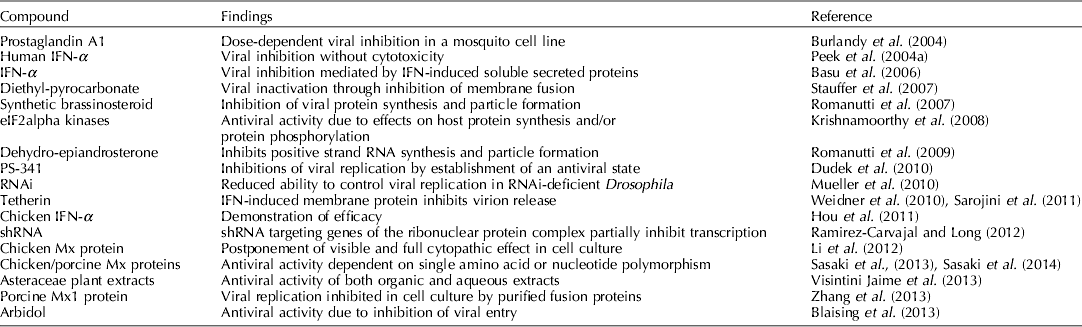
Vesicular stomatitis virus (VSV) is a prototypical member of the Rhabdoviridae family and serves as a representative of the negative-sense, nonsegmented and single-stranded RNA viruses for antiviral research (Table 3) (Basu et al., Reference Basu, Maitra, Xiang, Meng, Banerjee and Bose2006; Weidner et al., Reference Weidner, Jiang, Pan, Chang, Block and Guo2010). However, to our knowledge, development of antivirals to VSV for clinical use in bovine medicine is not currently being studied. Outbreaks of VSV are infrequent and usually limited to small geographical areas; mortality is low and usually associated with secondary bacterial infection. Thus, the primary clinical concern with VSV is as a differential diagnosis for FMD. Consequently, there is little regulatory or economic impetus to develop antiviral drugs effective against VSV for commercial use in cattle.
List of published studies with demonstrated antiviral activity against vesicular stomatitis virus (VSV)
IFN, interferon; RNAi, RNA interference; shRNA, short-hairpin RNA.
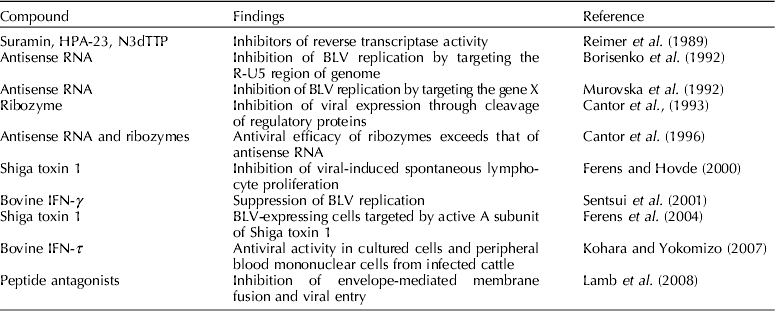
Likewise, bovine leukemia virus (BLV) is often used in antiviral research as a model of the lymphotrophic retroviruses (Sentsui et al., Reference Sentsui, Murakami, Inoshima, Yokoyama and Inumaru2001; Altanerova et al., Reference Altanerova, Holicova, Kucerova, Altaner, Lairmore and Boris-Lawrie2004), but extrapolation of in vitro results to the clinical setting will be challenging (Table 4). Current options for BLV control focus on herd prevalence monitoring and test-and-cull or test-and-segregate strategies (Bartlett et al., Reference Bartlett, Sordillo, Byrem, Norby, Grooms, Swenson, Zalucha and Erskine2014). One antiviral study reports a decrease in BLV titers when infected cattle were treated subcutaneously with bovine IFN-τ three times a week at a dose of 105–106 U/kg for at least 3 weeks (Kohara and Yokomizo, Reference Kohara and Yokomizo2007). While interesting, the relevance of this finding to the clinical setting is unknown, as <5% of BLV-infected cattle are expected to develop clinical lymphosarcoma. Theoretically, decreasing the viral titer may inhibit transmission of the virus, but this remains to be demonstrated and, given the endemic nature of infection in many regions of the USA, would be difficult to justify from an economic standpoint.
List of published studies with demonstrated antiviral activity against bovine leukemia virus (BLV)
IFN, interferon.
Summary
The potential for antiviral usage in bovine medicine is currently unrealized. Viral diseases, both endemic and epidemic, account for widespread economic losses, animal welfare issues and public health concerns in both the dairy and the beef sectors. Vaccines remain the only specific antiviral tool available to the bovine veterinarian for the control of viral diseases. For certain diseases, such as FMD, vaccination is not allowed in many countries except under very specific circumstances, such as containment of an active outbreak. In such scenarios, antivirals might be used to provide immediate protection for naïve animals during the onset of vaccinal protection. Additionally, differentiation of infected from vaccinated animals is a serious concern with many of our current vaccines used to control viral infections of regulatory concern; this is not the case with antivirals as their use does not preclude the use of current diagnostic testing. For many endemic viral diseases, such as BVD and IBR, antivirals could be best used as an adjunct therapy in the control of clinical disease and not strictly for the prevention of infection. Both diseases continue to cause significant losses despite the commercial availability of relatively effective vaccines. In situations where we know cattle will be stressed or exposed to novel viral strains, such as upon entry to the feedlot, antiviral prophylaxis could provide another means to limit viral transmission and improve animal health. However, before antiviral drugs become a reality in bovine medicine, additional research documenting efficacy and safety, both for the patient and the consumer, must be performed. Commercial development of antivirals for use in bovine medicine will provide the veterinarian an additional tool to improve animal health and to ensure a safe and plentiful global food supply.