Implications
Selection alpacas for meat and fiber traits can be interesting in developing rural communities in Peru, but research for relationships with other traits is needed. Genetic parameters obtained here showed high expectation of success if selection was conducted to increase weaning weight, also producing alpacas with better performance in animal conformation in animal show fairs. However, it will produce animals with slightly coarser fiber. Correlated changes in morphological and reproductive traits would have small relevance. Combined selection can be used If not negative impact was desired in any trait, but in this case improvement would be lower in all of them and mainly in weaning and fiber traits.
Introduction
As a consequence of Spanish discovering America carrying their own livestock, alpacas were relegated to the rugged highlands of the Andes, this is currently their resource to meet the indispensable energy to survive, to breed, to produce fiber and to nurse offspring. Under this scenario alpaca livestock is still the economic livelihood of many families who depend on their products and by-products, such as fiber and meat (Quispe et al., Reference Quispe, Rodriguez, Iñiguez and Mueller2009). While producing fiber has an annual return, alpaca meat has a short-term trading, thus becoming an important economic income in the high Andean families. Also, alpacas are the only animal protein supply in some cases (Wheeler, Reference Wheeler1993).
Peru is the largest country in the world breeding alpacas, with a population over 3.5 million of animals, because of that, the government has approved many regulations in order to promote alpaca show fairs and production of quality fiber, but the best animals in morphological competitions are not always the best animals producing fiber (Cervantes et al., Reference Cervantes, Pérez-Cabal, Morante, Burgos, Salgado, Nieto, Goyache and Gutiérrez2010; Cruz et al., Reference Cruz, Cervantes, Burgos, Morante and Gutiérrez2015). As a consequence there might be low genetic improvement due to the possible low or null genetic correlations between the criteria used to choose the best morphological and productive animals. It is not clearly delimited the selection objective in alpacas in Peru. For the textile industry the added value is obtained from the quality of the fiber measured by the finesse and low variability of fiber diameter, whereas for the developing communities they are also, or even more important, the fleece weight and traits regarding morphological competitions or the total weight of animals weaned. Given the underdevelopment of rural areas, the ideal alpaca, as thought by local breeders, would produce quality fiber, with a good conformation to win morphological alpaca shows and simultaneously provide a good income in the short-term producing meat. On the other hand, consumption of camelids meat is increasing because of its healthy properties, highlighting the low cholesterol level and the high yield in percentage of carcass to slaughter, 54.3% in alpacas reported by Smith et al. (Reference Smith, Bush, Thomson and Hopkins2015), or values between 46.2% and 59.4% in Chilean llama’s (Mamani-linares and Gallo, Reference Mamani-Linares and Gallo2013). Among South American camelids the llama is phenotypically the best adapted for meat production while the alpaca is mainly bred for fiber but also for meat as a secondary product. Some biometric traits such as birth weight (BW), weaning weight (WW) and weaning withers height (WH), could be of interest for meat production. Even though traits measured at weaning are usually defined as one of the possible selection objectives in breeding programs, traits measured at birth are also usually registered and could be used as selection criteria if they were highly heritable having a strong genetic correlation with the formers.
Significant correlations between size and weight traits have been reported in lamas (Wurzinger et al., Reference Wurzinger, Delgado, Nurnberg, Zarate, Stemmer, Ugarte and Solkner2005). Regardless age, the larger animals have been shown to produce greater benefits in lamas at slaughtering (Cristofanelli et al., Reference Cristofanelli, Antonini, Torres, Polidori and Renieri2005). However, no genetic correlations have been reported between this type of traits and fiber performance. Preweaning traits are important in meat livestock species. These traits are affected by maternal influence, which has to be modeled in genetic evaluation for a better fit but also because its genetic component can be also selected if needed and because of possible genetic relationships with other interesting traits. Survival at 15 days is another important economic trait in alpacas. Because of the economic impact, survival has been analyzed in other species, usually as a binary trait, as farrowing survival until 15 days after birth, or as survival from 15 days to preweaning, similar to survival analyzed in piglets reported by Knol et al. (Reference Knol, Leenhouwers and Van der Lende2002).
In Peru the main goal remains being the production of fine fiber, but there are opportunities for trade, selling meat or live animals. Some interesting traits to improve from this side of the production would be the weaning weight or the number of weaned animals, but also carcass performance and carcass quality traits. Hence it seems to be important assessing the genetic parameters for growth and survival traits and their genetic correlation with fiber, morphological and reproductive traits. Genetic parameters for several productive, morphological and reproductive traits have been previously estimated, but nothing has still been done about preweaning traits and their relationship to the current selection objectives. Then, the aim of this work was to estimate genetic parameters for preweaning traits and their genetic relationship with fiber, morphological and reproductive traits as a first step to consider the possibility of including some of them as selection criteria in alpacas.
Material and methods
Data
Data were collected from 2001 to 2015 in the Pacomarca experimental farm in southern Peru. Huacaya and Suri variants are raised by this farm. They have been called breeds in the past, but they will be called variants here given that it has been shown that these varieties are explained by a very low number of genes (Presciuttini et al., Reference Presciuttini, Valbonesi, Apaza, Antonini, Huanca and Renieri2010). Records were obtained from PacoPro v.5.2, the software used for animal husbandry management of Pacomarca experimental farm that contained 4330 females and 3788 males from 6396 and 1722 animals for Huacaya and Suri variants, respectively. For the Huacaya variant, there were 5871 animals with records, 154 sires with progeny in the data, 32.37 average offspring per sire, 1457 dams with progeny in the data, 87 sires with records and offspring and 750 dams with records and offspring. For the case of the Suri variant, there were 1580 animals with records, 70 sires with progeny in the data, 20.34 average offspring per sire, 440 dams with progeny in the data, 22 sires with records and offspring and 177 dams with records and offspring. PacoPro v.5.2 integrates profuse information concerning all the activities leading to a better management of alpacas. Both Huacaya and Suri variants are bred in Pacomarca, where they are managed together except that mating is restricted within variant. Thus, two independent data sets have to be considered. Registered traits included BW, WW, birth withers height (BH), WH, and average daily gain (DG) from birth to weaning; survival at weaning (SW) was also registered and analyzed as a binary trait with one being scored for death and two for alive animals. SW trait was not Gaussian distributed. However, restricted maximum likelihood methodology has been shown to perform ideally in such circumstances (Roehe, Reference Roehe1999; Ligda et al., Reference Ligda, Gabriilidis, Papadopoulos and Georgoudis2000; Gutiérrez et al., Reference Gutiérrez, Cervantes, Pérez-Cabal, Burgos and Morante2007). These traits were analyzed jointly with others in order to assess the genetic correlations among all of them. Therefore, two additional sets of traits were used:
(a) Reproductive traits as described by Cruz et al. (Reference Cruz, Cervantes, Burgos, Morante and Gutiérrez2015): Age at first calving as the age in days of the mother when her first birth and calving interval as the time in days between two consecutive births. (b) Fiber traits as described by Gutiérrez et al. (Reference Gutiérrez, Goyache, Burgos and Cervantes2009) and Cervantes et al. (Reference Cervantes, Pérez-Cabal, Morante, Burgos, Salgado, Nieto, Goyache and Gutiérrez2010): fiber diameter (FD), comfort factor (CF) this is defined as the percentage of fiber with <30 μm, standard deviation of FD (SD) and coefficient of variation of FD (CV). Both SD and CV address the variability of the sample, the first one of interest for the textile industry, and the second one usually accounted to score animals in shows. More important than variability, and given that the fiber diameter distribution is skewed to the right, what really matters is the percentage of fibers exceeding 30 microns which are attributed to be causing to them the responsibility of prickling. This is the reason of using CF. These traits were recorded from washed samples after minicored and 400 snippets of 2 mm using an optical fiber diameter analyzer. It is necessary to clarify that there is a very relevant fiber diameter variation along the fleece, which is usually removed by separating fleece portions in the classing shed at the alpaca fiber processing facility. That is not studied in this text. SD and CV are instead addressing the remaining variation within staple. (c) Subjective morphological traits scored from 1 to 5 as described by Cervantes et al. (Reference Cervantes, Pérez-Cabal, Morante, Burgos, Salgado, Nieto, Goyache and Gutiérrez2010): Density of fiber, crimp of fiber in Huacaya and lock structure of fiber in Suri, head conformation, coverage of legs and balance between head, body and legs. Note that lock structure is used in this context to describe the particular light crimp of Suri fleece unlike Huacaya.
Data sets were edited in order to exclude animals with identification errors or ambiguous birth dates. The age at recording was mandatory and ranged from 61 to 7212 days across traits. The number of Huacaya and Suri animals in the pedigree file was respectively 6396 and 1722 individuals. Number of records and mean for all the involved traits for Huacaya and Suri variants are shown in Table 1.
Number of records and means in Huacaya and Suri variants

BW=birth weight; BH=birth withers height; WW=weaning weight; WH=weaning withers height; DG=average daily gain; SW=survival to weaning; FD=fiber diameter; SD=standard deviation; CF=comfort factor; CV=coefficient of variation.
Methods
Genetic parameters were estimated via a multitrait restricted maximum likelihood procedure applied to mixed linear models. Preweaning, reproductive, morphological and fiber traits were analyzed all together.
The model fitted for age at first calving, density, crimp, lock structure, head, coverage and balance was:
 $${\bf y}\,{\equals}\,{\bf Xb}{\plus}{\bf Zu}{\plus}{\bf e}$$
The model fitted for calving interval, FD, SD, CF and CV was:
 $${\bf y}\,{\equals}\,{\bf Xb}{\plus}{\bf Zu}{\plus}{\bf Pp}{\plus}{\bf e}$$
and the model fitted for BW, BH, WW, WH, DG and SW was:
 $${\bf y}\,{\equals}\,{\bf Xb}{\plus}{\bf Zu}{\plus}{\bf Wm}{\plus}{\bf e}$$
 $$\eqalignno{ &{\rm with}\,\left( {\matrix{ {\bf{u}} \cr {\bf{m}} \cr {\bf{p}} \cr {\bf{e}} \cr } } \right)\!\sim\,N\left( {\left[ {\matrix{ {\bf{0}} \cr {\bf{0}} \cr {\bf{0}} \cr {\bf{0}} \cr } } \right],\left[ {\matrix{ {{\bf{A}} \,\otimes\,{\rm G}_{0} } & {{\bf{A}} \,\otimes\,{\bf{C}} _{{\bf{0}} } } & {\bf{0}} & {\bf{0}} \cr {{\bf{A}} \,\otimes\,{\rm C}_{0} } & {{\bf{A}} \,\otimes\,{\bf{M}} _{{\bf{0}} } } & {\bf{0}} & {\bf{0}} \cr {\bf{0}} & {\bf{0}} & {{\bf{I}} _{{\bf{p}} } \,\otimes\,{\bf{P}} _{{\bf{0}} } } & {\bf{0}} \cr {\bf{0}} & {\bf{0}} & {\bf{0}} & {{\bf{I}} _{{\bf{e}} } \,\otimes\,{\bf{R}} _{{\bf{0}} } } \cr } } \right]} \right),$$
where, y is the vector of observations, b the vector of fixed effects, u the vector representing the additive genetic effects, m the vector representing the maternal genetic effects, p the vector of permanent environments of individuals for fiber traits and calving interval, e the vector of residuals; X, Z, P and W the incidence matrices for fixed, direct genetic, permanent and maternal genetic effects, respectively, I e the identity matrix of equal order to the number of records, I p the identity matrix of equal order to the number of permanent environmental subclasses, A the numerator relationship matrix, R 0 the residual covariance matrix among measurements on the same animal, G 0 the covariance matrix for additive genetic effects, M 0 the covariance matrix for maternal genetic effects, C 0 the matrix for covariance between direct and maternal genetic effects, P 0 the covariance matrix for permanent environmental effects and ⊗ the Kronecker product.
Heritability and genetic correlations were obtained from the variance components as follows:
 $$h_{d}^{2} \,{\equals}\,{{\sigma _{a}^{2} } \over {\sigma _{p}^{2} }};\,\,h_{m}^{2} \,{\equals}\,{{\sigma _{m}^{2} } \over {\sigma _{p}^{2} }};r_{g} \,{\equals}\,{{\sigma _{{am}} } \over {\sqrt {\sigma _{a}^{2} \sigma _{m}^{2} } }}$$
where,
 $h_{d}^{2} $
is the heritability for direct genetic effect,
 $h_{m}^{2} $
the maternal heritability,
 $\sigma _{a}^{2} $
the direct additive genetic variance,
 $\sigma _{m}^{2} $
the maternal additive genetic variance,
 $\sigma _{p}^{2} $
the phenotypic variance, r
g
the correlation between both direct and maternal genetic effects, and σ
am
the covariance between both direct and maternal genetic effects.
The fixed effects included in the models for BW, WW, BH, WH and SW were: sex (two levels), color (three levels, white, cream and black), number of calving (11 levels, grouping also in the last level those are >11) and month–year of calving as contemporary group (44 levels) for all of them, and also age at weaning as linear covariate for WW and WH. Combining both the month and the year as a unique month–year fixed effect as contemporary group, allowed removing the influence of both effects and its interaction. Thus, only animals performing in a particular month within a particular year belonged to the same level of the effect. The fixed effects for reproductive traits were: color (three levels) and year of recording as contemporary group (14 levels), and also age as linear and quadratic covariate. The fixed effects for fiber traits were: color (three levels), year of recording as contemporary group (14 levels), sex (two levels) and age as linear and quadratic covariate. For the morphological traits the fixed effects were: color (three levels), sex (two levels) and year of recording as contemporary group (10 levels). Coat color was fitted in the model to reduce the residual variance in the analyses as there are significant differences between colors as a consequence of a different selection intensity across color coats. Huacaya and Suri variants were independently analyzed. Genetic parameters were estimated using the VCE 6.0 program (Neumaier and Groeneveld, Reference Neumaier and Groeneveld1998). This software uses REML methodology (Patterson and Thompson, Reference Patterson and Thompson1971) to carry out variance component estimations.
Results
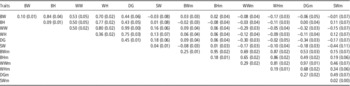
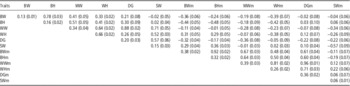
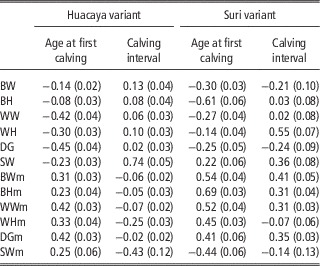
Direct and maternal heritability and genetic correlations estimates for preweaning traits are shown in Table 2 for Huacaya and Table 3 for Suri variant. Hereinafter an ‘m’ has been added to the initials of the traits in which the maternal effect is fitted, in order to refer to this effect. Estimated direct heritabilities for preweaning traits in Huacaya variant were high for WW (0.50) and DG (0.45), moderate for WH (0.36) and very low for BW, BH and SW, while estimated maternal heritabilities for preweaning traits were moderated for BWm (0.25), WWm (0.29) and DGm (0.27) and low for BHm, WHm and SWm. Corresponding direct heritabilities for Suri variant were higher for WH (0.66), and moderate for the rest of traits. Estimated maternal heritabilities were moderated for BWm (0.38), BHm (0.32), WWm (0.39), WHm (0.26) and DGm (0.36) and very low for SWm. The estimated heritabilities for the maternal genetic effect for preweaning traits tended to be moderate, being higher than the direct heritability for birth traits but lower for weaning traits in both variants except for WW in Suri. Both direct and maternal heritabilities of SW resulted much smaller in both variants. The direct genetic correlations within preweaning traits were positive between moderate and high, from 0.43 to 0.99 in Huacaya and from 0.21 to 0.88 in Suri. The direct genetic correlations between SW and preweaning traits resulted very low in Huacaya but moderate to high in Suri with traits measured at weaning an negligible with traits measure at birth. Genetic correlations between direct and maternal genetic effects for the Huacaya variant were moderate and negative for WW–WWm, DG–WWm, WW–DGm, DG–DGm and SW–SWm; and low for the correlation between the other pairs of traits, the maternal genetic correlations were moderate to high and positive in the range of 0.34 to 0.97 except for BWm–SWm and BHm–SWm. The genetic correlations between direct and maternal effects for Suri variant were moderate and negative between BW–BWm, BH–BWm, DG–BWm, BW–BHm, BH–BHm, WW–WWm, DG–WWm, BW–WHm, BH–WHm, WW–WHm, WH–WHm, WW–SWm, WH–SWm, DG–SWm, SW–SWm and moderated and positive between WH–BWm, SW–BWm, WH–BHm and SW–BHm; and lower for the rest of pairs of traits, the maternal genetic correlations were moderate to high and positive in the range of 0.22 to 0.96, except for the correlations between BWm–SWm, BHm–SWm, WWm–SWm and DGm–SWm.
Heritabilities (in diagonal), between traits direct and maternal genetic correlations (above diagonal) and their corresponding standard errors (in brackets) for preweaning traits in Huacaya variant

BW=birth weight; BH=birth withers height; WW=weaning weight; WH=weaning withers height; DG=average daily gain; SW=survival to weaning.
BWm, BHm, WWm, WHm, DGm and SWm are the maternal genetic effects for preweaning traits, respectively.
Heritabilities (in diagonal), between traits direct and maternal genetic correlations (above diagonal) and their corresponding standard errors (in brackets) for preweaning traits in Suri variant

BW=birth weight; BH=birth withers height; WW=weaning weight; WH=weaning withers height; DG=average daily gain; SW=survival to weaning.
BWm, BHm, WWm, WHm, DGm and SWm are the maternal genetic effects for preweaning traits, respectively.
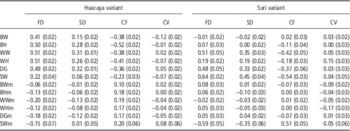
The direct and maternal genetic correlations of preweaning and fiber traits are shown in Table 4 for Huacaya and Suri variants. As some of the involved traits are willed to be decreased while others are willed to be increased and the sign of the correlations can be misinterpreted, hereinafter the discussion will be dealt in terms of favorable v. unfavorable instead of positive v. negative during the discussion. The genetic correlations were unfavorable from moderated to high in Huacaya, from 0.22 to 0.51 involving FD, and from −0.23 to −0.52 involving CF; direct genetic correlations of preweaning and SW traits with traits assessing fiber variability were poorer or insignificant in Huacaya, with the highest being that of 0.32 for DG–SD. Less direct genetic correlations were found relevant in Suri variant, between WW–FD, DG–FD, SW–FD, WW–SD, DG–SD, SW–SD, WW–CF, DG–CF and SW–CF, all of them unfavorable. The direct genetic correlations between CV and preweaning traits were very low in both variants. The corresponding maternal genetic correlations were very low in both Huacaya and Suri variants, except for SWm–CF in Huacaya and SWm–FD, SWm–SD and SWm–CF in Suri variant.
Direct and maternal genetic correlation and their corresponding standard errors (in brackets) for preweaning and fiber traits in Huacaya and Suri variant

BW=birth weight; BH=birth withers height; WW=weaning weight; WH=weaning withers height; DG=average daily gain; SW=survival to weaning; FD=fiber diameter; SD=standard deviation; CF=comfort factor; CV=coefficient of variation.
BWm, BHm, WWm, WHm, DGm and SWm are the maternal genetic effects for preweaning traits, respectively.
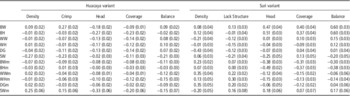
Direct and maternal genetic correlations of preweaning and morphological traits are shown in Table 5 for both variants. In general the correlations were low for Huacaya variant in both direct and maternal genetic effects, being that of −0.33 between SWm–head the highest in absolute value. There were some higher genetic correlations in the case of Suri variant in both direct and maternal genetic correlations. The direct and maternal genetic correlations between preweaning and reproductive traits are shown in Table 6 for both variants. Favorable genetic correlations were found from moderated to high in Huacaya variant for direct genetic correlations between WW–age at first calving, WH–age at first calving, DG–age at first calving, and very high and unfavorable between SW–calving interval, while the maternal genetic correlations were unfavorable between all the new studied traits with age at first calving (0.23 to 0.42), favorable between WHm–calving interval and SWm–calving interval. In the Suri variant the direct and maternal genetic correlations were from low to high (0.02 to 0.69 in absolute value), being favorable between BW–age at first calving, BH–age at first calving, WW–age at first calving, DG–age at first calving, SWm–age at first calving, BW–calving interval, DG–calving interval and unfavorable for the rest of pairs of traits.
Direct and maternal genetic correlation and their corresponding standard errors (in brackets) for preweaning and morphological traits in Huacaya and Suri variant

BW=birth weight; BH=birth withers height; WW=weaning weight; WH=weaning withers height; DG=average daily gain; SW=survival to weaning.
BWm, BHm, WWm, WHm, DGm and SWm are the maternal genetic effects for preweaning traits, respectively.
Direct and maternal genetic correlation and their corresponding standard errors (in brackets) for preweaning and reproductive traits in Huacaya and Suri variant

BW=birth weight; BH=birth withers height; WW=weaning weight; WH=weaning withers height; DG=average daily gain; SW=survival to weaning.
BWm, BHm, WWm, WHm, DGm and SWm are the maternal genetic effects for preweaning traits, respectively.
Discussion
In this paper the main genetic parameters for preweaning traits have been estimated as well as their genetic correlations with other interesting productive, morphological and reproductive traits in order to consider them as candidates to selection criteria in alpacas breeding programs. To our knowledge this is the first time this has been carried out under the Peruvian environmental conditions. There has been a wide range of estimated heritabilities for birth traits in the past. Those found here for BW and BH were much lower than those reported by Wuliji et al. (Reference Wuliji, Davis, Dodds, Turner, Andrews and Bruce2000). Maternal heritabilities become higher for these birth traits, showing that improvement of these traits should have to be focused selecting mothers. Wuliji et al. (Reference Wuliji, Davis, Dodds, Turner, Andrews and Bruce2000) compared the heritabilities for BW and FD in alpacas and sheep in New Zealand and they reported estimates of 0.63 and 0.73 for BW, and 0.13 and 0.51 for FD respectively for alpacas and sheep, Wurzinger et al. (Reference Wurzinger, Delgado, Nurnberg, Zarate, Stemmer, Ugarte and Solkner2005), reported heritabilities estimates of 0.36 and 0.27, respectively, for BW and BH in Bolivian Lamas.
Estimated direct heritabilities were much higher for the traits recorded at weaning, with a somehow lower maternal heritability. Therefore, in the case of selecting to improve weaning traits, efforts should have to be preferably done on the direct genetic effect. These values were similar to those reported by Wuliji et al. (Reference Wuliji, Davis, Dodds, Turner, Andrews and Bruce2000) in alpacas in New Zealand. The direct and maternal heritabilities estimated for SW were very low in Huacaya and slightly higher in Suri. The heritability of SW has been estimated at 0.07 in sheep (Zishiri et al., Reference Zishiri, Cloete, Olivier and Dzama2013), showing the natural low magnitude of this trait, but comparisons have to take into account that the species and conditions of rising are also very important factors of discrepancies.
Discrepancies between the parameters obtained here and others previously reported in the literature can strongly depend on the fitted model, and particularly on the inclusion or not of the maternal effect in the model and its relationship with the direct genetic effect. This was discussed by Boujenane et al. (Reference Boujenane, Chikhi, Ibnelbachyr and Mouh2015), when estimating parameters in D’man sheep; then, the direct genetic heritability decreased in BW and WW traits when the maternal genetic effect was included in the model (Ligda et al., Reference Ligda, Gabriilidis, Papadopoulos and Georgoudis2000). Roehe (Reference Roehe1999) suggested that maternal genetic effect would have to be fitted for BW in pigs, although the BW direct heritability become smaller than the maternal heritability (Knol et al., Reference Knol, Leenhouwers and Van der Lende2002), as reported here in alpacas for the same trait.
The objective of this work was to evaluate the possibility of including some of the preweaning traits as additional selections objective in alpacas to improve meat production. In this sense, heights are probably more related to morphological balance than weights (Tables 2 and 3). Given the relevant direct and maternal heritabilities of weaning traits (WW, WH and DG) it would be expected a good response to selection, unlike birth traits (BW and BH) with lower direct heritabilities. The correlations between direct and maternal genetic effects were similar to those reported in sheep by Ligda et al. (Reference Ligda, Gabriilidis, Papadopoulos and Georgoudis2000) for preweaning traits, these genetic correlations resulted higher in Suri maybe because of a smaller number of records for this variant.
Therefore, it can be concluded that selection for increasing weights would be successful, and, given the very high direct genetic correlations between BW and BH, animals would become taller and better looking. As commented before, weaning traits would be preferred as selection criteria in alpaca breeding programs instead of birth traits, but not only because of their higher direct and maternal heritabilities, but also because the weaned animal is the final product of an alpaca breeder selling animals. These weaning traits, WW, WH and DG, resulted with high genetic correlations between them (0.75 to 0.99), what would ensure favorable selection for all of them in both variants. Among these traits, WW would be the trait of election to be used as selection criterion in alpacas, having in addition the highest direct and maternal heritabilities in both variants. Concerning survival, the low direct and maternal heritabilities of SW advices initially ignoring it as a suggested trait to be genetically selected. On the other hand, SW would be indirectly selected in Suri variant given its high favorable direct genetic correlation with weaning traits.
WW has been concluded to be the trait of election to be included in alpacas breeding programs among all those studied here, but selecting to improve it, might have consequences in other economically important productive and reproductive traits due to their genetic relationships. Likewise, current ongoing selection can be carrying consequences in preweaning traits. Main selection objectives in alpacas are related to fiber production (Wuliji et al., Reference Wuliji, Davis, Dodds, Turner, Andrews and Bruce2000; Quispe et al., Reference Quispe, Rodriguez, Iñiguez and Mueller2009; Gutiérrez et al., Reference Gutiérrez, Goyache, Burgos and Cervantes2009 and Reference Gutiérrez, Varona, Pun, Morante, Burgos, Cervantes and Pérez-Cabal2014; Cervantes et al., Reference Cervantes, Pérez-Cabal, Morante, Burgos, Salgado, Nieto, Goyache and Gutiérrez2010; Paredes et al., Reference Paredes, Membrillo, Gutiérrez, Cervantes, Azor, Morante, Alonso-Moraga, Molina and Muñoz-Serrano2014; Cruz et al., Reference Cruz, Cervantes, Burgos, Morante and Gutiérrez2015), and genetic correlations between fiber and preweaning traits (Table 4) suggest that selecting for meat production would bring about animals with greater weight and size, this leading to coarsening the fiber increasing the diameter and loosing comfort factor, particularly in Huacaya, but also in a lesser extent in Suri. The influence of the live weight and subjective conformation traits on wool traits had already been reported in sheep (Matebesi et al., Reference Matebesi, van Wyk and Cloete2009a and Reference Matebesi, van Wyk and Cloete2009b). However, the influence on the variability of the fiber seemed to be lower. From the opposite point of view, selecting to decrease the fiber diameter would lead to smaller animals. This would be against the Peruvian programs developed with the objective of improving the fiber production but stating better score for larger animals. In fact regarding height, this program states a score of 10 over 10 to animals with withers height higher than 80 cm, and a score of zero to animals under 70 cm. and, regarding weight, the best score would be for alpacas weighing >25 kg at weaning. The successful selection carried out to decrease fiber diameter in Pacomarca from 2007 to 2015 has led to animals with withers height of 72.5 cm and 72.1 cm and 24.5 kg and 24.2 kg of WW on average for respectively Huacaya and Suri variants, but these animals are widely appreciated in Peru because of their performance in fiber. Moreover, it is expected that size will continue decreasing as a consequence of continuing selecting with the same objective. An alternative would be selecting for both fiber and size traits by using appropriate genetic index (Gutiérrez et al., Reference Gutiérrez, Varona, Pun, Morante, Burgos, Cervantes and Pérez-Cabal2014), but this would reject some elite animals for fiber traits as breeding animals, and genetic progress will slow down for the most economically important traits. Therefore, if double fiber and meat aptitude animals are willed, as the fiber is the origin of the main income for alpaca farmers, a little weight would have to be given to WW in a hypothetical genetic index. On the other hand, it will be noted that this research has been developed in the framework of an experimental farm belonging to the alpaca industry. Thus, from the point of view of the local developing communities, the fleece weight would be a trait of probably higher interest, and this trait would be probably increased with the size of the animals. However fleece weight strongly depends on other environmental factors such as shearing interval resulting in a lower heritability value (0.10) in this population (Gutiérrez et al., Reference Gutiérrez, Goyache, Fernández, Álvarez and Royo2011).
The second group of selected traits in order of interest are the subjective morphological traits in Pacomarca, fortunately there were very few unfavorable genetic correlations that would become somehow important (Table 5), favorable genetic correlations were found between BW–crimp and BH–coverage and unfavorable ones between BH–head in Huacaya, unfavorable genetic correlations were found between WW–density and slightly higher between DG–density, and higher and favorable genetic correlations between birth traits and head, coverage and balance in Suri. As morphological traits are scored at weaning, the most relevant genetic correlations with morphological traits were expected to be found for the traits recorded at weaning, but this was not the case. Gutiérrez et al. (Reference Gutiérrez, Varona, Pun, Morante, Burgos, Cervantes and Pérez-Cabal2014), pointed out that density and crimp or lock structure were the most relevant morphological traits and fortunately these are not particularly affected by the body size of the animals, with the exception of DG in Suri. Another remarkable result in Suri was that birth traits were importantly favorable correlated with the three traits directly related to the appearance of the animal, similar in genetic correlations between some live weight traits and subjective conformation traits were also reported in Tygerhoeck Merino flock by Matebesi et al. (Reference Matebesi, van Wyk and Cloete2009b). Finally, although correlations were low, it could be considered worrying that genetic correlations between SW and morphological traits were most of them unfavorable, given that selecting to improve morphology would bring about lower survival.
Cruz et al. (Reference Cruz, Cervantes, Burgos, Morante and Gutiérrez2015) have recently established the genetic parameters for several reproductive traits as well as their genetic correlations with fiber and morphological traits, and they concluded the relevance of age at first calving and calving interval because of the magnitude of their heritabilities and their genetic correlations with productive traits. Genetic correlations between preweaning and reproductive traits were more relevant in Suri, with the highest genetic correlations in absolute value found in birth traits, unlike in Huacaya in which the most relevant genetic correlations were found for weaning traits (Table 6). Again, fortunately most of the estimated genetic correlations between preweaning and reproductive traits were found favorable and many of them of moderate magnitude. A group of correlations worth mentioning are those involving SW, particularly that with calving interval in Huacaya variant, it reflects a genetic selection that will be naturally produced against this reproductive trait because those females genetically trending to have a higher calving interval will genetically trend to better survive. Fortunately this selection will have a low success given the weak magnitude of the SW heritability. It has to be noted that estimated genetic correlations between preweaning traits and age at first calving are conditioned by reproductive management, because 2 years old females are admitted to breeding only if the animal looks big enough. Therefore, larger animals are bred first within the reproductive season, breeding smaller animals only at the end of the season.
When analyzing maternal genetic correlations of the traits studied here with other traits, they were found to be with the opposed sign. In all that has been commented so far, the genetic correlations that were favorable regarding direct effects, are detrimental concerning maternal effects, becoming important which of those correlations have greater magnitude in absolute value. Genetic correlations between maternal effects of preweaning and survival traits with fiber traits were in general small, with the exception of SWm in Suri variant. Instead, these maternal genetic correlations were higher than direct ones when affecting morphological traits, especially for the lock structure in Suri at weaning, and only slightly unfavorable with traits recorded at birth. When addressing these maternal genetic correlations concerning reproductive traits, maternal genetic effects for reproductive traits were similar to the direct genetic correlations but unfavorable with age at first calving in both variants counterbalancing among them, not being so important with calving interval.
Concluding that selecting to increase WW would be advised mainly because weaned animals can be considered as a product of alpaca breeders, other weaning traits such as WH or DG would be indirectly selected. The selection would be based on the direct genetic effect for WW and not on its maternal genetic effect. Genetic correlations between preweaning and other traits showed that animals selected for fiber production would not be suitable to compete in livestock fairs that are established concerning morphological traits. Those fiber selected animals would not be either appropriate for meat production. It could be possible to establish different select indexes for males and females according to respectively growth and reproductive traits. However, as an offspring receives half of its genes from both father and mother, the weight of the different traits would be dependent on the different selection intensities defined by sexes, and not according to a willed interest of breeders. Combining different objectives in a genetic index would allow considering simultaneously all the traits in the selection process, but it would bring about a reduction in the genetic response of each of them. Taking clear decisions about the willed production aptitudes of the animals would be essential from the beginning. Also considering reproductive traits in the index would be advised, even with lower weight as the maternal genetic component partially compensates the negative impact of the direct genetic effect on them. Strictly speaking a multitrait breeding objective function could be developed including all traits of economic importance for a particular production system. Selection indices could then be constructed with data recorded so as to maximize the correlation between the breeding objective and the index. Such index would also maximize economic gain. Unfortunately, as economic weights are controversial to be addressed, and they depend on the stratum involved, the economic impact of the culling resulting from the Peruvian governmental policies considering minimum sizes of animals is also controversial. As the best animals according to fiber criteria, appeared of lower weight and size, reconsidering Peruvian governmental policies would be advised.