Wh-movement in questions is a central topic of contemporary syntax as well as theoretical approaches to language acquisition. Much work on the acquisition of wh-questions in the last decades has shown the adherence of children's developing grammars to abstract syntactic principles. The studies establishing these behaviors have been small scale, and have typically involved small samples of middle-class children speaking mainstream American English (MAE) or a handful of other languages. It is important to find out how robust are the facts on which the arguments are based. Will a larger, more diverse sample of children show similar knowledge of subtle grammatical properties? To what extent is this course of development susceptible to disruption in language impairment?
The current study presents data that can answer these questions. Using 13 different structures taken from previous studies by our research group and others, we examine when children permit long-distance (LD) movement in complex wh-questions, and when they respect a variety of syntactic “barriers” to that wh-movement. The children in the experimental groups differed according to age, dialect, and clinical status, as well as several control variables such as gender, socioeconomic status (SES) and geographic region. We examine children who speak MAE as well as African American English (AAE), a neglected variety.
Before discussing the study itself, it is necessary to give a brief background to two-clause wh-questions and consider why they are linguistically interesting for language acquisition research. The wh-phenomena are complex but principled, and hence, have the right properties to serve as a test of the ideas linking universal grammar (UG) and language acquisition. Given abstract, universal principles that appear difficult or impossible to acquire from the contexts of learning, then it is argued they should be part of the fundamental machinery of language acquisition in children, part of UG. If the principles are respected by children in their earliest experience with embedded clauses, then it will be evidence for the UG account. However, given the complexity of wh-questions, even within a UG framework, one would not expect all of their properties to be acquired at once.
Three characteristics of wh-questions make them particularly interesting from a syntactic point of view.
First, the wh-word can be considered to have two parts: a grammatical signal in the first sound wh- (cf. qu in French) and a second part that connects to other lexical items. For instance, one can analyze the words in Example 1 lexically as
1.


Therefore, one can explore whether factors affecting the acquisition of their syntactic behavior differ from those affecting the acquisition of their lexical properties.
Second, there are contrasts in the function of different wh-constructions that cause differences in the way wh-movement proceeds. The principal difference is between arguments and adjuncts within a sentence. Argument questions refer to “arguments of the verb”: subjects and objects, and possibly indirect objects for verbs like give. These roles are obligatory: they must be filled in a sentence, as the sentence is incomplete without them. Who and what replace argument constituents of sentences. In contrast, adjunct wh-words focus the question on less central, or “oblique” roles of the verb: how, why, and when ask about constituents that tell the manner, the time, or the reason for some action or state. They give important information, but they are not obligatory: the sentence could be grammatical without them. Where behaves sometimes as an argument, and sometimes as an adjunct, as some verbs require a place argument (e.g., put). Wh-words behave differently according to whether they play the role of an argument or an adjunct. A study of wh-question acquisition, therefore, should take this crucial distinction into account.
Third and finally, wh-questions are subject to movement rules, phenomena that are especially interesting to syntacticians. English (and many other languages) allows displacement of a question across more than a single clause. Consider a question such as the following:
2. When did she say she bought the car?
One can imagine circumstances in which the question would be ambiguous, for example, is it asking “when did she tell you about it” or “when did she buy the car?” The wh-question can thus originate in an embedded clause (“when did she buy”) and move over an LD to the front of the sentence, or it can originate with the first or matrix verb (“when . . . say”) and move only a short distance (SD).
THE SYNTACTIC MACHINERY FOR wh-MOVEMENT
In modern revisions of linguistic theory (Chomsky's Minimalist Program, Reference Chomsky1995) elements (including wh-forms) are said to move because they contain a set of features that are attracted to a certain “landing site” in the linguistic structure matching those features. For instance, a direct question moves to a landing site at the front of the sentence. The label for the position in the phrase into which it moves is the complementizer phrase (CP; Radford, Reference Radford1988). Each clause in a sentence has the potential for such a position, although it is not always occupied. In Example 3, the CP position is marked for a direct question feature, which the wh-word must match:
3.
In a multiclause sentence like Example 4, the wh-form moves through all intermediate possible landing sites, namely, the CP at the front of each clause, but fails to stop if its features are not perfectly matched. If a landing site is not “open,” the movement cannot advance. In Example 4, there is an open CP (CP2) in the “bought” clause, but there is no matching feature, so the wh-word advances to CP1, where it does match the feature.
4.
By contrast, an indirect question in Example 5 will move to a CP position with the right features to host an indirect question:
5.
The how stays below in CP2 because the word know “projects” (or creates the likelihood of) an indirect question in the CP of the following (lower) clause. That is, the verb has as part of its lexical entry the possibility that it can take an embedded or indirect question. Example 5 is an indirect question and so unlike a real question (Example 6), the how in Example 5 is not actually answered.
6.
What happens if the verb does not project a feature to satisfy? The sentence is actually ungrammatical:
7. *John pretended how Mary sang
8. *John thought where Bill sang
but the long moved, “real” question is fine:
9. How did John pretend Mary sang
10. Where did John think Bill sang
Verb by verb the properties of the complement clause are specified and they constitute a major challenge to the child, differing cross-linguistically.
Finally, Example 11 serves to demonstrate that LD movement is not always permitted in the adult grammar. Consider the context for the story in Example 2 again. The sentence could include a wh-word in the middle, or “medial” complementizer position, CP2, as in Example 11,
11.
The LD interpretation of the wh-question when, namely, “when she bought the car” is now unavailable because its path through the landing site in the intermediate or medial CP, is blocked by the complementizer how. The lower clause is called an “island” (Ross, Reference Ross1967), and the elements in it “cannot get off the island.” The principle is that the path, namely, each CP, must be open at every point for LD movement to be allowed. In the case of an island, the SD reading is still possible, namely, the one in which the wh-word originates next to the verb say, that is, “when she said it.”
The phenomena of islands have been a central part of linguistic theorizing for the past 40 years, and their relevance for language acquisition research was recognized at least 25 years ago (Otsu, Reference Otsu1981). Until quite recently, unimpeded movement was seen as the norm, and “islands” to movement were the constraints that needed to be explained. However, new concepts that pertain to these phenomena were introduced in the most recent versions of minimalist theory (Chomsky, Reference Chomsky2004). What were regarded as islands for movement have come to be seen as the primary domain where syntax, phonology, and semantics combine, now called a “phase.” Chomsky has argued that under ideal circumstances, the syntactic component transfers its contents to the phonological and interpretive components of the language system one “phase” at a time. Chomsky (Reference Chomsky2004, p. 8) puts it this way:
There are Transfer operations: one hands the SyntacticObject (SO) already constructed to the phonological component, which maps it to the Sensori-Motor interface (“Spell-Out”); the other hands SO to the semantic component, which maps it to the Conceptual-Intentional interface. Call these SOs phases. Thus Strong Minimalist Thesis entails that computation of expressions must be restricted to a single cyclic/compositional process with phases. In the best case, the phases will be the same for both Transfer operations. To my knowledge, there is no compelling evidence to the contrary. Let us assume, then, that the best-case conclusion can be sustained. It is also natural to expect that along with Transfer, all other operations will also apply at the phase level.
What this passage means is that, ideally, there is just a single phase: a wh-word will move to the head of a phase, and be pronounced and interpreted there. Thus, the basic fact of wh-displacement across a clause boundary (in English) is in competition with the more general principle of “locality,” namely, completing the operation within the clause, or more precisely, the phase. According to Chomsky's account, it would follow that in a sentence with two phases, the grammar would prefer to move, pronounce, and interpret a wh-word at the boundary of the first phase, namely, CP2, not in the sentence initial position where English speakers pronounce it. In English, as in Example 12, the wh-word continues on to the front of the sentence, to CP1, and leaves an unpronounced trace at CP2.
12.
Thus, LD movement/displacement rules are a departure from the ideal. It is of interest that they are a significant part of the grammar of English, but they are not found in all languages. The option for more local movement, resulting in a medial direct question in a sentence, exists in some dialects of German and other languages such as Hindi and Romani (McDaniel, Reference McDaniel1989). Recent reports have distinguished several varieties of so-called partial movement in the world's languages and there are some important recent analyses of the adult data (Abdulkarim, Reference Abdulkarim2001; Dayal, Reference Dayal, Lutz, Muller and Von Stechow2000; Fanselow, Reference Fanselow, Everaert and van Riemsdijk2005; Oiry & Demirdache, Reference Oiry and Demirdache2006; Schulz, 2006). In these languages, a lower clause wh-question word moves only to the medial CP where it has the status of a real question and is pronounced. Thus, its movement is locally constrained. How does an English-speaking child recognize which type of language she is learning?
The landscape of wh-phenomena that the child confronts is still more complex. Rizzi (1990) pointed out that there are important distinctions between movement possibilities for adjunct versus argument questions. Argument questions (who, what) circumvent barriers and allow movement more easily than adjuncts (how, when, where, why). When one compares the LD movement possibilities of different questions, this distinction becomes significant. Compare the adjunct question in Example 9a with the argument question in Example 9b where we can see exactly that a nonobligatory adjunct will block LD movement of an adjunct-wh, whereas the obligatory argument-wh is not blocked:
- 13.
a. When did Mary ask how to help?
b. Who did Mary ask how to help?
The answer to Example 13a should be unambiguous: the question is about when Mary asked the question, not when to help. However, the answer to Example 13b, with some thought, is ambiguous: it could be asking who Mary asked, or it could be asking who she wanted to help. In Example 13b, the LD reading of who is possible. It appears that the wh-word has circumvented the barrier and moved LD despite the intervening how question.Footnote 1
A further set of structures forbid LD interpretation because there is no possible path for the wh-word to move. The argument/adjunct distinction here is between clause types. Argument or complement clauses allow paths for movement, but adjunct clauses such as purpose or temporal clauses do not: they are islands. In such cases movement out of an island is impossible not because the path is blocked; rather it is because there is no movement path at all. An example is an impossible question such as Example 14b based on Example 10a:
- 14.
a. John laughed before Bill bought <something>.
b. *What did John laugh before Bill bought [trace]?
There is no complement required by laugh and therefore no complementizer position is set up for the “before” clause through which the moved what could pass, so Example 14b is not a possible question. (This argument is slightly simplified. For details see, e.g., Radford, Reference Radford1988.)
An important distinction has also been made between complement clauses and relative clauses. The latter are also adjuncts, in this case adjuncts to noun phrases instead of verb phrases as above, and they too block LD movement of a question. In fact, relative clauses were among the first islands, or linguistic units impervious to movement, identified by Ross (Reference Ross1967). For example, one cannot extract a question from a relative clause as in Example 15a, so Example 15b is impossible:
- 15.
a. The car that had the CD player cost 15,000.
b. *What did the car that had cost $15000? Ans: *CD player
Finally, another very subtle class of barriers occurs in a special set of forms where NP movement has occurred (Chomsky, Reference Chomsky, Culicover, Wasow and Akmajian1977, Reference Chomsky1982). In Example 16, “one” is obviously the object of the verb “wear” but it has moved, leaving an unpronounced trace, here [e] in its place.
16. Jim got one CP[[op] to wear [e] on the top of his head]
There seems to be an invisible barrier, called an Operator, which allows the object of the higher verb to be linked to the lower as if it were a relative clause:
17. John got one [which was] to wear on his head.
The CP for the “wear” clause is thus not open because it is occupied by this abstract operator.
Note that an abstract operator filling the CP position appears to block wh-movement through that CP, just as an overt operator would as in this example (Examples 13a and 13b) of an overt operator, for example, how, in the medial CP:
- 18.
a. Jim said how to make the cake <somewhere>.
b. *Where did Jim say how to make the cake [trace]?
This cannot mean “where did Jim make the cake,” only “where did he say it.” Another blocking by a trace occurs with the abstract operator in the medial CP in Example 19 (based on the structure in Example 16):
19. *Where did Jim get one [op]CP to put on his head?
This one cannot mean “where on his head did Jim put one?” It cannot come from “Jim put one on his head <somewhere>,” only “Jim got one <somewhere>.” In both questions, the SD or nearest verb reading of the wh-question is available but the LD reading is not.
In sum, studies of the movement of wh-questions have uncovered a rich array of phenomena of a highly abstract sort, in which the abstract configurational properties of their structure set limitations on which movements can take place or not, and hence, on what certain questions can mean. The island or barrier effects are highly abstract, and it has been claimed that they are both universal and unlearned, that is, they are part of what children know as part of UG (Chomsky, Reference Chomsky1986; de Villiers, Reference de Villiers and Rice1996). However, as we saw in Example 1, there are other “lexical” aspects of wh-words, such as what the individual wh-words “mean,” whether they replace adjuncts or arguments, and whether they are selected by certain verbs to take embedded indirect questions. These facts are presumably learned the way specific words are learned as a function of exposure and language experience. So modern linguistic theory would predict that some aspects of wh-words are not learned and will be known by very young children, whereas other aspects are learned and will show a more protracted path of acquisition.
PREVIOUS STUDIES OF wh-QUESTIONS
How does existing acquisition work bear out these claims? Do children understand LD movement? LD movement is a fundamental fact of English wh-questions. There must be the possibility of this movement in the target grammar for there to be island effects or barriers to movement.
In early work, de Villiers, Roeper, and Vainikka (1990) showed that some children as young as age 3.5 years do allow LD movement of wh-questions. Children heard stories followed by ambiguous questions that permitted the children a choice between two interpretations. For example, the following short story (Example 20, accompanied by pictures for the children) was used to test the movement possibilities introduced above in Example 2:
20. Story: This little girl went shopping one afternoon, but she was late getting home. She decided to take a short way home across a wire fence, but she ripped her dress. That night when she was in bed, she told her mom, “I ripped my dress this afternoon.”
21. Question: When did she say she ripped her dress?
As we saw above, there are two possible interpretations of the question, depending on where the wh-question when originated. Both of them are designed to be possible in the story. Is when connected as an adjunct to say, or as an adjunct to rip?:
- 22.
a. Wheni did she say [trace i] she ripped her dress? OR
b. Wheni did she say she ripped her dress [trace i]?
The answer could be at night (if Example 22a), or that afternoon (if Example 22b): both are permissible. The 3- to 6-year-old children in the study provided both answers to questions like Example 21, usually alternating across questions Example 22a and Example 22b, suggesting that they do readily permit LD movement.
These facts allowed de Villiers et al. (Reference de Villiers, Roeper, Vainikka, Frazier and de Villiers1990) to go further and test whether children were able not only to allow LD interpretations but also to block them where adults would. They tested whether children would appropriately resist LD interpretations in sentences with medial wh-complementizers, and whether they were more likely to allow movement when the medial CP came in the path of movement of an argument compared to an adjunct wh-question. Consider question Example 23 with a medial adjunct (similar to Example 7 above):
23. When did she say how she ripped her dress?
[CP Q when] [CP2 indirect Q how]
Here the answer “that afternoon” is blocked. The data from a small study of 3- to 6-year-olds confirm that children obey these barriers to LD movement. In a later study, de Villiers and Roeper (Reference de Villiers and Roeper1995b) followed a small group of children throughout a preschool year, testing them every 3 or 4 months, and again found that barriers were obeyed (see also de Villiers & Roeper, Reference de Villiers and Roeper1995a, for a review of other studies). It is important to note that the obedience to barriers reveals that the children are not just using cognitive inferences to arrive at a suitable answer to the questions based on the story. It is argued that their answers are instead linguistically constrained. Children allow movement across clauses when appropriate, and they do not allow movement in the presence of syntactic barriers.
OTHER BARRIERS
Several studies have asked whether children are sensitive to other islands such as adjunct temporal or purpose clauses. These are islands because there is no connection at all between the higher verb and an adjunct clause. Because this is a universal property of adjuncts (i.e., part of UG), children should obey them from the outset. Goodluck, Foley, and Sedivy (Reference Goodluck, Foley, Sedivy, Goodluck and Rochemont1992) showed that preschool children did block movement from true adjunct clauses such as temporal adjuncts, like “before helping” in Example 24:
24. *Who did the elephant ask before helping [trace i]?
de Villiers, de Villiers, and Roeper (2007) showed that children do not allow wh-movement from purpose clauses. For example, in the purpose clause:
25. Where did the boy get the money to fly?
an LD answer such as “to Florida” is not available from the adjunct clause, but the SD answer “from his Grandma,” that is, attaching where to the matrix verb get, is fine. The studies that have been done suggest that even by age 4 or so, children make a ready distinction between adjunct and complement clauses.
Another barrier of interest is the one formed by relative clauses. These were among the first barriers investigated experimentally with young children. Otsu (Reference Otsu1981) tested whether preschool children would allow a wh-question to come from inside a relative clause and used stories that made the blocked interpretation salient, for example,
26. This boy is painting a picture of a bird with a blue brush.
The bird has long wings with pink feathers.
Question: What did the boy paint a bird that had long wings with?
Notice the answer for adults can only be “a blue brush.” It cannot be “pink feathers,” because that latter question would link the wh-question inside the relative clause, “the bird that had long wings.” Children did respect the relative clause barrier, although the performance was not perfect until children showed evidence that they could comprehend relative clauses.
In later work with relative clauses, de Villiers and Roeper (Reference de Villiers and Roeper1995b) used adjunct questions instead of arguments, and their 3- to 5-year-old subjects were very good at avoiding LD readings with relative clauses. This study also manipulated the placement of the relative in the sentence so that sometimes the nearest clause was the relative clause:
27. How did the dog that barked climb the tree?
and sometimes not:
28. How did the woman knit who was swimming?
Despite the variation, children correctly identified the matrix clause in answering the question and respected the barrier it presented.
Finally, Vainikka and Roeper (Reference Vainikka and Roeper1995) investigated “empty operator” sentences as in Example 19 and found that 3- to 6-year-olds interpreted such sentences like adults 98% of the time.
THE IMPORTANCE OF THE MEDIAL “ERROR”
Despite children's success with barriers, a few notable error types are widely attested. One significant departure from the adult grammar has a direct connection to modern theory: It is relatively common for children to treat the medial question in wh-complements as if it were a real question, rather than an indirect question. Thus, for Example 23 above (“when did she say how she ripped her dress”), children age 4 or so will say “with the wire on the fence,” that is, how she ripped her dress. They are answering the medial how. One possible explanation is that the children mark the lower CP as [+Question] instead of [+Indirect Question]. Then their grammar will require that the question be answered. Alternately, the child's lexicon might “underspecify” a position under a particular verb and so the child would not immediately see the [+Indirect] property.
Evidence for nonadult interpretations of the complement position also comes from children's production. Researchers have reported that children at the same stage produced extra medial wh-forms in elicited production tasks as in Example 29 (Thornton, Reference Thornton1991).
29. What does he say what he wants?
Then, it is not surprising that the children who produced them then judged them to be grammatical in judgment tasks (McDaniel, Chiu, & Maxfield, Reference McDaniel, Chiu and Maxfield1995),
The important feature of this error is that it is grammar driven: in English, direct questions are not possible in the medial position, but it is not unreasonable that children should entertain the possibility for them to exist. Hence, it appears that this option in UG is making its appearance (at least temporarily) in the grammars of children speaking languages where it does not appear in the adult language. Although this fact has been known for some time, it has never been clear why English-speaking children so readily adopt an analysis from languages like Hindi or German. However, if children are biased to fulfill the idealization of locality whenever they can, by using and interpreting medial wh as a real question alternative they will handle the wh-movement one phase at a time, that is within the single (lower) phase.
OTHER ERROR TYPES
Other error types are also seen. One example is when there is an argument question with think or say, as in Example 30:
30. What did John say he found [trace]?
Then, an LD answer is obligatory: the question can only be linked to the lower verb found. However, the question word is said to be under the scope of both verbs: that is, both must be taken into consideration to correctly interpret the sentence. This fact is only noticeable if John speaks falsely, for example, he said he bought one thing, but in fact we know he bought something else. Children below the age of 4 or 5 often answer with the truth, rather than what John said he found. de Villiers (Reference de Villiers and Hollebrandse1999, Reference de Villiers, Astington and Baird2005) has argued that this is an error that should be attributed to the grammar. Children fail to recognize that the embedded clause under such a verb can be false. It is still unclear how this error relates to the developing syntax of the construction. It is possible that this discovery about the interconnectedness of the clauses, namely, that the wh is under the scope of both verbs, is the trigger for the phase transfer requirement discussed above. That is, when the child discovers that the answer to “what did John say he found?’ is not always just “what did he find,” she must reject the inherent locality bias to complete phases as soon as possible and consider the kind of displacement/LD movement required in English.
Another common error type that does not seem to be syntactic in nature appears in the literature. Children frequently answered adjunct questions of all types, but especially how-questions, with a because clause. Why-questions fall into something of a special class in that they call for more than a constituent to answer them. With when, where, or how, a constituent phrase can be the answer: in the morning, on the shelf, with a hammer. However, why questions typically entail a whole sentence: because he wanted to catch it, because his mother told him, because the road was wet. Why questions are odd in several other ways (Blank, Reference Blank1976; de Villiers, Reference de Villiers, Plunkett and Maxfield1991); nevertheless, children at 3–5 years seem primed to answer with forms beginning with because even when it is not appropriate:
31. How was the dog running?
—Because he wanted the bone.
Clearly, English-speaking children have some trouble mapping the semantic space that because occupies. One possible source of the difficulty is the prominent question in informal English, namely, how come, that maps onto some of the meanings of why, but has other distinctive properties (e.g., no auxiliary inversion). Also, there are languages such as Korean that have no why/how distinction. This error may be a consequence of the lexical difficulty posed by the wh-words.
In sum, small-scale studies of typically developing children, mostly speaking standard English, have suggested that children as young as 4 years are capable of LD movement, obey certain barriers to movement, and are sensitive to grammatical distinctions such as that between adjuncts and arguments. In addition, they show clear understanding of the conditions in which movement paths are structurally unavailable. However other aspects of wh-movement are not completely controlled at 4 or 5 years, such as the status of the indirect question, and semantic distinctions among adjuncts themselves.
LIMITATIONS OF PREVIOUS STUDIES: RESTRICTIONS OF SIZE, DIALECT, AND CLINICAL STATUS
Size
Given this array of phenomena and results, it is important to ask whether the small sample sizes in these studies represent what most children do at these ages. This is necessary before we can explore the possibility of using such materials with wider populations or language disordered children. We do not know how far these results are generalizable beyond the small samples of mostly middle-class children (often from university day care centers and preschools) who have constituted the subjects in almost all studies to date. At what age do children in general show LD movement and sensitivity to barriers of all these subtle types? At what age do the common error types such as answering the medial question, and answering globally with a reason, disappear? The focus of previous studies in this area has been limited to one or two wh-question constructions. Is the picture the same when one compares the different types across the grammar of the same children?
Different dialects of English
The phenomena discussed have so far been studied only in speakers of Mainstream American English. AAE-learning children have been largely neglected in the larger experimental work on language acquisition. From a survey of existing work on AAE in adults (e.g., Green, Reference Green2002; Mufwene, Reference Mufwene1998), we note that arguments and adjuncts behave the same in the two dialects, and there are no reports that barriers are different. Thus, there is nothing in AAE grammar of wh-questions per se that should make a difference across these sentence and story types. However, there are several differences in complementation between the dialects, and those differences might have an effect on how AAE speakers process wh-questions that include those structures.
For example, relative clauses in AAE have more optionality in their relative pronouns (Green, Reference Green2002). In many contexts, AAE uses the relative pronoun just as in MAE, but the subject relative pronoun can be dropped in certain existential contexts such as that in Example 32.
32. There's a man (who) came to see me.
Other differences in complementation in AAE have to do with whether inversion is allowed in an indirect question, such as “He asked can she come.” For comparison purposes, it might be important to avoid sentences in which dialect variation could make a difference in interpretation, so for example, choosing infinitival complements. However, some authors (e.g., Craig & Washington, Reference Craig and Washington1994) have observed that AAE drops the infinitival to especially with particular common verbs: “you wan’ go to the store?” and the new “auxiliaries” such as fit'na, I'm'na. Although we have not observed it in our own samples, the possibility exists that the interpretation of the complement may be changed when to is dropped.
A number of recent studies (Craig, Connor, & Washington, 2003; Craig & Washington, Reference Craig and Washington2000, Reference Craig and Washington2002; Craig, Washington, & Thompson, 1998, 2005) have examined wh-comprehension in AAE-speaking children. The battery these investigators developed to test for language impairment in AAE-speaking children includes a set of 12 single-clause wh-questions for each of two pictures. Craig et al. (Reference Craig, Washington and Thompson1998) report on the responses of 64 children, ages 4 to 7, to 12 single-clause questions, presented by an AAE-speaking clinician in dialect, such as “What this (is)?” “Who (object) this?” “How many (objects) in the picture?” “Where this?” “How long will it take to (perform action)?” “Why he (perform action)?” “How far he (perform action)?” and “When this happenin’?” (Note that the change from MAE is the reduced forms of the auxiliary and copula be.)
The children are reported to make many errors particularly at 4 and 5 years. From what is provided in the several papers using this task, the errors look familiar: a child, for example, answers a how question with “because. . . .” Examiner: “How often they barbecue?” Student: “Because they hungry” (Craig et al., Reference Craig, Connor and Washington2003, p. 35). The table provided in Craig et al. (Reference Craig, Washington and Thompson1998; Figure 1) shows a very high percentage of 4- to 6-year-old children making errors on both probes of each type of adjunct question: for example, 72% of kindergartners got both when questions wrong, and 50% got how wrong each time, but there is no evidence that the depth of the children's AAE dialect had any impact on their scores.
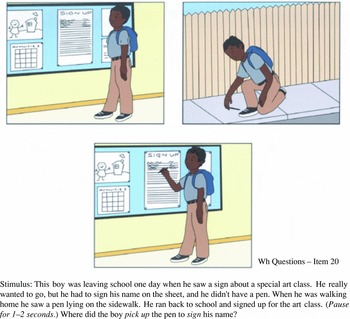
An example wh-question (Item 20) from the Dialect Sensitive Language Test. From Dialect Sensitive Language Test: Pilot Edition, by H. N. Seymour, T. Roeper, and J. G. de Villiers, Reference Seymour, Roeper and de Villiers2000, San Antonio, TX: The Psychological Corporation. Copyright 2000 The Psychological Corporation. Adapted with permission. [A color version of this figure can be viewed online at www.journals.cambridge.org]

The question remains about wh-questions that entail complex grammatical operations that might have different properties in AAE. Craig et al. (Reference Craig, Washington and Thompson2005) introduced seven longer, more complex probes, which were chosen because they required “processing of more advanced cognitive relationships that included comparatives, predictions, and explanations” (p. 122). The new probes were questions such as “What do you think will happen when the man/woman (action + object)?” “How is this like this?” (comparative) and “How would you describe this person/these people?” The emphasis was on more complex language, but the focus was not on exploring the grammar systematically. The questions were harder for the children, but it is not clear which aspects of the complex forms might have been responsible for children's errors at different ages. Given that vocabulary correlated highly with success, the likelihood is that some of the difficulty was semantic/conceptual.
Only one small-scale study of AAE examined structures involving LD movement and barriers as described above (Bland, de Villiers, Roeper, Champion, & Seymour, 1992; Roeper & Seymour, Reference Roeper, Seymour and Levy1994), and the data did not reveal any unusual properties of the grammar of wh-questions in children who spoke AAE. However, like the studies reported in Table 1, the findings of the small-scale study need to be replicated in a larger group.
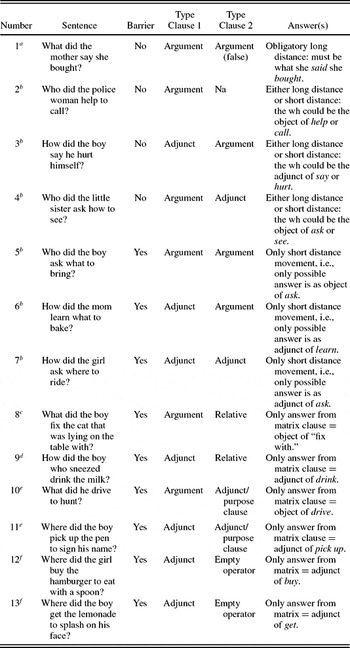
Summary of questions used in the study

ade Villiers and Pyers (2002).
bde Villiers, Roeper, and Vainikka (1990); Bland, de Villiers, Roeper, Champion, and Seymour (1992); Roeper and Seymour (1994); and McDaniel, Chiu, and Maxfield (Reference McDaniel, Chiu and Maxfield1995).
cOtsu (Reference Otsu1981); and de Villiers, and Roeper (Reference de Villiers and Roeper1995b).
dde Villiers, and Roeper (Reference de Villiers and Roeper1995b); Coles-White, de Villiers, and Roeper (Reference Coles-White, de Villiers, Roeper, Brugos, Micciulla and Smith2004).
ede Villiers (unpublished).
fFrom Vainikka and Roeper (Reference Vainikka and Roeper1995).
Language impairment
Finally, there is a lack of evidence about wh-questions in language impairment. The acquisition of wh-questions by language-impaired children is in dispute. In 1995, de Villiers claimed that no theory of specific language impairment (SLI) treated it as a disorder affecting UG. In other words, no child with SLI was assumed to have a disorder so deep that it ruled out the appearance of universal features of human grammars, such as hierarchical phrases, movement rules, structure dependence, and so forth. In early work on this question, Bland et al. (Reference Bland, de Villiers, Roeper, Champion and Seymour1992) presented evidence that older children (aged 6 to 12 years) identified as having significant language delays still were capable of LD wh-movement, barrier effects, and the argument/adjunct distinction.
However, van der Lely and Battell (Reference van der Lely and Battell2003) presented evidence that at least a subset of older children with SLI, called grammatically impaired SLI (GSLI), have profound grammatical impairments that impact wh-question production, particularly with object questions that entail movement. Their subjects were matched to two different groups of typically developing children on vocabulary and grammatical tests, and their deficits showed up in a game designed to elicit both object and subject wh-questions, primarily what, who, and which questions. Van der Lely (Reference van der Lely1998, Reference van der Lely, Levy and Schaeffer2003) contends that this population of children suffers from a deficit in movement rules across complex structures, arguing for a deficit she labels representational deficit for referential relations (RDRR). The fundamental problem these children are argued to have is that they consider movement rules to be optional rather than obligatory. It is claimed that they lack an economy principle that makes movement, including wh-movement, compulsory. What the children did not do, however, was leave the “wh-” in situ. Van der Lely does not report comprehension data on these children, and it is not completely clear what the RDRR hypothesis would predict about comprehension, given that the GSLI children's grammars do not lack the movement rule altogether. However, a computational deficit of this sort would be presumed to create difficulties in keeping track of LD dependencies.
Deevy and Leonard (Reference Deevy and Leonard2004) explored exactly this hypothesis in a study of what they refer to as “short” and “long” wh-movement questions. In their study the “LD” was created not by two clauses but by insertion of adjectival material in the subject noun phrase, for example, “Who is the happy brown dog washing?” to create a longer distance from wh-word to its trace. Their subjects with SLI (perhaps not as specific a subset as Van der Lely's GSLI older group) showed more difficulty as this distance varied, suggesting they did have computational problems with movement. Deevy and Leonard tested whether the processing problem was specific to movement, or whether there would be length effects on comprehension even if no movement was involved, by comparing object and subject questions. Because SLI subjects showed no impairment relative to typically developing children on subject questions with extra material, they argue that it is the object wh-movement that creates the difficulty.
Craig and Washington (2000, 2002) have found that their battery of simple wh-questions captures the problems of AAE-speaking children previously identified as having a language impairment. Despite the high percentage of errors made by typically developing children, the impaired AAE speakers apparently make even more errors. However, complex wh-forms were not explored.
There is thus some evidence for a parsing problem with wh-movement in SLI, which may or may not be in addition to a possible representational deficit involving the obligatory nature of wh-movement. As a result, it is possible that a large sample of language impaired children would turn up at least a subsample (like Van der Lely's GSLI children) who have profound enough deficits in grammar to fail to get LD readings. Or, they may be able to use inferences from context to answer questions. However, inferences alone would not allow them to detect the structural conditions under which certain interpretations are ruled out. The prediction would then be that at least some children should fail to respect barriers to LD movement.
GOALS OF THE CURRENT STUDY
The present study explores a range of wh-questions with a cross-sectional sample of children ages 4 to 9, allowing exploration of how LD movement emerges, which barriers are respected, and whether there are dialect differences or differences according to clinical status (typically developing or language impaired). Based on the previous research we made the following predictions: (a) children will be able to interpret questions involving LD movement from age 4 years; (b) children will respect barrier effects of several types, restricting their interpretations accordingly; (c) children will adopt a partial movement analysis when possible and answer medial complementizers as if they were questions; (d) children will have difficulty with questions that contain false complements until around age 6 at least; (e) children will have difficulty distinguishing the meanings of adjunct questions, in particular confusing how for why; (f) no dialect effects are expected in these phenomena if we avoid areas of dialect difference mentioned above; (g) we predict that children with language disorders will obey linguistic barriers but show a prolonged likelihood of partial movement, difficulty with false complements, and confusions among adjunct wh-questions, because these depend on learning.
DESIGN
The focus of interest was complex wh-questions. The items were designed to span the range of constructions discussed above. They included four two-clause sentences with no barriers, to test if the children from any group had difficulty with “LD” movement. The remaining questions were designed to test whether children were sensitive to the barrier effects of (a) wh-complements, (b) relative clauses, (c) adjunct “in order to” clauses, and (d) adjunct “empty operator” clauses.
Two examples of each were used. In the case of (a), the possible differential effects of adjunct and argument questions were also explored, for a total of five examples. In the case of (b) and (c), there was also one argument and one adjunct question. Type (d) does not allow this variation, so both were adjunct questions.
Table 1 provides a summary of the forms, a description of each, the predictions from adult grammatical treatments, and a citation for any acquisition work that has been done prior to this study. In every case, the items had been tested before in conditions that ensured that the story allowed both interpretations, as in de Villiers et al. (Reference de Villiers, Roeper, Vainikka, Frazier and de Villiers1990). That is, the same story had been tested against two different questions, for example, one with and one without a medial barrier (see also de Villiers & Roeper, Reference de Villiers, Roeper, McDaniel, Cairns and McKee1996, for a detailed discussion of this paradigm).
METHOD
Subjects
The current study presents data from the field testing of the Dialect Sensitive Language Test (DSLT; Seymour, Roeper, & de Villiers, Reference Seymour, Roeper and de Villiers2000).2 One thousand children aged 4 to 9 years were chosen on the basis that their data from all of the language subtests from the DSLT were available, they were reported by the testing clinicians as having normal vision and hearing, and as testing within the normal range on standard tests of intelligence. The participating clinicians categorized the children a priori as MAE speakers or AAE speakers based on the child's family and community background as well as their own judgment of the child's speech. As a partial check, a certified speech–language pathologist at The Psychological Corporation confirmed the children's dialect status by looking for the presence or absence of distinctive morphological, phonological, syntactic, and semantic features in the children's verbatim responses to DSLT items as recorded by the testing clinicians.
Of the 1,000 children in the present study, 628 (62.8%) were categorized as AAE speakers and 372 (37.2%) as MAE speakers. The clinicians also classified the children as typically developing or language impaired based on their standard practices of assessment before the test. All of the language-impaired children were receiving intervention services for language impairment, and most of them had recently been given norm-referenced tests of language skills, although these varied widely by state and across individual clinicians. About 30% of each dialect group were classified by the clinicians as language impaired a priori.
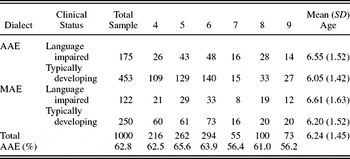
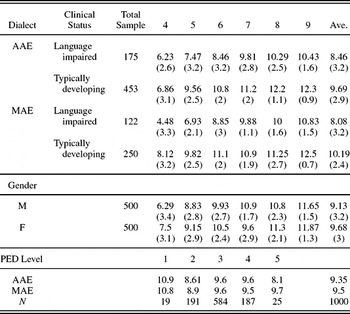
Table 2 shows the age distribution of the four groups of children in the study. There was a larger sample in the 4-, 5-, and 6-year-old age groups. The percentage of children categorized as AAE speakers was roughly the same in each age group.
Number of children in each age group by a priori dialect and clinical status

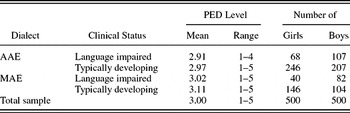
For each of the children the parental education level (PED) of at least one and where possible both parents was obtained. For each child the PED level of the primary caregiver (usually the mother) was categorized on a 5-point scale based on years of education: 1 = 0–8, 2 = 9–11, 3 = 12, 4 = 13–15, and 5 = 16+. The entire range of levels from 1 to 5 was represented across the sample, but the lower PED levels were over sampled because the use of AAE varies inversely with PED level in the US African American population (Washington & Craig, Reference Washington and Craig1998). As far as possible, The Psychological Corporation tried to match the caregivers’ PED levels of the MAE children to those of the AAE children across the full DSLT field-testing sample. However, as Table 3 indicates, in the present sample of 1000 children the average PED level of the MAE children tended to be slightly higher than that of the AAE speakers. The mean and modal PED level across the sample was 3.0, that is, a high school education.
Mean PED level and gender distribution for the four experimental groups

The two dialect groups were exactly matched for gender, with 314 girls and 314 boys in the AAE group and 186 girls and 186 boys in the MAE group. However, there were more girls than boys in the typically developing groups and more boys than girls in the language-impaired groups, reflecting demographics on language impairment (Tomblin et al., Reference Tomblin, Records, Buckwalter, Zhang, Smith and O'Brien1997). Table 3 includes the gender distribution for the four experimental groups.
Although all of the AAE speakers were African American, the MAE group was a mixture of ethnicities: 77.2% Caucasian, 15.1% Hispanic, 5.9% African American, and 2% other. The distribution across regions was designed to approximately match that of the distribution of the African American population of the United States: the south (58.1%) and north central states (27.7%), with fewer from the northeast (7.0%) and the west (7.2%).
Procedure
The children were tested individually by certified speech–language pathologists recruited for the field testing. The wh-subsection of the DSLT was the first subtest in the syntax section following a section on morphology. As a whole, the wh-comprehension subtest on the DSLT had 22 items, the first 9 of which tapped semantic aspects of wh-questions discussed elsewhere (Roeper, Reference Roeper2004). The remaining 13 questions involved two-clause sentences and these constitute the data for the analyses discussed here.
After a set of warm-up items to get the child answering simple questions, the child was in each instance shown a pictured story of approximately three scenes, and read a short story about them. The story terminated in a wh-question that asked for information provided in both the story and the pictures, but which required grammatical processing to answer (see Figure 1).
The child was encouraged to speak the answer to ensure coding accuracy. The speech–language pathologist wrote the answer verbatim on the score sheets, and then coders at The Psychological Corporation were trained with supervision from the researchers to classify the answer into several possible types. Any unclear responses were discussed with the researchers until agreement was reached about the classification.
Coding
The coding varied according to the type of question. For Item 1, an obligatory LD answer was required, in which both verbs take scope over the object. An alternative answer is for the child to only answer the wh-question with respect to the lower verb, that is, “what did she buy?”
In Items 2–4, there were two major types of answer possible: an SD answer in which the question links to the main verb, and an LD, in which the question is construed as embedded in the lower clause and under the scope of both verbs.
For Items 5–7, the additional possibility for the child is to answer the medial-wh (ME), even though for adults that is not a question but a complementizer.
For the adjunct barrier cases, Items 8–13, the choice is between a matrix clause (MA) answer or an answer from within the relative clause or adjunct, a barrier violation.
In addition, it is important to note that for all these questions the child might answer “I don't know,” coded as 88, or answer the wrong wh-question (WW), “where did he go?” with “because he didn't want to get hot,” or something “other” than what was asked (OT). This was the code if the child gave an answer beyond the possibilities listed above. Sometimes a child answered by repeating some piece of the story that was not an answer to the question asked, such as: “he fixed the cat's leg,” “because he drank all the milk.”
The correct answer in each case was scored as one point, and the remaining codes were scored as zero. For Items 2–4 where the options are either SD or LD, either one was given one point.
RESULTS
Overall results
The first question concerned whether children identified as language disordered would score less well than typically developing children, regardless of dialect, and throughout the age range of 4–9 years. A univariate analysis of variance (ANOVA) was performed with the dependent variable being the overall score out of 13. The independent variables were dialect (MAE vs. AAE), clinical status (language impaired vs. typically developing), age (4–9 years), and gender (male vs. female). PED level was treated as a covariate. The means and standard deviations are given in Table 4. The major effects are the child's clinical status, F (1, 951) = 69.3, p < .001, η2 = .068, and age, F (5, 951) = 59.1, p < .001, η2 = .237. Dialect, PED level, and gender account for no significant variance, neither alone nor in interaction with any other variable.
Wh-scores (of 13) by dialect, age, clinical status, gender, and PED level

Item analyses
There were four major types of items, with variations within types. Item 1 represents the first type: obligatory LD movement. Then the second type, Items 2–4, can be answered either LD or SD. The third type, Items 5–7, is obligatory SD. They have a wh-complement with a medial complementizer that is a barrier to LD movement and can potentially attract answers to the medial question word. The fourth type is various sorts of clauses that forbid wh-movement from inside the clause. These include relative clauses (Items 8 and 9), purpose clauses (Items 10 and 11), and empty operator clauses (Items 12 and 13).
LD movement
Considering Items 1–4 we asked the following: (a) Is LD movement, namely, LD interpretation, available generally to children as young as 4 years? (b) Are there any dialect differences between AAE and MAE? (c) Are there any signs that disordered children lack LD interpretation?
The case of Item 1 is important as it is an obligatory LD movement, but things can still go wrong if the child fails to consider the wh-word under the scope of both verbs (de Villiers & Pyers, Reference de Villiers and Pyers2002). As in earlier work, young children (4 and 5 years old) of both dialects had difficulty providing the appropriate answer when the lower clause involved a false statement, with about 33% answering the second clause only, answering “what the mother bought,” not “what she said she bought.” Children with language disorder behaved like younger children in this respect, with 25% still making this error at age 6 and 7. No dialect effect was evident, Pearson χ2 (1) = .00, but there was a highly significant effect of age, Pearson χ2 (5) = 57.7, p < .001, and a significant effect of clinical status, Pearson χ2 (1) = 3.8, p < .05. A fuller analysis of Item 1, connecting failure to other indices of the children's theory of mind development, is provided in de Villiers, Burns, and Pearson (Reference de Villiers, Burns, Pearson, Beachley, Brown and Conlin2003).
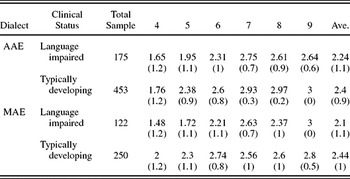
However, Item 1 does not directly address the answer of LD movement because there is no “SD” alternative. More direct evidence comes from the three ambiguous items, Items 2, 3, and 4. A summed score (0–3) was derived for each child across Items 2–4 (see Table 5). An ANOVA was performed with this score as the dependent variable, and clinical status, dialect, age group, and gender as independent variables with PED level as a covariate. Only clinical status, F (1, 951) = 7.51, p < .01, η2 = .008, and age, F (5, 951) = 21.7, p < .001, η2 = .102, have significant effects on this score.
Long distance wh-responses (where optional, of 3) by dialect, clinical status, and age

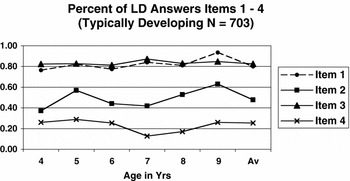
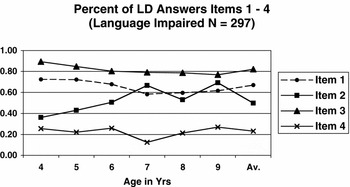
Figures 2 and 3 show the percentage of LD answers for Items 1 to 4 broken down by clinical status and age. One can see that it is not the case that 4-year-olds avoid LD movement. If anything, they prefer it for Item 3. An ANOVA was also conducted looking at preference for SD answers on Items 2 and 3, and the results revealed that taking the option of a SD answer increased with age, F (5, 951) = 5.3, p < .001, η2 = .026, and was more prevalent in typical than in language disordered children, F (1, 951) = 9.86, p < .002, η2 = .010. No other significant effects were observed.
Long distance responses (where optional) by age: typically developing children.

Long distance responses (where optional) by age: language impaired children.

A further inspection of the data reveals that there is no subgroup of language disordered children who fail to get LD interpretations where they are permitted. There are 20 disordered children who never choose a LD answer for Items 2 or 3 or 4, but 15 of these do answer Item 1 correctly, which shows they can interpret the LD relationship when it is obligatory. One can compare this with the 57 typically developing children who also do not choose an LD answer for Items 2 to 4, of which 45 answer Item 1 correctly. The percentages of children who give no LD answers are tiny for both typical and disordered groups (1.7 and 1.6%, respectively).
In sum, these data imply that 4-year-olds easily get LD interpretations, there are no dialect effects, and disordered children get the readings as easily as typically developing children. However, without considering the barrier cases, it is impossible to be sure that the children are not using inference or guessing rather than grammar-based interpretations. Barrier cases are considered next.
Wh-complement barriers
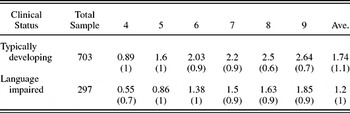
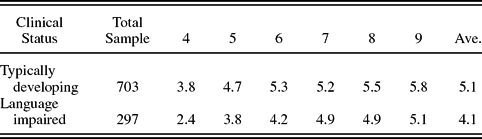
To be certain that the LD interpretations are grammatically based, it is important to see whether children from all groups appropriately limit LD movement in the presence of a medial wh, that is, with a wh-complement. The scores for Items 5–7 were combined (shown in Table 6) to form the dependent measure for the ANOVA shown in Table 9. Again, the only significant variables were clinical status, F (1, 951) = 68.46, p < .001, η2 = .067, and age group, F (5, 951) = 36.67, p < .001, η2 = .159.
Complement barrier wh-scores (of 3) by clinical status and age

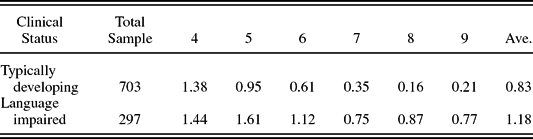
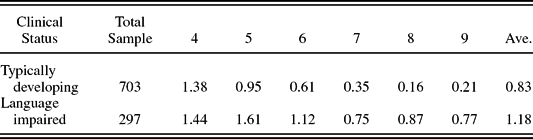
Average number of medial errors (of 3) by clinical status and age
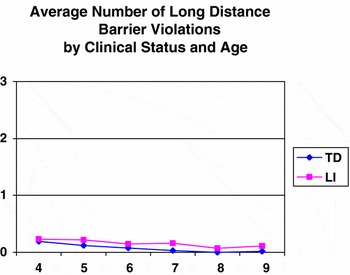
Two further analyses were undertaken. In one, the dependent measure was the number of illegal LD responses on these items. Although rare, were they more likely in the clinical group? Figure 4 provides the answer: illegal LD answers were more likely in the clinical group, and also declined with age. However, as the figure shows, they are very unlikely errors.
Illegal long distance responses by clinical status and age. [A color version of this figure can be viewed online at www.journals.cambridge.org]

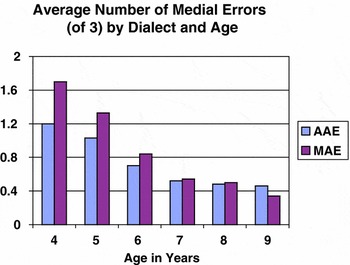
Finally, the medial answers were tallied across these items and an ANOVA explored these responses. The means in Table 7 and the ANOVA reveal that there is a strong effect of clinical status, F (1, 951) = 26.8, p < .001, η2 = .057, and age, F (5, 951) = 18.2, p < .001, η2 = .087, but in this case also of dialect, F (1, 951) = 4.04, p < .04, η2 = .004. Inspection of the means by dialect (in Figure 5) reveals that the dialect effect is a product of the higher likelihood of the medial error in the MAE-speaking children. We see also that the medial errors decline rapidly at age 5 in typically developing children of both dialect groups, being very rare after age 7, but persist in language disordered children, regardless of dialect. Especially at ages 4 and 5 years, MAE speakers are more likely than AAE speakers to answer the medial question. The clinical groups persist in the error through 9 years of age.
Individual item comparisons
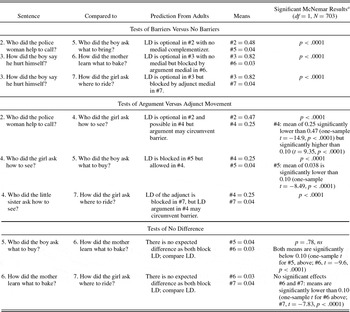
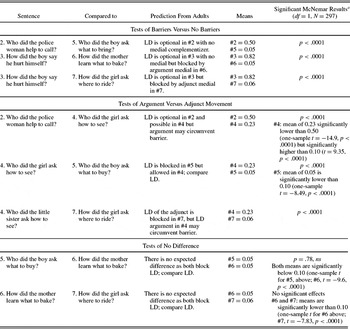
Tables 8 and 9 report the critical results from a series of chi-square tests for the specific comparisons.
Long distance answers compared by type of question: Typically developing children

aColumn 1 versus column 2.
Long distance answers compared by type of question: Language disordered children

aColumn 1 versus column 2.
Medial errors by dialect and age. [A color version of this figure can be viewed online at www.journals.cambridge.org]

Set a: Tests of barriers versus no barriers
The critical cases explored by de Villiers et al. (Reference de Villiers, Roeper, Vainikka, Frazier and de Villiers1990) were Items 5, 6, and 7, which disallow LD movement. In this study it was possible to conduct a series of chi squares pitting those cases against the corresponding items without a medial: Item 2 compares to Item 5, Item 3 to 6, and Item 3 to 7.
Set b: Tests of argument versus adjunct movement
With Items 4, 5, and 7 we tested whether the different constraints on arguments and adjuncts are operative: will a medial adjunct in fact not block LD movement of an argument wh? We tested Item 4 against Item 2, with no medial, and predict no difference in LD. We tested Item 4 against Item 7 and predicted that the barrier in Item 7 would be stronger than the barrier in Item 4. We also tested Item 4 against Item 5, where a medial argument blocks movement. In addition to the chi-square comparisons between them, we asked via one-sample t tests whether the overall means obtained were significantly higher than chance (0.50), or a 10% error rate (0.10).
Set c: Tests of no difference
We also compared cases where LD is equally blocked by medial barriers, and therefore we predict no difference in the LD answers: Item 6 versus Item 7, where an adjunct is blocked by either type of medial, and Item 5 versus Item 6, where a medial argument blocks both argument and adjunct movement.
To allow more precise interpretation, the analyses were run first for typically developing children (Table 8), then for the disordered group (Table 9), as the questions being asked are different. The typically developing children allow a test of the theories with a broader sample of children and dialects of English than previous studies. The disordered children allow a test of the idea that their development is governed by the same or different factors.
The tests of barriers in Table 8 reveal that typically developing children block LD movement in the three critical cases, and as seen in Figure 2, they do so even at age 4. This confirms in a much larger population the basic results of the smaller studies, and lends credence to the grammatical rather than inferential basis of the children's LD interpretations.
In terms of a test of the difference between adjunct and argument movement (Table 9), it is clear from the means that children do in fact allow LD movement with an argument moving across an adjunct medial question (Item 4). Although they do not prefer it compared to the no-barrier case, the percentage of LD movement (25%) is significantly higher than for an LD adjunct, and significantly above the 10% error rate that is characteristic of the barrier cases. Finally, in the comparison among the barrier cases there are no meaningful differences in the percentages of LD movement, as predicted. The significant differences that occur are minute: 4% compared to 3% among the typically developing children.
What happens with the disordered children? Table 9 and Figure 3 reveal that they also both allow LD movement and then restrict it appropriately in the barrier cases, to the same extent as typically developing children even from age 4 years. As to the argument/adjunct difference, the mean differences are the same magnitude as for the typically developing children. Tested against the value of 10%, there is significantly more LD movement on Item 4 than on true barrier cases. There is no evidence at all that these children fail to obey wh-barriers.
Other adjunct barriers
Answers to the adjunct cases Items 8–13 were combined into a single score (0–6) as shown in Table 10. The ANOVA results show strong effects of clinical status, F (1, 951) = 56.3, p < .001, η2 = .046, and age, F (5, 951) = 41.4, p < .001, η2 = .179, but no dialect or other effects or interactions.
Average adjunct score (of 6) by clinical status and age
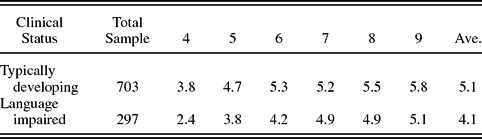
What kinds of errors occurred here? The two relative clause items (Items 8 and 9) have higher levels of barrier violations than the other adjunct clauses. The incidence of barrier violations was higher in the case of the adjunct question (19.6%) than for the argument question (8.5%), but the variance is so great that the difference is not statistically significant.
The relative clause complementizer who in Item 9 could be compared to the medial wh-complementizer, but children treat them quite differently. To Item 9, there were 34 answers of the medial who, for example, “the small boy,” or 3.4%. There was no difference by dialect but a slightly greater prevalence among disordered than typically developing children (5.4 compared to 2.6%), and virtually no such responses after age 7 years. These findings confirm earlier results with typically developing children (de Villiers & Roeper, Reference de Villiers and Roeper1995b) and suggest that the medial answer so prevalent above with wh-complements is a grammatical rather than a lexical option.
In terms of the errors made on adjunct forms, the other errors were usually WW or OT, as described in coding above. All such errors were noticeably greater in language disordered children than typically developing children, but not qualitatively different in kind. Errors of this kind are especially prevalent among 4-year-olds where they reached around 30% for the adjunct relative clause case. The language disordered children persisted with the error up until age 9, whereas it became rare for typically developing children after age 7. Nevertheless, this level of error is considerably higher, and more persistent, than with the wh-complement barriers (and found by Coles-White, de Villiers, & Roeper, Reference Coles-White, de Villiers, Roeper, Brugos, Micciulla and Smith2004, with why-question extraction out of relative clauses).
The prediction theoretically is that Items 12 and 13 should not differ, as they both present barriers. With respect to the difference between the empty category case and the purpose clause, one might predict that the empty operator case in Item 12 would represent a greater difficulty than the purpose clause in Item 13, because the trace and thus the “machinery” of barrierhood is invisible. Combining the scores on Items 10 and 11 gave a score of 0–2 on “purpose” clauses versus the combined score of Items 12 and 13 (0–2) for “empty operator” sentences. An ANOVA using these scores as the repeated measures revealed a significant effect of clinical status, F (1, 976) = 16.4, p < .001, η2 = .016, and age, F (5, 976) = 5.8, p < .001, η2 = .029, and no dialect effects. The ANOVA also a revealed significant effect of type of clause, with purpose clauses being more likely to lead to a violation than empty operator cases, F (1, 976) = 6.4, p < .01, η2 = .007. There is no evidence then that invisible barriers are harder than visible ones.
DISCUSSION
In sum, the results suggest the following. Taking the wh-questions as a whole and giving each child a score based on their adultlike responses, we find that there are significant age differences, as expected. However, children in the two dialect groups do not differ in their responses to the items. Neither is parent education level ever a significant variable. These results may surprise researchers who usually expect children of low SES to fail language tasks more frequently, but the wh-questions tap core grammatical operations that are shared in common across dialects and environments, at least after the age of 4 years.
The wh-questions individually test specific hypotheses about the nature of child grammars, and the item analyses provide rich confirmation that the results of earlier small-scale studies hold up with a much more diverse sample of the US population.
1. It is confirmed that children as young as age 4 years can give LD interpretations of questions, and there is no dialect difference. In fact, LD interpretations are preferred and diminish with age.
2. It is confirmed that children are sensitive from an early age to barrier effects, indicating that their interpretations go beyond inference strategies.
3. Children were found to answer the medial complementizer as a real question, a response particularly prevalent in younger ages and clinical groups.
4. Four- and 5-year-old children had difficulty with the false clause case, and this error was prolonged in the clinical groups.
5. Children respected the distinction in how adjunct versus argument wh-question words were allowed to move.
6. Children persisted in answering how questions as if they meant why, a process prolonged in the language disordered group.
7. No dialect effects were significant except for one: AAE speakers were less likely than MAE speakers to make the medial answer error.
8. The groups of language disordered children allowed LD movement and obeyed barrier effects, but perseverated across time on all the other error types that typically developing children make.
How can it be simultaneously true that children get better with age, but respect barriers from an early age? The answer lies in their nonadult errors that nevertheless do not violate barriers. For instance, we find pervasive answers to the medial question, confirming many previous small-scale studies. However, the study establishes that these errors are much rarer after age 6, even in this diverse sample of typically developing children. In addition, we find answers that “miss the mark” by answering something that was not asked. It is possible that some portion of these represent the child's misunderstanding of the lexical meaning of a wh-word, so that we simply cannot recognize what it is in answer to. The clearest case is one for which we were prepared by previous work, namely, the child answering with “because” to a wider variety of adjunct questions than “why.”
In terms of disordered children, we explored the possibility that at least some subset of language impaired children should show marked difficulties in obeying constraints on the interpretation of questions, if they have fundamental difficulty with movement rules (Van der Lely, Reference van der Lely, Levy and Schaeffer2003). We specifically explored whether (a) children with language impairment should have problems with LD when it is optional or (b) children with language impairment should have problems with barriers.
Even if children with language impairment appear to have intact grammars, it could be argued that they might have serious processing difficulties that would get in the way of complex sentence interpretation. If disordered children are more likely to guess an answer under the strain of processing, we might expect that they would show a greater likelihood of barrier violations. They might also, for instance, answer the medial complementizer in a relative clause, and be insensitive to the distinction between adjuncts and complements in their movement possibilities.
In fact, none of these turned out to be the case. Language-impaired children showed LD movement, and respected barriers of all types, as well as the adjunct/argument distinction. A detailed analysis of individual responses revealed no child who could be characterized as impaired in this way. Nonetheless, we may have missed the small percentage of children whom Van der Lely has characterized as GSLI, if they are as rare as she contends. That is, it is still possible that some children with language impairment would show these difficulties, although we did not find them in this sample.
Language-impaired children still more often failed to give the right answer. Their errors are typical of young typically developing children: namely, they answer the medial questions for a much longer time, and they answer “how” or even “where” with “because.” More often than typically developing children they avoid answering by giving a global response or saying “I don't know.” As a result, we find no evidence that language impaired children fail to observe principles of UG. Rather, the properties that characterize differences across languages, such as the medial wh as an indirect versus real question, and whether the language makes a distinction between lexical items for how and why, are the greatest sources of error for typically developing and disordered children. We assume that the learning processes that allow typically developing children to resolve these alternatives must operate less effectively in language disordered children, so that the distinctions take longer to make. If we understood what the crucial triggering evidence was, the design of effective intervention would be clear. In the case of AAE, there appears to be some other feature in the grammar that allows AAE-speaking children to more often avoid the medial error, and we are actively exploring that question (de Villiers et al., Reference de Villiers, de Villiers and Roeper2007).
In conclusion, we will try to place our results in the larger framework of linguistic theory. Two features are at the heart of modern work in syntax over the last half-century: “displacement” and “locality.” As we saw above, displacement is where an element is interpreted at a position different from where it is pronounced. We see it in sentences with topicalization (in Example 33) and wh-movement (Example 34):
33. Foreign movies I like ________.
34. What did you buy ________?
where the fronted nounphrase is interpreted as the object of the verb in its classical “deep structure” position, but appears at the front. In contrast, “locality” is the claim that all operations happen within a specific clause. The strongest evidence of locality feels like common sense: we cannot move a wh-word from one sentence into a prior one:
35. *What did yesterday it rain. She bought ________?
A pair of utterances like Example 35 is incomprehensible: no child or adult ever forms questions like that, and no known language allows it. They automatically obey this locality constraint and produce two different sentences:
36. Yesterday it rained. What did she buy ________?
Chomsky has suggested that locality applies in a much narrower way in principle, within a phase although it is overruled by displacement in very narrowly defined ways in some, not all, languages of the world. That is, every clause with a tense marker should be the outer boundary of movement, although it is not actually so:
37. What did John say [she bought ________?]
Under strict locality, one should not be able to move the what beyond the lowest clause:
38. John said it was [what she bought ________?]
Instead, in languages like English, displacement overrides the locality constraint.
If this strong claim is true, then it predicts that children will spontaneously seek to honor locality. This perspective was obscure until recently, because our first assumption was that children would show a parsing preference to connect the wh-word to its nearest possible trace, foregoing the need to handle LD movement by giving SD answers. We have found instead that from an early age that children easily allow LD movement, but that might reflect the bias toward locality:3 resolve the interpretation of the wh-word with respect to the lower clause. This is not a blind preference, but one sensitive to grammar: barriers and adjuncts block it completely. When there is a medial complementizer we find the clearest evidence of a bias toward locality—”compute, pronounce, and interpret all elements” (Chomsky, Reference Chomsky2004) within a clause—or a phase, in modern terms. The fact that “barriers” exist is just the adult reflection of this restriction. Instead of referring to “barriers to movement,” we could speak of “required transfer to interpretation.” In fact, the best index of whether a child is capable of genuine LD interpretation, not a locality preference, may be cases such as Item 1 (What did the mother say she bought?). Recall that the young children respond by answering such a question only with respect to the lower clause. When the child solves the problem of suspending that interpretation until the second phase, the problem still remains for cases in which there is an overt medial wh-word, not merely a trace. Answering this medial wh with respect to the lower phase remains a problem after children solve the type in Item 1. Understanding the mechanism by which a verb subcategorizes for an indirect question seems to be at the heart of the matter. Chomsky (Reference Chomsky2004) puts it this way: “resistance to extraction of the complement of C is traceable to the requirement of feature-inheritance from the selecting Phase Head.” If children do not recognize that a medial wh-word is a subcategorized indirect question, then they will treat it as a real question. As yet we do not know how children arrive at this solution, and if it is lexical, it may be piecemeal and protracted. These findings pertain to children with language disorders as well as typically developing children from a wide spectrum of English learners. Understanding how children determine when locality can be “breached” is a major next question for acquisition research, and the findings here suggest that the grammars of children who speak AAE might provide some clues in this regard.
ACKNOWLEDGMENTS
Thanks to The Psychological Corporation staff who made these data available to us and gave us such stalwart assistance, particularly Lois Ciolli, Gay Lamey, Chuck Wilkins, Robert Carlson, and Carol Waryas. We thank the numerous speech–language pathologists who collected the data, the many children who were tested, and their parents for their consent. We benefited from the wise advice of many individuals, especially Harry Seymour and Peter de Villiers. Several audiences have given useful feedback, particularly the Linguistics Faculty and students at the University of Delaware, in several ASHA talks, and participants in the 2005 Royaumont Conference on Language Disorders.