Introduction
The nose is an aesthetically important midline facial structure which is involved in up to 25 per cent of head and neck skin malignancies.Reference Johnson1 The majority of cases can be adequately treated with either limited surgical excision and reconstruction or radiotherapy. However, some tumours behave in a more aggressive manner and may require extensive surgery, in the form of rhinectomy, for adequate treatment.
We describe 14 patients who underwent rhinectomy for various forms of malignancy of both the nasal skin and mucosa, and we discuss clinical and histopathological features, reconstruction and outcome.
Methods
We performed a retrospective review of all plastic surgery patients who had undergone rhinectomy at University Hospital North Staffordshire between January 1999 and December 2009. Cases were identified from operating theatre records and consultant diaries. Case notes were reviewed to gather information relating to clinical features, histopathological reports, surgical treatment and outcome.
Results
We identified 14 patients who had undergone rhinectomy during the 11-year study period. There were 10 (71 per cent) men and four (29 per cent) women; all were Caucasian. The mean age was 64.7 years (range, 37–89 years).
Six patients (43 per cent) had recurrent disease, with a history of between one and three excisions prior to their rhinectomy. Two patients had previously undergone hemirhinectomy and required completion rhinectomy for recurrent disease. Four patients had previously been treated with radiotherapy to the surgical field, and presented with radio-recurrent disease.
Histological analysis of specimens revealed a diagnosis of basal cell carcinoma (BCC) in five patients (36 per cent), squamous cell carcinoma (SCC) in six patients (43 per cent) and malignant melanoma in two patients (14 per cent). The remaining patient had metastatic poorly differentiated carcinoma related to a primary oesophageal carcinoma treated five years previously.
Ten patients had lesions primarily affecting the skin of the nose, whilst the remaining four had tumours of the nasal mucosa.
All patients underwent rhinectomy with resection of adjacent structures as necessary, according to pre-operative imaging or the macroscopic appearance at the time of surgery. The two patients with mucosal malignant melanoma also underwent therapeutic unilateral neck dissection for biopsy-proven lymph node metastases. No patient underwent elective lymphadenectomy. Two patients (one with melanoma, the other with SCC) received adjuvant radiotherapy because of concerns about close margins in areas not readily amenable to further surgical resection.
The majority of patients (11, 79 per cent) had reconstruction with an adhesive-retained prosthesis, and achieved a satisfactory cosmetic appearance. Two patients had total nasal reconstruction with a free radial forearm flap, one performed immediately and one after a delay of two months. The remaining patient had a forehead flap reconstruction.
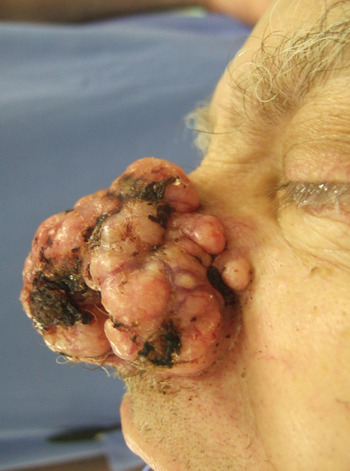
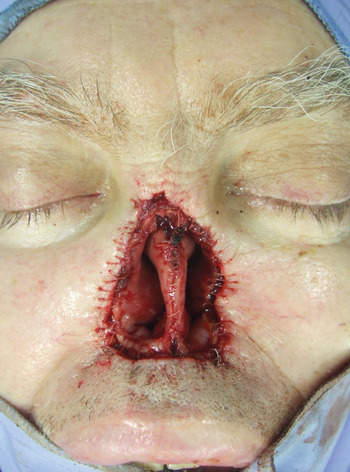
Seven patients (50 per cent) were alive and disease-free after a mean follow-up period of 30.1 months (range, zero to 96 months). Two patients were lost to follow up at six and 12 months post-operatively, variously. One patient was at the time of writing alive with metastatic disease from a primary oesophageal carcinoma; rhinectomy in this case had been performed as a palliative procedure because of a large, disfiguring, painful nasal tumour (Figures 1 and 2).
Painful and disfiguring metastatic tumour of the nose.

Post-operative defect following palliative rhinectomy for metastatic disease.

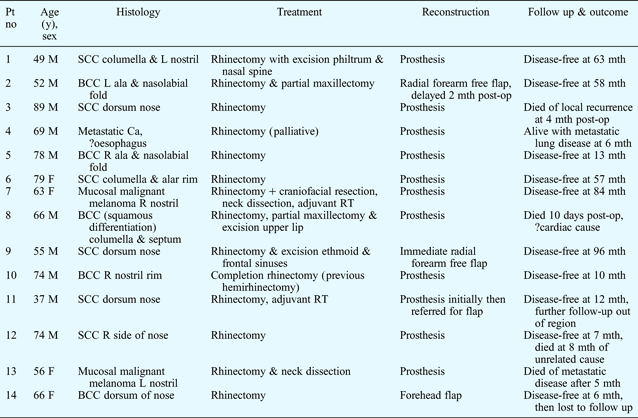
Four patients died during the study period. Two patients died of unrelated causes and two of causes related to the nasal malignancy (one of widespread metastatic melanoma and the other of rapidly progressive local recurrence of an SCC causing upper airway obstruction). Results and outcomes are summarised in Table I.
Summary of patient characteristics

Pt no = patient number; y = years; M = male; SCC = squamous cell carcinoma; L = left; mth = months; BCC = basal cell carcinoma; post-op = post-operative; Ca = cancer; R = right; F = female; RT = radiotherapy
Discussion
The majority of skin cancers affecting the nose are superficial and easily treated with local excision. The purpose of this paper is to highlight a subset of tumours which behave in a more aggressive manner and which require rhinectomy to achieve complete oncological clearance. This is mutilating surgery with functional, social and psychological consequences, but it may be the only option for adequate treatment of extensive or recurrent tumour. Harrison comments that one rarely regrets carrying out the operation, only the delay in persuading the patient of its advantages.Reference Harrison2
Rhinectomy is still a relatively uncommon procedure, and most published studies include small numbers of patients managed with rhinectomy, within larger numbers of nasal tumour patients managed with more limited surgical excision.
To date, the largest series of rhinectomies has been presented by Stanley and Olsen, who treated 51 patients over a 20-year period. They described a recurrence rate of 43 per cent, occurring after a mean of 9.4 months. Half of these patients succumbed to their disease. Squamous cell carcinoma was the most common histological type. Despite this high recurrence rate, 51 per cent of patients were alive and disease-free after a mean follow up of 68 months.Reference Stanley and Olsen3
Studies which describe tumours requiring rhinectomy all highlight the fact that these tumours have a high risk of recurrence, and have usually been inadequately excised in the past.Reference Johnson1, Reference Stanley and Olsen3, Reference Teichgraeber and Goepfert4 Stanley et al. found that as many as 62 per cent of patients requiring rhinectomy had had previous unsuccessful surgical treatment.Reference Stanley and Olsen3 This may have been due to the surgeon's reluctance to remove cartilage, or to create a full thickness defect in the case of a seemingly straightforward cutaneous malignancy.Reference Johnson1 The risk of recurrence is especially high in tumours affecting the nasal columella.Reference Mignogna and Garay5 Some authors argue that tumours in certain anatomical sites, such as the nasal ala and medial canthus, are especially difficult to control due to spread of the tumour along embryological fusion planes.Reference Panje and Ceilley6 Concern about reconstructive options may also cause the surgeon to carry out an inadequate excision in an attempt to conserve tissue.
In our series, six patients (43 per cent) had previously undergone surgery to excise a tumour of the nasal skin, before presenting with a recurrence requiring rhinectomy. Four of these patients had had an incompletely excised tumour, and the decision had been made to observe the area rather than to perform further surgical excision at that time; these patients subsequently presented with extensive, recurrent lesions necessitating rhinectomy. A further patient had an SCC of the dorsum of the nose, treated with repeated curettage by a dermatologist, despite the high risk nature of this anatomical site. This once again highlights the importance of adequate initial treatment of tumours of the nasal skin.
Tumour characteristics
Most tumours in our series were either BCC or SCC, as reported in previous studies.Reference Johnson1–Reference Teichgraeber and Goepfert4
Our study did have a higher proportion of malignant melanoma than previously reported, but this was likely to be at least partly due to the small numbers involved. Malignant melanoma of the nasal cavity and paranasal sinuses represents less than 1 per cent of all cases of malignant melanoma. Initial symptoms include epistaxis, obstruction, nasal discharge and facial pain.Reference Baek, Kim and Kang7 Patients tend to present relatively late due to the lack of a visible lesion, and therefore these lesions tend to be associated with a poor prognosis. Two patients in our series had malignant melanoma of the nasal mucosa; one died of widespread metastatic disease just five months after resection, whilst the other was alive and disease-free 61 months post-operatively.
In our rhinectomy series, the dorsum and ala of the nose were the sites most commonly affected, consistent with previous studies.Reference Teichgraeber and Goepfert4 Teichgraeber found that the anatomical site did not predict the need for rhinectomy but that the size and type of tumour did, with large SCCs being most likely to require rhinectomy rather than local full thickness excision.Reference Teichgraeber and Goepfert4 The columella appears to be a particularly high risk site; tumours at this site have been described by Mignogna as ‘potential timebomb[s]’. Such tumours may extend directly along septal cartilage, posteriorly into the nasal cavity, inferiorly into the maxilla and superiorly into the anterior skull base, meaning that recurrence is often detected late and is extremely difficult to treat.Reference Mignogna and Garay5
Management
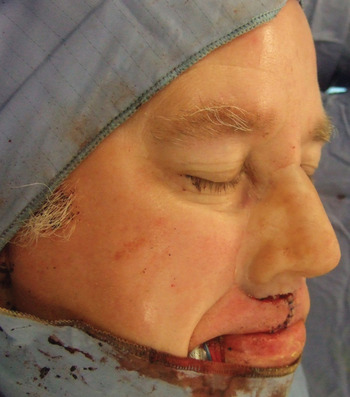
All patients should be reviewed within the setting of a multidisciplinary head and neck team. Examination should include a nasendoscopy and multiple biopsies as required. A computed tomography scan, at least, should be used to assess the extent of disease and any bony involvement. The patient should be counselled regarding the likely surgical deformity, and it is essential to involve an experienced maxillofacial prosthetic technician pre-operatively so that an initial silicone prosthesis can be provided immediately after surgery (Figure 3). This is invaluable in the rehabilitation of the patient. Surgery should be aggressive, with the appropriate expertise present to perform additional procedures such as bony resection, partial maxillectomy and septectomy as required. Unless Mohs surgery is planned, a simple surgical closure should be performed, awaiting definitive histological clearance. Whenever oncologically possible, the nasal bridge should be preserved, as it provides a stable base for the prosthesis.
Appearance of initial prosthesis applied intra-operatively. A definitive prosthesis was made at a later date.

Reconstruction
Surgical reconstruction of the rhinectomy defect is challenging. Attempts at autologous reconstruction with regional flaps or free tissue transfer are frequently unsatisfactory, even in the hands of the most skilled surgeon. A good prosthesis is invariably better than the best reconstruction. The advantage of a prosthesis is that it involves no surgical morbidity and allows easy monitoring of the surgical site for evidence of recurrent disease. Potential problems of a prosthesis include dermatitis and poor fit and colour match.Reference Stanley and Olsen3 However, modern prosthetic technology means that these problems are less common than previously described.
In our department, nasal prostheses are made by a team of experienced maxillofacial prosthetists who work closely with the surgical team. Patients who choose prosthetic reconstruction are initially assessed pre-operatively, and a mould of the nose is taken before rhinectomy is performed. An initial silicone prosthesis with uniform colouring is made to replicate the patient's nose. This means that the patient can have a basic prosthesis fitted intra-operatively, in order to avoid the psychological trauma of waking up after the surgery with a large midfacial defect. Once the wound has healed and any associated swelling has resolved, the patient is seen again by the prosthetist for a further mould, and fitting of an individualised prosthesis. This prosthesis is made of medical grade silicone and has intrinsic and extrinsic colouring to closely match the patient's own skin colour and texture. Details such as skin blemishes may be added for further realism.
• Nasal tumours are common, and are usually adequately treated by limited surgical resection or radiotherapy
• Some nasal tumours behave in a more aggressive manner and require rhinectomy for complete oncological clearance
• Rhinectomy is mutilating surgery with functional, social and psychological consequences, but may be the only option for extensive, recurrent or high risk tumours
• Prosthetic reconstruction provides an aesthetically satisfactory outcome for most patients, avoiding the need for major reconstructive surgery
The prosthesis may be retained by adhesive or by osseointegrated implants. The latter provide a more secure fixation, and can be placed either into the piriform fossa (using intraoral 10 mm implants) or into the bridge of the nose (using smaller craniofacial implants).Reference Flood and Russell8 In our experience, most of our patients find that the prosthesis can be easily and reliably secured with adhesive. The medical adhesive used by our maxillofacial technicians is waterproof and causes minimal skin reaction.
Our experience is that most patients are satisfied with prosthetic rehabilitation. In our series, only one patient, initially fitted with a prosthesis, later requested referral for flap reconstruction due to dissatisfaction with aesthetic appearance. This patient was 37 years old. Our remaining patients were all satisfied with the appearance of the nasal prosthesis. We found that many of these patients, particularly elderly individuals, were keen to have the simplest form of reconstruction which avoided the need for further surgery. The maxillofacial technicians reviewed the patients regularly to revise the fit and/or colour of the prosthesis as necessary; this process is clearly more difficult to do with a surgical reconstruction.
Decisions about reconstruction should always be made on an individual basis, and will depend on the preferences of both the patient and the surgeon, as well as tumour characteristics. Tumours requiring rhinectomy have a high risk of recurrence.Reference Johnson1, Reference Stanley and Olsen3 For this reason, many surgeons will advise a delay of between six months and two years before considering surgical reconstruction.Reference Johnson1, Reference Stanley and Olsen3, Reference Teichgraeber and Goepfert4 A prosthesis may be safely used within this initial period. Evans and colleagues have stated that primary reconstruction is safe in selected cases of nasal cutaneous malignancies, but have advised that surgical delay should be considered in aggressive cases or those with perineural invasion, bony involvement, inadequate margins, or where post-operative radiotherapy is planned.Reference Evans, Williams and Ainslie9 Where immediate reconstruction is planned, it is sensible to ensure adequate excision margins by using either Mohs micrographic surgery or intra-operative frozen section.
Conclusion
Tumours of the nasal skin are common, and can usually be managed with local excision and reconstruction or radiotherapy. Tumours which are inadequately treated have a high risk of recurrence and carry a poor outcome. Extensive, neglected or recurrent nasal tumours may require rhinectomy for complete excision. This is an operation which carries significant aesthetic, psychological and social implications, but which is an oncologically sound procedure for the management of high risk lesions. Reconstruction is commonly delayed because of the high risk of recurrence. Prosthetic rehabilitation is the most common post-operative option, and provides a safe and aesthetically pleasing outcome.