Introduction
Dementia is a disease that can affect sexual desire and its behavioral expression (Tabak and Shemesh-Kigli, Reference Tabak and Shemesh-Kigli2006). Despite so, there is also a tendency for sexual activity among persons with dementia (PWD) to be pathologized, such that it is regarded as an undesirable symptom of the disease rather than as an expression of ongoing and relevant needs. Although PWD could express their sexual interests in ways that might be harmful for themselves and their caregivers (Hashmi et al., Reference Hashmi, Krady, Qayum and Grossberg2000), research has failed to define such inappropriate sexual behaviors in a consistent way (Johnson et al., Reference Johnson, Knight and Alderman2006), and their prevalence among this population seems to be relatively low (Alagiakrishnan et al., Reference Alagiakrishnan2005). It should also be noted that inappropriate sexual behaviors may not always be a result of dementia, but could be triggered by side effects of medication (Lesser et al., Reference Lesser, Hughes, Jemelka and Griffith2005) or psychosocial factors (Hashmi et al., Reference Hashmi, Krady, Qayum and Grossberg2000).
Sexual expression in older age may also be a particularly problematic issue among older people living in residential aged care facilities (RACFs). One of the reasons for this is the lack of training given to staff on matters related to sexuality, and their negative attitudes towards it (Roach, Reference Roach2004; Mahieu et al., Reference Mahieu, Van Elssen and Gastmans2011). Few RACFs include sexual functioning as an area of assessment and intervention, and there is a widespread absence of formal policies or guidelines on this topic (Archibald, Reference Archibald1998). As a result, sexuality is frequently neglected in RACFs and few opportunities for its expression are provided (Aizenberg et al., Reference Aizenberg, Weizman and Barak2002).
Thus, in most cases, professionals at RACFs do not know how to react to the sexual and intimacy needs of residents, leading at times to their denial or inhibition (Mahieu et al., Reference Mahieu, Van Elssen and Gastmans2011). This lack of acceptance seems to depend on the type of behavior. Ehrenfeld et al. (Reference Ehrenfeld, Bronner, Tabak, Alpert and Bergman1999) found that when sexual behaviors were limited to expressions of love, care, and affection, then staff tended to respond sympathetically, whereas amusement, derision, and infantilization were the most frequent responses towards expressions of a romantic nature. The most problematic situations were those involving demonstrations of sexual arousal and desire, and they constituted a source of practical and ethical dilemmas among staff. The staff members who participated in the study by Ehrenfeld et al. (Reference Ehrenfeld, Bronner, Tabak, Alpert and Bergman1999) rarely perceived sexual expression as being beneficial or positive for a PWD, and when such expression did appear it was viewed as a potentially disruptive element for the institution and for the organization of work, a perception that has also been reported in other studies (e.g. Ward et al., Reference Ward, Vass, Aggarwal, Garfield and Cybyk2005).
According to Tarzia et al. (Reference Tarzia, Fetherstonhaugh and Bauer2012), one aspect that makes sexual relationships involving RACF residents with dementia particularly problematic for caregivers is that consent to the relationship cannot be assured, since dementia is characterized by impairments in communication, understanding, and reasoning that make such consent difficult to obtain in practice. In a sexual relationship without consent, the risk of being abused or harmed is present. Given that caregivers tend to remove any element of risk, sexual expression among people with dementia may be precluded as a way of protecting them from their own poor understanding and judgment in those kinds of situations. Consequently, caregivers in RACFs might hold an even more conservative and limiting attitude towards the expression of sexuality by PWD than they would in the case of older people with a higher cognitive status (Holmes et al., Reference Holmes, Reingold and Teresi1997; Archibald, Reference Archibald1998). This set of reactions, emphasizing the problematic nature of residents’ sexual expression, could be labeled as “extreme cautionary stance.” This term would include staff's paternalistic attitudes and overprotective and restrictive behaviors regarding sexual and intimate relationships involving people with dementia, guided by a an attempt to avoid a possible abuse.
Such stance does not match with the available data on sexual abuse in RACFs, which suggests that such abuse is rare and is more likely to be perpetrated by staff or visitors than by other residents (Burgess et al., Reference Burgess, Dowdell and Prentky2000). Furthermore, the so-called resident-to-resident mistreatment (RREM) involves far more frequently psychological forms of abuse (invasion of privacy, roommate disagreements, teasing, or joking) or physical abuse (fractures, bruises, or lacerations) than sexual abuse, which is rare among RACF residents (Shinoda-Tagawa et al., Reference Shinoda-Tagawa, Leonard and Pontikas2004; Pillemer et al., Reference Pillemer2011).
The extreme cautionary stance, in which staff members act to save and protect residents with dementia from abuse and from their own misguided (or “uninhibited”) sexual needs and desires, contrasts with the increasing focus on a person-centered care (PCC) approach in RACFs as a standard for delivering high quality care. PCC means treating residents in RACFs as individuals regardless of their age and health status, adopting the point of view of the person with dementia and taking into account his/her unique needs and feelings (including sexuality and intimacy) as the basis on which to provide as personalized care as possible. This perspective was proposed as a reaction against traditional care practices that ignore the needs and preferences of PWD, treating them as passive recipients of care and services, or in a paternalistic way (Cotrell and Schulz, Reference Cotrell and Schulz1993). By contrast, PCC defends the independence, autonomy, and dignity of PWD as a central aspect of care (Brooker, Reference Brooker2004; Edvardsson et al., Reference Edvardsson, Winblad and Sandman2008). In the case of sexual expression among people with dementia, the application of PCC implies, first, making sure that sexual behaviors will not cause any harm, and second, that one considers the potential value of such behaviors as a means to fulfill a basic human need, maintain independence, and promote well-being. The focus of attention should therefore shift from trying to eradicate the expression of sexual needs to encouraging their fulfillment in a safe way, while respecting residents’ rights.
In light of the above, the aim of the present study was to ascertain how RACF staff might interpret overtly sexual behaviors displayed by residents with dementia, and to explore how they would react to them. To this end, participating staff were asked to reflect upon two hypothetical situations involving residents. The scenarios were basically the same (i.e. the professional realized that two residents had been maintaining sexual relations), but whereas in the first situation only one of the residents suffered from dementia, in the second both of them did. The goal was to determine the extent to which the interpretations and reactions of staff corresponded to an extreme cautionary stance, one which emphasizes the risk of abuse, consent, and stopping/avoiding sexual relationships involving residents with dementia, or whether, on the contrary, their views were more compatible with a person-centered model of care, one that focuses on trying to understand the situation from the resident's point of view and which takes his/her rights into account. So, our intention is not to amend or propose any ethical theory but just to explore the normative stance that a limited group of RACF workers show when they reflect on hypothetical cases involving sexuality and dementia.
Methods
Participants
Using non-probability sampling techniques, 53 staff currently working in RACFs were interviewed for this study. Most of them were women (only five men participated in the study), a fact that reflects the predominance of female employees in RACFs in Spain. They ranged in age from 22 to 63 years old (M = 42.5, SD = 11.4), and most of them were married (73.6%).
Participants belonged to five different RACFs, all of them under private management but included in the public network run by the Department of Social Services in Catalonia (an autonomous region in the Northeast of Spain). The five RACFs were middle-sized (up to 90 residents) and provided both day-care services and long-term care. In order to seek maximum variation, the RACFs who participated in the study were extracted from different socio-economic areas of the city of Barcelona. In each facility, a similar number of parti-cipants were interviewed, and the number of interviews with nursing assistants (23 participants) and professional/managerial staff (30 participants: five managers, six educators, five nurses, five physiotherapists, five psychologists, and four social workers) was also balanced across facilities.
Regarding their academic and professional profile, 56.6% of participants had a university education (all of them members of the professional/managerial staff group). The remainder had completed primary or secondary education and were working as nursing assistants. The average number of years of experience in the field of elder care varied among participants from 1 to 25 years (M = 11.3, SD = 7.1).
Data collection
Data were collected between March and October 2012 by means of semi-structured interviews. The interview consisted of some introductory questions regarding sexuality and aging, followed by vignettes in which older people were depicted engaging in different sexual behaviors (masturbation, heterosexual relationships, homosexual relationships, and sexual relationships involving residents with dementia) in an institutional setting. The research team was assisted by professionals with a broad experience in gerontology to select and design how the vignettes were presented. Vignettes were short stories on which participants could make judgments and elicit anticipated behavior about their protagonists. This methodology has been used successfully in studies regarding sexuality and old adults (Archibald, Reference Archibald1998; Di Napoli et al., Reference Di Napoli, Breland and Allen2013).
In accordance with the study aims, only responses to one pair of vignettes, both involving PWD, are analyzed in this paper. In the first vignette the interviewer read the following situation: “Imagine that one day you realize that there are two residents who feel attracted to one another and that they have been maintaining sexual relations. One of them has dementia, whereas the other is cognitively intact.” The second vignette was introduced to the participant as follows: “Now imagine the same situation as before but in this case both members of the couple have dementia.” For both vignettes, participants were required to answer two questions: (a) What would you think of the situation? and (b) How would you react?.
The interviews ranged in length from 20 minutes to 1 hour and were recorded and transcribed verbatim. Each participant was assigned a code (e.g. W67_04_S1). Regarding these codes, which are going to appear at the end of each cited excerpt throughout the paper, the first letter indicates the participant's sex (M stands for man; W stands for woman) and the first number corresponds to his/her age. The number after the first underscore was randomly assigned to each facility. The type of situation was coded after the second underscore (S1 stands for the situation involving one PWD, S2 stands for the situation involving two PWD).
Procedure
The researchers presented the study to the managers of each center, explaining its objectives and the general procedure for data gathering, and seeking their agreement to participate. Study participants were randomly selected from among staff members who managers indicated as having regular contact with residents, it being taken into account that a similar number of participants (approximately 10) should be recruited from each center, and that job level (managerial/professional vs. nursing assistants) should be balanced in the final sample.
Before data collection, participants were informed of the study objectives and they gave their written informed consent. Data were gathered by two interviewers with extensive experience in psychological interviews but who would not be participating in the subsequent data analysis. As part of the training sessions, they each conducted two interviews with people who met the inclusion criteria. These interviews were discussed with the research team in an attempt to clarify the aim of each question and to identify the best strategies for obtaining rich and reliable data. These training interviews were not included in the subsequent analysis.
Data analysis
Content analysis, a qualitative analysis technique, was used to analyze responses. This type of analysis aims to identify common themes in the responses given by participants and quantifying their frequencies (Vaismorari et al., Reference Vaismorari, Turunen and Bondas2013).
Once all the participants’ responses had been transcribed verbatim and entered into a database, the researchers read through all the responses in order to become acquainted with the data. They then sought to identify ideas (or units of meaning) in each response. Each response could contain one or several different ideas.
The next step was to condense the list of units of meaning into themes or categories based on the repetition or similarity among threads of meaning or key words, phrases, or sentences contained in the unit (Owen, Reference Owen1984). These categories were constructed with the help of Nvivo 2.0 qualitative analysis software. To increase trustworthiness in the results, this second step was conducted independently by two researchers. The categories obtained by each one were compared and any differences were discussed until reaching a consensus on the category system.
Once the categories had been obtained and defined, the researchers independently reread the full list of units of meaning and tried to assign them to one category of the system. Disagreements were identified and used to correct the limits of the categories and to adjust their definition. Two category systems were designed, one for the interpretation of the situations, other one for the reactions to the situations.
The final step involved a third researcher who did not participate in the former process. He received the original units of meaning, randomly selected, as well as the final version of the category system including category definitions. His task was to assign responses into categories. The comparison between this new categorization and the original one was used to obtain the κ reliability index of the system. The values obtained, 0.97 (for the interpretation of the situations) and 0.92 (for the reaction to the situations), indicated that the reliability of the systems were very good.
χ 2 tests were used to analyze the potential influence of job level (professional/managerial vs. nursing assistants).
Ethical considerations
Approval to conduct the study was obtained from the Ethics Committee of the Faculty of Psychology of the University of Barcelona. Participants were volunteers who were provided with a detailed explanation of the study, and they all signed a consent form.
Results
Interpretation of the situations
The interpretation that participants made of the sexual situations involving PWD revolved around the question of whether or not abuse was involved. In the category system that emerged from the analysis, every participant's response to each situation corresponded to just one category.
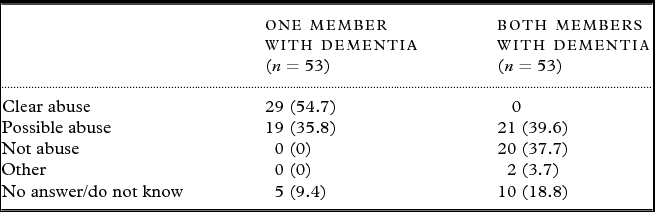
In the case of a sexual relationship in which just one party had dementia, all responding participants interpreted the vignette as a situation in which there was a risk of abuse. However, different types of arguments and degrees of sophistication appeared in participants’ responses. Two groups (categories) of abuse-related responses emerged from the analysis (Table 1).
Frequency and percentage (among brackets) of categories concerning the interpretation to sexual situations involving one or two PWD

The first of these (labeled as “Clear Abuse”) defined the situation as a clearly abusive relationship. The argument here was that a resident with dementia would be unable to give explicit consent to the relationship. Residents with dementia are depicted as lacking the necessary capacities of logical thinking required to weigh up the pros and cons of the situation and to decide for themselves if they wanted to engage in the relationship or not. Thus, residents with dementia were described as childish, helpless, and as being harmed by the situation, or as facing a clear risk of being harmed. This kind of response was very frequent in relation to the situation involving just one PWD (29 participants (54.7%) mentioned it), whereas none of the participants defined the situation involving two PWD in this way.
I would think that it's a kind of assault, an unwanted situation, a situation of abuse. W37_04_S1
When people have dementia they’re like children, they can no longer decide by themselves what they can and cannot do. W50_05_S1
These kinds of responses often included the categorization of sexual expression among PWD as a symptom of dementia, such that it is assumed to be a case of “disinhibition” or “hypersexuality” caused by the disease:
You have to be sure that there's not an abuse of authority. Because people with dementia often have frontal impairments, and then they’re sexually disinhibited . . . they’re not aware of what other people are doing with them, and maybe . . . so, we have to protect the weakest, don't we? W42_02_S1
In some responses, the situation is also defined as a case of abuse despite there being no signs of harm or even if the PWD manifests his/her consent. In this case, such consent seems to be interpreted as “apparent,” as a symptom of the illness due to the person's inability to understand the situation and to know what is good for him or her, to assess correctly the intentions of potential abusers or to resist their proposals. This kind of reasoning is often associated with the belief that the PWD is unable to make any important decisions. One of the interviewees coined the term “consented abuse” for these cases:
The crux of the matter is if there is some kind of abuse involved, because there are different kinds of abuse, because it could be consented abuse, abuse that has to do . . . maybe the person with dementia has been persuaded that sexual relationships are good for her, you know, sometimes people with dementia are easy to deceive. W62_01_S1
In addition to the kind of response that associates sexual relationships involving a PWD with abuse, the analysis also revealed a second and more nuanced kind of response (labeled as “Possible Abuse”). Here the risk of abuse is still present but certain factors are taken into account in order to determine whether or not the PWD is really being abused. Thus, participants who gave this kind of response considered that as long as certain circumstances are present, then the sexual situation is not an example of abuse. In the situation involving just one PWD, 19 participants (35.8%) gave this kind of response, whereas in the situation involving two PWD, 21 participants (39.6%) did so.
One of the stated “mediating factors” was the degree of dementia, as this could determine to what extent the person retains a capacity for decision making and giving consent. As dementia progresses, these capacities deteriorate further and the risk of being abused increases:
If the person has dementia in its early stages, when it's still possible to distinguish between what they like and dislike, then I think we should allow the relationship. W47_05_S1
Other mediating factors were the role which might be played by the feelings of residents, by their right to express their sexuality, or the possible contributions of the relationship to their well-being. In responses of this kind there is a much clearer intention to adopt the resident's point of view and to consider their emotions alongside their cognitive capacities and dementia symptoms, in a context in which the possibility of being abused is also present:
At least initially, if she's in love and she's excited by that, then I see nothing wrong with it. But you have to be really alert because you don't know if the person is fully aware of what she's doing, and that's a risk. Maybe at some point she wants to stop or she gets confused, it's a very complicated situation. We need to keep an eye out just in case we have to intervene. W38_04_S1
Finally, there was a third group of responses in which it was explicitly stated that the situation was not an example of abuse (labeled as “Not Abuse”). Responses of this kind, which implied an unconditional acceptance of the sexual relationship without any association with risk and abuse, only appeared in relation to the situation involving two PWD (20 mentions, 37.7%).
Responses expressing acceptance often depict the relationship between two PWD in terms of an uncontaminated and idyllic search for basic feelings of pleasure and happiness. Thus, no danger or risk is deemed to be involved:
If they don't have all their faculties, they can't lie. If the question is just touching, feeling, and experiencing pleasure, then I don't really see anything bad in the situation, just innocence and freedom. W49_04_S2
As regards the possible influence of job level on participants’ responses, nursing assistants were significantly more likely than were managerial/professional staff to regard the situation involving just one PWD as a clear example of abuse (χ 2(1) = 4.924; p = 0.02). However, mentions assigned to the category “Possible abuse” were not related to job type. Likewise, the number of years of experience had no significant influence on participants’ responses to this situation.
As for the situation in which two PWD were involved, the category “Possible abuse” appeared more often in the responses of managerial/professional staff than it did among nursing assistants (χ 2(2) = 4.488; p = 0.03), with the latter's responses being more likely to be classified as “Not abuse” (χ 2(2) = 7.300; p = 0.007). As in the previous situation, the number of years of experience did not influence the type of response.
Reactions to the situations
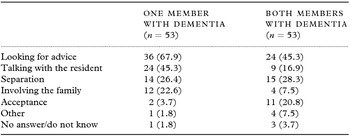
In contrast to the results for the interpretation of the situation, every participant was able to mention more than one reaction (category) to each situation (see Table 2).
Frequency and percentage (among brackets) of categories concerning the reaction to sexual situations involving one or two PWD

The most common reaction mentioned by participants in relation to both situations was to ask for counseling or advice from other professionals who are considered to be more competent in terms of assessing the situation and taking the appropriate measures. Thirty-six participants mentioned such a reaction to the situation involving just one PWD, while 24 did so for the situation in which both parties had dementia:
I would talk to our psychologist, he's the one who assess the residents’ cognitive abilities, and I’d ask him if this person is able to . . . to accept this relationship freely. W34_02_S1
In some cases, however, asking for advice seems to be a way of passing the problem on to people who have more knowledge or who are responsible for dealing with those kinds of situations:
Too difficult for me . . . I’d mention it to the managers and to the psychologist. I mean, I’d say: “guys, those people don't have all their faculties, they didn't know what they were doing, and they’ve found each other. . .” W56_01_S2
Participants sometimes stated that the complexity of this issue meant that it should be dealt with in a group meeting, since the decision cannot be taken by just one person and some kind of agreement is necessary:
I think that the multidisciplinary team should assess the case so that we can determine to what extent the relationship might be favoring well-being . . . or . . . or whether it might end up being a big problem for both of them. W45_02_S2
Some participants also noted the importance of interviewing the residents in order to know more about the relationship, what their intentions are, and to what extent they are aware of what they are doing. This kind of reaction was far more common in relation to the situation involving just one PWD (24 mentions, 45.3% vs. 9 mentions, 16.9% in the scenario with two PWD). When just one PWD was involved, the aim of the conversation would, in most cases, be to make the healthy partner see the risk of the situation and to persuade him/her, overtly or otherwise, to stop the relationship.
I would explain to the cognitively intact person that this is an unbalanced situation, that there's no equality, and so, from our point of view it would be better to find alternative ways of . . . of solving the need he's expressing. W43_01_S1
A third reaction identified in participants’ responses was to immediately stop the relationship by physically separating the couple. This reaction appeared with a similar frequency regardless of whether the situation involved just one PWD (14 mentions, 26.4%) or two PWD (15 mentions, 28.3%):
I would interrupt this situation . . . I think . . . it's difficult, because if both of them are demented, are they aware of what they’re doing? Is it animal instinct? Is it a response to a stimulus? It's very complicated . . . but I’d separate them because it's not right. W48_02_S2
In some cases, it was suggested that the individuals involved should be assigned different parts of the institution so that there was no likelihood of the situation reoccurring.
It would be necessary to split them up immediately, and to make sure they’re on different floors so they can't meet again. W57_02_S1
The fourth reaction identified by the analysis was to involve the family in the decision-making process. This reaction was more common in relation to the situation involving just one PWD (12 mentions, 22.6% vs. 4 mentions, 7.5% in the scenario with two PWD):
I think we should inform the family. They have the right to know. Without mentioning names, but they need to know what's going on with their relative. W43_01_S1
For these participants, families have the right (and sometimes the legal right, if they are the guardians of their relative) to know and decide, although, as in the previous case, involving the family is foreseen as being a potential source of problems:
If both of them have dementia and nobody shows signs of suffering, of being forced, then we should talk to the families. Families must be told, and if they’re fine with it, then there's no problem. Even if there's no harm being done, I guess that for families it's hard to accept. Whatever the case, it's something that needs to be discussed, and let's see what their opinion is. W54_04_S2
Finally, a minority of participants chose to do nothing and let the sexual relationship continue. This reaction was far more frequent when two PWD were involved in the relationship (11 mentions, 20.8%). In fact, when the situation involved just one PWD this alternative was only mentioned by two participants. Those who did mention this reaction said they would allow the relationship to continue if they did not detect any signs of alarm (e.g. that someone was being abused) and provided the situation seemed to be contributing to the well-being of the residents involved:
What they are doing doesn't matter, our job as professionals is to ensure they’re OK, that they feel good, that they’re not suffering and particularly . . . particularly that it's not a case of one of them enjoying it and the other having a rough time. W52_05_S2
Some participants who favored letting the relationship develop merely considered it necessary to find a suitable space in which it could take place:
If this situation occurs in a private room and both of them are OK, then there's no problem. We should find a place, a room for them if they’re both enjoying it. I mean, there's no abuse involved, is there? W54_02_S2
The results of the χ2 tests showed that the different reactions to both situations were not statistically associated with the participants’ type of job (managerial/professional vs. nursing assistants) or the number of years of experience (less than 10 vs. 10 or more).
Discussion
The aim of this study was to explore how RACF staff interpret and react to sexual relationships involving residents with dementia. The results suggest that the issues of abuse and consent are a central aspect in staff views, although the importance ascribed to them depends on the nature of the situation.
When the sexual relationship involves a resident with dementia and a cognitively intact resident, staff tend to define the situation as an actual or potentially abusive situation, in which one partner (the cognitively intact one) is taking unfair advantage of the other (the person with dementia). In a situation such as this the PWD is seen as the weaker party, and most staff responses suggest that he or she would be unable to interpret correctly what is happening and would not be capable of giving consent and deciding freely. At times, professionals even seem to treat sexual expression among PWD as a symptom of the illness. Thus, the diagnostic label acts as the frame of reference in which to interpret the situation and, if the PWD gives consent or shows positive emotions in the sexual relationship, then these behaviors would be further signs of his or her inability to take decisions. Consequently, the situation may be considered as abusive even if consent is given by the PWD.
This predominant interpretation of the situation in which just one PWD is involved is more compatible with an extreme cautionary stance than with the principles of person-centered care. Thus, the point of view of PWD (their feelings, needs, and rights) or their inherent diversity and uniqueness as individuals is only taken into account by a minority of staff members (responses included in the category labeled as “It could be abuse”), and even then, the shadow of abuse remains present. Thus, most participants prioritize a non-maleficence approach to care – seeking to ensure that the person with dementia is not harmed and avoiding their exposure to risky situations – over an approach based on beneficence, one which would try to maximize the resident's well-being and autonomy and that accepts reasonable risk as something inherently present in good care (Tarzia et al., Reference Tarzia, Fetherstonhaugh and Bauer2012).
In line with this cautionary stance and the emphasis it places on the potential for abuse and the lack of consent, the reaction towards a situation involving just one PWD is geared towards protection. However, this protection may take different forms and is aimed at different targets. For example, the results show that many participants would choose to involve other professionals in the decision, maybe as a way of protecting themselves. The dilemmas posed by the situation involving one PWD are perceived as being complex enough to justify passing the matter on to others with greater responsibility and decision-making ability (e.g. the managerial or professional staff, or the resident's family), and some participants believed that the issue merits group discussion in an interdisciplinary meeting.
In other cases, participants directly try to protect the resident from his/her own behavior and from the risk of being abused. This protection is achieved by physically separating the couple, but also by talking to those involved, which in this situation means telling the cognitively intact person that he/she (most often he) is committing a form of abuse and the relationship must stop. Trying to understand the residents’ point of view is virtually absent from those responses which mentioned “talking to the resident.”
The extreme cautionary stance appears to be mitigated when the situation under consideration involves two people with dementia. In this case, reference is still made to abuse and consent, but the situation is not clearly perceived as a case of abuse (even if there is no consent), or if it is, then only under some circumstances; in fact, many participants do not even consider this situation as abuse at all. Here there are more indications of a view that is compatible with a person-centered approach to care, although even some of those participants who clearly accept the situation and do not see abuse still use rather condescending arguments to support their point of view (they are innocent, let them be happy, they are not harming anybody, etc.). This infantilizing and romanticized treatment of PWD is consistent with what Ehrenfeld et al. (Reference Ehrenfeld, Bronner, Tabak, Alpert and Bergman1999) found in their study of staff attitudes towards residents’ sexual behavior, where views such as those reported here were more common than was a more ethical-oriented approach based on rights and needs.
As for the imagined reaction, the situation involving two PWD seems to be perceived as problematic and complex, since the most frequently mentioned reaction was seeking advice and external support, followed by separating the two residents involved. However, and in contrast to the situation involving just one PWD, reactions based on acceptance and letting the situation be are far more common here. Even so, signs of a person-centered attitude were, as in the previous situation, scarce: only 9 out of 53 participants said they would talk to the residents involved so as to know their point of view.
In summary, our results suggest that staff interpretations of and reactions to the two hypothetical situations cannot be understood in terms of an opposition between, on the one hand, a cautionary stance (based on external decision making and a focus on pathology) and, on the other, a person-centered approach. In fact, they are not even distributed along a continuum based on principles of non-maleficence and beneficence. This is because one pole of these oppositions is virtually absent in our participants’ discourse, namely the rights and needs of the PWD, taking into account their point of view or promoting their autonomy and quality of life. In fact, participants’ attitudes can best be described as being located along a simpler non-acceptance versus acceptance, or conservative versus liberal, continuum. The situation involving just one PWD is clearly biased towards attitudes of non-acceptance, whereas the scenario in which both partners have dementia elicits responses more towards the center of such a continuum.
Our results also show that the type of job (although not the years of experience) could influence attitudes towards sexual relationships among PWD. Specifically, auxiliary care staff seems to be more prone to the extremes of the abovementioned continuum: when just one PWD is involved, they tend to interpret the situation as clearly abusive, whereas they have a more liberal view with respect to a sexual relationship involving two PWD. By contrast, the responses given by professional and managerial staff are somewhat more nuanced and balanced in both situations.
This study does have some limitations that need to be taken into account when interpreting the results. First, the data are derived from a small purposive sample of RACFs and this limits the extent to which the results can be generalized. Further, more extensive studies are clearly needed to explore the extent to which the attitudes towards sexual relationships among PWD that have been identified here are actually widespread. Another limitation is that the method used to collect data (i.e. the interview) could be flawed by a tendency to give politically correct responses and by order-related bias (e.g. the situation involving one PWD was always presented first). Finally, complementing staff views with the opinions of families and residents could help to provide a more balanced and richer account of the issues at stake.
Despite these limitations, our results suggest that there is a need to change certain attitudes in relation to sexuality among PWD. It is understandable that professionals seek to eliminate potential harm or situations of conflict, since not only is it a way of protecting residents from mistreatment and abuse, but it also shields caregivers against charges of negligence. However, an extreme adherence to a principle of non-maleficence could also deny opportunities to preserve autonomy and increase well-being. In the case of sexuality, an overemphasis on non-maleficence could lead to an oversimplification of the phenomenon, labeling it as risky or harmful and, therefore, denying older people with dementia the right to channel appropriately the expression of their sexual needs.
Training would appear to be one of the most obvious ways of changing these attitudes. Indeed, sexuality in older age, both in general and specifically in the context of institutional settings and among PWD, should be a topic that is addressed by the basic training and continuing education of all staff who work in a RACF. Training should also include discussion of conflicts and difficult practical situations so that all staff levels are able to give a coherent and consistent response to these issues. Such an emphasis on training would ideally result in explicit guidelines being established to help staff manage sexual situations in residential care. The lack of such guidelines could promote conservative attitudes since staff may tend to eliminate situations of potential conflict, not only those which might imply abuse but also problems with families, with the institution, and with work colleagues.
Conflict of interest
None.
Description of authors' roles
F. Villar designed the study and formulated the research questions. He wrote the paper, assisted by M. Celdrán. M. Celdran and J. Fabà supervised data collection, categorized the responses, and built the category systems. R. Serrat helped with the reliability of the category systems and obtained κ values and performed χ2 tests. He also corrected the initial draft of the paper.
Acknowledgments
This research was funded by Spain's National Institute for Older People and Social Services (IMSERSO), grant 25/11.