INTRODUCTION
Agricultural production of high and stable yield in some regions relies on irrigation, and agriculture is a major global user of fresh water (Stockle Reference Stockle2002). Reallocation of fresh water from agriculture to cities and industries limits irrigated crop production in many important food-producing regions (Postel Reference Postel1998). Under these conditions, production is dependent on the use of alternative water sources including saline or waste water for irrigation. In addition, a problem with salinity exists on naturally saline soils and can be accentuated by poor irrigation and fertilization management, through high evaporation rate and insufficient leaching.
Watermelon is among the most widely cultivated crops in the world (FAOSTAT 2007). It is a crop with high water demand and is commonly grown with irrigation, but there are only a few studies dealing with watermelon response to salinity stress. Sodium accumulation, nutritional requirements and nutrient levels of watermelon grown under saline conditions are strongly dependent on cultivar (Lopez-Cantarero et al. Reference Lopez-Cantarero, Guzman, Valenzuela, Del Rio and Romero1992). The yield of watermelon increased by irrigation with underground saline water (EC=3·3–6·3 dS/m) compared with non-irrigated crops (Lei et al. Reference Lei, Xiao, Li, Mao, Wang, Liu and Zhang2003). In soilless systems, watermelon growth and yield were significantly reduced at salinity above 5 dS/m (Colla et al. Reference Colla, Roupahel, Cardarelli and Rea2006a).
High-salt stress in the root zone causes growth and yield reduction, depending on the severity of stress and sensitivity of the species (Shannon & Grieve Reference Shannon and Grieve1999). Salinity effects are also related to the duration of exposure and timing, as growth and yield are reduced less when salinity occurs relatively late in crop development (del Amor et al. Reference del Amor, Martinez and Cerda1999). Munns (Reference Munns1993) postulated that growth is inhibited initially by osmotic stress due to the decreased availability of water in saline media; subsequent growth reduction is the result of accumulation of toxic ions in the plant. High concentrations of Na+ and Cl− in the root zone may affect nutrient uptake through competitive interactions or by affecting the ion selectivity of membranes, causing disruption of ion homeostasis in cells (Grattan & Grieve Reference Grattan and Grieve1992). Thus, the important salt-tolerance feature affecting crop performance under salinity stress is the ability to exclude toxic ions from cells and organs.
High-yielding genotypes are usually salt-sensitive, so grafting them onto resistant rootstocks can be a feasible strategy to improve salt tolerance. Salt-tolerant rootstock can increase resistance to salinity in grafted plants (Rivero et al. Reference Rivero, Ruiz and Romero2003). The ability of rootstocks to prevent uptake and translocation of Na+ and Cl− to shoots and leaves was reported for tree crops like Citrus (Citrus sinensis L.; Garcia-Sánchez et al. Reference García-Sánchez, Jifon, Carvajal and Syvertsen2002), grape (Vitis vinifera L.; Fisarakis et al. Reference Fisarakis, Nikolaou, Tsikalas, Therios and Stavrakas2004) and avocado (Persea americana Mill.; Mickelbart & Arpaia Reference Mickelbart and Arpaia2002). Grafting reduced the concentrations of Na+ and Cl− in the xylem (Fernández-García et al. Reference Fernández-García, Martinez, Cerda and Carvajal2002), as well as accumulation in leaves, of tomato (Lycopersicon esculentum Mill.) plants (Santa-Cruz et al. Reference Santa-Cruz, Martinez-Rodriguez, Perez-Alfocea, Romero-Aranda and Bolarin2002). However, the effect induced by the rootstock may vary with the degree of stress and duration of salt treatment (Estañ et al. Reference Estañ, Martinez-Rodriguez, Perez-Alfocea, Flowers and Bolarin2005). When grafted watermelon (Colla et al. Reference Colla, Roupahel, Cardarelli and Rea2006a) and melon (Cucumis melo L.; Edelstein et al. Reference Edelstein, Ben-Hur, Cohen, Burger and Ravina2005; Colla et al. Reference Colla, Rouphael, Cardarelli, Massa, Salerno and Rea2006b) plants were grown at increased NaCl concentration, tested rootstocks reduced Na+ transport to leaves, but the Cl− concentration was similar in scion leaves regardless of the rootstock. In a study of grafted melon, Romero et al. (Reference Romero, Belakbir, Ragala and Ruiz1997) observed an even higher efficiency of Cl− exclusion, which raises the question of rootstock selection for stress tolerance.
The effect of salinity is known to be mediated, at least partially, by the enhanced generation of reactive oxygen species (ROS), which causes oxidative stress. Production of ROS can cause significant damage to cell structures, but it is also considered as a signal for activation of stress-response and defence pathways (Mittler Reference Mittler2002). In the enzymatic antioxidant pathway, superoxide dismutase (SOD; EC 1.15.1.1.) constitutes the first line of defence against ROS. It is the main scavenger of superoxide anion O2− catalysing its conversion into H2O2 and O2 (Bowler et al. Reference Bowler, Vanmontagu and Inze1992). The relationship between tolerance to salt stress and an efficient antioxidant system has been assessed in many plant species (Hernández et al. Reference Hernández, Ferrer, Jiménez, Barcelo and Sevilla2001; Vaidyanathan et al. Reference Vaidyanathan, Sivakumar, Chakrabarty and Thomas2003; Goreta et al. Reference Goreta, Bucevic-Popovic, Pavela-Vrancic and Perica2007), whereas grafted plants received less attention.
The objective of the present study was to determine the effect of short-term salinity stress on vegetative growth, SOD activity and ion composition in the leaves of fruit-bearing ungrafted seedlings and grafted watermelon plants. The hypothesis that the rootstocks could improve growth performance and contribute to the alleviation of salt stress in watermelon grown under increased root-zone salinity was tested.
MATERIALS AND METHODS
Plant material and growth conditions
Watermelon cv. Fantasy (Known-You Seed, Co., LTD., Kaohsung, Taiwan) was grown on its own roots or grafted on three rootstocks: Strong Tosa (Syngenta Seeds SAS, Saint Sauveur, France) and S1 (Known-You Seed) are interspecific hybrid rootstocks of Cucurbita maxima×C. moschata, whereas Emphasis (Syngenta Seeds) is a rootstock of Lagenaria siceraria (bottle gourd). The plants were grown in a greenhouse from March to July under natural photoperiod.
The required number of days from sowing to grafting for the tested scion and rootstocks was determined in a preliminary study, so that Emphasis, Fantasy and Strong Tosa and S1 were sown 20, 16, and 14 days before grafting, respectively. The seed was sown in polystyrene trays with cells (20 ml) in a commercial organic substrate (Gebr. Brill Substrate GmbH & Co. KG, Georgsdorf, Germany) and kept at 28°C until germination. One day before grafting, seedlings with a ball of substrate were transferred to rockwool cubes (65×65×75 mm; Grodan A/S, Hedehusene, Denmark) saturated with half strength nutrient solution (EC 1·0 dS/m and pH 5·5–5·7; Sonneveld Reference Sonneveld1989). Cleft grafting was performed, after which the plants were shaded and grown at relative air humidity of >95% and a temperature of 28–30°C until the graft union was healed.
After 28 days, the plants were transferred into rockwool slabs (1000×300×75 mm) saturated with full strength nutrient solution (electrical conductivity, EC 2·2 dS/m and pH 5·5–5·8). Three plants were planted per slab, pinched approximately at the 7th node and trained horizontally at two shoots per plant. Flowering started 20 days after planting. Hand pollination was performed during the morning (08:00–12:00) for 2 weeks, and only one fruit per plant was maintained.
At the stage when all plants had one fruit set, they were exposed to salinity stress for 15 days by adding NaCl to a standard nutrient solution (2·2 dS/m) until an EC of 4 or 6 dS/m was achieved. Salinity of the irrigation solution was increased daily by 1 dS/m in order to avoid sudden osmotic shock. Nutrient solution was delivered through an automated irrigation system by a separate drip emitter to each plant in a slab, 4–12 times per day, depending on the stage of growth. The leaching fraction of 0·2–0·3 was provided for all treatments during the course of the experiment.
Growth measurements
In order to distinguish growth under salinity, shoots were marked just below the shoot tip, a day before salinity treatments began. After a 2-week salinity treatment, the shoot grown during salinity was harvested. The length, number of leaves and nodes of the shoot were determined. Shoots were separated into leaves and stems, and the fresh weights of the samples were determined. Leaf area of all the leaves wider than 10 mm was measured using LI-3100 (LI-COR, Lincoln, Neb.). Dry weights of the leaves and stems were noted after drying at 60°C for at least 72 h. Specific leaf area (SLA, m2/g) was calculated by dividing the leaf area by dry leaf weight.
Ion analysis
Leaves developed after the beginning of salinity treatment were dried and ground for cation and anion analysis. Samples were ashed (0·5 g) at 500°C and dissolved in 2 ml HCl, and the Na+ and K+ concentrations were measured using the flame photometer model Flapho 4 (Carl Zeiss, Jena, Germany).
Anions were extracted with 10 ml of double deionized water from 0·1 g of ground sample. Samples were kept in a water bath at 80°C for 2 h. The extract was filtered and diluted prior to injection into an ion chromatograph (Dionex DX500, Sunnyvale, USA). An anion exchange column Ion Pac 9 AC9-HC (250×4 mm i.d.) with an anion self-regenerating suppressor ASRS-II was used for determination of Cl− and NO3− ions.
Enzyme extraction
The young fully developed leaves, approximately located at the 3rd to 4th node from the shoot tip, were collected for enzyme extraction after 15 days under salinity. The leaves were immediately frozen in liquid nitrogen and then stored at −80°C until being used. The frozen tissue (0·25 g) was homogenized in a mortar and pestle with approximately 0·5 g of sand and 4 ml of 50 mm K-phosphate buffer (pH 7·0) containing 10 mg/g polyvinyl pyrrolidone (PVP). The homogenate was centrifuged at 15 000 g for 30 min. All these procedures were carried out at 0–4°C. The supernatant was stored at −20°C and used for measuring SOD activity and protein content. Total soluble protein concentration of the enzyme extract was determined according to Bradford (Reference Bradford1976), using bovine serum albumin (Sigma-Aldrich Chemie GmbH, Taufkirchen, Germany) as a standard.
SOD activity assay
SOD activity was measured spectrophotometrically (Lambda Bio 40 UV/VIS Spectrometer, PerkinElmer Instruments, Milano, Italy) at 560 nm. The method by Beauchamp & Fridovich (Reference Beauchamp and Fridovich1971), which measures inhibition of the photochemical reduction of nitroblue tetrazolium chloride (NBT), was applied. One unit of enzyme activity was defined as the amount of SOD required to reduce the rate of NBT reduction to 0·5 of the rate of uninhibited reaction. Specific enzyme activity was expressed as units/mg of protein. The reaction mixture contained 50 mm K-phosphate buffer (pH 7·8), 0·1 ml EDTA, 13 mm L-methionine, 75 μm NBT, 2 μm riboflavine and an appropriate aliquot of the protein extract in a final volume of 3 ml. The reaction was started by illuminating the tubes with two 15 W fluorescent lamps for 10 min and stopped by switching off the light. A reaction mixture without the protein extract that developed maximum colour served as a control. The non-illuminated mixtures served as blanks.
Experimental design and statistical analysis
The experiment was set up as a randomized block design arranged in three replications. Three plants of each cultivar, planted in a single rockwool slab, were assumed as a replication, giving a total of nine plants per combination of three salinity×four rootstock.
Homogeneity of variance and normality of distribution were tested for all the variables and the data were transformed when necessary. Analysis of variance (ANOVA) was carried out using the PROC GLM of the SAS software package (SAS Institute 1989) to determine the main effects of rootstock and NaCl and their interaction on growth parameters, SOD activity and ion concentrations. To examine data trends for NaCl concentrations, linear coefficients were constructed and a trend analysis was performed. When interaction between salinity and rootstock was significant, the linear responses across the quantitative variable (NaCl) for different levels of the qualitative variable (cultivar) were determined.
RESULTS
Vegetative growth
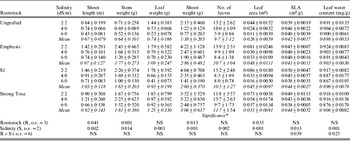
Vegetative growth parameters were more affected by salinity than by rootstock and no interaction between the two factors was observed except for SLA (Table 1). Shoot weight improved in all grafted plants when averaged across all salinity levels. Increased shoot weight of grafted plants was primarily due to an increase in stem weight (P⩽0·001), since the leaf weight (P=NS) was similar in all rootstocks. The shoot length enhanced only on plants grafted on to S1.
Vegetative growth parameters and water content (±s.e.) of ungrafted watermelon or grafted on three rootstocks (Emphasis, S1 and Strong Tosa) and exposed to three levels of salinity (2·2, 4·0 or 6·0 dS/m) for 2 weeks

* Effects were non-significant – NS (P>0·05) or significant at reported P-value. Salinity effects were linear at reported P-value.
Growth of plants was generally reduced as salinity of the nutrient solution increased (Table 1). The only exception was observed on plants grafted on to Strong Tosa, where shoot length, the number of leaves and the stem weight were increased by 34, 16 and 35%, respectively, when plants were grown at 4·0 dS/m compared to 2·2 dS/m. The most severe growth reduction in all growth parameters was found when salinity of the nutrient solution was increased to 6·0 dS/m, although growth of plants grafted on to Strong Tosa was reduced less compared to others (Table 1). Leaf growth was more impaired by salinity than stem growth, regardless of rootstock. At 6·0 dS/m, leaf weight was reduced from 50 (on Strong Tosa) to 83% (ungrafted) compared with 2·2 dS/m, whereas the stem weight decreased from 9 (on Strong Tosa) to 56% (on S1). The leaf number was not as sensitive to salinity as leaf weight and leaf area. It decreased from 17 (on Strong Tosa) to 54% (ungrafted) with an increase in salinity from 2·2 to 6·0 dS/m. Rootstock responded differentially to salinity only in SLA. SLA tended to increase with increasing salinity in ungrafted plants, but decreased in grafted plants (Table 1). Salinity caused water stress in grafted plants, leading to a linear decrease in leaf water content with increasing salinity. An almost unchanged (P=NS) water status was observed in ungrafted plants (Table 1).
SOD activity
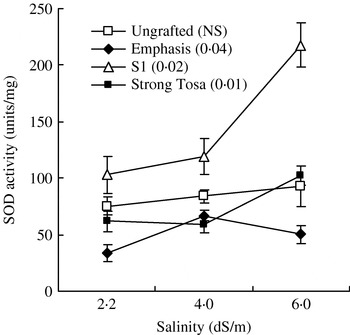
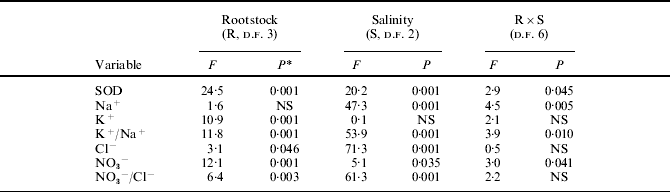
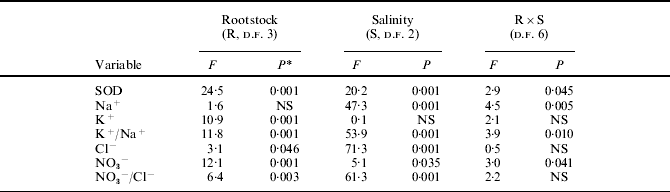
SOD activity was highly influenced by the rootstock, as evidenced by a variable level of constitutive leaf SOD activity (Table 2 and Fig. 1, respectively). Salinity, in general, linearly increased SOD activity, although significant interaction (P⩽0·045) indicated a different rootstock response (Table 2). The highest increase was observed when S1 was used as a rootstock, where SOD activity increased approximately two-fold at 6·0 dS/m compared with the 2·2 dS/m level. At the same time, almost no response was observed in ungrafted plants (Fig. 1).
Superoxide dismutase activity (SOD) in leaves of ungrafted (□) watermelon plants or grafted on three rootstocks (Emphasis (◆), S1 (△) and Strong Tosa (■)) and exposed to three levels of salinity (2·2, 4·0 or 6·0 dS/m) for 2 weeks. Vertical bar indicates mean±1 s.e. (n=3). The effects of salinity for each rootstock as denoted in brackets were non-significant (NS) or significant at reported P-value by polynomial linear analysis.

F-ratios (F) and their level of probability (P) of the main effects and interactions of rootstock (ungrafted, Emphasis, S1 and Strong Tosa) and salinity (2·2, 4·0 or 6·0 dS/m) on SOD activity, Na+, K+, Cl− and NO3− concentration and K+/Na+ and NO3−/Cl−ratio of watermelon leaves after 2 weeks under salinity
* Effects were non-significant – NS (P>0·05) or significant at reported P-value. Salinity effects were linear at reported P-value.
Ion concentration
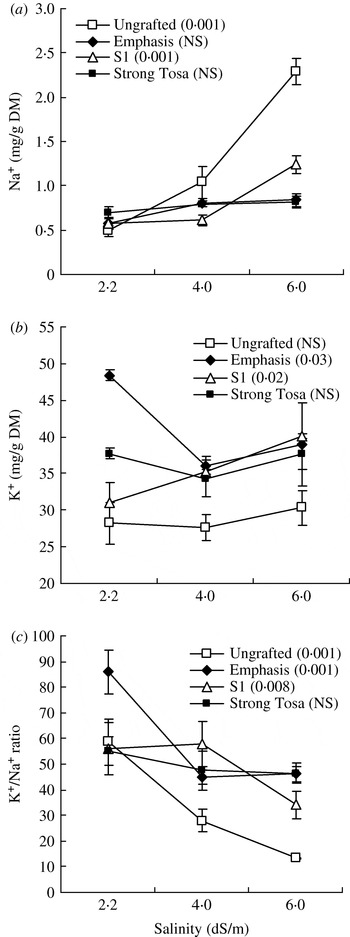
Sodium concentration was affected more by salinity of the nutrient solution than by the rootstock, although a differential response of rootstocks was noted (Table 2). A linear increase of leaf Na+ with increasing salinity was found when the plants were ungrafted or grafted on S1 rootstock. There was no significant accumulation of Na+ in Emphasis and Strong Tosa grafted plants (Fig. 2 a).
Leaf Na+ (a) and K+ (b) concentration, and K+/Na+ ratio (c) of ungrafted (□) watermelon plants or grafted on three rootstocks (Emphasis (◆), S1 (△) and Strong Tosa (■)) and exposed to three levels of salinity (2·2, 4·0 or 6·0 dS/m) for 2 weeks. Vertical bar indicates mean±1 s.e. (n=3). The effects of salinity for each rootstock as denoted in brackets were non-significant (NS) or significant at reported P-value by polynomial linear analysis.

The K+ concentration increased in leaves of grafted plant compared with ungrafted (P⩽0·001), whereas the effects of salinity or interaction were not significant (Table 2, Fig. 2 b). When K+ accumulation in leaves was related to the leaf Na+ concentration, the effect of rootstock and salinity was noted (Table 2). Increased salinity linearly reduced the K+/Na+ ratio in all the plants except those grafted on Strong Tosa (Fig. 2 c).
Rootstock determined the accumulation of Cl− in leaf tissues (Table 2), with lower concentrations found overall when the plants were grafted on S1 rootstock compared with plants grafted on Emphasis or ungrafted plants (Fig. 3 a). Concentration of Cl− was linearly increased in ungrafted and grafted plants as salinity increased (Fig. 3 a).
Leaf Cl− (a) and NO3− (b) concentration, and NO3−/Cl− ratio (c) of ungrafted (□) watermelon plants or grafted on three rootstocks (Emphasis (◆), S1 (△) and Strong Tosa (■)) and exposed to three levels of salinity (2·2, 4·0 or 6·0 dS/m) for 2 weeks. Vertical bar indicates mean±1 s.e. (n=3). The effects of salinity for each rootstock as denoted in brackets were non-significant (NS) or significant at reported P-value by polynomial linear analysis.

Leaf concentration of NO3− was differentially influenced by salinity in tested rootstocks (Table 2). The lowest NO3− concentration was found in ungrafted plants regardless of salinity. Salinity decreased NO3− only in leaf tissue of plants grafted on Emphasis (Fig. 3 b). Both rootstock and salinity affected the NO3−/Cl− ratio, but the response of rootstocks was similar (Table 2). Since NO3− concentration in rootstocks altered in different ways by salinity, it appears that the relation is highly influenced by the accumulation of Cl− at increased salinity (Fig. 3 c).
DISCUSSION
Plants with increased resistance to salinity are expected to maintain higher growth rates than less-resistant plants under saline conditions (Neumann Reference Neumann1997). The watermelon scions grafted on Strong Tosa rootstock enhanced the shoot length, the number of leaves and stem weight after 2 weeks of exposure to a moderate level of salinity (4·0 dS/m). When salinity in the root zone was increased to 6·0 dS/m, vegetative growth linearly decreased and the degree of response depended on the growth parameter or the rootstock. Leaf area and leaf weight were more reduced than the number of leaves in all rootstocks, suggesting that leaf expansion is more sensitive to salinity than leaf differentiation. The observed decline in shoot dry weight growth under salinity could largely be attributed to the reduction in light interception due to a smaller leaf area (Marcelis & van Hooijdonk Reference Marcelis and Van Hooijdonk1999). Strong Tosa had the lowest reduction of leaf area, which probably contributed to better vegetative growth performance under salinity compared to other rootstocks.
Under non-saline conditions, ungrafted plants had lower SLA (thicker leaves) than grafted, but when the plants were exposed to salinity, grafted plants responded by a decreased SLA. An increase in leaf thickness because of enlarged leaf mesophyll area has been reported as an adaptive response to salinity in other crops (Bayuelo-Jiménez et al. Reference Bayuelo-Jiménez, Debouck and Lynch2003; Vigo et al. 2005).
In ungrafted plants, the leaf water content remained the same even after exposure to salinity, probably due to an overall slower growth which could allow them to maintain a higher leaf water content (Estañ et al. Reference Estañ, Martinez-Rodriguez, Perez-Alfocea, Flowers and Bolarin2005). The leaf water content decreased with salinity in grafted plants, particularly with the S1 rootstock (by 5% with increasing salinity from 2·2 to 6·0 dS/m) in which the lowest leaf Cl− concentration was measured. Knowing that Cl− uptake and accumulation are related to water use (Moya et al. Reference Moya, Gomez-Cadenas, Primo-Millo and Talon2003), it may be assumed that the S1 rootstock limited water uptake as a tolerance mechanism that may reduce the toxic ion uptake and translocation to photosynthetic organs.
It is generally accepted that salt stress stimulates production of ROS, but there are only a few reports about the influence of rootstock on the oxidative status in plants exposed to salinity. A higher constitutive SOD activity was observed in lemon scions grafted on salt-tolerant Citrus rootstocks (Almansa et al. Reference Almansa, Hernández, Jimenez, Botell and Sevilla2002). Less oxidative stress occurred in tobacco plants grafted on salt-tolerant rootstocks (Ruiz et al. Reference Ruiz, Rios, Rosales, Rivero and Romero2006), whereas a higher antioxidant capacity was found in loquat plants grafted on anger rootstock (López-Gómez et al. Reference López-Gómez, San Juan, Diaz-Vivancos, Mataix Beneyto, García-Legaz and Hernández2007). In the present study, watermelon plants grown on different rootstocks or on their own roots exhibited variable levels of both constitutive and induced SOD activity. In ungrafted plants, an increase of SOD activity in response to salinity was insignificant. However, a substantial increase in SOD activity occurred in salt-treated grafted plants, indicating a build-up of a protective mechanism to reduce oxidative stress. The most prominent increase in SOD activity was noted in S1 grafted plants at high salinity, but these plants still showed significant growth reduction. Therefore, it may be concluded that SOD plays a significant role in watermelon salt stress response, but by itself is not sufficient to alleviate the impact of stress.
The ability of the rootstock to regulate leaf Na+ and Cl− accumulation, by restriction of uptake or translocation, is a highly important process contributing to increased salt tolerance of grafted plants (Santa-Cruz et al. Reference Santa-Cruz, Martinez-Rodriguez, Perez-Alfocea, Romero-Aranda and Bolarin2002). The Na+ exclusion efficacy of rootstocks tested in the present study was dependent on the imposed salt stress. The leaf Na+ content increased substantially already at 4·0 dS/m in ungrafted plants and at 6·0 dS/m on S1, whereas the accumulation of Na+ on Strong Tosa and Emphasis-grafted plants was not significant.
Metabolic toxicity of Na+ is largely a result of its ability to compete with K+ for binding sites essential for cellular functions (Tester & Davenport Reference Tester and Davenport2003). Potassium has an essential role in cell protection and osmotic adjustment under salinity, as well as in growth (Grattan & Grieve Reference Grattan and Grieve1999). In the present study, the rootstock had the main effect on K+ uptake, with the lowest leaf K+ concentration measured in ungrafted plants. However, the leaf K+ concentration was not significantly affected by salinity, thus the ability to keep a high K+/Na+ ratio was mainly achieved at reduced leaf Na+ concentrations. That was evident in Strong Tosa, which was the only rootstock where the K+/Na+ ratio had not significantly decreased as salinity in the root zone increased.
Regardless of the rootstock, the plants demonstrated greater capacity to regulate Na+ uptake and translocation than that of Cl− at all stress levels imposed in the present study. On average, across all treatments, scions accumulated almost 10-fold more Cl− than Na+ (8·9 v. 0·9 mg/g DW), probably due to different processes involving uptake and transport of these ions (White & Broadley Reference White and Broadley2001; Tester & Davenport Reference Tester and Davenport2003). It seems that the mechanisms of ion exclusion from the shoot were dependent on the genotype. At the highest level of salinity (6·0 dS/m), Emphasis and Strong Tosa were more effective in Na+, and S1 in Cl− exclusion from the shoot. In previous studies with cucurbits, some rootstocks excluded Na+ more efficiently than Cl− (Edelstein et al. Reference Edelstein, Ben-Hur, Cohen, Burger and Ravina2005; Colla et al. Reference Colla, Roupahel, Cardarelli and Rea2006a, Reference Colla, Rouphael, Cardarelli, Massa, Salerno and Reab), whereas others limited the leaf Cl− concentration more capably (Romero et al. Reference Romero, Belakbir, Ragala and Ruiz1997), which opens the possibility of site-specific rootstock selection.
An increase in Cl− uptake and accumulation is often accompanied by a decrease in shoot NO3− concentration (Grattan & Grieve Reference Grattan and Grieve1999), which is usually attributed to competitive inhibition between them (Cerezo et al. Reference Cerezo, Garcia-Agustin, Serna and Primo-Millo1997). Leaf NO3− concentration had changed substantially by salinity only in Emphasis. The decline in the NO3−/Cl− ratio in ungrafted or S1 grafted plants was less pronounced. Leaf growth (leaf area and leaf weight) in the case of these two rootstocks was slowed down to a higher extent than in Emphasis and Strong Tosa, probably as an adaptive strategy to avoid salt stress (Zhu Reference Zhu2001). Reduction of growth under salinity corresponds to inhibition of NO3− assimilation (Silveira et al. Reference Silveira, Melo, Viegas and Oliveira2001), which probably contributed to an almost unchanged leaf NO3− concentration in ungrafted and S1 grafted plants, regardless of salinity.
In conclusion, the present results demonstrate that vegetative growth of watermelon is substantially reduced after short-term exposure to salinity (6·0 dS/m), and that the degree of reduction depends on the rootstock. Salinity induced a significant increase in SOD activity only in grafted plants. The tested rootstocks were able to limit Na+ and Cl− uptake, although they were not equally effective in the exclusion of both ions. Emphasis and Strong Tosa were more efficient in Na+, and S1 in Cl− exclusion. Strong Tosa seems to be the most resistant among rootstocks tested in the present study. The growth of this rootstock was even enhanced by a moderate level of salinity (4·0 dS/m), while at the highest level (6·0 dS/m) it was less impaired than that of other rootstocks. The increased tolerance of Strong Tosa rootstock may be ascribed to the ability to induce anatomical changes (SLA) and the activity of antioxidative enzymes (SOD) in response to salt stress, and especially to the efficiency of Na+ exclusion from the shoot.