Introduction
Code-switching (that is, switching from one language to the other during the course of a conversation) is a ubiquitous feature of language use among bilinguals. A rich literature has described the linguistic regularities in code-switching, the pragmatic functions code-switching serves, and the social norms that influence the frequency of adults’ code-switching (e.g., Deuchar, Reference Deuchar2020; Liceras, Spradlin & Fernández Fuertes, Reference Liceras, Spradlin and Fernández Fuertes2005; MacSwan, Reference MacSwan, Nicoladis and Montanari2016; Toribio, Reference Toribio and Diaz-Campos2011). In contrast, the literature on bilingual children’s code-switching is small and heavily reliant on case studies, small samples, and cross-sectional studies. Theories of why children code-switch have far outpaced the available empirical evidence. The present, preregistered study investigates code-switching in a sample of 34 Spanish–English bilingually developing children who were studied longitudinally at the ages of 2;6 and 3;6. Using data from spontaneous speech samples, we describe the frequency and forms of the children’s code-switching at these ages, we describe the developmental changes in code-switching over this period, and we test four preregistered hypotheses regarding predictors of code-switching by bilingual children.
Types of code-switching and their appearance in children’s speech
Code-switching is the use of words or morphemes from two languages in an utterance or discourse. This can occur within an utterance (within-utterance or intra-sentential code-switches), between adjacent utterances by the same speaker (within-turn or inter-sentential code-switches), or at speaker switches within a conversation (across-speaker or inter-speaker code-switching; Genesee & Nicoladis, Reference Genesee, Nicoladis, Hoff and Shatz2007; Poplack, Reference Poplack1980). All these forms of code-switching have been observed in the speech of young children. Across-speaker code-switching is a particularly obvious feature of conversation in immigrant families where parents speak the heritage language to their children and their children reply in the societal language (Hurtado & Vega, Reference Hurtado and Vega2004; Ribot & Hoff, Reference Ribot and Hoff2014). Examples of young children switching languages mid-sentence or inserting a single word from their other language in a sentence can also be found.
The observed frequency of code-switching by young bilingual children varies substantially from study to study, and the factors that influence the rate of code-switching are not entirely clear. Vihman (Reference Vihman1998) described a pair of Estonian–English bilingual siblings at 2;8 and 5;11 who code-switched in 3% of their utterances when speaking to each other. Montanari, Ochoa, and Subrahmanyam (Reference Montanari, Ochoa and Subrahmanyam2019) reported that among Spanish–English bilingual children at 3;6, 11% to 16% of their utterances involved code-switching when they were speaking to a monolingual, unfamiliar interlocutor. Quick, Lieven, Carpenter, and Tomasello (Reference Quick, Lieven, Carpenter and Tomasello2018) described one 2;6 English–German–Spanish trilingual child for whom code-switches were involved in 23% of their total utterances when recorded at home. Importantly, there tends to be asymmetry in the frequency of code-switching across languages. For example, among the English–Spanish bilinguals studied by Montanari et al. (Reference Montanari, Ochoa and Subrahmanyam2019), 14% of children’s utterances were or contained codeswitches when speaking in a Spanish context, but only 3% of utterances in an English context involved code-switching.
Theories of why bilingual children code-switch
Code-switching by bilingually developing children was once considered to be evidence that the children were confused by their dual language exposure, that they failed to differentiate the two languages they heard, and that they instead developed a single, fused system (Volterra & Taeschner, Reference Volterra and Taeschner1978). This idea has since been discredited both by the decades of research showing the linguistic and social complexity of code-switching among bilingual adults (Toribio, Reference Toribio and Diaz-Campos2011) and by evidence that bilingual children have some control over which language they use as a function of what they believe about their interlocutor’s language abilities (Genesee, Nicoladis & Paradis, Reference Genesee, Nicoladis and Paradis1995). That is, children are more likely to switch between two languages if they believe their listener understands both languages. Theories of bilingual children’s code-switching have addressed both why code-switching occurs and the form that it takes.
Filling lexical gaps
The best-supported hypothesis regarding why children code-switch is the Lexical Gap Hypothesis, according to which children fill holes in their weaker language with their stronger language (Nicoladis & Secco, Reference Nicoladis and Secco2000). Evidence for this hypothesis comes from several sources. An in-depth examination of the speech produced by a Portuguese–English bilingual child studied from 1;0 to 1;6, found that 90% of his code-switches could be explained by the absence of a vocabulary equivalent in the language switched away from (Nicoladis & Secco, Reference Nicoladis and Secco2000). In this study, the child’s code-switching was assessed from recorded interactions with his parents who also provided weekly reports of his productive vocabulary outside of these sessions, allowing the researchers to determine whether the child had translation equivalents of his code-switched words (Nicoladis & Secco, Reference Nicoladis and Secco2000).
Additional evidence for the Lexical Gap Hypothesis comes from studies of five French–English bilinguals between 1;10 and 2;2 (Genesee et al., Reference Genesee, Nicoladis and Paradis1995) and of one Estonian–English bilingual from 1;1 and 2;0 (Vihman, Reference Vihman1985), which included audio recordings, video recordings, and diary records of the children’s language use. Both studies found that the children code-switched primarily when they were speaking the language in which they were less proficient. In the case of the French–English bilingual children examined by Genesee and colleagues (Reference Genesee, Nicoladis and Paradis1995), children who had a clear dominant language switched more when talking to the parent who spoke the child’s non-dominant language than when speaking with the parent who spoke the child’s dominant language. This was even the case when both parents were present (Genesee et al., Reference Genesee, Nicoladis and Paradis1995). In this study, dominance was determined by scores on four language skill measurements and confirmed through discriminant function analysis. Montanari et al. (Reference Montanari, Ochoa and Subrahmanyam2019) found that children code-switched away from the language their interlocutor was using to their dominant language even when they were led to believe that their interlocutor was monolingual. In this study, all the participants were deemed Spanish dominant because Spanish was spoken at home the majority of the time. This finding suggests that children will sometimes switch to their dominant language even when their code-switched words will not be understood by their interlocutor.
According to the Lexical Gap Hypothesis, as it is usually presented, bilinguals use the resource of their other language when they do not have the lexical item they need in the language they are currently speaking. Thus, children with weaker proficiency (and attendant smaller vocabularies) should have a reason to code-switch to another language more frequently than children with stronger proficiency (and attendant larger vocabularies). However, the other language is a useful resource only to the degree that the needed words are available in that other language. Taking this consideration into account yields the prediction that the size of the difference in vocabulary knowledge between the weaker and stronger language should also explain the frequency of code-switching. A previous analysis that included some of the children in the present study and used a caregiver-report measure of the children’s code-switching between speakers found that bilingual children who were more balanced in their dual language proficiency less frequently switched languages in replying to others, whereas as children who were unbalanced in their bilingual proficiency switched more frequently and to the use of their stronger language (Ribot & Hoff, Reference Ribot and Hoff2014).
Adaptation to the interlocutor
Another factor found to influence bilingual children’s code-switching is the language abilities of their interlocutors. Consistent with this Adaptation to Interlocutor Hypothesis, Lanza (Reference Lanza1992) reported that one Norwegian–English bilingual 2-year-old child code-switched more frequently with her bilingual father than she did with her monolingual mother, and Genesee, Boivin, and Nicoladis (Reference Genesee, Boivin and Nicoladis1996) reported that four French–English bilingual children at 2;2 code-switched more with their bilingual parents than they did with monolingual strangers. If children are sensitive to smaller differences in proficiency, it is possible that they may also switch away from a language spoken poorly by a bilingual interlocutor to use that interlocutor’s presumably stronger language. Certainly in conversations among adult bilinguals, one can observe speakers switching away from the language of group conversation to what they know is their listener’s stronger language if communication seems to require that.
The influence of models
According to the Modeling Hypothesis, bilingual children’s frequency of code-switching reflects the influence of the code-switching behavior they observe (Comeau, Genesee & Lapaquette, Reference Comeau, Genesee and Lapaquette2003). Consistent with this hypothesis, children have been found to code-switch at different rates with each of their parents, depending on the frequency with which that parent code-switches – and also depending on the degree to which the parent allows and encourages code-switching (Juan-Garau & Perez-Vidal, Reference Juan-Garau and Perez-Vidal2001; Lanza, Reference Lanza1992). However, not all studies find a relation between parent and child rates of code-switching (Genesee et al., Reference Genesee, Nicoladis and Paradis1995; Liceras et al., Reference Liceras, Spradlin and Fernández Fuertes2005; Mishina-Mori, Reference Mishina-Mori2011; Nicoladis & Genesee, Reference Nicoladis and Genesee1996, Reference Nicoladis and Genesee1998; Paradis & Nicoladis, Reference Paradis and Nicoladis2007). In a sample of five bilingual children between 1;11-2;2, Genesee et al. (Reference Genesee, Nicoladis and Paradis1995) found only two appeared to show similar rates of code-switching to their parents.
The most compelling evidence for an effect of modeling comes from studies in which children speak with an unfamiliar interlocutor who varies their rate of code-switching within the context of the experiment. In such a study, French–English bilingual children at 2;4 adjusted their own rates of code-switching to match an unfamiliar interlocutor who changed their own frequency of code-switching from a low rate (~15% of the time) to a higher rate (~40% of the time) across sessions (Comeau et al., Reference Comeau, Genesee and Lapaquette2003).
Balanced proficiency and the type of code-switching
The Balanced Proficiency Hypothesis pertains only to within-utterance code-switching. Based on the idea that within-utterance code-switching requires proficiency in both languages, this hypothesis predicts that bilinguals with more nearly equal proficiency in their two languages, often called balanced bilinguals, will produce more within-utterance switches than will bilinguals with more uneven levels of dual language proficiency. This hypothesis has found support in the results of studies of both adult and child bilinguals. Among Spanish–English preschoolers in the District of Columbia (Peynircioglu & Durgunoglu, Reference Peynircioglu, Durgunoglu, Hereida and Altarriba2002) and in Southern California (Montanari et al., Reference Montanari, Ochoa and Subrahmanyam2019), among English–Mandarin kindergarteners in Singapore (Yow, Patrycia & Flynn, Reference Yow, Patrycia, Flynn, Nicoladis and Montanari2016), and among adult Spanish–English bilinguals in New York City (Poplack, Reference Poplack1980), those with more balanced proficiency produced more within-utterance switches than did less balanced bilinguals.
The present study
The aims of the current study are (1) to describe the forms and frequency of code-switching by Spanish–English bilingual children in the U.S. at the ages of 2;6 and 3;6, and (2) to the test the hypotheses stemming from the theories outlined above regarding why bilingual children code-switch and the relation of proficiency to the form that those switches take. To do so, the current study makes use of video recorded conversations between 34 Spanish–English bilingual children and their bilingual parent or, in one case, their bilingual older sibling. At both ages, conversations were recorded once under instruction to speak only English and once under instruction to speak only Spanish. Nonetheless, the children did code-switch. The frequency and type of the children’s code-switches were counted from transcripts of those interactions. Measures of the children’s and their interlocutors’ language were also calculated from those transcripts, and measures of the children’s exposure to code-switching were available from the larger study in which these children participated. The following preregistered hypotheses and associated predictions were tested:
-
(1) The Lexical Gap Hypothesis. Two predictions can be made from the hypothesis that children code-switch to fill lexical gaps: one, proficiency should be a negative predictor of the frequency of code-switching; children with higher levels of proficiency will have lower rates of switching away from that language; and two, the size of the difference in proficiency between the weaker and strong language (i.e., degree of language dominance) should be a predictor of the rate of code switching, with code-switching to the stronger language occurring more when the difference is larger. In the present study, an additional set of exploratory analyses, which were not preregistered, were conducted to identify the unique effects of proficiency in the language being spoken and difference in proficiency between that language and the bilingual’s other language on the total rate of code-switching.
-
(2) The Adaptation to Interlocutor Hypothesis. Children’s rate of code-switching will reflect the properties of their interlocutor’s child-directed speech; lower levels of interlocutor proficiency should be associated with more frequent switching to the other language by children.
-
(3) The Modeling Hypothesis. Children’s rate of code-switching will be positively related to the amount of mixed language they have experienced. In this hypothesis, as it is tested here, experience refers broadly to children’s past and current experience of code-switching in their language environments, not to code-switching in the current conversation.
-
(4) The Balanced Proficiency Hypothesis. Children’s rate of within-utterance code-switching will be positively related to the degree of balance in their dual language proficiency.
Method
Participants
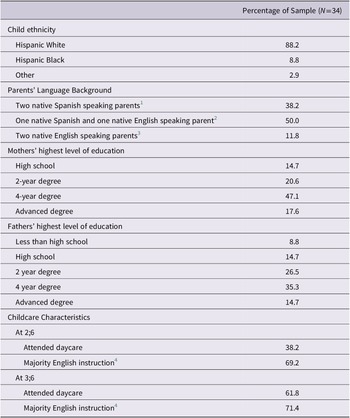
The participants were 34 Spanish–English bilinguals (19 girls) assessed at 2;6 (M = 29.73 months, SD = 0.37) and 3;6 (M = 41.80 months, SD = 0.37). These children were selected from a larger, ongoing longitudinal study of bilingual language development in South Florida, in the U.S. Participants were all of those in the larger study for whom recorded spontaneous speech samples with a bilingual caregiver were collected in both languages at both ages. Caregivers were considered bilingual if they met at least one of two criteria: (1) they reported speaking to the child in both languages, with the less frequently used language spoken at least 10% of the time, and/or (2) they had formal education in both languages. This latter criterion was used to include caregivers who reported using only one language with the target child but whom the child would know to be bilingual. All children had at least one parent who was born in a Spanish-speaking country, and Spanish was spoken in their homes, either in combination with English or exclusively. In the case of Spanish and English spoken at home, Spanish had to be spoken at least 10% of the time. Descriptive statistics for child ethnicity, childcare experience, and parent language background and education are presented in Table 1. Participants were recruited from advertisements in local magazines and through programs for parents with young children. All children were full term and healthy at birth, had normal hearing, and were born in the U.S.
Participant Characteristics

Note.
1 Native Spanish speaking is defined as from a Spanish speaking country and immigrated to the United States after the age of 4.
2 Native English speaking is defined as born in the United States or immigrated to the United States at or before the age of 4.
3 Includes one parent who immigrated to the United States at or before the age of 4.
4 For children who attended daycare, majority English = teachers spoke in English more than 80% of the time, according to caregiver report.
Procedure
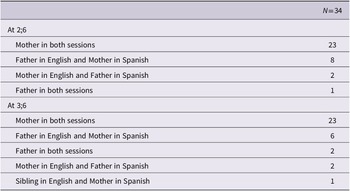
Participants were visited in their homes at 2;6 and 3;6 as part of the larger longitudinal study, with the exception of three participants who were seen in a laboratory playroom at 2;6. The 2;6 visit was the initial visit of the study. Each visit comprised three or four sessions, conducted on separate days, in which bilingual researchers administered standardized tests of the children’s Spanish and English – on separate days and in a counterbalanced order. In addition, parents completed a questionnaire at each visit in which they reported current information on children’s language exposure in and out of the home. Children were also video recorded in toy play and book reading interaction in each language with a bilingual parent or other bilingual family member. The family members serving the interlocutor role in each language are described in Table 2. For each recorded conversation, the child and interlocutor were provided with age-appropriate toys: animal toys, food toys, and books. The recordings were approximately 30 minutes in duration. On separate days and in a counterbalanced order, the interlocutor and the child were instructed to speak only in Spanish or only in English. The interlocutors complied, speaking the instructed language in 97% of their utterances. The children did not consistently comply, and their noncompliance provides the data for the present study.
Frequency of Interlocutor Relationships to Child in Recorded English- and Spanish-Designated Conversations at 2;6 and 3;6

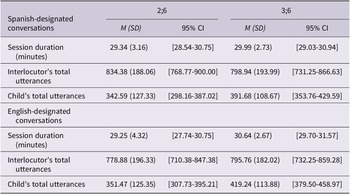
The recorded conversations were transcribed using CHILDES, which uses the TalkBank system (MacWhinney, Reference MacWhinney2000). All transcribers were trained against a common standard recording and transcript until they reached at least 90% accuracy before transcribing individual sessions. All utterances were coded in the transcripts as spoken in Spanish ([-spa]), English ([-eng]), a mixture of both ([-mix]), or unassigned ([-una]). Unassigned utterances were those that included words with the same meaning and similar pronunciation in both languages (e.g., okay) or English borrowed words (e.g., pizza in a Spanish utterance) Properties of the transcripts that provide the primary database for the current analyses are presented in Table 3. Conversations were approximately 30 minutes long and included a mean of 802 adult utterances and 376 child utterances.
Properties of Transcripts of Interlocutor-Child Interaction Designated as Spanish-Language and English-Language Conversations at 2;6 and 3;6

Measures
Children’s code-switching
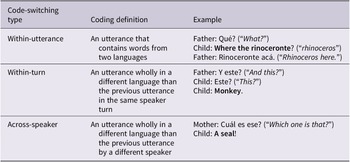
Each child utterance in the transcripts was coded as a code-switch if it was partly or completely in a language other than the instructed language and also was different from the language of the utterance that preceded it. Thus, only uses of English in the Spanish-designated context and uses of Spanish in the English-designated context were included in the final measures. Switches back to the assigned language from a code-switched utterance comprised less than 2% of all utterances, and these were not included in the analyses. Obvious borrowings (e.g., pizza) and words that are the same in both English and Spanish (e.g., okay/okey) were not included. The types of code-switches that were counted from the transcripts are defined and illustrated in Table 4. Coding was accomplished using CLAN (MacWhinney, Reference MacWhinney2000). The first author coded all the transcripts, and a trained research assistant coded a portion of the transcripts equal to 18% of the total at each age. High levels of interrater reliability were obtained at both 2;6 (κ = 0.94) and 3;6 (κ = 0.95). From the coded transcripts, we calculated the frequency of each type of code-switching separately for the Spanish-designated and English-designated conversations at each age.
Code-Switching Types, Definitions, and Examples

Note. English translation provided in italics. Code-switched utterances are bolded.
Indices of Children’s Language Skill in Spontaneous Speech
The mean utterance length in words (MLUw) and the lexical diversity (MATTR) of children’s speech were calculated using CLAN (MacWhinney, Reference MacWhinney2000) for Spanish and English, using only utterances that were produced entirely in the designated language. The MLT command produces MLUw; the FREQ command produces MATTR. MATTR, the moving-average-type-token-ratio, is a validated measure of lexical diversity (Fergadiotis, Wright & Green, Reference Fergadiotis, Wright and Green2015; Fergadiotis, Wright & West, Reference Fergadiotis, Wright and West2013) that is accomplished by taking a window of ten words and calculating the ratio of the number of unique words (types) over the total number of words (tokens). This window then moves over by one word and the type-token ratio is calculated again. Once the entire text is complete, all ratios are averaged to calculate the final MATTR (Covington & McFall, Reference Covington and McFall2010). (Note: MLUw and MATTR are used only as measures of individual differences in children’s English and Spanish skill. These measures cannot be used to compare children’s levels of Spanish and English proficiency because of the morphosyntactic differences between the languages.)
Children’s English and Spanish Expressive Vocabulary Scores
Expressive vocabulary in Spanish and English were measured using the examiner-administered Expressive One-Word Picture Vocabulary Test-Bilingual Edition (EOWPVT; Brownell, Reference Brownell2001). We administered the test separately in English and Spanish, on different days in a counterbalanced order, to obtain separate measures of children’s vocabulary in each language. We also modified the typical procedure to begin with the first item in the test booklet rather than by establishing a basal because we have found that bilingual children can have “holes” in their vocabularies which cause them to miss early words, yet know more advanced words (Hoff & Rumiche, Reference Hoff, Rumiche and Hoff2012). Because of these modifications in the administration procedure, there are no norms and, thus, no standard scores for this test. We used raw scores as the vocabulary measure.
Degree of English Dominance Score
There are multiple approaches to measuring language dominance in bilinguals, and they yield different outcomes (e.g., Bedore, Peña, Summers, Boerger, Resendiz, Greene, Bohman & Gillam, Reference Bedore, Peña, Summers, Boerger, Resendiz, Greene, Bohman and Gillam2012; Birdsong, Reference Birdsong, Silva-Corval´an and Treffers-Daller2016). One hypothesis under test in the present study is that the size of the gap in expressive ability between the weaker and stronger language predicts the frequency of switching from the weaker to the stronger. We measured that gap with a simple difference score, subtracting the Spanish EOWPVT score from the English EOWPVT score. Higher scores thus indicate greater English dominance; scores can be negative where Spanish is stronger than English.
Language Balance Score
Balance was calculated by dividing the EOWPVT score in the weaker language by the score in the stronger language, yielding a balance score between 0 and 1 in which 0 = monolingual and 1 = completely balanced bilingual (Gollan et al., Reference Gollan, Slattery, Goldenberg, Van Assche, Duyck and Rayner2011). Although this measure is redundant with the dominance score, the 0 to 1 scale allows testing the linear relation of balance to other measures.
Children’s Exposure to Code-Switching
At 2;6 the primary caregivers of 20 of the children in the sample completed a Language Diary (De Houwer & Bornstein, Reference De Houwer and Bornstein2003) in which they recorded, for every 30-minute block of each of the 7 days in a week: the person or persons who interacted with the child, the language spoken, the activity, and any comments. In order not to overburden the caregivers, each day of the 7-day period was recorded during a different week. From these diaries, the percentage of 30-minute periods in which the child heard both English and Spanish was calculated as an indirect indicator of their exposure to code-switching.
Parental Language Mixing Score
Primary caregivers completed the Byers-Heinlein Language Mixing Scale (Byers-Heinlein, Reference Byers-Heinlein2013) at child age 2;6 and 3;6. This is a self-report measure of code-switching that asks five questions such as, “I often start a sentence in English and then switch to speaking Spanish” and parents rate themselves on a scale from 1 to 7 (“very true” to “not true at all”). The responses are averaged to create a composite measure.
Properties of Interlocutor Child-Directed Speech
The interlocutor’s MLUw and lexical diversity measured with MATTR were calculated from the transcripts at each age using CLAN in the same manner that was done for assessing the children’s spontaneous speech. For the interlocutors, a composite measure of language complexity was created by transforming the MLUw and MATTR into z-scores and calculating the mean of these standardized scores.
Results
A table of descriptive statistics for all measures is provided in supplementary material (Supplementary Materials). The full dataset is available through the Open Science Framework. All analyses were conducted in SPSS 28.
Describing Children’s Codeswitching at 2;6 and 3;6
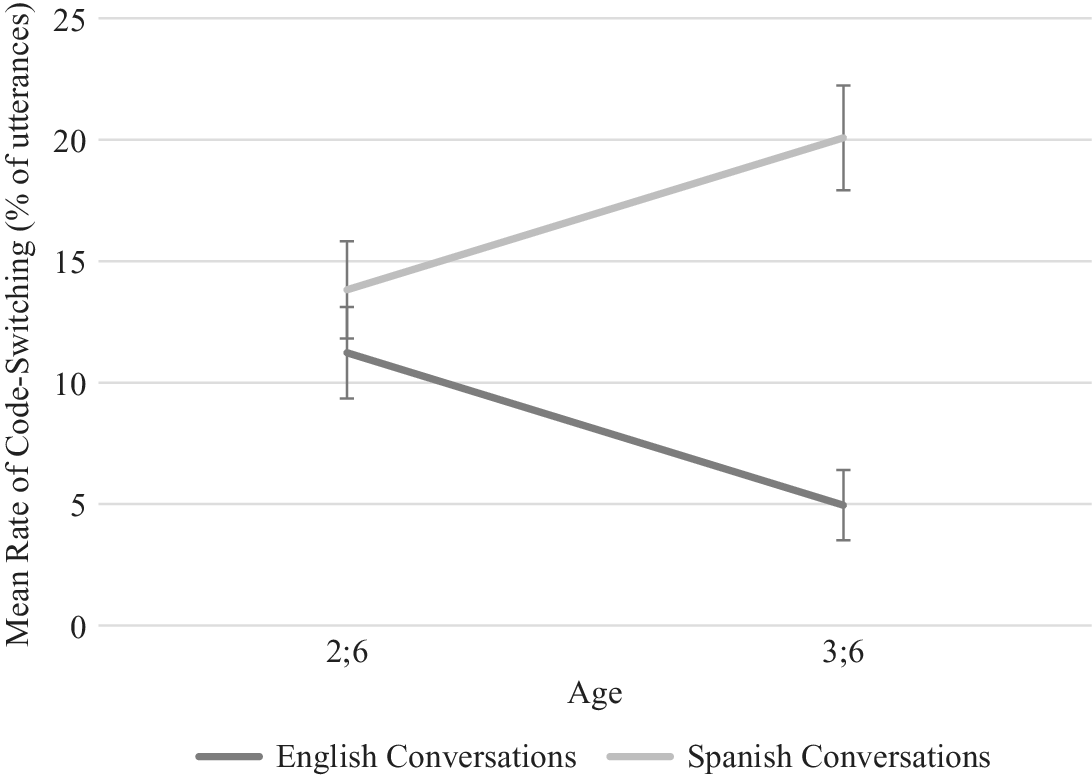
Figure 1 plots the percentage of child utterances that were code-switched utterances of any form by age and language context.
Frequency of Children’s Code-Switching as a Function of Age and Language Context
Note. Error bars represent 1 standard error.

A 2(Age) by 2(Language Context) repeated measures ANOVA with the percentage of utterances that were code-switches as the outcome variable indicated no main effect of Age, F(1, 33) = 0.00, p = .99, η2p = .00, observed power = .05; a significant main effect of Language Context, F(1, 33) = 8.73, p = .006, η2p = .21, observed power = .82, such that children’s total rate of code-switching during English-designated conversations was less than children’s total rate of code-switching during Spanish-designated conversations; and a significant Age × Language Context interaction, F(1, 33) = 24.76, p < .001, η2p = .43, observed power = 1.0. The frequency of switching to English in Spanish-designated conversations increased with age, while the frequency of switching to Spanish in English-designated conversations declined. Paired comparisons with the Bonferroni adjustment for multiple comparisons indicated that switches to English were significantly more frequent than switches to Spanish at 3;6, p < .001, but not at 2;6 p = .45.
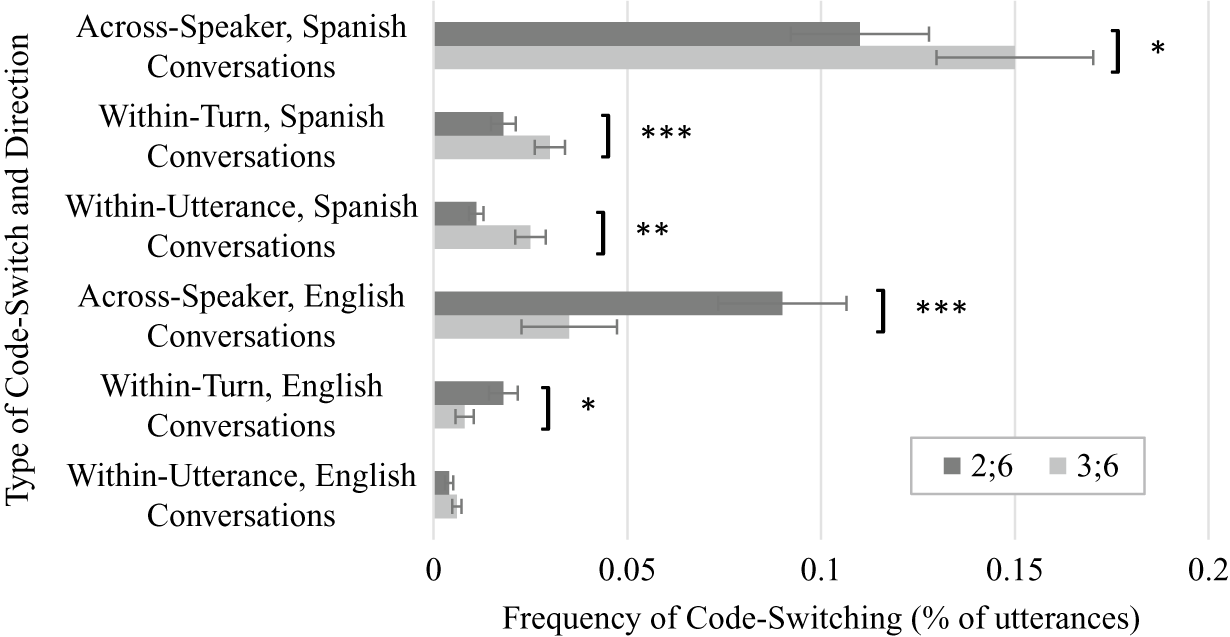
Figure 2 presents the proportion of children’s utterances that were across-speaker, within-turn, and within-utterance switches for each context and each age. Effects of child age and code-switching type on the frequency of code-switches were tested in two 2(Age) × 3(Type) repeated measures ANOVAs, one for the Spanish-designated and one for the English-designated contexts.
Frequency of Code-Switching Types by Age and Language Context
Note. Error bars represent 1 standard error. Statistical comparisons of frequency accomplished with paired-sample t-tests.
*p < .05. **p < .01. ***p < .001.

In the Spanish-designated conversations, there was a significant main effect of Age, F(1, 33) = 15.24, p < .001, η2p = .32, observed power = .97; children code-switched more frequently at 3;6 than at 2;6. There was a significant main effect of Type, F(1, 33) = 37.95, p < .001, η2p = .54, observed power = 1.0. Paired comparisons with the Bonferroni adjustment indicated that across-speaker code-switches were significantly more frequent than within-turn code-switches, p < .001, and more frequent than within-utterance code-switches, p < .001. There was no significant difference between the rate of within-turn and within-utterance code-switches, p = .44. There was no significant Age × Type interaction, F(1, 33) = 2.40, p = 0.10, η2p = .07, observed power = .47.
In the English-designated conversations, there was a significant main effect of Age, F(1, 33) = 13.51, p < .001, η2p = .29, observed power = .95; children code-switched less frequently at 3;6 than at 2;6. There was a significant main effect of Type, F(1, 33) = 19.44, p < .001, η2p = .37, observed power = 1.0. Paired comparisons with the Bonferroni adjustment indicated that children produced across-speaker code-switches significantly more than both within-turn, p < .001, and within-utterance code-switches, p < .001, and they produced significantly more within-turn code-switches than within-utterances code-switches, p = .006. There was a significant Age ×Type interaction, F(1, 33) = 13.16, p < .001, η2p = .29, observed power = 1.0. Paired comparisons with the Bonferroni adjustment were completed. Compared to 2;6, at 3;6 there were fewer across-speaker, p < .001, and within-turn code-switches, p = .01, whereas there was no significant change between 2;6 and 3;6 in the frequency of within-utterance code-switching, p = .44.
In sum, these descriptive data on the frequency and forms of children’s code-switching at 2;6 and 3;6 indicate that these Spanish–English bilingual children switch languages, on average, in just over 10 percent of their utterances – when they are speaking to a bilingual family member who is 97 percent consistent in not code-switching during that conversation. The distribution of those code-switched utterances changes from the age of 2;6 to 3;6, with switches to English becoming more frequent and switches to Spanish becoming less frequent. At both 2;6 and 3;6, the most frequent form of code-switching is across-speaker switches, accounting for 77 and 67 percent of all switches, respectively. Switches within-turns accounted for 16 and 17 percent of switches, and within-utterance switches accounted for 7 and 16 percent of switches. There was, however, variability among the children in both the overall rate and the relative frequencies of types in their code-switches, which provide the data for testing hypotheses regarding the reasons children code-switch.
Predicting Individual Differences in the Frequency of Children’s Code-Switching at 2;6 and 3;6: Tests of the Lexical Gap, Accommodation to the Interlocutor, and Modeling Hypotheses
Preliminary Analyses
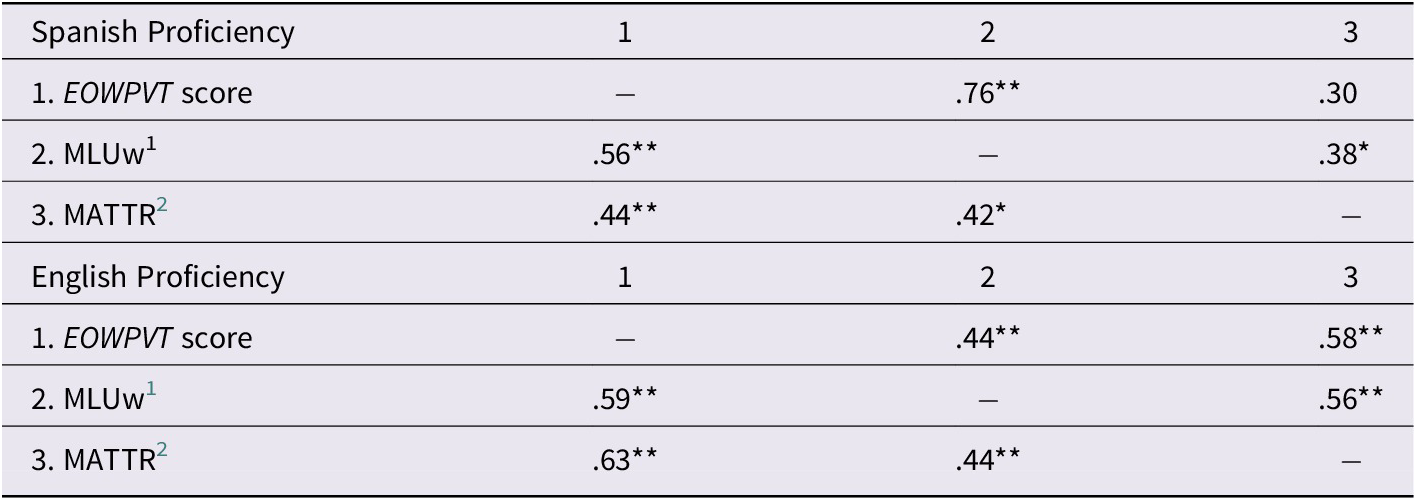
Because two of the hypothesized predictors of children’s code-switching, language dominance and language balance, were based entirely on children’s scores on the English and Spanish administration of the EOWPVT, we first asked how well these test scores captured individual differences in the children’s language proficiency as evidenced in their speech in the conversations that provided the measures of code-switching. The correlations between the EOWPVT scores, MLUw, and the MATTR scores are presented for each language and age in Table 5. At 2;6 and 3;6 the correlations between children’s English EOWPVT and the measures based on spontaneous speech were significant and moderate to strong. Within Spanish, the measures at 3;6 were similarly correlated, but at 2;6 the children’s Spanish EOWPVT scores were significantly and strongly correlated with MLUw but not significantly correlated with the MATTR measure.
Correlations Between Children’s Expressive Vocabulary Score and Transcript-Based Measures of Language Proficiency for Spanish and English at 2;6 and 3;6

Note. The results for the sample at 2;6 years are shown below the diagonal. The results for the sample at 3;6 years are shown above the diagonal.
1 MLUw = mean length of utterance, measured in words.
2 MATTR = moving average type-token ratio, a measure of lexical diversity.
*p < .05. **p < .01.
Descriptive Statistics for the Hypothesized Predictors of Code-Switching
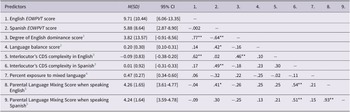
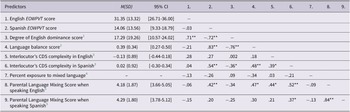
Table 6 and Table 7 present descriptive statistics for the hypothesized predictors of code-switching and their intercorrelations at each age. (As noted in the method section, measures of exposure to code-switching are available for only a subsample of the participants, the diary-based measure was collected only at 2;6, and the measures of interlocutors’ language complexity are z-scores. Raw data on both measures of the interlocutors’ speech complexity are provided in the supplementary material, Supplementary Materials). These data indicate that the children were, on average, slightly English dominant at 2;6 and more so at 3;6. The children heard both English and Spanish within the same 30-minute block for approximately half of their day, and their parents’ self-reported levels of language mixing were high – above 4 on a 5-point scale at both ages.
Descriptive Statistics (Means, Standard Deviations) and Zero-order Correlations Between All Predictors at 2;6

Note. N = 34.
1 English EOWPVT score minus Spanish EOWPVT score.
2 The lower of English and Spanish EOWPVT scores divided by the higher.
3 CDS = child-directed speech.
4 Percent of 30-minute time periods in which two languages were addressed to the child, regardless of speaker; n =20.
5 Composite score on the Byers-Heinlein parental mixing scale; n = 30 at 2;6.
*p < .05.**p < .01.
Descriptive Statistics (Means, Standard Deviations) and Zero-order Correlations Between All Predictors at 3;6

Note. N = 34.
1 English EOWPVT score minus Spanish EOWPVT score.
2 The lower of English and Spanish EOWPVT scores divided by the higher.
3 CDS = child-directed speech.
4 Percent of 30-minute time periods in which two languages were addressed to the child, regardless of speaker; n =20.
5 Composite score on the Byers-Heinlein parental mixing scale; n = 29 at 3;6.
*p < .05.**p < .01.
Relations Between Hypothesized Predictors and Children’s Total Frequency of Code-Switching
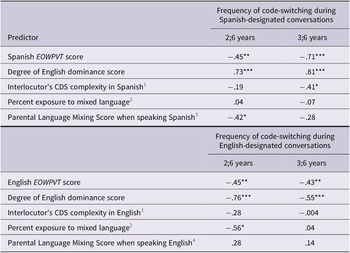
Table 8 presents the zero-order correlations between the predictors and the concurrent measures of code-switching in each language context at each age. Both absolute levels of proficiency and degree of English dominance were significant predictors of the frequency of children’s total rate of code-switching in both the Spanish and English contexts at both ages. Children with lower levels of proficiency in the designated language and with a larger difference between proficiency in the designated and other language switched to the other language more than did children with higher absolute proficiency and more nearly balanced proficiency. Other hypothesized predictors bore less consistent relations to children’s code-switching: the complexity of the interlocutors’ speech was negatively related to the frequency of children switching to the other language only for the Spanish-designated conversations at 3;6; children’s exposure to mixed input, based on the diary records, was unrelated to their code-switching in Spanish conversations and was (paradoxically) negatively related to their code-switching in English conversations at 2;6; parent language mixing based on the self-report instrument was (also paradoxically) a negative predictor of code-switching, but only in the Spanish conversations and only at 2;6.
Zero-order Correlations Between Predictors and the Frequency of Code-Switching at 2;6 and 3;6

Note. N = 34.
1 CDS = child-directed speech.
2 n = 20.
3 n = 30.
4 n = 29.
*p < .05. **p < .01. ***p < .001
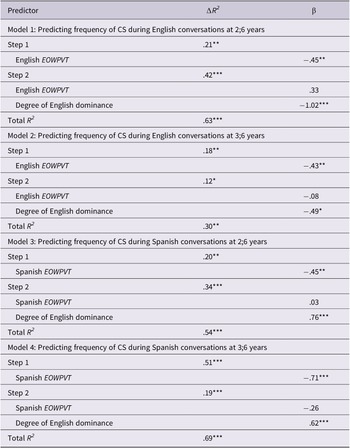
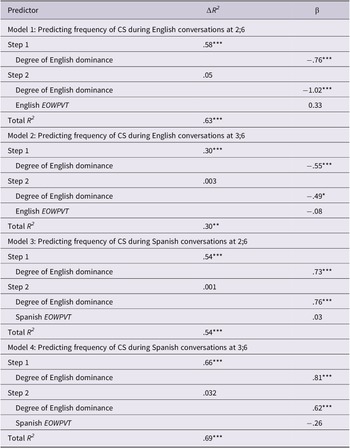
A final, exploratory set of analyses was conducted to ask whether degree of dominance (i.e., the size of the vocabulary score difference between English and Spanish) accounts for unique variance in the frequency of children’s total rate of code-switching over and above the effects of the children’s level of proficiency in the designated language. In separate hierarchical regressions calculated for the Spanish-designated and English-designated conversations at 2;6 and 3;6, children’s expressive vocabulary scores in the designated language were entered first and the measure of degree of English dominance was entered second. The results are reported in Table 9. In all four regressions, degree of English dominance accounted for significant, unique variance in the frequency of code-switching. The results of the obverse analyses, testing the unique effect of absolute proficiency over and above degree of English dominance are reported in Table 10. These results indicate that children’s vocabulary scores in the language they are instructed to use do not explain additional variance beyond that explained by the degree of dominance.
Hierarchical Regression Models Testing the Effect of Degree of English Language Dominance on Code-Switching, Controlling for Expressive Vocabulary (N = 34)

Note. CS = code-switching.
*p < .05. **p < .01. ***p < .001
Hierarchical Regression Models Testing the Effect of Expressive Vocabulary on Code-Switching, Controlling for Degree of English Language Dominance (N = 34)

Note. CS = code-switching.
*p < .05. **p < .01.
Predicting the Form of Children’s Code-Switching at 2;6 and 3;6: Test of the Relation Between Language Balance and the Frequency of Within-Utterance Code-Switching
Table 11 presents the correlations between the measure of balance in the children’s bilingualism and the frequency of within-utterance code-switching at each age and language context. None of these correlations reached traditional levels of statistical significance. However, at 2;6, for the English-designated conversations, the correlation had a p value equal to .05 and was in the predicted direction: children who were more balanced in their dual language proficiency code-switched more often within an utterance than did children who were less nearly balanced in their dual language proficiency.
Correlations Between Degree of Balance in Children’s Language Proficiency and Rate of Within-Utterance Code-Switching at 2;6 and 3;6 Years

+ p = .05.
Predicting Individual Differences in Age-Related Change in Children’s Code-switching
Our final analysis asked whether individual differences in the observed age-related increase in the rate of code-switching to English and in the decrease in the rate of code-switching to Spanish (Figure 2) could be explained as a result of age-related increases in the degree of English dominance (Table 8). We calculated change scores in English dominance, change scores in the frequency of switching to English in Spanish-designated conversations, and change scores in the frequency of switching to Spanish in the English-designated conversations. Individual differences in the change in English dominance significantly predicted change in the frequency of switching to English during Spanish-designated conversations, r (N = 34) = .52, p = .001, indicating that changes in dominance accounted for 27.4% of change in the frequency of switching during Spanish-designated conversations between 2;6 and 3;6. Individual differences in changes in English dominance did not predict change in the frequency of switching during English-designated conversations, r (N = 34) = -.15, p = .40.
Discussion
The present study measured the types and direction of code-switching by Spanish–English bilingual children in the U.S. at the ages of 2;6 and 3;6 and tested several preregistered hypotheses that have been proposed to explain why bilingual children code-switch. Our clearest finding is that of support for the Lexical Gap Hypothesis, according to which gaps in lexical knowledge in the weaker language motivate switches to the stronger language in order to access words that fill those gaps. We further found evidence suggesting that it is not just the limitations of the weaker language but the relative strength of the stronger language that influences the frequency of code-switching.
Our descriptive findings are that these children switched languages in over 10 percent of their utterances at both 2;6 and 3;6, when talking to a bilingual family member who was not code-switching in that interaction. The children’s most frequent type of switch was replying in English to their interlocutor’s Spanish. Between-speaker switches away from English and into Spanish also occurred, but less frequently. Within-turn and within-utterance code-switches were much less frequent, but where there were differences, they, too, were more frequently switches to English from Spanish than vice versa. The overall frequency and rank order of types of code-switches was stable from 2;6 and 3;6, but the direction of code-switching changed. All forms of switching to English became more frequent and all forms of switching to Spanish became less frequent.
The findings that support the Lexical Gap hypothesis are that children’s proficiency in the language they were instructed to speak was a negative predictor of the frequency of code-switching – both from English and from Spanish – and the degree of English dominance uniquely accounted for additional variance in code-switching as a positive predictor of the frequency of switching to English when speaking Spanish and a negative predictor of the frequency of switching to Spanish when speaking English. The average degree of English dominance in the sample increased from 2;6 to 3;6, as did the average frequency of switching to English from Spanish, and individual differences in the change in English dominance predicted individual differences in the increase in switching to English. These findings are consistent both with the predictions of the Lexical Gap Hypothesis and with previous findings that dominance predicts the direction of code-switching (Genesee et al., Reference Genesee, Nicoladis and Paradis1995; Nicoladis & Secco, Reference Nicoladis and Secco2000; Ribot & Hoff, Reference Ribot and Hoff2014; Vihman, Reference Vihman1985). The present findings add to the previous literature by distinguishing effects of dominance from effects of absolute proficiency and suggesting, therefore, that the Lexical Gap Hypothesis requires elaboration.
A distinction can be made between two ways of construing the nature of the gaps that bilingual children fill when code-switching. One is that the gap is relative to the communicative demands of the situation. For example, the child needs to refer to the toy rhinoceros, but the child does not know the word in the language they are speaking. The other is that the gap is relative to the child’s desire to share their thoughts and feelings with another person; it is not just a matter of having words for referents. That is, the communicative need is internally rather than externally caused. The desire to share one’s thoughts with others has been argued to drive language development (L. Bloom, Reference Bloom1993; Snow, Reference Snow and MacWhinney1999), and our findings suggest that this desire drives code-switching as well. The distinction is subtle but meaningful. It suggests that there is not a threshold of proficiency in a bilingual’s weaker language that will obviate the motive for using the stronger language in circumstances in which maximizing the power of expression matters. This interpretation is consistent with what is frequently expressed by even highly proficient bilinguals – that is, that some kinds of conversations have to be had in their stronger language. Of course, many human interactions have fairly prosaic goals and do not require maximizing one’s power of expression. In such circumstances there may well be thresholds of proficiency that, when reached, make code-switching unnecessary.
The present study tested other hypothesized influences on the rate of code-switching that have been proposed in the literature: that children code-switch to accommodate the proficiency of their interlocutor and that children’s code-switching reflects the models they have been exposed to. We did not find consistent support for either of these hypotheses.
The interlocutor’s proficiency was a negative predictor of children’s code-switching only at 3;6 and only in the Spanish-designated interactions. Consistent with the accommodation hypothesis, the children switched away from Spanish and to English less when their interlocutor appeared more proficient in Spanish, but it may also be that the children were switching to their own dominant language. Indeed, as shown in Table 6, the children with the more Spanish-proficient interlocutors were themselves less English dominant than the children with less Spanish-proficient interlocutors.
Measures of the children’s exposure to code-switching were available only for a portion of the sample, based on language diaries kept by primary caregivers and based on a self-report questionnaire. Neither measure was a positive predictor of the overall rate of code-switching. At 2;6 the parent self-report measure of code-switching when speaking Spanish was an unexpected negative predictor of the children’s code-switching when speaking Spanish, and the diary-based measure of exposure to mixed input was an unexpected negative predictor of the children’s code-switching when speaking English. The wide-spread evidence that there are community norms regarding code-switching argues that modelling must play a role in shaping code-switching behavior. However, in the South Florida bilingual community, code-switching is normative (Deuchar, Reference Deuchar2020), potentially dampening the variation in these children’s exposure to language mixing.
Last, the hypothesis that the degree of balance in the children’s proficiency would predict the frequency of within-utterance code-switches, a finding obtained in previous work with children (Peynircioglu & Durgunoglu, Reference Peynircioglu, Durgunoglu, Hereida and Altarriba2002; Yow et al., Reference Yow, Patrycia, Flynn, Nicoladis and Montanari2016) and adults (Poplack, Reference Poplack1980), was not supported here, but the total frequencies of within-utterances code-switches were very low, limiting power.
Limitations
This study does not provide a picture of children’s code-switching “in the wild.” The parents and children were instructed not to code-switch. The true frequency of code-switching by the parents is certainly higher than it was in these conversations, and the frequency by the children is potentially higher. Within-speaker and, particularly, within-utterance switches were rare, and the total amount of speech recorded may have been insufficient to capture variation in frequency of these rare events. Also, other unmeasured factors may contribute to the effect of language dominance and to the developmental increase in switching to English. Speakers may switch to their stronger language not only because they lack the lexical items they need for expression but also because using the weaker language is more demanding of cognitive resources (Abutalebi, Reference Abutalebi2008). Switching to English may be more modeled than switching to Spanish in the U.S., where Spanish speakers are more likely to be bilingual than English speakers. Lastly, the developmental increase in English proficiency and the associated increase in code-switching in the direction of English may both reflect the participants’ growing awareness of the status differences between English and Spanish in the United States.
Summary and Conclusion
Despite these limitations, this study makes unique contributions to the literature on dual language use in bilingual children: in studying a younger sample of bilingual children than is typical for relatively large N studies; in collecting longitudinal data that tracks changes in code-switching and changes in dual language proficiency; and in measuring children’s code-switching as they interact with a familiar family member whom they know to be bilingual.
The picture of code-switching that we found in these bilingual children at 2 and 3 years of age is one in which they choose to speak their stronger language. As the difference in their levels of Spanish and English grows toward greater English dominance, their frequency of switching to English increases – even as their Spanish proficiency is advancing. These findings argue for a form of the Lexical Gap Hypothesis in which the gap that needs filling is between communicative intentions and the available linguistic means of expression, not merely between the communicative demands of the situation and vocabulary knowledge.
Acknowledgments
Both authors were supported by grant number HD068421 from the Eunice Kennedy Shriver National Institute of Child Health and Human Development to Erika Hoff. Some of these descriptive data were included in a presentation to the meetings of the American Speech- Language-Hearing Association (Carmona, Guevara, Ratner & Hoff, Reference Carmona, Guevara, Ratner and Hoff2019).
Supplementary Material
To view supplementary material for this article, please visit https://doi.org/10.1017/S0305000922000307
Competing interests
The authors declare none.