INTRODUCTION
Advance care planning (ACP) provides patients with an opportunity to consider, discuss and plan their future care with health professionals, and may include close persons. Such discussions have the potential to lead to documentation of preferences for future healthcare, or appointment of a person to make healthcare decisions were the patient to lose mental capacity to make such decisions (lasting power of attorney). However, reluctance in our society to think about dying has resulted in barriers to ACP (Pearlman et al., Reference Pearlman, Starks and Cain2005). Recent United Kingdom policy documents recommend developing a national approach and clarifying the ACP process for health professionals and the public. The End of Life Care Strategy aims to make it easier to discuss preferences for end-of-life care (Department of Health, 2008). The Cancer Reform Strategy recognises ACP as a key component in improving cancer services within the United Kingdom and recommends access to good information to enable patients to play an active role in healthcare decisions (Department of Health, 2007). Guidance has also been published to inform health and social care professionals about the process of ACP and enable them to incorporate it into clinical practice (NHS End of Life Care Programme, 2008; Royal College of Physicians, 2009).
Although much research on ACP has focused on patient autonomy and the documentation of future healthcare decisions, there is increasing evidence to suggest that patients appreciate broader discussions about the future in which an understanding is reached about their values, experiences, feelings, and goals (Singer et al., Reference Singer, Martin and Lavery1998; Rosenfeld et al., Reference Rosenfeld, Wenger and Kagawa-Singer2000; Ratner et al., Reference Ratner, Norlander and McSteen2001; Schwartz et al., Reference Schwartz, Lennes and Hammes2003; Barnes et al., Reference Barnes, Jones and Tookman2007; Gott et al., Reference Gott, Gardiner and Small2009; Prommer, Reference Prommer2010). However, healthcare professionals do not always feel that they have the skills or time to initiate ACP discussions (Voltz et al., Reference Voltz, Akabayashi and Reese1998; Curtis et al., Reference Curtis, Patrick and Caldwell2000; Jezewski et al., Reference Jezewski, Meeker and Schrader2003; Horne et al., Reference Horne, Seymour and Shepherd2006).
Our team conducted phase I work and explored the suitability, nature, and efficacy of ACP discussions through focus groups (Barnes et al., Reference Barnes, Jones and Tookman2007). This provided insight from patients and carers on the importance of appropriate timing of ACP discussions, the skills needed for those conducting discussions, and the consideration of future healthcare decisions as part of broader discussions about end-of-life issues. We used these data to inform the nature and timing of an ACP discussion intervention delivered by an independent trained mediator. We then undertook a phase II exploratory patient preference randomized controlled trial in which we evaluated this ACP intervention compared to usual care in patients with recurrent progressive cancer. Results of the trial are reported in a separate article. Here, we present the findings from qualitative analysis of the audiotaped and transcribed content of the ACP intervention, which took the form of face-to-face discussions between each patient and a trained care planning mediator.
METHOD
Patients attending oncology and palliative care outpatient clinics in two London teaching hospitals and a nearby hospice were recruited between February 2007 and August 2008. Eligible patients had clinically detectable, progressive disease and were judged by clinicians to be suitable to undertake discussions about their future care. After valid informed consent, patients entered an exploratory patient preference randomized controlled trial. Those with strong preferences for ACP entered a preference arm; others were randomized to receive the intervention. Both these groups received up to three sessions with a trained care planning mediator in a place of their choice, usually their own homes. All sessions were audiotaped and transcribed verbatim. Ethical approval was granted by Royal Free Hospital and Medical School Research Ethics Committee.
ACP Discussion Intervention
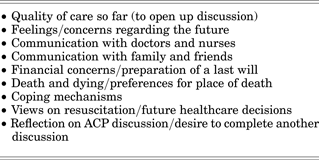
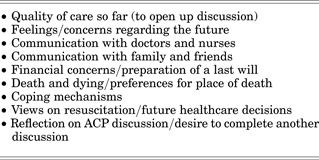
Informed by recommendations from phase 1, we used mediators who were independent of the clinical team but had extensive clinical experience and were able to respond to patient cues, answer questions, and tailor discussions to the needs of the individual. The mediators were trained using role play and did not divulge to participants the nature of their professional backgrounds or give clinical advice. A checklist of topic domains was introduced as appropriate for each individual (Barnes et al., Reference Barnes, Jones and Tookman2007). Topics included communication with health professionals and close persons, feelings about the future and the dying process, preferences for place of care, and making future healthcare decisions (Table 1). In order to ensure that the intervention was primarily patient focused, participants were seen alone for the first discussion but close persons could be present at subsequent meetings according to patient wishes. Second and third discussions focused on the main topics, but also returned to themes from earlier discussions that required further attention. A maximum of three sessions were offered as part of the trial design, and information was available for participants who felt they had need of further future support. For those wishing to document future healthcare decisions, living will documents were used (Terrence Higgins Trust & Kings College London, 2000) and these participants were encouraged to discuss decisions with their clinical team.
Main domains covered in ACP discussion
Analysis
Transcripts were analyzed using thematic content analysis to explore the content and context of discussions (Ritchie & Lewis, Reference Ritchie and Lewis2005). A manual method was used to draw out the main themes under each of the topic domains as it allowed total immersion in the data with in-depth consideration of context. A second researcher reviewed a random sample of 10% of the transcripts and any differences in interpretation were agreed upon by consensus. Emerging headings and themes were categorized and summarized under each topic domain, and this summary was then condensed and further summarized, re-categorizing certain points as appropriate. The transcripts were continually reread throughout the process of analysis to ensure that emerging themes were firmly rooted in the original data, to check for deviant cases, and to identify quotations that encapsulated the meaning of these themes.
RESULTS
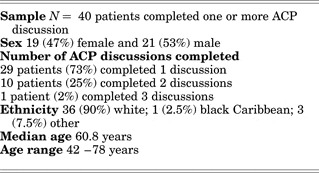
Forty patients completed one or more ACP discussions (Table 2). Fifty-two transcripts were available for analysis. Five patients (13%) requested the presence of one or more relatives for at least one ACP discussion. Discussions ranged in length from 25 minutes to 2 hours. The decision to allow participants up to three sessions with the mediator was shown to be adequate as only one participant requested a third discussion (Table 2). No patient became unduly distressed or requested a discussion be discontinued.
Characteristics of participants

Emergent Themes
Maintaining a Positive Attitude
The majority of patients had thoughts in the back of their minds about a possible deterioration in health, but were focusing on staying positive. Most considered the right mental attitude to be important in enabling them to cope.
You have got to be positive….so I don't sort of dwell on it. (Patient 60, session 1, male, age 55, pancreatic cancer).
Almost a third said the ACP discussion was thought-provoking and some wanted to think about the issues raised and make plans. Others were not ready to address the issues but said they would do so at a more appropriate time.
One has to discuss it at some stage, but discussing it early, I'm not sure is a good thing…I really don't want to think about it…I want to try and think positive. (Patient 33, session 1, male, age 47, diagnosis not specified).
Approximately half were trying to remain positive by getting on with life as usual and not thinking too far ahead. The need to maintain a sense of normality in daily life has been identified as important by patients in other studies (Davison & Simpson, Reference Davison and Simpson2006).
Maintaining Hope
Just over a third of patients said they had hope for the future and a small number were staying positive by focusing on treatment options.
I'm just concentrating…on taking the…treatment medication…. I do believe in mind over matter. (Patient 32, session 1, male, age 49, diagnosis not specified).
Evidence suggests that some health professionals believe that end-of-life discussions can destroy hope, and may hold back from engaging in such discussions (Johnston et al., Reference Johnston, Pfeifer and McNutt1995; Perry et al., Reference Perry, Swartz and Smith–Wheelock1996; Curtis et al., Reference Curtis, Patrick and Caldwell2000; Munday et al., Reference Munday, Petrova and Dale2009). However, in a study exploring hope in patients with end-stage renal disease, ACP was seen as an empowering process, enhancing hope through the provision of timely information about the impact of disease on daily life (Davison & Simpson, Reference Davison and Simpson2006). Although patients in our study did not specifically associate hope with being given information, almost a quarter said the discussion gave them new information about symptom control, potential options for place of care, and future healthcare decision making. Some found it challenging to discuss these issues, but many found this information valuable.
There's a bit of me that thinks… “I don't want to think about dying when I'm feeling well.”… It's not easy to talk about these things at all, but…information is power. (Patient 40, session 1, female, age 58, colorectal cancer).
Concerns about the Future
More than a third of patients expressed concern about the process of deterioration and experiencing distressing symptoms, such as pain. Over a third had fears about the dying process, some of which stemmed from distress at watching others die. A large proportion of patients said their main concern was for family, fearing that they may become a burden to them and that family members might find it difficult to cope.
[The family]…are the ones I worry about, how they'll cope. (Patient 52, session 1, female, age 52, gynecological cancer).
There is evidence to suggest that concern about burdening loved ones affects decisions that patients make about the future and may even lead them to reject life-sustaining treatments (Zweibel & Cassel, Reference Zweibel and Cassel1989; Singer et al., Reference Singer, Martin and Merrijoy1999; Rosenfeld et al., Reference Rosenfeld, Wenger and Kagawa-Singer2000). In our study, a third of participants said the ACP discussion had been helpful, and for some, it had alleviated their concerns about the future.
It's very useful…I can see the point of having a talk like this… If I…were to fall ill now, I'd have absolutely no fear. (Patient 23, session 1, female, age 77, lymphoma).
Timing and Talking about the Future with Health Professionals
Most participants had not spoken in depth to their doctors about the future or about a potential deterioration in health. Over a third said their doctors were reluctant to introduce such topics.
They always try to be positive…. upbeat… So he's not going…to say, “What happens if it goes wrong?” He doesn't want to discuss it (Patient 33, session 1, male, age 47, diagnosis not specified).
A third of patients said there was not time during clinic appointments for these discussions. In other studies, having sufficient time to talk through the issues was identified by patients as an important factor when considering ACP (Barnes et al., Reference Barnes, Jones and Tookman2007; Schikendanz et al., Reference Schickedanz, Schillinger and Landefeld2009).
The doctors…are very busy…so I have not talked to them, because it is probably quite a lengthy subject (Patient 60, session 1, male, age 54, renal cancer).
Over a third of patients said it was too soon for them for such conversations, but would talk more to their doctors if they deteriorated.
If…Dr [x] said to me, “look…it's flaring up again.”.. and if it was, then I think I'd say, “well, now let's plan” (Patient 23, session 1, female, age 77, lymphoma).
Other studies indicate that discussions should not be initiated too early, but rather after recurrence or when prognosis becomes poor (Ratner et al., Reference Ratner, Norlander and McSteen2001; Barnes et al., Reference Barnes, Jones and Tookman2007). In contrast, national United Kingdom guidance recommends that ACP discussions should be initiated in primary care or the outpatient setting before individuals become acutely unwell (Royal College of Physicians, 2009). Furthermore, a recent systematic review recommends that discussions should occur within a month of a patient's new diagnosis of advanced cancer (Walling et al., Reference Walling, Lorenz and Dy2008). Our results do not fully support this view and demonstrate the variation in preferences expressed by patients.
A small number of patients said they would take the lead from health professionals on when to have conversations about the future, and acknowledged that they might need prompting in order to address these issues.
There also needs to be a kind of a gentle nudging… You're…prompted in a good way (Patient 26, session 1, male, age 63, melanoma).
Although patients believe it is the doctor's responsibility to instigate discussions about advance decisions to refuse treatment, many doctors believe the responsibility lies with the patient (Johnston et al., Reference Johnston, Pfeifer and McNutt1995). Therefore, general practitioners and community nurses tend to discuss preferences for place of death only when patients give them clear cues they are ready for such conversations. In addition, they believe that other health professionals are better trained or positioned to discuss ACP (Munday et al., Reference Munday, Petrova and Dale2009). There is also evidence that although the seriously ill might want information about end-of-life planning from their doctors, they may defer to the conversation pattern the physician has established (Davison et al., 2006). Hence, patients may not initiate ACP discussions even if they want to engage in them. Health professionals may need training and support so as to feel equipped to initiate and discuss ACP. When ACP training was provided for nursing home staff, patients' wishes regarding future treatments were more likely to be identified and honored (Morrison et al., Reference Morrison, Chichin and Carter2005).
Over half of the participants wanted more information from their doctors about the future – the likely prognosis, process of deterioration, options for place of care, and future healthcare decisions. A recent systematic review found that the provision of oral information over multiple sessions is a successful way to encourage people to communicate their preferences regarding future healthcare (Bravo et al., Reference Bravo, Dubois and Wagneur2008). In our study, over a third of patients planned on talking to health professionals about the future after the first ACP discussion, and just over a quarter said they wanted information while they had time to plan.
Hopefully they can manage to give me answers… . “That's what you have and that's what you can do about it”… . That would be more important than just letting me…carry on like this (Patient 9, session 2, male, age 42, brain cancer).
Talking about the Future with Close Persons
Only a small number of patients had talked openly with family members about the future. Over half said they would talk more extensively if their condition deteriorated.
Timing is very important…. I don't think you want…people to…become distressed too, too early… . So it would be something that would be done in stages. (Patient 26, session 1, male, age 63, melanoma).
Almost a quarter of patients did not want to burden or upset those closest to them by talking about the future. In a study exploring barriers to ACP among patients attending a general medical clinic, almost half had not spoken to family about planning future care because of concern about burdening them (Singer et al., Reference Singer, Martin and Merrijoy1999).
During the course of conversations with the mediator, a quarter of participants realized that they wanted to talk to family members. A small number asked that family members be present during subsequent ACP discussions to discuss specific issues. In another study, patients who had had ACP discussions with their doctors were then more likely to discuss end-of-life issues with their families and reconcile differences about end-of life-care (Bravo et al., Reference Bravo, Dubois and Wagneur2008). ACP discussions may therefore assist patients to initiate these discussions with those closest to them.
Preferences for Place of Care
Over half of the patients were not aware of the options available to enable them to be cared for in a place of their choice, and many expressed appreciation for this information. The majority said they wanted to be cared for at home for as long as possible. Having control over their environment and maintaining some quality of life were reasons given for this.
If I had a choice, I would rather be at home…to have your things around you and be in a familiar place. (Patient 52, session 1, female, age 52, gynaecological cancer).
Some participants expressed concern about burdening those closest to them by being cared for at home. This may have been indicative of a lack of knowledge about the support that could be available.
Being cared for at home in the beginning is a good thing, but you put lots of pressure on people if you do that. (Patient 15, session 1, female, age 58, neuroendocrine cancer).
A study of death at home following targeted ACP for seriously ill patients found that 85% of patients expressed a preference to be cared for in their own home (Ratner et al., Reference Ratner, Norlander and McSteen2001). Facilitating ACP discussions in their own homes was associated with patients later receiving end-of-life care at home.
Future Healthcare Decisions
Most patients would trust their health professionals to make future healthcare decisions in their best interests, although almost half had not talked to their doctors about their preferences. A quarter of patients expressed the view that they trusted the medical profession, but would prefer those decisions be made in conjunction with family and friends.
If there was a decision to be made…and the doctors really didn't know which was best…if they're making a decision in your best interests, that interest may well be served by…having your family involved in the discussions. (Patient 33, session 1, male, age 47, diagnosis not specified).
The majority of elderly patients, while trusting their physicians to make the right decisions if they were to become very ill, consider that it would also be the role of the family to make or be involved in decisions about life-sustaining treatments (Morrison & Meier, Reference Morrison and Meier2004).
About a third of patients said they wanted to talk to relatives about future healthcare decisions at some point. One patient said,
I wouldn't want to do it now…..Because at the moment I'm trying to plan for success rather than failure….But if failure becomes a likely option then I'll switch to a different mode. (Patient 33, session 1, male, age 47, diagnosis not specified).
The mediators informed patients of the options for making future healthcare decisions and about a third expressed a desire to make an advance decision to refuse treatment or appoint a lasting power of attorney. A small number said their decisions about future treatments were limited by lack of knowledge about available treatments.
It's a bit easier to write a birth plan than to write or plan on something when I've got no idea what the options are…or what the problems will be. (Patient 33, session 1, male, age 47, diagnosis not specified).
Most palliative care professionals report finding completion of advance decisions to refuse treatment useful, but only 62% are comfortable in actively helping patients to complete them (Voltz et al., Reference Voltz, Akabayashi and Reese1998). There is a need for education among health professionals in facilitating patients to make future healthcare decisions if they so wish.
Almost half of the patients said that quality of life was more important than length of life and they would prefer not to be kept alive if quality of life were poor.
The purpose of medicine is to alleviate suffering… It's not about extending your life at any costs… There's got to be quality of life. (Patient 32, session 1, male, age 49, diagnosis not specified).
Half said their views on resuscitation would vary according to how ill they were, and over a third would only want to be resuscitated if they could expect good subsequent quality of life. A study of end-of-life decision making among the elderly found that their views on the importance of interventions, such as mechanical ventilation, depended upon whether they would be enabled to undertake valued activities (Rosenfeld et al., Reference Rosenfeld, Wenger and Kagawa-Singer2000).
DISCUSSION
Addressing end-of-life issues with patients with life-threatening conditions such as cancer is a delicate task. This study builds on earlier work conducted in the United Kingdom, and supports the findings that patients' willingness to engage in ACP varies widely (Horne et al., Reference Horne, Seymour and Shepherd2006; Barnes et al., Reference Barnes, Jones and Tookman2007; Munday et al., Reference Munday, Petrova and Dale2009). We have been able to report on how patients currently dealing with advanced cancer respond to the active process of ACP, the issues that they felt able to discuss, and those that they preferred to avoid. The large number of discussions available for analysis provided rich data and, although an ACP discussion with an independent mediator may be a situation not common in current clinical practice, this work has provided valuable information on topics that are important to patients. However, there are limitations in generalizing our findings, as the processes of recruitment, in which patient preferences were taken into account, are likely to have resulted in those receiving the intervention being the most receptive to ACP discussions.
We have shown that there is considerable variation in the extent to which patients wish to engage in ACP discussions. This may be related to a number of factors. Our results support our earlier work in that tensions were identified between wanting to get on with life as usual and considering end-of-life issues (Barnes et al., Reference Barnes, Jones and Tookman2007). However, we learned that the timing of discussions and the perceived willingness of health professionals to initiate conversations also appear to influence the extent to which end-of-life issues are discussed. Even though many of our participants voiced specific concerns about a potential deterioration in health and a desire for more information, they did not feel it was their own responsibility to start these conversations. Many were not aware that they might exercise a choice of where to receive end-of-life care, while others simply left important decisions to their doctors, whom they assumed had their best interests at heart. Such findings may be used to guide educational interventions and provide support for health professionals to empower them to create timely opportunities to introduce informal ACP conversations. However, it should not be forgotten that the timing of discussions should be tailored to individual need, with due respect to those patients who wish to postpone reflections on death and dying. The willingness to engage in ACP may be influenced by whether discussions focus on dialogue and understanding of values rather than simply documenting future healthcare decisions. A belief exists that providing patients with information alone enables them to make decisions regarding end-of-life care (Schwartz et al., Reference Schwartz, Lennes and Hammes2003). Our findings suggest that, even though patients are requesting information, there is a need to recognize their broader values and goals, in particular interactions with family and others close to them.
Our work does not fully support the current United Kingdom policy of introducing ACP early in life-threatening illness, as despite our patient preference design, some patients were not yet ready, even late in disease. Further research is needed in this complex area. Valuable insights could be gained by studying the effect of ongoing ACP discussions on the quality and conduct of end-of-life care, as well as monitoring the frequency and content of discussions concerning future care between patients and clinicians. Although guidance on ACP for health and social care professionals is currently available (NHS End of Life Care Programme, 2008; Royal College of Physicians, 2009), our data provide new in-depth patient-centered evidence to inform future policy documents, to challenge widely held assumptions in this area, and to guide the development of training for staff in health and social care.
ACKNOWLEDGMENTS
We thank all the participants and their relatives, and the Marie Curie Palliative Care Research Unit. Dimbleby Cancer Care funded this research study and entrusted our research team to make all decisions associated with collecting, analyzing, and interpreting data and presenting findings. They have not influenced this process in any way. All authors were involved in the design of the study and have seen and approved the final version of the manuscript. K.B. and K.O. worked as care planning mediators. K.B. and L.J. performed the qualitative data analysis. All authors take responsibility for the integrity of the data and the accuracy of the data analysis. L.J. is guarantor.