I. Introduction
In Greek literature, the barber (ὁ κουρϵύς) embodies the archetype of the gossip and incorrigible chatterbox, a character trait that is well summarized in the famous anecdote about the garrulous barber who once asked King Archelaos: ‘How do you want me to do your hair?’ (πῶς σϵ κϵίρω). To which the king replied: ‘In silence’ (σιωπῶν).Footnote 1 The barber is also a central character in various comedies and in several jokes collected in the Philogelos.Footnote 2 He regularly plays tricks on his friends or customers, such as the ‘garrulous and chattering’ (ἀδολέσχος καὶ λάλος) barber who shaved only part of Gamochairon’s beard, or the barber who shaved the whole head of one of his companions while he was asleep.Footnote 3
Furthermore, the barbershop (τὸ κουρϵῖον) is regularly described by ancient authors as a place of relaxation and socializing that was visited daily by the men of the district or neighbourhood. It was also the place where news, rumours and gossip circulated.Footnote 4 These shops played the role of ‘banquets without wine’ (ἄοινα συμπόσια, Quaes. conv. 5.5), to use an expression attributed by Plutarch to Theophrastus. As Sian Lewis and Jerry Toner have well shown, the barbershop in the Greek world served as a meeting place outside the home: friends or neighbours could meet there to chat informally, in a semi-private, semi-public setting that differed from that of the oikos or agora.Footnote 5 Compared to other workshops or boutiques, the barbershop was particularly well suited to this kind of male socializing, as it was a place where you had to spend time to get the service you wanted and where you had to wait.Footnote 6 The barbershop therefore seems to have played an important role in Greek popular culture.Footnote 7
These characteristics of the barber’s profession and the place where it was practised are the only ones that have really interested historians to this day.Footnote 8 This is undoubtedly because these are also the features most frequently emphasized by ancient authors. They took great pleasure in depicting these colourful characters and the stories that were told or played out in their shops. Apart from these numerous anecdotes, however, few scholars have investigated the concrete realities of the profession and the status of barbers in the Greek East (including Egypt). Given the cultural importance of body care and hairstyling in ancient societies,Footnote 9 barbers were an essential part of daily life in antiquity; they have remained in the shadows for too long. Like most craftsmen and labourers in ancient Greece, barbers have been ‘forgotten by history’ in two respects: forgotten by their contemporaries, the ancient authors, whose discourse is characterized by a contempt for craftsmen and labour in general; and forgotten by our contemporaries, who are all too often interested only in high-ranking figures and the upper classes of Greek society. The aim of this paper is therefore to re-place ancient barbers in their socio-professional and socio-economic environment, beyond the statements of ancient authors and their elitist discourse, and to rehabilitate these everyday workers as historical actors in the Greek and Hellenized societies of the eastern Mediterranean.
The methodological approach I advocate in this paper harbours many difficulties and pitfalls when applied to the lives of barbers over such a long period of time and in such a large geographical area. Indeed, the documents on barbers available for the Classical period come almost exclusively from elite Athenian authors, which distorts our perspective and gives us a very Athenocentric and ‘elitist’ view of the profession. For the Hellenistic and Roman periods, it is mainly inscriptions and papyri that provide us with information about barbers. As far as epigraphy is concerned, however, we encounter problems of a quantitative and qualitative nature. Only a few inscriptions mention barbers and all of them were either epitaphs or dedications: epigraphic production had therefore no connexion to the economic activity of craftsmen. In contrast, the papyrological documentation from Graeco-Roman Egypt appears to be particularly rich.Footnote 10 These archival documents, which have few counterparts anywhere else, are quantitatively sufficient to allow more detailed economic analyses than in the rest of the Greek world and provide information on many aspects of the daily life of barbers and their customers. However, even this documentation provides a distorted picture of reality, as it is only a snapshot limited to a village or, at best, a metropolis. Therefore, the data and conclusions drawn from the papyri and ostraca cannot be applied to the whole of Egypt and certainly not to the rest of the Greek East. The challenge, then, is to ‘pull out all the stops’ and compensate for these imbalances and limitations, with all the necessary nuances and precautions, by systematically cross-referencing all available data in order to reconstruct the socio-economic status of barbers in the Greek East and to show how much their work and daily life differed from what is portrayed in the literary sources.
II. Barbers and barbershops: semantic and material approaches
i. The words to say it
Derived from the verb κϵίρω, meaning ‘to cut, shave, shear’, when referring to hair, κουρϵύς is by far the most common and widespread term for ‘barber’ in the Greek and Hellenized world, with occasional different spellings and dialectal variants such as κωρούς or even κουρίος.Footnote 11 The term always refers to a male figure who deals exclusively with men. So far, there is only one exception: in the village of Trikomia (Arsinoite) in the middle of the third century BC, a certain Kleopatra is referred to as κουρϵύς in a tax register.Footnote 12 Everywhere else, including in Egypt, the terms κομμώτρια or κουρίς denote the female equivalent of koureus (a woman who styles women’s hair).Footnote 13 The grammatical feminine form κουρϵύτρια is a hapax that only appears in one text by Plutarch.Footnote 14 However, this female profession seems to have been much less developed than its male counterpart, and we have no evidence of specific places where these female hairdressers worked. From the Imperial period onwards, perhaps as a result of changing habits, fashions and customs, some authors used the word κομμωτής to refer to a barber, while κορσᾶς appears late in the papyrological record to describe mainly men, but also a woman, a certain Euterpe, who was counted among the korsatai of Arsinoe.Footnote 15 Finally, the terms κορσωτήρ, κορσωτής and κουρϵυτής are hapaxes.Footnote 16
Papyrological documents sometimes state that a barbershop was ‘for men’ (κουρϵῖον ἀνδρϵῖον).Footnote 17 This is not a gender-specific distinction, to differentiate it from a barbershop which would be ‘for women’. The clarification is made because koureus can also refer to the shearing of animals. This has already been pointed out by Cratinus, who said that the barber’s scissors were also used for shearing sheep.Footnote 18 For this reason, the Edict of Diocletian distinguished between the barber, who was paid ‘for each (shaved) man’ (κουρϵῖ καθ’ ἕκαστον ἄνθρωπον), and the ‘barber for cattle’ (κουρϵύς προβάτων) or shearer, who was paid ‘for each (shorn) animal’ (καθ’ ἕκαστον πρόβατον).Footnote 19
Finally, the term ψϵιλωταί appears in an inscription from Sidon, where the dedicatees of a building refer to themselves as ‘those who practise the profession of pseilōtai’ (οἱ ἀπὸ τῆς τέχνης ψϵιλωτῶν).Footnote 20 This is also a hapax, and scholars disagree on its meaning. For some, it is a borrowing from northwestern Semitic, formed from the root psl-, and thus refers to sculptors or stonemasons; others favour a Greek etymology, and in my opinion, the latter is the interpretation that should be adopted.Footnote 21 It is suggested that this is a noun formed from the verb ψιλόω, whose main meaning is ‘to shave’ and in particular ‘to shave someone’s head’. This implies that the term refers to barbers, whose profession is attested in another inscription from Sidon.Footnote 22
ii. Workspaces
No barbershops have been discovered in the Greek world, which is not surprising given that the equipment and tools that barbers used were generic, simple and portable.Footnote 23 When a barbershop was vacated, the barber probably took his tools (as they were valuable and useful), and there would be no material remaining that would identify any craft space specifically as a barbershop. Nevertheless, written sources show very clearly that barbershops were part of everyday life in Greek cities, from at least the Classical period onwards. The space in which the barber practised was clearly characterized, as a specific term was used for it, the κουρϵῖον, sometimes also called κορσωτήριον, and regarded as the barber’s workshop (ἐργαστήριον).Footnote 24 Numerous anecdotes handed down by ancient authors prove that barbershops were part of the everyday cityscape. They were set up near the agora to take advantage of the concentration of customers, in the central areas of cities, overlooking busy thoroughfares such as Hermes Street in Athens, or they were located in a particular neighbourhood or district and attracted a more local clientele.Footnote 25 Papyrological documents also attest to the frequency of koureia in the urban topography of Egyptian towns and metropolises, which in turn were located in places that made it easier to attract customers. In Hermoupolis, for example, a barbershop was located ‘on the left-hand side of the street’ (ϵἰς τὸ κουρῆον τὸ ἐπὶ τοῦ δρόμου ἀριστϵρᾶς χϵρὸς), while in Arsinoe the barber [- - -]on son of Herakleides had set up shop near the Propylon.Footnote 26 In Panopolis, the location of the koureia is not preserved in the long document listing the owners of the city, but we do know that the sons of the barber Apollonides owned a house.Footnote 27
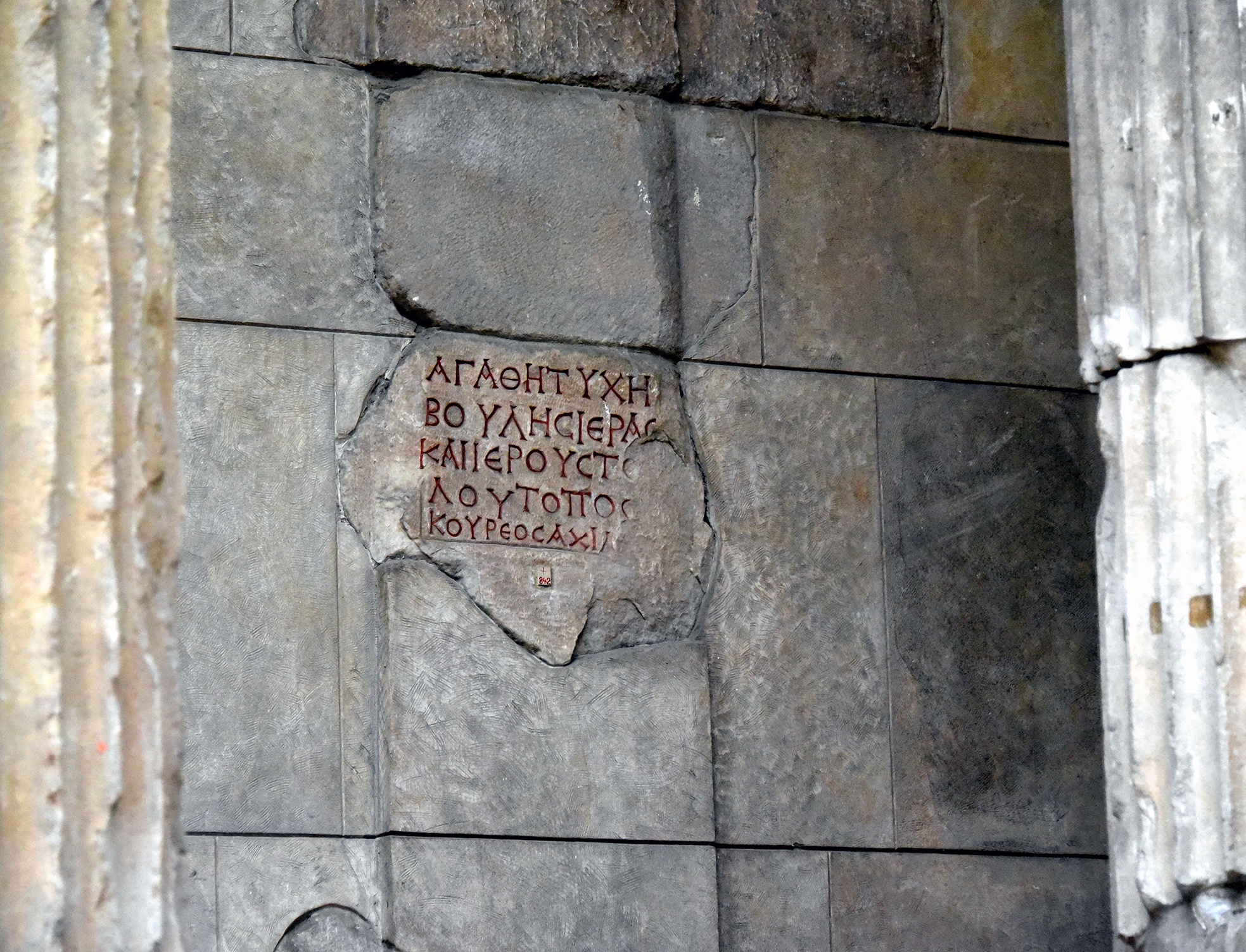
However, not all barbers had their own shop: many worked wherever they could sit and attract customers. Some took over part of the public space to set up their business, as shown by the inscription on the back wall of the Market Gate of Miletus, which marks the location of the barber Achilleus (fig. 1),Footnote 28 or the inscriptions engraved in Late Antiquity on a column of the Tetrastoon near the theatre of Aphrodisias, which indicate the locations of the barbers Alexandros and Zenon.Footnote 29 Barbers were therefore able to practise under the porticoes, in the shade between the columns, and in particularly busy parts of the city, thus securing a large and regular clientele. In Aphrodisias, the Tetrastoon was located directly opposite (to the north) the bath complex. The choice of this location is not insignificant. After all, hairdressing and shaving are connected to body care and go hand in hand with the use of the baths and gymnasiums that are so typical of ancient Greek culture.Footnote 30 From Tegea in Arcadia, three lists of ephebes who were enrolled in the gymnasium have been preserved (second century AD). In each case, after the names of the ephebes, we find those of several people who had a function or profession in the gymnasium. In addition to the oil supplier, the secretary, the doctor, the paedotribe, the manager of the palaestra and the intendant of the baths, we also find a barber.Footnote 31 He probably worked in the gymnasium for the ephebes and other citizens who visited the establishment, in addition to the other services for personal hygiene that could be offered in baths and gymnasia. Similarly, iron barber tools from the Roman colony of Doliche (Commagene) have been found on the southeastern part of the hill, not far from a bath house, perhaps in the area corresponding to the palaestra, suggesting that a barber worked in the bath house itself or in its immediate vicinity.Footnote 32 Finally, some barbers also worked in sanctuaries; such cases are discussed below.
Inscription on the back wall of the Market Gate of Miletus, indicating the location of the barber Achilleus; Staatliche Museen zu Berlin, Antikensammlung (© Ann Lauren Osthof; Universität Hamburg, inventory number: IvM 209).

Although barbers seem to have worked mainly in cities (which could, however, be an impression due to the nature of the sources), papyrological documents prove that, at least in Graeco-Roman Egypt, many also worked in the villages of the Egyptian chōra. In Philadelphia, for example, the shop of the barber Eudoxos is found in the middle of a settlement between two families,Footnote 33 while in Tebtynis, the property of the barber Heronas was used to mark the western boundaries of a catoecic lot.Footnote 34 Barbers are also documented in several other villages in the Arsinoite, such as Trikomia, Ptolemais Arabon, Karanis and Ptolemais Hormou.Footnote 35
Wealthy oikoi could also have a barber serve them permanently at home or frequently visit their home. This was the case with King Archelaos, as already mentioned, and with Dionysios of Syracuse, who ordered a servant to shave his hair with hot coals as he feared being murdered with a barber’s scissors.Footnote 36 In Oxyrhynchos, too, the slave Agathangelos worked in his master’s house as a barber for all the residents, while in Arsinoe the hairdresser Euterpe seems to have been in the service of a certain Severus.Footnote 37 This would undoubtedly explain why in Egypt some lists of household furniture mention barber’s chairs, stools or even tables, which were probably used when the professional visited the house.Footnote 38
A final category of barber appears in our sources: those who belonged to the Roman army, of whom there are some traces in Egypt. During campaigns, they set up makeshift koureia in military camps, in forts where soldiers were stationed or in quarries and mines managed by the Roman army. In Berenice, for example, the soldier Iulius Gemellus testifies on an ostracon that he received 30 keramia of water from the camel-driver Pesouris, son of Psenosiris, for the dekania of Peteesis son of Paminis, which were intended for the men’s koureion. Footnote 39 Similarly, in the quarries of Mons Claudianus, among the general lists of personnel present there, numbering around a hundred men, we always find a barber, in addition to a large number of other professions (doctors, shoemakers, carpenters, blacksmiths, etc.).Footnote 40 The same probably applies to the korsas Eusebes in Arsinoe, who was connected to the salt mines exploited by the Romans.Footnote 41 In the same town, a list of anakeimenoi (men belonging to a religious association?) includes 47 individuals: among them are some civilians (paganoi), but mainly Roman military men such as Sempronius the sandal-maker, Heraclianus the basket-maker, Severus the donkey-driver and Apollonarius the barber.Footnote 42 Finally, in Jathum, in the middle of the desert in the former Roman province of Arabia, a graffito probably dating from the third century AD tells us: ‘Life is worth nothing. The kitharode Diomedes and the barber Abchoros both crossed the desert with the commander of the hoplites and are stationed near the place called “the city of Abgar”.’Footnote 43 This testimony proves once again that barbers accompanied military garrisons almost everywhere, even in small units and completely isolated outposts,Footnote 44 which seems to be a somewhat hopeless situation in the eyes of Diomedes and Abchoros, if we may believe their first words. Finally, it should be noted that most of the examples of double scissors known so far come from the excavations of Roman military camps and forts, which proves the presence of barbers in their midst.Footnote 45
It is obvious that the varying number of more or less sophisticated instruments that barbers possessed,Footnote 46 as well as the very different areas and workspaces in which they practised, had an impact on their social and economic level. As we will now show, there were hierarchies: barbers could have very different social statuses, did not have the same type of client, had not all acquired the same level of technical expertise and therefore did not offer the same quality of service.
III. Social identities and hierarchies among ancient barbers
i. Portraits of barbers in the Greek East
Most of the barbers mentioned above were free men, but the sources do not allow us to learn much more about their exact identity and status. Nevertheless, with appropriate precaution it is sometimes possible to determine the ethnicity of individuals in Egypt by their name. Onomastic evidence shows that many barbers in both the Hellenistic and Roman periods were Egyptian.Footnote 47 They are also mentioned in some Demotic registers.Footnote 48 But unlike some other professions in Graeco-Roman Egypt, barbering was not restricted to Egyptians. In fact, a significant number of names are Greek as early as the middle of the third century BC, which makes it impossible to interpret them all as Hellenized Egyptians.Footnote 49 For tax reasons, they sometimes took the trouble to declare their status as ‘Hellenes’, which exempted them from certain impositions.Footnote 50 Other barbers have both Greek and Egyptian names and appear in bilingual documents: they therefore belonged to mixed families.Footnote 51 There was even an Arab barber called Parates who, like some of his compatriots, settled in the village of Ptolemais of Arabs in the Fayum.Footnote 52 Moreover, the ages of these barbers are sometimes mentioned in tax and census registers (46 years for Panegbauios, 25 years for the son of Zois), while an epitaph notes that the barber Artemas died at the age of 49.Footnote 53 As for the barbers working for the Roman army, some must have had the status of lixae or calones, that is public slaves or free men (civilian or military) in the service of the army who were orderlies and accompanied the soldiers on campaign and performed essentially non-combat duties.Footnote 54
It also appears that barbering was regularly reserved for private slaves who worked in their master’s house, as in the case of Naris, who was sold as a slave and entered the service of a citizen of Cardia as a barber.Footnote 55 In Athens two barbers were on the manumission lists in 330 BC, each offering a phiale worth 100 drachmas for their emancipation.Footnote 56 Similarly, a funerary altar from the Imperial period in Mylasa bears an epitaph in honour of the barber Hermes and the donkey-driver Hieratikos, who were both slaves.Footnote 57 Once again, however, it is the papyrological documents that provide us with more details about this status and show that these barbers were specialized slaves. In Tebtynis, a slave barber appears in a contract for the division of an inheritance between five brothers and a sister.Footnote 58 The divided property comprised 18 slaves, including Narkissos the barber, who went to the sister, Herakleia. Apart from Narkissos and another person of the same name, who is described as a donkey-driver, the occupations of the others are not specified; they were probably more versatile. A contract from Oxyrhynchos in which slaves were divided among several brothers also gives the occupations of some: there was a notary and a cook, as well as a barber named Geminus.Footnote 59 This clearly shows that barber-slaves were recognized for their work, which required a certain level of specialization, as I will now show.
ii. The κουρικὴ τέχνη: apprenticeship and socio-professional identity
Handling barbering tools required significant dexterity and technical know-how. Regardless of their status or wealth, barbers were therefore skilled craftsmen who often worked in a ‘workshop’. Indeed, ancient writers sometimes refer to the barbershop as the ἐργαστήριον, the craftsman’s workshop par excellence.Footnote 60 This know-how and expertise explains why the profession of barber was considered by the ancients a fully-fledged technē (κουρικὴ τέχνη), which helped to define not only their professional identity but also their social identity, beyond all the prejudices expressed by ancient authors.
In comparison to bad barbers, who are ‘ignorant and unskilled’ (ἀμαθϵῖς καὶ ἰδιώτϵς), Lucian describes good barbers as τϵχνίται, craftsmen skilled and qualified in their technē. Footnote 61 This is also the term Posidippus uses to describe their activity: ‘Thanks to our technical skill/profession (τέχνη), we have made many acquaintances, but thanks to our way of doing things (τρόπος), above all friends.’Footnote 62 At the end of the third century BC or the beginning of the second, the famous barber Onesagoras asserted in one of his dedications in the sanctuary of the Nymph of Kafızin (Cyprus) that his offering was made in connection with his profession as a barber (ἀπὸ [- - -τ]ῆς κουρικῆς τέχνης).Footnote 63 In Sidon in AD 104, six people built or had restored at their own expense an unspecified building, perhaps a meeting hall for their association. They refer to themselves as ‘those who practise the profession (τέχνη) of barbers (ψϵιλωταί)’, emphasizing the professional identity that unites them.Footnote 64 A few years later, in AD 132, Gaios Cassios Alexandros again had a building constructed or restored and took the opportunity to recall his function as ‘architechnos of the barbers’ (ἀρχιτέχνος κουρέων) in his dedication.Footnote 65 This term is unprecedented and its form unexpected, as we would rather expect architechnēs. It probably refers to a leader of the barbers’ association or a kind of ‘master’ in a community of barbers, as was the case later, in modern journeymen’s guilds.Footnote 66 Regardless of its exact meaning, this term once again emphasizes technē, whether it refers to a professional association or to the professional excellence of the individual.
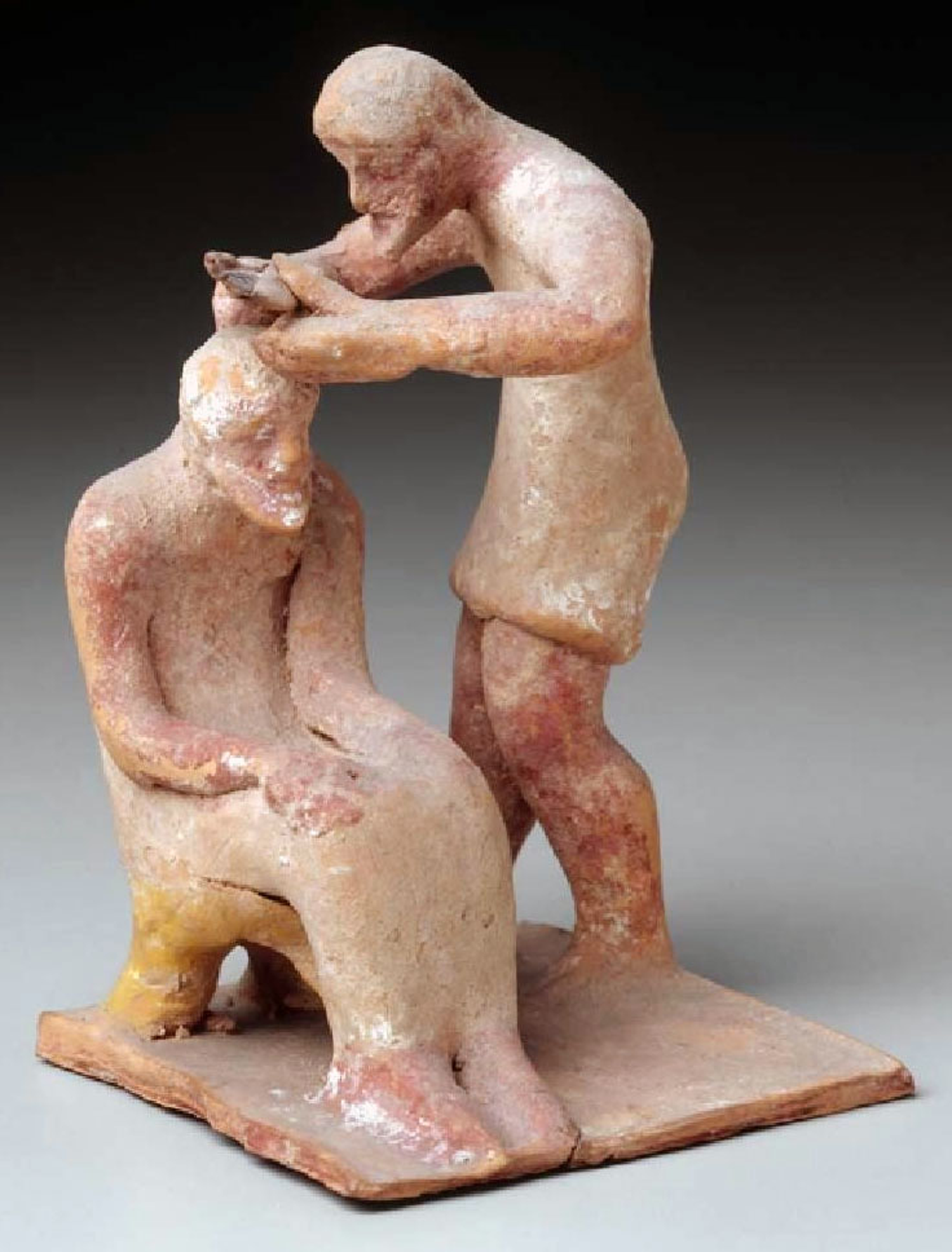
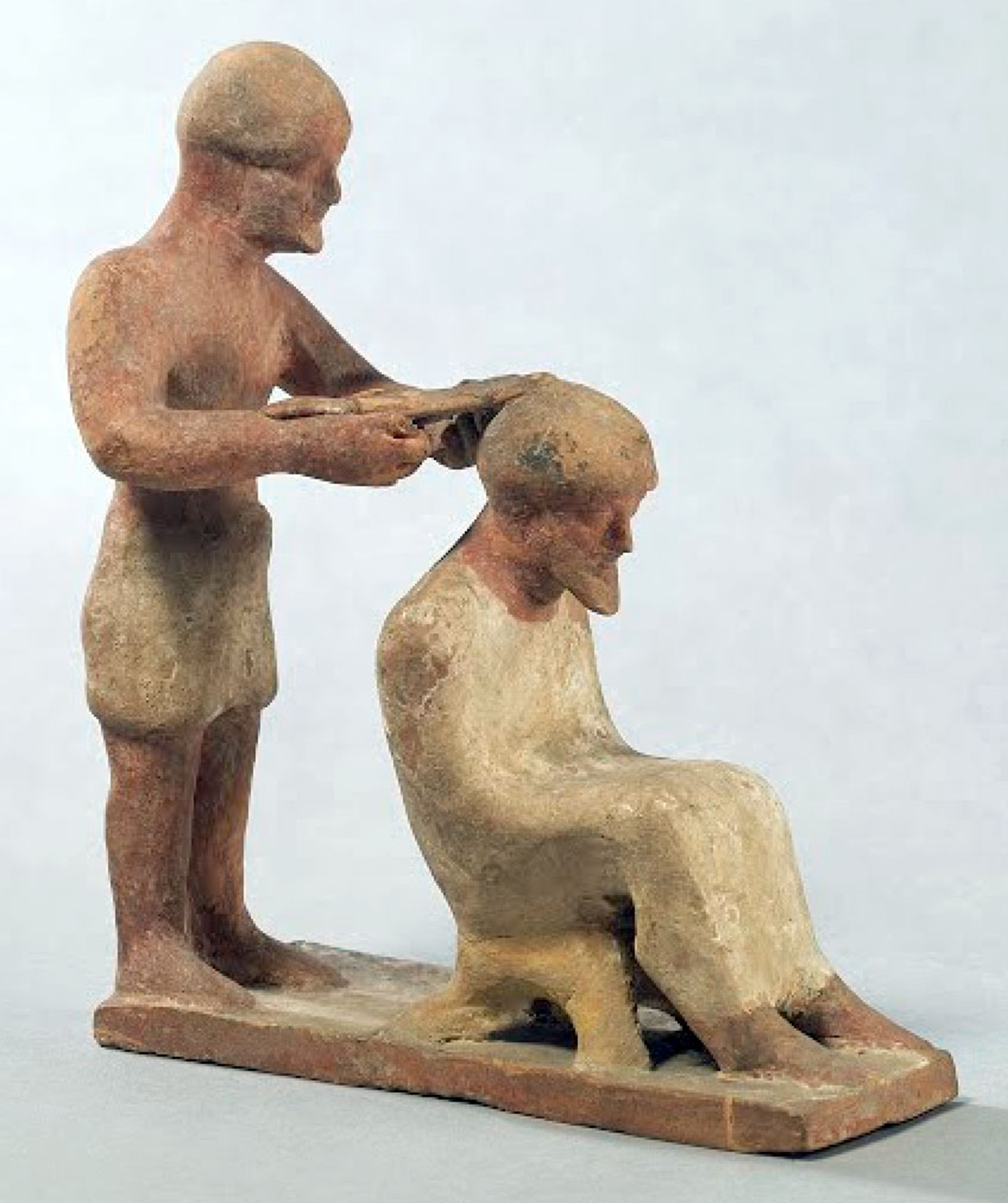
This professional identity was also characterized by the acquisition of specific skills that were not accessible to everyone. As shown by two Boeotian figurines from the early fifth century BC depicting barbers at work (figs 2–3), the Greek barber’s main tool for cutting hair was a pair of scissors, which were particularly tricky to handle as they were blades without a pivot (Supplementary figure 6).Footnote 67 Handling the two blades required a high degree of skill and training, which also explains why it was impossible to cut one’s own hair and why the services of a professional had to be called on. The same applies to ancient razors, as several scholars have demonstrated on the basis of archaeological finds.Footnote 68
Boeotian terracotta figurine of a barber cutting a man’s hair (ca. 500–475 BC) (© Museum of Fine Arts, Boston, No. 01.7784).

Boeotian terracotta figurine of a barber cutting a man’s hair (ca. 500–480 BC); Staatliche Museen zu Berlin, Antikensammlung (© Johannes Laurentius, CC BY-SA 4.0, inventory number: TC 6683 b).

To practise the profession of barber, one therefore had to spend some time learning the gestures, techniques and skills needed. In Oxyrhynchos, the aforementioned household slave barber Agathangelos wrote to his former master, the barber Panares, telling him of his progress and announcing that he is now the barber of all the residents of his new master’s house. He ends his letter with the following formula, which suggests that Panares had also taught him his profession and that Agathangelos had completed his apprenticeship with him: ‘Greetings to all my fellow apprentices (συμμαθηταί)’.Footnote 69 Apprenticeships could also be undertaken within the family, expertise being passed on from father to son. In Tebtynis, for example, a list of workers requisitioned for the construction of a dam in AD 193 mentions the barber Protas son of Heron (l. 265) and the barber (?) Pamoutis son of Protas (l. 364).Footnote 70 If the trade name is correctly restored, we are probably dealing with a father and his son, the former perhaps having taught the latter his skills.
A joke from the Philogelos also reminds us of the necessity of the barber’s apprenticeship. It is about a clumsy barber’s apprentice who, after cutting a customer’s hair badly and injuring him while cutting his nails, complains: ‘Master, why won’t he let me learn?’ (Ἐπιστάτα, τί οὐκ ἀϕίησί μϵ μαθϵῖν;).Footnote 71 In a second anecdote, a barber orders his clumsy apprentice to cut his nails. The apprentice begins to cry for fear of hurting him and then being beaten.Footnote 72 Beyond their comic nature, these anecdotes have the merit of illustrating the level of technique required to be a good barber. In comparison, Petronius reports that apprentice barbers in the Roman world learned ‘the barber’s boldness’ (audaciam tonsoris, 94) with blunt razors.Footnote 73 Finally, in the fourth century AD, an account register from the Oxyrhynchite nome mentions a sum of more than a talent paid to a barber’s assistant (βοηθός), who was possibly his apprentice.Footnote 74
Apprenticeship was thus at the centre of the barbers’ socio-professional identity, regardless of whether it took place within the family circle. This professional identity in turn helped to hold the profession together through specific, shared codes. In this way, barbers sometimes formed a larger circle of people who practised the same technē, and could meet for different reasons and on various occasions.
As we have seen, there was a religious association of barbers in Sidon at the beginning of the second century AD, perhaps with a meeting place in the sanctuary of Echmoun.Footnote 75 In Perinthos-Herakleia (Thrace) in the first century AD, several people restored the altar in honour of the barbers’ association (ἡ συναγωγὴ τῶν κουρέων), which had gathered around the ἀρχισυνάγωγος Caius Iulius Valens, and procured the (meeting) place.Footnote 76 Through joint religious celebrations that brought together those who practised the same technē, these associations provided the framework for a new sociability, in which mutual aid and the establishment of social and professional networks could help to place craftsmen at the forefront of the civic scene and bring social recognition to their profession. These dedications also served to emphasize the hierarchy within these associations and highlight the social success of some of their members, such as Gaius Cassius Alexandros and Caius Iulius Valens, who proudly displayed their Roman citizenship by listing their tria nomina and lineage.Footnote 77 Ultimately, this individual celebration of professional excellence seems to have been engaged in only by those who had managed to rise up the social hierarchy and were therefore able to align their behaviour with that of the elites. But they were no longer mere craftsmen and perhaps no longer practised the barber’s trade themselves. With these dedications, these barbers celebrated their social success rather than their status as technitai.
iii. The religious and funerary practices of the barbers: a form of social distinction?
The barbers also participated in the religious life of the cities on an individual basis by worshipping certain deities or performing votive and oracular practices. These religious practices enabled craftsmen, regardless of status, to assert their place in society and demonstrate their technical skills to others. Indeed, the votive practices of craftsmen in general and barbers in particular can be seen not only as an expression of their personal relationship with a particular deity: they were also part of relationships with others and had both religious and social value.Footnote 78 Therefore, offerings and dedications could have a demonstrative character.
This seems to have been the case in Athens at the end of the fourth century BC: in a dedication of the Thiasotes, only the barber Onesimos mentions his profession in the list of dedicatees, while the others merely give their name.Footnote 79 A few decades later, when he visited the sanctuary of Abu Simbel, the barber Boutrys son of Menelas, probably of Cypriot origins, did not fail to mention his profession in a graffito on one of the colossi at the entrance to the great temple.Footnote 80 Finally, in Sardis, inspired by a dream, the barber Eutychianos dedicated an Asclepius to the nymphs for his health and thanked them: a gesture of individual devotion to these water deities, who had a healing function.Footnote 81
As Jean-Baptiste Yon has clearly shown, the inscriptions of barbers in sanctuaries encompass at least two different types of activity: they could be present there like any other worshipper, as we have just seen. But these barbers could also work in the sanctuaries, for there was a long tradition of sacred barbers, especially in the sanctuaries of the Near East, which were under the influence of Phoenician and Semitic practices more broadly.Footnote 82 However, the distinction between these two categories is often difficult: the notion of the ‘sacred barber’ is in fact very poorly defined and varies greatly depending on local cultural and cultic traditions.
In this context, it is worth returning to the hundreds of vases or vase fragments found in the sanctuary of the Nymph of Kafızin on Cyprus. They were offered to the nymph and most were inscribed in the name of the barber Onesagoras son of Philounios.Footnote 83 This person is the dedicatee either in his own name or in the name of other people. As several scholars have shown, the question naturally arises as to whether he was simply a barber or a ‘sacred barber’.Footnote 84 Thanks to an analysis of the portraits incised at Kafızin, Sidonie Lejeune was able to demonstrate that ritual shaving was practised there.Footnote 85 Furthermore, the inscription mentioning the kourikē technē of Onesagoras also refers to a funeral ceremony during which a ritual shaving must have been performed, a well-established practice in the Hellenic and Phoenician worlds.Footnote 86 It is therefore difficult to escape the conclusion that Onesagoras must have been a sacred barber. The connection between barbers and healing deities is also found in Sardis, as already mentioned, and in Sidon, where the Phoenician god Echmoun was an equivalent of the Greek Asclepius. The special relationship between barbers and these deities can be traced back to the cultic practice of offering hair to commemorate a cure or the fulfilment of a wish, and more generally to various rites of passage.Footnote 87 The vases that were offered to the Nymph of Kafızin could, for example, have contained locks of hair and capillary offerings, which would also explain the systematic mention of the barber Onesagoras.Footnote 88
Finally, a barber named Barates or Bargates appears in a graffito from Dura-Europos which mentions that he offered two cups, while another graffito from the same site mentions an Ausas or Lysas, son of the barber [- - -]nabos.Footnote 89 We cannot prove that these were sacred barbers; nevertheless, the fact that Ausas/Lysas took the trouble to include his father’s profession indicates how important this function was, at least for him. Barbers could therefore worship a deity privately or as part of a professional association, without always being ‘sacred’. These various testimonies nevertheless prove that mastery of a particular technē may have played an important role in shaping the religious world of barbers in the Greek East; they were also proud to be recognized as barbers by the rest of society.
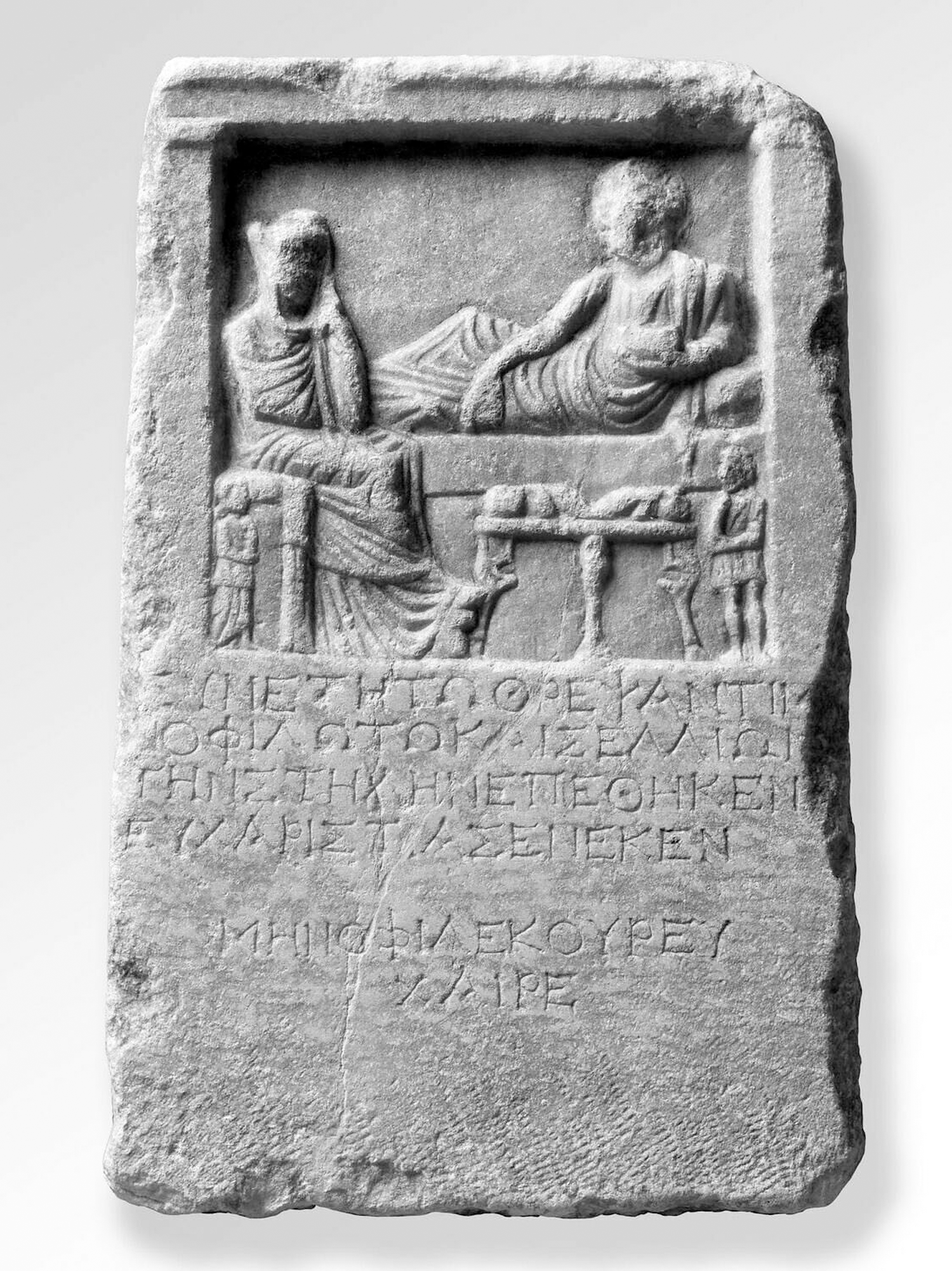
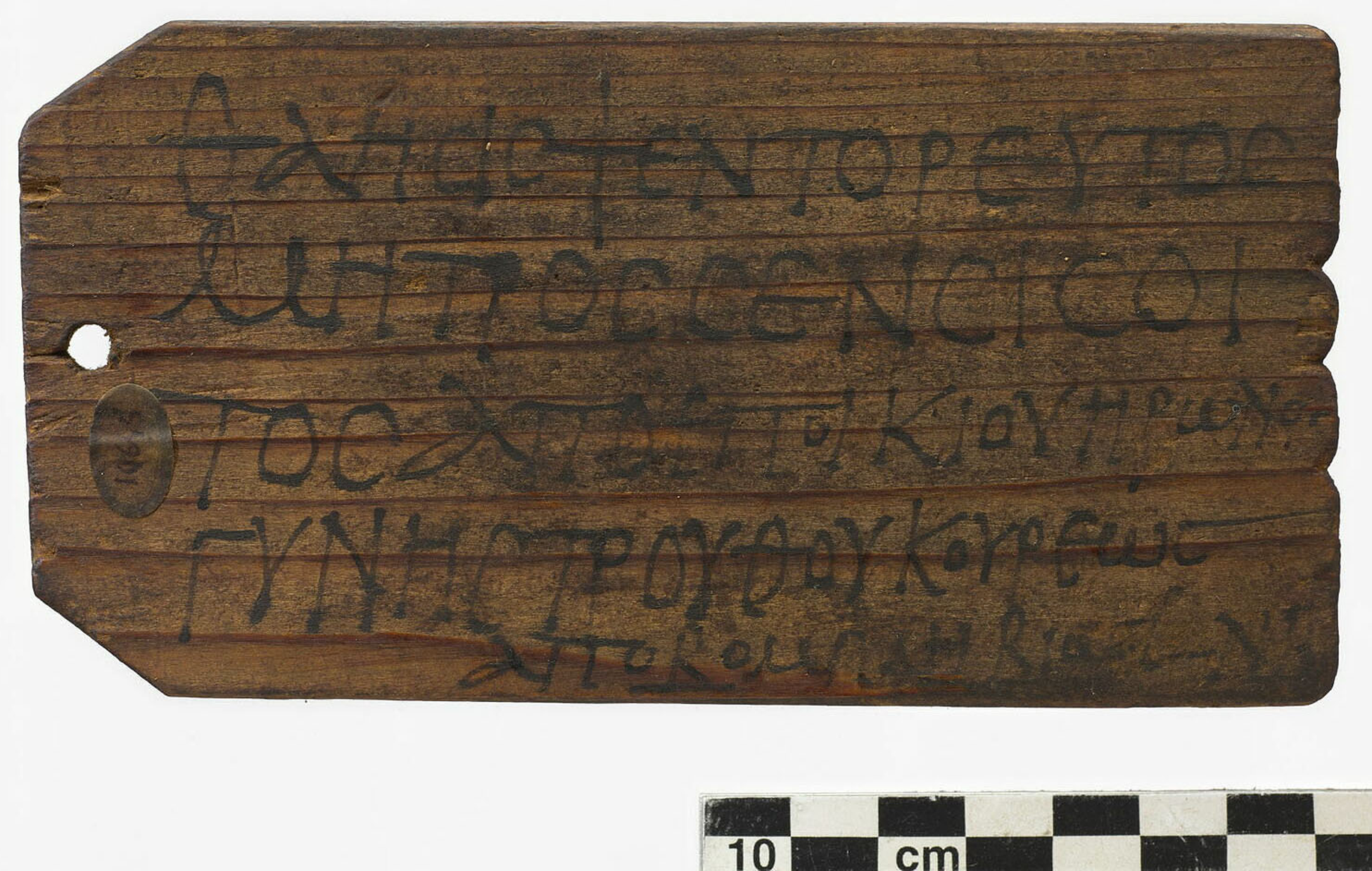
This recognition is also reflected in the fact that certain barbers were honoured as such in funerary inscriptions. At the end of the Hellenistic period, the slave Synete erected a funerary stele in Cyzicus for Menophilos alias Sellion, who had raised her: she inscribed the profession of barber practised by her master at the bottom of the stele (fig. 4).Footnote 90 As we have seen, the slave Hermes in Mylasa did not fail to mention his profession as a barber on a funerary altar that he had erected with his companion Hieratikos, while in Philadelphia (Lydia) Daphnos’ epitaph mentions his profession as barber, as does that of Artemas in Terenouthis (Nile Delta).Footnote 91 In Roman Egypt, the profession of the deceased was sometimes also noted on mummy labels. Thus we learn that Paniskeus and Aryotes alias Strouthos were barbers, a fact that is also mentioned on the label of Thaesis, the wife of the latter (fig. 5).Footnote 92 Of the 2,341 surviving mummy labels, only 5 per cent mention the occupation of the deceased, and by no means all professions are indicated.Footnote 93 One can say therefore that there was a particular concern to emphasize the profession of barber, which was immortalized with the name of the deceased, as it served to define his social identity, primarily in terms of professional activity, but also as a kind of social distinction.
Epitaph of the barber Menophilos alias Sellion, by his slave Synete, from Cyzicus (second–first century BC); Louvre Museum, Paris, Ma 165 (© 2007 RMN-Grand Palais (Musée du Louvre) / H. Lewandowski, https://collections.louvre.fr/ark:/53355/cl010252192).

Mummy label of Thaesis, the wife of the barber Aryotes alias Strouthos, from Panopolis (Roman period); Louvre Museum, Paris, E 10645 (© 2016 Musée du Louvre / Chipault - Soligny, https://collections.louvre.fr/ark:/53355/cl010048137).

iv. Barbers, their customers and social recognition
The social recognition enjoyed by barbers was based not only on their specialist know-how, but also on the relationship of trust they had to build up and maintain with their customers. Firstly, as the anecdote of Dionysios of Syracuse shows, the customer was literally at the barber’s mercy, which made a relationship of trust necessary.Footnote 94 Moreover, one of the aspects that set barbers apart from many other craftsmen and tradesmen was the fact that they were in direct contact with a very diverse clientele on a daily basis. Anyone could enter their shops and each customer returned frequently, if we are to believe the characters portrayed by Theophrastus: the Obsequious goes to the barber ‘very often’ (πλϵιστάκις, Char. 5.6), while the Boor goes on the first of every month (Char. 4.15). The many registers of accounts and private expenses preserved on Egyptian papyri and ostraca also show that people went to the barber regularly, on average several times a month.Footnote 95 Apart from the rumours and gossip that circulated in the barbershops, a certain familiarity could therefore develop between barbers and their customers, some of whom may have become friends, as Posidippus fr. 34 noted.
The barbershop was a place where people met and frequently passed by: so it could happen that the barber also offered other services, such as receiving letters that he had to deliver to others.Footnote 96 The barbershop was also often the scene of unrelated events or disputes. In Philadelphia (Fayum), for example, two families settled their dispute in the middle of Eudoxos’ barbershop, where a certain Euphronios was sitting and then testified as a witness.Footnote 97 Similarly, according to Diogenes Laertius (1.76), Pamphila reported that her son was killed by a blacksmith who threw an axe into a barbershop in Cumae while he was sitting there.
This direct relationship between the barber and his customers naturally had its drawbacks, and could also lead to conflicts, as papyrological documents attest. This is the case of the Arab barber Parates, who complained in an enteuxis that he had not been paid for a year by one of his clients, Malichos, even though he had been working for him and the rest of his family for several years.Footnote 98 Around the same time, Antipatros announces in a letter to Zeno that he has sent him the barber Thrason, whom the bearers of the letter from Memphis accuse of having mistreated them; he adds that evidence is presented by several people that Thrason had first been wronged by the others.Footnote 99 Finally, a few centuries later, the barber Kronios is accused of having fled Lykopolis when he was supposed to pay a large debt, and of having sold stolen camels.Footnote 100
The direct relationships that barbers were able to establish with their customers thus provided them with a certain social recognition, as well as a good or bad reputation, but also brought them their share of conflicts. Nevertheless, there were hierarchies and major differences in the social status of barbers in the Greek East that are difficult to apprehend from our documentation. These social issues are inextricably linked to underlying economic aspects, a topic we will now address, primarily through the papyrological documentation, which alone allows us to grasp some of these issues in detail.
IV. Some economic aspects: income and expenditure of barbers in Graeco-Roman Egypt
i. Wages and income
The written sources are almost completely silent on the prices charged by barbers and the expenses they incurred. Only the Egyptian documentation from the Hellenistic and Roman periods contains around 15 documents in which the amounts paid to barbers are specified. This documentation, which consists mainly of private accounts of daily or monthly expenses, gives us the opportunity to compare the amounts paid to barbers with the other domestic expenses that appear in the same documents.Footnote 101
The barber sometimes received payment in kind, such as gruel (?) or artabas (grain?),Footnote 102 or in money. In the third century BC, the amounts paid to the barber ranged between 1 and 1.5 obols.Footnote 103 In the second century BC, after the currency reform, they were paid between 10 and 20 drachmas, corresponding to 1 and 2 obols, respectively, according to the old system.Footnote 104 After another currency reform in the time of Augustus, a barber was paid 3 obols at the end of the first century AD.Footnote 105 The same monetary system remained in place until the end of the third century AD. It is therefore surprising that the amounts paid to barbers increased dramatically from the middle of the second century AD (up to 5 drachmas) and even reached 20 drachmas for a hairdresser in AD 270.Footnote 106 As various scholars have shown, different historical circumstances led to a general rise in prices throughout the Empire, which in turn caused the currency to depreciate and prices to rise.Footnote 107 In AD 301, the Edict of Diocletian attempted to curb this galloping inflation and set the price paid for barbers at 2 drachmas/denarii per man. This price scale is confirmed by an anecdote in the Philogelos, which suggests that the cost of a shave at the same time was around 1 denarius.Footnote 108 Nevertheless, the various financial and monetary crises that Egypt experienced in the fourth century AD, due to devaluations and inflation, drove a rapid rise in prices.Footnote 109 This explains why we find amounts of 1 and 5 talents paid to barbers, sums which may seem exorbitant at first glance, but which can be explained by rampant inflation.Footnote 110
In Hellenistic times, the sums paid to barbers may have seemed modest. But what did they really mean for an ancient household? In Graeco-Roman Egypt, the barber appears in numerous records amidst expenses related to the purchase of food (bread, lentils, opson, wine, beer, oil, water, milk, cheese, various vegetables, figs, cumin, etc.) or basic materials (wood, pitch, natron, papyrus).Footnote 111 The only other regular payment in these papyri that does not relate to the purchase of basic necessities is the cost of entry to the baths.Footnote 112 Apart from the barber, only a few other professions appear. These various testimonies therefore prove that the barber was one of the few craftsmen that people turned to regularly, even in small rural villages and towns. Barbering was not a luxury that only a very small part of the population could afford, except in times of high monetary inflation.
In general, our documentation is not detailed enough to determine the average daily or monthly wage of a barber in Graeco-Roman Egypt, and we can only rely on purely theoretical models, which must be treated with all due caution. According to experts, the average monthly wage of an agricultural labourer in Egypt at the end of the second century BC was around 3,000 drachmas.Footnote 113 Based on theoretical calculations for modelling purposes, a barber would have needed ten customers a day to earn the same monthly wage, at a price of 10 drachmas for a haircut or shave. In the first century AD, the average monthly wage for a man in Egypt was around 18 drachmas.Footnote 114 Based on the same theoretical calculations, at a price of 3 obols, the barber would only need to cut or shave two customers a day to earn the same amount. As Toner has already shown in relation to Rome in the time of Diocletian, the profession of barber ‘seems to have provided a livelihood well above that of a day labourer, and also a modest surplus income comfortably above subsistence levels’.Footnote 115 As we shall see, these theoretical calculations must be strongly relativized on the basis of other available data.
Barbers were so widespread in the Egyptian chōra that they may not all have had a very large clientele. According to the barber Parates, for example, the fact that one of his clients had not paid the agreed wage for a year caused him distress and prompted him to make an official complaint to Ptolemy.Footnote 116 It also seems that some barbers could not support their families solely with the income from their profession: they had to earn additional income from agriculture. We know that in Tebtynis the barber Heronas owned a klēros, while in Thebes the barber Oukatios Alexis owned or leased a palm grove.Footnote 117 The Tax Rolls of Karanis, on the other hand, record all the taxes paid by the inhabitants of the village for the years AD 171/2, 172/3, 173/4 and 174/5. They concern taxes paid in money, such as the poll tax, various professional taxes and above all taxes on land, agricultural production and livestock.Footnote 118 In each case, the barber Petheus had to pay the sum of 12 drachmas 24 obols (i.e. 16 drachmas) or 12 drachmas 25 obols, depending on the year, which corresponds to the payment of various taxes on land: the tax on orchards and vineyards (apomoira), the tax on olive oil production, the naubion, the eparourion, the kollubos and the geometria.Footnote 119 The fact that these barbers, like most of the other tradesmen mentioned in the Tax Rolls, are listed as liable for taxes on land and agricultural produce indicates that all of these craftsmen also farmed land. Their families therefore also lived off farming, and even from the processing and sale of agricultural products, as the taxes on olive oil production and the many oil presses found in private houses in Karanis suggest.Footnote 120 Others pursued other activities to supplement their income, such as Inaros, who, with another person, received a wage of 1 drachma and 3 obols for breaking clods of earth on a plot of land.Footnote 121 One can also imagine that some of these barbers were primarily farmers and only practised their trade alongside their agricultural work. They could use their specialized skills to increase their income over and above the domestic food supply and income derived from farming.Footnote 122 In this case, they would have been only part-time barbers.
ii. Expenses and taxes paid
To understand better the standard of living of barbers in Egypt, we must also take into account their daily living expenses (food, accommodation, clothing), the costs they incurred in the practice of their profession (in particular the rent for their shop if they did not own it), as well as the taxes they had to pay. As far as the first two points are concerned, the documents give us no indication other than the high cost of the barbers’ tools. In a letter from the barber Artemidoros to Zeno, we learn that he had received 9 drachmas from a certain Thorax as ‘payment for the barber’s iron’ (τίμησιν σιδήρου κουρικοῦ).Footnote 123 This probably involved several tools or even a complete barber’s set, as the price is far too high for a single instrument.Footnote 124 At around the same time and in the same region, a pair of scissors (or knives) and a small brooch, both presumably made of iron, cost a total of 1 drachma.Footnote 125 This could explain why some barbers were buried with their instruments, because apart from the symbolic significance of these objects, they were also valuable possessions.Footnote 126
We have a clearer picture of the many taxes that barbers were subject to, such as the salt tax (halikē), which from the middle of the third century BC became a poll tax levied on all adults.Footnote 127 From the Augustan period, a new poll tax called the laographia or suntaximon was introduced at the same time as the regular population census, and was part of the taxes payable by barbers and amounted to 8 drachmas in Philadelphia in AD 31 and 14 drachmas in AD 46/7.Footnote 128 In addition to the poll tax, the cheirōnaxion, which had to be paid monthly, was the main tax for all those engaged in craft production or trade, regardless of their status or gender.Footnote 129 Between AD 38 and 42, the barbers of Thebes collectively paid monthly sums of between 2 drachmas 1 obol and 3 drachmas 4 obols, plus a tax of 1.5 obols.Footnote 130 These sums were collected ‘on behalf of the barbers’ (ὑπ(ὲρ) κουρ&eacgr;(ων)) by Ptolis son of Psenenouphis, who may have been a barber himself. But as we do not know how many barbers were practising in Thebes at this time, it is impossible to determine the monthly sum that each of them paid. In the second century AD, however, two barbers paid respectively 6 and 8 drachmas per month for this tax.Footnote 131 This amount is not insignificant given that the average monthly wage of a man in Egypt at that time was around 24 drachmas.Footnote 132 After AD 160, the barber [- - -]on son of Herakleides even paid the sum of 12 drachmas 11 obols, probably for the same tax.Footnote 133 Although the amounts of these taxes may seem modest in themselves, they actually represented a considerable burden for barbers, as they were in addition to all the expenses they incurred to keep their profession running. So if barbers wanted to make a living and feed their families, they probably had to earn considerably more than the average wage, which is why they sometimes farmed land to supplement their income.
Nevertheless, some barbers earned a good living. In the Arsinoite nome, for example, a barber whose name has not survived was one of the collectors of the taxes paid in money (praktores) for the village of Ptolemais Nea.Footnote 134 When he died, he had to be replaced and the village scribe sent the stratēgos of the nome a list with the names of people who were ‘well-to-do and suitable’ (ϵὐπόρους καὶ ἐπιδηδίο[υς]) to perform this liturgy. Similarly, in Karanis, the barber Paesis son of Ptolemaios appears among the 31 nominees for the sitologos, a very important liturgical office. The sitologos was the official responsible for the administration of taxes paid in kind on various categories of land.Footnote 135 The village scribe stated that this candidate had a fortune of 800 drachmas. The fact that these two barbers had assets that made them liable for the compulsory liturgies shows their relative wealth.
V. Conclusion
The documentation on barbers in the Greek East is very unevenly distributed both spatially and temporally and is limited both quantitatively and qualitatively. It does not by any means allow us to draw a definitive and firm picture of barbers between the Classical period and the end of the Roman Imperial period. There were local differences and peculiarities between regions, as shown, for example, by the case of the sacred barbers, who belonged to a cultural and cultic tradition inherited from the Phoenician-Punic world. The world of ancient barbers was also hierarchical in terms of workspaces, social status, gender, ethnicity, clientele and economic situation.
Nevertheless, thanks to systematic cross-referencing of all available historical sources and the use of all the evidence at our disposal, we have been able to elucidate certain elements of barbers’ everyday life and say something about members of lower social groups. Beyond the reputation as gossips and jokers that elite ancient authors attributed to barbers, and barbershops as places of popular sociability, we have been able to demonstrate from the epigraphic sources that some barbers enjoyed a high degree of social recognition, not least because they possessed a technē that could only be acquired after an apprenticeship. The possession of this technē, which is clearly depicted in the iconographic sources as a special technical skill, and its glorification gave barbers a clearly defined professional identity, which they claimed on their epitaphs or in dedications, and which sometimes led them to form associations. The professional and social recognition of barbers also stemmed from the fact that they were in direct contact with their community on a daily basis and they needed a good reputation and the trust of their customers to keep their business going. The papyrological documents provide a sometimes very detailed insight into the daily lives of barbers and their customers. They allow us to understand the prices charged by barbers and the standard of living enjoyed by some of them, as well as the burden imposed on these craftsmen by state taxes, which must have been particularly oppressive at times. In certain regions and at certain times, this profession may have enabled these non-elite individuals to ‘acquire a source of modest social mobility’,Footnote 136 but in other contexts, they were able to supplement their income (and perhaps increase their status) through the land they owned or rented and farmed. Barbers may have been ‘garrulous and chattering’, but they were also skilled craftsmen recognized as such and indispensable to the societies of the Greek East.
Supplementary material
To view supplementary material for this article, please visit https://doi.org/10.1017/S0075426925100335