1. Introduction
The importance of environmental services has long been underestimated. Let alone trade in environmental services. While any modern society cannot function properly without such basic services as sewage treatment, waste collection and disposal, street cleaning, etc., very few people know the exact components of environmental services. Probably even fewer people know how environmental services are traded, who are driving those transactions, where trade flows go, and what are the trends in that area. The entry into force of the General Agreement on Trade in Services (GATS) in 1995 and trade negotiations within and outside the WTO since then have largely deepened worldwide understanding of environmental services and related trade. In recent years, the role of environmental services and related trade has gained more traction as the pursuit of sustainability and the urgency for climate change mitigation and adaptation have become the consensus of the international community.
Compared to other services, environmental services usually refer to those services provided to mainly achieve environmental goals. In the GATS context, environmental services are usually those classified under the heading ‘Environmental Services’ in the Sectoral Classification List (MTN.GNS/W/120, 10 July 1991, hereinafter ‘W/120’) and the 1991 provisional version of the United Nations Central Product Classification (CPC). These services can be divided into two broad categories, namely, infrastructure environmental services and non-infrastructure environmental services. Infrastructure environmental services include wastewater treatment, refuse collection and disposal services, and street cleaning services. Non-infrastructure environmental services usually cover air pollution prevention and mitigation, noise abatement and remediation of pollution sites, among others. In addition to ‘Environmental Services’ in a strict sense, various services classified under other sectoral headings in W/120 such as engineering services, architecture services, technical analysis and testing services and installation and repair services are also important even essential to address the challenges posed by climate change and other environmental or sustainability issues. In particular, services are supplied in the R&D, design, generation, transmission, distribution and sale of renewable energy, which are arguably supplied to serve environmental goals as well. Therefore, in a broad sense, environmental services are sometimes referred to as ‘environmental and related services’.
In addition to being supplied independently to achieve environmental goals, environmental and related services are often offered as a package together with environmental goods. They contribute not only to environmental benefits of using the final product, but also to its characteristics such as recyclability over its life cycle. For instance, research and development services contribute to sustainable material technology, more energy-efficient production processes, and less waste; distribution, marketing, and installation services are essential for installing the equipment when it is exported.
Governmental intervention is an important feature of environmental services. Some environmental services (e.g., sewage, waste treatment) are supplied, or heavily subsidized, by public authorities due to their characteristics of natural monopolies or public goods. Some environmental services (e.g., pollution mitigation, noise abatement, remediation of pollution sites) are provided as a result of the compliance with environmental requirements. In any event, governmental policies and regulations are the main market driver of environmental services and directly affect both the demand and supply of environmental services in a given market. As such, an economy's environmental services market including its imports and exports, to a large extent, depends on a government's will, capacity and means to promote and regulate environmental services. Given developed countries' dominant position in both supply and demand of environmental services, their environmental requirements and standards are the driving force of global trade in this respect.
Nowadays, with environmental concerns occupying the forefront of domestic and international policies, WTO Members have intensified regulatory efforts to address environmental challenges, including those focusing on climate change mitigation and adaptation and circular economy, which would have significant impacts on the trends of environmental services. In this context, the crucial role of services in the implementation of domestic and international environmental policies is being highlighted, which goes beyond traditional environmental services. For instance, construction services for renewable energy projects; weather forecasting services for disaster preparedness; waste management and recycling as important contribution to the transition to a circular economy. Moreover, services are also integrated into the UN Sustainable Development Goals (SDGs).Footnote 1
Like other services, environmental and related services are traded through the four modes of supply: for example, cross-border supply of environmental consulting or engineering design services (mode 1), shipbreaking or equipment recycling abroad (mode 2), establishment of wastewater treatment facilities with foreign investment (mode 3), and foreign engineers involved in solar panel installation (mode 4). It has been recognized that trade in environmental services can support the diffusion of environmental technologies, increase the availability and accessibility of environmental services globally, and help scale activities and initiatives necessary for climate change mitigation and adaptation.Footnote 2 Considering the importance of trade in environmental services, para 31(iii) of the Doha Declaration called for ‘the reduction or, as appropriate, elimination of tariff and non-tariff barriers to environmental goods and services’ with a view to ‘enhancing the mutual supportiveness of trade and environment’.
Environmental services were part of the first round of services negotiations under Article XIX of the GATS that began in 2000.Footnote 3 Several negotiating proposals were submitted in the first years of the negotiations with various issues raised, concerning the classification and definition of environmental services, trade restrictions, and domestic regulation.Footnote 4 Environmental services were also covered in many regional trade agreements (RTAs). Recently, a few developed country Members have initiated exploratory discussions on environmental services in the Special Session of the Council for Trade in Services. In 2020, a group of WTO Members launched the Trade and Environmental Sustainability Structured Discussions (TESSD). The TESSD initiative currently has 77 WTO Members participating in the discussions on various environmental sustainability related issues including promoting and facilitating environmental goods and services. Another group of 80 Members have also initiated discussions to explore how the WTO could contribute to the efforts to reduce plastics pollution and promote the transition to more environmentally sustainable trade in plastics. Trade in environmental services such as waste management and related services are integral to addressing plastics pollution as well.
While no one seems to have questioned the critical role of environmental services and related trade in achieving global environmental goals, so far developing countries' participation in environmental services negotiations has been limited. Moreover, developing countries have expressed their reluctance on liberalization issues related to environmental and related services. They note that GATS Art. XIX:2 and XIX:3 allow developing country Members to open their domestic services market at a slower pace and that they are not expected to reciprocate in terms of their liberalization given their developmental levels.Footnote 5 Trade negotiations including those on environmental goods and services, supported by the theory of comparative advantage, were the main approach to pursuing market opening and liberalization. The urgency to tackle climate change has placed sustainable development at the centre of recent trade related debates. An emerging consensus is that trade should be considered and can used as means to achieve SDGs. As the circumstances are changing, one issue to be addressed is how to adjust trade negotiations to reconcile the pursuit of economic growth with environmental goals. In considering this issue, this paper focuses on trade negotiations in one area: environmental services. By analysing the reasons behind developing countries' limited participation and assessing some new approaches, this paper attempts to explore how environmental services trade negotiations could be adapted to better engage developing countries and serve sustainable development goals.
This rest of the paper proceeds as follows: Section 2 presents the state of play of environmental services market in developing countries; Section 3 analyses developing countries' positions in WTO negotiations on trade in environmental services; Section 4 examines the engagement of developing countries on environmental services in FTAs; Section 5 discusses new approaches to negotiations on trade in environmental services. The paper concludes in Section 6.
2. Environmental Services Markets in Developing Countries: State of Play Based on Limited Data
2.1 Limited Data
Lack of data is one of the key challenges for any analysis of environmental services and trade in environmental services, which makes informed decision-making including that on trade negotiations extremely challenging. Environmental services are hardly clearly defined at either the national or the international level, and data are hardly reported or collected with environmental services disaggregated from other sectors.Footnote 6 Accurate information regarding the size of the global environmental services market is simply not available. According to the WTO estimates, environmental services are the least traded services sector, representing only 0.2% of world trade in services in 2017.Footnote 7
There may exist some sporadic information that could be used to shed some light on the environmental services market at certain levels, in certain aspects, or in some economies or regions. For example:
• According to the estimates of the 2013 Report on Environmental and Related Services by the United States International Trade Commission (USITC), revenues in the global environmental services market increased by 41% to 505.5 billion USD between 2000 and 2010; water and wastewater services accounted for 49% of the market in 2010, solid and hazardous waste services accounted for 32%, and remediation services accounted for 8%.The United States accounted for the largest share of the global environmental services market in 2010 (38%), followed by Western Europe (28%) and Japan (11%). Developing countries accounted for a very small share of the global market (Asia excluding Japan 8%, Latin America 5%, Middle East 2%, and Africa 1%). Footnote 8
• At the firm level, the Engineering News-Record (ENR) compiles and publishes annually the world's top 200 firms providing environmental services covering hazardous/solid waste management and disposal, nuclear waste management and disposal, wastewater treatment, environmental management, environmental science, and other environmental services. According to ENR, the top 200 firms' environmental services revenue was 58.9 billion USD in 2019, jumped substantially to 90.2 billion USD in 2020, and reached $112.7 billion at the end of 2021.Footnote 9 More than half of the revenue was generated in the United States. Of the non-US revenue, in 2021, Europe accounted for 58.1%, Asia 14.8%, Canada 8.5%, Australia and New Zealand 7.6%, Latin America 4.5%, Africa 4.1%, and Middle East 2.4%. Of the 200 listed firms, about 90% are based in the US, and the rest are in Europe, Canada, and Australia with one exception in the 2021 list. For the first time, a company from a developing country was listed: Larsen & Toubro LTD, based in Mumbai, India was ranked No. 3 on the list, reporting 4.83 billion USD environmental services revenue, mainly from its work in renewable energy, air quality, and waste infrastructure.Footnote 10 The firm-level data not only confirm that the share of developing countries in the global environmental services market is very small, but also shows that developed countries have a comparative advantage in environmental services.
• The firm-level data also show that the global environmental services market is highly concentrated. According to the ENR, in 2021, the top 20 firms had the global market share of 78.6% in hazardous waste management, 82.7% in water treatment, and 70.8% in wastewater treatment; the share reached 80.5% and 91.8% for the top 10 firms in air-quality services and nuclear waste treatment, respectively.Footnote 11 Most of these firms are based in the United States, and the rest are from Western European. A case-study by OECD confirms that companies engaging in environmental consulting and engineering services exports, mainly through mode 3, tend to be of large size and all from North America and Western Europe; the market is also concentrated in these two geographical areas.Footnote 12
• According to the Eurostat estimates, the European Union (EU) environmental economy as a whole grew by 4.4% in 2018, generating a total gross value added (GVA) of EUR 306.8 billion and contributing 2.3% to the EU GDP. The majority of gross value added and employment in the EU environmental economy is related to environmental goods and services sold, or intended to be sold, on the market.Footnote 13 The Eurostat estimates that market output of environmental goods and services has generated EU-wide 90,000 new full-time equivalent jobs in 2018. Most employment in the environmental economy is related to waste management, the production of renewable energy, and energy-efficiency measures.Footnote 14 In 2018, environmental goods and services contributed to the economy-wide exports by almost 10% in Finland, around 6% in Romania, Austria, and Denmark; Finland exports large amounts of wood and paper products, Romania exports products for protection of ambient air and climate, whereas equipment for renewable energy production accounts for a significant share of the environmental goods and services exports of Austria and Denmark. These data suggest that environmental goods and services have been growing fast in the EU in recent years and have constituted an important contribution to the EU economy including trade. These data could also be used to derive sector-specific indicators, including services value added. For example, gross value added of the renewable energy sector comprises energy production itself but also the manufacturing of equipment such as photovoltaic cells and wind turbines, the installation of equipment, and any related research, consultancy, and management services.Footnote 15
That some information on environmental goods and services as a sector (EGSS) in the EU market is available is thanks to the EU Regulation 2015/2174 of 24 November 2015 which made EGSS data reporting mandatory within the EU. But this is not the case for other regions or for most countries. There is very little information on the size of environmental services markets in developing countries, let alone their capacity to engage in environmental services trade.
To square the circle, this paper attempts to get a sense of environmental and related services in developing countries based on their environmental goods market. This is because environmental services are usually supplied together with the sale of environmental goods. Various services such as installation, maintenance, monitoring, and repair services are also needed for the efficient use of environmental goods. In addition, services are necessary for the manufacturing of environmental goods. For example, a case study of a Chinese manufacturer of solar cells and solar modules found that the activity involved over 40 different services despite the manufacturing of solar cells and solar modules being a relatively low value-added activity.Footnote 16 The services involved in the value chain include traditional environmental services such as sewage water treatment, and a variety of other services spanning across imports, sales and exports, operations, management, and in factory and factory-related services such as quality control, packaging, security, cleaning, and canteen operations.Footnote 17 The complementarity between environmental goods and services may help us have a glimpse of environmental and related services through the lens of environmental goods.
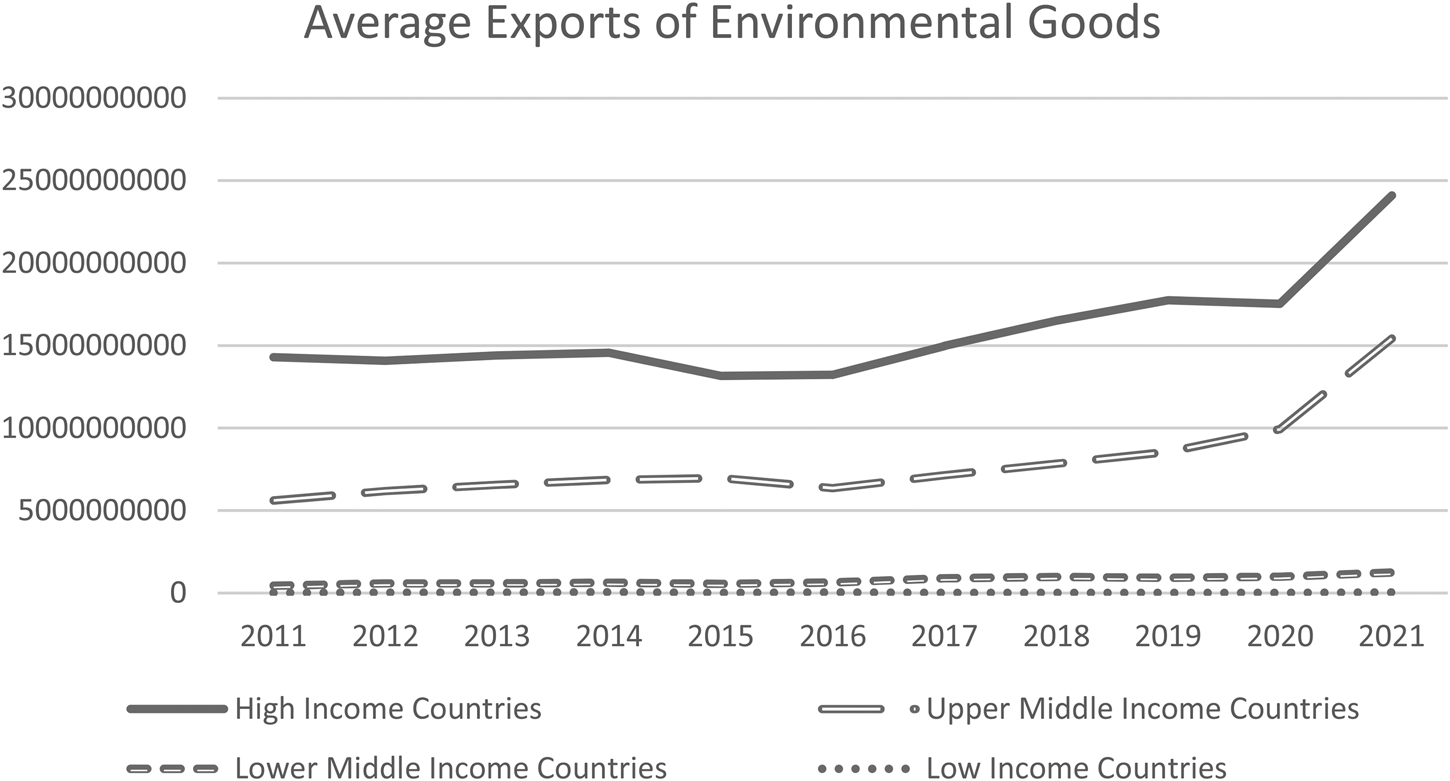
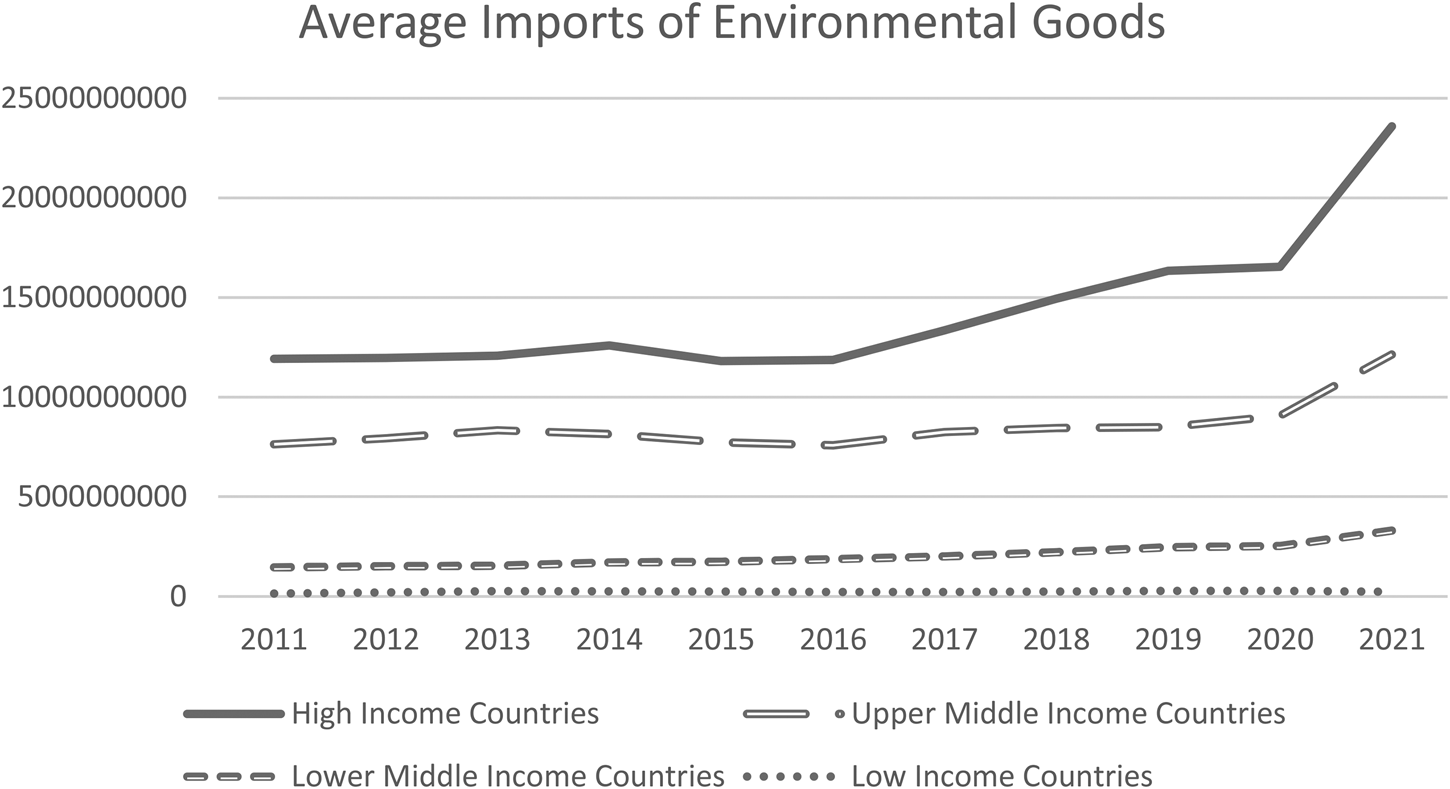
Figures 1 and 2 show the average exports and imports of environmental goods calculated based on the IMF Climate Change Dashboard as the dataset.Footnote 18 It is evident that there is a large gap between environmental goods imports and exports by low income countries and lower middle income countries as compared to upper middle income countries and high-income countries. For instance, in 2021, while low income countries only accounted for 0.5% and lower middle income countries account for 8.4% of the total imports of environmental goods, upper middle income countries and high-income countries accounted for 30.9% and 60.9% of total imports of environmetnal goods respectively.Footnote 19 In the case of environmetnal goods exports, low income countries and lower middle income countries only accounted for 0.12% and 3% of total environemtnal goods exports. However, upper middle income countries and high-income countries accounted for 37.78% and 59.03% of total enviornmetnal goods exports respectively.Footnote 20 Given the complementarity between environmental goods and services, such as environmental goods, environmental services are mostly traded between developed economies. Thus, our assessment is that the share of developing economies in the global environmental services market, including trade, is very small, consistent with the findings of the 2013 USITC Report.
Average exports of environmental goods (2011–2021)
Source: Calculations based on ‘Cross Border Indicators’, IMF Climate Change Dashboard, https://climatedata.imf.org/pages/bp-indicators (accessed 5 August 2023).

Average imports of environmental goods (2011–2021)
Source: Calculations based on ‘Cross Border Indicators’, IMF Climate Change Dashboard, https://climatedata.imf.org/pages/bp-indicators (accessed 5 August 2023).

2.2 Environmental Laws and Market Potential
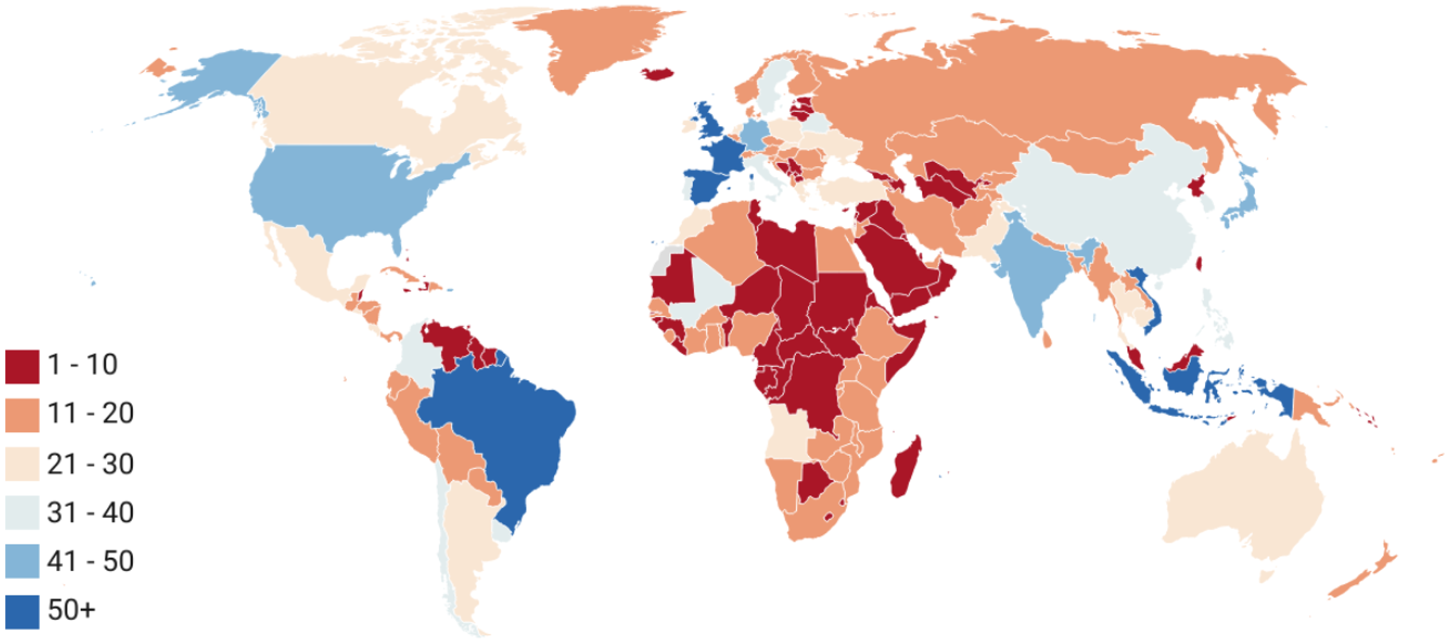
Environmental problems are a negative market externality as the cost of the damage is incurred by the society and not the producer. Environmental laws and policies are thus introduced to internalize the social cost of the environmental problems and address market imperfections. However, environmental laws and policies have also created markets for environmental goods and services. For instance, following legislation on air pollution control, Japan experienced an expansion of its air pollution industry in the 1970s and early 1980s.Footnote 21 In the Netherlands, efforts to overcome land contamination problems led to the development of advanced soil remediation technologies.Footnote 22 With growing awareness about the impact of environmental problems, a growing number of countries, including most developing countries, have put in place environmental laws and policies to tackle various issues such as deforestation, GHG emissions, and circularity as shown in Figure 3.
Number of Climate Laws by Country
Source: John Letzing, ‘These laws have formed a foundation to fight climate change’, World Economic Forum, 14 April 2023, www.weforum.org/agenda/2023/04/these-laws-have-formed-a-foundation-to-fight-climate-change/ (accessed 5 February 2023).

Considering the crucial role of services in environmental activities, the implementation and enforcement of environmental laws and policies may theoretically lead to growing demands for environmental and related services in developing countries. These laws and policies could also be a factor contributing to the creation of markets for environmental technologies and installation of environmental devices by mandating standards such as performance-based standards or technology-based standards.Footnote 23
However, environmental services markets cannot be created solely through the enactment of environmental laws and policies. Many factors need to be in play for government regulations to effectively affect supply and demand. Given the capital-intensive nature of environmental activities, resources constraints are one of the main impediments preventing developing countries from effectively implementing environmental laws and policies. Noting that financing is critical for the growth of the environmental industry in developing countries, multilateral environmental agreements (MEAs), including the UNFCCC, the Kyoto Protocol. and the Paris Agreement, all highlight the role of international investments in developing countries' efforts to pursue the environmental goals, including climate change mitigation and adaptation. Meanwhile, developing countries have often adopted laws and policies to attract foreign investment to overcome environmental challenges. For example, 30% of the investment policy measures adopted in climate-change related sectors between 2010 and 2022 concerned liberalization, mostly relating to the unbundling of the energy market or the privatization of state-owned enterprises (SOEs).Footnote 24 Seven developing countries (China, Ethiopia, India, Indonesia, Syria, Türkiye, and the United Arab Emirates) adopted measures to open their electricity market to private and/or foreign investment during the last decade, while the Philippines and the United Arab Emirates have also adopted measures specifically to open the renewable energy sector to foreign investors. The remaining measures are aimed at promoting investment in renewable energy generation and in green technologies, or at introducing regulations to promote the green energy transition.Footnote 25
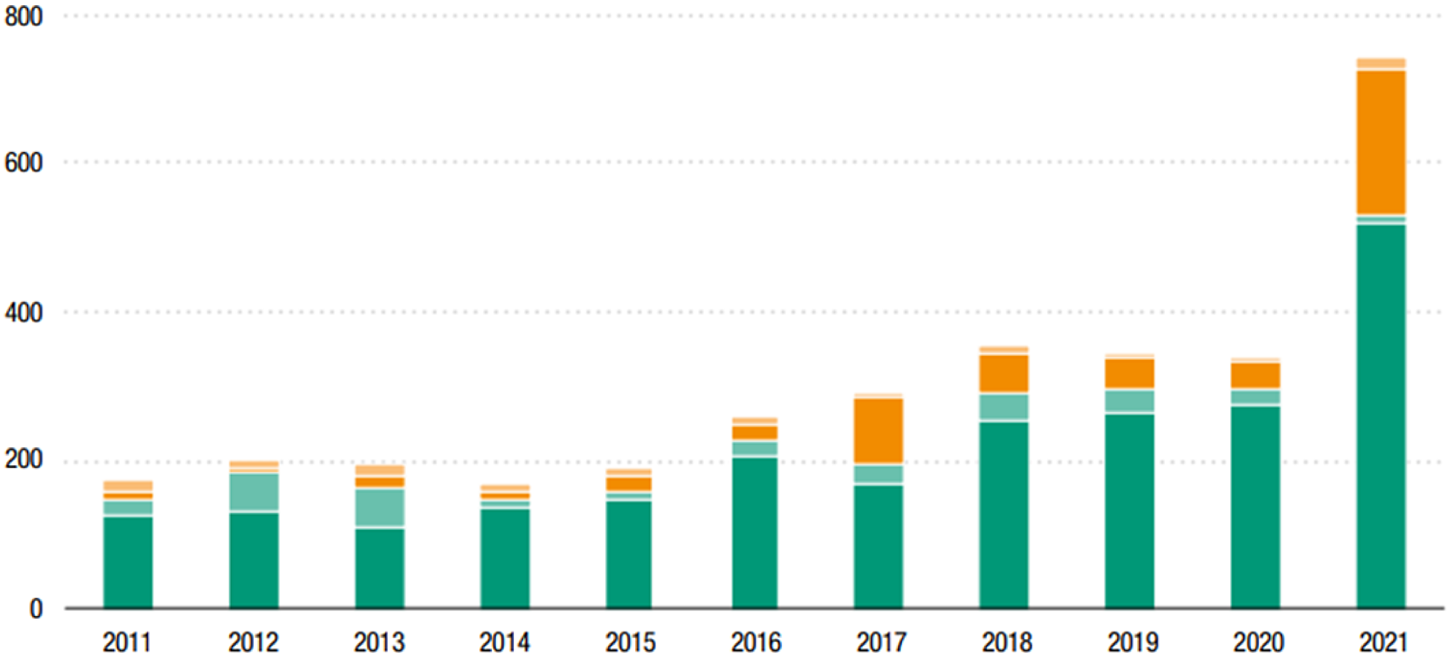
Investment related environmental measures often focus on specific environmental objectives or concerns such as the promotion of green sectors and/or technologies, renewable energy, electricity, and water.Footnote 26 As shown in Figure 4, there has been a rise in international investment for climate change mitigation and adaptation.Footnote 27 Private sustainable finance in emerging market and developing economies rose to a record $250 billion last year.Footnote 28 While developing countries have often highlighted their adaptation needs, the investment has been concentrated on climate change mitigation with mitigation projects accounting for more than 95% of international climate investments.Footnote 29 The number of adaptation projects with international investment is also high in developing countries focusing on water management.Footnote 30
International mitigation and adaptation investment projects, 2011–2021 (Billions of dollars)
Source: UNCTAD, based on information from Financial Times Ltd, fDi Markets (www.fdimarkets.com) for greenfield projects and Refinitiv SA for international project finance deals.

Developing countries are experiencing population growth, fast-paced urbanization, and industrialization along with economic growth aspirations. There is also growing environmental awareness, which is increasingly being translated into implementing and enforcing environmental laws and policies and undertaking international environmental obligations.
Overburdened by the export of waste from developed countries, several developing countries have adopted legislations that do not permit the import of waste.Footnote 31 However, waste management and related services presents good trade opportunities for both developed and developing countries as developed countries have the technology, capacity, and resources which are needed in developing countries. In this context, the environmental industry including environmental and related services may have opportunities to grow in developing countries.Footnote 32 For example, Larsen & Toubro LTD., the Indian company ranked No.3 in the Top 200 Environmental Firms, benefited from new governmental policies in clean water and sanitation that are driving market opportunities in India.Footnote 33 However, in general, insufficient financing, and competing needs and interests may create challenges for the growth of the environmental industry in developing countries. For instance, it is estimated that the climate change adaptation market could be worth $2 trillion per year by 2026, with the developing world standing to benefit from much of this.Footnote 34 However, so far, the growth of international private investment in climate change has been concentrated in developed countries and in particular in the deployment of renewable energyFootnote 35 and it remains highly challenging to channel such investment into developing countries and to address their broader environmental and developmental concerns.
Very small market size and lack of capacity to engage in trade are the state of play of environmental services for most developing countries. Developing countries also see the need and great potential for environmental services, including trade and investment opportunities. Therefore, when facing negotiations on trade in environmental services, the essential question for developing countries is what can they gain from the negotiations.
3. Developing Countries' Position in WTO Negotiations on Trade in Environmental Services
3.1 Overview of WTO Negotiations on Trade in Environmental Services
WTO Members' GATS commitments on environmental services are limited as compared to other sectors. Only 59 Members (counting the EU-25 as one) have undertaken specific commitments in at least one of the seven environmental services sub-sectors listed in the CPC. This may be due to the low level of environmental awareness during the Uruguay Round and the limited role of the private sector in the provision of these services.Footnote 36 In comparison, the level of commitments on environmental services is notably higher in the case of recently acceded Members. All of the 36 recently acceded Members have undertaken commitments on environmental services due to the particular nature of the WTO accession negotiation.
During the multilateral services negotiations launched in 2000 pursuant to Article XIX of the GATS and later integrated in the DDA, 25 Members – most of them being developed economies – offered new or improved commitments on environmental services,. Several Members had also expressed willingness to reduce or eliminate trade restrictive measures in this area during the Ministerial level Signalling Conference held in 2008.Footnote 37 These aspirations did not materialize due to a slowdown in the negotiations. In any event, there is no enthusiasm from developing country Members to undertake specific commitments on environmental services under the GATS.
Negotiations on trade in environmental services under the GATS, not different from the negotiations on trade in other service sectors, are aimed at achieving a higher level of liberalization, which ‘shall be directed to the reduction or elimination of the adverse effects on trade in services measures as a means of providing effective market access’ (GATS Article XIX). More specifically, the negotiations shall pursue new or improved GATS commitments on environmental services by WTO Members, which are undertaken under four modes of supply, i.e. the forms of services trade transactions.
Like other service sectors, environmental services are traded through all four modes of supply. However, the importance of each mode varies depending on the service that is being supplied. Commercial presence (mode 3) is the predominant mode for the supply of environmental services due to the nature of environmental services and their infrastructural needs. Movement of natural persons (mode 4) is also important for the supply of environmental services as firms usually need to send abroad managers or technicians with specialized skills when operating through affiliates, and professionals, such as environmental consultants, often physically supply their services abroad. While cross-border supply (mode 1) traditionally had limited significance in reference to environmental services, technological advancements have opened new opportunities for this mode. During the DDA negotiations, it was observed that while delivering infrastructure environmental services typically necessitated local service providers' physical presence in the market, environmental consultancy services – such as designing and implementing waste management plans or providing advice on eco-friendly solutions – could be offered across borders.Footnote 38
A key issue raised and extensively discussed during the DDA negotiations on environmental services was classification. It appeared to be a general view that the classification of environmental services contained in W/120 was inadequate as it focused on ‘end-of-pipe’ technologies (i.e. cleaning pollution) without capturing a range of activities aimed at preventing environmental degradation. Several written proposals pointed to this problem and submitted modifications of the classifications in W/120, which normally broadened the list of core environmental services and identified a list of environmental-related services, namely services that were not environmental per se, but nevertheless contributed to the provision of environmental services or overlap with environmental services in terms of end-use, such as construction, engineering, R&D, technical analysis services, etc.Footnote 39
Barriers to trade in environmental services as identified by Members during the DDA negotiations included monopolies and exclusive providers, restrictions on legal forms, equity limitations, tax discrimination, limitations on the ownership of specific assets (such as landfills and sewage systems), requirement of joint training with a local firm, unspecified licensing and approval requirements, unspecified economic needs tests, etc.Footnote 40 Lack of transparency of regulatory regimes and inconsistent or arbitrary enforcement of environmental laws and planning restrictions were also mentioned.Footnote 41 Multilateral negotiations on trade in environmental services were targeted at eliminating or reducing these barriers with a view to enhancing market access in this sector.
While there were two negotiating proposals on environmental services from developing country Members (Colombia and Cuba) during the DDA negotiations,Footnote 42 developing countries were generally on the defensive in negotiations aimed as further trade liberalization in environmental services. In the context where trade negotiations are deemed as exchanges of concessions, i.e., market opening, developing countries seem not convinced that they can benefit from making concessions or liberalization in environmental services. They argue that liberalization would address neither the substantial trade distorting effect of subsidies of developed countries in this sector, nor infrastructure and capacity gaps in developing countries.Footnote 43 In their view, such liberalization was being discussed for (developed countries') economic interests rather than environmental interests. For example, a developing country Member noted that considering the history of services negotiations, specific commitments were made in the areas of comparative advantage for developed industrialized countries and did not reflect the interests and comparative advantage of developing countries.Footnote 44 According to developing countries, some of the barriers to trade identified by developed country Members were legitimate policy requirements for them rather than barriers, and Members had a right to establish environmental legislation as they saw necessary.Footnote 45 Even in the discussion on classification of environmental services, developing country Members underlined the importance of broad considerations, including different levels of social and economic development among Members and the needs of developing countries.Footnote 46 In this context, developing country Members highlighted their need to maintain the flexibility to design their domestic frameworks and regulations in accordance with their national realities, priorities, and development strategies. Some such Members also pointed to their interest in commercially meaningful outcomes in mode 4, an area where many developing countries believe they have comparative advantage, and requested that developed countries undertake commitments on market access in mode 4 for balanced trade in services.Footnote 47
Developing countries' overall defensive position in trade negotiations on environmental services is an interesting phenomenon. One may think that given their need for investment, developing countries can benefit from the liberalization of services trade under mode 3 and should have the motivation to engage in the negotiation. However, developing countries appear not convinced that liberalization commitments would necessarily entail foreign investment. This is understandable as in practice, investment decisions depend on multiple factors such as market potential and trends, risks and returns, the regulatory framework including taxation and payment systems in the receiving country, etc. While liberalization commitments on mode 3 may be interpreted as signals welcoming foreign investment, trade policy is always considered as part of economic development strategies, and environmental objectives are often balanced with other domestic needs. Concerned about the huge gap with developed countries in terms of infrastructure and competitiveness, conscious of the immaturity of domestic environmental market, developing countries seek more assuring commitments undertaken by developed countries, which they expect to bring them broader development opportunities. As such, they brought forward narratives on their defensive interests in environmental services negotiations as presented below.
3.2 Developing Countries' Position: Development Opportunities vs. Trade Liberalization in Environmental Services
Developing countries' defensive narratives have been focusing on the development dimension. While recognizing opening up markets through negotiations on environmental services might generate favourable conditions for development, and increase stability and predictability under the right circumstances, developing countries argued that this would not automatically enhance their competitiveness given their levels of development and their limited domestic capacity.Footnote 48 Further, they noted the struggle when facing competition from transnational companies with access to their markets.Footnote 49 While not denying possible benefits of environmental services liberalization, such as increased investment, technology transfer, improvement in environmental, and sanitary conditions, developing countries highlighted their disadvantages in development.Footnote 50 Thus, they contested the assertion that environmental services liberalization would be beneficial for all importers and exporters as it would provide access to services inputs at competitive prices.Footnote 51 In their view, only focusing on environmental services liberalization is not a comprehensive approach and it may not build multilateral confidence.Footnote 52 They indicated that environmental services liberalization should unlock common ground and value for all rather than contribute to entrenching and widening asymmetries,Footnote 53 and that developing countries' domestic services capacity should be strengthened.Footnote 54
Developing countries therefore requested that services liberalization be considered in the broader context to ensure that the elimination or reduction of trade restrictions and distortions lead to a triple win outcome, i.e., it would benefit trade, environment, and development. Footnote 55 They identified technical cooperation and capacity building as core elements of the development dimension of the multilateral trading system and noted the need for special and differential treatment recognized by the Doha Declaration.Footnote 56
More specifically on development in the context of environmental goods and services, developing countries identified three main elements, namely, a mechanism to ensure the development and transfer of environmental technologies; a financial mechanism to ensure access to and development of environmental technologies, investment in environmental projects, and capacity development for production of the environmental goods; and special and differential treatment for developing and LDC Members.Footnote 57 In addition to these three elements, a developing country Member noted a fourth element, namely, the adoption of specific commitments which would guarantee the export of services from developing countries in the modes of supply of interest to them.Footnote 58
Like investment, the effectiveness of environmental technologies to address environmental challenges is dependent on multiple factors, including the dissemination and deployment of these technologies. Nevertheless, equipment and operating costs involved with environmental technologies are so high that their widespread deployment is often constrained. Moreover, in comparison with conventional technologies, the deployment of new environmental technologies is facing more challenges in terms of infrastructure, services, and institutions. As such, developing countries were concerned that liberalization that did not take into account levels of development and the particular interests of developing countries could lead to technological dependence, even if the liberalization of services were able to play an important role in promoting innovation and lowering the costs of new technologies.Footnote 59 For example, as one developing country Member noted, despite its high level of liberalization commitments under the GATS, its transition to a green economy had so far been largely supported by imports and had not triggered substantive investment in domestic production and exports of these services.Footnote 60 Out of these concerns, developing countries pushed for the integration of the following elements into any environmental goods and services framework: cooperation in research and development of environmental technologies, sharing related intellectual property rights, enhancing capacities of developing and least developed country Members to develop and implement such technologies, and ensuring effective transfer and implementation of such technologies.Footnote 61 In this context, developing country Members made specific suggestions regarding technology transfer, requesting that specific commitments on environmental services be linked to the effective technology transfer and aid/assistance to developing countries.Footnote 62
Related to environmental technology transfer, developing countries also requested commitments on financial support to enable them to implement development measures in an environmentally sound manner.Footnote 63 They also voiced their need for trade finance for environmental services, development of related SMEs, and mitigating the adverse impact of developed country response measures on developing country imports.Footnote 64
Developing countries also argued for special and differential treatment in the context of environmental goods and services. According to them, effective implementation of special and differential treatment would require less than full reciprocity in any commitments made by developing country Members. Also adequate transition periods, allowing phased implementation of obligations for developing and least-developed Members, should be an integral element of special and differential treatment.Footnote 65 In addition, a developing country Member proposed that market access for environmental goods and services should ensure that international prices for all such goods and services do not lead to undue monopolization by major players. Additionally, governments of exporting countries should bear a significant portion of the supply costs when targeting developing country markets.Footnote 66
Interestingly, the principle of common but differentiated responsibility (CBDR) included in various multilateral environmental agreements was also brought into the narrative. According to developing countries, CBDR in the context of environmental services trade would mean higher commitments by developed countries due to their greater responsibility for environmental degradation.Footnote 67 Some developing Members also proposed that the proponents of liberalization of environmental services forego negotiations and unilaterally liberalize environmental services as it was more expedient and supported the premises articulated by them.Footnote 68
What developing countries want to pursue in trade negotiations on environmental services is more development opportunities through technology transfer, financial support, investment, as well as special and different treatment. There appear gaps between the multilateral negotiations focusing on further liberalization and developing countries' demand for economic development.
Very recently, in the WTO, some developing countries expressed their caution about premature tariff liberalization on environmental goods and services associated with the green transition before building their own requisite capacities and capabilities in areas of revealed and latent comparative and competitive advantages.Footnote 69 They stressed that development remains the core focus of the WTO and called for greater policy space for economic growth and green industrialization, ‘as a critical complement to other adaptation and mitigation-related actions to build resilience against climate change’.Footnote 70 Developing countries appear to have also become increasingly vigilant about ‘green protectionism’ that has presented itself in the form of unilateral environment related trade measures and are keeping a close watch on the possible negative impacts of the ‘green cause’.Footnote 71 A group of developing countries recently proposed to the WTO a set of principles guiding the development and implementation of trade-related environmental measures to ensure that environmental measures do not create a competitive disadvantage for developing countries or negatively affect developing countries.Footnote 72 Noting that climate change is not only an important environmental problem, but also a major development issue, they stressed: ‘If the WTO is to play a supportive role in addressing the climate change challenge, it can only do so if trade responses are multilaterally agreed and are underpinned by the principle of CBDR.’Footnote 73
4. Developing Countries' Engagement on Environmental Services in Free Trade Agreements
More and more countries are pursuing trade liberalization and economic integration by negotiating bilateral and plurilateral free trade agreements (FTAs). Environmental services are incorporated in FTAs through specific commitmentsFootnote 74 directly as well as environment-related provisionsFootnote 75 indirectly.
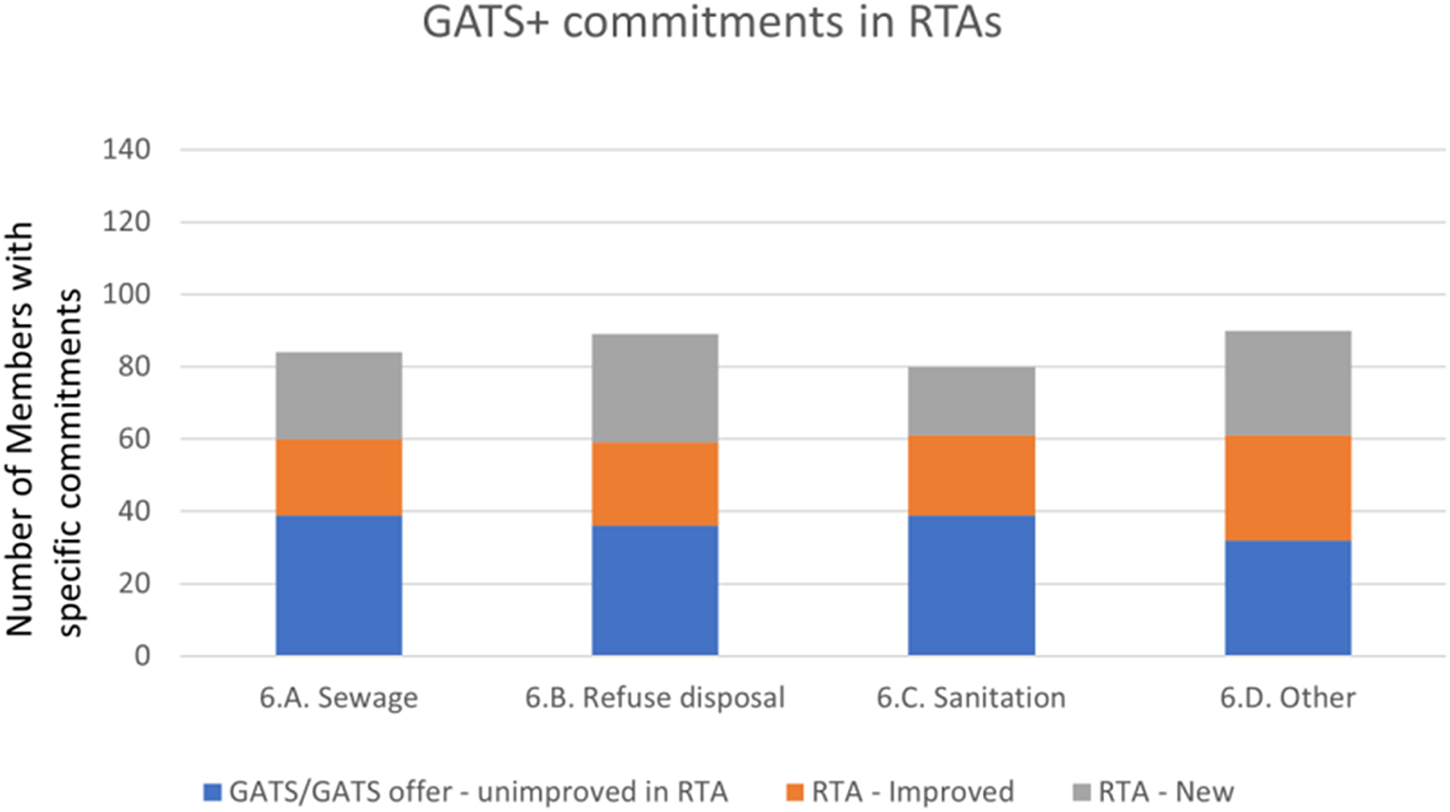
Considerable progress on the liberalization of environmental and related services has been achieved in FTAs. In comparison to GATS commitments, market access and national treatment commitments on environmental services undertaken in FTAs are significantly deeper in substance and broader in scope. These commitments go not only beyond existing GATS commitments, but also beyond offers made during the DDA services negotiations. These new or better commitments in FTAs are significant for each of the four environmental services sub-sectors in W/120.Footnote 76 For example, as regards refuse disposal services (CPC 9402), 23 of the 59 Members (counting EU-25 as 1) that have GATS commitments or offers in the sector have undertaken improved commitments in FTAs by binding a better level of treatment for market access or national treatment under any mode of supply. In addition, 30 Members that had no GATS commitments nor made offers in refuse disposal services have undertaken commitments in FTAs (Figure 5)Footnote 77
GATS+ Commitments on Environmental Services in Regional Trade Agreements
Notes: On the basis of 142 of the 193 regional trade agreements notified under GATS Article V as of 1 March 2022. Counting EU-25 as one. “GATS/GATS offer – unimproved in RTA” refers to the number of Members that have GATS commitments or that have made an offer in the WTO services negotiations in the relevant sub-sector, and that have not taken better commitments in RTAs. “RTA – Improved” refers to the number of Members that have undertaken a commitment in RTAs that improve a GATS commitment or offer. “RTA – New” refers to the number of Members that have undertaken a commitment in RTAs, where no commitment or offer had been made under the GATS.
Source: Note by the Secretariat on Experiences in the Promotion and Facilitation of Environmental Goods and Services, WTO document INF/TE/SSD/W/18, 23 March 2022.

In GATS-type positive list FTAs, several Members have undertaken preferential commitments on environmental services which are not equivalent in their GATS schedules. This is the case for various developing countries, such as the Cariforum countriesFootnote 78 in their agreement with the European Union (EU–CARIFORUM), Chile (EU–Chile, EFTA–Chile), Philippines (ASEAN–AUNZ, ASEAN–China, Japan–Philippines), Singapore (ASEAN–AUNZ, ASEAN–China, China–Singapore, EFTA–Singapore, India–Singapore, Japan–Singapore), Pakistan (Pakistan–Malaysia) and Peru (Peru–China). Some developing countries have also undertaken market access and national treatment commitments in FTAs on a range of environment-related sectors, including business services, energy services, or distribution services to list just a few.Footnote 79
Many developing countries have also concluded services FTAs based on the negative list approach.Footnote 80 Compared to positive list FTAs, negative list FTAs usually bind market opening status quo as the benchmark and are built upon the assumption that all services sectors are liberalized for the parties except those listed as existing or future ‘non-conforming measures’ (namely ‘reservations’). As such, negative list FTAs tend to achieve a higher level of commitments than positive list FTAs. This is the case for developing countries' commitments in environmental services as well. For instance, Brunei Darussalam, Chile, Mexico, Malaysia, Peru, and Singapore have no commitments on environmental services in their GATS Schedule of Specific Commitments; nevertheless, thanks to the standstill and ratchet obligations under the Comprehensive and Progressive Agreement for Trans-Pacific Partnership (CPTPP), these developing countries are committed not only to bind the actual market opening level in environmental services at the time of first commitments, but also lock in any future unilateral liberalization. By listing existing and future non-conforming measures related to environmental services under the CPTPP, they have undertaken important market access and national treatment commitments in this sector, going far beyond the GATS level.Footnote 81 These commitments provide more transparency to the environmental services market in these countries than do commitments under the GATS, ensure the certainty of level of liberalization, and prevent these countries from backtracking their commitments. Under the Regional Comprehensive Economic Partnership (RCEP), Indonesia which has no GATS commitments in environmental services, along with Brunei Darussalam, Malaysia, and Singapore, has made new commitments in this sector. Similarly, Chile and Mexico have also made commitments in environmental services under the Australia–Chile FTA and the US–Mexico–Canada Agreement (USMCA) respectively.
Given that most developed countries have already undertaken GATS commitments in environmental services, which usually bind market status quo, the difference between GATS commitments and FTA commitments in this sector for developed countries is less significant than that in the case of developing countries.Footnote 82
Some developing countries' highly liberal commitments on environmental services in FTAs, especially in the negative list FTAs, suggest that there exist very few trade restrictions particular to environmental services, and that benefits which may be brought by market opening are also recognized. However, the different dynamics in bilateral and regional FTA negotiations, as compared to multilateral negotiations, should be noted. It shows that FTAs are more adaptive in addressing the nexus between trade, environment, and development as evidenced by environment-related provisions in FTAs.
More and more FTAs include environment-related provisions ranging from the inclusion of environmental objectives in the preamble or a GATT Article XX-type environmental exception to a stand-alone environment chapter.Footnote 83 Environment-related provisions in FTAs can generally be classified under six categories, namely, objective and scope, exceptions for environmental purposes, licensing or qualification requirements and procedures, cooperation on environmental goods and services, schedule of commitments and regulatory cooperation, and good regulatory practices.Footnote 84
Developed countries such as the US, the EU, Canada, and New Zealand are the main promoters of the integration of environment-related provisions into FTAs, with most their signed FTAs including such provisions. In general, FTAs negotiated between developed countries and between developed and developing countries tend to include the highest number of environment-related provisions.Footnote 85 However, FTAs signed between developing countries contain much fewer environment-related provisions. Interestingly, several developing countries, in particular those that have already signed FTAs with high-income countries incorporating environment-related provisions, have also increasingly incorporated such provisions into their trade agreements with other developing countries, but the scope and level of commitments of these provisions are usually not as detailed as those found in trade agreements negotiated between developed and developing countries.Footnote 86
The spectrum of environment-related provisions in FTAs corresponds to the state of play of the environmental services market described in Section 2 of this paper. Given their higher environmental standards and dominant position in the market, developed countries are motivated to use trade agreements to pursue both environmental and economic goals. The fact that FTAs signed between developing countries contain much fewer environment-related provisions appears to suggest that developing countries are far from convinced that trade agreements should, or could, be used as vehicles to pursue environmental goals.
It is worth noting that an increasing number of trade agreements identify environmental cooperation as an objective and that those negotiated between developed and developing countries often foresee, or provide, for technical assistance, financial support, and/or capacity building on environmental matters.Footnote 87 In particular, several FTAs between developed and developing countries include support measures aimed to address the technological and institutional capacity shortfalls of developing countries.Footnote 88 These measures are often in the form of promoting access, diffusion, or transfer of environmental technologies as well as technical assistance, financial support, and capacity building. The depth and scope of such provisions range from one specific technology area to a comprehensive program. Examples of what is included in these provisions include joint programmes and environmental technology demonstrations; research studies and reports; exchange of professionals, technicians, and specialists; exchange of technical information, publications, and regulations; organization of joint conferences, seminars, workshops, and training sessions; and outreach and educational programmes.Footnote 89
Despite the progress FTAs have made in addressing the nexus between trade, environment, and development, what has been achieved so far remains modest. For example, the technology transfer provisions in FTAs are usually best-endeavour provisions that do not put binding obligations on parties to transfer technology.Footnote 90 This should be frustrating for developing countries, as the reality is that the transfer of environmental and climate technologies has been notably slow. Clean technologies continue to concentrate in developed countries, which produced at least 80% of clean technology innovations in all technological fields between 2010 and 2015, while lower middle-income and low-income countries produced almost no clean technology innovations during the same period.Footnote 91 Moreover, despite the inclusion of financial support provisions in FTAs, developing countries continue to suffer from inadequate climate finance.Footnote 92
5. New Approaches to Environmental Services Negotiations: Implications for Developing Countries
As noted in Section 3, developing countries prioritize economic development in negotiations on environmental services and request that common and differentiated responsibilities be taken into consideration. This is understandable given their social and economic development needs and their disadvantageous position in global trade competition. In addition, climate change indeed has a disproportionate effect on developing countries. Therefore, when engaging developing countries in trade negotiations on environmental services, more is needed than simply stating that environmental services liberalization would help achieve environmental goals.
Some WTO developed country Members have recently initiated exploratory discussions on environmental services in the Special Session of the Council for Trade in Services (CTS-SS), proposing a comprehensive approach in the context of advancing environmental objectives through trade liberalization.Footnote 93 In particular, they proposed a broader scope of negotiations on environmental services, highlighting additional services sectors where international trade liberalization and improved GATS commitments could significantly contribute to advancing global action on environmental issues. The proponents argued that environmental and related services liberalization supported by all Members, including developing countries and LDCs, would have a positive impact on sustainable development and help to integrate them into global value chains.Footnote 94 According to the proponents, there are both direct benefits and indirect benefits accrued by environmental and related services liberalization. Direct benefits include the greater availability, accessibility, and affordability of environmental and related services, and the resulting reduction in cost of achieving environmental goals. In their view, an overall improvement in the level of commitments, in reducing barriers to trade and removing limitations in all modes of supply would provide greater transparency and predictability to market access conditions and a more favourable business environment, thus facilitating environmental and related services trade from which all Members could benefit, including developing countries.
The proponents also highlighted a wide range of indirect benefits that could derive from the liberalization of environmental and related services, namely benefits accrued as a result of increased availability and accessibility of environmental services. For example, innovation and investment in environmental services sector resulting from liberalization may create further opportunities for skills transfers, job creation, and incentives for new ideas and initiatives.Footnote 95 According to one of the proponents, restrictions on trade in environmental services could be linked to weaker export performance by firms, which consequently leads to a less innovative sector where new clean technologies are so expensive that their wide deployment is inhibited.Footnote 96 The proponents contend that a more liberalized trade regime could help the domestic industry grow by increasing exports and by becoming integrated into global value chains.Footnote 97 They further highlight that improved commercial presence commitments could help attract foreign investment, and create economic opportunities domestically, including jobs and knowledge transfers via local partnership.Footnote 98
In commenting on this proposal, the ACP Group recognized novel technologies and methods to carry out economic activity and living in a sustainable manner and the contribution of discussions in identifying key environment-related services to support developing countries, particularly Small Island Developing States and Least Developed Countries (LDCs) in mitigating the effects of climate change and of natural disasters.Footnote 99 They however raised interesting questions that clearly reflect developing countries' interests. For example, they asked how the proponents see the principle of common but differentiated responsibilities being applicable and what their contribution would be in this regard; they also asked the proponents to identify technologies that could be harnessed in the context of developing countries and Small Island Developing States to support climate change mitigation, while creating new business and trading opportunities. A follow-up question would be how the market access negotiations aimed at improving specific commitments on environmental services under the GATS could incorporate the principle of common but differentiated responsibilities and achieve a win-win outcome for developing countries in both climate change mitigation and better trade opportunities. Only with more clarity on this question would developing countries be willing to engage in the market access negotiations on environmental services.
In the framework of TESSD, the Environmental Goods and Services Working Group is also discussing issues related to the promotion and facilitation of environmental and related services.Footnote 100 The following are the guiding questions for discussion:
• How can trade in environmental goods and services aid in achieving environment and climate goals?
• What are the opportunities, best practices, and possible approaches for promoting and facilitating trade in environmental goods and services to meet environmental and climate goals, including through addressing supply chains; technical and regulatory elements; promoting and facilitating access to, and uptake of, new and emerging low-emissions and other climate friendly technologies; and paying attention to issues of particular interest to developing countries?
• What challenges and policies impede the ability of developing countries and LDCs to engage in and maximize benefits from trade in environmental goods and services and how can these be addressed?Footnote 101 (Emphasis added)
While TESSD is not under negotiation yet and discussions therein are still at the preliminary stage, with priorities going forward or possible outcomes being identified and agreed on by Members, it is worth noting that issues of particular interest to developing countries and the challenges to engaging developing countries in environmental goods and services trade are already on the agenda for consideration. So far, a significant part of the discussions focused on Members' priorities in terms of objectives and sectors, and their views on how trade in environmental goods and services could achieve climate and environmental goals.Footnote 102 Members broadly agreed that discussions on environmental goods and services should have a broad scope. Members, inter alia, expressed interest in discussing non-tariff measures, regulatory cooperation, good regulatory practices, technology transfer, capacity building, biotrade, bottlenecks to the deployment of new technologies throughout the supply chain, etc.Footnote 103 It is evident that these issues are all highly relevant to the interests of developing countries. Also emphasized in discussions were challenges for developing countries, the importance of capacity building and aid for trade, and how environmental services could contribute to broader objectives, such as supporting economic growth, including for MSMEs and for LDCs.Footnote 104 It was highlighted that technology transfer and technical assistance should be addressed first before discussing lowering tariffs on environmental goods and services in order to ensure that developing countries were not only seen as potential markets for exports from developed countries.Footnote 105 Stakeholders that form an important part of the TESSD discussions have also highlighted that some developing countries had liberalized EGS but had still not registered any scaling of technologies or investment in these areas, which pointed to technology transfer and investments as drivers for EGS.Footnote 106
There is still a long way to go before the above ideas could become consensus among participants and ready for moving forward. It is also not clear how Members want to pursue environmental services in the framework of TESSD in parallel with the work in the CTS-SS. In any event, innovative thinking is needed to take developing countries on board and achieve a meaningful outcome, be it under the GATS or in TESSD.
The ongoing negotiation on the Agreement on Climate Change, Trade and Sustainability (ACCTS) currently among six WTO Members (Costa Rica, Fiji, Iceland, New Zealand, Norway, and Switzerland) is worth attention as it recognizes the particular vulnerability of Small Island Developing States to the impacts of climate change and is aimed to deliver WTO-consistent trade policy and trade rules that make a meaningful contribution to addressing climate change.Footnote 107 In terms of environmental services, it has been reported that significant progress, based on a broad view of how services can contribute to addressing pressing environmental challenges and thus also contribute to sustainable development, is being made to classify and develop an environmentally ambitious list of environmental and environmentally related services.Footnote 108
Another notable stride in exploring new approaches to addressing the nexus between trade, environment and development is the Singapore Australia Green Economy Agreement (GEA) signed in 2022. The GEA combines trade, economic, and climate change objectives to drive green growth and focuses on promoting trade and investment in environmental goods and services.Footnote 109 Regarding environmental services, the GEA includes a list consisting of services that are environmental in themselves and services which may be environmental when done in support of an environmental outcome.Footnote 110 A remarkable achievement in defining environmental services, such list will be reviewed in view of emerging environmental issues and changes to environmental technologies and services.Footnote 111 The two countries have also launched initiatives aimed at inter alia, developing the architecture to enable cross-border electricity trade, green shipping cooperation to help decarbonize and digitalize the port and shipping industry, and the green skills roundtable to share approaches and policies on developing the necessary skills and capabilities required in a green economy workforce.Footnote 112
There are huge opportunities for trade in environmental services, driven by the increasing demand for environmental improvement worldwide, in the future, including climate change mitigation and adaption as well as the pursuit of circular economy. For example, it is estimated that to achieve universal access to safe and affordable drinking water and significant improvements in sanitation by 2030 (No. 6 of the UN Sustainable Development Goals), developing countries of Eastern Asia and South-Eastern Asia would need capital investments of over USD 26 billion annually in water-supply and a sanitation infrastructure.Footnote 113 As noted above, climate change mitigation and adaptation would create a trillion-dollar market for cleaner energy and energy efficiency improvements over the forthcoming decades. It is important for developing countries to be convinced that they may also tap into these opportunities. To this effect, some developing countries' successful experiences of gaining competitiveness in environmental services are worth further study and sharing with other developing countries.
5.1 Successful Experiences of Developing Countries in Environmental Services Competitiveness: Case Studies from India and South Africa
An Indian infrastructure company, Larsen and Turbo Ltd. (L&T) has achieved competitiveness in environmental and related services related to renewables, green buildings, green hydrogen, water and sewage treatment, and energy efficient power grids. L&T experienced a significant 10% growth in fiscal year 2021–2022, driven by its strong performance in power transmission and distribution and its hydrocarbon business as well as by its exports to developing countries.Footnote 114 Government intervention and international focus on climate change, resource scarcity, and universal coverage to basic amenities have also been critical for its growth.
L&T has 30 ongoing projects which it operates through its regional offices in the SAARC, Middle East, Africa, ASEAN and CIS regions in the power transmission and distribution sector, one of the company's key sectors of operation.Footnote 115 The growing focus on net zero emissions, renewable energy, and increased funding opportunities have created expansion opportunities for L&T in this sector, both domestically and internationally. In India the goal of achieving 500 GW of renewable energy by 2030 and in Africa, funding from institutions such as Japan International Cooperation Agency and Millennium Challenge Corporation is driving L&T's growth.Footnote 116
In the water and effluent treatment sector, another one of its key sector, L&T's operations include water treatment plants, industrial water supply, and treatment plants for recycling and re-use, wastewater treatment and network, sludge management, desalination plants, and a utility infrastructure for developing greenfield and brownfield areas. The business is operational across India as a result of the growth opportunities provided by government schemes launched to address the extreme water stress, growing urbanization, and climate-related water inequity.Footnote 117 Increased investments in water and wastewater treatment in the Middle East and in clean water and sanitation in Africa and ASEAN provide L&T new opportunities in these regions.Footnote 118 The company is collaborating with well-known startups to enhance the efficiency and remote operation of its plants, which can potentially reduce costs and transform it into a technology-driven player.Footnote 119
However, the company has faced challenges in the form of geopolitical risks, trade barriers, climate change, and execution challenges (e.g., employee mobilization, delay in approval and clearances, and visa issues).Footnote 120 L&T's experience also shows that changes in government policies and priorities are significant challenges for its operation. For example, the wastewater treatment business faced challenges due to the diversion of government funds towards mitigating the healthcare emergency during the pandemic.Footnote 121
Proxa, a South African company that specializes in advanced water treatment within the mining, industrial, food & beverage and municipal sectors is another example of a company from a developing country that has achieved competitiveness in environmental and related services. Its provides a range of services that cover the entire water cycle from consulting and design, research and development, engineering and construction, and plant modernization to operational management, maintenance, repairs, after-market service, industrial effluent treatment, sewage treatment, and reuse of wastewater across four continents; Asia, Australia, Africa, and Europe.Footnote 122 Examples of Proxa's cross-border trade in wastewater treatment services includes a project it completed for Acacia Mining North Mara gold mine in Tanzania.Footnote 123 To complete this project, Proxa provided research, testing services, and modified and upgraded the existing membrane treatment plant.Footnote 124 The company has also worked on a project to establish a Zero Liquid Discharge plant for molybdenum processing facility in Chile which included the provision of services such as design, supply, and installation services.Footnote 125
The successful experiences of developing countries in achieving competitiveness in environmental and related services may provide insights for other developing countries on how to better leverage the opportunities presented by the global pursuit of sustainability.
6. Conclusion
Environmental services are both capital and technology intensive with developed countries being dominant in both supply and demand. For most developing countries, their market size of environmental services is very small, and they also lack capacity to engage in environmental services trade. While recognizing that trade liberalization, including foreign investment, may contribute to environmental goals, developing countries attempt to seek more development opportunities in trade negotiations on environmental services, requesting technology transfer, financial support, investment, as well as special and different treatment in undertaking market access commitments. They have been reluctant in participating in multilateral services trade negotiations aimed at further liberalization, which in their view failed to address their interests. However, developing countries see the need to upgrade environmental protection in their territories and have increasingly enacted environmental legislation which would also mean potential for the growth of environmental services in these countries. In coping with climate change and other environmental problems, the reconciliation between economic growth and environmental interests is more challenging for developing countries than for developed countries.
The changing landscape of global trade gives rise to new challenges for the world trading system. One of the challenges is to manage the interface between trade, environment, and development, which requires new approaches to dealing with trade negotiations which used to focus on market opening. Negotiations on environmental services present an interesting example in this respect. Future negotiations on environmental services need to address issues of particular interest to developing countries in order to have their engagement and achieve both economic and environmental goals. Developing countries should be convinced that their engagement would allow them to achieve a win-win outcome: better environmental protection and more economic development opportunities, namely sustainable development. Some trade agreements between developed and developing countries have tested environmental cooperation with support mechanisms aimed to address the technological and institutional capacity shortfalls of developing countries. This may be inspiring for negotiations on environmental services in the WTO, which require innovative thinking to take developing countries on board. It is important to assure developing countries that they can tap into development opportunities brought by trade in environmental services. Better data on environmental services in developing countries could also help their governments make informed policy decisions, including participation in trade negotiations.
Acknowledgment
This is a working paper, and hence it represents research in progress. The opinions expressed in this paper are those of its authors. They are not intended to represent the positions or opinions of the WTO or its Members and are without prejudice to Members' rights and obligations under the WTO. The authors wish to thank Ishrat Hans for her assistance in the work on the paper. Any errors are attributable to the authors.