Introduction
The modern world is characterized by the existence of diverse international connections and by the ensuing necessity to travel beyond the borders of one's home country. In this global environment, bilingualism becomes an essential skill that allows one to function successfully in cosmopolitan societies. The increase in the number of people who have mastered more than one language has prompted an interest in research that investigates the nature of the bilingual lexicon. The question that has intrigued researchers most of all is whether bilinguals manage the languages that they know by functionally independent systems (i.e., the language-selective account) or whether these languages are stored and represented within one common system (i.e., the language-nonselective account).
The debate seems to be settled in favor of a language-nonselective view of the bilingual lexicon (for a review see Dijkstra, Reference Dijkstra, Kroll and de Groot2005). According to this view, bilinguals cannot effectively prevent activation of contextually irrelevant languages that they know. In fact, the empirical evidence coming from a variety of tasks suggests that regardless of the situational requirements, all languages of a bilingual are active to some extent and operate in parallel at the level of orthography, phonology, and semantics (e.g., Brysbaert, Van Dyck & Van de Poel, Reference Brysbaert, Van Dijk and Van de Poel1999; De Groot, Delmaar & Lupker, Reference De Groot, Delmaar and Lupker2000; Friesen & Jared, Reference Friesen and Jared2012; Jared & Kroll, Reference Jared and Kroll2001).
Cross-language effects in word recognition
The issue of the selectivity of the bilingual lexicon has often been addressed by investigating the performance of bilinguals on interlingual words such as cognates and homographs. Cognates share orthographic and/or phonological wordforms in two languages as well as meaning (e.g., animal means the same thing in English and French). Numerous studies have found that cognates are responded to more quickly than matched single language control words (e.g., Dijkstra, Van Jaarsveld & Ten Brinke, Reference Dijkstra, Van Jaarsveld and Ten Brinke1998; Lemhöffer & Dijkstra, Reference Lemhöfer and Dijkstra2004; Van Hell & Dijkstra, Reference Van Hell and Dijkstra2002; see Dijkstra, Miwa, Brummelhuis, Sappelli & Baayen, Reference Dijkstra, Miwa, Brummelhuis, Sappelli and Baayen2010 for a review), supporting the language-nonselective view. In contrast to cognates, interlingual homographs have the same orthographic wordform in two languages but have different meanings (e.g., gift refers to “present” in English, but “poison” in German), and often have different pronunciations. Experiments using interlingual homographs in the lexical decision task have produced a complicated pattern of findings (e.g., De Groot et al., Reference De Groot, Delmaar and Lupker2000); however Dijkstra (Reference Dijkstra, Kroll and de Groot2005) concluded that most provide evidence for the language-nonselective view. Studies using interlingual homographs in other tasks, such as naming (Jared & Szucs, Reference Jared and Szucs2002; Smits, Martensen, Dijkstra & Sandra, Reference Smits, Martensen, Dijkstra and Sandra2006) and cross-language semantic priming (e.g., Paulmann, Elston-Güttler, Gunter & Kotz, Reference Paulmann, Elston-Güttler, Gunter and Kotz2006) have provided further evidence that representations from both languages are activated. Additional support for parallel activation of both languages comes from the finding that it is not only the frequency of interlingual homographs in the language of the task, but also their frequency in the task irrelevant language that has effect on the participants’ performance and electrophysiological activity (Kerkhofs, Dijkstra, Chwilla & De Bruijn, Reference Kerkhofs, Dijkstra, Chwilla and De Bruijn2006).
Automatic activation of the task irrelevant language has also been demonstrated in word recognition studies that have tested bilinguals who are fluent in languages with two different writing systems. Empirical evidence suggests that the presence of a distinct script does not inhibit activation of words in the non-target language. Several studies have shown that primes in one writing system facilitate phonologically and/or semantically similar target words that are written in a different writing system (e.g., Gollan, Forster & Frost, Reference Gollan, Forster and Frost1997; Kim & Davis, Reference Kim and Davis2003; Nakayama, Sears, Hino & Lupker, Reference Nakayama, Sears, Hino and Lupker2012; Zhou, Chen, Yang & Dunlap, Reference Zhou, Chen, Yang and Dunlap2010). These studies had English as one language and Hebrew, Korean, Japanese Katakana, and Chinese, respectively, as the other language. Furthermore, parallel activation of languages by Chinese–English bilinguals performing a semantic decision task on English words has also been demonstrated (Thierry & Wu, Reference Thierry and Wu2007). English word pairs whose Chinese translations shared a character produced a different event-related potential (ERP) response than word pairs whose translations did not share a character.
A few word recognition studies have examined language pairs that differ in most of their letters but have a few letters in common. One of the earliest such studies did not test bilinguals but rather tested Serbians who could read in both of the alphabets that are used to code their spoken language. Lukatela, Savic, Gligorijevic, Ognjenovic and Turvey (Reference Lukatela, Savic, Gligorijevic, Ognjenovic and Turvey1978) found that letter strings that could be read in either the Roman alphabet or the Cyrillic alphabet, but that had distinct meanings and pronunciations in each, produced longer decision latencies than did words that could be read only in Roman. More recently, Dimitropoulou, Duñabeitia and Carreiras (Reference Dimitropoulou, Duñabeitia and Carreiras2011) tested Greek–Spanish bilinguals, and examined cross-language priming for phonologically related primes and targets that either did or did not have some letters in common. They found no facilitation for targets that had some orthographic overlap with their primes (e.g., óριo–ocio), although they did find facilitation when there was phonological overlap only. The null effect of orthographic similarity casts doubt on whether letters in the context of one language can activate representations in the other language that contain the same letters. However, the authors suggested that the null effect was produced because competition between the orthographic representations of the prime and target eliminated the benefits of similar phonology. One further study that used a language pair that shares just a few letters tested Russian–English bilinguals, as in the current study. Kaushanskaya and Marian (Reference Kaushanskaya and Marian2007) used eye-tracking technology and a picture–word interference paradigm to demonstrate that Russian–English bilinguals attended to English nonwords that could be Russian legal words (Experiment 1) or to English nonwords that could map on a phonological representation of Russian words (Experiment 2) more often than to English control nonwords. These results confirm that a language-specific script does not act as a strong language cue making word recognition more language-selective for bilinguals who master languages with different writing systems. Despite the fact that there is little or no overlap in the orthography of the languages, lexical representations are activated in language-nonselective manner.
Cognates and interlingual homographs in sentence contexts
The main shortcoming of the research described above is the focus on investigating the mechanisms of isolated word recognition, which is not a common task in real life. Bilinguals process words in meaningful linguistic contexts at the level of phrase, sentence, and discourse. It is known from monolingual research that sentence context assists readers in word recognition by creating semantic, syntactic, and lexical expectancies for certain words (Schwanenflugel & Shoben, Reference Schwanenflugel and Shoben1985). Similarly, Dijkstra and Van Heuven (Reference Dijkstra and Van Heuven2002, p. 187) suggest that “linguistic context information may exert serious constraints on the degree of language-selective access that may be observed”. A number of studies have examined whether linguistic context at the sentential level can in fact serve as a cue allowing a bilingual to switch from a language-nonselective to a language-selective mode of processing (for a review, see Schwartz & Van Hell, Reference Schwartz, Van Hell and Adelman2012).
Studies in which cognates have been placed in sentence contexts have shown clear evidence of facilitation for cognates compared to noncognates, both when participants are reading in their second language (e.g., Duyck, Van Assche, Drieghe & Hartsuiker, Reference Duyck, Van Assche, Drieghe and Hartsuiker2007; Libben & Titone, Reference Libben and Titone2009; Schwartz & Kroll, Reference Schwartz and Kroll2006; Van Asshe, Drieghe, Duyck, Welvaert & Hartsuiker, Reference Van Assche, Drieghe, Duyck, Welvaert and Hartsuiker2011; Van Hell & De Groot, Reference Van Hell and De Groot2008) and when they are reading in their first language (Titone, Libben, Mercier, Whitford & Pivneva, Reference Titone, Libben, Mercier, Whitford and Pivneva2011; Van Assche, Duyck, Hartsuiker & Diependaele, Reference Van Assche, Duyck, Hartsuiker and Diependaele2009). The cognate effect has been particularly likely to be found in low constraint sentences, but has also been observed in high constraint sentences when sensitive measures are used. However, cognates may not be the best marker of nonselective activation because some authors have suggested that cognates can share a word-form representation (e.g., Dijkstra & Van Heuven, Reference Dijkstra and Van Heuven2002) or much of their semantic representations (e.g., Van Hell & De Groot, Reference Van Hell and De Groot1998). A more compelling marker of nonselective activation is the interlingual homograph effect.
Altarriba, Carlo and Kroll (Reference Altarriba, Carlo and Kroll1992, as cited in Altarriba & Gianico, Reference Altarriba and Gianico2003) conducted one of the first studies using interlingual homographs to demonstrate that language context is an inadequate cue in restricting activation of lexical representations to the relevant language. The researchers presented English sentences one word at a time and asked Spanish–English bilinguals to read aloud the word that appeared in capital letters. The target words were either an English–Spanish homograph (e.g., fin, “end” in Spanish) or matched control word (e.g., ram). Sentences with interlingual homographs were congruent with either the English (e.g., We knew it was a shark because we saw its FIN as it approached the boat) or the Spanish (e.g., We knew the play had reached its FIN when we saw the curtain fall) meaning of the homograph. In both types of sentences, the participants were slower and less accurate in naming interlingual homographs compared to control words, signaling the simultaneous activation of both members of the homograph pair. Altarriba et al. also found an interlingual homograph effect when Spanish–English participants read Spanish sentences in which the context biased the English meaning of the homograph, but not when it biased the Spanish meaning.
In contrast, Elston-Güttler, Gunter and Kotz (Reference Elston-Güttler, Gunter and Kotz2005) concluded that local sentence context and global language context can be used as effective cues allowing bilinguals to eliminate simultaneous activation of both languages. Global language context was manipulated by showing German or English movies to German–English bilinguals before the main task. After watching the movies, participants read English sentences. On each critical trial, a sentence was shown except for the final word (e.g., The woman gave her friend a pretty), then the final word of the sentence was presented, which was either a German–English homograph (e.g., gift, “poison” in German) or an English-only control word (e.g., shell), and lastly a target word appeared that corresponded to the English translation of the German meaning of the homograph (in this case, poison). Participants were asked to decide on the lexical status of the target words, and in addition, ERP data were collected during the task. Significant facilitatory interlingual homograph priming effects were observed in the behavioral data and in the ERP data, but only when participants were exposed to the German movie, and only in the first block of trials. The researchers concluded that top–down influences (i.e., semantic context, local language context, and global language context) allow participants to “zoom in” to a more language-selective mode of processing. However, another possible reason for the lack of an interlingual homograph priming effect in the second block of trials is that targets were presented twice, once in each block of the experiment (preceded by a homograph in one block and a control word in the other). Target words in the second block had faster decision latencies than targets in the first block, which may have made them less sensitive to the influence of the prime.
A number of subsequent studies have used sentences such as the English congruent sentences used by Altarriba et al. (Reference Altarriba, Carlo and Kroll1992, as cited in Altarriba & Gianico, Reference Altarriba and Gianico2003) and compared performance on interlingual homographs and control words. Dependent measures have been naming times (e.g., Schwartz & Kroll, Reference Schwartz and Kroll2006), lexical decisions (e.g., Baten, Hofman & Loeys, Reference Baten, Hofman and Loeys2011), and eye fixation latencies (e.g., Libben & Titone, Reference Libben and Titone2009; Titone et al., Reference Titone, Libben, Mercier, Whitford and Pivneva2011). The other languages spoken by participants have been Spanish (Schwartz & Kroll, Reference Schwartz and Kroll2006), Dutch (Baten et al., Reference Baten, Hofman and Loeys2011), and French (Libben & Titone, Reference Libben and Titone2009; Titone et al., Reference Titone, Libben, Mercier, Whitford and Pivneva2011). Interlingual homograph effects have not been observed when bilinguals were more proficient in English (the target language in all of the studies) than in their other language (Schwartz & Kroll, Reference Schwartz and Kroll2006, Experiment 1; Titone et al., Reference Titone, Libben, Mercier, Whitford and Pivneva2011), but have been found when English was their less proficient language (Baten et al., Reference Baten, Hofman and Loeys2011; Libben & Titone, Reference Libben and Titone2009; Schwartz & Kroll, Reference Schwartz and Kroll2006, Experiment 2). Baten et al. (Reference Baten, Hofman and Loeys2011) found a facilitatory interlingual homograph effect in decision latency data when both members of the homograph pair were from the same grammatical class, and an inhibitory homograph effect in the error data when they were from different grammatical classes. Another variable that has been manipulated is the extent to which the sentence constrains the meaning of the interlingual homograph in the target language. In high constraint sentences, Libben and Titone (Reference Libben and Titone2009) observed significant inhibitory interlingual homograph effects in initial fixation measures (first fixation duration, first pass gaze duration), but not in the later measures (go-past time, total gaze duration). In low constraint sentences, the interlingual homograph effect remained significant across all fixation duration measures. They concluded that language-nonselective activation occurs initially, but that semantic ambiguity is rapidly resolved in constraining contexts.
In summary, interlingual homophone effects can be found when such stimuli are embedded in sentences, indicating that nontarget language representations are still activated despite the fact that the context provides a strong cue that such representations are irrelevant. Evidence for this conclusion is strongest when participants are reading in their less proficient language. The question that has not yet been addressed in these studies is whether the combination of a language-specific script and the preceding language context can make lexical access more language-selective.
The present study
The purpose of the current study was to investigate whether the language in which a sentence appears can be used by bilinguals to activate lexical representations specific to that language when a bilingual's languages utilize different alphabetic scripts. Thus, the biasing of the target language comes not only from the language context, but also from language-specific orthographic cues. These two sources of language information may prevent activation of lexical representations in the nontarget language and make bilingual lexical access language-selective. On the other hand, if evidence can be found that meanings in the nontarget language are activated even when both of these biasing cues are present, it would be very strong confirmation indeed of the language-nonselective position.
Russian–English bilinguals, a rarely investigated group, were selected for this experiment due to the fact that Russian and English utilize different alphabetic scripts, but, nevertheless, have some orthographic overlap. Russian uses the Cyrillic alphabet, while English uses the Roman alphabet. The majority of the letters of the two alphabets are language-specific, but there are some letters that are shared by the alphabets (e.g., M, K, O, P, T), particularly in their upper-case form. This fact means that there is a small number of Russian–English interlingual homographs (e.g., POT, meaning “mouth” in Russian).
In the present experiment, Russian–English bilinguals and English monolinguals were asked to silently read for meaning English sentences that contained interlingual homographs. The English sentence contexts were constructed in such a way that the Russian meanings of homographs were expected (e.g., TO SEE TOM'S THROAT, THE DOCTOR ASKED TOM TO OPEN HIS POT WIDELY). These sentences are, therefore, analogous to Altarriba et al.'s (Reference Altarriba, Carlo and Kroll1992, as cited in Altarriba & Gianico, Reference Altarriba and Gianico2003) Spanish-congruent sentences described above, except that their bilinguals’ languages used the same alphabet. Performance on interlingual homographs was compared to performance on English words that are not characterized by between-language ambiguity, and that either suited (e.g., MOUTH) or violated (e.g., NET) the semantic expectancies formed by the sentential context. The reason that Russian-congruent sentences were used was that it was unclear whether any sign of activation of the nontarget Russian meaning of the homograph could be observed when the orthography of the sentence clearly signaled that English was the relevant language. It was quite possible that the English sentence contexts and Roman alphabet would be enough to prevent noticeable activation of the Russian meaning of the homographs. We expected, however, that the activation of the Russian meaning of the homograph in English sentence contexts would be more likely to be observed if the context biased a reader towards the Russian meaning rather than against it. Furthermore, we wished to examine ERPs to critical items. One ERP component, the N400, is particularly sensitive to participants’ detection of semantic incongruity (Kutas & Federmeier, Reference Kutas and Federmeier2011). The N400 is a negative going potential occurring in the timeframe of 300–500 ms, and having a peak latency around 400 ms post-stimulus onset. It is believed that N400 amplitudes reflect semantic processing costs, including the ease with which a word is integrated into the context (Friederici, Reference Friederici1995). Unexpected words or words that violate the semantic meaning of the sentence (e.g., I take my coffee with cream and dog) evoke more negative amplitudes than expected or semantically correct words (e.g., I take my coffee with cream and sugar).
We hypothesized that English monolinguals would produce a robust N400 for English–Russian homographs (e.g., POT) similar in size as for English control words (e.g., NET) because neither the English reading of the homographs nor the control words fit the context. The N400 for both should be larger than for the English translation of the Russian reading of the homograph (e.g., MOUTH), which does fit the context. Of greater interest is the combined effect that the presence of the English language context and English-specific Roman script has on our bilingual group. If these two factors applied simultaneously make lexical processing language-selective by allowing the activation to be spread only to English representations, then the performance of bilinguals should be similar to that of monolinguals. On the other hand, if the presence of two strong language cues (i.e., language context and language-specific script) still fails to make lexical processing language-selective, then the semantically plausible Russian meanings of the homographs will be activated. The expected consequence of the activation of the Russian meanings of the homographs is that the N400 for interlingual homographs (e.g., POT) should be smaller than for English control words (e.g., NET) that do not fit the context, signifying a more successful integration of the former items into the context compared to the latter. Such a finding would provide additional evidence for profoundly nonselective and automatic activation of the bilingual word recognition system.
Method
Participants
The bilingual participants were twenty-two right-handed native speakers of Russian (mean age 25 years, range 19–35 years; 9 female) who were recruited at the University of Western Ontario. They were all born in Russia and had been living in Canada for six years on average (median 5 years, range 2–15 years) prior to participating in the study. The participants were undergraduate or graduate students who reported attending educational institutions in which instruction was provided in English for a mean of five years (median 4, range 2–10). As per participants’ self-reports, English was currently their most frequently used language (M = 65% of the day vs. M = 35% for Russian). English was the language of choice in communicating with friends and colleagues (M = 82%), while Russian was mainly used in communication with family members (M = 91%). On a ten-point proficiency scale (1 = none; 10 = very fluent) participants reported native proficiency in Russian (M = 10 for speaking, writing, listening, and reading). The proficiency self-rating in English revealed an average value of 8.79 (SD = .90, range 7–10) with slightly more fluency in comprehension (listening: 9.13; reading: 9.13) than in production (speaking: 8.43; writing: 8.49). The data from an additional 5 bilinguals were not included in the analyses because these participants made over 30% errors on comprehension questions in the experiment, indicating that they did not have sufficient proficiency in English to comprehend many of the stimulus sentences. These participants had relatively low self-ratings on English proficiency (M = 4.12, SD = 1.25, range 2–7). Bilingual participants received $15 for taking part in the experiment.
The monolingual participants were 22 right-handed speakers of English (mean age 20 years, range 18–36; 8 female) who were recruited from the subject pool of the University of Western Ontario. Monolingual participants were born in Canada or in another English-speaking country (USA, Trinidad, and Jamaica). All monolingual speakers reported English to be the language that they use both with friends and families. Their proficiency in English was rated as being very high in all aspects of communication (M = 10 for speaking, writing, listening, and reading). Sixteen participants reported some knowledge of a second language, including 11 participants who learned French in school settings in Canada. There were also reports of some proficiency in Spanish, Portuguese, Hebrew, and Urdu. Their fluency in their second language was rather low, with an average proficiency score of 3.23 (listening: 4.13; speaking: 3.06; reading: 3.44; writing: 2.31). None of the participants reported either knowledge or exposure to Russian or any other Slavic language. The monolinguals received course credit for their participation.
An additional two bilingual participants and five monolingual participants were tested but their data were not included in the analyses because of poor quality ERP recordings. Poor quality ERP recording was defined as having over 30% of trials deleted due to ocular artifacts or other source of noise (i.e., activity greater than ±75 microvolts (μΩ)).
Materials
Thirty-three interlingual homographs (i.e., words that share the spelling in Russian and in English, but differ in phonology and meaning) were used in this study (see Appendix). For example, the orthographic form of the interlingual homograph MOPE refers to a notion of “gloomy person” in English, and “sea” in Russian. These 33 interlingual homographs were all that were identified after an extensive search, and therefore specific characteristics could not be selected for or manipulated. The English frequencies of the homographs (M = 323 occurrences per million) were, on average, higher than the Russian frequencies (M = 23 occurrences per million). The norms of the CELEX database were used to determine word frequency in English (Baayen, Piepenbrock & Gulikers, Reference Baayen, Piepenbrock and Gulikers1995), and the frequency of Russian meanings of homographs is reported as per the Frequency Dictionary of Modern Russian Language (Lyashevskaya & Sharov, Reference Lyashevskaya and Sharov2009). For each Interlingual Homograph, two other English words were selected. One word, which we will refer to as the English Match word, was the translation of the Russian meaning of Interlingual Homographs (e.g., SEA). The English Match word was congruent with the sentential contexts. The second word, which we will refer to as the English Mismatch word, was an English-only word (e.g., MACE) that was incongruent with the sentential contexts, and was matched to the Interlingual Homograph for frequency, length, and the percentage of language ambiguous letters (see Table 1). The English Match words, which were not chosen but were translations of the Russian meaning of the Interlingual Homographs, were, on average, less frequent (although not if log frequency is used), and slightly longer and less likely to contain an ambiguous letter.s
Characteristics of the critical words.

Note: Graphemic ambiguity is the percentage of language-ambiguous letters in words.
Eighty-eight percent of the Interlingual Homograph pairs came from the same word class. Twelve Interlingual Homographs were inflected forms in Russian (e.g., COKE is the dative form for the word “juice”), while 21 were uninflected forms (e.g., POT is the nominative form for the word “mouth”). Also, 10 Interlingual Homographs were phonological cognates if read using the Russian letter-phoneme mappings (e.g., PUCK has the same phonological form and meaning in Russian as risk in English), while 23 were not phonological cognates (e.g., BOP is pronounced as /vor/ and means “robber” in Russian). Of course, it would be of interest to assess the impact of the cognate status and of the grammatical form on the degree of activation of Russian meanings of the Interlingual Homographs in the current study. However, due to the fact that these were the only Russian–English homographs that could be found in the two languages, these types of studies are unlikely to be implemented.Footnote 1
Three English sentences were constructed for each English Match word, such that the English Match word was quite predictable (e.g., MANY FISH LIVING IN THE OPEN SEA ARE ENDANGERED; THE DIVERS EXPLORED THE WILDLIFE IN THE DEEP SEA FOR SCIENTIFIC PURPOSES; THEY WENT TO THE MEDITERRANEAN SEA FOR FISHING). The full set of sentences used in the experiment is available online as Supplementary Materials accompanying this paper on the journal's web pages, via http://journals.cambridge.org/BIL. The English Match words were positioned closer to the end of these sentences; however, they were never sentence-final words. Sentence-final words have been shown to evoke more positive going ERPs than sentence-intermediate words, potentially due to response-preparation effects (Hagoort, Reference Hagoort2003; Osterhout & Nicol, Reference Osterhout and Nicol1999). The percentage of letters that overlap in two languages did not differ in three types of sentences (57%, 60%, and 59%; F(2,96) = 1.37, p = .26, η2 = .03), suggesting that the likelihood of the activation of Russian meanings based on purely orthographic information presented prior to critical items was the same across sentences. The fact that the amount of graphemic overlap between English and Russian is quite substantial signifies that Russian–English bilinguals often encounter English words with some ambiguous letters. Hence, our critical stimuli (i.e., Interlingual Homographs) cannot be considered unusual in containing language ambiguous graphemes that could immediately signal the activation of Russian.
Prior to the main experiment, a norming study was conducted with native speakers of English to determine the predictability of the English Match words. The contexts up to but not including target items (e.g., The divers explored the wildlife in the deep ___.) were presented on printed forms. Participants were asked to provide the single word that they thought would best complete each sentence. Three different forms were created. Each form had only one of the three sentences for an English Match word. Twenty-five participants completed each form. On average, the cloze probability (i.e., the proportion of participants who give a certain response in finishing an incomplete sentence) was very high (M = 0.83). Moreover, there was no significant difference in cloze probability measures across the three forms, F(2,98) = .68, ns. Therefore, the expectancies for the English Match words were similar in the three different contexts.
To create the critical stimuli used in the experiment, one of the sentences for each English Match word was kept as is (e.g., THE DIVERS EXPLORED THE WILDLIFE IN THE DEEP SEA FOR SCIENTIFIC PURPOSES), the second replaced the English Match word with the Interlingual Homograph (e.g., THEY WENT TO THE MEDITERRANEAN MOPE FOR FISHING), and the third replaced the English Match word with the English Mismatch word (e.g., MANY FISH LIVING IN THE OPEN MACE ARE ENDANGERED). The second type of sentence becomes semantically plausible only if a reader activates the meaning corresponding to the Russian reading of the Interlingual Homographs, and the third type of sentence should be implausible for English monolinguals as well as for Russian–English bilinguals.
A semantic plausibility norming study with 20 native speakers of English was conducted to provide evidence that Interlingual Homographs and English Mismatch words were equally implausible in the given sentential contexts. Sentences with the three types of critical items embedded in them were presented in printed form. Participants were asked to rate the semantic plausibility of each sentence using a seven-point Likert scale (ranging from 1 = highly plausible to 7 = highly implausible). As expected, the sentences with English Match words were rated as plausible (M = 1.80, SD = .49), while sentences with English Mismatch words and Interlingual Homographs were rated as implausible (English Mismatch: M = 5.18, SD = .52; Interlingual Homographs: M = 5.13, SD = .59). Further, there were no differences in the ratings provided to sentences with Interlingual Homographs versus English Mismatch words, F < 1.
The critical sentences were divided into three blocks of 33 sentences, with only one member of a sentence triple in each block. Each block had an equal number of sentences with English Match words, Interlingual Homographs, and English Mismatch words. In addition to the critical sentences, 42 filler sentences were created for each block. The filler sentences contained no errors. Therefore, there were 75 sentences in each block with 72% of them being semantically correct, 14% of sentences containing Interlingual Homographs, and 14% of sentences being semantically incorrect. The order of blocks was counterbalanced across participants. To ensure that participants were reading the sentences for meaning and to assess their fluency in English, comprehension questions were written for 25 of the filler sentences per block (34% of trials). The questions required yes/no answers.
Procedure
Participants were tested individually. At the beginning of each block of trials, participants were instructed to read each sentence silently and to be ready to answer a question about it. At the beginning of each trial, a fixation point appeared in the center of the screen for 500 ms, followed by a sentence presented one word at a time. Each word stayed on the screen for 500 ms with an interstimulus interval (ISI) of 250 ms. Comprehension questions appeared in full text in the center of the screen until a button-press response was made. The answer YES to the comprehension question required the participant to press the “1” key on the response pad, and the answer NO corresponded to pressing the “2” key on the response pad. All stimuli were presented in black text on a white background in 24-point (fixation and critical sentences) or 18-point (comprehension questions and instructions) Adventure font. This font was chosen to increase the orthographic similarity of some of the letters of English and Russian. For the same reason all stimuli were presented in capital letters only.
After three practice trials, there were 225 experimental trials (99 critical, 126 filler) in three blocks of 75 trials each. Each block lasted approximately 15 minutes for a total of 45 minutes of testing. Participants took a five-minute break between the blocks. After the experiment, participants filled out a questionnaire assessing their English (monolinguals) or English and Russian (bilinguals) proficiency.
EEG recording and preprocessing
The continuous electroencephalogram (EEG) activity was recorded at 32 scalp sites (FP1, FP2, AF3, AF4, F7, F3, Fz, F4, F8, FC5, FC1, FC2, FC6, T7, C3, Cz, C4, T8, CP5, CP1, CP2, CP6, P7, P3, Pz, P4, P8, PO3, PO4, O1, Oz, O2) using ActiveTwo BioSemi active Ag/AgCl electrodes embedded in a custom elastic cap (BioSemi, Amsterdam, The Netherlands). The electrodes were arranged using the standard International 10–20 system (see Figure 1). As per BioSemi design, the ground electrode during acquisition was formed by the Common Mode Sense active electrode and the Driven Right Leg passive electrode. The electro-oculogram (EOG) was recorded with electrodes placed above and below the right eye (vertical), and on the outer canthus of each eye (horizontal). All EEG electrode impedances were maintained below 5 kΩ. All bioelectric signals were digitized on a PC using ActiView software (BioSemi) at a rate of 512 Hz with a bandpass of 0.1–100 Hz and a 60 Hz notch filter. Stimuli and trigger codes were delivered by E-Prime (Psychological Software Tools, Inc.).
Electrode montage. Dark circles indicate electrodes included in the analysis.
Offline analysis was performed using EMSE Suite software (Source Signal Imaging, San Diego, CA). All data were rereferenced to the mean electric activity of the mastoids and bandpass filtered with cutoffs of 0.1 Hz and 30 Hz. The epochs of interest for critical words were established to be from –100 ms to 800 ms post-stimulus onset. Trials contaminated with EOG activity greater than ±75 microvolts (μΩ) were rejected from the analysis (8.92% of the trials were excluded due to artifacts). These were equally distributed over the two groups of participants (monolinguals: 84 trials; bilinguals: 109 trials) and over three experimental conditions (English Match: 82 trials; Interlingual Homographs: 61 trials; English Mismatch: 50 trials).
Results
Monolingual participants provided correct responses to 92% of the questions in the sentence comprehension task, while bilingual participants were correct on 86% of the questions.
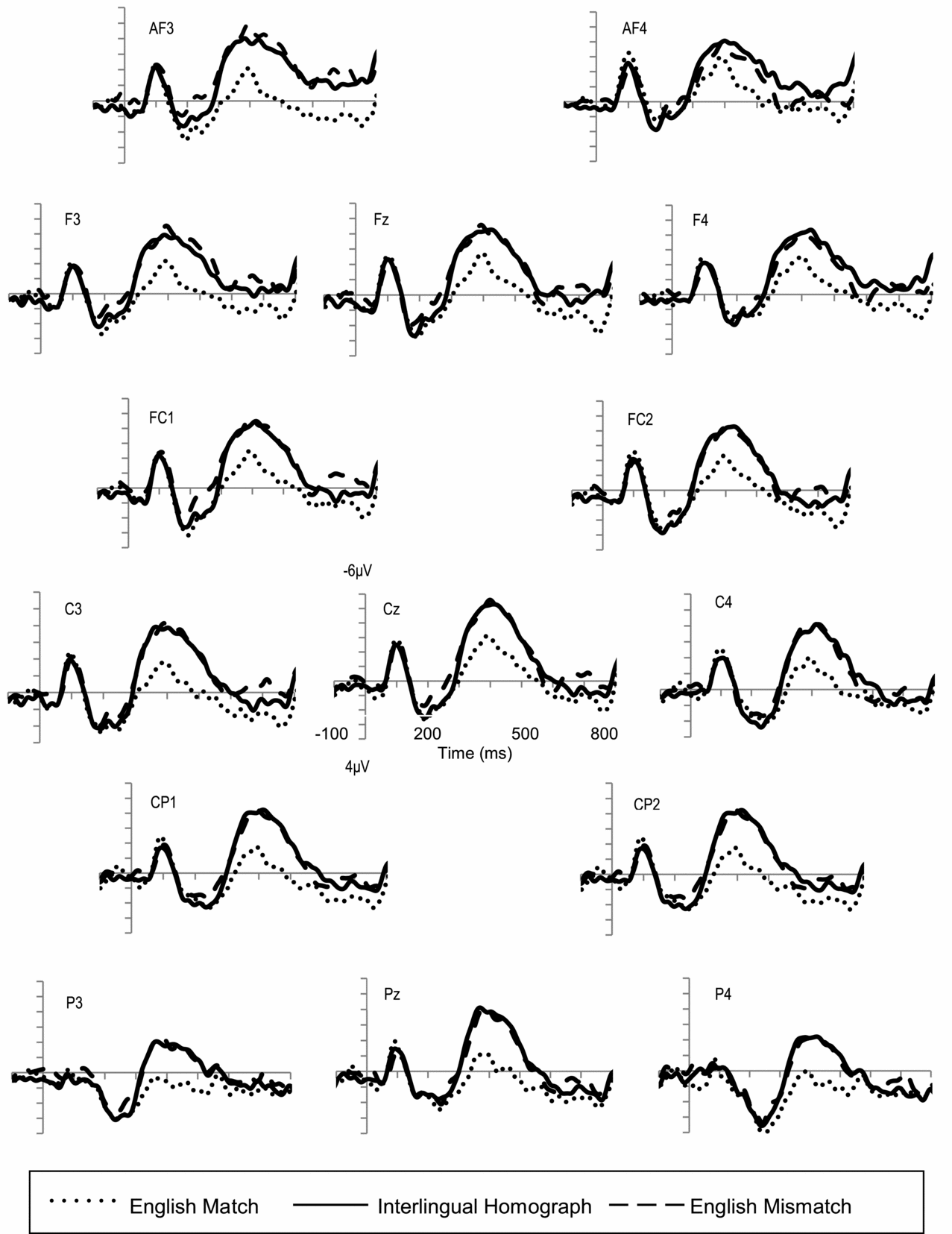
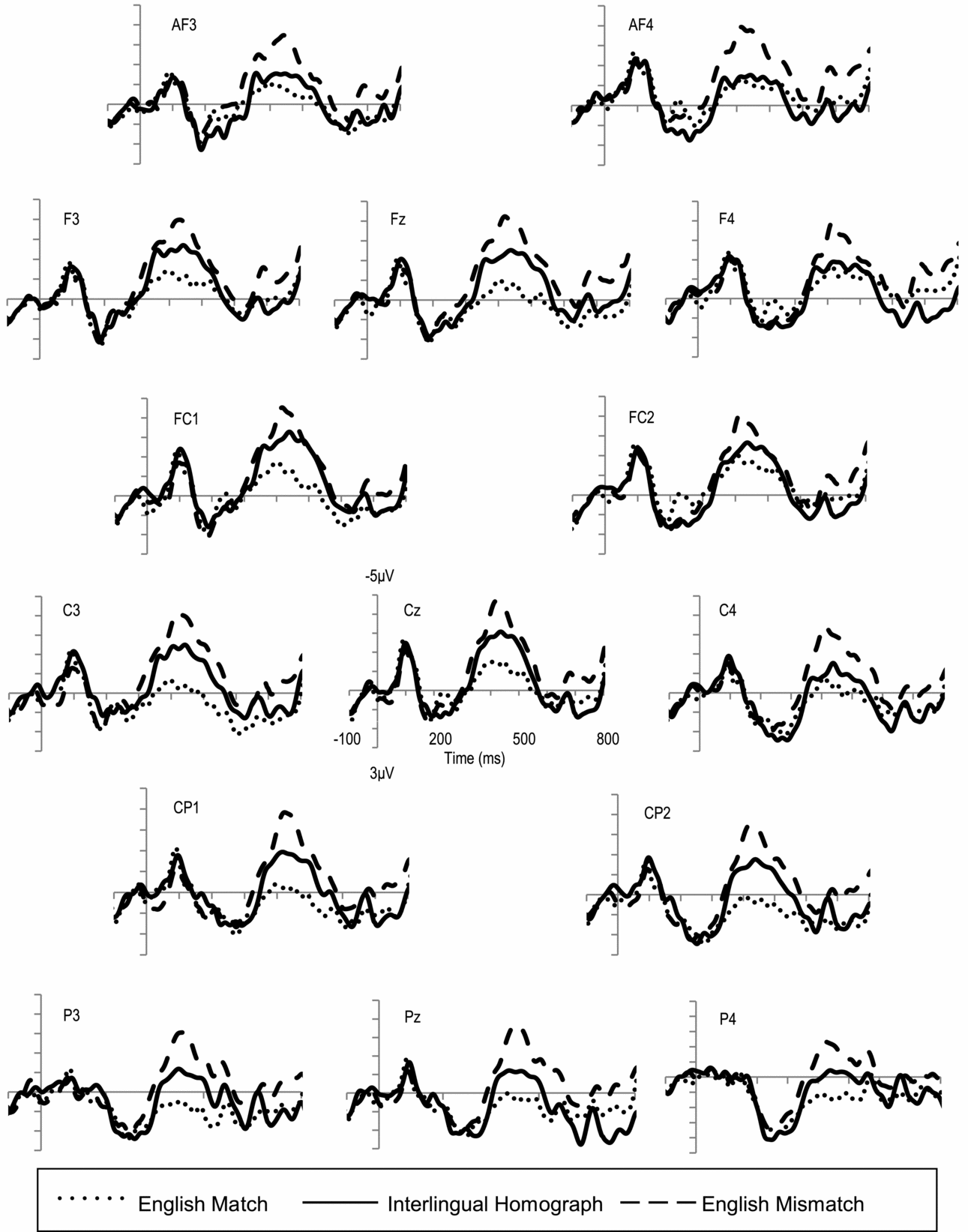
Separate ERP waveforms were calculated for critical words in each experimental condition for monolinguals and for bilinguals. Figure 2 shows the waveforms for the three types of words (English Match, Interlingual Homograph, English Mismatch) in the group of English monolinguals. Figure 3 shows the waveforms for the same words in the group of Russian–English bilinguals. Based on previous research (for a review see, Kutas & Federmeier, Reference Kutas and Federmeier2011), we expected that our experimental manipulation would lead to modulations in the N400 ERP component that is usually reported in 350–450 ms time-window. Therefore, the dependent measure used in our analyses was the mean amplitude of the epoch from 350 ms to 450 ms post-stimulus onset. Analyses of variance are first presented for each participant group separately, with Type of Word (English Match, Interlingual Homograph, English Mismatch), and Electrode (15 electrodes) as within factors. Subsequent analyses included both participant groups. All repeated measures for within factors used the Greenhouse-Geisser correction.
ERP waveforms of English monolingual readers from fifteen electrodes for Interlingual Homographs (solid line) compared to English Match (dotted line) and English Mismatch (dashed line) words.
ERP waveforms of Russian–English bilingual readers from fifteen electrodes for Interlingual Homographs (solid line) compared to English Match (dotted line) and English Mismatch (dashed line) words.
Monolingual group
In the monolingual group there was a significant main effect of Word Type, F(2,36) = 10.49, p = .001, η2 = .33. Planned comparisons on this main effect (collapsing across Electrodes) indicated that responses to English Match words (M = –0.140, SD = .05) differed significantly from the responses to English Mismatch words (M = –0.414, SD = .07), F(1,21) = 11.88, p = .002, η2 = .22, and from the responses to Interlingual Homographs (M = –0.420, SD = .08), F(1,21) = 14.43, p = .001, η2 = .41. As expected, there was no significant difference in the size of the amplitudes evoked by English Mismatch words and Interlingual Homographs, F < 1, because monolinguals had no knowledge of the Russian readings of the homographs. This pattern of results suggests that the English readings of the Interlingual Homographs were as implausible in the provided contexts as English Mismatch words. There was a main effect of Electrode, F(4.58; 96.22) = 8.98, p < .001, η2 = .30, with negativity overall being more central (e.g., Cz: M = –0.453, SD = .07) than parietal (e.g., P4: M = –0.128, SD = .06). The interaction between Word Type and Electrode was not significant (F < 1).
Bilingual group
The main effect of Word Type for this language group was also significant, F(2,36) = 10.78, p < .001, η2 = .34. As was observed for monolinguals, the amplitude of brain activity in response to English Mismatch words (M = –0.303, SD = .07) was more negative than in response to English Match words (M = –0.05, SD = .05), F(1,21) = 19.92, p < .001, η2 = .49. However, in contrast to monolinguals, bilinguals demonstrated significantly less negativity in response to Interlingual Homographs (M = –0.141, SD = .07) compared to English Mismatch words, F(1,21) = 14.06, p = .001, η2 = .40, and again unlike monolinguals, their responses to Interlingual Homographs did not differ significantly from those to English Match words, F(1,21) = 2.07, p = .17, η2 = .09. As in the monolingual group, there was a main effect of Electrode, F(4.23,88.84) = 11.12, p < .001, η2 = .35, and the overall electrophysiological activity had a more central (e.g., Cz: M = –0.263, SD = .06) than parietal distribution (e.g., P4: M = 0.027, SD = .06). No significant interaction of Electrode and Word Type was observed (F < 1).
Monolingual group vs. bilingual group
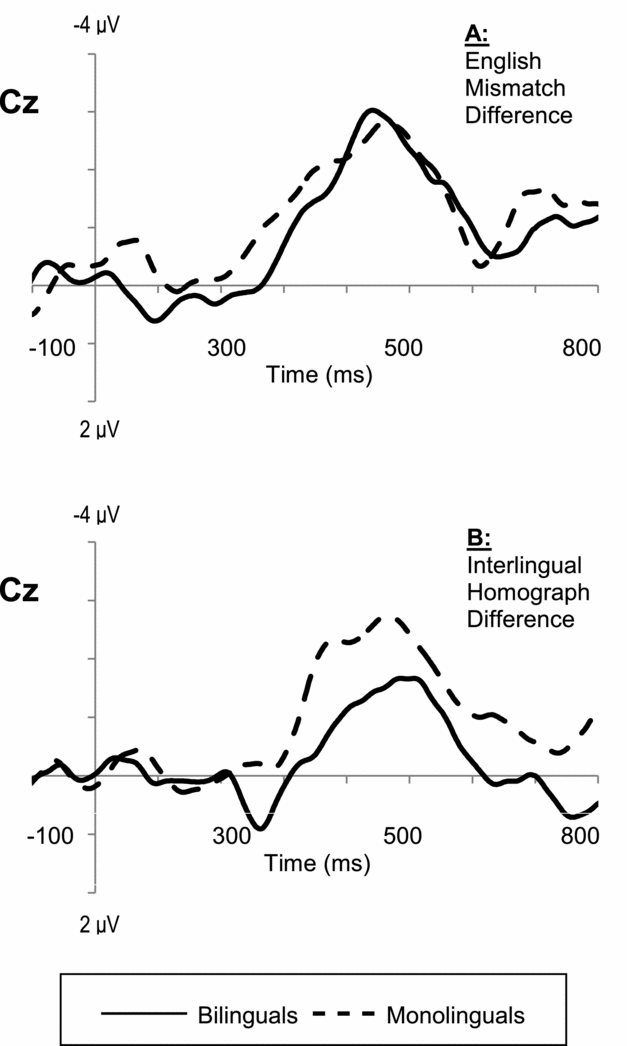
To eliminate any baseline differences in the neurophysiologic responses of our monolinguals and bilinguals, we subtracted mean amplitudes evoked by the participants in response to English Match words from their responses to English Mismatch words (English Mismatch Difference) and from their responses to Interlingual Homographs (Homograph Difference). Figure 4 shows grand average ERPs to English Mismatch words minus English Match words (see Figure 4a) and to Interlingual Homographs minus English Match words (see Figure 4b) at the Cz electrode for monolinguals vs. bilinguals. A repeated analysis of variance was conducted with Word Type (Homograph Difference vs. English Mismatch Difference), and Electrode (fifteen electrodes) as within factors and Group (Monolingual vs. Bilingual) as a between factor.
Grand average ERPs of bilinguals (solid line) vs. monolinguals (striped line) in response to English Mismatch words minus English Match words (A), and Interlingual Homographs minus English Match words (B).
There was a significant main effect of Word Type, F(1,42) = 5.19, p = .03, η2 = .11. The Interlingual Homograph Differences (M = –0.186, SD = .062) were significantly smaller than the English Mismatch Differences (M = –0.264, SD = .046). The main effect of Group was not significant (recall that amplitudes for English Match words were subtracted), F(1,42) = 1.31, p = .26, η2 = .03. However, the interaction between Group and Word Type was significant, F(1,42) = 5.92, p = .02, η2 = .13. Across-group comparisons for each Word Type were conducted. The post-hoc analyses showed that the English Mismatch Difference amplitudes were similar for monolinguals (M = –0.274, SD = .065) and bilinguals (M = –0.253, SD = .065), F(1,42) = 0.55, p = .82, η2 = .01. On the other hand, the Interlingual Homograph Difference amplitudes were significantly larger for monolinguals (M = –0.280, SD = .073) than for bilinguals (M = –0.092, SD = .073), F(1,42) = 4.10, p = .05, η2 = .09. The main effect of Electrode and all other interactions were not significant (F < 1).
An alternative way to compare the bilinguals and monolinguals is a direct analysis of the data with just the two most critical levels of Word Type (Interlingual Homograph, English Mismatch). In this analysis, there was a main effect of Word Type, F(1,42) = 5.19, p = .03, η2 = .11, a main effect of Group, F(1,42) = 4.26, p = .05, η2 = .09, and an interaction of Word Type and Group, F(1,42) = 5.92, p = .02, η2 = .12. The main effect of Word Type and the interaction are the same as in the analysis above, but in this analysis the main effect of Group becomes significant because baseline differences were not subtracted out.
Discussion
The main question addressed in this study is whether the combination of a language-specific script and preceding language context can make a bilingual's word recognition more language-selective. Specifically, we asked if Russian–English bilinguals would activate Russian semantic representations when reading English sentences with interlingual homographs embedded in them. The issue of language selectivity was assessed by comparing the ERP responses of bilinguals on interlingual homographs that only matched the English sentential context with the Russian meaning of the homographs to the ERP responses on English-only words that either matched or mismatched the sentential context. The electrophysiological performance of English monolinguals on the same set of critical items was also investigated. The rationale was that if the presence of the Roman script and English sentential context can restrict the lexical activation to the target language only, then Russian–English bilinguals should perform in a way similar to English monolinguals, thus providing evidence for the language-selective account.
In contrast, the ERP findings provided strong support for the language-nonselective account. English monolinguals and Russian–English bilinguals demonstrated different patterns of electrophysiological responses to interlingual homographs. Monolinguals faced difficulty in integrating the interlingual homographs into the preceding context as signaled by the increased N400 to this type of word compared to semantically plausible English words. In fact, the ERP data suggests that they treated the interlingual homographs the same as the English control words that were semantically implausible in the given contexts, which was expected because the monolinguals had no knowledge of the Russian meanings of the homographs. Of particular interest was the finding that Russian–English bilinguals had less trouble interpreting interlingual homographs compared to monolinguals. The absence of a significant difference in the amplitude of the N400 by bilinguals in response to interlingual homographs and semantically plausible English words signifies that for this group of participants, homographs were about as easy to integrate into the provided contexts as the semantically plausible words. Moreover, unlike monolinguals, bilingual participants produced a significantly smaller N400 to homographs than to semantically implausible English control words. As the successful integration of interlingual homographs into the context is possible only if the Russian reading of the homograph is activated, this pattern of ERP results suggests that Russian–English bilinguals were indeed activating the Russian semantic representations of the homographs despite the fact that the orthographic cues in the script and the language context were English. Our results indicate, for the first time in the literature, that even the combination of such strong language cues as language-specific orthography and language context is not sufficient enough to restrict activation to only one language of a bilingual. The findings are consistent with the language-nonselective account of bilingual word recognition, as in the Bilingual Interactive Activation (BIA+) model (Dijkstra & Van Heuven, Reference Dijkstra and Van Heuven2002), and provide an extension to numerous behavioral and neuroimaging studies showing that bilinguals are not able to suppress activation of words of the irrelevant language (for reviews see Dijkstra, Reference Dijkstra, Kroll and de Groot2005; Schwartz & Van Hell, Reference Schwartz, Van Hell and Adelman2012). Because our study used the interlingual homograph effect as a marker of cross-language activation rather than the cognate effect, it provides particularly compelling support for the language-nonselective view.
Relation to previous studies
Our findings are consistent with several previous studies that have tested bilinguals whose languages do not share an alphabet and have used single word or priming paradigms (e.g., Gollan et al., Reference Gollan, Forster and Frost1997; Kim & Davis, Reference Kim and Davis2003; Nakayama et al., Reference Nakayama, Sears, Hino and Lupker2012; Zhou et al., Reference Zhou, Chen, Yang and Dunlap2010). In particular, our stimuli are most similar to those of Lukatela et al. (Reference Lukatela, Savic, Gligorijevic, Ognjenovic and Turvey1978). Their Serbian participants had longer decision latencies on words that could be read in either the Roman or Cyrillic alphabets than on words that could be read only in Roman. Their ambiguous words had different pronunciations and different meanings. In a lexical decision task, competition between either or both could have been responsible for the longer decision latencies. Our study has shown that both meanings of such words are activated, even in single language sentential contexts. The results are also consistent with Kaushanskaya and Marian's (Reference Kaushanskaya and Marian2007) picture-word interference study in which they found that Russian–English bilinguals attended to English nonwords that could be Russian legal words or to English nonwords that could map on a phonological representation of Russian words more often than to English control nonwords. Their finding suggests that their participants activated Russian orthographic and phonological representations from the English nonwords.
More specifically, this experiment extends previous studies that have found an interlingual homograph effect in sentence contexts with language pairs that share an alphabet and bilinguals who are reading in their less proficient language (Altarriba et al., Reference Altarriba, Carlo and Kroll1992, as cited in Altarriba & Gianico, Reference Altarriba and Gianico2003; Baken et al., Reference Baten, Hofman and Loeys2011; Elston-Güttler et al., Reference Elston-Güttler, Gunter and Kotz2005; Libben & Titone, Reference Libben and Titone2009; Schwartz & Kroll, Reference Schwartz and Kroll2006). The current study shows that such cross-language activation occurs even when a pair of languages shares only a few letters. In Elston-Güttler et al.'s study, there was an effect of sentence final word type (English–German homograph, e.g., gift, vs. English-only control, e.g., shell) on target (in this case, poison) N400 responses only when participants first viewed a German film prior to reading the English sentences. Here, no such priming of Russian was needed to observe an effect in the N400. A possible reason that the interlingual homograph effect in the N400 was so robust in our study is that participants had to try to integrate the target word into the preceding context because it appeared within the sentence, whereas in Elston-Güttler et al.'s study, target words appeared after the end of the sentence and did not have to be integrated with the context. Furthermore, their targets appeared twice each, and the repetition may have been responsible for the diminished effect of word type in the second block of trials.
Altarriba et al. (Reference Altarriba, Carlo and Kroll1992, as cited in Altarriba & Gianico, Reference Altarriba and Gianico2003) also used sentences in which the context biased the meaning of English–Spanish homographs in the nontarget language (e.g., We knew the play had reached its FIN/RAM when we saw the curtain fall). They found that the interlingual homographs were more difficult to name than matched control words. In our study, the interlingual homographs showed a reduced N400 compared to control words, suggesting that they were easier to integrate into the sentence than control words. Altarriba et al. also found that interlingual homographs were harder to name than control words when the sentence context biased the meaning of the homograph in the target language (e.g., We knew it was a shark because we saw its FIN/RAM as it approached the boat). Their findings of an inhibitory interlingual homograph effect on naming performance as well as no impact of the type of sentence context suggests that the homograph effect in their study arose from conflicting phonological representations of the homograph rather than from the activation of two meanings. Their findings do support the language-nonselective view, but our findings add that such activation reaches semantic representations, not just phonological representations. Altarriba et al. also found an interlingual homograph effect when Spanish–English participants read Spanish sentences in which the context biased the English meaning of the homograph. Such a finding suggests that English–Russian bilinguals might show an interlingual homograph effect with our stimuli. Cross-language homograph effects on first language reading are typically more difficult to find, and have not been observed when the interlingual homograph is congruent with the context (Altarriba et al., Reference Altarriba, Carlo and Kroll1992, as cited in Altarriba & Gianico, Reference Altarriba and Gianico2003; Schwartz & Kroll, Reference Schwartz and Kroll2006, Experiment 1; Titone et al., Reference Titone, Libben, Mercier, Whitford and Pivneva2011).
Libben and Titone (Reference Libben and Titone2009) observed that interlingual homographs had longer fixation durations than matched control words when reading sentences for meaning. Their inhibitory rather than facilitatory interlingual homograph effect probably arose because in their study, the meaning of the homograph in the nontarget language was inconsistent with the context, whereas in our study it was consistent with the context. The two language pairs in their study shared an alphabet; our study extends their finding to a language pair that shares only a few letters. Their manipulation was more subtle than ours because they looked for evidence that the meaning of the homograph in the nontarget language was activated when the sentence context was congruent with the target language meaning, whereas in our study, the sentence context was congruent with the meaning of the homograph in the nontarget language. The context in our study likely heightened the activation of the nontarget meaning. We used the paradigm that we did because it was unclear at the outset whether any sign of activation of the nontarget Russian meaning of the homograph could be observed when the orthography of the sentence clearly signaled that English was the relevant language.
A future eye tracking or ERP experiment could investigate whether the Russian meanings of homographs are activated when the sentence context is congruent with the English meaning. The activation of the Russian meanings of homographs in a context biasing against it might be reflected in longer fixation durations or a more negative N400 response than matched control words. Such a result would be most likely to be observed when the Russian frequency of the homograph is higher than the English frequency, as was the case for the French reading of the homographs used by Libben and Titone (Reference Libben and Titone2009). However, only four of the Russian–English homographs that we were able to find had a higher frequency in Russian than in English. Therefore, we think that there is a fairly low likelihood of observing an interlingual homograph effect when English sentences are congruent with the English, not Russian meaning of the homograph.
Theoretical accounts
The pattern of results observed in the current study can be explained by the Bilingual Re-Ordered Access Model (Arêas da Luz Fontes & Schwartz, Reference Arêas da Luz Fontes and Schwartz2010, Reference Arêas da Luz Fontes and Schwartz2011). According to this model, the speed of activation of meanings of interlingual homographs presented without contextual support will depend on their frequency, with dominant meanings being activated first. Biasing context, in its turn, may change the relative order of activation, by providing a boost to a subordinate meaning. As predicted by the model, we found that contextually biased Russian meanings of homographs were activated despite the fact that they were less frequent than their English mates.
The BIA+ model of bilingual word recognition can also account for our findings (Dijkstra & Van Heuven, Reference Dijkstra and Van Heuven2002). The model assumes that orthographic and phonological representations of both languages of a bilingual are stored in common pools of nodes representing sublexical orthographic and phonological information, as well as pools of lexical orthographic and phonological nodes. In the case of languages with partially overlapping orthographic and phonological features (e.g., English and Russian), some sublexical nodes will represent shared features and some will represent features that are unique to each language. The lexical nodes are connected to one of two language nodes, as well as to nodes representing semantic information. There are feedback connections from the semantic nodes to the lexical nodes, but no feedback connections from the language nodes to the lexical nodes. This means that the prior semantic context of a sentence can influence the activation level of lexical nodes, but the language of the sentence cannot.
The BIA+ would give the following account of our findings. As participants read the context words in the sentence, semantic nodes relevant to the context would have fed activation back to their corresponding lexical nodes in both languages. When the target words were presented, all sublexical orthographic nodes consistent with the visual information would have been activated, and these in turn would have sent activation to any lexical orthographic nodes that contained the same activated letter in the same position. Words sharing more letters in common with the presented word would have become more highly activated. In the case of interlingual homographs, bottom–up activation would have highly activated both the English and the Russian lexical nodes, but because the Russian lexical node would have also received some top–down activation from semantic nodes, it would have been particularly highly activated. The Russian lexical node would, therefore, have been likely to survive competition from the numerous activated English lexical nodes, as well as to send activation on to its specific semantic representation. That activated semantic representation would have fit in the sentence and carried no information about the language of the lexical item that activated it, and so the bilingual would register little surprise for the interlingual homograph.
Conclusion
In summary, the results of the current study indicate that the presence of a language specific writing system and sentence context do not constrain activation to target language representations. English letters that are the same as Russian letters appear to activate Russian words that contain those letters even in the presence of strong local and global language cues. Our findings therefore provide particularly compelling evidence that activation in bilingual word recognition is not selective for language.