Introduction
With an ageing population and de-institutionalisation of psychiatric hospitals, nursing homes have become a significant resource for continuing care of the elderly. In Ireland, 5.3% of the population of people aged 65 years and older live in residential care settings (CSO, 2017).
Institutionalisation of older people with dementia is often related to behavioural symptoms (Testad et al., Reference Testad, Aasland and Aarsland2007). In Reference Chou, Kaas and Richie1996, Chou et al. defined aggressive behaviour, which may be verbal or physical, as behaviour that harms or threatens another individual. Disturbed or aggressive behaviour is one of the most challenging issues facing staff working with older patients in long-term care facilities (Whall et al., Reference Whall, Gillis, Yankou, Booth and Beel-Bates1992; Voyer et al., Reference Voyer, Verreault, Azizah, Desrosiers, Champoux and Bédard2005; Cubit et al., Reference Cubit, Farrell, Robinson and Myhill2007)
While there is a lack of a consensus definition for VDB (Dwyer & Byrne, Reference Dwyer and Byrne2000; Von Gunten et al., Reference von Gunten, Alnawaqil, Abderhalden, Needham and Schupbach2008), VDB is still the most widely accepted term in the literature referring to vocal or verbal behaviours that are disruptive, repetitive, or inappropriate to the situations in which they occur (Cohen-Mansfield & Werner, Reference Cohen-Mansfield and Werner1997). These behaviours may consist of repetitive and persistent words or phrases and include swearing, bizarre noises, and grunting (Nagaratnam et al., Reference Nagaratnam, Patel and Whelan2003). Screaming may be the most common presentation (Locke & Mudford, Reference Locke and Mudford2010).
VDB can also be grouped into aggressive and non-aggressive behaviours. Verbal aggressive behaviours include screaming, making verbal sexual advances and cursing or verbal aggression. Verbal non-aggressive behaviours include uttering repetitive sentences and questions, making strange noises, complaining, negativism, and constant unwarranted requests (Cohen-Mansfield et al., Reference Cohen-Mansfield, Marx and Rosenthal1989; Beck et al., Reference Beck, Richards, Lambert, Doan, Landes, Whall, Algase, Kolanowski and Feldman2011).
VDB is common among elderly people with dementia but is not exclusive to this patient group. The majority of disruptive vocalisations in older adults are associated with dementia of Alzheimer’s or vascular origin (Cohen-Mansfield et al., Reference Cohen-Mansfield, Werner and Marx1990; Cariaga et al., Reference Cariaga, Burgio, Flynn and Martin1991) but also occur in other conditions such as intellectual disability (Matson et al., Reference Matson, Sipes, Horovitz, Worley, Shoemaker and Kozlowski2011), psychotic depression, personality disorders (Sloane et al., Reference Sloane, Davidson, Buckwalter, Lindsey, Ayers, Lenker and Burgio1997), and autistic spectrum disorders (Lanovaz et al., Reference Lanovaz, Sladeczek and Rapp2011). Repetitive vocalisation has also been reported in acquired brain injury, frontal lobe impairments (Sloane et al., Reference Sloane, Davidson, Buckwalter, Lindsey, Ayers, Lenker and Burgio1997), and patients with epilepsy (Enatsu et al., Reference Enatsu, Hantus, Gonzalez-Martinez and So2011).
Estimates of the prevalence of VDB in nursing home residents vary between 10% and 40% (Cohen-Mansfield et al., Reference Cohen-Mansfield, Werner and Marx1990; Cariaga et al., Reference Cariaga, Burgio, Flynn and Martin1991; Sloane et al., Reference Sloane, Davidson, Buckwalter, Lindsey, Ayers, Lenker and Burgio1997; Voyer et al., Reference Voyer, Verreault, Azizah, Desrosiers, Champoux and Bédard2005; Von Gunten et al., Reference von Gunten, Alnawaqil, Abderhalden, Needham and Schupbach2008). Rovner et al. (Reference Rovner, Kafonek, Filipp, Lucas and Folstein1986) found ‘noisiness’ and ‘verbal aggression’ in 24% and 26% of nursing home residents respectively. Cohen-Mansfield studied 66 nursing home residents and found that 14% presented with strange noises and screams, 52% with verbal aggression or cursing, and 62% with repetitive sentences, constant unwarranted requests for attention or asking questions (Cohen-Mansfield, Reference Cohen-Mansfield1986).
Some other studies including those of Cariaga et al. (Reference Cariaga, Burgio, Flynn and Martin1991) and Friedman et al. (Reference Friedman, Gryfe, Tal and Freedman1992) have found that a substantial minority (11%) of nursing home residents exhibit VDB. The lack of a consensus definition of VDB may account for the variability in prevalence. To date, there have been no studies of prevalence of VDB in nursing home residents in Ireland although clinicians who visit patients in these settings readily attest to the frequency of the problem.
Despite a lack of consensus definition of VDB, there is a broad consensus that VDB is common and challenging to manage. There is, however, a paucity of data guiding appropriate intervention (Cohen-Mansfield & Werner, Reference Cohen-Mansfield and Werner1997; Von Gunten et al., Reference von Gunten, Alnawaqil, Abderhalden, Needham and Schupbach2008). Contributory factors are diverse and invariably suggest that an array of different interventions need to be tailored to the individual’s needs (Von Gunten et al., Reference von Gunten, Alnawaqil, Abderhalden, Needham and Schupbach2008).
Adverse consequences of VDB include increased anxiety and overwhelming distress in the resident as well as other persons in their environment (Burgio et al., Reference Burgio, Scilley, Hardin, Hsu and Yancey1996). This can lead to social isolation (Draper et al., Reference Draper, Snowdon, Meares and Turner2000) and over-use of medication (Cariaga et al., Reference Cariaga, Burgio, Flynn and Martin1991).
We aimed to study VDB in nursing home residents in Ireland and we hypothesised that VDB is a result of complex interaction between organic and environmental factors, a better understanding of which might guide interventions.
Methods
Setting
The target population for this study were the residents of 35 nursing homes in south county Dublin, Ireland. All 35 nursing homes were contacted and provided with information about the research. Eight nursing homes did not respond to invitation to participate in the study and eight chose not to participate, of which one cited data protection concerns. As a result, 19 nursing homes took part in the study. At each nursing home, managers and nursing staff provided a list of residents who met study inclusion criteria.
Recruitment
Inclusion criteria in this study were that the residents must be at least 65 years old and exhibit VDB at least once per week to an extent that required active consideration or intervention (Chou et al., Reference Chou, Kaas and Richie1996). Examples of VDB include persistent moaning, abusive language, screams, and repetitive verbalisations. VDB were reviewed in detail with each interviewee (nursing staff). Following collection of data on residents who met study inclusion criteria, nursing home staff were asked to randomly select residents who were at least 65 years of age and with similar demographics but who did not exhibit VDB (controls). Overall, we included 66 nursing home residents in the study, of whom 35 exhibited VDB and 31 were controls.
Assessments
Staff questionnaire
A structured questionnaire was developed to gather information from staff on VDB and other problematic behaviours. This was administered to the nurses who were most familiar with the residents in a structured interview process with the first author. Twenty-three nurses were interviewed, all of whom had training in behavioural and psychological symptoms of dementia. Interviews took 15–30 minutes each and included information about the typology of VDB, frequency and duration of episodes, and potential precipitating or antecedent factors. Information on diagnoses, medications, specialists involved in care, and medication history were obtained from medical records.
From both interviews and medical records, information was gathered on pharmacological and non-pharmacological management of VDB. The perceived efficacy of management approaches was evaluated by nursing staff using a three-point Likert scale: not effective, sometimes effective, and often effective (Cariaga et al., Reference Cariaga, Burgio, Flynn and Martin1991).
Assessment of agitation
Nursing staff were asked to complete Cohen-Mansfield Agitation Inventory (CMAI) (Cohen-Mansfield et al., Reference Cohen-Mansfield, Marx and Rosenthal1989). This inventory lists common physical and verbal aggressive and non-aggressive behaviours. Nurses were asked to rate each behaviour based on the average frequency of occurrence over the preceding 2 weeks, with frequencies ranging from ‘never’ to ‘several times an hour’.
Assessment of cognitive function
Results of Mini-Mental State Examinations (MMSE) completed by occupational therapists and trained nurses in the 6 months preceding each interview were collected.
Assessment of activities of daily living
Barthel index of Activities of Daily Living was completed with nursing staff during the interview (Dwyer & Byrne, Reference Dwyer and Byrne2000; Collin et al., Reference Collin, Wade, Davies and Horne1988). This is an assessment of mobility and self-care activities of daily living suitable for use in older people who are residents in long-stay care settings. Nurses were asked to rate each residents’ ability to self-care in relation to feeding, toilet use, bowels, bladder, grooming, toilet use, mobility, dressing, and bathing. Scoring is based on the sum of the resident’s score on each item with total scores ranging from 0 to 20. Higher scores reflect greater independence with self-care.
Statistical analysis
Data were stored, described, and analysed using IBM SPSS Statistics 23. For bi-variable analysis, we used the Student t-test and Chi square test, as appropriate. For multi-variable analysis, we generated a binary regression model with whether or not the resident was vocally disruptive (yes/no) as the dependent variable. Only variables significantly associated with being vocally disruptive on bi-variable analysis were included as independent variables in the multi-variable model (i.e. a diagnosis of dementia, lower MMSE scores, lower Barthel Index scores, and higher Cohen-Mansfield scores for physical agitation).
Ethics
Prior to commencement, this study was ethically approved by University College Dublin (UCD) Office of Research Ethics.
Results
Sample characteristics
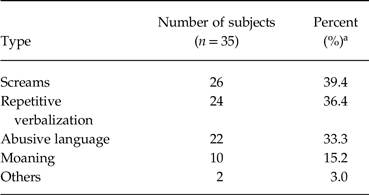
Across the 19 participating nursing homes, 35 residents (8.2%) were identified as displaying VDB. Screaming was the most commonly reported VDB (n = 26; 39.4%), followed by repetitive verbalisation (n = 24; 36.4%), abusive language (n = 22; 33.3%), moaning (n = 10; 15.2%), and others (n = 2; 3.0%), (Table 1). In 60% (n = 21) of vocally disruptive residents, the behaviour occurred daily; for the remainder (40%; n = 14) it was less frequent. Episodes of VDB typically lasted for fewer than 30 minutes in three quarters of vocally disruptive residents (77.1%; n = 27) but lasted for longer in over a fifth (n = 8).
Typology of VDB and their relative frequencies

a More than one category could be scored. Thus, total percentage greater than 100.
Vocally disruptive residents did not differ from those who were not vocally disruptive in terms of gender (56.9% and 40.0% female and male respectively; Chi square 1.323; p = 0.378), mean age (85.9 years, standard deviation [s.d.] 9.0 and 84.4, s.d. 7.6; t = 0.761; p = 0.449) or marital status (54.3% and 54.8% widowed respectively; Chi square 3.825; p = 0.281).
Almost one-third of all residents (n = 20; 30.3%) were diagnosed with a medical disorder only; 1.5% (n = 1) with a psychiatric disorder only; 22.7% (n = 15) with medical and surgical disorders; 22.7% (n = 15) with medical and psychiatric disorders; 19.7% (n = 13) with medical, surgical and psychiatric disorders; and 3.0% (n = 2) with none of these disorders; these proportions did not differ between residents who were and were not vocally disruptive (Chi square 7.997; p = 0.156). Almost half of residents (43.9%; n = 29) had an affective disorder but there was no significant difference between the two groups with regard to recorded mental disorders.
On review of medical records, dementia was recorded more commonly among vocally disruptive residents compared to non-vocally disruptive residents (94.3% and 67.7% respectively; Chi square 7.786; p = 0.005). Of the residents with a documented diagnosis of dementia (n = 54), almost one-third (31.5%; n = 17) had vascular dementia; 24.1% (n = 13) had Alzheimer’s dementia; 7.4% (n = 4) had mixed vascular and Alzheimer’s dementia; 3.7% (n = 2) had other dementias; and 33.3% (n = 18) had dementia without a specific sub-type diagnosed; these proportions did not differ between residents who were and were not vocally disruptive (Chi square 6.016; p = 0.198).
Almost one-quarter (24.2%; n = 16) of residents had hearing impairment; 45.5% (n = 30) had visual impairment; and 24.4% (n = 16) had speech impairment; these proportions did not differ between residents who were and were not vocally disruptive (Chi squares 2.095, 0.894, and 0.088, respectively; p > 0.05 in all cases).
Almost half of residents (n = 31; 47.0%) had pain. One-third (n = 22; 33.3%) were immobile; 40.9% (n = 27) were mobile with assistance; and 25.8% (n = 17) were independently mobile; these proportions did not differ between residents who were and were not vocally disruptive (Chi squares 0.047 and 1.793 respectively; p > 0.05 in all cases).
Cognitive and personal function
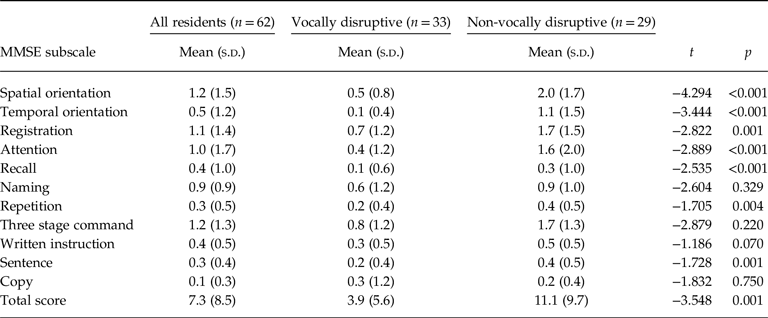
The mean MMSE score for vocally disruptive residents (3.9, s.d. 5.6) was significantly lower than that for non-vocally disruptive residents (11.1, s.d. 9.7; t = −3.548; p = 0.001), indicating lower cognitive function in vocally disruptive residents. Vocally disruptive residents scored significantly lower than non-vocally disruptive residents on all MMSE subscales except for naming, three-stage command, following written instruction, and copying intercepting pentagons (Table 2).
MMSE subscale scores

The mean Barthel Index score for vocally disruptive residents (5.9, s.d. 4.4) was significantly lower than for non-vocally disruptive residents (9.0, s.d. 6.4; t = −2.267, p = 0.028), indicating lower physical and self-maintenance function in vocally disruptive residents.
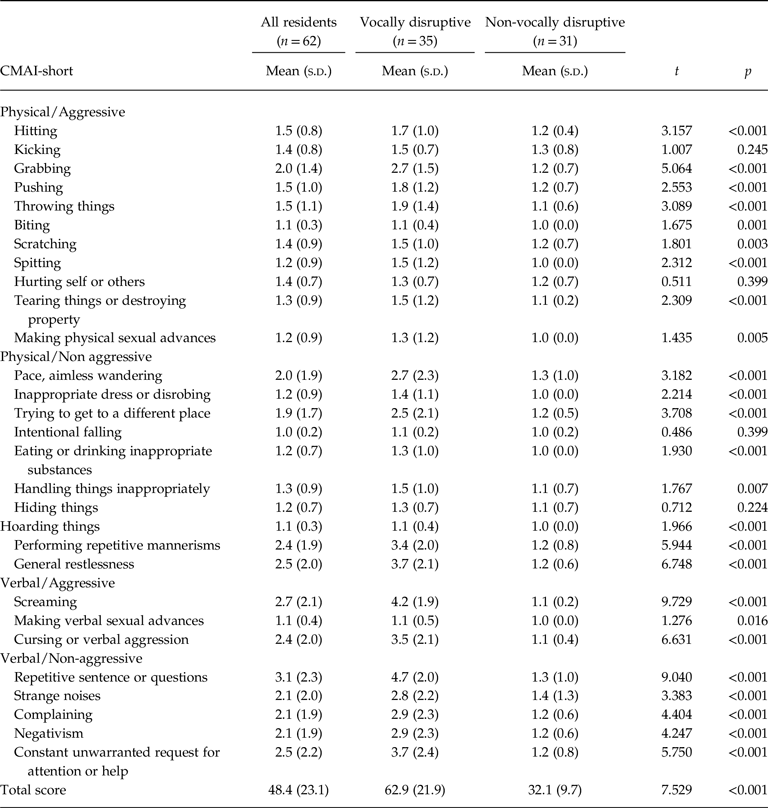
The mean CMAI score was significantly higher in vocally disruptive residents (62.9, s.d. 21.9) than in non-vocally disruptive residents (32.1, s.d. 9.7; t = 7.529, p > 0.001), indicating greater behavioural disturbance among vocally disruptive residents (Table 3). Vocally disruptive residents scored higher than non-vocally disruptive residents on all verbal and physical items on CMAI, and on total score for physical agitation (mean total scores for physical agitation items: 38.2, s.d. 12.5 and 23.6, s.d. 6.5, respectively; t = 5.960, p < 0.001).
Cohen-Mansfield agitation inventory scores

Management of vocally disruptive behaviour
Majorities of vocally disruptive (57.1%; n = 20/35) and non-vocally disruptive residents (54.8%; n = 17/31) were resident in nursing homes with more than 50 residents; these proportions did not differ between the two groups (Chi square 0.068, p = 0.995). All staff members interviewed had completed training in management of behavioural and psychological symptoms of dementia (100.0%, n = 66).
Expressing a need was reported by staff as the most common precipitant of VDB (n = 23; 65.7%) followed by another patient being noisy (n = 17; 48.6%), bathing (n = 15; 42.9%), being transferred or moved (n = 13; 37.1%), before meals (n = 12; 34.3%), during meals (n = 12; 34.3%), before bathing (n = 11; 31.4%), upon wakening (n = 10; 28.6%), before bedtime (n = 10; 28.6%), when others are approaching (n = 10; 28.6%), after meals (n = 9; 25.7%), after bathing (n = 8; 22.9%), before medication (n = 6; 17.1%), and after medication (n = 3; 8.6%). In 11 (31.4%), there was no discernible pattern reported.
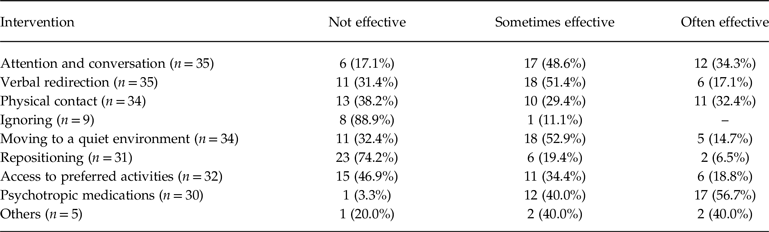
The interventions most commonly used to manage VDB as reported by nursing staff included one-to-one attention and engaging the resident in conversation (n = 35; 100%), redirection of behaviour by talking (n = 35; 100%), moving to a quiet environment (n = 34; 97.1%), physical contact like holding the resident’s hands (n = 34; 97.1%), access to preferred activities (n = 32; 91.4%), re-positioning (n = 31; 88.6%), psychotropic medication (n = 30; 85.7%), and others (n = 5; 14.3%) (Table 4). Among these interventions, psychotropic medication was the most consistently useful for individual episodes, with nurses reporting it to be ‘sometimes effective’ in 40% of residents and ‘often effective’ in 56.7%. Attention, conversation and verbal redirection were the next most effective interventions reported.
Intervention utilised for vocally disruptive behaviours and perceived efficacy as reported by staff a

a More than one category could be scored. Thus total percentage greater than 100.
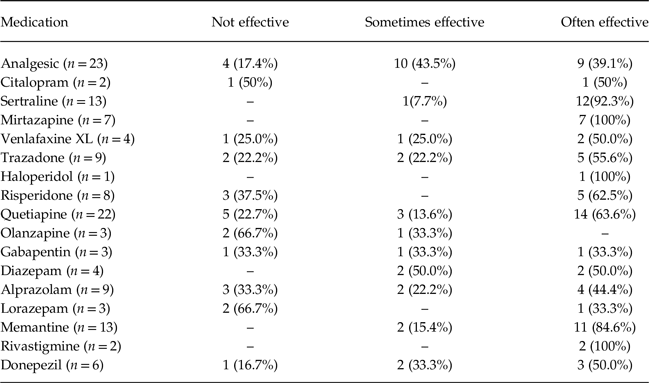
A range of medications were used for the management of VDB including, most commonly, analgesia (n = 23, 65.7%), quetiapine (n = 22, 62.9%), memantine (n = 13, 37.1%), and sertraline (n = 13, 37.1%) (Table 5). Nurses reported that analgesia was either ‘sometimes’ or ‘often effective’ in 82.6% of residents; quetiapine in 77.2% for individual episodes of VDB. Furthermore, the perception among nurses was that analgesics, quetiapine, sertraline, mirtazapine, and memantine were most effective overall but not necessarily for managing individual episodes of VDB.
Reported effectiveness of medication used for the management of vocally disruptive behaviours in Irish nursing homes a

a More than one category could be scored. Thus total percentage greater than 100.
Almost two-third of residents with VDB (n = 23, 65.7%) had been referred to psychiatry of old age services for further assessment or management; those referred were younger than those who were not (mean ages 83.3 years, s.d. 8.8 and 90.4, s.d. 6.9, respectively; t = 2.720, p = 0.010) but the two groups did not differ in terms of gender, presence or absence of dementia, Barthel Index scores, MMSE scores, or Cohen-Mansfield Agitation scores (p > 0.05 in all cases).
Multi-variable analysis of independent correlates of vocally disruptive behaviour
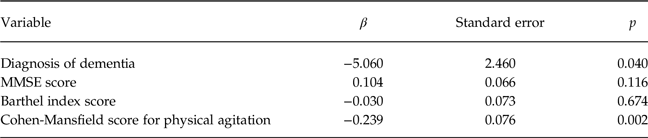
For multi-variable analysis, we generated a binary regression model with whether or not the resident was vocally disruptive (yes/no) as the dependent variable. Variables significantly associated with VDB on bi-variable analysis were included as independent variables in the multi-variable model; that is, having a diagnosis of dementia, lower MMSE scores, lower Barthel Index scores, and higher Cohen-Mansfield scores for physical agitation. Of these, only a higher Cohen-Mansfield score for physical agitation and a diagnosis of dementia were significantly and independently associated with vocally VDB in the multi-variable model (Table 6). Together, these two variables accounted for 65.6% of the variability in VDB between residents.
Multi-variable logistic regression analysis of correlates of vocally disruptive behaviour in nursing home residents in Ireland

Binary regression model with whether or not the resident was vocally disruptive (yes/no) as the dependent variable; r 2 = 65.6%; p < 0.001.
Discussion
This is the first study in Ireland to look at the prevalence and risk factors for VDB in nursing home residents. We found a lower prevalence of VDB in our study (8.2%) than equivalent studies elsewhere 10–40% (Rosin, Reference Rosin1977; Cariaga et al., Reference Cariaga, Burgio, Flynn and Martin1991; Whall et al.,Reference Whall, Gillis, Yankou, Booth and Beel-Bates1992; Sloane et al., Reference Sloane, Mitchell, Preisser, Phillips, Commander and Burker1998). Several factors may have contributed to this disparity. The definition of VDB used in our study is similar to that used by Cariaga et al. (Reference Cariaga, Burgio, Flynn and Martin1991) but it required the VDB to be of sufficient severity to be included in the person’s care plan. While this is a practical and clinically orientated definition, it might have excluded VDB that was less disruptive and or repetitive (Von Gunten et al., Reference von Gunten, Alnawaqil, Abderhalden, Needham and Schupbach2008). Studies with less restrictive definitions reported higher prevalence (Cohen-Mansfield, Reference Cohen-Mansfield1986).
Another potential reason for the apparently low prevalence of VDB in our study is that more residents in our study were receiving analgesia (66%) compared to those in a similar previous study (9%) (Cariaga et al., Reference Cariaga, Burgio, Flynn and Martin1991). The use of these medications may modify the severity and frequency of vocalisations (Testad et al., Reference Testad, Aasland and Aarsland2007).
In addition, the majority of nursing homes in our study were smaller units that offered single-room accommodation to most residents and emphasised individualised care plans. The importance of the physical environment and carer training is supported by Sloane et al. (Reference Sloane, Mitchell, Preisser, Phillips, Commander and Burker1998) and Testad et al. (Reference Testad, Aasland and Aarsland2007) who found that quality of care by staff and the physical environment had close relationships with the behaviour of residents with dementia, as smaller units provided opportunity to manage VDB and possibly other forms of behavioural disturbance more effectively. It seems reasonable to suggest that patients with VDB who have single room accommodation can be managed more easily and that triggering of VDB in other residents may also be reduced.
Our study found that residents in nursing homes who exhibit VDB are more cognitively impaired and have higher rates of diagnosed dementia than those without VDB. Our study therefore supports previous findings of an inverse relationship between cognitive function and VDB (Beck et al., Reference Beck, Frank, Chumbler, O’Sullivan, Vogelpohl, Rasin, Walls and Baldwin1998; Draper et al., Reference Draper, Snowdon, Meares and Turner2000; Dwyer & Byrne, Reference Dwyer and Byrne2000; Menon et al., Reference Menon, Gruber-Baldini, Hebel, Kaup, Loreck, Zimmerman, Burton, German and Magaziner2001; Matteau et al., Reference Matteau, Landreville, Laplante and Laplante2003; Vance et al., Reference Vance, Burgio, Roth, Stevens, Fairchild and Yurick2003; Cohen-Mansfield & Libin, Reference Cohen-Mansfield and Libin2005; Burgio et al., Reference Burgio, Park, Hardin and Sun2007).
Data on relationships between VDB and age and gender varies. A number of studies have found that a typical nursing home resident who vocalises repetitively is female with advanced dementia (Cariaga et al., Reference Cariaga, Burgio, Flynn and Martin1991; Cohen-Mansfield & Libin, Reference Cohen-Mansfield and Libin2005). Some studies have made a distinction between aggressive and non-aggressive vocalisations with some studies finding the former more common in males (Beck &Vogelpohl, Reference Beck and Vogelpohl1999; Eustace et al., Reference Eustace, Kidd, Greene, Fallon, Bhrain, Cunningham, Coen, Walsh, Coakley and Lawlor2001; Zeisel et al., Reference Zeisel, Silverstein, Hyde, Levkoff, Lawton and Holmes2003) and the later more common in females (Vance et al., Reference Vance, Burgio, Roth, Stevens, Fairchild and Yurick2003; Burgio et al., Reference Burgio, Park, Hardin and Sun2007). Our findings, however, did not support this stereotype and found no correlation between VDB and age, gender, or marital status. Our findings are supported by other studies in similar patients and suggest that, overall, age and gender are not relevant to VDB in nursing home residents (Keene et al., Reference Keene, Hope, Fairburn, Jacoby, Gedling and Ware1999; Dwyer & Byrne, Reference Dwyer and Byrne2000; Eustace et al., Reference Eustace, Kidd, Greene, Fallon, Bhrain, Cunningham, Coen, Walsh, Coakley and Lawlor2001; Schreiner, Reference Schreiner2001; Pomara et al., Reference Pomara, Volavka, Czobor, Hernando and Sidtis2005; Testad et al., Reference Testad, Aasland and Aarsland2007).
In our study, residents with VDB had lower mean Barthel Index score than those without VDB, indicating lower physical and self-maintenance function. This suggests that residents with VDB are more dependent and require more assistance with activities of daily living as reported in other studies (Cohen-Mansfield et al., Reference Cohen-Mansfield, Werner and Marx1990; Cariaga et al., Reference Cariaga, Burgio, Flynn and Martin1991; Beck et al., Reference Beck, Frank, Chumbler, O’Sullivan, Vogelpohl, Rasin, Walls and Baldwin1998; Draper et al., Reference Draper, Snowdon, Meares and Turner2000).
While nursing home staff in our study reported that screaming was the most common VDB, formal assessment using the CMAI found that repetitive sentences or questions were the most common verbal behaviours in our group; this, too, is consistent with previous studies (Testad et al., Reference Testad, Aasland and Aarsland2007). Screaming was second most common VDB according to the CMAI. The discrepancy between staff interviews and the findings of the CMAI highlights the role of subjective impressions and the importance of using standardised measures such as the CMAI to gain a more comprehensive clinical picture of VDB.
Based on results of our study, VDB does not occur in isolation: residents with VDB scored higher in all verbal and physical items on CMAI and, therefore, showed greater overall behavioural disturbance. This is consistent with the findings of Cariaga et al. (Reference Cariaga, Burgio, Flynn and Martin1991).
Expressing a need was the most commonly reported precipitant or antecedent factor for VDB, followed by vocalisation by another resident, consistent with previous studies (Cohen-Mansfield et al., Reference Cohen-Mansfield, Werner and Marx1990; Beck et al., Reference Beck, Richards, Lambert, Doan, Landes, Whall, Algase, Kolanowski and Feldman2011). A range of studies have found associations between VDB and levels of stimulation (both under- and over-stimulation) (Sloane et al., Reference Sloane, Davidson, Buckwalter, Lindsey, Ayers, Lenker and Burgio1997; Von Gunten et al., Reference Von Gunten, Favre, Gurtner and Abderhalden2011). Our study compares to these as we found that a high level of stimulation (e.g. vocalisation by other residents) may contribute to the occurrence of VDB.
Some studies have reported that aggressive behaviour in nursing homes is associated with depression, delusions, hallucinations, and constipation (Leonard et al., Reference Leonard, Tinetti, Allore and Drickamer2006). While we did not explore this in our study, future work could incorporate assessment of these parameters to determine whether or not they are associated with VDB. There was low recording of mental disorders in our study and, thus, a possible underestimation of their impact in contributing to VDB in vulnerable residents. Low recording may be as a result of low detection of mental disorders in nursing homes residents (Burrows et al., Reference Burrows, Satlin, Salzman, Nobel and Lipsitz1995; Teresi et al., Reference Teresi, Abrams, Holmes, Ramirez and Eimicke2001; Cohen et al., Reference Cohen, Hyland and Kimhy2003; Gruber-Baldini et al., Reference Gruber-Baldini, Zimmerman, Boustani, Watson, Williams and Reed2005). In Reference Bagley, Cordingley, Burns, Mozley, Sutcliffe, Challis and Huxley2000, Bagley et al. found rate of recognition of depression by nursing and other care staff in long-term care facilities to be as low as 15–27%. Depression can be very difficult to detect in dementia and rating scales appropriate for this patient group, such as the Cornell Rating Scale for Depression could be used (Alexopoulos et al., Reference Alexopoulos, Abrams, Young and Shamoian1988).
One-to-one attention, engaging the resident in conversation and redirecting the behaviour by talking were the interventions most commonly used. Use of psychotropic medications was the least common but was reported to be the most consistently useful, with 56% of nursing staff perceiving it to be effective in over half of residents with VDB. None of these interventions were considered by staff to be as highly effective as reported by Cariaga et al. (Reference Cariaga, Burgio, Flynn and Martin1991).
With VDB, intervention is complex and effects may be paradoxical. For example, although attention was reported as beneficial in VDB, it may also reinforce the behaviour (Cariaga et al., Reference Cariaga, Burgio, Flynn and Martin1991) and although under-stimulation may contribute to VDB, isolating a vocally disruptive resident may still be necessary (Sloane et al., Reference Sloane, Davidson, Buckwalter, Lindsey, Ayers, Lenker and Burgio1997), especially to minimise negative impacts on other residents (Bang et al., Reference Bang, Price, Prentice and Campbell2008). Nonetheless, the resultant under-stimulation may exacerbate the behaviour if compensatory measures are not provided.
Various non-pharmacological approaches to VDB have been described in the literature and are commonly used. These are divided into four major categories: emotion-oriented, behaviour-oriented, cognitive-oriented, and sensory stimulation interventions (Cohen-Mansfield, Reference Cohen-Mansfield2001; Douglas et al., Reference Douglas, James and Ballard2004; O’Neil et al., Reference O’Neil, Freeman, Christensen, Telerant, Addleman and Kansagara2011; Carrion et al., Reference Carrion, Aymerich, Baillés and López-Bermejo2013). Non-pharmacological interventions should be tailored to the individual (Magri et al., Reference Magri, Ferry and Abela2007) and there is evidence that they have some effect on behavioural and psychological symptoms in dementia (Strøm et al., Reference Strøm, Ytrehus and Grov2016), but evidence for an effect in VDB is limited.
Pharmacological interventions may become necessary when non-pharmacological approaches prove ineffective. Use of medications, especially psychotropics, can have negative effects and, in our study, medications were reported as effective in little more than half of residents. Antipsychotic use is especially complex in this population as it is associated with deterioration in cognitive functioning (Schneider et al., Reference Schneider, Dagerman and Insel2006), increased risk of cerebrovascular accidents, and higher mortality (Jeste & Lacro, Reference Jeste and Lacro2000).
As a result, initiating psychotropic medication requires careful consideration of the risk-benefit profile in context of each individual resident. The ideal drug would effectively target VDB and have minimal interactions and side effects (Jeste & Lacro, Reference Jeste and Lacro2000). Concerns regarding the adverse effects of antipsychotics and a lack of licenced medication in this area highlight a need to investigate alternative medications and treatment strategies. There is a dearth of evidence to support particular pharmacological approaches to managing VDB as majority of studies in this area are observational or case based reports (Sloane et al., Reference Sloane, Davidson, Buckwalter, Lindsey, Ayers, Lenker and Burgio1997). Agents such as pregabalin might well prove effective; however, further work is needed (McCarthy et al., Reference McCarthy, Boland, Murphy and Cooney2019). Therefore, there is a clear need for multi-centre studies examining this issue.
The literature suggests that pain and discomfort are commonly associated with VDB (Cohen-Mansfield et al., Reference Cohen-Mansfield, Werner and Marx1990). Although pain is often reported as linked with agitation, we found no difference in reported pain in residents with and without VDB in our study. This might be because pain was not formally measured in our study. It is also noteworthy that nurses reported analgesia to be the most frequently used medication and often effective in almost 90% of residents with VDB. The importance of assessing and effectively treating pain in this group cannot be over-emphasised (Ballard et al., Reference Ballard, Smith, Corbett, Husebo and Aarsland2011; Husebo et al., Reference Husebo, Ballard, Sandvik, Nilsen and Aarsland2011). Formal measures of pain, such as the Mobilisation–Observation–Behaviou–Intensity–Dementia-2 (MOBID-2) pain scale (Husebo et al., Reference Husebo, Ostelo and Strand2014), have an important role in assessing whether or not pain may be contributing to VDB and whether, as a result, use of psychotropic medications could be reduced (Ballard et al., Reference Ballard, Smith, Corbett, Husebo and Aarsland2011; Husebo et al., Reference Husebo, Ballard, Sandvik, Nilsen and Aarsland2011).
Our findings support the idea that the best approach to managing VDB is to view the behaviour as an expression of unrecognised, unmet care needs that can both precipitate and perpetuate VDB. This is a population with high care needs and high dependence on others owing to various physical and cognitive deficits, understanding residents’ needs is a critical element of care.
Strengths and limitations
This study has several strengths. It addresses an under-studied topic of clinical importance in a relatively neglected population: older adults in nursing homes. We assessed VDB in considerable details, noting its type, repetitiveness, intensity and, to some extent, context, as suggested by Von Gunten et al. (Reference von Gunten, Alnawaqil, Abderhalden, Needham and Schupbach2008). Our multi-variable model had a relatively high r 2, at 65.6%, indicating that the two variables in our model (a higher Cohen-Mansfield score for physical agitation and a diagnosis of dementia) accounted for almost two-thirds of the variation in VDB between residents.
This study also has several limitations. Assessment of VDB was based on nursing home staff reports, rather than direct observation by researchers, which would be more time-intensive than was possible. For future research, a combination of staff reports with in-depth analysis of selected cases might be a more comprehensive but still pragmatic approach. Another limitation was a lack of formal assessment of sensory impairment and pain; scales such as the MOBID-2 pain scale (Wilson et al., Reference Wilson, Sloane, Davidson, Buckwalter, Lindsey, Ayers, Lenker and Burgio1997), would add to future work. Finally, this study involved a single data collector (CN), which has both disadvantages and advantages in terms of validity, but has the merit of eliminating inter-rater differences in assessments.
Conclusions
VDB is a complex, difficult-to-manage behaviour that is seen in a significant proportion of nursing home residents. On multi-variable analysis, two-thirds of the variability in the distribution of VDB is accounted for by agitation and dementia. One-to-one attention, engaging in conversation and redirecting behaviour by talking to residents, as well as use of psychotropic medication, are reported as the most useful interventions. These approaches are ‘sometimes’ or ‘often effective’ in the great majority of residents with VDB. Analgesics are the medications most commonly used.
The study of VDB among the elderly is limited by the broad range of factors that contribute to this behaviour. Given the distress that different forms of VDB cause, future research could usefully focus on sub-groups of residents with specific problems (e.g. just screaming, or just VDB attributable to pain) and use standardised assessment protocols and tools to gain a better understanding of typology, intensity, frequency, and correlates of VDB.
It is both pragmatically and ethically difficult to conduct randomised controlled trials of treatments for VDB. As a result, a multi-centre approach may be needed in order to adequately power such studies and to navigate the complex ethical issues on a collaborative basis. Finally, there are clear needs for both specific tools to assess VDB and the establishment of a panel of experts to develop consensus guidelines on the definition, assessment, and treatment of this complex, distressing behaviour.
Conflict of interest
The authors report no conflicts of interest.
Ethical standards
The authors assert that all procedures contributing to this work comply with the ethical standards of the relevant national and institutional committee on human experimentation with the Helsinki Declaration of 1975, as revised in 2008.
Financial support
This research received no grant from any funding agency, commercial or not-to-profit sectors.
Description of authors roles
C.N. collected the data, reviewed the literature and wrote the article. B.K. analysed the data and assisted with writing the article. C.C. assisted with review of literature and writing the article.