INTRODUCTION
A rapidly increasing number of plant species has become established outside their native range due to human agency (Van Kleunen et al. Reference VAN KLEUNEN, DAWSON, ESSL, PERGL, WINTER, WEBER, KREFT, WEIGELT, KARTESZ, NISHINO, ANTONOVA, BARCELONA, CABEZAS, CÁRDENAS, CÁRDENAS-TORO, CASTAÑO, CHACÓN, CHATELAIN, EBEL, FIGUEIREDO, FUENTES, GROOM, HENDERSON, INDERJIT, KUPRIYANOV, MASCIADRI, MEERMAN, MOROZOVA, MOSER, NICKRENT, PATZELT, PELSER, BAPTISTE, POOPATH, SCHULZE, SEEBENS, SHU, THOMAS, VELAYOS, WIERINGA and PYŠEK2015), and some of these exert negative impacts on the environment or socio-economy (Simberloff et al. Reference SIMBERLOFF, MARTIN, GENOVESI, MARIS, WARDLE, ARONSON, COURCHAMP, GALIL, GARCÍA-BERTHOU, PASCAL, PYŠEK, SOUSA, TABACCHI and VILA2013, Vilà et al. Reference VILÀ, BASNOU, PYŠEK, JOSEFSSON, GENOVESI, GOLLASCH, NENTWIG, OLENIN, ROQUES, ROY, HULME and DAISIE2010, Reference VILÀ, ESPINAR, HEJDA, HULME, JAROŠIK, MARON, PERGL, SCHAFFNER, SUN and PYŠEK2011). Despite intensive research, the factors that promote the spread of alien species and that modulate their impacts on native biota are insufficiently understood (Pyšek et al. Reference PYŠEK, RICHARDSON, PERGL, JAROŠÍK, SIXTOVÁ and WEBER2008). In general, research has shown that the spread of alien species at the landscape scale is influenced by the interplay of properties of the spreading species (Pyšek & Richardson Reference PYŠEK, RICHARDSON and Nentwig2007), the resident vegetation (e.g. functional traits of native species) (Carboni et al. Reference CARBONI, MÜNKEMÜLLER, LAVERGNE, CHOLER, BORGY, VIOLLE, ESSL, ROQUET, MUNOZ, DIVGRASS and THUILLER2016), ecosystem properties (e.g. disturbance regime, the spatial configuration of habitat patches) (Carboni et al. Reference CARBONI, MÜNKEMÜLLER, LAVERGNE, CHOLER, BORGY, VIOLLE, ESSL, ROQUET, MUNOZ, DIVGRASS and THUILLER2016, Milbau & Nijs Reference MILBAU and NIJS2004) and propagule pressure (Chytrý et al. Reference CHYTRÝ, JAROŠIK, PYŠEK, HAJEK, KNOLLOVÁ, TICHÝ and DANIHELKA2008a, Colautti et al. Reference COLAUTTI, GRIGOROVICH and MACISAAC2006, Lockwood et al. Reference LOCKWOOD, CASSEY and BLACKBURN2005, Pyšek et al. Reference PYŠEK, KRIVANEK and JAROŠIK2009). This complex interaction of a suite of factors renders generalizations and predictions of biological invasions inherently difficult.
With the important exception of islands (Daehler Reference DAEHLER2006, Denslow et al. Reference DENSLOW, SPACE and THOMAS2009, Kueffer et al. Reference KUEFFER, DAEHLER, TORRES-SANTANA, LAVERGNE, MEYER, OTTO and SILVA2010), tropical ecosystems are so far less affected by biological invasions than temperate or subtropical regions (Van Kleunen et al. Reference VAN KLEUNEN, DAWSON, ESSL, PERGL, WINTER, WEBER, KREFT, WEIGELT, KARTESZ, NISHINO, ANTONOVA, BARCELONA, CABEZAS, CÁRDENAS, CÁRDENAS-TORO, CASTAÑO, CHACÓN, CHATELAIN, EBEL, FIGUEIREDO, FUENTES, GROOM, HENDERSON, INDERJIT, KUPRIYANOV, MASCIADRI, MEERMAN, MOROZOVA, MOSER, NICKRENT, PATZELT, PELSER, BAPTISTE, POOPATH, SCHULZE, SEEBENS, SHU, THOMAS, VELAYOS, WIERINGA and PYŠEK2015). However, while there is little evidence of the spread of alien plant species into undisturbed rain forests (Fine Reference FINE2002, Padmanaba & Corlett Reference PADMANABA and CORLETT2014; but see Dawson et al. Reference DAWSON, BURSLEM and HULME2009, Parthasarathy et al. Reference PARTHASARATHY, PRAGASAN, MUTHUPERUMAL, Bhatt, Singh, Singh, Tripathi and Kohli2012), evidence has accumulated that cultural landscapes and anthropogenic ecosystems can be heavily invaded in the tropics (Barbier Reference BARBIER2007, Lopez Reference LOPEZ2012, Padmanaba & Corlett Reference PADMANABA and CORLETT2014). Similar to regions in cooler climates (Chytrý et al. Reference CHYTRÝ, JAROŠIK, PYŠEK, HAJEK, KNOLLOVÁ, TICHÝ and DANIHELKA2008a), aquatic habitats and riverine habitats in the tropics are particularly affected by increasing levels of invasion (Richardson et al. Reference RICHARDSON, HOLMES, ESLER, GALATOWITSCH, STROMBERG, KIRKMAN, PYŠEK and HOBBS2007, Thomaz et al. Reference THOMAZ, ESTEVES, MURPHY, DOS, CALIMAN and GUARIENTO2008). This is attributed to three main factors: running water is an excellent conduit for the transport of propagules (Chytrý et al. Reference CHYTRÝ, MASKELL, PINO, PYŠEK, VILÀ, FONT and SMART2008b, Richardson et al. Reference RICHARDSON, HOLMES, ESLER, GALATOWITSCH, STROMBERG, KIRKMAN, PYŠEK and HOBBS2007), these habitats have been strongly modified by humans, and frequent natural disturbances of riparian ecosystems facilitate alien species invasions (Chytrý et al. Reference CHYTRÝ, MASKELL, PINO, PYŠEK, VILÀ, FONT and SMART2008b, Davis et al. Reference DAVIS, GRIME and THOMPSON2000, Parendes & Jones Reference PARENDES and JONES2000, Richardson et al. Reference RICHARDSON, HOLMES, ESLER, GALATOWITSCH, STROMBERG, KIRKMAN, PYŠEK and HOBBS2007).
So far, invasion processes at the landscape scale have only rarely been analysed in tropical regions. However, due to the progressive encroachment of agriculture into natural forests (Ellis et al. Reference ELLIS, KLEIN GOLDEWIJK, SIEBERT, LIGHTMAN and RAMANKUTTY2010, Wassenaar et al. Reference WASSENAAR, GERBER, VERBURG, ROSALES, IBRAHIM and STEINFELD2007), the spread of alien species has gained momentum in many tropical regions (Dawson et al. Reference DAWSON, BURSLEM and HULME2009, Lopez Reference LOPEZ2012, Seebens et al. Reference SEEBENS, ESSL, DAWSON, FUENTES, MOSER, PERGL, PYŠEK, VAN KLEUNEN, WEBER, WINTER and BLASIUS2015). Consequently, understanding the spread of alien species in the tropics has become a priority for researchers and conservationists alike (Barbier Reference BARBIER2007, Padmanaba & Corlett Reference PADMANABA and CORLETT2014).
Here, we focus on two alien plant species which have become invasive in a range of tropical regions: the aquatic Hydrilla verticillata (Langeland Reference LANGELAND1996) and Hedychium coronarium (Soares & Barreto Reference SOARES and BARRETO2008) which is invading riverine habitats. By using plot data from a cultural landscape – the La Gamba valley – in southern Costa Rica, we test the following hypotheses: (1) Short local residence time limits the current distribution of the study species and has led to a yet incomplete colonization of suitable habitat patches; (2) Ecosystem properties of the invaded habitat patch as well as landscape context modulate the frequency and abundance of the study species; and (3) The presence and abundance of the study species exert negative impacts on native plant species diversity and cover.
METHODS
Study region
The La Gamba valley is a lowland region (50–100 m asl) of c. 15 km2 size in the Puntarenas district of Costa Rica in the Pacific Region close to the Golfo Dulce (8°4′61′′N, 83°12′97′′W). The climate is humid with annual average rainfall of c. 6000 mm and a short dry period from December to April. Mean temperature is 28.3°C (Weissenhofer et al. Reference WEISSENHOFER, HUBER, MAYER, PAMPERL, WEBER and AUBRECHT2008). The La Gamba valley, formerly covered with rain forest, was colonized and forests were largely cleared on the flat valley bottom and on gentle slopes from the 1950s onwards, when the United Fruit Company established banana plantations in the region, which were abandoned in the 1980s (Weissenhofer et al. Reference WEISSENHOFER, HUBER, MAYER, PAMPERL, WEBER and AUBRECHT2008). Since then the dominant form of land-use has been agriculture, especially rice paddies and cattle pastures. Moreover, oil palm plantations have been established since the turn of the millennium (Höbinger et al. Reference HÖBINGER, SCHINDLER, SEAMAN, WRBKA and WEISSENHOFER2012). The area is sparsely populated, with about 500 people living in the village of La Gamba. The La Gamba valley is surrounded by steep hills which are covered by primary and secondary forests which are largely protected by the Piedras Blancas National Park (Weissenhofer et al. Reference WEISSENHOFER, HUBER, MAYER, PAMPERL, WEBER and AUBRECHT2008).
Study species
Both study species are major invasive alien species in several tropical regions, which cause substantial negative impacts on invaded habitats (Langeland Reference LANGELAND1996, Soares & Barreto Reference SOARES and BARRETO2008). In the study region, both species belong to the most widespread herbaceous alien plant species in and along water bodies (W. Huber unpubl. data).
Hydrilla verticillata (L. f.) Royle (Hydrocharitaceae) is a submerged rooted water plant that forms dense mats under favourable conditions. Leaves are organized in whorls of 3–8, branching occurs only close to the water surface. Reproduction and spread is achieved by asexual (tuber-formation, stolons, fragmentation) and sexual reproduction. Colonization of new sites predominantly occurs via dispersal of plant fragments or propagules by running water, boats, contaminated soil and water fowl (Langeland Reference LANGELAND1996). Although the location and extent of the native range is uncertain, it likely encompasses tropical Asia, Africa and possibly northern Australia (Acevedo-Rodríguez & Strong Reference ACEVEDO-RODRÍGUEZ and STRONG2012, Thomaz et al. Reference THOMAZ, ESTEVES, MURPHY, DOS, CALIMAN and GUARIENTO2008). Due to human-mediated spread, H. verticillata has become a pantropical species. It was introduced into the La Gamba valley at the Tropical Research Station of La Gamba as an ornamental plant in 2005 during the construction of a new pond (W. Huber unpubl. data). The prime example of the rapid invasive spread of H. verticillata is Florida, where it was discovered in 1960 and by 1988 it had colonized almost every water body (Langeland Reference LANGELAND1996). Presumably, its rapid spread was assisted by motorboats and waterfowl. In Florida, it causes severe impacts on native species composition in aquatic habitats by shading. For Costa Rica, no data on impacts caused by H. verticillata are available (E. Chacon unpubl. data). In different parts of its alien range, various means of management have been tested and carried out. However, H. verticillata is difficult to manage inter alia due to its high capacity of asexual reproduction (Langeland Reference LANGELAND1996).
Hedychium coronarium Koenig (Zingiberaceae) is native to lower altitudes of the eastern Himalayas (Nepal, India) (van Valkenburg & Bunyapraphatsara Reference VAN VALKENBURG and BUNYAPRAPHATSARA2001). This herb has white flowers, large leaves up to 60 cm long, and it reaches heights of up to 2.5 m. It has fleshy perennial rhizomes that are strongly aromatic, and as several culms can arise from the rhizome it is able to form dense clonal stands. Hedychium coronarium prefers shaded or semi-shaded ecosystems, tolerates flooding and waterlogged soils, and thus predominantly invades riverine ecosystems (Soares & Barreto Reference SOARES and BARRETO2008). Running water is also important for the dispersal of rhizomes and seeds and thus responsible for the spread along river and stream networks (Soares & Barreto Reference SOARES and BARRETO2008). Hedychium coronarium has become established in many tropical and subtropical regions worldwide, it is widespread in Costa Rica (Chacón & Saborío Reference CHACÓN and SABORÍO2006, Huber et al. Reference HUBER, WEISSENHOFER and ESSL2008) and considered invasive in neighbouring Panama (Hertentains et al. Reference HERTENTAINS, LEZCANO and SANTIAGO RIOS1993, Lopez Reference LOPEZ2012). In Brazil, H. coronarium is invasive and management was implemented there to contain the spread of the species, but with limited success (Soares & Barreto Reference SOARES and BARRETO2008).
Data collection
Field data in the La Gamba valley were collected in February 2015 (data are available upon request from the corresponding author). For both study species, we established plots of standardized size, collected a similar set of explanatory variables, and recorded the geographic coordinates with a GPS.
For H. verticillata, we searched all potential parts of the study area, i.e. flat terrain in the valley bottoms where standing or slowly flowing water bodies do occur. When a potentially suitable water body was found, a plot of standardized size (15 m2) was established. When several water bodies occurred in close proximity (distance between ponds <50 m, which was the case in some rice paddies), only one plot was established. Within each plot, we recorded H. verticillata cover, cover of each resident plant species, and total cover of the resident vegetation. Plant cover was estimated in %. Nomenclature and taxonomy follows the Manual de Plantas de Costa Rica (INBio 1998). In addition, a range of environmental site conditions was collected: habitat type (forest, shrubland, herbaceous vegetation, other), degree of shading, connectivity (i.e. number of inflows/outflows), water body size (m2) and maximum water depth (cm), adjacent habitat diversity (i.e. number of habitat types in a radius of 50 m), and distance (m) to the point of local introduction (i.e. the Tropical Research Station La Gamba). In addition, in plots where H. verticillata was present, two subplots (5 m2) were established to analyse if differences in the abundance of H. verticillata within the plot affected native species diversity and abundance. One subplot represents the section of the plot that was most invaded by H. verticillata (subplots invaded), whereas the other represents the section where the species was least abundant or absent (subplots uninvaded). In each subplot, we recorded the cover of H. verticillata and of the resident species.
For H. coronarium, we surveyed systematically the running water body network in the study region which consists of the Rio Bonito and its tributaries. We set the minimum distance between plots at 500 m to eliminate spatial auto-correlation. To select sites for study plots, we searched river sections of 100 m length for H. coronarium occurrence. When the study species was present, a plot of standardized size (25 m2) was established within these populations, otherwise a plot was selected at a non-invaded site. The following parameters were recorded: the size of the stream or river (breadth), the type of the river bank (i.e. steep, often eroded slopes vs. moderately steep slopes where sediments accumulate), habitat type invaded (herbaceous vegetation, shrubland, forests, other), and adjacent habitat diversity (number of habitat types in a radius of 50 m). In every plot with presence of H. coronarium, two subplots (5 m2) were established which represent the most (subplots invaded) and the least invaded (subplots uninvaded) section of the plot. In each subplot, we recorded cover of H. coronarium and number and cover of other resident herbaceous and woody plant species.
Data analyses
To test for the factors that influence the current distribution and abundance of the study species, we used Generalised Linear Models (GLMs) which included within-plot and landscape-context as explanatory variables. For H. verticillata, we included distance to the point of local introduction, habitat, adjacent habitat diversity, connectivity, depth and size of the water body, and degree of shading as explanatory variables. We fitted two GLMs, one from the binominal family with presence/absence of H. verticillata being the dependent variable, and one from the Poisson family with plant species cover of H. verticillata being the dependent variable (Faraway Reference FARAWAY2006). To test for species-co-occurrence of H. verticillata with the four most frequent native plant species in the plots (Heteranthera reniformis, Limnocharis flava, Leersia hexandra, Eleocharis elegans) we used Spearman's rank correlation analysis of species cover values.
For H. coronarium, we included habitat type (in the plot), adjacent habitat diversity, water course width and slope type as explanatory variables. Again, we fitted a binominal GLM with H. coronarium presence being the response variable and a GLM from the Poisson family with H. coronarium cover being the dependent variable. Further, we used GLMs from the Gaussian family to test if there was a correlation between H. coronarium cover and the number and cover of co-occurring woody and herbaceous species.
To see how different habitat types (herbaceous vegetation, shrubland, forest, other) were affected with respect to H. coronarium cover and differ from each other, an Analysis of Variance (ANOVA), together with a post hoc Tukey test, was conducted. All statistical analyses were done with the statistical software R using several contributed packages (nlme, mass, minqa, nloptr, sandwich, splines).
RESULTS
Distribution and abundance
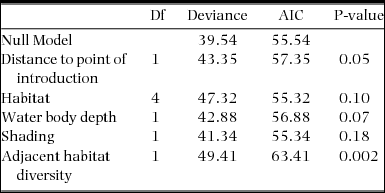
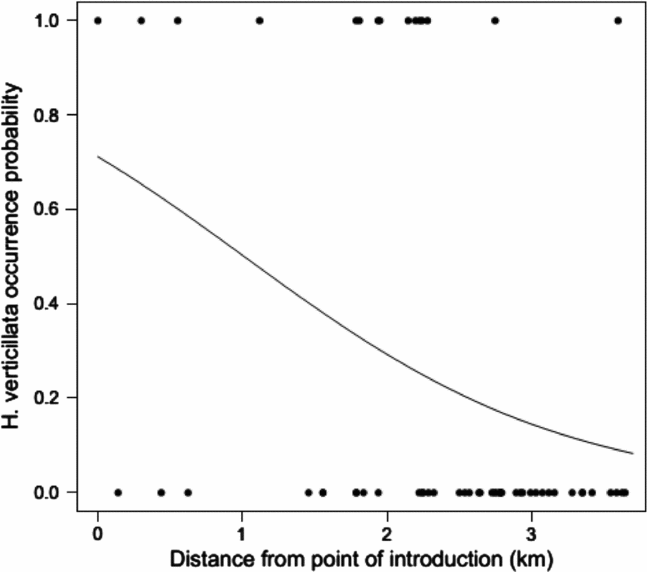
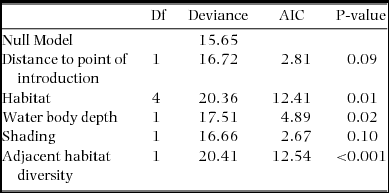
In total, we recorded H. verticillata in 15 of 58 plots (Figure 1a). Mean cover of H. verticillata in the invaded plots was 61%, with a maximum cover of 98% in two plots. A decade after its introduction into the La Gamba valley, the occurrence probability of H. verticillata was positively correlated with proximity to the point of introduction (Table 1, Figure 2).
Location of the plots of Hydrilla verticillata (n = 58) (a) and Hedychium coronarium (n = 56) (b) in the study region (= La Gamba valley). Also shown are major habitat types, and the river and stream network. The inserts show the location of the study region in Costa Rica.

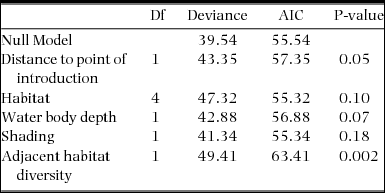
Results of the Generalized Linear Models (GLMs) of the factors that influence the occurrence (presence/absence) of Hydrilla verticillata in the plots (n = 58) in the La Gamba Valley, Costa Rica. The explained deviance by the full model is 50.8%. Df, Deviance: the change in the degrees of freedom and the deviance respectively when dropping the respective variable from the full model.
The influence of distance to the Tropical Research Station La Gamba (= the point of introduction of Hydrilla verticillata into the study region in 2005) on H. verticillata occurrence probability in plots (n = 58).
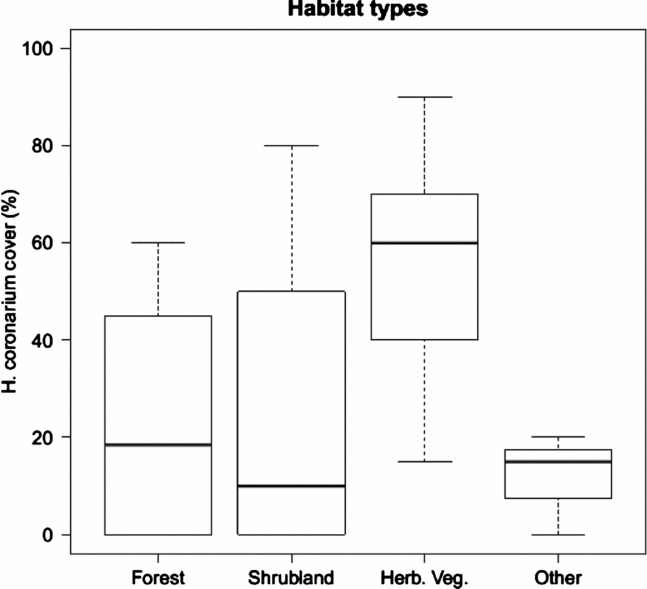
We recorded H. coronarium in 45 of a total of 56 plots (Figure 1b). Mean cover of H. coronarium was 35%, maximum cover was 90%. Results of an Analysis of Variance (ANOVA) showed that plots in herbaceous vegetation had significantly higher cover of H. coronarium than those located in woody vegetation types (Figure 3).
Average cover of Hedychium coronarium in the 56 study plots (forest: n = 8; shrubland: n = 26; herb. veg: n = 18; other: n = 4) located in different habitats in the La Gamba Valley, Costa Rica. Cover of H. coronarium in plots located in herbaceous vegetation is significantly higher than in other habitats (ANOVA; herb vs. forest: P = 0.035; herb vs. shrubland: P = 0.007; herb vs. other: P = 0.028).
Species co-occurrence and species diversity in plots invaded by Hydrilla verticillata
The resident vegetation in the H. verticillata plots was dominated by a few species. The four most abundant species in the plots were Limnocharis flava (recorded 31 times, 13 times accompanying H. verticillata), Eleocharis elegans (recorded nine times, twice accompanying H. verticillata), Heterantherea reniformis (recorded 29 times, 11 times accompanying H. verticillata), Leersia hexandra (recorded 31 times, seven times accompanying H. verticillata). The results of the Spearman's rank correlation analysis showed that there is a significantly positive correlation between the species cover of H. verticillata with Heteranthera reniformis (rho = 0.31, P = 0.02), while the correlations were not significant for the other species: Limnocharis flava (rho = 0.15, P = 0.25), Eleocharis elegans (rho = −0.06, P = 0.64) and Leersia hexandra (rho = −0.14, P = 0.29).
Factors affecting the current distribution of the study species
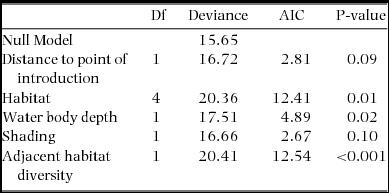
The GLM showed that the habitat type invaded, i.e. backwater, pond, ditch and vehicle track, had no significant effect on H. verticillata presence (Table 1). Also shading of the plot did not influence the distribution significantly. Shallow water bodies were somewhat more likely to be invaded by H. verticillata, although the effect was not significant (P = 0.07). However, distance to the point of introduction was significant (P = 0.05). In addition, habitat diversity in the adjacent landscape did significantly affect H. verticillata presence. The relationship was positive, i.e. plots located in more diverse landscapes were more likely to be invaded. Further, the GLM using H. verticillata cover as response variable (Table 2) yielded only moderately different results.
Results of the Generalized Linear Models (GLMs) of the factors that influence the cover of Hydrilla verticillata in the plots (n = 58) in the La Gamba Valley, Costa Rica. The explained deviance by the full model is 82.5%. Df, Deviance: the change in the degrees of freedom and the deviance respectively when dropping the respective variable from the full model.
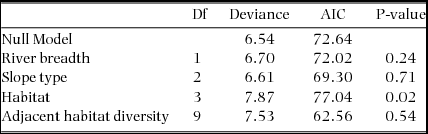
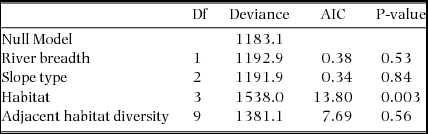
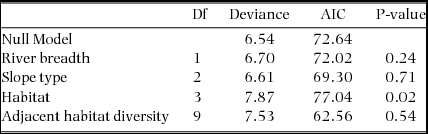
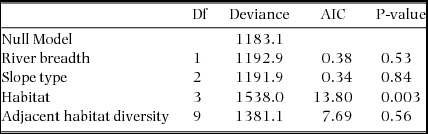
For H. coronarium presence and cover, we found a significant correlation with the invaded habitat type (Tables 3, 4). The probability of H. coronarium presence was significantly higher in herbaceous vegetation compared with other habitats. However, all other factors (river breadth, river bank slope, adjacent habitat types) included in the GLM did not influence H. coronarium presence and cover.
Results of Generalized Linear Models (GLMs) of the factors that influence the occurrence (presence/absence) of Hedychium coronarium in 56 plots in the La Gamba Valley, Costa Rica. The explained deviance by the full model is 26%. Df, Deviance: the change in the degrees of freedom and the deviance respectively when dropping the respective variable from the full model.
Results of Generalized Linear Models (GLMs) of the factors that influence the cover of Hedychium coronarium in 56 plots in the La Gamba Valley, Costa Rica. The explained deviance by the full model is 31.8%. Df, Deviance: the change in the degrees of freedom and the deviance respectively when dropping the respective variable from the full model.
Impacts on resident species
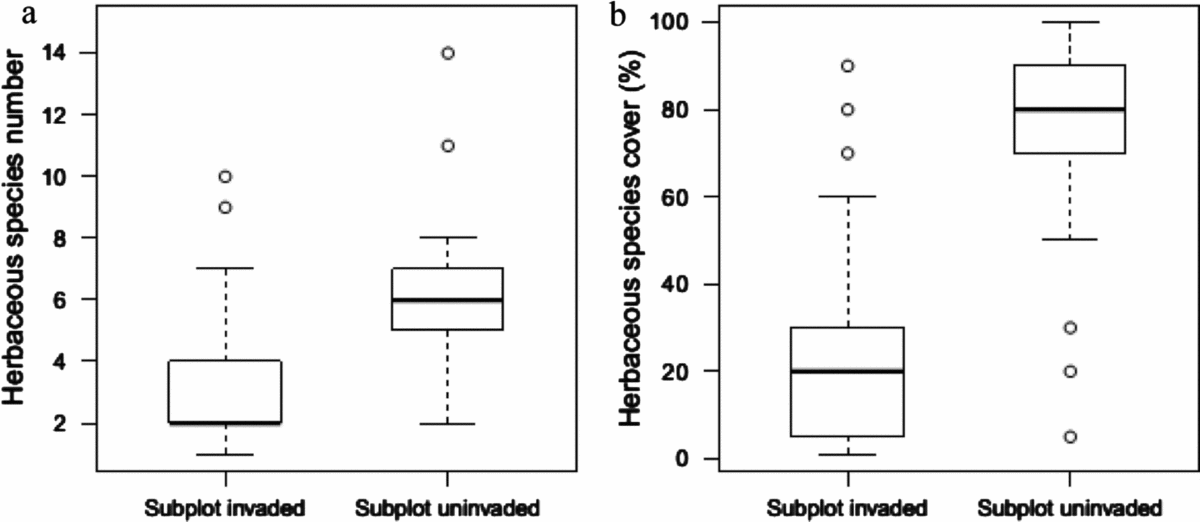
For both study species, we analysed the impact on native species richness and cover by comparing the subplots with high and low cover of the study species by GLMs. For H. verticillata, we found no effect on native plant species cover (correlation of fixed effects = 0.75). Similarly, there were no significant differences in woody species numbers or cover in the herb layer in invaded and non-invaded subplots of H. coronarium. However, we found a pronounced difference in herbaceous plant species number and, in particular, cover (Figure 4). Hedychium coronarium cover and the cover of co-occurring native species are significantly negatively correlated.
Herbaceous plant species number (a) and cover (b) of subplots with high (subplot_invaded) and low cover (subplot_uninvaded) of Hedychium coronarium in the La Gamba Valley, Costa Rica. t-tests showed that differences in herbaceous plant species numbers were not significant (P = 0.55), while differences in species cover were significant (P = 0.01).
DISCUSSION
Invasion history, pattern and velocity of spread
The invasion history of H. verticillata in the La Gamba valley is unusually well documented due to the fact that the location (Tropical Research Station La Gamba) and timing (2005) of its regional first introduction are well-known (W. Huber unpubl. data). After a decade of spread, we found a positive correlation between H. verticillata presence and distance to the point of introduction (Table 1). This finding suggests that the spread of this species – most likely via the dispersal of plant fragments and propagules by running water, contaminated soil and water fowl – is still on-going in the La Gamba valley, and that dispersal limitation has yet precluded the colonization of more distant sites. Compared with observed rates of spread in other places of the world (Balciunas et al. Reference BALCIUNAS, GRODOWITZ, COFRANCESCO, SHEARER, Van Driesche, Blossey, Hoddle, Lyon and Reardon2002, Madeira et al. Reference MADEIRA, JACONO and VAN2000), spread velocity within the first decade of the regional presence of H. verticillata was rather low. With the exception of one population, H. verticillata was still limited to sites within 3 km of the initial point of introduction. We argue that this low rate of spread results from the fact that suitable sites are small and isolated ponds, thus H. verticillata populations are small, the resulting propagule pressure is low, and colonization of new sites is difficult because of the isolated distribution of the ponds.
The local introduction history of H. coronarium is less well-documented, but it is known that it was already widespread in the study region in the mid-1990s (W. Huber unpubl. data), when botanical exploration of the study region commenced. Arguably, the species has been locally present for several decades, and thus likely has been able to colonize all or most suitable sites in the meantime.
The role of habitat and landscape characteristics
We found a significant influence of adjacent landscape structure on the distribution of H. verticillata. Greater numbers of adjacent habitat types increased the probability of H. verticillata presence. This corroborates other studies which have shown that landscape variability facilitates invasion, e.g. by increasing the likelihood of occurrence of nearby suitable habitats or corridors for spread (Bennie et al. Reference BENNIE, HODGSON, LAWSON, HOLLOWAY, ROY, BRERETON and WILSON2013, King & With Reference KING and WITH2002). But we note that our result has to be interpreted in the context of the landscape structure in the La Gamba valley. Plots which showed a low diversity in adjacent habitats were mostly located in ponds and ditches within extensive oil palm plantations (cf. Höbinger et al. Reference HÖBINGER, SCHINDLER, SEAMAN, WRBKA and WEISSENHOFER2012) and secondary forests. These habitats seem to be largely unsuitable for H. verticillata due to dense shading. In contrast, more complex open landscapes (rice paddies, pastures, settlements) likely offered suitable habitats and thus fostered the spread of H. verticillata. In addition, agricultural machinery as used in harvesting rice is an effective device for the transport of propagules (Benvenuti Reference BENVENUTI2007), and thus facilitates spread. Running water also plays an important role as a conduit for propagules and for asexual spread of H. verticillata (Dar et al. Reference DAR, RESHI and SHAH2015, Le Maitre et al. Reference LE MAITRE, KOTZEE and O'FARRELL2014).
Of the factors included in the GLMs of H. coronarium presence and cover, only the invaded habitat type was significant (Tables 3, 4). Hedychium coronarium cover was significantly higher in plots located in herbaceous vegetation, likely because higher light availability than in forests or shrublands allowed H. coronorium to build up dense clonal stands. Other factors such as size of the river or the landscape context did not affect the presence and cover of H. coronarium.
Evidence of impacts on native plant species
Both study species are known to exert substantial impacts on native species composition in neotropical regions (Langeland Reference LANGELAND1996, Soares & Barreto Reference SOARES and BARRETO2008, Thomaz et al. Reference THOMAZ, ESTEVES, MURPHY, DOS, CALIMAN and GUARIENTO2008). Surprisingly, we found no evidence of impacts of H. verticillata. Due to the absence of natural standing waters, H. verticillata only occurred in highly disturbed, anthropogenic water bodies. Plant species composition was similar in all plots where H. verticillata occurred as well as in potentially suitable, but yet not colonized, plots. This lack of evidence of negative impact may be explained by the fact that few native pioneer species (e.g. Heteranthera reniformes, Leersia hexandra, Limnocharis flava, Eleocharis elegans) can cope with the disturbance-prone habitats. The absence of negative correlations between species cover values of H. verticillata and the four most abundant native species indicates that these species prefer the same habitat conditions but interspecific competition seems to be of limited importance, likely because of frequent disturbance events.
For H. coronarium, we documented negative impacts on native herbaceous plant species cover (Figure 4). Shading of dense clonal stands of the study species suppresses native herbaceous species, a fact that has also been reported from other tropical regions (Soares & Barreto Reference SOARES and BARRETO2008). In contrast, the number and cover of woody species in the plots were not negatively affected by H. coronarium. This finding is most likely related to the fact that woody species are released from shading once they have overgrown H. coronarium. In addition, long-lived woody species might have been present in the plots before they were invaded by the study species. However, we argue that negative impacts on woody species might emerge over time, as H. coronarium likely inhibits the germination of woody plant seedlings as has been proven for the closely related Hedychium gardnerianum (Minden et al. Reference MINDEN, HENNENBERG, POREMBSKI and BOEHMER2010a, Reference MINDEN, JACOBI, POREMBSKI and BOEHMERb).
CONCLUSIONS
While both species are major alien species in tropical regions worldwide, their local abundance and impacts on native vegetation differ profoundly. Hydrilla verticillata is a rather recent alien species in the study region, and thus dispersal limitation still restricts its local range. In addition, the scarcity of suitable habitats seems to contribute to a slow spread velocity which is in stark contrast to the rapid expansion of this species in other tropical regions (Langeland Reference LANGELAND1996). Hedychium coronarium has been present in the study region for a substantially longer time period, and we found no indication of ongoing spread on the landscape level. This species encounters suitable habitat conditions in particular in herbaceous vegetation along rivers and streams in the cultural landscape of the La Gamba valley, where it is able to build up dense clonal stands which negatively affect the cover of the native herbaceous vegetation.
ACKNOWLEDGEMENTS
We thank the farmers and landowners in La Gamba, who gave their permission to carry out the field work for this study on their properties. We are grateful for the comments of an anonymous reviewer.