Introduction
What appears at first sight to be a cartographic anomaly on maps of northeast Greenland is an island named ‘Île de France’. A clue as to the source of this anomaly is to be found in the name of the adjacent part of the Greenland mainland, namely Hertugen af Orleans Land [Duke of Orleans Land]. These names, and a few others, such as that of the offshore Belgica Bank, represent the cartographic legacy of one of four arctic expeditions mounted by the Duc d'Orléans in 1904, 1905, 1907, and 1909. These expeditions are little known in the English-speaking world, largely because, with one exception, all the sources are in French, and most are long out of print and are very rare.
Born on 6 February 1869 at York House, Twickenham, England, now the municipal offices of the London borough of Richmond upon Thames, Louis-Philippe-Robert, Duc d'Orléans, (generally known as Philippe in the family) was the second son of Louis-Philippe-Albert, Comte de Paris, the exiled Orléans claimant to the French throne, and Maria-Isabella, Infanta of Spain. The family had been exiled from France since Philippe's great grandfather, King Louis-Philippe, had abdicated in 1848. But in February 1871, after the Third Republic had been proclaimed, the French National Assembly repealed the law of exile on 26 May 1848 and the Comte de Paris returned to France with his family (Lafon Reference Lafon1999). Initially they lived in the Hôtel Fould at 129 Rue du Faubourg Saint-Honoré. But then in 1872 the state restored to the Orléans family some of the estates that had been seized in 1848. The Château d'Eu, located near Tréport at the mouth of the Bresle, northeast of Dieppe, and now the Musée Louis-Philippe, was allocated to the Comte de Paris. It was here that Philippe d'Orléans spent a very happy childhood. Educated initially by tutors, he later attended the Collège Stanislas in Paris.
On 15 May 1886 the engagement of Orléans’ older sister Amélie to Don Carlos, Duche de Braganza and heir to the Portuguese throne, was celebrated at the Hôtel de Martignon, rue de Varenne. Representatives of the major royal houses of Europe were invited, but not the foreign minister and president of the council, Charles de Freycinet, or any other high official in the French government. This was perceived as a serious slight, even a threat, to the republic, and on 11 June the Chambre des Députés passed a bill banning heads of families that had reigned in France, and their direct descendants, from the territory of the republic. The bill was confirmed by the Sénat on 22 June. On 24 June the Comte de Paris and his family left the Château d'Eu and boarded the steamer Victoria at Tréport, bound for England. As a temporary measure the Comte rented Sheen House and its estate in Twickenham (Lafon Reference Lafon1999). Young Philippe was already a keen hunter and one room at Sheen House was set aside for his collection of stuffed animals.
Banishment from France was a severe blow to Philippe who had been preparing mentally to sit the entrance exams for the Saint Cyr military college. But instead, through the intercession of Queen Victoria, he gained admittance to the Royal Military College at Sandhurst and passed out as a second lieutenant. Then, through the good offices of the Duke of Cambridge, the British commander-in-chief, he was attached as a lieutenant to the King's Royal Rifles, serving in India, from January 1888 to March 1889.
His military duties clearly allowed him plenty time for relaxation, and especially for his passion of hunting. Even before joining his regiment, Philippe, along with his cousin Prince Henri d'Orléans, accepted an invitation from Lord Dufferin, the viceroy, to take part in a tiger shoot on the Nepalese border in March/April. A moment of high drama occurred on this shoot when a tigress leaped into the howdah in which Philippe was riding on the back of an elephant, but he escaped uninjured. He served on garrison duty at Chakatra, but his duties were evidently not very onerous since during his leaves he was able to visit Tibet, other parts of India, Afghanistan, the Persian Gulf and Sri Lanka.
While he was back in England to attend his parents’ silver wedding celebrations on 30 May 1889, this was also the occasion of the announcement of his engagement to his cousin Princesse Marguerite de Chartres (The Times (London) 28 May 1889). He resigned from the King's Royal Rifles soon afterwards and in October 1889 journeyed to Lausanne to pursue studies at the Académie Militaire Suisse. He again spent some of his time hunting, this time his quarry being ibex and chamois.
But with his 21st birthday Phlippe was driven to do something he felt he had to do. He returned to France and on 7 February 1890, presented himself at the recruitment office in the rue Saint-Dominique in Paris, to join the French army. On being turned down he tried again at the Hôtel de Ville for the 7th arrondissement, and then at the War Ministry. Arrested that evening, and held at the Concièrges, on the 8th February he was charged with contravening the law of 22 June 1886, forbidding his father and descendants from ever setting foot in France. On 17 February at the Palais de Justice he was sentenced to two years in prison and was transferred to Clairvaux prison in Aube arrondissement. But to prevent him being seen as a ‘martyr’ his sentence was reduced and on the night of 3–4 June he was transported to the Swiss border and released. By 6 June 1890 he was back home with his parents at Sheen House.
Over the summer he took part in shoots in Scotland at the invitation of Earl Grey, and on the estate of his uncle, the Duc d'Aumale, at Wood Norton, near Evesham in Worcestershire (Lafon Reference Lafon1999). Then on 23 September, along with his father, Philippe boarded the liner Germania at Liverpool, bound for New York. The Comte de Paris planned to revisit the battlefields of the civil war, in which he had participated as aide-de-camp to General McClellan, commanding the Army of the Potomac. They also visited Philadelphia, Washington, Richmond, Virginia, Montreal and Québec. They were back in England by 9 November.
Philippe had also found time for activities of a total different nature. He was involved in an affair with Mrs. Charles Nisbett Armstrong, better known as the opera singer, Nellie Melba. They were seen together in London, Brussels, St. Petersburg and Vienna, where they indiscreetly shared a box at the Opera (Davidson Reference Davidson and Pike1984). Her husband filed for divorce and Philippe was served with a summons at Vienna railway station in early November 1891 (The Times (London) 5 November1891) to appear as co-respondent. The case did not go to court. However, partly because of this scandal and partly because of royalist concerns about consanguinuity (his father, the Comte de Paris had also married a first-cousin) and about the need for Philippe to contract an alliance with a well connected reigning royal family, his engagement with Princesse Marguerite was broken off late in 1890.
Early in 1891, travelling on a passport under the name of Comte de Nevers, Philippe went by train from Brussels, via Berlin, to St. Petersburg. He was invited to hunts by the Grand Dukes Vladimir and Mikhail, and also attended the opera. With the approval of Tsar Aleksandr III, on 13 March he took the train from Moscow, bound for Vladikavkas, in the northern foothills of the Caucasus, and there spent several weeks hunting wolves, brown bears, otters and deer in the mountains. He ventured as far as Tbilisi in Georgia, but aborted his plans to visit Iran. He returned to England via Rostov, Kharkov, Kyiv, and Vienna, and on 17 May joined his family at Stowe House (now Stowe School, west of Buckingham), which his father had rented since late in 1890. Here a large room in the west wing was set aside for his museum, which housed his hunting trophies and firearms.
In 1892 he mounted a hunting expedition to Somalia (Récamier Reference Récamier1927; Lafon Reference Lafon1999). Here he discovered a previously unreported species of elephant, subsequently named Elephas africanus orleansi; the mounted head of the animal he shot was transported back to Stowe House where it became a prominent feature of his museum. In Somalia he also shot his first lion, as well as a rhinoceros, a buffalo and a leopard. All of these ended in his museum.
On 8 September 1894 his father, the Comte de Paris, died at Stowe House. With his death Philippe became the Orleanist claimant to the French throne, a role that he took very seriously for the rest of his life. On the day of his father's burial he received delegates from the French monarchist organisations at the Grosvenor Hotel in London, and thereafter he held a weekly audience at the Savoy; he also went regularly to Brussels to meet with monarchists since, of course, he could not enter France.
Philippe spent a good part of most winters at the family estate at Villamanrique de la Condesa, near Seville, in Andalusia. He was able to indulge in his favourite sport of hunting in the Marismas, the vast marshes along the lower Guadalquivir River. He hunted wild boar, deer, geese, bustards, flamingoes and ducks, and on one occasion even lassoed a feral camel (Récamier Reference Récamier1927).
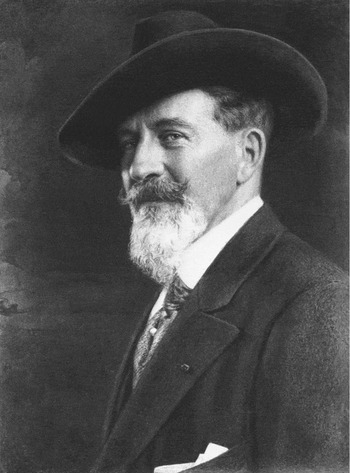
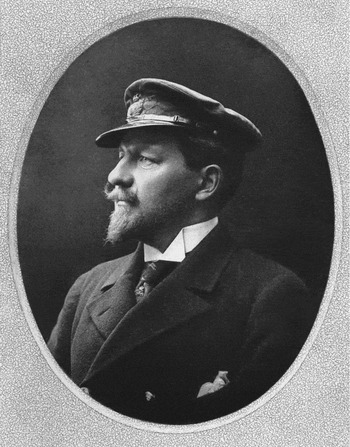
In June 1896, while visiting the Archduke Joseph Habsburg at Alcsuth Castle, just west of Budapest, he met the archduke's daughter, and cousin of Kaiser Franz-Josef, Marie-Dorothée, who usually used the Hungarian version of her name, Maroussia. They became engaged on 15 July and were married in the parish church of the imperial and royal court in the Hofburg, Vienna, on 5 November 1896. But then, on 7 May 1897 Philippe's uncle, the Duc d'Aumale, died of a heart attack. In his will he bequeathed to Philippe his estates at Eu and Aumale (between Amiens and Rouen and not far from Eu), the Palazzo d'Orléans in Palermo, along with the Zucco vineyards in Sicily, as well as Wood Norton Hall (now the Wood Norton Hall Hotel) and Philippe's birthplace, York House in Twickenham. The latter mansion became the young couple's usual residence in England. At York House he had a wing added to house his rapidly growing museum, in which were displayed his hunting trophies and dioramas of animals and birds in their natural environment (Lafon Reference Lafon1999). A portrait of him at this stage of his life is presented (Fig. 1).
Louis-Philippe- Robert. Duc d'Orléans, Reference Orléans1904.

Svalbard 1904
On 6 April 1898, the Duc d'Orléans bought a 49% share in the three masted steam yacht Roxana, built at Partick on the Clyde in 1885 (Lafon Reference Lafon1999). Schooner-rigged, she was 67 m long; had a beam of 8.4 m, and a draft of 5 m aft, with a displacement of 1350 tonnes (123.4 registered tons). Previous owners included Prince Georgiy Romanovskiy, the Duke of Leichtensberg, and most recently the American, Adam Mortimer Singer. Almost immediately Philippe renamed her Maroussia after his wife.
Apart from changing the yacht's name Philippe also had her rig changed at Southampton in December 1898. One mast was removed and the foremast was square rigged, to make her a brigantine, or hermaphrodite brig (Récamier Reference Récamier1927). Philippe was very keen that she should be registered in France, but anticipating difficulty arising from his exiled status, he avoided it by arranging for his co-owner to be Baron Louis de la Grange. Thus on 31 January 1899 Maroussia was registered in the port of Le Havre (Lafon Reference Lafon1999) and thereafter was able to fly the French flag.
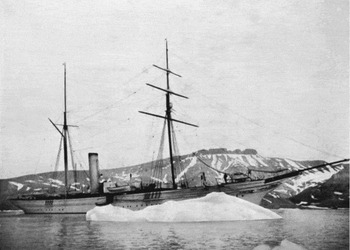
Maroussia (Fig. 2) was commanded by Captain Baichis, assisted by Captain Henri Candolle and Lieutenant Joseph Allain; the surgeon was Dr. Joseph Récamier, Orléans’ personal physician; the chief engineer was Charles Bourguignon, and the second engineer was Charles Sallée (Récamier Reference Récamier1927; Orléans Reference Orléans1904). The deck crew and engine room crew totaled 24 and were all French. A further eight men worked in the galley, the saloon and the cabins, again all French, with the exception of two English maîtres d'hôtel, Harry Sansome and Frederick Penny.
Maroussia in Billefjorden, Spitsbergen, 1904.

For the following six years Maroussia cruised between Cowes in the Isle of Wight, Lisbon, Seville, Palermo, Fiume and Constantinople. At Lisbon Philippe and his wife visited his sister, Amélie, now Queen of Portugal and Philippe went hunting with King Carlos in his estate around Mafra Castle. From Seville he went hunting in the Marisma. And from Fiume the couple went to the Villa Giuseppi, guests of Maroussia's father, the Archduke Ferdinand and Orléans went hunting on the Isola Veglia off the Dalmatian coast (Récamier Reference Récamier1927). And in Palermo they stayed at the Palazzo d'Orléans.
In 1904 Philippe decided to cruise north along the Norwegian coast and, if possible, to push north to Svalbard. He was accompanied by his valet Louis Kermaingant, while Maroussia was attended by her lady-in-waiting Mlle. Geneviève du Gardier and two chamber maids, Henriette Mezerette and Islona Oberleitner (Récamier Reference Récamier1927; Orléans Reference Orléans1904). Having started from the Mediterranean, and having called at various ports including Ostend and Bergen, where the pilot Gundersen came aboard, Maroussia cruised north through the Norwegian fiords and reached Tromsø on 26 June. Here three further Norwegians came aboard: Captain Hansen, as ice pilot and interpreter, Stenertsen as ice pilot, and the hunter trapper Nielsen. The addition of these arctic experts must have gone some way to relieving the concerns of Captain Baichis, who had expressed strong reservations about taking a steel hulled vessel such as Maroussia into ice infested water. At Tromsø, too, Philippe invested in cold weather clothing for his officers and crew.
The presence of four Norwegians on board presented something of a communication problem. None of them spoke French, English, German, Breton or Provençal that were the only languages spoken by the remainder of the ship's complement. Hansen's skills at interpreting between Norwegian and English were therefore in demand.
Putting out to sea again on 29 June, Maroussia next called at Hammerfest. Here Philippe visited a sealing schooner that had just returned from Jan Mayen with 1500 seal pelts. He found the stench unbearable, only matched by the smell of heaps of stockfish and vats of cod liver oil, seal oil and whale oil that permeated the town. He also indulged in some pleasure outings, cruising the nearby fiords in his vessel, admiring the cliff-colonies of sea birds and enjoying the midnight sun (Récamier Reference Récamier1927).
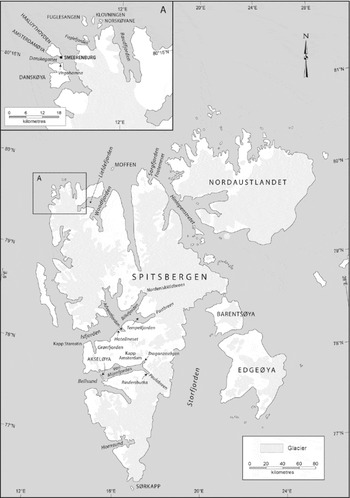
Maroussia sailed from Hammerfest on 2 July bound north across the Barents Sea. In the early hours of the 3 July she was steaming through dense fog, but the direction of flight of sea birds, a few points to starboard of her course, suggested that she must be near Bjørnøya, and by 7 am the lower parts of that island's cliffs were looming through the fog. By midnight a depth of 112 m and a rocky bottom suggested that they were about 10 km from Sørkapp, the southern tip of Spitsbergen and indeed, by 6 a.m. Sternertsen reported that the cape was in sight (Map 1).
Svalbard.

Maroussia coasted north past the entrances to Hornsund and Bellsund and on the afternoon of 4 July she swung into Isfjorden, dodging some fog patches as well as the occasional iceberg and ice floe, and dropped anchor off the western entrance cape of Adventfjorden. Here, to Orléans’ dismay he learned that a large building on the cape was a hotel, the ‘Turist-hutt’ operated by the Norwegian steamship company Estercalen, one of whose ships called with a new group of tourists every week. The site of the hotel is still commemorated by the name of the cape, Hotellneset.
Early next morning Maroussia got under way again, eastward bound up Isfjorden and Sassenfjorden to Sassendalen where Orléans hoped to hunt reindeer. As the anchor went down off the mouth of Sassendalen a herd of reindeer could be seen grazing quietly on shore. Soon after noon Philippe headed ashore along with Nielsen, Récamier and a few of the sailors. In a very short time they had shot six animals that the Duc felt would provide an adequate supply of fresh meat. Skins and heads were also taken, for inclusion in Philippe's museum at York House. An attempt was made to take aboard a fairly large, live calf whose mother had been killed, but it objected so strenuously to being lifted into the boat that it had also to be shot. Much of the valley bottom was boggy and everyone, especially the sailors carrying the quite heavy carcasses, found the return trip to the boats very heavy going. They constantly sank knee deep in the mud and some of them lost their boots and returned to the ship covered in mud (Orléans Reference Orléans1904; Reference Orleans1911).
On the morning of 6 July Orléans, Récamier and Kermaingant set off in the launch to reconnoitre the Postbreen, the glacier that fills the head of Tempelfjorden, at the very head of Isfjorden. The group landed on the glacier and hiked some distance up it; reassured by this reconnaissance Orléans decided to bring his wife to share in this adventure on the following day. Next morning a party consisting of himself, the duchesse, Mlle. du Gardier, Dr. Récamier, Captain Baichis and Kermaingant set off in the launch, towing a Norwegian whaleboat. The boats steamed east with the precipitous slopes of the spectacular Templet to port. Some distance short of the front of the Postbreen the Princesse asked that the boat stop so that she might sketch the glacier; from this sketch she later produced a study in oils that she completed in her small studio on board ship.
The glacier reached the sea in an ice cliff some 30–40 m high and some 3 km long; crevasses had partly separated many séracs and columns of ice weighing many tons that were frequently collapsing into the sea, raising waves that were sufficiently large to make Maroussia roll quite heavily and to leave her surrounded by brash ice (Récamier Reference Récamier1927).
On the next day (8 July) Orléans, with Récamier and a group of men headed ashore again to explore De Geersdalen on the south side of Isfjorden. Despite boggy ground and meltwater torrents fed by melting snow, they managed to reach a plateau at a height of about 900 m with a spectacular view over Isfjorden, and with sharp, rocky peaks rising above glaciers and ice-caps in every direction. Once again Orléans shot some reindeer and the meat and skins were hauled back to the coast and taken aboard (Orléans Reference Orléans1904).
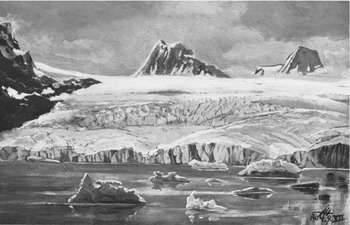
Next morning a party of sailors built a cairn on shore in Sassendalen; above it a white-painted board was erected with the inscription ‘Yacht Maroussia, DUC D'ORLÉANS, July 1904.’ Once this party was back aboard Maroussia weighed anchor, ran back down Sassenfjorden and swung to starboard, into Billefjorden to visit Nordenskiöldbreen at its head. Just as with the Postbreen, the front of the glacier filled the entire head of the fiord and Captain Baichis anchored at a safe distance; the glacier was calving constantly and bergs and bergy bits drifted steadily past the anchored yacht all night long, sometimes scraping noisily along the hull. Once again the duchesse took the opportunity to sketch the glacier front and to produce a delightful study in oils (Fig. 3).
The duchesse's painting of the front of the Nordenskiöldbreen.

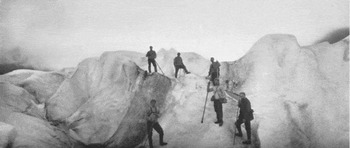
On 9 July Orléans, Récamier and five of the fittest men started to hike up the glacier; they were equipped with ropes, crampons, ice axes and provisions. After a hike of about 25 km, up the glacier and back, during which a rough map of the area was produced, the group returned safely to sea level, despite crevasses and fog that slowed their progress. The men particularly enjoyed the experience; when Orléans and the duchesse visited them in the crew's quarters in the evening, they found them regaling their shipmates with probably exaggerated stories of the day's adventures (Orléans Reference Orléans1904) (Fig. 4).
The party on the Nordenskiöldbreen, July 1904.

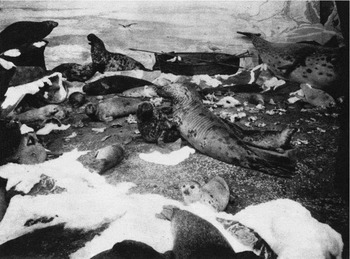
On the following day Philippe hiked some distance up a valley running north from near the glacier snout, and followed this by hunting seals from the launch; he shot and recovered 17 of them, of two species, probably ringed seals and bearded seals. The best of them were skinned carefully, with a view to being displayed in his museum.
Recalling the operations of rendering seal oil at Hammerfest, Baichis decided to attempt the same sort of operation on board, since he had heard that the seal oil was perfect for waterproofing leather boots. A seaman was delegated to take charge of the operation in the galley. But the smell that pervaded the whole ship was so revolting that he was forced to desist after the first barrel had been produced (Orléans Reference Orléans1904).
It was a superb, sunny day, with a temperature of 7°C. All the men that could be spared were allowed to go ashore for the day, and once they had built another cairn, supervised by Lieutenant Allain, they were permitted to scramble about on the glacier, or to hike up the nearby mountain peaks for the remainder of the day.
Next morning Maroussia's departure was delayed by fog until 8 am, when the weather cleared, but as she emerged from Isfjorden into the open sea, she again ran into dense fog. Orléans had been hoping to run north to visit Salomon August Andrée's base at Virgohamna on Danskøya, but in view of the fog and the sea state Baichis advised against it; instead Maroussia swung south. Philippe decided to visit Hornsund instead.
By 1 am on the 11 July dead reckoning placed the ship abeam of Hornsund. Cautiously, with Stenertsen on the lookout for some feature that he could recognise, the ship eased towards the coast, but repeatedly she encountered rocks and reefs, looming out of the fog. Finally, shortly after 9 the southwest wind tore the fog apart, allowing Sternertsen to recognize the Flakskjeret off Sørkapp, off the southern tip of Spitsbergen. They had overshot Hornsund by some 60 km.
A further attempt to visit Hornsund was also defeated by fog, as were the Orléans’ hopes of pushing north in Storfjorden to Barentsøya, where he had been told there was a good chance of finding bears and walrus. Reluctantly, therefore, he agreed that they should head south.
At 8 pm on 12 July the summit of Miseryfjellt on Bjørnøya was spotted on the horizon, over 100 km away, and in the early hours of 13 July Maroussia dropped anchor in Sørbukta. To Orléans’ surprise he discovered that his was not the only ship there; three whale catchers lay at anchor. But the whales they had killed were also lying there, moored to buoys, fin and humpback whales. More catchers towing whales arrived during the day and by nightfall there were 22 whales, some of them decomposing rapidly. The smell was bad and it quickly permeated every corner of the ship. Philippe had hoped to survey the island but contented himself with a cruise around the harbour, accompanied by Récamier and the duchesse, to view the nesting colonies of sea birds on the cliffs and to visit one of the whale catchers. During the day a tug put to sea towing a string of eight dead whales, bound for a shore based whaling station on mainland Norway.
The wind and sea rose during the night, and when a whaleboat was sent to get fresh water from a waterfall cascading down the cliffs, the boat capsized; fortunately the men escaped with just a ducking. Maroussia weighed anchor and headed south. Orléans and Récamier spent the day organising and classifying the collection that had been secured on Spitsbergen: reindeer skins and antlers, bird skins and eggs, seal skins, walrus and whale bones, and some mineral samples. Over 200 specimens of plants, moss and lichens had also been collected. The duchesse had also made a large number of sketches, many of which had formed the basis of oils and water colours that she had painted in her well lit studio on board.
Around 8 am on 15 July Nordkapp was in sight and by noon Maroussia had dropped anchor in Stickelvaaghaven. Next morning Philippe went for a long hike, along with Récamier and Kermaingant; in the afternoon the duchesse organised a picnic on shore for the entire crew.
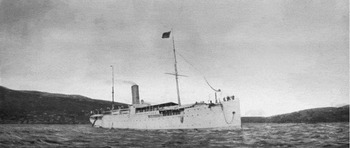
During the picnic a steamer suddenly appeared, flying the French flag; she was Île de France (Fig. 5) on a cruise to Nordkapp with a party of French tourists (Orléans Reference Orléans1904; Récamier Reference Récamier1927). Around noon next day Maroussia again caught up with her at Skaarøya. Once Maroussia had anchored Orléans had a salute of 21 guns fired to honour the French flag, to which Île de France replied with her whistle. Orléans invited a large number of her passengers on board Maroussia and he and the duchesse greatly enjoyed meeting and chatting to them, an interesting mix of an admiral, generals, scientist, artists and priests, all French.
The cruise ship, Île de France off Skaarøya, July 1904.

A few days later the royal party left Maroussia at Ostend, while Baichis took the ship to her home port of Le Havre.
Svalbard and east Greenland 1905
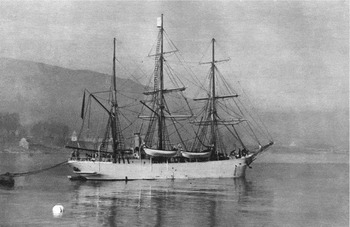
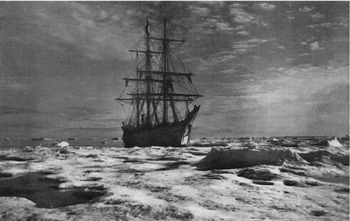
The Duc d'Orléans had been so enthralled by the arctic scenery and wildlife that on his return south he began making plans for a further arctic cruise in 1905, but this time he would use a vessel better able to tackle arctic ice than Maroussia. The vessel he decided to charter was Belgica, which had returned to Antwerp on 5 November 1899 from the Antarctic where she had endured a southern winter adrift in the pack ice of the Bellingshausen and Amundsen seas with the Belgian Antarctic Expedition led by Lt. Adrien de Gerlache de Gomery (Cook Reference Cook1900; de Gerlache Reference de Gerlache1902; Lecointe Reference Lecointe1910). Originally named Patria this vessel had been built at Svelvik near Oslo (then Christiania) in 1884, specifically for bottlenose whaling (Kjaer Reference Kjaer2005). With a length of 35 m, a beam of 7.5 m and a draft of 4.15 m, she was built of pine and pitchpine on oak ribs; bow and stern were sheathed with greenheart and the midships section with oak. Her bow was a solid 2 m of wood, further protected with iron bands. Rigged as a three masted barque, she had an auxiliary engine of 125 hp. that gave her a speed of 7 knots. Patria made her maiden voyage to kill bottlenose whales in 1885 under the command of E, Olsen; in subsequent years her captain was M.S. Petersen. De Gerlache bought her in 1896 and renamed her Belgica (Fig 6). She was refitted for the Antarctic expedition at Sandefjord in the spring of 1897. After her return from the Antarctic in 1901 Belgica was chartered to support the Baldwin-Ziegler expedition, led by Evelyn Baldwin and financed by William Ziegler; this was an attempt at the North Pole from a starting point on Zemlya Frantsa-Iosifa. Belgica, under Captain Christian Halvorsen, sailed to Bass Rock, off Shannon Ø, east Greenland, where her crew built a house and established a depot, in case the North Pole party of the Baldwin-Ziegler expedition should arrive there, having crossed the pole. Then over the next three seasons she returned to bottlenose whaling and sealing (Kjaer Reference Kjaer2005).
Belgica at Bergen, May 1905.

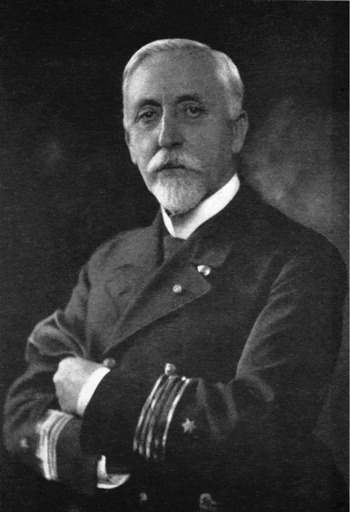
Once the arrangements to charter Belgica had been made, Orléans also hired de Gerlache to command her (Fig. 7). This was an extraordinarily fortunate development, in that it was he, with the whole hearted support of Récamier, who persuaded Philippe to combine science with hunting on the impending arctic voyage (Pergameni Reference Pergameni1935). De Gerlache took the ship north to Sandefjord where she underwent a relatively minor, but important refit. The most important change was the fitting out of a laboratory in the forward deck house (Orléans Reference Orléans1907a).
Adrien de Gerlache de Gomery.

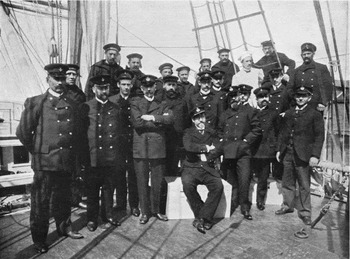
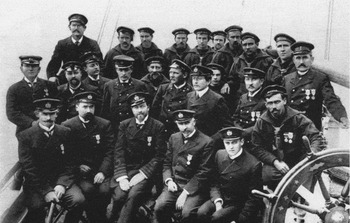
Belgica sailed from Sandefjord on 6 May 1905 and reached Bergen three days later. On 20 May Orléans (Fig. 8) arrived on the steamer from Newcastle (Orléans Reference Orléans1907a). Four days later Belgica put to sea, northward bound. Once again Récamier was on board, as ship's doctor. The first officer was Svante Bergendahl of the Swedish Navy. To handle most of the scientific work Orléans had also engaged the Dane Einar Koefoed, biologist and oceanographer, a student of the oceanographer Dr. Hjort of the fisheries institute in Bergen (Récamier Reference Récamier1927). Another new addition to the wardroom was the artist Edouard Mérite who specialised in painting animals from life. The mate was F.-L Andreassen and the chief engineer A. Carlsen. Both men had only recently returned from Otto Nordenskiöld's Antarctic expedition (1901–1904) on board Antarctic and had thus survived the sinking of their ship in the Weddell Sea and a wintering in a rough stone hut on Paulet Island, on a diet of penguins (Nordenskjöld and others Reference Nordenskjöld, Andersson, Skottsberg and Larsen1905). On board Belgica Carlsen was assisted by two assistant engineers and two stokers. The deck crew totaled 11 men (three Frenchmen and the rest Norwegian). The chef was again the Frenchman Albert Homo and the duke's valet, Louis Bourgeolet and the two English maîtres d'hôtel, Sansome and Penny were also on board again (Fig. 9).
Louis-Philippe-Robert, Duc d'Orléans, 1905.

The Duc d'Orléans (seated) with officers and crew of Belgica, 1905.

As in the case of Maroussia, Belgica was a multilingual vessel; in conversation ten different languages were in use: French, Flemish, Swedish, Norwegian, Danish, English, German, Spanish and Breton, and Latin for scientific topics.
Before leaving Bergen, on 22 May, Orléans went ashore, accompanied by Koefoed, to visit Professor Hjort in his laboratory. The latter persuaded him to concentrate on the area between Svalbard and Greenland, as being practically unexplored, both in terms of depths and in terms of the origins of the different water layers. Hjort was particularly interested in the possibility, championed by Fridtjof Nansen, that there might be a relatively shallow threshold between the central Arctic basin and the Greenland Sea, that is stretching from Svalbard to Greenland.
To carry out these investigations the necessary instruments and equipment were borrowed either from the fisheries institute in Christiania, or from the zoological station in Bergen. They included a Lucas depth sounder, three Eckmann tipping bottles and four Richter tipping thermometers, four silk Nansen nets and three conical silk nets for collecting plankton, and three trawls and four dredges for bottom dredging (Lafon Reference Lafon1999).
Belgica put to sea from Bergen on 24 May and at 9 pm on 29 May dropped anchor off Tromsø. Having topped up the coal bunkers and having made a few last minute purchases, Belgica put to sea again, northward bound on the afternoon of 3 June. Since it was much too early to contemplate tackling the Greenland pack ice, Orléans and Récamier decided to head for Svalbard again (Récamier Reference Récamier1927). By the evening of the 6 June Bjørnøya and the first icebergs were in sight (Orléans Reference Orléans1907a). Belgica ran into the first drift ice on the morning of the 7 June but by 4 pm she was in open water again and Sørkapp was in sight by the evening.
It was decided to make a stop in Bellsund, but even from the entrance to the fiord it was clear that all the bays and fiords opening from it were still covered with solid fast ice; hence Belgica continued north, only to run into a vicious storm that lasted for 48 hours. De Gerlache was forced to heave to, and even to try to reduce the wave impact somewhat by hanging bags of oil saturated oakum over the sides. Life on board became quite strenuous, particularly at mealtimes:
Lunch at noon became quite eventful. Dishes were flying across the saloon and the chairs were flying from one side to the other. One was obliged to perform gymnastics in order to brace oneself with one's feet, hold one's plate with one hand and eat with the other. It was amusing to watch my companions grabbing the critical moment to pour a drink between rolls (Orléans Reference Orléans1907a: 43).
Late on 10 June, between snow squalls, a bay or strait between high mountains was glimpsed and it was surmised that this was Danskegattet, between Danskøya and Amsterdamøya. Next morning, 11 June, after Belgica had swung east around the northern tip of Amsterdamøya into the lee of the mountains, the wind dropped and she encountered calm seas and warm sunshine. Orléans had hoped to investigate Raudfjorden, but it was still ice covered and hence Belgica ran back west to drop anchor between Fuglesangen and Klovningen; millions of little auks and guillemots flew up from the slopes and cliffs. In the afternoon Orléans went ashore on Fuglesangen and sat among the myriads of little auks as they perched on the rocks or flew to and from their nesting crevices. He collected five for his museum. Later that day, along with Récamier he travelled by launch to the glacier at the head of Fuglefjorden; along the way they explored some low islands, covered with nests of eider ducks (Somateria mollissima), and he collected four drakes and four ducks, as well as an Arctic skua (Stercorarius parasiticus) and three glaucous gulls (Larus hyperboreus). To his surprise few of the eider nests had any down in them; the solution to this mystery was revealed by the ashes of a driftwood fire and a scattering of egg-shells, undoubtedly left by the crew of a small hunting vessel they had seen anchored off Ytre Norskøya.
On the following day the weather was foul with wind and snow, and Orléans confined himself to a walk in the snow on Fuglesangen. And on 13 June, despite the snow, he amused himself by catching little auks on the wing with a scoop net, the same technique as that still used by the Inughuit of the Quaanaaq area of northwest Greenland and formerly by the King Islanders, near Nome, Alaska. He caught six birds. With little improvement in the weather, on the next day Belgica moved her anchorage to Danskegattet, off the site of the former Dutch whaling town of Smeerenburg. Next day, still with a gale blowing, the smell of smoke in the saloon gave warning of a fire in a store room directly beneath; it was quickly extinguished with buckets of water. It was determined that it had been started by a candle left burning in the store room by the steward, being overturned by the ship's rolling.
When the wind dropped in the afternoon Orléans and a party went ashore on Amsterdamøya to investigate the site of Smeerenburg. The brick try works, minus the iron try pots, were still much in evidence, as were a number of coffins in the old cemetery, with the bones of the occupants lying jumbled, probably by bears.
Next Orléans and his companions crossed Danskegattet to Virgohamna, to investigate the site from which Andrée and his companions, Strindberg and Fraenkel, had set off in the balloon Örnen, for the North Pole in 1897, a flight from which they never returned (Andrée and others Reference Andrée, Strindberg and 1931). Orléans rummaged around in Andrée's house (built by the Englishman Arnold Pike in 1888) (Pike Reference Pike1897). He found himself deeply affected by the atmosphere of the place. He also wandered around among the litter of equipment and supplies and the gasproducing plant near the house, including the remains of a collapsed hangar. A more recent description of these relics (and of those left by Walter Wellman in 1906, 1907 and 1909) may be found in Capelotti (Reference Capelotti1999).
Early next morning, on 16 June, as Belgica still lay off Smeerenburg, a small boat manned by three men, rowed alongside. They were Hendrick Jonas, the Finnish captain of the Norwegian hunting vessel Swanen that they had seen off Ytre Norskøya, and two of his men. In the gale force winds and heavy seas their vessel had been driven ashore and her sternpost and rudder had been torn off. Fortunately the crew had managed to launch their boats and get ashore safely and had salvaged what they could of the cargo of seal pelts and casks of blubber. The other five members of the crew were encamped under one of the boats on Ytre Norskøya. Belgica immediately weighed anchor and ran back to the site of the wreck. The arrangement that was now negotiated was that Jonas and one of his men would act as pilots, guiding Belgica east to the north end of Hinlopenstretet where they reported there were many bears and walrus. The ship would then return to pick up the remainder of Swanen's crew, who in the meantime would continue to salvage what they could from the wreck. Having supplied the crew with beer, tobacco and provisions, Belgica weighed anchor and headed east.
Running past the mouth of Raudfjorden, Woodfjorden, and Liefdefjorden under full sail, in warm sunshine and with a following wind that pushed her along at 6 knots, the ship rounded Verlegenhuken, but heavy clouds to the northwest promised a change in the weather and de Gerlache ran for shelter in Sorgfjorden. On shore the large wooden house and observatories where the Swedish component of the Swedish/Russian arc of the meridian expedition under Edward Jäderin had wintered in 1899–1900, still appeared to be in good condition (Backlund and others Reference Backlund, Jäderin and Engström1901). Large numbers of seals lying on the ice tempted Orléans to try stalking them, but they all dived down their holes before he could get within range.
He had planned a lengthy hike on shore next day (18 June) but gale force winds and driving snow led to a change of plan. In the early hours of the 19 June the anchor began to drag, and when a second anchor was dropped it dragged too; the ship drifted across the head of the fiord until it reached the edge of the fast ice; with great difficulty the two anchors were weighed, steam was raised, and Belgica fought her way back to a more sheltered anchorage where the anchor was again dropped, and this time it held.
Next morning, since the wind had died, Belgica got under way, heading east; she rounded Fosterneset into the northern end of Hinlopenstretet, but soon encountered pack ice and was forced to retreat back to Sorgfjorden. The wind had now swung into the north, driving the pack ice into Sorgfjorden and trapping Belgica in that bay. Over the next few days de Gerlache made several unsuccessful attempts to escape, but each time was forced to retreat to the small area of open water at Heclahamna, where Sir Edward Parry's ship, Hecla had lain while he made his attempt at the North Pole with boats on runners in 1827 (Parry Reference Parry1828). Belgica was imprisoned here for a week, much to Orléans’ disgust, although he did manage to shoot some seals, six eiders and a jaeger, and to explore the Swedish station thoroughly. On the afternoon of 25 June, along with Récamier and his valet, Louis Bourgeolet, he climbed Heclahuken (650 m) overlooking the anchorage, and examined the shelter that the Swedes had built for their instruments.
Finally, on 26 June, a southwesterly wind had loosened the ice barrier sufficiently, and de Gerlache took Belgica to sea; the ice was still quite close, however, and it was only by dint of pushing along leads and ramming floes when necessary that he succeeded in reaching relatively open water off Verlegenhuken by midnight. Over the next two days Belgica pushed westwards despite fog, and varying ice concentrations. By noon on the 28 June she reached Moffen; Orléans and Récamier went ashore on this doughnut-shaped island and watched skuas harassing the numerous nesting eiders; they returned aboard with eight eiders and large quantities of down. In the afternoon and evening, in sunny weather and calm seas Orléans shot three bearded seals (Erignathus barbatus). Next day he killed another two seals of this species.
By that evening Belgica was back at Ytre Norskøya; Jonas's men were embarked along with all his seal pelts and casks of blubber, and the ship got under way again. The flights of little auks coming and going from Fuglesangen were too much of a temptation for Orléans; he went ashore with his scoop net and caught several more birds and also collected four eggs from nests concealed in the talus. Mérite joined him and caught a number of birds on the wing by waving a fishing rod smeared with bird lime. In the meantime the men were skinning the five bearded seals on Belgica's deck.
As the ship rounded Hakluythovden, the northern tip of Amsterdamøya she encountered a strong southwest wind and heavy seas; Philippe and de Gerlache decided to take shelter in Virgohamna until the weather improved. In the afternoon Orléans took a walk at Smeerenburg and landed on Liksholmen, where he was intrigued to see eiders nesting among the remains of coffins with bones and skulls exposed. Mérite landed to paint this unusual scene next day.
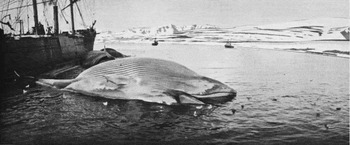
After two days of wind, fog and rain the weather improved on 3 July and Belgica headed south. By late evening she was anchored in Grønfjorden, to find the anchorage crowded with eight vessels, the floating factory ship Avenmore, Captain O. Bryde, and her catchers and tugs (Orléans Reference Orléans1907a) (Fig. 10). The fiord was full of whale carcasses, many of them of blue whales, waiting to be flensed, as well as the decomposing carcasses of those that had been flensed, along with a layer of oil and putrid scraps of flesh that covered the water surface, the stench was overpowering. Belgica anchored near Avenmore but the stench became even worse when, with the turn of the tide, a string of nine whales drifted down on Belgica, to the accompaniment of the screams of hundreds of fulmars that were fighting over the scraps. At Bryde's invitation Orléans visited both Avenmore and one of the catchers to see the entire operation at first hand. Then in the afternoon he went in the launch to a small islet at the entrance to the fiord, and to Kapp Starostin, just west of its entrance. Between the two he collected specimens of little auks, eiders, guillemots and phalaropes. On learning that a small Norwegian hunting vessel anchored at the head of the fiord would soon be leaving for Hammerfest all the crew of Swanen arranged to go south with her. But Philippe persuaded their captain Hendrick Jonas to stay on board Belgica, in the capacity of hunting guide for the remainder of the cruise to east Greenland.
The factory ship Avenmore with whale carcasses waiting to be flensed, Grønfjorden, July 1905.

At 12.30 pm on 6 July Belgica weighed anchor and headed out of Isfjorden. Running north, by 1 pm next day she was off Hakluythovden, still heading north. At 2.00 pm she hove to to occupy the first oceanographic station of the cruise: depths, water temperatures, plankton hauls and bottom dredging and trawling. It would be the first of dozens. Another station was occupied at 8 pm, and at 10.30 pm the pack ice appeared. Next morning (8 July), as the ice became closer, de Gerlache was forced to angle more to the northwest, where the ice appeared to be slacker. In the evening Koefoed insisted in trying to haul his largest trawl, in a depth of 560 m, against the advice of Orléans and Récamier, who felt his cable was too light. The outcome was that the trawl was lost.
On the morning of 9 July as Belgica lay moored to the edge of the main pack, a bear was spotted on the ice from the crow's nest. The ice was bristling with hummocks between which lay deep drifts of snow and slush, commonly covering holes and cracks. Orléans, Jonas and Récamier set off in pursuit of the bear, Orléans having been persuaded to use snowshoes for the first time. Especially when floundering in deep slush or clambering over hummocks, he found them less than an advantage. By 2.00 pm they were back on board, having seen no sign of the bear. But after lunch the bear was spotted again and Orléans set off again, this time having been persuaded to try skis, again for the first time. He was accompanied by Récamier, Jonas and Olausen, the bosun, who spoke English, to act as interpreter. Despite finding skis even more of a handicap than snowshoes, and despite several spectacular tumbles in the slush as a result, Orléans did manage to get a couple of shots at the bear, but missed. The party got back to the ship at 9 pm, having spent ten hours clambering and floundering across the pack ice.
The following two weeks were a period of intense frustration for all on board especially (at least at one level) for Orléans, who was keen to reach the Greenland coast, but at the same time found it intensely satisfying in terms of hunting. De Gerlache made every effort to push west through the pack ice, taking advantage of every promising looking lead and polynya, but repeatedly he found himself being forced to deviate southwards or even southeastwards to prevent being beset. Persistent fog made his task even more difficult. On one occasion, to add to his problems, while manœuvring to moor to a floe, a mooring line became wrapped around the propeller. On this occasion the facility whereby the propeller could be hoisted inboard up a special well proved extremely useful; the cable was cut away and the propeller lowered back into place. Finally, on 24 July, at 75° 58′N, land was sighted to the west and was identified as the Koldewey Øer, and by the morning of 26 July Belgica was lying off Kap Bismarck.
With regard to Orléans’ other passion, hunting, during these two weeks he shot seven adult bears, some on the ice and some in the water (Fig. 11). Two of these were females with cubs, and the cubs were captured and, with considerable difficulty, placed in cages on deck. Philippe also shot and retrieved three hooded seals (Cystophora cristata), two females and a male, and also fired at several narwhals and assorted other seals, but they all dived and were lost.
Skinning one of the bears shot by Orléans in 1905.

Récamier, Bergendahl and Koefoed also spent a very productive two weeks. Oceanographic stations were occupied almost daily; indeed Orléans became quite impatient at this activity at times.
When he came on deck on the morning of 27 July off Kap Bismarck, there was only one feature that made him less than happy. This was the sight of a sealing vessel lying in the ice about 6 km away. Before heading further north Belgica pulled alongside this vessel and her captain, Captain Grødahl and two of her crew came aboard. She was Søstrene out of Tromsø, and since leaving that port in April she had taken 700 seals, 13 bears and six walrus. She had first reached the Greenland coast at about 72°N and since then had been working her way steadily north. Grødahl reported that he had never previously managed to get as far north as Kap Bismarck.
Getting under way on the evening of the 27 July Belgica pushed cautiously northwards at half speed through the fog, following the edge of the fast ice. Around 7 pm she passed the highest latitude reached by Karl Koldewey and Julius Payer on land just to the west, on 15 April 1870, leading a sledge party that had travelled north from their ship, Germania, wintering at Shannon Ø (Koldewey Reference Koldewey1874). Orléans bestowed the name ‘Terre de France’ on the land to the west, but this name was not accepted by the Danish authorities although they did do him the honour of naming it Hertugen af Orleans Land.
During the day of the 28 July while Récamier, de Gerlache and Koefoed were occupying an oceanographic station, and while Bergendahl and a team of men were retrieving a bear that Orléans had shot from the ship, land was sighted to starboard, that is to the northeast. The bay or strait between it and the Greenland mainland was filled with close, unbroken fast ice, to which Belgica moored once she had steamed as close as she could to the new land.
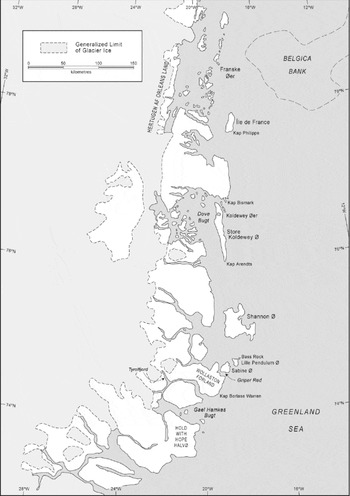
That evening, together with all his wardroom companions Orléans hiked across the fast ice to the new land. He was pleasantly surprised to find it quite well vegetated; Koefoed identified Dryas octopetala, Cerastium alpinum, Salix arctica, Alspecnus alpinus, Papaver radicatum, Festuca ovina, Saxifraga cospilaxa, S. oppositifolia and Draba alpina. They saw tracks and signs of arctic hares, foxes, geese, ptarmigan and terns, as well as reindeer bones and antlers (Map 2).
East Greenland.

While the rest of the group built a cairn on a low summit Récamier and Orléans hiked north for some 5.5 km across a small ice cap. From there Récamier sketched the mainland mountains to the west while Orléans took bearings on the major features. Rejoining their companions at the cairn, they all drank a toast in champagne while the French flag was raised. Since, as was later established, they were on an island, that is the ice covered sea to the west was a strait rather than a bay, this island has been named Île de France and, strange as it is this name that has been accepted by Denmark as the official name. The southern tip of the island was named Cap Philippe (now Kap Philippe) and the bay to the west Baie d'Orléans (now Orleansbugt).
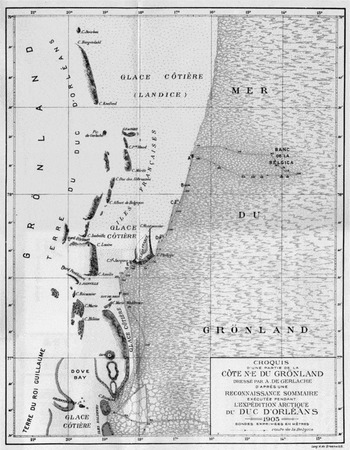
The fog returned overnight and hence Belgica remained at anchor all next day. Bergendahl and a group of men went ashore and built an even larger cairn, and placed a message in a bottle inside a tin box in the cairn. Next morning (30 July) Belgica rounded Kap Philippe and pushed north along the edge of the fast ice, still in thick fog. The edge of the fast ice gradually angled northeastward, forcing the ship further and further offshore. By midnight that day she was at 78° 16′N; 16° 21′W. Beyond this to the north lay close pack ice. Orléans was ready to turn back south but de Gerlache and Récamier persuaded him that they should head east where the ice appeared looser, with a view to putting some soundings on a large blank space on the charts. The depth at midnight was 470 m; 24 km further east, 220 m; at 7.00 am on 31 July, 100 m; and at 11 am, 40 km east of the midnight sounding, only 58 m. The lead brought up some pebbles. They were over a previously unknown morainic bank, which was named the Belgica Bank. Continuing eastward, still in fog, they sounded 75 m at noon; 115 m at 2 pm and 300 m at 3 pm Thus they were over the eastern slope of the bank (Fig. 12).
Contemporary map showing Orléans’ discoveries, including Belgica Bank, 1905.

Belgica then headed back west; at 12.30 pm on 1 August the fog lifted briefly to reveal a stretch of land from Kap Philippe in the south to another prominent cape in the north. They were seeing the full length of Île de France. But then the fog curtain dropped again. The ship was threatened by large floes drifting south along the edge of the fast ice, and had to change her position repeatedly. But next morning Orléans’ patience was rewarded. The entire coast was then in sight; while Mérite sketched the coast, De Gerlache, Bergendahl and Orléans took bearings on prominent points. Between the ship's position and the Greenland mainland some low, rocky islands broke the expanse of the fast ice; these are now named the Franske Øer. Belgica then turned south and by the evening of 2 August she was back at her anchorage just west of Kap Philippe.
On the morning of the 3 August Récamier and Orléans went ashore on Île de France and surveyed its west coast for about 12 km to the north. It was a clear day, and they could now confirm that this was an island, separated from the Greenland mainland by a strait, still covered with fast ice, about 21 km wide, rather than a peninsula. The afternoon was spent in plotting all the new information on the chart.
Determined to try to set foot on ‘Terre de France’, on the morning of 4 August Philippe, accompanied by Récamier, Hendrick Jonas, the valet Louis Bourgeolet and seaman Léon Olivier, set off at 8 am to hike across the fast ice to the mainland. Progress was painfully slow; the melt was quite far advanced and much of the ice was covered with melt pools, partially covered with a thin crust of ice. The hikers tried to avoid the pools initially, especially where they obviously connected with the sea beneath, but they soon abandoned all hopes of staying dry. As they approached the land, around 3 pm, they were brought to a halt by a network of shore leads. Forced to face reality they stopped on an island of ‘dry’ ice, took some bearings and started back. Orléans named a conspicuous, bold cape with sheer cliffs on the mainland opposite their turning point Kap Récamier. It took them until 9.30 pm to get back to the ship, having been away from it for about 11 hours.
Having achieved all he could, on 5 August Orléans gave orders to head back south; since the weather was now clear they were able to survey the coast, south to Kap Bismarck. Around 11 am, not far from Kap Bismarck, Bergendahl went ashore to make observations; on his return he reported having found the ruins of an Eskimo village, the stone walls of several of the houses still standing.
Ice prevented Belgica from rounding Kap Bismarck to explore Dove Bugt; instead she ran south parallel to the east coast of the Koldewey Øer, but separated from it by a belt of pack ice. By the evening of 6 August she was moored to the edge of the fast ice off Kap Arendts, the southern tip of Store Koldewey Ø. Orléans led a party ashore, where they found some more Eskimo hut ruins. As they got back to the ship they spotted two walrus. Launching a whaleboat, in the bows of which a harpoon gun was mounted, and which was manned by four men, Orléans and Récamier headed towards the animals. Orléans fired a harpoon at one of them but missed; thereafter a fusillade of rifle shots killed both animals but both sank, fortunately in fairly shallow water. One was brought to the surface fairly easily, by means of a hand harpoon lashed to a number of poles; it was hauled out onto the ice, but only with considerable difficulty, through the combined muscle power of 12 men. The second one was hauled out more easily, using an ice anchor and a block and tackle. Despite the short time since it had been killed it was already covered with shrimp and sea lice. Mérite immediately began sketching one of them. Both animals were skinned and the skins and heads hoisted aboard.
Early on the morning of 7 August Belgica got under way again, working her way through the pack ice and generally trying to head south but sometimes being forced by ice conditions to head east or northeast to find navigable leads or polynyas. Frequent thick fog banks did not make progress any easier. Orléans had hoped to call at Shannon Ø but the ice conditions did not allow this (Fig. 13). On the afternoon of 12 August the coast at Hold-with-Hope was in sight, but was inaccessible due to close pack. By the evening of 14 August the mountains of the Liverpool Kyst were in sight, but again ice conditions prevented a closer approach. But that afternoon and evening, as some compensation as far as Orléans was concerned, he managed to shoot and retrieve three bears, two adults and a large cub. This brought his total bag of bears to 14 (including the two captured cubs) (Orléans Reference Orléans1907a).
Belgica in the pack off the Liverpool Kyst, August 1905.

By that evening the sound of waves breaking on the floes at the edge of the pack was audible. But it was not until 8 pm on 18 August that Belgica finally reached open water. It had taken her six hours to traverse the final 400 m of dangerously pitching and tossing ice floes that repeatedly collided with her hull; thick fog did not help the situation. She had spent a total of 40 days in the pack ice, during which time fog was recorded for 482 hours, that is for half the time.
Belgica reached Reykjavik on 22 August (Pergameni Reference Pergameni1935). While the crew enjoyed a well earned rest Orléans and Récamier spent a few days sight seeing, travelling on Icelandic ponies to Thingvellir, historic site of the Icelandic ‘thing’ or assembly, the Great Geysir and the neighbouring geysirs and fumaroles, and the spectacular waterfall of Gullfoss (Récamier Reference Récamier1927). Once Orléans and party were back aboard Belgica ran south, then through the North Sea. After stops at Peterhead and Lowestoft she reached Ostend where Orléans left her, on 12 September (Orléans Reference Orléans1907a).
The scientific results of the voyage were impressive. Soundings had been taken at 74 locations, mainly in previously unexplored areas of the Greenland Sea. At 53 stations water temperature profiles had been measured, water samples taken and plankton hauls made at different depths. Geographically probably the most important contribution was the exploration and mapping of the east Greenland coast north of Kap Bismarck and of Île de France, not to mention the discovery and delimitation of the Belgica Bank.
The data and samples brought back were analysed by a group of experts and published in 1907 (Orléans Reference Orléans1907b). The titles of the various papers are listed in Appendix 1. In 1909, Fridtjof Nansen, one of the most eminent oceanographers of the day, appraised the work as follows.
Your Highness,
I have just received the magnificent volume Croisières océanographique dans la mer du Groenland en 1905. Résultats scientifiques, and I pray you will accept all my thanks and congratulations for having completed this magnificent work, which truly contains very important additions to human knowledge. Naturally it is the oceanographic research that is of special interest to me.
Through your extraordinarily successful voyage you were able to achieve work of great value in an area of the sea that was previously totally unknown; you have provided us with information that we had previously lacked, to fully understand the physical conditions of the Arctic Ocean, and I believe you have enabled us now to resolve in its broad outline the problem of the circulation in that ocean.
You have probably just received the book, The Norwegian Sea, by Helland-Hansen and myself, from Bergen [Helland-Hansen and Nansen Reference Helland-Hansen and Nansen1909]. If you take the trouble to cast a glance at these pages you will see how much I value the investigations made during your expedition and how important they have been in our work.
I believe we have thus been able to resolve important problems for the science of oceanography in all the oceans. Your research is particularly valuable not only because it was pursued in an unknown region of particular interest, but also because yours are the best and most exact observations made by any expedition.
But in addition you have made geographical discoveries of great value both above and below the surface of the sea and have made meteorological, zoological and geological observations.
Truly you have every reason to look with satisfaction on the result of these months; your fine volume will always remain one of the basic works on the physical geography of the boreal regions.
I am, your Highness, your obedient servant,
Fridtjof Nansen (Récamier Reference Récamier1927:189–90).
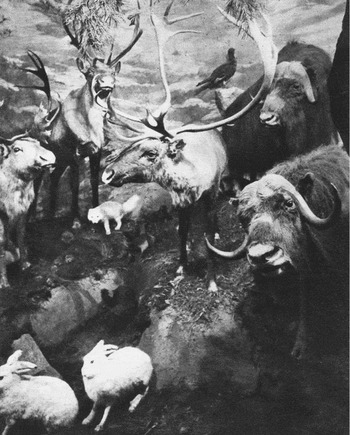
On his return to England many of the specimens that Orléans had brought south were included in the displays in his museum at York House, but on 30 October 1906 he sold the York House estate, although he hung onto the museum until 31 March 1907 in order to pack up and remove his collections. Wood Norton Hall, near Evesham, now became his sole residence in England. Just as at York House he had a special annex built there for his museum. It measured 90 feet by 60 feet (27.7 m by 18.5 m). Along with dioramas of two lions fighting, a lioness attacking a Grevy's zebra and of the tigress leaping onto the howdah on his elephant, was an arctic display featuring polar bears, walrus and seals. Nearby was a further display of arctic terrestrial mammals and birds: reindeer, foxes, lemmings, a lynx, snowy owls, willow and rock ptarmigan and eiders. In an annex off the museum Orléans had a replica of his cabin on board Belgica built, furnished in precisely the same fashion (Figs. 14, 15).
Marine mammal exhibit in the museum, Wood Norton Hall.

Arctic land mammal exibit in the museum, Wood Norton Hall.

Frustration in the Kara Sea 1907
Soon after the end of the 1905 cruise Orléans had bought Belgica with a view to undertaking further arctic voyages. For the 1907 season he set his sights on tackling the Kara Sea and, if conditions permitted, on attempting the northeast passage to Bering Strait (Récamier Reference Récamier1927). From Wood Norton Orléans travelled north to Newcastle where he boarded the passenger steamer Haakon VII, and reached Bergen, where Belgica was waiting, on 13 June 1907 (Orléans Reference Orléans1909). De Gerlache was once again in command, assisted by Lieutenant Svante Bergendahl and also by Lieutenant Cato Rachlew of the Norwegian Navy. Dr. Joseph Récamier once again served as ship's surgeon, while biologist Louis Stappers of the Université de Louvain had taken Koefoed's place. Because of lack of space Mérite did not participate in this expedition (Lafon Reference Lafon1999). Once again A. Carlsen served as chief engineer, assisted by his two sons. Of the previous crew members Ottersen, Kristoffersen and Johansen had signed on again, while two new French sailors had also joined the deck crew: Floury, and Rivolan. In the galley Homo was again in charge, assisted by a French assistant cook, Huvé (Fig. 16).
The Duc d'Orléans (front row, centre) with officers and crew of Belgica, 1907.

Last minute preparations and the late arrival of stores and equipment delayed the ship's departure until 18 June. She crossed the Arctic circle on the afternoon of 22 June and reached Tromsø late on the evening of 24 June. After Orléans and the French seamen had attended high mass on shore, Belgica put to sea again on the morning of 30 June. Next afternoon De Gerlache made a trial of the ‘submarine sentinel’, a device that alerted the officer of the watch when the ship was in dangerously shallow water; it functioned well. Belgica then made a slight detour into Altafjorden to Bossekop where Rachlew checked his magnetic equipment against the readings obtained there by the Norwegian expedition of the first International Polar Year in 1882–1883 (Barr Reference Barr1985; 2008). In the afternoon Philippe and Récamier went for a stroll through the birch woods up the valley of the Alta and next morning attended mass at the local Roman Catholic church.
Belgica weighed anchor at 4 pm on 4 July and by 7 next morning was abeam of Nordkapp; at 4 am on the following morning she reached Vardø. Here to Orléans’ dismay he found that the smell of drying and/or rotting fish that wafted across the harbour and permeated everything, equaled or even surpassed the stench of fish oil and seal blubber at Hammerfest. He did make a trip ashore but spent most of the day writing letters since this would be the last port from which mail could be dispatched. On the following afternoon, however, he took the time to visit the island of Renø; here he admired the bird cliffs which displayed a clear ‘stratification’ by nesting species: cormorants at the bottom; guillemots above them; kittiwakes above them; and puffins nesting in their burrows in the turf at the cliff top. Glaucous gulls perched on vantage points, ready to exploit the slightest opportunity of snatching an egg or a chick.
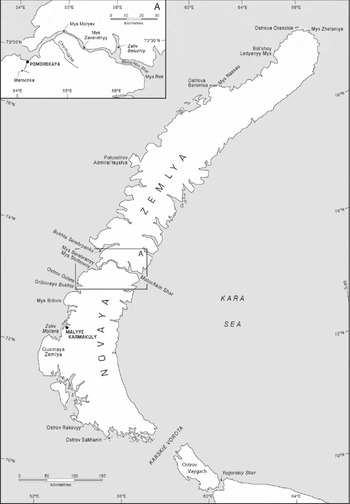
Getting under way at 2 pm on 8 July Belgica headed east, but when an east wind rose and strengthened Orléans, after consultation, decided to head for Matochkin Shar, rather than Yugorskiy Shar, in order to reach the Kara Sea, since on the former heading the east wind would be more manageable. Rolling heavily Belgica made excellent time across the Barents Sea; her landfall on Novaya Zemlya, at 11.30 am on 12 July was at Zaliv Mollera. Giving the reefs off Mys Britvin a wide berth, de Gerlache headed north; in the early hours of the next day he estimated that they were off the entrance to Matochkin Shar, but he could not reconcile the coastal features that were visible with the chart or the sailing directions. Finally he decided that they were off Bukhta Serebryanka, that is that they had made more northing than anticipated, pushed by a north flowing current. Belgica went about and by 8 am was running into Matochkin Shar with Mys Stolbovoy to starboard and Mys Serebraniy to port (Map 3).
Novaya Zemlya.

As the ship headed into the spectacular fiord like strait, bordered by glacier hung mountains, Orléans trained his telescope on the few buildings of Pomorskaya where two inhabitants and some 40 dogs watched the ship go by. But just after noon, off the delta of the Chumilikha River Belgica ran aground on a muddy shoal in a depth of 3.5 m. Kedge anchors were laid out, first astern, then ahead, but the anchors simply dragged, ploughing up the sea bed. Finally, at the top of the tide de Gerlache tried the old, and sometimes successful, method of sallying, getting the entire crew to run repeatedly from port to starboard and back again. The technique succeeded and progress eastward continued, but off the snout of the Tretyakov Glacier a belt of ice about 1 km wide stretched from shore to shore; fortunately the ice was relatively rotten and by steady, persistent ramming the ship forged through it. She emerged from this ice at 1 am on 14 July but off Mys Zavorotnyy she encountered a second belt of ice, this one some 500 m wide. This ice was tougher, however, and it took the ship the rest of the night to ram through it, emerging into open water only at 10.30 am. An hour later the ship was passing Zaliv Beluzhyy and the eastern end of the strait was in sight. Unfortunately, however, the Kara Sea was still ice covered.
Accompanied by de Gerlache, Récamier, and Stappers, Orléans went ashore on Mys Rok to try to get an extensive view of ice conditions. As they climbed the slopes of the cape he had his first encounter with a snowy owl (Bubo scandiacus), perched on a rock. He tried to approach it but it repeatedly flew out of range. Unfortunately the fog now rolled in across the sea ice, eliminating any chance of a panoramic view, and the party returned to the shore and to the ship. Determined to try to add a snowy owl to his collection, after a late dinner Orléans went back ashore with Récamier, Bergendahl, and Stappers. Once again, despite his pursuing the owl for several hours, it persistently flew away before had had come within range. As a slight consolation, however, he located a snow bunting's (Plectrophenax nivalis) nest in a rock crevice; using his geological hammer he was able to widen the crevice and to collect the six nestlings and two eggs, along with the nest, for his collection. He and his companions got back to their boat at 3 am; as the men rowed it out of the cove where they had landed the same (or another) snowy owl watched them from a rock ridge, and then flew way.
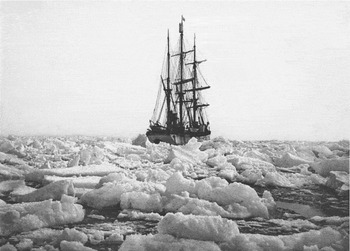
On the morning of 15 July Belgica pushed out into the ice of the Kara Sea and was soon brought to a halt; de Gerlache would have preferred to turn back and to wait for a few days in one of the bays of Matochkin Shar, but Orléans persuaded him to persevere. It was an unfortunate decision. The alignment of the leads forced the ship to head south parallel to the coast. Young ice started to form between the floes each night, but still Belgica made some progress each day. But on 18 July a northeast wind started to blow, pushing the ice against the coast. De Gerlache managed to place the ship in a ‘bay’ on the lee side of a very large floe, thus protecting her from the most severe ice pressures, but from that point on the ship was beset and began drifting slowly southwards, within sight of the land when the weather was clear, which was not very often. Frequently the pressure produced severe ridging and rafting among the surrounding floes but Begica in her ‘ice-harbour’ suffered no damage although she was occasionally nipped. Seals were spotted in cracks and leads occasionally, but generally there was little sign of life. Orléans did his best to be patient, but, reading between the lines of his journal, one can guess that he became very irritable.
His mood undoubtedly improved on 23 July when a bear was sighted; he shot it at close range but despite the best efforts of himself and his men to follow its track, it escaped. The ship's slow, mainly southward drift, imprisoned in the ice, continued as the northeast wind persisted. The tedium was again relieved in the early hours of 30 July when a bear and two cubs were sighted. They came right up to the ship and Orléans killed all three without leaving the ship.
Two days later, on 1 August, the situation started to improve; the wind swung into the southeast and then the southwest and the ice started to slacken and to break up. The engine was started and Belgica began fighting her way northeastwards, making steadily better progress as more and more leads and polynyas opened. Several oceanographic stations had been occupied during her ice drift in the shallow waters near the coast. Then, as further stations were occupied as she pushed northeastwards the depths increased: to 152 m, then 240 m on 2 August, and 315 m on 3 August. Belgica was thus crossing the Sv. Anna Trough that parallels the coast of Novaya Zemlya (Fig. 17).
Belgica beset in the pack, Kara Sea, July 1907.

These more favourable conditions did not last long, however; the southwest wind died, and later in the day the north wind resumed. The ship quickly became beset again and the relentless southward drift also resumed, with the ship heaved up a little and with a slight list to port. On 7 August Orléans found his mind turning to the fate of the scientists of the Dutch expedition of the first International Polar Year and of the crew of their ship, Varna, which after drifting around beset in these same waters in the winter of 1882–1883 was finally crushed (Barr Reference Barr1985; 2008). Her complement had taken refuge in the neighbouring Danish ship, Dijmphna, but then, fearing that it too might be crushed they took to boats and sledges and journeyed over the ice to Ostrov Vaygach and were ultimately rescued. One imagines that the engineer A. Carlsen, must have found his thoughts going back to his experiences on board the icebound Antarctic in the Weddell Sea and, after she was crushed, to the desperate wintering on desolate Paulet Island. De Gerlache, too must have been experiencing flash backs to his earlier ice-drift on board Belgica, in the Antarctic.
By 8 August the sun was dipping briefly below the horizon at midnight and the new ice that formed at night on pools on the ice was no longer melting during the day. On the next day there were some serious ice pressures with a chaos of uplifted blocks rearing up near the ship, which dropped with a jolt when the floe supporting her cracked and subsided, only to be hoisted up as another ice ram was pushed under the keel. And still the steady southward drift continued, at a speed of 19 to 29 km per day, parallel to the coast of Novaya Zemlya which lay about 32 km to the west.
On 15 August the ice drift, that had been displaying a menacing easterly tendency, raising fears that the ship might be about to begin an anti-clockwise circuit in the Kara Sea, developed a definite westward trend, towards Karskiye Vorota, although due to fog there was still no sign of land, either on Novaya Zemlya or on Ostrov Vaygach, although neither was more than 24–32 km away. The depths started to become shallower, to only 78 m on 16 August, while the drift velocity had accelerated to 32 km per day. And on the morning of 17 August, although the land on either side was still hidden by fog, Belgica drifted with the ice through the Karskiye Vorota into the Barents Sea at a speed of 3.5 kph. The ice slackened and the ship found herself floating freely; de Gerlache ordered some canvas set and the ship got under way, navigating a series of polynyas. At 2 pm Carlsen cautiously started the engine; there was considerable relief that the ship seemed to have survived without damage. At 4 pm the coastline of the extreme tip of Novaya Zemlya was sighted. The relief on board was palpable, and Orléans started making plans for the remainder of the season.
But Belgica was not yet clear. By late morning on 18 August she was again jammed among heavy floes, in dense fog. By the following morning there was some consolation in that the fog had cleared and the ship was in bright sunshine, but she was still beset, drifting parallel to the southwest coast of Novaya Zemlya which was clearly visible to the north. Unfortunately, however, she was drifting straight towards an off lying island, Ostrov Sakhanin. But around 11.30 am on 20 August, when the cliffs of the island were getting uncomfortably close, some major movements occurred in the ice, and it slackened sufficiently for Belgica to be able to get under way into some more manageable pack ice, and for five hours she enjoyed some magnificent sailing.
By 1 pm, however she was again beset, drifting west parallel to the rocky coast among large debris covered floes. Worst of all, she was drifting straight towards a small, rocky islet, Ostrov Rakovyy. All indications were that the ship would pass between the islet and the mainland. But as she got closer she found herself in a maelstrom of whirling, jostling ice floes, some crashing into her sides, others diving under her keel and scraping noisily as they did so. All the time a northeasterly gale was driving the ice and the ship towards Ostrov Rakovyy. At one point the ship was only 300 m from the islet; but at that critical point a small polynya opened, de Gerlache manœuvred ahead and astern, wedging floes aside, and as leads steadily widened he headed south to put as much distance as possible between the ship and the coast. Finally, at 5 am on 21 August, five weeks after she entered the ice of the Kara Sea at the east entrance to Matochkin Shar, Belgica emerged into open water for the first time, as she headed north along the coast of Gusinaya Zemlya.
By 8 pm she was abeam of the small Nenets settlement of Malyye Karmakuly, with its large wooden Russian church, but did not stop. De Gerlache wanted to stop at Gribovaya Bukhta to locate an observation point to check his chronometers that might have suffered from the numerous impacts with the ice. He also planned to fill the freshwater tanks; for some time Carlsen had been raising steam with sea water, or at least brackish water, not a practice to be recommended for any prolonged period. Although Orléans had resigned himself to the fact that due to the month lost in the pack of the Kara Sea, an attempt at the northeast passage was no longer feasible, he wanted to round the north end of Novaya Zemlya and to try to visit the remote island of Ostrov Uyedineniya in the middle of the Kara Sea.
At 6.30 am on 22 August, off the entrance to Gribovaya Bukhta, at a location where the chart indicated she was well clear of a string of reefs running out from Ostrov Golets, Belgica suddenly grounded heavily on rocks. Planking and pieces of wood from the ice sheathing and the keel floated up around the ship, as she pounded violently due to a long swell that was rolling in from the west. It was almost full high tide. The only good aspect was that the ship was not making any water. A first attempt at warping her off at 9 am was a failure since the cable broke; and since the anchor had not been buoyed the kedge anchor was lost. The ship was continuing to pound and as the tide ebbed her stern gradually rose and she began listing to starboard.
As the only possibility of refloating the ship de Gerlache ordered the fresh water remaining in the tanks to be discharged, and a good part of the coal stocks to be jettisoned. The coal was in briquettes, which facilitated the task to some degree, and a chain was quickly set up, the briquettes being passed from the hold up the chain to the deck and then over the rail.
In the meantime de Gerlache made a second attempt at warping off, using one of the bower anchors. To carry its enormous weight two boats were lashed together and the anchor hung between them. Meantime, as the tide continued to drop, the list was increasing, to 23° by 12.15 pm. As the substitute kedge anchor was being placed, and its chain was running out from the boat carrying it, the boat heeled over, started taking water, and sank. Now there were two anchors, two shackles of chain and a boat on the sea bed. A third anchor was placed finally, but by then the ship was listing to 25° and more and more splinters of wood were floating up as the ship pounded. Orléans gave orders for everyone to pack a bag with essentials, in anticipation of having to abandon ship, and for everyone to grab a meal, although with the ship now listing to 30° this was quite a challenge for the cooks. The jettisoning of the coal and of every heavy object was still continuing, and the spare propeller was moved to the bows.
A team began hauling emergency supplies, biscuit and canned goods, up to the deck and loading them in to the boats, along with sleeping bags. Since the swell had died the ship had ceased pounding, and at 6 pm, as a precaution the first two boats headed ashore to land the emergency stores and to prepare a camp. By this point over 50 tonnes of coal had been jettisoned. The tide had started rising around 2.30 pm and by 6.30 the ship was almost upright again, but the wind started to rise and she began pitching and pounding again. The only positive note was that the ship was still making no water. At 7 pm, with the tide approaching full again, by hauling on the kedge anchor and with the engine running full ahead de Gerlache tried to ease her afloat, but without success.
Orléans ordered everyone to have another meal, and as the officers sat at the table in the saloon, all black with coal dust, the ship pounded particularly heavily a couple of times, then lurched forward, scraping across the rocks, and pushed by the swells from astern, she refloated herself. The ship was still making no water; the propeller was turning and hence the shaft was not bent; in other words, despite the pounding Belgica had suffered no serious damage. The kedge anchor was retrieved and the ship anchored in a safe depth of 18 m. Leaving the decks in a chaos of stacks of provisions and equipment, everyone headed for his bunk, except for the officer of the watch.
Next morning Orléans went ashore in one of the boats to retrieve the supplies and equipment that had been sent ashore as a precaution. He collected some glaucous gulls and once again tried to shoot a snowy owl, without success.
The ship was still not making any water, but until she could be placed in a dry dock it was impossible to be sure of the extent of the damage to her hull, and for the moment prudence dictated that she be not exposed to further heavy weather or ice pressures. In any case the loss of some 80 tonnes of coal greatly constrained the possibilities as to further explorations, for example of Ostrov Uyedineniya. The first priority now was to refill the freshwater tanks, and with this in view Belgica headed for the entrance to Matochkin Shar.
Before she left Gribovaya Bukhta an attempt was made, unsuccessfully, to retrieve the boat and anchors that had sunk, but the buoy marking the anchor had somehow come adrift and they could not be located. At 11.45 am on 24 August Belgica got under way, heading north. By 9 pm she was dropping anchor off the small settlement of Pomorskaya at the west end of Matochkin Shar. Orléans and Récamier went ashore and were met by a blind Nenets woman. With some difficulty due to the linguistic problems, they determined from her that the nearby Matochka River was not suitable for obtaining fresh water. An examination of the river mouth confirmed this information; the river flowed into a wide, brackish lagoon, which connected with the sea at high tide.
The following day (25 August) was spent uncomfortably at anchor, in that a vicious northeast gale was blowing, with speeds of 72 to 78 kph. All day the ship was pitching and lurching abruptly as she pulled at her anchor chain. Fortunately, however, the holding ground was good and the anchor was not dragging. The wind dropped in the evening, however, and next morning the ship ran east along Matochkin Shar to Mys Moryev where a small torrent poured down a steep slope from a hanging glacier; a dam was built near the stream mouth from which water was pumped into a boat, which was then towed out to the anchored ship, and the water pumped into her tanks. In the meantime the boiler was blown down so that the scale resulting from the use of sea water could be removed. The work at both tasks continued next day. All night, however, ice floes carried west by the tide towards the Barents Sea had been scraping and bumping along the ship's sides. At 11 pm a fairly large floe fouled the anchor chain and while the men managed to push it clear, the motor boat towing the water boat became wedged against the ship's side, was stove in and sank. But worse was to come; a much larger floe fouled the anchor chain. More floes piled up behind it and the anchor began to drag. Fortunately the task of cleaning the boiler was complete; it was filled as rapidly as possible and Carlsen began raising steam as fast as possible, firing the boiler even before it was completely full. By 1.30 pm the ship had been dragged over 1.5 km, straight towards the rocks of Mys Moryev, until she was no more than 50 m from the shore. Fortunately the water was about 20 m deep even that close in. Finally, at 2.30, with the ship's stern almost on the rocks, Carlsen started the engine. As the ship got under way the anchor chain was hauled in with the steam winch until it was finally weighed and by 3 pm the ship was able to fight clear of the stream of floes still surging down the strait with the tide. Then, after the pump and gear had been retrieved from the mouth of the stream, as well as the stove in motor boat, which had been spotted on a floe, De Gerlache headed back west and by 10 pm Belgica lay safely at anchor off Pomorskaya again.
Orléans recognised that the ship had suffered some damage, and that insufficient coal remained to run even the slightest risk of a wintering. But since the ship was still not taking on any water, and after consultation with de Gerlache, he decided to push north along the coast of Novaya Zemlya at least to the edge of the pack ice was reached. Belgica emerged from the west end of Matochkin Shar at 3.30 pm on 29 August and swung north. A heavy swell from the northwest suggested that there must be a wide expanse of open water in that direction. Throughout 30 August the ship coasted north past Poluostrov Admiral'teystva, and thereafter, as she continued past the Ostrova Barentsa everyone on board was able to admire the series of spectacular glaciers descending to sea level, each ending in a blue ice cliff which calved frequently. By 5.45 pm Mys Nassau was in sight and by 5 am on 1 September Belgica was coasting past the spectacular ice-front of Bol'shoy Ledyanyy Mys, some 9 km wide and apparently 40–50 m high. By 9 am she was passing the Ostrova Oranskie to reach Mys Zhelaniya, the northern tip of Novaya Zemlya. From here, still in open water, de Gerlache headed northeast, with a fine southeast wind. At 4 pm he hove to while Récamier, Bergendahl, and Stappers occupied an oceanographic station. The ship then got under way again, but around 8 pm the first belt of ice appeared on the horizon. Belgica ran along the edge of it for a further two hours until much larger floes, forerunners of the main pack, appeared. Here, at 78°N a further oceanographic station was occupied, then Belgica swung west and northwest along the edge of the pack towards Zemlya Frantsa-Iosifa until, at 78° 10′N the appearance of close pack ice forced Orléans, reluctantly, to turn south.
But the crises of this voyage had still not ended. As Belgica raced south, on 4 September a southeasterly gale developed and while the ship was storming along at 6 knots under sail alone, a heavy westerly swell made her roll and pitch heavily. After a lull, in the early hours of 6 September a northwesterly gale sprang up, producing mountainous seas which, however Belgica handled superbly, although rolling and pitching even more vigorously. Orléans has painted an eloquent picture of the hazards of meals in the saloon.
As for the meals they are a true gymnastic performance. Glasses, of course, are stuck in the bottom of the pockets of one's pea-jacket, and everyone hangs onto ropes or straps fixed to the walls of the saloon. Moreover everyone exercises his ingenuity to maintain his balance, and the saloon has never been so cheerful. Everyone laughs heartily when a more violent roll results in an amusing disaster; one has to counter misfortune with cheerfulness (Orléans Reference Orléans1909: 189–90).
But with sail reduced to the large staysail, the trysail and the mizzen topmast staysail, the ship rose to every wave and not a single one came on board.
On the evening of 8 September, however, another gale blew up out of the southwest and de Gerlache was forced to heave to; but even then the ship's movements were violent and unpredictable.
We are all exhausted. Last night [8th-9th] the noise of the screw as it emerged from the water the noise of the steam pump that is running almost constantly, the whistling of the wind, and especially the ship's manic movements prevent one from sleeping even when lashed in one's bunk, as I am. It is quite impossible to sleep for long. One wakes every ten minutes, and since this has now lasted for a week, one is starting to feel it. . . . From beginning to end this voyage has been a trial, in its different forms (Orléans Reference Orléans1909: 192).
Although the wind was still as strong as ever, around 3 am on 10 September de Gerlache decided to get under way, heading south, but being set substantially towards the east. Although de Gerlache was trying to make Norkapp, the landfall at 9 pm on 10 September was further east, between Nordkyn and Vardø. By then the wind had dropped significantly and the seas had subsided, and after dinner a magnificent auroral display, with the stars shining through it, entranced everyone on board. By the morning of the next day the wind had died completely, the sky had clouded over and it was raining.
Even then, however, the elements still had a further challenge in store for Belgica and her crew. At noon on 11 September the ship was steaming quietly along the north coast of Magerøya, heading into Porsangen, in calm, rainy weather. Suddenly, at 1 pm a gale sprang up out of the southwest, whipping the sea to foam and with the ship heeling over almost on her beam ends, even under bare poles. Having just passed the little harbour of Kjelvik de Gerlache decided to run back to it to seek shelter. But just as Belgica swung into the harbour, she was struck by a ferocious gust that drove her shorewards and her fore foot briefly touched the rocks. De Gerlache ordered the jib set to make the ship pay off even faster, and after a tense few moments as the stem scraped over rocks again, the ship was clear and running seaward parallel to a line of rocks only 10 m away, and soon afterwards found herself in the open sea, flying before a hurricane force wind. In short order she reached the relative calm in the lee of the Magerøya cliffs again, and thereafter spent the night dodging to and fro in this restricted lee; the great depths made anchoring impossible. At 4 am on 13 September the wind slackened and she ran successfully into Magerøyasund. Even then, however, her progress past the point of Havøya was a battle since the west wind hit her here again. And even when she was in the open sea again, heading for Hammerfest, there was one final tense moment when she barely missed a Russian schooner that cut across her bows, abeam of Rolvsøya. When Belgica then encountered a strong head wind and a heavy sea out of the northwest, Orléans and de Gerlache decided to run back to Rolvsøyahavn, where they dropped anchor in this sheltered cove at 7 pm That night was the first calm, restful night they had enjoyed for a long time.
Getting under way at 8 am Belgica reached Hammerfest at 1 pm on 14 September. Saying goodbye to the officers and crew Orléans, whom urgent duties were calling back to London, accompanied by Récamier, caught the mail steamer south to Bergen and thence to Newcastle. They, and Belgica, had survived a season which could scarcely have represented a greater contrast to the previous voyage, in terms of near escapes whether from being crushed in the pack ice, running aground, or being driven ashore by charging ice floes. But despite this Belgica's scientists had returned with a rich haul of oceanographic date, and of samples of marine fauna. The results were again published in an impressive volume (Orléans Reference Orléans1910–1912), the contents of which are listed in Appendix 2.
The last arctic expedition 1909
Orléans mounted his fourth and final expedition to the Arctic in 1909. But this expedition made no claim to be scientific in nature. It was primarily a hunting expedition but, as always, with the specific aim of obtaining more specimens of arctic birds and animals for his museum (Récamier Reference Récamier1927; Lafon Reference Lafon1999). The expedition vessel was again Belgica and de Gerlache was again in command. Also on board, as on previous expeditions were Dr. Joseph Récamier, Lieutenant Cato Rachlew and the artist Edouard Mérite. A newcomer in the officers’ quarters was the Norwegian, Captain Ingvard Svendsen, who had vast experience at hunting whales and walrus. The Norwegian crew was little changed from the previous expedition while Homo and Huvé were again in the galley and Olivier in the steward's room. Finally the English maître d'hôtel, Sansome, was participating in his fourth arctic expedition.
On this occasion Philippe joined Belgica at Thorshavn in the Faroe Islands on 16 June 1909. From there Belgica headed north past Iceland, bound for Jan Mayen; along the way attempts were made at harpooning bottlenose whales, but without success. She reached Jan Mayen on 21 June and since it was a clear, sunny day the snow clad cone of the volcano of Beerenberg was visible from a great distance out to sea. Belgica anchored off Driftwood Bay on the southeast side of the narrow isthmus in the centre of the island, and the Duc quickly led a party ashore. As the boat approached the land it had to make its way through thousands of fulmars that were gorging on small crustaceans that were being thrown onto the beach with each wave.
Philippe and his party headed across the isthmus to the buildings of the Austro-Hungarian station of the first International Polar Year (1882–1883), located on Marymushbukta on the northwest side of the island. As they approached they were met by two men, members of a group of six trappers from Tromsø who had been landed here in July 1908 to trap foxes over the winter. One man had died of scurvy during the winter and one of the men who now greeted Orléans was showing the first symptoms of the disease. Récamier turned back and escorted him out to Belgica to start him on a course of treatment.
Orléans meanwhile continued across the isthmus with the leader of the trappers to the former Austro-Hungarian station which he likened to a row of ‘conservatories’ (Orléans 1911). He was referring to the unique shape of the row of buildings that resembled a series of overturned boats, with no eaves or right angled corners to catch the wind (Barr Reference Barr1985; 2008). The other three men of the group were quite disappointed on meeting Orléans; they had mistaken Belgica for a sealing vessel from Tromsø that was due to pick them up.
The trappers were occupying only one room in the old scientific station; it was equipped with comfortable bunks and was well heated by a good Norwegian stove. Outside a cage housed three blue foxes that had been captured and were intended for fox farms. In addition the men had accumulated about 100 pelts of both white and blue foxes.
Once the shore party was back on board Belgica headed west and soon encountered the first ice floes. Soon after she ran into a large patch of harp seals hauled out on the floes, both adults and pups. Orléans had a boat launched and with Svendsen and two of the men rowing quietly approached the nearest of the seals. He quickly shot three of them and once the men had skinned them they returned to the ship (Orleans Reference Orleans1911).
Thereafter Belgica pushed westwards, and, making use of the numerous leads and polynyas, headed roughly along the parallel of 73°N. Early on the morning of 27 June, at 73° 05′N; 20° 25′W, she reached the edge of the fast ice off Hold with Hope. Once the ship had moored to the fast ice Orléans set off to try to stalk an old bear that had been spotted from the ship; it kept well out of range, however. On reaching the land Philippe hiked some distance up the valley south of the cape; in the valley bottom he found anemones, arctic poppies and blueberries. There were tracks of hares, reindeer and muskoxen, but no animals were seen. Since the hunting prospects were so poor Orléans returned to the ship.
Belgica now headed north along the edge of the fast ice past Tyrolfjorden and the well named Saddelberget on Wollaston Forland; the sun was setting as they passed Gael Hamkes Bugt. At midnight, de Gerlache moored to the fast ice again, and when a pod of narwhals was spotted at 3 am the Duc had a boat launched and went in pursuit; but new ice was forming and foiled all the attempts at closing with them (Pergameni Reference Pergameni1935). Soon afterwards Philippe had better success when a bear was spotted; this was his first bear of the voyage.
Off Kap Borlase Warren, however, close pack ice blocked further northward progress and for three days fog kept the ship immobilised. Around 6 am on 1 July as the fog lifted de Gerlache headed back landwards again and at 2 pm Belgica reached Griper Red (Griper Roads), an anchorage on the south coast of Sabine Ø. Scanning the shores Orléans spotted a wooden house and, to his surprise, quite close to it an immature muskox was tethered. A man emerged from the house (Orleans Reference Orleans1911; Récamier Reference Récamier1927). Accompanied by Récamier, Mérite, Svendsen. Rachlew, and Louis, Philippe headed ashore, to be greeted by the man they had seen, a trapper from Ålesund. He and six companions had wintered here, having arrived on 3 July 1908. Their leader and one other man had been drowned when they fell through the ice during a bear hunt on 12 May. Over the winter the party had killed four walrus, 14 bears, 40 foxes and five muskoxen; they had also captured five muskox calves, for which there was a strong demand from European zoos. Unfortunately the men's provisions had run low over the winter and they had had to kill four of the calves for food. Their host explained that his companions were away hunting walrus off Shannon Ø.
After inspecting the muskox calf Orléans elicited from the trapper the information that muskoxen were usually to be found in a nearby valley, and he was persuaded to guide the party there (Orleans Reference Orleans1911; Récamier Reference Récamier1927). They did not spot a single muskox but from a plateau they had a superb view of the spectacular fiords, straits and islands. Back at the hut Philippe negotiated the purchase of one blue fox and two white foxes that the trappers had captured alive; they were placed in a box and transported out to the ship.
Belgica got under way and tried to push further north, but abeam of Pendulum Ø she encountered close, heavy pack and was forced to swing south then east. On 5 July she encountered the Scottish whaler, Scotia, that had left Dundee on 15 April; since then she had taken six bowhead whales, an amazingly successful trip at such a late date.
On 8 July, from about 73°N; 14°W Belgica was able to head north along the eastern edge of the wide area of large close packed floes. She steamed north to 78° 10′N; 13° 20′W, that is almost to the eastern edge of the Belgica Bank (Pergameni Reference Pergameni1935). Swinging east she fought her way through heavy pack along the 78th parallel until at about 5°W the ice became too heavy and she was forced to turn south. She emerged from the pack at 75° 57′N; 7° 30′W on the morning of 18 July. De Gerlache, who had had barely more than four hours of sleep per day for the preceding 10 days, was finally able to get some proper rest. In the meantime, during Belgica's cruise among the ice of the Greenland Sea Orléans had killed about 40 hooded seals, a walrus and about 10 bears (Récamier Reference Récamier1927).
De Gerlache now headed for Adventfjorden to bunker. Arriving there on 21 July Belgica moored to a wharf; the coal, delivered by a cable railway from the adit high on the mountain side, thundered from the buckets down a chute directly into her bunkers. Then she headed south to Bellsund. Having negotiated the tricky tidal currents that stream through the narrow gap at the north end of Akseløya, which almost completely blocks the entrance to Van Mijenfjorden de Gerlache took his ship the full length of that fiord. She made a brief visit to Rindersbukta where the Duc admired the impressive, wide front of the Paulabreen at the head of that bay; however he felt that the beauty of the glacier itself was somewhat marred by the numerous medial moraines of mud and rock debris that striped its surface (Récamier Reference Récamier1927).
Next Belgica eased into Braganzavågen, the other fiord into which Van Mijenfjorden bifurcates at its head. From the crow's nest Svendsen spotted two reindeer on the north shore of the basin. Orléans, Svendsen, and Rachlew went ashore where Orléans shot both animals, a bull and a cow. A party of sailors skinned them and cut them up, then carried the meat, skins and antlers back to the boat (Orleans Reference Orleans1911). Moving only a short distance west along Van Mijenfjorden de Gerlache anchored for the night near the north shore. On 29 July Orléans went ashore just west of Kap Amsterdam at 8 am along with Récamier, Svendsen, and three men for a day's sport. The bag for the day was six reindeer, four adults and two calves. The party got back aboard at 8.30 pm.
With quarters of reindeer meat hanging in the shrouds, next morning Belgica headed out of Van Mijenfjorden, swung south, rounded Sørkapp and headed east across the Barents Sea, bound for Zemlya Frantsa-Iosifa. There now followed two weeks of intense frustration, almost as bad as the month spent beset in the Kara Sea in 1905, but with the consolation that the ship was not beset. For most of this period the ship was embedded in dense, impenetrable fog as she groped blindly eastward, trying to follow the edge of the pack ice. There was a fairly heavy sea running so that the floes pitched, rolled and collided with each other as they emerged ghost like from the fog then slowly faded back into invisibility astern. During a brief clear spell, however, a bear was spotted near the edge of the pack and Orléans was able to shoot it without leaving the ship (Récamier Reference Récamier1927).
The fog finally lifted completely on 14 August, by which time Belgica was close to Mys Zhelaniya. The pack to the north appeared to be manageable and de Gerlache pushed in that direction without hesitation. En route Orléans shot more bears and a cub was taken aboard alive. On 17 August the ship reached open water, within sight of the southeastern islands of Zemlya Frantsa-Iosifa. Initially, having had no chance to take any observations for over two weeks de Gerlache could not definitely identify the landfall, but as Belgica pushed north into a strait between islands, he was able to identify them as Ostrov MakKlintoka to starboard and the ice-cap of Ostrov Li-Smita to port, There were still fog banks around, but soon they cleared completely to reveal Proliv Allen-Yung ahead; it, however, was completely blocked by fast ice extending from Ostrov Korolevskogo Obshchestva to Ostrov Nansena.
De Gerlache next headed into Proliv Gamiltona, and Svendsen spotted two walrus on the ice ahead. The whaleboat was launched, with Svendsen manning the harpoon gun in its bow. As it approached the sleeping walrus, it emerged that they were a female and a fairly large calf. Svendsen fired a harpoon at the calf, as both animals plunged into the water. The mother came to the defence of its calf, charging the boat and striking it powerfully with her tusks. Svendsen sank a hand harpoon into its body and Orléans killed it with a shot at close range (Récamier Reference Récamier1927l; Pergameni Reference Pergameni1935; Orleans Reference Orleans1911). Then he shot the calf which, while harpooned, was still alive. Soon afterwards a third walrus was killed.
The walrus were hoisted aboard the ship which then managed to anchor between Ostrov Pritchetta and Ostrov Nansena at 80° 24′N; 54° 20′E. But then the weather deteriorated again; a strong southwest wind blew up and the fog rolled in again. Belgica lay at anchor for two days, waiting out the storm and then, on 20 August she got under way. Orléans wanted to visit Mys Flora but a combination of fog and ice defeated this plan, although he was able to shoot a further three bears. Then, reluctantly, he agreed to head south. The ship emerged relatively easily from the pack ice and Philippe was able to add several bearded seals and hooded seals to his collection.
On 28 August Belgica reached Hopen where Orléans went ashore (Récamier Reference Récamier1927; Pergameni Reference Pergameni1935). A party of Norwegian trappers was just about to leave the island; they reported that they had taken 80 bears over the winter. Getting under way again Belgica reached Tromsø on 1 September. Philippe's arctic expedition of 1909 was over. He would never visit the Arctic again.
Further collecting trips
But this was not the end of his travels aimed at collecting animals for his museum. In 1912 he made an extended trip to central Asia. Travelling by train he reached Tashkent via Moscow and Orenburg. From there he reached Andizhan in the Ferghana Valley, then travelled south into the Tien Shan to hunt wild boar. Thereafter he headed west to Samarkand and Merv, again in pursuit of wild boar, but this time among the irrigation canals fed by the Murgab River. His final destination in the area was Bukhara, before travelling by train and steamer to Baku, Tbilisi and north again into European Russia (Récamier Reference Récamier1927).
Prior to this, however, Philippe had decided to sell his estate at Wood Norton and to move to Belgium; the sale was concluded on 4 September 1912. Moving his museum was a major operation. In January 1913 he leased the Château de Putdaël, at Woluwe Saint-Pierre near Brussels, with its small estate of about 12 hectares (Lafon Reference Lafon1999). He renamed it Manoir d'Anjou, and purchased it outright on 18 July 1914. In the meantime the task of transferring his massive collections from Wood Norton to the Manoir d'Anjou had begun in May 1913. The new museum at Manoir d'Anjou was not completed until October 1913, and then the work of installing the collections could begin. That work, however, was interrupted by the outbreak of World War I; with the German invasion of Belgium, Orléans was forced to return to England for the duration of the war. The Manoir d'Anjou was occupied by German troops, but the Marquis de Villalobar, the Spanish minister plenipotentiary in Brussels, kept an eye on the estate on Orléans’ behalf. The work of setting up the displays in the museum was renewed in 1920. But in Orléans’ view the displays were far from complete.
In August 1921 he and Récamier headed south on board the steamer Saxon, and then on board the Kenilworth Castle. Having called at Freetown, Cape Town, Durban, Port Elizabeth, Mozambique, Dar-es-Salaam and Zanzibar, they disembarked at Mombasa and took the train to Nairobi (Récamier Reference Récamier1927; Lafon Reference Lafon1999). From there they set off on safari to the Masai lands on the border of Kenya and Tanganika. Here Orléans obtained substantial additions to his museum collections: six lions, wildebeest, gazelles, giraffes, buffaloes and, as usual, large numbers of birds. The safari had to be cut short when he was stung by a scorpion and had to return to Nairobi for treatment. His sojourn there was greatly enhanced by meeting the governor of Kenya, General Northey, whom he knew from Sandhurst and from his service in India. Before leaving Kenya he spent some time hunting along the Tana River, north of Nairobi, where he shot elands, a buffalo, a puff adder, a rhinoceros, zebras, oryx and a giraffe.
Progressing north by rail to Lake Victoria, the party crossed the lake to Entebbe and then visited Kampala, where Orléans hunted birds along the lakeshore. From there they moved west to Lake Albert, where he shot a white rhino and a hippopotamus. Heading north down the Nile by steamer, they travelled overland from Nimule to Rejaf to avoid that unnavigable section of the river, then continued north by steamer to Khartoum.
By April 1922 they were back at Manoir d'Anjou with an amazing collection of some 300 birds and a substantial collection of animal heads and skins. Orléans also went to great pains to collect representative samples of the vegetation where each animal was shot, with a view to making the dioramas in his museum as authentic as possible.
For the following two years the creation of the museum displays absorbed most of his time; he took a close interest in the design of each display, the placing of the animals and the arrangement of the rocks and vegetation. At the entrance to the African display he had his camp set up: tent, camp bed, and folding chairs.
During his descent of the White Nile and a visit to its tributary the Bahr-el-Djebel, the sight of vast flocks of birds had provoked a desire to spend more time hunting in this area, but Orléans had had little opportunity while running down the river on a scheduled steamer. Hence he made plans to return with this end in view (Récamier Reference Récamier1927; Lafon Reference Lafon1999). On 8 January 1925, accompanied by Récamier and Sansome, Orléans reached Port Sudan by steamer and then Khartoum by rail. He chartered the small steamer Margaret, to which a barge was lashed, and set off up the White Nile. For three months they travelled the Bahr-el-Ghazal, the Bahr-el-Arab, the Bahr-el-Djebel and the Bahr-el-Zeraf, collecting specimens of the rich avifauna: kingfishers, crowned cranes, Nile geese, African fishing eagles (Haliaeetus vocifer), ibis and jacunas, to name just a few of the species. In the evenings Orléans would have the birds skinned, identified them, recorded them in his notebooks and attached labels to them. They returned to Europe via Egypt, visiting the temples at Karnak and Luxor and the tombs of the Valley of the Kings. After a visit to Jerusalem they returned to Naples and Palermo, where Orléans arrived on 26 April 1925.
He set off again in January 1926, this time heading for the vast desert steppe lying between the mountains of Ethiopia and the Blue Nile. Travelling via the Suez Canal he reached Port Sudan on the Red Sea around 15 January. An ibex hunt had been arranged for him in the Red Sea mountains inland of that port. The party's transport was white dromedaries. The ibex proved to be very elusive, however, and this disappointment, plus the sterility of the landscape resulted in Orléans suffering from uncharacteristic lassitude, and he aborted the hunt and returned to Port Sudan.
Travelling west to Khartoum by rail he then moved by rail and road to Singa on the Blue Nile, then crossed to its tributary, the Dinder. He collected a large number of bee-eaters of various species, but he found few of the rare birds he was seeking. Tired and disappointed at this comparative failure, he abandoned his quest and headed for home. He was back at Palermo by mid-March. Soon afterwards he was displaying alarming symptoms: high fever, headaches and a persistent cough. Then the characteristic pustules of smallpox erupted. While, to his knowledge, he had not been in contact with anyone with the disease, he had been handling skins that might possibly have been contaminated. With his sister, Queen Amélie at his bedside, he died on 28 March 1926, and was temporarily buried in Palermo. After a three year delay demanded by the health authorities, in March 1931 the French authorities gave permission for the body to be returned to France. Louis-Philippe-Robert, Duc d'Orléans, was buried at the Chapelle Royale at Dreux on 12 May 1931, the homily being read by the Bishop of Chartres. The mausoleum built over the grave displays a recumbent effigy of him, wrapped in the French flag.
His bequest to the French nation
As early as 1913, the Duc had charged Récamier with contacting Professor Edmond Perrier, director of the Muséum National d'Histoire Naturelle in Paris, with a view to making arrangements to bequeath his collections to France, but they were already too extensive to be accommodated in any existing facility (Lafon Reference Lafon1999). Instead, as we have seen, the collection was transferred from Wood Norton Hall to the Manoir d'Anjou. But then, in his will dated 26 November 1922, Orléans left the collections, in the interim greatly enlarged from his African expeditions, to the Muséum National d'Histoire Naturelle in Paris. The costs of transport were to be charged to his estate. In a codicil dated 7 March 1924 he further stipulated that if necessary the required land should also be purchased from his estate, and he endowed the museum with sufficient capital to produce an annuity of 25,000 francs (Lafon Reference Lafon1999).
After Orléans death, on 26 June 1927 President Gaston Doumergue authorised the museum's director to accept the bequest. Plans were drawn up by architects M. Weber and M. Michau for a building on the site of the former nursery near the botanical and entomological laboratories at 45 rue de Buffon. The museum was officially opened by Orléans sister, Queen Amélie of Portugal on 22 December 1928. It consisted of five halls in which were displayed in a series of dioramas the collections from the Arctic (along with a replica of Belgica's saloon), east Africa, the Sudan and Andalusia.
With time, however, the collections began to deteriorate as a result of leaks in the roof, inadequate heating and the depredations of insects. The Musée du Duc d'Orléans was closed to the public in 1959 (Lafon Reference Lafon1999). After considerable debate transfer of some of the exhibits to the Galerie de Zoologie and to the Laboratoire de Mammalogie began on 21 December 1962. A substantial part of the collection (for example 140 stuffed animals) was still housed in the Musée du Duc d'Orléans. By 16 April 1970, however, a restoration of the Laboratoire d'Entomologie made space available for the remaining displays from the Musée du Duc d'Orléans, and the latter was finally disbanded.
Nonetheless as late as 1999 a remarkable number of the specimens assembled by the Duc d'Orléans was still on display in the Laboratoire d'Herpétologie (reptiles), the Laboratoire de Mammalogie et Ornithologie and in the Grande Galerie de l'Evolution (Lafon Reference Lafon1999). The specimens obtained during the Arctic expeditions included (in the Laboratoire de Mammalogie et Ornithologie) three muskoxen, four polar bears a hooded seal and two other large seals, a tuskless walrus and seven with tusks. Further Arctic specimens collected by Orléans and displayed in the Grande Galerie de l'Evolution included a walrus, a polar bear and two harp seals. In short, the legacy of the Orléans to the people of France informed and educated the French public, as well as large numbers of foreign visitors, for over 40 years, and in a reduced form still continued to do so until very recently.
Appendix 1. Scientific results of the 1905 cruise
The scientific results of the 1905 cruise are set out in Orléans Reference Orléans1907b. The individual contributions are as follows.
de Gerlache, A. 1907. Extraits du journal de bord: 25–70.
Lacour, D. 1907. Météorologie. Cartes synoptiques du temps pour la période juillet-août 1905: 71–82.
Bøggild, O.B. 1907. Sédiments sous-marins recueillis dans la Mer du Grönland: 85–98.
Ostenfeld, C.A.H. 1907. Plantes recoltées à la côte nord-est du Grönland: 101–111.
Koefoed, E., and A. de Gerlache. 1907. Océanographie et biologie. Avant-propos. Engins et mode d'emploi. Journal des stations: 113–272.
Helland-Hansen, B., and E. Koefoed. 1907. Hydrographie: 273–343.
Damas, D., and E. Koefoed. 1907. Le plankton de la Mer du Grönland: 345–453.
Hartlaub, C.C. 1907. Méduses: 461–482.
Koefoed, E. 1907. Poissons: 483–500.
Grieg, J.A. 1907. Invertébrés du fond: 501–570.
Appendix 2. Scientific results of the 1907 cruise
The scientific results of the 1907 cruise are set out in Orléans Reference Orléans1910–1912. The individual contributions are as follows.
de Gerlache, A., A. Nippoldt, and G. Lüdeling. 1911. Journal du bord et physique du globe: 99 p.
Dautzenberg, P., and H. Fischer. 1910. Mollusques et brachiopodes: 25 p.
Grieg, J.A. 1910. Echinodermes: 42 p.
Richters, F. 1911. Faune des mousses; tardigrades: 20 p.
Meunier, A. 1910. Microplankton des Mers de Barents et de Kara: 355 p.
Thoulet, J. 1910. Étude lithologique de fonds recueillis dans les parages de la Nouvelle-Zemble: 31 p.
Stappers, L. 1911. Crustacés Malocostracés: 152 p.
Nordgaard, O. 1912. Bryozaires: 43 p.
Fauvel, P. 1911. Annélides polychètes: 45 p.
Broch, H. 1912. Coelentérés du fond: 29 p.