Significant outcomes
• This work is the first to describe the IL1RN polymorphism associated with schizophrenia in a large North African population. In addition, the gender difference in interleukin 1 receptor antagonist (IL1Ra) secretion has been shown in other pathologies but not in the IL1RN polymorphism associated with schizophrenia.
Limitations
• Although the subjects were from the same Tunisian region, we could not rule out the possibility of a population structure effect in our findings. Further studies using family-based samples are needed to confirm these results. In addition, it would be interesting to complete this work with functional analysis associating the IL1RN polymorphism with the level of IL1Ra in plasma and in the different cells of the patients’ brains.
Introduction
Schizophrenia is a heterogeneous mental illness that appears in late adolescence or early adulthood and may cause long-term disabilities, leading to impairments in social and occupational functioning and self-care problems and requires substantial management such as clinical and psychosocial treatments (Reference Liddle1–Reference Mueser and McGurk2). The incidence of schizophrenia has prominent variation according to sex, age at onset, urbanicity, migration, substance abuse and month of birth (Reference McGrath3). In particular, several reviews have concluded that the incidence of schizophrenia in the male population is significantly higher than in the female population. In addition, women tend to have a later age at onset compared with men and a more benign course of illness (Reference Angermeyer, Kuhn and Goldstein4).
Its aetiology includes a strong heritable component, as 70% of patients had a family history of psychosis. Genetic studies showed that there are multiple susceptibility genes, each with small effects and acting in concert with epigenetic and environmental factors. These genes are implicated in cellular signalling, neurodevelopment and neuroprotection/damage recognition (Reference Harrison and Weinberger5). A growing number of studies have suggested a role of the inflammatory response system in the physiopathology of schizophrenia (Reference Potvin, Stip, Sepehry, Gendron, Bah and Kouassi6). Being produced by neuronal and glial cells in the central nervous system, cytokines can modify the metabolism of neurotransmitters and influence neural development (Reference Nawa, Takahashi and Patterson7). The increased levels of proinflammatory cytokines could be a consequence of exposure to maternal infections, which could disorganise the development of the foetal brain (Reference Wright, Gill and Murray8). Alternatively, it could simply be a consequence of mental stress associated with the onset or exacerbation of the disease (Reference Tohmi, Tsuda, Watanabe, Kakita and Nawa9). Therefore, these cytokines could be of primary pathogenic importance, either in the acute disease phase or during those stages of brain development that possibly influence the sensitivity of a person to schizophrenia in later life.
Among the various inflammatory cytokines, the IL1–IL1R system is of particular interest because of its pleiotropic effects mediated under inflammatory conditions and also under physiological circumstances. Thus, nonspecific adaptative response to infection, systemic reaction to injury, sickness syndrome, fever, appetite control, bone metabolism, central pain modulation, stress response and memory modulation are only some of the central modulatory effects of IL1.
In brain tissues, IL1 is widely expressed by microglia, astrocytes and endothelial cells. This cytokine has been described as an astroglial growth factor during the development of the mammalian brain (Reference Giulian, Young, Woodward, Brown and Lachman10) and has been involved in the differentiation of mesencephalic progenitor cells into dopaminergic neurons in vitro (Reference Potter, Ling and Carvey11). It exerts neuroprotective and neurodegenerative effects and modulates synaptic plasticity (Reference Allan, Tyrrell and Rothwell12). Moreover, clinical investigations have reported that the levels of IL1 and IL1Ra were significantly increased in plasma and cerebrospinal fluid of drug-naïve patients with schizophrenia when compared with healthy controls, and drugs have an immunomodulatory effect on IL1 and IL1Ra peripheral levels (Reference Katila, Appelberg, Hurme and Rimón13–Reference Akiyama15).
Regulatory processes affecting IL1 function are, at least in part, determined by genetic variations. The IL1 cluster located on chromosome 2 region q13-21 contains nine genes of the IL1 family of cytokines. It includes two agonists, IL1α and IL1β, and a naturally occurring receptor antagonist, IL1Ra. The IL1Ra gene (IL1RN) allows the production of several splice variants. Its product, IL1Ra, is an endogenous antagonist at IL1 receptors (IL1R1 and IL1R2) and modulates the action of IL1 agonists. It is produced locally by various tissues and is present in high levels in the circulation secondary to hepatic production as an acute-phase protein (Reference Arend and Guthridge16). The IL1RN polymorphism is characterised by a variable number of tandem repeats of 86 bp sequence (six alleles comprising between one and six repeats) within intron 2. The frequency of the alleles varies among different populations. It has been shown that the IL1RN*2 allele has positive associations with inflammatory and autoimmune diseases and it has negative associations with infections and cancers (Reference Witkin, Gerber and Ledger17). The IL1RN*2 allele has been functionally correlated with elevated sIL1Ra plasma concentration (Reference Santtila, Savinainen and Hurme18) but with a lower level of IL1Ra produced by different cells, compared with the IL1RN*1 allele (Reference Andus, Daig and Vogl19–Reference Carter, Jones and Camp21). The influence of this polymorphism on the brain was shown by an association of the IL1RN*2 allele with the ventricular enlargement of patients with schizophrenia (Reference Papiol, Molina and Desco22) and the attention deficit hyperactivity disorder (Reference Segman, Meltzer and Gross-Tsur23).
Numerous studies have investigated the association between IL1RN and schizophrenia but results are inconsistent, probably because of differences in population stratification between cases and controls, differences in haplotype structure between populations, variation in power and difference in study design (Reference Xu and He24–Reference Katila, Hänninen and Hurme30). To assess whether the IL1RN gene is one of the genes affecting the vulnerability to schizophrenia, we conducted a case–control study analysing allele and genotype distributions in a group of Tunisian patients with schizophrenia and ethnically matched healthy controls. In addition, to address the heterogeneity of this disorder, we investigated the differential distribution of genotypes and alleles in relation to socio-demographic and clinical characteristics such as sex, age at onset and subtype of schizophrenia.
Materials and methods
Subjects
The study comprised 259 patients with schizophrenia and 178 unrelated healthy controls who provided blood samples available for genetic analysis after providing written informed consent. Controls and patients were selected from the same population living in the Middle Coast and the southwest of Tunisia.
Patients were recruited from the Department of Psychiatry of Monastir Hospital, Tunisia. Pathological confirmation of the diagnoses and initial history were available in most cases. Diagnoses were classified according to the DSM-IV TR criteria (31), using a semistructured interview instrument (Reference Wing, Babor and Burke32). Schizoaffective and schizophreniform disorders were excluded. The case samples consisted of 64 women and 195 men (sex ratio 1 : 3.05). The age at onset, defined as the subject's age at the time of the first occurrence of positive psychotic symptoms, varied from 12 to 38 years. The average age at onset in all patients was 23.84 ± 5.76. One hundred patients met the criteria for undifferentiated, 82 for paranoid and 42 for disorganised subtypes of schizophrenia. The total number in some categories was <259 because of missing values. The actual mean age of patients was 38 ± 10 years.
The controls (62 women and 104 men, sex ratio 1 : 1.7, ages varying from 18 to 50 years) had a mean age of 33.97 ± 4.57 years and were healthy blood donors having no evidence of any personal or family history of any serious illness. The total number in some categories was <178 because of missing values.
Genomic DNA extraction
Genomic DNA was extracted from peripheral blood leucocytes using the salting-out procedure.
Analysis of IL1RN gene polymorphism
The IL1RN intron 2 polymorphism was analysed as previously described by Tarlow et al. (Reference Tarlow, Blakemore and Lennard33). For polymerase chain reaction (PCR), the primers used were 5′-CTCAGCAACACTCCTAT-3′ and 5′-TCCTGGTCTGCAGGTAA-3′. The PCR products were analysed by electrophoresis on a 3% agarose gel stained with ethidium bromide. Allele assignment was made in accordance with a previous report: allele 1 (86 bp)4, allele 2 (86 bp)2, allele 3 (86 bp)3 andallele 4 (86 bp)5. Ten per cent of the samples were duplicated as internal quality control to avoid sampling or reading errors. The average agreement rate of the duplicate sample was >95%.
Statistical analysis
The allele frequencies of IL1RN were tested for Hardy–Weinberg equilibrium for both patient and control groups using the χ 2-test. The same test was used to evaluate for significant association between disease (schizophrenia against controls) and IL1RN alleles or genotypes. The relative risk for schizophrenia associated with a particular genotype was estimated by the odds ratio (OR). OR was considered significant if confidence interval (CI) did not cross unity. The χ 2-test (or Fisher's exact test when expected values were <5) was used to determine whether significant differences (p value) in the epidemiological and clinical parameters were observed between carriers of different genotypes. Statistical analyses were performed using Epinfo2. Differences between groups were tested for significance by the two-tailed test. A p value <0.05 was considered significant. This statistical analysis was completed by logistic regression analysis to identify the genotypes independently associated with schizophrenia using SPSS17.
Results
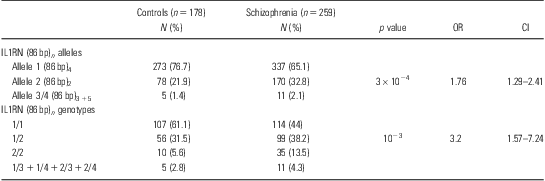
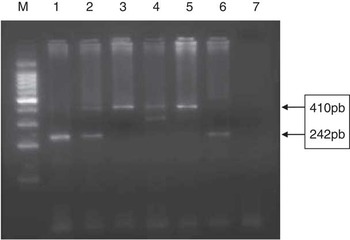
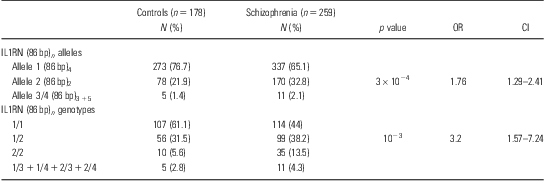
The genotype frequencies of IL1RN were in Hardy–Weinberg equilibrium for both the patient (p = 0.08) and control (p = 0.46) groups. The distribution of the IL1RN genotype and allele frequencies in the patient and control groups is shown in Table 1. In our study, four alleles were identified (see example in Fig. 1): allele 1 (four repeats of the 86 bp region, 410 bp), allele 2 (two repeats of the same region, 242 bp), allele 3 (three identical repeats, 325 bp) and allele 4 (five identical repeats, 500 bp). As the IL1RN*1 allele is the most common one and the IL1RN*2 allele is less common, whereas IL1RN*3 and IL1RN*4 alleles are rare, we considered only the first two.
Distribution of genotype and allele frequencies of IL1RN (86 bp)n polymorphisms in control subjects and patients with schizophrenia
CI, confidence interval; OR, odds ratio.
The χ 2-test was used to determine whether significant differences (p value) were observed when patient group was compared with control group (genotype 1/1 compared with genotype 2/2 and allele 1 compared with allele 2).
*The association remains significant in male group under the recessive model (genotype 2/2 compared with genotype 1/1 + 1/2) with p = 0.005).
Polymerase chain reaction amplification bands for IL1Ra variable number of tandem repeats showing positive A1 (band size, 410 bp) and A2 (band size, 242 bp) in lane 2 giving the A1/A2 genotype, only positive A1 in lanes 3 and 5 giving the A1/A1 genotype, only positive A2 in lanes 1 and 6 giving the A2/A2 genotype and positive A1 and A3 (band size, 325 bp) in lane 4 giving the A1/A3 genotype. Lane M shows DNA size marker and lane 7 shows negative control (no DNA).

The IL1RN*1 homozygote genotype was more frequent in the control group compared with the patient group (60.1% vs. 44%), whereas the IL1RN*2 homozygote genotype had a higher frequency in the patient group compared with the control group (13.5% vs. 5.6%), as shown by the difference, which was statistically strongly significant (p = 10−3, OR = 3.2 and 95% CI: 1.57–7.24). Similarly, the allele frequency of IL1RN*1 decreased in patients with schizophrenia compared with control subjects (65.1% vs. 76.7%), whereas the IL1RN*2 allele frequency increased (32.8% vs. 21.9%), reaching statistical significance (p = 3 × 10⁻⁴, OR = 1.76 and 95% CI: 1.29–2.41). Our results showed that five (2.8%) control subjects had a rare genotype, including three (1.7%) with the A1/A3 genotype, one (0.55%) with the A2/A3 genotype and one (0.55%) with the A1/A4 genotype. Similarly, 11 (4.3%) patients had a rare genotype, including eight (3.1%) with the A1/A3 genotype, two (0.8%) with the A2/A3 genotype and one (0.4%) with the A2/A4 genotype.
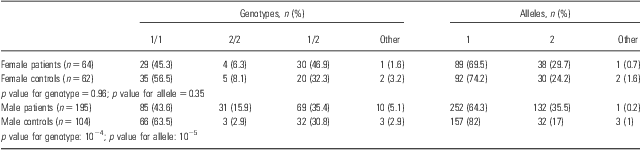
To provide a robust reduction in the heterogeneity of this disorder, we subdivided schizophrenia into two categories – patients with and patients without specific characteristics – and investigated differential distributions of genotypes and alleles in relation to clinical characteristics of the schizophrenia, such as age and sex of the patients and subtype of schizophrenia. Only when we stratified the patients according to sex (Table 2) did we find a statistically significant difference in the IL1RN genotype and allele distribution between control and male patients but not between control and female patients. In fact, we showed that the IL1RN*2 homozygote genotype frequency, as well as the IL1RN*2 allele, was particularly high in male patients compared with male controls (15.9% vs. 2.9%, p = 5 × 10⁻⁴ and 35.5% vs. 17%, p = 10−5).
Distribution of genotype and allele frequencies of IL1RN (86 bp)n polymorphism in control subjects and patients according to sex
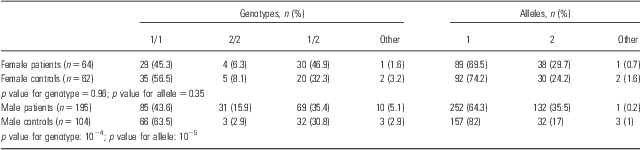
The χ 2 or Fisher's exact test was used to determine whether significant differences (p value) were observed when patient group was compared with control group.
*The association remains significant in male group under the recessive model (genotype 2/2 compared with genotype 1/1 + 1/2) with p = 0.0004.
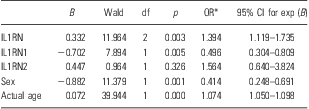
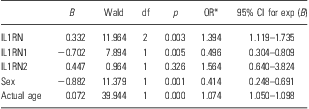
A multivariate logistic regression model including the variables sex, age and genetic polymorphism showed that the association between IL1RN and schizophrenia remains statistically significant (Table 3). The adjusted OR for the IL1RN genotypes was statistically significant (1.39; 95% CI = 1.11–1.73; p = 0.003). In particular, the IL1RN*1 allele appeared to be a protective factor against the disease (p = 0.005, OR = 0.49 and 95% CI: 0.3–0.8).
Multivariate logistic regression of schizophrenia risk associated with IL1RN genotypes
CI, confidence interval; OR, odds ratio.
*Odds ratios adjusting by sex and age.
Discussion
To evaluate the contribution of IL1 signalling to the brain pathology of schizophrenia, we analysed the IL1RN (86 bp) repeat polymorphism in a group of Tunisian patients with schizophrenia and in ethnically matched healthy controls. Our results have shown a strong increase in the IL1RN*2 allele in patients with schizophrenia compared with controls. Thus, this polymorphism or another one at proximity may influence the susceptibility to schizophrenia. In previous studies, only one study conducted in the Korean population described results similar to ours, with a carriage rate of the IL1RN*2 allele being associated with a higher risk for schizophrenia (Reference Kim, Lee and Koo28). In other studies, inconsistent associations have been reported with three polymorphisms of two candidate genes (−511IL1β, +3953IL1β and IL1RN). These studies have shown an excess of different haplotypic combinations (IL1β–IL1RN) in schizophrenic patients compared with European controls (Reference Papiol, Rosa and Gutiérrez27,Reference Zanardini, Bocchio-Chiavetto and Scassellati29,Reference Katila, Hänninen and Hurme30), but no association was found in studies conducted in Asia (Reference Watanabe, Nunokawa, Kaneko, Muratake, Koizumi and Someya25,Reference Chowdari, Xu and Zhang34). This divergence may reflect a difference in haplotype structure between populations and in the aetiology of the disease. Indeed, we noted that the IL1RN allelic frequency displayed an ethnic variation. The IL1RN*1 and IL1RN*2 allele frequencies determined in the control group of our study (76.7% and 21.9%, respectively) were the closest to those found in Spain (71% and 25%) and varied even more from those found in Finland (70% and 29%), Italy (65% and 32%), United States (52% and 39%), Japan (93% and 7%) or China (86% and 12%). As the IL1 signalling depends on the IL1/IL1Ra ratio and the IL1 gene is complex and contains several single nucleotide polymorphisms, we project to determine the genotypic analysis of IL1β to compare the haplotypic structure of our population with that of others. Further studies experimenting either family-based samples or other types of populations are needed to confirm or reject these results.
The molecular mechanism behind the association between the IL1RN*2 allele and inflammatory diseases is unclear. Initially, this allele had been correlated with enhanced IL1β and IL1Ra production by mononuclear cells in vitro and increased levels of IL1Ra in the plasma of healthy blood donors, leading the authors to hypothesise that the increased capacity to produce IL1β could be more critical than the increased IL1Ra levels in the pathogenesis of those diseases (Reference Santtila, Savinainen and Hurme18). More recently, it was suggested that the impact of this polymorphism could be different according to the cell subtype, as it has been shown that in epithelial and endothelial cells the IL1RN*2 allele was associated with reduced protein and RNA messenger production (Reference Andus, Daig and Vogl19–Reference Carter, Jones and Camp21). The functional effects of this allele on IL1Ra and IL1 production remain to be evaluated in brain cells. Nevertheless, as it has been shown, the IL1Ra serum levels (mainly produced by hepatocyte cells) were increased in patients with schizophrenia in contrast to the decreased level of IL1Ra in the postmortem brain tissues of the patients’ prefrontal cortex, demonstrating that the regulation of IL1Ra differed in brain from the periphery (Reference Toyooka, Watanabe and Iritani35). We can hypothesise that the IL1RN polymorphism could have an impact on brain cells similar to that in epithelial cells and would be regardless of the periphery. Therefore, the IL1RN*2 allele may be associated with a decreased level of IL1Ra production in brain cells, resulting in neuroinflammation, which may enhance various IL1-mediated stress responses such as glucocorticoid induction and could increase the susceptibility to various psychiatric diseases, including schizophrenia (Reference Prolo and Licinio36).
Although it has been comprehensively reported that IL1Ra plays an anti-inflammatory role in the immune system and its production seems, at least in part, to be genetically determined, the functional role of this polymorphism in the schizophrenia aetiology remains unclear. Several experimental models based on genetically modified mice have been used to display the role of the IL1/IL1Ra balance in embryonic brain development and neuroinflammation in adulthood (Reference Spulber, Bartfai and Schultzberg37). Mouse models showed that IL1 displays peaks of expression in the brain during development, controlling the brain size in adult animals (Reference Spulber, Oprica, Bartfai, Winblad and Schultzberg38). In addition, IL1 appears to be central in regulating the elasticity of the brain response to injury, and IL1Ra knockout mice displayed neurobehavioural impairments (Reference Spulber, Bartfai and Schultzberg37). Moreover, it has been suggested that exposure to IL1β levels leads to a dose-dependent reduction in neuronal survival (Reference Marx, Jarskog, Lauder, Lieberman and Gilmore39) and to a dopaminergic differentiation of neural progenitors (Reference Potter, Ling and Carvey11). Implication of the IL1 complex polymorphisms in the development of schizophrenia is supported by several correlations of the IL1 complex genetic polymorphism with ventricular enlargement (Reference Papiol, Molina and Desco22), decreases in bifrontal–temporal grey matter volume and generalised white matter tissue deficits in schizophrenia (Reference Meisenzahl, Rujescu and Kirner40).
The analysis of our results according to gender showed that the IL1RN polymorphism is associated with schizophrenia susceptibility in male but not in female subjects, suggesting that gender influences the penetrance of the IL1RN gene for schizophrenia. The regulation of IL1Ra production is controlled by both genotypic and environmental factors (Reference Cullup, Middleton, Duggan, Conn and Dickinson41). Moreover, it could be fundamentally different from one gender to another. Indeed, the IL1Ra level was higher in women than in men, and the involvement of oestrogen levels in regulating the IL1 system was suggested (Reference Lynch, Dinarello and Cannon42,Reference Sadeghi, Daniel, Naujokat, Weimer and Opelz43). As our results showed no implication of the IL1RN polymorphism in the schizophrenia susceptibility in female subjects, we hypothesised that, for women, the anti-inflammatory molecule IL1Ra could be upregulated by oestrogen, also known to be protective against schizophrenia (Reference Kulkarni44), without the influence of the IL1RN polymorphism. In contrast, for male subjects, the genetic regulation of the IL1Ra production could play a decisive role and strongly influence the susceptibility to schizophrenia. Nevertheless, the sample size of female subjects was small (64 patients and 62 controls), and a replication of our findings in other, larger populations could be of particular importance to exclude IL1RN as one of the susceptibility genes for schizophrenia in the female sex.
In conclusion, our data suggest that the genetic variability in IL1RN potentially associated with a decreased IL1Ra production level in the brain would cause a neuroinflammation, which may contribute to a shared genetic risk background of vulnerability for schizophrenia disorder in our population. How the IL1Ra reduction level in the brain is implicated in the aetiology of schizophrenia remains to be elucidated.
Acknowledgements
We thank the staff of the Department of Blood bank and Psychiatry of the CHU F. Bourguiba of Monastir for providing samples and clinical information. This work was supported by the Secretary of State of Scientific and Technological Research and the Ministry of Graduated Studies of Scientific and Technological Research.