Introduction
The family Allocreadiidae Looss, 1902 comprises small digeneans that infect primarily freshwater fishes, although some species have also been reported from amphibians and reptiles. The family is distributed worldwide, with South America harbouring a particularly high diversity. In recent years, substantial taxonomic revisions accompanied by the description of numerous new species have reshaped the systematics of the family. These advances have been driven largely by integrative approaches combining classical morphological techniques with molecular data, allowing more robust hypotheses of species boundaries and phylogenetic relationships (Aguiar et al. Reference Aguiar, Ebert, Gomes, Teixeira, de Souza and da Silva2024; Alcantara et al. Reference Alcantara, Ebert, Ferreira-Silva, Forti, Morais, Pérez-Ponce de León and Silva2024; Aydogdu et al. Reference Aydogdu, Vainutis, Voronova and Aydogdu2023; Caira and Bogéa Reference Caira, Bogea, Jones, Bray and Gibson2005; Franceschini et al. Reference Franceschini, Aguiar, Zago, Yamada, Ebert and Silva2021; Mendoza-Garfias et al. Reference Mendoza-Garfias, García-The, Caspeta-Mandujano, Vidal-Martínez and Hernández-Mena2022; Montes et al. Reference Montes, Arredondo, Croci, Barneche, Reshaid, Ibañez Shimabukuro and Pérez-Ponce de León2025; Upadhyay et al. Reference Upadhyay, Babita, Singh, Yadav, Kumar, Singh, Pandey, Nanware and Sharma2023; Vainutis et al. Reference Vainutis, Voronova and Urabe2021, Reference Vainutis, Voronova, Urabe and Kazarin2023; Vainutis Reference Vainutis2024). Beyond resolving taxonomy, these studies have increasingly revealed complex patterns of host association and biogeographic structure within the family.
In South America, Allocreadiidae is currently represented by five genera. Three genera possess oral lobes – Creptotrema Travassos, Artigas & Pereira, 1928; Creptotrematina Yamaguti, 1954; and Martorellia Montes et al., Reference Montes, Arredondo, Croci, Barneche, Reshaid, Ibañez Shimabukuro and Pérez-Ponce de León2025 – whereas Allocreadium Looss, 1900 and Wallinia Pearse, 1920 lack oral lobes (Montes et al. Reference Montes, Arredondo, Croci, Barneche, Reshaid, Ibañez Shimabukuro and Pérez-Ponce de León2025; WoRMS 2026). In the Neotropical region, members of these genera parasitize fishes belonging mainly to Characiformes, Gymnotiformes, Perciformes, and Siluriformes (Caira and Bogéa Reference Caira, Bogea, Jones, Bray and Gibson2005; Liquin et al. Reference Liquin, Gilardoni, Cremonte, Saravia, Cristobal and Davies2022), which constitute a major component of South American fish assemblages.
The genus Creptotrematina parasitizes primarily characid fishes, including species of Astyanax, Psalidodon, Tetragonopterus, Triportheus, and Megalamphodus. It currently comprises five valid species: Creptotrematina aguirrepequenoi Jiménez-Guzmán, 1973; C. batalhensis Dias & Abdallah, 2020; C. dispar (Teixeira de Freitas, 1941) Manter, 1962; C. dissimilis (Teixeira de Freitas, 1941) Yamaguti, 1954; and C. saltograndensis Ebert, Hernández-Mena, Pérez-Ponce de León & da Silva, 2024. Among them, C. aguirrepequenoi is the only species reported from Middle America (Mexico). In South America, C. dispar and C. dissimilis have been recorded in Argentina (Kohn et al. Reference Kohn, Fernandes and Cohen2007), whereas C. batalhensis and C. saltograndensis are known from Brazil.
These four South American species occur within the La Plata Basin, one of the largest and most geomorphologically complex freshwater systems in the world. The basin is subdivided into three major sub-basins: the Paraná River, including the Iguazú and Salado rivers, the Paraguay River, including the Pilcomayo and Bermejo rivers, and the Uruguay River (Pasquini and Depetris Reference Pasquini and Depetris2006). The Paraná River, the principal component of the La Plata Basin (Amsler et al. Reference Amsler, Paoli, Schreider, Cacik, Cristina, García, Giacosa, Hämmerly, Iriondo, Macor, Montagnini, Prendes, Ramonell, Szupiany, Toniolo and Tujchneider2020), has traditionally been divided into Upper, Middle, and Lower sections based on geomorphological and hydrological criteria (Popolizio Reference Popolizio2003). Throughout its geological history, the basin has undergone river capture events, floodplain expansion, and drainage rearrangements, processes widely recognized as drivers of diversification and population structuring in Neotropical freshwater fishes.
Despite the vast geographic extent of the La Plata Basin and the remarkable diversity of freshwater fishes it harbours (Mirande and Koerber Reference Mirande and Koerber2020), relatively few host species have been reported for Creptotrematina. Most species of the genus have been recorded from a single host or a limited number of closely related hosts, with the exception of C. dispar and C. dissimilis, which have been reported from multiple fish species (Kohn et al. Reference Kohn, Fernandes and Cohen2007). This apparent restriction in host range contrasts with the broad geographic distribution of the genus within the basin and raises questions about the relative roles of hydrographic fragmentation, host phylogeny, and dispersal capacity in shaping patterns of parasite diversification.
Freshwater basins are often viewed as mosaics of isolating compartments that promote allopatric divergence. However, for parasites with complex life cycles and host-mediated dispersal, hydrographic boundaries may not necessarily translate into evolutionary isolation. Evaluating whether species of Creptotrematina exhibit genetic structuring across sub-basins of the La Plata Basin therefore provides an opportunity to assess whether parasite diversification in this system is primarily driven by geographic compartmentalization or by host-associated evolutionary processes.
The present study aimed to identify specimens of Creptotrematina using molecular analyses based on partial sequences of the 28S rDNA, ITS region, and mitochondrial COI genes and to compare them with sequences available in GenBank. We also evaluated patterns of genetic variation among populations from different sectors of the La Plata Basin. By integrating molecular data within a basin-scale biogeographic framework, we sought to clarify the taxonomic identity of these specimens and explore the broader processes underlying their distribution.
Material and methods
Specimen collection
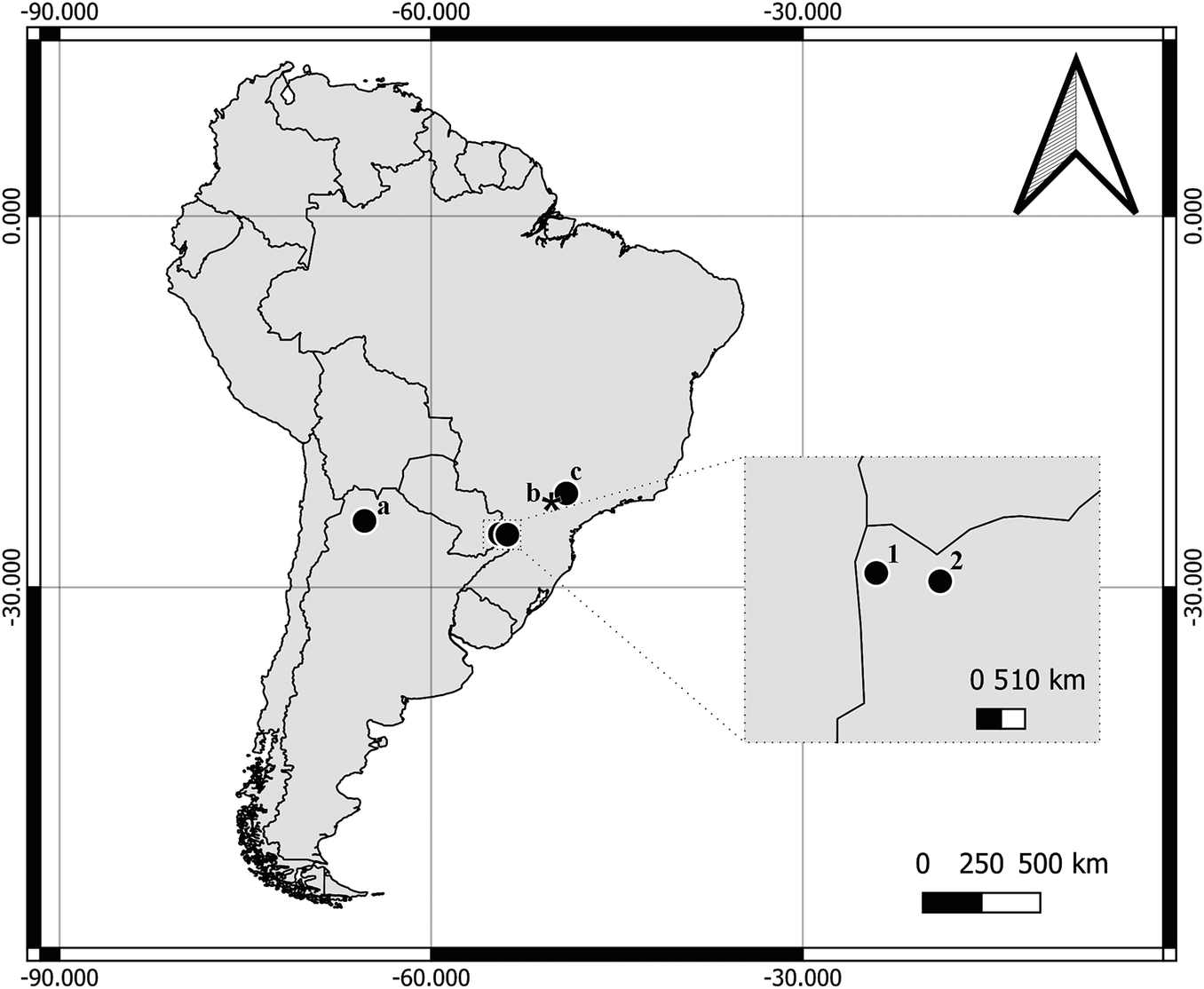
Specimens of Psalidodon leonidas (Azpelicueta, Casciotta & Almirón, 2002) were collected from Piletas Stream (25°39′59″S, 54°34′43″W; Paraná River Basin) and Astyanax bifasciatus (Garavello & Sampaio, 2010) was collected upstream of Iguazú Falls in the Iguazú River Basin (25°41′20.16″S, 54°26′44.87″W), Misiones Province, Argentina (sites 1 and 2, Figure 1). Fishes were captured using fish traps and gill nets and transported alive to the laboratory in oxygenated bags containing water from the sampling site. In the laboratory, fish were maintained in aquaria supplied with aerated water from the collection site. Specimens were euthanized by cervical section (Institutional Animal Care and Use Committee (IACUC) Protocol number: 015.05.2024), necropsied, and examined for digeneans. Recovered specimens were preserved in 96% ethanol for molecular analyses. Voucher specimens were deposited in the Helminthological Collection of the Museo de La Plata, La Plata, Argentina, under accession number MLP-He 8365.
Sampling sites of fishes infected with Creptotrematina batalhensis Dias & Abdallah, 2020 from Argentina. (1) Piletas Stream, Paraná River basin (Argentina), host: Psalidodon leonidas. (2) Iguazú River basin, Misiones (Argentina), host: Astyanax bifasciatus. Other records of Creptotrematina spp. supported with DNA information (a) La Caldera, Salta (Argentina), host unknown (sequence OQ616981, sequences not published). (b) Type locality of Creptotrematina saltograndensis Ebert, Hernández-Mena, Pérez-Ponce de León & da Silva, 2024: Pardo River, Paranapanema River basin, Salto Grande municipality, São Paulo (Brazil), parasitizing Megalamphodus eques. (c) Type locality of Creptotrematina batalhensis: Batalha River (São Paulo, Brazil), hosts: Astyanax fasciatus and Astyanax lacustris.

Figure 1. Long description
A map of South America with a coordinate grid showing longitude from negative 90.000 to negative 30.000 and latitude from 0.000 to negative 30.000.
* In the Northwest of Argentina, a black dot is labeled ‘a’.
* In Southeast Brazil, a black dot is labeled ‘c’ and an asterisk is labeled ‘b’.
* A dashed box in the border region between Northeast Argentina and Southern Brazil is magnified in an inset map to the right.
* The inset map shows two numbered black dots: ‘1’ located further West and ‘2’ located to the East.
* The inset includes a scale bar representing 0 to 510 k m.
* The main map includes a North arrow in the top right corner and a primary scale bar in the bottom right representing 0, 250, and 500 k m.
* D N A information for these sites is referenced in the caption.
DNA extraction, amplification and sequencing
Genomic DNA was extracted using the Wizard® Genomic DNA Purification Kit (Promega), following the manufacturer’s protocol. A fragment of the 28S rDNA gene was amplified by polymerase chain reaction (PCR) using an Eppendorf Mastercycler thermal cycler, with the forward primer LSU5 (Littlewood et al. Reference Littlewood, Curini-Galletti and Herniou2000) and reverse primer 1500R (Olson et al. Reference Olson, Cribb, Tkach, Bray and Littlewood2003).
The ITS2 rDNA region was amplified using the forward primer 3S (Morgan and Blair Reference Morgan and Blair1995) and the reverse primer ITS2.2 (Cribb et al. Reference Cribb, Anderson, Adlard and Bray1998). In addition, a partial ribosomal sequence (961 bp) comprising the terminal portion of 18S rDNA, ITS1, 5.8S rDNA, ITS2 and the initial portion of 28S rDNA, was generated for Martorellia liciae Montes, Arredondo, Croci, Barneche, Reshaid, Ibañez Shimabukuro & Pérez-Ponce de León, 2025 from the type host Pseudocorynopoma doriae Perugia, 1891 collected at the type locality, from Arroyo Juan Blanco (Buenos Aires Province, Argentina) using the forward primer MITF1 (5′-CGT AAC AAG-GTT TCC GTA G-3′) (Tkach and Curran Reference Tkach and Curran2015). The mitochondrial cytochrome c oxidase subunit I (COI) gene was amplified using the primers LCO1490 and HCO2198 (Folmer et al. Reference Folmer, Black, Hoeh, Lutz and Vrijenhoek1994).
PCR reactions were performed using GoTaq Master Mix (Promega), following the protocols described by Tkach et al. (Reference Tkach, Littlewood, Olson, Kinsella and Swiderski2003) for the 28S rDNA gene and the partial ribosomal DNA sequence amplified with primer MITF1 and by Muñoz and George-Nascimento (Reference Muñoz and George-Nascimento2019) for the other ITS2 region. The thermocycling profile for COI consisted of an initial denaturation at 94 °C for 3 min; followed by 45 cycles of 94 °C for 30 s, 50 °C for 30 s, and 72 °C for 1 min 45 s; with a final extension at 72 °C for 2 min.
PCR products were sequenced by Macrogen Inc. (South Korea). Chromatograms were edited and assembled in Geneious 11. Consensus sequences were used to search for homologous sequences in GenBank.
Sequence comparison and phylogenetic analysis
Newly generated sequences and those retrieved from GenBank were aligned using the online version of MAFFT v.7 (Katoh et al. Reference Katoh, Rozewicki and Yamada2019). The best partitioning scheme and nucleotide substitution models were selected under the Akaike Information Criterion (AIC; Posada and Buckley Reference Posada and Buckley2004) implemented in MEGA X (Kumar et al. Reference Kumar, Stecher, Li, Knyaz and Tamura2018).
The selected substitution model for the 28S dataset was HKY+I and for the ITS dataset was GTR+I+G. For the COI dataset, the best-fit models for the first, second, and third codon positions were K2+G+I, TN93+G+I, and T92+I, respectively. Because K2, TN93, and T92 are not implemented in MrBayes, these models were approximated by HKY+G+I for the first codon position, GTR+G+I for the second position, and HKY+I for the third position.
Phylogenetic reconstruction was conducted using Bayesian inference (BI) in MrBayes v.3.2.3 (Ronquist et al. Reference Ronquist, Teslenko, van der Mark, Ayres, Darling, Höhna, Larget, Liu, Suchard and Huelsenbeck2012). Two parallel Metropolis-coupled Markov chain Monte Carlo (MCMC) analyses were run for 3 million generations, with trees sampled every 1,000 generations. Convergence was assessed by verifying that the average standard deviation of split frequencies was below 0.01. A majority-rule consensus tree was constructed after discarding the first 25% of sampled trees as burn-in.
Uncorrected p-distances and nucleotide differences were calculated in MEGA X. Newly generated sequences were deposited in GenBank (Table 1).
Sequences included in the phylogenetic analysis and their corresponding allocreadid taxa, host species, and geographic origin. Newly generated sequences are shown in bold

Table 1. Long description
The table contains 7 columns: Species, 28 S, I T S, C O I, Host, Country, and Sequence author.
Key entries include:
* Crepidostomum nemachilus: 28 S MK818618, Host Barbatula toni, Russia, Vainutis et al. 2021.
* Creptotrema astyanace: 28 S KF631422 and HQ833707, I T S KF631428 and HQ833707, Hosts Astyanax fasciatus and Astyanax aeneus, Costa Rica.
* Creptotrema lobata: 28 S KX954171-72, I T S KX954165-66, C O I PP587333-34, Host Brycon guatemalensis, Mexico.
* Creptotrema ocloya: Multiple entries for 28 S MT140287-91, I T S MT140284-86, Hosts Heptapterus qenqo, Pisidium ocloya, and Hyalella sp., Argentina.
* Creptotrematina aguirrepequenoi: Multiple sequence entries for 28 S, I T S, and C O I, Hosts Astyanax mexicanus and Astyanax aeneus, Mexico and Costa Rica.
* Creptotrematina batalhensis (P): 28 S PZ514110, I T S PZ514111, C O I PZ514114-17, Host Psalidodon leonidas, Argentina, This study (bolded).
* Creptotrematina batalhensis (I): 28 S PZ514109, I T S PZ514112, Host Astyanax bifasciatus, Argentina, This study (bolded).
* Martorellia liciae: 28 S OQ331017-19, I T S PZ514113, Host Pseudocorynopoma doriae, Argentina, Montes et al. 2025 (bolded).
* Pseudoparacreptotrema yaguezani: 28 S PP545471-72, I T S PP548224, C O I PP577106, Host Agonostomus monticola, Puerto Rico.
* Wallinia chavarriae: 28 S HQ833703 and PP575800-01, I T S KC899975-76, Host Astyanax aeneus, Costa Rica.
Several rows for Margotrema and Paracreptotrema species list sequences from Mexico and USA hosts such as Ictalurus punctatus and Profundulus species.
Results
Morphological analysis
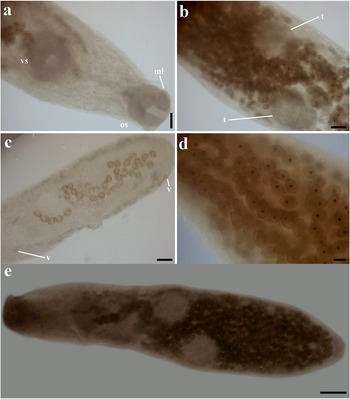
The specimens examined are morphologically consistent with C. batalhensis, particularly in the presence of ventrolateral muscular lobes on the oral sucker (Figure 2a), an oral sucker to ventral sucker ratio of approximately 1:1 (Figure 2a), oblique testes located in the posterior half of the body (Figure 2b), and vitelline follicles extending to the posterior extremity without forming dense confluent fields (Figure 2c). The presence of eyespots in the eggs and the extension of the uterine loops into the posterior extremity of the body support this identification (Figure 2d, e).
Photographs of the material used for DNA analysis showing the characters used to relate the specimens to Creptotrematina batalhensis. a. Oral sucker showing the ventrolateral muscular lobes and ventral sucker with a sucker ratio of approximately 1:1. b. Testes disposition oblique in the posterior half of the body. c. Vitelline follicles extending to the posterior extremity without forming dense confluent fields. d. Eggs with eyespot. e. Uterine loops into the posterior extremity of the body. Abbreviations: mL = muscular lobes; os = oral sucker; t = testes; v = vitelline follicles; vs = ventral sucker. Scale bars: a–c = 100 μm; d = 40 μm.

Figure 2. Long description
The figure consists of five panels labeled a through e.
* Panel a: A close-up of the anterior end. The label o s points to the circular oral sucker at the tip. The label m l indicates the muscular lobes on the ventrolateral side of the oral sucker. Further down the body, the label v s identifies the ventral sucker.
* Panel b: A view of the mid-body region. Two white lines labeled t point to the testes, which are positioned obliquely to one another in the posterior half of the organism.
* Panel c: Shows the posterior half of the body. Labels v point to the vitelline follicles, which appear as small, dark clusters distributed along the lateral margins and extending toward the posterior extremity.
* Panel d: A high-magnification view of the eggs. The eggs are oval-shaped and contain distinct dark spots, identified as eyespots.
* Panel e: A full-body view of the specimen showing the uterine loops filled with eggs extending into the posterior extremity of the body.
Scale bars are provided in the bottom right of each panel. For panels a, b, and c, the scale bar represents 100 micrometers. For panel d, the scale bar represents 40 micrometers.
Molecular analyses
One 28S sequence (1242 bp) and one ITS sequence (492 bp) of C. batalhensis were obtained from specimens collected in the Iguazú River. From the Paraná sub-basin of the La Plata Basin, one 28S sequence (1332 bp), one ITS sequence (477 bp), and four COI sequences (699–807 bp) were generated.
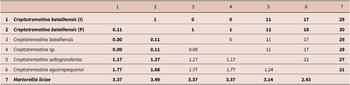
The 28S dataset comprised 946 bp and 85 taxa, including all Neotropical allocreadiid sequences available in GenBank. In the resulting topology (Figure 3), the new sequences clustered with C. batalhensis and Creptotrematina sp. (OQ616981). No genetic divergence was detected among the new sequences from the Paraná sub-basin (C. batalhensis (P)), the published sequences of C. batalhensis, and Creptotrematina OQ616981. The sequence obtained from the Iguazú River differed from the Paraná River sequence by a single nucleotide (0.11%) (Table 2, Supplementary Material 1).
Phylogram inferred using Bayesian analysis (3,000,000 generations) from partial 28S rDNA sequences, showing relationships among Allocreadiidae from Middle and South America retrieved from GenBank. Branch support values represent posterior probabilities (>0.90).

Figure 3. Long description
A phylogenetic tree with a scale bar of 0.01 at the bottom. The tree branches from a root on the left toward species names on the right.
* The top major clade includes various Creptotrema species such as Creptotrema creptotrema, C. guacurarii, C. schubarti, C. tica, C. totonacapanensis, C. stenopteri, C. megacetabulare, C. lobata, C. astyanace, C. conconae, C. cruste, and C. ocloya. Support values at these nodes range from 0.97 to 1.00.
* Below this is a clade containing Wallinia species including Wallinia anindoi, W. brasiliensis, W. caririensis, W. mexicana, W. sp., and W. chavarriae.
* The next major section includes Creptotrematina species. Notably, Creptotrematina batalhaensis (I) and (P) are grouped with Creptotrematina sp. (O Q 6 1 6 9 8 1). This group also includes Creptotrematina saltograndensis, C. aguirrepequenoi, Martorellia lizae, and Mesoamericatrema magnisacculus.
* Further down, a clade contains Paracreptotrema blancoi, P. rosthali, and P. heterandriae.
* This is followed by a group of Pseudoparacreptotrema species including P. axtlaensis, P. yaguezani, P. falciformis, P. macroacetabulatum, and P. pacificum.
* The bottom of the tree features more divergent lineages including Megalonia ictaluri, Creptotrema funduli, Margotrema sp., and the outgroup Crepidostomum nemachilus at the very base.
Pairwise uncorrected p-distances (%) based on 28S rDNA sequences of Creptotrematina spp. and Martorellia liciae. Values below the diagonal represent percentage sequence divergence, whereas values above the diagonal indicate the number of nucleotide differences

Table 2. Long description
The table compares seven taxa. Values above the diagonal represent the number of nucleotide differences, and values below the diagonal represent percentage sequence divergence.
* Row 1: Creptotrematina batalhensis (I). Nucleotide differences: 1 with taxon 2, 0 with taxon 3, 0 with taxon 4, 11 with taxon 5, 17 with taxon 6, and 29 with taxon 7.
* Row 2: Creptotrematina batalhensis (P). Divergence: 0.11 percent with taxon 1. Nucleotide differences: 1 with taxon 3, 1 with taxon 4, 12 with taxon 5, 18 with taxon 6, and 30 with taxon 7.
* Row 3: Creptotrematina batalhensis. Divergence: 0.00 percent with taxon 1, 0.11 percent with taxon 2. Nucleotide differences: 0 with taxon 4, 11 with taxon 5, 17 with taxon 6, and 29 with taxon 7.
* Row 4: Creptotrematina sp. Divergence: 0.00 percent with taxon 1, 0.11 percent with taxon 2, 0.00 percent with taxon 3. Nucleotide differences: 11 with taxon 5, 17 with taxon 6, and 29 with taxon 7.
* Row 5: Creptotrematina saltograndensis. Divergence: 1.17 percent with taxon 1, 1.27 percent with taxon 2, 1.17 percent with taxon 3, 1.17 percent with taxon 4. Nucleotide differences: 12 with taxon 6, and 27 with taxon 7.
* Row 6: Creptotrematina aguirrepequenoi. Divergence: 1.77 percent with taxon 1, 1.88 percent with taxon 2, 1.77 percent with taxon 3, 1.77 percent with taxon 4, 1.24 percent with taxon 5. Nucleotide differences: 21 with taxon 7.
* Row 7: Martorellia liciae. Divergence: 3.37 percent with taxon 1, 3.49 percent with taxon 2, 3.37 percent with taxon 3, 3.37 percent with taxon 4, 3.14 percent with taxon 5, and 2.43 percent with taxon 6.
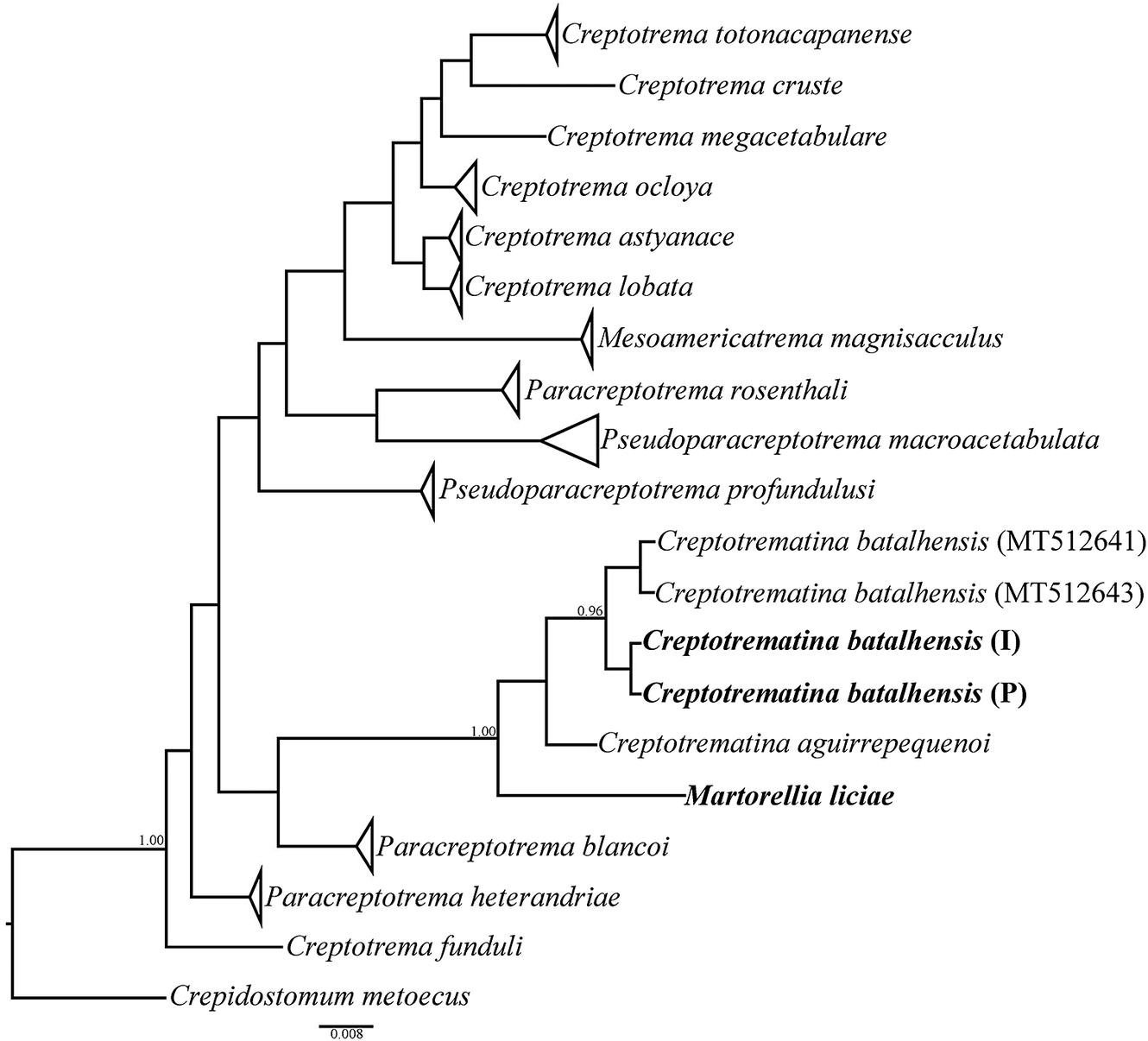
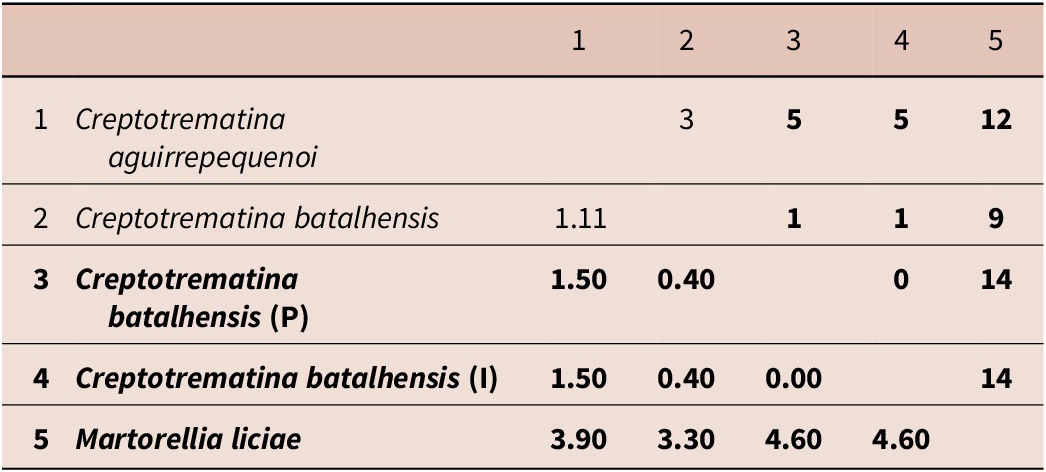
The ITS dataset comprised 344 bp and 31 taxa. The resulting topology included Neotropical allocreadiids (Figure 4). Creptotrematina species formed a clade with low support, whereas M. liciae was recovered as the sister taxon of Creptotrematina spp. The relationship between C. aguirrepequenoi and C. batalhensis received moderate support (PP = 0.80). The new sequences clustered with C. batalhensis (PP = 0.96). Genetic divergence between the new sequences and previously published sequences of C. batalhensis was 0.00–0.40%. Martorellia liciae was recovered as sister to Creptotrematina spp., with genetic divergence values ranging from 3.30% to 4.60% (10–12 bp) (Table 3, Supplementary Material 2).
Phylogram inferred using Bayesian analysis (3,000,000 generations) from partial ITS2 rDNA sequences, showing relationships among Allocreadiidae from Middle and South America retrieved from GenBank. Branch support values indicate posterior probabilities (>0.90).

Figure 4. Long description
The phylogram branches from a root on the left toward terminal nodes on the right. At the bottom, Crepidostomum metoecus serves as the outgroup. Moving upward, the tree splits into several major clades.
Top Clade: Includes Creptotrema totonacapanense, Creptotrema cruste, Creptotrema megacetabulare, Creptotrema ocloya, Creptotrema astyanace, and Creptotrema lobata.
Middle Clade: Features Mesoamericatrema magnisacculus, Paracreptotrema rosenthali, Pseudoparacreptotrema macroacetabulata, and Pseudoparacreptotrema profundulusi.
Lower Clade: This group contains a cluster of Creptotrematina species including Creptotrematina batalhensis with accession numbers M T 5 1 2 6 4 1 and M T 5 1 2 6 4 3, as well as specimens labeled I and P in bold. This cluster is sister to Creptotrematina aguirrepequenoi and Martorellia liciae.
Basal to the lower clade are Paracreptotrema blancoi, Paracreptotrema heterandriae, and Creptotrema funduli.
Branch support values are indicated at key nodes, such as 1.00 at the primary split and 0.96 within the Creptotrematina group. A scale bar at the bottom represents 0.008 substitutions per site.
Pairwise uncorrected p-distances (%) based on ITS2 rDNA sequences of Creptotrematina spp. and Martorellia liciae. Values below the diagonal represent percentage sequence divergence, whereas values above the diagonal indicate the number of nucleotide differences. Sequences generated in this study (including specimens from Psalidodon leonidas, Piletas Stream, Parana basin (P), and Astyanax bifasciatus, Iguazú River Basin (I)) are included and correspond to the values reported in the Results section; remaining sequences were retrieved from GenBank

Table 3. Long description
The table compares five taxa: 1. Creptotrematina aguirrepequenoi, 2. Creptotrematina batalhensis, 3. Creptotrematina batalhensis P, 4. Creptotrematina batalhensis I, and 5. Martorellia liciae.
Nucleotide differences (above diagonal):
* 1 vs 2: 3
* 1 vs 3: 5
* 1 vs 4: 5
* 1 vs 5: 12
* 2 vs 3: 1
* 2 vs 4: 1
* 2 vs 5: 9
* 3 vs 4: 0
* 3 vs 5: 14
* 4 vs 5: 14
Percentage sequence divergence (below diagonal):
* 2 vs 1: 1.11
* 3 vs 1: 1.50
* 3 vs 2: 0.40
* 4 vs 1: 1.50
* 4 vs 2: 0.40
* 4 vs 3: 0.00
* 5 vs 1: 3.90
* 5 vs 2: 3.30
* 5 vs 3: 4.60
* 5 vs 4: 4.60
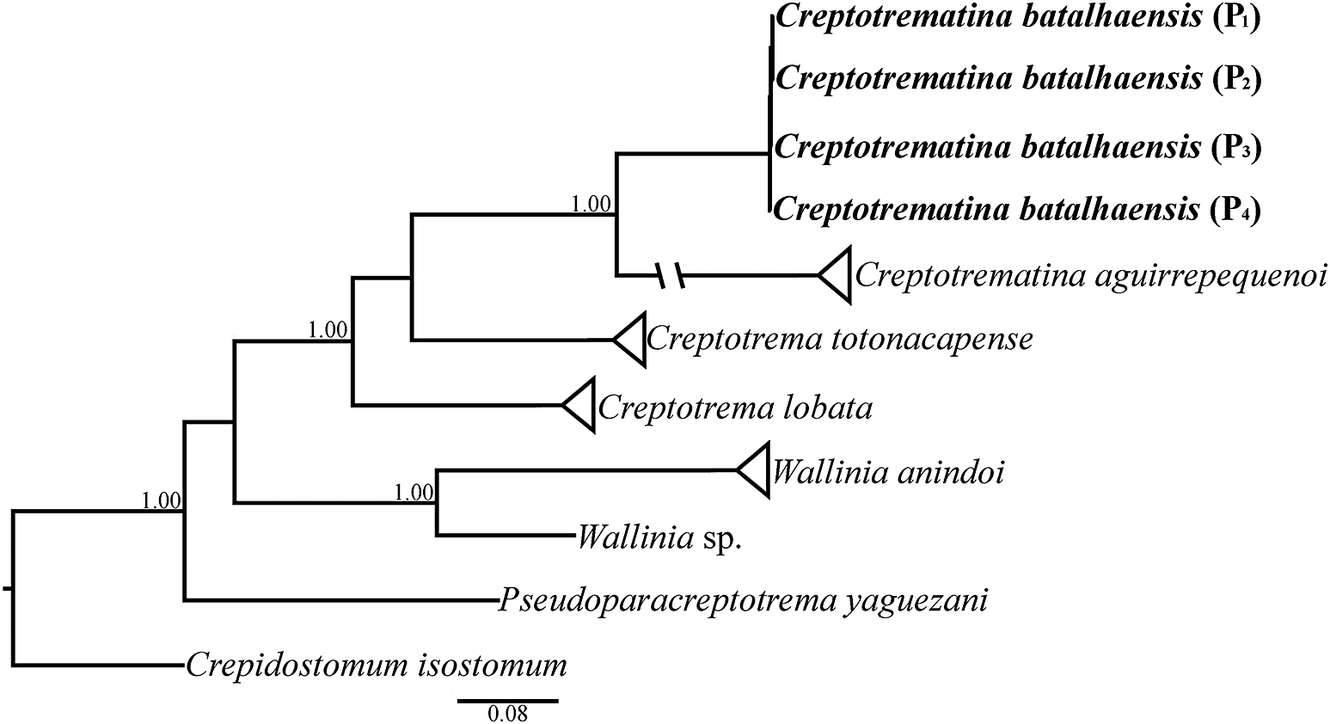
The COI dataset comprised 750 bp and 18 taxa. In the resulting topology (Figure 5), the new sequences formed a strongly supported clade and were recovered as sister to C. aguirrepequenoi. No genetic divergence was detected among the new sequences (0%, 0 bp). Genetic divergence between the new sequences and C. aguirrepequenoi was 14.77% (90 bp) (Table 4).
Phylogram inferred using Bayesian analysis (3,000,000 generations) based on partial COI mtDNA sequences, showing relationships among Allocreadiidae. Sequences were retrieved from GenBank. Branch support values represent posterior probabilities (>0.90).

Figure 5. Long description
A horizontal phylogram with a scale bar of 0.08 at the bottom. The tree originates from a root on the left.
* The most basal branch at the bottom leads to Crepidostomum isostomum.
* Moving upward, the next branch leads to Pseudoparacreptotrema yaguezani.
* A major node with a support value of 1.00 splits into two main clades.
* The lower clade of this split has a node value of 1.00 and contains Wallinia sp. and a collapsed clade for Wallinia anindoi.
* The upper clade of the split has a node value of 1.00 and further divides into Creptotrema lobata and another sub-clade.
* This sub-clade has a node value of 1.00 and splits into Creptotrema totonacapense and a final sister group.
* The final sister group contains a node with a value of 1.00 that branches into a collapsed clade for Creptotrematina aguirrepequenoi (indicated by a broken branch line) and a terminal cluster of four individuals: Creptotrematina batalhaensis P sub 1, P sub 2, P sub 3, and P sub 4.
Pairwise uncorrected p-distances (%) based on mitochondrial cytochrome c oxidase subunit I (COI) sequences of allocreadiid digeneans included in this study. Values below the diagonal represent percentage sequence divergence, whereas values above the diagonal indicate the number of nucleotide differences

Table 4. Long description
The table compares seven species: 1. Creptotrematina batalhensis (P), 2. Creptotrematina aguirrepequenoi, 3. Creptotrema totonacapense, 4. Creptotrema lobata, 5. Pseudoparacreptotrema yaguezani, 6. Wallinina anindoi, and 7. Wallinia species.
Values above the diagonal (nucleotide differences):
* Species 1 compared to 2 through 7: 90, 80, 85, 105, 110, 91.
* Species 2 compared to 3 through 7: 93, 88, 107, 102, 96.
* Species 3 compared to 4 through 7: 68, 81, 97, 89.
* Species 4 compared to 5 through 7: 88, 96, 83.
* Species 5 compared to 6 and 7: 104, 87.
* Species 6 compared to 7: 81.
Values below the diagonal (percentage sequence divergence):
* Species 2 compared to 1: 14.77.
* Species 3 compared to 1 and 2: 13.91, 16.17.
* Species 4 compared to 1 through 3: 13.87, 14.52, 11.90.
* Species 5 compared to 1 through 4: 14.65, 17.56, 14.09, 14.36.
* Species 6 compared to 1 through 5: 18.11, 16.80, 16.87, 15.89, 17.12.
* Species 7 compared to 1 through 6: 15.22, 16.07, 15.81, 13.88, 14.55, 13.60.
The concatenated dataset comprised 2040 bp and 34 taxa. The resulting topology (Figure 6) recovered a strongly supported clade (PP = 1.00) comprising Creptotrematina spp. and M. liciae. The Creptotrematina clade was also strongly supported (PP = 1.00). Within this clade, the new sequences clustered with C. batalhensis, which was recovered as sister to C. saltograndensis; together, these species formed the sister group to C. aguirrepequenoi.
Consensus phylogenetic tree inferred using Bayesian analysis (3,000,000 generations) from partial 28S rDNA, ITS2, and COI mtDNA, showing relationships among Allocreadiidae from Middle and South America (GenBank sequences). Branch support values represent posterior probabilities (>0.90).

Figure 6. Long description
The tree begins at a root on the far left with a scale bar of 0.08 at the bottom.
* The basal outgroup is Crepidostomum sp.
* Moving upward, the next branch leads to Creptotrema funduli.
* A large clade follows, subdivided into several major groups.
* The bottom-most group in this clade includes Pseudoparacreptotrema species: P. profundulusi, P. pacificum, P. macroacetabulata, P. falciformis, P. yaguezani, and P. axtlaensis, with posterior probabilities ranging from 0.90 to 1.00.
* Above this is a group containing Paracreptotrema heterandriae, P. rosenthali, and P. blancoi.
* The next major branch includes Mesoamericana magnisacculus and Martorellia liciae, which are sister to a clade of Creptotrematina: C. aguirrepequenoi, C. saltograndensis, and two specimens of C. batalhensis, one marked with P in bold.
* A distinct clade above contains Wallinia species: W. chavarriae, W. mexicana, W. caririensis, W. brasiliensis, and W. anindoi.
* The uppermost and largest clade consists of various Creptotrema species: C. ocloya, C. cruste, C. conconae, C. lobata, C. astyanax, C. totonacapanense, C. stenopteri, C. megacetabulare, C. creptotrema, C. schubarti, and C. guacurarii.
Branch support values are indicated at nodes, with many showing 1.00, 0.99, or 0.97, signifying high posterior probability.
Discussion
The material analysed in this study was collected in 2016, when only C. dispar – reported from Triportheus paranensis (Günther, 1874) in Argentina and Brazil – and C. dissimilis – recorded from Astyanax bimaculatus (Linnaeus, 1758), Psalidodon eigenmanniorum (Cope, 1894) (formerly Astyanax eigenmanniorum) in Argentina, and Tetragonopterus argenteus Cuvier, 1816 in Brazil – were known from the La Plata Basin. At that time, C. aguirrepequenoi had been described from Astyanax mexicanus (De Filippi, 1853) and Astyanax aeneus (Günther, 1860) in Middle America and later reported from additional localities (Curran et al. Reference Curran, Tkach and Overstreet2011; Kohn et al. Reference Kohn, Fernandes and Cohen2007).
As discussed by Montes et al. (Reference Montes, Arredondo, Croci, Barneche, Balcazar and Reig Cardarella2024), historical records of A. bimaculatus from Argentina likely represent misidentifications of Astyanax abramis (Jenyns, 1842) or Astyanax lacustris (Lütken, 1875), given that A. bimaculatus does not occur naturally in the region (Lucena and Soares Reference Lucena and Soares2016). Furthermore, the taxonomic rearrangements proposed by Terán et al. (Reference Terán, Benitez and Mirande2020) divided the historically broad genus Astyanax into several distinct genera. Despite these systematic changes, species of Creptotrematina remain consistently associated with multiple closely related characid lineages formerly encompassed within Astyanax, indicating that host association in the genus is structured at a phylogenetic rather than purely nominal level (Mirande Reference Mirande2019; Poulin Reference Poulin2011).
This recurrent association reflects a clear pattern of host clade fidelity (Combes Reference Combes2001). Rather than exhibiting strict specificity to a single genus, species of Creptotrematina appear to be associated with a particular evolutionary radiation of small-bodied characids. Such a pattern is consistent with phylogenetic niche conservatism (Peterson et al. Reference Peterson, Soberón and Sánchez-Cordero1999; Wiens and Graham Reference Wiens and Graham2005) in which ecological compatibility is retained within a defined host lineage over evolutionary time, even as host taxonomy is revised.
The report of C. dissimilis in T. argenteus from Brazil warrants critical evaluation. If confirmed, it would indicate that host clade fidelity within Creptotrematina is not absolute and that ecological similarity among small-bodied characids may facilitate host expansion beyond closely related lineages (Elvira et al. 2023). Alternatively, the occurrence in Tetragonopterus may represent a morphologically similar but distinct species, particularly given that most historical identifications relied exclusively on morphology (Blasco-Costa and Poulin Reference Blasco-Costa and Poulin2017). In this case, apparent host generalist could instead reflect unrecognized speciation associated with host switching (De Vienne et al. Reference De Vienne, Refrégier, López-Villavicencio, Tellier, Hood and Giraud2013), a hypothesis that can only be resolved through multilocus approaches.
The La Plata Basin constitutes one of the largest and most geomorphologically complex freshwater systems in South America, encompassing the Paraná, Paraguay, and Uruguay rivers and multiple interconnected sub-basins. Its history of river capture, floodplain expansion, and drainage rearrangement has profoundly shaped the diversification of its freshwater biota (Lundberg et al. Reference Lundberg, Marshall, Guerrero, Horton, Malabarba, Wesselingh, Malabarba, Reis, Vari, Lucena and Lucena1998). Such processes are widely recognized as major drivers of population structuring and endemism in Neotropical fishes (Albert et al. Reference Albert and Reis2011; Hubert and Renno Reference Hubert and Renno2006) and, by extension, are expected to promote genetic structuring in their parasites (Blasco-Costa and Poulin Reference Blasco-Costa and Poulin2013; Criscione et al. Reference Criscione, Poulin and Blouin2005).
Against this biogeographic background, a notable finding of the present study is the very low genetic divergence observed among geographically distant populations of C. batalhensis across distinct sectors of the La Plata Basin, including the Paraná, Iguazú, and Bermejo sub-basins. Although the 28S is generally considered a conservative marker, the observed interspecific p-distance among Creptotrematina species ranged from 1.24% to 1.88% (11–18 bp), whereas divergence between the newly generated sequences and previously published sequences of C. batalhensis was only 0.00–0.11% (0–1 bp). Furthermore, the sequence identified as Creptotrematina sp. (OQ616981) showed no differences from C. batalhensis, suggesting that this record may represent the westernmost occurrence of the species. Despite distances exceeding 2,000 km, all markers analysed (28S, ITS, COI, and concatenated datasets) revealed near-identical sequences, suggesting an absence of substantial differentiation at these loci among the sampled individuals. In a system where hydrographic fragmentation and geomorphological complexity frequently generate regional endemism and population subdivision (Albert and Reis Reference Albert and Reis2011), such basin-wide genetic similarity is unexpected and warrants further investigation.
These results indicate that internal sub-basin boundaries within the La Plata Basin have not functioned as effective long-term evolutionary barriers for C. batalhensis (Avise Reference Avise2000). Rather than reflecting recent expansion alone, the multilocus consistency of this pattern suggests sustained or recurrent connectivity across the basin. The data are therefore consistent with a model in which hydrological rearrangements may redistribute and reconnect parasite populations, generating a basin-wide evolutionary network rather than completely isolated compartments (Campbell Grant et al. Reference Campbell Grant, Lowe and Fagan2007).
However, hydrology alone may not fully account for the observed pattern. The consistent association of C. batalhensis with closely related characid hosts suggests that host-related processes could contribute to shaping parasite connectivity across the basin (Nieberding and Olivieri Reference Nieberding and Olivieri2007). If this species is indeed associated with a phylogenetically cohesive and broadly distributed group of ecologically flexible characids (Albert and Reis Reference Albert and Reis2011), parasite dispersal may be facilitated by host-mediated connectivity, potentially reducing the isolating effects of hydrographic compartmentalization. Nevertheless, in the absence of data on intermediate hosts and host population structure, this interpretation should be considered provisional. Under this perspective, the host clade may represent an important, although not exclusive, component influencing parasite diversification.
The absence of detectable genetic structuring, even across sub-basins characterized by partially endemic fish and molluscan assemblages such as Iguazú and Bermejo (Albert and Reis Reference Albert and Reis2011; Hubert and Renno Reference Hubert and Renno2006), is consistent with scenarios in which processes other than strict co-diversification contribute to the basin-wide persistence of C. batalhensis. In this context, ecological fitting represents a plausible, albeit not exclusive, explanatory framework (Agosta and Klemens Reference Agosta and Klemens2008). While digeneans typically exhibit strong specificity to their molluscan first intermediate hosts (Cribb et al. Reference Cribb, Bray and Littlewood2001), the persistence of this species across environmentally distinct systems may reflect the occurrence of compatible intermediate hosts throughout the basins. However, in the absence of empirical data on the life cycle of C. batalhensis, particularly regarding its intermediate hosts, these possibilities remain unresolved. More broadly, these patterns are consistent with the known dependence of parasite dispersal and population structure on host traits and distributions (Blasco-Costa and Poulin Reference Blasco-Costa and Poulin2013).
Comparable cases reinforce this interpretation. Saccocoelioides nanii Szidat, 1954, commonly associated with migratory prochilodontids within the La Plata Basin, has also been recorded in an isolated endorheic basin in northwestern Argentina (De Martino et al. Reference De Martino, Teran, Romero, Alonso, Moncada, Cardarella, Aguilera and Montes2025). Such occurrences demonstrate that parasite lineages can persist across marked hydrological discontinuities, suggesting that ecological compatibility and host-mediated dispersal may buffer the effects of geographic isolation (Araujo et al. Reference Araujo, Braga, Brooks, Agosta, Hoberg, Von Hartenthal and Boeger2015; Poulin Reference Poulin2011).
Taken together, these findings suggest that diversification in Creptotrematina spp. within the La Plata Basin may not be fully explained by strictly allopatric models driven solely by hydrographic fragmentation (Pyron and Burbrink Reference Pyron and Burbrink2010). Instead, the observed patterns are consistent with the possibility that host phylogeny and ecological compatibility contribute to structuring parasite diversity, while basin architecture may influence dispersal without necessarily resulting in strong lineage isolation. Under this perspective, diversification could involve historical host-switching events among closely related characid lineages (D’Bastiani et al. Reference D’Bastiani, Princepe, Marquitti, Boeger, Campião and Araujo2023; Hoberg and Brooks Reference Hoberg and Brooks2008), followed by periods of relative evolutionary stability potentially facilitated by ecological fitting and host-mediated connectivity. However, in the absence of explicit tests of host–parasite co-structure, population-level analyses, and life-cycle data, these processes should be regarded as working hypotheses rather than demonstrated mechanisms.
The inclusion of the newly generated ITS sequence of M. liciae recovered the same relationship previously observed in the analyses based on 28S rDNA (Montes et al. Reference Montes, Arredondo, Croci, Barneche, Reshaid, Ibañez Shimabukuro and Pérez-Ponce de León2025), with Martorellia consistently recovered as the sister genus of Creptotrematina. Although support for the Creptotrematina clade was lower in the ITS analysis, the sister-group relationship between the two genera remained stable across markers.
In conclusion, this study provides the first molecular confirmation of C. batalhensis in Argentina, extending its known distribution across multiple sub-basins of the La Plata Basin. We document new host records for this parasite and reveal remarkably low genetic divergence across geographically distant localities. While our data do not resolve the mechanisms underlying this pattern, they provide a robust taxonomic framework and generate testable hypotheses regarding the roles of host phylogeny, ecological fitting, and hydrological connectivity in shaping parasite diversification. Future studies integrating population-level sampling, higher-resolution markers, and life-cycle data will be essential to better understand the evolutionary dynamics of Creptotrematina in one of South America’s most complex freshwater systems.
Supplementary material
The supplementary material for this article can be found at http://doi.org/10.1017/S0022149X26102065.
Availability of data and material
All the material is deposited in museums, and the sequences are deposited in GenBank.
Code availability
Not applicable.
Acknowledgements
We are grateful to Consejo Nacional de Investigaciones Científicas y Técnicas (CONICET), to CEPAVE for providing facilities and equipment, and to Ministerio de Medio Ambiente de la Provincia de Misiones, Parque Nacional Iguazú, and Ministerio de Medio Ambiente de la Provincia de Buenos Aires for providing collection permits (51/2023, NEA 511, DI-2019-49-GDEBA-DANPOPDS).
Author contribution
Fabricio Gomez: Writing – original draft. Jorge Barneche: Methodology, formal analysis. Exequiel Furlan: Methodology, writing – review and editing. Agustin Solari: Methodology, formal analysis. Marina Ibáñez Shibamukuro: Methodology. German Reig Cardarella: Writing – review and editing. Martin M. Montes: Supervision, visualisation.
Financial support
This work was supported by the Consejo Nacional de Investigaciones Científicas y Técnicas (CCT-CONICET-La Plata; M.M.M., grant number 11220200101713CO) and Fondo para la Investigación Científica y Tecnológica (FONCyT) (M.M.M., grant number PICT-2020-SERIEA-01531).
Competing interests
The authors declare no competing interests.
Ethical standard
The authors assert that all procedures contributing to this work comply with the ethical standards of the relevant national and institutional guides on the care and use of laboratory animals.
Consent to participate
All the authors give their consent to participate in this work.
Consent for publication
All the authors give their consent to the publication of this work.
Use of artificial intelligence
We used AI tools during the preparation of this manuscript exclusively for English-language correction. This use has been transparently declared in accordance with the journal’s policy and ethical requirements.