

INTRODUCTION
Post-operative nausea and vomiting (PONV) are common problems after surgery under general anaesthesia and occurs among 25–30% of the patients [Olutoye and Watcha, Reference Olutoye and Watcha2003]. PONV can be caused by several perioperative factors, such as differences regarding methods of anaesthesia [De Negri and Ivani, Reference De Negri and Ivani2002] and opioids given post-operatively [Karlsson et al, Reference Karlsson, Larsson and Nilsson1990]. Post-operative pain is one of the factors that can give rise to PONV and also a mechanical stimulation of the pharynx and blood in the ventricle during surgery and can release signals directly to the emetic centre in the brain [Watcha and White, Reference Watcha and White1992]. Furthermore, tonsillectomy (TE) is an operation where post-operative pain is one of the major problems, and this is one of the reasons why TE, especially among children, has been difficult to perform as day-care surgery. TE with coblation is a rather new method, which makes it possible to dissect the tonsils without significant heat and subsequently less damage to the surrounding tissues and with practically no bleeding during the operation [Burton and Doree, Reference Burton and Doree2007]. TE with coblation has also shown less pain post-operatively compared to diathermy methods [Temple and Timms, Reference Temple and Timms2001; Chang, Reference Chang2005], although the coblation technique has been associated with more post-operative bleeding, if it is used by surgeons not well educated in the coblation technique [Belloso et al, Reference Belloso, Chidambaram, Morar and Timms2003; Carney et al, Reference Carney, Harris, MacFarlane, Nasser and Esterman2008]. The coblation technique also makes another type of operation, tonsillotomy (TT), easy to perform. At TT, only the hypertrophic parts of the palatine tonsils are removed in contrast to TE, where the palatine tonsils are completely removed.
Prophylactic treatment of PONV has been shown to be effective in diminishing morbidity and increasing recovery after surgery [De Negri and Ivani, Reference De Negri and Ivani2002]. There are several options of anti-emetic treatment, such as droperidol, ondansetron and metoclopramide, for example [Belloso et al, Reference Belloso, Chidambaram, Morar and Timms2003]. Droperidol, however, has reported frequent side effects such as dizziness, sedation and even negative effects on the heart [Olutoye and Watcha, Reference Olutoye and Watcha2003; McKeage et al, Reference McKeage, Simpson and Wagstaff2006]. Ondansetron is commonly used with good effects but also reports side effects such as headache and dizziness. Metoclopramide has been shown to be less effective than the other drugs mentioned above [Olutoye and Watcha, Reference Olutoye and Watcha2003]. Another category of pharmaceutical treatment of PONV is cortisone. Several studies have been made using dexamethasone perioperatively [Aouad et al, Reference Aouad, Siddik, Rizk, Zaytoun and Baraka2001; Elhakim et al, Reference Elhakim, Ali, Rashed, Riad and Refat2003; Liechti et al, Reference Liechti, Feurer, Gross, Schmitz, Stutz, Gerber and Weiss2007; Czarnetzki et al, Reference Czarnetzki, Elia, Lysakowski, Dumont, Landis, Giger, Dulguerov, Desmeules and Tramer2008], and in some studies PONV in children was reduced by as much as 30–35% [Kaan et al, Reference Kaan, Odabasi, Gezer and Daldal2006]. Steward et al [Reference Steward, Welge and Myer2003] concluded that the use of a single dose of dexamethasone during tonsillectomies in children was efficient against PONV, inexpensive and safe to give without any reported side effects. A recent study of Czarnetzki et al [Reference Czarnetzki, Elia, Lysakowski, Dumont, Landis, Giger, Dulguerov, Desmeules and Tramer2008], however, indicated an increase in post-TE haemorrhage with increasing doses of dexamethasone.
This study aimed to investigate if a single dose of betamethasone given perioperatively could reduce common post-operative problems such as vomiting, nausea and pain in children undergoing TE or TT. As coblation is a method that causes less pain post-operatively, compared to TE performed with diathermy [Chang, Reference Chang2005], it would be beneficial for the patients if the morbidity could be diminished even more, by adding a single dose of cortisone during the operation. As dexamethasone is not available in Sweden for intravenous administration, betamethasone with a similar activity regarding the anti-inflammatory effect was used.
Materials and Methods
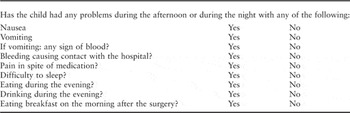
Since 2007, all tonsillar surgery at the ear, nose and throat (ENT) department in Gällivare, Sweden has been made with the coblation technique. Two ENT specialists, well educated in the coblation method, performed all the TE/TT operations. There was no bias regarding the method of surgery or skill of the surgeons between the two study groups. After the coblation method was introduced at the ENT clinic in Gällivare, all tonsillar surgeries in children were performed as day care surgery. If the distance from the patient’s home to the hospital exceeded 50 km, the patient slept overnight at the patient’s hotel near the hospital. At the same time, we introduced a questionnaire, where the patients (or their parents) received two checklists immediately pre- or post-operatively: One of the questionnaires concerned PONV, nutrition, sleeping, bleeding and pain problems during the first 24 hours post-operatively (Table 1), while the other concerned pain and nutrition during days 1–10 post-operatively. The first questionnaire was either returned to the clinic, or reported to an ENT nurse who made a phone call to the parents on the first day post-operatively. The answers of the questionnaire were documented in the medical record of the patient. This study is founded on the results of the first questionnaire, especially on question numbers 1, 2 and 5, and on the medical records from the department of anaesthesia regarding pre-medication, method of anaesthesia, weight of the patient, length of the operation, and amounts of betamethasone and opioids or anti-emetics given. Medical records were also studied to examine if there had been any significant post-TE haemorrhage during the first weeks after surgery. During the period of January 2007 to February 2008, 37 children were operated with TT or TE. An examination of the questionnaires revealed a high number of PONV problems during the first 24 hours post-operatively (one-third of the children). Since steroids are an established anti-emetic treatment, it was decided to give 4 mg of betamethasone to all children with a body weight of less than 40 kg and 8 mg of betamethasone to the patients with a body weight of 40 kg or more. Thirty-two children did receive betamethasone consecutively between March 2008 and February 2009. During the study period, the surgeons, method of surgery and follow-up schedule were identical. All children below 19 years of age, operated for TE/TT during the period above, were included in the study.
Questionnaire for the patients (parents) to return to an ENT nurse on the day after surgery for post-operative assessment

The study was approved by the Local Ethics Committee, Umeå University. Dnr 08-071M.
Statistics
Patient data were coded and SPSS, version 17, Chicago, Illinois, USA, was used for the statistical calculations. Categorical data were calculated according to non-parametric analyses (Pearson χ 2and Fisher’s exact test), while numerical data were calculated with parametric analyses (t-test). Descriptive data are presented in frequency tables with percentage, mean value and standard deviations. The significance level was defined as p < 0.05.
RESULTS
A total of 87 children of 18 years and below were operated with TE or TT at the ENT Department of Gällivare hospital between January 2007 and February 2009. Fourteen of the children had an incomplete or missing questionnaire and four of the medical anaesthesia records were missing. Thus, it was possible to evaluate 69 children regarding the effect of betamethasone on PONV and on post-operative pain during the first 24 hours.
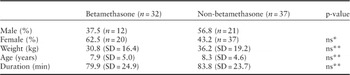
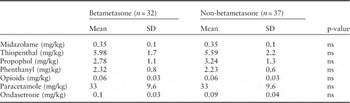
While betamethasone was given perioperatively to 32 of the children, 37 did not receive it. Demographic data from the two study groups are presented in Table 2. There were no significant differences between the two groups regarding sex, body weight, age, duration of anaesthesia, sedatives or anti-emetics. Furthermore, there was no significant difference between the study groups regarding the amounts of opioids or paracetamol (Table 3). Sevoflurane was used as an anaesthetic agent in both groups. The children operated on for TE and TT were divided proportionally between the two groups.
Demographic data of the two study groups

Duration = total length of the anesthesia; * = χ2 test, ** = t-test; ns = non-significant.
Distribution of pharmaceuticals between the two study groups

ns = non-significant.
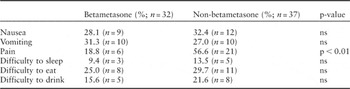
There were no significant differences between the two groups of children regarding PONV or nutrition problems. Nearly one-third of the children reported nausea or vomiting within 24 hours after the operation in both groups. However, regarding the pain post-operatively, there was a significant difference between the two groups (Table 4). Only 19% of the children in the betamethasone group reported pain, compared to 57% of the children in the non-betamethasone group (p < 0.01). It could not be shown that the operation methods influenced the prevalence of post-operative pain in the betamethasone group. In the non-betamethasone group, however, the children operated on for TE reported significantly more pain than those operated on for TT. During the first two weeks post-operatively, one patient in the non-betamethasone group experienced significant post-operative bleeding on the 4th day. In addition, one patient in the betamethasone group (1 day after surgery), and one patient in the non-betamethasone group (day 2) reported a small amount of visible blood in the saliva.
Results of the symptoms asked for in the questionnaire and reported to the nurse at the day after the surgery

ns = non-significant.
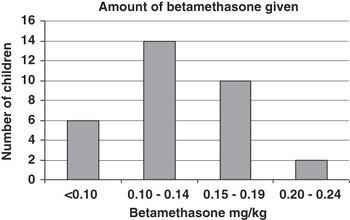
Betamethasone was administered to the children in average 32 minutes (SD = 23) after induction of the anaesthesia (SD = 23), but the time of administration of betamethasone had no impact on the prevalence of either PONV or pain after the surgery. The dose of betamethasone given to the children was in average 0.14 mg/kg (SD = 0.04). The majority of the children received a dose of betamethasone, which was 0.14 mg/kg or below (Fig. 1).
Amount of betamethasone given to the children.

DISCUSSION
In spite of being an established anti-emetic medication, this study could not show any reduction in PONV in children operated for TE/TT after a single dose of betamethasone. However, there was a significant reduction in post-operative pain during the first 24 hours in the betamethasone group. In contrast, Steward et al [Reference Steward, Welge and Myer2003] concluded in a Cochrane report that perioperatively given dexamethasone (0.15–1.0 mg/kg) reduced the frequency of PONV by up to 50% in children operated with TE. At least three of the studies included in the report above [Aouad et al, Reference Aouad, Siddik, Rizk, Zaytoun and Baraka2001; Elhakim et al, Reference Elhakim, Ali, Rashed, Riad and Refat2003; Fazel et al, Reference Fazel, Yegane-Moghaddam, Forghani, Aghadoost, Mahdian and Fakharian2007] showed that a single dose of 0.5 mg/kg dexamethasone with a maximum dose of 8 mg had a good effect on PONV. An important observation, however, is that in the study of Czarnetzki et al [Reference Czarnetzki, Elia, Lysakowski, Dumont, Landis, Giger, Dulguerov, Desmeules and Tramer2008] a dose of 0.5 mg/kg of dexamethasone significantly increased the risk for post-operative bleeding after TE in children. The risk of post-operative haemorrhage was however not increased with a dose of 0.15 mg/kg of dexamethasone.
In this study, the given dose of betamethasone was on average only 0.14 mg/kg (maximum dose 8 mg), which could suggest that the dose of betamethasone was not high enough to show any effect on PONV, but taking into account the risk of haemorrhage, maybe steroids are not well suited as a medication for PONV in TE surgery. Furthermore, Aasboe et al [Reference Aasboe, Raeder and Groegaard1998] could show a significant reduction in both PONV and post-operative pain after perioperative given betamethasone to adults after proctologic or orthopaedic surgery. In the study of Aasboe et al [Reference Aasboe, Raeder and Groegaard1998], the adults were given 12 mg betamethasone intramuscularly as a single dose before surgery, but in contrast, a patient of 70 kg, receiving 12 mg of betamethasone, nevertheless reaches a concentration of about 0.17 mg/kg, which is about the same concentration as in this study.
Regarding the positive effect on post-operative pain in this study, Kaan et al [Reference Kaan, Odabasi, Gezer and Daldal2006] also reported a significantly lower pain score 6 hours post-operatively in the group which received 0.5 mg/kg dexamethasone at TE. Furthermore, they were also not able to show any effect on PONV, which is in accordance with the results of this study. In addition, Czarnetzki et al [Reference Czarnetzki, Elia, Lysakowski, Dumont, Landis, Giger, Dulguerov, Desmeules and Tramer2008] concluded that even the lowest dose of dexamethasone was able to significantly reduce the need for ibuprofen post-operatively. Fazel et al [Reference Fazel, Yegane-Moghaddam, Forghani, Aghadoost, Mahdian and Fakharian2007] suggested that the mechanism of dexamethasone, which reduces post-operative pain, is due to the anti-inflammatory effect, diminishing the local oedema of the operated tissues. Unfortunately, there are no studies published where different doses of betamethasone are related to the symptoms of PONV or pain. Kim et al [Reference Kim, Cote, Cristoloveanu, Roth, Vornov, Jennings, Maddalozzo and Sullivan2007] presented a study where they compared the effects of the doses of dexamethasone, 0.0625, 0.125, 0.25, 0.5 and 1.0 mg/kg, but could not find any significant differences regarding the outcome of PONV or post-operative pain between these doses of dexamethasone. Thus, it is still not clear whether perioperative betamethasone must be given at higher doses than in this study, or if it is not efficient against PONV. General problems associated with patient questionnaires are low response frequencies, but this study had a high response rate (85%), and the questionnaire was always reported to an ENT nurse with possibilities to answer questions regarding the protocol. The survey was made at the same clinic, with the same type of patients, and surgery was performed by two experienced surgeons from the same clinic and with the same operation method (coblation) throughout the study time. Furthermore, there were no other changes in the methods of anaesthesia at the clinic during the study period. The questionnaire was easy to complete and the questions were of ‘yes’ or ‘no’ character, which render a high validity. Although the study was not blinded to the anaesthesia personnel, the study results show that there were no significant differences regarding the given amount of other pharmaceuticals, as paracetamol or opioids, between the two study groups. The anaesthesia personnel, however, had nothing to do with the evaluation of PONV or the evaluation of pain, and the nurses who evaluated these symptoms had no access to the medications given by the anaesthesia personnel. The parents also had the same schedule for post-operative pain medication (paracetamol and diclofenac), based on the body weight of the child, throughout the study period.
In conclusion, this study does not support the use of betamethasone as an anti-emetic medication in TE surgery. Until more studies are made, we have only been able to verify the positive effect of betamethasone on the post-operative pain in TE/TT-operated children, and as recent studies have reported an increased risk of post-TE haemorrhage with doses of dexamethasone of 0.5 mg/kg, we suggest that steroids could be used in low doses in tonsillar surgery, but only for pain relief. As one of the major problems with tonsillar surgery is post-operative pain and related nutrition problems, it is however of value to make every effort to diminish the post-operative pain by suitable medication and surgical methods as the coblation technique. Using betamethasone perioperatively in combination with the coblation technique, we have been able to make TE surgery ‘day-care’ surgery. Since most of the post-TE bleedings and 97% of the lethal bleedings [Windfuhr et al, Reference Windfuhr, Schloendorff, Baburi and Kremer2008] occur after the first 24 hours, it is mostly the pain, PONV and nutrition problems that prevent TE from being a day-care surgery and not the concern of post-TE bleeding.
CONCLUSION
There was no beneficial effect shown of perioperatively giving betamethasone to children undergoing TE/TT with coblation, regarding the prevalence of PONV. This was maybe due to a comparatively low dose of betamethasone. However, the given dose was sufficient to significantly reduce post-operative pain after surgery, suggesting that the effect on post-operative pain in this study was the most powerful effect of perioperative steroid treatment.
Acknowledgements
We want to thank the personnel at the ENT department and the Anaesthesia department at Gällivare for invaluable help. A special thanks to Stig Karlsson, PhD and Senior Lecturer at the Department of Nursing, Umeå University and Marie Lindkvist, PhD and Senior Lecturer in Statistics at the Department of Statistics, Umeå University who have been of great help regarding the statistics. A special thanks also to Tatiana Jaklovska and Piotr Faras, who performed the tonsillar surgery and enrolled the patients in the study.