1. Introduction
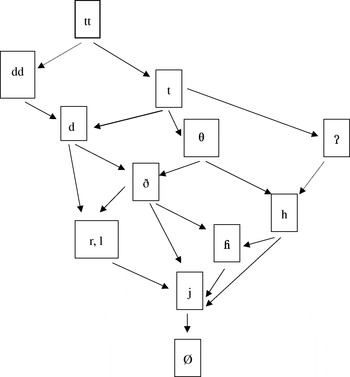
Most treatments of lenition define it ostensively rather than by giving a set of necessary conditions for a process to be termed lenition. The processes that are indicated by this method as being processes of lenition differ slightly from authority to authority. A full example is given in figure 1, from Hock (Reference Hock1986: 83).
A definition of lenition by ostension from Hock (Reference Hock1986). Dotted lines indicate possible but unobserved changes. I have added the arrows and a standard IPA transcription.

Even this complex version of the ostensive method has its weaknesses, since it does not allow for [s] anywhere in the set of processes, yet [s] does not necessarily work just the same way that [θ] does (Kirchner Reference Kirchner2001: 78–80). However, we can take this figure as an illustration of the technique. Phonetic changes which proceed in the direction indicated by the arrows are called lenitions, and the sounds at the heads of the arrows are said to be weaker than the sounds at the tails of the arrows. Conversely, changes in the direction against the flow of the arrows are called fortitions, and the consonants at the tails of the arrows are said to be stronger than those at the heads. Lenition and weakening are thus synonyms, as are fortition and strengthening.
It would be possible to look at the changes indicated in figure 1 and object that they represent a heterogeneous set of processes, including voicing, spirantisation, debuccalisation, and so on. It would also be possible to dismiss en bloc the aggregate of changes indicated in figure 1 and say that, for example, only those changes which affect consonants in the environment V_V should be considered as lenitions. Either of these viewpoints (or others like them) is intellectually responsible, but they miss a point. That point, argued perhaps most strongly by Foley (Reference Foley1977) but also by Kirchner (Reference Kirchner2001), is that to argue in these ways is to overlook the generalisations which the term lenition (and its contrary fortition) have been introduced to capture. That is, there is a unity here, which these other approaches could not state. The starting point of this paper is that such a unifying viewpoint is valuable, but that it has not been coherently justified in most of the work on the topic because no unifying definition of lenition has been given. Thus the basic question for this paper is whether and how the notion of lenition can be given a general definition which will make sense of the ways in which the term is usually used. This will lead on to other questions, including: (i) does our pre-existing notion of lenition have to be modified to accommodate to the new definition? (ii) are there confounding issues which we need to keep separate from lenition in order to make the notion of lenition clearer? Such questions are not questions regarding the way in which lenition is expressed within a particular theoretical model of phonology, but questions about the definition of a fundamental notion which, I would argue, any phonological model which aspires to take the phenomenon of lenition seriously must be able to deal with.
If some unity to the set of changes indicated as lenition in figure 1 is sought, there are two possible lines of explanation. The first is a historical–phonological definition, and originates from Vennemann, cited in Hyman (Reference Hyman1975: 165):
A segment X is said to be weaker than a segment Y if Y goes through an X stage on its way to zero.
Such a definition, useful as it may be, has two drawbacks. The first, and lesser of the two, is that in principle it does not allow any change to be called lenition until the final zero stage has been reached. Either a change of [t]→[d] or one of [d]→[t] could ultimately lead in the fullness of time to a zero stage, and until we reach that zero, we cannot call either of these changes a case of lenition. While this is true in principle, in practice it can be circumvented by saying that a change counts as an instance of lenition if it is of a type which has, in other apparently similar cases, eventually led to a zero stage.
The second objection is more serious. The above definition assumes that any progress towards zero is a monotonic progression of weakening without any intervening strengthening. This is a dangerous assumption given how many cases there are of changes which appear to change direction. For example, Spanish [ʎ]→[j] seems like a weakening in terms of figure 1, but the subsequent change of [j]→[ʤ] (or, perhaps more accurately, [dʑ]) in the south of Spain and some areas of Latin America appears to reverse this direction and be a strengthening. There is, in this particular case, no final zero stage, so we are not justified in calling this lenition in terms of Vennemann's definition; but then that definition provides us with no definition of fortition,Footnote 2 so it has hard to say we are dealing with either lenition or fortition using this definition. The best we can do is to call this a series of changes. Nevertheless, the apparent change of direction from lenition to fortition is crucial. It is for reasons like this that an appeal for a phonetic definition of lenition was made in Bauer (Reference Bauer1988). The definition proposed there has little to justify it, and I would now consider the particular solution suggested to be an error, but I would hold with the principle of wanting a phonetic definition.
Of course, phonetic definitions of lenition have been proposed in the past. However, they tend to have problems with them as well. It is to those definitions and the objections to them that I first turn.
2. Phonetic definitions and their disadvantages
Two phonetic definitions of lenition are current in the literature. The first one views lenition as a change whereby resistance to airflow in the oral tract is decreased, the second as a change whereby the amount of articulatory effort is decreased. These two (and other interpretations of figure 1) are usually seen as synonymous. Kirchner (Reference Kirchner2001) puts the latter of these definitions into an Optimality Theoretic account by proposing a constraint called LAZY, which interacts with other constraints in the normal way. LAZY is interpreted as meaning that, within the limits imposed by other constraints, as little effort as possible will be exerted in the pronunciation of any given sound. Although the labelling of this particular constraint seems unfortunate in terms of the sociolinguistic values we usually try to impart to our students, and although an alternative such as ECONOMY would no doubt have been just as useful (if not as sexy), we can see that this notion does reflect the effort interpretation of figure 1.
It is not necessarily clear that these two phonetic interpretations of lenition are equivalent. The equation of lenition with lack of obstruction in the vocal tract appears to make lenition equivalent to an increase in sonority. Such an interpretation allows us to move the discussion away from simply changes affecting consonants to ones affecting vowels as well. But it implies that any change involving vocalic opening should count as a case of lenition. This is, to say the least, controversial. Hooper (Reference Hooper1976: 236–238), for instance, argues that a close vowel is weaker than an open vowel in at least Portuguese, Japanese and Spanish.
The LAZY constraint, or its less fashionably labelled counterparts, requires that a weaker sound should require less effort to produce. In other contexts, however, less effort appears to produce a centralised vowel rather than a more open vowel. For example, words spoken in isolation generally display more peripheral vowel qualities than the same words spoken in context (see Deterding Reference Deterding1997, who also points out that this may be an oversimplification). Thus the two general interpretations of lenition seem to contradict each other at least when it comes to what lenition might be in vowels. If some version of either of these interpretations is to be used, some clarification will be required. However, there are other problems with these definitions which will now be briefly considered.
2.1 Intervocalic spirantisation
A standard example of lenition is the case of voiced plosives becoming voiced fricatives intervocalically. Widely cited examples include Spanish and Danish, although in both these cases the intervocalic fricatives have gone on to become intervocalic approximants (and in Danish to be deleted in vernacular styles).
Latin vita ‘life’>Spanish vida>Modern Spanish viða
Old Norse hvítr ‘white’>Mod Danish viːðə~viːə
The paradox here is that a change of stop to fricative should be seen as an instance of lenition, even though it is well known that fricatives require greater muscular control for accurate articulation than plosives do (Ladefoged & Maddieson Reference Ladefoged and Maddieson1996: 137, Perkell Reference Perkell, Hardcastle and Laver1997: 352). In a plosive, the active articulator simply has to make contact with the passive articulator; in a fricative the active articulator has to be held a precise distance from the passive articulator by the effort of opposing muscles in order to establish the turbulent airflow which characterises the fricative. If the fricative requires greater muscular control, it is not clearly ‘lazy’ in any meaningful sense of the word. This problem is avoided in many discussions of lenition in which lenition is seen in terms of less obstructed airflow through the vocal tract (Lass & Anderson Reference Lass and Anderson1975: 151) or, perhaps equivalently, within Dependency Phonology, in terms of the addition of a |V| component (Lass Reference Lass1984: 283). Nevertheless, the fact remains that the outcome of a lenition process is supposed to be a ‘weaker’ sound (hence ‘weakening’ as a synonym of ‘lenition’) and a weaker sound which requires greater muscular effort seems paradoxical in itself.
2.2 Voicing and devoicing
Another standard example of lenition is the intervocalic voicing of obstruents. Thus Latin vita ‘life’ giving rise to an earlier Spanish form vida (the <d> no longer represents a plosive today, but is assumed to have gone through such a stage) is regularly given as an example of lenition (e.g. Foley Reference Foley1977: 34). At the same time, terminal devoicing of obstruents in languages such as Catalan, Dutch, German, Russian and so on may also be viewed as a weakening. Thus, although Lavoie (Reference Lavoie2001) defines devoicing as strengthening, she admits (2001: 107) that ‘it may be a way of reducing effort’. While this may seem to make good sense, it runs counter to the position implicit in figure 1 that only voicing counts as weakening, and that devoicing is inevitably strengthening.
The paradox here is that both voicing and devoicing can be seen as instances of lenition. If we want a phonetic definition of lenition, then it has to be one which can incorporate contradictory phonetic processes.
3. Lenition and fortition as process or as output
The implication of the layout in figure 1 is that any change which follows the flow of the arrows and has a particular output is always an instance of lenition. We have seen this above with relation to devoicing. In this section I should like to consider two changes which are generally thought of as fortitions, namely affrication and diphthongisation. Neither of these is specifically dealt with in figure 1, but their classification as fortitions is not particularly controversial (see Foley Reference Foley1970, as cited in Hyman Reference Hyman1975: 166, Kirchner Reference Kirchner2001: 220 and Lavoie Reference Lavoie2001: 28 on affrication, though cf. Lass Reference Lass1984: 284, 292 for a dissenting view; see Donegan & Stampe Reference Donegan, Stampe and Dinnesen1979: 142 and Foley Reference Foley1977: 86 on diphthongisation).
A typical example of affrication as fortition comes from Spanish. The sound written <ll> in words like calle was a palatal lateral [ʎ] from about the thirteenth century (Elcock Reference Elcock1960: 421), although in modern colloquial Spanish, [j] is now more common. However, in some varieties of Spanish, including Mexican Spanish, we find [dʑ] in this position instead. It is not clear whether the affricate emerged directly from the lateral or, as seems more likely, from the median (=central) approximant. But it seems clear that the affricate involves a greater amount of movement on the part of the tongue than the median or lateral approximants, that it involves less sonority than the approximants and that it involves greater energy than the approximants, and that fortition is thus an appropriate classification for this change.
However, if we consider a change whereby d→ʤ / _ i, for example, the conclusion may not be the same. Ohala (Reference Ohala, Hardcastle and Beck2005) discusses just such a case in Mvumbo, a Bantu language. He points out that a plosive creates high pressure behind the closure, so that air escapes at a greater than normal rate once the plosive is released, and that a higher flow rate can give rise to friction, particularly in voiceless but even with voiced plosives. The implication is that it would take greater effort to overcome this natural tendency to affrication (before close front vowels) than to allow it to happen, since the vocal tract would have to be opened with greater than normal speed to avoid the friction. Thus we seem to have a situation where an affricate demands less effort than a plain stop.
An even clearer contrast, it seems to me, can be found in instances of diphthongisation. A case that can probably be considered typical can be found in the passage from Classical to Vulgar Latin. There a short stressed [o] in an open syllable is lengthened and then diphthongised, so that Classical Latin novum gives rise to Old French nuef, Modern Spanish nuevo and Modern Italian nuovo (Elcock Reference Elcock1960: 44). This is generally considered to be first a lengthening (which is a classic case of fortition, see Blevins Reference Blevins2004: 145), then possibly a shift in stress from the first mora of the long vowel to the second, and finally a dissimilation. Dissimilations are considered by some (e.g. Donegan & Stampe Reference Donegan, Stampe and Dinnesen1979: 142) always to be fortitions, and so this is a consistent fortition process.
As a contrasting case, consider the diphthongisation of the fleece and goose vowels in some current varieties of English. Pronunciations like [fləis] and [ɡəus] arise because it takes time for the tongue to move to the position for the close vowels, and that movement is not completed before the release of the preceding consonant. This is one of those changes which, at least by the prescriptive population, might atheoretically be called ‘lazy’ or ‘slovenly’, and it does seem that it probably requires less effort than the straight monophthong in that the target is not achieved as rapidly and is held for a shorter period. These instances of diphthongisation, therefore, look more like lenition than fortition.
Accordingly, the conclusion must be that it is not sufficient to look at the output category and say that any process which yield a relevant output must be an instance of fortition or lenition (as the case may be). Rather, the process whereby that output is produced has to be considered. This means that flowcharts such as that in figure 1 can appropriately be taken as indicating some kind of norm, but not as indicating an inevitability in terms of the application of the terms ‘lenition’ and ‘fortition’. Even a change like the voicing of a voiceless obstruent might appear to be fortition in the unlikely event of it occurring between two voiceless segments.
4. A unified solution to these problems
I should like to suggest here that the two problems discussed in section 2 have a single solution. That solution is to define lenition as the failure to reach a phonetically specified target: articulatory undershoot or underachievement. Such a view of lenition is not entirely new (Hock & Joseph Reference Hock and Joseph1996: 129 speak of ‘a relaxation … of the articulatory gestures required’, for instance), but it has not, as far as I am aware, been discussed in detail. This definition of lenition will have the benefit of resolving the paradoxes we have considered while remaining faithful to traditional views of what lenition is. However, as might be expected, it is not entirely without problems, some of which will be considered below.
Lavoie (Reference Lavoie2001: 20f.) considers a similar, but I believe importantly different, version of lenition based on Browman and Goldstein's theory of articulatory phonology. Browman and Goldstein work with a version of what used to be called ‘parametric phonetics’ (Tench Reference Tench1978). Since their model is phonological rather than phonetic, the individual targets for articulatory movements are plotted on a graph-like representation termed a ‘score’, rather than the details of the movement as in Tench's version of parametric phonetics (Browman & Goldstein Reference Browman and Goldstein1989). These targets, and the movements towards them and away from them, are termed ‘gestures’ of the articulatory system. As is typical with such approaches, many of the gestures which turn out to be crucial for discussion of lenition are represented as deviations from an expected default (e.g. velic closure is the default and velic opening is marked on the score; fricative and plosive articulations are indicated on the score, while opener articulation is considered the default).
Since I want both the retention of voicing and the retention of voicelessness to be considered lenition under appropriate circumstances, the notion of a default seems inappropriate for my purposes here. A default setting seems to imply that the default is inherently easier (less effort) than the non-default, while I want to say that what counts as less effort may be defined by the environment in which the lenited segment is produced. This does not mean that lenition cannot be read from an articulatory phonology score; rather, it reflects the local nature of what ‘articulatory underachievement’ might mean, in contrast to Browman and Goldstein's theory, which is set up to look at overall markedness differences.
My proposed definition would allow the standard examples discussed above to be classified as lenition, and so would not be grossly opposed to standard discussions of lenition. However, such a definition allows us to consider both intervocalic devoicing and terminal voicing as lenition: intervocalic voicing is failure to achieve the voiceless gesture for the intervocalic obstruent, and terminal devoicing is failure to maintain the voicing gesture for the obstruent. Both are cases of underachievement, but they differ because of the different environments in which the sounds occur. Incidentally, it would be perfectly expected for either of these to be a potential step on the way to zero. In the transition from Middle Chinese to modern Mandarin, all final plosives have been lost (Chen Reference Chen1976: 211).
With such a definition, the [d]>[ð] change also counts as lenition. It is a matter of considering the way in which the process gives rise to the fricative, rather than of considering the output of the change. For the generation who inaugurate the change of the [d]>[ð] type, the change arises because the active articulator is not raised far enough towards the passive articulator for the air-stream to be completely blocked. This is a failure to reach the intended target, and so counts as lenition by the definition proposed here. Subsequent generations of speakers, however, hear a fricative, and so aim to produce a fricative and to avoid producing a stop. It is at this stage of development, after the initial lenition has taken place, that speakers have to invest the extra energy to ensure that a complete closure does not occur and that the narrow aperture of the fricative is maintained.
Thus a definition of lenition as articulatory underachievement solves a number of problems with the theory of lenition: it allows us to provide the notion with some phonetic correlate – moreover, with a correlate which makes sense of the label ‘lenition’ – while at the same time allowing us to count both voicing and devoicing as lenition, as long as they occur in appropriate environments.
Such a definition has other implications beyond solving the problems discussed above. One of these is that various changes that are not normally termed lenition can be seen as being part of the same phenomenon. Examples include [r]- and [l]-vocalisation, which arise through failure to fully articulate the tongue-tip/blade articulation for the consonants concerned.
This definition also makes it easier to extend the notion of lenition to vowels. Talking of lenition and fortition in vowels is not new (see Hyman Reference Hyman1975, Foley Reference Foley1977, Donegan Reference Donegan1978, Blevins Reference Blevins2004). There is, though, a certain amount of disagreement about precisely what changes affecting vowels are to count as lenition or fortition, particularly, but not exclusively, in relation to vowel height. Adopting the definition proposed here might allow the resolution of some of these problems. To begin with, vowel shortening clearly counts as lenition by this definition, since the full articulation is not maintained. This is similar to degemination of obstruents, which is traditionally seen as a form of lenition. Note, however, that for McMahon (Reference McMahon1994: 16) vowel lengthening counts as weakening, because she sees weakening as an increase in sonority. Proceeding to vowel height, we can see that both vowel opening and vowel closing may, under appropriate circumstances, be considered as lenition. By default we might expect a short mid-central [ə] to be the weakest vowel, since it is the vowel which apparently demands the least displacement of the tongue from a ‘neutral’ position for its articulation. More peripheral vowels would thus require greater effort; failure to accurately articulate peripheral vowels would lead to more [ə]-like articulations. However, while such a conclusion seems to work well for a language like English (and also for many others), it ignores the question of articulatory settings (Honikman Reference Honikman, Abercrombie, Fry, MacCarthy, Scott and Trim1964). It might be that a language or variety with a more open articulatory setting than standard RP English might have a more open hesitation vowel or default vowel, and that languages or varieties with a closer articulatory setting might have closer default vowels. Language-specific notions of what counts as vocalic weakening would have to be adjusted to take account of such phenomena.
One problem that is raised by my new definition of lenition as articulatory underachievement is whether there is then any distinction to be made between lenition and assimilation. The problem is not a new one. Hock (Reference Hock1986: 84) argues that assimilation can be seen as a type of weakening, but claims that it is better to keep the two apart since lenition ‘tends to be restricted to medial and final environment, while assimilation is not so restricted’. The relevance of position will be taken up in section 5 below, and will be ignored for the moment. Here we can ask two questions: are there instances of lenition which are not assimilatory, and are there instances of assimilation which are non-leniting?
Cases of lenition which are not assimilatory are relatively easy to find. Consider the example of [l]-vocalisation, already mentioned briefly above. If we consider the word bottle, pronounced as [bɒtɤ] or [bɒto] in many varieties of English, we see that the loss of apical or laminal contact means that this is lenition by the new definition. However, if this were assimilation, it might be expected that the apical or laminal contact from the preceding [t] would be maintained in the [l] where a phonetic [t] is found (e.g. in New Zealand English). This is thus leniting, but not assimilatory. Among the processes which have more traditionally been viewed as lenition, degemination is not obviously assimilatory. The change from Latin mittere to Spanish meter ‘to put’ may involve a lessening of effort, and certainly involves a shorter duration of the stop element, but does not clearly make the stop in any way ‘more like’ its surrounding segments.
Conversely, there are also instances of assimilation which are not leniting. The obvious cases are instances of acoustic (but not articulatory) assimilation. In Danish (Basbøll Reference Basbøll2005), an expected low front unrounded vowel becomes back before a tautosyllabic bilabial or velar. Basbøll (Reference Basbøll2005) calls this grave-assimilation. If this change occurred only before a velar, it might look like a failure to achieve the front vocalic articulation before a velar consonant. Such a process would count as underarticulation, though it would not traditionally have been called lenition. Before a bilabial, however, there is no articulatory justification for the vowel quality, and thus it cannot be a matter of lenition. Although the matter is not altogether clear, the frequent pattern of vowel-lowering in nasalising contexts may be another similar example (Ohala Reference Ohala, Anderson and Jones1974, Reference Ohala and Ferguson1975; but contrast Bhat Reference Bhat and Ferguson1975).
Most cases of assimilation, however, are lenitions. An assimilation of place such as that illustrated by [ðæʔp mæn] for that man shows the failure to make an alveolar gesture in word-final position; an assimilation of manner such as [ɪ eə] for in there shows failure to achieve alveolar contact in the first nasal and failure to make a velic closure in the second nasal segment; a voice assimilation such as [daʊn də ðə bɒɾm] down to the bottom (Lodge Reference Lodge1984: 66) shows failure to articulate a voiceless section in a voiced stream. It might seem that vowel harmony as found in the affix alternations of languages like Finnish or Turkish might count as non-leniting assimilation. But in these languages, vowel harmony has become a morphologised process, with sufficient non-phonologically based exceptions for it to be difficult to claim that it still a productive process of assimilation. If we consider a case where vowel harmony really is an instance of productive assimilation, it looks far more like lenition. Consider, for example, the process that gives French [nεʒ] ‘snow’, [nεʒε] ‘was snowing’, but [neʒe] ‘to snow/snowed (participle)’ (for speakers who do not have ‘e moyen’ in all these cases). Here it seems that we really might want to say that the first [e] in [neʒe] is pronounced as [e] because of a failure to articulate the more open vowel in the presence of the following closer vowel.
Thus although we can see that assimilation and lenition are closely related, the fact that it is possible to find cases of lenition that are not assimilations and cases of assimilation that are not lenitions suggests that the two are not to be equated.
There is a problem here, however, which needs to be resolved. Browman & Goldstein (Reference Browman, Goldstein, Kingston and Beckman1990) discuss certain matters which others have presented under the heading of assimilation as instances of overlapping gestures. For instance, the process whereby n→m / _ [bilabial] may still involve the retention of the coronal contact even though that contact becomes inaudible when the labial closure blocks the airflow (for some discussion of less straightforward instances see Local Reference Local, Docherty and Ladd1992, Nolan Reference Nolan, Docherty and Ladd1992). There is potentially a difference between a synchronic and a diachronic analysis here, at least if we are considering word-phonology. When a gesture becomes totally inaudible the next generation may not acquire it. (Of course, where there is morphophonemic variation to indicate that the original gesture is present in some forms, it may well be retained, which is why I speak of word-phonology, where such considerations are less likely to be relevant; we might even speculate that in our literate society spelling could result in the maintenance of an inaudible gesture.) However, it has already been argued in section 4, in the case of [d]→[ð], that the synchronic reality of lenition and the report of a diachronic change reflecting that reality may be significantly different, and that it is the synchronic event which should be counted as lenition.
Unfortunately, it is not clear that we can dismiss the question of overlapping gestures on this basis. First, it was stated above that it is synchronic underarticulation which defines lenition, while it is only if we view the process diachronically that we can see what looks like lenition. Second, if we accept that some assimilations of a type which might be considered leniting are the result of the relative timing of articulatory gestures, we have to take seriously the question of whether such changes really should count as lenition or not. If both gestures actually occur, there is presumably no underarticulation as such; rather, what we find is a loss of alignment of the timing of gestures. Such a lack of precision may well involve laziness in the everyday understanding of the word, but it is less clear that it involves reduction of effort in any meaningful sense, and even less clear – and this is crucial in this context – that there is any sense in which underarticulation is involved. To make matters worse, it might be argued that gemination and degemination and changes in vowel length equally involve questions of timing of gestures, and should thus be treated on a par with other mistimings rather than as instances of under- or overarticulation.
It is clearly important in this context to take a stand on whether (or to what extent) gestural overlap should or should not count as lenition, given the definition that has been provided here. I suggest that changes of duration should still continue to be counted as matters involving lenition/fortition, as should instances where a particular gesture fails to be realised (the case of voicing/devoicing for example), but that, for the reasons outlined above, partial overlap of gestures should not count as lenition. If the proposals in this paper gain any general acceptance, this matter seems likely to remain a potentially controversial topic.
There is a benefit to this discussion, namely that lenition and assimilation can now be seen to be more distinct than many have envisaged. There may be a countervailing disadvantage, namely that assimilation has to be seen as the result of a larger set of disparate processes than is usually allowed for.
5. Lenition and position
Against this background, I should like to consider the effect of position in the word, as discussed specifically by Escure (Reference Escure1977). Escure hypothesises that lenition is tied to position in such a way that there is a hierarchy of positions in which lenition can operate. Part of that hierarchy is reproduced here:
V _ C##
…
V _ ##
V _ V
## _ V
According to Escure, lenition occurs earliest and goes furthest in environments higher up the list, and the occurrence of a particular leniting change at a position lower down the list will imply that the same change also takes place higher up the list. Escure pays no attention to syllable structure, presumably on the assumption that a single intervocalic consonant will inevitably act as the onset to the following syllable – an assumption which may be controversial (see below).
It should be noted that other authors have adopted positions similar to Escure's. I do not wish to ignore their work, nor to give the work of Escure undue prominence, but having a specific set of claims makes the line of argumentation clearer, and I am not aware of other work which differs in significant respects from what Escure claims, although the precise details may differ.
Working from Escure's version, then, it is possible to present a simple disproof of the validity of her hierarchy. Let us make some general assumptions about the form of the argument. First, we will assume that we are dealing with just three positions: initial, intervocalic and final. Escure actually deals with a more subtle gradation in coda consonants, but this is not relevant for the shape of the argument here. We will further assume that we are concerned with changes normally termed lenition, and that we have the options of either a change (C) or no change (NC) in any given position.
If we have three positions with two possibilities (change or no change) in each, we have a total of eight possibile outcomes. Of these eight, no change in all positions and change in all positions are trivial, and add nothing to the demonstration. Each of the six remaining patterns is attested.
• In non-rhotic varieties of English /r/>Ø word-finally, but not intervocalically or initially. Escure (Reference Escure1977: 58) cites this example, which shows the pattern NC/NC/C – that is, no change initially and intervocalically, and change finally – and it fits with her hierarchy.
• In the change from Old Norse to Old Danish (ca. 1200), voiceless plosives become voiced intervocalically and finally: kaːka>kaːge, sak>sag, uːti>uːde (Haugen Reference Haugen1982: 80). (The voiced plosives later become fricatives.) This shows the pattern NC/C/C, which again fits with Escure's hierarchy. It has been suggested to me (Hans Basbøll, personal communication) that the output of this change should be syllabified as kaːg.e, uːd.e, with an unstressed final vowel, and that the appropriate generalisation of the environment for the change is that it occurs in syllable-final position. This is an entirely plausible analysis, but not particularly helpful in the present context. Escure's hypothesis can be reformulated as implying that intervocalic consonants are to be treated either as syllable-initial or as syllable-final. If we have good reason for assigning these Danish consonants to syllable-final position, this will indeed explain why we find this particular outcome in this instance; but it will not help with the general consideration of Escure's hypothesis. The point of the argument here is that Escure's hypothesis is not tenable in the form in which it is presented, and that intervocalic consonants need not behave either like word-initial syllable-initial consonants or like word-final syllable-final consonants: there are other options which need to be considered. While there is no reason to attribute this particular example directly to ambisyllabicity, it might be that ambisyllabic consonants behave differently from those which belong to one syllable only.
• Proto-Dravidian [*j]>Ø initially in most of the Dravidian languages but remains as [j] both intervocalically and finally (Krishnamurti Reference Krishnamurti2003: 142, 154). This shows the pattern C/NC/NC, which runs counter to Escure's hierarchy.
• Middle Indo-Aryan /s/(derived from the merger of [s], retroflex [ʂ] and palatal [ś]) stays as /s/finally in Sinhalese but becomes /h/elsewhere (Masica Reference Masica1991). This shows the pattern C/C/NC, and runs counter to Escure's hierarchy.
• English /t/>[ɾ] intervocalically but not initially or finally in some varieties in the US and New Zealand. This shows the pattern NC/C/NC, which runs counter to Escure's hierarchy.
• Proto-Malayo-Javanic *q (probably phonetically a glottal) is deleted initially in Madurese, but is retained as [ʔ] between identical vowels, and becomes [h] finally (Nothofer Reference Nothofer1975). This shows the pattern C/NC/C, which runs counter to Escure's hierarchy.
In summary, of the six relevant patterns of change, all of which are attested, two support Escure's hierarchy and four do not. This says nothing about the frequency of the individual patterns of change, of course. Those patterns predicted by Escure certainly seem to be frequent, especially in Romance and Germanic. However, even if there are patterns of preference here, the most economical solution is simply to ignore position in the way defined by Escure as a factor affecting the working of lenition.
Can we rescue Escure's position? Certainly not in the bald form in which the hypothesis is formulated in Escure (Reference Escure1977). Even the revised definition of lenition given here does not help very much, at most helping to balance the six possible patterns of change with three changes in conformity with the hierarchy and three changes counter to it. It may be that Escure's hypothesis would work as an OT constraint, but that cannot be determined from such data as I have presented here.
Alternatively, as hinted at in the discussion of the Danish example above, a subtler version of the hypothesis might be worked out, building in more reference to prosodic positions than was generally accepted when Escure wrote her paper. Such a conclusion is also supported by Keating (Reference Keating, Harrington and Tabain2006), who argues that consonants which occur at the beginning of some prosodic domain (syllable, foot, word, intonational phrase, etc.) are ‘stronger’ than consonants which occur finally in the same domain. ‘Stronger’ here is defined in terms of amount of contact between active and passive articulators, and duration of the contact. The point to note about Keating's work is that the prosodic units combine, and the ‘strength’ that is inherited from each of the prosodic units also combines in complex ways. Thus, given a word like propaganda, where the first /p/is foot-initial, the second not foot-initial, but syllable-initial, and the /ɡ/is not only foot-initial, but initial in the main stressed syllable in the word, we would expect the /ɡ/to be stronger than the first /p/, which in turn should be stronger than the second /p/. Under such an approach, no simple equation of strength with position in the word can be expected, especially not in a language which, like English, has variable stress position.
It might also seem that we could appeal to psycholinguistics to reduce the necessity for special reference to position as a phonological variable in the lenition formula. It has often been suggested that word beginnings are particularly important for word-perception (Marslen-Wilson & Zwitserlood Reference Marslen-Wilson and Zwitserlood1989). On that basis we might predict that word beginnings would be more likely to be phonologically conservative, retaining stronger pronunciations, even after what was originally the same sound had undergone lenition elsewhere. However, the examples from Dravidian and Indo-Aryan cited above show that even such a generalisation cannot be expected to hold in all cases. It is not clear whether there are special circumstances operating in these particular changes, but it seems unlikely that they are unique.
The conclusion I should like to draw here is that position is not part of the definition of lenition. Brasington (Reference Brasington and Crystal1982: 88) points out that there is a history of conflating segment strength with positional strength; I am simply arguing for a divorce of these two notions. Processes may be termed lenition independent of the position in the word in which they occur. While it is almost certainly the case that position in prosodic hierarchies influences the likelihood of lenition, the two have to be considered as independent theoretical constructs. This means that lenition should not be defined as a set of processes which apply in certain positions, but rather should be defined in terms of the phonetic changes which occur, while position can be seen as one of the influences on what phonetic changes are likely to occur.
6. Lenition and resistance to change
Hooper (Reference Hooper1976: 238) argues that /a/is the strongest vowel in Spanish because it ‘has never undergone reduction or deletion, while all other vowels have been deleted in post-tonic position’. The claim is controversial (see e.g. Foley Reference Foley1977: 45 and Vennemann Reference Vennemann1988: 9 for contrary claims, though not specifically in relation to Spanish), but this is not my concern here. Rather, I would like to concentrate on the argument that resistance to change indicates position on some hierarchy of potential lenition. Earlier arguments in the present paper suggest that the notion of a hierarchy of lenition which automatically indicates that a particular sound is ‘weaker’ than another must be interpreted with some care. It is thus only consistent that I should wish to query the validity of Hooper's argument here.
There are several ways in which we might challenge this argument, some more serious than others. I will begin with some of the less serious counter-arguments.
The first problem with Hooper's argument is that it is not clear that diachronic evidence can sensibly be used to draw a conclusion about the synchronic status of a particular element after the end of the period covered by the diachronic evidence. It ought, at least in principle, to be possible for a series of diachronic changes to give rise to a segment which is ‘stronger’ (whatever that means) than one which has not taken part in any changes. On this basis alone, we might argue that Hooper's observation, though interesting, is strictly irrelevant.
A more practical kind of objection is that it is not clear how Hooper's argument is supposed to convert to a concrete metric. It happens that in the example Hooper cites, over the period Hooper discusses, there has been no deletion of /a/but some deletion of all other vowels in the language. One suspects, however, that the metric is supposed to work in more situations than this. For example, assume a situation in which all the other vowels are deleted under four different sets of conditions, but /a/is deleted only in one of these four conditions. This would presumably be accepted as evidence on the same footing as the evidence in the real Spanish case. Consider, though, a different hypothetical situation, set out in (1).
(1) i→Ø / A _ B, E _ F, J _ K
e→Ø / C _ D, E _ F, G _ H, J _ K
o→Ø / C _ D, E _ F, G _ H, J _ K
u→Ø / A _ B, E _ F, G _ H, J _ K
a→Ø / G _ H, J _ K
It is clear in (1) that /a/is deleted in fewer environments than the other vowels, and one of the environments where it is deleted is one in which all the vowels are deleted, but is the evidence still strong enough to say that /a/is the ‘strongest’ vowel? Given the incredibly large number of possible cases we might adduce here, many of them involving change of some kind rather than deletion, we really need some guideline as to when a pattern is to be taken as indicating a particular degree of ‘strength’.
Consider some real examples. In Hawaiian, only /p/, /m/, /n/and /l/among the consonants go back unaltered to Proto-Polynesian (Clark Reference Clark1976: 20), and of these /n/and /l/have two Proto-Polynesian sources. Must we then conclude that /p/and /m/are the strongest consonants of Hawaiian? Moreover, all the vowels of Proto-Polynesian survive unchanged in Hawaiian (Clark Reference Clark1976: 23); can we then legitimately conclude that vowels are stronger than consonants? (Incidentally, the only vowel change given by Clark for Polynesian vowels concerns Proto-Polynesian *a in Tongan; so is Tongan /a/the weakest vowel in that language?) In Nukuoro, none of the obstruents of Proto-Polynesian have survived unchanged, but most of the sonorants have, except for a merger between *l and *r (Clark Reference Clark1976: 20). Are we then to conclude that sonorants are stronger than obstruents? If these conclusions do not seem justified, we have to ask whether the analogous conclusion about Spanish /a/is justified.
A more important problem with Hooper's evidence, however, is the way it intersects with the actuation problem (Weinreich et al. Reference Weinreich, Labov, Herzog, Lehmann and Malkiel1968). The actuation problem is phrased as follows:
Why do changes in a structural feature take place in a particular language at a given time, but not in other languages with the same feature, or not in the same language at other times? (Weinreich et al. Reference Weinreich, Labov, Herzog, Lehmann and Malkiel1968: 102)
Whatever the answer to the actuation problem may be, it seems likely that some social motivation lies at its heart: things change not because of the inherent linguistic properties of the features involved, but because for some reason change in that particular feature has become invested with some social meaning. That is, lack of change is the default and simply means that no social value has been associated with change in that particular feature. Yet according to Hooper's argument we must assign some special linguistic status to the fact that no social value has been attributed to the segment under consideration and that nothing has happened. This seems to turn the motivation for change on its head.
I thus conclude that whatever it is that makes particular segments resist change over a shorter or longer period of time, it is not something which is inherently linked to the processes of lenition and fortition. We can be fooled into believing that there is some link because the word ‘strength’ occurs in both places, but that may be all there is in common.
It may be objected that I am throwing out the proverbial baby with the bathwater here. Foley (Reference Foley1977) has what he calls his inertial development principle, phrased as
(1) strong elements strengthen first and most extensively and preferentially in strong environments and (2) weak elements weaken first and most extensively and preferentially in weak environments. (Foley Reference Foley1977: 107)
This principle, which is put to good use by Foley, refers to elements having inherent degrees of strength and to particular environments being inherently strong or inherently weak. These are concepts which I am suggesting should be dispensed with.
Consider the environment question first. My position here is compatible with Foley's. There may be indeed positions which, by virtue of articulatory physiology, are more likely to host lenition processes than are others. However, position does not define the process of lenition. Lenition may fail to occur in these positions, and may even occur in positions which do not typically host lenition processes. Lenition is defined by the phonetic changes that occur and not by the position these changes occur in, although it is necessary to consider the environment of a particular change to see whether it counts as a lenition process or not.
Much of the criticism of Foley's theory, though, has focussed on the notion that there are deterministic hierarchies of lenition and fortition on which ‘weak’ segments lenite first and ‘strong’ ones are first to undergo fortition processesFootnote 3 (see e.g. Bauer Reference Bauer1983). Even if we accept Foley's (Reference Foley1977: 49) suggestion that what counts as ‘strong’ or ‘weak’ may differ from language to language, there are too many exceptions for the notion of such determinism to emerge unscathed. This is not to deny that there may be phonetic and/or typological processes which make some changes generally more likely than others. For example, there is no language which does not have oral stop consonants (Quileute is reported as having no nasal stops; Maddieson Reference Maddieson1984: 379). This is presumably related to factors such as the maximal auditory distinction between vowels and oral stops and to the fact that children, both at the pre-babbling stages and as language starts to emerge, seem to find oral stops relatively easy to control. Thus, in any language, any set of changes which had the effect of removing oral stops from the set of contrastive elements would seem to be unnatural. It is not clear to me how any constraint to prevent such an unnatural process could be built into a model of language change, especially since it is generally accepted that language change is not teleological; but simply defining oral stops as ‘strong’ seems to be a way of restating the problem rather than a way of solving it. Again I would want to say that lenition and fortition are phonetic processes which might, in principle, apply to any segment, though there are statistical preferences for patterns in which they have in fact applied in attested instances of language change. These preferences, however, are not a part of lenition as such. They arise because articulatory and/or perceptual properties of particular sounds make those segments more or less prone to variability, and if they are more prone to variability, there is a greater chance that a particular type of variation will be perceived as being socially meaningful, and therefore that change will result. If being prone to variability is to be termed ‘weakness’, then it might help if lenition were not called ‘weakening’. The link between the two is not direct.
7. Conclusion
‘Lenition’ is a traditional term in the description of phonological change, in wide use to bring together a set of processes which can be seen as being phonetically and phonologically heterogeneous. In this paper I have assumed that the unity underlying the use of the term is real, and that lenition can be defined in terms of some unifying phonetic process, and I have attempted to suggest how that might be done. Independent of whether that definition is accepted, I have suggested that lenition as a process is not to be confused with positions which are likely to call forth lenition, nor to be confused with inherent resistance to change or proclivity for change. In the unmarked cases, lenition and fortition will, of course, follow the statistically expected patterns. But these expected patterns do not define lenition, and lenition can occur in unexpected places.