1. Introduction
‘Financial Cooperatives’ are member-owned financial institutions such as cooperative banks, credit unions, credit cooperatives, as well as savings and credit cooperatives. Existing literature suggests that financial cooperatives are better able to serve low-income populations than other microfinance institutions, and are more stable compared to other investor-owned banks (Ayadi et al., Reference Ayadi, Llewellyn, Schmidt, Arbak and Pieter De Groen2010: 116; Birchall, Reference Birchall2013: 24; Cuevas and Fischer, Reference Cuevas and Fischer2006: 55; Hesse and Cihak, Reference Hesse and Cihak2007). But it is still not clear why financial cooperatives grew in some emerging economies and not in other similar economies, and there is no political economy theory or empirical investigation that explains how the behaviour of political institutions influences the development of the financial cooperative sector. Only recently, Périlleux et al. (Reference Périlleux, Vanroose and D'Espallier2016) examined the relationship between the size of the commercial banking sector and the development of financial cooperatives in developing countries, arguing that financial cooperatives grow in countries where the commercial banking sector is relatively underdeveloped. Here, I use panel data for 65 developing countries covering the period from 1995 to 2014, to test the correlation between indicators of democracy, political rights and civil liberties against variables representing the degree of financial cooperatives development. In addition, I tried to develop a theoretical analysis that can explain the behaviour of political institutions towards financial cooperatives. This paper is mainly related to literature on the political economy of finance (Nienhaus, Reference Nienhaus1993; Pagano and Volpin, Reference Pagano and Volpin2001; Perotti, Reference Perotti2014; Rajan and Zingales, Reference Rajan and Zingales2003) and financial cooperative (or credit union) (Cuevas and Fischer, Reference Cuevas and Fischer2006; Ferguson and McKillop, Reference Ferguson and McKillop1997; Périlleux et al., Reference Périlleux, Vanroose and D'Espallier2016).
There are several possible factors that can explain the evolution and performance of financial cooperatives in developing countries, including the economic structure, the degree of development of the financial sector, the legal framework that governs financial cooperatives’ activities as well as the cultural uniqueness of each country. Yet, since political institutions significantly influence all these factors – keeping in mind that the political structure itself is influenced by these factors as well – it is important to understand how they can dictate the development of financial cooperatives, and the motives behind the behaviour of these institutions. Political institutions can provide supportive or obstructive environment for financial cooperatives through legislations and other institutional arrangements. For instance, Bamrungwon (Reference Bamrungwon and Münkner1994: 55–62) noticed that excessive control by the state is strongly maintained by regulations. This is clear from similarities in the cooperative laws of several developing countries, where regulations did not only emphasize statutory provisions (such as licensing, membership, governance structure, property protection and equity structure), but also included several provisions concerning the authority of government officials over cooperatives.
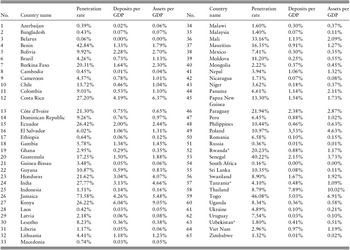
The main argument here is that autocratic regimes may deliberately oppose the development of a well-functioning financial cooperative sector, whereas democracies are more willing to support the development of financial cooperatives. I do not argue that every country fits into this theory, but the argument comes from clear observable evidence that large financial cooperative sectors in many cases exist within democratic political systems. In 2014, the market share of cooperative banks in many European democracies was quite large, amounting to 62% of the domestic deposits in France, 36% in the Netherlands, 35% in Austria, 34% in Finland, 33% in Italy, 27% in Cyprus and 21% in Germany (EACB, 2015). The argument is also derived from some examples where the growth of financial cooperatives in developing countries is associated with a relatively open political system and, to a large extent, guaranteed civil rights. The definition of ‘developing countries’ here is based on the International Monetary Fund's (IMF) classification of emerging and developing economies in the World Economic Outlook of 2012 (IMF, 2012: 181) (For a list of countries included in this study, see Table A1 in the appendix). In Latin America, where almost all countries in the region are democracies since the 1980s, the average penetration rateFootnote 1 in 2014 was 21.6% and the average assets per GDP was 2.6%, with Jamaica, Ecuador, Costa Rica, have impressively high penetration rates of 76%, 63% and 23%, respectively, and assets per GDP of 8%, 5.2% and 7.4%.
Similarly, Benin and Senegal are amongst the most stable democracies in West Africa, and had the highest members’ penetration rate in Africa by the end of 2014 and noticeably high deposits per GDP compared to their counterparts in the region. For the last 20 years, Benin was ranked as free by Freedom House and Senegal as free or partly free. On the other side of the continent, the total assets of Kenyan financial cooperatives were 8.3% of its GDP in 2014, one of the highest in developing countries, with 29% members’ penetration rate. Kenya had implemented several social and political reforms in the last decade, including the adoption of a new Cooperative Societies Act in 2004, a new financial cooperative law in 2008 and a new Constitution in 2010. Kenya is ranked as partly free by Freedom House since 2002, following the national elections that witnessed the change in political leadership and parliamentary majority.
Relatively low penetration rates and deposits per GDP can be noticed in other African countries like Ethiopia and Zimbabwe, where rights of associations remain tightly restricted and financial cooperatives are regulated under outdated and insufficient regulatory frameworks. Zimbabwe and Ethiopia ranked 44 and 46, respectively out of 53 countries in the ‘Rights sub-category’ of Ibrahim Index of African Governance 2015 (Mo Ibrahim Foundation, 2015).
A similar comparison can be found in Southeast Asia, where penetration rates and assets per GDP are high in India, the Philippines and Thailand. India and the Philippians are electoral democracies that have vibrant civil societies, and are classified as free or partly free by Freedom House for the last 20 years. Thailand, according to Freedom House measurements, the political environment persisted in the last three decades – until 2014 – gave citizens opportunities to actively participate in the political sphere and provided legal protection for their civil rights. Thailand ranked as free or partly free from 1979 till 2006, following a military coup in 2006 that overthrew the democratically elected prime minister at that time. But the country was ranked as partly free again in 2008 after democratic elections were held in 2007. On the other hand, low penetration rates and assets per GDP can be observed in two of the severely autocratic political regimes in the region, Cambodia and Laos. Both countries are non-electoral democracies and are classified as not free by Freedom House for the last 20 years. Civil societies’ activities are extremely restricted, as freedoms of assembly and of association, as well as other human rights, are not respected.
The remainder of the paper is organized as follows: Section 2 proposes a political economy theory for financial cooperatives development. Section 3 defines the data used and the methodology adopted. Results are presented and interpreted in section 4. Section 5 serves as a conclusion.
2. A political economy theory of financial cooperatives
The political economy theory of financial cooperatives established in this study is based on the origins and history of cooperatives in developing countries, alongside pressure groups theory and political economy theory of the financial sector. Both theories belong to traditional ‘new institutional economics’ that try to explain how economic behaviour is shaped by the evolution and behaviour of institutions. According to these theories, the government is not a neutral agent in the economy, but is a prominent player who influences and benefits from the economic system. North (Reference North1990) and Olson (Reference Olson1993) argue that those in power shape economic policies and institutions that enable them to stay in power and to enrich themselves. An autocratic political system will probably have a strong incentive to adopt an opportunistic behaviour that exploits the economy's resources and outputs, in order to maximize the rents of the ruling elites and those who influence the political decision-making. Thus, the distribution of these economic resources and benefits will depend on the bargaining power of different groups in the economy (North, Reference North1990: 49; 2005: 67; Olson, Reference Olson1993: 569). But even though political institutions shape economic ones, the causality goes both directions. Property rights, contract enforcement and opportunity distribution are designed and enforced by political institutions; however, the economic structure of a society also shapes its political structure (North, Reference North1990: 48).
Following the same line of reasoning, an underdeveloped financial cooperative movement may be the result of intentional policies by political decision-makers. In a political system dominated by narrow elite groups, political decision-makers may deliberately oppose the formation of other pressure groups that represent a broad range of people with strong bargaining power against the ruling elites, and who will have more control over their own resources, mainly their deposits in the case of financial cooperatives. That is because (1) an autocratic ruler and governing elites will prefer to control cooperatives to extend their popularity and their political influence, and with that, people's sense of belonging and ownership of cooperatives will decrease, as well as their participation (section 2.1); (2) well-organized associations will have stronger political bargaining power against the ruler and the governing elites (section 2.2); (3) the economic benefits gained by the governing elites, from underdeveloped and exclusive financial system, will be threatened and diminished (section 2.3). It must be acknowledged that the behaviour of autocrats towards financial cooperatives is not linear and is not identical amongst all non-democratic regimes. For instance, a stable autocrat, as a matter of ruling for a long-term period, will have the incentive to increase the overall productivity of the society in order for him, and the governing elite, to extract the maximum possible rent from the economy (Olson, Reference Olson1993: 569). State control in this case will intend to encourage a minimum level of savings by the low-income class to secure enough finance for the higher income class to invest in projects with relatively high expected marginal return. Also, stable autocrats will try to guarantee a minimum level of return for low-income populations to avoid social dissatisfaction and political unrest. Thus, there will always be a minimum level of financial services provided to the lower income class, through cooperatives or any other institutions, even in the most oppressive and autocratic regimes.
History of state control over cooperatives in developing countries
The evolution of cooperatives in developing countries is strongly dependent on the colonial governments that implanted these institutions. Cooperatives did not intend to be independent self-help associations that emerge spontaneously, but rather to be instruments for colonial governments to implement their own economic policies (Cuevas and Fischer, Reference Cuevas and Fischer2006: 27; Münkner, Reference Münkner2013:13). The organizational nature of cooperatives changed from instruments intended to create alternative contractual arrangements that govern the relation between the members and the market – and amongst the members themselves – into government instruments that transfer credit and subsidies to mass populations and follow state policies (Cuevas and Fischer, Reference Cuevas and Fischer2006: 28). Thus, in developing countries, what are sometimes labelled as ‘cooperative organizations’, are not really cooperatives (Birchall, Reference Birchall2004: 6).
Fals-Borda et al. (Reference Fals-Borda, Apthorpe, Inayatullah, Nash, Dandler and Hopkins1976: 442) describe how most post-independence governments in developing countries have adopted a compulsory cooperative strategy to force people, especially peasants, to become members in state-organized cooperatives. Forcing people to join cooperatives was made possible through three ways: ‘(1) direct compulsion and coercion, (2) the creation of a monopolistic situation in which the individual is deprived of certain economic benefits if he decided to stay out, (3) the offering of inducements in the shape of prospective benefits’ (Fals-Borda et al., Reference Fals-Borda, Apthorpe, Inayatullah, Nash, Dandler and Hopkins1976: 442). They noted that in the 1960s, the ruling parties in Iran, Venezuela and other Latin American countries, strove to extend their political influence in order to spread their ideologies through their control over the cooperative movement. Cooperatives were organized by the State in order to secure the political support of peasants for the existing regimes. They also remarked that leaders of cooperative societies in Latin America and Africa were extremely over-controlled by government officials. Cooperative leaders ceased to be true representatives of the members, and instead, they carried out instructions from government officials and communicated them to the members and sometimes they were even members of the local administration or part of the political hierarchy. Cooperatives’ elections did not take place on a regular basis in many cases and some leaders were re-elected indefinitely (Fals-Borda et al., Reference Fals-Borda, Apthorpe, Inayatullah, Nash, Dandler and Hopkins1976: 440–441). Similarly, Gagnon (Reference Gagnon, Nash, Dandler and Hopkins1976: 376) pointed out that, during the 1960s and 1970s, cooperatives in Cuba, Senegal and Tunisia were not spontaneous grassroots movements, but were rather organized and controlled by the states and political parties in power to spread their policies and ideologies. And whenever cooperatives ‘[…] had the opportunity to become social movements, to enter the political arena, and to threat the dominant classes, they were rapidly curtailed by the ruling powers [...]’ Gagnon (Reference Gagnon, Nash, Dandler and Hopkins1976: 376).
The history of the cooperative movement in the former communist countries provides additional evident for that. In Russia, the once-autonomous consumer cooperatives were the main suppliers for basic goods to urban populations before the revolution of 1917. State control over cooperatives during the totalitarian regime that followed the revolution had abolished the movement's autonomy and was nationalized by Stalin in 1935. Agricultural cooperatives that existed before the revolution were replaced by collective farms and were falsely named ‘cooperatives’. The same trend took place in many other so-called socialist countries, in which the number of cooperatives and their members immensely grew but without any real autonomy or member control (Birchall, Reference Birchall2004: 3, 16).
Another interesting historical event was the dissolution of the Egyptian Confederation of Agricultural Cooperatives in 1976. The early founded cooperatives in Egypt were relatively independent from the state. However, the post-independence regime led by Nasser seized control of the cooperative movement and completely changed its nature to a state-controlled organization. When Sadat took office after Nasser in 1970, he chose one of his protégés, Ahmed Yunis, to be the president of the Confederation of Agricultural Cooperatives. However, Yunis tried to establish an independent movement that ‘[…] would not only fall outside the domain of state control, but which would challenge the government and demand a say in state policy making [sic] especially that related to agriculture’ (Fahmy, Reference Fahmy2002: 208–209). In 1976, Yunis refused the governmental pressure on the confederation to support the ruling party in the parliamentary elections. He stated that the confederation should be politically neutral and non-partisan, and called for the confederation's full independence from any government intervention. In return, the government led a publicity campaign against Yunis, accusing him of mismanagement and corruption (Fahmy, Reference Fahmy2002: 210). Not long after, Sadat disbanded the confederation in 1976 under Law 824 and transferred the functions of cooperatives to the state-owned Agricultural Bank. With the dissolution of the confederation, Sadat made sure that cooperatives could never be used to mobilize any opposition against his regime. The confederation remained dissolved until 1983, after Sadat's assassination. The ruling party at that time won all the seats of the confederation council in its first elections (Fahmy, Reference Fahmy2002: 211).
In brief, as Develtere and Pollet (Reference Develtere, Pollet, Develtere, Pollet and Wanyama2008: 64–65) explained, governments can either maintain cooperatives’ autonomy and independence or they can take control over the sector. Government control can be ‘defensive’ or ‘instrumental’. A ‘Defensive’ attitude is when a government attempts to keep tight control over all civil society activities for its own political interests. ‘Instrumental’ attitude on the other hand is when a government uses cooperatives as instruments to implement its economic development policy.
Theories of pressure groups
Olson (Reference Olson1965: 111–112) relates the development of pressure group theories to the rise of pluralism; a political philosophy that argues for a greater constitutional and political role for private associations of all types – especially labour unions, churches and cooperatives – whilst the state should have limited control over these associations. ‘Pluralism tends to create a mood favourable to pressure groups primarily because it emphasizes the spontaneity, the liberty and the voluntary quality of the private association’ Olson (Reference Olson1965: 112). Politics can be affected by organized groups in two ways: directly, by lobbying to influence political decision-makers, and indirectly, by mobilizing voters or demonstrations. Modern pressure group theories emphasize the influence of pressures produced by different groups, as the fundamental determinant of economic structure and distribution of political power in a society (Becker, Reference Becker1983; Bentley, Reference Bentley1908; Commons, Reference Commons1950; Latham, Reference Latham1952; Truman, Reference Truman1958). Pressure group theories date back to the 19th and early 20th Century political philosophers, especially Alexis de Tocqueville (1805–1859) and Pierre–Joseph Proudhon (1809–1865).
In the United States, Arthur Bentley (1870–1957) argued that conflicting group pressures are the key to understanding government policies. He shaped his argument in denying any significance to individual interests, stressing that the main effective forces in societies are groups’ interests and actions. Nevertheless, as no one group can represent all the members in a society; people will naturally tend to group together in associations, unions, cooperatives and other representative associations that can protect their interests and increase their bargaining power. Bentley states that ‘all phenomena of government are phenomena of groups pressing one another, forming one another and pushing out new groups and group representatives’ (Bentley, Reference Bentley1908: 269). Following Bentley's view, Earl Latham (Reference Latham1952) stressed the importance of studying groups’ interests as the primary force in economics and politics. For him, ‘the structure of society is associational’ (Latham, Reference Latham1952: 17). Like Bentley and Latham, David Truman (Reference Truman1958: 33–35) pointed out that there are inevitable disturbances and dislocations from economic institutions that will naturally lead to the formation of occupational associations like workers and farmers associations, in order to influence government policies.
Commons (Reference Commons1950: 30) had strongly supported the formation of economic pressure groups, arguing these groups, such as cooperatives, labour unions and farmers’ associations, were the most dynamic institutions and ‘the lifeblood of democracy’ (Olson, Reference Olson1965: 116). Commons promoted occupational pressure groups as the ideal representative and beneficial actors in economic policies. He based his argument on the view that market mechanisms alone cannot bring fair outcomes for all groups in the economy, and the reason behind that is the unequal bargaining power that different groups possess. Such inequalities in bargaining power will exist as long as the wealthy group dominates political institutions, and thus, pressure groups are essential in Commons’ argument to achieve a just and rational economic system (Olson, Reference Olson1965: 115).
The most relevant part for the argument here is Commons’ opinion on the United States Bill of Rights. For him, the Bill is important not only because it guarantees freedom of speech, press and investigation, but most importantly, that it protects the rights of association. He further explains how the totalitarian authorities of Russian Communism and Italian Fascism after the First World War weakened labour unions and cooperative movements. As Commons puts it, ‘the civil liberties that make possible the voluntary associations of labour unions, farmers unions, business cooperatives, and political parties… [is] the refugee of modern Liberalism and Democracy from Communism, Fascism, or Banker Capitalism’ (Commons, Reference Commons1990: 901–903). Mancur Olson (Reference Olson1965) in the Logic of Collective Action pointed out that all large well-organized economic groups that have significant lobbying power were originally organized for another non-political purpose in the first place. He noted that, ‘[...] the common characteristic which distinguishes all of the large economic groups with significant lobbying organizations is that these groups are also organized for some other purpose’ (Olson, Reference Olson1965: 132). Olson recognized that most of group formation costs are start-up costs, and once a group has been organized, the costs associated with engaging in political actions become relatively low. Political actions, such as lobbying to influence the political and economic policies, become natural by-products of the group with relatively low-costs, since the costs of group formation has already been mobilized. Labour unions, farmers cooperatives and all large economic organizations that were able to create influential lobbies initially had ‘the capacity to mobilize a latent group with selective incentives’, in order to overcome the collective-action problem (Olson, Reference Olson1965: 132).
Financial cooperatives can easily overcome the ‘collective-action problem’ of group organizing identified by Olson, due to their ability to provide ‘selective incentives’. According to Olson, organizations that can provide ‘selective incentives’ are those that (1) have the ability to be coercive, or (2) have the ability to provide positive incentives. Many independent and strong cooperative federations in developing countries had succeeded in influencing the policies and legislations regulating the operations of their affiliates, for example, ANGKASA, Malaysia; SNCF, Singapore and URECOCI, Côte d'Ivoire (ILO, 2001: 63). Similarly, the Kenya Union of Savings and Credit Cooperatives (KUSCCO) had recently opposed the retrenchment policies in Kenya, mainly because many public sector employees are members in Savings and Credit Cooperative Societies (SACCOs). KUSCCO also advocated against the taxation of SACCOs (Owen, Reference Owen2007: 18), and it was behind the enactment of the SACCO Act in 2008 (Wanyama, Reference Wanyama, Develtere, Pollet and Wanyama2008: 91). On the other hand, many autocratic governments in developing countries would naturally resist the development of such representative associations because of their potential political power.
Political economy theories of financial developmentFootnote 2
Political economy theories of financial development explain the distributional output of the financial sector, and argue that political institutions shape the level of an economy's financial development. Narrow political and industrial elites, who control political institutions, will use their influence and networks to have preferential access to finance, whilst ensuring other potential competitors’ accessibility to finance is reduced. However, democracy should limit the influence of narrow elite groups and redistribute political power to a wider range of people who would favour a well-functioning financial sector (Girma and Shortland, Reference Girma and Shortland2008: 568). Rajan and Zingales (Reference Rajan and Zingales2003: 18–21) proposed an interest group theory of financial development where industrial and financial elites have a direct interest in opposing financial development. As they are small enough to organize (Olson, Reference Olson1965), and have large economic weight, these elites can successfully influence political leadership to keep the financial sector underdeveloped. Large firms can finance new opportunities without the need for external capital, or can obtain finance by pledging their assets as collaterals. Thus, in underdeveloped financial system, they have positional rent in their markets resulting from their privileged access to capital. Additionally, even if new entrants can obtain capital, the narrow group of industrial and financial elites will still be able to capture most of the returns gained by these new entrants, through higher interest rates, since they own and control financial institutions. These rents will diminish or even disappear with financial development.
Rajan and Zingales (Reference Rajan and Zingales2003: 22) argued that economic openness, in term of trade and capital flows, will weaken the industrial and financial elites’ ability to resist financial development. That is because foreign trade increases competition and reduces domestic rents, putting pressure on industrial elites. Similarly, cross-border capital flow will reduce the financiers’ oligopolistic position if domestic corporates can have access to cheaper finance. However, that does not provide a clear explanation to the behaviour of political institutions towards financial development, especially that economic openness is argued to be a political choice in itself (Perotti, Reference Perotti2014: 17). Barth et al. (Reference Barth, Caprio and Levine2006: 278–286) proposed a social conflict view of bank supervision and regulation that explains why some countries may intentionally choose inefficient banking regulatory and supervisory policies that produces inefficient outcomes. The social conflict view argues that financial regulatory and supervisory policies are not chosen by the entire society or for the benefit of the whole society. The state is more concerned about distribution and not efficiency, and the ruling group does not seek to maximize the total social welfare but rather to maximize its own. In closed autocratic regimes, financial regulations then will be chosen by those in power for the benefit of a narrow politically influential group, whereas a more open and democratic political system may reduce the power and benefits of such narrow elites. However, democracy will not totally eliminate their influence. Inefficient banking policies are also favoured by autocratic regimes because they can protect the interests of elites by limiting other groups’ economic and political potentials.
Girma and Shortland (Reference Girma and Shortland2008: 570–571) explained how in underdeveloped financial systems, access to capital will be associated with connections or wealth. The allocation of credit will depend on borrowers’ collaterals, social position and political connections, whilst a well-developed financial system allows firms and individuals to obtain credit upon the feasibility of their economic activities and needs. Therefore, the government and elite groups will tend to determine the level of financial development based on the costs of increased competition incurred from easing the accessibility of credit. In political economy theory, the ‘equilibrium’ level of financial development is then determined by the relative power of financial development beneficiaries and adversaries. Also, when the financial sector is underdeveloped, small and rural households tend to keep a portion of their savings in the form of real assets (e.g. gold and jewellery). The other portion is mobilized in the hands of few large banks that refuse to provide credit to these small depositors afterwards. In both cases, these small communities and rural areas are confronted with an inefficient resources utilization problem, because local resources are rarely utilized in productive investments inside these local communities. Financial cooperatives are best able to mobilize local resources for the benefit of the local economy (Nienhaus, Reference Nienhaus1993: 18).
Rajan and Zingales (Reference Rajan and Zingales2003) were the first to propose and provide empirical evidence that governments controlled by narrow elite groups obstruct the development of the financial sector. Similarly, Girma and Shortland (2004) also found a statistically significant relationship between the annual change in financial development and the degree of democracy and stability of the political system. Barth et al. (Reference Barth, Caprio and Levine2006: 286–305) examined the relationship between political institutions and bank supervisory and regulatory frameworks. Their findings suggest that autocratic political regimes tend to have large state-owned banks and are more likely to impose regulatory restrictions on bank operations. They argued that autocratic regimes have large state-owned banks to easily channel financial resources towards the ruling elite, and to control financiers by creating regulatory restrictions.
Briefly, a banking system dominated only by state-owned or private commercial banks, investment and lending decisions lie in the hands of the government and banks’ large shareholders. Thus, the allocation and use of depositors’ money will not be controlled by the depositors themselves, who are the real owners of the money; instead, it will be in the hands of a narrow elite group that is formulated by large capitalists and that can influence political decision-makers. As a result, an independent financial cooperative sector that can mobilize local resources for the benefit of the mass population will not be favoured by autocratic political decision-makers, as cooperatives would limit the exploitation capacity of the government and narrow elite groups.
3. Data and method
Measuring financial cooperatives development
The development of the whole financial sector is usually measured using indicators covering the sector's size, depth, efficiency and stability (Beck and Levine, Reference Beck, Demirguc-Kunt and Levine1999). However, statistics on financial cooperatives that cover all these indicators are not available in most countries. The variables used here to measure financial cooperatives development can only reflect the sector's size and depth but do not give insight on the level of efficiency or stability of the sector. Financial cooperatives’ data were obtained from the World Council of Credit Union's (WOCCU) statistical reports, which are based on financial cooperatives responses to the WOCCU's annual survey, and are the most comprehensive dataset available for financial cooperatives. Only for India, additional data were collected from the National Federation of State Cooperative Banks regarding primary agricultural credit societies, which are not covered by the WOCCU dataset.
Three indicators are used as dependent variables that can define the degree of development in the financial cooperative sector. First variable is member penetration rate, which is calculated as the country's total number of financial cooperatives’ members as percentage of the total economically active population (obtained from International Labour Organization - ILO). The penetration rate shows the proportion of citizens who are members in financial cooperatives. This variable can reflect the financial cooperatives’ ability to attract and organize people. Second and third variables are total assets per GDP and total deposits per GDP. Both variables show the sector's size in the national economy. The three variables were log transformed to normalize data distribution. Assuming here that, high penetration rate, total assets per GDP and total deposits per GDP reflect a well-developed financial cooperative sector in a country.
Measuring the quality of political institutions
Finding reliable measurements for the quality of political institutions is challenging, mostly because the meaning of democracy has been a controversial issue in political science (Acemoglu and Robinson, Reference Acemoglu and Robinson2005: 48). Three measurements for political institutions are used here: Freedom House's political rights and civil liberties indices, and Polity index from the Polity IV Project. The Freedom House's political rights and civil liberties indices have been previously used for studying trends in democracy by various scholars including Barro (Reference Barro1999: 160–162) as well as Acemoglu and Robinson (Reference Acemoglu and Robinson2005: 48–63) who only used the political rights index. Originally, both indices range from 1 to 7, in which 7 represents the least political freedom – in terms of political rights and civil liberties – and 1 represents the freest. However, the values of both indices were reversed so that 1 becomes the lowest score in political rights and civil liberties score and 7 represents the highest score.
The Polity index was also used by Acemoglu and Robinson (Reference Acemoglu and Robinson2005: 48–63), and it ranges from +10 to −10, in which +10 represents strongly democratic institutions and −10 represents strongly autocratic ones. The Polity index is computed by subtracting the democracy and autocracy indices of the Polity IV project. Both, the democracy and autocracy indices range from 0 to 10. (Marshall, et al., Reference Marshall, Gurr and Jaggers2014: 14–16).
Methodology
In this paper, linear relationships are assumed between financial cooperatives’ indicators and indicators of democracy, political rights and civil liberties, using unbalanced panel regressions covering the period from 1995 to 2014 for 65 developing countries.Footnote 3 Three methods were used to estimate the parameter values, pooled ordinary least squares (OLS), random and fixed-effects OLS (FE OLS), and fixed-effects instrumental variables (IV) regressions.
The basic structure for the OLS regression models take the form of
 $$\begin{equation}
{y_{it}} = \alpha + {X_{it}}\beta + {\mu _i} + {\nu _{it}},
\end{equation}$$
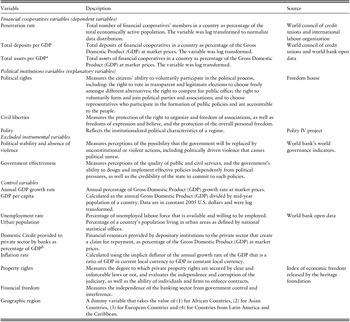
where yit is the dependent variable, representing in the model the logarithm of variables used as indication for the development of the financial cooperative sector in country i at year t. Specifically, y represents log(penetration rate), log(deposits per GDP) and log(assets per GDP). Moreover, α is the intercept, and X is a set of explanatory variables (independent variables). The explanatory variables are polity index, political rights index and civil liberties index, in addition to a set of variables to control for annual economic growth rate, gross domestic production (GDP) per capita, unemployment rate, percentage of people living in urban areas (urban population), domestic credit provided to private sector by banks as percentage of the GDP, financial freedom, property rights and geographic region. Tables 1 and 2 below provide a brief description on the variables included in the model. Furthermore, β are the coefficients that need to be estimated to determine the potential relationship between the dependent variables y and each explanatory variable in X. The error term in the panel regression is denoted by μ i + ν it , where μ i denotes the time-invariant and unobservable country-specific effect or idiosyncratic error term, that differs across countries, and not included in the regression (e.g. historical and cultural country-specifications). And, ν it is the remainder disturbance which varies across countries and years, with similar characteristics to the usual ‘error term’ of any linear regression equation, assumed to be homoscedastic, normally distributed with a mean equals to zero, uncorrelated with itself, and uncorrelated with μ i and X.
Information on the data sources and variables used

a Missing data for total assets in West African countries (Benin, Burkina Faso, Cote d'Ivoire, Guinea Bissau, Mali, Niger, Senegal and Togo) were calculated using average total assets to total deposits ratio from other available years of the same country.
b Data for Uzbekistan were collected from the IMF country reports (No. 07/133; 08/235; and 13/278) and for Zimbabwe from the Central bank, under domestic statistics (available at http://www.rbz.co.zw/assets/monthly-economic-data-from-2009-to-date.pdf).
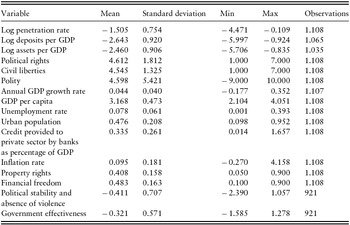
Data description

The pooled OLS estimator ignores the longitudinal structure of the data and assumes that μ i is equal to zero, unlike the fixed and random-effects estimators that consider the presence of unobserved heterogeneity between the countries. The fixed-effect estimator, known as the within estimator, assume μ i as fixed parameters that do not have a distribution. It controls for all country-specific effects and these time-invariant parameters are omitted. The remainder disturbances ν it are assumed to be independent and identically distributed (IID), whilst Xit are assumed to be correlated with μ i and independent from ν it for all countries i at any period t (Baltagi, Reference Baltagi2005: 12–13 and StataCorp., 2013: 366). The fixed-effect estimator performs OLS regression on
 $$\begin{equation}
\left( {{y_{it}} - {{\bar{y}}_i}} \right) = \alpha + \left( {{X_{it}} - {{\bar{X}}_i}} \right)\beta + \left( {{v_{it}} - {{\bar{v}}_i}} \right).
\end{equation}$$
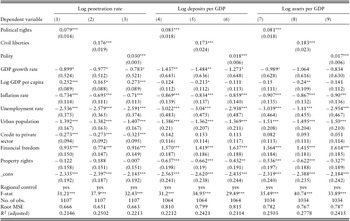
Breusch–Pagan/Cook–Weisberg test and Lagram-Multiplier test were estimated to determine the presence of heteroscedasticity and serial correlation in the panel data. Following that, Huber–White sandwich robust estimator was used to correct for the heteroscedasticity and serial correlation found in the panel data. Generally, the coefficients estimated by Huber–White robust estimator of variance are similar to the coefficients produced by the non-robust estimators, however, Huber–White robust estimator produces ‘correct’ standard errors (in a statistical sense). Using the robust estimator of variance allows us to relax the assumption of identically distributed disturbances vit over the panels, and the no serial correlation assumption in the fixed-effect regressions (StataCorp., 2013: 383). Finally, ‘Breusch and Pagan Lagrangian multiplier test for random-effects’ was computed to decide between pooled OLS regressions and random-effects regressions, and ‘Hausman Fixed Random Test’ to decide between choosing the random-effects or the fixed-effects models. I report regression results obtained only from the Pooled OLS (Table A2) and fixed-effects estimations following Hausman-test results and the high correlation between the country-specific effects μ i and the explanatory variables X found in all the regressions, all which suggest fixed-effects estimations to be more efficient than random-effects estimations for the analysis. Nevertheless, the random-effects predictions had slightly higher statistical significance and higher coefficients when financial cooperatives indicators are regressed against political rights and civil liberties indices compared to the fixed-effects estimations, whilst there is almost no difference in polity regressions.
The OLS estimators do not solve the possible endogeneity problem in the panel regressions, and treat all explanatory variables as exogenous which can make OLS estimates inconsistent, as it will only measure the magnitude of the correlation but not the magnitude and direction of possible causal relation between the independent and the explanatory variables. Endogeneity problem exists when an explanatory variable is correlated with the error term as a result of not including all relevant variables in the model or because of sample selectivity caused by data availability or any other reasons. To assess the possible causal effect of political institutions on financial cooperatives, it is important to control for unobservable variables that are correlated with political institutions and affect financial cooperatives at the same time, taking into account that there is no econometric method that can prove causation in the absolute meaning of the word. One way to address the endogeneity problem in political institutions indicators is to use IV two-stage least squares (2SLS) estimator, as recommended by Baltagi (Reference Baltagi2005: 113) and Stock and Watson (Reference Stock and Watson2007: 332–334). The IV regression divides the explanatory variables in set X of equation (1) into endogenous and exogenous variables, where endogenous variables, X 1, are assumed to be correlated with the error term μ i + ν it , and the exogenous variables, X 2, are assumed to be uncorrelated with the error term. IV method uses additional variables Z as instruments, to help in predicting the values of the endogenous explanatory variables X 1, so that Z should be correlated with X 1 but also uncorrelated with the error term. In this model, democracy, political rights and civil liberties indices are the endogenous variables and are instrumented by the World Bank's ‘political stability and absence of violence’ and ‘government effectiveness’ indices. The typical IV 2SLS regression can be denoted by the following two equations:
 $$\begin{equation}
{X_{1it}} = {\delta _0} + {Z_{it}}{\delta _1} + {X_{2it}}{\delta _2} + {\varepsilon _{it}},
\end{equation}$$
 $$\begin{equation}
{y_{it}} = \alpha + {\hat{X}_{1it}}{\beta _1} + {X_{2it}}{\beta _2} + {\mu _i} + {\nu _{it}}.
\end{equation}$$
In the first stage (3.1), the endogenous variables X
1 – democracy, political rights and civil liberty indices – are regressed against the exogenous variables X
2 in addition to the excluded instruments Z. The predicted values resulted from the first stage OLS regressions can be denoted by
 $\ {\hat{X}_{1it}} = {\hat{\delta }_0} + {Z_{it}}{\hat{\delta }_1}$
. Following that, the second stage of the 2SLS described in equation (3.2), regresses yit
on the predicted values
 ${\hat{X}_{1it}}$
using OLS regression to estimate the causal effect of political institutions on financial cooperatives. The main idea behind IV regression is to find instruments that can explain part of the variation in the endogenous variables X
1 and that is unrelated to the error term. Valid instruments must have a direct and strong correlation with democracy, political rights and civil liberties indices, but also must not be correlated with the financial cooperatives indicators. The second condition is called the ‘exclusion restriction’. It is not an easy task to find valid instruments for political indicators, as Treisman (Reference Treisman2007: 236) pointed out that researchers have not found any consistent instruments for political institutions; however, I attempted to instrument for democracy, political rights and civil liberties indices using the World Bank's political stability and government effectiveness indicators.
The political stability and absence of violence indicator measures perceptions of the possibility that the government will be replaced by unconstitutional or violent actions, including politically driven violence that causes political unrest. The government effectiveness indicator measures perceptions of the quality of public and civil services, and the government's ability to design and implement effective policies independently from political pressures, as well as the credibility of the state to commit to such policies (Kaufmann et al., Reference Kaufmann, Kraay and Mastruzzi2009: 6). The relationship between democracy and political stability is highly controversial. Some scholars argue that a prerequisite for the existence of democratic institutions is to secure domestic safety and stability, whereas many political scientists claim that the causal mechanism is reversed. Many scholars argued that democratic systems are vulnerable to social discontent which may lead to social and political instability, whilst others suggested that democracies promote political stability through several mechanisms that absorb social dissatisfaction, settle political conflict and redistribute economic opportunities (Tusalem, Reference Tusalem2015). Government effectiveness, on the other hand, is assumed to be correlated with democracy, in line with La porta et al. (Reference La Porta, Lopez-de-Silanes, Shleifer and Vishny1999: 239) who found democracy and political rights measurements to be correlated with low level of government intervention, more efficiency and better public goods provided. I do not argue here that there is an absolute one-way causal relationship between perceptions of political stability or government effectiveness and the quality of political institutions, rather what matters for the analysis is that political stability and government effectiveness should explain a considerable part of the variation in the democracy, political rights and civil liberties indices, and to be uncorrelated with financial cooperatives’ penetration rate, deposits per GDP and assets per GDP.
4. Results and discussion
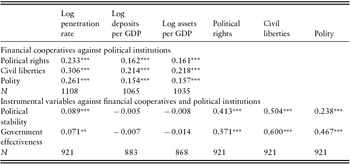
Table 3 shows pairwise correlation coefficients between indicators of financial cooperative development and political institutions and the IV. Generally, Table 3 gives preliminary support for the argument adopted here that financial cooperatives correlate with the governing political institutions. Results indicate that penetration rate, deposits and assets per GDP are positively correlated with political rights, civil liberties and polity indices, significant at the 1% level, with higher correlation between financial cooperatives’ indicators and civil liberties. Deposits and assets per GDP are not significantly correlated with the IV; political stability and government effectiveness, whereas penetration rate are positively correlated with the IV significant at the 1% level and 5% level, respectively, the magnitude of the correlations is quite low which do not largely disturb the validity of the instruments. More importantly, political rights, civil liberties and polity indices are positively correlated with political stability and government effectiveness with relatively high correlation coefficient and significant at the 1% level.
Pairwise correlation coefficients amongst the dependent, explanatory and instrumental variables

*, ** and *** indicate statistical significance at the 10%, 5% and 1% level, respectively.
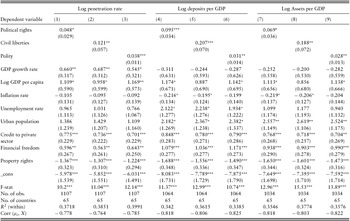
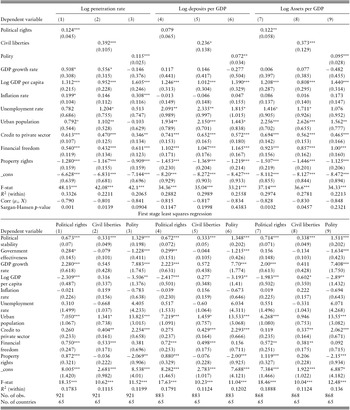
Tables 4 and 5 present the results of the FE OLS and the IV 2SLS regressions. In these regressions, each of the three financial cooperatives’ indicators: penetration rate; deposits per GDP and assets per GDP (all dependent variables are in natural logarithm), is regressed against variables representing indicators of political rights, degree of democracy and civil liberties, in addition to a set of variables to control for economic growth, GDP per capita, inflation rate, unemployment rate, credit to private sector as percentage of the GDP, financial freedom and property rights. Columns 1 to 9 in Table 4 show statistically significant positive correlations between the quality of political institutions and the degree of financial cooperatives development, with the magnitude of the coefficients increase considerably in the IV 2SLS regression compared to the FE OLS regressions, especially for the civil liberties regressions in columns 2,5 and 8. The R 2 (within) for the fixed-effects estimations ranged between 33.8% and 39.9%, whereas the R 2 (within) for IV 2SLS estimations varied between 21% and 33%. These results support the political economy theory developed earlier in this study, which argues that representative and open political institutions tend to have well-functioning financial cooperative sector, represented by high penetration rates, deposits and assets per GDP, whilst autocratic political regimes, on the other hand, are more likely to oppose the development of financial cooperatives. The high magnitude of the civil liberties’ coefficients and their statistical significance in all regressions, compared to political rights and polity coefficients, suggest that underdeveloped financial cooperative movements are likely to be associated with the oppression of civil societies in general, suggesting that non-democratic regimes may perceive financial cooperatives as potential pressure groups that may threaten the current status quo. Countries scoring the lowest rate in the civil liberties index have limited or no freedom of association, that include legal or practical constraints on trade unions, peasant organizations, civic organizations and interest groups.
Fixed-effects OLS regression results for financial cooperatives indicators against democracy, political rights and civil liberties indices (developing countries 1995–2014)

*, ** and *** indicate statistical significance at the 10%, 5% and 1% level, respectively.
° indicates significance between 10% and 15% level, whilst no asterisk means the coefficient is not statistically significantly different from zero.
Robust standard errors are in parentheses. Huber–White sandwich robust estimator was used to control for the presence of heteroscedasticity and serial correlation in the panel data as determined by Breusch–Pagan/Cook–Weisberg and Lagram–Multiplier tests.
Fixed effects IV 2sls regression results for financial cooperatives indicators against democracy, political rights and civil liberties indices (developing countries 1995–2014)

*, ** and *** indicate statistical significance at the 10%, 5% and 1% level, respectively.
° indicates significance between 10% and 15% level, whilst no asterisk means the coefficient is not statistically significantly different from zero. Standard errors are in parentheses.
As for the control variables, the fixed effects OLS and IV 2SLS regressions in Tables 4 and 5 show a statistically significant positive correlation between financial cooperatives development and financial freedom index that provides additional support to my hypothesis that strict government control over the allocation of credit and the quality of financial regulations play important role in the development of financial cooperatives. The financial freedom index measures the degree of financial sector independence from government control and interference. Specifically, the index measures the quality of financial regulations (which should be limited to enforcing contractual obligations and controlling market failures), direct and indirect intervention by the state in financial institutions, financial and capital market development, openness to foreign competition and government's control over the allocation of credit.
The results also show statistically significant negative correlation between property rights and financial cooperatives development, in the fixed effects OLS and IV 2SLS regressions, in Tables 4 and 5. These results are inconsistent with the law and finance theory, and contradict the broader consensus in favour of property rights protection as a key institutional requirement for financial development, investment and economic growth. The common argument in favour of property rights on assets and returns is that secure property rights encourages individuals and firms to better allocate their resources, and gives incentives for savers to invest in the banking sector and the financial market as a result of increased confidence in legal institutions (Beck and Levine, Reference Beck, Levine, Ménard and Shirley2008: 251).
Claessens and Laeven (Reference Claessens and Laeven2003: 2401–2402) found that better property rights lead to higher economic growth, and that the impact on growth is higher with improved access to finance, using the same property rights indicator obtained from the Heritage Foundation's Economic Freedom Index. However, the negative correlation between the growth of financial cooperatives and protection of property rights found here is not as odd as it seems. The property rights index measures the degree to which private property rights are protected by clear laws that are efficiently enforced by the state; thus, legal protection over property rights are primarily benefiting those who already possess ‘formal’ assets, and therefore can obtain finance from commercial banks in the first place. Whereas members of financial cooperatives are usually part of the informal economy, and workers and self-employed individuals do not usually benefit from these property rights. Strict laws for property rights then may restrict the economic activities of the informal sector, imposing pressure on financial cooperatives’ members. The share of the informal sector to GDP varies from around 30% in Asia and Latin America to 64% in sub-Saharan Africa (Jütting and Laiglesia, Reference Jütting and de Laiglesia2009), and one-half to three-quarters of non-agricultural employment in developing countries is informal employment, a figure which would significantly increase if informal employment in agriculture is included (ILO, 2002: 5). In any case, there is a need for further theoretical and empirical investigation to understand the relationship between financial cooperatives and property rights.
Furthermore, there is a positive correlation between financial cooperatives development and GDP per capita, with the statistical significance increases noticeably in the IV 2SLS regressions. The annual GDP growth rate was found to have a positive correlation with financial cooperatives’ penetration rate, but no statistical significance correlations were found between GDP growth and financial cooperatives’ deposits or assets per GDP. These results are, to a large extend, similar to Périlleux et al. (Reference Périlleux, Vanroose and D'Espallier2016) who only used penetration rate and number of cooperative institutions as indicators for the development of financial cooperatives. However, contrary to Périlleux et al. (Reference Périlleux, Vanroose and D'Espallier2016), domestic credit provided by banks per GDP here is positively correlated with the three financial cooperatives’ indicators, suggesting that there is a strong likelihood that financial sector development is positively correlated with the development of financial cooperatives. Taking into account that Périlleux et al. (Reference Périlleux, Vanroose and D'Espallier2016: 121–122) had reported a slightly small R 2 for the penetration rate regressions (0.01 for fixed-effects, 0.04 for random-effects and 0.1 for IV 2sls). In addition, unemployment rate was found positively correlated only with financial cooperatives’ deposits per GDP using IV 2SLS regression, whereas the fixed-effects results showed weak or no statistical significance at all. Finally, the percentage of population living in urban areas was found positively correlated with financial cooperatives’ deposits and assets per GDP, suggesting that probably financial cooperatives can mobilize more deposits in countries where urbanization is high, which would be a change in the traditional characteristics of financial cooperatives as they used to focus mainly on rural areas.
5. Conclusion
I tried here to explain how political institutions can influence the trend of development of financial cooperatives, arguing that autocratic regimes may deliberately oppose the existence of a strong financial cooperative sector. Certainly, there is no single factor that can explain the evolutionary development of financial cooperatives, as they do not operate in isolation. Like any other economic institutions, financial cooperatives are the product of the surrounding economic structure, and get influenced by the performance of the whole financial sector, and the presence of supportive legal framework, as well as the historical and cultural uniqueness of each country. All these factors are of no less importance for the development of financial cooperatives, and should be empirically explored in future research. However, political institutions and those who possess large political power have a strong incentive to influence all these factors, and the results presented in this study suggest that political institutions are major determinant for the development of financial cooperatives.
In the current phase of financial capitalism, and the legitimate growing concern about unequal wealth distribution, it is important to establish well-functioning financial sector that serves the interests of the masses and not just few large shareholders or narrow governing elites, and that the financial sector is efficiently able to reallocate people's deposits in value-added investments that serve the real economy and the whole society. Thus, it is important to recognize the political and economic potentials of financial cooperatives, as independent members-owned financial intermediary institutions that represent the interests of the low and middle income populations, and that can help in redistributing economic resources and political power in societies. In many developing countries, small households and rural populations are confronted with a problem of inefficient resources utilization, especially their savings. As large portion of people's savings are transferred to larger banks outside the local community; financial cooperatives are best able to mobilize these resources for the benefit of the local economy, and are also able to attract external funds; otherwise, these resources are rarely utilized in productive investments inside these communities.
There is a common concern over the politicization of the cooperative movement coming from historical practices, although it is clear that the cooperative movement can hardly be isolated from politics. The focus should rather be on making sure that cooperatives do not become controlled by the government or absorbed by political parties, nor narrow elites that do not seek the benefits of the members and the society. But a political role for financial cooperatives is merely inevitable. Financial cooperatives are not only financial intermediaries; they are also civil society organizations, with a main objective of realizing the social and economic interests of their members. By protecting and advocating for their members’ interests, they can become representing and defending the interests of particular groups in the society, usually the low and middle-income classes, and who are rarely represented by any political or economic groups in most developing countries. Financial cooperatives can also act as ‘schools of democracy’. Democratic participation by citizens in the public sphere does not only imply voting in elections or enrolment in political parties. Citizens’ participation can also take the form of joining pressure or advocacy groups, federations or unions, or any other means that enable them to express their voices and pursue their interests.
Acknowledgements
I would like to express my sincere appreciation to Professor Volker Nienhaus and the two anonymous reviewers for their constructive comments. I am also very grateful for the financial support from the German Academic Exchange Service (DAAD).
Appendix
List of countries included in the analysis and main indicators as of 2011

Pooled OLS regression results for financial cooperatives indicators against democracy, political rights and civil liberties indices (developing countries 1995–2014)