“Just as the biblical lamb and lion lived in (not understood) concord, so the endless varieties of things, states, and thoughts support one another: because everything is everything to everything.”Footnote 1 In 1960, the composer Stefan Wolpe wrote these words as a kind of creative credo about art and community life. The statement addressed not only the disparate inspirations of his music, but also the intensely interactive art communities that lay at the heart of his practice. Wolpe's hopeful vision of plural elements that “support one another” in art and life may seem uncritically optimistic given his past as a German Jew fleeing Nazi violence, yet his vision cannot simply be dismissed as a vague or sentimental belief in the universal brotherhood of mankind. Rather, his words speak to a project of redress. As a refugee living in New York at mid-century, Wolpe developed an ethic of pluralist interaction that guided his compositional practice, pedagogy, and community involvements in response to traumatic life experience. He was by no means alone in showing such preoccupations in mid-century America. Questions of human plurality, interdependency, and traumatic history assumed special urgency in many artistic and intellectual circles after World War II. In this essay, I explore two such scenes of creative interaction: first, Wolpe's friendship and creative exchange with jazz composer George Russell within the racially integrated jazz circles that clustered at Gil Evans's midtown apartment, a milieu connected with Miles Davis's epochal Birth of the Cool sessions; and, second, Wolpe's transient but nonetheless formative encounters with political theorist Hannah Arendt and her husband Heinrich Blücher in German-Jewish émigré circles and at the Eighth Street Artists’ Club, the hotbed of Abstract Expressionism.Footnote 2
Wolpe emerges as a remarkable figure because he bridged avant-gardes that have often been fragmented among different histories and disciplines. Although Theodor Adorno admired Wolpe as “an outsider in the truest sense of the word,” the composer is best understood as a uniquely positioned insider whose work cut across avant-garde communities and ideas.Footnote 3 His home was a rare space that drew the varied likes of Franz Kline, Gil Evans, Yoko Ono, George Russell, Willem and Elaine de Kooning, Leonard Meyer, Robert Creeley, and the Juilliard String Quartet. John Cage would even describe his apartment, bustling with musicians, poets, and painters, as “the true center of New York, an almost unknown center of New York.”Footnote 4 The composer stands as an extreme case in his outward-directed impulse to translate between different media and modes of representation throughout his life. Wolpe participated in Berlin Dada, attended art classes at the Weimar Bauhaus, composed for agitprop theater in Berlin and Moscow, studied composition with Anton Webern in Vienna, created repertories for the kibbutzim in Mandate-era Palestine, identified with causes of Arab and Jewish political and civic integration in Palestine, and studied Arab classical musics with Iraqi-Jewish and Yemenite musicians and comparative musicologists in Jerusalem.Footnote 5 In New York and at Black Mountain College in North Carolina, he became known as a charismatic teacher and formidably original composer who left a strong imprint on the sound-world of postwar American concert music, fundamentally orienting composers ranging from Elliott Carter to Morton Feldman. Having fled Germany in March 1933—triply marked as Jewish, Communist, and entartet (degenerate)—Wolpe self-consciously grappled with questions of forced migration, totalitarianism, and human plurality for the rest of his life.
My interest is neither in heroizing Wolpe nor in asserting his place within a canon of modern musical masters. Rather, I see Wolpe as a figure whose life-narrative and work raise valuable questions in the historiography of modernism. The composer's plethora of cultural affiliations confounds traditional accounts of modernism as a series of developing schools, styles, and “isms,” just as his cross-cutting geographical itineraries unsettle notions of national identity that often underlie the study of concert-hall composers in the Western art tradition. In the space opened by these disjunctions, a set of questions emerges concerning the place of migration within histories of aesthetic modernism. How might one conceive relationships (if any) between modernist boundary-crossings of genre, medium, and style and the geographical boundary-crossings that affected so many moderns (whether forced, voluntary, or something in between)? In what ways might a practice of aesthetic heterogeneity also self-consciously engage dilemmas of human plurality? How might a historiography focused on conditions of displacement alter the usual categories, lineages, and associations through which aesthetic modernism is often conceived? I see all of these questions as working in the service of a historiography that addresses past creative responses to global dilemmas that persist in changing forms to this day.
As Edward Said observed, “our age—with its modern warfare, imperialism, and the quasi-theological ambitions of totalitarian rulers—is indeed the age of the refugee, the displaced person, mass immigration.”Footnote 6 Modernism studies has increasingly conceived its subject more expansively as a global family of aesthetic practices that register experiences of modernity and, in many cases, seek to imagine the world otherwise.Footnote 7 Yet given the impressive accumulation of literature on migration in the wider academy, modernism studies could still refine its understanding of those conditions of displacement that Said identified as distinguishing recent times. A shift of focus toward mediating figures like Wolpe and interdisciplinary communities can be vital to this project for several reasons. First, it locates repertories and artists in a garrulous, hybrid space quite alternative to an imaginary museum of national culture, which still operates in many humanities disciplines (reinforced in modernism studies by notions of “school,” “style,” and “-ism”).Footnote 8 Second, the emphasis on community also prevents émigrés, cosmopolitans, and refugees from being seen as mere symptoms of a rootless and alienated modernity, with a lack of meaningful social embeddedness and collectivity.Footnote 9 Third, the attention to energetic exchange also resists the cliché of the solitary Romantic exile, which proves inadequate to describing émigrés’ lack of privileged knowledge and their extreme personal vulnerability, alongside their frequently corresponding need for multivalent community affiliations in the wake of unfathomable, humiliating experiences.Footnote 10 Indeed, multiple community affiliations—nearby and afar—served as lifelines through which many displaced artists like Wolpe secured a sense of identity and vocation in the midst of extreme life disruption. The following discussion is guided by the recognition that cultural identity followed not from “return” (to an origin, imagined nation, essence, etc.), but from repeated negotiations with difference.Footnote 11
The deeply interactive avant-gardes of mid-century New York were a testing ground for possibilities to transform a modernist heritage that seemed in urgent need of revision. Displaced figures like Wolpe, Russell, and Arendt reacted to political catastrophes they had experienced all too immediately and personally, after two world wars and the Holocaust, during an era of decolonization, mass migration, civil rights struggle, McCarthyism, and Cold War fears of nuclear annihilation. The communities central to this essay—post-bebop, German-Jewish circles around Arendt, and the Eighth Street Artists’ Club—shared related concerns, which motivated and were encouraged by Wolpe's participation. Protagonists in each of these communities took seriously art's capacity to play a part in worldly transformations: aesthetic experience, they believed, could participate in social change by altering given modes of interaction, communication, and perception. Above all, as we will see, select members of each community valorized transformative acts of aesthetic self-representation that responded to experiences of historical trauma.Footnote 12 Such work did not simply assert or celebrate self-sufficient individuality or autonomy; rather, it suggested a gratitude for human plurality, resisting the abuse or erasure of difference associated with recent humanitarian catastrophes. Ultimately, it was hoped that the arts would not only inspire such liberating acts of self-representation, but also help to energize heterogeneous modes of collectivity. Pluralist forms of belonging would work as an antidote to the homogenizing social impulses of their times, especially as embodied in totalitarian and racist ideologies. Of particular interest here are the specific musical models that were taken to herald such possibilities for heterogeneous community, however impossibly high these hopes may now seem.
In order to appreciate such aspirations for music's role in community life, we must consider music's “translational” qualities and capacities, to invoke a term not ordinarily used to describe music's possibilities as a medium (but one which I will elaborate over the course of my argument).Footnote 13 In the words of philosopher Samuel Weber, “The work can only be itself insofar as it is transported elsewhere, altered, transformed—in short, translated. . . . To signify is to be transformed.”Footnote 14 Music's openness as a signifier calls out for manifold reactions, interpretations, and transformations, endowing it with an unpredictable afterlife in disparate community interaction. Music's afterlife in collective interpretation and reaction brings durability to the medium known for its transience. The trope of translation provides a means through which to acknowledge radical alterities of musical experience while allowing the medium some capacity to “speak” in its summoning of varied interpretations. At the same time, because translation traffics in difference, it does not locate musical meaning and experience in terms of a homogeneously imagined community of listeners. Music signifies, but it does not signify in a concrete, fixed, or unified way. Music's semiotic fluidity draws people together in interpretive networks that would ideally allow for the heterogeneous community valorized by thinkers like Wolpe, Russell, Arendt, and Blücher. In other words, “translation” addresses music as a medium of survival via transformation in day-to-day, gregarious community life, speaking to music's history as a medium of gathering. Negotiations of difference are here examined in the specific case of a translational poetics of music.
“Tongued Music”
In the 1940s and 1950s, Stefan Wolpe developed close friendships and teaching relationships with many jazz composers and arrangers, including Gil Evans, George Russell, John Carisi, Tony Scott, Bill Finegan, and Eddie Sauter. All of these musicians participated in the post-bop circles that clustered around Evans, a community dedicated to extending the radical musical innovations of bebop from small combos to larger ensembles. The exchange took place during a time when racially integrated projects assumed special political significance in jazz, exemplified most famously by the Gil Evans–Miles Davis collaborations.Footnote 15 This moment also corresponded with a period when Wolpe thoroughly revised his aesthetic in a series of compositions eventually to be heralded as his mature repertory, with a signature exuberant, loquacious sound that modeled interactions between disparate musical entities and behaviors. As he put it, he composed music “where ideas live within a multidimensional space and behave that way, behave discontinuous, behave abrupt, behave collapsing, behave cohering, coalescing.”Footnote 16 In Wolpe's terms, such musical forms could communicate and encourage unforeseen modes of identification across difference: “the business of one's art and one's human relationships” was “the will to connect,” or to acknowledge and to find value in diverse forms of life and expression.Footnote 17 Wolpe's goals, we will see, dovetailed well with preoccupations in post-bop jazz circles around mid-century.
In elaborating this encounter, my discussion is by no means a narrative of one-way influence. Nor am I simply describing a case of exoticist musical appropriation. Because of his day-to-day proximity to and friendships with jazz musicians, Wolpe was clearly in a different situation than the Ernst Krenek of Jonny Spielt Auf or the Igor Stravinsky of Ragtime. Rather, the composer became part of a community of musicians of different cultural, racial, and artistic backgrounds who, at a particular historical juncture, discovered resonance in their musical and social sensibilities. No secondary literature examines Wolpe's place in this exchange, yet a wealth of first-hand testimony from the musicians themselves attests to the value they found in it. It is precisely this first-hand testimony that reveals their exchanges as more complicated and rich than a mere case of superficial exoticism or musical tourism.Footnote 18
In contrast, I would like to describe the New York post-bop community as having found voice in a vernacular cosmopolitan negotiation, to invoke Homi Bhabha's concept.Footnote 19 Their work embodied a cosmopolitanism that was rooted not in privilege, but in conditions of vulnerability. These musicians adapted culturally disparate conventions, from blues to raga to atonality to Tin Pan Alley. Their blending of idioms fed into novel projects of aesthetic self-representation, which responded to memories of displacement and discrimination. All of these musicians turned to techniques and concepts from the musical avant-garde in their projects. At the same time, they worked side-by-side in different vernacular idioms, respecting the cultural and stylistic differences between their jazz and non-jazz modes of music making.Footnote 20 This dynamic defined Wolpe's place in the community. As Gil Evans reportedly put it, “You would go to [Wolpe] as a jazz arranger, and you would come back a jazz arranger.”Footnote 21 Sustained by carefully preserved disciplinary and cultural distinctions (especially the difference between improvisation and non-improvisation), a crossover of attitudes and techniques flourished in these musicians’ sound-worlds.
A wealth of jazz scholarship has shed light on the historical setting in which Wolpe's exchange with jazz musicians took place. Focusing on jazz from mid-century onward, George Lewis and Ingrid Monson have recently emphasized the extent to which jazz musicians perceived and continue to perceive an ethical, political, and spiritual dimension to music making.Footnote 22 As Ornette Coleman put it, jazz can voice “the sound of what [is] experience[ed] as a human being.”Footnote 23 This belief gained special credence from jazz's proximity to the civil rights struggles after World War II. During this time, bebop mobilized modernist discourses to assert jazz's status as a form of art music, celebrating notions of artistic autonomy, historical progress, heroic individualism, and formal experimentation. Numerous jazz scholars have shown how modernist aesthetics and attitudes were adapted within New York bebop communities, consisting largely of migrants from the South and Midwest. Modernist discourses were mobilized both to combat racist stereotypes of black musicians as low entertainers and to establish musical spaces apart from the commercial swing circuit, with its many institutionalized forms of racism.Footnote 24 In Dizzy Gillespie's words, there was the possibility to “survive as modernists, without any further ties to the mother dance bands.”Footnote 25 Like other Afromodernisms at mid-century and earlier, bebop's celebration of vanguard aesthetics went hand in hand with an assertion of liberating, deliberately “modern” forms of black self-representation. Smaller ensembles, independent record labels, and intimate club settings brought opportunities for creative freedom largely unavailable within larger venues, with their frequent commercialization of stereotypes and exploitation of segregated work conditions.
Jazz musicians found strong affinities with the older German-Jewish composer, a multiply displaced migrant—and veteran of small-scale venues, publishers, and labels—who also wrote in his diary in 1950, “It is time to define the concept of human freedom and dignity precisely.”Footnote 26 Wolpe understood racial integration and equality as central to these values.Footnote 27 In keeping with his goals and ideals, he established the short-lived Contemporary Music School in 1946 on the Lower East Side. The school's then-unusual purpose lay in teaching Bauhaus-inspired pedagogy to an integrated mix of popular, jazz, and concert-hall musicians, many of whom were apparently not charged tuition.Footnote 28
The motivation for this exchange was as pressing for Wolpe as for his students. In his own words, the composer despaired of “the corpse-smell, the hocus-pocus of the time, the deception, the knot-thick rope of the time.”Footnote 29 After his own refugee experience and the many humanitarian catastrophes that had marked his lifetime, the composer's encounter with post-war jazz helped to renew his long-flagging belief, formed in Weimar-era Germany, that innovative artistic activity might participate in cultural reconstruction and progressive social change.Footnote 30 As the poet Robert Creeley remembered,
Stefan was fascinated by jazz. Not just as a communal music or a social agency of whatever order, but I think he heard it. . . I don't think he would be simply persuaded by the fact that it could move spontaneously. That was his obvious difference. [Rather he] was much involved with a basic sense of the musical organization—with voicing.Footnote 31
Creeley's words distinguish Wolpe from the wave of postwar thinkers—from Norman Mailer to John Cage to Jack Kerouac—attracted to the primitivist myth of jazz as spontaneous human expression, unencumbered by the intellectual complexity and technical expertise that bebop musicians themselves actually prized.Footnote 32 Rather, Wolpe's fascination with jazz's “musical organization” drew not only from jazz musicians’ own insider valorization of innovative technique, but also from his particular engagé modernist background, with its faith that formal experimentation in the arts could transform everyday living.
Given this history, it is all the more significant that Creeley singled out Wolpe's preoccupation with voicing in jazz. With its talkative interplay of improvised instrumental lines, jazz voicing has often seemed to confound traditional boundaries between art and the hubbub of everyday conversation. Metaphors of speech have long pervaded jazz musicians’ own descriptions of collective improvisation, a process that Ingrid Monson aptly characterized as a “cultural aesthetics of interaction.”Footnote 33 In addition to the intensely dialogical qualities of jazz improvisation, the music shows cross-culturally absorptive tendencies that link it with other syncretic musics of the African diaspora and Great Migration. From the 1940s onward, Wolpe's friend and student George Russell—whose compositions and music theory heralded modal jazz—found formal means to intensify jazz's syncretic capacities to voice allusions to musics of other cultures—especially in the wake of decolonization struggles that drew comparison with the civil rights movement in the United States.Footnote 34 In this case, jazz expressed a cultural aesthetics of interaction not just in its “conversation” between varied vocal and instrumental personas, but also in its musical evocation of disparate traditions and movements across the world. Precisely because these musicians, in their various ways, had such a tremendous stake in formal innovation—linking it with larger political, ethical, and social imperatives—it is worth specifying the compositional techniques they developed.
Many former jazz students—from Russell to John Carisi—have credited Wolpe with teaching what he called “techniques to put in [their] arsenal.”Footnote 35 As Monson has stressed, the ideal of culturally heterogeneous social interaction remained crucial in these circles and powerfully affected their musical thought.Footnote 36 Wolpe understood musical forms that linked disparate musical qualities and behaviors as catalysts for analogous modes of social connection. In keeping with this notion, he taught with wildly expressive gestures that extended the exuberance of his music: “He would demonstrate things. He would jump up and dance around the room. He'd climb over the sofa and go up the stairs and back.”Footnote 37 To ensure a heightened variety and density of instrumental lines, the composer encouraged the use of wide registral contrast between instruments, unusual timbral combinations, minutely terraced dynamics, atonal pitch structure and harmony, and highly differentiated, asymmetrical rhythms with spans of dense musical activity contrasting with extended moments of relative inactivity.Footnote 38 This approach reflected longstanding preoccupations of Wolpe's aesthetic that only intensified through his encounter with bebop, which in its own way exemplified these qualities to an extreme. Because of the artists’ confluence of musical interests and Wolpe's training in densely contrapuntal modernist orchestration, the émigré was well positioned to help his jazz students to write large-scale arrangements that mirrored the innovations of bebop as practiced in small improvisatory groups. To do so, it was necessary to compose precisely detailed arrangements with fully notated opening, closing, and transitional sections that framed and overlapped with improvisatory ones.Footnote 39
Carisi described his composition “Israel,” recorded in the 1949–50 Birth of the Cool sessions, as “partly Stefan's piece [because] he contributed some ideas that were startlingly beautiful.”Footnote 40 In this piece, Carisi takes full advantage of the timbral possibilities afforded by Miles Davis's nine-member ensemble, with its inclusion of distinctively mellow sonorities—French horn, baritone sax, and tuba—that complement Davis's own rich, “covered” sound.Footnote 41 The head, or main theme, in trumpet and saxophones articulates a heavily modified blues form altered through colorful chord extensions and substitutions in the piano and back-up brass. What is unusual about the head, however, is its repetition, after its first iteration, within the framework of elaborate nine-voice, five-part counterpoint. This lush, plural activity is made all the more striking by its contrast with Davis's subsequent sparse and concentrated solo, which launches from the counterpoint just as the rest of the ensemble drops out. At the end of his solo chorus, Davis's improvisation feeds into a delicate tissue of quiet, pre-composed individualized voices that again make a play of their plurality.
I would suggest that the real distinctiveness of the piece emerges through its dovetailing of disparate layers of improvised and pre-composed sound. The arrangement's richly variegated contrapuntal textures engage an aesthetic that became tied to a discourse of racial integration, especially in the context of the Birth of the Cool Sessions. This project, which pointedly brought black and white musicians into collaboration, became a symbol for the integrationist impulses of post-bop jazz as a cultural movement at mid-century.Footnote 42 Notably, by virtue of its title, “Israel” also joined an early wave of jazz compositions that gesture toward some sort of transnational identification. Yet the composition signals this international connection in a manner that is not primarily exoticist: “Israel” is characterized neither by typical exoticist musical devices nor by any obvious tendency to portray its subject as sensationally foreign.Footnote 43
Building on this integrationist and transnationally conscious movement in new ways, George Russell's mid-century music theory and composition radically expanded the musical resources available for imagining such global identifications. It is significant that Russell's studies with Wolpe generally coincided with the jazz composer's formulation of the Lydian Chromatic Concept of Tonal Organization, which became one of the primary foundations for modal jazz, with its enhanced tendency to evoke non-Western musical traditions.Footnote 44 Russell's Concept created a theoretical and practical system for the exploration of musical modes—or particular sets of intervallic patterns and melodic types—that offered alternatives to the dissonant-consonant relationships, major and minor scales, and triadic harmonies of European common-practice-period tonality. With regard to his studies with Wolpe, Russell explained: “The two things that impressed me, that caused me to think in a new way, were his theory of the rate of chromatic circulation as a means of destroying any tonical integrity [or common-practice-period tonality] and the principle of the thirdless sound. I thought that was incredible.”Footnote 45 Russell studied Wolpe's post-tonal methods while developing his own. His modal jazz highlighted slow-moving, mode-based harmonies—usually articulated by drones and vamps—over which soloists could improvise drawing from an expanded harmonic vocabulary that included prominent non-triadic “thirdless sounds.” These more open harmonic, textural, and rhythmic frameworks invited the allusions to non-Western sounds associated with the genre—exemplified as early as Russell's “Cubana Be/Cubana Bop” and further elaborated in later works like John Coltrane's “India” and “Africa.” As Monson has argued, although these works did partake of exoticist musical tropes, they also signified in more complicated ways through their simultaneous subversion of the hierarchies of Western tonality and evocation of decolonization and equity struggles across the world.Footnote 46
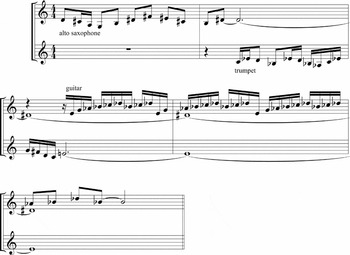
As a musical example testifying to Wolpe and Russell's exchange, I would draw attention to Russell's piece “Odjenar”—the opening tune of the 1951 album Conception—recorded by Lee Konitz on alto saxophone, Miles Davis on trumpet, Max Roach on drums, Sal Mosca on piano, Billy Bauer on guitar, and Arnold Fishkin on bass (Example 1). “Odjenar” speaks to Russell's movement toward a more open tonal and rhythmic framework liberated from regular harmonic changes. The tune announces its eccentricity from the beginning. Lee Konitz smoothly plays a melodically off-kilter, but rhythmically straight oscillating line that ends a half-step higher than where it began. Many segments of the line belong to one diatonic collection or another and create the impression of tonal allusion, but taken together the whole line can hardly be understood as establishing any key. Indeed, within such a short span of time as Konitz's first phrase, Russell makes use of all but four notes of the chromatic scale. Davis's subsequent entrance fills in the last four pitch classes (C, Bb, Ab, and E) completing the circulation of all twelve pitch classes in a line full of difficult dissonant leaps, landing on an E4 that clashes with the D#4 in the saxophone. (Already, the “rate of chromatic circulation” and “principle of the thirdless sound” are in play, the concepts Russell credited to Wolpe.) Davis and Konitz sustain this minor second, which is joined by metrically disorienting runs by Bauer on guitar. Prominent, tight motivic relationships connect all of these otherwise disparate instrumental lines. The opening four notes of the tune articulate a motive, a pointedly non-triadic D4–C#4–A3–G3 descent that is echoed in transposition throughout the opening, including in the saxophone's downward-moving line from F#4 in mm. 1–2 and the trumpet's descents from Eb4 in m. 2 and from G4 in measure 3. Konitz and Davis prominently riff off of this motive in their later improvisations, which further destabilize any strong sense of tonicity. The hallmarks of George Russell's modal jazz—repeated vamps and ostinatos—provide rhythmic and harmonic foundations for Konitz's and Davis's later improvisations. Russell used similar atonal techniques to those in “Odjenar” in compositions like “Jack's Blues” and “Livingstone, I Presume” released on the album Jazz Workshop in 1956, which Russell described as showing the specific influence of his exchanges with Wolpe.Footnote 47
Russell, “Odjenar,” mm. 1–5. Transcription made by the author from Miles Davis, Stan Getz, and Lee Konitz. Conception (original recording reissued), Original Jazz Classics, Ojc B000000Z5B (originally released in 1951 as a compilation of recordings from 1949–51).

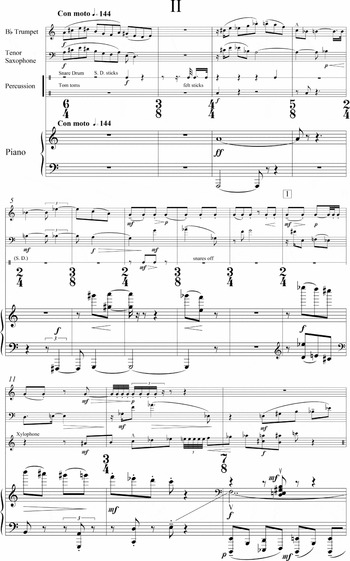
Wolpe's own music conveys the extent to which Russell's compositional tendencies both resonated with and stimulated his own. Inspired by a suggestion from Charlie Parker that they collaborate, Wolpe wrote his Quartet for Saxophone, Trumpet, Piano, and Percussion (a. k. a. Saxophone Quartet) with Parker in mind as a soloist in 1951 (Example 2).Footnote 48 The piece premiered at the Contemporary Music School and was dedicated to the People's Republic of China, in sympathy with its anti-capitalist and anti-colonial struggle.Footnote 49 At first glance, the second movement shows strikingly specific similarities in its harmonic language to “Odjenar.” The first phrase (m. 1) includes all but three pitches of the chromatic scale. Like in “Odjenar,” the response to that phrase (mm. 3–5) fills in the last three pitch classes, Bb, C, and F#. The melodic line contains fragments that may in themselves suggest tonal harmony, yet taken as a whole the line does not establish any key. Moreover, there is an augmented triad (D#5–B4–G4) that prominently inflects the oscillating first phrase in measure 1, like in “Odjenar.” Yet the connections between Wolpe's mid-century aesthetic and Russell's work exceed their similarity of harmonic language. Wolpe's Saxophone Quartet is distinguished by a dramatic movement from a rhythmically simple unison between saxophone and trumpet to a much more complex staging of heterogeneous but highly relational instrumental gestures. The music becomes increasingly talkative, with chattering voices that interrupt one another, echo one another, mimic, contradict, and transform one another through their interactions. Surely Wolpe's turn toward rhythmically spontaneous, highly relational textures at mid-century was partly inspired by his involvement in bop and post-bop scenes, as exemplified in his exchanges with Russell.
Wolpe, Quartet for Saxophone, Trumpet, Percussion, and Piano (Movement 2), mm.1–13. Used by permission of Southern Music Publishing Co., Inc. All Rights Reserved.

In interpreting such musical developments, it is crucial to remember that Wolpe and Russell were drawn together not just on the basis of mutual talent, but also through deeper shared identifications. Their music turned on questions of self-representation and mutual recognition through interaction. Their friendship can be understood as embodying all the more strongly the desire to self-represent and to be recognized. Russell underscored this point:
The legacy of bebop lay in its challenge to this whole feeling of blacks as an inferior intellect, you know . . . I think it was a very muscular drive that bebop represented. To convince—to try again to convince small-minded people that if you have any kind of sensitivity at all, you can see that this music does not come from someone who lacks complexity.Footnote 50
Between Wolpe and Russell there developed a friendship of often like-minded musicians who shared a penchant for idiosyncratic formalized systems, an interest in non-Western musics, and a faith in music's potential to encourage complex forms of mutual recognition. Crucially, Russell took as much interest in Wolpe's persona and life experiences as in his composition: “I have a feeling that other people like myself just wanted to absorb as much not only of the music but of the man.” “My interest was in talking to him chiefly about life.” “Wolpe and his [musical] principles and his forceful being are part of me now, and they always have been, and they always will be.”Footnote 51
Wolpe responded to this exchange with equally strong gratitude. In a 1962 interview, he considered how his relationships with jazz musicians had affected him: “[I]t's very well possible that certain material dormant in me, material which belongs to my own ancestry, my ancestry of doing . . . things, might have been reawakened [by jazz].”Footnote 52 This “ancestry” included a belief, as articulated by his Bauhaus teacher Johannes Itten in the early 1920s, that “there exists a relationship of affinity between the modes of man and the artistic forms he designs.”Footnote 53 Wolpe suggested that he sympathized with jazz not only as a “language in use”—or engagé art form—but also as a “tongued music.”Footnote 54 This latter phrase suggests that he found liberatory potential both in its loquacious voicing and in its juxtaposition of manifold musical “tongues.” He argued that music should inspire people to “shout argue speak”—actions the music itself could model through its dialogical forms and groundbreaking integrated social contexts.Footnote 55 He also saw it as encouraging new cosmopolitan identifications, beyond one's particular race, ethnicity, customs or nationality. This is the aspiration that motivated Wolpe's hopeful words: “Just as the biblical lamb and lion lived in (not understood) concord, so the endless varieties of things, states, and thoughts support one another: because everything is everything to everything.”Footnote 56 In a similar vein, “deal with categories through pluralities” became the refrain of Wolpe's teachings and lectures.Footnote 57 Given the composer's background, this idealized vision of interdependency and “will to connect” is best seen not as a manifestation of rosy-eyed naïveté, but rather as a realistic response to life-threatening experience. In the words of Yoko Ono, another member of Wolpe's creative circles and a fellow vanguardist with a refugee past, “We need the magic of optimism for our survival.”Footnote 58
Music and the Menschennetz
In his personal and public writings in the 1950s and 1960s, the composer itemized fantastical lists to reflect upon the pluralizing activity of his music. He conceived the music as a play of multiple agents that “make connections, bump up against one another,” pursuing “immediate, delayed, distant, shifting, single, many, similar, dissimilar, direct, vague, and opposite goals.”Footnote 59 Their actions played out within the constraints of a Menschennetz (“human net”).Footnote 60 Wolpe's language reveals how he valued music as a locus for metaphors of human life and action—a mainstay of his German musical heritage (exemplified most obviously here in the “conversation” metaphors of the quartet tradition). In keeping with this investment, Wolpe's search for maximally interactive, heterogeneous models of musical form and texture entailed a revision of inherited notions of human subjectivity, agency, and belonging. In the wake of his own experiences of acute vulnerability as a refugee, Wolpe sought alternatives to certain values central to his German intellectual heritage: ideas of sovereign agency and autonomous subjectivity, developmental visions of history, and conceptions of human belonging framed primarily by national identity. This conceptual project was by no means abstract, “merely” philosophical, or disconnected from daily life. Rather, Wolpe had suffered physical and psychological violence that made him question his subjective autonomy and individual powers of self-determination; he felt betrayed by the holistic visions of developmental progress that had inspired him in his youth; and he could no longer rely on familiar securities of national belonging. These painful recognitions spurred Wolpe to revise established musical forms and metaphors bound up with ideas of history, human development, and belonging. He constructed a new musical-conceptual world through which to conceive the pluralities, constraints, and transformations—of subjectivity, history, and belonging—that emerge in displacement. This project was a vital aspect of what Russell called Wolpe's “[musical] principles and forceful being.”
I want to highlight the unexpected way in which Wolpe's composition mediates between the communities of interest in this study. For all its evident connections with jazz composers like George Russell, his music equally suggests his encounter with the thought of Hannah Arendt, a political theorist whose work, which defies easy categorization, addresses subjects ranging from totalitarianism, revolution, and plurality to historiography, thought, and judgment. After Wolpe's arrival in New York, he had contact with Arendt and her husband Heinrich Blücher through a number of shared communities, as I will discuss below. Although it is unlikely Wolpe developed with the Arendt-Blüchers the kind of close friendship he had with Russell, there is ample evidence that their contact was formative for Wolpe. Arendt's work from the same period sheds light on Wolpe's musical metaphors, especially his idea of musical agents that interact within a web of connection and constraint. After her completion of The Origins of Totalitarianism (1951), Arendt initiated projects that would lay the groundwork for The Human Condition (1958), which theorized human agency within a “web of human relationships”—an idea that we will see resembles Wolpe's Menschennetz. So much has already been written of Arendt's texts in recent years that it may seem as though nothing new could be said. But Wolpe's musical contexts open an unusual window onto Arendt's theoretical work, which itself holds aesthetic dimensions that deserve considerable attention.
Arendt's thought from mid-century onward turned on the notion that aesthetic experience may foster a heightened attentiveness to difference. As Kimberly Curtis has argued, “[h]er aestheticism is mindful—indeed driven—by the need for a world sufficiently common that human particularity and plurality can be cherished and saved, a world in which the texture of reality is fullness as opposed to force.”Footnote 61 This project went hand in hand with her elaboration of emphatically relational notions of subjectivity and agency, in redress for a European philosophical tradition that in Arendt's words “spoke of Man and never dealt with human plurality.”Footnote 62 Already in the first edition of The Origins of Totalitarianism (1951), Arendt described the existence of human plurality as constitutive of the human condition, as heralding man's capacity for speech and action in a political world, with its promise of unforeseeable transformation and renewal.Footnote 63 This valorization of plurality was both ethical and aesthetic. It militated against a threat of totalitarian ideologies and terror that “allow for no diversification whatsoever” and erect “holes of oblivion” in place of social spaces for creative human interaction. In The Human Condition, Arendt elaborated a theory of agency that famously described human speech and action—the basic conditions of human life—as being both constricted and made possible by a web of human relationships, the “inter-est” that binds individuals to one another and differentiates them in their concerted actions. In words that resonate with Wolpe's vision of agents that pursue “many, similar, dissimilar, direct, vague, and opposite goals,” Arendt explained, “It is because of this already existing web of human relationships, with its innumerable, conflicting wills and intentions, that action almost never achieves its purpose; but it is also because of this medium, in which action alone is real, that it ‘produces’ stories with or without intention.”Footnote 64 Such notions would have opened all manner of narrative possibilities for Wolpe, who conceived music as a medium through which to dramatize unexpected temporalities of speech and interaction in all their particularity.
The similarity of Wolpe's and Arendt's concepts speaks to a relationship more specific than merely their shared status as Jewish refugees from Berlin. They participated side by side in a distinctive segment of New York's émigré community, united by ethical and political agendas. In the 1940s, Wolpe and Arendt held active memberships in the German-Jewish Club of New York.Footnote 65 As a subset within this network, they both belonged to a left-wing, pacifist Zionist circle associated with Martin Buber and Judah Magnes.Footnote 66 In 1948, Arendt and Wolpe joined other Jewish intellectuals, including Albert Einstein, to co-sign a letter in the New York Times protesting the New York visit of Menachem Begin, who sought funding for his newly created, right-wing Herut “Freedom” party.Footnote 67 The émigrés’ very specific pacifist Zionist political milieu, evident in their co-signed letter, helps to make their historical relationship concrete and particular. A common commitment to causes of Arab-Jewish civic integration and political reconciliation in the Middle East bound them together.Footnote 68
Arendt's husband Heinrich Blücher also strengthened her connection to Wolpe. Blücher was a self-taught philosopher and aesthetic theorist who inserted himself in the downtown New York art scene at mid-century. The Arendt-Blüchers struck a friendship with Wolpe's comrade and neighbor, the artist Alcopley, a founder of the Eighth Street Artists’ Club, where the composer was a member.Footnote 69 By 1950, Blücher began to attend meetings of the Club, delivering several lectures, and Arendt also presented there on one occasion.Footnote 70 The Club would have been an intriguing place for the émigrés, given its anxious attachment to the European avant-garde and heated debates about the nature of painterly action and self-expression.Footnote 71 In an unpublished 1950–51 diary, Wolpe includes Blücher's name in an extravagant and poetic list, which probably functioned both as a “to do list” and as an inventory of serious matters to reflect upon. The list mentions “The talk by Blücher” among a range of transformative ambitions that blithely mix daily life with utopian aspiration: “revision of purpose of living” and “overhauling knowledge,” alongside “clear the closet/was überaltet ist [what is too old] throw out/put summer clothes in luggage/. . . with moth balls and put/it on top of the closet.”Footnote 72 It is surely relevant here that Wolpe's list also includes the notes “Morty's [Morton Feldman's] new Estetics [sic]” and “Impressions from Arshille [sic] Gorky,” suggesting his meditation on discussions at the Artists’ Club.Footnote 73 Wolpe probably considered these Artists’ Club lectures and conversations in relation to the far-reaching aspirations on his list (which he tempered with humorous allusions to a “revisionary” cleaning of his closet).
It was in the wake of Blücher's regular presence at the club that the composer noted him in his diary, and concepts key to Arendt's and Blücher's theories appeared prominently in Wolpe's writings. In addition to their pacifist Zionism, Wolpe's relationship with the Arendt-Blüchers surely benefited from other shared identifications, especially their past involvement in Berlin agitprop circles and mutual preoccupation with Bertolt Brecht (as expressed in Wolpe's musical settings of Brecht's texts and in Arendt's written commentary on his persona and projects).Footnote 74 To be sure, there were also pronounced differences: Wolpe identified with aesthetic avant-gardes with an intensity Arendt did not share (though Blücher did), and he could not bring himself to recognize the atrocities of Stalinism that, in contrast, had galvanized Arendt's thought.Footnote 75
At the heart of their connection, however, lay their strong engagement with concepts of plurality and their related focus on notions of narration. These are the commitments, I believe, that drew Wolpe to post-bop circles, on the one hand, and to Arendt and Blücher at the Eighth Street Artists’ Club on the other. Arendt connected her gratitude for plurality with the responsibility to narrate and lead courageous lives in a shareable world: “Generally speaking, such gratitude expects nothing except—in the words of Faulkner—one's ‘own anonymous chance to perform something passionate and brave and austere not just in but into man's enduring chronicle . . . in gratitude for the gift of [one's] time in it.’”Footnote 76 Arendt conceived life as a political action revealed in the language of narration, a form of remembrance that secures the afterlife of actions. The “who” at the center of a life-story reveals itself not through lonesome self-reflection, but through a flux of manifold effects, partial repetitions, recollections, and reinterpretations—a pluralizing process that both attenuates human sovereignty and brings newness into the world. As Arendt famously put it, “The stories, the results of action and speech, reveal an agent, but this agent is not an author or producer. Somebody began it and is its subject in the two-fold sense of the word, namely its actor and sufferer, but nobody is its author.”Footnote 77 This model of subjectivity is more deeply relational than the solitary notions of selfhood that characterized many discourses at the Eighth Street Artists’ Club, as described by Michael Leja.Footnote 78 Rather, as Julia Kristeva has written of Arendt, “the ‘who’ is revealed in the temporality of the memory of others.”Footnote 79
In this context, Wolpe is best understood as an artist who asserted a strong sense of authorship and responsibility over his artwork as a form of narration or testament. In turn, his composition helped to compensate for the lack of control he felt over his own life story, of which no one was an author.Footnote 80 In his own words, Wolpe wrote music as an enduring life-chronicle: “One must compose the documents of this decamping [aufbrechend] time and one's testament alongside them.”Footnote 81 The composer's description of “time” as “aufbrechend”—which means not only “decamping,” but also more literally “breaking open” or “bursting”—indicates how readily he transposed ideas of historical experience and personal memory into fragmentary and pluralizing notions of musical temporality.
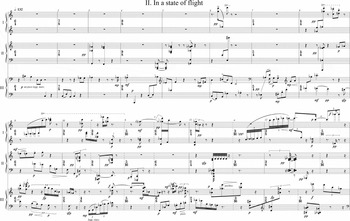
Whereas Arendt valued Greek tragedy and epic drama as the ultimate artistic manifestations of human action as narrative, Wolpe's work can be interpreted as enacting in the insistently temporal terms of musical form, metaphor, and collective performance. The composer already conceived musical experience through notions of speech and interaction, a tendency reinforced by his investment in the jazz world. Wolpe's own composition, however, also shows how music could recall and transform through “testament” an intrusive and terrifying past. Consider, for example, Enactments for Three Pianos (1953), a work that seems to point toward the place of individual subjects within a network of interdependent actions and reactions. The second movement, “In a State of Flight,” opens with a quirky, meandering tenor-register piano tune that ambles with an unassuming rhythmic simplicity, jarred only very subtly by some syncopated angular leaps (Example 3).Footnote 82 This line's qualities might suggest an “implicit musical persona” in Edward T. Cone's sense, linked with the tradition—especially prominent in Austro-German musical thought—of interpreting musical form through metaphors of human life and consciousness.Footnote 83 Yet the single continuous line is broken between two fragmentary piano parts, like a Klangfarbenmelodie, but between two pianists, that calls for acute reactivity between them. The challenges of three-piano performance only heighten this need for attentiveness, because the medium makes it uniquely difficult for players to distinguish their own sounds from others’. Within a few seconds of the movement's opening, two violent, extremely high-pitched outbursts interrupt the opening line's progress. For all of their disjunction, there is nonetheless an intensive relationship between the opening line and volatile interruptions. The first outburst (m. 6) belatedly reacts to an earlier three-note tenor-range figure (mm. 3–4) with an up-beat rhythm and plummeting leap; the outburst inverts and distorts the profile of that previous figure, transforming and magnifying the leap downward into a shrill leap upward.Footnote 84 The mid-register piano line, in turn, splits into two-voice counterpoint in the same measure (m. 6). The second high-pitched outburst (m. 8) then triggers a sudden condensation of time and an explosive multiplication of voices (m. 9). From that moment onward, the frantic congestion and blurring of boundaries among gestures obliterates any semblance of a stable persona that the tenor voice may have suggested at the opening.
Wolpe, Enactments for Three Pianos (Movement 2 “In a State of Flight”), mm. 1–12. Used by permission of PeerMusic Classical. All Rights Reserved.

Although the piece persists for more than eight minutes with an overwhelming textural density, echoes of the opening continuously return in refracted figures that alter one another through their interactions, piling up at wildly varied speeds. The most startling rupture occurs three quarters of the way through, when an insistent repeated-note motive, arguably machine-gun-like in sound, emerges after a rare silence and then rebounds in transformed fragments in all registers throughout the vast sound-space. The kinetic force of the motive is jolting. Its transformation within the web of voices, however, emerges in a technically dazzling display of proliferating, fine-tuned details and singularities.
If this piece seems to point toward the place of individual subjects within a network of interdependent actions and reactions, then it is worth bearing in mind that its title ties the very idea of action to a question of memory. “In a State of Flight” recounts an original trauma, and this retelling is itself a reclamatory action, as the title Enactments suggests. It enacts a “flight” of virtuosity in its composition and performance. In characteristically poetic words, Wolpe described this kind of action as expressing gratitude, recalling Arendt's own thanksgiving for plurality:
Say thanks to be born as a human being.
To make oneself over again and anew
a hundert and thousand times,
in the strain of tides and vortexes
which threaten existence with dangerous
pulls into dangerous depths and no-
man's ends-nowhere.Footnote 85
These words speak to the sound-world of “In a State of Flight,” which can be understood as shuttling between an autobiographically charged image of human superfluousness—“dangerous depths and no-man's ends-nowhere,” like Arendt's “holes of oblivion”—and a fullness of aesthetic particularities that evoke unpredictable possibilities for renewal. Yet Wolpe's “document” and “testament” cannot be reduced to the status of a reified object, the category Arendt herself used to describe most artistic production.Footnote 86 Rather, in Wolpe's terms, it enacted: it both played out musical metaphors for action and performed itself as human action. Just as its heterogeneous musical form suggests by analogy the relational contingencies and unpredictable consequences of human action, so the piece itself was performed by close associates of Wolpe for an audience of “reactors.” As George Russell recalled, “I. . .went to concerts where Wolpe's music was played. All of us did.”Footnote 87 I believe Wolpe wanted his legacy (or “testament”) not to operate as a “school” or “style,” but rather—in the manner of his own musical forms—as a set of aesthetic-ethical soundings and responses that reverberated in divergent streams of activity.
“Ungraspable Metamorphoses”
Arendt's husband Heinrich Blücher articulated an aesthetic theory that may help to put a finer point on our understanding of Wolpe's vision of art's legacies in community life. In unpublished lectures Blücher delivered in 1951, he argued that “artistic form” is distinguished by its capacity “to bring [one] into an experience of participation. [P]articipation . . . as the possibility expressed by art lies directly between those two other possibilities of human beings—the possibility of communication as expressed in language, for example, and the possibility of identification as expressed in love.”Footnote 88 In keeping with this notion of artistic “form” as bringing “participation,” Blücher suggested that art could encourage people to treat others as creative “beings” rather than as mere “things.”Footnote 89 This idea responded to Arendt's critiques of totalitarianism, the power that sought to transform “the human personality into a mere thing” by depriving people of social spaces for creative interaction.Footnote 90 In redress, Blücher hoped that art would restore and preserve such creative spaces: its energetic and “speaking” aesthetic forms would encourage humane modes of identification and dialogue. He praised artists who, in his view, conjured an interdependent world of animate beings from the isolated materials of inanimate things. He singled out Paul Cézanne as an artist who revealed “beings in motion,” “being of all kind woven into an active density.”Footnote 91 Blücher explained, “Cézanne, when asked once why he painted so many still-lifes answered: ‘I suppose you have never heard the conversation between apples, a vase, and a table.’ His apples were entirely de-individualized in human terms, but he made an apple into a being that could talk and influence other beings.”Footnote 92 To Blücher, the active and “speaking” presence of such works, animated by kinetic brushstrokes and colliding planes, would literally summon an interpretive community to cluster around them in dialogue.
Wolpe realized a kindred aesthetic through a world of musical metaphors far more elaborate than what Blücher articulated in relation to Cézanne.Footnote 93 The wild, teeming surface of Wolpe's music, with its evocation of beings in action, has a basis in an extensive and idiosyncratic system of compositional techniques. For our purposes, this quality is best exemplified in Wolpe's concept of “organic modes,” the primary technique through which he imagined the musical work as a field of play among disparate agencies. These “organic modes,” central to his pedagogy, were collections of unordered pitches with specific intervallic patterns. In this basic sense, they resembled Russell's modes, as bunches of notes not governed by static tonal hierarchies. In Wolpe's case, however, “organic modes” were assigned complex musical behaviors and composed out as entities that could act and react to one another like living organisms. Wolpe conceived the modes’ behaviors through a poetic discourse that blended Bauhaus visual theory with Second Viennese School concepts, Arab maqam theory, surrealist aesthetics, and more:
A certain organic mode may act within [the musical interval of] a major seventh. All manifestations then take place within an extremely constricted and narrowed area. As an organic, structural phenomenon it signifies jammed densities in action. As a pictorial sensation it is the doodle, the beehive. As an expressive sensation it is the symbolic retreat into sub-miniature forms of human beings the size of ants.Footnote 94
Within a composition, this wildly imagined “de-individualizing” mode—to use Blücher's term—would interact with another that may, among other qualities, “exist in an ever-expanding trajectory of curves. . .. As a pictorial sensation it is bird's flight, movement of waves. As an expressive sensation it is extension on all sides, giving and being given.” Such modes could count among many within any given piece. Over the course of a composition, each of these modes would transform the tendencies of the others. Plurality characterizes each mode both in itself (“jammed densities,” “trajectory of curves,” etc.) and in its interactions with other modes. Wolpe's language of lists and conjunctions dramatizes this multiplicity. Indeed, he performed the lecture cited above, like many others, with pre-composed musical examples played by pianist David Tudor, alternating with his own “extraordinary improvisatorial voice, which like his music, shook sound on its ear.”Footnote 95
What I find most striking in Wolpe's work—from pedagogy to composition—is its valorization of plurality under a sign of musical translation. Music comes to be, precisely at the unfathomable moment when it becomes something else, something multiple: visual, structural, expressive, ethical, gesticulate, articulate. Wolpe's far-flung imagery—from dehumanized “human beings the size of ants” to “extension on all sides, giving and being given”—summons all of these “extra-musical” categories. It would not be unreasonable to compare Wolpe's poetics with Samuel Weber's reading of Walter Benjamin's notion of translatability: “a work can only ‘work,’ do its work, have effects, be significant insofar as it goes outside of itself and is transformed by and into something else, something other.”Footnote 96 In the composer's own migrant-inflected terms, music brings a mysterious threshold experience of freedom, loss, and transmutation: “to overhear the play of liberated sensations, to take notes in the dark, to partake of the endless encounters of things, situations, and thoughts; [to perceive] secret signs, something in vain, something dying, indescribable, ungraspable metamorphoses.”Footnote 97 By recognizing music—for all its enigmatic presence and vaunted non-referentiality—as a medium of translation, we take seriously the element of untranslatability (“secret signs, something in vain, something dying”) in any source language or enunciatory act—the untranslatability that opens up the original to an altering flux of contingency in its afterlife. We also press music to speak to a wider range of ethical histories.Footnote 98
It is remarkable how the trope of translation brings together individuals not otherwise seen as connected. All of the figures of my narrative held stakes in an aesthetics devoted to enacting, in Kimberly Curtis's words, “a world in which the texture of reality is fullness as opposed to force.” Translation pertains not only to a poetics of subtle perception, exchange, and dialogue, but also to modes of belonging and historical continuance that benefit from cultural boundary-crossing and its unpredictable play of difference. Neither Wolpe nor Russell, Blücher nor Arendt could fully take for granted the forms of intellectual and artistic genealogy that have oriented so many histories defined by nation, genre, and discipline. No wonder, then, that the crisscrossing relationships they exemplify have proved elusive. Yet, as notions of modernity are reassessed and modernism's legacies reevaluated, the strands that bound together displaced individuals such as these give pause. Through their connection, we may draw familiar categories and figures somewhat outside of themselves. And though a whole gamut of avant-garde musics has long remained a relatively sequestered subject of study in the academy, this medium's peculiar temporalities and hyper-relational forms suggest alternative modes through which to tell a history of aesthetic responses to modernity's global dislocations. This history unfolds through unexpected encounters and proximities. It highlights the role of migrants as cultural brokers. It follows musical forms and concepts that survive through transformation in their transference. It traces lines of “influence” defined less by replication of genre, technique, or style than by conceptual and ethical resonances that cross disciplines and media. It views musical avant-gardes not as a “terminal” point in the development of Western art music, but as a source to be mined in deciphering current dilemmas of human difference, cultural loss, and mediation.