Dr. C. Norman Coleman—or Norm as we all knew him, our beloved Norm—had a rich and varied life and career, summarized in the accompanying guest editorial and elsewhereFootnote a , Footnote b I had the pleasure of working closely with him for more than a decade on issues relating to nuclear and radiological preparedness before my career turned in a different direction, to focus on epidemic and pandemic preparedness and the development of vaccines against emerging and re-emerging viruses. Just as there was continuity, in Norm’s life, between his roles as husband, father, scientist, clinician, civil servant, and generous mentor and champion of the work of others, and in his mind, between his work across the disciplines of science, medicine, public health, and emergency response, so do I perceive a continuity, intellectually and analytically, between my recent work on infectious diseases and epidemic and pandemic response and the work I pursued in the U.S. government between 2002 and 2017 on the development of radiation medical countermeasures and preparedness for nuclear and radiological incidents and emergencies. A great deal of what I know about the latter, I learned through my partnership and interactions with Norm, and I have naturally carried concepts and habits of mind that we cultivated together in that domain into my thinking and problem-solving in the domain where I now spend most of my professional time. The application of these concepts and habits of mind to the problems posed by viruses and viral epidemics has produced insights and novel ways of solving problems that testify to the surprising range of Norm’s influence and may, reflexively, contribute to solving some remaining problems in radiological and nuclear preparedness.
Fortunately, nuclear and radiological incidents and emergencies are rare. There have been 3 large-scale nuclear meltdowns at civilian nuclear power plants in the last 45 years (during one of which—Fukushima—Norm played a critical role as adviser to both the Japanese and U.S. governments), and accidental occupational or medical exposures due to human error or exposure of civilians due to discarded or lost industrial or medical radiation sources (or, in the case of Alexander Litvinenko, intentional poisoning) are infrequent, with only a handful of incidents reported publicly since the turn of the century. The International Atomic Energy Agency (IAEA) publishes detailed accounts of the most significant of these.Footnote c Outbreaks of emerging infectious diseases, on the other hand, occur much more frequently, with some diseases (such as Dengue or Lassa fever) causing outbreaks annually somewhere within their range and others (such as the Ebola, Sudan and Marburg filoviruses or Chikungunya) occurring sporadically but not infrequently (the filoviruses, for example, have caused nearly 50 outbreaks since they were discovered in the 1960s and 1970s). Since 1977, at least 4 newly emerging viruses have caused pandemics (influenza A/H1N1 in 1977, HIV in the 1980s, influenza A/H1N1pdm in 2009, and SARS-CoV-2 in 2019). This frequency of occurrence both compels the development of systematic capabilities to detect and respond to such threats and provides occasion to test, improve, and perfect these capabilities in what amount to live-fire settings.
Our experience over the last decade in developing vaccines and other medical countermeasures against the filoviruses known to cause disease in humans is illustrative in this regard. The 2013-2016 epidemic of Ebola virus disease in West Africa was the largest outbreak of the disease to date, with more than 28,000 cases and 11,000 deaths. It prompted the acceleration of the development of several Ebola vaccines, one of which (rVSV-ZEBOV, now licensed in the United States and Europe by Merck Sharpe & Dohme [MSD] as ERVEBO®) was shown to be effective in a phase 3 open-label, cluster-randomized ring vaccination trial conducted in Guinea and Sierra Leone and initiated in late March 2015, approximately a year after Ebola was identified as the cause of the outbreak.Reference Henao-Restrepo, Camacho and Longini 1 The long delay reflected the fact that the vaccine was in preclinical development when the outbreak began and the event that effectively triggered the acceleration of vaccine development, the World Health Organization’s (WHO’s) declaration that the outbreak represented a public health emergency of international concern (PHEIC), did not occur until August 8, 2014. 2 This experience prompted investments that resulted in the licensure of ERVEBO® as well as Johnson & Johnson’s Zabdeno® (Ad26.ZEBOV)/Mvabea (MVA-BN-Filo) 2-dose preventive vaccine,Footnote d as well as additional public sector investments to develop vaccines against both the Sudan and Marburg viruses.
These investments in Sudan and Marburg vaccines and the licensure of the 2 Ebola vaccines and prequalification by WHO of ERVEBO® have accelerated the vaccine response to subsequent outbreaks. For example, the deployment of experimental vaccines in response to the recent Sudan outbreak in Uganda occurred significantly sooner than the deployment of ERVEBO® in West Africa, with the first doses of vaccine arriving in country just 79 days after Uganda’s declaration of the outbreak on September 20, 2022.Footnote e This achievement was enabled by prior investment in Sudan vaccine development, but delayed by the fact that the vaccine drug substance had not been filled and finished into vials suitable for deployment. By the time vialed vaccine arrived in country on December 8, the last confirmed case had recovered and been released from care (on November 30).
Between the Sudan outbreak in Uganda and the declaration of a Marburg outbreak in Rwanda on September 27, 2024, 2 further developments helped improve the speed and effectiveness of response. Based on its experience with its Sudan vaccine in the Uganda outbreak, the Sabin Vaccine Institute, with funding support from the U.S. Biomedical Advanced Research and Development Authority (BARDA), created an investigational stockpile of filled and finished phase 2-ready doses of its Marburg vaccine candidate. These doses, along with relevant export permits, were stored at a facility in Italy maintained by Sabin’s contract manufacturing partner. Separately, the organization I currently lead, the Coalition for Epidemic Preparedness Innovations (CEPI), with a number of key international partners already working in Rwanda (Ginkgo Bioworks, IQVIA, and BioNTech), had developed a “100 Days Mission in Rwanda” initiative with Rwanda’s Ministry of Health, the Rwanda Biomedical Centre, and the Rwanda FDA.
The “100 Days Mission in Rwanda” initiative focused on planning and envisioned a series of tabletop and functional exercises designed to accelerate Rwanda’s response to an emerging infectious disease. After several months of planning, and fortuitously, the first of these exercises was conducted in Kigali about 2 weeks before the Marburg outbreak began. One output of this exercise had been the rapid generation (in ~10 days) of a real-world effectiveness protocol for the imminent deployment of mpox vaccine in response to the simultaneous mpox PHEIC. This practical experience, which helped cement critical relationships, coupled with the Sabin Vaccine Institute’s investments in preparedness and BARDA’s willingness to support the deployment of the investigational reserve, enabled an experimental Marburg vaccine to be deployed into an approved open-label phase 2 clinical trial in Rwanda that was initiated just 9 days after the outbreak was declared.
This progressive improvement in the ability to deploy experimental vaccines into clinical trials during public health emergencies is at the core of CEPI’s 100 Days Mission. The observation, often attributed to Omar Bradley,Footnote f that “amateurs talk strategy, [while] professionals talk logistics” expresses the idea that to achieve an ambitious goal, the problem the goal presents must be broken down into its component parts, each of which must then be solved operationally if the goal is to be achieved. Opportunities to actualize these solutions through practice must be exploited, with iterative incorporation of lessons learned, if the objective of developing real and sustainable capabilities—and improving performance—is to be accomplished.
An analogy accessible to lay audiences that we have adopted to explain the kinds of performance improvements that can be achieved through such an approach is the progressive reduction of pit stop times over several decades in Formula One racing, through engineering of the vehicles, development of highly specialized tools for the pit crew, significant enlargement of this crew and specialization of the roles assigned to individuals within it, development of strict protocols to govern team effort, and optimized execution of these protocols through repetition and practice, all in the service of gaining a competitive edge by reducing the time spent off the track during a race. This sustained and concerted investment of resources and effort has resulted in a reduction of pit times from more than a minute on average in the 1950s and 1960s to 2-3 seconds today—a reduction of approximately 95%, equivalent to a 20- to 30-fold improvement in performance.Footnote g Planning and preparing to deliver medical countermeasures in public health emergencies (whether caused by infectious diseases or nuclear or radiological incidents) in a similarly systematic, engineering-oriented way would yield immeasurable benefits when such threats materialize.
The vaccine response to the COVID pandemic, while of a vastly different scale and caliber than comparable efforts in the filovirus examples cited above, also offers lessons that may be applicable in the context of nuclear and radiological emergencies, particularly as these lessons illuminate the challenge of ensuring equitable access to medical countermeasures.Footnote h The public-private collaboration to develop vaccines against SARS-CoV-2, as exemplified in the U.S. Government’s Operation Warp Speed, was a phenomenal success and the rollout and uptake of these vaccines in high-income countries was generally rapid. The global response, however, was much more mixed, with vast disparities of access emerging, leading to prolonged delays in vaccine availability in poor countries.
The causes of these delays were manifold, ranging from the global scarcity of vaccine (at least initially), to “vaccine hoarding” by rich nations (which often purchased quantities of vaccine in excess of their immediate needs) leading to the imbalanced allocation of available supplies, to the imposition of export controls by countries where manufacturing was occurring, to the delays experienced by international organizations such as Gavi in securing financing for procurement, to concerns about whether vaccines requiring stringent cold chain management could be delivered safely and effectively in low-resource environments, to limited health care capacity in many countries to deliver vaccines to high-risk populations. From CEPI’s perspective, failures of vaccine access were not simply a function of catastrophic moral failures attributable to “vaccine nationalism” or “vaccine apartheid,”Reference Cohen 3 , Reference Bajaj, Maki and Stanford 4 but rather a systemic output, the etiology of which, properly understood, points toward opportunities for targeted intervention and improvement. Generalizing the problem of achieving equitable access to countermeasures as (to a certain degree of approximation) a logistical rather than a moral problem necessarily changes one’s approach to solving it.
Particularly in the context of a nuclear emergency involving radioactive fallout dispersed over a wide geographic area (and possibly extending across national borders), disparities of access to critical medical countermeasures will almost certainly occur. It may be the case that these disparities are not driven (or not driven simply) by income, if one assumes a government-led response, with free access to biodosimetry and indicated countermeasures, but they are likely to have systemic causes—which might include language barriers, disability, education status, or other factors increasing social fragility—and these causes are likely to be those associated with other health inequities. The best way to reduce disparities in access in an emergency is to anticipate and plan against them.
“One of the hardest things about solving hard problems is that they are hard!” sounds like something Norm would say—and responding to a nuclear or radiological emergency would present a whole set of hard problems. Fortunately, hard problems often yield to the right question. But getting to the right question, the question that unlocks a solution, is by no means easy. Bringing a systems perspective to hard problems, which is something that Norm always did, can allow one to situate these problems in a way that reveals their structure. And it has been my experience, over and over again, in dealing with the problems that emerge while planning for epidemics and pandemics, that once the structure of a problem is understood, and properly framed, the question that needs to be answered to solve the problem often becomes obvious.
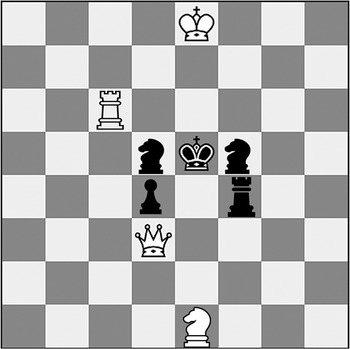
Let me conclude by illustrating this serious point in a somewhat whimsical way that I hope Norm would appreciate, with a chess problem. In 1939, C.D. Locock published an instructive book of chess problems entitled Imagination in Chess. Reference Locock 5 In that book, Locock aimed to teach young players how to solve chess problems by developing their imagination—and chess imagination, for Locock, was manifest in the knowledge and application of particular devices. In the introduction to his book, Locock describes 12 such “devices” (which include such things as jumping, line-clearance, manufacture of discovered checks, nullifying the opponent’s command of a square, etc.). These devices, he says, may be used to achieve certain ends. The challenge for young players is to understand the structure of the problem that each position presents, and then apply the available tactics to achieve checkmate.
In the mate-in-two problem depicted in Figure 1, with white’s side of the board at the bottom, the solution can of course be achieved, with significant mental expenditure, through brute force calculation, by evaluating all of white’s possible moves. But it soon becomes evident that what appear to be white’s most promising moves (using the rook or queen to put the black king in check) will not achieve the goal of mate-in-two.
Mate-in-two diagram adapted from CD Locock.Reference Locock 5

The key to solving this puzzle efficiently is to recognize the structure of the trap that ensnares the king. Because of the placement of the white rook and queen, the king’s mobility is already severely impaired. That is obvious. But there is an additional, critical feature, which is that the placement of the white knight eliminates 2 additional squares that might serve as an escape route for the black king. The black king cannot go “north” because of the rook; he has his back to the wall. If he can be enticed to the white square beneath his starting position, he will be trapped by the knight and his own pieces in a “tunnel” and the white rook can then deliver the coup de grace.
The critical question then is, “Can the king be drawn into this tunnel?” Framed that way, the solution to the problem becomes clear. Sacrificing the white queen, by moving it to the white square just beneath the king—a move that most amateurs dismiss—leaves black with no good options. The black king cannot retreat because of the rook. Taking the queen draws the king into the tunnel, where the white rook and the knight can work in coordination to achieve the mate-in-two. The other option is to take the queen with the black rook, but this puts the king in a metaphorical barrel, where the white knight can finish him off with a direct attack (by moving to the square occupied in the diagram by the white queen) that also attacks the king’s only escape square.
The general truth embodied in chess problems is that the solutions to hard problems emerge when one asks the right questions, and one discerns the right questions by understanding the structure of the problem that needs to be solved. Norm, who demonstrated through his work and contributions that he understood the challenges of nuclear and radiological preparedness in precisely these terms, would take pleasure in the fact that a pastime can be used to illustrate such an important point.
Competing interests
None.