Implications
The longer is the productive life of the rabbit doe the lower productivity is obtained under heat stress conditions, mainly due to the high-kit mortality during lactation. This impairment is probably related to the difficult of rabbit does to lose body heat that would lead to a reduction of milk production. Accordingly, it seems necessary to develop additional management (e.g. weaning earlier than at 35 days of age), feeding and/or housing strategies to help rabbit doe to remove heat losses in order to optimize rabbit production under heat stress.
Introduction
The impairment of rabbit doe performance under seasonal heat stress conditions is well described both in experiments carried out during summer in Spain or Egypt (Méndez et al., Reference Méndez, de Blas and Fraga1986; Marai et al., Reference Marai, Habeeb and Gad2002a) or in climatic chambers (Fernández-Carmona et al., Reference Fernández-Carmona, Cervera, Sabater and Blas1995; Fernández-Carmona et al., Reference Fernández-Carmona, Alqedra, Cervera, Moya and Pascual2003). In these studies it is observed that hot climate increased body temperature and reduced feed and digestible energy intake, milk production, litter size and growth, and rabbit doe weight, and increased kit mortality, but performances improved once the heat stress period is overcame. Little information has been obtained in conditions of chronic exposure to heat stress that might difficult the recovery of the animal in any period of the year, as occurs in Maracaibo that combines high temperature and relative humidity (RH) along the year. However, both environmental conditions (temperature and RH) and intake/excretion habits in rabbits (Prud’hon, Reference Prud’hon1973; Carabaño and Merino, Reference Carabaño and Merino1996) follow circadian rhythms, being feed intake during night (cooler period), that might make easier their adaptation to these conditions.
Heat stress not only reduced rabbit doe productivity but also growth performance of fattening rabbits (Pla et al., Reference Pla, Fernández-Carmona, Blas and Cervera1994; Chiericato et al., Reference Chiericato, Boiti, Canali, Rizzi and Ravarotto1995; Ayyat and Marai, Reference Ayyat and Marai1997). Moreover, under dry tropical conditions fattening mortality increased in small weaned rabbits (<450 g, which accounted for 25% of the total number of rabbits). Besides, increasing stock densities reduced growth performance and enhanced aggressiveness (Villalobos et al., Reference Villalobos, Guillén and García2008). The latter is also stimulated by increasing group size in European conditions, when stock density is constant (Princz et al., Reference Princz, Dalle Zotte, Radnai, Bíró-Németh, Matics, Gerencsér, Nagy and Szendró2008), and might be a relevant factor under tropical conditions.
Accordingly, under heat stress conditions reproductive management and age at weaning may play an important role to optimize rabbit doe and growth performance. The objective of this work was: (i) to evaluate heat stress and circadian rhythms in our conditions comparing unclipped and clipped rabbit does, (ii) to study if a more extensive breeding system (delay of mating and weaning) may increase weight of litters at weaning without impairing rabbit doe performance, and (iii) to determine if cage size maintaining stock density influences growth performance.
Material and methods
Management and housing
The experiment was conducted at Ana Maria Campos Experimental Farm facilities in 2007 from late April to the beginning of November. The climate condition is characterized as tropical very dry forest (Holdridge, Reference Holdridge1978). The minimal–maximal temperature recorded along the experiment was 25.5°C to 34.5°C and the minimal–maximal RH 65% to 96%. The farm is an open-air building equipped with a ventilator to favour air recycling and a mesh (80% shade) in the windows to avoid animals were exposed to the sun. There was no artificial light. Rabbits does were housed in flat-deck cages of 500 × 1000 × 500 mm (0.5 m2) equipped with one nipple drinker and one hopper feeder (30 cm available) each one. A commercial pelleted diet containing (g/kg dry matter) 163 crude protein, 364 neutral detergent fibre and 43 acid detergent lignin, was offered ad libitum to all the animals throughout all the trials described. Water was filtered before stored in the farm water-tank. The temperature–humidity index (THI) was calculated according to Marai et al. (Reference Marai, Ayyat and Abd El-Monem2001): THI = db°C − [(0.31 − 0.031 RH) × (db°C × 14.4)], where db°C is dry bulb temperature in Celsius degrees, and RH is the relative humidity as percentage. According to Marai et al. (Reference Marai, Habeeb and Gad2002b) there is heat stress when THI is higher than 28.9, and under 27.8 there is no heat stress.
Heat stress evaluation and circadian rhythms of rabbit does trial
Forty-six crossbred New Zealand White, Californian, Butterfly, Dutch and Satin nulliparous rabbit does with an average weight of 3.67 ± 0.05 kg (s.e.) were divided randomly into two groups (23 per treatment). The first one was clipped once 2 days before the beginning of the measurements and the second one remained unclipped to study only their capacity to eliminate heat in our conditions, as it is not a usual practice. Clipped area extended from scapula to sacred zone with a 20 cm width. A bovine electrical clipping machine was used. During 24 consecutive hours, rectal temperature, feed and water intake were recorded every 4 h. Rectal temperature was measured by using a clinical digital thermometer inserted 2 cm into the rectum for 2 min. In the same period, it was registered the farm temperature and the RH. After this experiment rabbit does were not clipped again.
Breeding system trial
Forty-three crossbred New Zealand White, Californian, Butterfly, Dutch and Satin rabbit does from the latter experiment were mated 7 days after rectal measurements with an average weight of 3.58 ± 0.06 kg, by using 12 male rabbits weighing 3.42 ± 0.08 kg. Each rabbit doe was mated twice using two different males, and each male mounted twice per day as maximum. Once the does were confirmed pregnant, they were randomly assigned to the two breeding systems (including in both systems rabbit does that had been clipped or not and from the different crossbred types). In the control one (C) rabbit does were mated 14 days after parturition and litter was weaned at 35 days of age, and in the extensive one (E) they were mated 21 days after parturition and weaned at 42 days of age. At 21 days of lactation the nest were closed (and only open at 0700 h for 10 to 15 min daily to allow suckling, that was not measured) and a feeder with the same feed of the mother was placed inside the nest to record litter feed intake from 21 days up to weaning, separately from that of their mothers. The following measurements were recorded for 6 months (the first three cycles, each cycle considered the period between two consecutive parturitions): eliminated does (culled and dead), doe weight (at birth, at 21-day lactation and at weaning), rabbit doe feed intake (at birth, 21-day lactation and at weaning), fertility (number of mating per doe to get pregnant: 100%, 50%, 33.3% and 25%. These percentages means mated at first, second, third or fourth mating, respectively), pregnancy length, number of kits and kit mortality (at birth, 21 days lactation and at weaning), litter weight and litter feed intake, and feed efficiency among parturitions. It was also studied the difference between the real and theoretical parturition-effective mating interval, being the theoretical values 14 and 21 days for control and extensive reproductive breeding systems, respectively.
Cage size trial
Two hundred twenty-eight weaned rabbits from the first two cycles of the latter experiment were divided into two cage sizes for fattening. Half of the animals of each treatment were caged in wire-mesh cages of 500 × 1000 × 500 mm (0.5 m2) at a rate of eight rabbits per cage. The remaining group was housed in cages of 500 × 500 × 500 mm (0.25 m2) at a rate of four rabbits per cage. Both groups maintained the same stock density (16 rabbit/m2), that is lower than the maximal recommended by Villalobos et al. (Reference Villalobos, Guillén and García2008) in our conditions (18 rabbit/m2). The large cages were equipped with two nipple drinkers and two hopper feeders, whereas the small cages had one nipple drinker and one hopper feeder. Feed intake, growth rate, feed efficiency, length of fattening, aggressiveness (number of rabbits injured) and mortality was recorded until rabbits reached 2.1 kg BW.
Statistical analysis
Results obtained from doe rabbits to evaluate heat stress and rabbit doe and litter performances were analyzed by a repeated measures analysis using MIXED procedure of SAS (Littell et al., Reference Littell, Milliken, Stroup and Wolfinger1996). The model for evaluating heat stress included treatment (clipped or not), period of the day (2200 to 0200, 0200 to 0600, 0600 to 1000, 1000 to 1400, 1400 to 1800 and 1800 to 2200 h) and its interaction. In the case of rectal temperature metabolic weight was also included as a covariate. Variance and covariance matrix structure were modelled according to an auto-regressive structure for the measurements repeated in each rabbit doe, which was considered as a random effect (Littell et al., Reference Littell, Henry and and Ammerman1998). The model for rabbit doe and litter performances included breeding system (control v. extensive), cycle number (1, 2 and 3) and its interaction. Variance and covariance matrix structure was modelled according to a compound symmetry structure and rabbit doe was also considered a random effect. Means comparison was made by t-test when cycle effect was significant (P < 0.050). Data from total removed, dead and culled does were analysed using logistic regression (GENMOD procedure of SAS, considering a binomial distribution) and results were transformed from the logit scale. Finally, data from the cage size trial was analyzed as a factorial structure 2 (cage sizes) × 2 (breeding systems) × 2 (cycles) by using GLM procedure of SAS, including in the model as main factors cage size (large/0.5 v. small/0.25 m2), breeding system (control v. extensive) and cycle number (1 v. 2) and their interactions. All variables in tables are least squared corrected means. Statistical analysis was made using the Statistical Analysis System, SAS (version 8.2).
Results
Heat stress evaluation and circadian rhythms of rabbit does trial
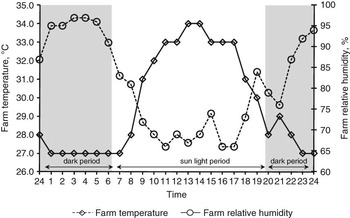
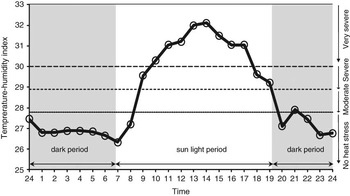
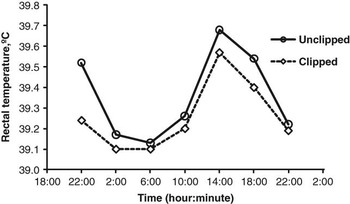
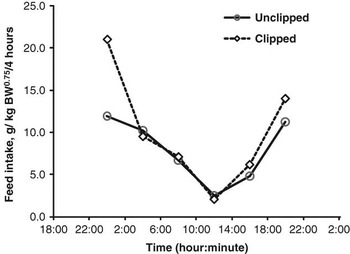
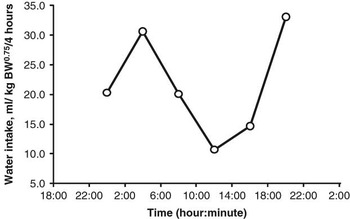
In our farm rabbits does were under heat stress from 0800 to 1900 h (Figures 1 and 2), being exposed to very severe stressed from 1000 to 1800 h. It is in agreement with the influence of daytime on rectal temperature (P < 0.001). Maximal rectal temperatures match up with the sun period were farm temperature and THI increased, and RH decreased (Figure 3). The maximum farm temperature (and THI value) is reached around 1400 h, that is, the same time in which rabbits showed their highest rectal temperature. Daytime also affected feed and water intake (P < 0.001. Figures 4 and 5), decreasing both during the sun light period. From 1800 h onwards farm temperature/THI, and rectal temperature decreased and rabbit does begun their feed and water intake period. The lowest farm temperature/THI and rectal temperature and highest feed and water intake were observed during night that is the natural period for rabbit meal.
Circadian evolution of temperature and relative humidity inside the farm during the 24 h experimental period to evaluate heat stress and circadian rhythms of rabbit does.

Circadian evolution of temperature-humidity index inside the farm calculated according to Marai et al. (Reference Marai, Ayyat and Abd El-Monem2001) during the 24 h experimental period to evaluate heat stress and circadian rhythms of rabbit does.

Circadian evolution of rectal temperature of clipped or unclipped rabbit does (n = 23/treatment). P clipping = 0.045 and s.e.clipping = 0.036; P time < 0.001 and s.e.time = 0.042; P clipping × time = 0.22 and s.e.clipping × time = 0.060; P metabolic weight = 0.021.

Circadian evolution of feed intake (g/kg BW0.75/4 h) of clipped or unclipped rabbit does (n = 10/treatment). P clipping = 0.019 and s.e.clipping = 0.61; P time < 0.001 and s.e.time = 1.15; P clipping × time = 0.043 and s.e.clipping × time = 1.62.

Circadian evolution of water intake (g/kg BW0.75/4 h) of rabbit does (n = 10/treatment). P clipping = 0.75 and s.e.clipping = 2.01; P time < 0.001 and s.e.time = 3.95; P clipping × time = 0.73 and s.e.clipping × time = 5.57.

Rabbit does that remained unclipped increased rectal temperature (39.4°C v. 39.3°C; P = 0.045) and decreased feed intake (7.87 v. 10.0 g/kg0.75 per 4 h; P = 0.019) respect to those clipped. An interaction clipping × time was observed for feed intake due to the especially high-feed intake of clipped rabbits at the first hours after sunset (P < 0.043; Figure 4). Water intake varied in parallel to feed intake and was not influenced by clipping (21.6 ml/kg0.75 per 4 h, on average). The ratio water/feed intake in this study was 2.5 ml water/g feed.
Breeding system trial
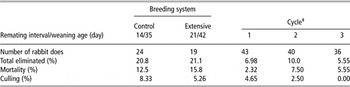
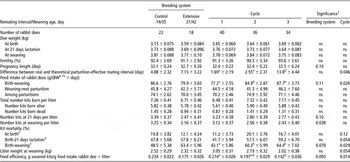
The proportion of total eliminated, dead and culled does was not affected either by breeding system or by cycle number being on average 21%, 14.1% and 6.8%, respectively (Table 1). Fertility and weight of rabbit does at birth, 21-day lactation and weaning was not affected by breeding system or cycle number, being on average 92.2% and 3.66, 3.71 and 3.79 kg, respectively (Table 2). Pregnancy length tends to increase by 0.6 days with the extensive breeding system compared with the control one (P = 0.10) with no effect of cycle number. The difference between the real and theoretical parturition-effective mating interval was not affected by breeding systems, but it increased in the third compared the first two cycles (P = 0.046). Feed intake of rabbit does from birth to weaning tended to decrease with the extensive breeding system compared with the control one (P = 0.11). However, feed intake from weaning to next parturition and among parturitions was not affected by breeding system (86.8, 44.0 and 72.0 g/BW0.75 × day, respectively). Feed intake during lactation was higher in the second and third cycles compared with the first one (P = 0.026), but cycle number did not affect feed intake after weaning and among parturitions. Neither breeding system nor cycle number influenced the total number of kits born per litter and those born alive or dead (6.98, 5.80 and 1.19, respectively), but kit mortality at birth tended to be lower in the first cycle compared the next two cycles (P = 0.12). The number of kits at 21 days per litter tended to decrease (P = 0.10), whereas at weaning decreased by 33% (P = 0.038) with the extensive breeding system compared the control one. Cycle number did not affect these variables. Accordingly, extensive breeding system tended to increase kit mortality during lactation (P = 0.070). It also increased in the second and third cycles compared with the first one (P ⩽ 0.054). The extensive breeding system tended to reduce feed efficiency (g weaned kits/g feed intake does+litter; P = 0.093), whereas cycle number impaired it from the first to the third cycle by 48% (P = 0.014). No effect was observed from the previous clipping on any trait of rabbit does.
Effect of breeding system and cycle on total eliminated, mortality and culled rabbit does

Remating interval/weaning age: 14/35 v. 21/42 day post partum.
‡No significant effect of breeding system, cycle and breeding system × cycle was detected.
Effect of breeding system and cycle on rabbit doe performance (mean ± s.e.)
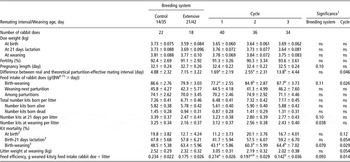
Remating interval/weaning age: 14/35 v. 21/42 day post partum.
a,bFor cycle effect mean values in the same row with a different superscript differ (P < 0.05).
1The interaction breeding system × cycle was not significant (P > 0.15) for all traits.
2Expressed over total born.
3Expressed over number of born alive.
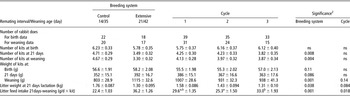
Data of Table 2 is conditioned by the relatively high number of parturitions/lactations that finished with no weaned kits (34.5%). In order to show what are the real performances of litters in this study, additional information has been included considering only the litters with at least one kit at weaning (Table 3). In these litters, the extensive system did not affect the number of kits at birth, but tended to increased their weight (P = 0.11), which is probably related to the trend to increase pregnancy length. The extensive system reduced the number of kits at 21 days and at weaning (by 28%. P ⩽ 0.008) and litter weight at 21 days (by 26%; P = 0.038). However, kits from the extensive group tended to be heavier at 21 days (P = 0.086) and at weaning (by 39%; P = 0.001). Litter feed intake were similar from 21 to 35 days of lactation for both breeding systems (23.0 g/day and kit as average). However, it increased in the extensive compared with the control group from 21 days to weaning (by 62%; P < 0.001). The weight of litter at 21 days tended to be maximal in the first cycle compared second and third cycles (P = 0.084), whereas litter feed intake was maximized at the third cycle (P = 0.018).
Effect of breeding system and cycle on litter performance during lactation in litters that at least weaned one kit per parturitionFootnote 1 (mean ± s.e.)

Remating interval/weaning age: 14/35 v. 21/42 day post partum.
a,b For cycle effect mean values in the same row with a different superscript differ (P < 0.05).
1 Litters with no kit alive were excluded from these calculations.
2 The interaction breeding system × cycle was not significant (P > 0.15) for all traits.
Cage size trial
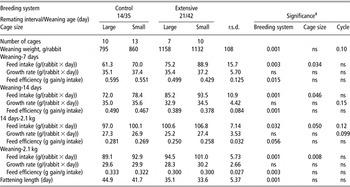
Growing rabbits from the extensive breeding system were heavier at weaning (by 38%; P < 0.001), and showed a higher feed intake (+7.4%) and lower feed efficiency (−8.4%) throughout the fattening period (P ⩽ 0.056) respect to rabbits from control breeding system (Table 4). Their fattening period was 9 days shorter than those of control group (P < 0.001), but the age at the end of the fattening period was not different (77.3 ± 1.70 day). Growing rabbits caged in large cages increased feed intake by 5.6% throughout the fattening trial (P ⩽ 0.050), but no influence was observed in growth rate and feed efficiency. Weaned weight of rabbits from the first cycle tended to be higher than those of the second cycle (1016 v. 957; P = 0.10), and tended to show a higher growth just after weaning (35.5 v. 33.4; P = 0.15) that was compensated later (25.7 v. 27.8. P = 0.099) obtaining similar final weight at the end of fattening. Neither breeding system nor cage size influenced the uniformity of weight of rabbits at the end of fattening (average s.d.: 0.22 kg). There were no animals with injuries, and no mortality was observed in this experiment.
Effect of breeding system, cycle (1 and 2) and cage size (large: 8 rabbits in 0.5 m2 v. small: 4 rabbits in 0.25 m2) on growth performance from weaning to 2.1 kg BW (results expressed per cage)

Remating interval/weaning age: 14/35 v. 21/42 day post partum.
‡The interactions breeding system × cage size, breeding system × cycle, cage size × cycle and breeding system × cage size × cycle were not significant for any trait.
Discussion
Heat stress evaluation and circadian rhythms of rabbit does trial
Most of the eating/drinking activity of nulliparous rabbit does was done during the night period that is the normal circadian rhythm of rabbits (Carabaño and Merino, Reference Carabaño and Merino1996), and which is regulated by the time of sunrise/sunset (or light on/off). According to Marai et al. (Reference Marai, Ayyat and Abd El-Monem2001) the night would be the only period with no heat stress in our farm and in which rabbit does showed minimal rectal temperature. However, it did not mean that rabbit does were completely free of heat stress, as when they remain unclipped they increased rectal temperature not only during the day but also during the night, decreasing their feed intake. In fact, when minimal temperature was higher than 24°C, as occurs in our study, Pascual et al. (Reference Pascual, Cervera, Blas and Fernández-Carmona1996) also observed an important reduction of milk production as a consequence of heat stress. Furthermore, data reviewed by Cervera and Fernández-Carmona (Reference Cervera and Fernández-Carmona1998) indicated that the upper critical temperature for rabbits would be close to 24°C to 25°C. The ratio water/feed intake was higher than that recorded at 20°C in adult rabbits (Prud’hon, Reference Prud’hon1976), but lower than that observed by Finzi et al. (Reference Finzi, Nyvold and and El Agroudi1992) in a climatic chamber (2.5 v. 3.5 and 8.3 ml/g at 26°C and 32°C, respectively) or by Marai et al. (Reference Marai, Habbeb and Gad2005) in Egyptian hot conditions (4.4 ml/g), and similar to Egyptian mild conditions (2.8 ml/g). It might be explained by the differences in both ambient temperature and water temperature and/or water quality among studies (Abdel-Samee, Reference Abdel-Samee1997; Marai et al., Reference Marai, Habbeb and Gad2005). These results suggest that feed intake is limited by heat stress, even during the night, and that clipping favours body heat dissipation enhancing feed intake during the night, as also observed by Finzi et al. (Reference Finzi, Macchioni and Kuzminsky1994), probably due to the difficulty of increase heat loss during the day.
Breeding system trial
The effects of heat stress can be observed when comparing our performances with recent European studies (Quevedo et al., Reference Quevedo, Cervera, Blas, Baselga and Pascual2006a and Reference Quevedo, Cervera, Blas, Baselga and Pascual2006b; Nicodemus et al., Reference Nicodemus, Redondo, Pérez-Alba, Carabaño, De Blas and García2010). In our conditions (that differed in environment, but also in genetic) we observed a reduction of the total number of kits born alive per litter (−4.1), that is accounted for the lower prolificacy (−3.2) and higher number of kits born dead (+0.9). We also recorded a higher mortality at birth (16.0% v. 7.5%) and during lactation (56.0% v. 10.0%) respect to these European studies, but similar to data obtained in hot conditions that might be partially explained by the reduction of milk production (not determined in this study; Marai et al., Reference Marai, Habeeb and Gad2002a; Fernández-Carmona et al., Reference Fernández-Carmona, Alqedra, Cervera, Moya and Pascual2003). Besides, the high temperature might have also make difficult the search of the mammary area by young suckling kits, as according to Jeddi (Reference Jeddi1971) this search would be absent when temperature is higher than 36°C. However, minor differences were observed for fertility (Nicodemus et al., Reference Nicodemus, Gutiérrez, García, Carabaño and De Blas2002) suggesting that problems related to doe receptivity and/or male fertility were negligible.
The use of the extensive breeding system compared with the control one tended to increase kit mortality from birth to weaning, reducing the number of kits at 21days and at weaning per litter. These results might be accounted for a reduction of milk production in the extensive rabbit does, as their litters showed a lower weight at 21 days compared with the control group. Litter weight at 21 days is the variable more related to milk production as until to this time kits practically do not eat feed (Lebas, Reference Lebas1968; Fernández-Carmona et al., Reference Fernández-Carmona, Blas, Cervera and Pascual2006). Accordingly, the reduction of milk production would have impaired kit viability. In fact, most of mortality of suckling rabbits (>90%) occurred during the first 21 days of lactation. The reduction of milk production might be explained by the trend to reduce feed intake during lactation in rabbit does from the extensive group. The longer lactation in the extensive system might have increased heat load, resulting in a reduction of feed intake in this period and milk production in order to reduce heat production. These results and the lack of effect of breeding system on feed intake of rabbit does among parturitions lead to a trend to reduce feed efficiency of rabbit does from the extensive group. When feed efficiency is calculated for the global productive period (breeding + fattening periods), the differences between control and extensive breeding system still remain (0.289 v. 0.225 g rabbit at the end of fattening/g total feed consumed (lactation + fattening)). The numerical productivity (number of weaned kits per rabbit doe and year) decreased in the extensive group (23.3 v. 13.0, respectively), showing values much lower than in European conditions (⩾62 kits weaned/cage and year; Nicodemus et al., Reference Nicodemus, Gutiérrez, García, Carabaño and De Blas2002). However, breeding system did not affect weight of rabbit does, the difference between the real and the theoretical parturition-effective mating interval, prolificacy or fertility, that remained high compared with previous studies performed under hot conditions (Marai et al., Reference Marai, Habeeb and Gad2002a).
Rabbit does and litter performances were impaired along the successive reproductive cycles, from the first to the third one (delay between the real and theoretical parturition-effective interval, increase of kit mortality during lactation, and decrease of litter weight at 21 days and at weaning and feed efficiency). Besides, rabbit does were not able to growth from the first parturition onwards, in spite of the increase of lactation feed intake along cycles, which apparently would have avoided to reach their adult weight (Fernández-Carmona et al., Reference Fernández-Carmona, Alqedra, Cervera, Moya and Pascual2003). These results show that rabbit doe productivity decreased along successive reproductive cycles or when lactation was extended, possibly due to its progressive weakening, and its inability to recover properly under our chronic heat stress conditions.
Cage size trial
The limited milk production would have been the responsible of the high-mortality rate during lactation. It would have produced a natural selection, and that the survival kits were those stronger kits of each litter, that might explain the absence of mortality during fattening. Growing rabbits weaned at 42 days of age were heavier at weaning, and showed a higher feed intake and lower feed efficiency throughout the fattening period than those weaned at 35 days. Garrido et al. (Reference Garrido, Nicodemus, García, Chamorro and De Blas2009) also recorded a higher weaning weight and lower feed efficiency in the growing rabbits weaned later (35 v. 25 days of age).
Large cages enhanced feed intake compared with small cages, probably due to feed waste. In general, rabbits housed in larger groups reduced the time of resting and increased their activity in European conditions (Princz et al., Reference Princz, Dalle Zotte, Radnai, Bíró-Németh, Matics, Gerencsér, Nagy and Szendró2008), which would have favoured feed waste. However, type of cage did not influence growth rate, feed efficiency, uniformity of final weight or aggressiveness as observed under European conditions by Rommers and Meijerhof (Reference Rommers and Meijerhof1998).
In conclusion, these results indicate that our rabbits are under heat stress. In this situation, as longer is the production period (either extended lactation from 35 to 42 days or cycle number) the lower productivity is obtained, mainly due to the high kit mortality during lactation. It might be probably related to the difficult of rabbit does to lose body heat that would lead to a reduction of milk production. Accordingly, it seems necessary to develop additional management (e.g. weaning earlier than at 35 days of age), feeding and/or housing strategies to help rabbit doe to remove heat losses.
Acknowledgements
Authors are grateful to CONDES (Consejo de Desarrollo Científico y Humanístico) from Zulia University for the financial support to maintain the experimental rabbit farm Ana María Campos (belonging to the Agronomy Faculty of Zulia University), to the Technical University of Madrid for the financial support (project AL08 0250-001), and also to the Microbiology Department from the Veterinary Faculty of Zulia University, and to Javier González (Nanta, S.A.) for their technical help.