

Two decades ago, White (Reference White, Ashton, Healy and Pettitt1998a) suggested that Acheulean assemblages with high frequencies of twisted ovate handaxes all belonged to late Marine Isotope Stage (MIS) 11 or early MIS 10. This was not the first time this highly distinctive type had been singled out for special attention. Evans (Reference Evans1872, 520) recorded several early discoveries of twisted handaxes at Hoxne and Santon Downham, noting that while they were ‘by no means uncommon’ they were probably accidental. Spurrell (Reference Spurrell1883) likewise thought twisted edges to be a defect, left uncorrected due to raw material constraints. This view was not shared by Smith and Dewey (Reference Smith and Dewey1913; Reference Smith and Dewey1914), who regarded the rare twisted forms from Swanscombe and Dartford as technologically advanced. Despite coming from the highest and, therefore, oldest terrace in the Lower Thames, they assigned them to the culturally-evolved St Acheul II stage, equivalent to the ‘Upper Acheulean’ described by Victor Commont (Reference Commont1908) in the Somme Valley. Henri Breuil included the latter material in his Acheulean IV, the penultimate phase of the Acheulean before, according to him, it evolved into the Micoquian (Acheulean VI & VII; Breuil & Kelley Reference Breuil and Kelley1954). Collins (Reference Collins1969) similarly saw twists as a technically advanced trait, using them as the basis for his youngest ‘Elveden’ stage of the Acheulean, which he dated, on the basis of typology, to the mid-Rissian (ie, the penultimate glacial) period. Around the same time Roe (Reference Roe1968) identified a large group of assemblages (his Ovate Tradition, Sub-Group VI) with above-average frequencies of twisted handaxes but the lack of secure dating and compressed chronological framework, which recognised too few climatic cycles, again meant that he was unable to link them by anything other than artefact form. More mindful of the spurious use of typological dating, Roe leaned in print towards a functional explanation (Roe Reference Roe1981), although privately he always suspected they were of the same age (D. Roe, pers. comm. to MJW, 1998).
By the late 1990s, important advances in lithostratigraphy (eg, Bridgland Reference Bridgland1994; Antoine et al. Reference Antoine, Lautridou and Laurent2000) and biostratigraphy (eg, Keen Reference Keen1990; Schreve Reference Schreve1997; Reference Schreve2001a; Reference Schreve2001b), in particular, had made it possible to correlate the fragmentary terrestrial record with the more complete oxygen isotope record from deep sea sediment and terrestrial ice cores. This provided archaeologists with a new and expanded chronological framework that allowed the archaeological evidence to be arranged in a more coherent order. White (Reference White, Ashton, Healy and Pettitt1998a) simply recognised that all the better understood and dated sites with twisted handaxes belonged, according to several new and independent lines of evidence, to the same period, which he believed to be late MIS 11/early MIS10. He further suggested that they might represent an endemic cultural practice, perhaps one that developed during a period of high sea-level when Britain was cut off from Europe. He warned against uncritically using isolated twisted handaxes for dating purposes, following the prevailing near-consensus among British workers that any handaxe type could feasibly occur any place and any time, simply by chance: a statistical consequence of giving enough hominins enough time and enough stone.
White’s (Reference White, Ashton, Healy and Pettitt1998a) interpretation ran contrary to the dominant theoretical paradigm of the time, and contrary to his main thesis (White Reference White1998b). Older ideas that handaxe shapes reflected the cultural norms of their makers, conscious or unconscious reflections of the groups who made them, had given way to more ‘Processual’ interpretations, which emphasised the impact of function, raw materials, and resharpening on biface form. Similarly, the notion that handaxe shapes were the physical expression of ‘mental templates’, traditional and socially-resonant designs held in the mind’s eye, was recast in more techno-functional terms as a ‘mental construct’ (Ashton & McNabb Reference Ashton, McNabb, Ashton and David1994). This involved a basic set of rules uniting all handaxes – bifacial working to form cutting edges, an idea of symmetry, and distinct butts and tips – in which the realisation of a practical bifacial edge was more important than final form and in which any consistency in shape emerged from repetitive rhythms of making, rather than design (eg, White Reference White1998b).
Today twisted handaxes are one of a number of temporally-restricted types used by White and Bridgland (White et al. Reference White, Scott and Ashton2006; Reference White, Bridgland, Schreve, White and Penkman2018; Bridgland & White Reference Bridgland and White2014; Reference Bridgland and White2015; White Reference White, Coward, Wenban, -Smith and Hosfield2015) to construct a new Lower Palaeolithic framework, based not on notional schemes of typological progression but on independent relative and absolute dating methods. This includes a consistent pattern in the timing of Clactonian and Levalloisian industries, as well as a number of handaxe assemblage types that belong to different interglacial cycles. In other words, Roe’s (Reference Roe1981) hunch that the apparent lack of coherent cultural patterning was due to an inaccurate and inadequate chronological framework was correct; some of the variation in handaxe shape is culturally significant, and this has the potential to reveal much about hominin settlement, social networks, and modes of social transmission during the Middle Pleistocene.
Here we return to our original temporal peculiarity, twisted handaxes, and explore more fully their distribution, significance, and contribution to the deep history of Palaeolithic Britain. A map showing the sites discussed in this paper is presented in Figure 1.
Map of Britain showing main sites mentioned in the text and tables

THE TWISTED HANDAXE KNAPPING METHOD: WHAT, HOW, & WHY
Twisted handaxes are usually ovate or cordate forms, although they are defined not by the outline shape of the tool but by the profile of the edges, which display strong (usually reversed) ogee curves on all sides (Fig. 2). In more mathematical terms, ‘when viewed in the four orthogonal directions (left, right, distal and proximal)’, twisted handaxes present a ‘sinusoidal edge [with] four inflection points, i.e., the point on a curve at which the curvature changes sine and the curve changes from concave upwards to concave downwards or vice versa’ (Gallotti et al. Reference Gallotti, Collina, Raynal, Kieffer, Geraads and Piperno2010, 310).
The Twisted Handaxe Knapping Schema: A) diagram showing the conceptual pattern of inflection points and the edge configuration of a twisted handaxe, in this case describing a z-twist (redrawn after Gallotti et al. Reference Gallotti, Collina, Raynal, Kieffer, Geraads and Piperno2010); B) the series of rotations and inversions employed in the ‘Classic Twisted Strategy’ (White Reference White, Ashton, Healy and Pettitt1998a): 1: the first quarter is knapped; 2: the piece is turned over through the long axis, presenting the opposite margin and other face for knapping. This quarter is knapped; 3: the piece is rotated 180°, presenting the quarter diagonally opposite 2 for knapping; 4: the handaxe is inverted through the long axis once more, presenting the final quarter for knapping. Each quarter is knapped in an opposite direction to that adjacent to it, and in the same direction as that diagonally opposite it
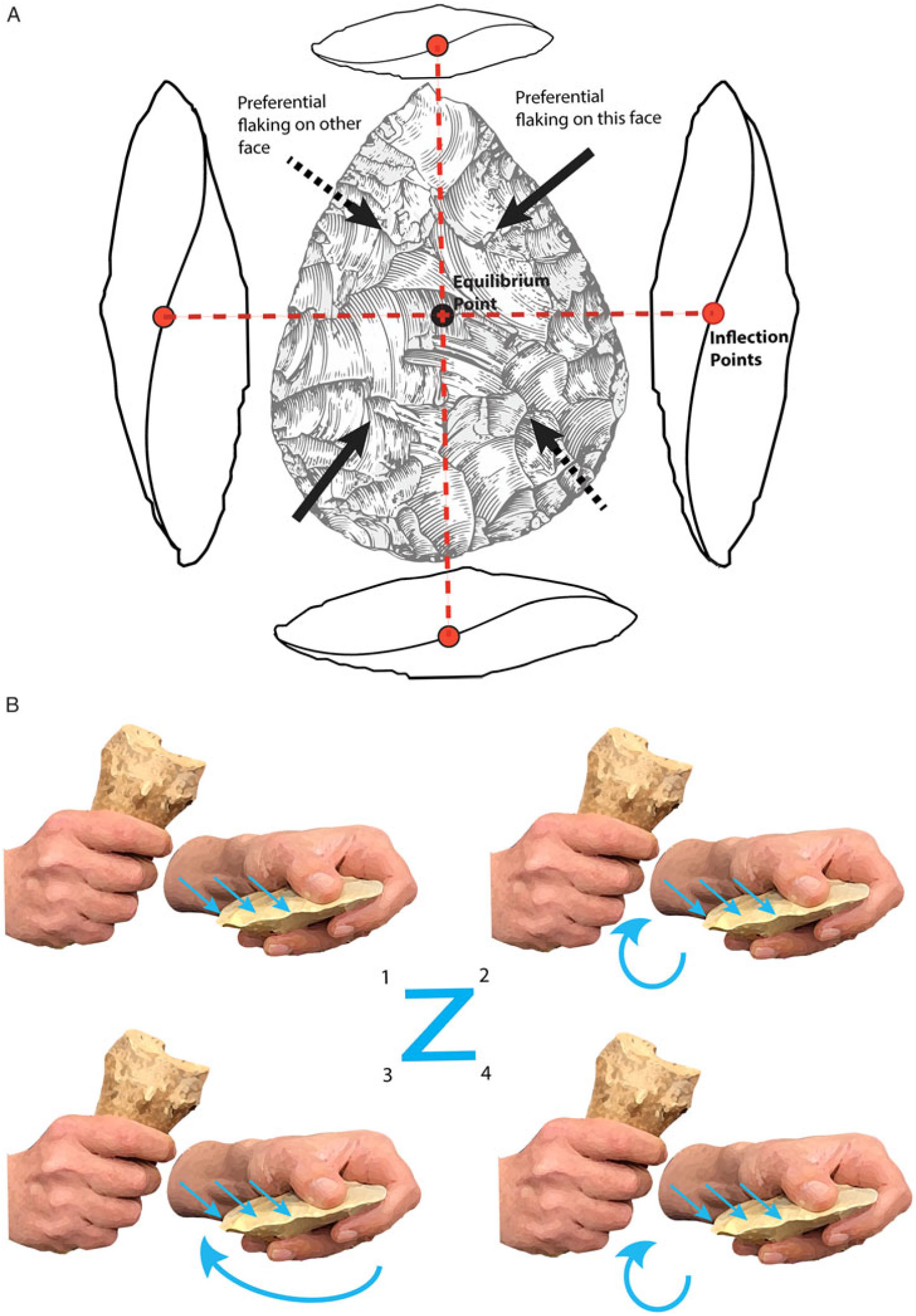
Twisted handaxes were created using a specific knapping strategy (Fig. 2a). As described by White (Reference White, Ashton, Healy and Pettitt1998a), this involved the division of the implement into four quarters or arcs, each of which was worked in the opposite direction to that adjacent to it, causing their edges to curve away from one another. Each quarter was brought into the correct knapping position by a series of rotations and inversions in the hand, the precise sequence of which was free to vary provided that contiguous quarters were preferentially worked in different directions and diagonally opposed quarters in the same direction (Fig. 2b). Expressed in the terms employed by Gallotti et al. (Reference Gallotti, Collina, Raynal, Kieffer, Geraads and Piperno2010), there has to be an inflection point on each edge at which the knapping direction reverses, causing the edges on either side to curve away from one another. The twist could presumably have been imposed upon a handaxe at almost any stage of manufacture, although it was preserved or enhanced during finishing. Cognitively, the production of twisted edges demands the mental ability to conceive and impose wave forms onto handaxe edges, by keeping several opposing and future knapping operations in mind. The individual edge segments must be continuously conceived as parts of the greater whole and work in harmony with each other to achieve what is, in our opinion, not an accident but a clear design template.
White also noted that 94% of twisted handaxes displayed z-twists rather than s-twists, a likely indicator of handedness and brain laterality among Acheulean hominins. Unknown to White (Reference White, Ashton, Healy and Pettitt1998a), Flaxman C.J. Spurrell (Reference Spurrell1883) had described the technique used to make a twisted edge, and its implications for handedness, 115 years earlier.
Similar deviations from the more typical straight or zig-zagged bifacial edge can be produced accidentally, but such ‘pseudo-twists’ are usually found only on one edge and are typically curved at one end rather than being properly sinusoidal. The assemblage from Broom, Devon, is a case in point. Hosfield and colleagues reported that 3% (n=30) of Broom hand axes showed a twisted profile, but that ‘in many cases the S-twists were not pronounced, and in no examples were they as diagnostic as the S and Z-twisted ovates discussed by White (Reference White, Ashton, Healy and Pettitt1998a)’ (Hosfield & Chambers Reference Hosfield and Chambers2009, 87; Hosfield & Green Reference Hosfield and Green2014). From the examples we have seen, we concur with this assessment: the Broom ‘twists’ represent unstructured deviations from straight, some with repeated sinusoidal waves on a single edge, rather than classic twisted handaxes. These pseudo-twists would thus appear to add to the already unusual set of practices seen at Broom, which include the use of Greensand chert (95% of handaxes), the production of asymmetrical handaxes (23%), and specific sharpening techniques (cf. Ashton and Hosfield Reference Ashton and Hosfield2009; Ashton et al. Reference Ashton, Lewis, Hosfield, Ashton, Lewis and Stringer2011; Hosfield and Green Reference Hosfield and Green2014).
An obvious question is whether twisted handaxes served a specific function or represent a resharpened (but nonetheless formalised) expression of untwisted forms. Our analyses (Appendix S1, Tables S1–2) found little technological or morphometrical support for the idea that twisted edges emerged from regularised resharpening practices. Nor are twisted handaxes found in flint-poor regions where hominins might have been more economical in their use of stone resources and resharpened their tools more frequently: quite the contrary in fact. Twisted edges conceivably served a specific or auxiliary function, such as scraping (Walter Reference Walter1996), although this is equally possible for many non-twisted forms. None of the existing examples is fresh enough for micro-wear analyses and the suggestion therefore remains untested (Walter Reference Walter1996; cf. Keeley Reference Keeley1980).
In contrast, evidence that twisted edges were a deliberate design might be found at the primary-context site at Foxhall Road, Ipswich, Suffolk. Here, three ‘twinned’ pairs of untwisted handaxes and a trio of near-identical twisted forms (Fig. 3) were found together in a small cluster around a central focus, which Nina Layard, the excavator, thought was a hearth (White & Plunkett Reference White and Plunkett2004). We interpret the pairs and the trio as the products of different individuals, each having their own style based around the common ovate form. They are witness to mental templates repeatedly imposed using skill and precision, derived from socially-acquired techniques and ideas, learnt as children and developed throughout life. If these groupings do not represent the distinctive products of specific individuals then they were made by different people who closely copied each other, which would indicate that imitation (or over-imitation: Shipton & Nielsen Reference Shipton and Nielsen2015) was a key factor in the social transmission of handaxe making between contemporaries and across generations.
A trio of ‘near-identical’ twisted ovate handaxes from Foxhall Road. These were found by Nina Layard in 1903, lying side by side. Line drawings are of the pair of handaxes in Ipswich Museum (Acc. No. 1920-76-35/Layard #48 & 1920-76-37/Layard #42). The outline drawing is of the handaxe given to Sir John Evans and now housed in the Ashmolean Museum, Oxford (Layard #45)

Regardless of whether twisted edges were a redundant design feature or a shared practical solution, the temporal and geographical patterning of twisted handaxes described below suggest that this was part of a long-lasting regional tradition.
THE STRATIGRAPHICAL HISTORY OF THE TWISTED HANDAXE
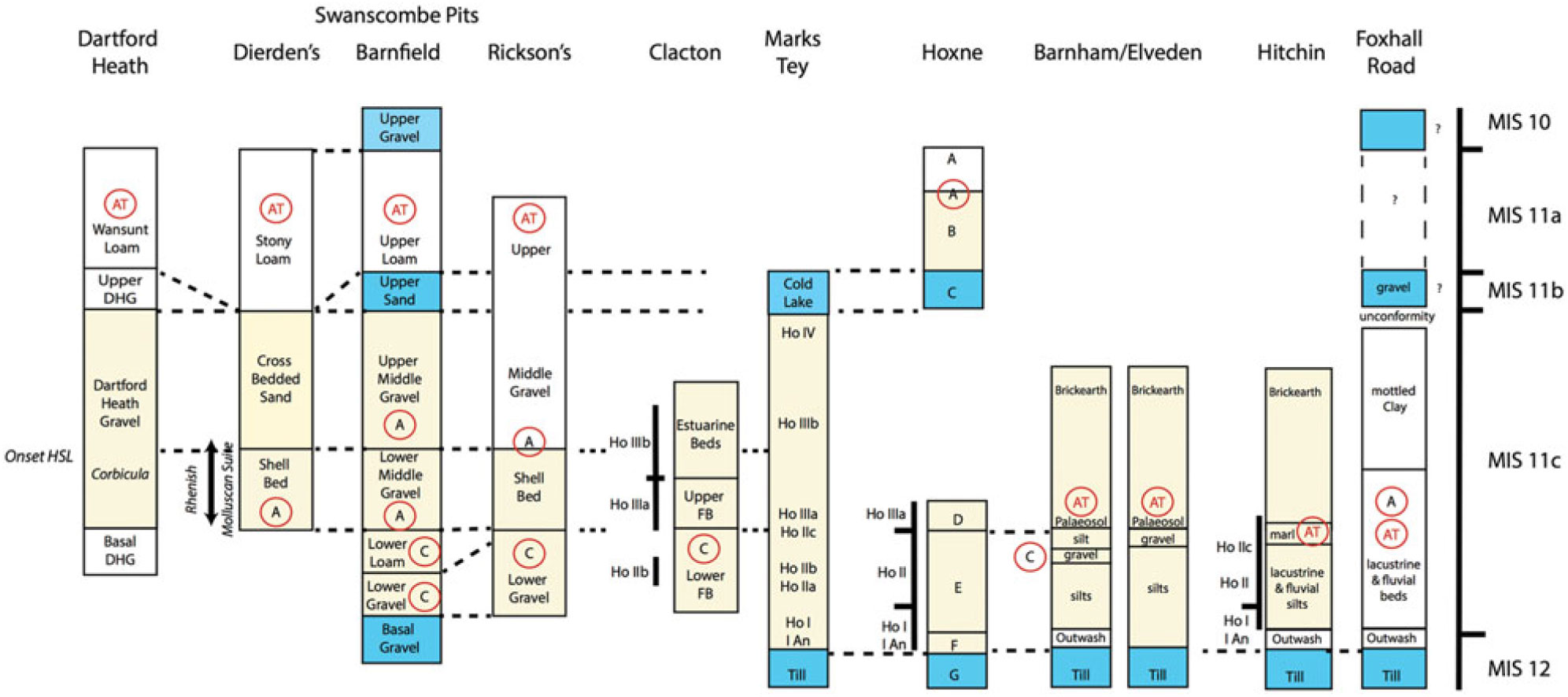
White (Reference White, Ashton, Healy and Pettitt1998a) suggested that assemblages containing relatively high frequencies of twisted handaxes all belonged to late MIS 11/early MIS 10, their occurrence at the top of the Swanscombe sequence suggesting they were present during the final part of the interglacial or interglacial complex (cf. Bridgland Reference Bridgland1994; Conway et al. Reference Conway, McNabb and Ashton1996). Recent advances in our understanding of MIS 11, combined with new discoveries and a wider examination of the twisted-ovate phenomenon, suggests that this did not reveal the real story. MIS 11, which spanned approximately 60,000 years, encompassed two warm periods, MIS 11c (the Hoxnian sensu stricto) and MIS 11a, separated by a cold interval, MIS 11b (Ashton et al. Reference Ashton, Lewis, Parfitt, Penkman and Coope2008; White et al. Reference White, Preece and Whittaker2013). During the past 20 years, more MIS 11 sites have been correlated to the sub-stage level (Table 1). A greater number of sites can now also be confidently attributed to other Marine Isotope Stages and substages (eg, Candy & Schreve Reference Candy and Schreve2007; Penkman et al. Reference Penkman, Preece, Bridgland, Keen, Meijer, Parfitt, White and Collins2013), providing valuable comparative data from which to explore the significance of the twisted ovate phenomenon (Table 2). Below we summarise the dating evidence for the key twisted-handaxe assemblages (see Fig. 4).
Schematic correlation diagram for sites in the Thames Valley and East Anglia, showing the chronological distribution of different archaeological industries (based on correlations in Preece et al. Reference Preece, Gowlett, Parfitt, Bridgland and Lewis2006; Pettitt & White Reference Pettitt and White2012; White et al. Reference White, Preece and Whittaker2013). Blue shading = cold climate. Yellow shading = palaeo-environmental evidence for temperate climate
ASSEMBLAGES SHOWING HIGH FREQUENCIES OF TWISTED HANDAXE ASSEMBLAGES, ORGANISED BY REGION & AGE CORRELATIONS

PERCENTAGE OF TWISTED OVATES FROM 30 WELL-STUDIED SITES, FOR WHICH IT IS POSSIBLE TO PROPOSE AN AGE BASED ON LITHOSTRATIGRAPHICAL, BIOSTRATGRAPHICAL OR CHRONOMETRICAL METHODS

Artefact typology has played no critical role in assigning ages. Data from White (1996 & unpublished), Roe (Reference Roe1968), Wymer (Reference Wymer1968), Field et al. (Reference Field, Nicolayson and Cotton1999); Hosfield & Green (Reference Hosfield and Green2014) They are organised according to probable age.
* = Almost certainly belongs to or is derived from the underlying Grey Clays. Mixing of older material is also suspected at Furze Platt, while collection or contextual issues surround Barton Cliff, Warren Hill and Limpsfield. The twists from Broom are not considered to conform to the technological strategy seen in MIS 11.
East Anglia & Hertfordshire
Barnham and Elveden are situated in the Breckland region of East Anglia, 3.5 km south and 5 km south-west of Thetford, respectively. The Barnham sequence consists of a deep glaciogenic channel filled with Anglian (MIS 12) till and glacial outwash, upon which a sequence of interglacial lacustrine, fluvial, and colluvial deposits has been emplaced (Ashton et al. Reference Ashton, Lewis and Parfitt1998). At Elveden there is a depression within the Chalk, mantled by Anglian till and filled by a similar sequence of aqueous and slope deposits to that at Barnham. The stratigraphy and environmental signatures of the two sequences led Ashton et al. (Reference Ashton, Lewis, Parfitt, Candy, Keen, Kemp, Penkman, Thomas, Whittaker and White2005) to conclude they were part of the same evolving drainage network, spanning the late Anglian and early Hoxnian: late MIS 12 and MIS 11c (cf. Penkman et al. Reference Penkman, Preece, Bridgland, Keen, Meijer, Parfitt, White and Collins2013; Ashton et al. Reference Ashton, Lewis, Parfitt, Davis and Stringer2016). Twisted handaxes account for 35% of the total Elveden assemblage and 45% of the (metrically defined) ovates alone. Handaxes from Barnham are rare. Only three have been recovered in the recent excavations but one of these is a twisted cordate similar to those found at Elveden. It was recovered in 2017, on the surface of the organic clays in the centre of the pit.
The sequence at Foxhall Road, Ipswich, Suffolk comprises a series of interglacial lacustrine deposits filling a basin formed in MIS 12 till and outwash, once again very similar to the records at Barnham and Elveden. These are overlain by fluvial sands and gravels indicative of a return to cold conditions (Allen et al. pers. comm.). The whole describes an immediate post-glacial landscape, one covered by a pock-marked till plain with disrupted drainage (cf. Mangerud Reference Mangerud, Shane and Cushing1991) and containing interglacial lakes that gradually filled before being subsumed by an integrated fluvial system. Allen and White (Reference Allen, White, White and Plunkett2004) suggested that deposition had spanned the Anglian–Hoxnian, a proposal supported by recent OSL dates of 416±36 ka and 434±54 ka (Peter Allen et al. forthcoming). The twisted ovate assemblage came from the deepest archaeological horizon, on the sloping Grey Clay deposits, 4 m below the (1903) ground surface and 2 m below cold-climate horizontal beds, part of a continuous sequence of lake beds that had been accumulating since Anglian deglaciation; we therefore correlate the twisted ovate assemblage with the Hoxnian, MIS 11c.
The artefacts from Hitchin, Hertfordshire, were almost certainly in primary context although their collection history has probably conflated two separate assemblages: a point-dominated assemblage with forms not dissimilar to those from the Swanscombe Middle Gravel and an ovate assemblage with a high proportion of twisted ovates (37.5%). With dedicated archival research or new fieldwork it might prove possible to disentangle these assemblages. The sequence at Hitchin represents a stream-fed interglacial lake occupying a basin (?kettle hole) in outwash gravel and till (Boreham & Gibbard Reference Boreham and Gibbard1995). The lake later fragmented into small pools within which shelly freshwater marl accumulated, and was ultimately incorporated into a maturing drainage system. Later infilling of the basin is represented by a series of poorly stratified silts, possibly laid down under cold conditions. Pollen from the lake beds and Chara marl showed accumulation throughout biozones Ho I and Ho II of the Hoxnian, the absence of later pollen being either a result of weathering or cessation of organic sedimentation (Boreham & Gibbard Reference Boreham and Gibbard1995). The majority of the artefacts were found in the lake beds, the Chara marl, and the brickearth at Jeeves’s Pit and Ransom’s Pit, towards the top of the lake sequence; according to West’s pollen results from Jeeves’s Pit, the Chara marl represents deposition during Ho IIc (West Reference West1955). Boreham and Gibbard linked evidence for a reduced water table at Hitchin with similar phenomena across East Anglia, all of which appear to span Ho II–III. Thus, both the pollen and hydrological sequence suggest that Hitchin spans a substantial length of the Hoxnian sensu stricto: MIS 11c.
Roe’s Group VI also included the assemblage from Allington Hill, Cambridgeshire, on the edge of the Breckland, where 46% of the handaxes showed a marked twisted profile. This site is very poorly known, but artefacts came from gravel at 150 ft (~48 m) OD. Exposures seen by Hughes (Reference Hughes1916) and the British Geological Survey (BGS) (Worssam & Taylor Reference Worssam and Taylor1969) showed that the gravel was heavily festooned and contorted and overlay what might have been a till. Hughes believed the contortions to have been caused by dissolution of the underlying Chalk. BGS mapping suggests that this gravel represents head deposits, evidence of ‘drastic landscape changes during some early glacial episode’ (Wymer Reference Wymer1999, 167). If the basal deposit is till then this can only represent MIS 12 in this part of East Anglia, so the deposits above most likely belong to the succeeding MIS 11 interglacial. However, for present purposes, the assemblage remains undated and is excluded from the current discussion. The site is clearly a pressing target for further examination. Owing to similar uncertainties about context, assemblage integrity, and age, we also exclude the possible MIS 11 assemblage at Santon Downham, Suffolk, which has 18% twisted handaxes but was assigned by Roe (Reference Roe1968) to his Group IV (mixed or intermediate).
South of the Thames
The deposits at Barnfield Pit, Swanscombe, Kent (= the skull site) record a more-or-less complete sequence through MIS 11 as well, perhaps, as the end of MIS 12 and the beginning of MIS 10 (Fig. 5). In his review of the Swanscombe deposits and their significance, Bridgland (Reference Bridgland1994) adopted the stratigraphical scheme established by Bernard Conway during the 1968–1972 Waechter investigation of the site (Conway Reference Conway1969; Reference Conway1970; Reference Conway1972; Reference Conway, Conway, McNabb and Ashton1996; Conway & Waechter Reference Conway, Waechter, Shephard and -Thorn1977). This recognised three divisions within the sequence, termed Phases I, II, and III, with the first two recording terminal MIS 12 and the whole of MIS 11c, a long-accepted attribution based on both lithostratgraphical and biostratigraphical evidence such as height, the presence of Rhenish molluscan fauna (which first appears in the Thames in Ho IIIa of the Hoxnian interglacial), and a typical MIS 11 mammalian suite (Bridgland Reference Bridgland1994; Schreve Reference Schreve2001b; White et al. Reference White, Preece and Whittaker2013). Archaeologically, these deposits contain the much-disputed Clactonian industry (Phase I) and a point-dominated Acheulean assemblage attributed to Roe’s Group II (Phase II). They have yielded no twisted handaxes, unlike contemporaneous East Anglian sites of similar age.
The sequence at Barnfield Pit, Swanscombe showing phases and deposits, archaeology, climate, pollen zones and MIS (after Bridgland Reference Bridgland1994)

The age of the Phase III deposits is less clear-cut, although they certainly post-date the post-temperate stage of the Hoxnian (MIS 11c) interglacial. Evidence for deteriorating climatic conditions in the top of the Phase II sequence comes from the arrival of lemming and the replacement of closed-canopy molluscs by open-ground species in the Upper Middle Gravel (Kerney Reference Kerney1971; Sutcliffe & Kowalski Reference Sutcliffe and Kowalski1976). The overlying Phase III deposits, the Upper Sand and Upper Gravel, show periglacial features such as cryoturbation and small ice-wedge casts (Conway Reference Conway, Conway, McNabb and Ashton1996); the latter deposits also contains musk-ox, a clear indicator of arctic conditions. Conway interpreted these cold-climate levels as representing the MIS 10 glacial with the overlying Upper Loam deposits, which have been interpreted as interglacial estuarine deposits, therefore belonging to MIS 9. However, Schreve (Reference Schreve2001b), having recognised MIS 9 deposits with a completely separate biostratigraphical signature in the lower-level Corbets Tey terrace at sites such as Purfleet (Schreve et al. Reference Schreve, Bridgland, Allen, Blackford, Gleed-Owen, Griffiths, Keen and White2002), attributed the Swanscombe Upper Loam to MIS 11; in which case, the cold episode must represent MIS 11b and the Upper Loam MIS 11a. There is further support for this climatic complexity within the usually disregarded palynological study from Barnfield Pit by Hubbard (Reference Hubbard1972; Reference Hubbard and Leach1982; see, however, Turner Reference Turner, Renault-, Miskovsky and Thi1985).
The presence of a white-patinated twisted ovate assemblage in the Swanscombe Upper Loam has been accepted for over 105 years, although Roe was unable to reconstruct a satisfactory sample (just 18 handaxes marked as Barnfield UL, four of which were twisted) and their rarity in the Stopes Collection has led to doubt about whether it ever really existed outside workmen’s anecdotes (Wenban-Smith, pers. comm. 2015). However, the invertebrate-based correlation by White et al. (Reference White, Preece and Whittaker2013) and historical reconstructions of various Swanscombe localities convincingly shows that the twisted ovates found by Newton (Reference Newton1901) at Dierden’s Pit, and, by extension, those from at Rickson’s Pit too, came from lateral equivalents of the Barnfield Upper Loam (Fig. 4). This confirms the presence of a significant twisted component within assemblages from the Phase III deposits, temporally and morphologically distinct from the untwisted point-dominated industry ubiquitous throughout the area during Phase II times.
The Bowman’s Lodge and Wansunt Pits revealed a sequence of ~15 m of gravel (Dartford Heath Gravel, DHG) overlain by silts and clays (Wansunt Loam), at a height of ~42 m OD. The apparent ~10 m height difference between Dartford Heath and the top of the Boyn Hill Terrace at Barnfield Pit, Swancombe, led some to attribute the Dartford Heath deposits to the (MIS 12) Black Park Terrace (this historical debate has been summarised by Bridgland (Reference Bridgland1994; Reference Bridgland2006)). However, more recent archaeological evaluation at the Swan Valley Community School and the adjacent Sweyne County Primary School, to the west of Southfleet Road, Swanscombe, revealed a hitherto unrecorded occurrence of the Swanscombe sequence with a much thicker Upper Loam extending above 40 m OD. This effectively settles the argument in favour of correlation of Swanscombe with Dartford Heath and the attribution of both to the Boyn Hill Formation (Wenban-Smith & Bridgland, Reference Wenban-Smith and Bridgland2001) of MIS 11 age.
This MIS 11 correlation can be more finely tuned by further comparison with Swanscombe. Dewey (Reference Dewey1959) recorded a tributary channel feature beneath the DHG at Pearson’s Pit, cut to a level comparable with the Swanscombe Lower Gravel. Newton (Reference Newton1895) reported molluscs recovered by Spurrell from the DHG at Dartford Brent (probably at TQ 555 743; cf. Bridgland Reference Bridgland1994), including Corbicula fluminalis, Bithynia tentaculata, and Valvata piscinalis. The first of these is a member of the distinctive assemblage known as the ‘Rhenish fauna’, which appears in Lower Thames deposits during Hoxnian pollen zones Ho IIIa–IIIb of MIS 11c (White et al. Reference White, Preece and Whittaker2013), and strongly supports both the correlation of the DHG with the Swanscombe Middle Gravel and the formation of a land-connection with Europe. Chandler and Leach (Reference Chandler and Leach1912; Leach Reference Leach1913) reported faunal remains from the lower sandy gravel of the DHG, including Palaeoloxodon antiquus, Cervus elaphas, Equus ferus, and indeterminate rhinoceros, the first of which, at least, is an indicator of wooded interglacial conditions. We thus equate the basal channel and the main body of gravel at Dartford Heath with the Phase I and Phase II interglacial deposits at Swanscombe. Both thus represent MIS 11c, encompassing Ho I to Ho IIIb–IV.
Artefacts from within the body of the Dartford Heath Gravel are few and poorly contextualised, although where reported are similar to those from the Middle Gravel at Swanscombe (Wymer Reference Wymer1968). Primary context twisted ovate assemblages occur above the Dartford Heath Gravel at both Wansunt Pit and Bowman’s Lodge: in the Wansunt Loam at the former (White et al. Reference White, Bridgland, Ashton, McNabb, Berger, Bridgland, Allen and Haggart1995); in the Wansunt Loam and on the surface of the DHG at the latter (Tester Reference Tester1951; Reference Tester1953; Reference Tester1975). They must be younger than the late temperate stage of the MIS 11c interglacial represented by the bulk of the DHG, and we equate them with MIS 11a, the same age, same height, and same context lithology as the Upper Loam at Swanscombe.
Another major occurrence of twisted ovate handaxes is found at Limpsfield, Surrey, where several hundred handaxes, forming a surface assemblage exposed by a deep ploughing of terrace gravels 0.6 m below the surface, were collected by A.M. Bell between 1883 and 1906 (Field et al. Reference Field, Nicolayson and Cotton1999; Bridgland Reference Bridgland2003). The gravel, on the interfluve between the catchments of the Eden–Medway, to the south, and the Darent, to the north, is at ~150 m OD. It contains Hastings Beds material, leading to the conclusion that it was deposited by a formerly more extensive River Darent that drained the central Weald (Gossling Reference Gossling1940; Bridgland Reference Bridgland1999; Reference Bridgland2003). Prestwich (Reference Prestwich1891) made a connection between Limpsfield and Dartford Heath, correlating the DHG with his ‘Upper Valley Gravels’ of the Darent, which he traced from the Darent–Eden watershed at Limpsfield, where he noted the occurrence of artefacts. Bridgland (Reference Bridgland2003) similarly concluded that the Limpsfield gravel correlated with the Boyn Hill of the Thames, the presence of twisted ovates being among the several criteria he used to establish the connection. Nonetheless, this can be presumed to represent the final floodplain of a Darent draining from the Weald, prior to its subsequent beheading (capture) by the Medway system (cf. Wooldridge & Linton Reference Wooldridge and Linton1955; Worssam Reference Worssam1973; Bridgland Reference Bridgland2003) and is correlated here with MIS 11.
Twisted handaxes were also reported from Terrace B at Farnham, Surrey, the MIS 11 ‘step’ in the terrace-staircase of the River Wey (Oakley Reference Oakley, Oakley, Rankine and Lowther1939; Bridgland & White Reference Bridgland and White2018). They were not apparently found in the other terraces, although further research is required to confirm and quantify the Farnham sequence. Only the Farnham Terrace A material in Table 2 is included in the present paper.
TWISTED HANDAXES IN MIS 11 & OTHER INTERGLACIALS
Twisted handaxes are rare (Table 3). From a sample of 4722 handaxes from 27 British sites (30 assemblages), only 302 (6.3%) show twisted edges (Table 2). But of these, 252 (84%) occur in sites attributed to MIS 11. (Table 3 shows alternative calculations that exclude the Broom ‘twists’ and the entire Limpsfield sample, although even when the data are cleansed the pattern of MIS 11 predominance remains).
SUMMARY DATA SHOWING PERCENTAGES OF TWISTED HANDAXES FROM DIFFERENT MARINE ISOTOPE STAGES
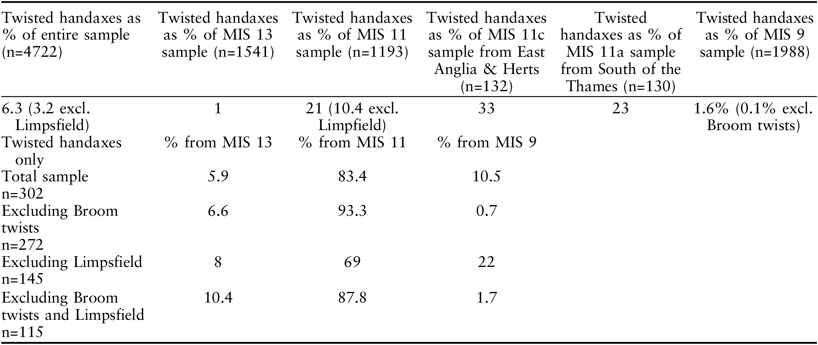
Due to the atypical nature of the Broom twists, and the element of circularity in the dating of the Limpsfield assemblage (Bridgland Reference Bridgland2003), figures are given both with and without these samples
Twisted forms account for 21% of handaxes from all sites dated to MIS 11. At the substage level, greater regional patterning becomes evident. Twisted handaxes make up 33% of MIS 11c assemblages in East Anglia and Hertfordshire, but just 1% of assemblages of this age from south of the Thames. Conversely, twisted handaxes constitute 22% of the five MIS 11a assemblages south of the Thames but the solitary East Anglian assemblage thus far firmly assigned to this substage, from Hoxne, has only 3%. The latter is little more than background variation and is based on Roe’s older sample: the smaller but contextually more secure sample of MIS 11a handaxes (n=19) from the Wymer/Chicago excavations has 0% (Singer et al. Reference Singer, Gladfelter and Wymer1993).
Pre-Anglian (MIS 13) contexts contain just 1% twisted handaxes, with over half of these coming from the Warren Hill, Suffolk, ‘fresh’ assemblage, which is poorly contextualised and might possibly include later material. The percentage of twisted handaxes from sites correlated with the MIS 9 (Purfleet) interglacial is practically zero (0.1%, excluding Broom), with even the two from Furze Platt, Middlesex, possibly being intrusive (naturally or through collector/museum error) from the higher (and nearby) Boyn Hill terrace. The combined percentage of twisted handaxes in assemblages belonging to MIS 13 and MIS 9 is just 1.4%, or 0.5% excluding Broom. Thus the twisted handaxes from MIS 13 and MIS 9 contexts, where they occur at all, are merely background variation and may be due to many factors, including chance production, intrusion of younger or older objects, collector error, or an idiosyncrasy that had little relevance to the wider group.
The MIS 11 assemblages from the Swanscombe Middle Gravels, Dovercourt, and Hoxne, which contain very low levels of classic twisted ovates, show 6–15% ‘twisted-tips’ (Roe Reference Roe1968, table vi), also seen in lower frequencies in Roe’s typologically and stratigraphically mixed MIS 11 samples from Foxhall Road and Hitchin. This feature is not found in other interglacials. So, regardless of whether they made classic twisted ovates, hominins throughout MIS 11 appear to have been familiar with a technique for producing twisted edges that was not used in other periods. It is important to note here that all these assemblages fall into Roe’s point-dominated tradition, a group which may owe some of its large-scale characteristics to local raw materials (White Reference White1998b). It remains to be seen whether an MIS 11c ovate-dominated assemblage south of the Thames or a larger MIS 11a assemblage north of it would contain twisted handaxes but, nonetheless, the influence of raw-material packages on handaxe form in Britain has been hotly disputed (see for example Wenban-Smith et al. Reference Wenban-Smith, Gamble and ApSimon2000) and a more moderate view would see raw material selection as part of a cultural chaîne opératoire. Nodules were chosen by the knapper because they assisted the production of the culturally desired form; stone did not impose form onto a passive human instrument. There are also enough examples of straight-edged ovates from all relevant sites, which could have been twisted but were not, to suggest this is not a controlling factor.
Collector preferences may have created a bias towards fine and unusual forms such as twists and may be affecting the very high proportion of twisted handaxes seen at Limpsfield, but the fact remains that they must have occurred in greater numbers at some sites to allow such biases to develop and leave us with the collections we have. Llewellyn Treacher, who was active around the Maidenhead area of the Middle Thames, found twisted ovates in pits located on the Boyn Hill Terrace, but almost none when exploring sites on the next terrace, the Lynch Hill, where ficron and cleaver assemblages occurred instead. This was not the expected pattern and led to interpretative problems (eg King & Oakley Reference King and Oakley1936). Similarly, twisted forms made up 10% of the handaxes recovered by Worthington Smith (Reference Smith1894) from the rather low-resolution secondary context sites at Stamford Hill and Leytonstone, situated on the Boyn Hill Terrace of the Lea, but there were none at Stoke Newington, where a primary context assemblage was collected from sands and gravels of the Lynch Hill Terrace (Green et al. Reference Green, Gibbard and Bishop2004). Smith is known to have been a comprehensive collector not prone to selection biases other than those forced upon him by heavy items that he could not either carry or afford to transport.
Twisted handaxes are thus rare, highly distinctive, and tightly restricted in time and space.
TWISTED HANDAXES IN GLOBAL CONTEXT
On a global scale, twisted-handaxe assemblages are extremely rare, an observation underlined by the fact that only one well-stratified and well-studied site (Gombore II, Melka Kunture, Ethiopia), plus a handful of surface collections, is known for the entire African Early Stone Age (Gallotti et al. Reference Gallotti, Collina, Raynal, Kieffer, Geraads and Piperno2010). In Europe, twisted handaxe assemblages have been widely reported only from northern France (Callow Reference Callow1976), particularly from the complex terrace deposits and overlying loessic and colluvial sequences of the Somme.
The oldest are the two series (fresh and worn) from fluvial terrace gravel at Cagny la Garenne (Breuil Reference Breuil1934; Bordes Reference Bordes1956; Bourdier Reference Bourdier1969), now dated to MIS 12 (Antoine et al. Reference Antoine, Moncel, Locht, Limondin-Lozouet, Auguste, Stoetzel, Dabkowski, Voinchet, Bahain and Falgueres2015). Callow’s analysis of the worn series in the Musée de l’Homme and Bordeaux (n=>100) found it to be dominated by thick ovate handaxes (limandes and amydaloids), of which 48% were twisted (27% of the entire assemblage). Fewer twisted handaxes (13%) were recorded in the more refined (ie, thinner) fresh series, none of which was pronounced.
Victor Commont recorded the presence of classic twisted ovates at the St Acheul type-site. ‘Some’ came from the sable roux/brun (Bed H) at Bultel and Tellier’s Pit (Atelier Commont; Commont Reference Commont1909, 47), while large numbers (116 out of 300) were reported from the sable roux (Bed D) at No. 54 Rue de Cagny (Commont Reference Commont1908, 559). These deposits were described as clayey sands and were positioned above the fluviatile sands and gravels at both localities, at the base of the loessic and slope deposits. At Rue de Cagny the base of the sable roux was associated with large angular and whole flint nodules, while at Atelier Commont, an in situ knapping floor occurred in this position, underlain locally by a shelly silt. More recent work at St Acheul identified an MIS 11 tufa, locally preserved in the same stratigraphical position as Commont’s sable roux (Antoine & Limondin-Lozouet Reference Antoine and Limondin-Lozouet2004), and it would seem reasonable to infer that the twisted ovate assemblage from the latter is of a very similar age. The MIS 12/early MIS 11 finds from the underlying fluvial sands and gravels in the St Acheul region, however, contain a mixture of pointed and ovate assemblages, none notably twisted. Other undisputed MIS 11 levels in France, such as La Celle and St Pierre les Elbeuf IV in the Seine basin (Cliquet et al. Reference Cliquet, Lautridou, Antoine, Lamotte, Leroyer, Limondin-Lozouet and Mercier2009; Limondin-Lozouet et al. Reference Limondin-Lozouet, Antoine, Bahain, Cliquet, Coutard, Dabkowski, Ghaleb, Locht, Nicoud and Voinchet2015) similarly contain no twisted ovates, again indicating regional and temporal complexity in handaxe form.
A potentially younger, MIS 9, occurrence is found in the primary context assemblage from the sable roux at Cagny L’Epinette (Agache Reference Agache1971; Callow Reference Callow1976; Reference Callow and Collcutt1986; Antoine et al. Reference Antoine, Moncel, Locht, Limondin-Lozouet, Auguste, Stoetzel, Dabkowski, Voinchet, Bahain and Falgueres2015) on the lower L’Epinette Terrace. Here, Callow (Reference Callow1976) recorded an unusual assemblage containing a high proportion of thick ovates with unworked butts. Approximately 25% (n=65) had twisted edges, although these were not pronounced. We have not studied these handaxes, nor those from Cagny la Garenne, but wonder whether they conform more to the Broom variation than true twisted forms. Younger still might be the twisted ovate handaxes from the Older Loess at St Acheul and Mareuil (Callow Reference Callow and Collcutt1986), although these could well represent older inclusions.
In summary, various forms of twisted handaxes are found in the Somme in deposits currently thought to belong to MIS 12, MIS 11, and MIS 9. Those belonging to MIS 11 show pronounced twists on well-made refined forms, exactly as found in the British sample, but those from MIS 12 and MIS 9 are often found on thick handaxes and are rarely pronounced. Despite an extensive (although by no means exhaustive) literature review and consultation with European colleagues (see acknowledgments), we know of no major concentrations of twisted handaxes in Iberia, central or southern France, Germany, Italy, Belgium, or the Netherlands. At present, such forms appear to be restricted to Britain and the closest neighbouring region of France, although we would genuinely welcome all information to the contrary.
HANDAXES & THE DEEP HISTORY OF MIS 11 BRITAIN
The twisted ovate phenomenon in Britain occurred in different regions before and after MIS 11b, the Thames acting as the physical dividing line. The presence of twisted tips in point-dominated assemblages on the ‘wrong’ side of this physical and temporal divide suggests that some form of twisted technique was familiar to all MIS 11 hominin groups but was variably expressed among individuals and their networks.
Given the estimated small size of archaic hominin populations and the small social groups and regional landscapes they inhabited (Gamble Reference Gamble, Slack and Ward2002), we doubt whether these preferences and variations had any meaning outside Gamble’s (Reference Gamble1999) intimate and effective networks, involving kith and kin and maybe familiar others from neighbouring groups. In other words, handaxes may have been used for ‘assertive’ signalling about the identity of individuals within their local group and social networks, but not ‘emblemic’ signalling representing the identity of the group within or without it (cf, Wiessner Reference Wiessner1983; Gamble Reference Gamble1999). For the purposes of Palaeolithic archaeologists, however, these amount to the same thing: signals emerging from living in groups.
The greatest distance between our MIS 11c occurrences north of the Thames is 98 km, between Hitchin and Ipswich (Fig. 1), and they all could be subsumed within a network of ~50 km radius. This provides an area c. 50% greater (5026 km2 vs 7853 km2: radii of 40 km vs 50 km) than Gamble’s ‘local hominin network’ (Reference Gamble1999; Reference Gamble, Slack and Ward2002), but that was based on maximum distances of raw-material transfers which almost certainly under-estimated mobility in flint-rich landscapes. Thus, the twisted ovate phenomenon in East Anglia and adjacent regions north of the Thames could feasibly be the product of just one or two local hominin groups. The same is true south of the Thames in MIS 11a. Dartford and Swanscombe are just 9 km apart, a distance that could have been covered in a few hours. Limpsfield and Farnham, although not correlated to the substage level, are only 25 km and 75 km from Dartford, respectively. The distance between these two sites is 56 km. Again, the area south of the Thames might have been home to only a few related local groups, perhaps just a few hundred individuals (the social brain hypothesis predicts a group size of ~150, eg, Dunbar et al. Reference Dunbar, Gamble and Gowlett2014; cf, Gamble Reference Gamble, Slack and Ward2002; Pettitt & White Reference Pettitt and White2012).
The twisted ovate phenomenon might thus represent a fleeting event recording perhaps a few generations of biased transmission (perhaps influenced by the makers’ status, reproductive success, homophily, or conformism) before drift took handaxes in another direction. At some sites it is preceded or succeeded by assemblages with quite different characteristics: at Foxhall Road the twisted ovate assemblage occurred beneath a horizon with only straight-edged pointed handaxes and the same might be true of the material from Hitchin. In MIS 11a, a similar pattern is seen at Hoxne, but here untwisted ovates were replaced by points (Singer et al. Reference Singer, Gladfelter and Wymer1993). But at a wider scale, the appearance of such an unusual type north of the Thames during the earlier warm substage of MIS 11 and south of the Thames in the later one, when it is missing from all other interglacials and rare on a global scale, suggests that the two are connected not just by coincidence but by history. The practice was much longer-lived at a regional level suggesting that, despite a small demographic presence, geographical barriers and being the human settlement furthest north-west from Africa (cf, Lycett & von Cramon-Taubadel Reference Lycett and von Cramon-Taubadel2008), handaxe manufacturing skills and ideas were preserved through strong networks of social transmission and conservatism in north-west Europe.
Ashton (Reference Ashton, Gamble, Pope, Scott, Shaw and Bates2017) has suggested that during periods of stable environment local groups were able to persist in the landscape over multi-generational timescales and, once established, they developed ways to deal with local circumstances that became embedded into social practices. So technological practices and handaxe shape ‘preferences’ might still have emerged from local resources but through choice and historical engagement: landscapes of habit (eg, Gamble Reference Gamble1999) created landscapes of cultural tradition. Conversely, periods of climatic instability would have caused large-scale shifts in population, particularly within northern Europe, where the southwards translocation and/or extinction of populations would have occurred. In Britain, we might thus expect to find our clearest signatures in our longest interglacials, such as MIS 11.
Britain was first recolonised after the Anglian glaciation (MIS 12) by populations from Europe that did not habitually make handaxes, leaving an industry widely known as the Clactonian (White Reference White2000). The source populations for the Clactonian have never been satisfactorily identified, but possibly derived from areas of central Europe, where handaxes are rare or absent (White & Schreve Reference White and Schreve2000; Ashton Reference Ashton, Gamble, Pope, Scott, Shaw and Bates2017). They persisted through the stable environments of the early and full temperate periods (Ho I & II) before being replaced by Acheulean populations in Ho IIb–III, coinciding with a pan-European catastrophic event registered in the pollen record as a period of rapid deforestation (Ashton et al. Reference Ashton, Lewis, Parfitt, Penkman and Coope2008; Ashton Reference Ashton, Gamble, Pope, Scott, Shaw and Bates2017). That the Acheulean appeared at a period of environmental instability, when ‘resident populations’ in the affected areas may have begun to decline or be displaced, can hardly be coincidence. The question of whether sea-level change might also have been implicated is unresolved. Britain was almost certainly connected to the continent during Ho IIb–III, when the freshwater ‘Rhenish fauna’ arrived, but its status during the main interglacial is uncertain; different sea-level reconstructions provide different answers (see Pettitt & White Reference Pettitt and White2012; White Reference White, Coward, Wenban, -Smith and Hosfield2015). It is equally uncertain whether these populations ever met or whether, as Ashton (Reference Ashton, Gamble, Pope, Scott, Shaw and Bates2017) evocatively asks, the first Acheulean settlers would have found a landscape eerily littered with the tools, structures, hearths, and meals of an earlier extinct people.
The first MIS 11c handaxe makers south of the Thames did not make twisted handaxes while those who settled East Anglia and adjacent regions did. This probably represents different regional source populations from neighbouring areas of Europe, and/or the drowned landscapes of the North Sea and Channel basins. The pattern reverses after the cold interval of MIS 11b, when twisted handaxes were made only south of the Thames. It seems reasonable to infer that cold conditions would have pushed East Anglian populations south during MIS 11b, as the climate deteriorated and the Thames became more braided and less of a physical barrier, or that these same factors would have facilitated greater mobility and contact between the two areas. If this were the case, these populations survived into MIS 11a in the south, but a different population without twists must have entered East Anglia in MIS 11a. Alternatively, both MIS 11c populations might have moved east and south never to return, or died out entirely, in which case Britain was colonised in MIS 11a by new populations with their own handaxe traditions. One of these was probably related to the original twisted handaxe making populations, who survived MIS 11b somewhere.
The pattern in neighbouring Europe is intriguing in this regard. On current dating estimates, twists of some form were made in the Somme during MIS 12, MIS 11, and MIS 10/9, making this an obvious region in which to seek deep historical connections with Britain. It is equally interesting that, during this long period, classic twisted ovates are found in France only in MIS 11 contexts, with those from sites which temporally sandwich this period being less-well-developed early and ‘degenerating’ late examples. These are tentative observations that require further research, but they provide potentially important information about the nature and resilience of regional traditions and populations. Another major implication is that the populations occupying the large area now submerged by the North Sea and Channel were maintaining and following different sets of handaxe-shape traditions, perhaps two or more regional groups overlapping on this ephemeral land. This overlap might be expressed in the succession of assemblage types at Foxhall Road, Hitchin, or Hoxne. That MIS 11b was potentially ‘survivable’, either in Britain or nearby, is also shown by the strong similarities between the fauna from MIS 11c and 11a (Schreve Reference Schreve2001b; Ashton et al. Reference Ashton, Lewis, Parfitt, Penkman and Coope2008). Pan-European studies might help tease out some of these regional groups, although the cultural geography of mainland Europe is likely to be more complex than the British cul-de-sac, a northern sink zone with episodes of residency, abandonment, and recolonisation synchronised by the climatic rhythms of the Pleistocene (White Reference White, Coward, Wenban, -Smith and Hosfield2015; Ashton Reference Ashton, Gamble, Pope, Scott, Shaw and Bates2017).
CONCLUSIONS
Handaxes have been key to understanding archaic hominin culture and behaviour from the beginning of our discipline and Britain has a record that is extremely well suited to exploring these issues. It is a valid geographical entity, the north-west uplands of the north European Plain, fringing the Atlantic and surrounded on two sides by basins that were periodically flooded. It was also occasionally glaciated and inhospitable. Consequently, it has a punctuated pattern of occupation with distinct periods of abandonment, colonisation, settlement, and isolation, all of which can be synchronised to Pleistocene climatic fluctuations. Despite being a sink area at the limits of human occupation, accessible only at certain times and from certain directions, it provides insights into demographic patterns that can be isolated in far more detail than in more permanently occupied areas. It is also increasingly well dated and well researched.
Nearly two centuries of interpretation have created a (monochrome) tapestry of hominin behaviour in a landscape context but British archaeologists had all but abandoned ideas that group-level patterns could be detected in the Acheulean and, ergo, that handaxe shape contained a meaningful cultural signal. Paradoxically, it was partly the better documented record, which facilitated influential syntheses ranging from Breuil’s to Wymer’s and to Roe’s, that exposed this lack of structure. To explain variation, archaeologists thus turned to more ecological or techno-functional explanations, attempting to find some behavioural order within the seemingly directionless and unstructured archaeological record, described, equally accurately, as both a ‘bewildering variety’ (Roe Reference Roe1981) and a ‘variable sameness’ (Isaac Reference Isaac1977). This failure can now largely be attributed not to the absence of cultural patterns but to the use of an incomplete Quaternary framework. The revolution brought about by correlation with the MIS record, with the greater number of climatic events thus recognisable in the terrestrial domain, eventually revealed these patterns. Now, using large datasets interpreted at different scales, we can suggest that handaxes indeed provide cultural signals.
The British handaxe record does not show linear or predictable patterns and does not form the progressive developmental sequence expected by past cultural frameworks but it is no longer a bewildering variety in time and space. Acheulean handaxe assemblages contain much variation but also show clear modal tendencies. Such variation is perhaps an inevitability in stone objects that were hand-made by people of all ages and skill-levels using inconsistent materials. Twisted handaxes and other time-locked forms (eg, MIS 9 ficrons and cleavers), however, isolate clear modalities, distinctive and (often) highly accomplished forms that earlier workers would have called fossile directeurs (cultural markers) although we appreciate that experience has taught many colleagues to be wary of such things. We are equally aware that the persistence of local traditions over potentially vast time periods presents some scalar problems in terms of social transmission, although we are probably observing, in primary context assemblages, only a few hundred years. Handaxe assemblages thus capture hominin socio-politics at centennial scales, cross-generational histories of regional groups involving a moving roster of related individuals through time, with social transmission for particular forms biased by the success (or not) of real individuals and networks. We would further note that similar time scales are not deemed overly problematic when studying Upper Palaeolithic industries, such as the ~9000 year-long Aurignacian.
The next challenge is to understand better the social mechanisms at work, and to re-examine the European record in similar terms, using standardised methods and new analyses, acknowledging the possibility that only another bewildering variety might emerge. This was the reality faced by Paul Callow (Reference Callow1976), who failed to detect even a clear point-dominated/ovate-dominated division in northern France. As a potentially atypical but somewhat predictable case, Britain might just provide some of the empirical and theoretical tools necessary to unlock this complexity.
SUPPLEMENTARY MATERIAL
To view supplementary material for this article, please visit https://doi.org/10.1017/ppr.2019.1
Acknowledgements:
We would like to thank Pascal Depaepe, Agnes Lamotte, Jean-Luc Locht, Marie-Hélène Moncel, Marina Mosquera, and Andreu Ollé for information on twisted handaxes (or their absence) from neighbouring regions of Europe. We would also like to thank three anonymous referees for their comments on the original version of this paper.


 Open access

