INTRODUCTION
Citizens make use of political stereotypes when evaluating candidates for public office. While information about candidates can be costly to obtain, easily observable candidate attributes such as partisan affiliation and race can serve as informational shortcuts that allow citizens to make inferences about other important candidate characteristics such as political ideology (Bullock Reference Bullock1984; Feldman and Conover Reference Feldman and Conover1983; Swain Reference Swain1995; Wright and Niemi Reference Wright and Niemi1983). The accuracy of such inferences, however, varies. For example, when evaluating the ideology of a challenger who has no legislative voting record, a voter may be well served by the political stereotype that Democratic candidates tend to be more liberal than Republican candidates. On the other hand, as Kuklinski and Hurley (Reference Kuklinski and Hurley1994) remind us, stereotypes can also lead voters astray. Racial stereotyping of candidates, for instance, might cause a voter to incorrectly conclude that an African-American candidate is more liberal than a white candidate even if the two candidates actually espouse similar policy positions. Whether political stereotypes lead to accurate inferences or not, they are an important determinant of voters' perceptions of candidates' ideologies. As these perceptions can affect the likelihood that a citizen will vote for the candidate with policy positions most similar to their own, stereotypes play an important role in the process of representation. As Kuklinski and Hurley suggest, “we need to identify the conditions under which taking cues from elites does and does not serve the interests of the electorate” (Kuklinski and Hurley Reference Kuklinski and Hurley1994).
Scholars have made strong cases that partisan identification (Rahn Reference Rahn1993), race (Sigelman et al. Reference Sigelman, Sigelman, Walkosz and Nitz1995; McDermott Reference McDermott1998), and gender (McDermott Reference McDermott1998; Koch Reference Koch2002) have important effects on citizens' perceptions of candidates' ideologies. With the exception of McDermott (Reference McDermott2007; Reference McDermott2009), however, little systematic and comprehensive research on the effects of religious affiliation on evaluations of candidates' ideologies has been published.Footnote 1
In this article, I use American National Election Studies data, Poole-Rosenthal DW-Nominate Scores, and data on the religious affiliations of candidates to estimate the extent to which the religious affiliations of citizens and candidates affect perceptions of candidates' ideologies in congressional elections. I show that religion has important independent effects on these perceptions, and that the use of religion-based stereotypes varies with frequency of church attendance. Moreover, respondents perceive candidates differently when they share religious affiliations with those candidates. These results attest to the external validity of McDermott's experimental findings and demonstrate the importance of religious affiliations in influencing perceptions of candidates in the context of real-world election campaigns.
RELIGION AND POLITICAL IDEOLOGY IN THE UNITED STATES
The comparatively high level of religiosity in the United States defies predictions, based on long-standing theories of secularization and modernization, that religion will recede in social importance most quickly in the most wealthy, stable, and highly-educated societies (Wald and Calhoun-Brown Reference Wald and Calhoun-Brown2006). Alexis de Tocqueville ([1835] Reference de Tocqueville2002) commented on the significance of religion in American society in the mid-19th century, and as evidenced by the rise of the Christian Right since the early 1980s and the degree of religious rhetoric surrounding debates over contentious issues such as abortion and homosexuality, religion continues to be an important part of the political landscape. In the run-up to the 2008 presidential nominations, both Massachusetts Governor Mitt Romney's Mormonism and Illinois Senator Barak Obama's level of commitment to Christianity were significant campaign issues, much to the chagrin of both candidates (Pasek et al. Reference Pasek, Tahk, Lelkes, Krosnick, Payne, Akhtar and Tompson2009; Smidt Reference Smidt2010). John F. Kennedy may have convinced many Americans that his Catholicism was not a good reason to vote against him, and that a politician's religious beliefs should have little bearing on his politics, but 40 years later, the religious beliefs of candidates continue to be very important to many citizens.
Among Americans, citizens' religious traditions have long been correlated with their ideological preferences.Footnote 2 Despite a recent rightward trend tied to American policies regarding Israel, Jewish Americans have consistently tended to fall on the left side of the political spectrum. Likewise, black Protestants have consistently displayed highly liberal political tendencies.Footnote 3 On the other side of the political spectrum, evangelical Christians, at least in recent decades, have on average been decidedly conservative in their ideological leanings (Campbell, Green, and Layman Reference Campbell, Green and Layman2010). Roman Catholics, meanwhile, tend to be found near the middle of the ideological landscape, often holding conservative positions on issues such as abortion while taking liberal positions on issues such as the death penalty. In short, religious identification and political preferences are strongly related in the United States. It should come as little surprise, then, that citizens use the religious affiliations of political candidates as heuristics in making inferences about the ideological stances of candidates when accurate information about the policy positions actually staked out by these candidates is often difficult and costly to obtain.
A significant negative aspect to the use of stereotypes in evaluating political candidates, of course, is that the accuracy of inferences derived from stereotypes varies considerably. If having accurate perceptions of candidates' ideologies is important, citizens would ideally have specific knowledge regarding each candidate's ideological positioning, perhaps in the form of that candidate's prior roll-call voting record or some similar information. The use of stereotypes, on the other hand, while potentially useful, might cause misperception of candidates' ideologies in two ways. First, if ideology is conceived of as a characteristic that can be largely captured by locating candidates on single liberal-conservative dimension, it is highly unlikely that any particular candidate's ideological location will be precisely at the mean or median location of some group of candidates of which that candidate is a member. For example, while the typical evangelical candidate may be somewhat conservative, any given evangelical candidate may be a moderate or extremely conservative. All else equal, then, misperception of a candidate's ideology is more likely to occur when stereotypes are relied upon than when specific ideologically-relevant information about that particular candidate's stances is used to make inferences about that candidate's ideology.
Second, misperceptions can be generated when citizens have incorrect information about the location of the typical member of some group. On a liberalism-conservatism scale from -1 to +1, for example, a citizen might believe that the typical Jewish candidate has an ideology of -0.8, when in actuality the typical Jewish candidate has an ideology of -0.6. It is this second type of error in the perception of candidates' ideologies that I focus on here. While errors of the first type are problematic, they will not cause perceptions of candidates' ideologies to be wrong on average. The second type of error, on the other hand, will result in evaluations of candidates' ideologies that are systematically biased.
Research in political and social psychology documents some of the various ways that in-group/out-group biases affect perceptions of out-group members. As Duckitt (Reference Duckitt, Sears, Huddy and Jervis2003) notes, there is strong evidence that social categorization accentuates in-group similarities and out-group differences. Brewer and Kramer (Reference Brewer and Kramer1985) provide a review of various reasons that such accentuation occurs. One example is the process of “illusory correlation.” When subjects are shown various pairings of group labels and characteristics, they remember more of the pairings that deal with out-groups. This phenomenon, for example, might cause a white voter to perceive “almost all” evangelical candidates as conservative, rather than perceiving “most” evangelical candidates as conservative. Another example is that when group boundaries are more clearly defined, as is often the case with religious traditions, subjects tend to see greater differences between themselves and out-group members than they do when group boundaries are not as clear-cut. This fact comports well with Calfano and Djupe's (Reference Calfano and Djupe2009) findings that Republican candidates employ a type of religious code; as such coded language is not recognized by mainline Protestants and Catholics, candidates can appeal to evangelical voters without highlighting the boundaries between religious traditions that might push non-evangelicals away.Footnote 4
As the group boundaries that separate members of various religious traditions are salient in American politics, I hypothesize that the religious affiliations of both citizens and candidates will have an impact on how citizens perceive candidates' ideologies. In this article, I estimate the extent to which religious affiliation affects the perception of candidates' ideologies. This endeavor has important ramifications for the nature of representation in the United States and the study of religion and politics.
PERCEPTIONS OF CANDIDATES' IDEOLOGIES AND REPRESENTATION
The ideological proximity between citizens and candidates plays an important role in spatial models of voting behavior and representation (Downs Reference Downs1957; Enelow and Hinich Reference Enelow and Hinich1982; Alvarez and Nagler Reference Alvarez and Nagler1998; Powell Reference Powell1982; Reference Powell2000; Ansolabehere, Snyder, and Stewart Reference Ansolabehere, Snyder and Stewart2001). In such models, citizens are typically assumed to base their voting decisions on the utility they expect to receive if a given candidate is elected. For each citizen, this expected utility is generally assumed to be a decreasing function of the distance between the citizen's ideal point and the position of a given candidate on some ideological dimension. In this scenario, if a citizen has perfectly accurate information about the position of each candidate on the liberalism-conservatism scale, the determination of the “correct” vote choice, in terms of the maximization of expected utility, is straightforward. In the real world, however, citizens cannot know the true positions of candidates with certainty. Rather, citizens' voting decisions are affected by the ideological distance between their own policy preferences and the perceived positions of candidates on the liberalism-conservatism scale.Footnote 5 When citizens misperceive candidates' ideologies, they are more likely to register “incorrect” votes.Footnote 6 The occurrence of such errors increases the likelihood that the policy positions of winning candidates will be further from the policy preferences of their constituencies than the policy positions of losing candidates. Because of their potential impact on the degree of congruence between the preferences of citizens and the policy positions maintained by office holders, perceptions of candidates' ideologies are critical to the process of representation.
PRIOR RESEARCH ON POLITICAL STEREOTYPES AND PERCEPTIONS OF CANDIDATES' IDEOLOGIES
A small number of rigorous non-experimental studies on the effects of stereotypes on perceptions of candidates' ideologies and voting behavior in actual elections have been undertaken (Conover and Feldman Reference Conover and Feldman1989; Koch Reference Koch2000; Reference Koch2002; McDermott Reference McDermott2007), but only one of these studies analyzes religion-based political stereotypes. In an innovative analysis of stereotypes and perceptions of Catholic candidates, McDermott (Reference McDermott2007) uses American National Election Studies data, Gallup polls, and exit poll data related to a United States Senator to show that views of Catholic candidates have changed over time as Catholic political behavior has shifted from solidly Democratic to moderately Republican. While using non-experimental survey data, part of McDermott's analysis is based on a question regarding a hypothetical, rather than actual, Catholic candidate. Moreover, McDermott does not directly address the accuracy of stereotypes of Catholic candidates in general, as a measure of “actual” candidate ideology is not included in her analysis.
While not using “real-world” election data, experimental research has been particularly useful in establishing the importance of stereotypes in the evaluation of candidates' ideologies. In experimental and quasi-experimental settings, the group membership of candidates can be manipulated while other factors are held constant. Rahn (Reference Rahn1993), Sigelman et al. (Reference Sigelman, Sigelman, Walkosz and Nitz1995), McDermott (Reference McDermott1998), and Campbell, Green, and Layman (Reference Campbell, Green and Layman2010) are among a group of scholars who have documented the importance of party-based, race-based, and gender-based political stereotypes in experimental contexts.
Most relevant to the present article, McDermott (Reference McDermott2009) uses an experimental approach to show that hypothetical evangelical Christian candidates are seen as more conservative than non-evangelical candidates who share otherwise identical characteristics. This finding indirectly addresses the important issue of the accuracy of stereotypes; the perceptions of the otherwise identical evangelical and non-evangelical candidates cannot both be accurate.
While clearly having great value, experimental approaches often suffer from several drawbacks. First, social desirability bias may temper the reaction of experimental subjects to racial and gender-based cues. In many contemporary scenarios, subjects may make conscious efforts to avoid revealing any prejudices they may have. For example, even in cases where it is not immediately clear to subjects that attitudes about characteristics such as race, religious identification, or gender are key components of an experiment, subjects may infer that researchers are interested in such attitudes. One example would be an experiment in which race is one of only a few candidate attributes that are provided to subjects. In such an example, subjects may be wary of indicating that race has any impact on how they evaluate candidates, even if they would normally make rational use of race as an informational shortcut that indicates the likely ideology of a candidate.
Second, experiments cannot capture the complexity of actual election campaigns. The importance of religion as a determinant of perceptions of candidates' ideologies may be affected by the amount of information presented during a campaign, the context in which the information is received, and the timing and duration of information reception. When race, religious affiliation, or gender is one of only a small number of characteristics known about a candidate, as is typically the case in experimental studies, it may be more likely that respondents will use that cue in evaluating candidates' ideologies.Footnote 7 In such a context, the perceptual effects of social group membership may be overestimated.
Third, in an experimental setting, while it may be possible to determine whether citizens view, for example, evangelical candidates as being more conservative than mainline Protestant candidates, it is difficult to determine whether citizens perceive evangelical candidates as taking more conservative stances than the voting records of these candidates actually indicate. While actual politicians have voting records, run real campaigns, and take numerous policy stances, the fictional politicians described in most experimental studies are highly simplified caricatures of hypothetical candidates. Although experiments may provide solid evidence that similar candidates from different reference groups are perceived differently, it is difficult to determine experimentally if stereotypes serve as informational shortcuts that are likely to help citizens make “good” voting decisions, or if they are more likely to cause citizens to avoid voting for candidates that they might otherwise vote for.
EMPIRICAL ANALYSIS
The present analysis uses pooled survey data from the American National Election Studies (ANES). Beginning in 1978, the ANES survey included questions about respondents' perceptions of the ideologies of the general election candidates for the United States House of Representatives in their districts. The analysis includes cross-sectional data from the standard, biennial ANES general elections surveys performed between 1978 and 2004.Footnote 8 This ANES data was merged with Poole-Rosenthal first dimension DW-Nominate scores as further described below. The pooling of the data across survey years is critical to overcoming the imprecision that results from the small size of subgroup populations — such as Jewish respondents in districts with Jewish incumbents — in any given year.
Following Guth (Reference Guth2007), I assign survey respondents to religious traditions based on their denominational affiliations as recorded during the ANES surveys. While faith involves, at the very least, belief, behavior, and belonging (Leege and Kellstedt Reference Leege and Kellstedt2002), the measure of religious group membership used here focuses on belonging and the institutional effects of religion on political evaluations.Footnote 9
The religious traditions of House members are drawn from Fastnow, Grant, and Rudolph (Reference Fastnow, Grant and Rudolph1999) and Guth (Reference Guth2007),Footnote 10 as well as from various archival materials and web searches. Where possible, representatives were assigned to religious traditions by denominational affiliation in the same way that respondents were assigned to them.
Perceived Candidate Ideology
The dependent variable in this analysis is the response to an ANES survey question that asks each respondent to place the House candidates in the respondent's district on a seven-point scale, from extremely liberal to extremely conservative. The dependent variable, denoted by Perceived Ideology, has been coded such that a response of −3 indicates that a respondent perceives a candidate to be extremely liberal, while a response of +3 indicates that a respondent perceives a candidate to be extremely conservative.
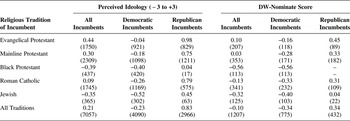
Preliminary analysis clearly suggests that religion affects the perception of candidates' ideologies. This can be seen in Table 1, which shows the mean values of the perceived ideology of House incumbents for each of the five religious traditions that are most strongly represented in Congress.Footnote 11
Mean perceived ideologies and DW-Nominate scores of United States House Incumbents By Religious Tradition

Note: N is shown in parentheses.
The perceived ideologies of candidates vary with religious affiliation in ways that scholars of religion and politics in the United States would largely expect. Perceptions of evangelical Protestant candidates tend to fall on the conservative side of the political spectrum, while black Protestant and Jewish candidates (or at least Jewish Democrats) tend to be seen as liberals. On average, Roman Catholic candidates are seen as moderates. This finding is in line with the fact that Roman Catholic Church espouses conservative positions on issues such as abortion, but liberal positions on issues such as nuclear arms reduction. Respondents tend to perceive mainline Protestant candidates as conservative, but not as conservative as evangelical Protestants. Variations in perceptions across religious traditions are also clearly apparent within each of the two major parties.
Actual Candidate Ideology
Accurately measuring the ideologies of representatives is not a simple task. However, measures such as DW-Nominate scores (Poole and Rosenthal Reference Poole and Rosenthal1991; Reference Poole and Rosenthal1985) are readily available and are commonly used in contemporary scholarship (Griffin and Flavin Reference Griffin and Flavin2007; Binder and Maltzman Reference Binder and Maltzman2002; Schickler Reference Schickler2000; Shotts Reference Shotts2003; Powell Reference Powell1989).Footnote 12 As they are based on roll-call votes, however, DW-Nominate scores can only provide information on incumbents. In this analysis, therefore, I only consider perceptions of incumbents.Footnote 13 In the data employed here, DW-Nominate scores range from -0.84 (the most liberal) to +1.20 (the most conservative), with -0.01 being the mean. The distribution of DW-Nominate scores by the party and religious affiliation of candidates is shown in the last three columns of Table 1.
I expect actual candidate ideology, denoted by DW-Nominate, to be significantly and positively related to Perceived Ideology. The more accurate the information that respondents have about the ideologies of candidates, the closer their perceptions will be to the actual ideologies of these candidates. In an ideal world, where reliable information about candidates was costless to acquire, citizens would have perfectly accurate information about the roll-call voting records of candidates, and knowledge of candidates' actual DW-Nominate scores would be the only thing that voters looked to in evaluating candidates' ideologies.Footnote 14 There would be no need to use stereotypes in evaluating candidates' ideologies. Put simply, among perfectly informed respondents, extremely liberal candidates would be correctly perceived as being extremely liberal and extreme conservatives would be correctly perceived as being extremely conservative. Amongst real-world citizens with limited information about candidates' actual ideologies, however, this relationship is not perfect. Candidates are often perceived as being more liberal or conservative than they actually are.
Political Sophistication
A large literature portrays American citizens as politically ill-informed (Converse Reference Converse and Apter1964; Delli Carpini and Keeter Reference Delli Carpini and Keeter1996). Other scholars have found, however, that many citizens are able to correctly identify the voting decisions that their representatives made on key votes (Alvarez and Gronke Reference Alvarez and Gronke1996). Additionally, research has shown that politically knowledgeable citizens are more likely to be able to place candidates on ideological scales, and more likely to be accurate in these placements (Wright and Niemi Reference Wright and Niemi1983; Powell Reference Powell1989; Koch Reference Koch2003).
Powell (Reference Powell1989) finds that a significant percentage of respondents who are able to place candidates on the seven-point scale “get it right” when it comes to evaluating candidates' ideologies. Powell also notes, however, that the presence of random responses, or guessing, in the data will bias estimates of population parameters, such as the mean perceived ideology of a given candidate, toward the least extreme response available. This is because guesses will tend to be distributed symmetrically around the median of available responses. Therefore, the mean response among guessers will tend to be close to a moderate zero, not because guessers have information that candidates are actually moderates, but because guessers will tend to cancel each other out in the aggregate.
To adjust for the effects of education and guessing, the regression models that I employ include an interaction term, Education × DW-Nominate, that interacts the education level of each respondent with the DW-Nominate score of the incumbent candidate in his or her district.Footnote 15 The use of the interaction term is necessary to control for the fact that the difference between a candidates' actual ideology and the mean reported perception of that ideology will be affected both by the level of information about a candidate that respondents have and the actual ideological location of that candidate. Among respondents with lower levels of education, guessing will be more frequent, and will result in a weakening of the relationship between actual ideologies and the mean reported perceptions of these ideologies. The largest differences between the reported perceptions of perfectly informed respondents and less informed respondents will occur when candidates are ideologically extreme. For more moderate candidates (i.e., where DW-Nominate is closer to zero), differences in responses between guessers and non-guessers will be muted. In such cases, the mean reported perception among guessers will be similar to that reported by non-guessers not because less informed respondents know more about moderate candidates than they know about extreme candidates, but because the responses of less informed respondents tend towards zero, or moderate, due to guessing.
Including education and the phenomenon of guessing in this analysis is crucial due to the hypothesis that religious stereotypes will bias perceptions of candidates' ideologies, causing these perceptions to diverge from what the roll-call voting records of candidates might otherwise indicate. For example, assuming that Democratic candidates all fall on the liberal side of the political spectrum (an assumption that is borne out in the DW-Nominate data used here), the observed mean perception of Democratic candidates among all respondents is less liberal than we would expect it to be if guessing were not present. In the aggregate, the extent to which non-guessers correctly perceive liberal candidates to be liberal is masked by the less liberal perceptions that guessers tend to report. Additionally, the extent to which candidates' religious affiliations affect the perceptions of non-guessers would be underestimated if guessing were not accounted for. I therefore include Education × DW-Nominate in the analysis and hypothesize that its coefficient will be positive and significant.
As additional indicators of political sophistication, I also include the age of respondents and the level of interest that respondents had in the political campaigns going on at the time of the survey. These variables are interacted with the actual ideologies of candidates in the same way that education is. Age is the logged value of a respondent's age, and it is expected to be associated with lower levels of guessing, as older respondents have had more experience with the political world (Powell Reference Powell1989). Interest in Election is also expected to be associated with higher levels of political sophistication (Luskin Reference Luskin1990) and lower levels of guessing. Hence, Both Age × DW-Nominate and Interest in Election × DW-Nominate are expected to be positively correlated with perceptions of candidates' ideologies.
Religious Affiliation
To allow for the examination of the effects of the religious affiliations of candidates on perceptions of candidates' ideologies, the regression models that I specify include a series of dummy variables that indicate the religious tradition of each candidate. Mainline Protestant dummies are excluded as the baseline categories. As previously demonstrated, candidates' ideologies do indeed vary with the religious affiliation of candidates. I hypothesize, however, that religious stereotypes cause respondents to perceive candidates from certain religious traditions to be more ideologically extreme than their roll-call voting records alone would indicate. For example, while a given evangelical candidate is likely to be conservative, I hypothesize that due to religious stereotypes, respondents will tend to perceive an evangelical conservative to be more conservative than they would if their perceptions were based only on accurate information about that candidate's actual ideology.Footnote 16 Accordingly, I expect that the coefficient of Evangelical Protestant Candidate will be positive, and that the coefficients of Black Protestant Candidate and Jewish Candidate will be negative. I have no strong expectation regarding perceptions of Roman Catholic candidates.
As a robustness check, I also estimated a model, Model 3b, in which respondents were categorized as being from a conservative religion tradition, a liberal tradition, or neither.Footnote 17 This specification allows for the possibility that the in-group/out-group dynamics at play operate between groups of ideologically similar religious traditions rather than between specific religious traditions. For example, a Mormon respondent might identify to some extent with non-Mormon conservative Christians while viewing all liberal religious adherents as members of an out-group.Footnote 18
As previously discussed, the psychology of in-group/out-group dynamics suggests that members of salient social groups perceive greater differences between themselves and members of other groups than they do between themselves and members of their own group. Because of this, it is important to control for the fact that some respondents will share the religious tradition of the candidate in their district, while other respondents will be affiliated with a tradition other than the one the candidate in their district is affiliated with. Accordingly, I generated a series of four interaction terms, Evangelical Protestant × Evangelical Candidate, Black Protestant × Black Protestant Candidate, Jewish Respondent × Jewish Candidate, and Catholic Respondent × Catholic Candidate. I expect the coefficient on the first of these four variables to be negative, as non-evangelical and typically less conservative respondents should perceive greater differences between themselves and evangelical candidates than evangelical respondents do. As black Protestant and Jewish candidates tend to fall on the left side of the political spectrum, I hypothesize that the coefficients on the next two religious tradition pairing variables will be positive. I have no strong expectations regarding the Catholic Respondent × Catholic Candidate variable. For methodological reasons, I also include dummy variables for evangelical, black Protestant, Jewish, and Catholic respondents.
Religious Participation
Not all citizens respond to religious cues in the same way. Prior research has shown that citizens with stronger religious attachments react to religious cues to a greater extent than those who are only nominally religious and those who see religion as less important in their lives (Kellstedt and Green Reference Kellstedt, Green, Leege and Kellstedt1993; Layman Reference Layman1997). I expect that the effects of religious stereotypes on perceptions of candidates' ideologies will be stronger among those who participate in religious activities the most frequently. To capture this hypothesized effect, I include a dummy variable that takes a value of one for respondents who report attending religious services every week and zero otherwise.Footnote 19 I then interact this dummy variable with the religious identification of the candidates. I expect that the coefficient of Weekly Attendance × Evangelical Candidate will be positive, while the coefficients of Weekly Attendance × Black Protestant and Weekly Attendance × Jewish Candidate will be negative.
In Model 4b, I also include three-way interaction terms between the attendance level of respondents, the religious traditions of respondents, and the religious traditions of candidates. As mentioned above, I expect that frequent church attendees will be more likely to make use of religious stereotypes than those who attend less often. I also expect, however, that among frequent attendees, respondents will apply stereotypes to members of other religious traditions differently than they apply stereotypes to members of their own tradition. As is the case with the dummy variables that pair the religious tradition or respondents with those of candidates, I expect to find a negative coefficient on Attendance × Evangelical Respondent × Evangelical Candidate, and positive coefficients on Attendance × Black Protestant Respondent × Black Protestant Candidate and Attendance × Jewish Respondent × Jewish Candidate.
Party Identification
I include a dummy variable, Republican Candidate, to control for the importance of partisan stereotypes. Additionally, research in social psychology suggests that in the context of in-group/out group situations, in-group members misperceive characteristics of out-group members for several reasons (Brewer and Kramer Reference Brewer and Kramer1985; Duckitt Reference Duckitt, Sears, Huddy and Jervis2003). To account for this, I include dummy variables that pair partisan respondents with the party identifications of candidates. Respondents were coded as Democrats if they identified themselves as either strong Democrats or Democrats, and as Republicans if they identified themselves as strong Republicans or Republicans on a seven-point scale. The reference category consists of independents and weak partisans, or “learners,” who are not expected to be as strongly affected by in-group/out-group effects with respect to Democratic and Republican candidates.Footnote 20
Candidate Recognition
Respondents can only use religious stereotypes in the evaluation of candidates' ideologies if they know (or at least think they know) the religious affiliations of the candidates that they are voting for. A precondition for this is that respondents must recognize (or at least think they recognize) the candidates they are evaluating. The ANES asks respondents if they recognize the names of any of the candidates in their district as being the incumbent. If respondents do say that one of the candidates is an incumbent, the accuracy of their reported recognition is coded. I hypothesize that the use of religious stereotypes will be more prominent among respondents who can recognize the name of their incumbent representative. To test this proposition, I run each of the regression models described below both among all respondents, and among only those respondents who were able to correctly identify the incumbent candidate in their district.
RESULTS
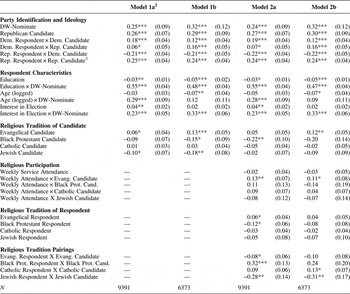
Ordered probit regression models were specified due to the ordinal nature of the dependent variable, Perceived Ideology. I specified four models, and each model was estimated both for all respondents and for only those respondents who recognized their current representative. In the tables and discussion below, model numbers with a suffix of ‘a’ indicate estimations that included all respondents in the analysis. In the models with ‘b’ suffixes, only respondents who were able to correctly identify the incumbent candidate in their district were included in the analysis. As many interaction terms are included in the models, all variables were centered at their means or medians to facilitate the interpretation of coefficients. The results for Models 1a through 2b are presented in Table 2. The results for Models 3b and 4b are provided in the Appendix.
Factors affecting perceived ideologies of United States House incumbents1

Notes: (1) The dependent variable is a seven-point scale from “Extremely Liberal” (−3) to “Extremely Conservative” (+ 3). Ordered probit regression was used. Standard errors are robust and adjusted for clustering by district-year. *indicates p < 0.10; **indicates p < 0.05; *** indicates p < 0.01. One-tailed tests are used where appropriate. (2) Models with “a” suffixes were estimated using all respondents, while models with “b” suffixes were estimated using only respondents who could identify the incumbent congressperson in their district. (3) As the coefficients on this variable are large and in the unexpected direction, the significance levels reported are based on two-tailed tests.
DW-Nominate is positive and statistically significant in all specifications, indicating that, in the aggregate, respondents' perceptions of candidates' ideologies are indeed strongly related to candidates' actual ideologies, even when other important factors are controlled for.Footnote 21 As shown by the positive and significant coefficients on Republican Candidate, respondents also rely on partisan stereotypes in the evaluation of candidates' ideologies. The positive sign on Democratic Respondent × Democratic Candidate indicates that Democratic respondents perceive Democratic candidates to be less liberal (or more moderate) than independent respondents do. This may reflect a tendency among Democratic identifiers to see candidates belonging to their own partisan group as more “typical” with respect to the population as a whole than they actually are. In contrast, the positive coefficients on Republican Respondent × Republican Candidate show that Republican respondents perceive Republican candidates to be more conservative, or less typical, than they actually are. The coefficients on Republican Respondent × Democratic Candidate mesh well with previously discussed social-psychological findings that out-group members are perceived as more different from in-group members than they actually are. The coefficients on Democratic Respondent × Republican Candidate lead to the same conclusion, although they are only significant in the models that were limited to respondents who correctly identified the incumbent in their district.
The coefficients on Education × DW-Nominate are positive as expected and statistically significant. This means, for example, that when respondents with low levels of education (Education < 0) evaluate liberal candidates (DW-Nominate < 0), the interaction term is positive, and as compared to respondents with average or higher levels of education, the mean perception is shifted to the right, towards “moderate.” When the candidate is conservative (DW-Nominate > 0), the interaction term for less educated respondents is negative, and the mean perception is once again moderated, in this case by being shifted to the left. This result is consistent with the supposition that less educated respondents are more likely to guess in placing candidates on a liberalism/conservatism scale. The positive and statistically significant coefficients on the interaction terms involving age and interest in the election are also in accordance with the phenomenon of guessing. Additionally, while the coefficients on Education, Age (Logged), and Interest in Election are significant in many specifications, their magnitudes are quite small.
Turning to the variables related to religious stereotypes, the main focus of the article, several interesting findings emerge. Model 1a is a relatively simple baseline model that includes the religious affiliation of candidates, but does not include church attendance, the religious affiliation of respondents, or any of the associated interaction terms. In Model 1a, while the coefficients of all of the variables representing the religious affiliations of candidates are of the expected signs, they are quite small in magnitude, and only two of them attain statistical significance at the modest p = 0.10 level. In this specification, then, perceptions of candidates from traditions other than mainline Protestantism are not substantially different than perceptions of ideologically similar mainline Protestant candidates. The religious identification variables are also jointly insignificant (a χ2 test yields a p-value of 0.15). However, when only respondents who could correctly identify the incumbent candidate are included in the analysis, the use of religious stereotypes becomes significant. The coefficients in Model 1b show that, among respondents who can identify the incumbent candidate in their district, evangelical candidates are predicted to be seen as more conservative than ideologically similar mainline Protestant candidates. Black Protestant and Jewish candidates, on the other hand, are predicted to be seen as more liberal than their roll-call voting records alone would indicate. Perhaps unsurprisingly then, the use of religious stereotypes is considerable only among those respondents who can recognize the candidates in their district, with such recognition being practically a pre-requisite for knowing the religious tradition of these candidates.
Models 2a and 2b add variables reflecting the frequency with which respondents attend religious services as well as their religious traditions. Interaction terms between the religious traditions of candidates and respondents are included to test for the hypothesized influence of in-group/out-group psychology on perceptions of candidates' ideologies. χ2 tests indicate that the religious variables, including religious tradition, attendance, and the associated interaction terms, are jointly significant (p < 0.01) in both specifications. At the same time, a χ2 test shows that the religion of candidates is only significant at the p = 0.10 level when church attendance and the associated interaction terms are not included in the group of jointly tested variables. Combined with the observation that the coefficients of Weekly Attendance × Evangelical Candidate and Weekly Attendance × Jewish Candidate are of the expected signs, this discrepancy in levels of significance suggests that respondents with higher degrees of formal religious commitment are more likely to make use of religious stereotypes than those who do not attend services regularly.
Somewhat puzzling are the negative coefficients on Jewish Respondent × Jewish Candidate. One potential explanation for the negative signs on these coefficients is the fact that Jewish respondents typically have higher levels of education than other respondents, and more educated respondents are less likely to guess. This would lead to less moderate reported perceptions of the ideologies of Jewish candidates among Jewish respondents. To examine this possibility, I included an interaction term, Jewish Respondent × Education × DW-Nominate in the model and re-estimated it.Footnote 22 While this term was highly significant, Jewish Respondent × Jewish Candidate was rendered statistically insignificant. This is in line with the potential explanation that Jewish Respondent × Jewish Candidate is actually capturing an educational effect. It may also be the case, of course, that Jewish respondents, perhaps by virtue of being rather religiously distinct from a population that is so largely Christian, are simply more attuned to the typical ideological characteristics of candidates in their in-group than members of other traditions.
In Model 3b (Appendix), rather than including the specific religious traditions of respondents, respondents are classified as being members of liberal religious traditions, conservative religious traditions, or neither. The signs and magnitudes of the coefficients for the variables indicating the religious traditions of candidates and the religious traditions of candidates interacted with church attendance are very similar to those in Models 1a through 2b. While statistically insignificant, the negative sign on the Respondent From Liberal Tradition × Evangelical Candidate is somewhat puzzling, but one should keep in mind that this variable only takes on a value of one when Respondent From Liberal Tradition and Evangelical Candidate also take on values of one, and the coefficient on each of these variables is positive. Moreover, the omitted reference category consists of the non-religious, who may be more likely to stereotype candidates affiliated with any religious tradition as being more conservative than the voting records of such candidates would indicate; compared to the non-religious, members of even liberal religious traditions might stereotype evangelical candidates to a lesser degree. This could also potentially explain the negative and significant coefficient on Respondent From Liberal Tradition × Catholic Candidate. Another potential explanation for the latter coefficient is the fact that Catholics are more likely to attend services frequently than members of liberal religious traditions, and Catholics who attend regularly see Catholic candidates as more conservative than infrequent churchgoers, perhaps due to being more likely to be exposed to conservative messages from the pulpit on issues such as abortion.Footnote 23 This explanation would be consistent with the positive coefficients on Catholic Respondent × Catholic Candidate in Models 2A and 2b. On the whole, the importance of the religious traditions of candidates and church attendance in determining perceptions of candidates' ideologies remains evident even if one hypothesizes that the ideological tendencies of one's religious group matter more than membership in that group itself.
Last, regression results for Model 4b (Appendix) include three-way interaction terms between church attendance, the religious tradition of respondents, and the religious traditions of candidates. Among frequent attendees in particular, the use of religious stereotypes changes when respondents are of the same religious tradition as candidates. For instance, the probability that a mainline respondent who attends church weekly will perceive a conservative evangelical candidate to be conservative is greater than the probability that an evangelical respondent who attends church weekly will do so. Consistent with the possibility, described above, of being more likely to be exposed to conservative messages in church, Catholics who attend weekly are more likely to see Catholic candidates as more conservative than non-Catholic respondents. Such differences in perceptions should be expected given the importance of in-group/out-group dynamics in the use of stereotypes.
If one considers all of the specifications described above as a whole, a very strong case can be made that both the religious tradition of candidates and the frequency of service attendance among respondents are important determinants of perceptions of candidates' ideologies. Among the religious traditions of candidates, evangelicalism stands out as playing the most significant role.Footnote 24 Considering the level of media coverage regarding the Christian Right, this should come as no surprise.
Predicted Probabilities
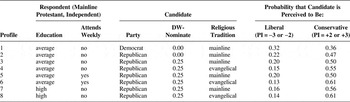
The interpretations of coefficients reported above deal with the signs and statistical significance of the variables of interest. Due to the nature of ordered probit regression, however, it is necessary to calculate predicted probabilities in order to interpret the magnitude and substantive importance of these variables. The calculation of predicted probabilities can also aid in demonstrating the importance of the interaction terms.Footnote 25 The predicted probabilities for a wide range of substantively interesting hypothetical situations are displayed in Table 3. The probabilities were calculated using the coefficients estimated for Model 4b.
Predicted probabilities

Note: Perceived Ideology (PI) is a seven-point scale from “Extremely Liberal” (−3) to “Extremely Conservative” (+3).
To provide a baseline for interpreting the magnitude of the effects religious stereotypes on perceptions of candidates' ideologies relative to the effects of other important stereotypes, I present the predicted probabilities for situations in which two moderate candidates differ only in their partisan affiliation in Profiles 1 and 2. As a candidate changes from a Democrat to a Republican, the probability that this candidate is perceived to be on the conservative side of the political spectrum (predicted ideology > 0) rises from 0.36 to 0.47; a difference in probability of 0.11.
How large are the effects of the religious tradition of a candidate on perceptions of that candidate's ideology? While it depends on the particular profiles that one examines, if one compares Profile 3 to Profile 4, with the only difference being that the candidate is a mainline Protestant in the first profile and an evangelical Protestant in the second, the probability of the candidate being perceived to the right of “moderate” is increased by 0.05, or roughly half the increase caused by a candidate switching parties. The strength of the effect is much greater, however, for frequent churchgoers. In Profiles 5 and 6, the respondent attends services regularly, whereas in Profiles 3 and 4 the respondent is not a frequent attendee. For the frequent attendee, when the candidate changes from a mainline to an evangelical Protestant, the increase in the same probability is 0.11, which is equal to the increase caused by the party switch. Clearly then, the importance of religious stereotypes in determining perceptions of candidates' ideologies in real-world electoral contexts is far from trivial, at least in the case of evangelical candidates. The findings regarding evangelical candidates in particular provide real-world verification of the experimental results described by McDermott (Reference McDermott2009). Moreover, the non-experimental findings described above have significant additional value in that they allow for comparisons of the importance of religious stereotypes to that of other types of politically-relevant stereotypes.
Additionally, in comparing Profile 3 to Profile 4 and Profile 7 to Profile 8, one can see that the degree to which respondents make use of religious stereotypes of evangelical candidates is similar among more highly educated and less highly educated respondents. At the same time, the fact that highly educated respondents correctly perceive conservative candidates to be conservative more often than less educated respondents is in accordance with expectations, and highlights the importance of controlling for education in this type of study.
CONCLUSION
Ultimately, perceptions of candidates' ideologies are important because the quality of information that citizens have about candidates has a large effect on the nature of representation that is afforded by any electoral democracy. Citizens will have difficulty voting for candidates who are ideologically like themselves if they do not know the actual ideologies of the candidates. It is important to understand, therefore, the factors that affect citizens' perceptions of these ideologies.
I have shown that, in actual electoral contests, the religious identification of candidates is one factor that affects perceptions of candidates' ideologies. Moreover, citizens who show higher degrees of formal religious commitment are more likely to make use of such stereotypes. The results suggest that citizens will tend to perceive evangelical candidates to be more conservative than non-evangelical candidates with similar policy preferences, and this tendency is stronger among better-informed citizens. Jewish candidates, in contrast, will tend to be seen as more liberal than ideologically similar mainline Protestants. Additionally, Catholic respondents perceive Catholic candidates to be more conservative than non-Catholic respondents do. That education plays an important role in the evaluation of candidates' ideologies has also been demonstrated. All of these findings have important effects on the process of representation in that the degree of congruence between citizens' preferences and the policy positions of office holders is potentially diminished in cases where religion-based misperception of candidates' ideologies causes citizens to refrain from voting for candidates who have the ideologies most similar to their own. Citizens who have more accurate perceptions of candidates' ideologies are better equipped to vote for candidates who espouse policy stances in line with their own preferences.
Moreover, the preceding analysis only considers perceptions of incumbent ideologies. In most cases, citizens have more information — and more reliable information — about incumbents than they have about challengers. Assuming that religion becomes more important as a heuristic when citizens know less about a given candidate, it is highly likely that in omitting challengers, the present analysis underestimates the true magnitude of the effects of the religious affiliation of candidates on perceptions of candidates' ideologies. Even citizens with little knowledge of a candidate's ideological position might be aware of that candidate's religious affiliation, as it is often prominently listed in voting guides and other campaign-related literature.
Further work is needed to establish the extent to which perceptions of ideology serve as an intervening variable between religious identification and vote choice in real-world elections. Additionally, as perceptions that are affected by religion have an impact on voting decisions, it is reasonable to believe that strategic politicians take such perceptual effects into account when making decisions. For example, if misperceptions disadvantage evangelical candidates, we might expect competing non-evangelical candidates to attempt to reinforce such misperceptions. Future research might examine such a possibility. In short, the finding that highly religious citizen perceive evangelical candidates to be more liberal than ideologically identical non-evangelical legislators leads naturally to several avenues for potential future research.
APPENDIX. Factors Affecting Perceived Ideologies of U.S. House Incumbents1