Effective cleaning and disinfection of contaminated environmental surfaces is needed to prevent transmission of healthcare-associated pathogens.Reference Donskey 1 Because nonsporicidal disinfectants do not kill Clostridium difficile spores, it is recommended that sporicidal agents be used in C. difficile infection (CDI) isolation rooms if CDI rates are not adequately controlled when nonsporicidal agents are used.Reference Dubberke, Carling and Carrico 2 Bleach products have been the most commonly used sporicidal disinfectants due to their efficacy and low cost, but these agents can be corrosive to surfaces and irritating to personnel and patients.Reference Rutala and Weber 3 Recently, peracetic acid (also termed peroxyacetic acid)–based sporicidal disinfectants have emerged as alternatives to bleach because they may be less damaging to surfaces and less irritating to personnel.Reference Deshpande, Mana and Cadnum 4 However, a potential limitation of peracetic acid–based disinfectants is that they can be relatively unstable and may have a shelf-life of only a few days to 3 weeks.Reference Deshpande, Mana and Cadnum 4 , Reference Deshpande, Mana and Cadnum 5 To address this limitation, some peracetic acid–based products are activated on site by diluting a concentrated solution of hydrogen peroxide and peracetic acid. In addition, the manufacturer may recommend use of the activated product within a specified time period after activation.Reference Deshpande, Mana and Cadnum 4
In March 2015, the personnel of the Infection Control Department at the Cleveland VA Medical Center investigated an increase in the incidence of healthcare-associated CDI that occurred after a switch from bleach to a peracetic acid–based disinfectant. As part of the investigation, we examined the effectiveness of the peracetic acid–based product and measured the concentrations of peracetic acid in newly activated and in-use containers of the product. Here, we report the findings of our testing and subsequent events that culminated in discontinuation of the sale of the product.
METHODS
Setting
The Cleveland VA Medical Center includes a 215-bed tertiary-care hospital and an affiliated 250-bed long-term care facility that is adjacent to the hospital. CDI surveillance is conducted by the Infection Control Department using standard definitions.Reference Dubberke, Carling and Carrico 2
Outbreak Investigation
The study was conducted as an outbreak investigation by the Cleveland VA Medical Center Infection Control Department. In response to an increase in the incidence of healthcare–associated CDI identified in March 2015, Infection Control Department personnel reviewed data on disinfectant usage, thoroughness of environmental cleaning based on fluorescent marker removal, use of automated ultraviolet-C (UV-C) room decontamination devices, hand hygiene compliance, and the antimicrobial formulary.
Initial Evaluation of the Peracetic Acid–Based Disinfectant
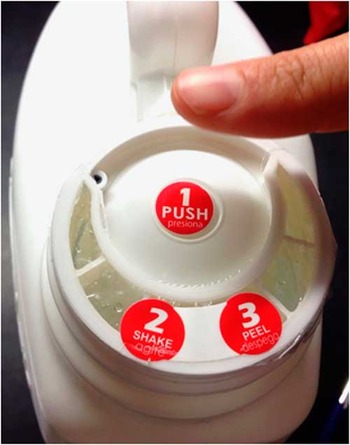
The commercial peracetic acid–based product (Steriplex SD, sBioMed, Orem, UT) was supplied in 675-mL spray bottles or larger bottles containing 950 or 1,250 mL. The product was either sprayed onto surfaces followed by wiping with a cloth wipe or wipes were wetted with the product prior to contact with surfaces. Each container included a small volume of solution termed Activator Part B (hydrogen peroxide 22% and peracetic acid 15%) that was combined with a larger volume of solution termed Part A (0.15% silver solution) to yield the activated product (0.15% peracetic acid, 0.02% hydrogen peroxide, 10% ethanol, 0.015% silver, and 0.15% acetic acid). The Activator Part B was contained inside a SmartCap reservoir in the cap of the container and was released into the Activator Part A solution when a button at the top of the container was pressed resulting in extrusion of a plastic cap holding the solution in the reservoir. Figure 1 shows the SmartCap reservoir for a 950-mL container; the smaller spray bottles have a similar mechanism but the cap is pushed off when the top of the container is screwed into place. Each container of the product was stamped with the date of manufacture of the lot of product. According to the manufacturer, the shelf-life of the nonactivated product was 1 year after the date of manufacture; the manufacturer did not provide information on the shelf-life of the product after activation.
Photograph showing the SmartCap for a 950-mL container of Steriplex. Pushing button 1 causes downward movement of a plunger that pushes off a plastic cap and releases a small volume of an activator solution containing hydrogen peroxide 22% and peracetic acid 15% from a reservoir into a larger volume of solution termed Part A. The activated product contains 0.15% peracetic acid, 0.02% hydrogen peroxide, 10% ethanol, 0.015% silver, and 0.15% acetic acid.

We used a commercial kit (LaMotte Hydrogen Peroxide and Peracetic Acid, Lamotte, Chestertown, MD) to measure concentrations of peracetic acid in newly activated (ie, activated immediately before testing) containers of the product from 7 different lot numbers as well as in-use product obtained from environmental services personnel. For comparison, concentrations of peracetic acid were measured in newly activated preparations of another commercial peracetic acid–based disinfectant (OxyCide, EcoLab, St Paul, MN). The concentration of peracetic acid was compared in newly activated containers with a recent manufacture date (March 21, 2016) versus an older manufacture date (October 23, 2015, or May 26, 2015) using the Student t test.
To evaluate the efficacy of the peracetic acid–based product for killing microorganisms, we tested activity against C. difficile spores and methicillin-resistant Staphylococcus aureus (MRSA) using the American Society for Testing and Materials standard quantitative carrier disk test method (ASTM E-2197-02). 6 The test organisms included a clinical USA400 pulsed-field gel electrophoresis type MRSA strain and 2 C. difficile strains including VA 17, an epidemic restriction endonuclease analysis BI strain, and American Type Culture Collection (ATCC) strain 43598. As a control, newly activated preparations of OxyCide were tested. After a contact time of 5 minutes, the steel disk carriers were placed in 1 mL of Dey-Engley neutralizing medium (Remel Products, Lenexa, KS), serially diluted, and plated onto selective media for quantification. Log reductions were calculated in comparison sterile water controls. Experiments were repeated 3 times.
Additional Investigations of the Peracetic Acid–Based Disinfectant
It is possible that handling of the peracetic acid–based product after delivery to the facility could have impacted efficacy. Therefore, we obtained nonactivated product and in-use containers of the product from 3 different lot numbers from another local hospital. The disinfectant was tested for peracetic acid concentrations and killing of MRSA and C. difficile as described previously.
To determine the stability of the product after activation, we obtained newly made (ie,<1-week-old) containers of the product from the manufacturer and tested them immediately after receipt. For 3 containers, peracetic acid levels were measured immediately after activation and then each week for 6 weeks; in vitro killing of C. difficile spores was also measured as described previously. To determine the stability of the nonactivated product, additional containers of the newly made product were kept on a shelf and then activated and tested at 4, 5, and 6 weeks after receipt from the manufacturer.
RESULTS
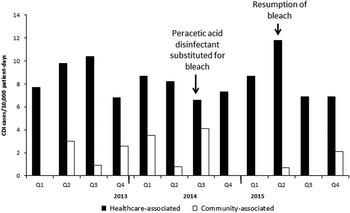
As shown in Figure 2, the incidence of healthcare-associated CDI increased after the change to the peracetic acid–based disinfectant, but there was no increase in the incidence of community-associated CDI. The peracetic acid–based disinfectant was introduced as a replacement for a bleach product, and we use increased gradually with full implementation by the fourth fiscal quarter of 2014. With full implementation, the product was used for all daily and terminal disinfection of rooms of patients with CDI and for terminal disinfection of rooms of all patients on contact precautions. There were no other changes in disinfectant products. Throughout the time period shown in Figure 2, the thoroughness of terminal cleaning of high-touch surfaces based on fluorescent marker removal remained stable at>85%. In CDI rooms, thoroughness of daily disinfection of high-touch surfaces was monitored Monday through Friday, and environmental services personnel were required to re-clean the room if fluorescent marker was present on surfaces. An automated UV-C room decontamination device was used as an adjunct to standard terminal cleaning in CDI rooms. Hand hygiene compliance remained stable at 90% to 95% throughout the same period. There were no changes in the hospital’s antimicrobial formulary.
Epidemic curve showing the incidence of healthcare–associated and community-associated Clostridium difficile infection (CDI). The peracetic acid–based disinfectant was substituted for a bleach wipe product in the third fiscal quarter of 2014 and use of the bleach product was resumed in the second fiscal quarter of 2015. Q, fiscal quarter.

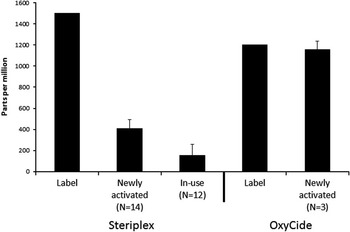
As shown in Figure 3, measured concentrations of peracetic acid in the suspect product (50–800 ppm) were significantly lower than the level stated on the label (1,500 ppm), whereas concentrations of peracetic acid for the other commercial product were consistent with the label. Low concentrations were present in newly activated, in in-use product, in product from all 7 lot numbers tested at the Cleveland VA Medical Center, and in samples from all 3 lot numbers tested from another local hospital. Based on the quantitative carrier disk test method, product with peracetic acid levels<600 ppm did not have sufficient activity to reduce C. difficile spores or MRSA by 2 logs. The mean concentration of peracetic acid was significantly higher in newly activated product with recent (March 21, 2015) versus an older (October 23, 2014) date of manufacture (579.0 vs 333.5 ppm; P=.01).
Concentrations of peracetic acid on the product label versus measured in newly activated and in-use peracetic acid–based disinfectants. Steriplex was the disinfectant used in the study hospital; OxyCide was tested for comparison. Mean measured concentrations from multiple containers are shown. Error bars indicate standard error.

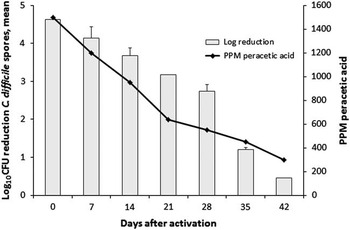
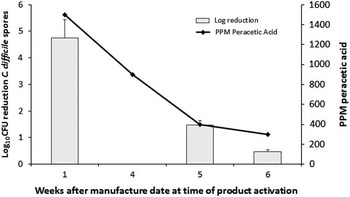
As shown in Figure 4, newly made containers of the product that were activated and tested upon receipt had concentrations of peracetic acid that were consistent with the product label and reduced C. difficile spores by>5 logs. However, when product from the same containers was subsequently tested each week, the concentration of peracetic acid decreased markedly over 6 weeks, resulting in decreased killing of C. difficile spores. As shown in Figure 5, reductions in peracetic acid concentrations and activity against C. difficile spores also occurred in newly manufactured product that was kept on a shelf without activation and then activated immediately before testing.
Log reductions in Clostridium difficile spores and parts per million (PPM) of peracetic acid in newly manufactured containers (N=3) of peracetic acid–based disinfectant that were activated immediately after receipt and tested at different time points after activation. Error bars indicate standard error.

Log reductions in Clostridium difficile spores and parts per million (PPM) of peracetic acid in newly manufactured containers (N=9) of peracetic acid–based disinfectant that were activated either immediately after receipt (week 1) or 4, 5, or 6 weeks after receipt. Error bars indicate standard error.

We informed the Environmental Protection Agency (EPA) of our findings in July 2015. Multiple nonactivated containers of the product were sent to the EPA for testing. In addition, the EPA tested product received directly from the manufacturer. The tests of liquid and spray formulations confirmed that the product was not effective against C. difficile spores when used as directed with a contact time of 5 minutes. Based on these results, the EPA ordered the manufacturer to immediately stop the sale, use, or removal of the product on September 11, 2015.Reference Fortin 7
According to the manufacturer, further internal investigation suggested that malfunction of the SmartCap reservoir led to insufficient amounts of the Activator Part B being present at the time of activation. It was suggested that the malfunction may have been due to sensitivity of the reservoir to certain shipping and handling conditions. According to the manufacturer, testing of the product prior to shipping indicated that activated disinfectant had the concentrations of peracetic acid stated on the label.
As shown in Figure 1, the incidence of healthcare-associated CDI decreased after a switch back to a bleach product for daily disinfection of CDI rooms and for terminal disinfection of all contact precautions rooms.
DISCUSSION
As part of an investigation of an increase in the incidence of healthcare-associated CDI in our institution, we demonstrated that a commercial peracetic acid–based product had much lower concentrations of peracetic acid than claimed on the label and that many containers had levels that were not sufficient to kill C. difficile spores. The low concentrations of peracetic acid were present in newly activated and in-use product as well as product from different lot numbers and product from another hospital. Our findings were confirmed by the EPA, and an order to stop the sale of the product was issued on September 11, 2015. Reference Fortin 7 Based on information available from the manufacturer, the stop-sale order affected>300 US healthcare facilities that were using the product.
An investigation by the manufacturer implicated malfunction of the SmartCap reservoir (Figure 1) as the cause of the low concentrations of peracetic acid (personal communication from sBioMed). It was suggested that the malfunction may have been due to sensitivity of the reservoir to leakage during certain shipping (variation in temperature and atmospheric pressure) and handling (upright positioning required to maintain integrity of the SmartCap) conditions. Leakage of the activator solution into the container during transportation resulting in premature activation of the product could explain some of the test results. If premature activation occurred during transportation, product tested within a short period after shipping would be expected to still have peracetic acid concentrations consistent with the label, whereas product stored for a period of weeks would have low concentrations of peracetic acid due to a decrease in peracetic acid concentrations over time. Alternatively, it is possible that the product lost activity over time even in the absence of malfunction of the SmartCap reservoir.
It is plausible that use of the defective product could have contributed to the increase in the incidence of healthcare-associated CDI in our facility. Contaminated surfaces are an important potential source of C. difficile transmission.Reference Donskey 1 , Reference Sitzlar, Deshpande, Fertelli, Kundrapu, Sethi and Donskey 8 Although nonsporicidal wipes can reduce spores on surfaces through physical removal,Reference Rutala, Gergen and Weber 9 such wipes have the potential to transfer of spores from contaminated sites to clean sites during cleaning.Reference Cadnum, Hurless, Kundrapu and Donskey 10 The fact that the incidence of CDI was reduced after the switch back to a bleach product provides additional support for the hypothesis that use of the nonsporicidal wipes might have contributed to the increase in CDI.
Our findings highlight the importance of conducting real-world assessments of the efficacy and active ingredient concentrations of liquid disinfectants. Such assessments may be particularly important if use of products requires mixing or diluting of solutions on site. For example, factors such as variations in water pressure or binding of disinfectant to cotton cloths may result in significant reductions in concentrations of quaternary ammonium disinfectants.Reference Boyce, Sullivan, Booker and Baker 11 – Reference Gerba 13 In the current study, measuring concentrations of active disinfectant in the peracetic acid–based product was instrumental in identifying and reporting of the problem. For peracetic acid–based products, easy to use and inexpensive commercial test kits are available to monitor concentrations of peracetic acid.
Our study has some limitations. As noted previously, the exact mechanism underlying the reduced peracetic acid concentrations is not entirely clear. Although it is plausible that the use of the defective product may have contributed to the increase in CDI, other unknown factors may have been responsible. We only tested product from 2 hospitals. However, product sent directly from the manufacturer also had low concentrations of peracetic acid.
In conclusion, we demonstrated that a commercial peracetic acid–based product had much lower concentrations of peracetic acid than claimed on the label. The findings were confirmed by the EPA and an order to stop the sale of the product was issued. Our findings highlight the need for assessments to assure that liquid disinfectants are effective in real-world settings.
ACKNOWLEDGMENTS
Financial support: This work was supported by a Merit Review grant from the Department of Veterans’Affairs to C.J.D.
Potential conflicts of interest. C.J.D has received research grants from Merck, GOJO, STERIS, and EcoLab, and he serves on an advisory board for 3M. All other authors report no conflicts of interest relevant to this article.