INTRODUCTION
Innovation has become increasingly important for contemporary organizations to survive and gain competitive advantages (Anderson, Potočnik, & Zhou, Reference Anderson, Potočnik and Zhou2014). Given that team working increasingly becomes a critical practice to improve organizational innovation (Hülsheger, Anderson, & Salgado, Reference Hülsheger, Anderson and Salgado2009), managers have been looking for optimal ways to improve team innovation (e.g., Gebert, Boerner, & Kearney, Reference Gebert, Boerner and Kearney2010). However, they often face dilemmas in practice. For example, many organizations are interested in bringing experts from different functions to carry out an innovative task in short term, but these teams are likely to suffer process losses and coordination problems (e.g., Edmondson & Nembhard, Reference Edmondson and Nembhard2009). Other organizations rely on intact teams to realize their innovative goals, however, these teams are sometimes found to be hindered by shortage of novel ideas (e.g., Katz, Reference Katz1982).
Team familiarity, defined as the extent to which team members share accumulated experience in working together (Huckman, Staats, & Upton, Reference Huckman, Staats and Upton2009; Sieweke & Zhao, Reference Sieweke and Zhao2015), clearly has an important effect on team processes and innovation. Unfortunately, there is presently no consensus in theoretical arguments regarding the relationship between team familiarity and team innovation. Some experts feel that assigning individuals who are familiar with each other to work on innovative efforts may be an appropriate approach. In support of this view, many researchers propose that team familiarity helps teams to integrate diverse knowledge, develop shared understanding and coordinate teamwork (e.g., Harrison, Mohammed, Mcgrath, Florey, & Vanderstoep, Reference Harrison, Mohammed, Mcgrath, Florey and Vanderstoep2003; Taylor & Greve, Reference Taylor and Greve2006; Savelsbergh, Poell, & van der Heijden, Reference Savelsbergh, Poell and van der Heijden2015), thereby enabling teams to transform diverse ideas into new products or solutions (e.g., Akgün & Lynn, Reference Akgün and Lynn2002; Akgün, Byrne, Keskin, Lynn, & Imamoglu, Reference Akgün, Byrne, Keskin, Lynn and Imamoglu2005). However, familiarity may also trigger a loss of innovation. For example, many researchers suggest that team familiarity is likely to attenuate communication and restrict constructive debates within the team (e.g., Katz, Reference Katz1982; Slotegraaf & Atuahene-Gima, Reference Slotegraaf and Atuahene-Gima2011; Sieweke & Zhao, Reference Sieweke and Zhao2015). Such limited interaction may hinder the generation of new ideas and innovative solutions (e.g., Choi & Thompson, Reference Choi and Thompson2005; Nemeth, & Ormiston, Reference Nemeth and Ormiston2007).
The empirical evidence on this question is similarly contradictory. Several studies report that team familiarity is positively related to team innovation (e.g., Taylor & Greve, Reference Taylor and Greve2006; Gajendran & Joshi, Reference Gajendran and Joshi2012; Post, Reference Post2012). Other studies show that team familiarity is negatively associated with team innovation (e.g., Ziller, Behringer, & Goodchilds, 1962; Liu, Chen, & Tao, Reference Liu, Chen and Tao2015). Moreover, numerous studies find no significant relationship between team familiarity and team innovation (e.g., Chi, Huang, & Lin, Reference Chi, Huang and Lin2009; Hu & Randel, Reference Hu and Randel2014), even in the case of meta-analysis (Hülsheger, Anderson, & Salgado, Reference Hülsheger, Anderson and Salgado2009).
A plausible explanation for these divergent perspectives and results is that the relationship between team familiarity and team innovation might be curvilinear. To elaborate, various studies have shown that team innovation encompasses both the generation and the implementation of ideas (Amabile, Conti, Coon, Lazenby, & Herron, Reference Amabile, Conti, Coon, Lazenby and Herron1996; Sheremata, Reference Sheremata2000; Anderson, Potočnik, & Zhou, Reference Anderson, Potočnik and Zhou2014). These two processes are to some extent paradoxical, but complementary. The absence of either process makes team innovation impossible (Sheremata, Reference Sheremata2000; Gebert, Boerner, & Kearney, Reference Gebert, Boerner and Kearney2010). According to habitual routines theory (Gersick & Hackman, Reference Gersick and Hackman1990), teams with a high degree of familiarity are likely to develop habitual routines and effective coordination, but such familiarity often hampers creative thinking. If the level of team familiarity is low, team members may feel free to propose diverse viewpoints, but they may have less capacity for cooperation in achieving an innovative result. Overall, neither low nor high levels of team familiarity yield team innovation. Only a moderate level of team familiarity can foster the best performance in team innovation, because moderate familiarity maintains idea generation and implementation in a proper balance. Therefore, the relationship between team familiarity and team innovation may exhibit an inverted U-shape.
It is difficult to make changes and keep innovative by the long-standing team itself. We respond to this problem by introducing team external learning as a possible moderator for the curvilinear relationship between team familiarity and innovation. We propose that external learning may attenuate and buffer the negative effects of team familiarity, without significantly disrupting existing team coordination. To test our hypotheses, we conducted an archival study with a sample of 68,933 R&D teams in the electrical engineering industry from a patent database. The results support an inverted U-shaped relationship between team familiarity and team innovation, and the moderating effect of external learning on this relationship.
This study contributes to relevant research literature in two ways. First, we contribute to team innovation research by reconciling the paradoxical arguments and contradictory evidence on the relationship between team familiarity and team innovation. It is suggested that team familiarity is an important antecedent concerning team processes and outcomes (Goodman & Leyden, Reference Goodman and Leyden1991), however, previous studies cannot reach a consensus regarding the effect of team familiarity on team innovation. Based on habitual routines theory, our study directly tests the relationship between team familiarity and innovation with a large sample, and finds an inverted U-shaped relationship between the two, in so doing the theoretical and empirical contradictions are, to some extent, reconciled.
Second, our study extends habitual routines theory by exploring the influence of external learning on changes to habitual routines. As habitual routines theory (Gersick & Hackman, Reference Gersick and Hackman1990) suggests, situational novelty is more likely to initiate a change of habitual routines. In line with this reasoning, we investigate whether external learning activities can serve as effective channels for teams to expand their awareness of new situations, and to introduce novelty to internal routines, thereby achieving innovation without sacrificing the capacity for teamwork.
THEORY AND HYPOTHESES
The curvilinear relationship between team familiarity and team innovation
Team familiarity is defined as the shared experience that team members have worked together (Reagans, Argote, & Brooks, Reference Reagans, Argote and Brooks2005; Huckman, Staats, & Upton, Reference Huckman, Staats and Upton2009). Through repeated interactions within their team, team members develop a clear understanding regarding their tasks and teammates (Espinosa, Slaughter, Kraut, & Herbsleb, Reference Espinosa, Slaughter, Kraut and Herbsleb2007). Similar concepts include team stability, which concerns the extent to which team members remain together for the duration of the team’s lifecycle (Slotegraaf & Atuahene-Gima, Reference Slotegraaf and Atuahene-Gima2011). Another related concept is team longevity, which refers to the length of time that team members have worked with each other (Katz, Reference Katz1982). Most previous studies support the idea that a high level of team familiarity can facilitate team coordination (e.g., Espinosa et al., Reference Espinosa, Slaughter, Kraut and Herbsleb2007), team productivity and team efficiency (e.g., Harrison et al., Reference Harrison, Mohammed, Mcgrath, Florey and Vanderstoep2003; Huckman, Staats, & Upton, Reference Huckman, Staats and Upton2009). However, the effects of team familiarity on team innovation are inconclusive.
Team innovation refers to the extent to which a team generates novel and useful ideas, and then applies these ideas to new solutions or products (Amabile et al., Reference Amabile, Conti, Coon, Lazenby and Herron1996; Glynn, Reference Glynn1996). Team innovation encompasses both idea generation and idea implementation (Sheremata, Reference Sheremata2000; Gebert, Boerner, & Kearney, Reference Gebert, Boerner and Kearney2010; Anderson, Potočnik, & Zhou, Reference Anderson, Potočnik and Zhou2014). Idea generation denotes the extent to which a team develops and communicates novel ideas among its members, and idea implementation describes the degree to which a team can actually transfer new ideas into products or work processes (Gebert, Boerner, & Kearney, Reference Gebert, Boerner and Kearney2010). Idea generation and idea implementation are seemingly separate, but they require each other nevertheless. On the one hand, idea generation requires attention to both novelty and usefulness with consideration for the requirements of implementation. On the other hand, new ideas usually cannot be applied by old methods, therefore implementation also requires new thinking on how to achieve novel solutions (Rosing, Frese, & Bausch, Reference Rosing, Frese and Bausch2011). Without idea generation, teams have no fresh ideas to develop new products or processes. Without idea implementation, the pursuit and discussion of new knowledge become a wild goose chase. In considering this interdependent picture, we suggest that idea generation and implementation are complementary and synergistic, both being requisites for innovation (Sheremata, Reference Sheremata2000; Gebert, Boerner, & Kearney, Reference Gebert, Boerner and Kearney2010).
According to habitual routines theory (Gersick & Hackman, Reference Gersick and Hackman1990), teams are likely to develop habitual routines when their members recurrently interact with each other, and are familiar with both their tasks and their teammates. Such routine operations enable rules, standards and priorities to be established concerning how work should be done. Familiarity with accepted routines tends to reduce the degree of disagreement and dissent within a team and foster a shared understanding of tasks and teamwork, both of which help idea implementation. Because repeated routines, however, prohibit teams from trial-and-error or divergent thinking, whose importance on idea generation has been indicated by previous literature (Gebert, Boerner, & Kearney, Reference Gebert, Boerner and Kearney2010; Rosing, Frese, & Bausch, Reference Rosing, Frese and Bausch2011), we expect that team familiarity is likely to jeopardize idea generation. In total, we propose that team familiarity may benefit idea implementation but hurt idea generation. Next, we state our arguments in greater detail.
Team familiarity is likely to facilitate idea implementation by coordinating teamwork and integrating diverse knowledge. As previously stated, team familiarity can lead to habitual routines (Gersick & Hackman, Reference Gersick and Hackman1990), and these routines may help team members to develop a shared understanding on which tasks should be completed, or which objectives and standards should be met within specific time periods (Feldman & Rafaeli, Reference Feldman and Rafaeli2002; Bresman & Zellmer-Bruhn, Reference Bresman and Zellmer-Bruhn2013). As a result, both the tasks and the temporal structures are clarified. Work can smoothly move from one team member to another, and individual tasks are effectively combined without spending too much time on discussion or instruction.
In support of these arguments, many studies show that team familiarity (or stability) can benefit group coordination (e.g., Espinosa et al., Reference Espinosa, Slaughter, Kraut and Herbsleb2007), enhance transactive memory systems (e.g., Akgün et al., Reference Akgün, Byrne, Keskin, Lynn and Imamoglu2005) and expedite speed-to-market of new products (e.g., Akgün & Lynn, Reference Akgün and Lynn2002). Routines also tend to establish collective evaluation standards, which can make it much easier to make decisions when encountering divergent perspectives (Gebert, Boerner, & Kearney, Reference Gebert, Boerner and Kearney2010). As evidence for these ideas, several previous studies find that team familiarity is helpful for enabling teams to better utilize diversity for achieving higher performance (e.g., Huckman & Staats, Reference Huckman and Staats2011; Gevers, Rispens, & Li, Reference Gevers, Rispens and Li2016). Given that coordination and integration are both critical in the process of idea implementation (Bledow, Frese, Anderson, Erez, & Farr, Reference Bledow, Frese, Anderson, Erez and Farr2009; Gebert, Boerner, & Kearney, Reference Gebert, Boerner and Kearney2010), it seems clear that team familiarity can directly improve idea implementation.
However, team familiarity may also restrict the opportunities and motivations for challenging old ideas, exploring new possibilities or experimenting with new methods through the force of habitual routines (Gersick & Hackman, Reference Gersick and Hackman1990). Once habitual routines are established through long-term interaction, team members may be unwilling to change them, because those routines satisfy their needs for safety. Routines comfort people by providing an unambiguous and predictable environment (Katz, Reference Katz1982). Team members may feel that they are expected to maintain and abide routines or norms by their teammates (Jones & George, Reference Jones and George2014: 371). In that case, any attempt to alter their routines can be viewed as introducing an unnecessary risk. Calls for changes and innovation may therefore be resisted or rejected by the team. Therefore, alternative views and new ideas that challenge the status quo are unlikely to be expressed or accepted in teams with high levels of team familiarity (Slotegraaf & Atuahene-Gima, Reference Slotegraaf and Atuahene-Gima2011). Clearly, too much team familiarity can impede idea generation. In support of the above reasoning, a considerable body of research indicates that excessive familiarity is harmful for teams seeking to adapt in changing and uncertain situations (e.g., Berman, Down, & Hill, Reference Berman, Down and Hill2002; Sieweke & Zhao, Reference Sieweke and Zhao2015), and hinders team creativity (e.g., Ziller, Behringer, & Goodchilds, 1962; Choi & Thompson, Reference Choi and Thompson2005).
Because teams need to combine both idea generation and implementation to realize innovation (Sheremata, Reference Sheremata2000; Gebert, Boerner, & Kearney, Reference Gebert, Boerner and Kearney2010), we conclude the above evidence by proposing that there is a nonlinear relationship between team familiarity and team innovation. As previously stated, when team familiarity is low, habitual routines are underdeveloped within a team. In this condition, team members have enough freedom to generate new knowledge, but they lack shared experience and find it difficult to work together for implementing these ideas, and therefore have a weak performance for team innovation. When the level of team familiarity is high, new ideas can be easily integrated and implemented because shared habitual routines allow shared cognition and effective action plans. However, owing to the stability and rigidity of habitual routines, the generation of original and divergent ideas that challenge the status quo is likely to be suppressed. In that case, too much team familiarity is also a barrier to team innovation.
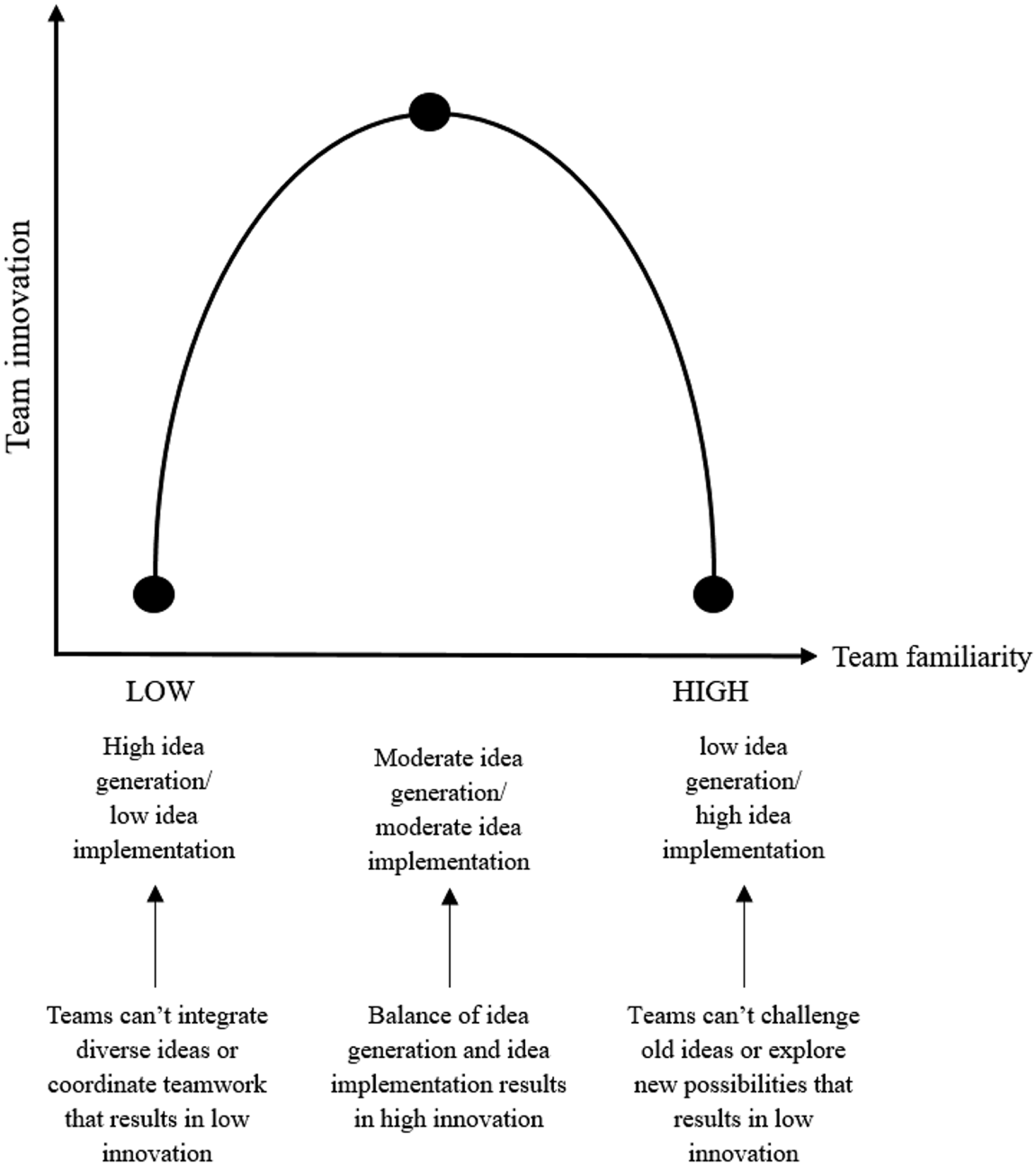
These contrasting issues point to a solution involving balance. A moderate degree of team familiarity provides teams with a certain level of freedom to generate new ideas, and such familiarity can also help teams to implement their ideas for new solutions or products. Therefore, teams with a moderate level of familiarity are likely to have higher levels of team innovation than teams with very high or very low levels of team familiarity. Overall, our theoretical logic could be summarized in Figure 1. Specifically, we propose that teams with both high and low level of team familiarity may have low innovation. Unfamiliar teams generate too many ideas but fail to implement them. Familiar teams are likely to implement ideas well but suffer from a lack of new ideas. By contrast, teams with moderate level of team familiarity could realize the balance between idea generation and idea implementation, leading to highest innovation. Based on this reasoning, we propose following hypothesis:
Hypothesis 1: There is an inverted U-shaped relationship between team familiarity and team innovation.
The relationship between team familiarity and team innovation

The moderating effect of external learning
As proposed above, neither short-term teams nor long-standing teams can realize team innovation. To resolve this problem, managers need to find ways to weaken shackles of team familiarity with idea generation. To attenuate the negative effects of team familiarity on idea generation, teams need to overcome the constraint of rigid habitual routines when necessary. We suggest that introducing novelty provides an important stimulus for changing habitual routines (Gersick & Hackman, Reference Gersick and Hackman1990). In most cases, such novelty is likely to arise from outside the team’s boundary (Ancona, Reference Ancona1990; Ancona & Caldwell, Reference Ancona and Caldwell1992; Gibson & Dibble, Reference Gibson and Dibble2013), and therefore external learning, defined as searching, communicating and integrating knowledge activities with individuals outside the team, is proposed to offer an available opportunity for team members to access novel thinking (Wong, Reference Wong2004).
Previous research indicates that external learning provides opportunities for teams to acquire novel information and stimulate divergent thinking (Wong, Reference Wong2004), which enables the team to make adjustments to a changing context (Bresman, Reference Bresman2010) and change habitual routines accordingly. In accordance with these arguments, we propose that external learning is likely to moderate the inverted U-shaped relationship between team familiarity and innovation, because external learning can attenuate the negative effect of team familiarity on idea generation.
More specifically, we suggest that team familiarity is more likely to be positively related to innovation in teams that have high levels of external learning. A high level of external learning encourages teams to take notice of environmental turbulence and to embrace divergent perspectives (Wong, Reference Wong2004; Bresman, Reference Bresman2010). Therefore, teams with high levels of external learning are more likely to become aware of the wider contexts in which they are embedded, and to make changes to habitual routines because of sorts of new information from the external (Bresman, Reference Bresman2010). In that case, they are less likely to develop rigid habitual routines over time, and the negative effects of team familiarity can be attenuated. Furthermore, external learning does not inevitably disrupt the development of necessary coordinated routines. Previous studies demonstrate that external learning can help teams to acquire the experience of others for improving their work routines, which in turn can enhance coordination and efficiency (e.g., Zellmer-Bruhn, Reference Zellmer-Bruhn2003; Bresman, Reference Bresman2010). In general, the positive effect of team familiarity on idea implementation may persist, but the negative effect of team familiarity on idea generation decreases, or even disappears, if the levels of external learning are high.
In cases where external learning is low, the relationship between team familiarity and team innovation is likely to remain curvilinear, because the negative effect of team familiarity on team innovation is not sufficiently relieved. Insufficient external learning is likely to constrict divergent thinking and limit awareness of contextual changes (Wong, Reference Wong2004; Gibson & Dibble, Reference Gibson and Dibble2013). Without external interruptions, teams are inclined to grow committed to whatever routines they believe are most appropriate to their tasks (Gersick & Hackman, Reference Gersick and Hackman1990; Zellmer-Bruhn, Reference Zellmer-Bruhn2003). As these habitual routines become rigid and unshakable with the increase of team familiarity, team members grow highly dependent on those routines to process and filter diverse ideas. Any idea that is inconsistent with the current routines tends to be discarded or even resisted, and hence the process of idea generation suffers.
However, such teams can still benefit from their shared understanding and effective coordination (Mathieu, Heffner, Goodwin, Salas, & Cannon-Bowers, Reference Mathieu, Heffner, Goodwin, Salas and Cannon-Bowers2000) because of habitual routines. Low levels of external learning do not necessarily impede the positive effects of team familiarity on achieving idea implementation. Therefore, we hypothesize that in the absence of external learning, the positive effects of team familiarity on idea implementation interact with the negative effects of team familiarity on idea generation, resulting in an inverted U-shaped relationship between team familiarity and team innovation. Based on the above observations, we hypothesize the following:
Hypothesis 2: External learning moderates the inverted U-shaped relationship between team familiarity and innovation such that this relationship has an inverted U-shape for teams with low levels of external learning, but team familiarity is positively related to team innovation in teams with high levels of external learning.
METHODS
Samples and data collection
Patent data offers an ideal context for research on innovation (Lanjouw & Schankerman, Reference Lanjouw and Schankerman2004; Nagaoka, Motohashi, & Goto, Reference Nagaoka, Motohashi and Goto2010; Yoon, Lee, & Song, Reference Yoon, Lee and Song2015), and information on patents is commonly applied in studies of team innovation (e.g., Bain, Mann, & Pirola-Merlo, Reference Bain, Mann and Pirola-Merlo2001; Tzabbar & Vestal, Reference Tzabbar and Vestal2015). To test our hypotheses, we collected data on patents related to the electrical engineering industry from the National Bureau of Economic Research (NBER) patent database.
In the electrical engineering industry, the intensity of R&D spending is relatively high compared with other industries (Feller, Ailes, & Roessner, Reference Feller, Ailes and Roessner2002), and R&D is generally seen as having an important influence on organizational growth and profits (Grinyer, McKiernan, & Yasai-Ardekani, Reference Grinyer, McKiernan and Yasai-Ardekani1988). Moreover, innovation is highly dependent on R&D teams in the electrical engineering industry (Leiponen, Reference Leiponen2005). Therefore, patents filed by teams in the electrical engineering industry are highly appropriate as a focus for this study. In addition, the patent data we investigated have a long-time span, so technological revolutions may be a possible concern that influences our results. It has been suggested that the electrical technology and electronics fields have had the most stable shares of total patents over the three decades from 1965 to 1999 (Hall, Jaffe, & Trajtenberg, Reference Hall, Jaffe and Trajtenberg2001). Therefore, the possible influence of technological revolutions is rather low in the electrical engineering industry.
All the data were collected from the NBER patent database, which includes almost three million patents granted in the United States between 1963 and 1999 (Hall, Jaffe, & Trajtenberg, Reference Hall, Jaffe and Trajtenberg2001). Several types of information in this database are useful for this study: (1) the year when the patent was applied for and when it was granted, (2) the inventors who applied for the patent, (3) the number of citations that the patent has received (forward citation) and the number of citations that the patent has made (backward citation), (4) the pairwise citations information, and (5) the organization and the technological category that the patent belongs to. Any patent record that was not able to supply these five kinds of information was excluded from our study. Specifically, since the updated citation information is only available from 1976 to 2006, the patents that granted before 1976 were excluded.
Consistent with prior studies using patent data to research team innovation (e.g., Tzabbar & Vestal, Reference Tzabbar and Vestal2015), we identify an R&D team as a group of inventors develop a given patent together. Jackson, Brett, Sessa, Cooper, Julin, and Peyronnin (Reference Jackson, Brett, Sessa, Cooper, Julin and Peyronnin1991) suggest that minimum team size for team research should be at least three members. Thus, we also excluded patents in which the number of inventors was less than three. Ultimately, our final sample consisted of 68,933 teams from 9,290 organizations, which obtained patents in the United States from 1976 through 1999. Among our samples, 43.67% of the patents (n=30,106) were assigned to private organizations in the United States; 53.11% (n=36,610) were assigned to private organizations outside of the United States; 2.23% (n=1,534) were assigned to US public organizations; and 0.99% of the patents (n=683) were assigned to non-US public organizations.
Measures
Team innovation
It has been suggested that the number of forward citations a patent receives (or the number of later patents that cite a given patent) is an appropriate indicator for the value and quality of innovation in a patent (e.g., Trajtenberg, Reference Trajtenberg1990; Lanjouw & Schankerman, Reference Lanjouw and Schankerman1999; Kim, Arthurs, Sahaym, & Cullen, Reference Kim, Arthurs, Sahaym and Cullen2013). Following this suggestion, we measured team innovation by the number of forward citations that each patent has received. Although our sample of patents included only those granted from 1976 to 1999, we collected the number of forward citations for these patents from 1976 through 2006 by using an updated data set in the NBER database. The data on forward citations were extended because there is always a time lag between the year that a patent is granted and when it is cited by other patents. Also, the forward citation data used in our study included all citations that each patent had received across all technological categories, rather than only the citations received within the electrical engineering industry.
Team familiarity
Similar to previous studies (e.g., Huckman, Staats, & Upton, Reference Huckman, Staats and Upton2009; Sieweke & Zhao, Reference Sieweke and Zhao2015), we measured team familiarity by averaging the total time that each pair of team members had worked with each other. First, we identified the first year when each team member applied for a patent with a given organization (individual team tenure). This method of calculating individual team tenure for patent data was adopted from Tzabbar and Vestal (Reference Tzabbar and Vestal2015). Second, we determined the length of time that each pair of team members had worked together. Finally, we aggregated these dyadic measurements to the team level through averaging each pair’s overlapping experience for each team, as follows (Huckman, Staats, & Upton, Reference Huckman, Staats and Upton2009):
 $${\rm Team}\,{\rm familiarity}\,{\equals}\,\mathop \sum\nolimits_{i{\equals}1}^n \mathop \sum\nolimits_{j{\equals}1}^n PT_{{ij}} /(n(n{\minus}1)/2),$$
where PT ij refers to the length of time that team members i and j have worked together, and n refers to the team size.
External learning
We used an inverted Herfindahl index to measure external learning. To develop our measurement, we first collected backward citations (or which patents were cited by a given patent) for each patent through pairwise citation information. Next, we identified the technological categories for these backward citations by using the United States Patent and Trademark Office (USPTO) three-digit patent classification. Finally, the score of external learning for each team was quantified as follows:
 $${\rm Degree}\,{\rm of}\,{\rm external}\,{\rm learning}\,{\equals}\,{\rm 1}\,{\minus}\mathop{\sum}\nolimits_{i\,{\equals}\,1}^n {S_{i}^{2} } ,$$
where S i refers to the proportion of citations made by a given patent that belongs to patent class i, and n the number of technological categories that a given patent has cited.
We adopted this measurement because it reflects the extent to which an R&D team integrates diverse knowledge into one patent. This measure is consistent with the notion that external learning emphasizes acquiring and integrating new knowledge from outsiders. In other words, when teams cite patents that span a wide range of technological categories, it means that they have effectively acquired and integrated a great deal of external knowledge into their work. If they only cite patents in a narrow field, it means that team members have sought and utilized external knowledge to a limited extent. A similar measurement is applied by Trajtenberg, Henderson, and Jaffe (Reference Trajtenberg, Henderson and Jaffe1997), Gruber, Harhoff, and Hoisl (Reference Gruber, Harhoff and Hoisl2013), and Kaplan and Vakili (Reference Kaplan and Vakili2015) in their studies on patent data.
Control variables
Several team-level factors that may affect team innovation were controlled for in this study. First, we controlled for team size, because team size is likely to be positively related to team innovation (Hülsheger, Anderson, & Salgado, Reference Hülsheger, Anderson and Salgado2009). Second, we controlled for average experience, because teams that have more experience may perform better in innovation (Kaplan & Vakili, Reference Kaplan and Vakili2015). Following prior research (e.g., Kaplan & Vakili, Reference Kaplan and Vakili2015; Sieweke & Zhao, Reference Sieweke and Zhao2015), we developed a measure for the operationalization of member experience. We counted the cumulative number of patents that each inventor had applied for. Next, these cumulative numbers of patents were averaged for each team. Finally, we controlled for team member experience diversity and team tenure diversity, because previous studies suggest that diversity reflects the extent to which teams have wide-ranging knowledge or expertise for developing new ideas and products, and such diversity in turn affects team innovation (e.g., Horwitz & Horwitz, Reference Horwitz and Horwitz2007; Mitchell & Boyle, Reference Mitchell and Boyle2015; Tang & Naumann, Reference Tang and Naumann2016). As member experience and team tenure are both continuous variables, we used the coefficient of variation to calculate team member experience diversity and team tenure diversity (Allison, Reference Allison1978).
We also controlled for patent-level factors that may affect innovation (Tzabbar & Vestal, Reference Tzabbar and Vestal2015). First, as previous research suggests that private organizations are more innovative than public organizations (e.g., Roessner, Reference Roessner1977; Damanpour, Reference Damanpour1991), and as country differences are likely to affect both innovative activity (e.g., Gittelman, Reference Gittelman2006; Varsakelis, Reference Varsakelis2006) and patent value (e.g., Bessen, Reference Bessen2008), we created three dummy variables to control for these ownership and country differences. Second, we controlled for the year (between 1976 and 1999) in which each patent was granted, using 23 dummy variables, as the number of citations may increase over time for each patent (Hall, Jaffe, & Trajtenberg, Reference Hall, Jaffe and Trajtenberg2001).
RESULTS
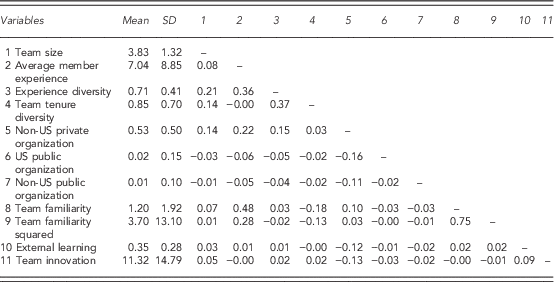
Table 1 shows the results of descriptive statistics and pairwise correlations for each variable. Next, we used hierarchical regression analysis to test our hypotheses. To address the concern over possible multicollinearity, we mean-centered all predictors before entering them into our regression models. The highest value of variance inflation factor was 3.01 for team familiarity, which was well below the common benchmark of 10 (O’Brien, Reference O’Brien2007). Therefore, we concluded that the problem of multicollinearity was unlikely to influence the results of our hierarchical regression analysis.
Means, standard deviation and correlates between variables

Note. n=68,933; 23 dummy variables for granted year are not included.
Absolute value of correlations >0.01 is significant at p<.01.
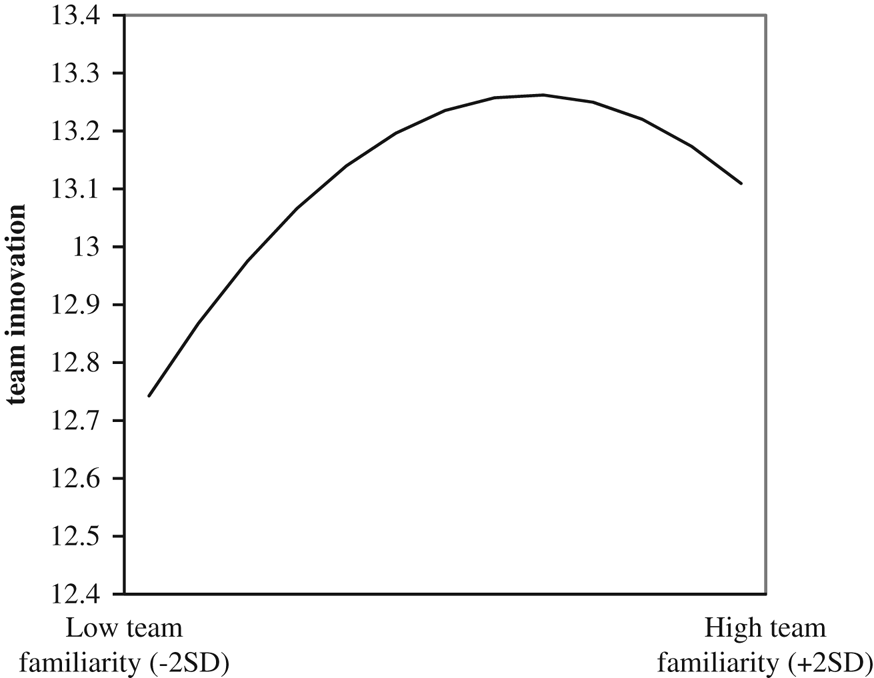
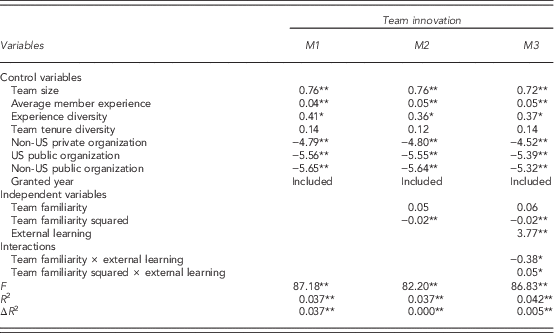
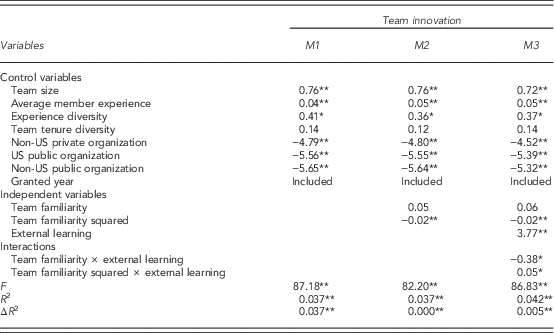
In Hypothesis 1, we proposed that the relationship between team familiarity and team innovation has an inverted U-shape. As shown in Table 2, when both team familiarity and the square of familiarity were entered in model 2, the coefficient of the squared term of team familiarity was significant in the regression (β=−0.02, p<.01). We further tested the inverted U-shaped relationship between team familiarity and innovation by utest (Lind & Mehlum, Reference Lind and Mehlum2010). First, we tested whether the slope of both ends of curve is steep enough. In order to respond the concern that curvilinear effect may be caused by outliers (Cohen, Cohen, West, and Aiken, Reference Cohen, Cohen, West and Aiken2003: 413), we conducted this test with 1.5 SD below and above the mean rather than a wider data range. The same analysis has also been used by previous studies of curvilinear effects (e.g., Kehoe & Tzabbar, Reference Kehoe and Tzabbar2015; Tzabbar & Vestal, Reference Tzabbar and Vestal2015). In doing so, 7.84% of our samples (n=5,401), which were either too big or too small, were excluded from the slope test. The results indicated that the slopes of the curve at both the lower level of team familiarity (1.5 SD below the mean) (t=2.07, p<.05) and the upper level of team familiarity (1.5 SD above the mean) (t=−2.14, p<.05) were significant. The overall result of utest for an inverted U shape was also significant (t=2.07, p<.05). Furthermore, the results of utest showed that the inflection point of the curve was 1.14, which was about 0.6 SD above the mean (1.14/1.92≈0.6). This finding revealed that team innovation started to decrease when team familiarity was about 0.6 SD above the mean. In addition, we graphed the relationship between team familiarity and team innovation. As shown in Figure 2, with the increase in the degree of team familiarity, team innovation first improved, and then declined, presenting an inverted U-shaped form. According to these results, Hypothesis 1 was supported.
The inverted U-shaped relationship between team familiarity and team innovation

The hierarchical regression results between team familiarity and team innovation
Note. n=68,933.
*p<.05; **p<.01.
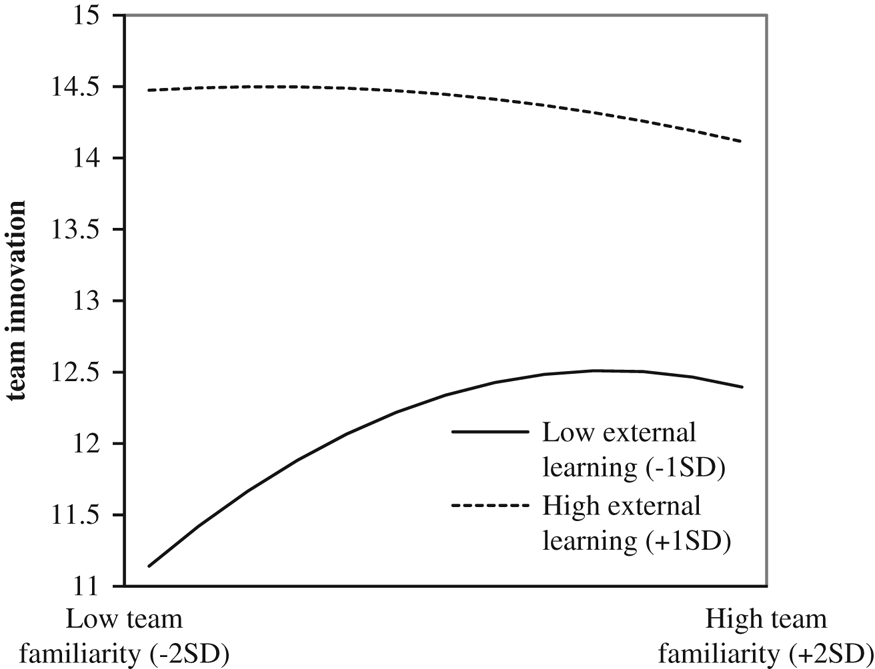
In Hypothesis 2, we proposed that external learning may moderate the curvilinear relationship between team familiarity and team innovation. In particular, we suggested that the relationship between team familiarity and team innovation is still an inverted U-shape when external learning is low, but team familiarity is positively related to team innovation when external learning is high. As shown in Table 2 (model 3), the squared interaction term was significant in the regression (β=0.05, p<.05). We graphed (see Figure 3) and further tested this moderating effect with simple slope tests, as recommended by Dawson (Reference Dawson2014). When external learning was low (1 SD below the mean), the coefficient of the squared term for team familiarity was still significant (β=−0.04, p<.01). However, when external learning was high (1 SD above the mean), both the monomial term of team familiarity (β=−0.05, ns) and the squared term (β=−0.01, ns) were insignificant. Overall, Hypothesis 2 was partly supported.
The moderating effect of external learning on relationship between team familiarity and team innovation

Robustness checks
Last, we conducted robustness checks using different operationalizations of team familiarity. Previous research (e.g., Berman, Down, & Hill, Reference Berman, Down and Hill2002) suggests that team familiarity may be operationalized by averaging the tenure of team members. We first determined the team tenure for each team member, and then averaged the team tenure of all the individuals to calculate team familiarity. Next, we ran a hierarchical regression analysis with the same variables that were used in models 2 and 3, but using an alternative operationalization of team familiarity. Consistent with our hypotheses, the squared term of team familiarity was still negative and significant (β=−0.01, p<.01) in the model testing the relationship between team familiarity and team innovation. The squared interaction term between team familiarity squared and external learning was positive and marginally significant (β=0.03, p<.10) in the model for testing the moderating effect of external learning. Therefore, the results of the robustness check also supported Hypotheses 1 and 2.
DISCUSSION
The literature is inconclusive concerning whether team familiarity benefits or hinders team innovation. Applying habitual routines theory to this problem (Gersick & Hackman, Reference Gersick and Hackman1990), we propose that the relationship between team familiarity and team innovation may have an inverted U-shape. Furthermore, we suggest that external learning is likely to moderate this curvilinear relationship. We conducted an archival study with a data set of 68,933 R&D teams to test our hypotheses, and the results of the data analysis support most of our hypotheses. That is, our results support our proposal that the association between team familiarity and team innovation has an inverted U-shape. However, the moderation effect of external learning on this inverted U-shaped relationship is only partly supported. Our findings show that the relationship between team familiarity and innovation has an inverted U-shape when external learning is low, but neither a linear nor a curvilinear relationship is indicated when external learning is high.
One possible explanation for the nonsignificant result under high levels of external learning is that the positive effect of team familiarity on idea implementation, to some extent, may also be attenuated by external learning. Teams that are keen to seek new knowledge externally may introduce too much diversity of knowledge into the team, but teams only have limited capability to use diverse knowledge (Luan, Ling, & Xie, Reference Luan, Ling and Xie2016). Therefore, it is difficult for teams to integrate diverse ideas and to develop appropriate routines when they face too much diverse information, and team coordination may suffer. As we argue that external learning is likely to attenuate the negative effect of team familiarity on idea generation, high levels of external learning is likely to simultaneously attenuate both the positive and the negative effects of team familiarity on innovation, leading to a nonsignificant relationship as our results indicated.
Theoretical contributions
Our study makes two main contributions to the relevant literature. First, this study contributes to research on the relationship between team familiarity and team innovation by reconciling paradoxical arguments and contradictory evidence. Because team familiarity can help teams to coordinate individual work (e.g., Harrison et al., Reference Harrison, Mohammed, Mcgrath, Florey and Vanderstoep2003; Espinosa et al., Reference Espinosa, Slaughter, Kraut and Herbsleb2007), identify and utilize team members’ expertise (e.g., Littlepage, Robison, & Reddington, Reference Littlepage, Robison and Reddington1997; Bunderson, Reference Bunderson2003), and develop a transactive memory system (e.g., Akgün et al., Reference Akgün, Byrne, Keskin, Lynn and Imamoglu2005), some previous studies support the argument that team familiarity is beneficial to team innovation. Other studies, however, suggest that team familiarity can hinder team innovation by attenuating internal and external communication (e.g., Katz, Reference Katz1982). Such attenuated communication can cause blindness toward the need for change (e.g., Sieweke & Zhao, Reference Sieweke and Zhao2015) and induce rigidity in patterns of knowledge, thereby constraining a team from being innovative (e.g., Berman, Down, & Hill, Reference Berman, Down and Hill2002). Through an inquiry based on habitual routines theory, our study is conducive to reconciling these contradictions. We find that the relationship between team familiarity and team innovation is indeed curvilinear. When team familiarity is low, teams are prohibited by a lack of mature implementation routines from high quality of team innovation. However, as team familiarity becomes too high, the generation of creative ideas significantly drops and team innovation suffers consequently. Only the moderate level of team familiarity produces the best team innovation because both idea generation and idea implementation are assured.
Moreover, by proposing and testing our hypothesis regarding a curvilinear relationship between team familiarity and team innovation, our study also responds to an important question from Anderson, Potočnik, and Zhou (Reference Anderson, Potočnik and Zhou2014). These researchers propose research to assess whether increasing a variable that has been found positively associated with innovation at a glance will always elevate the level of innovation. By proposing and examining a nonlinear relation between team familiarity and innovation, our study finds the potential negative impact of team familiarity on innovation when team familiarity goes too far. Therefore, our findings support their arguments. There could be more antecedents of team innovation covered by previous studies, just like team familiarity in our study, which need further attention to their influence on team innovation based on Anderson et al.’s (Reference Anderson, Potočnik and Zhou2014) suggestion.
Second, we contribute to the literature on habitual routines theory by highlighting the potential effect of external learning for impacting habitual routines. Gersick and Hackman (Reference Gersick and Hackman1990) suggested that encountering novel situations provided an important impetus for teams to modify or break their habitual routines. However, many researchers argue that teams with high levels of familiarity are usually unable to adapt in changing situations and to become unproductive over time (e.g., Katz, Reference Katz1982; Berman, Down, & Hill, Reference Berman, Down and Hill2002). In other words, teams that have high levels of familiarity may be increasingly unaware of novelty in their changing environment. Our study proposes that external learning is conducive to providing an opportunity for teams to perceive novel stimulus and to embrace new perspectives. In line with this, we found that external learning could partly attenuate the negative effect of too much team familiarity on team innovation. Although the nonlinear relationship between team familiarity and team innovation is still significant under a low level of external learning, the negative influence of intense team familiarity on team innovation is buffered by a high level of team external learning. Teams are endowed with access to external knowledge and ideas by a high level of external learning. They are thus more likely to notice external change and novelty, and then have materials to propose new ideas.
It merits noticing that we did not find a positively linear relationship between team familiarity and team innovation under the high level of external learning. Previous studies argued that excessive external activities might interfere with team internal cooperation (e.g., Gibson & Dibble, Reference Gibson and Dibble2013), which could explain the nonsignificant results under high levels external learning. Despite its positive influence on idea generation, we speculate that the presence of high levels of external learning probably makes the team difficult to develop and set down routines for idea implementation. We suggest that further research retests the moderating effects of external learning by uncovering the underlying mechanism between team familiarity and team innovation.
Practical implications
Our study also has several important implications for practice. First, we provide an insight on how to deal with team familiarity in team design. On the one hand, in many organizations, innovative tasks are conducted by project-based teams, which will be disbanded after the project is completed. Whereas organizations can select specific employees based on the task requirements, team instability and its temporary membership may cause coordination problems and in turn stifle innovation (Edmondson & Nembhard, Reference Edmondson and Nembhard2009). Members of newly established teams require time to be familiar with each other, which is conducive to the formation of shared cognitive structure (Akgün & Lynn, Reference Akgün and Lynn2002; Akgün et al., Reference Akgün, Byrne, Keskin, Lynn and Imamoglu2005) and uncertainty reduction about interpersonal interaction (Littlepage, Robison, & Reddington, Reference Littlepage, Robison and Reddington1997). Therefore, for organizations that are accustomed to utilize disposable teams, they need to wait patiently until team members become familiar with each other, otherwise team innovation will suffer owing to lack of shared understanding of both task-related and relationship-related issues.
On the other hand, our findings alert managers to the possible danger of ‘too much of a good thing effect’ (Pierce & Aguinis, Reference Pierce and Aguinis2013) for team familiarity. We show that team familiarity does not always lead to desirable outcomes, and excessive familiarity may result in a decline of innovation. When employees have been working together for a long time, they are apt to be slaves of habitual routines. Too much familiarity leads to homogeneity in thinking (Katz, Reference Katz1982; Choi & Thompson, Reference Choi and Thompson2005) and intense commitment to prior experiences and routines (Gersick & Hackman, Reference Gersick and Hackman1990), thereby stifling alternative perspectives and new ideas. As idea generation is highly dependent on diverse knowledge and novel ideas (Zhou & Hoever, Reference Zhou and Hoever2014), long-standing teams are stuck in habitual routines and prevent themselves from innovation. For example, through a study of innovation teams in 12 global companies, Ashkenas and Spiegel (Reference Ashkenas and Spiegel2015) found the teams that are used to blindly follow habitual routines or norms are often unsuccessful in innovation.
In sum, because neither short-term teams nor long-standing teams enable innovation, organizations need to consider carefully how to build a team and when to dissolve the team. It is better that organizations can select members with a moderate level of familiarity. Once a team has been united for a long time, organizations should be cautious about its motivation or capability to innovate. It is noted that we do not suggest the teams whose members are familiar with each other must be dissolved. We found that external learning could partly attenuate the negative influence of team familiarity on innovation. Therefore, it may be a possible solution to encourage teams, especially long-standing teams, to span team boundaries and to learn from the outside. Based on relevant research, we provide several suggestions for management on how to stimulate external learning. First, it is suggested that psychological safety plays a critical role in external learning (Bresman & Zellmer-Bruhn, Reference Bresman and Zellmer-Bruhn2013). According to this, leaders should encourage and support team members to express alternative ideas and engage in the trail-and-error process (Nembhard & Edmondson, Reference Nembhard and Edmondson2006). Second, individuals are motivated to engage in external activities when these activities become a part of their personal roles (Marrone, Tesluk, & Carson, Reference Marrone, Tesluk and Carson2007). Therefore, managers can promote external learning through assigning responsibilities of external activities to team members. Meanwhile, because the positively linear association between team familiarity and team innovation under the high level of external learning was not supported by the results, we recommended team leaders to keep their eyes skinned for the influence of external learning especially on intrateam coordination. As previous literature suggests (e.g., Wong, Reference Wong2004), it is important to keep the balance between external learning activities and internal coordination activities, whereas excessive external activities may result in the loss of coordination within team.
Limitations and future research
This study also has several limitations. First, because of the study’s cross-sectional design, we were not able to make any causal claims for our results. Experimental study is required to test the causal relationships involved in our theories.
Second, we measured team familiarity by using an objective index (i.e., tenure) rather than by self-report scales. This approach may have limited our ability to make a more detailed investigation into the effects of team familiarity on team innovation. For example, individuals are likely to gradually become familiar with both their tasks (task familiarity) and their coworkers (group familiarity) over time (e.g., Littlepage, Robison, & Reddington, Reference Littlepage, Robison and Reddington1997; Espinosa et al., Reference Espinosa, Slaughter, Kraut and Herbsleb2007). However, the measures used in our study could not distinguish between these two types of familiarity. Therefore, it should be interesting in future studies to investigate whether task familiarity and group familiarity may have different effects on team innovation.
Third, although we proposed that the generation and implementation of creative ideas could mediate the effect of team familiarity on team innovation, we could not examine these two variables separately due to the limits of our data set. We encourage future studies to reexamine our theoretical model by directly measuring these two mechanisms.
Finally, although most of hypotheses are supported, the effect size of our findings is small. It might be because curvilinear effects are commonly smaller than main effects of a linear relationship (Busse, Mahlendorf, & Bode, Reference Busse, Mahlendorf and Bode2016). Another possible explanation is that sample size is usually inversely related to effect size (Mcmahon, Holly, Harrington, Roberts, & Green, Reference Mcmahon, Holly, Harrington, Roberts and Green2008). The sample size of this study is rather large (n=68,933), therefore the effect size of our findings could be small compared with other studies using a small sample. Nevertheless, we still strongly recommend future studies to retest what we have found in this study and to pay more attention to understand the relationship between team familiarity and team innovation.
CONCLUSION
Whether team familiarity may benefit or harm team innovation is inconclusive in current literature. We address this question by an archival study with a big sample of 68,933 R&D teams. The results show that the relationship between team familiarity and innovation is inverted U-shaped, and external learning could moderate this relationship. In so doing, our study is helpful to reconcile the paradoxical arguments and empirical evidences in previous research. The curvilinear relationship indicates that moderate level of familiarity produces best team innovation, and therefore those teams that are primarily responsible for innovative task are optimal to keep a certain level of stability in team membership or shared experiences of working together. Moreover, we contribute to habitual routines theory by highlighting the impact of external learning on breaking out rigid routines. Managers should bear in mind that external learning could partly attenuate the negative effect of too much team familiarity on team innovation.
Acknowledgements
This research is supported by the National Natural Science Foundation of China (Project No. 71772159 and No. 71372056) and the Fundamental Research Funds for the Central Universities.