





1. Introduction
Constraining the properties of stellar populations and nebular gas at low metallicity is of great relevance for multiple topical questions. These range from understanding how early galaxies transformed the ionization structure of the Inter-Galactic Medium to how the evolution of metal-poor massive stars gives rise to binary black holes. Crucial, are observational constraints for theoretical predictions, which can be obtained from rest-frame UV spectra of star-forming dwarf galaxies approaching the low-metallicity threshold of the nearby universe. We test UV spectral evolution models of young stellar populations and photoionization models against unpublished Cosmic Origins Spectrograph (COS) observations of metal-poor galaxies.
2. Sample and observations
Our sample is composed of eight nearby (
 $z\leq0.013$
) galaxies with ionized gas oxygen abundances of
 $12+\rm{log(O/H)}\approx7.48-7.81$
, seven of which have
 $Z \lt Z_\odot /10$
. The galaxies were selected to have nebular He II 4686 emission in observations of the Sloan Digital Sky Survey IV/DR14 Abolfathi et al. (Reference Abolfathi, Aguado and Aguilar2018). We used the low resolution grating of COS, G140L (FWHM/FUV=0.48 Å, FWHM/NUV=0.24 Å), at central wavelength 1105 Å and life time position 4, to obtain continuous rest-frame UV spectra of the galaxies, covering from 1100 to 1950 Å, as part of Hubble Space Telescope program 15220 (PI Wofford). This covers a rich set of stellar, nebular and ISM gas diagnostics, from P V 1118 to C III] 1909. The spectra were obtained with the circular Primary Science Aperture, which is 2.5
 $^{\prime\prime}$
in diameter. We retrieved the individual spectral data sets from the Mikulski Archive for Space Telescopes and initially processed them on-the-fly with version 3.3.4 (2018-01-08) of the CalCOS pipeline. We corrected the observations for the Milky-Way and/or intrinsic H I Ly
 $\alpha$
absorption(s) and redshift.
3. Models
We use updated versions of STARBURST99 (Leitherer et al. Reference Leitherer, Ekström and Meynet2014, S99) and GALAXEV (Plat et al. Reference Plat, Charlot and Bruzual2019, CB19) to compute UV spectral evolution models for young (
 $\lt10$
Myr) single stellar populations (SSPs), where the stars are born simultaneously in an instant burst. These codes assume that massive stars evolve as single isolated stars. We compute spectral evolution models at metallicities Z=0.001, 0.004, and 0.008, with (v40-l) and without (v00-l) rotation using S99, and non-rotating models with (CB19-100) and without (CB19-300) Very Massive Stars (VMS, of up to 300 M
 $_\odot$
) using CB19. We use these models to analyze the observations of galaxies with P-Cygni like profiles. In addition, we compute Cloudy c23.01 Gunasekera et al. (Reference Gunasekera, van Hoof, Chatzikos and Ferland2023) photoionization models that use ionizing spectra predicted by the new pySTARBURST99 Hawcroft et al. (Reference Hawcroft, Leitherer and Aranguré2025) code as input. We compare these models with observations of J1044, a galaxy dominated by UV nebular emission lines.
4. Results
N V 1240 and C IV 1550 P-Cygni like doublets are detected in three galaxies with EW(H
 $\beta)\lesssim90$
Å, whereas nebular C IV 1550 emission lines are detected when EW(H
 $\beta)\gtrsim100$
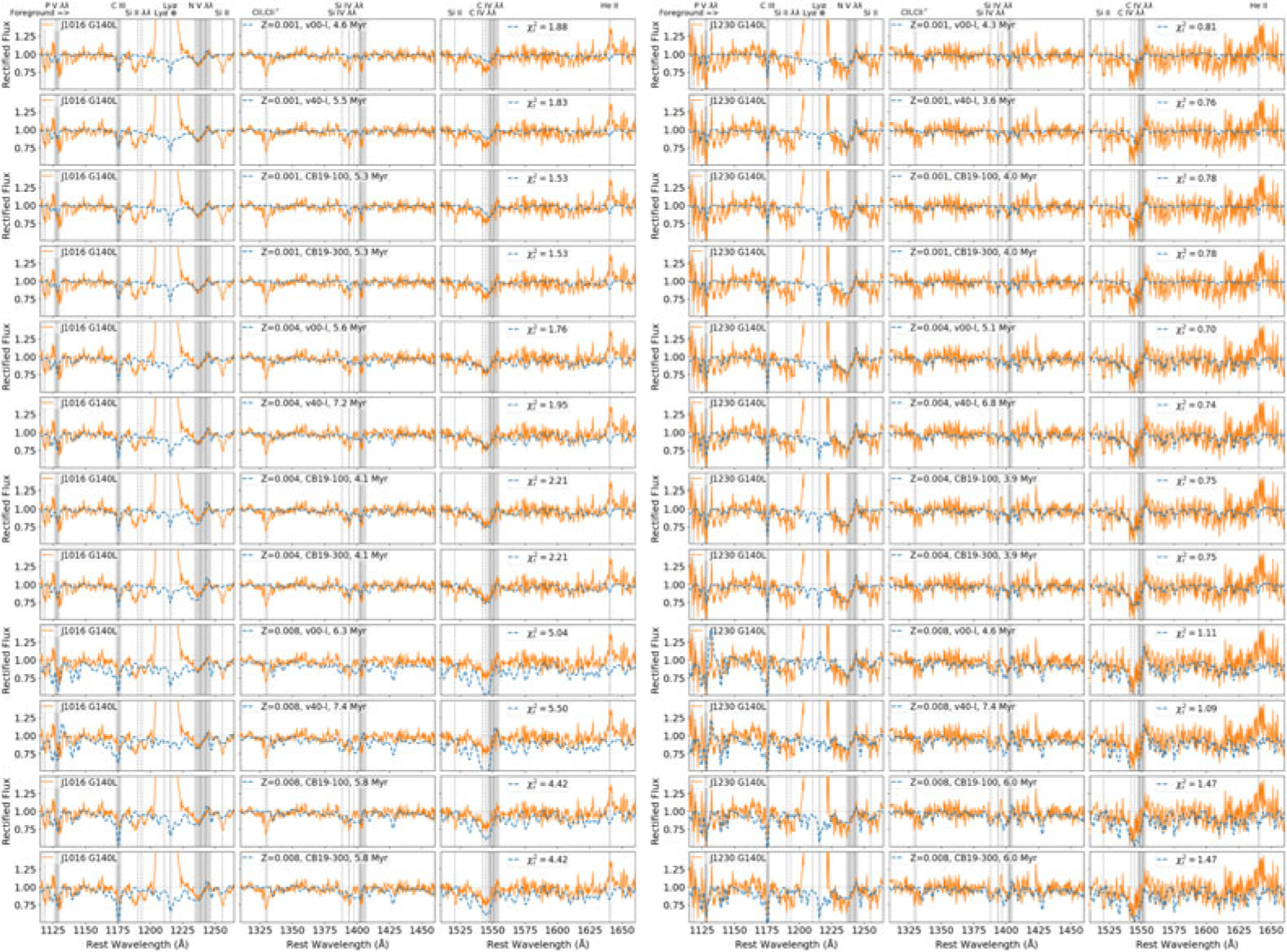
Å. All but one galaxy show He II 1640 nebular emission, and all show at least one nebular component of the O III] 1661, 6, [Si III], Si III] 1883, 92, and [C III], C III] 1907, 9 doublets. For the galaxies with P-Cygni like doublets, none of the models simultaneously reproduces all age-sensitive features. This is shown for two galaxies in Fig. 1, where the regions fitted are marked with vertical gray bands. As expected from the low O/H values of the galaxies, the Z=0.008 models produce the largest
 $\chi_r^2$
values and worst fits to the observations. In general, the v40-l ages are larger than the v00-l ages, which is consistent with rotation extending the MS lifetimes of massive stars. The age differences between the v00-l and CB19-100 are between
 $0.3-3$
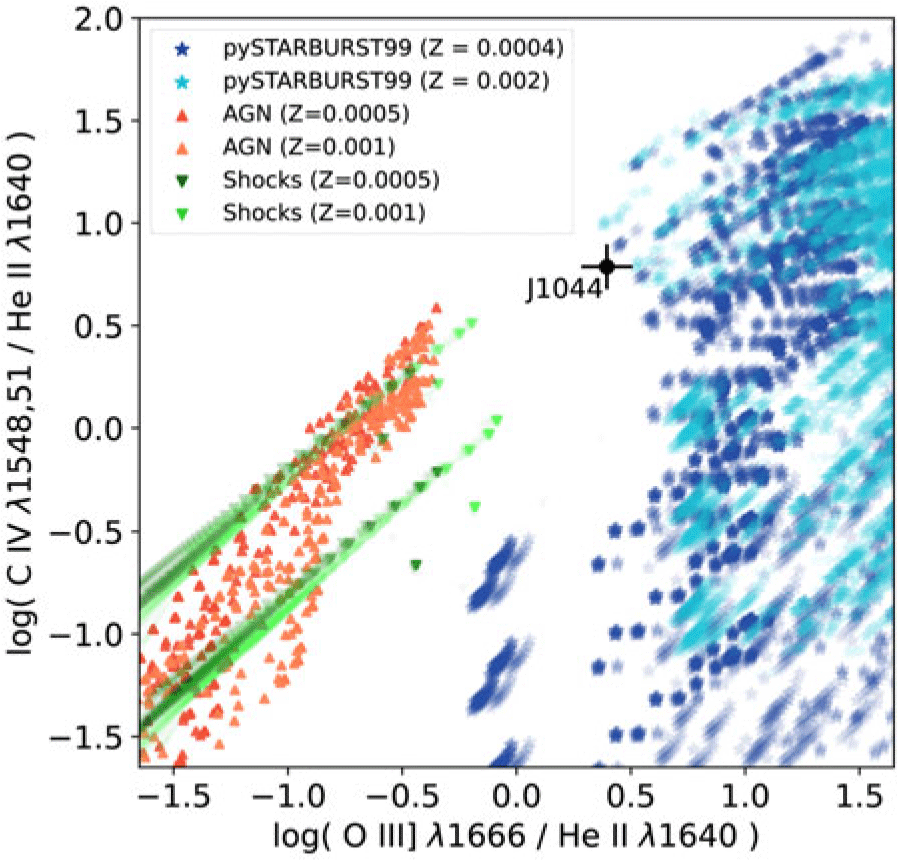
Myr and 1.4 Myr on average. In addition, we find photoionization models that approach the observed emission line ratios of galaxy J1044, as shown in Fig. 2.
For each of two galaxies in our sample with P-Cygni like profiles, comparison of COS G140L spectra (orange curves) with 12 models corresponding to the minimum
 $\chi_r^2$
age found for a fixed model-metallicity combination (blue-dashed curves). We mark the positions of important foreground (geocoronal,
 $\oplus$
; and MW ISM) features with dashed vertical lines; and intrinsic features with solid vertical lines. The vertical gray bands represent the regions used in the fits.

Observed emission line ratios of J1044 vs. photoionization models, the AGN models of (Feltre et al. Reference Feltre, Charlot and Gutkin2016, orange triangles) and the shock models of (Alarie & Morisset Reference Alarie and Morisset2019, green triangles).

5. Future work
We are currently testing models which account for mass-exchanging binaries. Models that include narrow-He II emission from VMS would be interesting to test as well. We plan to compare our photoionization models to observations of additional galaxies, using different types of UV diagnostic diagrams.
 χr2
 ⊕

 Open access

