




No CrossRef data available.
XOO-PHASE CERAMICS FROM OAXACA FOUND AT CALIXTLAHUACA IN CENTRAL MEXICO
Published online by Cambridge University Press: 28 March 2006
Abstract
We describe tombs and ceramic collections in Zapotec style excavated in central Mexico, outside Oaxaca. The most notable are 13 ceramic vessels and objects from the Xoo complex (a.d. 500–800) excavated by José García Payón in Calixtlahuaca (near the city of Toluca), and three Zapotec-style tombs excavated in Los Teteles (near the city of Puebla). We also mention Zapotec remains excavated near Tula, Hidalgo, and tombs in other parts of central Mexico. We briefly explore the implications of these data for our understanding of central Mexico after the fall of Teotihuacan.
Information
- Type
- Research Article
- Information
- Copyright
- © 2005 Cambridge University Press
The presence of Oaxacan ceramics at Teotihuacan in the Early Classic period is well known. Parts of the “Oaxaca barrio” (or Tlailotlacan), where these materials are concentrated, have been excavated (Spence 1989, 1992), revealing a tomb and a calendrical inscription in Oaxacan style in addition to imported ceramic vessels. It appears that a group of people from Oaxaca—most likely Zapotecs—resided at Teotihuacan, and the implications of this situation for trade and interaction between Teotihuacan and Monte Albán are much discussed topics (e.g., Marcus 1983; Rattray 2001; Spence 1992, 2005; Winter 1998). In this paper we report additional evidence for Oaxacan ceramics and tombs in central Mexico during several time periods, from circa a.d. 200 to 800. Some of these materials have been published previously, but they are not well known and have been little remarked on in the literature.
Most of the ceramic vessels discussed here date to the Xoo phase in the Valley of Oaxaca, circa a.d. 500–800. With the recent formal definition of the Xoo ceramic complex at Monte Albán (Martínez López et al. 2000) and the accompanying reevaluation of the nature of cultural development in the Valley of Oaxaca (Lind 1994; Markens and Martínez López 2001), this is an appropriate time to discuss the evidence for Xoo-phase ceramics and tombs in central Mexico. We should note here that there is a lengthy debate over the nature and validity of the Xoo phase as a chronological unit in the Valley of Oaxaca. The Late Classic/Epiclassic period was initially divided into two phases, Monte Albán IIIA and Monte Albán IV, by Alfonso Caso and colleagues (1967) on the basis of stratigraphic relationships at the site of Monte Albán. Paradoxically, they could not distinguish the ceramics of these two units and therefore described the ceramics as a single ceramic complex, which they called Monte Albán IIIB/IV. Later, John Paddock (1966) distinguished Monte Albán IIIB and Monte Albán IV as separate ceramic phases, a practice that was then followed by archaeologists conducting survey and surface collections in the Valley of Oaxaca (Blanton et al. 1982; Finsten 1995; Kowalewski et al. 1989).
On the basis of fieldwork at Monte Albán itself, however, Marcus Winter (1989) and Michael Lind (1994) proposed merging these two constructs (Monte Albán IIIB and IV) back into a single ceramic phase, which they named Xoo. A 2000 monograph (Martínez López et al. 2000) provides a formal definition of the Xoo ceramic complex, with ample illustrations (see also Lind 2001 and Markens and Martínez López 2001). A number of archaeologists have criticized the Xoo concept, however, arguing that Monte Albán IIIB and Monte Albán IV do exist as distinctive and valid chronologically ordered ceramic phases (Finsten 1995:12–14, 81–82; Marcus and Flannery 1990). This view was reiterated in personal communications by Joyce Marcus and Christina Elson to Smith in 2004. We believe, however, that the data in the 2000 monograph (Martínez López et al. 2000) provide a firm empirical basis for the Xoo phase, a view that appears to be shared by many—but not all—archaeologists working in Oaxaca and adjacent areas of Mesoamerica. Regardless of the eventual outcome of this debate, the ceramics described in this paper are clearly from Oaxaca, where they fit into the Late Classic/Epiclassic period in whatever chronology one wishes to employ.
We use the terms “Zapotec” and “Zapotecs” for central Mexican traits and peoples that were probably from the Valley of Oaxaca, acknowledging that such ethnic identifications in archaeology are often open to dispute. We suggest that the notion of a merchant diaspora (Curtin 1984; Zenner 1991) may help explain the distribution of Zapotec ceramics and tombs in central Mexico.
XOO PHASE CERAMICS FROM CALIXTLAHUACA
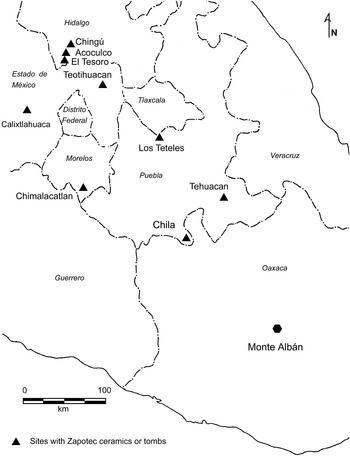
The ceramic vessels discussed here were excavated in the 1930s by José García Payón at Calixtlahuaca, a site with several large Postclassic temples just north of the city of Toluca in the western part of the State of Mexico (Figure 1). The Oaxacan ceramics are probably from offerings associated with one or more burials, but the poor level of documentation of the excavations prevents a precise reconstruction of their contexts. Apart from a few articles (e.g., García Payón 1941), José García Payón published very little on his work at the site. The first volume of a planned series of reports (García Payón 1936) focused almost exclusively on the Valley of Toluca and its ethnohistory. The second two volumes in this series were published posthumously (García Payón 1979, 1981), but they still leave most of the excavation without adequate descriptions.

Map of central Mexican sites (outside Oaxaca) with Zapotec ceramics or tombs.
García Payón (1936:174 ff) published a photograph of several ceramic vessels that includes two Oaxacan examples: a cylindrical vase with a glyph (vessel no. 1200) and a bat claw vessel (vessel no. 1124). The photo caption says, “Piezas de cerámica zapoteca encontrada en la zona arqueológica de Tecaxic-Calixtlahuaca.” (Although the site has always been known simply as Calixtlahuaca, from pre-Hispanic times through the present, García Payón sometimes called it “Tecaxic-Calixtlahuaca.”) These vessels apparently excited little interest among archaeologists, and the only mention of them we can find is in Adam Sellen's (2002a:8–9) dissertation. The major occupation of Calixtlahuaca was during the Late Postclassic period, when numerous burials were interred with offerings of ceramic vessels and other items (García Payón 1941; Smith et al. 2003). The burial offerings were poorly documented, but the collection of vessels and other offering goods (e.g., copper-bronze objects, precious stones, and spindle whorls) survives intact in two museums run by the Instituto Mexiquense de Cultura, a division of the State of Mexico.
In summer 2002, Smith studied the ceramic vessels in this collection, making a catalogue, taking digital photos, and recording attributes. Along with 1,285 Postclassic vessels he identified 79 Classic-period vessels very similar to examples from Teotihuacan and the 13 Oaxacan pieces described here. The 2002 research is described in two works (Smith 2003; Smith et al. 2003); they discuss the nature of the collection and its context in greater detail. A major drawback of the Calixtlahuaca collection is the lack of precise provenience data. It is not known which vessels came from which burials or offerings. Until unpublished notes or documents are discovered, we have no way to know whether the 13 Oaxacan pieces were from a single burial or from more than one context. Smith has been searching for García Payón's unpublished notes, catalogues, and other materials in archives, museums, and libraries in Toluca and Mexico City (Smith 2003). This is an ongoing effort, and there are still some promising leads that may pay off in the future. He also plans to conduct new excavations at Calixtlahuaca, which may help illuminate the context of the Zapotec ceramics described here.
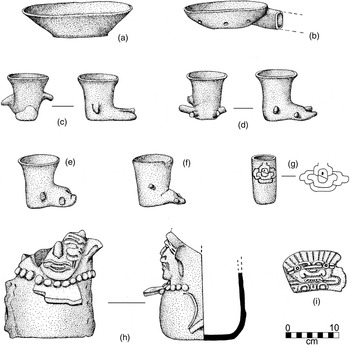
The 13 Oaxacan objects from Calixtlahuaca are listed in Table 1; nine of them are illustrated in Figure 2. They can be classified into six categories.
Xoo-phase ceramic vessels from Calixtlahuaca


Zapotec ceramic objects from Calixtlahuaca. (a) G35 conical bowl; (b) handled censer; (c–f) bat-claw vessels; (g) cylindrical vessel with glyph; (h) urn or effigy vessel; (i) headdress fragment. See Table 1 for catalog numbers and information about the pieces. The glyph was drawn by Jennifer Wharton; the vessels were drawn by Jessie Pellerin based on photographs taken by Smith and Wharton.
G35 Conical Bowls
Type G35 conical bowls are a distinctive ceramic category from the Valley of Oaxaca. Four examples of this type are in the Calixtlahuaca collection; one is illustrated in Figure 2a. Two of the G35s are large (25.5 cm and 28 cm) and light gray, and two are medium-size (15 cm and 20 cm) and dark gray. All have reinforced rims, and two (one large and one small) have incipient bases. These characteristics are typical of G35 conical bowls from Monte Albán (Martínez López et al. 2000:36–37), where their occurrence is not limited to the Xoo phase.
Handled Censers
Two handled censers from Oaxaca are in the collection (Figure 2b), which has an additional nine handled censers in a local style. The Zapotec examples have a light gray paste and a rough finish. Their perforated bowls have diameters of 12 cm and 15 cm, respectively, and the handles join the bowls at a slight downward angle. These attributes are characteristic of Xoo-phase handled censers from the Valley of Oaxaca (Martínez López et al. 2000:152–159), and they differ greatly from the nine local handled censers in the collection. In contrast to the Xoo examples, the local censers have polished surfaces (sometimes painted), larger perforations, and longer handles, and the handles extend in the same plane as the bowl opening (as compared with the Oaxacan censers, where the handles extend down at an angle).
Bat-Claw Vessels
Bat-claw vessels are one of the most distinctive Oaxacan ceramic forms (Caso et al. 1967:404, 409). Four of these vessels are present in the Calixtlahuaca collections; all four are illustrated (Figure 2c–f). Of the four, two are dark gray, one is light gray, and one is orange-brown (cafe). The bat claws are in the form of solid cones and/or large curving claws. These bat-claw vessels, one of the most easily identifiable Zapotec vessel forms, are identical to examples from the Xoo phase in the Valley of Oaxaca (Martínez López et al. 2000:96–101). An effigy bat-claw vessel—part of a large ceramic sculpture of Xipe Totec—was also recovered in Mazapan phase deposits at Teotihuacan (as discussed later).
Cylindrical Vase with Glyph
This vessel, illustrated by García Payón (1936:174 ff) is shown here in Figure 2g. The carved glyph represents Glyph J (Corn). There may be traces of two doughnut-like circles below and on each side of the glyph. Lind noticed one of these in a photograph of the vessel, but because it was not noticed during Smith's examination of the vessel, there is no drawing of the circle; hence it is not shown in the figure. If they are indeed present, these circles probably represent the number 2. Cylindrical vessels decorated with 2-J glyphs are diagnostic of the Xoo phase in the Valley of Oaxaca, where they frequently occur together in burials with cylinders decorated with 1-B (1 Jaguar) glyphs (Martínez López et al. 2000; Urcid 2001:156–157, 161).
Urn
An urn-like object, perhaps an effigy vessel, depicts an old person with wrinkles around the eyes and mouth and missing teeth (Figure 2h). Although this particular configuration is unusual among the canon of known Zapotec urns (Marcus Winter and Javier Urcid, personal communications 2003), the overall style and the individual elements do fit within the urn tradition as described and illustrated by Caso and Bernal (1952). The bead necklace is a very common feature on Zapotec urns (e.g., Caso and Bernal 1952:35, 52, 54, 95, 124, 133). The flange below the face, which may represent a loincloth (Sellen 2002b), is found on many examples (e.g., Caso and Bernal 1952:33, 48, 124–125, 151). The wrinkled face is similar to the abundant depictions of the “Old God called ‘5F’” (Caso and Bernal 1952:187–197) and to the God L face (Caso and Bernal 1952:94–101). These features are common in Zapotec urns in the Valley of Oaxaca during the Xoo phase, although not in the combination shown by the Calixtlahuaca vessel (Caso and Bernal 1952:125, 140). Somewhat similar urns also occur at Cerro de las Minas during the Late Classic Ñuiñe phase (Winter 1996:21, Figure 7). No other examples of this type are known from the Toluca Valley.
Headdress Fragment
The final Zapotec object is an incomplete headdress with a molded Glyph C element (Figure 2i). Molded C glyphs are characteristic of the headdresses found on several kinds of Xoo-phase ceramic objects, including Cocijo and other urns, Cocijo effigy vessels, and large figurines (Caso and Bernal 1952:17–29, 92, 95, 100, 136; Martínez López et al. 2000:118–126). This broken fragment could come from any of these three ceramic forms; it does not resemble figurines or other vessels from the Toluca Valley.
Discussion
These 13 vessels clearly stand out within the collection of nearly 1,400 whole ceramic vessels from García Payón's fieldwork at Calixtlahuaca. Most of those vessels pertain to the Postclassic ceramic style of the Toluca Valley, well published in a number of sources (Sodi Miranda and Herrera Torres 1991; Tommasi de Magrelli 1978). The 79 Classic-period vessels in the collection are also quite distinctive compared with the Postclassic examples; they resemble closely ceramics of the Tlamimilolpa and Xolalpan phases at Teotihuacan (George Cowgill, personal communication 2004). The Xolalpan and Xoo phases overlap chronologically, and it is possible that some of the Classic vessels were associated with some of the Xoo vessels. García Payón (1979:305–306) suggested that the first stage of the famous circular temple at Calixtlahuaca dated to the Classic period, but he did not publish sufficient evidence to evaluate the claim.
Smith believes that the most parsimonious way to interpret the Calixtlahuaca chronology—on the basis of García Payón's poorly documented fieldwork—is through a sequence of three broad occupations. First, there was an Early to Middle Classic occupation with burials that produced the 79 Classic-period ceramic vessels. Second, there was a Late Classic to Epiclassic occupation with burials that produced the 13 Xoo-phase vessels described here, along with a few Coyotlatelco bowls. None of the standing architecture can be securely attributed to those periods. Third, there was a Middle to Late Postclassic occupation with monumental architecture that was responsible for all of the structures excavated by García Payón and the burials that yielded the 1,285 Postclassic ceramic vessels. Until García Payón's notes are recovered, or until additional fieldwork is undertaken at Calixtlahuaca, inferences on the dating and significance of the Oaxacan vessels must rest solely on the vessels themselves as described earlier.
THE TOMBS OF LOS TETELES, MANZANILLA, PUEBLA
Three Zapotec-style tombs have been identified at the site of Los Teteles on lands formerly owned by the Hacienda San Diego Manzanilla near the village of La Resurrección in the Valley of Puebla (Figure 1). Tomb 1 had been completely looted, and Tomb 3 was partially looted, but Tomb 2 was found intact and was excavated by a group under the direction of Norberto González Crespo (Hirth and Swezey 1976:14; Molina 1981). The three tombs have steps descending to the doorway. Two of the tombs (Tombs 2 and 3) had a niche in each of their three walls, which is typical of tombs in the Valley of Oaxaca. Tomb 1 has a cruciform layout, a form common in Oaxaca in the Liobaa and Chila phases (Postclassic period) but rare in the Pitao and Xoo phases (Acosta 1965; Lind and Urcid 1983; Saville 1909).
Tombs 1 and 2 were located in adjacent Classic-period domestic structures. The rooms in these houses had thick plaster floors placed over a well-prepared base composed of small cobblestones. This technique is typical of Classic-period house floors in the Valley of Oaxaca. Tomb 2 contained two primary burials: an adult male and a disturbed adult individual of uncertain sex. This pattern is also typical of tomb burials in the Valley of Oaxaca (Lind and Urcid 1983). The offering in Tomb 2 consisted of twelve G35 conical bowls made of local Los Teteles clay and two Teotihuacan style burnished black ware flaring rim bowls (Reliford 1983:88, 125). In Tomb 3, which had been partially looted, some skeletal remains belonging to two individuals were found along with a Teotihuacan-style articulated figurine (Reliford 1983:133). Because of the looting, however, it is uncertain whether this figurine had been part of the original tomb offering.
OTHER SITES
Three sites near Tula, Hidalgo—El Tesoro, Acoculco, and Chingu—have Zapotec ceramics of the Niza phase, similar to those from the Oaxaca barrio at Teotihuacan. The Chingu and Acoculco materials—sherds from surface collections—were pointed out some time ago (Crespo and Mastache 1981; Díaz Oyarzábal 1980; Flannery and Marcus 1983). Ana María Crespo and Alba Guadalupe Mastache (1981) note the presence of extensive lime deposits in this area and suggest that Zapotecs from the Oaxaca barrio at Teotihuacan may have been exploiting them to produce lime plaster for the city (see also Torres Rodríguez et al. 1999). More recently, Carlos Hernández Reyes (1990, 1994) reported a Oaxaca-style tomb with Niza-phase ceramic offerings at El Tesoro. These findings suggest the presence of groups of Zapotecs not only at Teotihuacan, but also at several smaller sites in Hidalgo.
Oaxaca-style tombs have been reported from at least three other sites outside Oaxaca, but the dating and cultural affiliations of these features are uncertain. Florencia Muller (1948:35, dibujo 4) excavated a tomb at the enigmatic and poorly dated fortified site of Chimalacatlan in southern Morelos. She cites a personal communication from Caso that this tomb resembles tombs from the periods Monte Albán I and Monte Albán II in the Valley of Oaxaca. Eduardo Noguera (1940:308) reports two Oaxaca-style tombs excavated at Tehuacan. One had the characteristic cruciform layout, and the other had ceramic vessels related to Teotihuacan. Finally, Hubert Bancroft (1875:465–66) mentions a cruciform tomb at Chila in southern Puebla. The Oaxaca-style tombs at these sites (Figure 1) cannot be dated on current information. The Chila tomb may in fact pertain to the Nuiñe culture (Caso 1938; Winter 1996) rather than the Zapotec culture; a cruciform Nuiñe tomb is known from Tecomavaca (Javier Urcid, personal communication 2003).
DISCUSSION
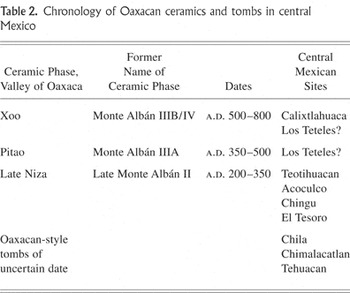
The data described earlier extend forward the time period of known Zapotec presence in central Mexico. The Oaxaca barrio at Teotihuacan has ceramics from the Late Niza phase of the Valley of Oaxaca. The late facet of the Niza phase has recently been isolated by Winter, who dates it to a.d. 200–350 (personal communication 2003; Table 2). Michael Spence (1992:59) estimates that a colony of 600–700 Zapotecs lived at Teotihuacan over several centuries. The most reasonable and widespread interpretation of this phenomenon is that many of these individuals were merchants, and that commerce between Teotihuacan and Monte Albán was a primary reason for the colony (Millon 1973:432, 1988; Spence 1992, 1996; Urcid 2003; Winter 1998). It is difficult to determine whether the contemporaneous Oaxaca-style tombs and ceramics from Hidalgo represent independent Zapotec enclaves, Zapotec enclaves subordinate to or related to the colony at Teotihuacan, or else Zapotec ceramics placed in local elite tombs as exotic, high-value goods.
Chronology of Oaxacan ceramics and tombs in central Mexico

The evidence for Zapotec traits during the Early Classic period (Pitao phase in the Valley of Oaxaca; Table 2) is equivocal. The apparent continued occupation of the Oaxacan barrio at Teotihuacan after a.d. 350 has been difficult to reconcile with the lack of Pitao-phase Oaxacan ceramics (Paddock 1983; Rattray 2001). The remains from Los Teteles—Zapotec-style tombs and G35 ceramic bowls—could pertain to the Pitao phase, the Xoo phase, or both phases, although a Xoo-phase date is more likely. The G35 bowls, although present in the Valley of Oaxaca in the Pitao phase, are more abundant and more characteristic of the Xoo phase (Caso et al. 1967:385). The collection of Zapotec ceramics from Calixtlahuaca (Figure 2) clearly date to the Xoo phase, although a Pitao-phase dating for one or more of the G35 bowls cannot be ruled out (given the lack of provenience data for García Payón's excavations).
The lack of documentation for García Payón's fieldwork at Calixtlahuaca prevents us from drawing firm conclusions about the context and significance of the Zapotec ceramics from that site. It is possible that the inhabitants of Calixtlahuaca imported or obtained these artifacts from Zapotec (or other) merchants and placed them in local burials as exotic items; this is the most common interpretation of imported ceramic vessels in Mesoamerican tombs. G35 conical bowls and handled censers are crude, roughly finished vessels, however, hardly the exotic fine serving ware typically included in burial offerings in Mesoamerica. These vessels were most likely used in funerary rituals in the Valley of Oaxaca, where they are included in nearly every known offering found in Xoo-phase tombs of both commoners and the elite (Lind and Urcid 1983). This suggests to us that these vessels may have been offerings in tombs of Zapotec inhabitants of Calixtlahuaca during the Xoo phase. Unfortunately, García Payón does not describe the nature of the tombs or burials that produced these vessels. The Zapotec-style tombs at Los Teteles suggest more strongly the physical presence of Zapotecs living and dying there during the Classic period.
The period from a.d. 500 to 800 was a highly volatile time in highland central Mexico. Teotihuacan collapsed and new Epiclassic urban centers appeared, including Xochicalco, Teotenango, Cacaxtla, and Tula (Diehl and Berlo 1989; Mastache et al. 2002; Millon 1988). This was a time of political instability and active commercial and stylistic interaction with other areas (Beekman and Christensen 2003:133–145; Rattray 1996; Ringle et al. 1998; Smith and Heath-Smith 1980). Little is known about the organization and infrastructure of long-distance commerce at this time, but it would not be surprising to find a continuation (or perhaps a reestablishment) of an earlier pattern of Zapotec merchant colonies in central Mexico.
The merchant diaspora, in which groups of merchants from a home region establish colonies in foreign lands, is a common organizational strategy for long-distance exchange in many preindustrial states (Cohen 1969; Curtin 1984; Spence 2005; Stein 2002; Zenner 1991). This model has received little attention in Mesoamerica, however. Archaeologists have discussed some possible ethnic enclaves during the Classic period, including the Oaxaca barrio and the “merchant's barrio” at Teotihuacan (Rattray 1990; Spence 1992, 1996, 2004), and potential colonies of Teotihuacan origin at distant sites such as Matacapan and Kaminaljuyu (Santley et al. 1987; Spence 1996). The cases described in this paper suggest a pattern of Zapotec enclaves in central Mexico over a period of many centuries. The Oaxaca barrio at Teotihuacan thus should be seen not as an exceptional phenomenon but, rather, as the currently best-documented example of a more widespread pattern. We suggest that groups of merchants from Monte Albán may have set up strategically placed colonies in a variety of settlements in central Mexico.
Why would Zapotec merchants have been interested in establishing an outpost at Calixtlahuaca in the Toluca Valley? During the Late Classic and Epiclassic periods, the peoples of the Toluca Valley were active participants in central Mexican networks of trade and interaction. Inscriptions at Teotenango (Piña Chán 1975) resemble contemporaneous inscriptions at Xochicalco (Smith and Hirth 2000), and ceramics in the Coyotlatelco style are abundant in both the Toluca Valley and the Basin of Mexico (Rattray 1996; Sugiura Yamamoto 1996, 1998). Calixtlahuaca was located along a probable route of trade and communication between the Basin of Mexico and areas farther west, including the rich valleys of Michoacan (Beekman and Christensen 2003). The large urban center of Teotenango was located some 30 km to the south, and a major salt-production center, San Miguel Ixtapan (Carranza Solano and Suárez Canepa 1995; Rodríguez García 2003)—was located a day's travel to the west. Calixtlahuaca could have provided a good base to obtain goods from both the Basin of Mexico (e.g., obsidian) and western Mexico (e.g., salt, obsidian, and several types of precious stones).
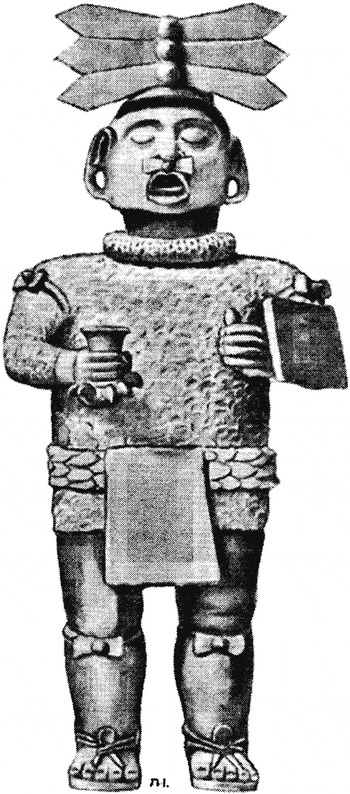
Interaction between Oaxaca and central Mexico continued beyond a.d. 800. Sue Scott (1993, 1998) has identified close stylistic links between Early Postclassic ritual objects in the Valley of Oaxaca and the Teotihuacan Valley. One of the more intriguing of these features is a ceramic sculpture of the deity Xipe Totec excavated by Sigvald Linné (2003) at Teotihuacan in a Mazapan-phase context (currently dated to ca. a.d. 800–1000; see Cowgill 1996:327). This figure, shown in Figure 3, holds a Xoo-style bat-claw vessel in its right hand. The size of this vessel (height, 8–9 cm) is the same as the bat-claw vessels from Oaxaca (Martínez López et al. 2000) and those from Calixtlahuaca (Table 1).

Xipe Totec ceramic sculpture from Mazapan-phase deposits at Teotihuacan; note the bat-claw vessel in the right hand (from Linné 2003:84). The object is 1.14 m in height.
Although the data reported here are fragmentary and incomplete, they do provide evidence of some kind of Zapotec presence in central Mexico in the Classic and Epiclassic periods. The sites in Hidalgo indicate that Teotihuacan was not the only place with likely Zapotec enclaves during the Early Classic period, and the data from Los Teteles and Calixtlahuaca suggest that this pattern continued after the occupation of the Oaxaca barrio at Teotihuacan into the Late Classic and Epiclassic periods. Further research is needed at sites such as Calixtlahuaca and Los Teteles to clarify the nature of these possible post-Teotihuacan Zapotec enclaves, and greater attention to the organization of commerce in general is needed to evaluate the merchant diaspora and other models of long-distance interaction in Mesoamerica.
RESUMEN
Describimos tumbas y colecciones de cerámica en estilo zapoteco, encontradas en el centro de México, fuera del estado de Oaxaca. Los más destacables son 13 vasijas y objetos zapoteco de la fase cerámica Xoo (a.d. 500–800) excavadas por José García Payón en Calixtlahuaca (cerca de la ciudad de Toluca), y tres tumbas en el estilo zapoteca excavadas en Los Teteles (cerca de la ciudad de Puebla). También mencionamos restos zapotecos excavados cerca de Tula, Hidalgo, y varias otras tumbas en otras partes. Exploramos brevemente las implicaciones de estos nuevos datos para el entendimiento del centro de México después de la caída de Teotihuacan.
ACKNOWLEDGMENTS
Smith's analysis of the ceramics from Calixtlahuaca in 2002 was aided by the director of the Instituto Mexiquense de Cultura in Toluca, Mexico, Carolina Monroy del Mazo; and by the staff of the insitute, especially Patricia Aguirre, Martín Antonio, and Daniel Granados. Permission to analyze and publish the ceramics was granted by the Instituto Nacional de Antropología e Historia. Jennifer Wharton and Melissa McCarron assisted with the study, which was funded by the Foundation for the Advancement of Mesoamerican Studies, Inc., and the Department of Anthropology, University at Albany (State University of New York). We thank Marcus Winter and Javier Urcid for helpful discussions of the Calixtlahuaca ceramics and for their comments on an earlier draft of this paper. We also received helpful comments from Christina Elson, Geoffrey McCafferty, Joyce Marcus, Sue Scott, and Michael Spence.
References
REFERENCES
Acosta, Jorge R.
1965
Preclassic and Classic Architecture of Oaxaca. In
Archaeology of Southern Mesoamerica, Part 2, edited by
Gordon R. Willey, pp.
814–836.
Handbook of Middle American Indians, vol. 3.
University of Texas Press,
Austin.Google Scholar
Bancroft, Hubert H.
1875
The Native Races of the Pacific States of North America, Vol. 4:
Antiquities.
Appleton,
New York.Google Scholar
Beekman, Christopher S., and
Alexander F. Christensen
2003
Controlling for Doubt and Uncertainty through Multiple Lines of
Evidence: A New Look at the Mesoamerican Nahua Migrations.
Journal of Archaeological Method and Theory
10:111–164.CrossRefGoogle Scholar
Blanton, Richard E.,
Stephen A. Kowalewski,
Gary M. Feinman, and
Jill Appel
1982
Monte Alban's Hinterland, Part I: The Prehispanic Settlement
Patterns of the Central and Southern Parts of the Valley of Oaxaca.
Memoirs,
vol. 15.
Museum of Anthropology, University of Michigan,
Ann Arbor.CrossRefGoogle Scholar
Carranza Solano, Inés, and
Ramón Suárez Canepa
1995
Importancia del sitio salino de San Miguel Ixtapan, Tejupilco,
México.
Revista mexicana de estudios antropológicos
41:33–44.Google Scholar
Caso, Alfonso
1938
Exploraciones en Oaxaca: Qunita y sexta temporadas,
1936–1937.
Publicación 34.
Instituto Panamericano de Geografía e Historia,
Mexico City.Google Scholar
Caso, Alfonso, and
Ignacio Bernal
1952
Urnas de Oaxaca.
Memorias, vol. 2.
Instituto Nacional de Antropología e Historia,
Mexico City.Google Scholar
Caso, Alfonso,
Ignacio Bernal, and
Jorge R. Acosta
1967
La cerámica de Monte Albán.
Memorias, vol. 13.
Instituto Nacional de Antropología e Historia,
Mexico City.Google Scholar
Cohen, Abner
1969
Custom and Politics in Urban Africa: A Study of Hausa Migrants in
Yoruba Towns.
University of California Press,
Berkeley.CrossRefGoogle Scholar
Cowgill, George L.
1996
Discussion, Special Section: Recent Chronological Research in
Central Mexico.
Ancient Mesoamerica
7:325–332.CrossRefGoogle Scholar
Crespo, Ana María, and
Alba Guadalupe Mastache
1981
La presencia en el área de Tula, Hidalgo, de grupos
relacionados con el barrio de Oaxaca en Teotihuacan. In
Interacción cultural en México central, edited
by
Evelyn C. Rattray,
Jaime Litvak King, and
Clara Díaz Oyarzábal, pp.
99–106.
Instituto de Investigaciones Antropológicas,
Universidad Nacional Autónoma de México, Mexico
City.Google Scholar
Curtin, Philip D.
1984
Cross-Cultural Trade in World History.
Cambridge University Press,
New York.CrossRefGoogle Scholar
Díaz Oyarzábal, Clara Luz
1980
Chingú: Un sitio clásico del área de Tula,
Hidalgo.
Instituto Nacional de Antropología e Historia,
Mexico City.Google Scholar
Diehl, Richard A., and
Janet Berlo (editors)
1989
Mesoamerica after the Decline of Teotihuacan, ad
700–900.
Dumbarton Oaks,
Washington, DC.Google Scholar
Finsten, Laura
1995
Jalieza, Oaxaca: Activity Specialization at a Hilltop Center.
Publications in Anthropology, Vol. 48.
Vanderbilt University,
Nashville.Google Scholar
Flannery, Kent V., and
Joyce Marcus
1983
A Possible Oaxacan Enclave Near Tula. In
The Cloud People: Divergent Evolution of the Zapotec and Mixtec
Civilizations, edited by
Kent V. Flannery, and
Joyce Marcus, p.
181.
Academic Press,
New York.Google Scholar
García Payón, José
1936
La zona arqueológica de Tecaxic-Calixtlahuaca y los
matlatzincas: Etnología y arqueología (primera
parte).
Talleres Gráficas de la Nación,
Mexico City.Google Scholar
García Payón, José
1941
Manera de disponer de los muertos entre los matlatzincas del Valle
de Toluca.
Revista mexicana de estudios antropológicos
5:64–78.Google Scholar
García Payón, José
1979
La zona arqueológica de Tecaxic-Calixtlahuaca y los
matlatzincas: Etnología y arqueología (textos de la segunda
parte), edited by
Wanda Tommasi de Magrelli and
Leonardo Manrique Castañeda.
Biblioteca Enciclopédica del Estado de México,
vol. 30.
Estado de México,
Toluca.Google Scholar
García Payón, José
1981
La zona arqueológica de Tecaxic-Calixtlahuaca y los
matlatzincas: Etnología y arqueología (tablas, planos e
ilustraciones de la segunda parte), edited by
Leonardo Manrique Castañeda.
Biblioteca Enciclopédica del Estado de México,
vol. 31.
Estado de México,
Toluca.Google Scholar
Hernández Reyes, Carlos
1990
Un enclave Zapoteco en el Valle del Mezquital.
Atalaya
1(1):3–10.Google Scholar
Hernández Reyes, Carlos
1994
Rescate de una tumba zapoteca en Tepeji del Río. In
Simposio sobre arqueología en el Estade de Hidalgo: Trabajos
recientes, 1989, edited by
Enrique Fernández Dávila,
pp.
125–142.
Colección Científica, vol. 282.
Instituto Nacional de Antropología e Historia,
Mexico City.Google Scholar
Hirth, Kenneth G., and
William Swezey
1976
The Changing Nature of the Teotihuacan Classic: A Regional
Perspective from Manzanilla, Puebla. In
Las Fronteras de Mesoamérica: XIV Mesa Redonda (Tegucigalpa,
1975), vol. 2, pp.
11–24.
Sociedad Mexicana de Antropología,
Mexico City.Google Scholar
Kowalewski, Stephen A.,
Gary M. Feinman,
Laura Finsten,
Richard E. Blanton, and
Linda M. Nicholas
1989
Monte Alban's Hinterland, Part II: Prehispanic Settlement
Patterns in Tlacolula, Etla, and Ocotlan, the Valley of Oaxaca,
Mexico.
Memoirs,
vol. 23.
Museum of Anthropology, University of Michigan,
Ann Arbor.CrossRefGoogle Scholar
Lind, Michael D.
1994
Monte Albán y el Valle de Oaxaca durante la fase Xoo.
In
Monte Albán: Estudios recientes, edited by
Marcus Winter, pp.
99–111.
Contribución del Proyecto Especial Monte Albán
1992–1994, vol. 2.
Proyecto Especial Monte Albán, Centro Instituto Nacional de
Antropología e Historia,
Oaxaca.Google Scholar
Lind, Michael D.
2001
Lambityeco and the Xoo Phase (ca. A.D. 600–800): The Elite
Residences of Mound 195. In
Memoria de la primera Mesa Redonda de Monte Albán: Procesos
de cambio y conceptualización del tiempo, edited by
Nelly M. Robles García, pp.
111–128.
Instituto Nacional de Antropología e Historia,
Mexico City.Google Scholar
Lind, Michael D., and
Javier Urcid
1983
The Lords of Lambityeco and Their Nearest Neighbors.
Notas mesoamericanas
9:78–111.Google Scholar
Linné, Sigvald
2003
Archaeological Researches at Teotihuacan, Mexico,
reprint ed.
University of Alabama Press,
Tuscaloosa.Google Scholar
Marcus, Joyce
1983
Teotihuacan Visitors on Monte Alban Monuments and Murals.
In
The Cloud People: Divergent Evolution of the Zapotec and Mixtec
Civilizations, edited by
Kent V. Flannery and
Joyce Marcus, pp.
175–181.
Academic Press,
New York.Google Scholar
Marcus, Joyce, and
Kent V. Flannery
1990
Science and Science Fiction in Postclassic Oaxaca: Or, “Yes,
Virginia, There is a Monte Albán IV.” In
Debating Oaxaca Archaeology, edited by
Joyce Marcus, pp.
191–206.
Anthropological Papers, vol. 84.
Museum of Anthropology, University of Michigan,
Ann Arbor.Google Scholar
Markens, Robert, and
Cira Martínez López
2001
Resumen de la cerámica de la fase Xoo (época Monte
Albán IIIB-IV) en el Valle de Oaxaca. In
Memoria de la primera Mesa Redonda de Monte Albán: Procesos
de cambio y conceptualización del tiempo, edited by
Nelly M. Robles García, pp.
303–327.
Instituto Nacional de Antropología e Historia,
Mexico City.Google Scholar
Martínez López, Cira,
Robert Markens,
Marcus Winter, and
Michael D. Lind
2000
Cerámica de la fase Xoo (época Monte Albán
IIIB–IV) del Valle de Oaxaca.
Contribución no. 8 del Proyecto Especial Monte Albán
1992–1994.
Proyecto Especial Monte Albán, Centro Instituto Nacional de
Antropología e Historia,
Oaxaca.Google Scholar
Mastache, Alba Guadalupe,
Robert H. Cobean, and
Dan M. Healan
2002
Ancient Tollan: Tula and the Toltec Heartland.
University Press of Colorado,
Boulder.Google Scholar
Millon, René
1973
Urbanization at Teotihuacan, Mexico, Volume 1: The Teotihuacan Map,
Part 1: Text.
University of Texas Press,
Austin.Google Scholar
Millon, René
1988
The Last Years of Teotihuacan Dominance. In
The Collapse of Ancient States and Civilizations, edited by
Norman Yoffee and
George L. Cowgill, pp.
102–164.
University of Arizona Press,
Tucson.CrossRefGoogle Scholar
Molina, Diana
1981
Rescate arqueológico en Los Teteles, Manzanilla. Unpublished
report, Centro Regional Puebla, Instituto Nacional de Antropología
e Historia, Puebla.Google Scholar
Muller, Florencia
1948
Chimalacatlan.
Acta Antropológica, vol.
3, no. 1.
Escuela Nacional de Antropología e Historia, Mexico
City.Google Scholar
Noguera, Eduardo
1940
Excavations at Tehuacan. In
The Maya and Their Neighbors, edited by
Clarence L. Hay,
Ralph Linton,
Samuel K. Lothrop,
Harry Shapiro, and
George C. Vaillant, pp.
306–319.
Appleton-Century,
New York.Google Scholar
Paddock, John
1966
Oaxaca in Ancient Mesoamerica. In
Ancient Oaxaca, edited by
John Paddock, pp.
83–242.
Stanford University Press,
Stanford, CA.Google Scholar
Paddock, John
1983
The Oaxaca Barrio at Teotihuacan. In
The Cloud People: Divergent Evolution of the Zapotec and Mixtec
Civilizations, edited by
Kent V. Flannery and
Joyce Marcus, pp.
170–175.
Academic Press,
New York.Google Scholar
Piña Chán, Román
(editor)
1975
Teotenango, el antiguo lugar de la muralla: Memoria de las
excavaciones arqueológicas.
2 vols.
Gobierno del Estado de México, Dirección de
Turismo,
Mexico City.Google Scholar
Rattray, Evelyn C.
1990
The Identification of Ethnic Affiliation at the Merchants
“Barrio” at Teotihuacan. In
Etnoarqueología: Primer Coloquio Bosch-Gimpera, edited
by
Yoko Sugiura Yamamoto and
Mari Carmen Serra Puche, pp.
113–138.
Instituto de Investigaciones Antropológicas,
Universidad Nacional Autónoma de México, Mexico
City.Google Scholar
Rattray, Evelyn C.
1996
A Regional Perspective on the Epiclassic Period in Central
Mexico. In
Arqueología Mesoamericana: Homenaje a William T.
Sanders,
vol. 1, edited by
Alba Guadalupe Mastache,
Jeffrey R. Parsons,
Robert S. Santley, and
Mari Carmen Serra Puche, pp.
213–231.
Instituto Nacional de Antropología e Historia,
Mexico City.Google Scholar
Rattray, Evelyn C.
2001
Teotihuacan: Cerámica, cronología y tendencias
culturales/Ceramics, Chronology and Cultural Trends.
Arqueología de México. Instituto Nacional de
Antropología e Historia,
Mexico City, and
University of Pittsburgh.Google Scholar
Reliford, William T.
1983
Los Teteles: An Early to Middle Urban Site in the Valley of Puebla,
Mexico.
Master's thesis,
Department of Anthropology, Universidad de las Américas,
Puebla.Google Scholar
Ringle, William M.,
Tomás Gallareta Negrón,
and
George J. III Bey
1998
The Return of Quetzalcoatl: Evidence for the Spread of a World
Religion during the Epiclassic Period.
Ancient Mesoamerica
9:183–232.CrossRefGoogle Scholar
Rodríguez García, Norma L.
2003
Recientes exploraciones en el sitio arqueológico de San
Miguel Ixtapan.
Expresión Antropológica
19:54–65.Google Scholar
Santley, Robert S.,
Clare Yarborough, and
Barbara Hall
1987
Enclaves, Ethnicity, and the Archaeological Record at
Matacapan. In
Ethnicity and Culture, edited by
Reginald Auger,
Margaret F. Glass,
Scott MacEachern, and
Peter H. McCartney, pp.
85–100.
Archaeological Association,
University of Calgary.Google Scholar
Saville, Marshall
1909
The Cruciform Structures of Mitla and Vicinity. In
Putnam Anniversary Volume: Anthropological Essays Presented to
Frederic Ward Putnam in Honor of His Seventieth Birthday, pp.
151–190.
G. E.
Stechert,
New York.Google Scholar
Scott, Sue
1993
Teotihuacan Mazapan Figurines and the Xipe Totec Statue: A Link
between the Basin of Mexico and the Oaxaca Valley.
Vanderbilt University Publications in Anthropology, vol.
44.
Department of Anthropology, Vanderbilt University,
Nashville.Google Scholar
Scott, Sue
1998
A Continuing Connection between Teotihuacan and Monte Alban.
In
Rutas de intercambio en Mesoamérica: III Coloquio Pedro
Bosch-Gimpera, edited by
Evelyn C. Rattray, pp.
185–199.
Instituto de Investigaciones Antropológicas,
Universidad Nacional Autónoma de México,
Mexico City.Google Scholar
Sellen, Adam T.
2002a
Las vasijas efigie zapotecas: Los ancestros personificadores de
divinidades.
Ph.D. dissertation,
Department of Estudios Mesoamericanos, Universidad Nacional
Autónoma de México,
Mexico City.Google Scholar
Sellen, Adam T.
2002b
Storm-God Impersonators from Ancient Oaxaca.
Ancient Mesoamerica
13:3–20.CrossRefGoogle Scholar
Smith, Michael E.
2003
Postclassic Urbanism at Calixtlahuaca: Reconstructing the
Unpublished Excavations of José García Payón.
Report to the Foundation for the Advancement of Mesoamerican
Studies, Inc. (FAMSI). Available at: http://www.famsi.org/reports/01024/.Google Scholar
Smith, Michael E., and
Cynthia Heath-Smith
1980
Waves of Influence in Postclassic Mesoamerica? A Critique of the
Mixteca–Puebla Concept.
Anthropology
4:15–50.Google Scholar
Smith, Michael E.,
Jennifer Wharton, and
Melissa McCarron
2003
Las ofrendas de Calixtlahuaca.
Expresión antropológica
19:35–53.Google Scholar
Smith, Virginia, and
Kenneth G. Hirth
2000
A Catalog of Carved Monuments and a Guide to the Visual
Characteristics of Xochicalco's Art Style. In
The Xochicalco Mapping Project, edited by
Kenneth G. Hirth, pp.
17–56.
Archaeological Research at Xochicalco, vol. 2.
University of Utah Press,
Salt Lake City.Google Scholar
Sodi Miranda, Federica, and
Hugo Herrera Torres
1991
Estudio de los objetos arqueológicos de la cultura
matlatzinca.
Instituto Nacional de Antropología e Historia,
Mexico City.Google Scholar
Spence, Michael W.
1989
Excavaciones recientes en Tlailotlaca, el barrio Oaxaqueno de
Teotihuacan.
Arqueología
5:81–104.Google Scholar
Spence, Michael W.
1992
Tlailotlacan, a Zapotec Enclave in Teotihuacan. In
Art, Ideology, and the City of Teotihuacan, edited by
Janet C. Berlo, pp.
59–88.
Dumbarton Oaks,
Washington, DC.Google Scholar
Spence, Michael W.
1996
A Comparative Analysis of Ethnic Enclaves. In
Arqueología Mesoamericana: Homenaje a William T.
Sanders,
vol. 1, edited by
Alba Guadalupe Mastache,
Jeffrey R. Parsons,
Robert S. Santley, and
Mari Carmen Serra Puche, pp.
333–353.
Instituto Nacional de Antropología e Historia,
Mexico City.Google Scholar
Spence, Michael W.
2004
A Zapotec Diaspora Network in Classic Period Central Mexico.
In
The Archaeology of Colonial Encounters, edited by
Gil J. Stein.
SAR Press,
Santa Fe, NM.Google Scholar
Stein, Gil J.
2002
Colonies without Colonialism: A Trade Diaspora Model of Fourth
Millennium b.c. Mesopotamian Enclaves in Anatolia. In
The Archaeology of Colonialism, edited by
Claire L. Lyons and
John K. Papadopoulos, pp.
27–64.
Getty Research Institute,
Los Angeles.Google Scholar
Sugiura Yamamoto, Yoko
1996
El Epiclásico y el problema del Coyotlatelco vistos desde el
valle de Toluca. In
Arqueología Mesoamericana: Homenaje a William T.
Sanders,
vol. 1, edited by
Alba Guadalupe Mastache,
Jeffrey R. Parsons,
Robert S. Santley, and
Mari Carmen Serra Puche, pp.
233–255.
Instituto Nacional de Antropología e Historia,
Mexico City.Google Scholar
Sugiura Yamamoto, Yoko
1998
El Valle de Toluca después del ocaso del estado
Teotihuacano: El epiclásico y el posclásico. In
Historia general del Estado de México, vol. 1:
Geografía y arqueología, edited by
Yoko Sugiura Yamamoto, pp.
199–259.
Gobierno del Estado de México, and
El Colegio Mexiquense,
Toluca.Google Scholar
Tommasi de Magrelli, Wanda
1978
La cerámica funeraria de Teotenango.
Biblioteca Enciclopédica del Estado de México,
vol. 61.
Estado de México,
Toluca.Google Scholar
Torres Rodríguez, Alfonso,
Juan Cervantes, and
Patricia Fournier García
1999
Las relaciones entre el centro y la periferia: El caso de las
comunidades del clásico en la región de Tula,
México.
Boletín de antropología americana
35:73–93.Google Scholar
Urcid, Javier
2001
Zapotec Hieroglyphic Writing.
Studies in Pre-Columbian Art and Archaeology, vol. 34.
Dumbarton Oaks,
Washington, DC.Google Scholar
Urcid, Javier
2003
Las urnas del barrio zapoteco de Teotihuacan.
Arqueología mexicana
11(64):54–57.Google Scholar
Winter, Marcus
1989
From Classic to Post-Classic in Pre-Hispanic Oaxaca. In
Mesoamerica after the Decline of Teotihuacan, ad
700–900, edited by
Richard Diehl and
Janet Berlo, pp.
123–130.
Dumbarton Oaks,
Washington, DC.Google Scholar
Winter, Marcus
1996
Cerro de las Minas: Arqueología de la Mixteca Baja.
H. Ayuntamiento Constitucional, Casa de la Cultura de Huajuapan de
León, Huajuapan de León,
Oaxaca.Google Scholar
Winter, Marcus
1998
Monte Albán and Teotihuacan. In
Rutas de intercambio en Mesoamérica: III Coloquio Pedro
Bosch-Gimpera, edited by
Evelyn C. Rattray, pp.
153–184.
Instituto de Investigaciones Antropológicas,
Universidad Nacional Autónoma de México, Mexico
City.Google Scholar
Zenner, Walter P.
1991
Minorities in the Middle: A Cross-Cultural Analysis.
State University of New York Press,
Albany.Google Scholar
Map of central Mexican sites (outside Oaxaca) with Zapotec ceramics or tombs.

Xoo-phase ceramic vessels from Calixtlahuaca
Zapotec ceramic objects from Calixtlahuaca. (a) G35 conical bowl; (b) handled censer; (c–f) bat-claw vessels; (g) cylindrical vessel with glyph; (h) urn or effigy vessel; (i) headdress fragment. See Table 1 for catalog numbers and information about the pieces. The glyph was drawn by Jennifer Wharton; the vessels were drawn by Jessie Pellerin based on photographs taken by Smith and Wharton.
Chronology of Oaxacan ceramics and tombs in central Mexico
Xipe Totec ceramic sculpture from Mazapan-phase deposits at Teotihuacan; note the bat-claw vessel in the right hand (from Linné 2003:84). The object is 1.14 m in height.
 You have
Access
- 9
- Cited by