Because people make mistakes and may use communication to manipulate each other, children have to learn to trust others selectively (e.g. Harris, Reference Harris2002). Such selective trust depends on children's ability to identify cues that can help distinguish reliable from unreliable information. One such cue is the source of the information. Concerns about the source of knowledge manifest themselves in questions like ‘Were you at the game?’, ‘Did you speak with Ivan?’ and ‘How do you know this?’ as well as in the use of phrases like ‘I saw’ and ‘Ivan said’ that often preempt these questions. In some languages, e.g. Bulgarian, Turkish, Korean and Tuyuca, in addition to phrases equivalent to ‘I saw’, there are grammatical morphemes – evidentials – that mark the source of the speaker's knowledge (e.g. Chafe & Nichols, Reference Chafe and Nichols1986). The purpose of the present research was to examine the role of these morphemes in Bulgarian children's reliability judgments and whether they influence children's trust.
By age four, children attend to a wide range of non-verbal cues in their judgments, such as the reliability of previous information from a source and the age of their informants (Jaswal & Neely, Reference Jaswal and Neely2006; Koenig & Harris, Reference Koenig and Harris2005). At this age, children also show evidence of attending to source-of-knowledge cues that are non-verbal, that is cues based on phenomenological experience and on observing epistemically-relevant behavior by others, e.g. looking and touching (e.g. Mitchell, Robinson, Isaacs & Nye, 1996; Robinson, Champion & Mitchell, Reference Robinson, Champion and Mitchell1999; Robinson, Mitchell & Nye, Reference Robinson, Mitchell and Nye1995; Robinson & Whitcombe, Reference Robinson and Whitcombe2003; Whitcombe & Robinson, Reference Whitcombe and Robinson2000). For example, in one study children had to find out which one of two objects that were identical except for color (e.g. a red and a blue ladybird) was hidden in a tunnel (Robinson & Whitcombe, Reference Robinson and Whitcombe2003). In one condition, children were asked to look at the hidden object in the tunnel and the experimenter touched it; in the other condition, children were asked to touch the object and the experimenter looked at it. After performing these actions, the child and the experimenter had to answer which object was in the tunnel. The experimenter always contradicted the child. At age four, children could effectively use the sources of their own and the experimenter's knowledge in deciding whether to keep or change their original belief. If they had looked, they kept their belief; if the experimenter had looked, they changed it. Importantly, this study demonstrated that children understand that source reliability changes with the type of information being sought. When the two objects used in the task differed in feel rather than color (e.g. a hard and a soft snowman), children kept their belief if they had felt the object in the tunnel and changed it if the experimenter had felt it.
Robinson and Whitcombe's research offers two further intriguing observations about the development of children's use of source-of-knowledge cues. First, despite succeeding in the tunnel task described above, four-year-olds were unable to report the source of their final belief (i.e. their experience or being told). This disassociation suggests that at least in some cases source can influence children's reliability judgments automatically and without conscious awareness. Second, when four-year-olds were not involved in the interaction but observed two others perform the task, they were unable to decide whom to believe. Only five-year-olds succeeded in this task. Thus, although sensitivity to non-verbal source-of-knowledge cues emerges early, their initial use is constrained and integrating them in reliability judgments appears to be a gradually developing skill.
Research suggests that in their preschool years children also begin to attend to verbal reliability cues. In particular, children begin to attend to cues of speaker certainty provided by mental and modal verbs and intonation (e.g. Hirst & Weil, Reference Hirst and Weil1982; Moore, Bryant & Furrow, Reference Moore, Bryant and Furrow1989; Moore, Pure & Furrow, Reference Moore, Pure and Furrow1990; Noveck, Ho & Sera, Reference Noveck, Ho and Sera1996). By age five, for example, children reliably choose to rely on must statements, e.g. ‘The candy must be in the red box’, over might statements, e.g. ‘The candy might be in the blue box’ (Moore et al., Reference Moore, Pure and Furrow1990). Understanding whether evidentials influence reliability judgments is important for further understanding of children's ability to access reliability cues embedded in language.
Prior research on Turkish and Korean has revealed that evidentials appear in children's speech before the age of three but that children's awareness of the meaning of evidentials develops later (Aksu-Koç, Reference Aksu-Koç1988; Choi, Reference Choi1991, Reference Choi, Bybee and Fleischman1995). For example, the evidential suffixes -di and -miş are available to Turkish children to mark witnessed and non-witnessed events respectively as in (1a–b) (Aksu-Koç, Reference Aksu-Koç1988).
(1a) Ahmed gel-di.Ahmed come-PAST /witnessed ‘Ahmed came; I saw that.’
(1b) Ahmed gel-miş. Ahmed come-PAST PERF /non-witnessed ‘Ahmed came; someone told me. /I have concluded this on the basis of other things I know.’
When children were asked to make a sentence on behalf of a character who had witnessed an event or a character who had just seen its consequence, they began to reliably apply the -di and -miş suffixes respectively around age four. When they were asked to decide which one of the two characters said a sentence containing either -di or -miş, they succeeded around age six. As evidentials are pervasive in the Turkish input (Aksu-Koç, Reference Aksu-Koç1988), it is not surprising that children produce them before they consciously understand their meaning. It is, however, unclear how early children use evidentials to assess the reliability of information.
Two recent studies on Korean and Japanese addressed this question. The studies used designs similar to that of Robinson & Whitcombe (Reference Robinson and Whitcombe2003) and Moore et al. (Reference Moore, Pure and Furrow1990): children were asked to compare the reliability of two utterances but this time, instead of being associated with different non-verbal source information or certainty expressions, the utterances were marked with different evidentials. Papafragou, Li, Choi & Han (Reference Papafragou, Li, Choi and Han2007) focused on two of the five Korean sentence-ending particles that are considered to carry evidential meaning (-e, -ta, -tay, -ci and -kwun): -e which indicates that the speaker has direct evidence for the reported information and that the information is already assimilated by the speaker and -tay which indicates that the speaker has learned the reported information through hearsay. Four-year-olds, the oldest child participants in the study, succeeded on non-verbal source reliability and source memory tasks. However, they performed at chance on the reliability task involving the two evidential particles.
Matsui, Yamamoto & McCagg (Reference Matsui, Yamamoto and McCagg2006) examined the ability of three- to six-year-old Japanese children to adjudicate between information marked with the sentence-ending particles -yo which marks direct evidence and -tte which marks indirect evidence for the report. Only six-year-olds performed differently from chance, preferring utterances marked with -yo. Importantly, consistent with the findings with English-speaking children described above (e.g. Moore et al., Reference Moore, Pure and Furrow1990), Japanese children succeeded earlier in a conceptually identical task involving sentence-ending particles that mark speaker certainty.
Both Papafragou et al. (Reference Papafragou, Li, Choi and Han2007) and Matsui et al. (Reference Matsui, Yamamoto and McCagg2006) reported that adults (tested under somewhat different conditions than the children) performed very well, suggesting that the particles affect the reliability judgments of adult speakers of these languages. Most importantly though, these initial findings from Korean and Japanese suggest that evidentials become part of children's repertoire of reliability discriminating cues after other, conceptually related cues, such as non-verbal source cues and verbal certainty cues. There could be many reasons for the lags observed by Matsui et al. (Reference Matsui, Yamamoto and McCagg2006) and Papafragou et al. (Reference Papafragou, Li, Choi and Han2007) – e.g. integrating speaker certainty information in a reliability judgment may require less cognitive effort because it is in essence a reliability judgment (Comrie, Reference Comrie, Johanson and Utas2000; Fitneva, Reference Fitneva2001) – but for now, given that the goal of both studies was descriptive, these explanations remain untested. The findings of these studies, however, are consistent with Robinson and Whitcombe's conclusion that the integration of source-of-knowledge cues in reliability judgments is a gradually developing skill.
Examining Bulgarian evidentiality is interesting for two main reasons. First, the age at which children begin to attend to evidentials as reliability cues may be affected by idiosyncratic properties of the evidential system of their language, e.g. the form of evidentials and the number and type of source distinctions made. A Bulgarian speaker can say the sentence ‘Ivan went to the park’ in four ways depending on the information source, as shown in examples (2a–d).
(2a) Ivan otid-e v park-a.Ivan go-PAST 3SG in park-DEF‘Ivan went to the park; I saw that.’
(2b) Ivan e otish-al v park-a.Ivan is go-PAST PARTICIPLE MASC in park-DEF‘Ivan went to the park; I've concluded this on the basis of other things I know.’
(2c) Ivan otish-al v park-a.Ivan go-PAST PARTICIPLE in park-DEF‘Ivan went to the park; someone told me – she or someone else had seen Ivan do that.’
(2d) Ivan bi-l otish-al v park-a.Ivan be-PAST PARTICIPLE go-PAST PARTICIPLE in park-DEF‘Ivan went to the park; someone told me – she or someone else thought that's what Ivan must have done.’
For all past tense third person statements, a Bulgarian speaker must make a choice between the four forms illustrated in (2a–d). The evidential information is carried by obligatory verb morphemes that, as in Turkish and many other languages, are related to different tense–aspect paradigms. (The verb is italicized in the examples.) Example (2a) represents simple past tense. Example (2b) represents present perfect and is composed of the third person form of the auxiliary sum ‘be’ (e ‘is’) and the past (-l) participle of the main verb. The difference between (2c) and (2b) is the omission of the auxiliary. Example (2d) is a form of the past perfect and composed of the past participles of the auxiliary sum ‘be’ and the main verb. (The exact form of verb morphemes depends on the lexical aspect and phonology of the verb and there is gender and number agreement between the participle forms and the sentence subject.)
To highlight some other differences between evidential systems, in contrast to Bulgarian, the Japanese particles -yo and -tte, although very common, are optional. The Korean particles are also not used in formal discourse and text (Choi, Reference Choi1991). Also in contrast to Bulgarian, as Matsui et al. (Reference Matsui, Yamamoto and McCagg2006) point out, much research has stressed the unique emphasis of Japanese communication on sharing social and interactional goals rather than on the transfer of propositional information. Correspondingly, some Japanese linguists have proposed that the class of particles to which -yo and -tte belong perform perhaps predominantly a distinctive discourse function (Horie & Taira, Reference Horie, Taira, Akatsuka, Strauss and Comrie2002; Kamio, Reference Kamio1995). (For example, -yo indicates that the speech act is an assertion and that the asserted information is within the knowledge ‘territory’ of the speaker rather than the addressee.) Currently, there is no theoretical framework that predicts how these and the numerous other differences between languages with evidential systems influence the use of evidentials in reliability judgments. Examining Bulgarian evidentiality can eventually contribute to the development of such a framework.
Examining Bulgarian evidentiality is also interesting for another reason: it provides an opportunity to examine children's use of two dimensions of source information – how the information was acquired and who acquired it. As a type of comparison, a source-based reliability judgment requires that children align sources on some attribute or dimension (Markman & Medin, Reference Markman, Medin, Medin and Pashler2002; Smith, Reference Smith1984). Systematic analysis of these attributes and dimensions, however, is largely missing from existing developmental research. The studies on non-verbal source reliability have based their predictions of source reliability on whether or not a source leads to the target information (e.g. vision affords knowledge of color, touch does not). Papafragou et al. (Reference Papafragou, Li, Choi and Han2007) and Matsui et al. (Reference Matsui, Yamamoto and McCagg2006) adopted a scale which corresponds to the degree to which the evidence involves the speaker's own experience (Willett, Reference Willett1988), positing that speakers should prefer reports of direct over indirect experience.
The experience scale adopted by Papafragou and Matsui made possible important advances in the study of evidentials. However, its application in many cases is not straightforward or sufficient. In Tuyuca, for example, there are evidentials allowing the speaker to distinguish seeing and hearing (e.g. a game) as sources of knowledge (Barnes, Reference Barnes1984). Both sources involve the speaker's own perceptual faculties, yet many would say that seeing a game is more reliable than hearing it. As Willett himself points out, this scale has a probabilistic relationship with the reliability of the reported information (see also Chafe, Reference Chafe, Chafe and Nichols1986; Comrie, Reference Comrie, Johanson and Utas2000; Fitneva, Reference Fitneva2001): the relationship could be affected by context, the specific cultural interpretation of the sources and may vary from one language community to another (Willett, Reference Willett1988: 85–87). An alternative analysis of source information is suggested by the extensive literature on source memory and source monitoring. In it, ‘source’ is defined as a multidimensional construct specifying spatio–temporal (when and where information originated), modal (how it originated) as well as social (who the information originated with) aspects of the process of knowledge acquisition (Johnson et al., Reference Johnson, Hashtroudi and Lindsay1993). Expressions like ‘I see’ and ‘he thinks’ illustrate this multidimensionality in English source expressions (I vs. he, see vs. think). Both the I–he contrast and the see–think contrast could be relevant to the listeners' evaluation of the information introduced with these expressions. Bulgarian evidentials can be analyzed in a similar way.
Detailed analyses suggest that Bulgarian evidentials qualify the information by who acquired it – henceforth referred to as an authorship dimension – and by how it was acquired in the first place – henceforth referred to as a modality dimension (Fitneva, Reference Fitneva2001). Along the authorship dimension, information could be first-hand or second-hand. First-hand information has passed through one person – the speaker – before being apprehended by the listener. Second-hand information was acquired by the speaker from someone else and hence has passed through more than one person before being apprehended by the listener. (The term ‘second-hand’ is adopted here for ease of exposition.) Along the modality dimension, the information could be acquired perceptually or cognitively. Perceptual acquisition can involve any of the senses and cognitive acquisition a range of reasoning processes, including induction and deduction. Within this space, the evidential form in (2a) indicates first-hand/perceptual information, e.g. that the speaker has observed Ivan's going to the park. The evidential form in (2b) indicates first-hand/cognitive information, e.g. that the speaker has inferred the occurrence of the reported event. The form in (2c) indicates second-hand/perceptual information, e.g. that the speaker reports what someone else has observed. Finally, (2d) indicates second-hand/cognitive information, e.g. that the speaker reports what someone else thinks. The four evidential forms in (2a–d) have been referred to as direct perception, inference, hearsay or report of inference respectively and these labels will be used here for convenience as well (see Table 1). However, it is important to keep in mind the fine-grain information carried by the evidentials as the labels could be a bit misleading, e.g. the word hearsay carries no connotations about how the information has come to exist, just that the speaker has acquired it from someone else.
Organization of Bulgarian evidentials

In sum, the present research aimed to establish whether evidentials affect the reliability judgments of Bulgarian children and whether their effect is due to the authorship or modality information they carry. Given the caveats expressed in the linguistic literature about the existence of a fixed, cross-culturally and cross-linguistically valid scale of source reliability (e.g. Willett, Reference Willett1988) and Johnson et al.'s (Reference Johnson, Hashtroudi and Lindsay1993) proposal about the multidimensionality of sources of knowledge, the present research adopted an inductive approach toward the problem of identifying children's evidential criteria, i.e. the dimensions on which they compare sources. Specifically, to determine the role of authorship and modality, the experiments assessed children's discrimination between perceptually and cognitively acquired information and between first- and second-hand information.
The participants in the studies were six- and nine-year-old children. This age range was chosen for two reasons. First, there are no published data on the acquisition of Bulgarian evidentials but preliminary observations in the kindergarten classrooms showed that all four evidentials were present in six-year-olds' speech. In contrast, not all evidentials were present in the speech of preschoolers (approximately four years old) with whom similar observations were carried out. Six-year-olds' use of evidentials was appropriate to the extent it could be determined from the context. This observation is consistent with detailed production studies in other languages, which suggest that children rarely make production errors with evidentials (Aksu-Koç, Reference Aksu-Koç1988).
Second, the 4th grade curriculum in Bulgaria introduces the topic of evidentiality focusing on the issue of hearsay. This raises the question of whether it is appropriate to compare children before 4th grade with older Bulgarian speakers. Pilot testing revealed a marked difference between third-graders on the one hand and fourth-graders and adults on the other in terms of their explicit awareness of the manipulation of evidentials in the reliability-judgment task. The latter groups, but never the former, spontaneously commented on the evidential forms. For adults, this explicit reasoning often led to contradictory outcomes (e.g. realizing that Ivan asserted he had seen an event led to questioning his motivation for saying he had witnessed it and de facto discarding the source information). This difference between third-graders on the one hand and fourth-graders and adults on the other suggests that formal instruction may affect the status of evidentials in consciousness and reliability judgments, and thus that the performance of older Bulgarian children and adults may not present an appropriate standard for assessing younger children's development and performance. Consequently, older children and adults were not included in the studies and the research focused on the role of evidentials in reliability judgments before children are exposed to evidentiality-related instruction at school.
EXPERIMENT 1
METHOD
Participants
Twenty-four kindergartners (mean age 6 ; 9, range 6 ; 1–7 ; 0) and 24 third-graders (mean age 9 ; 8, range 8 ; 7–10 ; 0) were recruited from Bulgarian schools serving predominantly middle-class neighborhoods. There were 16 girls in the younger group and 11 in the older. All children were native speakers of Bulgarian.
Materials, design and procedure
Children were presented with six vignettes which had the following schematic structure (see the Appendix). A meets B and C, the best friends of X. A is looking for X and asks B and C for help. The answers of B and C differ. For example, B states that X went to the amusement park and C that X went to the beach. Consequently, A has to choose whom to believe. Children had to answer the question ‘Whom do you think A believed?’ In case of difficulty, a second question was asked: ‘Where do you think A went to look for X?’ Previous research has shown no systematic differences between these two types of questions as measures of children's reliability judgments (Noveck et al., Reference Noveck, Ho and Sera1996). Each vignette was supplemented with a line drawing showing A, B and C.
A's question was always a request for spatial information, e.g. ‘Where did Ivan go?’ The utterances of B and C embodied the manipulation of grammatical form. Each of the six vignettes presented to a child incorporated a different pair of evidentials. (Pairing the four evidentials with each other yields six pairs.) Across children, the pairs of evidentials were assigned to vignettes following a Latin-square design. Thus all children responded to all evidential contrasts and, across children, each evidential contrast appeared equally often in each vignette. In addition, the order of evidentials and the order of utterances were independently counterbalanced within a vignette between subjects.
An adult native speaker interviewed the children individually in a quiet room in their school. Care was taken to utter the stimulus sentences in the vignettes with natural, even intonation. Children received neutral feedback on their answers.
RESULTS
Of main interest in the study was children's use of authorship and modality information. Hence, two separate analyses were conducted: one to assess whether children's reliability judgments are based on discriminating perceptual and cognitive information and another to assess whether they are based on discriminating first-hand and second-hand information. The two analyses tested respectively whether the proportion of times children chose perceptual over cognitive information and the proportion of times they chose first-hand over second-hand information was different from the chance level of 50%. The data were also submitted to a univariate analysis of variance to assess the significance of any developmental trends. Preliminary analyses showed no effect of utterance content, utterance order and evidentials order on children's decisions. Thus, these variables were not considered further.
The proportion of times children chose perceptual information was derived from the four vignettes that implemented a contrast between perceptual and cognitive information acquisition. Recall that the direct perception and hearsay evidentials indicate perceptual acquisition of the information and the inference and report-of-inference evidentials indicate cognitive acquisition of the information (see Table 1). Thus listing the perceptual before the cognitive source, the relevant contrasts here were: direct perception vs. inference, direct perception vs. report of inference, hearsay vs. inference and hearsay vs. report of inference. The proportion of times children chose first-hand over second-hand information was derived from the four vignettes that implemented a contrast between first- and second-hand information. Again, recall that the direct perception and inference evidentials indicate that the information is first-hand and the hearsay and report-of-inference evidentials that the information is second-hand (see Table 1). Thus, listing the first-hand before the second-hand source, the relevant contrasts here were: direct perception vs. hearsay, direct perception vs. report of inference, inference vs. hearsay and inference vs. report of inference.
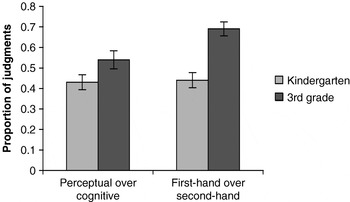
Figure 1 summarizes the findings. On average, older children preferred perceptual over cognitive information 59% of the time (SD=0·19) which was significantly different from chance (t(23)=2·15, p=0·04). The younger children showed the opposite pattern, choosing cognitive over perceptual information on average 60% of the time (SD=0·19; t(23)=2·63, p=0·02). With age, the value of perception relative to cognition as a source of knowledge substantially increased (F(1, 46)=11·42, p=0·001, ηp2=0·2). Kindergartners preferred first-hand information 48% of the time (SD=0·32) and third-graders 51% of the time (SD=0·24). Neither group's performance differed from chance and the age difference was not significant (F(1, 46)=0·147, p=0·7, ηp2=0·003). Thus, the data only provide evidence that children discriminate sentence reliability based on modality.
Mean proportion of reliability judgments favoring perceptual over cognitive information on the modality source dimension, and first-hand over second-hand information on the authorship source dimension in Experiment 1, by grade. Error bars represent ±1SE.

In addition to these main analyses, the performance of each age group with each of the six evidential pairs was assessed against chance. The comparison between inference and hearsay was the only pair where children demonstrated a statistically significant preference for one of the forms. Third-graders chose hearsay 75% of the time (p=0·02 by binomial test). Kindergartners, however, were at chance (58% chose hearsay; p>0·1 by binomial test).
Supplemental analyses
The role of authorship and modality was also assessed using maximum likelihood estimation procedures (generalized estimating equation – GEE) for binary repeated measure data (Carey, Zeger & Diggle, Reference Carey, Zeger and Diggle1993). GEE methods account for correlations in the data (in particular, within-subject variance) that are not considered in more traditional statistical approaches for dichotomous data. The models included perceptual/cognitive or first-hand/second-hand as outcome variables and age, condition, and their interaction as independent variables. Condition refers to the four pairs of evidentials where modality was contrasted and the four pairs where authorship was contrasted. Although this research focuses narrowly on whether and at what age children use modality and authorship information in reliability judgments, it is nevertheless important to test the robustness of the findings across condition. Moreover, condition differences may suggest interesting directions for future research on children's use of evidentials.
The probability of choosing perceptual over cognitive information depended on age (χ2(1, N=48)=9·34, p=0·002) but not on condition (χ2(3, N=48)=7·77, p>0·05) or the interaction between age and condition (χ2(3, N=48)=0·87, p>0·05). None of the variables was a significant predictor of children's choice of first-hand over second-hand information (age χ2(1, N=48)=0·11, p>0·05; condition χ2(3, N=48)=6·52, p>0·05; interaction between age and condition χ2(3, N=48)=7·1, p>0·05).
DISCUSSION
This study provides initial evidence that the source information carried by Bulgarian evidentials influences the reliability judgments of six- and nine-year-old Bulgarian children. The data revealed that overall children's judgments are guided by modality information, i.e. how the information was acquired. The data also revealed significant developmental differences: nine-year-olds associated reliability with perceptual sources, six-year-olds with cognitive sources. These novel findings raise a number of questions. The most pressing of those from the perspective of the goals of the present research was these findings' generality.
One possibility is that children generally attend more closely to modality than authorship information. Research on non-verbal source cues suggests that by age five children are able to conceptually distinguish first- and second-hand information, generally judging first-hand information more reliable (Mitchell et al., Reference Mitchell, Robinson, Isaacs and Nye1996). Some of these studies, however, reveal more robust effects of modality, although in this context the definition of modality and authorship is somewhat different: vision vs. touch, self vs. other. For example, when the child and the experimenter both look into the tunnel and the only relevant difference is self vs. other, children are at chance in deciding whether to stay with their guess or go with the experimenter's suggestion about which object is in the tunnel (Robinson & Whitcombe, Reference Robinson and Whitcombe2003).
Previous research has also shown, however, that children's informational goal, i.e. the type of information they seek to obtain, influences their judgments (Robinson & Whitcombe, Reference Robinson and Whitcombe2003; Whitcombe & Robinson, Reference Whitcombe and Robinson2000). In general, decision-makers' goals influence judgments as they shift attention from one set of attributes of the options that are being compared to another, i.e. they shift the decision-makers' evaluation criterion (for a review see Markman & Medin, Reference Markman, Medin, Medin and Pashler2002). In the present study, children always had to assess the reliability of sentences against the goal of finding someone's whereabouts. (Recall that A's question was always a request for spatial ‘where’ information.) Thus, it is possible that the role of modality does not generalize.
As a limited test of the generality of children's reliance on modality information, Experiment 2 examined children's reliability judgments when the sentences that had to be compared were answers to a ‘what’ rather than ‘where’ question.Footnote 1 If modality is the only source information in evidentials that affects children's reliability judgments, the findings of Experiment 1 would be replicated in this setting as well.
EXPERIMENT 2
METHOD
Participants
Twenty-four kindergartners (mean age 6 ; 2, range 5 ; 5–6 ; 7) and 24 third-graders (mean age 9 ; 4, range 8 ; 9–10 ; 0) participated in the study. The children were recruited from the same schools as the participants in Experiment 1 but none had participated in Experiment 1. There were 16 girls in the younger group and 11 girls in the older group. All children were native speakers of Bulgarian.
Materials, design and procedure
Twelve vignettes were constructed for this study so that children could be presented with each pair of evidentials twice, counterbalancing for the order of evidentials within-subject. The structure of the vignettes was the same as in Experiment 1. However, A's question was always ‘What did X do here?’ as in (3).
(3) Kakvo li e prav-il Ivan tuk?What PARTICLE is do-PAST PARTICIPLE MASC Ivan here‘What did Ivan do here?’
Thus, rather than finding where someone was, in this experiment children had to assist the story protagonist in discovering what a friend did. As questions and answers are interdependent, the sentences whose reliability the children compared were different from those in Experiment 1.
The 12 vignettes were randomly divided into two groups. In each group, A and X were the same for all vignettes so that the sequence of vignettes resembled a narrative. As the transition between vignettes was much shorter, the duration of a test session in this study was approximately the same as in Experiment 1. The introduction to each narrative stated that X concealed his or her actions and that the protagonist's (A's) task was to solve the puzzle created by X:
‘Ivan went away. When he came back his friends asked about his adventures. But Ivan said he would let his friends find out what he had done! He had left a clue at the places where he had been. Gosho was Ivan's best friend. He decided he could solve the puzzle and would find out what Ivan had done.’
The pairs of evidentials were assigned to the six vignettes in each narrative following a Latin-square design, as in Experiment 1. Across children, as in Experiment 1, each evidential contrast appeared equally often in each vignette. The order of evidentials and the order of utterances were independently counterbalanced within a vignette between subjects. In addition, as children responded to all evidential contrasts twice, once in each narrative, the order of evidentials was counterbalanced for each pair of evidentials within child.
Two additional vignettes, one at the end of each narrative, contrasted utterances that expressed hearsay and inference sources lexically. These vignettes allowed for a more direct within-subject test of the effect of informational goal on reliability judgments. The inference vs. hearsay comparison was chosen because it was the only individual comparison between evidentials in Experiment 1 where children showed a significant preference. The two vignettes differed in the question A asked. In one of them, A asked (as in the other vignettes), ‘What did X do here?’ In the other one, A asked for spatial information as in Experiment 1: ‘Where did X pass through?’ In these vignettes the inferential source was expressed with a modal verb (as in 4a) and hearsay was conveyed with the phrase ‘[they] said’ (as in 4b). As the subject ‘they’ is omitted, in this context this phrase means ‘someone said’ or ‘it is said’. For these vignettes, source was crossed with utterance between subjects and the utterances were presented in counterbalanced order.
(4a) Zoya tryabva da e minala prez tzentar-a.Zoya must to is passed through center-DEF‘Zoya must have passed through the city center.’
(4b) Zoya, kaza-ha, e minala prez pazar-a.Zoya, said-3P PL PAST, is passed through market-DEF‘Someone said Zoya passed through the market.’
RESULTS
Reliability judgments with evidentials
Preliminary analyses were conducted to test for possible effects of utterance content, utterance order and order of evidentials on children's reliability judgments. No such effects were found and these variables are not considered further. Separate analyses were conducted again to examine the roles of modality and authorship. Again, the analyses tested respectively whether the proportion of times children chose perceptual over cognitive information and the proportion of times they chose first-hand over second-hand information was different from the chance level of 50%. The proportion of times children chose perceptually over cognitively acquired information and the proportion of times they chose first-hand over second-hand information were calculated as in Experiment 1. The data were also submitted to univariate analyses of variance to assess the significance of any developmental trends. Figure 2 displays the data for each age group.
Mean proportion of reliability judgments favoring perceptual over cognitive information on the modality source dimension, and first-hand over second-hand information on the authorship source dimension in Experiment 2, by grade. Error bars represent ±1SE.

The analysis suggested that children did not discriminate information based on the modality of its acquisition. Third-graders chose perceptual information 54% of the time (SD=0·22; t(23)=0·83, p=0·42). Kindergartners again showed a tendency to choose cognitively acquired information, selecting it on average 67% of the time (SD=0·18), but this result did not reach significance (t(23)=1·98, p=0·06). The difference between the two groups was also not significant (F(1, 46)=3·61, p=0·06, ηp2=0·07).
In contrast to modality, authorship showed a clear effect in third-graders' decisions. Third-graders showed a strong preference for first-hand over second-hand information. They chose first-hand information on average 69% of the time (SD=0·17; t(23)=5·438, p<0·001). Younger children chose first-hand over second-hand information 44% of the time (SD=0·18; t(23)=1·696, p=0·103). There was a significant increase in children's preference for first-hand information from kindergarten to third grade (F(1, 46)=24·53, p<0·001, ηp2=0·35). This result suggests that authorship is also an evidential criterion used by third-graders.
Focusing on the hearsay–inference comparison, the overall trends in the data contrasted with those in Experiment 1 where children tended to select hearsay. In the current study, kindergartners judged hearsay to be more reliable only 48% of the time (t(23)=0·37, p=0·71). Third-graders did so 31% of the time, i.e. they favored inference (t(23)=2·84, p=0·009). The new informational goal appears to have reversed older children's preference in this comparison.
Reliability judgments with lexical inference and hearsay expressions
The two vignettes in which inference and hearsay were lexically expressed provided an environment to test within subjects the effect of informational goal and the robustness of the findings with evidentials. In the vignette where the goal was spatial, i.e. to find where Zoya passed through, younger children chose information from hearsay 54% of the time and older children 79% of the time. In the vignette where the goal was to discover what someone has done, younger children chose hearsay 46% of the time but older children chose hearsay only 29% of the time. These results closely replicate the results from the evidentials-based inference and hearsay comparisons in the two experiments. (Younger and older children chose hearsay respectively 58% and 75% of the time in Experiment 1, and 48% and 31% of the time in Experiment 2.)
The significance of the effect of informational goal was evaluated in each age group using McNemar's test. Informational goal had no effect on kindergartners: three children switched their preference from inference (when identifying what someone has done) to hearsay (when finding a location) and three switched from hearsay to inference. In contrast, informational goal clearly influenced third-graders' choices: twelve children switched their preferences and all of them chose inferential information when identifying what someone has done and hearsay information when finding a location (p<0·001). This finding provides direct evidence for an effect of informational goal on the reliability judgments of third-graders.
Supplemental analyses
The roles of authorship and modality were again analyzed using generalized estimating equations. The models included age, condition and their interaction as independent variables. The probability of choosing perceptual over cognitive information did not depend on age (χ2(1, N=48)=3·23, p=0·07) and condition (χ2(3, N=48)=6·9, p=.0075) but there was a significant interaction between age and condition (χ2(3, N=48)=12·12, p=0·007). The effect of age was examined in each of the four conditions to identify the source of the interaction effect. The Bonferroni method was used to control the family-wise error rate (alpha set at 0·05). The only significant effect of age was when children compared report of inference to direct perception (χ2(1, N=48)=6·49, p=0·01). While nine-year-olds tended to choose information from direct perception, six-year-olds tended to choose report-of-inference information.
The probability of choosing first-hand over second-hand information depended on age (χ2(1, N=48)=15·77, p<0·0001) and condition (χ2(3, N=48)=11·73, p=0·008) but these main effects were qualified by a significant interaction between the variables (χ2(3, N=48)=11·72, p=0·008). The effect of age was examined in each of the four conditions to identify the source of the interaction effect (alpha set again at 0·05). In addition to the significant effect of age reported above when children compared report of inference to direct perception, there was also a significant effect of age in the comparison of inference and report of inference (χ2(1, N=48)=23·18, p<0·0001). Nine-year-olds preferred information from inference while six-year-olds preferred again information from report-of-inference. Overall, it appears that the interaction effects in both analyses derive from the different treatment of the report-of-inference source by the two groups. In contrast to older children, younger children tended to prefer report-of-inference as a source of information.
DISCUSSION
Three findings emerge from this study. First, Experiment 1 posed the possibility that children attend to modality but not authorship information in evidentials. However, Experiment 2 suggests that this is not the case: nine-year-olds can also draw on the authorship information carried by evidentials. This finding is consistent with the hypothesis that the information-gathering task children face constrains their judgments (Robinson & Whitcombe, Reference Robinson and Whitcombe2003). The finding that nine-year-olds' source preference varied between the two vignettes that integrated lexical inference and hearsay expressions and set contrasting informational goals also supports this hypothesis.
The data also revealed a significant developmental difference in the use of authorship information. In contrast to nine-year-olds, six-year-olds showed no evidence of attending to authorship. As pointed out earlier, by age six children usually have some conceptual understanding of the difference between first- and second-hand information (Mitchell et al., Reference Mitchell, Robinson, Isaacs and Nye1996). Although these data are from research with English-speaking children, they suggest that the reason six-year-olds in the present study failed to attend to authorship is unlikely to be conceptual.Footnote 2 One alternative is that six-year-olds have not mapped the evidential forms to the concepts of first- and second-hand information. Another alternative, suggested by the mixed evidence for children's use of authorship in non-verbal reliability judgment studies (Robinson & Whitcombe, Reference Robinson and Whitcombe2003), is that it is the use of authorship information that is problematic for six-year-olds. That is, six-year-olds may grasp the authorship information in evidentials but either do not use it in their reliability judgments or use it in circumstances other than those captured in the present studies.
GENERAL DISCUSSION
The present research investigated the role of the source information carried by evidentials in Bulgarian children's reliability judgments. Previous studies have shown that children attend to various aspects of how the information was acquired (e.g. Robinson et al., Reference Robinson, Champion and Mitchell1999; Robinson et al., Reference Robinson, Mitchell and Nye1995; Robinson & Whitcombe, Reference Robinson and Whitcombe2003; Whitcombe & Robinson, Reference Whitcombe and Robinson2000) and who provided it (e.g. Ceci, Ross & Toglia, Reference Ceci, Ross and Toglia1987; Jaswal & Neely, Reference Jaswal and Neely2006). The present research contributes evidence that by age nine Bulgarian children use both of these types of information when they are intertwined in language. The studies showed that nine-year-olds readily use the authorship and modality information carried by the evidentials: they discriminated the reliability of sentences based on modality in Experiment 1 and on authorship in Experiment 2. Six-year-olds showed only evidence of using modality to assess reports: in Experiment 1 they showed preference for cognitively over perceptually acquired information.
The finding that children can use both authorship and modality is an important extension of previous research on the role of evidentials in reliability judgments (Matsui et al., Reference Matsui, Yamamoto and McCagg2006; Papafragou et al., Reference Papafragou, Li, Choi and Han2007). The contrasts between -yo and -tte in Japanese and -e and -tay in Korean do not map clearly onto either authorship or modality. Recall that the Japanese particle -yo and the Korean particle -e introduce information for which the speaker has direct evidence, that the Japanese particle -tte introduces indirect evidence, encompassing both hearsay and inference, and that the Korean particle -tay introduces hearsay. While the literature suggests that ‘direct evidence’ is perceptual evidence,Footnote 3 it also suggests that when -tte and -tay convey hearsay, they convey that the speaker reports second-hand information but not how the information was originally acquired. Thus, as Matsui et al. (Reference Matsui, Yamamoto and McCagg2006) and Papafragou et al. (Reference Papafragou, Li, Choi and Han2007) suggest, Japanese and Korean speakers can distinguish direct and indirect sources of knowledge, but more specific conclusions seem unwarranted. The present research, however, suggests that at least Bulgarian children can use finer-grain source information, namely authorship and modality, in their evidentials-based reliability judgments.
In addition to demonstrating that nine-year-olds can rely on authorship and modality information, the present research contributes to previous findings suggesting that informational goals affect children's choice of an evidential criterion (e.g. Robinson & Whitcombe, Reference Robinson and Whitcombe2003). Specifically, the experiments differed critically in whether the protagonists sought spatial information or aimed to discover what someone had done. Although there were other differences between the studies, e.g. in number of trials and whether the vignettes were presented separately or as a narrative, these differences are unlikely to explain the qualitative change in nine-year-olds' decisions. Importantly, when comparing inference and hearsay under different informational goals in Experiment 2, nine-year-olds showed in the same study that informational goals influenced what source they deemed reliable.
Further research is needed to identify the mechanisms through which informational goal could lead children to attend to modality in some cases and authorship in others and to express particular preferences along these dimensions. An influential proposal by Perner (Reference Perner1991) is relevant here. Perner explained the effect of informational goal on the reliability of sources with the ‘aspectuality of knowledge’, i.e. that different sources generate different knowledge. Within this framework, the reliability of sources can be established by examining information-gathering experience and whether or not this experience leads to the desired information. Importantly, other researchers have pointed out that information-gathering experience may underlie not only contextual but also developmental differences in the perceived reliability of source information, such as the ones observed in the current research. For example, having observed that three-year-olds have markedly worse understanding of the epistemic effects of their actions than four- and five-year-olds, O'Neill, Astington & Flavell (Reference O'Neill, Astington and Flavell1992) remarked that whether three-year-olds decide to look at or feel in order to learn a specific property of an object may depend on their ‘experience and familiarity with exploring objects and the surrounding environment’ (p. 489).
It is, however, not immediately apparent how information-gathering experience can explain the source reliability findings in the present studies. The problem is that our understanding of children's (and adults') information-gathering experience is quite limited. In most non-verbal source studies, there is a (conventionally) dominant way of obtaining the needed information, and that way could be expected to be the preferred source of knowledge, e.g. seeing when the needed information is color of the object. We resolve the problem of ascertaining someone's whereabouts and actions in more variable ways and often by integrating multiple inputs. Hence here, in the absence of detailed knowledge of information-gathering experience, it is difficult to predict what source would be perceived as reliable.
The present findings converge with those of Matsui et al. (Reference Matsui, Yamamoto and McCagg2006) in suggesting that the source information in evidentials begins to be used at around age six. Specifically, the present findings reveal that six-year-olds use at least some of the source information in evidentials in their judgments, namely modality. It is intriguing that six-year-olds showed a preference for cognitive over perceptual information in Experiment 1. Besides information-gathering experience, two other factors warrant speculation in searching for an account of this finding: semantic knowledge and cognitive development. Six-year-olds may either not grasp the meaning of evidentials or misinterpret it in some systematic way. However, if they did not know the meaning this should have resulted in chance behavior and there is no obvious motivation for a radical discontinuity in six- and nine-year-olds' interpretation of evidentials. Thus, it is probably necessary to look beyond semantic knowledge for an explanation of this finding.
An alternative possibility is that six-year-olds' preference for cognitive over perceptual information could be based on their still developing understanding of the interpretative nature of the mind (Carpendale & Chandler, Reference Carpendale and Chandler1996; Pillow & Henrichon, Reference Pillow and Henrichon1996). At this age, children still fail to understand that the mind introduces biases in the interpretation of information that reaches it. It may be that until children attain such understanding they do not view mental processing as a liability. Some studies indeed suggest that children consider reasoning as good as perception as a source of knowledge. Specifically, Robinson et al. (Reference Robinson, Mitchell and Nye1995) showed that three- to four-year-olds who could infer from the picture on a toy box what the box contained tended to resist the suggestion of an experimenter who had looked into the box and thus had knowledge derived from perception. Although not viewing mental processing as a liability is not the same as viewing it as an asset, such an attitude in six-year-olds may explain in part their choice of cognitive over perceptual information.
Although six-year-olds show some use of evidential information, the present findings clearly show that there are situations in which they do not systematically rely on this information. This may again relate to information-gathering experience but considered from a slightly different angle. Judgments are affected by multiple, differently weighed factors, e.g. prior beliefs, cognitive capacity, affective state and intentions of the decision-maker, framing of the alternatives and informant characteristics (e.g. Bodenhausen, Kramer & Susser, Reference Bodenhausen, Kramer and Susser1994; Cacioppo, Petty, Feinstein, Blair & Jarvis, 1996; Gigerenzer & Goldstein, Reference Gigerenzer and Goldstein1996; Kumkale & Albarracin, Reference Kumkale and Albarracin2004; Tversky & Kahneman, Reference Tversky and Kahneman1981). While standard in adult decision-making and belief-formation research, this assumption has not been given much attention in developmental research. In everyday conversation, evidentials typically co-occur with other, in some cases partially redundant, reliability cues, e.g. observations of the speaker's actual behavior, knowledge of the speaker's reputation, assertions of the speaker's certainty, own prior knowledge, etc. Given the availability of other cues and the extensive evidence that children are sensitive to some of them since early preschool (e.g. Jaswal & Neely, Reference Jaswal and Neely2006; Koenig & Harris, Reference Koenig and Harris2005; Moore et al., Reference Moore, Bryant and Furrow1989; Robinson & Whitcombe, Reference Robinson and Whitcombe2003), it is possible that children begin to readily rely on evidentials as a reliability cue when these other cues begin to fail. Until then, evidentials may be unnecessary, or of very low utility, in deciding what to trust.
Experience that decontextualizes the reliability assessments of reports and increases the informational value of evidentials, such as formal school instruction, may be necessary for evidentials to become a habitually or at least a readily used reliability cue. Bruner (Reference Bruner, Bruner, Olver and Greenfield1966) pointed out that, by its remoteness from direct action, school ‘robs’ children of contextual and ostensive supports for indicating what they mean and compels them to rely on language to accomplish this task (p. 323). Similarly, school limits the availability of contextual reliability cues and may thereby deepen children's awareness of and attention to reliability cues available in language.
The present findings leave a number of important questions for future research. In addition to better understanding the mechanisms of developmental change, these include the question of how formal instruction about evidentiality and the associated development of explicit awareness of reliability-marking linguistic devices affect the role of these devices in reliability judgments. The adult data mentioned at the beginning suggest that explicit awareness may be related to skepticism about the value of evidentials as ‘honest signals’ of reliability for adult Bulgarian speakers. In addition, evidence from other measures should be sought about the role of evidentials in children's reliability judgments. The present findings will be bolstered in particular by examining children's assessment of reports in more naturalistic settings and examining whether and how the evidential form of a report affects children's actual behavior. Despite these limitations, the present studies provide an important first set of data on the role of Bulgarian grammatical source-of-knowledge markers in children's assessment of information.
APPENDIX
EXAMPLE OF A VIGNETTE FROM EXPERIMENT 1
Following the general schema for the stories, X=Ivan, A=Ivan's mom, B=Mitko and C=Kamen.
Ivan, Mitko i Kamen sa dobri priyateli. Te mnogo obichat da igrayat futbol.‘Ivan, Mitko, and Kamen are very good friends. They like to play soccer a lot.’
Ivan si ima kuche – Sharo. Edin den Sharo se zagubi i Ivan otide da go tarsi.‘Ivan has a dog by the name Sharo. One day, Sharo disappeared and Ivan went looking for him.’
Mitko i Kamen ritaha sami topka na igrishteto. Maikata na Ivan doide pri tyah i kaza:‘Mitko and Kamen were kicking a ball on the field. Ivan's mom came to them and said:’
Iskam da pomogna na Ivan da nameri Sharo.‘I'd like to help Ivan find Sharo.’
Kade li e otish-al?Where PARTICLE is go-PAST PARTICIPLE MASC‘Where did he go?’
Ivan e otish-al da tarsi Sharo v park-a – kaza Mitko.Ivan is go-PAST PASTICIPLE to seek Sharo in park-DEF – said Mitko‘Ivan went to look for Sharo in the amusement park; I've concluded this on the basis of other things I know’ said Mitko.
Ivan otish-al da tarsi Sharo na plazh-a – kaza Kamen.Ivan go-PAST PARTICIPLE to seek Sharo on beach-DEF – said Kamen‘Ivan went to look for Sharo on the beach; someone told me – she or someone else had seen Ivan do that’ said Kamen.
Na kogo li e povyarv-al-a maika-ta na Ivan?To whom PARTICLE is believe-PAST PARTICIPLE-FEM mother-DEF of Ivan‘Whom did Ivan's mom believe?’
(Kade li e otish-la da go tarsi?)Where PARTICLE is go-PAST PARTICIPLE FEM to he-ACC seek‘Where did she go to look for him?’