INTRODUCTION
Cladorhizid sponges are most frequently found in deep-water habitats, where the carnivorous feeding mode has been considered as a response to a nutrient-poor environment (Vacelet & Boury-Esnault, Reference Vacelet and Boury-Esnault1995). Given the currently accepted classification (Van Soest et al., Reference Van Soest, Boury-Esnault, Hooper, Rützler, de Voogd, Alvarez de Glasby, Hajdu, Pisera, Manconi, Schoenberg, Janussen, Tabachnick, Klautau, Picton, Kelly, Vacelet, Dohrmann, Díaz and Cárdenas2014), carnivory is distributed within the three families Cladorhizidae Dendy, Reference Dendy1922, Esperiopsidae Hentschel, Reference Hentschel, Kükenthal and Krumbach1923 and Guitarridae Dendy, Reference Dendy1924. Eight cladorhizids have so far been reported from the SW Atlantic (Lopes & Hajdu, Reference Lopes and Hajdu2014). Two of these belong to Cladorhiza, namely C. diminuta Lopes & Hajdu, Reference Lopes and Hajdu2014 and C. inversa Ridley & Dendy, Reference Ridley and Dendy1886. Altogether 39 species of Cladorhiza have been reported from various parts of the world (Hestetun et al., Reference Hestetun, Fourt, Vacelet, Boury-Esnault and Rapp2013; Lopes & Hajdu, Reference Lopes and Hajdu2014; Lundsten et al., Reference Lundsten, Reiswig and Austin2014).
The Franco-Brazilian MD-55 Vitória-Trindade Seamounts expedition was carried on board the RV ‘Marion Dufresne’ in 1987, and from a rich collection of sponges only the Hexactinellida have been described so far (Tabachnick et al., Reference Tabachnick, Menshenina, Lopes and Hajdu2009). In this paper we aim to give the first contribution into the study of the Demospongiae in this collection by describing a new species of carnivorous sponge as well as redescribing the morphologically most similar species, Cladorhiza inversa Ridley & Dendy, Reference Ridley and Dendy1886.
MATERIALS AND METHODS
The holotype of the new species is deposited in the Porifera collection of the Museum Nacional/UFRJ. The material was studied and described following standard procedures for the group (Hajdu et al., Reference Hajdu, Peixinho and Fernandez2011; Lopes & Hajdu, Reference Lopes and Hajdu2014). The micrometric data of spicules were obtained from 30 measures of each category. Figure 1 indicates the type locality of the new species, off SE Brazil. The redescription of C. inversa was based on re-examination of the holotype in the BMNH, Natural History Museum (London), followed by anatomical studies conducted in Bergen (Norway). Abbreviations used: MNRJ, Porifera Collection, Museu Nacional/UFRJ, Rio de Janeiro, Brazil; TAAF, Terres Australes et Antarctiques Françaises; MD55, 55th Oceanographic Campaign of RV ‘Marion Dufresne’.
Collecting locality of Cladorhiza nicoleae sp. nov. – continental slope off SE Brazil. Insert shows South America and the SE sector of the Brazilian coast shown in the expanded figure.

RESULTS
SYSTEMATICS
Phylum Porifera Grant, Reference Grant and Todd1836
Class Demospongiae Sollas, Reference Sollas1885
Order Poecilosclerida Topsent, Reference Topsent1928
Family Cladorhizidae Dendy, Reference Dendy1922
Genus Cladorhiza Sars, Reference Sars1872
Cladorhiza nicoleae sp. nov.
(Figure 2)
TYPE MATERIAL
Holotype. MNRJ 15991, continental slope off Quissamã (TAAF MD55, Stn 4 DS08, 22°34.6′S – 40°05.4′W, SE Brazilian EEZ), 750 m depth, coll. N. Boury-Esnault, 10.V.1987.
DIAGNOSIS
Erect and pedunculated Cladorhiza with two categories of mycalostyles as megascleres, and microscleres comprising tridentate anchorate anisochelae up to 45 µm long, sigmas and sigmancistras up to 40 µm long.
DESCRIPTION
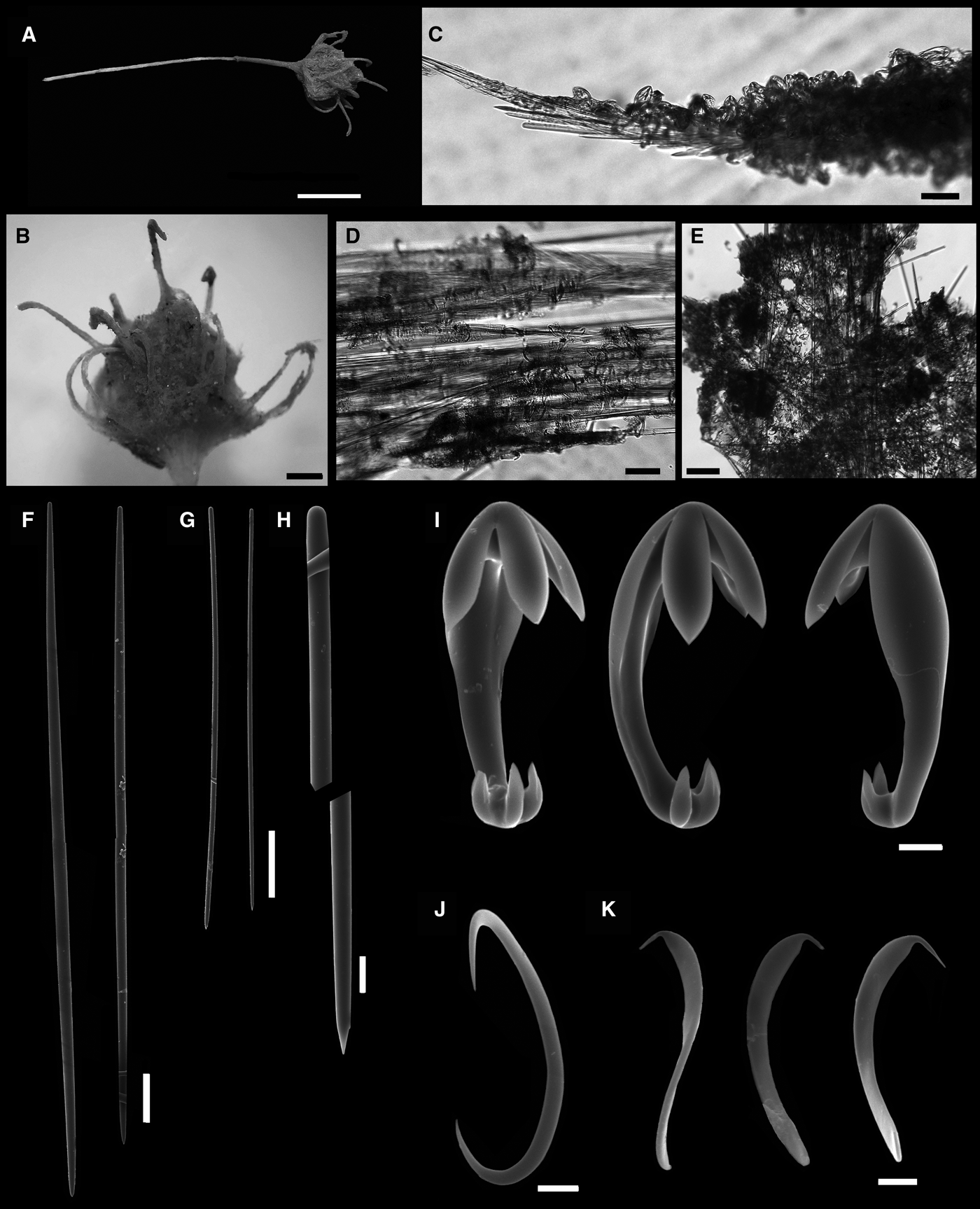
The single specimen is an erect, delicate and pedunculated sponge, 2.6 cm long, with a 2.0 cm long peduncle. Its globular body is slightly flattened sideways (diameter 0.45 cm), with radial projections up to 0.3 cm long, supported by a calyx-like thickening of the peduncle (Figure 2A, B). Surface slightly velvety and consistency very fragile. No oscule was observed. Colour yellowish-brown in ethanol.
External morphology, skeleton and spicules of Cladorhiza nicoleae sp. nov. (holotype, MNRJ 15991). (A) external morphology of holotype, (B) detail of external morphology of holotype, (C) appendages skeleton, (D) skeleton of peduncle, (E) skeleton of globular body, (F) mycalostyle I, (G) mycalostyle II, (H) detail of mycalostyle II, (I) anchorate anisochelae, (J) sigma, (K) sigmancistras. Scale bars: A = 0.5 cm; B = 0.10 cm; C–E = 100 µm; F–G = 100 µm; H = 10 µm; I–K = 5 µm.
SKELETON
Peduncle and body formed by an axis of longitudinally arranged mycalostyles. Microscleres abundant, distributed around the bundles of mycalostyles. Radial projections composed by similar longitudinal axes of mycalostyles surrounded by a layer of microscleres (Figure 2C–E).
SPICULES
Megascleres, mycalostyles in two size categories (Figure 2F–H); both straight or slightly curved mixed in different parts of the sponge. Microscleres, one category each of anchorate anisochelae, sigmas and sigmancistras (Figure 2I–K).
• Mycalostyles I, acerate, 939–1252.3–1618 µm long, 15–21.5–24 µm thick.
• Mycalostyles II, with short, acerate to conical point, 445–659.5–832 µm long, 4.8–9.1–9.7 µm thick.
• Anchorate anisochelae, 34–38.9–44 µm long, with tridentate head bearing spatuliferous alae, 9.7–14.4–17 µm tall, and tridentate unguiferate foot, 4.9–6.7–9.7 µm tall (Figure 2I).
• Sigmas, smooth, contorted, with relatively large hooks, 24–32.3–39 µm long (Figure 2J).
• Sigmancistras, contorted, concave side lined by long and large fimbriae (giving an overall flat appearance to the shaft), with very sharp, spur-like terminations, 19–29.8–39 µm long (Figure 2K).
DISTRIBUTION AND ECOLOGY
The species is known only from its type locality, off Quissamã (SE Brazilian EEZ).
ETYMOLOGY
The species is named in honour of Dr Nicole Boury-Esnault, the expert on sponges on board the RV ‘Marion Dufresne’ when the holotype was collected, and one of the greatest specialists on sponge taxonomy in recent times, with an important contribution to the taxonomic study of Brazilian species.
Remarks
Of the 39 species of Cladorhiza known worldwide, 11 have been reported from the Atlantic Ocean, and only two from the SW Atlantic, namely C. diminuta Lopes & Hajdu, Reference Lopes and Hajdu2014 and C. inversa Ridley & Dendy, Reference Ridley and Dendy1886. Cladorhiza nicoleae sp. nov. differs from both mainly by its distinct set of spicules. Cladorhiza diminuta has only one category of much smaller mycalostyles (298–595/8–15 µm), smaller tridentate anisochelae (13–18 µm), and somewhat larger sigmas (28–53 µm). Cladorhiza inversa can be distinguished from C. nicoleae sp. nov. by its larger category of styles (1496–2111/31–48 µm), the presence of tylostyles (270–365/8–13 µm), and by having smaller tridentate anisochelae (30 µm) as its sole category of microscleres (see redescription below).
With respect to all Cladorhiza congeners a similar body shape (pedunculate with radial projections) can be found in 12 species (C. arctica Koltun, Reference Koltun1959, C. bathycrinoides Koltun, Reference Koltun1955, C. diminuta Lopes & Hajdu, Reference Lopes and Hajdu2014, C. ephyrula Lévi, Reference Lévi1964, C. flosabyssi Topsent, Reference Topsent1909, C. grandis Verrill, Reference Verrill1879, C. inversa Ridley & Dendy, Reference Ridley and Dendy1886, C. longipinna Ridley & Dendy, Reference Ridley and Dendy1886, C. mirabilis (Ridley & Dendy, Reference Ridley and Dendy1886), C. moruliformis Ridley & Dendy, Reference Ridley and Dendy1886, C. nematophora Lévi, Reference Lévi1964, C. similis Ridley & Dendy, Reference Ridley and Dendy1886). However, none of these species have the same spicular set of the species described above.
Nineteen species of Cladorhiza have tridentate anisochelae (C. arctica Koltun, Reference Koltun1959, C. bathycrinoides Koltun, Reference Koltun1955, C. corona Lehnert, Watling & Stone, Reference Lehnert, Watling and Stone2005, C. diminuta Lopes & Hajdu, Reference Lopes and Hajdu2014, C. ephyrula Lévi, Reference Lévi1964, C. flosabyssi Topsent, Reference Topsent1909, C. inversa Ridley & Dendy, Reference Ridley and Dendy1886, C. linearis Ridley & Dendy, Reference Ridley and Dendy1886, C. longipinna Ridley & Dendy, Reference Ridley and Dendy1886, C. mani Koltun, Reference Koltun, Pavlovskii, Andriyashev and Ushakov1964, C. microchela Lévi, Reference Lévi1964, C. mirabilis (Ridley & Dendy, Reference Ridley and Dendy1886), C. moruliformis Ridley & Dendy, Reference Ridley and Dendy1886, C. nematophora Lévi, Reference Lévi1964, C. pentacrinus Dendy, Reference Dendy1887, C. pteron Reiswig & Lee, Reference Reiswig, Lee, Custódio, Lôbo-Hajdu, Hajdu and Muricy2007, C. schistochela Lévi, Reference Lévi and Crosnier1993, C. similis Ridley & Dendy, Reference Ridley and Dendy1886, C. tridentate Ridley & Dendy, Reference Ridley and Dendy1886) but these species all differ from C. nicoleae sp. nov. with respect to further important features of their spicular set.
The only species with a similar spicular set as C. nicoleae sp. nov. are C. abyssicola Sars, Reference Sars1872 from the boreal Arctic and C. segonzaci Vacelet, Reference Vacelet2006 and C. septemdentalis Koltun, Reference Koltun and Bogorov1970 both from the Pacific Ocean. Besides the body shape (these three species are pinnate or branching), C. abyssicola differs from C. nicoleae sp. nov. by the presence of megasclere styles (only one category), smaller anisochelae (20 µm) with five alae, larger sigmas (100 µm) and sigmancistras with ‘C’ to ‘S’ shape and both tips hastate; Cladorhiza segonzaci differs from C. nicoleae sp. nov. by the presence of one category of styles, smaller anisochelae (15–17.5 µm) with five alae, larger sigmas (50–80 µm) and sigmancistras with two hastate tips. Cladorhiza septemdentalis differs from C. nicoleae sp. nov. by the presence of styles (in two categories), anisochelae with seven alae and larger sigmas. Although C. nicoleae sp. nov. has the same spicule complement and spicule sizes as the species above, its tridentate chelae and body shape suggest that these species are more distantly related.
Thus C. nicoleae sp. nov. is well separated from any previously known Cladorhiza species. Based on a total assessment of body shape, chela shape and spicule complement, the closest relatives to C. nicoleae sp. nov. seem to be the other two SW Atlantic species C. diminuta and C. inversa. More generally, C. nicoleae sp. nov. could be seen as part of a larger assemblage of pedunculate Cladorhiza-species where the head of the chelae have three teeth rather than five or sometimes seven which is common for single-axis or branching Cladorhiza. Curiously, a similar division seems to occur also within genus Chondrocladia (Topsent, Reference Topsent1902, Reference Topsent1930). In addition to species mentioned above, the species C. arctica Koltun, Reference Koltun1959, C. bathycrinoides Koltun, Reference Koltun1955, C. ephyrula Lévi, Reference Lévi1964, C. flosabyssi Topsent, Reference Topsent1909, C. inversa Ridley & Dendy, Reference Ridley and Dendy1886, C. linearis Ridley & Dendy, Reference Ridley and Dendy1886, C. longipinna Ridley & Dendy, Reference Ridley and Dendy1886, C. mani Koltun, Reference Koltun, Pavlovskii, Andriyashev and Ushakov1964, C. mirabilis (Ridley & Dendy, Reference Ridley and Dendy1886), C. moruliformis Ridley & Dendy, Reference Ridley and Dendy1886, C. nematophora Lévi, Reference Lévi1964, C. pentacrinus Dendy, Reference Dendy1887, C. similis Ridley & Dendy, Reference Ridley and Dendy1886 could be considered as part of this group.
Cladorhiza inversa Ridley & Dendy, Reference Ridley and Dendy1886
(Figure 3)
EXAMINED MATERIAL
Holotype. BMHN 87.5.2.145, between Rio de la Plata and Tristan da Cunha, Challenger Expedition (Station 332, 37°29′S 27°31′W), 4023 m depth.
COMPARATIVE MATERIAL EXAMINED
Cladorhiza similis Ridley & Dendy, Reference Ridley and Dendy1886, holotype (BMNH 87.5.2.142); Cladorhiza longipinna Ridley & Dendy, Reference Ridley and Dendy1886, holotype (BMNH 87.5.2.143); Cladorhiza mirabilis (Ridley & Dendy, Reference Ridley and Dendy1886), holotype (BMNH 87.5.2.141).
DIAGNOSIS
Erect and pedunculated Cladorhiza with a crown-shaped body, two categories of mycalostyles and one category of tylostyles as megascleres, and tridentate anchorate anisochelae up to 27 µm as microscleres.
DESCRIPTION
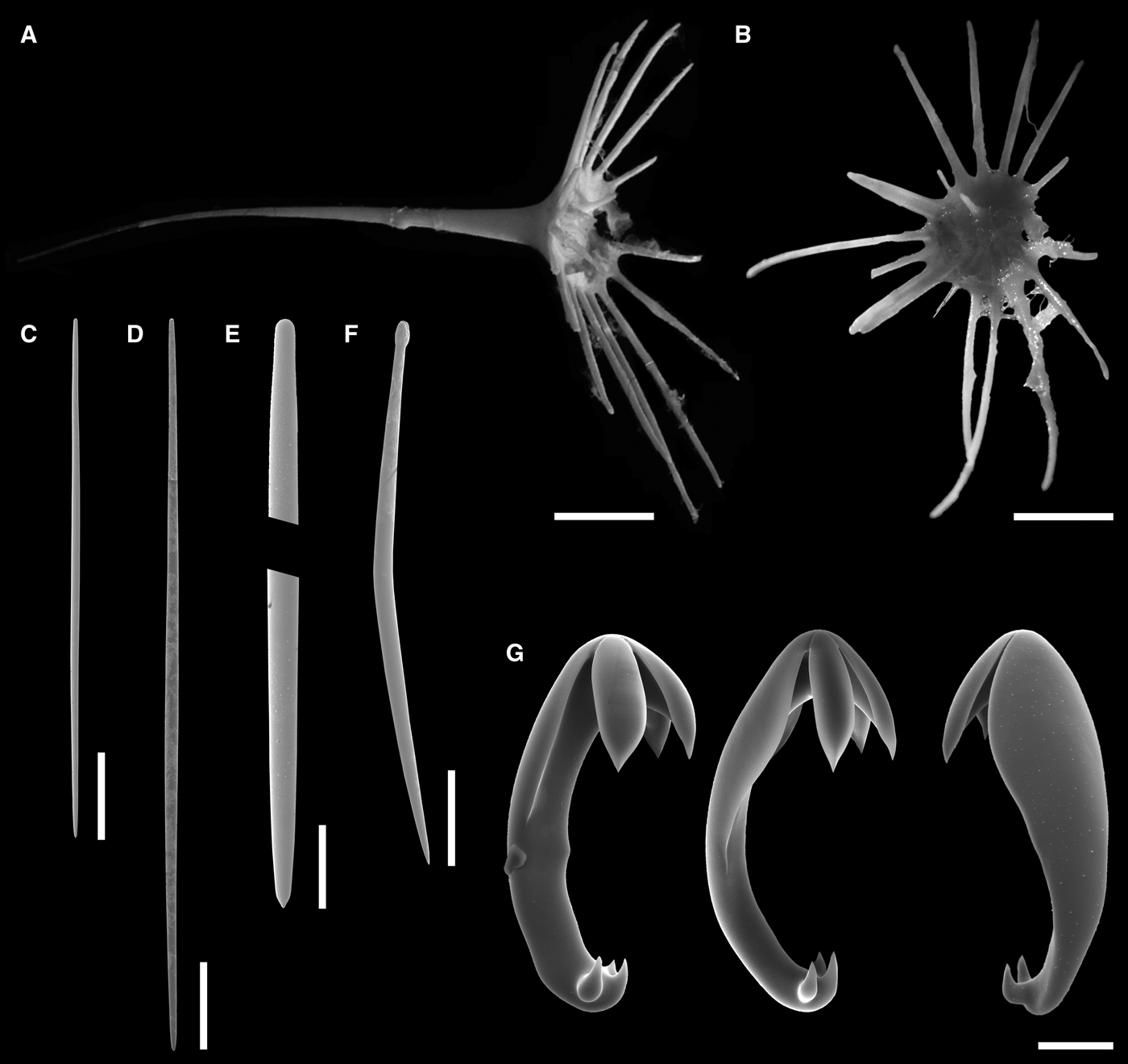
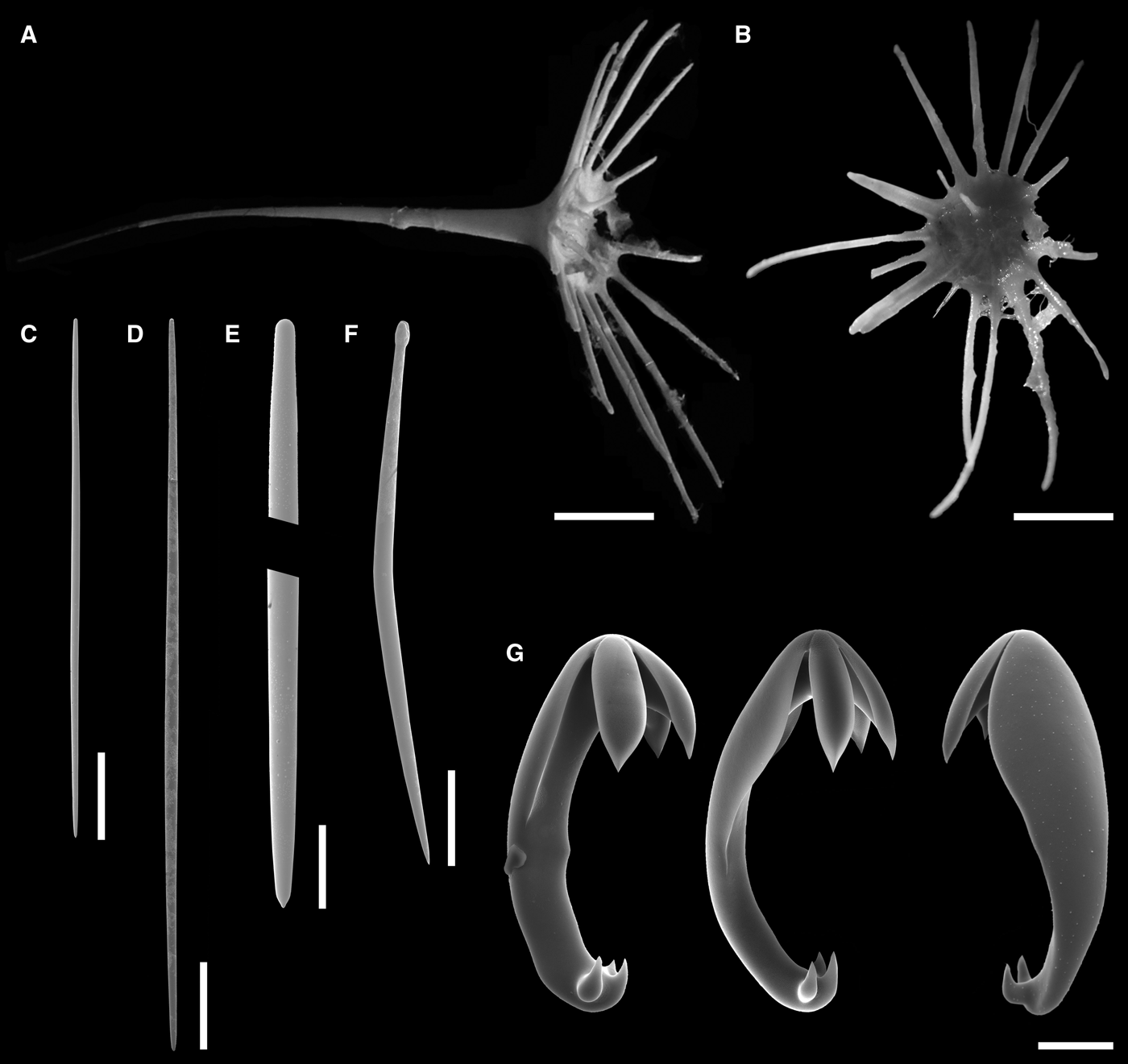
The holotype is a small, erect and pedunculated sponge 1.9 cm tall. The base of the sponge is missing. The peduncle is 1.5 cm long and supports a short, cup-shaped body with a fine central continuation of the stem and a crown of 16 up to 8 mm long projections pointing apically away from the sponge (Figure 3A, B). The sponge is fragile, partly damaged and with a slightly hispid surface. No oscules or any signs of an aquiferous system were observed. The colour is light brown in ethanol.
Cladorhiza inversa Ridley & Dendy, Reference Ridley and Dendy1886 (A–B) holotype (BMNH 87.5.2.145), (C) mycalostyle I of the stem and main body, (D) mycalostyle II from the projections with (E) detail, (F) tylostyle and (G) anchorate anisochelae. Scale bars: A, B = 3 mm; C, D = 250 µm; E, F = 50 µm; G = 5 µm.
SKELETON
Peduncle and body formed by axis of longitudinally arranged mycalostyles. Projections composed of larger mycalostyles with a cover of microscleres. Chelae are abundant in body and projections but nearly absent in peduncle, possibly due to the condition of the specimen (Figure 3C–E).
SPICULES
Megascleres are straight and fusiform mycalostyles in two size categories (Figure 3C–E). Microscleres are anchorate anisochelae in a single size category (Figure 3G).
• Mycalostyles I in peduncle and body, with acerate point, 542–975.4–1500 µm long and 11.1–19.0–30 µm thick.
• Mycalostyles II in the projections only with acerate point, 1496–1799.6–2111 µm long and 31–35.9–48 µm thick.
• Tylostyles in the body, fusiform, straight or slightly bent 270–303.4–365 µm long and 7.9–10.8–12.6 µm thick (Figure 3F).
• Anchorate anisochelae 22.4–25.2–27.1 µm long with a tridentate spatuliferous head 9.6–12.6 µm long and tridentate unguiferate foot ~5 µm long (Figure 3G).
DISTRIBUTION AND ECOLOGY
The species is known only from its type locality, the South Atlantic abyssal plain between Rio de la Plata and Tristan da Cunha.
Remarks
In Ridley and Dendy's original measurements the mycalostyles are given as about 2000 µm long and 37 µm thick while tylostyles are given as 630 µm long and 19 µm thick (Ridley & Dendy, Reference Ridley and Dendy1886, Reference Ridley and Dendy1887). It is possible that the measurements given of the smaller mycalostyles and tylostyles by Ridley and Dendy were mixed up as the tylostyles are shorter (270–365 µm) in our measurements and the smaller type of mycalostyle is not mentioned in the original description. The cryptic statements ‘bihamates (?)’ (Ridley & Dendy, Reference Ridley and Dendy1886) and ‘sigmata (?)’ (Ridley & Dendy, Reference Ridley and Dendy1887) are given in Ridley and Dendy's descriptions. Possibly they were expecting these spicules but were unable to find them. We did not find any trace of sigmas or sigmancistras in our examination of the holotype.
The name of the species derives from the original assumption by Ridley and Dendy that the body represents the basal part of the sponge with the projections acting as roots preventing the sponge from getting buried in the sediment (Ridley & Dendy, Reference Ridley and Dendy1886, Reference Ridley and Dendy1887). This interpretation was challenged by Topsent (Reference Topsent1902) who correctly noted that the sponge is pedunculated with the body apical to the stem.
The spicule set and habit of C. inversa differs from that of the two other Cladorhiza-species known from the SW Atlantic, most significantly by its conical rather than clavate habit and by the lack of sigmas or sigmancistras in C. inversa (see remarks for C. nicoleae sp. nov. above).
The Pacific species C. similis Ridley & Dendy, Reference Ridley and Dendy1886 and C. longipinna Ridley & Dendy, Reference Ridley and Dendy1886 are also close relatives but can be distinguished from C. inversa mainly by longer mycalostyles, slightly different chela sizes, the fact that projections point clearly downwards from the body as well as geographic distance. Two other species have a crown-shaped pedunculate body with apically oriented projections similar to C. inversa: C. flosabyssi Topsent, Reference Topsent1909 from the Azores, and C. corona Lehnert et al., Reference Lehnert, Watling and Stone2005 from the Aleutian Islands. Cladorhiza inversa can be distinguished from them by its smaller mycalostyles, the size of its chelae and the lack of sigmas or sigmancistras.
ACKNOWLEDGEMENTS
The authors are grateful to the Muséum National d'Histoire Naturelle and the ‘sponge team’ in Marseille (Station Marine d'Endoume), namely Jean Vacelet, Nicole Boury-Esnault and Thierry Perez, for granting us access to the TAAF-MD55 collection of sponges. We would like to thank Norwegian Oil and Gas, The Norwegian Biodiversity Information Centre and Det Norske Veritas for sponsoring the 2nd International Workshop on Taxonomy of Atlanto-Mediterranean Deep-Sea Sponges (Bergen, Norway), where preliminary results leading to this publication were presented. M.Sc. Amanda G. da Veiga and Beatriz C.A. Cordeiro are thanked for help with SEM operation at the Center for Scanning Electron Microscopy of Museu Nacional/UFRJ. JTH is grateful to Emma Sherlock and Clare Valentine for granting access and assisting his visit to the Natural History Museum (London), when the type specimen of C. inversa was reexamined.
FINANCIAL SUPPORT
The Brazilian authors thank the National Counsel of Technological and Scientific Development (CNPq), Carlos Chagas Filho Research Support Foundation of Rio de Janeiro State (FAPERJ), and Coordination for Improvement of Higher Education Personnel (CAPES) for grants and/or fellowships.