


1 Introduction
Classic Optimality Theory is a parallel theory of grammar (Prince & Smolensky Reference Prince and Smolensky1993). In other words, it evaluates fully formed output candidates that may show the effects of many different processes simultaneously. The winning candidate is simply the most harmonic member of the candidate set, according to some language-particular constraint hierarchy.
There is a version of OT called Harmonic Serialism (HS). HS is a serial or derivational theory of grammar, but, unlike more familiar derivational theories, it is based on candidate evaluation by ranked constraints rather than rules. HS imposes a requirement of gradualness, which restricts how much a candidate can differ from the input. This more limited candidate set is evaluated, its most harmonic member is chosen as output, and that output becomes input for another pass through the grammar. Thus, HS takes a gradual path to the ultimate output of the grammar, whereas classic OT proceeds immediately to the ultimate output.
A consequence of gradualness is that there are input–output mappings that classic OT allows but HS does not, all else being equal. In the simplest case, a classic OT grammar maps A to C, but the differences between A and C are sufficient to require an intermediate step B in the HS analysis. That is, the flat classic OT derivation is A→C, but the serial HS derivation has to be A→B→C because of gradualness. For A→B→C to be a possible HS derivation, B must be more harmonic than the faithful candidate A and less harmonic than C, according to the constraint hierarchy. If no such B exists – for instance, because there is no markedness constraint which favours B over A – then it will not be possible to get from A to C in HS, even though this mapping is possible in classic OT. C is therefore inaccessible from A.
In this article, I argue that this property of HS is an asset. The evidence comes primarily from an observation known as the coda/onset asymmetry. In many languages, consonant clusters simplify by deleting the first consonant, but never the second one (Wilson Reference Wilson2000, Reference Wilson2001, Steriade, forthcoming): /patka/→[paka], not [pata]. In many languages, clusters assimilate by changing the first consonant to match the second one, but not the other way around (Webb Reference Webb1982, Ohala Reference Ohala, Kingston and Beckman1990, Mohanan Reference Mohanan1993, Jun Reference Jun1995, Reference Jun, Hayes, Kirchner and Steriade2004, Steriade Reference Steriade2001): /panpa/→[pampa], not *[panta]. In short, the would-be coda is often targeted for deletion or assimilation, but the would-be onset never is.
The HS explanation for the coda/onset asymmetry has two components: deletion or assimilation requires two steps, the first of which is loss of the Place node; and loss of the Place node is harmonically improving in codas but not onsets. I will show that both aspects of the explanation have a principled basis, are supported by independent evidence and are precedented in the literature of both rule-based phonology and OT. I will also show that the HS explanation avoids the problems of other extant approaches to the coda/onset asymmetry.
The coda/onset asymmetry is one instance of a range of typological observations that have been known as ‘too many repairs’ (TMR) or ‘too many solutions’ problems ever since Lombardi (Reference Lombardi and Lombardi2001) and Pater (Reference Pater1999) first discovered them.Footnote 1 In a TMR problem, the observed ways of satisfying a markedness constraint by an unfaithful mapping are a proper subset of the ways that are predicted by free permutation of faithfulness constraints. Thus, the coda/onset asymmetry is a TMR problem because the markedness constraint(s) usually deemed to be responsible for cluster simplification could equally well be satisfied by altering the first consonant or the second one, but only alterations in the first consonant are ever observed.
The full range of TMR problems is too big and ill-defined to be addressed in just this article, but in other work I have argued that HS can solve other TMR problems besides the coda/onset asymmetry. Blumenfeld (Reference Blumenfeld2006) has identified stress–syncope interaction as a TMR problem, and in McCarthy (forthcoming) I develop an HS analysis of the typology of stress–syncope interactions. In McCarthy (Reference McCarthy, Blaho, Bye and Krämer2007b), I discuss several TMR problems and their solutions in HS: the inability of constraints on word- and syllable-final consonants to conspire to delete word-final sequences of non-conforming segments; the impossibility of double (/apekto/→[paketo]) or long-distance (/art/→[tar]) metathesis; the limitation of autosegmental flop processes to situations where assimilation would also be possible; and the impossibility of long-distance feature spreading to satisfy a highly local markedness constraint. From all of this, it would appear that HS has a significant contribution to make toward understanding the differences between licit and illicit input–output mappings in phonology and perhaps elsewhere.
2 Harmonic Serialism
2.1 Overview
Prince & Smolensky (Reference Prince and Smolensky1993: 94–95) mention HS as a possible variant implementation of OT. HS differs from classic OT in two respects: Gen, and the Gen→Eval→Gen … loop.
In OT, the Gen component creates candidate output forms from an input. Classic OT's Gen produces a highly diverse candidate set; a candidate can differ from the input in many different ways at once. HS's Gen produces a restricted candidate set; there is no more than one difference between any candidate and the latest input. For instance, the candidate set for input /pat/ would include [pat], [pa.ti] and [pa.ʧi] in classic OT, but [pa.ʧi] would be absent from the HS candidate set.Footnote 2 This property of HS is called gradualness. It will be defined in the next section.
In OT, the Eval component applies a language-particular constraint hierarchy to select the most harmonic member of the candidate set. Eval works exactly the same in the two theories; only the candidate set that it evaluates differs.
In classic OT, the output of Eval is also the ultimate output of the grammar. In HS, however, the output of Eval is fed back into Gen as a new input for another pass through Gen and Eval. This Gen→Eval→Gen … loop terminates when there is convergence: the candidate selected by Eval is identical with the most recent input to Gen. Once that has happened, no further changes are possible, and we have the ultimate output of the grammar. For example, if a language has a constraint hierarchy that favours epenthesis of [i] after codas and palatalisation of [t] before [i], then the output of /pat/'s first pass through Gen and Eval will be [pa.ti], and the output of [pa.ti]'s pass through Gen and Eval will be [pa.ʧi]. Submitting [pa.ʧi] to Gen and Eval yields [pa.ʧi] as the output once again – convergence. We can write this series of steps compactly as <pat, pa.ti, pa.ʧi>.
Because Eval applies repeatedly, each step in the derivation <pat, pa.ti, pa.ʧi> must better satisfy the constraint hierarchy than its predecessor. This property of HS is called harmonic improvement. Harmonic improvement is always determined relative to a particular constraint hierarchy that is invariant across all iterations of the Gen→Eval→Gen … loop. As long as all constraints evaluate outputs (markedness) or require input–output identity (faithfulness), convergence in a finite number of loops is guaranteed. In other words, every underlying representation has finite potential for harmonic improvement (Moreton Reference Moreton2000, Reference Moreton and McCarthy2004).
To show harmonic improvement in an HS derivation, we require a device similar to classic OT's winner-loser tableau. An example of a harmonic improvement tableau appears in (1). It illustrates the rankings necessary for harmonic improvement in the HS derivation <pat, pa.ti, pa.ʧi>. (For the definition of CodaCond, see (6).)
(1)

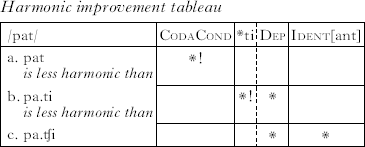
Tableau (1) illustrates a couple of conventions that will be followed throughout this article. The exclamation point is used to signal a constraint violation whose removal at the next step in the derivation improves harmony. Harmonic improvement requires that any violation marks added at the next step be ranked lower than the violation that is removed. I also follow the practice of showing faithfulness violations relative to the original underlying representation, not to the input of the latest pass through Gen. This assumption is not crucial in this article, but it is required for the proper application of HS to phonological opacity (McCarthy Reference McCarthy2007a).
(1) certifies that <pat, pa.ti, pa.ʧi> is harmonically improving under the given constraint hierarchy. The form [pa.ti] in (1b) improves over the harmony of [pat] in (1a) because [pa.ti] eliminates [pat]'s CodaCond violation without adding violations of any constraints ranked higher than CodaCond (there are none). Likewise, [pa.ʧi] in (1c) improves over the harmony of [pa.ti] in (1b) because [pa.ʧi] eliminates [pa.ti]'s violation of *ti without adding violations of any constraints ranked higher than *ti.
Harmonic improvement over the course of a derivation is also important in the theory of Harmonic Phonology, which links rule application to harmonic improvement in the sense of greater conformity with phonotactic requirements (Goldsmith Reference Goldsmith1990: 319ff, 335–336, Reference Goldsmith1993a). On the other hand, harmonic improvement over the course of a derivation is not meaningful in another serial approach to optimality, stratal OT (Rubach Reference Rubach and Roca1997, Kiparsky Reference Kiparsky2000, Ito & Mester Reference Ito and Mester2003 and many others). In stratal OT, a different grammar is used on each pass through Gen and Eval, and grammars differ in what they regard as harmonic improvement. In contrast, HS uses the same grammar on each pass through Gen and Eval, so harmonic improvement is always determined by the same grammar.
Each step in an HS derivation is also locally optimal. This simply means that it is optimal within HS's restricted candidate set for that derivational step. If, say, CodaCond and Max dominate Dep, then [pa.ti] is locally optimal in comparison with a candidate set that includes faithful [pat] and [pa], with deletion. Even though [pa.ti] is locally optimal, it is not the ultimate output of the grammar, if further harmonic improvement can be achieved by palatalising [t] on the next pass through the Gen→Eval→Gen … loop.
Harmonic improvement and local optimality are intrinsic to the HS architecture, since they are inherent properties OT's Eval component, which is exactly the same in HS and classic OT. But gradualness is a restriction that is unique to HS's Gen. The next section discusses the details of this restriction.
For further discussion and applications of Harmonic Serialism, see McCarthy (Reference McCarthy2000, Reference McCarthy2002b: 159–163, Reference McCarthy2007a, Reference McCarthy, Blaho, Bye and Krämerb, forthcoming).
2.2 Defining gradualness
The origin of HS's gradualness requirement can be found in Prince & Smolensky's (Reference Prince and Smolensky1993: 94–95) original sketch of this model: in Gen, ‘some general procedure (Do-α) is allowed to make a certain single modification to the input, producing the candidate set of all possible outcomes of such modification’. The reason for considering such a possibility even at the very beginning of OT is that it recalls certain restrictive theories of phonological (and syntactic) rules.
Chomsky & Halle (Reference Chomsky and Halle1968) formalised phonological processes as unrestricted rewrite rules, but they entertained the possibility of limiting phonology to rules that can alter only one segment at a time (1968: 399). Later work pursued this idea further, limiting rules to single operations on autosegmental association lines (Goldsmith Reference Goldsmith1976), feature-geometric nodes (Clements Reference Clements1985) or metrical grid positions (Prince Reference Prince1983). Archangeli & Pulleyblank (Reference Archangeli and Pulleyblank1994) proposed a parametric rule system with a limited vocabulary of elementary phonological operations, insertion and deletion of phonological elements and insertion and deletion of association lines. Almost from the beginning, syntactic theory has also recognised a set of basic operations, as in Chomsky's (Reference Chomsky1965: 147) definition of a grammatical transformation: ‘a Boolean condition on Analyzability and a sequence of elementary transformations drawn from a base set including substitutions, deletions, and adjunctions’.
HS's gradualness requirement takes a similar approach to OT's Gen component. Very informally, gradualness limits Gen to doing one thing at a time, like Archangeli & Pulleyblank's parametric rules. Getting from /pat/ to [paʧi] therefore requires at least two steps, both of which must be harmonically improving to make it through the Gen→Eval→Gen … loop.
There are many possible ways of formalising this basic intuition, and further study of more diverse phenomena may very well render current ideas obsolete. Nonetheless, an explicit hypothesis is necessary before we can do any sort of serious analysis in HS. One approach is to establish a connection between the operations in Gen and the faithfulness constraints (McCarthy Reference McCarthy2007a: 61–62, 77–79). Certain elementary operations in Gen, such as insertion or deletion of a phonological element, are directly linked to violations of faithfulness constraints, such as Max and Dep. I will use the term unfaithful operations to refer to them. Other operations, including most of the prosodic parsing apparatus, have no faithfulness consequences. Gradualness limits the use of unfaithful operations in generating candidates.
(2) Gradualness
If β is a member of the set Gen(α), then no more than one unfaithful operation is required to transform α into β.
This definition places no limit on the number of faithful operations required in the α→β mapping. It also places no limit on the number of faithfulness constraints that β violates in comparison with α. A single unfaithful operation can yield violations of several faithfulness constraints – for instance, when both a general and a positional faithfulness constraint are applicable to the same segment.
Because gradualness is defined in terms of faithfulness, the details of faithfulness theory are important in determining the limits of a candidate set. In this article, the treatment of distinctive features in faithfulness theory is crucial.
For over three decades, phonological theory has recognised two views of distinctive features, features as attributes and features as entities. This difference is reflected in how features are treated by the correspondence theory of faithfulness (McCarthy & Prince Reference McCarthy and Prince1995, Reference McCarthy and Prince1999). If features are thought of as attributes of segments, as in Chomsky & Halle (Reference Chomsky and Halle1968), then Ident[feature] constraints are the appropriate means of expressing faithfulness to them. In autosegmental phonology (Goldsmith Reference Goldsmith1976), distinctive features are regarded as independent entities. In this view, Max[feature] and Dep[feature] constraints are the appropriate means of expressing faithfulness.
One of the most important differences between the Ident[feature] and Max[feature] theories arises when segments delete (Lombardi Reference Lombardi and Lombardi2001). For instance, the mapping /patka/→[pa.ka] obeys Ident[Place] and violates Max[Place]. This mapping obeys Ident[Place] because, according to the definition in (3), an input segment that has no output correspondent vacuously satisfies Ident[Place].
(3)
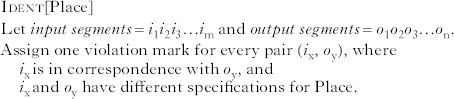
In contrast, the /patka/→[pa.ka] mapping does violate Max[Place], as defined in (4), because an input token of the Place feature [coronal] has no output correspondent.
(4)

These two views of featural faithfulness have various empirical consequences that have been explored in earlier work (e.g. Itô et al. Reference Itô, Mester and Padgett1995, Lamontagne & Rice Reference Lamontagne and Rice1995, Causley Reference Causley1997, Lombardi Reference Lombardi1998, 2001, Zoll Reference Zoll1998, Davis & Shin Reference Davis and Shin1999, Gnanadesikan Reference Gnanadesikan2004). For present purposes, the interesting thing about them is how they intersect with the definition of gradualness in (2).
(i) If Ident[Place] is assumed, then deletion of a consonant is a single unfaithful operation, since Ident[Place] is not violated when a consonant deletes. In that case, HS's Gen, when given the input /patka/, can offer [pa.ka] as one of the output candidates. Hence, deletion of a consonant can be accomplished in a single step of a properly gradual HS derivation: <pat.ka, pa.ka>.
(ii) If Max[Place] is assumed, then deletion of a consonant will require at least two unfaithful operations, one to delete Place and one (or more) to delete the rest of the consonant. In that case, HS's Gen, when given the input /patka/, cannot offer [pa.ka] as one of the output candidates. The best it can do is offer [paH.ka], where [H] denotes whatever is left when /t/'s Place feature has been taken away. Hence deletion of a consonant requires two steps of a properly gradual HS derivation: <pat.ka, paH.ka, pa.ka>.
In short, the Ident[Place] regime treats consonant deletion as a single operation, whereas the Max[Place] regime treats it as gradual attrition.
Similar reasoning applies to Place assimilation. Changing /m/ to [ŋ] incurs a single violation of Ident[Place], so it can be accomplished in a single step of an HS derivation: <pam.ka, paŋ.ka>. But with Max[Place], assimilation requires two unfaithful operations. The first violates Max[Place], changing /pamka/ into [paN.ka], where [N] denotes whatever is left when /m/'s Place feature has been taken away.Footnote 3 The second operation violates the faithfulness constraint NoLink[Place], as defined in (5), because it spreads Place from [k] to [N]. The properly gradual HS derivation is therefore <pam.ka, paN.ka, paŋ.ka>.
(5)

(The details of this definition are not important here, but they are provided for completeness. They say that NoLink is violated when elements that are present but unlinked in underlying representation become linked in the output.)
This view of Place assimilation recalls a theory of assimilation that was well established in the pre-OT literature (Poser Reference Poser, Hulst and Smith1982, Mascaró Reference Mascaró1987, Cho Reference Cho1990, Kiparsky Reference Kiparsky, Hargus and Kaisse1993).Footnote 4 A mapping like /pamka/→[paŋ.ka] is a case of feature-changing assimilation, and it was proposed that all apparent feature-changing assimilation rules should be analysed as a combination of a feature-deleting neutralisation rule and a feature-filling assimilation rule, applied in that order. With HS and the assumption that neutralisation violates Max[Place], the gradualness requirement (2) entails this same decomposition of feature-changing assimilation into neutralisation plus spreading.
In this article, I assume that Max[Place] is the right faithfulness constraint. In consequence, consonant deletion or assimilation requires two derivational steps, with a Placeless consonant as the intermediate step: [paH.ka], [paN.ka]. I will show how this accounts for the coda/onset asymmetry: the intermediate steps required for onsets to delete or undergo assimilation – that is, [pat.Ha] and [pam.Ha] – do not improve performance on CodaCond.
3 Analysis
3.1 Harmonic improvement in coda deletion
We know from §2.2 that the HS derivation <pat.ka, paH.ka, pa.ka> meets the gradualness requirement, but it must also be harmonically improving in any language that simplifies medial clusters by deleting the first consonant. Specifically, if the intermediate step [paH.ka] is not more harmonic than [pat.ka] and less harmonic than [pa.ka], then this derivational path will be impossible in HS. The goal of this section is to establish the ranking conditions under which this sequence is indeed harmonically improving.
Cluster simplification is usually attributed to CodaCond, which is defined in (6). This is an onset-licensing formulation of CodaCond, along the same general lines as Goldsmith (Reference Goldsmith1990: 123–128). Place is licensed by association with an onset consonant; a Place node that is so licensed can also be associated with a preceding coda without violating CodaCond (cf. Itô Reference Itô1989 for a somewhat different formulation of this constraint).
(6)

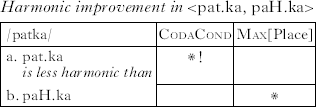
Whereas [pat.ka] violates CodaCond because of [t]'s [coronal] specification, [paH.ka] does not, since [H] has no Place features. Therefore, a necessary condition for harmonic improvement in <pat.ka, paH.ka> is for CodaCond to dominate Max[Place]. This ranking is shown in the harmonic improvement tableau (7).
(7)
For <pat.ka, paH.ka, pa.ka> to be a possible derivation, the step from [paH.ka] to [pa.ka] must also improve harmony. It does so if the markedness constraint HavePlace in (8) dominates the faithfulness constraint violated by deleting [H] – i.e. Max.
(8)

All of the constraint rankings necessary for harmonic improvement in <pat.ka, paH.ka, pa.ka> are summarised in (9). If a language has this constraint hierarchy and no other rankings undermine it, then /patka/ will map to [pa.ka] by way of [paH.ka].
(9)
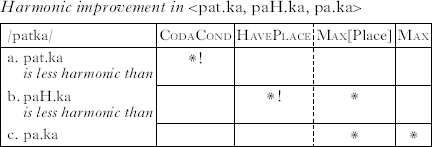
Tableau (9) shows that getting from [pat.ka] to [paH.ka] in a harmonically improving fashion requires that CodaCond dominate both HavePlace and Max[Place]. That is because [H] violates HavePlace and the /t/→[H] mapping violates Max[Place]. The step from [paH.ka] to [pa.ka] requires that HavePlace dominate Max. The direct mapping from /patka/ to [pa.ka] is simply unavailable in this theory, because of gradualness, as defined in §2.2. As we will see in the next section, the unavailability of this direct mapping is a crucial element of the explanation for the coda/onset asymmetry.
The analysis so far has been conducted in the realm of the hypothetical. We will therefore turn now to an authentic and familiar example, cluster simplification in Diola Fogny (Niger-Congo, Senegal and Gambia) (Sapir Reference Sapir1965, Kiparsky Reference Kiparsky, Anderson and Kiparsky1973, Itô Reference Itô1986). Medial codas are deleted (10), except for nasals followed by homorganic stops (see §3.3). By the logic of (9), deleting a coda involves passing through a step where the coda is reduced to the Placeless consonant denoted by [H].
(10)
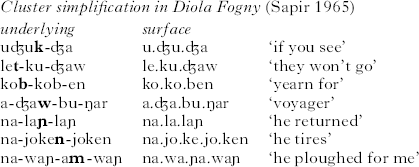
Tableau (11) demonstrates harmonic improvement in the HS derivation necessary to effect the mapping /uʤuk-ʤa/→[u.ʤu.ʤa].
(11)

Examples like [le.ku.ʤaw] show that word-final consonants are not subject to deletion. The phonological literature offers various explanations for this, and nearly all are compatible with the HS analysis above. In Itô (Reference Itô1986), Diola Fogny word-final consonants are licensed by extraprosodicity. In Goldsmith (Reference Goldsmith1990), word-final position can have its own licensing properties. In Piggott (Reference Piggott1991, Reference Piggott1999), Diola Fogny word-final consonants are the onsets of empty-headed syllables. In the Itô, Goldsmith and Piggott analyses, then, word-final consonants simply do not violate CodaCond. Krämer (Reference Krämer2003) takes a somewhat different approach: Diola Fogny word-final consonants are protected by a right-edge positional faithfulness constraint that dominates CodaCond. The licensing-by-cue approach of Steriade (Reference Steriade, Fujimura, Joseph and Palek1999a, Reference Steriadeb) and Côté (Reference Côté2000) takes yet another tack: CodaCond is replaced by a constraint against Place specifications with poor perceptual cues, and those cues are stronger in word-final codas than in word-medial codas (Côté Reference Côté2000: ch. 5). This too is completely compatible with the analysis proposed here; constraints determine the phonetic realisation of Place, and the constraint against weakly cued Place replaces CodaCond in the ranking above. Indeed, I know of only one approach to the immunity of word-final consonants that is truly incompatible with the HS analysis, Yip's (Reference Yip1991) Cluster Condition. It is discussed in the next section.
3.2 The coda/onset asymmetry in deletion
We now have the tools necessary to solve half of the problem introduced in §1: when a medial cluster simplifies, the first consonant deletes and the second one doesn't. Deletion of the first consonant is a consequence of the ranking in (9) and (11), which favours an HS derivation that first deletes the Place node and then the remainder of the would-be coda consonant: <pat.ka, paH.ka, pa.ka>. Neither this ranking nor any other permutation of those constraints will produce a harmonically improving, gradual derivation that deletes the second consonant. The reasons are worth exploring in detail.Footnote 5
Direct deletion of the second consonant in a medial cluster is ruled out by the gradualness requirement. For example, <pat.ka, pa.ta> deletes [t]'s Place feature and the balance of its features in a single step; that is prohibited under the assumptions in §2.2. Therefore, the only properly gradual way to simplify a medial cluster by deleting the second consonant is with an HS derivation like <pat.ka, pat.Ha, pa.ta>.
But this derivation is ruled out because it is not harmonically improving. For <pat.ka, pat.Ha, pa.ta> to be harmonically improving, its first step <pat.ka, pat.Ha> must also be harmonically improving. But <pat.ka, pat.Ha> is not harmonically improving under any ranking of the four constraints in (9) and (11). Tableau (12) shows that [pat.ka] harmonically bounds [pat.Ha] relative to input /patka/ within the scope of this constraint set.Footnote 6
(12)
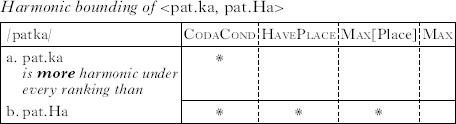
In general, if the path from A to C must go by way of B because of the gradualness requirement, then it is not enough for the mapping A→C to improve harmony; the mappings A→B and B→C must improve harmony as well. Therefore, no HS derivation <A, B, C> can ever be possible, in any language, if A harmonically bounds B. Because of the harmonic bounding result in (12), no language will permit the HS derivation <pat.ka, pat.Ha> under this constraint set. And if <pat.ka, pat.Ha> is ruled out, then so is <pat.ka, pat.Ha, pa.ta>. Although the mapping /patka/→[pa.ta] improves harmony under some ranking of these constraints (i.e. the one in (9) and (11)), the derivation necessary to accomplish this mapping does not display monotonic harmonic improvement. That is why /patka/→[pa.ta] is possible in classic OT but not in HS.
This example can be used to introduce a useful concept from optimisation theory, the local minimum. Imagine a ball rolling down a bumpy hill. As it descends, it loses potential energy. If it reaches the bottom of the hill, then it has found the global minimum of potential energy. If it gets stuck at a bump, then it has reached a local minimum that is not the global minimum. Translating into OT terms, potential energy is equivalent to potential for harmonic improvement. Classic OT always finds the candidate that is the global minimum of potential for further harmonic improvement. HS sometimes gets stuck at a local minimum.
The /patka/ example will illustrate. Suppose that deletion of the /t/ is ruled out by a constraint requiring faithfulness to segments in initial syllables (Beckman Reference Beckman1997, Reference Beckman1998). Suppose too that other ways of fixing this cluster, such as vowel epenthesis, are excluded by high-ranking constraints. In that case, the global minimum of potential for harmonic improvement is [pa.ta]. Classic OT finds this global minimum without difficulty because it compares candidates that differ from the input without limitation. But HS, with gradualness as defined in §2.2, cannot get from /patka/ to [pa.ta] because there is a bump along the way. The bump is [pat.Ha], a form that is less harmonic than [pat.ka]. HS therefore gets stuck at the local minimum [pat.ka].
Classic OT always finds the global minimum – the output form that is more harmonic than all other candidates. HS is not guaranteed to find the global minimum – sometimes it gets stuck in a local minimum when all routes to the global minimum involve decreasing harmony before it can increase. HS's propensity to get stuck in a local minimum sounds like a liability, but the typological results discussed here and in McCarthy (Reference McCarthy, Blaho, Bye and Krämer2007b, forthcoming) show that it is arguably an advantage that HS has over parallel OT.
Back to (12). Harmonic bounding results like this one are always determined relative to some set of constraints; an outcome that is harmonically bounded under one constraint set may not be bounded under another. In particular, if CodaCond is replaced by the Cluster Condition of Yip (Reference Yip1991) (see also Prince Reference Prince, Aronoff and Oehrle1984), then the typological result in (12) no longer goes through. The Cluster Condition prohibits a sequence of Place nodes. It is violated by *[pat.ka], because of the [tk] sequence. The problem is that <pat.ka, pat.Ha> does improve performance on the Cluster Condition, though not on CodaCond. Therefore, the results here rely on rejecting the Cluster Condition as a member of OT's universal constraint set Con. For other reasons to doubt the Cluster Condition, see McCarthy & Taub (Reference McCarthy and Taub1992: 364–365), Jun (Reference Jun1995: 23–24), Côté (Reference Côté2000: 51) and Scholz (Reference Scholz2003: 147).
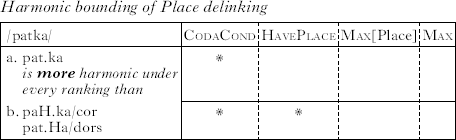
Harmonic bounding also forecloses another imaginable path of cluster simplification: delinking but not deleting a Place feature.Footnote 7 (I use the notation X/F to represent the word X with floating feature F.) Neither of the derivations <pat.ka, paH.ka/coronal> and <pat.ka, pat.Ha/dorsal> improves performance on CodaCond. As defined in (6), CodaCond is violated by any Place feature without an onset linkage, and floating features perforce lack onset linkage. Since the segments left behind after Place delinking violate HavePlace, the first step in each of these derivations is harmonically bounded.
(13)
The HS analysis of the coda/onset asymmetry finds support from a surprising quarter: cases where the onset actually does delete. The theory here predicts that the coda/onset asymmetry will not hold when the deleted consonant is Placeless in underlying representation. The reason: although CodaCond can compel loss of Place only in codas, loss of Place is not a precondition for deletion when the affected segment already lacks Place. This prediction is borne out in Tonkawa (Coahuiltecan, Oklahoma). Tonkawa [h] has the following distribution (Hoijer Reference Hoijer, Hoijer, Bloomfield, Haas, Halpern, Li, Newman, Swadesh, Trager, Voegelin and Whorf1946: 291–292): it occurs initially ([henox] ‘pretty’) and intervocalically ([ʔahen] ‘daughter’), it is banned from codas and it is also banned from postconsonantal onsets, leading to alternations like those in (14).
(14)

Deletion of [h] can occur in a single step of a properly gradual HS derivation: <…, neshetsanoʔs, nesetsanoʔs, …>. This step improves harmony in Tonkawa because HavePlace dominates Max. The preservation of initial and intervocalic [h] shows that HavePlace is itself dominated by Onset.
3.3 The coda/onset asymmetry in Place assimilation
Like deletion, Place assimilation targets the first and never the second consonant in an intervocalic cluster, so we find mappings like /panpa/→[pam.pa], but never /panpa/→[pan.ta]. The explanation follows straightforwardly from what we have already seen. Because of gradualness, a nasal that is specified for Place in underlying representation must lose its Place in one step and gain a new Place by spreading in the following step: <pan.pa, paN.pa, pam.pa>.
This view of Place assimilation can be illustrated with some additional data from Diola Fogny in (15). Nasals assimilate in Place to following stops and affricates.
(15)
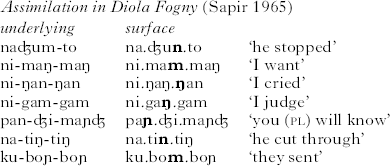
The resulting homorganic cluster has a single Place feature shared by the coda and the onset. CodaCond is satisfied because, as defined in (6), it does not so much ban Place from codas as require that Place be in an onset. Harmonic improvement in the HS derivation <na.ʤum.to, na.ʤuN.to, na.ʤun.to> is demonstrated by the following tableau.
(16)

For the reasons given in the previous section, loss of Place can be harmonically improving in codas but not onsets. The derivation <pap.ŋa, pap.Na, pap.ma> is impossible because it is harmonically bounded in its first step, <pap.ŋa, pap.Na>.
(17)

Because <pap.ŋa, pap.Na, pap.ma> is an impossible derivation and there is no other gradual path from /papŋa/ to [pap.ma], the mapping /papŋa/→[pap.ma] is impossible as well. And although <pap.ŋa, pap.ma> is harmonically improving, it is ruled out by gradualness. As I explained in §2.2, gradualness requires feature-changing assimilation to be decomposed into separate feature-deleting and feature-filling steps.
As in §3.2, we can find independent support for this explanation of the coda/onset asymmetry by looking at cases where the asymmetry does not hold. There are three situations to consider: Place assimilation when the targeted consonant is a Placeless laryngeal, Place assimilation when the targeted consonant is epenthetic, and assimilation of features other than Place.
If one of the consonants in a cluster is a Placeless laryngeal, then Place deletion is not a necessary precursor to Place assimilation (not all laryngeals are Placeless; see §3.4). Obviously, a Placeless coda can be targeted for assimilation, but so can a Placeless onset. That is why there can be languages like Arbore and Afar (both Cushitic, Ethiopia), where onset /h/ is targeted by assimilation.
(18)
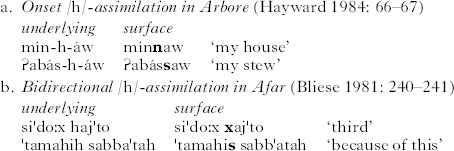
The explanation for the coda/onset asymmetry in Place assimilation rests on the harmonic bounding of Place deletion in onsets, as shown in (17). But when the onset is already Placeless, there is no problem with harmonic bounding of the Place-deletion step, and spreading Place from coda to onset provides a way of satisfying CodaCond.
The second situation where the coda/onset asymmetry does not hold involves targeting of an epenthetic onset consonant for Place assimilation. Loss of Place is not a necessary precondition for assimilation when the affected segment has no underlying structure to be faithful to, so it is predicted that the coda/onset asymmetry will not hold in such cases. This prediction is borne out in Lardil (Hale Reference Hale and Sebeok1973). In this language, /CVC/ words are usually augmented by adding [Ca], where C is a stop that is homorganic with the preceding root-final consonant (19).
(19)
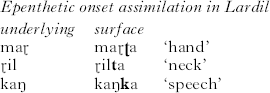
Here, an onset consonant assimilates in place to a preceding coda. This is permitted because the onset consonant is epenthetic, so it does not need to go through the harmonically bounded step of onset Place deletion before it can be targeted for spreading of the Place node.
The third situation where the coda/onset asymmetry does not hold is when the assimilating feature is not Place. Manner features can assimilate progressively, as in Arbore /fal-n-e/→[fálle] ‘(we) cursed’ (Hayward Reference Hayward1984: 79). So can laryngeal features, as in Dutch /krɑb-tə /→[krɑbdə ] ‘scratched’ (Booij Reference Booij1995: 58–64, Wetzels & Mascaró Reference Wetzels and Mascaró2001). Dependent place features like [distributed] and [anterior] also sometimes assimilate progressively in clusters; for examples, see Kristofferson (Reference Kristoffersen2000: 96–100) on progressive assimilation of apicality (i.e. [−distributed]) in Norwegian, and Whitney (Reference Whitney1889: 68) on progressive assimilation of palatality (i.e. [−anterior]) in Sanskrit. Nothing in the proposal here would cause us to expect anything different. Codas are targets of Place deletion and subsequent Place assimilation because the existence of CodaCond ensures that Place deletion will improve harmony in systems where it dominates Max[Place]. Constraints on the licensing of other features may and obviously do have different effects.
3.4 Debuccalisation
Deletion of oral Place features from consonants was dubbed debuccalisation by Hetzron (Reference Hetzron1972), because loss of Place is loss of the constriction in the oral cavity. The result of debuccalisation is a Placeless oral or nasal consonant, which I have been writing as [H] and [N].
In the HS analyses above, debuccalisation is a step on the way toward deletion or assimilation. But with a different ranking, debuccalisation can be the final result. As (20) shows, the candidate HS derivation <pat.ka, paH.ka> is harmonically improving but <pat.ka, paH.ka, pa.ka> is not if Max dominates HavePlace (cf. (9)).
(20)
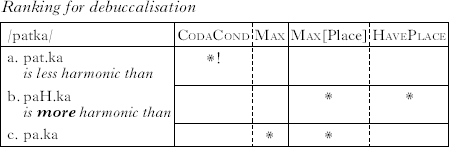
With this ranking, the HS derivation can never make it as far as [pa.ka], starting from /patka/. Instead, the derivation converges at [paH.ka].
Among the languages with debuccalisation processes are Arbore (21a), which debuccalises glottalised coda consonants, and Kagoshima Japanese (21b), which debuccalises coda stops and nasals derived by apocope.Footnote 8
(21)

Because debuccalisation is a step along the way toward assimilation or deletion, we should not be surprised to find that that debuccalisation sometimes co-occurs with assimilation or deletion, with other constraints determining which outcome is chosen when. Carib of Surinam (Hoff Reference Hoff1968, Gildea Reference Gildea1995) and Arbore (Hayward Reference Hayward1984) provide illustrations. In Carib, coda nasals assimilate in Place to a following stop (22a), but they debuccalise to [ʔ] before another nasal (22b). Assimilation is blocked before nasals because the language has no geminates. In Arbore, plain stops in coda position assimilate (22c), but glottalised stops debuccalise (21a). The differential treatment of glottalised stops is presumably an effect of faithfulness to their underlying [constricted glottis] specification.
(22)

Besides illustrating one of the consequences of constraint permutation, debuccalisation is also useful in answering a question that several anonymous reviewers have raised about the HS explanation for the coda/onset asymmetry. If Placeless [H] is an intermediate step on the path to deletion or assimilation, then what does this predict about the fate of underlying /ʔ/ and /h/ in the same language? The answer depends on a known ambiguity in the representation of these segments:
(i) In some languages, /ʔ/ and /h/ act as if they are Placeless. They can be targeted for deletion or assimilation in onset position, as in (14) and (18). They can also occur in coda position in languages that enforce CodaCond rigidly (Rice Reference Rice1992, Rose Reference Rose1996).Footnote 9
(ii) In other languages, /ʔ/ and /h/ act as if they have [pharyngeal] Place, since they pattern phonologically with the class of guttural consonants, all of which are produced in the uvular, pharyngeal or laryngeal regions of the vocal tract (Hayward & Hayward Reference Hayward and Hayward1989, McCarthy Reference McCarthy and Keating1994b).
In light of this ambiguity, predictions about the relationship between [H] and /ʔ/ and /h/ are necessarily rather subtle. If underlying /ʔ/ and /h/ have (or receive) [pharyngeal] Place prior to debuccalisation, then they will behave differently from the truly Placeless result of debuccalisation. Rose (Reference Rose1996: 92–97, 106–107) shows that exactly this occurs in Tigre. Coda /kˀ/ debuccalises to [ʔ]. But Tigre bars coda position to underlying /ʔ/ and /h/, as well as the other [pharyngeal] consonants. This difference shows that the [ʔ] derived by debuccalisation is truly Placeless, but underlying /ʔ/ and /h/ in Tigre are not.
In sum, we expect to find no difference in behaviour between the output of debuccalisation and underlying /ʔ/ and /h/ in languages where /ʔ/ and /h/ are truly Placeless, whereas we do expect to find differences when /ʔ/ and /h/ have [pharyngeal] Place.
So when do underlying /ʔ/ and /h/ have [pharyngeal] Place? One possibility is that each language freely determines whether its laryngeals have Place (Bessell Reference Bessell1992, Bessell & Czaykowska-Higgins Reference Bessell and Czaykowska-Higgins1992, McCarthy Reference McCarthy and Keating1994b). A more restrictive alternative is that laryngeals have [pharyngeal] Place if and only if there are other [pharyngeal] consonants in the language (Rose Reference Rose1996). The latter is too restrictive, as it turns out. Jahai (Austro-Asiatic, Malaysia) has no [pharyngeal] consonants except [ʔ] and [h], but it also satisfies one of the main criteria for [pharyngeal] place, vowel lowering. In reduplicated words of the form C1V1C2-C1V2C2, the quality of V1 is determined phonologically (Burenhult Reference Burenhult2001): [a] if C2 is [ʔ] or [h], [i] if C2 is palatal and [ə ] otherwise. Jahai, then, is a language with [pharyngeal] Place in [ʔ] and [h], but nothing in the system of contrasts forces this. With our present understanding, then, the presence of a [pharyngeal] specification in underlying laryngeals is simply another dimension of language difference.
3.5 Additional steps on the path to deletion?
HS derivations like <u.ʤuk.ʤa, u.ʤuH.ʤa, u.ʤu.ʤa> naturally provoke a question about gradualness: segments have more structure than just a Place node and a Root node, so are additional intermediate steps required? The explanation of gradualness in §2.2 offers some guidance in answering this question: properties that are not protected by faithfulness can change with no impact on gradualness. For example, it has been claimed that the constraint Max(μ) does not apply to the moras associated with non-geminate codas (Bermúdez-Otero Reference Bermúdez-Otero2001, Campos-Astorkiza Reference Campos-Astorkiza2004). If this is correct, then deleting these moras should not require a separate derivational step.
For reasons given in §2.2, features protected by Ident rather than Max can delete along with their host segment without requiring a separate derivational step. Davis & Shin (Reference Davis and Shin1999: 290–292) argue that features differ systematically in this respect. Stricture features [sonorant] and [continuant] are plausible candidates for Ident status, since they never seem to exhibit independence from their segmental hosts.
On the other hand, Lombardi (Reference Lombardi and Lombardi2001) argues that coda devoicing is a process of [voice] deletion, violating Max[voice]. Her argument is based on the observation that languages never accomplish coda devoicing by deleting the whole consonant. Classic OT with Ident[voice] predicts that such a language could exist because of Ident's vacuous satisfaction property.
(23)
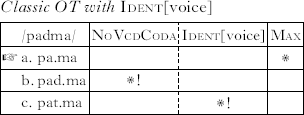
Lombardi observes that this problem does not arise with Max[voice], however. As tableau (24) shows, deletion of a voiced coda violates both Max[voice] and Max, whereas devoicing it violates only Max[voice]. Since both mappings produce a result that satisfies the markedness constraint NoVcdCoda, the more faithful candidate has to win.
(24)

Though initially attractive, the move to Max[voice] makes an unwelcome prediction. If Max[voice] dominates CodaCond, which itself dominates Max, then voiceless obstruent codas will be deleted, but voiced obstruent codas will not. We therefore get a language where /patka/ becomes [pa.ka], but /padma/ becomes [pad.ma].
(25)

With this ranking, we get a language that has voiced obstruent codas but no voiceless ones. That does not seem to happen.
This typological result indicates that there is something amiss with the Max[voice] idea. But if we retreat to Ident[voice], how will we rule out the unwanted result in (23)? Under the assumptions about gradualness in §2.2, HS does not need Max[voice] to explain why NoVcdCoda is unable to compel coda deletion. Instead, HS can rely on the fact that NoVcdCoda is unable to compel Place deletion, and Place deletion is an essential step on the path to deleting the entire coda consonant. The Place-deleting first step in the chain <pad.ma, paH.ma, pa.ma> does not improve performance on NoVcdCoda, so this constraint acting alone cannot produce coda deletion in HS.
(26)
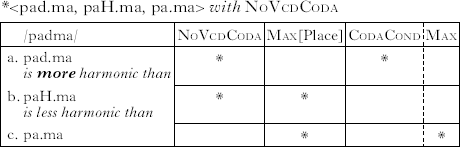
If, in addition, Ident[voice] dominates NoVcdCoda, then [pad.ma] is a local minimum. The global minimum, [pa.ma], is unattainable because there is no harmonically improving gradual path to it from /padma/. Classic OT always finds the global minimum because it evaluates the results of all processes together, in parallel. That is why classic OT with Ident[voice] makes the bad prediction in (23).
At the beginning of this section, I asked whether deleting a coda consonant might involve more intermediate steps than just debuccalisation. We know from §2.2 that the answer to this question depends on whether there are any other Max[feature] constraints besides Max[Place]. The current answer is no, since the best candidate for such a constraint, Max[voice], turns out to be problematic and, in HS, unnecessary.
3.6 Target and trigger conditions
Jun (Reference Jun1995, Reference Jun, Hayes, Kirchner and Steriade2004) did a typological survey to discover the conditions that languages impose on the segment that undergoes Place assimilation (‘target conditions’) or the segment from which the assimilating Place feature spreads (‘trigger conditions’).
Certain target conditions are rather common. In English and Diola Fogny (15), for example, nasals undergo Place assimilation, but plosives do not. In English and Catalan, coronals undergo Place assimilation but labials and velars do not.
(27)
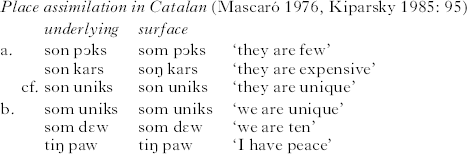
In principle, the effect of target conditions could be obtained by elaborating the markedness constraint CodaCond or the faithfulness constraint Max[Place]. For example, suppose there is a coronal-specific constraint CodaCondcoronal. In Catalan, CodaCondcoronal dominates Max[Place], but unadorned CodaCond is dominated by Max[Place]. Thus, there is a harmonically improving derivation <son kars, soN kars, soŋ kars>, but there is no gradual, harmonically improving path from /tiŋ paw/ to *[tim paw].
(28)

Likewise, Place assimilation can be limited to target nasals, as in Diola Fogny, if there is a nasal-specific version of CodaCond.
The overall proposal here is equally compatible with the faithfulness-based approach to target conditions taken by Jun (Reference Jun1995, Reference Jun, Hayes, Kirchner and Steriade2004) and de Lacy (Reference de Lacy2002, Reference de Lacy2006). Let Max[labial|dorsal] stand for the constraint or constraints violated when the marked Place features [labial] or [dorsal] are deleted. The Catalan pattern of coronal targeting is obtained if Max[labial|dorsal] dominates CodaCond, while Max[coronal] is dominated by CodaCond.
(29)

The markedness- and faithfulness-based approaches to target conditions appear to be equally compatible with the HS analysis of the coda/onset asymmetry. We will now see that a trigger condition on place assimilation has to be analysed with faithfulness, since a markedness analysis would undermine the HS explanation for the coda/onset asymmetry.
In Korean and Latin, non-coronals trigger Place assimilation but coronals do not (Hale & Buck Reference Hale and Buck1966, Devine & Stephens Reference Devine and Stephens1977, Kim-Renaud Reference Kim-Renaud1986, Jun Reference Jun1996, Reference Jun, Hayes, Kirchner and Steriade2004).
(30)

In Korean, dorsal+labial clusters are allowed without assimilation: [ʧakʰpa] ‘destruction’. They are disallowed in Latin, but the morphology provides no opportunities to see whether they assimilate.
In Korean and Latin, place assimilation does not occur when the second consonant in the cluster is a coronal. In principle, we could differentiate CodaCond and Max[Place] by the Place of the following consonant. There could be a high-ranking markedness constraint CodaCond/—lab|dors that is violated by *[mitko], but not by [ikta]. Or there could be a low-ranking faithfulness Max[Place]/—cor that is violated by the mapping /ik-ta/→[iHta], but not by the mapping /mit-ko/→[miHko]. In keeping with his overall faithfulness-based approach to trigger and target conditions, Jun opts for the latter. The HS analysis of the coda/onset asymmetry also requires a faithfulness-based approach to trigger conditions.Footnote 10
From the HS perspective, the problem with CodaCond/—lab|dors is that it can be satisfied in two different ways: debuccalising the coda or debuccalising the following onset. From input /mit-ko/, two harmonically improving HS derivations should be possible: <mit.ko, miH.ko, mik.ko> and *<mit.ko, mit.Ho, mit.to>. The problem is that [miH.ko] and [mit.Ho] both improve performance on CodaCond/—lab|dors. The HS explanation for the coda/onset asymmetry rests on the assumption that there are no constraints like the Cluster Condition discussed in §3.2. That is, there are no constraints that specifically militate against sequences of non-identical Place specifications in heterorganic clusters. CodaCond/—lab|dors is such a constraint. This is perhaps less obvious in the case of CodaCond/—lab|dors, since the reference to onset place is framed as a contextual condition, but the effect is the same.
As I noted previously, Jun's (Reference Jun1995, Reference Jun, Hayes, Kirchner and Steriade2004) analysis of trigger conditions, like his analysis of target conditions, is couched in faithfulness terms. A constraint with the force of Max[Place]/—cor prevents coda debuccalisation before a coronal, and so Place assimilation dies aborning. With Max[Place]/—cor ranked above undifferentiated CodaCond, neither *<ip.ta, iH.ta, it.ta> nor *<ip.ta, ip.Ha, ip.pa> is harmonically improving in their first steps. Furthermore, the latter is harmonically bounded under exactly the same conditions as the onset-altering derivation in (17). The HS explanation for the coda/onset asymmetry emerges unscathed.
There is a larger lesson to be found here. In an HS derivation, harmonic improvement is really a matter of becoming progressively less marked, relative to the language's constraint hierarchy. Faithfulness constraints are only relevant insofar as they stop progress toward greater unmarkedness (so every derivation does not end in [ba]) or choose among alternate paths to greater unmarkedness (such as epenthesis vs. deletion). For this reason, innovations in markedness constraints are a greater threat to restrictive typologies obtained in HS than innovations in faithfulness constraints. New markedness constraints open up new derivational paths that can lead to surface forms that had previously been unobtainable. This is a two-edged sword. In this section, the new markedness constraint proved to be a bad idea. In the next section, though, a different markedness innovation permits a necessary departure from perfect coda/onset asymmetry.
3.7 Suffix-initial deletion and assimilation
Wilson (Reference Wilson2001) suggests that the coda/onset asymmetry in deletion may not hold at root-suffix juncture. Jun (Reference Jun1995) says the same thing about the coda/onset asymmetry in Place assimilation (see also Borowsky Reference Borowsky2000 and Hyman Reference Hyman2001).
The evidence comes from cases where a consonant-final root meets a consonant-initial suffix, and the second consonant is affected by deletion or assimilation rather than the first. Most examples cited by Wilson or Jun involve alternations of a single suffix, such as the Ibibio negative (Akinlabi & Urua Reference Akinlabi and Urua2002), the Gidabal ‘to get’ suffix (Kenstowicz & Kisseberth Reference Kenstowicz and Kisseberth1977: 181), a verbal agreement suffix in Kambaata (Hudson Reference Hudson1980, Sim Reference Sim1985, Reference Sim1988) and the Dutch diminutive. The last of these is exemplified in (31).
(31)
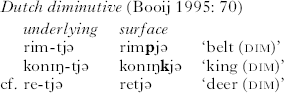
A standard phonological analysis of Dutch takes the underlying form of the diminutive suffix to be /-tjə /, with feature-changing progressive Place assimilation in words like [rimpjə ] or [konɪŋkjə ] (Booij Reference Booij1995: 69–73). But since no other Dutch suffix has this behaviour, it is equally reasonable to suppose that the diminutive suffix is /-Cjə /, where C denotes a segment unspecified for Place. It gets Place by spreading from a preceding consonant, and otherwise defaults to coronal (van der Hulst Reference Hulst1984: 127, Lahiri & Evers Reference Lahiri and Evers1991, van Oostendorp Reference Oostendorp1997: 234ff, van de Weijer Reference Weijer, Broekhuis and Fikkert2002: 203). Dutch therefore escapes the consequences of the coda/onset asymmetry for exactly the same reason that Lardil does: the affected consonant has no underlying Place to be faithful to.
This analytic move is not available for another of Jun's (Reference Jun1995) examples, however. A process of suffix-consonant place assimilation in Musey (Chadic, Chad) is analysed in detail by Shryock (Reference Shryock1993).Footnote 11 Musey has four consonant-initial suffixes: /-na, -da, -ɗi, -kijo/. When the preceding root ends in a vowel, glide or [ɾ], these suffixes preserve their underlying forms, except that /-da/ lenites to [-ɾa] and /-kijo/ lenites to [-gijo] by regular processes. But when the root ends in an oral or nasal stop, the suffix-initial consonant assimilates in Place to the root-final one.
(32)

If the root ends in a continuant [f], [s], [ɬ] or [l], then Place and manner assimilate from root to suffix: /giɾif-kijo/→[giɾiffijo] ‘kneel’. These four clusters are the only source of heteromorphemic clusters in the language, so the evidence is necessarily somewhat limited.
Obviously, Musey does not respect the coda/onset asymmetry at root-suffix juncture. An explanation is required. Jun's (Reference Jun1995) analysis calls on the distinction between root- and affix-faithfulness constraints proposed in McCarthy & Prince (Reference McCarthy and Prince1995, Reference McCarthy and Prince1999). The general idea is that the inventory of phonological objects allowed in affixes is often a less marked proper subset of the inventory in roots. If faithfulness constraints come in root and affix versions, with the root version never ranked lower, then this observation is explained. A side-effect is that phonological alternations may preferentially affect affixes when the choice is between being unfaithful in a root or an affix. In Jun's classic OT analysis, Musey exemplifies this latter behaviour: faithfulness to root Place takes precedence over faithfulness to affix Place.
(33)
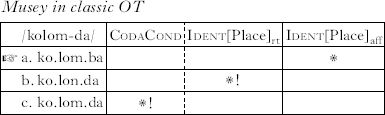
This strategy will not help with the HS analysis of Musey, however. The problem is that the first step of the derivation <ko.lom.da, ko.lom.Ha, ko.lom.ba> does not improve harmony relative to CodaCond, since the [m] of [ko.lom.Ha] has a [labial] Place feature in coda position. Although this Place feature could be licensed at the next step of the derivation by spreading to the following onset, HS requires harmonic improvement at every step, so <ko.lom.da, ko.lom.Ha, ko.lom.ba> is impossible if CodaCond is the only active constraint that favours deletion of Place.
Some recent research results suggest a different approach. There are cases where restrictions on affixes cannot be accounted for with high-ranking root faithfulness. This leads to the conclusion that affix-specific markedness constraints are required. Some examples: (i) Padgett (Reference Padgett, Suzuki and Elzinga1995) argues that Place assimilation in Gã requires a constraint against complex segments in affixes to block total Place assimilation; (ii) Walker (Reference Walker1998) presents an analysis of Tuyuca in which an affix-specific markedness constraint is needed to block nasal spreading; (iii) Bat-El (forthcoming) shows that an affix-domain OCP constraint is required in Modern Hebrew; (iv) Gouskova (Reference Gouskova2007) and Flack (Reference Flack2007) show that certain templatic requirements must be analysed with affix-specific markedness constraints.
With affix-specific markedness constraints, a proper HS analysis of Musey becomes possible.
Markedness constraints like *Coronal and *Dorsal are quite standard in OT (Prince & Smolensky Reference Prince and Smolensky1993, de Lacy Reference de Lacy2002, Reference de Lacy2006, Lombardi Reference Lombardi2002 and many others). Affix-specific versions of these constraints – that is, *Coronalaff or *Dorsalaff – will be violated by tokens of these features that belong to affixal morphemes. For example, [kolom-da] violates *Coronalaff because it contains a token of [coronal] belonging to the affixal morpheme [-da]. This token of coronal is missing from [kolom-Ha], which therefore obeys *Coronalaff. The ultimate output [kolom-ba] also obeys this constraint, because the token of [labial] associated with the affix-initial [b] does not belong to the affixal morpheme. (Consistency of Exponence ensures that the underlying morphological affiliations of phonological material are always preserved; McCarthy & Prince Reference McCarthy and Prince1993.) We can therefore discern a harmonically improving path from /kolom-da/ to [ko.lom.ba] via [ko.lom.Ha].Footnote 12
(34)
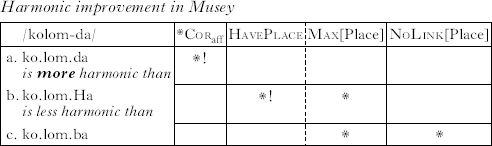
*Dorsalaff must also dominate HavePlace to account for assimilation of the initial consonant in the suffix /-kijo/. If *Dorsal universally dominates *Coronal, as is often assumed, then this ranking follows from transitivity of constraint domination.
This leaves one detail to account for: the preservation of coronal and dorsal place in affixes after root-final vowels, glides and [ɾ]: /ka-ɗi/→[ka.ɗi], *[ka.Hi]. The explanation derives from the general phonotactics of the language: the Placeless consonants [h] and [ɦ] are allowed only word-initially. We already have the explanation for why they do not occur pre- and postconsonantally: HavePlace dominates NoLink[Place], so any would-be VChV sequence will undergo Place assimilation (cf. Arbore and Afar in (18)). The only other context where [h] or [ɦ] could in principle occur but do not is after a vowel, glide or [ɾ] – exactly the environment where *Coronalaff and *Dorsalaff are unable to compel Place deletion. Therefore, the same markedness constraint(s) can block loss of Place after a vowel, glide or [ɾ], and forbid underlying Placeless consonants from surfacing faithfully in this context.
4 Further typological consequences
4.1 Introduction
The assumptions about gradualness in §2.2 entail that deletion of a Place-bearing consonant cannot be accomplished in a single step of an HS derivation. Two steps at least are required: one to delete the targeted consonant's Place node, and another to delete the rest of its structure. Because of HS's basic architecture, specifically the Gen→Eval→Gen … loop, each of these deletion steps must individually improve harmony.
Deletion of codas is possible because CodaCond prohibits Place in codas, so deleting a coda's Place node is a way of improving performance on this constraint. A different markedness constraint could also disfavour codas without specifically mentioning the Place node. Deleting the Place node would not improve performance on this constraint. Since deleting the Place node is the required path to consonant deletion, such a constraint is predicted not to cause consonant deletion. As we will see, this prediction seems to be correct. It provides additional support for HS by resolving other TMR problems that arise in classic OT.
4.2 Elimination of CVːC syllables
Many languages take pains to avoid CVːC syllables. These syllables violate markedness constraints against exceeding two moras or against having a coda that does not support its own mora (Sherer Reference Sherer1994). In classic OT, permuting the ranking of Max, Dep and Max(μ) predicts three distinct ways of eliminating CVːC.
(i) If Max and Dep dominate Max(μ), then CVːC syllables will be eliminated by vowel shortening. This occurs in Cairene Arabic, for example (Mitchell Reference Mitchell1956: 112).
(35)
(ii) If Max and Max(μ) dominate Dep, then CVːC syllables will be eliminated by epenthesising a vowel after the coda. This occurs in Mekkan Arabic, for example (Abu-Mansour Reference Abu-Mansour1987).
(36)
(iii) If Max(μ) and Dep dominate Max, then CVːC syllables will be eliminated by deleting the coda (see (37)): /siːb-ha/→[siːha].Footnote 13 To my knowledge, this never occurs.
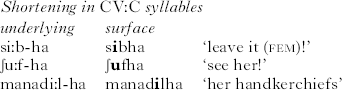
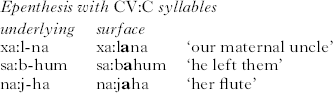
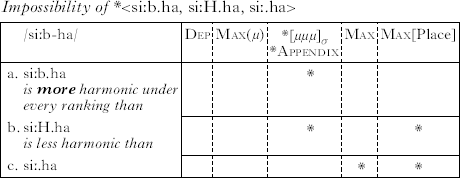
This gap in the typology is another TMR problem. The HS explanation for this typological gap is that deleting the final consonant of a CVːC syllable requires first deleting Place, and Place deletion is not harmonically improving in this specific environment. CVːC syllables are marked because they contain too much material in the rhyme, and not because the coda has Place. The HS derivation *<siːb.ha, siːH.ha, siː.ha> can only be well-formed if its first step is harmonically improving, but the constraints against CVːC syllables, unlike CodaCond, do not ensure that.
Under the ranking in tableau (37), [siː.ha] is /siːb-ha/'s global minimum of potential for further harmonic improvement. This tableau shows that classic OT has no difficulty finding the global minimum. That is because classic OT's single pass through Gen produces a very diverse candidate set that always includes the global minimum.
(37)
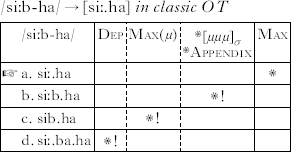
The markedness constraints *[μμμ]σ and *Appendix rule out the two possible ways of faithfully parsing [siːb], as a trimoraic syllable or as a bimoraic syllable with a non-moraic coda.
In comparison, HS's more limited Gen produces a candidate set that does not include the global minimum whenever the global minimum is at least two steps away because of gradualness. The global minimum is sometimes reached eventually, in which case classic OT and HS give identical final outputs for a given input and a given constraint hierarchy. But sometimes the global minimum is unattainable because HS gets stuck in a local minimum along the way. That is the situation in (38). The faithful form [siːb.ha] is a local minimum – there is no single step that will improve its harmony relative to this constraint hierarchy. Because debuccalisation by itself does not improve performance on the markedness constraints *[μμμ] and *Appendix, the only way to get from [siːb.ha] to [siː.ha] requires first becoming less harmonic [siːH.ha] before becoming more harmonic [siː.ha]. But the Gen→Eval→Gen … loop makes that literally impossible.
(38)
Obviously, the typological effects of local minima will depend on exactly which constraints are in Con and on precisely how gradualness is defined. But the point is clear from this example and the others in this article: the possibility of getting stuck in a local minimum allows HS to solve some TMR problems that challenge classic OT and its ability to always find the global minimum.
4.3 Metrically conditioned shortening
Many languages have processes of vowel shortening that are conditioned by metrical structure. In Cairene Arabic, vowels shorten in syllables that do not bear the main stress (Mitchell Reference Mitchell1956: 111–112).
(39)

In Latin, vowels shorten to allow a light-heavy sequence to be parsed as a well-formed moraic trochee consisting of two light syllables (Allen Reference Allen1973, Mester Reference Mester1994).
(40)
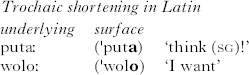
Trochaic shortening is also found in Tonkawa (Hoijer Reference Hoijer, Boas and Hoijer1933, Reference Hoijer, Hoijer, Bloomfield, Haas, Halpern, Li, Newman, Swadesh, Trager, Voegelin and Whorf1946, Gouskova Reference Gouskova2003) and Fijian (Dixon Reference Dixon1988, Hayes Reference Hayes1995). English trisyllabic shortening is an instance of trochaic shortening as well (Prince Reference Prince1990).
The rationale for these processes is straightforward. Shortening of unstressed long vowels is a response to the constraint Weight-to-Stress (Prince Reference Prince1990), which is violated by any syllable that is heavy yet unstressed. Trochaic shortening, as I noted, brings a light–heavy sequence into conformity with the usual quantitative requirements on trochaic feet embodied in the Iambic/Trochaic Law (I/TL) of Hayes (Reference Hayes1995). According to I/TL, trochaic feet optimally have equal quantity, so light–light [(ˈputa)] is less marked than light–heavy *[(ˈputaː)]. For a full HS analysis of trochaic shortening, see McCarthy (forthcoming).
Deleting the coda from an unstressed heavy syllable could in principle improve performance on Weight-to-Stress and I/TL. For example, Weight-to-Stress would favour *[ʃaˈsijja] over faithful [ʃamˈsijja] ‘parasol’ in Cairene. Likewise, I/TL would favour *[(ˈputa)] over faithful [(ˈputat)] ‘he thinks’ in Latin. Deleting the highlighted consonants in these examples turns a heavy syllable into a light one, just as vowel shortening does. Ranking Max above Weight-to-Stress and I/TL can account for why Cairene and Latin do not do this. But this language-particular ranking does not solve the typological problem: to my knowledge, no language satisfies Weight-to-Stress or I/TL by deleting a consonant (except by degemination). This is another instance of the TMR problem.
With gradualness as defined in §2.2, HS has an explanation for why Weight-to-Stress and I/TL never lead to consonant deletion. Weight-to-Stress and I/TL are constraints on the relationship between syllable quantity and metrical structure. Obviously, neither of them says anything about the Place node, so deleting a consonant's Place node will not improve performance on either of these constraints. Consider pseudo-Cairene, where Max is ranked below Weight-to-Stress. The second step in the derivation *<ʃamsijja, ʃam(ˈsij)ja, ʃaN(ˈsij)ja, ʃa(ˈsij)ja> is not harmonically improving relative to Weight-to-Stress; satisfaction of Weight-to-Stress is not obtained until the third step. Consider also pseudo-Latin, with Max ranked below I/TL. The second step in the derivation *<putat, (ˈputat), (ˈputaH), (ˈputa)> does not purchase better satisfaction of I/TL; that has to wait until the third step. Because consonant deletion must proceed by way of debuccalisation, and neither Weight-to-Stress nor I/TL favours debuccalisation, these constraints acting alone cannot compel consonant deletion.
Pseudo-Cairene and pseudo-Latin are further examples of the effect of local minima in HS. In *<ʃamsijja, ʃam(ˈsij)ja, ʃaN(ˈsij)ja, ʃa(ˈsij)ja>, the form [ʃam(ˈsij)ja] is a local minimum that is distinct from the global minimum [ʃa(ˈsij)ja]. Classic OT finds the global minimum without difficulty – to its detriment, if the typological claim is correct. HS gets stuck at the local minimum, so it cannot reach the global minimum. To return to the analogy that introduced this concept, Weight-to-Stress and I/TL are unable to push the ball over the debuccalisation bump, so the ball never makes it to the bottom of the hill.
5 Comparison with other theories
There are three other main approaches to the coda/onset asymmetry: positional faithfulness, the P-map and targeted constraints. I will briefly discuss each of them in turn, focusing on the ways in which they differ from the HS analysis presented here.
5.1 Positional faithfulness
Positional faithfulness constraints are based on the general idea that faithfulness constraints can be relativised to certain contexts (Casali Reference Casali1996, Reference Casali1997, Beckman Reference Beckman1997, Reference Beckman1998, Lombardi Reference Lombardi1999, Reference Lombardi and Lombardi2001 and others). At first, this looks like a promising approach to the coda/onset asymmetry. Perhaps /patka/ becomes [pa.ka] and not *[pa.ta] because /k/ is in a position of greater faithfulness. This initial optimism turns out to be unjustified. The devil is in the details.
To use a positional faithfulness constraint, we need to identify a context of greater faithfulness, and we have to say whether that context is defined on the input or the output. For instance, Max(Vː) prevents deletion of underlying long vowels, and it extends this protection to underlying long vowels that are shortened in the output, so its context must be defined on the input (Gouskova Reference Gouskova2003, McCarthy Reference McCarthy, Alhawary and Benmamoun2005). On the other hand, Beckman (Reference Beckman1998: ch. 3) proposes a class of Identˈσ[feature] positional faithfulness constraints that require vowels that are stressed in the output to have the same feature values as their input correspondents. In most cases, whether a syllable is stressed or not is determined by the grammar, not the lexicon, so the context for this constraint has to be defined on the output.
A positional faithfulness constraint that is intended to prevent deletion has to have its context defined on the input. There is no way to block the mapping /patka/→*[pa.ta] with a positional faithfulness constraint that references the output, since the segment that this constraint would have to protect is missing from the output. In other words, Maxonset makes no sense, because a consonant's status as onset or coda is something that can only be determined by looking at the output.Footnote 14
We therefore require a faithfulness constraint that differentiates /t/ and /k/ in /patka/. For instance, we might say that /k/ is treated more faithfully because it is prevocalic. On this view, hypothetical Maxprevocalic is violated whenever a consonant is deleted that is prevocalic in the input.Footnote 15
Wilson (Reference Wilson2001) identifies the flaw in this proposal: even when a cluster is derived by syncope, it is still the first consonant in the cluster that is targeted for deletion, debuccalisation or assimilation, even though both consonants are prevocalic in underlying representation. The Cariban languages supply some nice examples. Gildea (Reference Gildea1995) describes in detail how coda deletion, assimilation and debuccalisation processes in these languages affect consonants that have become codas by syncope. For instance, in the paradigm of the Panare verb /utu/ ‘give’, the final /u/ is deleted before a -CV suffix, and the preceding /t/ is debuccalised to [h] (or [ʔ] before a nasal).
(41)
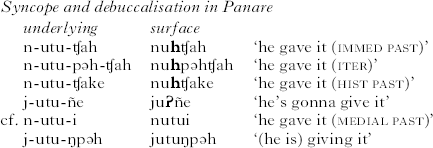
Deletion fed by syncope is illustrated by the Carib of Surinam data in (42).Footnote 16
(42)

Constraints like Ident[Place]prevocalic or Maxprevocalic are no help in analysing these data. For instance, in /wɨːto-sa/, both /t/ and /s/ are prevocalic in the input, so there is no way of using Maxprevocalic to distinguish between [wiːsa] and *[wiːta]. And since Maxprevocalic is necessarily input-sensitive, there is no way of using the output to resolve this conundrum.
Reduction of clusters derived by syncope is entirely unproblematic under the HS system advocated here. CodaCond is not relevant until the HS derivation has progressed to the point of syncope: <wɨː.to.sa, wɨːt.sa, …>. At this point, the situation is exactly the same as it is in the /patka/ example: CodaCond favours debuccalisation of /t/ but not /s/, and debuccalisation is a necessary step on the way toward deletion: <wɨː.to.sa, wɨːt.sa, wɨːH.sa, wɨː.sa>.
Morpheme-initial positional faithfulness constraints offer another possible approach to the coda/onset asymmetry. Drawing on evidence from hiatus resolution, Casali (Reference Casali1996, Reference Casali1997) proposes that morpheme-initial segments are subject to special faithfulness constraints, and Pater (Reference Pater2003: 25) suggests that these constraints might account for the coda/onset asymmetry. This idea could work for many commonly cited examples of the asymmetry, such as Diola Fogny. Furthermore, unlike the faithfulness constraints that refer to prevocalic position, morpheme-initial positional faithfulness would be able to deal with the Panare and Carib examples in (41) and (42).
Morpheme-initial faithfulness cannot account for all instances of the coda/onset asymmetry, however. This is shown by examples where a consonant that assimilates or deletes in coda position remains unchanged in onset position even when it is not morpheme-initial.
(i) In Syrian Arabic, coda /n/ assimilates in place to a following labial (Cowell Reference Cowell1964: 27): /mə n beːruːt/→[mə m beːruːt] ‘from Beirut’; /ʕanbar/→[ʕambar] ‘storehouse’ (cf. [ʕanaːber] ‘storehouses’). But onset /n/ never assimilates, even when it is not morpheme-initial: /b-jə -bni/→[jibni], *[jibmi] ‘he builds’.
(ii) In Tiberian Hebrew, /n/ (unless root-final) assimilates totally to a following consonant (Gesenius Reference Gesenius1910: 69): /min ʃam/→[miʃʃaːm] ‘from there’; /ji-nteːn/→[jitteːn] ‘he gives’ (cf. [naːθan] ‘he gave’). But onset /n/ is not affected, even when it is not morpheme-initial: /ji-tne-uː/→[jiθnuː], *[jittuː] ‘they hire’.
(iii) In Akkadian, the facts are much the same as in Hebrew (Huehnergard Reference Huehnergard2005: 32, 588). Coda /n/ assimilates: /i-ndin/→[iddin] ‘he gave’ (cf. [nadaːn-um] ‘to give (nom sg)’). But onset /n/ does not: /ʃakin-um/→[ʃaknum], *[ʃakkum] ‘placed (nom sg)’.
There are also cases where the coda/onset asymmetry is observed even though both consonants are morpheme-initial. For instance, in Classical Arabic, a high glide assimilates totally to following /t/ in circumstances where the glide is root-initial and the /t/ is the initial (and sole) segment in an infix that is located immediately after the root-initial consonant (Wright Reference Wright1896: 80): /ja-w-t-aʕid-u/→[jattaʕidu] ‘he receives a promise’ (cf. [waʕada] ‘he made a promise’). From this and the other evidence, it is clear that morpheme-initial faithfulness is no substitute for the HS analysis of the coda/onset asymmetry.
5.2 The P-map and related ideas
Steriade (Reference Steriade2001, forthcoming) proposes that unfaithful mappings are constrained by perceptual similarity. When there is more than one way to satisfy markedness requirements, the optimal unfaithful mapping is the one that is most similar perceptually to the faithful candidate. Similarly, Jun (Reference Jun1995: 122) proposes that faithfulness ‘constraints for consonantal gestures with strong acoustic cues are more highly ranked than those with weak ones’.
In the case at hand, we compare two unfaithful candidates, [pa.ka] and [pa.ta], for perceptual similarity with faithful [pat.ka]. The [t] and [k] of [pat.ka] differ in salience: [t] is less salient because its V—C context means that phonetic cues to its Place are relatively weak. In contrast, [k]'s C—V context means that those cues are more robust. The reason why /pat.ka/ becomes [pa.ka] and not *[pa.ta], then, is that [pa.ka] is simply more faithful, because relative faithfulness is a matter of perceptual similarity with the faithful candidate.
Formally, information about perceptual similarity is recorded in a data-structure called the P-map, and faithfulness constraints in universally fixed rankings are projected from the P-map. Among other things, the P-map says that a consonant is more similar to in the context V—C than in the context C—V. Two faithfulness constraints are projected from this, Max/V—C and Max/C—V, in the universally fixed ranking Max/C—V≫Max/V—C. From this it can follow that the mapping /patka/→[pa.ka] is more faithful than the mapping /patka/→[pa.ta] in every language.
This approach and the positional faithfulness approach are somewhat similar. In fact, the P-map can be understood as providing an answer to why prevocalic position evokes greater faithfulness against deletion, debuccalisation and assimilation. It is not surprising, then, that the P-map approach has the same problem as positional faithfulness does in dealing with clusters derived by syncope. The Carib candidates [wɨː.sa] and *[wɨː.ta] equally obey both Max/C—V and Max/V—C, since the contexts for these constraints are not met in the fully faithful candidate [wɨː.to.sa].
A promising line of future research is to unite HS with the study of perceptual influences on phonological mappings. The P-map's problem in classic OT is that it has only one touchstone of perceptual similarity, the fully faithful candidate. But HS's intermediate forms offer additional possibilities. For example, if Max/C—V referred to the conditions obtaining in the output of syncope, [wɨːt.sa], rather than the fully faithful candidate [wɨː.to.sa], then it would work fine. A reasonable research hypothesis is that candidates are evaluated for perceptual similarity with their immediate derivational predecessor, rather than with the underlying representation.
5.3 Targeted constraints
Standard OT constraints impose a stratified partial ordering on the entire candidate set. This means that every candidate is in the ordering (i.e. every candidate has zero or more violation marks), but some candidates tie with others. Targeted constraints, proposed by Wilson (Reference Wilson2000, Reference Wilson2001), impose a partial ordering that may be non-stratified. This means that some candidates can be entirely outside the ordering, so the constraint says nothing about their relationship to other candidates. For this reason, targeted constraints do not assign violation marks; instead, they make assertions about the relative harmony of candidates.
The coda/onset asymmetry is the basis of an argument for targeted constraints in Wilson (Reference Wilson2001). Cluster reduction is a response to the markedness constraint NoWeakCons.
(43)

Whereas CodaCond favours both [pa.ka] and [pa.ta] over faithful [pat.ka], NoWeakCons favours only [pa.ka] over [pat.ka] – it says nothing about [pa.ta]. That is because [pa.ka] and [pat.ka] meet the requirement of being exactly alike except for the removal of an unreleased consonant, whereas [pa.ta] and [pat.ka] don't. In the context of the rest of targeted-constraints theory, this difference is enough to ensure that [pa.ta] can never beat [pa.ka].
Targeted-constraints theory (TCT) and HS have one important thing in common: they rely on a representation that is neither the input nor the output. In HS, this representation is the intermediate step of a derivation. In TCT, it is the candidate referred to in the ‘exactly like … except’ clause of (43). This point of similarity between HS and TCT is particularly clear when we consider how the two theories deal with reduction of clusters derived by syncope (§5.1). In HS, we have a derivation <wɨː.to.sa, wɨːt.sa, wɨːH.sa, wɨː.sa> with the intermediate form [wɨːt.sa]. In TCT, [wɨːt.sa] also makes an appearance; it is the ‘exactly like … except’ candidate: [wɨː.sa] is more harmonic than [wɨːt.sa] because [wɨː.sa] is exactly like [wɨːt.sa] except for removal of the unreleased consonant [t].
There is also an important difference between TCT and HS. A targeted markedness constraint is like a rule, because it specifies not only a prohibited configuration but also a specific way of repairing that configuration. For instance, in (43) the prohibited configuration is an unreleased consonant and the repair is deletion. In contrast, HS's markedness constraints are identical to classic OT's markedness constraints – they specify prohibited configurations but say nothing about how to fix them.
The resemblance between targeted constraints and rules might seem to abandon one of the main insights of classic OT: the same undesirable output configuration can be avoided in different ways in different languages or even in different contexts within the same language. The situation is not so dire, however, since Wilson (Reference Wilson2001: 171–173) is careful to show that targeted NoWeakCons still allows for an analysis of languages that avoid clusters by vowel epenthesis rather than reduction. The idea is that top-ranked NoWeakCons establishes the harmonic ordering [pa.ka]≻[pat.ka], and then lower-ranking Max gives [pa.tə.ka]≻[pa.ka], [pa.ta].
Nonetheless, targeted markedness constraints do have a deficiency in comparison with standard OT markedness constraints: they cannot in general account for emergence of the unmarked effects (McCarthy & Prince Reference McCarthy and Prince1994). Emergence of the unmarked in allomorph selection supplies an example (for others, see McCarthy Reference McCarthy2002a: 281–282, 284–285). A widely adopted approach to allomorph selection in OT says that both allomorphs appear in underlying representation, so outputs based on either of them are equally faithful. The correct allomorph is selected by emergent markedness constraints (Burzio Reference Burzio and Ristad1994, Mester Reference Mester1994, Hargus Reference Hargus1995, Mascaró Reference Mascaró, Durand and Laks1996, Tranel Reference Tranel and Zagona1996a, Reference Tranel, Parodi, Quicoli, Saltarelli and Zubizarretab, Reference Tranel1998, Hargus & Tuttle Reference Hargus and Tuttle1997 and others).
For example, the nominative suffix in Korean has two allomorphs, /-i/ and /-ka/. The /-i/ allomorph follows consonants and the /-ka/ allomorph follows vowels.
(44)
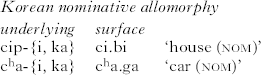
The standard OT markedness constraints easily do the job for Korean: Onset favours [cʰa.ga] over *[cʰa.i], and CodaCond favours [ci.bi] over *[cip.ka]. But targeted markedness constraints will not work, because they are limited to comparing forms that differ only minimally. NoWeakCons says nothing about the relative harmony of [ci.bi] and *[cip.ka], since [ci.bi] is not exactly like *[cip.ka] except that an unreleased consonant has been removed.
One of the goals of TCT is to explain why the coda/onset asymmetry cannot be disrupted by other markedness constraints. For example, since velar consonants violate *Dorsal, why don't we find languages that usually delete the first consonant in a cluster but delete the second one if it is a velar: /map-ta/→[ma.ta], but /pat-ka/→[pa.ta]? The answer given in Wilson (Reference Wilson2001) is that *Dorsal could not have this effect unless it were ranked high enough to cause all velars to delete, even those that occur outside clusters. In other words, we don't find languages exhibiting this pattern of cluster simplification because any such language would completely lack velars in its inventory.
There is a flaw in this argument (McCarthy Reference McCarthy2002a: 277–280): if Onset dominates *Dorsal, then velars will be present in the language's inventory in forms like [ka.ta] or [ta.ka], yet they will still delete in /pat-ka/→[pa.ta]. More generally, the argument is undermined by any markedness constraint that can block deletion of /k/ in /kata/ or /taka/, but not /patka/.
It appears that the present proposal does not have this problem. For a velar to delete, it must first lose Place. *Dorsal could certainly cause that to happen. This is only a problem, however, if there exists a markedness constraint that is violated by the [H] in [Ha.ta] or [ta.Ha], but not in [mat.Ha]. I know of only two possibilities. An ad hoc constraint against intervocalic [h] appears in the McCarthy & Prince (Reference McCarthy and Prince1995) analysis of Javanese, but this turns out to be wrong because Javanese bans [h] from all onsets, not just intervocalic ones (Davis & Cho Reference Davis and Cho2003; see also Parker Reference Parker2001). And a constraint against intervocalic [ʔ] appears in Gabriel & Meisenburg's (forthcoming) analysis of French h aspiré; it is criticised and shown to be superfluous by Boersma (Reference Boersma2007).
6 Conclusion
In this article, I have argued that harmonic serialism offers a novel account of the generalisation that simplification and assimilation of medial consonant clusters targets the would-be coda and not the would-be onset. The elements of HS that are essential to the explanation are gradualness and harmonic improvement. Gradualness is what distinguishes HS's Gen from classic OT's Gen, and harmonic improvement is a consequence of HS's basic architecture, the Gen→Eval→Gen … loop. When combined with certain substantive assumptions about faithfulness and segmental representation, HS requires consonant deletion or Place assimilation to go by way of consonant debuccalisation. Because CodaCond favours debuccalisation in codas but not in onsets, only would-be codas can undergo deletion or assimilation in a harmonically improving fashion.
The analysis developed here and HS in general have many potential implications for our understanding of phonological phenomena. They provoke questions like the following:
(i) According to the analysis here, deletion of a coda consonant is a process of gradual attrition. Is that also true of vowel deletion?
(ii) When segments delete in template mapping or other situations, is the path also gradual?
(iii) When several segments are affected by the same process, are they changed one at a time or all at once?
(iv) Does gradualness make sense with other phonological phenomena, such as epenthesis or stress assignment?
Obviously, definitive answers to these and other questions are impossible in an article of this size. I can, however, suggest possible directions for research and call attention to any progress that has already been made.
(i) Do vowels also delete by gradual attrition?
One reason to think that consonant deletion is a process of gradual attrition is the similarity between debuccalisation and deletion – they occur in the same context and sometimes in the same language (see §3.4). There is a similar connection between vowel reduction and syncope: both tend to occur in syllables of low prominence. This observation suggests that vowel reduction may be a step (or two) along the path to syncope.
The details depend on exactly how we understand the process in representational and faithfulness terms. In theories that represent vowels as combinations of phonological elements (or privative features), reduction is analysed as loss of structure (e.g. Harris Reference Harris1994: 107–113). Were we to assume an element theory of vowel representation within an HS analysis of reduction, then there would be one derivational step for each underlying element that is deleted. Each step would have to improve harmony, so appropriate markedness constraints on the licensing of these elements would be required. Obviously, different assumptions about representations and faithfulness would have different implications.
(ii) What about other deletion phenomena?
The view of deletion as gradual attrition is a good fit to coda weakening and deletion processes, and perhaps to vowel reduction and syncope. But what about other cases of deletion, particularly the loss of segments that cannot be mapped to a prosodic template? For example, the Japanese ‘rustic girls’ names' pattern maps a name to a bimoraic foot: [(mido)ftɾi]→[o-(mido)ft] (Poser Reference Poser1984a, Reference Poserb, Reference Prince1990, Mester Reference Mester1990). Do the [ɾ] and [i] each require at least two derivational steps to delete, like a coda consonant in Diola Fogny?
Starting with the earliest work on prosodic morphology (McCarthy Reference McCarthy1979, Marantz Reference Marantz1982, McCarthy & Prince Reference McCarthy and Prince1986), it was assumed that prosodic templates make segments pronounceable by parsing them. Segments that could not be parsed into the template, like [ɾ] and [i] in [o-(mido)ft], were not pronounced, precisely because they could not be parsed. If this traditional view of template mapping is correct, then there is no reason to expect that ‘deletion’ of extra-templatic segments has the same gradual character as deletion of codas in Diola Fogny. (Also see note 6 for discussion of yet another kind of deletion.)
(iii) Do multiple instances of the same process occur sequentially or simultaneously? Footnote 18
If a hypothetical word of Diola Fogny has two coda consonants, does each have its own debuccalisation and deletion steps: <pak.tap.ta, paʰ.tap.ta, paH.taH.ta, pa.taH.ta, pa.ta.ta>? Or do all debuccalisation mappings and all deletion mappings occur simultaneously: <pak.tap.ta, paH.taH.ta, pa.ta.ta>? Although I know of no evidence bearing on this specific question about codas, there is solid evidence for the sequential account from other phenomena. In McCarthy (Reference McCarthy, Blaho, Bye and Krämer2007b), I argue on typological grounds that apocope, autosegmental feature spreading and metathesis can affect no more than one segment at a time. Pruitt (Reference Pruitt2008) argues, again on typological grounds, that metrical feet are assigned one at a time, and in McCarthy (forthcoming) I find further confirmation for this claim.
The theoretical issue at stake here is the proper definition of gradualness. Should the definition in (2) be revised to read ‘If β is a member of the set Gen(α), then no more than one type of unfaithful operation is required to transform α into β’ or ‘If β is a member of the set Gen(α), then no more than one instance of an unfaithful operation is required to transform α into β’? The evidence so far favours the latter version.
(iv) Does gradualness make sense with other phonological phenomena?
Work already discussed suggests that gradualness and harmonic improvement do indeed make sense with – and help to make sense of – phenomena like deletion, reduction, assimilation, autosegmental spreading and stress assignment. Wolf (Reference Wolf2008) shows that HS with these premises also leads to a better understanding of phonology–morphology interactions, if the spell-out of a single morpheme is included among the operations that can constitute a single derivational step. A version of HS, OT with candidate chains (OT-CC), is applied to phonological opacity in McCarthy (Reference McCarthy2007a). Obviously, much more remains to be done, but this list covers a great deal of phonological territory.
One common phonological phenomenon that has not been mentioned so far is epenthesis. Max[feature] constraints have Dep[feature] counterparts, so epenthesis should involve gradual, harmonically improving accretion of structure, just as deletion involves gradual, harmonically improving attrition of structure. This is certainly not a novel view of epenthesis. In the early OT literature and previously (Selkirk Reference Selkirk, Borer and Aoun1981, Broselow Reference Broselow1982, Piggott & Singh Reference Piggott and Singh1985, Itô Reference Itô1986, Reference Itô1989, Prince & Smolensky Reference Prince and Smolensky1993), epenthesis is analysed as at least a two-stage process: creation of an empty timing slot followed by insertion of default features. In underspecification theory (Archangeli Reference Archangeli1984), the default features are inserted by separate rules that apply sequentially. A plausible approach to epenthesis in HS could be built on this earlier work. There are obvious problems when epenthesis creates segments that have too much structure to be plausible defaults, but these cases are no less a problem for classic OT, rule-based underspecification theory, or markedness in general (for relevant discussion, see Lombardi Reference Lombardi2002, Reference Lombardi2003, Vaux Reference Vaux2002, Uffmann Reference Uffmann2007).
Any novel approach to familiar phenomena is bound to raise new questions even as it answers old ones. HS is no different. Sometimes these new questions can seem like problems or even insuperable obstacles. Questions are not problems; they are opportunities for further research. HS offers many such opportunities.



