I. Introduction
Article 24 of plant protection EC Commission Regulation No 1107/2009 (PPP Regulation) introduced in 2009Footnote 1 a new concept in crop protection substances as well as a specific status for active substances as candidates for substitution (CfS).Footnote 2 This new category of substances was undoubtedly introduced with the objective of reducing pesticide impacts following civil society concerns.Footnote 3 Active substances can be registered as one of the four types: standard substances (approved for ten years), basic substances (not a substance of concern, no time limit for approbation, etc.), low-risk substances (low risk to human and animal health and the environment, approved for fifteen years, etc.) and CfS (cut-off criteria imposed and only approved for seven years maximum, etc.).Footnote 4 The establishment of this statute with the first CfS only came late in 2015 after the entry into force of the PPP Regulation in 2011.Footnote 5
The regulatory definition of CfS included two parts: (1) “An active substance complying with the criteria provided for in Article 4 shall be approved, for a period not exceeding seven years, as a candidate for substitution if it meets one or more of the additional criteria laid down in point 4 of Annex II. By way of derogation from Article 14(2), the approval may be renewed once or more for periods not exceeding seven years”; and (2) “Without prejudice to paragraph 1, Articles 4 to 21 shall apply. Candidates for substitution shall be listed separately in the Regulation referred to in Article 13(4)”. Numerous criteria were defined for the classification of CfS, mainly referring to point 4 of Annex II to the PPP RegulationFootnote 6: being carcinogen category 1A or 1B or toxic for reproduction category 1A or 1B; having endocrine-disrupting properties; having a low acceptable daily intake (ADI), acute reference dose (ARfD) or acceptable operator exposure level (AOEL); having two properties from being persistent, bio-accumulative or toxic (PBT); and containing a significant proportion of non-active isomers or inducing critical effects. At the present time, the endocrine-disrupting properties refer to point 3.6.5 of Annex II to the PPP Regulation, but are not fully settled. Substances that the approval document (Implementing Regulation) is referring to in terms of Article 80(7) of the PPP Regulation should also be verified for CfS status during full approval and inclusion in Part B of Regulation (EU) No 540/2011.Footnote 7 Once granted CfS status, some restrictions apply when renewal of the approval is involved. The renewal duration is reduced to a maximum of seven instead of fifteen years.
The first wave of qualification took place in 2015 with an impressive official total of seventy-seven CfS, in reality corresponding to eighty-one active substances (copper compounds are not considered as active substances).
II. Material and methods
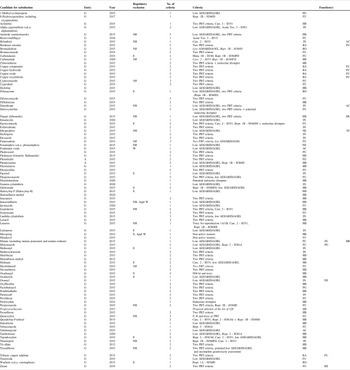
The evolution of the agrochemical substances panel was followed using the Commission implementing regulations amending Implementing Regulation (EU) No 540/2011. These regulations were used to trace the history of agrochemical substances since 2011 to the present day and took into account all of the approvals, approval extensions and renewals of the substances, together with their approved periods. The European Union (EU) Pesticides DatabaseFootnote 8 was also used to follow Commission Implementing Regulation No 2015/408 updates.Footnote 9 The EU Pesticides Database is also used to determine the disappearance of substances without any implementing regulation (end of approval, CfS qualification during evaluation). Review reports on each active substance published on each page in the EU Pesticides Database were also taken in consideration. The EU Pesticides Database was moving to its v.2.1 revision at the end of 2020, consisting of a large update to its active substances data. Constant follow-up and analysis of all regulation implementations were conducted regarding the evolution of all substances in the different Parts (A to E) of Regulation EC 540/2011. The results show the allocations into Part A (in 2011), Part B (from 2011) and Part E (from 2015); since all CfS are not registered in the dedicated Part E, this analysis includes the disappearance of non-supported substances (end of approval without a regulatory event). Later, some CfS were identified in the evaluation outcomes from the European Food Safety Authority (EFSA) during renewals. The resulting material data are exhibited in Table 1. Thus, ninety-four active substances were granted CfS since 2015 at diverse levels, and their functions are detailed in Table 1.
Candidates for substitution substances in the PPP Regulation: functions, entryway (A or G) and entry date.

Italics represent an ongoing process.
A = approved as CfS (others were granted (G) after approval); AC = acaricide; ADI = acceptable daily intake; AOEL = acceptable operator exposure level; Appl W = application withdrawn; ARfD = acute reference dose; BA = bactericide; Carc. = carcinogenic; DE = desiccant; E = end of approval; FU = fungicide; HB = herbicide; IN = insecticide; Muta. = mutagenic; NE = nematicide; NR = non-renewal; PBT = persistent, bio-accumulative and toxic; PG = plant growth regulator; RE = repulsive; Repr. = reprotoxic; RO = rodenticide; Tox. = toxicity; W = withdrawal.
III. Results
1. Overall evolution of candidate for substitution substances since 2011
With the entry into force in 2011 of the Commission Implementing Regulation (EU) No 540/2011, 398 substances were immediately approved. At the present time, approximately 467 substancesFootnote 10 have been permitted, which represents a significant increase compared to the initial number; however, the maximum number of substances was 502.Footnote 11 To understand the calculation of the total number of substances, it should be mentioned that many blocks of microorganism active substances (lists of strains in a single substance) were converted at various points into individual approvals (ie during renewals).
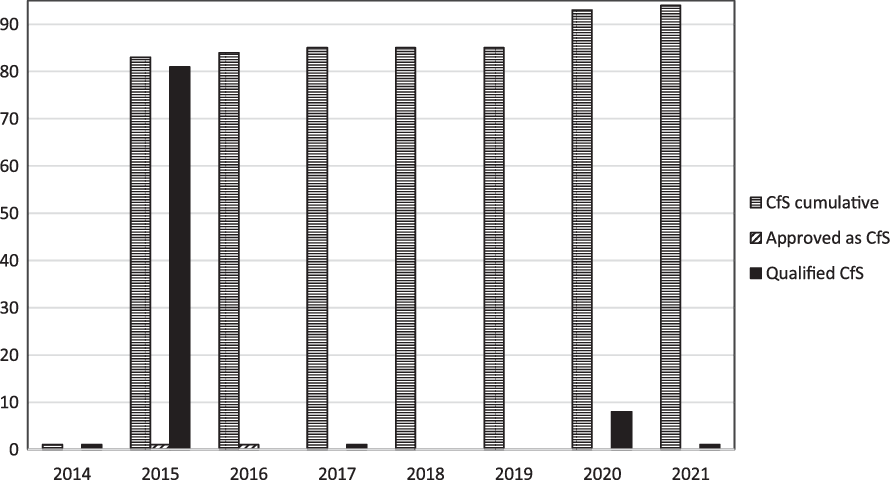
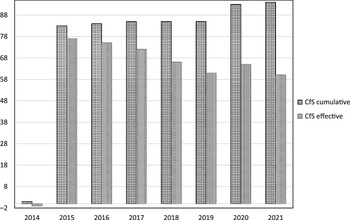
Thus, CfS represent at their entry time (2015) more than 16% of the total number of substances. Recently, two newly approved substances (flumetralin and benzovindiflupyr) were directly granted this CfS status, entering directly in Part E.Footnote 12 In 2017, 8-hydroxyquinoline was also granted CfS status. It has to be noted that Part E of Implementing Regulation (EU) No 540/2011 was not implemented with substances qualified under Implementing Regulation (EU) No 2015/408. Later evolutions of Implementing Regulation (EU) No 2015/408 show the addition to the CfS list of 8-hydroxyquinolineFootnote 13 and 1-methylcyclopropene.Footnote 14 A further list of CfS (seven active substances) was published in 2020, transferring seven more substances into the annex of Implementing Regulation (EU) No 2015/408.Footnote 15 Finally, thiacloprid was qualified as a CfS during its renewal process and thus does not appear in Table 1, but is present in Figure 1. Thus, ninety-four active substances were granted CfS status since 2015 at diverse levels detailed in Table 1, and their evolution is shown in Figure 1.
Number of candidates for substitution (CfS) by type of entry and cumulative sum between 2014 and 2020.

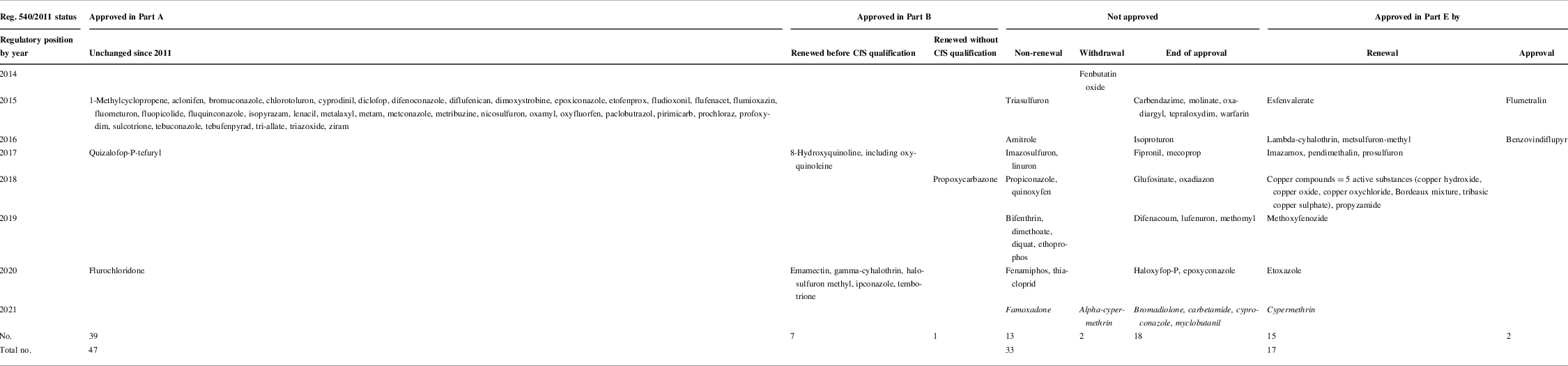
The different movements of CfS between Parts A, B and E and their reglementary status are described in Table 2. Some were initially granted when present in Part A and some when present in Part B (after renewal). The CfS present in Part E were granted during renewal (from Part A or Part B) or by direct approval as CfS.
Evolution of candidates for substitution (CfS) in the PPP Regulation.

Italics represent an ongoing reglementary event.
Previously, fenbutatin oxideFootnote 16 was already withdrawn and oxadiargyl’sFootnote 17 approval ended in 2014 from Part A before the publication of the first list. The first non-renewed active substance was triasulfuron,Footnote 18 whereas the first CfS removed from Part A by simple end of approval was carbendazime.Footnote 19 The first active substance qualified as a CfS in the PPP Regulation by Implementing Regulation (EU) No 2015/408Footnote 20 renewed from Part A was esfenvalerate in 2015, therefore opening the way to Part E of the PPP regulation. FlumetralinFootnote 21 was the first For CfS to undergo direct entry in Part E in 2015. Surprisingly, propoxycarbazoneFootnote 22 was renewed from Part A into Part B in 2017 and CfS qualifications were abandoned during its renewal. These qualification changes resulted from the risk assessment conclusions of the renewal evaluation,Footnote 23 and the abandonment of the CfS qualification was officially requested in 2021.Footnote 24
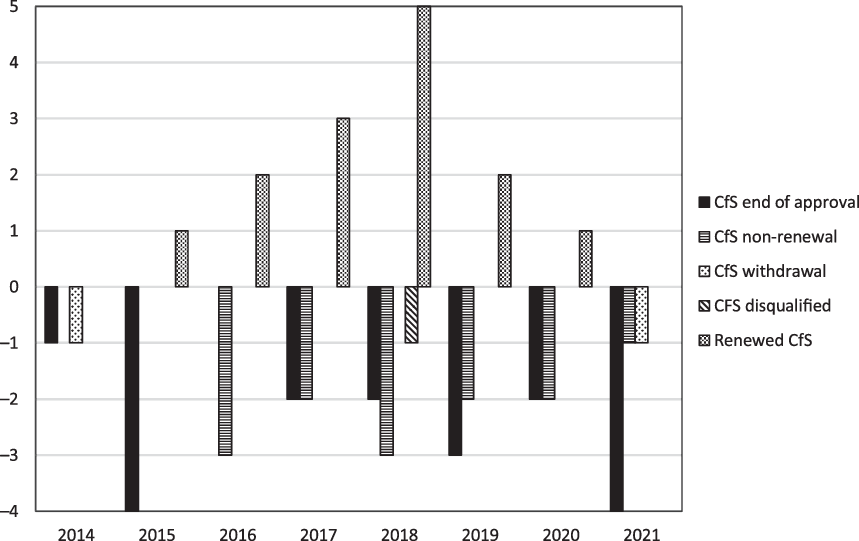
Exits (by suppression, withdrawal, end of approval or disqualification) from Implementing Regulation (EC) No 540/2011 since 2014 are shown in Figure 2, while the cumulative sum of CfS entries (via approval or qualification) and resultant annual effective numbers of CfS are exhibited in Figure 3. These show a relative high number of granted CfS since 2014 (ninety-four active substances) compared to the approved maximum number of active substance (502), as well as a slow decrease of the still-approved CfS (sixty active substances) from the total granted CfS; thus, only 30% (thirty-four active substances) have been removed (Figure 2).
Evolution of candidates for substitution (CfS) between 2014 and 2020.
Note: Number and type of CfS suppression (under) and renewal (above).

Cumulative entries and effective approved numbers of candidates for substitution (CfS) between 2014 and 2020.

In the meantime, fifteen CfS were renewed between 2014 and 2020 (Figure 2 and Table 2)Footnote 25 for a maximum of seven years, as described in Article 24, instead of a maximum of fifteen years for regular active substances. These renewals also maintain a high number of approved CfS, as shown in Figure 3, even if they represent few active substances per year (copper compounds account for five in 2018).Footnote 26
2. Type of substances, classes and functions affected
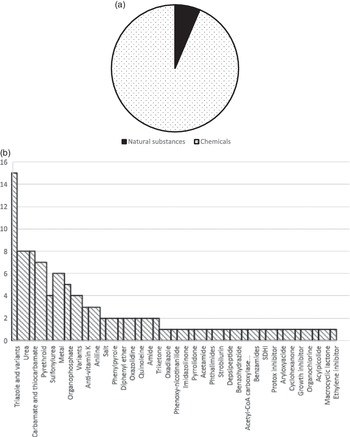
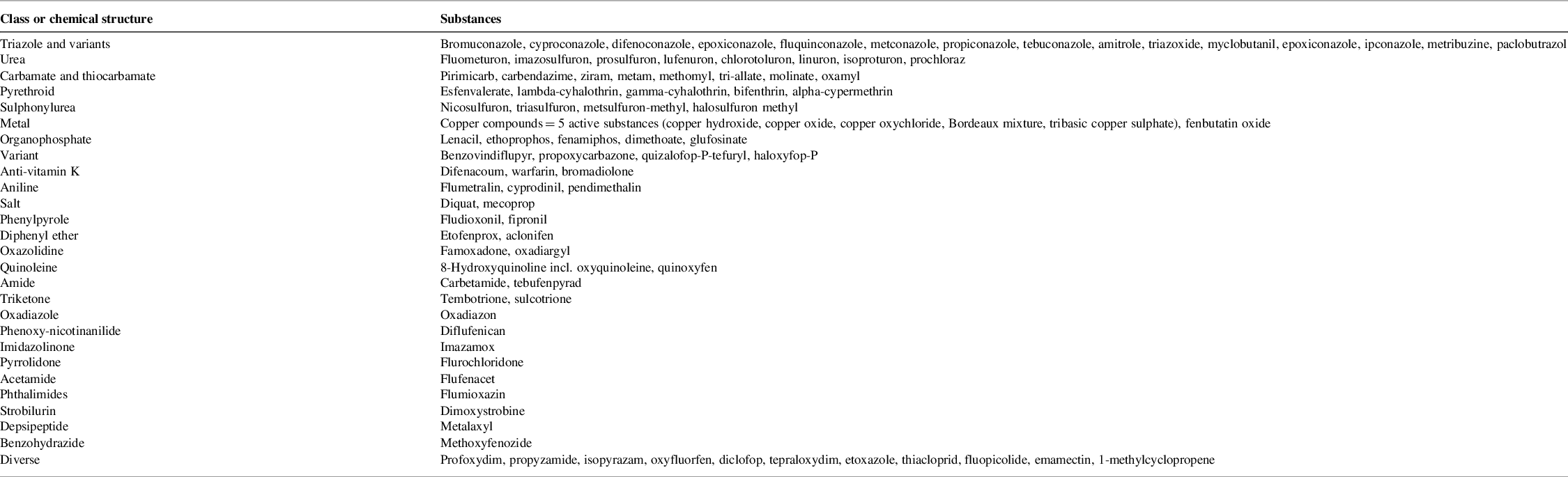
The major type of substances granted CfS are chemicals (eighty-seven active substances, 93.5%), whereas natural substances are few (six active substances, 6.5%), only being represented by the copper compounds family (five active substances) and, more recently, emamectin (Figure 4).Footnote 27 The corresponding classes covering many of the distinguished specific chemical structures are listed in Table 3.
Characteristics of candidates for substitution. (a) Type of candidates for substitution. (b) Classes of candidates for substitution.

Class of all candidates for substitution (by amount rank).

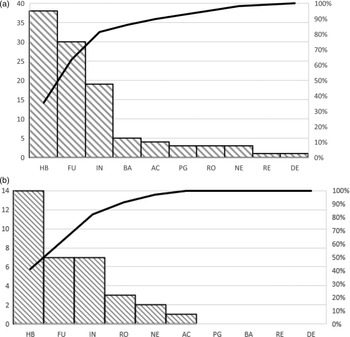
Functions covered by CfS detailed in Table 1 are mainly herbicides (thirty-eight active substances), fungicides (thirty active substances) and insecticides (nineteen active substances) accounting for 81% of the usages, and only few bactericides (five active substances), acaricides (four active substances), rodenticides, plant growth regulators and nematicides (three active substances reach), desiccants and repulsives (one active substances each) (Figure 5). The sum of the corresponding usages (106) is higher the total CfS (94); thus, the number of lost usages and functions for each removed CfS is greater than one.
Attributes of candidates for substitution. (a) Functions for candidates for substitution. (b) Functions of removed candidates for substitution.
AC = acaricide; BA = bactericide; DE = desiccant; FU = fungicide; HB = herbicide; IN = insecticide; NE = nematicide; PG = plant growth regulator; RE = repulsive; RO = rodenticide.

Supressed functions, following non-approval status of CfS for all removal issues (thirty-four active substances), are different from the CfS profile. In the great majority, herbicide functions (fourteen active substances), mainly insecticide (seven active substances) and fungicide (seven active substances) functions, account for approximately 82% of the usages, while other functions (rodenticide and nematicide (three and two active substances each) and acaricide (1 active substance) functions) are negligible (Figure 5b), although some removals may create orphan uses. Indeed, the disappearance, for example, of ziram (after that of thiram and pepper dust) could create a situation where there would be no more repellents for mammals.
IV. Discussion
The evolution of CfS shown in the various figures in this paper demonstrates erratic and non-linear changes. Qualifications as CfS are given mainly in steep increments, whereas decreases are slow and at the individual level for each active substance. Thus, lot of movement has been observed since the first qualification as a CfS – only a few reductions have been enacted (withdrawal, end of approval or non-renewal), including the ongoing process for haloxyfop-P and later the end of approval for ziram. A significant number of CfS (fourteen active substances) were renewed (from Part A to B or E), including the recent renewal for etoxazole.Footnote 28 A lot of renewals of CfS are still pending, and considering the increasing evaluation time for these substances, this generates numerous extended approval periods (cf. chlorotoluron,Footnote 29 dimoxystrobin and oxamylFootnote 30 or ziram),Footnote 31 although some non-renewals are in progress (cf. famoxadone).Footnote 32
Since all CfS were used in the field as approved active substances, the effective (substances now non-approved) or the possible (ongoing regulatory process) and programmed loss (regulations stipulating that CfS are supposed to be removed/substituted) of these CfS active substances and therefore the loss of these functions and usages may be problematic for some agricultural sectors, leading to orphan uses (see above). A few examples may be detailed, such as the loss of many CfS herbicides as well as non-CfS herbicides, reducing the diversity of active substances, therefore automatically increasing the use and therefore the volume (in tonnes) of the few remaining herbicides and thus the occurrence of their residues.Footnote 33 In the meantime, other non-PPP integrated pest management (IPM) techniques are being implemented in fields to overcome chemical herbicide reductions or as direct replacements, but initial thermic solutions, first developed in organic production, are in decline due to CO2 emissions concerns. In fact, mechanical weeding is rapidly taking over, but electrical weeding systems are also promising.
Similarly, organic food production may be heavily affected by the evolution of copper compounds as CfS.Footnote 34 Furthermore, follow-up on the evolution of CfS is not easy to conduct, since only twelve CfS entries are listed in Part E of Regulation (EC) No 540/2011, accounting for sixteen material active substances (due to the copper compound family including copper hydroxide, copper oxide, copper oxychloride, tribasic copper sulphate and Bordeaux mixture), whereas another sixty-four active substances are candidate for substitution. This means that a majority of the CfS were not considered for evaluation during renewal operations and still remain in Parts A and B of Regulation (EC) No 540/2011.
This study shows that gaining access to complete information (harmonised risk indicator (HRI1) effective national values, pesticides weight sales, explanations of the amendment of the EU HRI1 curve) is not easy, although our survey is continuous and accurate (using the EU Pesticides Database, regulations and EFSA outcomes). Complete follow-up of CfS requires full EU website analyses since previous versions of the EU Pesticides Database using simple research numbered only seventy-three CfS in the EU Pesticides Database v.2.0 (approved/non-approved), whereas ninety-four active substances were officially granted CfS status. EU regulatory processes and sometimes individual active substance evolutions also must be investigated in order to gather all of the data. An update after the recent qualification of seven CfS active substance included eighty-one active substances, and the actual EU Pesticides Database v.2.1 now exhibits ninety-one CfS active substances. Thus, only two active substances labelled as CfS (triasulfuron and 1-methyl-cyclopropene) are still missing from the EU Pesticides Database.
1. Subcategories of candidates for substitution
Seven subcategories taken in consideration for CfS correspond to specific criteria.Footnote 35 No scale is mentioned regarding risk or danger (ie from medium to high), thus they have the same risk weight for all of the CfS classifications. From the twenty-nine CfS removed through non-renewal, withdrawal or expiry of approval, some were representative of only one criterion (ie dimethoate, methomyl, etc.), but several exhibited two criteria (ie diquat) and some three criteria (ie epoxiconazole), although some single-criterion examples such as “PBT” are already a proof of the presence of two negative properties from being persistent, bio-accumulative or toxic. Table 1 describes the granted criteria for these actual non-approved CfS with information founded in implementing regulations, EFSA outcomes and the EU Pesticides Database. Table 1 shows thirteen non-renewals, fourteen ends of approval and one withdrawal, with the results exhibited in Figure 2 (under the baseline).
Moreover, CfS examples that are still approved meet one (ie cyprodinil), two (ie chlorotoluron) or three (ie dimoxystrobin) criteria, still with the same ambiguity regarding PBT with two risk points. This is exhibited in Figure 2 (above the baseline) and confirms the absence of priority between CfS categories and numbers of criteria retained for managing the existing CfS in terms of conducting removal or renewal.
2. Implications of candidates for substitution in Directive (EC) No 128/2009
The political action at the European level includes, amongst others, Directive 2009/128/EC,Footnote 36 which encourages a reduction in pesticide risks, and is also a triggering factor for CfS decreases.Footnote 37 In fact, the multiplication factor for CfS in the calculation of harmonised risk indicators (HRI1 and HRI2) is very high, as the multiplication factor is ×16 for CfS,Footnote 38 while the multiplication factors are ×1 for low-risk substances, ×8 for regular active substances and zero for basic substances (versus a very high multiplication factor (×64) for non-approved substances).Footnote 39 The slow decrease of CfS and the discontinuous but permanent increase of CfS due to inclusion through different entryways are described by Figure 3. This, coupled with steep arrival increments for the new qualification of CfS approved substances (eight in 2020), is generating an increase in HRI1, directly linked to CfS number. The increase in HRI1 is a worrying sign as the expectation and goal was for a decrease of this value over time (in terms of the number of risky substances and corresponding sales volumes).
3. Future evolution
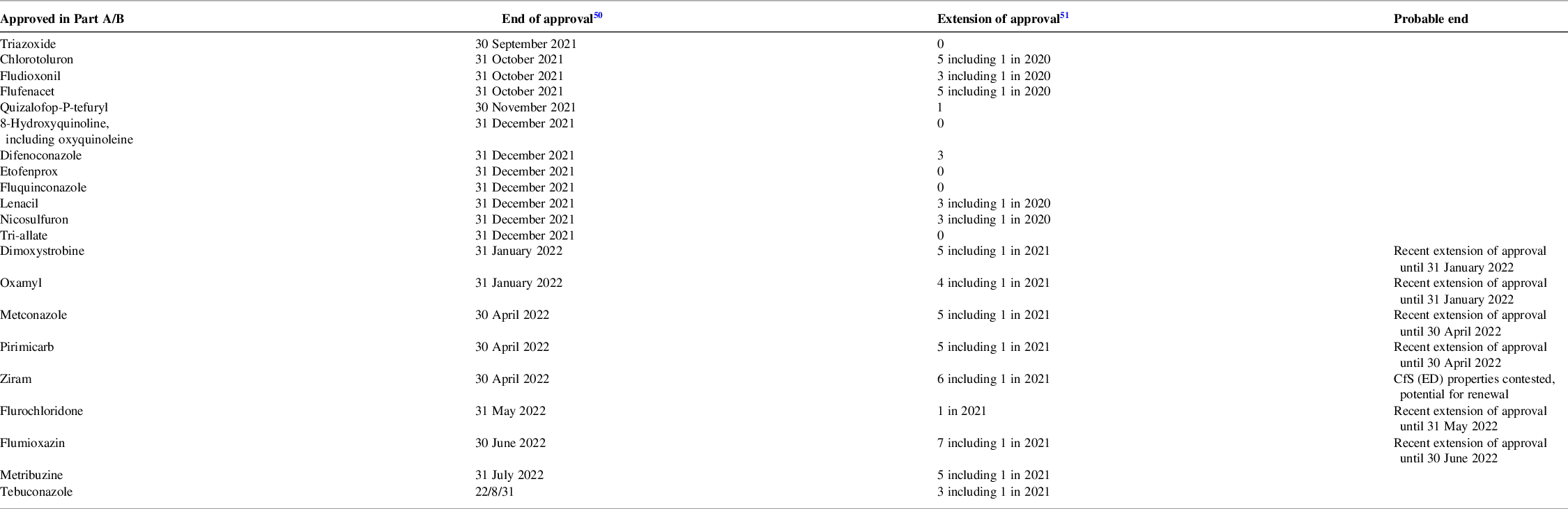
The quantity of CfS is still high and the currently observed decreases are not efficient, although twenty-eight CfS have been removed by various means. The ongoing renewal processes for a few CfS are not going to decrease radically the total number of CfS, since the criteria for endocrine disruptors are now published,Footnote 40 and already seven new ones have been qualified for the CfS list in 2020, and other new CfS qualifications will clearly occur.Footnote 41 However, an significant decrease in CfS numbers may occur in 2021 as a lot of qualified CfS were approved for ten years in 2011 at the entry of the PPP Regulation. Perspectives are given in Tables 4 and 5. Short-term perspectives for CfS with end of approval before July 2021Footnote 42 are given in Table 4 (along with an attempt to predict outcomes from implementing regulation drafts, EFSA outcomes and Plants, Animals, Food and Feed (PAFF) Committee agendas), while mid-term perspectives for CfS are detailed in Table 5. The existence of a recent EFSA outcome is a good indication of the willingness for renewal from the applicant, while the number of extensions of approval is also a good indication of an ongoing evaluation process for renewal, at least from the point of view of the applicant. The number of extensions of approval voted for in 2020Footnote 43 is detailed in order to give greater clarity regarding the issues facing these CfS. Thus, in 2021, twenty-seven CfS were pending, with a possible end of approval; however, massive extensions of the approval periods for these CfS were voted for in January and March 2021. At the same time, some CfS exits are ongoing, such as for alpha-cypermethrin,Footnote Footnote which was recently renewed in 2019Footnote 46 and is now proposed for withdrawal.Footnote 47 Again, the CfS amount is increasing, with the active substance cypermethrin qualified as a CfS during the undergoing of renewal in 2021.Footnote 48
Candidates for substitution (CfS) end of approval pending in 2021: short-term perspectives for CfS.

Italics represent an ongoing reglementary event.
Bold text represent a definitive issue.
EFSA = European Food Safety Authority.
Mid-term end of approval for candidates for substitution (CfS) in 2021 and recently extended to 2022.

ED = endocrine disruptor substance.
Table 5 details CfS with end of approval before the end of 2021 (from July to December), including the recent extension to the approval period. It also shows the number of extensionsFootnote 49 of approval for each CfS for similar reasons as in Table 4. Conclusions regarding the issues are more uncertain in Table 5 than in Table 4, but clearly extensions of approval represent a good indication of the willingness of the applicants to pursue renewal, especially those voted for twice in 2020 and 2021.
All of these considerations increase constantly the number of non-desired substances in specific crop protection systems (labelled with “no pesticide residues”, labelled with no carcinogenic, mutagenic and reprotoxic (CMR) substances, IPM, organic production, etc.), and their non-uses may also impact their availability for plant protection due to decreases of Footnote Footnote sales,Footnote 52 complications in renewals and a global desire to abandon the use of these substances.Footnote 53 Therefore, when looking at Table 4, it is clear that a large number of CfS may be supressed through re-evaluation processes or abandoned by applicants in 2021, this now being effective for bromadiolone, carbetamide and cyproconazole, whose approval ends without regulatory event.Footnote 54 Accordingly, in the second batch of CfS taken into consideration in 2021 (Table 5), the issue may also lead to quite a few ends of approval or non-renewals, such as for famoxadone. Indeed, it is also quite confusing to observe in the same PAFF Committee an extension of the period and a proposal for non-renewal or a suppression of the extension of the period, giving rise to an end of approval, but this may be the result of a renewal application withdrawal from the applicant side after the first results of re-evaluation.Footnote 55 Finally, these constraints may trigger an effective removal of dangerous pesticides and a real “substitution” of these pesticides corresponding to a paradigm change, including an agroecology approach in order to reduce the dependence on chemical pest control, as well as the adoption of higher-level IPM methodologies or increasing interest in organic farming.Footnote 56 However, these choices and new constraints may also contribute to a cost increase for moving from crop protection using traditional chemicals to biocontrol agents, as mentioned previously.Footnote 57
V. Conclusions
This study has documented the overall evolution of CfS substances. Firstly, the legislator’s initial desire to introduce this new category of active substances was respected. Secondly, endocrine disruption criteria were published, increasing the total amount of substances granted CfS status. We show that although ninety-one CfS are listed in the EU Pesticides Database (approved or not), ninety-four were actually granted this status from 2014 to 2020 through regulation or during evaluation processes for approval or renewal. However, the slow growth of biocontrol substances included in Implementing Regulation (EU) No 540/2011 (EC 2011) did not allow for an acceleration of the disappearance of the corresponding targeted CfS. The massive initial entry followed by continuous CfS qualifications is maintaining a high level of still-approved CfS (sixty active substances), which was not necessarily the initial intention. Thus, Article 24 was effective at targeting active substances of concern, but was insufficient to remove them from use in practice according to Sustainable Uses of Pesticides Directive EC No 128/2009 (SUD) (EC 2009b), since only thirty CfS were removed. The actual amount of approved CfS may decrease rapidly in 2021 since approvals for ten years in the PPP Regulation occur in 2011 (EC 2009), and dozens of substances are under renewal procedures. The implementation of the endocrine disruptor criteria will also be a triggering factor, although it could lead to new CfS approvals.Footnote 58 The constant and massive decline in regular active substances or CfS (more than eighty in fewer than four years) and the loss of corresponding usages were not anticipated nor followed by substantial replacement of them with biocontrol agents, but more agroecology-compatible tools may overcome the pure plant protection product solution against bioaggressors.