The goal of ‘learning’ from peace processes is widely expressed in the conflict resolution field. Countless studies offer ‘lessons from’ cases. Practitioners facilitate comparative workshops, giving actors in different peace processes the opportunity to ‘share lessons’ (Mitchell, Reference MitchellForthcoming). There is some evidence of ‘policy transfer’ (Dolowitz and Marsh Reference Dolowitz and Marsh2000) between peace arenas – that is, the implementation of mechanisms, procedures and institutions based on their previous use in other contexts (Darby Reference Darby, Darby and Mac Ginty2008). The Colombian peace process, notably, deliberately drew on the experience of earlier international counterparts (Pearce Reference Pearce, Özerdem and Mac Ginty2019).
But while the desirability of learning from peace processes has wide currency, the methods and meaning of such learning, or even what constitutes a ‘lesson’, are poorly understood. Indeed, there are significant methodological and epistemological grounds on which to be sceptical of the fruitfulness of searching for lessons from peace processes. These include the uniqueness of all conflicts and comparative politics’ ‘problem of equivalence’ (the challenge of comparing like with like) (Van Deth Reference Van Deth1998), the incompleteness of empirical knowledge on peace processes and the inherently politically contested nature of peace and peace processes.
This article investigates what kinds of knowledge can be gleaned from a peace process, the theoretical and methodological bases of such learning, and what impact it may have. It begins with an interdisciplinary discussion of the reasons to learn, the kinds of lessons proposed in the peace process literature and how theories of learning may be applied to a peace process. The primary research pursues these themes through a case study of the sharing of the Northern Ireland peacemaking experience with other conflict-affected societies, especially through in-person dialogues between decision-makers. It is based on interviews with the facilitators of comparative learning workshops, as well as the author's participation in this work. The conclusion sets out a comprehensive ideal model of learning from peace processes. The workshops are conceptualized as participatory pedagogical fora aimed ultimately, not at exporting generic models, but at engendering ‘transformative learning’ (Mezirow Reference Mezirow, Mezirow and Taylor2009) and a ‘policy paradigm shift’ (Hall Reference Hall1993) towards a de-escalatory approach to conflict management. A definition of a peace process ‘lesson’ is offered as the basis for future research.
Learning from peace processes: why, what and how?
This section draws on a number of disciplinary literatures, especially Peace and Conflict Studies, Policy Studies, and Education to consider, first, the rationale of learning from a peace process, second, what kind of lessons and learning may be possible, and third, what learning means and how a phenomenon such as a peace process may be accessible to those who seek to learn.
Why learn?
In the emergence of the conflict resolution field in the 1950s, a foundational assumption was that studying conflict in its widest setting, including not only inter- and intrastate conflicts but interpersonal, community and industrial conflicts as well, would lead to accumulated, transferable and practice-relevant knowledge (Ramsbotham et al. Reference Ramsbotham, Woodhouse and Miall2016: 5). The proliferation of peace processes in the post-Cold War world led to numerous comparative studies (such as Aronson Reference Aronson1995; Ben-Porat Reference Ben-Porat2008; Brewer Reference Brewer2010; Darby and Mac Ginty Reference Darby and Mac Ginty2000, Reference Darby and Mac Ginty2008; Hampson Reference Hampson1996; Özerdem and Mac Ginty Reference Özerdem and Mac Ginty2019; Stedman et al. Reference Stedman, Rothchild and Cousens2002; Tonge Reference Tonge2014). This research assumes that conflicts display, and are impacted by, common global patterns such as colonialism, religious ideologies, nationalist mobilization, neoliberal globalization, gender inequality and intervention by third parties. If the political and psychological patterns of different conflicts are similar, so also may be the prescriptions.
Thus, comparative learning creates the potential for policy transfer (Dolowitz and Marsh Reference Dolowitz and Marsh2000). The actual occurrence of policy transfer in peace processes lacks focused research (an exception is Darby Reference Darby, Darby and Mac Ginty2008), but it promises the same in conflict resolution as in any field: expanding the range of options available to decision-makers and helping avoid the mistakes made in other polities. Policy transfer occurs on a spectrum from ‘hard’ to ‘soft’: from the direct copying of a programme, to looser emulation, to simply the conveyance of inspiration, ideas and attitudes (Benson and Jordan Reference Benson and Jordan2011; Dolowitz and Marsh Reference Dolowitz and Marsh2000; Rose Reference Rose2005). Various channels facilitate transfer – professional conferences, international organizations, ‘epistemic communities’ (knowledge-based expert networks) (Haas Reference Haas1992) and the activity of ‘policy entrepreneurs’ (Rose Reference Rose1993: 56). Policy transfer is political by nature – drawing a lesson from elsewhere is a political choice (Rose Reference Rose1993: 45). It also may be ‘coercive’, such as when policies are imposed on countries by powerful international organizations (Benson and Jordan Reference Benson and Jordan2011: 370). The much-criticized liberal peacebuilding model of security reform, free elections and free markets (Newman et al. Reference Newman, Paris and Richmond2009) might be an example of coercive transfer in peace processes, but in this article the focus is on the voluntary search for ideas from abroad.
What lessons?
Although, in a general sense, all work in Peace and Conflict Studies offers learning, an online search for the terms ‘peace’ and ‘lessons’ finds hundreds of academic studies which are explicitly couched in terms of providing lessons oriented to future practice. In the main, these studies fall into one of two genres: technical lessons and process lessons.
Technical lessons refer to knowledge relating to the actual or potential operation of specific conflict resolution techniques. In the literature, technical lessons involve: exemplars, such as the Gender Subcommission in the Colombian peace process (Herbolzheimer Reference Herbolzheimer2016); negative learning, such as inadequacies in disarmament, demobilization and reintegration (DDR) in Liberia (Nilsson and Söderberg Kovacs Reference Nilsson and Söderberg Kovacs2005) or tribunals in Sierra Leone and Cambodia (Stensrud Reference Stensrud2009); and cumulative learning from several cases, such as ideal methods of implementing power-sharing (Bogaards Reference Bogaards2019; Schneckener Reference Schneckener2002) or third-party intervention (Hampson Reference Hampson1996).
Process lessons are more general, revealing the broad nature, dynamics and necessary architecture of peace processes. These are exemplified in – though certainly not restricted to – the multi-case study works of John Darby and Roger Mac Ginty (Reference Darby and Mac Ginty2000, Reference Darby and Mac Ginty2008) and Alpaslam Özerdem and Roger Mac Ginty (Reference Özerdem and Mac Ginty2019). The Darby and Mac Ginty studies offer a series of propositions regarding the dynamics of peace processes, such as: political leaders must focus on delivering their own side rather than assisting opponents, and post-deal violence is likely and must be managed. In a slightly different approach, the work edited by Özerdem and Mac Ginty (Reference Özerdem and Mac Ginty2019) sets out dimensions which appear to be required for a comprehensive and sustainable peace process. These include supportive third-party engagement, an accord that effectively deals with governance, economic and security issues, and the inclusion of the public, youth and women. Process lessons are generic principles, without guidance for action in specific contexts.
To these two types of lesson a third may be added. In a rare essay on the concept, as opposed to the content, of lessons in peace processes, William Hazelton (Reference Hazelton and White2013: 35) distinguishes what we are referring to as technical lessons from ‘the lessons that participants on the ground may have learned, albeit in a more particularistic fashion, from what transpired around them’. These may be termed actor lessons, referring to what is learned by conflict parties and peacebuilders in the course of their own peace process – things that proved effective within that process. Actor lessons may involve strategic or policy learning and adaptation entailing the discovery of technical or process insights (for example, Ahtisaari Reference Ahtisaari2008; Powell Reference Powell2011; Santos Reference Santos2016). They warrant their own category because they emerge from the direct experiences of actors rather than the assessment of analysts, and thus include insights that are more personal and psychological. For instance, Juan Manuel Santos, former president of Colombia, recounted how he learned of the need to see the FARC guerrillas as human beings, adversaries rather than enemies (Santos Reference Santos2016). In South Africa Roelf Meyer and Cyril Ramaphosa, negotiators for the white National Party and black African National Congress respectively, recalled how they learned to trust each other during a three-month period of intensive talks in 1992 (O'Malley Reference O'Malley1996). In both examples, the lessons learned were also offered by the actors as universal lessons for other places.
Alternative typologies of lessons are of course possible, based on, for example, issue areas of lessons or the type of actor to which they are relevant such as political leaders, third parties or civil society. The one suggested is useful in broadly distinguishing the quality of lessons and it is employed below in relation to the research findings. But it must also be acknowledged that it is debatable whether many of the lessons in the literature should be described as such. Richard Rose (Reference Rose2005: 22) seeks to counter the ‘casual’ and ‘abused’ way in which lessons are invoked in politics by setting out a clear definition: a policy lesson must be ‘a practical, nuts-and-bolts outline of the means as well as the ends of policy [in a new context]’. Yet in scholarly and practitioner discourse, peace process lessons are not so formally defined.Footnote 1 Technical, process and actor lessons do not intrinsically include an application to another context. In many instances, lessons may be better described simply as within-case ‘conclusions’ or ‘observations’. Moreover, lessons that are ostensibly derived from cases may in fact be axiomatic in any case and not contain the novel insights the word ‘lesson’ arguably implies. In sum, while ‘lesson’ has obvious appeal in the social sciences, connoting as it does generalizable prescriptions, the term needs more precise definition to prevent its overuse, at least in relation to peace processes. To this end, the conclusion to this article suggests such a definition.
How can lessons be learned?
The aforementioned lessons emerge from academic research methods and the personal experience of actors. Yet a more in-depth, generic model of how a peace process is accessible to learning may be presented, a model which begins with an understanding of how teaching and learning occur in general. Traditional teaching methods of instruction, rote learning, incentivizing and penalizing are associated with a behaviourist theory of learning. This assumes that people are blank slates and that their behaviour may be shaped through external stimuli. By contrast, dialogical, participatory teaching methods are based on a constructivist understanding that humans create their own knowledge based on prior experience, beliefs and values (see Aubrey and Riley Reference Aubrey and Riley2019). In the latter tradition is David Kolb's experiential learning, which emphasizes how ‘knowledge is created through the transformation of experience’ (Kolb Reference Kolb2015: 49). These theories are evident in influential work within the Peace and Conflict field. For instance, John Paul Lederach (Reference Lederach1995) – drawing on Paulo Freire's (Reference Friere1970) Pedagogy of the Oppressed – delineated a dichotomy between ‘prescriptive’ peacebuilding training, in which experts convey models, and ‘elicitive’ training, which, informed by constructivism, harnesses the cultural knowledge of trainees through dialogue and problem solving. Importantly, Lederach emphasized that both approaches were valuable. While the elicitive approach is participatory, empowering and locally grounded, learners often desire and benefit from external expertise as well.
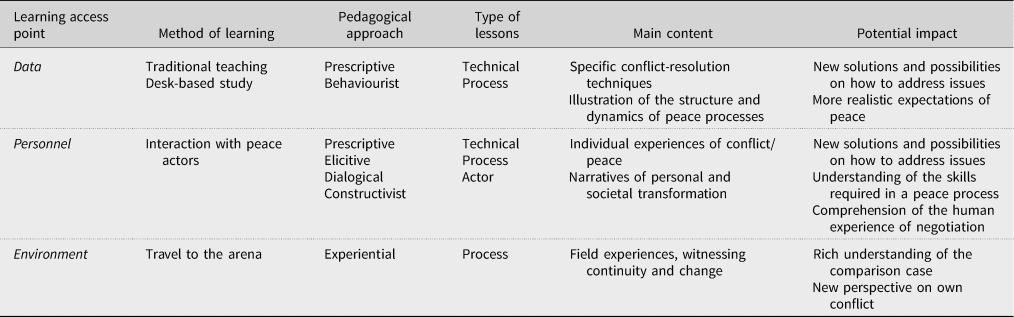
How may all this be applied to learning from a peace process? A peace process is a sustained engagement between conflict actors and other stakeholders aimed at ending violent conflict and establishing consensus-based political institutions. It is a complex sociopolitical phenomenon with historical, psychological, spatial and other dimensions. There are three basic access points for learning, each of which lends itself to different pedagogical approaches.
The first access point is qualitative and quantitative data regarding the causes, events, conflict resolution approaches and possibilities of the case. Data are most naturally conveyed through prescriptive teaching in which learners assimilate the new information in written or oral form. The second is via encounter with the personnel involved in the peace process. Such an encounter may involve prescription yet will also probably include elicitive methods in which learners actively probe interlocutors and construct a new understanding of their own experience as well as the peace process under study. Third, learning may occur through bodily presence in the physical environment of a conflict-affected place. War, peace and the transition from war to peace manifest themselves in myriad ways in the built environment, ‘symbolic landscape’ (Ross Reference Ross and Ross2012) and spatial geography of a conflict-affected society. Placing learners within this setting represents an experiential method.Footnote 2
To recap, the motivation behind learning from peace processes mirrors that of the transnational migration of policies in other domains which occurs in the hope of accelerating the discovery of good practice and avoiding mistakes. Peace processes have produced at least three broad categories of lesson: technical information; generic knowledge on the nature of peace processes; and peace-relevant insight gained by actors within a process. A peace process is discoverable through three access points – data, personnel and environment – and different teaching and learning methods are appropriate to each. The next sections turn to the case of Northern Ireland to examine in depth if and how these theoretical considerations are manifested in real-world peace process learning. In particular, the research investigates further the value and potential impact of learning.
The case of Northern Ireland
The conflict in Northern Ireland, usually known as the ‘Troubles’, lasted from the late 1960s until the mid-1990s. Anti-state, pro-state and inter-communal violence claimed over 3,500 lives out of a relatively small population of 1.5 million. Fighting a guerrilla war against the British security forces, the Irish Republican Army (IRA) aimed to force Northern Ireland out of the United Kingdom, while unionist (pro-British) paramilitary groups fought the IRA. Several factors, including a change in IRA tactics towards democratic means, an inclusive negotiation process managed jointly by the British and Irish governments, and widespread exhaustion with conflict, led to the 1998 ‘Good Friday’ or ‘Belfast’ Agreement which provided for a power-sharing government and far-reaching security and equality reforms (Cochrane Reference Cochrane2013).
Despite the locally popular impression, the conflict was far from exceptional (Wright Reference Wright1987). Edward Azar (Reference Azar1990) named Northern Ireland as one of at least 70 ongoing ‘protracted social conflicts’. Academic research during the conflict approached Northern Ireland with a number of comparative lenses including settler-colonial theory and consociational theory (McGarry Reference McGarry and McGarry2001). Since the 1998 ‘Good Friday’ or ‘Belfast’ Agreement, a considerable body of literature has interrogated the meaning and implications of the Northern Ireland peace process for other places. Such studies are often explicitly set in terms of ‘lessons’ or a ‘model’ for elsewhere (Doyle Reference Doyle2010; Irish Department of Foreign Affairs 2008; LSE IDEAS 2011; Mac Ginty Reference Mac Ginty, Özerdem and Mac Ginty2019; White Reference White2013a; Wilson Reference Wilson2010). At the same time, actors in the Northern Ireland peace process have engaged in outreach to policymakers from around the globe to share their experiences of making peace (Devenport Reference Devenport2009; Geoghegan Reference Geoghegan2016).
However, some of the debates on lessons have been ideologically charged, such as the disagreement on what, if anything, Northern Ireland suggests for how states should engage with militants (for a summary of this see O'Kane Reference O'Kane2010). The literature also exhibits caution regarding the pursuit of lessons, for at least three reasons. One is that the deficiencies in the Northern Ireland peace process, added to clashing interpretations of the Agreement, may make it a dubious exemplar (Guelke Reference Guelke2011). In particular, critics of the consociational institutions created in Northern Ireland naturally recoil from any suggestion that they are a ‘model’ to be shared (Wilson Reference Wilson2010). A second reason for caution is of course the uniqueness of conflicts (Hazelton Reference Hazelton and White2013), an issue compounded by the fact that in a number of respects, including the stable regional context and absence of United Nations involvement in brokering peace, Northern Ireland is an outlier in comparison with the many other turn-of-the-millennium peace processes (Halliday Reference Halliday, Cox, Guelke and Stephen2006). Third, the search for lessons is made considerably more difficult and unreliable by the lack of information about what went on, something due both to the (necessarily) secret and sensitive nature of back-channels, internal deliberations and so on, and the relatively short period of time that has elapsed since the Agreement (Clancy Reference Clancy2010).
Methodology
The primary research entailed a qualitative methodology that utilized three methods. First, semi-structured interviews were conducted with 15 practitioners, all of whom had been involved in organizing and facilitating interactions between Northern Ireland peace process actors and actors in other peace/conflict arenas. I have described in detail this methodology elsewhere, calling it ‘comparative consultation’, and portraying it as a variant of Track Two diplomacy (Mitchell, Reference MitchellForthcoming). In the terms being used here, comparative consultation uses all three of the learning access points – data, discussions with personnel and travel to the location of a comparison peace process case. Interviewees were recruited through the author's knowledge of the field, existing contacts and snowballing.
The interview questions probed the following topics: the nature and scope of the individual's/organization's work; their motivations for conducting this work; aspects of the Northern Ireland process found to be of particular interest or value to other places; examples of the perceived impact of that work; and perceived risks and shortcomings of sharing the Northern Ireland experience. A thematic analysis of the interview transcripts was conducted which took a ‘theoretical’ approach to coding – themes were selected based on the literature review (Braun and Clarke Reference Braun and Clarke2006: 84). The data are analysed according to the framework of technical, process and actor lessons in order to show how such learning was perceived and conveyed in real-world exchanges. What follows is not an exhaustive analysis of the meanings and implications of the Northern Ireland peace process. Rather, it explores the ‘why’, ‘what’ and ‘how’ of peace process learning in a specific case.
Second, the research also draws on the author's own participation in activities to share the Northern Ireland experience in two roles – as an interlocutor to 22 visiting delegations brought to Northern Ireland by some of the practitioners included in the research sample, and as a co-facilitator of four such visits. Third, the findings are shaped by available literature produced by practitioners about their activity.
The quotations are not attributed but the interviewees agreed to be named as participants. The cohort includes the following individuals (job titles are those at time of interview): Kerim Yildiz is chief executive officer of the Democratic Progress Institute (DPI), a London-based NGO which aims to promote peace and dialogue, predominantly in Turkey. Also interviewed from DPI were Esra Elmas, head of the Turkey Programme, and Sally Holt, deputy director. Eamon Rafter is learning coordinator at the Glencree Peace Centre in Co. Wicklow, Ireland. Gary Mason is director of Rethinking Conflict, a Belfast-based conflict resolution NGO. Eva Grossman is chief executive officer of the Belfast-based Centre for Democracy and Peacebuilding, a conflict-resolution NGO.
Wilhelm Verwoerd is a South African academic and peacebuilding practitioner. Dong Jin Kim is a Korean academic, currently based in Ireland. Laurence Simms is political and reconciliation director of the Irish Department of Foreign Affairs and Trade. Paul Arthur is Professor Emeritus of Politics at Ulster University, Northern Ireland. Oliver McTernan is director of Forward Thinking, a London-based conflict-resolution NGO. Peter Sheridan is chief executive officer of Co-operation Ireland, an NGO which works on reconciliation across the island of Ireland. Mikko Patokallio is an analyst at the Finland-based Crisis Management Initiative, a conflict-resolution NGO. Duncan Morrow is Professor of Politics at Ulster University with strong links to the Corrymeela Peace Centre in Ballycastle, Northern Ireland. Máire Braniff is director of the INCORE conflict research centre at Ulster University.
Findings
The findings are presented according to the three modes of lesson identified above: technical, process and actor.
Technical lessons
Numerous functional aspects of the Northern Ireland peace process have been tentatively promoted by scholars for possible use elsewhere. These include the need for, and means of, the inclusion of women (Fearon Reference Fearon1999); mechanisms of delivering economic support (Buchannan Reference Buchannan2014); outsourcing difficult issues to international bodies (Clancy Reference Clancy2010; Walsh Reference Walsh2017); rules of non-violence during negotiations (Darby Reference Darby, Darby and Mac Ginty2008); the inclusive negotiation process (Amaral Reference Amaral2019); and police reforms (Doyle Reference Doyle2010). The most significant and studied aspect of Northern Ireland has been its consociational political institutions, from which both proponents and opponents of consociationalism have drawn lessons (O'Leary Reference O'Leary2019; Taylor Reference Taylor2009).
The sharing of concrete, technical knowledge was a motivation of the practitioners’ work to facilitate connections across peace processes. The topics just mentioned formed part of the workshops. However, interviewees understood the importance of context in the success of specific peace mechanisms and approaches. ‘Some participants think you can copy and paste, and I would call that a misunderstanding’, said one practitioner. Another commented on how purported ‘lessons’ could tempt politicians with instant legitimacy: ‘It's the realm of political propaganda. I mean if anyone [actor in another context] says that in Northern Ireland this happened so we should do that here, it's basically nonsense.’
The practitioners saw the value of learning about technical aspects of the Northern Ireland process as extending beyond the possibility of borrowing ideas. One practitioner noted that even when an approach is ruled out as unworkable in another context: ‘I think that's still useful to people as it gives them a sense that they are on a project where people have faced those issues before … it makes it feel less impossible.’ Similarly, another practitioner noted the importance of studying technical aspects of the Northern Ireland process which had faced difficulties:
I think those examples are better in terms of spurring original thinking rather than a case where, ‘we did something, it worked wonderfully, therefore you should do the same thing in your own context’. This spurs reflection on, ‘what about your context? How do you see this playing out in your context?’ And it forces participants to approach familiar issues from an unconventional angle.
In these views, even if conflict resolution approaches are not regarded as applicable in another context, the mere awareness that the same issues have been confronted elsewhere can energize the search for home-grown solutions. This recalls Rose's (Reference Rose1993: 30) observation that a policy which is thought not to be transferable can still act as an ‘intellectual stimulus to develop a novel program’.
Process lessons
Process lessons are also common in the literature on the meaning and implications of the Northern Ireland peace process. For instance, Timothy White (Reference White and White2013b) suggests that the following aspects were crucial in Northern Ireland and may be relevant for other processes: inclusivity in negotiations; as few preconditions to talks as possible; providing security for all parties; a role for third parties; economic aid; grassroots reconciliation; intense engagement with negotiations; support for moderates over spoilers; and the importance of changes in structural conditions (see also Mac Ginty Reference Mac Ginty, Özerdem and Mac Ginty2019). Yet, as noted above, the extent to which process lessons do in fact offer learning for anywhere else is unclear due to their broad and decontextualized character.
Nevertheless, for the practitioners, conveying a generic understanding of the nature and requirements of a peacemaking process was viewed as highly beneficial. Perhaps the most worthwhile insight was thought to be how long in duration, and non-linear, a peace process can be: ‘One of the things that Ireland shows is that things can go backwards and then spring forwards very quickly.’ Related to this are the imperfections in Northern Ireland's peace which, the practitioners thought, helped actors in other contexts to understand that, as one put it, ‘peace is not a fairytale’. In this view, managing expectations about what a peace process is capable of delivering can, paradoxically, be galvanizing and inspirational – peace comes to seem achievable. Nearly all of the interviewees commented that it was just as important to find out about mistakes and failings made in Northern Ireland as it was to find out what ‘worked’. For example, one person pointed to the near-total absence of women until the later stages of the process, and the failure to realize a peace dividend after the peace agreement. Indeed, the imperfections were what made studying Northern Ireland worthwhile: ‘Peacemaking is a very messy, unpredictable process. If everything was perfect [in Northern Ireland] I wouldn't take people there’; ‘What makes Northern Ireland compelling is that it's not complete and there are still big implementation problems.’
Another process lesson mentioned in the literature is that regardless of whether the Northern Ireland case offers a road map or toolkit for a peace process, it does ‘teach’ that intractable conflict can be transformed (Mac Ginty Reference Mac Ginty, Özerdem and Mac Ginty2019; Mitchell Reference Mitchell2015: 197; O'Kane Reference O'Kane2010: 254; Powell Reference Powell2008: 322). For the practitioners, this inspirational lesson was important; the mere existence of the peace process was regarded as offering compelling evidence that a protracted conflict could come to an end through consensual means. Being physically present in Northern Ireland could reinforce this message: ‘People will say what can we [in Northern Ireland] share? But it is successful in that people are not killing each other, society is stabilizing, normalizing. They come here and they see Titanic [a new visitor attraction in Belfast] and they see nice restaurants, it gives people hope.’ Moreover, Northern Ireland could inspire different sectors of society by demonstrating that a peace process had to be built and sustained at multiple levels. One interviewee recalled an impactful discussion between religious leaders in Ireland and counterparts from another country: ‘They realized that they had a responsibility not to sit around and let the conflict go on but to take steps for peace, and that came from discussions with religious leaders who took part in the Irish scene.’ Another person reported a similar transformation in mindsets among a private sector delegation who left Ireland with a new sense of having a role to play in their own peace process.
A further process issue that needs consideration here is the role, if any, of force in peace processes. This is vigorously debated in the Northern Ireland lessons literature, especially in relation to how important state counter-insurgency was in causing a reassessment of republican strategy towards democratic means. Some ‘lesson-sharers’ from the peace process have been accused of glossing over the reality of counter-insurgency which, it is argued, was instrumental in ensuring the success of dialogue and negotiation (Bew Reference Bew2011; McDonald Reference McDonald2011). For the interviewees’ part, they were clearly biased towards making peace by peaceful means. It may be assumed that, in the comparative workshops, some interlocutors convey that there is a role for armed action in combination with a political process (a point stressed by Powell Reference Powell2011). Yet, as expanded upon below, the overarching purpose of the workshops is to move actors away from believing that conflict can be resolved using force. For many of the interviewees, Northern Ireland's chief value was that the case proved this. As one person put it, ‘the biggest lesson from Northern Ireland is that there is no military solution to conflict’.
Actor lessons
Actor lessons are the understandings actors in the Northern Ireland conflict gained that proved to be effective within the Northern Ireland context (White Reference White and White2013b: 4–7). ‘Learning’ is a descriptor which has been applied to the evolution of actor strategies which helped de-escalate the conflict, as parties realized the untenable nature of earlier positions (Ruane Reference Ruane, Bric and Coakley2004; Tannam Reference Tannam2001). However, the protagonists in Northern Ireland have said little in public of lessons they learned, presumably due to an aversion to admitting earlier ignorance. By contrast, the governments, especially the British, have been communicative, happy to propose generic peacemaking lessons from what they see as their diplomatic triumph (for similar lists of lessons see Blair Reference Blair2010; Hain Reference Hain2007; Mowlam Reference Mowlam2002; Powell Reference Powell2008, Reference Powell2011). Yet given the unique circumstances from which they are drawn, actor lessons can seem to be of limited value to other places.
This was not the practitioners’ view. They believed that the personal and political experiences of actors inside the Northern Ireland process (what one interviewee described as the ‘people stuff’) were of considerable worth to peace process actors elsewhere because human experiences can transcend their contextual specificity and convey universal insights. One interviewee mentioned a Northern Ireland political leader who regularly told the story to visiting groups of meeting a parent of a person who had killed a family member, and how impactful this could be: ‘It's a very personal human experience, this is him saying it's about recognizing the human being in the other person.’ Another mentioned how the role of prisoners and ex-prisoners in the Northern Ireland peace process could impact other processes:
In Israel they are locked in a mindset that you can't release people who have blood on their hands. If they sit with former prisoners [in Northern Ireland] and they see them now playing a role in political process, in the community, them actually being instrumental and promoting and maintaining peace, that's a very powerful challenge. It's an emotional challenge, more than an intellectual challenge.
Thus, since peace processes were thought to make many of the same psychological demands and pose similar political challenges, the experience of actors who had faced these realities was thought to be of great instructive value for people in the midst or on the brink of comparable obstacles.
Significantly, the practitioners noted that actors’ stories naturally tended to resonate specially with particular actors elsewhere. For instance, unionists were compared by one interviewee to the Israeli right:
Peter Robinson [former unionist leader] is a brilliant strategist but also a pragmatist, they [Israelis] can relate to somebody like that because they can have a detailed conversation and it's not some guitar-carrying long-haired hippie saying ‘let's love one another’. He can say, ‘We made these compromises, these are the reasons why we did this, this is why we didn't sign up for this agreement’, those are all ringing bells so you really are comparing like with like at least, mentally, psychologically and politically. You're not saying the solution is the same, but at least, here's somebody who thinks like me who did a deal. So I think that's helpful.
Similarly, others mentioned how the FARC rebels in Colombia showed a strong interest in Irish republican strategy, while unionists and republicans had been particularly influenced by the South African National Party and the African National Congress respectively. Thus, although, as indicated above, clashing interpretations of the Northern Ireland peace process could be thought to undermine the case's value for study by actors from other contexts, in fact, as some of the interviewees pointed out, there is no need to convey a single ‘story’ from Northern Ireland because, first, there is no single story, and second, actors from abroad will inevitably believe that one side's experience has more instructive value than others’. One practitioner explained that it was when participants grasped the contradictions that he felt that they were beginning properly to understand the case:
It's impossible to have a master narrative [of a peace process]. You have to have opinions and narratives which are conflicting and which force people [participants] to realize that these people don't agree on this. If participants get to that point it means that it [the trip] has been successful because it has pushed them to do something on their own, rather than just receiving information.
Others agreed it was important for actors in other peace processes to appreciate that opposing perspectives and the ‘constructive ambiguity’ of agreements were fundamental realities of the Northern Ireland process which brought their own opportunities and obstacles.
Discussion
These findings, combined with the theoretical discussion, inform the comprehensive model (Table 1) which represents, in ideal form, the methods and theories, as well as corresponding content and potential impact, of learning from a peace process.
Analysis of Peace Process Learning

To reiterate, the nature of a peace process suggests three access points for learning – data, personnel and environment. For both scholars and practitioners, descriptive data in all its forms is required to reveal the structure, actors and issues in a conflict. These are discoverable through prescriptive, non-dialogical teaching and learning methods. Data can produce technical lessons, but also inform regarding the nature of the process and experiences of actors. This can transfer specific policies on peace process issues, stimulate novel thinking on conflict resolution, as well as enhance understanding of what a peace process involves and demands.
Dialogue with personnel who have first-hand experience of a peace process encourages participant learners to create their own understanding of the implications of the case out of their prior experience's interaction with the interlocutors’ contributions. These in-person dialogues can open up technical, process and actor lessons, but clearly are uniquely suited to conveying lessons gained by actors from their own experience, whether personal or more political/strategic. The findings suggest that the personal and political stories of actors can resonate more widely regardless of differing conflict circumstances. Physical presence within a peace process setting is the third access point for learning from a peace process. Such experiential learning is a valuable counterpart to prescriptive and dialogical teaching methods, enriching understanding of the peace process in its totality.
The model above is expressed in general terms, not restricted to the comparative experience-sharing workshops; yet, given these workshops do include all of the access points and activities to some extent, they are a relatively comprehensive means of learning about a peace process. What, then, is the summative, ideal impact of these workshops? Two concepts, one from Education and one from Policy Studies, help characterize, respectively, the overall intended individual and political impacts of the comparative learning workshops.
Transformative learning theory – associated primarily with Jack Mezirow – holds that education can involve a wholesale transformation in perspective through the learner questioning taken-for-granted beliefs, values and thought-patterns: it is ‘learning that transforms problematic frames of reference to make them more inclusive, discriminating, reflective, open and emotionally able to change’ (Mezirow Reference Mezirow, Mezirow and Taylor2009: 22). Transformation may entail ‘objective reframing’, a change in point of view resulting from becoming ‘critically reflective of the content of a problem or of the process of problem solving’ and ‘subjective reframing’ in which ‘we become coauthors of the cultural narratives with which we have been inscribed’ (Mezirow Reference Mezirow, Mezirow and Taylor2009: 23). The impacts of comparative peace process learning identified in the model above include both such types of reframing – the acquisition of new knowledge on conflict resolution techniques and the nature of a conflict, as well as the deconstruction of existing political positions and ideologies, and experiencing new emotions such as hope and inspiration. Indeed, the comparative workshops include pedagogical practices closely associated with transformative learning, especially storytelling, immersive and perhaps uncomfortable experiences, and reflection (Taylor and Jarecke Reference Taylor, Jarecke, Mezirow and Taylor2009). All this may lead to a reorientation of the learners’ understanding of the possibilities of conflict resolution.
In terms of the wider political context, the desired ripple effects of the transformative education of individual participants amount to a ‘policy paradigm shift’. Using the language of Thomas Kuhn, Peter Hall (Reference Hall1993: 279) describes a policy paradigm as ‘a framework of ideas and standards that specifies not only the goals of policy and the kind of instruments that can be used to attain them, but also the very nature of the problem they are meant to be addressing’. In a manner analogous to revolutions in science, these paradigms can shift as a result of anomalous events which do not fit existing understanding, through policy failures and through societal debate and pressure. The findings show that facilitators wished to introduce new conflict resolution concepts into public discourse through the example of Northern Ireland and to shape the skills, sense of possibility and even fundamental attitudes and values of second-level future leaders. In essence, the workshops seek to precipitate, or perhaps highlight, a crisis in the prevailing policy paradigm of prosecuting conflict and to promote a paradigm of de-escalation and resolution. Accordingly, the facilitators, and to some extent the interlocutors, are acting as policy transfer entrepreneurs (Rose Reference Rose1993). Although they eschew promoting specific courses of action, they nonetheless work to disseminate and inculcate, on the basis of expertise and experience, the ideas, evidence and values of a paradigm of non-violent, consensual conflict resolution.
Conclusion
Efforts to garner learning from peace processes proceed, and will continue, in the understanding that, as Rose (Reference Rose2005: 3) puts it, ‘In the twenty first century, it is the politics of the ostrich to claim that the problems of a single city or a single country are unique.’ This article has sought to be foundational, endeavouring to scope the topic, analyse concepts and, through empirical case study research, point to general processes and potential in learning from a peace process. Some proposals may be made for future studies which build on these themes.
First, research should proceed with a clearer conception of a peace process ‘lesson’. As noted above, the term is used loosely and too often in the literature. As a corrective, a definition, informed by the constructivist thrust of the dialogue workshops examined above, is as follows: a peace process lesson is a new insight, gained as a result of encounter with a conflict and peace process, into the nature of another conflict and potential strategies, motivations and mechanisms for resolving the conflict. Lessons, in this understanding, may be of a technical nature, a process nature, or they may be some other personal or strategic insights ignited through engagement with a peace process. However, the lessons of a peace process cannot be offered by actors with sole experience of that process – they can only give their own testimonies. It is for learners to identify lessons – that is, what aspects of their own situation are revealed or clarified in the light of the other context.
Three avenues for further research may be suggested. First, this article has maintained a general focus regarding the meaning and potential of learning from peace processes; the next step is to – following the proposed definition of lesson – probe the lessons learned by actors from Case A through encountering Case B. This requires a methodology that goes beyond facilitators to include the participant learners. Second, the extent to which the ideal model of learning is or is not fulfilled in instances of real-world peace process learning activity, and why, demands study. Third, research should track the movement and impact of policy ideas between peace processes – a phenomenon which is known but lacks explicit research – and study the extent to which policy paradigm shifts have resulted from international contacts between peace processes. It has been noted in the policy transfer literature that the identification of policy failure, which partially motivates policy transfer, is socially constructed and subjectively perceived, and that this has been inadequately considered by scholars who have in the main taken a more positivist approach (Benson and Jordan Reference Benson and Jordan2011). The comparative peace process workshops offer a rich environment in which to study how ideas, experiences, dialogue and relationships can catalyse policy dissatisfaction, new policies and new policy paradigms.
Acknowledgements
The author thanks the editors and anonymous reviewers for their comments which helped to significantly strengthen this article.