INTRODUCTION
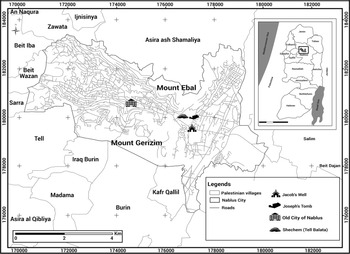
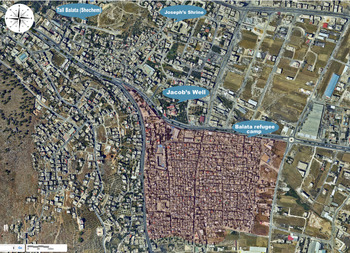
Jacob’s Footnote 1 Well is an ancient well identified by pilgrims in the fourth century, such as Eusebius. The well is located on Jacob’s parcel of land and where Jesus had a conversation with a Samaritan woman (known as the orthodox saint, Photini) Footnote 2 . Over the centuries, since that time, various churches have been erected to house the well, and it has been a site of veneration, even when no church has stood there. The latest of these churches is the current Greek Orthodox Church, dedicated to St Photini, completed in the 21st century. It stands in the walled grounds of the Bir Ya’qub monastery complex that has a total area of 11,500 m2. This is a Byzantine-style church with a large representation of orthodox iconography. There are stairs downward from the nave of the ground-level main hall to the lower-level crypt where the well is found cut into the bed rock. The upper part of the well, lined with rough masonry, emerges in a rectangular stone structure with an iron framework to support a winch and bucket. The outer stones of the well are polished by centuries of wear. Jacob’s Well is visited by tourists and pilgrims and is situated 300 m southeast of another site of pilgrimage, the white-domed Ottoman-style building of Joseph’s Tomb. Both sites are found east of the city center of Nablus, near the outlying Tall Balata, the site of the Canaanite city of Shechem (Figures 1 and 2). The old city of Nablus has been proposed as a world heritage listing in Palestine, and Jacob’s Well constitutes another important cultural heritage site in the city, venerated by both Christians and Jews. Hence, due to its importance as a heritage, religious, and tourist site in Nablus, our aim is to add information to the existing knowledge of the history of the well. On April 10, 2019, the present custodian of the church and the priest responsible for its construction, Fr Ioustinos Mamalos, at our request and to aid in our research, presented us with samples of human skeletal remains he had found when digging to build foundations for a guestroom and refectory in 1997, and a skull from a sarcophagus located alongside the church. Due to the fact that there were no detailed archaeological reports made during construction work, we are only in a position to presume the skeletal remains were found in an ossuary or retained in some other way. We applied radiocarbon dating to retrieve more information on the individuals and chronological information of the site. Firstly, we provide a historical context for the well.
Map of Nablus showing location of Jacob’s Well. (Drawing by M. Bulqan.)

Aerial photo showing Jacob’s Well complex in Nablus. (Source: Geomolog.ps.)

Historical Background
The Samaritan city of Nablus was a stronghold against Christianity (Abu Alsaud Reference Abu Alsaud2018: 193); for centuries, paganism, Christianity and Samaritanism coexisted there (Bagatti Reference Bagatti2002). During the fourth century, Nablus belonged to Palaestina Prima and became an episcopal seat (Abel Reference Abel1967; Piccirillo Reference Piccirillo1993). The bishop of Nablus, Germanus, attended the Synod of Ankara in AD 314 and the Council of Nicea in AD 325 (Bagatti Reference Bagatti2002). Ammianus Marcellinus refers to Nablus as a great city in the only fourth century source on the city (Rolfe Reference Rolfe1935: Amianus Marcellinus, xiv: 8 and 12). Other bishops were Terebinthus and Ammonas; the latter was killed in the Samaritan revolt of AD 529 (Malalas Reference Malalas1831). The building of the Church of Mary Theotokos above the Samaritan Temple in Nablus during the reign of Zeno (AD 424–491) (Naveh and Magen Reference Naveh and Magen1997: 10) provoked riots and confrontations between the Samaritans and Byzantine authorities (Magen Reference Magen1993: 1355). After a number of historical changes in a short period of time the Sassanid invasion occurred in AD 614 (Kalbonah Reference Kalbonah1992); a Byzantine contra attack (AD 589–628) in AD 628 lasted until victory by the Muslims in AD 636, who then ruled during the Umayyad and Abbasid dynasties. The Crusaders gained control in AD 1099 (Kalbonah Reference Kalbonah1992); during their control (AD 1099–1187) churches were built in Nablus, including one at Jacob’s Well. The reconquest by Saladin and a severe earthquake in AD 1202 destroyed this church and other buildings. Dominion by the Mamluks followed (AD 1260–1516) and then the Ottomans (AD 1516–1918), who converted Nablus into a district capital (Hütteroth and Abdulfattah Reference Hütteroth and Abdulfattah1977). The old city of Nablus, an example of traditional architecture in Palestine, appeared among Palestinian cultural sites with potential world heritage status in 2005 (Tahah Reference Tahah2005: 18–22).
History of the Jacob’s Well Site
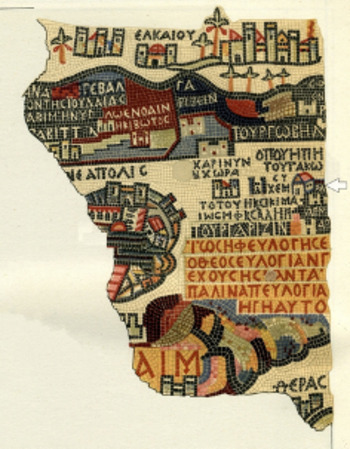
Early sources indicate that the first church was built at Jacob’s Well in the fourth century (although our analysis suggests there may have been a structure there before this time). Historian and geographer, Eusebius (fourth century), wrote that Jacob’s Well was near Shechem, and that “a church had been built there” (Klostermann Reference Klostermann1904). During the Crusade Wars in Palestine, it was changed to a cruciform plan. Two biblical verses refer to the well, one to the well standing in the land that Jacob bought from Hamor (Genesis 33:19) and the other, found in John 4:13–14, refers to the place Jesus converses with the Samaritan woman and asks for water from the well. The site has been a destination for pilgrims since AD 333 when it was first considered as the site of this conversation (Geyer Reference Geyer1965). There is a suggestion that before the building of the first church in the fourth century, the well may have been used for Christian baptisms (Pringle Reference Pringle1993). This would tie in with an earlier structure at the site. This first church is referred to as Latin-cross before AD 384 by St Jerome (Jerome 1892: Paula, XXII, 888) and it appears on the Madaba Mosaic Map (Figure 3). It is believed that it was destroyed in the Samaritan revolts of 484 or 529. Justinian later built another Byzantine church over the well that is known to have existed until the 720s and may have survived to the ninth century (Pringle Reference Pringle1993). There are remains of mosaic flooring in the southeastern and northeastern areas of the church dating to this period. The Crusaders built another church on the Byzantine foundations in the twelfth century, changing the design to cruciform (Fr Ioustinos Mamalos, personal communication, March 25, 2017). Pilgrims visiting the site have suggested that various churches have stood on the site at different times (Bromiley Reference Bromiley1982; Hastings and Driver Reference Hastings and Driver2004). The ancient church changed from a basilica plan to cruciform during reconstruction. In the account of his pilgrimage in AD 670, Arculfus describes the church as cruciform in design (Arculfus 1889).
Jacob’s Well on Madaba Map. (Avi-Yonah Reference Avi-Yonah1954.)

During the Umayyad (AD 661–750) and Abbasid periods (AD 750–1258), there are no records of the site. The church built by the Crusaders in the twelfth century was destroyed after their expulsion by the Muslims. During Mamluk rule (AD 1260–1516) there were no references to any changes at the well. In 1697, Henry Maundrell refers to his measurement of the water in the well during the Ottoman era (AD 1516–1918; Maundrell Reference Maundrell1836). In AD 1826, Sophronius, Bishop of Gaza, gave the order for the building of a wall around Jacob’s Well (Fr Ioustinos Mamalos, Interview, August 9, 2019), and in the mid-nineteenth century, Edward Robinson and Eli Smith were witness to ruins at the site and described broken granite columns among architectural remains of a church, mentioning that the well was nevertheless still venerated by local Christians (Robinson and Smith Reference Robinson and Smith1856). In 1866, the well was described by a traveller, Major Anderson, as having a 120-cm-deep neck with a diameter able to admit a person, expanding to 230 cm below the neck (Warren and Whiston Reference Warren and Whiston1870). The well, completely lined with rough stone had been sunk into soil deposits to a limestone base; in 1935 it measured 41 m in depth, although it was originally deeper (Bromiley Reference Bromiley1982). The Survey of Western Palestine (Conder and Kitchener Reference Conder and Kitchener1881) includes detailed measurements for the well (Figure 5: 1–4) and describes only a broken vault with a massive slab of local white limestone with a round hole directly over the well, the stone deeply grooved from the rope with which water pots were drawn up. Concerning the well the Memoirs (pp. 172 and 176) state:
The site is acknowledged by Jews, Moslems, and Christians. The existence of a well sunk to a great depth in a place where water-springs on the surface are abundant is sufficiently remarkable to give this well a peculiar history. It is remarkably characteristics of the prudence and forethought of the great Patriarch, who having purchased a parcel of ground at the entrance of the vale (of Shechem), secured on his own property, by dint of great toil, a perennial supply of water at a time when the adjacent water-springs were in the hands of unfriendly, if not actually hostile, neighbors… The well was undoubtedly sunk to a great depth for the purpose of securing, even in exceptionally dry seasons, a supply of water, which at great depth would always be filtering through the sides of the well and would collected at the bottom.
In 1885, the Greek Orthodox Church purchased the Jacob’s Well property with financial backing, mainly from the White Russian church. In 1903, they commenced construction on a new church on the site, dedicated to St Photini (Figure 6: 1–4). The Russian revolution of 1917 caused the work to cease. A wall to fence the area was built in 1908. (Fr Ioustinos Mamalos, interview, August 9, 2019). An earthquake in 1927 destroyed the church building. No reconstruction took place until the end of the century. On New Year’s Day, 1998, Yaser Arafat, President of the Palestinian Authority at the time, visited the site and gave the order for reconstruction to begin, subsidising the cost with one million dollars (Fr Ioustinos Mamalos, interview, April 9, 2019). According to Fr Ioustinos, the first and only archaeological excavations at the site were conducted by the Department of Antiquities of Jordan in the 1960s. These excavations took place in the southern part of the monastery grounds near the church, but there is no record of a report. The rebuilding of the church and complex took place between 1998 and 2006, at a cost of 4 million American dollars. Fr Ioustinos commenced reconstruction on October 17, 1998, and played a pivotal role in the construction and decoration. The foundations of the church are 6 meters below ground and have an area of 1000 square meters (Fr Ioustinos Mamalos, personal communication, March 25, 2017). The stone well is housed in the crypt. The site is administered by the Greek Orthodox Church.
Nablus was an arena of conflict between militant Palestinians and the Israel Defense Forces during the Second Intifada, between 2000 and 2005, but has since rebuilt itself as an industrial and commercial center. Jacob’s Well has also been a site of contention and violence and before reconstruction of the present church, in 1979, a Zionist group claimed it as a Jewish holy place and demanded the crosses and icons in the church be removed.
Radiocarbon Analysis of Human Remains
The human skeletal remains, consisting of three skulls and a femur, were found in situ by Fr Ioustinos. He then placed them in a cabinet for preservation, after they had been washed in wine and olive oil. It is through his courtesy that the skull and bone samples were entrusted to us. A fragment of a skull (Sample 2) was found in a sarcophagus, previously looted, adjacent to an exterior side wall of the church near the southwestern corner, and two other skulls (Samples 1 and 3) and a femur were found in the northern part of the monastery complex. The three individuals found in the ground beneath where the guestroom was erected were given burials of less social importance than the individual in the sarcophagus. Fr Ioustinos had found complete skeletons, but only preserved the skulls.
METHODOLOGY AND RESULTS
We sent our samples to a laboratory in Kiev, Ukraine, under the management of Dr Mykhailo Buzinny, for radiocarbon analysis. Initially, the samples, reduced to less than 1 cm, needed to undergo treatment in a benzene and alcohol solution for 3–4 hr to remove contamination caused by the original cleansing in wine and olive oil. They were then dried for 3–5 hr at approximately 100°C to a constant mass. Old semi-natural contaminants were then removed overnight in a weak 1% HF Footnote 3 solution, and drying took place again for 3 hr at approximately 200°C. The collagen content was determined by weight loss of an aliquot of completely dry bone sample after HF treatment following calcination in air at 650°C. We produced benzene using vacuum pyrolysis technology similar to that described by Skripkin and Kovaliukh (Reference Skripkin and Kovaliukh1997: 211–214).
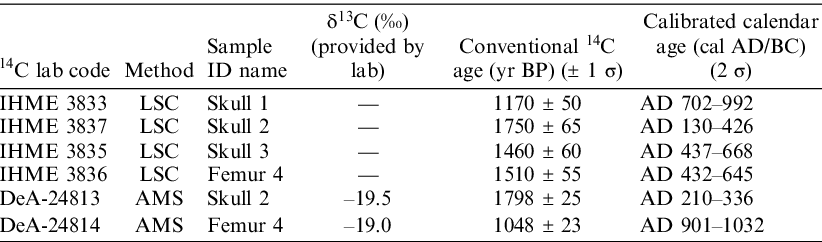
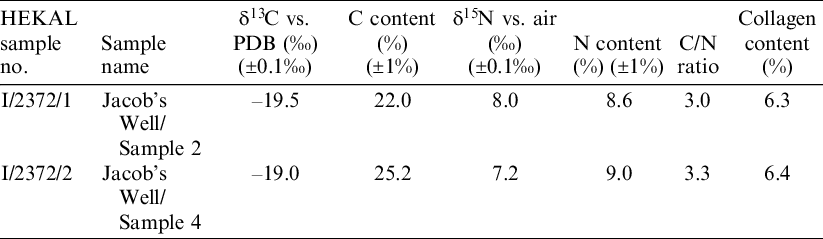
For each sample, δ13C, ranging from –19 to –23‰, was determined on benzene. LSC benzene measurements were performed using Quantulus 1220TM using small volume Teflon vials to minimize dilution (Buzinny and Skripkin Reference Buzinny and Skripkin1995: 743–747). Results were calculated following Stuiver and Polach (Reference Stuiver and Polach1977: 355–363). Details of the samples are shown in Table 1 and the results are shown in Table 2. Calibrated ages were obtained using OxCal 4.3 and the IntCal20 calibration curve (Reimer et al. Reference Reimer, Austin, Bard, Bayliss, Blackwell, Ramsey, Butzin, Cheng, Edwards, Friedrich, Grootes, Guilderson, Hajdas, Heaton, Hogg, Hughen, Kromer, Manning, Muscheler, Palmer, Pearson, van der Plicht, Reimer, Richards, Scott, Southon, Turney, Wacker, Adolphi, Büntgen, Capano, Fahrni, Fogtmann-Schulz, Friedrich, Köhler, Kudsk, Miyake, Olsen, Reinig, Sakamoto, Sookdeo and Talamo2020).
Details of bone samples recovered from a burial ground at Jacob’s Well complex.

Radiocarbon measurements for bone samples from Jacob’s WellFootnote 4.

Results of determination of δ 13C, δ15N, and C/N for Samples 2 and 4.

Dating Summary
Sample 1/IHME 3833, Skull
Radiocarbon analysis dates this skull sample to between AD 765 and 998, with a high probability of a chronological margin of 233 years (90%). The chronology falls within the Abbasid period (AD 750–1258). The skull was one of two found in what may have been a burial chamber, although due to possible severe damage, no surviving architectural remains were found.
Sample 2/ IHME 3837, Skull
The skull from which our sample was taken was found in a sarcophagus adjacent to the exterior church wall. Radiocarbon analyses from both IHME and Debrecen produced consistent results. The weighted average of the two dates was 1792 ± 22 14C yr BP, which gave a calibrated age range of AD 216–333, with a confidence level of 95.4%, within the middle to late Roman or early Byzantine periods. It is possible there may have been a very early church or burial ground at the well before construction of a church in the fourth century (Table 2)
Sample 3/IHME 3835, Skull
Footnote The skull from which our sample was taken was also found in the northern burial ground and radiocarbon analysis dates it to AD 527–665, consistent with the Late Byzantine period (Table 1 and 2).
Sample 4/IHME 3836, 1510-+55 BP: Femur
The femur from which our sample was taken was also found in the northern burial ground and radiocarbon analysis dates it to AD 426–641, within the late Byzantine period (Table 1; Figure 9: 1). The date provided by the Hertelendi Laboratory of Environmental Studies, Debrecen, Hungary, differs, placing it at AD 900–920 and AD 960–1030. Due to the greater state of preservation of the femur sample analyzed in Debrecen, we consider these results more reliable. Table 3 shows the state of preservation of the sample (C/N ratio: 3, 3; 3). The isotopic composition is consistent with a terrestrial animal and plant diet.
Dietary Study
Bone samples for stable isotope analysis were obtained from two relatively well-preserved individuals, that we designated, Jacobs 2 (IHME 3837), from the Roman era, and Jacobs 4 (IHME 3836), from the early Islamic period. A sample of approximately 1 g of bone was taken from each specimen. Pretreatment consisted of cleaning each sample by removing 1–2 mm of surface bone. Well-preserved collagen samples were analyzed for δ13C and δ15N by Isotoptech Zrt., in Debrecen, Hungary. Results are corrected for linearity and instrumental drift and are reported per mil (‰) according to internationally accepted standards, V-PDB and AIR.
Carbon and nitrogen stable isotope analysis of human bone collagen, an established method of investigating diet in past populations, was used to determine food consumption patterns in the Roman and Medieval Christian communities at Jacobs Well, in Nablus, Palestine (Ambrose Reference Ambrose and Sandford1993; Ambrose and Norr Reference Ambrose, Norr, Lambert and Grupe1993). With very few skeletal remains from Christian sites undergoing isotopic analysis, results from Jacob’s Well provide a unique view of monastic sites in the region. The Roman diet in Palestine was based largely on cereals, such as wheat, barley, millet and oats, as well as legumes, such as lentils and chickpeas, with significant consumption of olive oil and wine. Meat was not a predominant feature of the diet, although it was a component for the Roman upper classes. Sheep and goat were reared for wool and milk, and cattle were mainly used for traction. As in other parts of the Empire, the main meat sources were sheep, pig, and goat, with fish being difficult to obtain (Garnsey Reference Garnsey1999; Alaica et al. Reference Alaica, Schalburg-Clayton, Dalton, Kranioti, Graziani Echávarri and Pickard2018).
In medieval times, bread was the most important food produced by monastic communities, but they also had vegetable plots that produced a large variety of legumes and pulses including lentils, chickpeas, and peas, as well as vegetables such as pumpkin, and fruits such as carob, dates, grapes, apples, and peaches (Harlow and Smith Reference Harlow and Smith2001). If we refer to the Byzantine typika, or rulebook for monastic life, the monks were to have two daily meals of modest amounts of bread, legumes, vegetables, olive oil, and wine (Talbot Reference Talbot2007). The results of the two samples, δ13C = –19.5/–19 and δ15N = 8.6/7.2, show that the diet of the population was derived predominantly from C3 terrestrial sources; plant foods were possibly dietary staples, in conjunction with low meat and dairy consumption, demonstrating an almost exclusive C3-derived diet that accords with written records describing daily monastic life (Gregoricka and Sheridan Reference Gregoricka and Sheridan2013).
We do not observe increased δ15N values typical of diets that include fish. Fish, similarly to meat, appears to have been a luxury, restricted food for the rural monks, except in circumstances of illness or on feast days (Hirschfeld Reference Hirschfeld1992; Thomas and Hero Reference Thomas and Hero2000; Gregoricka and Sheridan Reference Gregoricka and Sheridan2013). The low δ15N ratios may result from individuals consuming larger amounts of beans, chickpeas, peas, or lentils, and the higher δ13C levels of C3 can be explained by a higher presence of typical products from monastic life, such as wine and possibly other alcoholic beverages produced from fruit. Similar dietary results were found in other monastic sites in Jordan during the Byzantine era, such as Sa’ad, Ya’amun, and Yasileh (King Reference King2001), showing a predominantly C3-based diet, with the lower than expected human δ15N ratios from legumes. It is probable the low animal protein intake came mainly from dairy products, rather than meat.
Corresponding Historical Periods
Analysis reveals that the four skeletal samples studied may be associated with the following historical periods or events:
Early Christian period. All our sources suggest the first church at Jacob’s Well was built in the fourth century. However, our analysis of skull sample 2/3837 found in a sarcophagus may date as far back as AD 130–330. A building for religious purposes may have existed before this time (Klostermann Reference Klostermann1904).
The Samaritan Revolts (AD 484, 529, 556) and Sassanid invasion of Palestine (AD 614–628). The Samaritans rebelled against forced conversion to Christianity by the Byzantine authorities. According to Samaritan sources, the Samaritans were responsible for 11,000 Christian deaths (Pringle Reference Pringle1993). This invasion also caused the deaths of large numbers of Christians and monks during the Sassanid struggle with the Byzantines to gain control over Palestine. Skull sample 3/3835 dates to between AD 527 and 665 within the late Byzantine period. The age for sample 3 overlaps with this period of history.
Abbasid rule (AD 750–1258). Skull sample 1/3833 and the femur sample 4/3836, are consistent with the Abbasid period. Christians were on peaceful terms with the Abbasids due to the Abbasid-Carolingian alliance and this is reflected by a Christian presence in Palestine and in this case at Jacob’s Well in Nablus (Heck Reference Heck2007).
CONCLUSION
Radiocarbon analysis of the human remains from Jacob’s Well has enabled us to obtain a clearer picture of the chronology of the site. The remains confirm the importance of the well as a place of worship and pilgrimage that dates to before the fourth century when the first evidence of a church was recorded in historical literature: one skull dating to between 130 and 330 AD shows an earlier church or burial chamber may have existed at the site. As well, analysis of the other remains, testify to specific periods and events in Nablus, recorded in historical sources and relating to the Christian community. These were the Samaritan Revolt (AD 529 and 556), the Sassanid Invasion (AD 614–628), and Abbasid rule (AD 750–1258). Our analysis has provided information on the Abbasid period as yet unrecorded by historians due to the scarcity of archaeological information dating to that period. Overall, according to the information obtained from radiocarbon dating of human skeletal remains found at the site, we can date Jacob’s Well to the second century (early Christian period) before the fourth century construction of a church at the well by Constantine the Great.
ACKNOWLEDGMENTS
We would like to express our appreciation to Fr Ioustinos Mamalos for providing us with the human skeletal samples, to Dr Mykhailo Buzinny of the Academy of Medical Sciences of Ukraine, Kiev, for his laboratory analysis of our samples, and also to Anita Molnár, who analyzed Samples 2 and 4 at the Hertelendi Laboratory of Environmental Studies, Debrecen. Hungary. We also thank translator, Mary-Lou Crane, and the editors of Radiocarbon.
Supplementary material
To view supplementary material for this article, please visit https://doi.org/10.1017/RDC.2021.17