Implications
This study contributes to knowledge about which factors affect a lactating dairy cow's risk of having dirty legs and hooves. Poor cleanliness is associated with a greater risk of infections in the udder and with the occurrence of some hoof disorders. Therefore, allowing cow's access to pasture and providing clean and comfortable lying areas, among other factors, may be beneficial for the hygienic conditions of the cows and might thus be valuable actions to implement in the prevention of udder infections and hoof disorders.
Introduction
Many dairy farmers put great effort into keeping high standards of hygienic conditions in loose housing systems in order to prevent diseases caused by environmental pathogens and to maintain a high quality of the milk products. An increased risk of high somatic cell count and intramammary infections has been associated with cows having dirty udders and legs (Schreiner and Ruegg, Reference Schreiner and Ruegg2003; Ellis et al., Reference Ellis, Innocent, Mihm, Cripps, Mclean, Howard and Grove-White2007; Breen et al., Reference Breen, Green and Bradley2009). Poor hygienic conditions are also suggested as an important risk factor for foot diseases, and studies of cow cleanliness in different tie-stalls have verified this (Bergsten and Pettersson, Reference Bergsten and Pettersson1992; Hultgren and Bergsten, Reference Hultgren and Bergsten2001), whereas results from loose housing systems are sparse. Moisture and different environmental agents may cause a softening of the hoof tissue associated with a greater risk of injuries and hoof diseases such as sole ulcer and white-line disease (van Amstel et al., Reference van Amstel, Shearer and Palin2004; Gregory et al., Reference Gregory, Craggs, Hobson and Krogh2006). Moreover, it seems plausible that infectious diseases of the skin and hoof tissue can be caused by environmental pathogens and that unhygienic conditions may increase the prevalence by increasing the susceptibility of the skin, by amplifying the infection pressure, or both. The effect of different parameters affecting the cows’ environment such as floor type, use of scrapers and access to outdoor paddocks have been evaluated in several studies indicating that poor hygienic conditions can be associated with an increased risk of digital dermatitis (DD) and heel horn erosions (Wells et al., Reference Wells, Garber and Wagner1999; Somers et al., Reference Somers, Frankena, Noordhuizen-Stassen and Metz2005; Cramer et al., Reference Cramer, Lissemore, Guard, Leslie and Kelton2009).
Most studies of cow cleanliness have investigated the effects on mastitis and milk quality, and therefore udder or whole-cow assessments are most common. However, when focusing on hoof diseases, assessment of hoof cleanliness seems more relevant. Cleanliness-scoring systems used in the existing literature consider typically legs and hooves, and this will most likely result in a more nuanced picture of the hygienic conditions than considering the hooves only. Large-scale studies in loose housing systems focussing on cow leg cleanliness and associated risk factors are sparse. Ellis et al. (Reference Ellis, Innocent, Mihm, Cripps, Mclean, Howard and Grove-White2007) assessed whole-cow cleanliness and they showed that housing (compared with grazing), season, housing type and lactation stage were associated with cows being dirtier. More knowledge about what affects the leg cleanliness of cows would be valuable in order to learn how to increase the hygienic standards in the cow's environment.
The aim of this study was to identify risk factors for poor cow leg cleanliness in loose housing systems. It was hypothesised that management factors such as small herd size, lower milk production, automatic milking system (AMS), pasture grazing, slatted floors, frequent floor scraping, hoof bathing and hoof washing were associated with a decreased risk of dirtier cows. Furthermore, we hypothesised that animal-based factors such as late lactation, multi-parous and longer daily lying time were associated with a decreased risk of dirtier cows.
Material and methods
In October 2007, a random sample of 500 Danish dairy herds with more than 60 cows was drawn from the Danish Cattle Database and farmers were contacted by mail. A letter explained the outline and purpose of the study and farmers were asked to return a response form in a prepaid envelope whether (i) they had a loose housing system; (ii) they hoof trimmed cows routinely; and (iii) they were willing to participate in the study. No reminders were sent to the farmers. A total of 102 farmers (20%) were willing to participate and all of them met the inclusion criteria. Afterwards, 42 of these herds were randomly selected for the study. The number of farms was decided based on available resources in the project. Each herd was visited by a research technician from Aarhus University at one occasion (two visits with 3 days in between) during the period from December 2007 to May 2009. Three different research technicians took part in the study. Before the study, they were all educated and trained in using the lameness and the cleanliness-scoring systems by discussing the scales and by matching, illustrative pictures.
At the first visit, the technician performed an interview with the farmer with questions about hygiene management of the floors and cubicles and about hoof health management. Furthermore, a description of the housing system and a sketch of the barn were made. Finally, the technician scored cow cleanliness and lameness and put on a three-axis accelerometer (IceTags, IceRobotics, Roslin, Scotland, UK; a technical device for measuring the time budget, described in the next paragraph) on 31 to 40 lactating cows selected by systematic random sampling. In practice, sampling was conducted at the farms by walking through all areas of the barn selecting each 10th animal until all available IceTags were put on. The precise number of cows selected in each herd depended on the number of functioning IceTags available to the technician at that day. Only lactating cows were included in these samples as dry cows typically were housed in a different environment. At the second visit, the IceTags were removed.
Cow cleanliness was scored on cows in the barn. The randomly sampled cows were fixed at the feeding table or in the cubicle. The cleanliness of the hind limbs was scored observing the hooves and the legs below the hock from behind and from both sides and given a score on a 4-point ordinal scale based on the following four categories: (i) completely free of or has very little dirt; (ii) slightly dirty; (ii) mostly covered in dirt; or (iv) completely covered, caked-on dirt as described by Schreiner and Ruegg (Reference Schreiner and Ruegg2002). Thus, cows with score 1 were clean or had only small flecks of dirt below the hock. Cows with score 2 had more or larger flecks of dirt or had a larger area at one leg mostly covered in dirt. Score 3 meant cows had many flecks on most of the areas below the hocks on both legs or had larger areas almost completely covered with dirt. Finally, the areas below the hocks on cows with score 4 were completely covered with many flecks or had most of the areas covered with caked-on dirt. The cleanliness scoring did not distinguish between mud and manure or between old and fresh dirt. Immediately after scoring the cleanliness, cows were loosened and lameness was scored using a five-point ordinal scale developed by Thomsen et al. (Reference Thomsen, Munksgaard and Tøgersen2008). The five scores are as follows: score 1: normally walking cows with no sign of lameness or uneven gait; score 2: uneven gait; score 3: mild lameness; score 4: obvious lameness on one or more legs; and score 5: severe lameness on one or more legs and unable, unwilling or reluctant to bear weight on the affected leg(s). The IceTag is an accelerometer measuring acceleration in three dimensions eight times per second. The IceTags were attached to a hind leg and thus measured the cow's movements. It is able to detect whether the cow is walking, standing or lying down and to predict the duration of lying bouts as documented in recent studies (Munksgaard et al., Reference Munksgaard, Reenen and Boyce2006; Nielsen et al., Reference Nielsen, Pedersen, Herskin and Munksgaard2010; Tolkamp et al., Reference Tolkamp, Haskell, Langford, Roberts and Morgan2010). The activity measure used in this study was the mean number of minutes lying per day during the 2 days before the second herd visit. This interval was chosen to minimise the possible effects of the research technicians’ activity on the daily routines of the cows.
Risk factors for poor cow limb cleanliness were analysed by ordinal logistic regression fitting a proportional odds model (using a multinomial error distribution and the cumulative logit link). Estimation of the parameters was performed using generalized estimation equations (GEE) taking into account for correlation between observations on the herd level (Zeger and Liang, Reference Zeger and Liang1986). This was carried out using PROC GENMOD in the statistical software SAS 9.1 (SAS Institute Inc., Cary, NC, USA). Clustering of cows within herds was taken into account by invoking the GEE method using the REPEATED statement in PROC GENMOD and by specifying an independent working correlation structure. Data were arranged sorting the categories of the outcome as descending, and thus the model described the effect of the risk factors on the odds of a leg having a higher rather than a lower cleanliness score. For example, given an odds ratio (OR) of parity 1 compared with parity 3 or older of 1.7, and given a parity 3 or older cow had a cleanliness score of 2, then a parity 1 cow would have a 1.7 times higher odds of having a cleanliness score 3 or 4 than having a cleanliness score of 1 or 2.
The assumption of proportional odds in the data was checked by visually assessing whether the curves on the various cumulative logits were parallel. This was performed for each predictor by plotting it against the empirical logits calculated by using the observed counts; plots are not shown. By merging the two lowest cleanliness scores, a higher degree of parallelism was obtained (plots are not shown). The outcome in the model then had three levels: score 1 and 2 merged, score 3 and score 4.
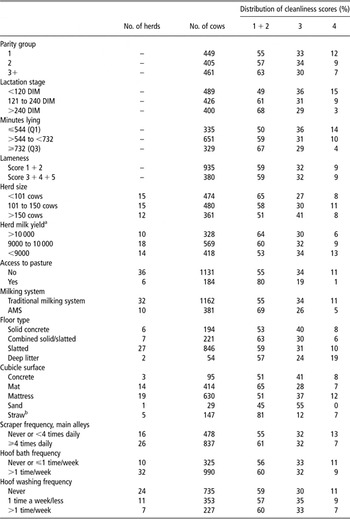
Four cow-level risk factors were included: parity (categorical; 1, 2, 3 or older), lactation stage (categorical; 0 to 120 days in milk (DIM)/121 to 240 DIM/>240 DIM), lameness (binary; 0 = lameness score 1,2/1 = lameness score >2) and the mean daily lying time (continuous; min). Eight herd-level risk factors were included: herd size (categorical; <101 cows/101 to 150 cows/>150 cows), mean annual milk production (categorical; <9000 kg energy-corrected milk (ECM)/9000 to 10 000 kg ECM/>10 000 kg ECM/cow per year), milking system (binary; traditional milking system/AMS), floor type (categorical; solid concrete floor/slatted floor/straw yard/combination of solid concrete and slatted floor), access to pasture grazing at the time of the visit (binary; yes/no), alley scraper frequency (binary; never or <4 times/day/⩾4 times/day), hoof bathing frequency (binary; never or ⩽1 time/week/>1 time/week) and hoof washing frequency (binary; never or ⩽1 time/week/>1 time/week). Floor type refers to the type of floor in the feed and cubicle alleys, whereas deep litter refers to herds where the lying area is a deep litter barn. Hoof bathing refers to the use of walking-through hoof bathing systems typically used when cows return from milking. Hoof washing refers to manual or automatic washing of the hooves typically during or immediately after milking. The distribution of the variables in the different categories is presented in Table 1. The model with potential main effects was reduced using stepwise backward elimination sequentially removing explanatory variables with a P-value >0.05 from the model (Dohoo et al., Reference Dohoo, Martin and Stryhn2003). After model reduction, all possible two-way interactions between remaining risk factors were included in the final model one by one and was tested for significance. Furthermore, 16 interactions between the original risk factors were considered to be biologically plausible and were tested for significance. These interactions were: parity × herd size, parity × milk yield, parity × lameness, lactation stage × herd size, lactation stage × milk yield, lactation stage × lameness, floor type × scraper frequency, floor type × milking system, floor type × lameness, floor type × pasture access, milking system × herd size, milking system × milk yield, milking system × pasture access, milking system × scraper frequency, milking system × hoof bath frequency, milking system × hoof washing frequency. Likewise, to assess possible confounding all excluded risk factors were forced in one by one and it was checked whether parameter estimates changed by more than 20%.
Numerical distribution of the 42 herds and 1315 cows and the distribution (expressed in percentages of number of cows) of the hind limb cleanliness scores in the different levels of the herd-level and cow-level risk factors in a cross-sectional study of risk factors for poor hind limb cleanliness in loose-housed, lactating Danish dairy cows

DIM = days in milk; AMS = automatic milking system.
akg energy-corrected milk per cow per year.
bThe two herds with deep litter barns included.
Results
Descriptive
In total, 42 herds were included in the study. The mean herd size was 153 cows (s.d.: 76; min: 49; max: 453) and the mean milk production was 9382 kg ECM/cow per year (s.d.: 937; min: 6945; max: 11 165). In 38 herds, more than 90% of the cows were large breed cows (Danish Holstein, Danish Red Holstein or Danish Red Dairy Breed), two herds were Danish Jersey and two herds were cross-bred herds (>50% cross-bred cows). The predominant large breed was Danish Holstein comprising 87% (n = 1163) of the large breed cows. Cows were housed in cubicles in 40 of the herds, and two herds had deep litter barns.
In total, 1476 cows were cleanliness scored. From 100 of these cows, IceTag data were missing. The missing IceTag data were missing at random due to different reasons such as technical problems in reading the IceTag or failure in registration of the animal or IceTag number. Thus, 1376 cows had readable IceTag data. Observing a histogram of daily lying times per cow (plot not shown) showed that 90% of all cows had daily lying times between 444 and 840 min (7.4 and 14.0 h). The tails of the histogram contained a few observations where the daily time was close to 0% or 100% of the day, respectively. Observations with a mean lying time per day <10% of the day (<144 min/2.4 h) or more than 90% of the day (>1296 min/21.5 h) were considered biologically unlikely and were excluded (n = 61; 4%). Only cows with complete data were kept and thus, in total, 1315 cows were used in the analysis. The mean number of cows with missing or excluded IceTag data per herd was 3 (s.d. = 4.1).
The mean number of cows included per herd was 31 (s.d. = 5.3). The cows were distributed with 34% (n = 449) first parity cows, 31% (n = 405) second parity cows and 35% (n = 461) third parity or older cows. DIM was categorised into start lactation (0 to 120 DIM), mid lactation (121 to 240 DIM) and late lactation (>240 DIM). The distribution of the cows in the three categories was 37% (n = 489) in start lactation, 32% (n = 426) in mid lactation and 30% (n = 400) in late lactation. The mean daily lying time per cow was 640 min equal to 10.7 h (s.d.: 151; min: 192; max: 1212). The mean herd prevalence of lameness (lameness score >2) was 0.29 (s.d. = 0.17). The categorisation of the herd-level risk factors and the distribution of the herds in the different categories are shown in Table 1.
The overall median cleanliness score was 2 (interquartile range = 2 to 3). Of all cows, 12.8% had score 1; 45.9% had score 2; 31.9% had score 3; and 9.4% had score 4. The distribution (in %) of the cleanliness scores in different categories of the possible risk factors is listed in Table 1. The distribution of the three cleanliness score categories used in the risk factors analysis is shown in Table 2, where the median, minimum, maximum and the quartiles of herd prevalences of the three categories are also shown.
Distribution of all cows in the three levels of the hind limb cleanliness score and the herd-specific prevalence (median, minimum, maximum and quartiles, Q) of observations in the three levels of hind limb cleanliness scores (n = 1315) in the 42 herds in a cross-sectional study of risk factors for poor hind limb cleanliness in loose-housed, lactating Danish dairy cows

Statistics
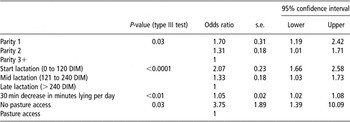
After merging scores 1 and 2 on the cleanliness score, the curves on the various cumulative logits were parallel, thereby indicating that the assumption of proportional odds in the data was correct. Of the initial 12 risk factors, three cow-level and one herd-level risk factors remained in the final model with P-values ⩽0.05. To help the interpretation of the model results, the cleanliness scale is briefly recapitulated: the higher a cleanliness score, the larger part of the hind legs below the hocks was contaminated with dirt. This could be either as multiple, smaller flecks of dirt or as larger areas covered in caked-on dirt. First and second parity cows were more likely to have more dirty hind legs than third parity or older cows (P = 0.004 and 0.04, respectively). Secondly, being in late lactation was associated with a higher probability of having cleaner hind legs compared with the other lactation stages (start lactation P ⩽ 0.001; mid lactation P = 0.03). Finally, increase of the daily lying time was associated with a decreased risk of having dirtier hind legs (P = 0.001). Of the herd-level factors, having access to pasture (P = 0.01) reduced the risk of having dirtier hind legs. No significant interactions or confounding were found. Score statistics and ORs obtained by exponentiation of the parameter estimates from the model are presented in Table 3. The presented ORs are interpreted as the effect of the variable on the odds of being in a higher rather than a lower cleanliness category. For example, the odds of a parity 1 cow having a higher cleanliness score (rather than a lower cleanliness score) is 1.7 times the odds for a parity 3 or older cow. In other words, compared with a parity 3 or older cow with a cleanliness score of 2, the odds of a parity 1 cow having a cleanliness score of 3 or 4 would be 1.7 times the odds of having a cleanliness score of 1 or 2.
Results from an ordinal logistic regression on the risk of having higher leg cleanliness score in a cross-sectional study of 1315 loose-housed, lactating Danish dairy cows

DIM = days in milk.
Generalized estimation equation estimates for intercept 1 = −0.10 (P ⩽ 0.0001) and intercept 2 = −1.07 (P = 0.08).
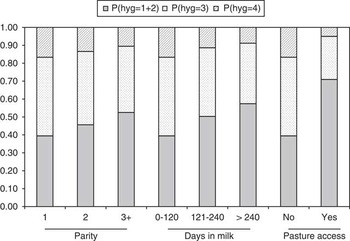
The individual effects of the risk factors are illustrated in Figure 1, where the predicted probabilities of the different cleanliness levels are shown stratified by the levels of the risk factors. To predict the influence of a particular risk factor, the others were fixed: first parity; DIM: 0 to 120 days; a mean lying time of 640 min; and no access to pasture.
Predicted probabilities (P(Hyg)) of the three cow leg cleanliness levels stratified by the levels of the risk factors based on the results from an ordinal logistic regression on the risk of having a higher leg cleanliness score in a cross-sectional study of 1315 loose-housed, lactating Danish dairy cows. To predict the influence of a particular risk factor, the others were fixed: first parity; days in milk 0 to 120 days; no pasture access and a mean lying time of 640 min/day.

Discussion
This study evaluated the effects of possible herd-level and cow-level risk factors on the cleanliness of the hind limbs of 1315 loose-housed, lactating Danish dairy cows in 42 commercial herds. Poor hygienic conditions in the cows’ environment are considered to be a risk factor for some hoof diseases, and cleanliness scoring of the cows’ hind limbs in this study is used as a measurement of the hygienic conditions.
Not having access to pasture at the time of the visit was associated with an increased risk of having dirtier hind limbs. This is in agreement with Ellis et al. (Reference Ellis, Innocent, Mihm, Cripps, Mclean, Howard and Grove-White2007) who found that the transition from summer grazing to winter housing resulted in increased whole-cow cleanliness scores as would be expected as cows in housed systems are more restricted in space and choice of lying areas. Furthermore, Ellis et al. (Reference Ellis, Innocent, Mihm, Cripps, Mclean, Howard and Grove-White2007) observed that the difference between cleanliness of cows in housed and grazing herds diminished when the grazing period was prolonged into more wet periods of the year. This indicates that the beneficial effects of pasture access depend on the conditions of the outdoor area. Decreased risks of heel horn erosions, interdigital dermatitis and DD have been found when pasture grazing systems are compared with indoor systems or systems with access to outdoor exercise areas (Wells et al., Reference Wells, Garber and Wagner1999; Somers et al., Reference Somers, Frankena, Noordhuizen-Stassen and Metz2005; Cramer et al., Reference Cramer, Lissemore, Guard, Leslie and Kelton2009). The common interpretation of this relationship is that the pasture-based system provides the best hygienic conditions and the results from this study support this theory. In Denmark, cows are typically housed indoor from November to April due to the climatic conditions during winter. Therefore, the shown effect of pasture access could possibly be an indication of a seasonal effect.
In this study, three cow-level factors were associated with the leg cleanliness. The risk of having dirtier hind limbs was higher for younger cows; cows in early lactation; and for cows with shorter daily lying times. The mean daily lying time observed in this study is comparable with other studies (Cook et al., Reference Cook, Mentink, Bennett and Burgi2007; Fregonesi et al., Reference Fregonesi, Tucker and Weary2007; Olmos et al., Reference Olmos, Boyle, Hanlon, Patton, Murphy and Mee2009; Tolkamp et al., Reference Tolkamp, Haskell, Langford, Roberts and Morgan2010). The association of shorter daily lying time with the risk of having dirtier hind limbs is expectable as the legs would be more exposed to slurry in the alleys than in the lying area. Reduction in mean daily lying times has been observed with increased stocking density (Fregonesi et al., Reference Fregonesi, Tucker and Weary2007) with different aspects of cubicle design such as decreasing the curb – neck–rail distance (Tucker et al., Reference Tucker, Weary and Fraser2005) and sand bedding compared with straw bedding (Norring et al., Reference Norring, Manninen, de Passillé, Rushen, Munksgaard and Saloniemi2008), as well as during periods of heat stress (Cook et al., Reference Cook, Mentink, Bennett and Burgi2007). The data from this study do not allow us to evaluate the specific reason for a reduced lying time, but it may indicate that improved leg cleanliness is yet another argument for the farmer to focus on the quality and management of the lying area.
Within the herds in this study, all lactating cows were housed in the same environment, and still DIM and parity affected the leg cleanliness. The effects of DIM and parity indicate that the usage of the barn differs between cows. Ellis et al. (Reference Ellis, Innocent, Mihm, Cripps, Mclean, Howard and Grove-White2007) found that groups of high-yielding as well as mid-yielding cows were less likely to be clean than cows in herds where all cows were housed together. This study showed no effect of herd-level milk production on the risk of having dirtier hind limbs, but being in early lactation where the milk production typically peaks was associated with an increased risk of having dirtier hind limbs. Studies of time-budgets and feeding behaviour show that feeding behaviour and daily mealtime to some extent vary with parity, lactation stage and milk yield (Fregonesi and Leaver, Reference Fregonesi and Leaver2001; Azizi et al., Reference Azizi, Kaufmann and Hasselmann2009; Bewley et al., Reference Bewley, Boyce, Hockin, Munksgaard, Eicher, Einstein and Schutz2010). Some of this variation might be due to different physiological needs in different periods, and social factors also influence the feeding behaviour (Rioja-Lang et al., Reference Rioja-Lang, Roberts, Healy, Lawrence and Haskell2009).
Finally, several management factors may also influence the leg cleanliness of the cows. In this study, we considered a variety of management factors such as herd size, milk production, floor type, cubicle surface and milking system and also considered were factors such as hygienic preventive initiatives such as floor scraping, hoof bathing and hoof washing. However, none of these factors showed significant effects on the leg cleanliness of the lactating cows on the basis of the data from this study, which might have resulted from a low variability of management practices among the herds. Given the cross-sectional nature of these data, the identified associations are not necessarily causal relationships as the temporal relationship between exposure and outcome cannot be established. The farms included in this study were randomly selected from a group of farmers that responded positively to an inquiry from our research unit. This willingness to participate might indicate a possible selection bias as only farmers with positive attitudes towards the project were included. To some extent, both the lameness and cleanliness scoring systems are subjective systems. Differences between the observers’ interpretation of the scales might have led to some bias in the results if one observer, for example, tended to give consequently lower cleanliness scores, thereby leading to lower scores in some herds compared with others. However, the reliability of subjective systems can be enhanced by training (Kristensen et al., Reference Kristensen, Dueholm, Vink, Andersen, Jakobsen, Illum-Nielsen, Petersen and Enevoldsen2006). All three research technicians were carefully trained in using these systems, and therefore the variation in scoring between the technicians is considered to be minimal. Furthermore, 61 observations were excluded because the measured lying time seemed biologically unlikely. Previous studies have validated the automatic monitoring of lying, standing and walking behaviour with IceTags by comparing with direct or video observations of the cows (Munksgaard et al., Reference Munksgaard, Reenen and Boyce2006; Nielsen et al., Reference Nielsen, Pedersen, Herskin and Munksgaard2010; Tolkamp et al., Reference Tolkamp, Haskell, Langford, Roberts and Morgan2010). These studies have shown that IceTags are reliable in detecting lying behaviour and also accurate in predicting the duration of lying bouts. Daily lying times close to 0% or close to 100% indicate that the IceTag for some reason was removed from the cow. An IceTag placed on an unmoving surface would result in daily lying times close to 0% or 100% depending on whether it was placed in a vertical or a horizontal position.
Conclusions
This study identified four risk factors for poor leg cleanliness of loose-housed, lactating cows. At the cow level, low parity, early lactation stage and decrease of the daily lying time were associated with an increased risk of having dirtier hind limbs. At the herd level, an increased risk of dirtier hind limbs was found in herds with no access to pasture grazing compared with pasture systems.
Acknowledgements
We wish to thank farmers for their participation in the project. Dr. Ulrich Halekoh is thanked for his advice on the statistical procedure. The project was partly funded by The Innovation Law, Danish Ministry of Food, Agriculture and Fisheries.