Introduction
The diagnosis and management of idiopathic sudden sensorineural hearing loss (SNHL) are controversial and challenging. Idiopathic is an adjective meaning of unknown cause, as regards a disease. It originates from the Greek ιδιoς, idios (one's own) and πάθος, pathos (suffering): i.e. a disease of its own kind. As medical knowledge advances, more root causes of disease are discovered, and so the number of cases designated as idiopathic shrinks. In his book The Human Body, the well known science fiction writer and professor of biochemistry Isaac Asimov noted a comment about the term idiopathic made in the 20th edition of Stedman's Medical Dictionary: ‘A high-flown term to conceal ignorance’.Reference Asimov1
There are various components which constitute idiopathic sudden SNHL, most of them indistinct in definition or determination. The ‘sensorineural’ component is the one we can identify with most confidence, and investigate via accurate audiological assessment with appropriate masking. ‘Sudden’ may mean instantaneous or over hours or days. Somewhat arbitrarily, sudden is typically defined as an onset over less than three days.Reference Wilson, Byl and Laird2–Reference Arellano, Garcia Berrocal, Gorriz, Gonzalez, Vicente and Ramirez Camacho4 Defining ‘hearing loss’ in terms of dB loss and frequencies affected is without logical foundation. Often, a loss of 30 dB in three or more contiguous frequencies will be considered to qualify.Reference Wilson, Byl and Laird2 Whether a hearing loss is ‘idiopathic’ is a question of determination, rather than definition. It is almost always uncertain, but the level of uncertainty will vary.
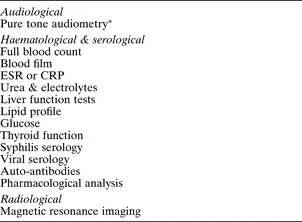
From the huge list of potential causes of sudden SNHL, a specific cause is found in less than 5 per cent of cases.Reference Burton and Harvey5 It seems likely that there are numerous and varied causes for sudden SNHL, including both intra- and retro-cochlear pathologies, and that we may lack tests to accurately identify many of these causes in any case. Expert opinion (i.e. the best evidence currently available) recommends that sudden SNHL may be referred to as idiopathic once a specific cause has been excluded on the basis of history, clinical examination and basic investigations with or without magnetic resonance imaging (MRI).Reference Burton and Harvey5 The choice of investigations varies according to opinion and availability, and discrepancies frequently arise between academic treatise and clinical practice. Some possible initial investigations for sudden SNHL are shown in Table I.
Possible investigations for sudden SNHL

*Appropriately masked. SNHL = sensorineural hearing loss; ESR = erythrocyte sedimentation rate; CRP = C-reactive protein. Adapted with permission 5
A low certainty of diagnosis will result from: lack of patient appraisal specifically for conditions for which they, as individuals, may be at high risk; limited investigation; and a single consultation. Where such low diagnostic certainty remains unrecognised, a diagnosis may be delayed or missed.
We present a case in which a relatively uncertain diagnosis of idiopathic sudden SNHL was made. We discuss giant cell arteritis as a possible cause of sudden SNHL. We also consider whether modifying our approach to sudden SNHL, by actively determining the certainty of diagnosis and then guiding management as appropriate, might lead to improved outcomes.
Case report
A 76-year-old woman presented to the accident and emergency department with a one-week history of right-sided hearing loss, with tinnitus and dizziness. Her general practitioner had prescribed her betahistine, but her symptoms had continued unabated. The night before her attendance, the patient had experienced a further, sudden, overnight deterioration in right-sided hearing, prompting her to seek attention. There had been no previous similar episodes. There were no other symptoms of note. The patient's past medical history included coronary artery disease and diet-controlled diabetes.
Examination revealed findings consistent with severe right-sided hearing loss, together with first-degree nystagmus to the right. Pure tone audiometry showed a flat sensorineural hearing loss of 80 dB (air conduction threshold average across 0.5, 1, 2 and 4 kHz) in the right ear. Presbyacusis was noted in the left ear, with average thresholds (similarly measured) at 19 dB. The only abnormality noted on haematological investigation was an elevated C-reactive protein (CRP) concentration, at 92 mg/L.
A diagnosis of idiopathic sudden SNHL was made (or, more accurately, acute cochleovestibular dysfunction of unknown aetiology). An out-patient MRI was booked.
The patient was treated with oral steroids, betahistine, prochlorperazine and carbogen. She had previously been taking regular aspirin, and this was continued. Her dizziness improved quickly, but there was no parallel improvement in hearing over the first 48 hours. She was discharged from hospital.
The patient was reviewed again at one week, when repeat audiometry showed her hearing to be static in both ears. The steroid dose was tapered.
Immediately prior to a further review at two weeks, and the day after finishing her course of steroid treatment, the patient re-presented to the ENT department complaining of new hearing loss and tinnitus in the left ear. She also now complained of scalp tenderness, jaw pain and mild headaches. Examination revealed palpably thickened, tender superficial temporal arteries bilaterally. At this point, a diagnosis of giant cell arteritis was made clinically. Repeated pure tone audiometry showed thresholds of 44 dB (determined as above) in the left ear, with no change in the right. Further investigations showed that the CRP had risen to 121 mg/L and that the erythrocyte sedimentation rate (ESR) was 77 mm/hour.
Steroid therapy was recommenced, and the case was discussed with the rheumatology team. Temporal artery biopsies a few days later confirmed the diagnosis of giant cell arteritis.
The patient made a good recovery with appropriate treatment, and suffered no major complications. Her tinnitus and dizziness completely resolved. Her hearing recovered partially, but not fully, in both ears.
Discussion
Giant cell arteritis is an inflammatory rheumatic disease closely related to polymyalgia rheumatica. It is predominantly seen in the elderly, and is characterised by vasculitis of large and medium-sized vessels.Reference Dasgupta and Hassan6 Cases under the age of 50 years are relatively rare. Female sex also predisposes to developing giant cell arteritis, with a 2.5- to threefold relative risk. The condition is rare in Asian and Afro-Caribbean populations. The incidence in the UK is 2.2/10 000 person-years, and it is more common in the south than the north.
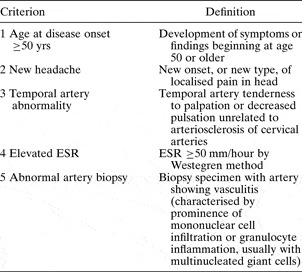
The diagnostic criteria widely used for giant cell arteritis are those of the American College of Rheumatology (Table II).Reference Hunder, Bloch and Michael7 A patient can be diagnosed with giant cell arteritis if three or more criteria are fulfilled. This yields a sensitivity of 93.5 per cent and a specificity of 91.2 per cent.
American College of Rheumatology Classification criteria for giant cell arteritis

Yrs = years; ESR = erythrocyte sedimentation rate; Arthritis Rheum. Vol. 33, 1990, page 1122. Copyright (1990, John Wiley & Sons, Inc.). Reprinted with permission of John Wiley & Sons, Inc.
An elevated CRP concentration may be a more sensitive indicator when the ESR is normal, although both can be normal.Reference Ciccarelli, Jeanmonod and Jeanmonod8, Reference Poole, Graham and Lucas9 Early temporal artery biopsy is desirable in all cases, preferably within a week of starting steroids. However, there are reports that biopsy findings may remain positive for 14–28 days following initiation of steroids, as in our patient.Reference Achkar, Lie, Hunder, O'Fallon and Gabriel10
Visual loss and ischaemic stroke are the most feared complications of giant cell arteritis. Steroid treatment has been proven to be effective in reducing the risk of such complications, as well as in relieving symptoms. The initial dose of steroids favoured in the treatment of giant cell arteritis is approximately 40 to 60 mg prednisolone daily, although it has been suggested that prompt commencement of medication is relatively more important than the actual dose.Reference Dasgupta and Hassan6 Interestingly, in our patient the correct treatment was administered despite a delay in diagnosis. This will have been beneficial in treatment of the condition, but may have delayed correct diagnosis further. Aspirin use is also recommended in giant cell arteritis unless contraindicated; aspirin is, again, a treatment common to both idiopathic sudden SNHL and giant cell arteritis.
In 1998, Hausch and Harrington reported a small case series of giant cell arteritis associated with sudden SNHL.Reference Hausch and Harrington11 In three of the four cases described (of 271 cases of giant cell arteritis evaluated over 10 years), the sudden SNHL preceded the diagnosis of giant cell arteritis by two days to two months. In all cases, there was partial or full return of hearing with treatment. Prior to this report, only 14 other, similar cases of giant cell arteritis associated with sudden SNHL had been reported in the literature, the sudden SNHL not necessarily preceding the diagnosis of giant cell arteritis. Of the 18 cases, the overall response rate to treatment, with respect to hearing recovery, was calculated at only 44 per cent, although the magnitude of recovery was not quantified in most cases. There have been no further reports of similar cases in the literature for over 10 years.
• Diagnosis of idiopathic sudden sensorineural hearing loss (SNHL) is controversial, and practice varies widely depending on opinion and availability of resources
• Some cases of idiopathic sudden SNHL may not be idiopathic, but may have an identifiable cause that is missed or its identification delayed
• Clinicians' readiness to accept that a case of sudden SNHL is idiopathic should be directed by an explicit assessment of the certainty of diagnosis
• Certainty of diagnosis may be guided by clinical assessment, investigation and the passage of time
• This change in approach to idiopathic sudden SNHL diagnosis should optimise both patient management and clinical knowledge
In cases of sudden SNHL, bilateral involvement (either synchronous or metachronous) must raise suspicion of an underlying cause. In less than 1 per cent of such cases can idiopathic sudden SNHL be diagnosed.Reference Burton and Harvey5 Higher incidences of idiopathic sudden SNHL with bilateral involvement have been reported, with figures varying widely.Reference Byl12 However, the preliminary diagnosis that any bilateral sudden SNHL is ‘idiopathic’ should be questioned.
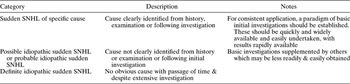
Burton and Harvey recently proposed a new categorisation of sudden SNHL, by certainty of diagnosis (Table III).Reference Burton and Harvey5 Their categorisation recognises the inherent difficulty of reaching a confident diagnosis of idiopathic sudden SNHL, and focuses the clinician's diagnostic process. Although agreement on what investigations are deemed appropriate for each category is unlikely to be reached, it is doubtful this will reduce the practical value of the categorisation. This, or any other similar system, serves to make clinicians aware of their approximate level of confidence in a diagnosis of idiopathic sudden SNHL, allowing appropriate modification of management.
Suggested categorisation of sudden SNHLReference Burton and Harvey5

SNHL = sensorineural hearing loss. Reproduced with permission 5
The ability to recognise and deal with uncertainty is an important part of the development of clinical judgement. Most trainees start with a positivist view of medicine, which has been characterised as ‘absolute knowing’: i.e. there is one clear answer to any clinical problem, which will become apparent as they learn more.Reference Baxter Magolda13 Despite the contributions of evidence-based medicine, a constructivist view appears to better describe the reality of clinical practice. The answers to any given clinical problem are multiple and context-dependent, and develop over the course of a complete clinical encounter.Reference Schön14 Development of true expertise involves the embracing of uncertainty, both in diagnosis and in clinical decision-making.Reference Bereiter and Scardamalia15 Dissonant features of a clinical presentation should act as a stimulus for further assessment and as a focus for new learning.Reference Norman, Young and Brooks16, Reference Jarvis17
A clinician's evaluation of the certainty of diagnosis may be facilitated or refined by consciously considering the contributions not only of clinical investigations but also of clinical assessment and time.
The contribution of clinical assessment can be seen in the case of an individual patient who may be at high risk of a particular condition known to cause sudden SNHL. Specifically identifying and excluding such a condition will improve the certainty of diagnosis. For example, our patient was over 50 years old and female, and this should have alerted us to the possibility of giant cell arteritis. Specific enquiries regarding headaches, scalp tenderness, jaw claudication, visual symptoms and a history of polymyalgia rheumatica might have been helpful at first consultation. Temporal arteries may have been palpable. Liver function tests could have been undertaken, as well as measuring inflammatory markers. Another example of the contribution of clinical assessment may be the testing of Afro-Caribbean patients in whom sickle cell trait or disease is suspected.
The contribution of the passage of time following initial consultation, and the number of reviews undertaken in that time, should also not be underestimated. The certainty of diagnosis will increase with time and with repeated reassessment.
The initial diagnosis of idiopathic sudden SNHL is made with varying certainty in each clinical case. Explicit recognition and documentation of the level of certainty of diagnosis, based on clinical assessment, investigations performed and the passage of time, will make us better-informed and more clear-thinking. This, in turn, will improve our management of sudden SNHL, expanding our knowledge and improving patient care.