Residents of the Mississippi Gulf Coast have faced multiple disasters, including natural hazards and technological disasters, during the past several decades. Previous studies that examined the impact of disasters on mental health have focused largely on the role of resilience at the personal level, indicating that greater psychological resilience is related to lower mental health problems in the aftermath of disasters.Reference Blackmon, Lee and Cochran 1 - Reference Shenesey and Langhinrichsen-Rohling 3 An individual’s ability to adapt to and recover from disasters, however, cannot be fully understood without understanding the context of community in which individual adaptation and living take place.Reference Abramson, Grattan and Mayer 4 , Reference Windle 5 Very limited attention, however, has been paid to the role that community plays in the process of recovery. The purpose of the current study was therefore to examine the relationship between community resilience and psychological resilience and how these factors impact depressive symptoms. This study used a sample of residents of 3 coastal counties of Mississippi who lived in the area at the time of Hurricane Katrina in 2005 and the Deepwater Horizon oil spill in 2010. The area was heavily affected by these 2 consecutive disasters.
LITERATURE REVIEW
Community Resilience and Mental Health
Community resilience is the collective ability of a specific geographic area or neighborhood to overcome disaster-related stressors through cooperation in order to return to day-to-day life activities as quickly as possible.Reference Aldrich and Meyer 6 Originally, community resilience was viewed as the ability of a community to remain stable or return to equilibrium after a disturbance, but the definition has evolved to regard the resilience of a community as adaptation after a disturbance, over time, with feedback loops that encourage growth and development even during times when there are no disasters.Reference Bergstrand, Mayer and Brumback 7 - Reference Walker and Salt 9 Community resilience has been viewed as a multidimensional construct, which includes several sets of adaptive capacities, including economic, infrastructural, ecological, and social (eg, social capital, information and communication, and leadership).Reference Cai, Lam and Zou 10 - Reference Norris, Stevens and Pfefferbaum 12 The idea of community resilience as a multidimensional construct has been empirically tested in several studies using exploratory factor analysis and confirmatory factor analysis. For example, Pfefferbaum et alReference Pfefferbaum, Pfefferbaum and Nitiéma 13 reported a 5-factor model of community resilience that includes caring and connection, resources, transformative potential, disaster management, and information and communication. Kulig et alReference Kulig, Edge and Townshend 8 reported a 3-factor model that incorporates leadership and empowerment, community engagement, and positive or nonadverse geography. Community resilience has been measured by individual perceptions of the adaptive capacity of a community or by physical and geographical indicators, such as housing units per square mile, hospital beds per 10,000 persons, and elevation.Reference Cai, Lam and Zou 10 , Reference Pfefferbaum, Pfefferbaum and Nitiéma 13 , Reference Cutter, Ash and Emrich 14
Community resilience has been found to affect better mental health outcomes among survivors of disasters.Reference Adeola and Picou 15 , Reference Fullerton, Ursano and Liu 16 Adeola and PicouReference Adeola and Picou 15 found that lack of social capital was related to greater post-traumatic stress disorder (PTSD) and depressive symptoms among survivors of Hurricane Katrina. Fullerton and othersReference Fullerton, Ursano and Liu 16 examined public health workers exposed to a number of storms in Florida during the 2004 hurricane season and found that higher community-level collective efficacy was associated with lower levels of depressive symptoms. Conversely, mixed findings were observed in a 2015 studyReference Lowe, Sampson and Gruebner 17 that examined the relationship between community factors and mental illness following Hurricane Sandy in New York. Higher social capital (ie, lower percentage of residents living alone) was related to increased rates of PTSD symptoms, whereas economic development was only related to reductions in depressive symptoms among residents with no disaster-related stressors.
Psychological Resilience and Mental Health
Psychological resilience can be defined as “the process of effectively negotiating, adapting to, or managing significant sources of stress or trauma” (p163).Reference Windle 5 While psychological resilience has been conceptually viewed in terms of static traits, more recent studies have agreed that it is more accurately viewed as a dynamic process that involves meta-cognition and developmental, situational, and sociocultural factors that change over time.Reference Windle 5 , Reference Fletcher and Sarkar 18 - Reference Pangallo, Zibarras and Lewis 20 The latter perspective suggests that the process of positive adaptation can be understood within the context of adversity (eg, severity) and environment (eg, family, neighborhood, and community) and the interaction between people and their environments.Reference Windle 5 , Reference Fletcher and Sarkar 18 , Reference Pangallo, Zibarras and Lewis 20
The literature has consistently demonstrated an inverse relationship between psychological resilience and psychological distress. For instance, Osofsky et alReference Osofsky, Osofsky and Hansel 2 examined a sample from areas in Louisiana that were highly exposed to both Hurricane Katrina and the Deepwater Horizon oil spill and found that lower resilience was associated with higher rates of depression and anxiety. Shenesey and Langhinrichsen-RohlingReference Shenesey and Langhinrichsen-Rohling 3 conducted a similar study among coastal communities in Alabama 1 year after the Deepwater Horizon oil spill and determined that lower resilience was associated with chronic symptoms of depression. An inverse relationship between psychological resilience and psychological distress has also been found in a number of longitudinal studies.Reference Youssef, Green and Beckham 21 , Reference Wild, Smith and Thompson 22
Relationship Between Community Resilience and Psychological Resilience
Egeland et alReference Egeland, Carlson and Sroufe 23 reviewed several longitudinal studies with children and adolescents and concluded that “the capacity for resilience is seen as developing over time through an interaction of constitutional and experiential factors in the context of a supportive environment” (p525). UngarReference Ungar 24 mentions that personal resilience embraces capacities “to navigate to resources” and “to negotiate for the resources to be provided and experienced in culturally meaningful ways” (p17); therefore, family, community, and government play key roles in the process of navigation and negotiation by making resources available and accessible. Several empirical studies have indicated that psychological resilience plays a mediating role that links community factors with mental health. For instance, a longitudinal study of adolescents conducted by Williams and MertenReference Williams and Merten 25 indicated that human agency (ie, self-efficacy and optimism) was a significant mechanism linking community factors (ie, community connectedness, community integration) with depressive symptoms. In a study conducted by Lyons et al,Reference Lyons, Fletcher and Bariola 26 the Fletcher-Lyons Collective Resilience Scale (FLCRS) was constructed to measure the perceptions of collective resilience, which is the resilience of groups or communities. The authors found a strong relationship between individual resilience and collective resilience. In addition, the relationship between collective resilience and mental health was fully mediated by individual resilience, further suggesting that “collective and individual resilience come together to play a role in health and well-being” (p76).Reference Lyons, Fletcher and Bariola 26
Confounding Factors
Although the major purpose of this study was to investigate relationships between community resilience, psychological resilience, and depressive symptoms, other variables were also examined as possible confounding covariates. Three variables considered in this category were age, household income, and the cumulative effects of disasters. Previous studies have indicated that income is significantly related to psychological resilienceReference Campbell-Sills, Forde and Stein 27 , Reference Ni, Chow and Jiang 28 and mental health.Reference Lorant, Croux and Weich 29 , Reference Sareen, Afifi and McMillan 30 Age was also found to be significantly related to psychological resilienceReference Gooding, Hurst and Johnson 31 and mental health.Reference Knight, Gatz and Heller 32 - Reference Person, Tracy and Galea 34 Studies have also indicated that the degree of exposure to a disaster and exposure to multiple disasters are associated with poor mental health outcomes.Reference De Soir, Zech and Versporten 35 , Reference Harville, Xiong and Smith 36 For example, Harville et alReference Harville, Xiong and Smith 36 found that those who had severe exposure to both Hurricanes Gustav and Katrina showed higher depressive and PTSD symptoms.
Current Study
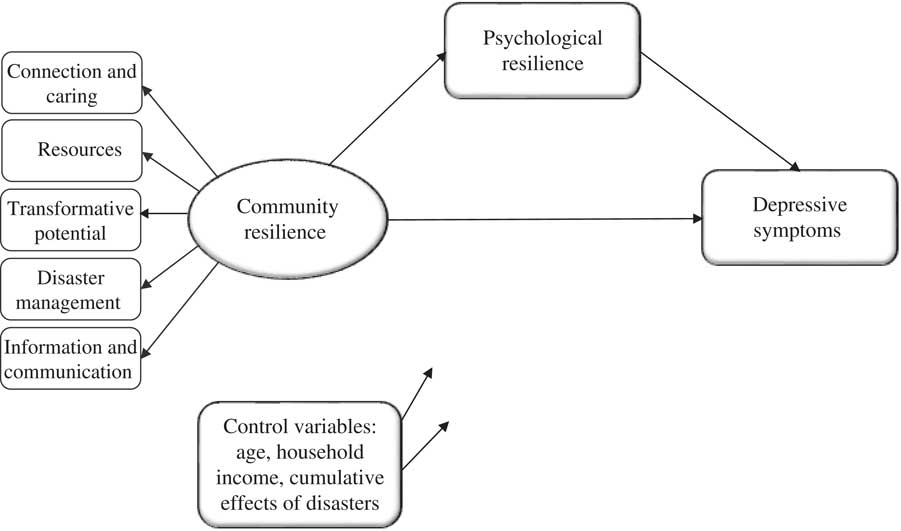
The current study builds on the previous literature by examining how the relationships between psychological and community resilience impact depressive symptoms among individuals who have experienced multiple disasters. Furthermore, we develop and test a conceptual model based on the previous literature, which links community resilience and psychological resilience to depressive symptoms (Figure 1). In this model, community resilience is represented by 5 dimensions: connection and caring, resources, transformative potential, disaster management, and information and communication.Reference Pfefferbaum, Pfefferbaum and Nitiéma 13 The following hypotheses were proposed: (1) community resilience would be inversely related to depressive symptoms, (2) psychological resilience would be inversely related to depressive symptoms, and (3) psychological resilience would mediate the relationship between community resilience and depressive symptoms.
Proposed Model of Community Resilience, Psychological Resilience, and Depressive Symptoms.

METHODS
Sampling Procedures
The study area consisted of the southernmost portions of the 3 Mississippi coastal counties, which corresponded to an area that extended from Interstate 10 southward to the coast of the Gulf of Mexico. Most residents in these 3 counties live in the relatively densely populated cities and in close proximity to the Gulf of Mexico. The more rural areas north of Interstate 10 were excluded to ensure that the sample represented only residents living in the most disaster-prone areas.
Survey administration took place during the spring of 2015 and focused on a spatially stratified, random sample of households in the study area. Public-domain parcel maps obtained from the coastal counties were used to locate all parcels within the area between Interstate 10 and the Gulf of Mexico coast. Parcels associated with businesses, industries, schools, hospitals, churches, and other nonresidential uses were removed from analysis. Likewise, parcels larger than 2 acres or smaller than 0.1 acres were also removed given that these sizes of properties are normally nonresidential or, in the case of large parcels, are not conducive to survey administration. The remaining parcels consisted of residential households from which a random sample of 1000 households was selected and mapped by using ArcGIS 10.2 software. 37
Undergraduate and graduate students from a public university in Mississippi conducted the surveying by using maps with numbered grid systems to assist them in finding the randomly sampled households. The maps contained the highlighted households as well as aerial imagery and road networks to ensure that the appropriate residences were sampled. An orientation took place prior to the survey administration where the students were trained in community-based surveying. The project was reviewed and approved by the Human Subjects Protection Review Committee of the university with which authors of the current study are affiliated.
Out of a total of 379 completed surveys, 294 were administered to individuals who lived in 1 of the 3 counties of the Mississippi Gulf Coast at the time of Hurricane Katrina in 2005 and the Deepwater Horizon oil spill in 2010. Survey questions that asked respondents to identify the city and state where they lived were used to identify this subset of respondents. The 294 respondents who experienced both disasters became the focus of analysis for this study.
Measures
Perceived Community Resilience
Levels of perceived community resilience were measured by using the Communities Advancing Resilience Toolkit (CART).Reference Pfefferbaum, Pfefferbaum and Nitiéma 13 , Reference Pfefferbaum, Neas and Pfefferbaum 38 The 24-item CART was designed to measure community resilience to disaster and, by a series of exploratory factor analysis and confirmatory factor analysis, 5 domains were identified and confirmed.Reference Pfefferbaum, Pfefferbaum and Nitiéma 13 , Reference Pfefferbaum, Neas and Pfefferbaum 38 The final 5 domains include: (1) connection and caring (5 items), (2) resources (5 items), (3) transformative potential (6 items), (4) disaster management (4 items), and (5) information and communication (4 items). Examples of items: “People in my community help each other” (connection and caring), “My community has resources it needs to take care of community problems (resources include, for example, money, information, technology, tools, raw materials, and services)” (resources), “People in my community communicate with leaders who can help improve the community” (transformative potential), “My community can provide emergency services during a disaster” (disaster management), and “My community keeps people informed (for example, via television, radio, newspaper, Internet, phone, neighbors) about issues that are relevant to them” (information and communication). Each item is scored on a 5-point Likert scale from 1 (strongly disagree) to 5 (strongly agree), with higher scores reflecting greater resilience. In the current study, the Cronbach’s alphas were 0.86 for connection and caring, 0.84 for resources, 0.90 for transformative potential, 0.85 for disaster management, and 0.79 for information and communication.
Psychological Resilience
The 10-item Connor-Davidson Resilience Scale (CD-RISC 10)Reference Campbell-Sills and Stein 39 was used to measure levels of psychological resilience. The brief 10-item CD-RISC is considered a unidimensional measure with evidence of good internal consistency and construct validity.Reference Campbell-Sills and Stein 39 Items reflect “the ability to tolerate experiences such as change, personal problems, illness, pressure, failure, and painful feelings” (p1026).Reference Campbell-Sills and Stein 39 Using a 5-point Likert scale that ranges from 0 (not true at all) to 4 (true nearly all of the time), participants were asked to rate each statement. Higher scores reflected greater resilience on a scale from 0 to 40. Cronbach’s alpha calculated in the current study was 0.92.
Depressive Symptoms
The Center for Epidemiologic Studies Depression scaleReference Radloff 40 was used to measure depressive symptoms. The CES-D is a 20-item self-rated measure that has been widely used in community-based epidemiological studies.Reference Radloff 40 - Reference Walsh, Levine and Levav 42 Respondents were asked to rate the frequency of each symptom during the past week by using a 4-point scale from 0 (rarely or none of the time [less than 1 day]) to 3 (most or all of the time [5-7 days]). Scores range from 0 to 60, with higher scores reflecting more depressive symptoms. The Cronbach’s alpha calculated in this study was 0.88.
Other Variables
The survey also documented a variety of demographic and socioeconomic variables, including age, gender, race/ethnicity, and household income. Additionally, respondents were asked to provide the city and state where they lived during Hurricane Katrina in 2005 and the Deepwater Horizon oil spill in 2010. Cumulative effects of disasters were measured by 2 items: (1) Did you have to move from your home because of Hurricane Katrina? (Yes/No), and (2) Were you or anyone in your household exposed to oil or dispersants? (Yes/No). Responses were coded as 0 (neither), 1 (either), and 2 (both). Higher scores indicated greater cumulative effects.
Statistical Analysis
First, distributions of variables were screened for normality. The value of the skewness and kurtosis ± 1.96 was used to indicate a reasonably normal distribution.Reference Hair, Anderson and Tatham 43 Additionally, outliers were identified through Z-score, with the cutoff value of 3.29.Reference Tabachnick and Fidell 44 Second, selected socioeconomic and disaster variables were examined to determine whether they should be included in the structural equation model as control variables. Third, structural equation modeling (SEM) was conducted to test the proposed model. The SEM was performed using AMOS version 21Reference Arbuckle 45 and the maximum-likelihood estimation method. To assess model fit, several indices were used: the chi-square test, the comparative fit index (CFI), the Tucker-Lewis Index (TLI), the normed fit index (NFI), and the root mean squared error of approximation (RMSEA) with a 90% CI. Nonsignificant chi-square; the CFI, TLI, and NFI of no less than 0.95; and a RMSEA of no more than 0.06 typically indicate a good fit.Reference Hu and Bentler 46 In addition, the Sobel testReference Sobel 47 was used to determine whether the indirect effect of the predictor on the outcome variable through the mediator variable was significant.
RESULTS
Sample Characteristics
Of 294 respondents, 58% were women and 42% were men. Sixty-four percent of the respondents were white, non-Hispanic American, followed by African American (32%) and others (5%; Asian American, Hispanic American, Native American, multi-ethnic American). The respondents ranged in age from 19 to 92 years, with an average age of 53 years. With regard to educational attainment, 13% of the respondents had received less than a high school diploma; 58% had a high school diploma, some college, or an associate’s degree; and 29% had a bachelor’s degree or higher.
Preliminary and Bivariate Analyses
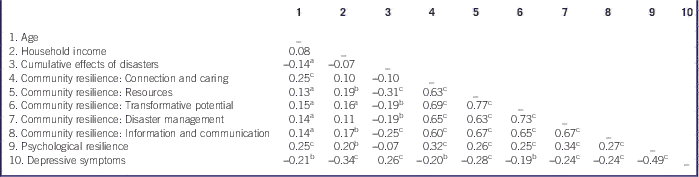
Distributions of all variables were screened for normality and outliers by applying the value of the skewness and kurtosis ± 1.96 and the value of z-score 3.29, respectively. Cases with outliers were detected and removed from subsequent analysis. Pearson product–moment correlation coefficients were computed for the relationship between variables. Confounding factors including age, household income, and the cumulative effects of disasters were examined to determine whether these variables were significant factors related to community resilience, psychological resilience, and depressive symptoms. Significant relationships were found between confounding variables and main study variables. Therefore, these confounding variables were included in the SEM model as control variables. Bivariate correlations among the study variables are presented in Table 1.
Bivariate Correlations Among the Study Variables

a P<0.05; b P<0.01; c P<0.001.
Test of Proposed Model
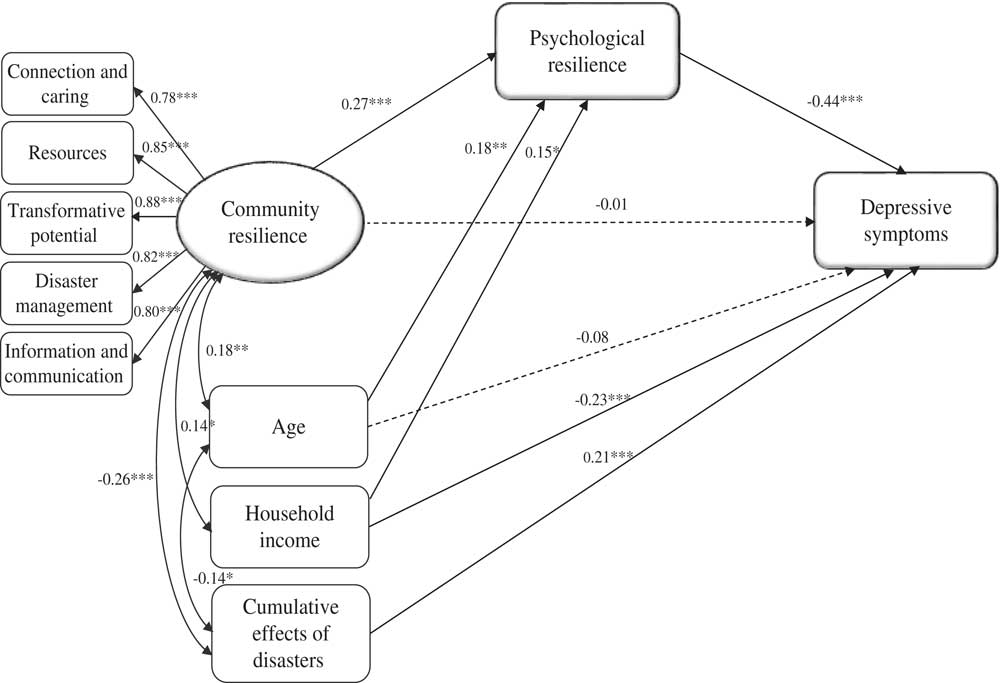
The proposed structural equation model, which included measurement and structural components, was tested with the maximum likelihood method by using AMOS version 21. Fit indices reflected a reasonable fit between the model and the sample data: chi-square (28, N=294)=80.59, P<0.001, NFI=0.93, TLI=0.91, CFI=0.95, RMSEA=0.08. The standardized regression weights associated with the paths from the latent variable (community resilience) to its indicators of connection and caring, resources, transformative potential, disaster management, and information and communication were 0.78, 0.85, 0.88, 0.82, and 0.80, respectively, and all were statistically significant (P<0.001). Next, the individual paths in the model were examined with respect to the hypotheses. The path diagram of the model with standardized parameter estimates appears in Figure 2. After control variables were taken into account, there was a significant and inverse relationship between psychological resilience and depressive symptoms (β=–0.44, P<0.001). Conversely, no significant relationship was found between community resilience and depressive symptoms; instead, the results revealed an indirect relationship between community resilience and depressive symptoms through the mediating variable of psychological resilience. In other words, community resilience was positively related to psychological resilience (β=0.27, P<0.001), which, in turn, was inversely related to depressive symptoms (β=–0.44, P<0.001). Furthermore, the indirect effect was statistically significant (Sobel z test=–3.87, P<0.001). The squared multiple correlation coefficient (R 2 ) was 0.39, indicating that the proposed model combining age, household income, cumulative effects of disasters, community resilience, and psychological resilience explained 39% of the variance in depressive symptoms.
Parameter Estimates for the Model of Community Resilience, Psychological Resilience, and Depressive Symptoms. Note: chi-square (28, N=294)=80.59, P<0.001, normed fit index=0.93, Tucker-Lewis index=0.91, comparative fit index=0.95, root mean squared error of approximation=0.08 (90% CI: 0.06–0.10), PCLOSE=0.01; nonsignificant paths are illustrated by dotted line. Standardized coefficients are presented. Age, household income, and cumulative effects of disasters are control variables; *P<0.05; **P<0.01; ***P<0.001.

DISCUSSION
This study examined the role of community resilience and psychological resilience on depressive symptoms among residents of the Mississippi Gulf Coast who have experienced multiple and significant disasters within the last 15 years. First, we hypothesized a significant relationship between community resilience and depressive symptoms. The results suggested otherwise, which was a surprise based on previous literature that has shown significant associations between community resilience and mental health.Reference Adeola and Picou 15 , Reference Fullerton, Ursano and Liu 16 There may be several possible explanations for this finding. First, previous studies used different measures for community resilience. For instance, Adeola and PicouReference Adeola and Picou 15 linked social capital and trust to depression rates, and Fullerton and othersReference Fullerton, Ursano and Liu 16 used zip codes to measure collective self-efficacy. A significant relationship between community resilience and depression was found in both studies. On the other hand, Lowe and othersReference Lowe, Sampson and Gruebner 17 used 3 community-level measures (percentage of residents living alone, number of buildings affected, and median household income) and found that only median household income predicted depression among participants with no disaster-related experiences. While previous studies regarded community resilience as a multidimensional construct, most studies used single-dimension measures to represent it. Our study, on the other hand, used the CART survey, whose 5 thematic domains have been empirically validated and are based on well-established theory.Reference Pfefferbaum, Pfefferbaum and Nitiéma 13
The second explanation is related to our third hypothesis that psychological resilience would mediate the relationship between community resilience and depressive symptoms. In the current study, results from bivariate analysis suggested that there were significant relationships between community resilience factors and depressive symptoms. However, in the multivariate model that included both community resilience and psychological resilience, the relationship was no longer significant. These findings suggest that the impact of community resilience on depression is not direct, but rather indirect through a mediating variable of psychological resilience. In other words, people’s perceptions of the capacity of a community to deal with adversities may influence how they actually view those adversities (eg, remediable and in control), as well as the process of their adapting to those adversities (eg, navigation to resources and utilization of resources), which in turn has a positive influence on their mental health.Reference Ungar 24 - Reference Lyons, Fletcher and Bariola 26 , Reference Kim, Han and Shaw 48
We also hypothesized that a significant relationship would exist between psychological resilience and depressive symptoms. Consistent with other research,Reference Osofsky, Osofsky and Hansel 2 , Reference Shenesey and Langhinrichsen-Rohling 3 our findings demonstrated that higher levels of psychological resilience were related to lower levels of depressive symptoms. It is interesting to note that the relationship between psychological resilience and depressive symptoms does not seem to disappear in the years following a disaster. This suggests that interventions emphasizing psychological resilience may be warranted in the short- and long-term aftermath of a disaster.
Our findings confirmed the third hypothesis that psychological resilience mediated the relationship between community resilience and depressive symptoms, which is consistent with the findings of previous studies.Reference Williams and Merten 25 , Reference Lyons, Fletcher and Bariola 26 These findings highlight the importance of psychological resilience in long-term disaster recovery and imply that long-term recovery efforts should address factors associated with both psychological and community resilience to improve mental health outcomes. In the years following a disaster, perhaps the constructs of community resilience such as the availability of community resources, connections with neighbors, disaster-related information, and communication with community leaders are necessary to sustain high levels of psychological resilience in disaster-prone communities. Our findings also demonstrate the need for future research to examine the different constructs of community resilience (ie, connection and caring, resources, transformative potential, disaster management, and communication and information) in order to unravel its complex interplay with psychological resilience and depression.
Limitations and Future Studies
Despite the significance of these findings, there are several limitations that should be considered when interpreting results. First, this study utilized a cross-sectional sampling approach. As a result, causality cannot be established. Although we interpreted the association between resilience and depressive symptoms in causal terms, it is possible that the relationship in fact operates in both directions or in reverse. For example, the path model suggests that resilience factors precede depressive symptoms, but it is possible that the relationship occurs the other way around. In other words, depression could make people feel less capable of dealing with adversity or it could make people believe their community lacks capacities in dealing with community issues. A longitudinal study might clarify the causal process. Second, community resilience was measured only by an individual’s perception. Future research also would benefit by including geographical and physical indicators of community resilience.
The final model revealed that there are clearly more factors involved in predicting depression among disaster survivors. Although the final model was significant and accounted for 39% of the variance in depressive symptoms, future studies should use models with broader swaths of demographic and socioeconomic variables to enhance the predictive capability of long-term depression rates in areas that have experienced multiple disasters. Understanding the sociodemographic and economic predictors of mental health outcomes can help policy-makers and behavioral health practitioners identify and serve the most vulnerable populations in long-term disaster recovery efforts. Future studies also need to include scales that measure other symptoms such as PTSD because of the high comorbidity of depression and PTSD in individuals exposed to traumatic events.Reference Kar and Bastia 49 , Reference Fullerton, Ursano and Wang 50 Focusing on multiple symptoms would provide more comprehensive interventions to individuals exposed to disaster. The current study used the CES-D scale to measure only the frequency of occurrence of depressive symptoms. With this in mind, future studies may include diagnostic and severity measures of depression, such as the Patient Health Questionnaire.Reference Kroenke, Spitzer and Williams 51
Implications
Our findings suggest that both psychological resilience and community resilience may be critical factors in mitigating a disaster’s impact on mental health outcomes such as depression. Psychological resilience is the likely mechanism through which community resilience affects psychological distress among those exposed to a disaster. As such, intervention efforts should focus on psychological resilience in recovery from disasters. Evidence suggests that some resilience-promoting programs are effective at enhancing psychological resilience, but more research is needed to determine which techniques, approaches, and formats are most effective.Reference Macedo, Wilheim and Gonçalves 52
Furthermore, the importance of community resilience should not be downplayed owing to its propensity to strengthen psychological resilience, which in turn may reduce depressive symptoms. Previous research has indicated that individual- and community-related resilience factors operate in tandem to improve mental health outcomesReference Lowe, Sampson and Gruebner 17 and that resilience attributes such as human capital, economic capital, social capital, and political capital exist on both the community and individual levels.Reference Abramson, Grattan and Mayer 4 That being said, much research is still needed to untangle the processes by which community and psychological resilience factors interact in order to inform the structure and coordination of interventions in areas such as the Mississippi Gulf Coast that are still recovering from multiple disasters.
Acknowledgment
The authors would like to acknowledge the Gulf Region Health Outreach Program and the School of Social Work at the University of Southern Mississippi for funding and support. The Gulf Region Health Outreach Program was developed jointly by BP and the Plaintiffs’ Steering Committee as part of the Deepwater Horizon Medical Benefits Class Action Settlement, which was approved by the US District Court in New Orleans on January 11, 2013, and became effective on February 12, 2014. The Outreach Program is supervised by the court and is funded with $105 million from the Medical Settlement. The authors also acknowledge contributions of the Geoinformatics and Hazards Research Lab at the University of Southern Mississippi funded by the National Science Foundation (CMMI-1335187). The view and conclusions contained in this document are solely those of the authors.