After the destruction of the Yugoslav federal state in the early 1990s, the creation of new, independent national states from the former federal republics was accompanied by a substantial rethinking of Yugoslav and national history. This article investigates the role of 1918, the end of the First World War, and the establishment of the Yugoslav state in the public memories of post-communist Croatia and Serbia. Based primarily on analyses of history schoolbooks within the context of the major works of history and public discussion, we trace the developments of public memory of the end of the war and 1918 in these two countries. Drawing on the concepts of public memory and historical narrative, we focus on the ways in which history textbooks create historical narratives and on what the textbooks seem to suggest that students should learn from the past. While the two states have rather different patterns of First World War memory—in Serbia the First World War memory tradition remains strong and highly visible, whereas it is vague and in the background in Croatia—we argue that both states have abandoned the Yugoslav communist narrative and now publicly commemorate 1918 as a loss of national statehood. In Serbia, the story of loss is packed in a fatalistic narrative of heroism and victimhood, while in Croatia the story of loss is embedded in a tale of necessities caused by political complexities, which nevertheless helped to create a positive final outcome in the form of the sovereign Croatian state of the 21st century.
Public Memory, Historical Narratives, and History Textbooks
History may well be understood as a specific mode of cultural memory (Erll Reference Erll, Erll and Nünning2010, 7), one of the many ways in which “societies remember” (Connerton Reference Connerton1989). Cultural memory depends on transmissions and representations in media, that is, mediations and re-mediations, in order to become shared, social and collective (Erll and Rigney Reference Erll, Rigney, Erll and Rigney2009, 1–2). With regard to history, the prominent medium would be history writing, but history teaching, textbooks, films, TV, and many other public and popular representations of the past are also important forms of mediation of history. Thus, we argue that history is a form of public memory, understood as the particular aspects of cultural memory that are connected to political systems. These are the types of cultural memory that are applied by states and their institutions to create legitimacy and consensus. As such, public memory is “one of the principal cultural supports for a stable polity” (Tosh Reference Tosh, Maerker, Sleight and Sutcliffe2018, 30). It is official and political, anchored in public space and played out at commemorations, monuments, museums, and other societal institutions such as the education system. Thus, public memory is sustained by a variety of media, of which school textbooks are a crucial element. Textbooks convey, in simple popularized forms, a selection of historical symbols, events, and narratives that are deemed important as the building blocks of a shared past. Since they usually constitute a part of a politically supervised education plan and are reviewed and approved by administrative organs, school textbooks arguably constitute a consensus view on national history from the side of political institutions. Thus, to borrow a concept from Aleida Assmann, they represent a politically endorsed simplified “canon” of a society’s past (Assmann Reference Assmann, Erll and Nünning2009, 100).
In the cases of Serbia and Croatia, history is a core subject in both primary and secondary school, and textbooks are reviewed and approved by the Ministries of Education. Teachers can choose between a handful of books, and though these books may vary between a more conservative and a more liberal approach to the nation’s past, they still remain within the politically sanctioned narrative (Trošt Reference Trošt2018; Agičić and Najbar-Agičić Reference Agičić, Najbar-Agičić, Cipek and Milosavljević2007). Moreover, history schoolbooks are a particular and influential medium of public remembering, since they often constitute the pupils’ first meeting with history as an institutionalized discipline and also their first exposure to systematic historical narratives. These experiences may be all the more powerful, because they happen in the formative years of childhood and youth.Footnote 1
Cultural memory, of which history and history teaching constitute important parts, serve to orientate people in time and space and to establish individual and collective identities. Thus, school teaching in history contributes both to consolidating a consensual public memory in future citizens and, more fundamentally, to helping students form an understanding of their time and place in the world. This is done through narratives. Historical narratives, as presented in school textbooks, connect past, present, and future into a concept of continuity. They mobilize experiences of the past, engraved into archives of memory, to make the present understandable and to make expectations of future time possible (Rüsen Reference Rüsen2008, 11). Or, in the words of Reinhart Koselleck, historical teaching creates “spaces of experience,” that is pasts made relevant in the present, based on events remembered and incorporated. These spaces of experience are then drawn upon to grasp the present and create “horizons of expectation,” understood as possible and imaginable futures made present by hope and fear, wishes and desires, cares and rational analyses (Koselleck Reference Koselleck1985, 272).
Thus, the narratives presented in school history textbooks not only supply the building blocks of public memory, they also help to create a certain logic of the connection between past, present and future, which will also suggest something about what is to be learned from the past and what should be expected of the future. In the following pages, we will attempt to extract what constitute these building blocks, narratives, and logics from Serbian and Croatian schoolbooks with regard to the end of the First World War and the creation of a new Yugoslav state system in 1918. Since 1918 is inevitably a key element in the modern history of South Slav statehood, we argue that it constitutes a prism through which we can observe how state narratives condense and crystallize themselves. By studying these narratives, we can observe what sorts of basic values, points of importance, and narrative logics the two states wish to imprint in their future citizens. By exploring this, we can also get an idea about the types of assumptions the students are supposed to develop about their states and themselves as members of those states. It is, however, an important limitation to the scope of this article that we mainly investigate the printed textual presentations of the historical narratives. In doing so, we do not take into account the practices and attitudes of the teachers in the actual ongoing instructions in the classrooms. Obviously individual teachers may use their position to contest, question, endorse or expand the interpretations and narratives of the textbooks and thus influence the ways in which students relate to them. Looking into this would require an entirely different methodology involving techniques such as interviews and ethnographic fieldwork in and around the class rooms. To our knowledge, few studies of this kind exist, with Trošt (Reference Trošt, Trošt and Mandic2017) as a notable exception. Yet, what we do aspire to say something about in this article are the officially adopted narratives and logics promoted for public use in schools in Serbia and Croatia.
Furthermore, it is worth noting that both the message of the textbooks as well as their authors interact with society at large and should not be understood in isolation from the social, political and economic context in which they appear. An example of this is the fact that an author of one of our analyzed textbooks, Radoš Ljušić, frequently participates in (and thus shapes) national debates on Serbian/Yugoslav history from a nationally oriented perspective (Centar za srpske studije, n.d.). Other authors either have a less public presence or represent different ideological viewpoints, all of which can filter through to the textbooks and also can shape the context into which textbook narratives are inserted.
Obviously, this context is shaped by other factors than debates among academics. Museum exhibitions, novels, theatre plays, films, and television shows, among others, may also interact with the narratives coming from the education sector and thus influence the creation of collective memories. It is, for instance, hard to imagine that the fact that three highly successful television shows in Serbia, Senke nad Balkanom, Ranjeni orao, and Montevideo Bog te Video, all of which were set in the interwar period in Yugoslavia, had no impact on the perception of this period in the general public. Although further research would be needed to discover the exact nature of this influence on our period, especially since all the shows are set in the period following the establishment of the Royal dictatorship in 1929, the very fact that these television series were so successful, with Senke nad Balkanom being the most viewed television series ever in Serbia (Krmpotić Reference Krmpotić2020), provides us with an insight into the popularity of this period at the very least.
The First World War, 1918, and Yugoslavia
The end of the First World War and the fall of the Austro-Hungarian Empire created conditions for establishing a new state in Southeastern Europe, the Kingdom of Serbs, Croats, and Slovenes (SHS, from 1929 called the Kingdom of Yugoslavia). The new Yugoslav state united the kingdoms of Serbia and Montenegro, both on the victorious Entente side in the First World War, with Slovenia, Croatia, Bosnia, and Vojvodina, all formerly parts of the defeated Austro-Hungarian Empire. Though the Yugoslav state as a state for the South Slavs could be seen as a realization of the Wilsonian principle of national self-determination, its creation went directly against the ambitions of the more narrowly defined Croatian and Serbian national projects of the pre-war period. The Kingdom of Serbs, Croats and Slovenes was, like the Czechoslovak state created in the same process, explicitly multi-ethnic and aimed at a large and inclusive national community. This incongruity between the somehow multinational idea of the Yugoslav Kingdom established in 1918 and the more exclusive Croatian and Serbian nationalism, as well as the exclusive national ideas that characterize the contemporary post-Yugoslav nation states, might explain why the creation of Yugoslavia is not—today—seen as the triumph of Wilsonianism in the South Slav region. This distinguishes it from most other states that have emerged from the Austro-Hungarian Empire, where common wisdom states that the “Wilsonian moment” of 1918–1919 was the culmination of a long and inevitable process of national emancipation in much of Eastern Europe (Storm and Van Ginderachter Reference Storm and Van Ginderachter2019, 750). Though the inevitability of the Empire’s collapse and the role of nationalism in that process can certainly be debated (see for example Judson Reference Judson2016, 14–26), the defining role of nationalism and national ideas for the new state projects is unquestionable.
Wilsonianism, which can be understood as the merging of ideas of national self-determination with a liberal-capitalist world order, is thus seen as a mechanism which ensured national sovereignty for many states by providing both theoretical and real-power support for the dismantling of the multi-ethnic empires of Austria-Hungary, Russia, and the Ottoman Empire (Ryan Reference Ryan2000, 84; Storm and Van Ginderachter Reference Storm and Van Ginderachter2019, 748). However, Austria-Hungary was hardest hit by this new world order as revolution in Russia and imperial interests of Britain and France in the Middle East made it less expedient to attempt to implement Wilsonian ideas in these areas (Ryan Reference Ryan2000, 85).
The creation of Yugoslavia thus became part of the process of Austro-Hungarian dismantling and was, as stated above, initially seen as a triumph for South-Slav national ambitions rather than Serbian or Croatian ones. However, since the memories of 1918 today are mostly crafted by specifically Serbian or specifically Croatian nationalists—who also see themselves as being in opposition to any Yugoslav project—it becomes harder to memorialize the creation of Yugoslavia 1918 as a national triumph since it is today more perceived as the creation of yet another multinational entity that hindered or delayed national emancipation.
As seen in the example of Wilsonianism, The First World War, the events of 1918 and the creation of the Yugoslav state constitute a complex and challenging set of memories. The war fundamentally changed the political landscape of Southeastern Europe. It also set the conditions for the new Yugoslav state, and this state, in turn, was to frame the ways in which the war and the construction of the new state were to be remembered.
On July 28, 1914, Austro-Hungarian forces invaded Serbia in retaliation for the alleged Serbian support of the Sarajevo assassination the month before, setting in motion a chain of events that would, within a week, see the Austro-Serbian conflict spiral into a World War (Seton-Watson Reference Seton-Watson1933, 244–285). In the following year and a half, Serbia managed to win significant victories against Austria-Hungary, whose forces at this front were in large part manned by the South Slavs of the Empire, including Serbs, at the battles of Cer (1914) and Kolubara (1914–1915) (Pavlowitch Reference Pavlowitch and Djokić2003; Herwig Reference Herwig2014). By late 1915, however, Austro-Hungarian forces, reinforced by German troops, launched an offensive that forced the Serbian army, Royal House and political elite to retreat through the mountains of Albania and Montenegro in the winter months of early 1916. This epic retreat, named the Albanian or Serbian Golgotha in the modern memory culture in Serbia, inflicted appalling losses on the Serbian army before it could be transported to the island of Corfu by French and British ships (Mitrović Reference Mitrović2007, 144–154). And while the army suffered, life was not much easier for those civilians who had stayed behind in Serbia, exposed to violent oppression, denationalization policies, forced labour, and hunger, in part caused by the occupying powers’ expropriation of resources for their war efforts (Mitrovi Reference Mitrović2007, 221–244). Meanwhile, in the South Slav lands of the Dual Monarchy, there was also hardship despite the fact that these areas were not directly affected by the battles. Here the population felt the effects of the war mostly through widespread famine and the conscription of young men for the Imperial armies. By 1916, this resulted in hunger in parts of Croatia (Lampe Reference Lampe2000, 102–109).
Following the evacuation to Corfu, the Serbian government found itself in a situation where it had survived the Austro-Hungarian offensives, but had lost control of Serbia. This left it little option but to try to strengthen its diplomatic position and prepare the way for a negotiated settlement of the war. In December 1914, the Serbian government had formally proclaimed its war aims and called for the creation of a Yugoslav state that was to include the territories of Serbia, at that time including Macedonia and Kosovo, the Kingdom of Montenegro and the South Slav areas of Austria-Hungary (ibid., 102). The international support for such a new state was not guaranteed, though, as the Western Powers were not certain that the breakup of the Dual Monarchy was inevitable or even desirable (Pavlowitch Reference Pavlowitch and Djokić2003, 31). Thus the ability of Belgrade to create a new Yugoslav state in any form would depend above all on the ability of the Serbian army to seize and hold the territories, which were to become part of that state. In the summer of 1916, following a rest on Corfu, the Serbian army was therefore sent to the Southern Front to support French operations near Thessaloniki, where it contributed to the final breakthrough and liberation of Serbia by November of 1918 (Bataković Reference Bataković2005).
Although they came back to a war-ravaged country, the Serbian government quickly began preparing for a Yugoslav state (Banac Reference Banac1984, 127–128). They were greatly helped by developments in Austria-Hungary itself. As the regime in Vienna was breaking apart, the South Slav lands of the Empire were ravaged by thousands of demobilized soldiers who turned into veritable gangs and caused chaos in the countryside. This process was exacerbated by the simultaneous breakdown in the structures of law and order in the dying Empire. Furthermore, Italian troops were landing on the Dalmatian coast aiming to secure the territories, which had been promised to Rome by the Entente. Having no ability to check the Italian advance or stop the gangs in the countryside, the leaders of the newly formed National Council of Serbs, Croats and Slovenes approached the Serbian government and asked that unification take place as soon as possible so that the Serbian army could restore order (Pavlowitch Reference Pavlowitch and Djokić2003, 36–40). The negotiating position of the Council at this moment was very weak, making it possible for the Serbian government to pressure it to agree to unification on Belgrade’s terms (Banac Reference Banac1984, 127–129). On this basis the Kingdom of Serbs, Croats and Slovenes was formed in Belgrade on December 1st 1918.
The creation of a common Yugoslav state would become one of the most important sites of memory connected to the Great War and to South Slav history in general. The manner in which the state was formed and the many conflicts it was riven by from the very outset created a need for memories of the past that would legitimize the new state and create national unity. The official memory of the war in Yugoslavia emphasized what John Paul Newman (Reference Newman2015, 13) has termed a “culture of victory” in which Serbian victories and the ties with the Entente were highlighted. This could be seen in the new monuments constructed at this time, in the status of Serbian veterans, and in the descriptions of Serbia and the Entente in the textbooks that were printed after 1929. Here the early victories of the Serbian army at Cer and Kolubara were described in great detail as well as the later liberation of the country in 1918. In addition, the suffering of Serbian soldiers during their retreat across Albania to Corfu was also presented as the superhuman feat and the ordeal of the whole nation (Dedović Reference Dedović2018, 134–136). At the same time, the experiences of Yugoslavs who had been part of the Habsburg armies were marginalized in the memory culture, making it harder for them to identify with the commemorations and to some extent with the state itself (Newman Reference Newman2015, 13–16).
Obviously, the education sector had a central role to play in promoting this official memory of the past. However, as has been argued by, among others, Charles Jelavich, this sector was plagued by several issues that made it difficult to be the central promoter of the official memory of the war. The legacies of Habsburg, Ottoman, Serbian, and Montenegrin education systems, different textbooks, varying levels of literacy, and general organizational confusion in the new state made the creation of a uniform memory difficult to achieve (Jelavich Reference Jelavich and Norman2003, 101). It was only after the school reform of 1930 that a centrally organized system was introduced, and centrally approved textbooks were issued. Although not without its share of problems (most notably a lack of resources), this new system at least provided a direction and a more solid basis to the promotion of First World War memory in the interwar period (Petrungaro Reference Petrungaro2009, 57–59).
In socialist Yugoslavia (1945–1992) the Second World War became the main site of memory, relegating the Great War to a more marginal position. This was not least because the socialist authorities struggled with how to incorporate the Great War into their own narrative of the past. However, in 1950 it was argued by top communist Milovan Đilas that the socialist revolution inherent in the Communist-led resistance movement during the Second World War was the beginning of a new age and that the history of the Yugoslav peoples was merely a prelude to this revolution (Sindbæk Reference Sindbæk2012, 75). And from the mid-1960s the Great War would also be incorporated into this narrative template and increasingly be seen as one in a long line of “liberation wars,” stretching from the South Slav wars of national liberation in the 19th century, culminating with the Partisan struggle in the 1940s (Manojlović Pintar Reference Pintar, Olga, Cipek and Milosavljević2007, 159–162). This ensured the Great War a not insignificant place in the collective memory of socialist Yugoslavia, although it never became as important as the Second World War.
The collapse of Yugoslavia in the 1990s drastically reconfigured the ethnic, social, economic, and political relations in all the republics of the former common state. The wars that ravaged many of the republics and destroyed communities, towns, and basic infrastructure made possible and even necessary new approaches to the past that could legitimize the new states, but also explain why and how Yugoslavia disintegrated so violently. The collapse of the federal state also meant the shredding of the institutions and common interpretative frameworks which were established in the preceding decades. As a result of all this, the writing and teaching of history in all the new states conformed to more nationalist visions of the past, legitimizing newly created and embattled nation states. Based on the idea of multinational coexistence and tolerance, the Yugoslav state was increasingly ignored in the new history books of all states in favor of other, more usable periods of history (Dedović Reference Dedović2012). The new national histories were initially focused on justifying the need to abandon Yugoslavia and create national states, on the internal Yugoslav armed conflict during the Second World War, and on the struggle to somehow come to terms with the wars of the 1990s, not least under the influence of the International Criminal Tribunal of the former Yugoslavia (Brunnbauer Reference Brunnbauer2004; Sindbæk Reference Sindbæk2012; Ristić Reference Ristić2014; Gordy Reference Gordy2013). In this context, the memory of the Great War as such suffered a similar fate to that of the memory of Yugoslavia. It was not directly usable for most of the new states and thus it was relatively marginalized as a theme. Yet, the centenary of the First World War and the massive Europe-wide commemorative projects actualized the very different public memories of that war and its implications in different post-Yugoslav states (Sindbæk Andersen & Dedović Reference Tea, Dedović, Pedriali and Savettieri2020). However, the topics of 1918, the end of the multinational Empire, and the creation of Yugoslavia were crucial to the narratives of the new independent states. And along with the nationalization of history, the memory of 1918 has been revised and reinterpreted to fit contemporary needs in post-Communist Croatia and Serbia.
1918 in Croatian Public Memory
In the post-Yugoslav Croatian state, the First World War has not become a very important part of public memory. Some elements of a more particular Croatian First World War memory did exist in the Yugoslav period, primarily in the form of literature. The Croatian God Mars (Hrvatski Bog Mars), a collection of short stories from the early 1920s by Croatia’s great novelist Miroslav Krleža is certainly the most well-known example. In these stories, Krleža, himself a veteran, having spent a brief period at the front, mercilessly exposes the suffering of wounded dying soldiers in frontline lazarettos and the senseless, self-absorbed militarism of the Habsburg armies (Krleža Reference Krleža1995 [1922]). Yet, these aspects were largely overshadowed by the shared Yugoslav First World War memory with its focus on a primarily Serbian heroic narrative (Sindbæk Andersen and Dedović, forthcoming). In the new Croatian state, the main protagonist of public memory was the Croat nation, often wounded and victimized (Pavlaković Reference Pavlaković and Kolstø2014). Croatian memory politics in the 1990s were mainly concerned with justifying the striving for an independent Croatian nation state and with reconciling Croatia’s problematic Second World War history, sometimes leading to quite problematic cases of revisionism with regard to Croatia’s genocidal Fascist regime during the Second World War (Goldstein and Goldstein Reference Goldstein and Goldstein2002; Pavlaković Reference Pavlaković2008, Sindbæk Reference Sindbæk2012). Given this situation, a narrative of the First World War which emphasized Serbian victimization and heroism in the struggle for a Yugoslav state became quite irrelevant. Thus, the Serbian/Yugoslav memory narrative was largely discarded, and it was not initially replaced by a Croatian First World War memory. In the years leading up to the centenary of the First World War, when most European states were preparing for massive commemorations, Croatian historians and politicians pointed to the need to address the Great War as part of the nation’s history. Motivated also by the plans in other European countries and coordinated by EU meetings, a substantial commemorative program was prepared by Croatia’s Ministry of Culture, resulting in numerous cultural events and special exhibitions of museums throughout the country between 2014 and 2018 (Sindbæk Andersen and Dedović, forthcoming). Nevertheless, this increased interest was primarily connected to the centenary and therefore appears to be a passing phenomenon. Croatia still do not seem to have an established public memory of the First World War.
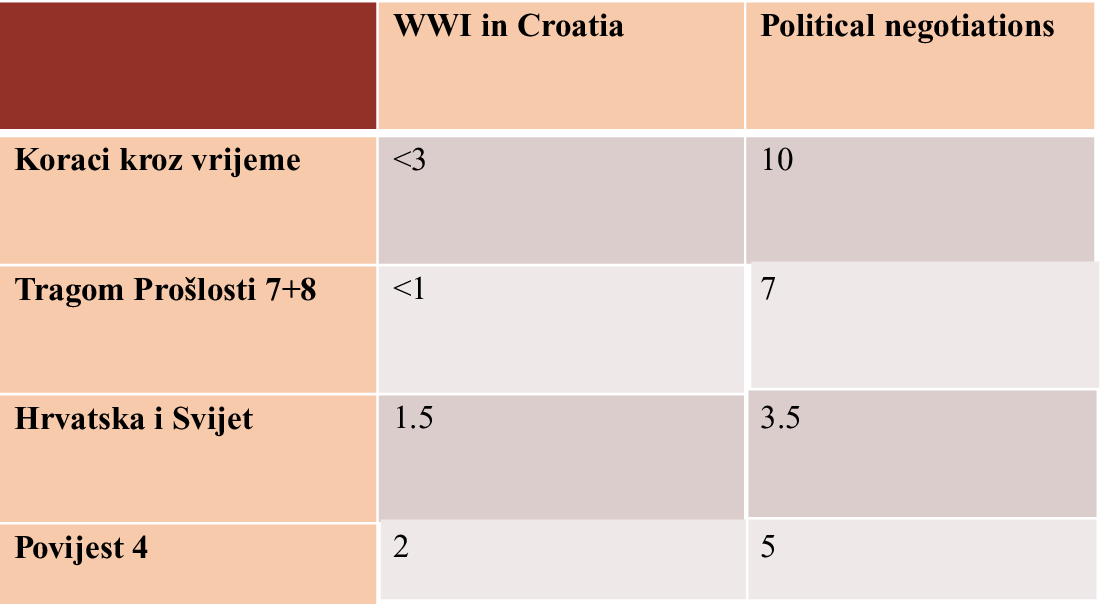
Yet, whereas the First World War appears to be a somehow insignificant element of Croatian public memory, the year 1918 is certainly presented as a crucial moment in Croatian history. The end of the Great War, the collapse of the Habsburg Empire, and especially the creation of the Yugoslav state, initially the Kingdom of Serbs, Croats and Slovenes, figure prominently in history writing and especially so in history school books throughout the period since Croatia’s declaration of independence. A quick overview of the distributions of pages in a selection of widely used textbooks clearly reveals that a lot more text and explanation is dedicated to the political negotiations leading up to the unification of the Kingdom than to the years of warfare (see Figure 1).Footnote 2
Priority of pages in Croatian history school books: column 1 shows the number of pages describing Croatia’s War and the war years, whereas column 2 shows the number of pages describing the political negotiations about the creation of the unified Kingdom of Serbs, Croats and Slovenes.

Based on this, it should be clear that the 1918 unification with Serbia and Montenegro is considered the most important element of First World War history in Croatia. And this is not only in school books. An edited volume from 2012 argued that “in Croatian history there is no year more pregnant with fateful decisions than that of 1918” (Holjevac Reference Holjevac2012, cover text).
The question of 1918 and the creation of the Yugoslav Kingdom were always highly important in Yugoslav and Croatian history writing. However, the meaning of the events of that fateful year was radically reinterpreted in post-Yugoslav Croatia. In the socialist era, the Yugoslav idea had to be the leading motive of historical development for textbook authors, and the creation of the Yugoslav state in 1918 was presented as the successful outcome of the Yugoslav aspirations (Agičić and Najbar-Agičić Reference Agičić, Najbar-Agičić, Cipek and Milosavljević2007, 204). In the textbooks of independent Croatia of the 1990s, the descriptions of the years 1914–1918 was completely different, not only because the descriptions of the heroic warfare of the Serbian and pro-Yugoslav armies were removed, but also because the Yugoslav lead motive was replaced by the idea of the Croatian state as the main theme. According to Agičić and Najbar-Agičić, Yugoslavia as a topic became somehow odious during the first decade of Croatian independence, and the Yugoslav idea disappeared from the Croatian primary school textbooks. Instead “the guiding principle of the entire Croatian history became the idea of the creation of an own national state. Thus all events and all persons are evaluated according to their relation towards ‘The Croatian state’ (whatever that may be)” (Agičić and Najbar- Agičić Reference Agičić, Najbar-Agičić, Cipek and Milosavljević2007, 207). Croatian as well as other historians of the region have criticized the political and ideological instrumentalization of history education in the first decade of Croatian independence. In these years, Croatian politics was completely dominated by President Franjo Tuđman and his nationalist conservative party HDZ (Croatian Democratic Union). The ruling elite was seen as striving to transform contemporary history into party-political propaganda promoting an exaggerated idea of Croatian statehood or even “some sort of obsession with the idea of Croatian statehood as a new ideology” (Tukalj Reference Tukalj, Cipek and Milosavljević2007, 240).
The Croatian textbook market was opened at the end of the 1990s, and since then schools and teachers decide which books to use (Trošt Reference Trošt2018, 728–732; Agičić and Najbar-Agičić Reference Agičić, Najbar-Agičić, Cipek and Milosavljević2007, 211). The liberalization has made presentations of history more pluralistic. Moreover, by the year 2000, shortly after Tuđman’s death, a Social Democrat government was elected, thus breaking HDZ’s ten-year monopoly on power and initiating a more pluralistic development in Croatian politics. Yet, in the mid-2000s, high school textbooks still followed the teaching plans and programmes from the ministry rather strictly, which meant that the descriptions of the period 1914–1918 primarily focused on political events, while comparatively little space was devoted to social and cultural history (Tukalj Reference Tukalj, Cipek and Milosavljević2007, 216, 240).
Though history education is now less politicized, history textbooks published later in the 2000s and 2010s, we argue, continue to focus on the Croatian state as a dominant motive and, in a way, as a main protagonist of the historical narrative. Based on a comprehensive survey of Croatian history schoolbooks of the last four decades, Tamara Trošt concludes that “the unifying narrative—the millennial dream of statehood—is clear in Croatian textbooks from 1991 through today” (Trošt Reference Trošt2018, 731). This is quite obviously the case in the descriptions of the period 1914–1918. Thus, the chapters in the textbooks describing the political negotiations leading to the creation of the Kingdom of Serbs, Croats, and Slovenes carefully explain in quite some detail the events and especially the political reasoning on which the decision to enter the unified Kingdom was based. Crucial in this context is the tendency to describe the creation of the new state as a loss of the Croatian state or Croatian statehood. Indeed, this aspect of the First World War and the war’s aftermath sometimes seem to be one of the most important elements of the historical narratives. Thus, one high school textbook explains:
“The end of the war and the changes of the European map led Croatia into the creation of the Kingdom of Serbs, Croats and Slovenes, later the Kingdom of Yugoslavia. In this she [Croatia] lost the characteristic of statehood which she had guarded in all periods of history until then.” (Akmadžija et al. Reference Akmadža, Jareb and Radelić2009, 47)
A textbook for vocational secondary school describes how
“After the First World War and the fall of Austria-Hungary, Croatia entered a new state community. This community, however, was largely organized according to the idea of Greater Serbia and was completely unsuccessful with regard to solving the Croatian national question. This lack of success was the source of continued political crisis, but also of terror against Croats. The most important consequence of the creation of the Monarchy of Yugoslavia was the loss of Croatian statehood” (Samardžija, Reference Samardžija2013, 109; see also Akmadžija et al. Reference Akmadža, Jareb and Radelić2009, 119).
The textbooks for vocational schools are shorter and less detailed than those written for the classical gymnasium. This does not change the content fundamentally, but it does make some of the claims appear more concise and less elaborately explained.
This idea of the loss of state is present not only in school textbooks. The permanent exhibition of Zagreb’s city museum, which has been in place already before the First World War centenary, has a small section with a few panels dedicated to the First World War. The section’s final panel concludes that “at the end of 1918 the centuries-old Habsburg monarchy collapsed, the Yugoslav union was created, and in consequence of crucial and tempestuous events, Croatia ceased to exist as a state in its own right” (Zagreb City Museum 2013; Ružić, Reference Ružićn.d.).
This argument may seem a bit odd, since Croatia had not really existed as a state since the Middle Ages, and it had not really been united administratively either. In the form of an administrative unit within its current borders, Croatia was established as a republic within the People’s Federative Republic of Yugoslavia, created under Communist control after the Second World War. Though the central part of Croatia was partially ruled by the Croatian noble diet, the Sabor, during the centuries of Hungarian and Habsburg rule, the role of a Croatian state as such in this period is hardly prominent. Thus, the strong emphasis of the loss of that state is a somewhat peculiar way to frame that historical narrative.
The basic message of many Croatian textbooks seems to be that the creation of the Kingdom of Serbs, Croats, and Slovenes was a bad thing: it was not what the Croats wanted and their state disappeared. Moreover, according to the textbooks, the new state was dominated by Serbia, and Croatia and Croats were treated unfairly (see, for example, Erdelja and Stojaković, Reference Erdelja and Stojaković2014a, 79; Erdelja and Stojaković, Reference Erdelja and Stojaković2014b, 77). It thus becomes a necessity to explain why this unification happened. All the textbooks we have looked at make a significant endeavour to explain that the decision to join the Kingdom of Serbs, Croats and Slovenes was the absolutely only feasible option, though it was certainly undesirable. One textbook for eighth grade of primary school explains that:
because of the already described bad condition in the country and because of the Italian army in the Croatian coastal region, [it was decided] to hurry up with the steps towards unification. It is worth pointing out that not one important political party of that time (thus, neither the Croatian Party of Rights, known for its ‘hard’ Croatianness) proposed the establishment of an independent Croatian state. It was, namely, obvious that an eventual independent Croatia, as part of a defeated Austria-Hungary, would suffer large territorial losses. Therefore unification with Serbia was in fact the only possibility for the Croatian politicians at that time. (Erdelja and Stojaković Reference Erdelja and Stojaković2014b, 68)
Parts of this text are foregrounded in bold lettering, thus making the sentence “because of the entry of the Italian Army … unification with Serbia … [was] … the only possibility” stand out clearly. Obviously, this simple statement constitutes what the pupils should remember from this presentation. Although unification was not a very attractive solution, keeping together the territories of Dalmatia with Croatia and Slavonia was more important than independence. A gymnasium textbook makes a similar point, adding the idea of reflective hindsight: “ … seen from today’s perspective, the route to unification with Serbia and Montenegro was the only option, both for domestic and external reasons” (Erdelja and Stojaković Reference Erdelja and Stojaković2014a, 73).
The schoolbook presentations of the history of 1918 contain definite lessons to be learned. A “space of experience” is created in which the Croatian statehood was sacrificed as a necessary evil to keep as much territory as possible together. And drawing on present understandings to frame these experiences, the pupils will know that this statehood was (re)established in the 1990s, and thus the outcome was successful, seen within the logic of this narrative. Obviously, this is written from the perspective of the state that sees itself as the regeneration of the statehood that was supposedly lost in 1918. The “horizon of expectations” created out of this will, we believe, contain the ideas that it is crucial to take care of the state and its territories, that this can successfully be done against severe odds, and also that such endeavours may even have a meaningful outcome.
1918 in Serbian Public Memory
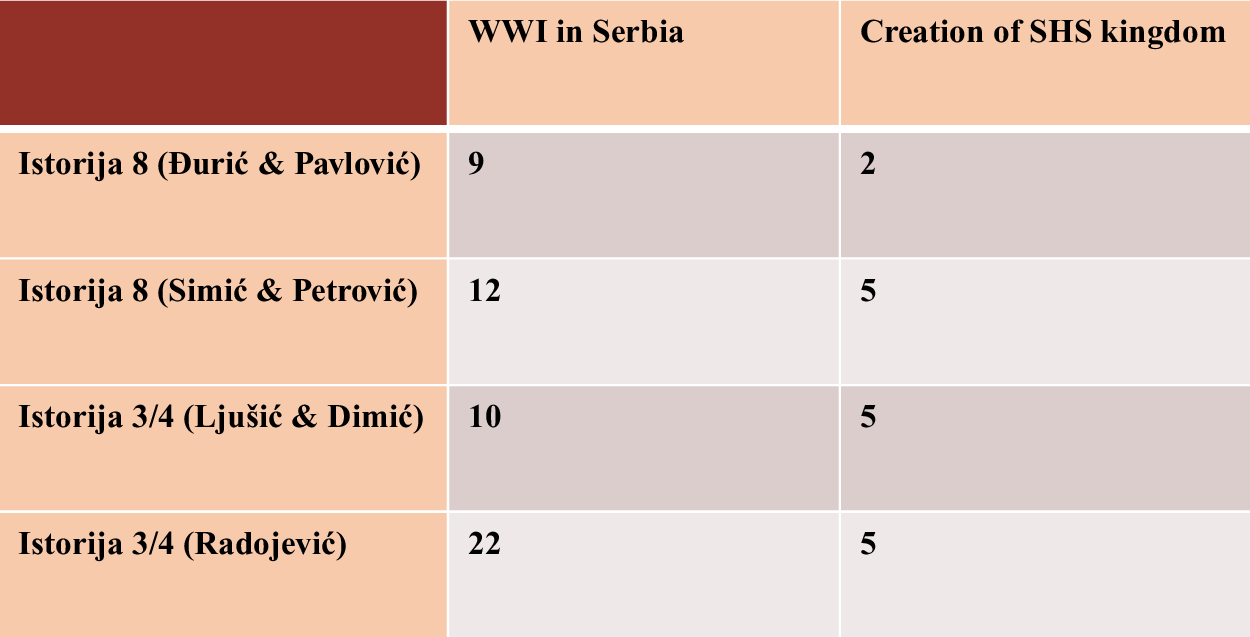
In Serbia the memory of The First World War constitutes a much stronger memory tradition. Here Yugoslavia’s First World War public memories were largely continued, though now in a more nationalized version better suited to the post-Yugoslav period (Dedović Reference Dedović2018, p.56; Stojanović Reference Stojanović and Dimou2009, 143–144). This nationalized memory places a great emphasis on the Serb people in both Serbia proper and in the other Yugoslav republics rather than on Serbia as a state, although this is not irrelevant in the text. In addition, the themes dealt with are almost opposites of the ones dealt with in Croatia (see figure 2 below). Rather than emphasizing the creation of a new state, there is noticeably more focus on the war itself and themes such as heroism of Serbian soldiers, victimization of the Serb state and people, and the enormous sacrifice borne by Serbia and its army in the war. This combination of themes is perhaps not surprising, as there is often a desire in national memory to portray one’s own nation as both heroic and as a just/righteous victim of the machinations of others.
Distribution of pages in Serbian history textbooks. Much more space is dedicated to the war and warfare as such, whereas the political negotiations about the unification of the Yugoslav kingdom receive less attention.

The exploits of the Serbian army are presented as undoubtedly heroic in the textbooks, as illustrated in the following quote in an elementary school textbook from 2013, describing the Serb victories at the end of the war:
The enemy was defeated, the front at Salonica was broken through and after a few days, Bulgaria was knocked out of the war. The arriving German reinforcements did not manage to halt the advance of the Serbian army, which found itself in Belgrade less than two months later. After the liberation of Serbia, the Serbian army crossed the Sava and the Danube and continued its advance with the aim of liberating its compatriots living in Austria-Hungary. (Dujković and Dujković, Reference Dujković and Dujković2013, 78)
It should be noted here that the Serbian army appears doubly heroic in the textbooks: first of all, the victories described are triumphs against stronger opponents and thus are heroic in and of themselves. Second, the victories are part of a just war effort for the liberation of the soldiers’ homeland and are thus an even greater success.
On Serbian suffering and victimhood a textbook states that:
Life in defeated Serbia was hard and much harder in the Bulgarian than in the Austro-Hungarian zone of occupation. Serbia resembled a desolate land. The people hid in the forests and lived there as groups of refugees as in the time of the Turks. It was important to save one’s life and violence—primarily from the Bulgarians—was an everyday occurrence. The removal of the male population into Austro-Hungarian detention camps and into Bulgaria, where they were forced to work, made Serbia into a land of the elderly, women, and children. (Ljušić and Dimić, Reference Ljušić and Dimić2012, 81)
The descriptions of life in occupied Serbia are, however, not the only examples of Serb suffering in this war. Rather this is a recurring theme as Serbia is presented as an innocent victim of Austro-Hungarian aggression at the outset of the war (see for example Radojević Reference Radojević2014, 86–87). In addition, the descriptions of the Serbian army’s retreat across the Albanian mountains, known today as the Albanian Golgotha (for example, in Đurić and Pavlović Reference Đurić and Pavlović2012a, 96; Đurić and Pavlović Reference Đurić and Pavlović2012b, 74), are some of the most important elements of the First World War memory in Serbia. Thus, the plight of the Serbian population during the occupation would be part of a larger tradition of memory of suffering just as the heroism of the Serbian soldiers at the end of the war would be reinforced by memories of the heroism in the first war years.
As mentioned above, there is much less emphasis on the creation of the Yugoslav state in Serbian textbooks compared to the Croatian focus on this theme or compared to the themes of heroism and victimhood. When Yugoslav unification is dealt with, there is a visible tension in the textbooks between the need to explain how a Yugoslav state came about and how Serbia contributed to this project while at the same time keeping the national focus that has become the main schematic template for writing history in Serbia and the Yugoslav region. Some textbooks “solved” this tension by emphasizing the national ambitions inherent in the Yugoslav program or presented the ideas of the Serbian elites as being national in origin only growing into a Yugoslav program at a later point. One textbook thus states:
However, no political party in Serbia foresaw the Yugoslav idea in its program, but rather [desired] to gather all Serbs and the territories in which they lived around the Kingdom of Serbia. (Dujković and Dujković, Reference Dujković and Dujković2013, 79)
In some high school textbooks, the connection between the creation of Yugoslavia and the realization of Serb national ambitions is elaborated even further as seen in the following quotes:
Instead of a Serbian state, a Yugoslav state – of Serbs, Croats and Slovenes – was created. This state included all Serbs, thus it can be concluded that they succeeded in uniting in 1918, though not in a mononational, but in a multinational state. It is unquestionable that with the creation of the Kingdom of Serbs, Croats and Slovenes, both the Serbian and the Yugoslav unifications were realized. This was the greatest success of Serbia and the Serbian people, greater than the medieval empire of Dušan. (Ljušić & Dimić Reference Ljušić and Dimić2014, 89)
The realization of the war aims of the Kingdom of Serbia … and the creation of the common state of Serbs, Croats, and Slovenes represented a great victory for the Serbian people … The act of national liberation and the striving to include the “unliberated brothers” that was begun with the First Serbian Uprising [1804] were completed. (Radojević Reference Radojević2014, 131)
Thus, the idea of national unification is a key element and one the textbooks agree on. Yet, the degree of nationalist triumphalism that is connected to this unification varies between the different authors, apparently depending on personal style and perspective.
In other textbooks, Yugoslav—rather than Serb—unification is presented as the main aim of the Serbian government and emphasis is more on Serbian efforts at winning the war itself. One of these books makes a point of emphasizing the fact that Serbian statehood was sacrificed to achieve this Yugoslav state, which would bring all Serbs and other Yugoslav peoples into a common state (Simić and Petrović Reference Simić and Petrović2016, 95, 125). Here the Serbian focus on the nation’s heroism and sacrifices stands out clearly:
The basis for the Yugoslav unification was the idea of the “three-named people” (that is Serbs, Croats, and Slovenes) were one people with three names. The Serbian army had in the First World War liberated the whole area of the new common state. In the new state, Serbia deposited her own statehood and tradition, and for it sacrificed one third of its population. (Simić and Petrović Reference Simić and Petrović2016, 125)
This quote also illustrates the contrast between the Croatian textbook’s focus on the loss of statehood and the thematization of heroic sacrifice and victory in the Serbian textbooks.
The tension between the desire to applaud the result of Serbia’s victory and the desire to present Serbian war aims as being something other than Yugoslav unification only makes sense if understood in the context of post-Yugoslav memory politics in the country. All textbooks that we have examined here are, obviously, written well after the bloody collapse of the Yugoslav state. Thus the project for which Serbia is said to have fought and shed so much blood has collapsed in a way that not only caused immense human suffering and material losses, but also has left the Serb people scattered in many different countries: the very opposite of what the national project was supposed to achieve according to the textbooks.
Furthermore, anti-Yugoslavism was an important element of the Serb national revival of the 1980s as it was thought that the Yugoslav state did not fulfil the Serb national aims, but was rather subverting them (Dragović-Soso Reference Dragović-Soso2002, 64). There is, therefore, an obvious difficulty, for the textbooks, in explaining how Serbia’s sacrifices make sense as the very country which was born out of Serbia’s victory does not exist today and has been maligned by nationalists in Serbia (and elsewhere in the post-Yugoslav region) for decades. This, perhaps, is the explanation for the greater focus on the much simpler and more usable themes of heroism and suffering of the Serbian army and people in the war itself as well as the greater focus on the causes and pretexts of the war in general, than on the creation of Yugoslavia.
Outside of the textbooks, however, there has existed a more or less stable narrative on the effects of Yugoslav unification on Serbia since the 1980s, when the ideas of nationalist authors, such as Dobrica Ćosić, gained popularity. Indeed, it was Ćosić who formulated the main nationalist interpretation of Serbia’s position in Yugoslavia when he in 1977 wrote:
How is it possible that some among us, in our own home, have stolen from us what a much more powerful enemy could not take on the battlefield? How can a people so dignified and courageous in war accept to be so humiliated and docile in peace? (as cited in Dragović-Soso Reference Dragović-Soso2002, 92)
In Ćosić’s view, it was the other Yugoslav peoples who had stolen the spoils of war from the Serb people thereby nullifying the great sacrifices made for a Yugoslav state in the First World War (and the Second World War as well). This nationalist narrative is still very much alive in Serbia today when the topic of the First World War is discussed. Thus, in 2013, then Serbian Prime Minister Ivica Dačić remarked:
We were on the side of the victors in World War One, unlike the other Yugoslav peoples with whom we created a new common state, a state which they left violently during the 1990s. These last decades have thus completely destroyed the results of the struggle of the Serbian people in the last century … That is why the Great War has to become a great lesson for us. For far too long we have been victors in war and losers in peace, as some have described it.” (“Dačić: Srbija je izgubila pobjedu iz Prvog svjetskog rata” 2013)
In this statement, Dačić basically sums up the official view of the war’s end in Serbia: it was a heroic, but ultimately costly mistake. And although this narrative is not visible directly in the textbooks, it does feature as a backdrop in the public discourse on these subjects and thus, perhaps, would influence the way the textbooks are perceived by pupils and teachers.
The memory of the Great War in Serbia is thus a mixture of clear, simple, and very usable narratives on the exploits of the Serbian army and the endurance of Serbian soldiers and civilians under extreme conditions and not at all simple or perhaps even usable narratives on the creation of the Yugoslav state, whose collapse complicates what was, until the 1990s, an officially triumphant narrative. In effect, this is the opposite of the Croatian memory of the war, where Croatian participation on the losing side is less of a usable narrative for Croat elites than is the memory of Croat struggles to preserve Croatian statehood during and after the war.
Conclusions
In both Croatian and Serbian public memory, 1918, the end of the First World War, and the creation of the Yugoslav state are narratives of loss and sacrifice. Yet, the stories of loss are packed rather differently. Indeed, they almost constitute each other’s opposites: when it comes to the priority of the content, Serbian textbooks emphasize the war, whereas Croatian books portray 1918 and the creation of the Kingdom as most important. And when it comes to evaluation of these events, Serbian books present the creation of the Yugoslav state as a desired outcome, whereas Croatian narratives explain it as a necessary evil.
In Croatian history textbooks and other versions of public memory, the idea of the loss of Croatian statehood appears to be one of the most crucial aspects of 1918, even though a Croatian independent state had not existed since the middle ages. The war as such receives less attention, whereas significant effort is put into explaining the process leading up to Croatia’s inclusion in the Yugoslav kingdom. In Serbian public memory, the idea of lost statehood is less prominent, though certainly present. In Serbian textbooks, unlike Croatian ones, 1918 and the unification of the Kingdom of Serbs, Croats, and Slovenes are preceded by detailed descriptions of the First World War, with a focus on Serbian military heroism, suffering, and staggering human losses. The war and warfare receive far more attention than the end of statehood and the politics leading to the creation of the new Kingdom. To some Serbian textbook authors, the creation of the new state was a national triumph.
As spaces of experience, the Croatian and Serbian public memories of 1918 point in rather different directions, and thus the horizons of expectation drawn from them certainly differ. In their simplest form, these historical narratives convey rather clear messages. In the Croatian case, the public memory narrative suggests that Croatian politicians did the only possible thing and consequently Croatian statehood, the main motive of national history, was lost. But, luckily, as any pupil and any Croatian citizen will be told, statehood was (re)gained in the 1990s, and thus, in the end, all was well. This creates a positive and meaningful perspective on national history. The message in the Serbian historical narrative is less straightforward. It emphasizes national heroism, sacrifice, and tragedy in war, and then the triumph of victory - or perhaps not, because in the end there was also a loss of statehood, and later also a loss of Yugoslavia, including a large part of the nation that so gloriously and at such cost was liberated during the First World War. Ultimately it is all about loss and sacrifice, which could be seen as futile.
The historical narratives of 1918 and the creation of the Yugoslav kingdom are limited but significant elements of both Croatian and Serbian public memory. As narrative elements, they are crucial to the histories of the Croatian and Serbian national states, both the ones that ended in 1918 and the ones that were (re)established in the 1990s as Yugoslavia fell apart. As such they provide a prism through which we can observe some of the characteristics of public memory and of the relationships between historical memory and national identity in Croatia and Serbia in the early 21st century. It seems that the ways in which 1918 is narrated in Serbian and Croatian public memory provide for a meaningful and self-confirming memory in the Croatian case, and a troubled and quite difficult memory in the case of Serbia. This resonates with Tamara Trošt’s comprehensive survey of youth identity and values in Serbia and Croatia between 2009 and 2012, in which she explored attitudes to history and nationhood in relation to identity and pride. Trošt’s study shows that Serbian teenagers had difficulties finding positive ascriptions to contemporary Serbianness and often chose to refer to rather distant history in search of sources of pride. Croatian youth, on the contrary, were mostly proud of Croatia in the present and of Croatian independence (Trošt Reference Trošt, Trošt and Mandic2017, 180). These different attitudes towards the contemporary state were also visible in a large survey of state loyalty and attitudes to national identity, conducted in 2011: More than seventy percent of Serbs regretted the dissolution of Yugoslavia. This was the highest percentage of any of the former Yugoslav states. Merely eighteen percent of Croats regretted Yugoslavia’s demise; only Kosovo had a lower percentage of people regretting the end of the Yugoslav state (Kolstø Reference Kolstø and Kolstø2014; Pavlaković Reference Pavlaković and Kolstø2014, 34). The public memories of 1918 and the creation of the Yugoslav state reflects this relationship as well: in Croatia, 1918 and the creation of the Yugoslav state is remembered as the end of statehood in the form of a necessary evil that found its redemption in the 1990s, thus creating an unwanted parenthesis of Yugoslavia. In Serbia, 1918 is remembered as the result of a heroic sacrifice and victory that led to a form of national unification, which was lost again with the dissolution of Yugoslavia in the 1990s.
Disclosure
Authors have nothing to disclose.