Introduction
Many insects, including some of the most notorious pests, have long been known to associate with beneficial microbes (Buchner, Reference Buchner1965; Petri, Reference Petri1909; Douglas, Reference Douglas2009). Mutualistic bacterial endosymbionts of many phloem-, grain- and blood-feeding insects are known to supplement their host's nutritionally unbalanced diet (Buchner, Reference Buchner1965; Aksoy, Reference Aksoy2003; Gil et al., Reference Gil, Latorre and Moya2004; Baumann, Reference Baumann2005; Douglas, Reference Douglas2009). However, other benefits to the hosts have been identified recently, including nitrogen fixation (Lauzon, Reference Lauzon, Bourtzis and Miller2003; Ben-Yosef et al., Reference Ben-Yosef, Jurkevitch and Yuval2008), resistance to both temperature fluctuations (Montllor et al., Reference Montllor, Maxmen and Purcell2002) and parasitoids (Oliver et al., Reference Oliver, Russell, Moran and Hunter2003, Reference Oliver, Moran and Hunter2005), and synthesis of aggregation pheromones (Dillion et al., Reference Dillion, Vennard and Charnley2000, Reference Dillion, Vennard and Charnley2002). Additionally, some insects lacking their specific endosymbionts cannot mate (Hosokawa et al., Reference Hosokawa, Kikuchi, Nikoh, Shimada and Fukatsu2006). Mutualistic bacteria are beneficial to both male and female reproductive success and ultimately to fitness.
The olive fly Bactrocera oleae Rossi (Diptera: Tephritidae) is one of the flies in the family Tephritidae long recognized to harbour endosymbiotic bacteria (Petri, Reference Petri1909). At least one of these bacteria, Candidatus Erwinia dacicola, seems to have a specific and long-term association with its host. Evidence is based on the presence of bacteria in geographically distinct populations (Belcari et al., Reference Belcari, Sacchetti, Marchi and Surico2003; Capuzzo et al., Reference Capuzzo, Firrao, Mazzon, Squartini and Girolami2005; Sacchetti et al., Reference Sacchetti, Granschietti, Landini, Viti, Giovannetti and Belcari2008; Estes et al., Reference Estes, Hearn, Bronstein and Pierson2009, Reference Estes, Hearn, Burrack, Rempoulakis and Pierson2012a; Kounatidis et al., Reference Kounatidis, Crotti, Sapountzis, Sacchi, Rizzi, Chouaia, Bandi, Alma, Daffonchio, Mavragani-Tsipidou and Bourtzis2009; Savio et al., Reference Savio, Mazzon, Martinez-Sanudo, Simonato, Squartini and Girolami2012), in all developmental stages (egg, larva, pupa and adult) (Estes et al., Reference Estes, Hearn, Bronstein and Pierson2009), and within a specialized evagination of the digestive system (Sacchetti et al., Reference Sacchetti, Granschietti, Landini, Viti, Giovannetti and Belcari2008; Estes et al., Reference Estes, Hearn, Bronstein and Pierson2009). Candidatus Erwinia dacicola is thought to be vertically transmitted during oviposition (Sacchetti et al., Reference Sacchetti, Granschietti, Landini, Viti, Giovannetti and Belcari2008; Estes et al., Reference Estes, Hearn, Bronstein and Pierson2009). Beneficial effects of bacteria on the host are beginning to be identified. Egg production has been found to be significantly higher in symbiotic female olive flies fed a diet of non-essential amino acids as the only nitrogen source. Bacteria did not affect egg production if females were fed only sucrose or a protein-rich diet (Ben-Yosef et al., Reference Ben-Yosef, Aharon, Jurkevitch and Yuval2010). These data suggest that the endosymbionts may supplement nutritionally incomplete foods, such as honeydew. Additional roles of the endosymbionts may include detoxification of secondary compounds naturally produced in olives (Estes et al., Reference Estes, Hearn, Bronstein and Pierson2009) or nitrogen fixation (Lauzon, Reference Lauzon, Bourtzis and Miller2003; Ben-Yosef et al., Reference Ben-Yosef, Jurkevitch and Yuval2008).
Beneficial endosymbionts of insect pests might influence the choice and success of management methods, such as the sterile insect technique (SIT) (Knipling, Reference Knipling1955; Estes et al., Reference Estes, Nestel, Belcari, Jessup, Rempoulakis and Economopoulos2012b) and biological control using parasitoids. For example, the success of the SIT depends on the ability of sterilized, mass-reared laboratory males to compete successfully in the field with wild males for mating with wild females so that no fertile offspring occur (Hendrichs et al., Reference Hendrichs, Robinson, Cayol and Enkerlin2002). Successful SIT against the Mediterranean fruit fly Ceratitis capitata Wiedemann requires the presence of beneficial endosymbionts in the sterile males that are released (Niyazi et al., Reference Niyazi, Lauzon and Shelly2004; Gavriel et al., Reference Gavriel, Jurkevitch, Gazit and Yuval2011). By contrast, the presence of facultative mutualistic endosymbionts such as Serratia symbiotica and Hamiltonella defensa in aphid populations renders some species of parasitoids ineffective for aphid control (Oliver et al., Reference Oliver, Russell, Moran and Hunter2003, Reference Oliver, Moran and Hunter2005, Reference Oliver, Moran and Hunter2006).
Several studies have shown that populations of laboratory and wild flies often are incompatible as mates (Loukas et al., Reference Loukas, Economopoulos, Zouros and Vergini1985; Konstantopoulou et al., Reference Konstantopoulou, Economopoulos and Manoukas1996; Cosmides et al., Reference Cosmides, Loukas and Zouros1997; Parker, Reference Parker, Dyck, Hendrichs and Robinson2005). Populations of olive flies reared in the laboratory on an artificial diet do not disperse as far and are not as successful at mating as wild flies (Tzanakakis et al., Reference Tzanakakis, Tsitsipis and Economopoulos1968; Economopoulos et al., Reference Economopoulos, Giannakakis, Tzanakakis and Voyadjoglou1971; Cavalloro and Delrio, Reference Cavalloro and Delrio1974; Fletcher and Economopoulos, Reference Fletcher and Economopoulos1976; Fletcher and Kapatos, Reference Fletcher and Kapatos1981). Laboratory and wild populations are known to differ genetically (Tsakas and Zouros, Reference Tsakas and Zouros1980), because laboratory populations are thought to be under selection for multiple traits in part due to the artificial diets used and homogeneity of the laboratory environment (Tsakas and Zouros, Reference Tsakas and Zouros1980; Konstantopoulou et al., Reference Konstantopoulou, Economopoulos and Manoukas1996; Konstantopoulou and Raptopoulos, Reference Konstantopoulou and Raptopoulos2003). However, genotypic differences between populations may explain only some of the behavioural and fitness changes in laboratory flies (Konstantopoulou et al., Reference Konstantopoulou, Raptopoulos and Economopoulos1999).
Previous studies have shown that populations of laboratory olive flies reared for several decades on an artificial diet have a bacterial flora that is different from that of wild flies (Estes et al., Reference Estes, Hearn, Burrack, Rempoulakis and Pierson2012a). Olive flies reared in the laboratory on artificial diets are, unlike their wild counterparts, not colonized by the potentially beneficial endosymbiont Ca. E. dacicola, but are colonized by several different species of bacteria that are opportunistic pathogens (Estes et al., Reference Estes, Hearn, Burrack, Rempoulakis and Pierson2012a). If Ca. E. dacicola is beneficial to mating in the olive fly, we would expect symbiotic wild female olive flies to achieve more matings and achieve them faster than laboratory females lacking the symbiont.
To determine whether Ca. E. dacicola contributes to the mating success of the olive fly, in this study, we conducted mating assays between laboratory and wild olive flies. We investigated copulation success and mating latency (time elapsed between fly release and copulation) as a first step to examining the influence of the endosymbiont, Ca. E. dacicola, on mating success. We expected the endosymbionts in laboratory populations to be present at lower frequencies than those in wild populations. We hypothesized that the presence of the endosymbiont would be correlated positively with copulation success and negatively with mating latency. These relationships were predicted to be independent of the source population of the copulating flies.
Materials and methods
Insects
Wild pupae were obtained from infested Manzanillo and Mohsan varieties of olive fruits collected in central Israel in January 2008. Infested olive drupes were kept under controlled conditions, and larvae were provided with a substrate to pupate. Pupae were collected and shipped to the FAO/IAEA Insect Pest Control Laboratory (IPCL), Seibersdorf, Austria, where they were incubated in sterile Petri dishes until adult emergence.
The laboratory population used was a cross between wild male olive flies from Israel and females from the Demokritos strain, Greece, that had been maintained continuously in the laboratory on an artificial diet for 34 years (c. 340 generations). Male offspring were backcrossed with Demokritos females for six generations and then sibling-mated for ~16 generations. Wild Israeli male flies were crossed with Demokritos females to reintroduce wild alleles into the laboratory population and increase the fitness of this laboratory population intended to be used in future area-wide integrated pest management (AW-IPM) programmes that include a SIT component. Wild female olive flies are not adapted to ovipositing on artificial egging substrates and do not produce eggs as quickly as the Demokritos laboratory females. So, alleles from the wild populations can only be introduced via the males.
Upon emergence from the puparium, adults from both laboratory and wild populations were separated by sex and transferred to sterile Plexiglass cages (c. 20 cm in diameter and 40 cm long), where they were given access to γ-sterilized (2 kGy) sugar, hydrolysed yeast and autoclaved distilled water for 10–12 days.
Mating tests
To determine the degree of mating compatibility between both sexes of the wild and laboratory populations, mating assays were conducted under field cage conditions at the FAO/IAEA IPCL. The standard procedure for field cage tests (FAO/IAEA/USDA, 2003) was followed. Tests were carried out in a greenhouse with controlled minimum temperature (>18 °C) and humidity (60–80%) between 15.00 and 17.30 h under natural light conditions. This time period overlapped with the sexual activity of olive flies at the time of the year the tests were carried out. In each cage, one olive tree (c. 1.7 m high) provided an arena for resting and mating activities of the flies. Twenty 10–12-day-old flies from each Israeli population (laboratory and wild) and sex were released inside each field cage. A total of five cage replicates (for a total of 400 flies tested) were used.
Previous studies using quantitative polymerase chain reaction (qPCR) to measure the density of Ca. E. dacicola have shown that the endosymbiont populations increase dramatically from emergence from the puparium to within 48 h (Estes et al., Reference Estes, Hearn, Burrack, Rempoulakis and Pierson2012a). To ensure that adults used for this mating study had stable endosymbiont populations, great care was taken to ensure that all flies were aged between 10 and 12 days. These flies were old enough to mate and to have fully developed microbial communities.
For identification, flies were marked with a dot of water-based paint on the thorax 48 h before the field cage tests. A previous study has demonstrated that this procedure does not affect the sexual performance of tephritids (Shelly and Kennelly, Reference Shelly and Kennelly2002). The colour used was randomly assigned to a fly population. The flight cages were continuously surveyed, and as mating pairs formed, the couples were removed and each was placed in a vial of 95% ethanol for DNA extraction. The population origin of male and female and the time at which the pair was found were recorded to determine mating latency. This method is thought to allow the accurate collection of data on copulatory success and mating latency, but not of those on mating duration or successful sperm transfer. Any flies that remained in the field cages after 2.5 h were considered unsuccessful at mating and were killed and stored in 95% ethanol for further analysis.
Screening for Candidatus Erwinia dacicola
To identify bacteria present in mated and unmated flies, the DNA of surface-sterilized whole adults was extracted following the method of Estes (Estes et al., Reference Estes, Hearn, Bronstein and Pierson2009). The presence of Ca. E. dacicola in the same insects has been reported previously elsewhere (‘Lab AD Israel’) (Estes et al., Reference Estes, Hearn, Burrack, Rempoulakis and Pierson2012a). However, the methods are summarized herein as well. PCR amplicons were synthesized using the primer pair EdF1 (Estes et al., Reference Estes, Hearn, Bronstein and Pierson2009) and 1507R (Lane, Reference Lane, Stackenbrandt and Goodfellow1991), which generates an ~1400 bp PCR product of 16S rRNA. The extracted DNA of a homogenized olive fly previously identified as having ‘Ca. E. dacicola’ was used as a positive control template. Negative controls lacked DNA. Amplicons that produced an ~1400 bp band were subjected to a restriction enzyme digest using PstI. The 16S rRNA sequence of Ca. E. dacicola contains a PstI site that distinguishes this bacterium from another bacterium (Morganella morganii) that is amplified using the 16S rRNA primer set EdF1-1507R. Digests of unknown samples were compared with digests of the positive control. A subset of samples identified as positive for Ca. E. dacicola and those with a banding pattern different from the control was sequenced by the Genomic Analysis and Technology Core of the University of Arizona using an Applied Biosystems 3730XL sequencer. Sequences were manually edited with Sequencher 4.8 (Ann Arbor, Michigan, USA) and subjected to a BLAST analysis against the GenBank database (http://www.ncbi.nlm.nih.gov/) to estimate taxonomic placement.
Data analysis
Female relative performance index (FRPI) and male relative performance index (MRPI) were calculated to determine the competitiveness of both females and males (Cayol et al., Reference Cayol, Vilardi, Rial and Vera1999). The values of these indices range from − 1 to +1. FRPI or MRPI is calculated as the number of couples involving females (or males) of population A minus the number of couples involving females (or males) of population B divided by the total number of couples. FRPI and MRPI values of − 1 indicate that all matings were achieved by one population of females or males (e.g. all wild females or wild males). Values of +1 indicate that the other population of females or males achieved all the matings. If both populations have equal mating performance, the RPI is 0. The FRPI and MRPI of laboratory flies versus wild flies were evaluated using a χ2 test of goodness of fit, with the null hypothesis of equal performance for males and females of both populations. A paired t test was used to evaluate differences in the number of matings achieved between males and females. The level of pre-zygotic isolation between wild and laboratory flies was evaluated using the index of sexual isolation (ISI) (Cayol et al., Reference Cayol, Vilardi, Rial and Vera1999). ISI is the number of homotypic couples minus the number of heterotypic couples divided by the total number of couples. The value of ISI range from − 1 to +1. Populations in which matings occur only between insects from the same population exhibit positive assortative mating (total sexual isolation) and have an ISI value of +1, whereas populations in which matings occur between insects from the two populations being tested exhibit negative assortative mating and have an ISI value of − 1. Populations in which there is no mating preference (uniform sexual compatibility) have an ISI value of 0. The ISI was calculated, two-way contingency tables were constructed, and differences between the ISI values of both populations were evaluated using a χ2 test of homogeneity.
To determine whether Ca. E. dacicola was more frequently associated with female or male flies in both wild and laboratory populations, a χ2 test of goodness of fit was carried out. Female and male flies of each population were pooled and examined using a χ2 test to determine whether wild and laboratory populations were equally colonized by the endosymbiont. The endosymbiont status of mated and unmated flies from each population was compared using a χ2 test of independence on a two-by-four contingency table. Logistic regression was used to examine the relationship between copulation success and endosymbiont status and mating latency and endosymbiont status.
Results and Discussion
The objective of this study was to determine whether the endosymbiont Ca. E. dacicola is beneficial to the mating success of the olive fly. It was hypothesized that if the bacterium positively influenced mating, mated insects would be more likely to have Ca. E. dacicola than unmated flies. Furthermore, it was assumed that wild flies were more likely to harbour the endosymbiont than laboratory flies and hence more matings were expected between wild males that harboured Ca. E. dacicola and all females with or without the endosymbiont than between other combinations of pairings.
Measures of mating success
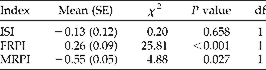
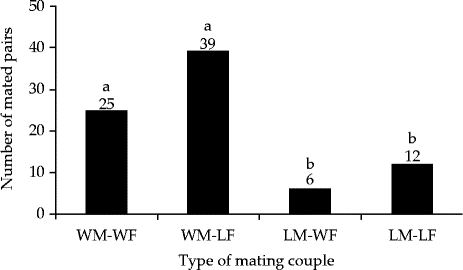
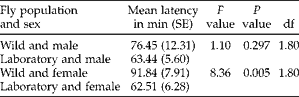
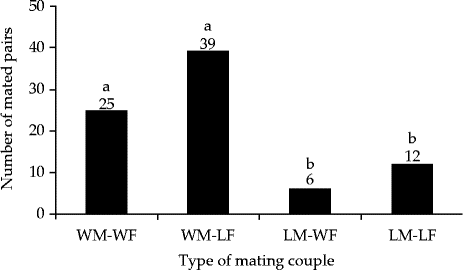
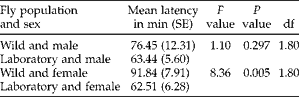
No indication of sexual isolation was found between the two populations (Table 1). Wild males and laboratory females paired more frequently than did other pairing combinations (Fig. 1). However, flies from different populations had different sexual performance. Laboratory females participated in a significantly higher number of matings than did the wild females (P< 0.001) (Table 1 and Fig. 1). By contrast, wild males participated in a significantly higher number of matings than did the laboratory males (P< 0.05) (Table 1 and Fig. 1). Males from the different populations did not differ in mating latency (P= 0.297), but laboratory females initiated mating sooner than wild females (P< 0.01) (Table 2).
Mating compatibility of two olive fly populations (laboratory and wild strains) originating from Israel during field cage studies
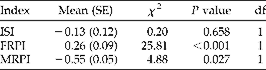
ISI, index of sexual isolation; FRPI, female relative performance index; MRPI, male relative performance index.
Composition of mating couples during mating compatibility tests with a laboratory and a wild strain of olive fly. Under each bar, the population source and sex are given (e.g. WM-LF is wild male, laboratory female). Numbers above the bars indicate the numbers of mated pairs under each condition. Letters above the bars indicate significant differences.
Mating latency (time to initiation of mating) of mating couples during field cage studies with two olive fly populations (laboratory and wild strains)
Laboratory males achieved only 22% of the matings (Fig. 1). The relative sterility index (0.24) was above the recommended level (FAO/IAEA/USDA, 2003). However, such a low mating success for laboratory males was unexpected, as this laboratory population had recently been backcrossed with wild males to increase the fitness of the population. Another study using flies from the same backcrossed laboratory population showed that laboratory males had higher coupling duration than wild males (Rempoulakis et al., Reference Rempoulakis, Nemny-Lavy, Dimou, Economopoulos and Nestel2008). However, the laboratory population used by Rempoulakis et al. (Reference Rempoulakis, Nemny-Lavy, Dimou, Economopoulos and Nestel2008) had been backcrossed for fewer (four) generations and was not sibling-mated. More detailed mating experiments between the laboratory and wild populations are necessary to determine whether the benefits of backcrossing wild males with the laboratory population decrease in subsequent generations.
Presence of Candidatus Erwinia dacicola in populations
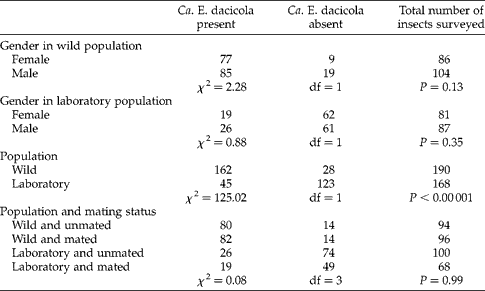
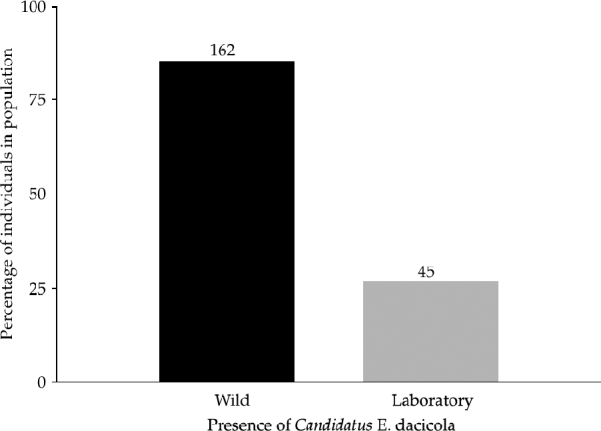
Sequencing of the 16S rRNA amplicons that produced two bands when cut with Pst1 revealed >99% similarity to Ca E. dacicola using BLAST. Other Pst1 banding patterns produced from the 16S rRNA amplicons from laboratory flies had a >97% BLAST match to Serratia marcescens, Enterobacter agglomerans, Enterobacter sp., Providencia sp. or M. morganii. Males and females of both wild and laboratory populations were equally likely to have Ca. E. dacicola (Table 3). Accordingly, males and females from each population were pooled for further analyses. There was a significant difference in endosymbiont presence between the populations. Flies from the wild population were more likely to be colonized by Ca. E. dacicola than those from the laboratory population (Fig. 2 and Table 3). Overall, 85% of flies from the wild population (females 90% and males 82%) harboured detectable Ca. E. dacicola, but only 27% of flies from the laboratory population (females 24% and males 30%) (Fig. 2) were colonized. The frequency of Ca. E. dacicola colonization in wild olive flies from Israel was similar to that in populations from the USA (Estes et al., Reference Estes, Hearn, Bronstein and Pierson2009) and Italy (Estes et al., Reference Estes, Hearn, Burrack, Rempoulakis and Pierson2012a). Although Ca. E. dacicola was expected to be found in most wild olive flies, its presence in both males and females of the laboratory population is surprising. Previous studies have shown that males and females from other laboratory strains reared on an artificial diet lack this bacterium (Kounatidis et al., Reference Kounatidis, Crotti, Sapountzis, Sacchi, Rizzi, Chouaia, Bandi, Alma, Daffonchio, Mavragani-Tsipidou and Bourtzis2009; Estes et al., Reference Estes, Hearn, Burrack, Rempoulakis and Pierson2012a). The endosymbiont may have entered the colony when wild males were crossed with the laboratory population. Candidatus Erwinia dacicola has been found to be associated with the digestive system of the olive fly and is absent in the testes and ovaries, so the most parsimonious hypothesis is that the bacterium is acquired via horizontal transmission through cohabitation of wild and laboratory animals either when feeding on shared food (Sacchetti et al., Reference Sacchetti, Granschietti, Landini, Viti, Giovannetti and Belcari2008) or through coprophagy. If horizontal transmission occurs naturally through cohabitation, this endosymbiont could be easily introduced into laboratory colonies that lack the endosymbionts at a low cost and without needing specialized training or equipment. The presence and importance of other bacteria in the olive fly microbiome in the absence of Ca. E. dacicola will be important for future research to address. Next-generation sequencing methods can determine the identity of members of the microbiome of flies lacking Ca. E. dacicola. There is the possibility that a secondary endosymbiont may be present in laboratory populations that could potentially replace Ca. E. dacicola, as has been observed in other insect systems (Conord et al., Reference Conord, Despres, Vallier, Balmand, Miquel, Zundel, Lemperiere and Heddi2008; Moran et al., Reference Moran, McCutcheon and Nakabachi2008; Prado and Almeida, Reference Prado and Almeida2009; Toenshoff et al., Reference Toenshoff, Gruber and Horn2012). Alternatively, the presence of opportunistic pathogens may explain decreases in the fitness of flies without Ca. E. dacicola.
Presence of Candidatus Erwinia dacicola in wild and laboratory populations of olive fly and its relationship with mating status
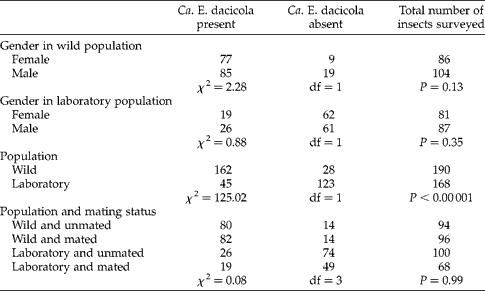
Distribution of Candidatus Erwinia dacicola in olive fly populations. A χ2 test revealed significant differences at P>0.00 001. The black bar represents the percentage of insects from the wild population of 190 that had Ca. E. dacicola. The grey bar represents the percentage of insects from the laboratory population of 168 that had Ca. E. dacicola. Numbers above the bars indicate the number of insects with Ca. E. dacicola.

Influence of Candidatus Erwinia dacicola on the measures of mating success
There was no significant (P>0.05) relationship between the presence of Ca. E. dacicola and copulatory success or mating latency (Table 3). Instead, the frequency of Ca. E. dacicola colonization in the mated population was predicted primarily by the composition of the mated pairs (e.g. wild males × laboratory females) (Table 3). There was no significant relationship between mating latency and the presence of Ca. E. dacicola (logistic regression, R 2= 0.001, χ2= 0.09, P= 0.76).
However, the possibility that Ca. E. dacicola is beneficial to mating success could not be distinguished from behavioural factors affecting copulatory success and mating latency. It is possible that Ca. E. dacicola affects other unmeasured fitness variables in the olive fly, such as the identification of mates, courting, competition for mates, or successful copulation and insemination (Sivinski et al., Reference Sivinski, Martin, Gary, Amnon, David, Kenneth, Peter, Aluja and Norrbom2000). This study examined only the formation of mating couples. Allowing couples to continue mating and then examining copulation duration, mating success, offspring fitness (survival, dispersal and reproductive success) and frequency of remating may provide additional insights into the symbiosis between the olive fly and Ca. E. dacicola. Differences in the behaviour and frequencies of symbiont colonization between the two populations could not be uncoupled in this study. Laboratory and wild olive flies differ in their mating behaviour; that is, laboratory females are more receptive to mating, develop eggs several days sooner than wild females, and produce higher numbers of eggs (Zervas and Economopoulos, Reference Zervas and Economopoulos1982; Zervas, Reference Zervas and Cavalloro1983). Additionally, flies of laboratory origin do not disperse as far or live as long as the flies of wild origin (Prokopy et al., Reference Prokopy, Haniotakis and Economopoulos1975). Conducting mating experiments in which the fly genotype (i.e. wild or laboratory) is held constant and Ca. E. dacicola is present or absent would remove the interactions between endosymbiont presence and mating behaviour and allow to better determine any fitness advantage that Ca. E. dacicola confers on the olive fly.
Conclusion
This study provides several important findings with implications for the biology of the olive fly–Erwinia symbiosis. Candidatus Erwinia dacicola was identified in both wild male and female olive flies from Israel. The presence of Ca. E. dacicola in laboratory females as well as males was surprising and may be due to horizontal transmission during cohabitation of laboratory and wild flies. This suggests a natural mechanism for introducing the endosymbiont into laboratory populations that is simple, low technology and cost saving in nature. We did not detect Ca. E. dacicola to be beneficial to copulation success or mating latency, but benefits to overall fitness may have gone undetected. Future experiments assessing more fitness parameters may reveal the benefits of associating with Ca. E. dacicola. The finding that wild males achieved more matings than laboratory males is of concern for the SIT, as laboratory males are the control-point insects released. Future studies directed at understanding the mechanism behind the poor performance of laboratory flies is essential for improving olive fly SIT.
Acknowledgements
The authors thank David Nestel for collecting the wild flies and Amirul Islam and Sohel Ahmad for their assistance in carrying out the field tests and rearing the laboratory flies. Leland S. Pierson, III graciously allowed Anne McCoy Estes (A.M.E.) unlimited access to laboratory equipment and expendable supplies. Doug Mahana assisted in extracting DNA from the flies. Discussions with Daniel Papaj and David Hearn strengthened the data analysis. The manuscript was greatly improved by discussions with Daniel Papaj, David Hearn, Judith Bronstein and Julie Dunning Hotopp.
This study was funded by IAEA technical contract no. 14748 for the research project on Development of Mass Rearing for New World (Anastrepha) and Asian (Bactrocera) Fruit Fly Pests in Support of SIT. Funding from the Orchid Society of Arizona supported A.M.E. during the writing of this manuscript.