1. Introduction
Many studies such as the Stern report (Reference Stern2007) and the Intergovernmental Panel on Climate Change (IPCC, 2007) have predicted an intensification of climate change and its consequences in the forthcoming years. Therefore, policy makers and academics have increasing concerns about the environment, which has thus occupied an important place in world governance. However, the partial failure of important meetings on the environmental issue shows that it is difficult for the states to agree on the strategy to adopt to reduce their impact on the environment. The interests and means of action differ according to each nation's level of development. Developed countries are responsible for an important partFootnote 1 of pollution and greenhouse gas (GHG) emissions compared to developing countries, which are disproportionately affected owing to their economic vulnerability and lack of means due to poverty. Many developing countries are experiencing an increase in the frequency and costs of natural disasters, which are estimated on average at 5 per cent of their GDP between 1997 and 2001 (IMF, 2003). They suffer a ‘double penalty’ because less developed countries may be trapped in a vicious circle, whereby their poverty makes them more vulnerable in the face of natural disasters, which in turn causes some issues in dealing with the consequences of these disasters. In this context, migration appears as one of the coping mechanisms for natural disasters.
History demonstrates that the natural environment is probably the oldest determinant of population displacement. For example, the climatic factor is seen as one of the main drivers of migration in the context of ancient Chinese history (Huang and Su, Reference Huang and Su2009). Moreover, the climatic factor also influenced Polynesian migrations between 300 and 1400 (Bridgman, Reference Bridgman1983). The El Niño events between the 1970s and 1990s caused extended droughts in Ethiopia. They were followed by famine and political turmoil, which resulted in radical changes of government, secession and a massive program of population redistribution (Comenetz and Caviedes, Reference Comenetz and Caviedes2002). More recently in 2004, the tsunami in Indonesia displaced 500,000 people, while Hurricane Katrina in 2005 had serious consequences in terms of human displacement for tens of thousands of migrants in 26 states of the USA. Moreover, it also contributed to increasing male migration from Honduras to Nicaragua (Smith, Reference Smith2007).
According to the International Organization for Migration (IOM), in the next half century, 200 million people (equal to the current estimate of international migrants) could be permanent or temporary environmental migrantsFootnote 2 within their countries or overseas. Therefore, the management of supplementary migratory flows from developing countries due to environmental events can be more complicated for developed countries. However, the alarming view concerning the consequences of environmental factors on migration is more and more put into perspective (Black, Reference Black2001; Piguet et al., Reference Piguet, Pecoud and Guchteneire2011). Views also differ on whether migration could be considered as an adaptation to risks associated with environmental shocks or failure. On the one hand, migration is viewed as an adaptive response (Black et al., Reference Black, Adger, Arnell, Dercon, Geddes and Thomas2011), a mitigation and ex post management strategy (Halliday, Reference Halliday2006) or even a solution to the failure of different survival strategies (Meze-Hausken, Reference Meze-Hausken2000; Smith, Reference Smith2007). Furthermore, some operational organizations and academics point out the role that migration can play in helping home communities to adapt themselves, for instance, using the resources from migrant remittances (Barnett and Jones, Reference Barnett and Jones2002; IOM, 2007). On the other hand, some characterize migration as a failure, rather than as a form of adaptation. Oliver-Smith (Reference Oliver-Smith2009) expresses the view that migration is a maladaptive response because it may trigger an increased risk for those who move, as well as possibly for areas towards which people migrate. Notwithstanding this, it is important to specify that the idea implying that environmental migrants could represent a ‘threat’ for the receiving areas is very controversial (Piguet et al., Reference Piguet, Pecoud and Guchteneire2011).
The discussions and controversies related to the consequences of climate events on migration are likely due to the fact that the literature is relatively small regarding empirical evidence, apart from some case studies. Therefore, more research is needed and thus this paper aims to contribute to the literature by studying the relationship between natural disasters, mainly due to climate change, and migration in developing countries. Furthermore, for the first time in the literature, we investigate the effect of natural disasters on the selectivity of migrants regarding their level of education. The idea that environmental factors lead to more internal than international migration is becoming increasingly accepted (Piguet et al., Reference Piguet, Pecoud and Guchteneire2011). However, it is important to ascertain whether this effect depends on the characteristics of migration such as the education level and, more specifically, if natural disasters can lead to brain drain, which is supposed to be a long-term migration. This issue is particularly crucial if we refer to the consequences of climate events in developing countries as described above. It is thus important to know who migrates in terms of education when developing countries suffer from an environmental shock. Since we are interested in brain drain effects, we mainly focus on international migration from developing countries to developed countries.
To our knowledge, our paper is also the first seeking to form a consensus about the idea of migration as an adaptive response or failure strategy. Indeed, if one assumes the existence of a brain drain, namely that the most educated migrate, this can be seen as a failure strategy because it raises equity issues in the origin countries when they are at their most vulnerable. At the same time, it can be seen as positive and subsequently as an adaptive strategy from the perspective of remittances, for example. However, if we do not find any brain drain effect, this will support the argument of migration as an adaptive response, which would contribute to relativizing the negative consequences of climate events on migration. Our study also refers to natural disasters mainly determined by climate change because, even if they are sudden events, the frequency, magnitude or intensity of disasters is related to climate change, which is a longer process. Therefore, we use natural disasters closely associated with climate change as our variables of interest. They are composed of: meteorological disasters considering the events caused by storms; hydrological disasters, using a variable that groups together the events caused by floods and other wet mass movements; as well as climatological disasters, which take into account disasters caused by drought, wildfire and extremely high temperatures. These data are provided by the Center for Research on the Epidemiology of Disaster (CRED). For the purpose of our analysis, namely exploring the relationship between natural disasters and migration, as well as between natural disasters and migration according to different levels of education, we use panel data from the World Bank Databases. This data set measures international migration to the six main OECD destination countries from 1975 to 2000. We conduct the analysis for low, medium and high education levels. We use a sample of 67 developing countries and run OLS estimations with pair-country and year fixed effects. We also take into account the geographical location of the countries and conduct a more detailed analysis of the effects of the aforementioned types of disasters on migration.
Our results can be summarized as follows: natural disasters are positively associated with migration rates. Beyond this result, the paper shows that natural disasters may exacerbate the brain drain in developing countries by involving the migration of highly skilled people. Our results are robust to various model specifications, estimators and measures of disasters. We also find some heterogeneity of the relationship between natural disasters and migration across regions. Moreover, the results show that the effect of natural disaster on migration is mainly driven by hydrological disasters.
The remainder of the paper is organized as follows. The next section presents the existing literature on the relationship between the environmental issue and migration, also drawing on the literature related to the selection of migrants and the brain drain issue. Section 3 presents the empirical design. Section 4 presents the results concerning the relationship between natural disasters and migration, as well as between natural disasters and migration, with a focus on the education level. Finally, concluding remarks and implications are provided in section 5.
2. Literature review
This paper aims to study the relationship between natural disasters closely associated to climate change and migration, with a particular interest in migrants' level of education. Therefore, we firstly draw on literature on the relationship between climate change, natural disasters and migration, before subsequently reviewing the brain drain literature.
2.1. Environmental issues and migration
There is little evidence concerning the relationship between climate events and migration, with the existing literature being very mixed. A branch of studies uses the urbanization rate to proxy internal migration and find that climate events positively affect internal migration in developing countries (Barrios et al., Reference Barrios, Bertinelli and Strobl2006; Beine and Parsons, Reference Beine and Parsons2012; Marchiori et al., Reference Marchiori, Maystadt and Schumacher2012). For instance, Barrios et al., (Reference Barrios, Bertinelli and Strobl2006) show that a decrease of 1 per cent in rainfall increases the urbanization rate in sub-Saharan Africa by 0.45 per cent. In the case of international migration, Munshi (Reference Munshi2003) finds that a decrease in rainfall increases emigration from Mexico to the United States. Marchiori and Schumacher (Reference Marchiori and Schumacher2011) show theoretically that minor impacts of climate change have major impacts on the number of migrants. Reuveny and Moore (Reference Reuveny and Moore2009) argue that environmental decline plays a significant role in out-migration, with their results suggesting that a 1 per cent increase in disaster produces an increase in migration between 0.011 and 0.014 per cent. Finally, Marchiori et al. (Reference Marchiori, Maystadt and Schumacher2012) find that rainfall and temperature anomalies led to the international migration of 5 million people between 1960 and 2000, which corresponds to 0.3 per thousand individuals each year.
Another trend in the literature suggests that natural disasters have no direct impact on international migration, yet have a possible indirect effect through the wage differentials, for example (Beine and Parsons, Reference Beine and Parsons2012). Naudé (Reference Naudé2010) also found the absence of a direct relation between natural disasters and migration, showing that natural disasters only affect emigration in sub-Saharan Africa by increasing the risk of conflicts related to the scarcity of resources and by having a negative impact on the GDP. Based upon a descriptive analysis, Findley (Reference Findley1994) finds no effect of drought on migration in Mali at an aggregate level. However, she finds some changes related to the destinations, with more internal than international migration. Drought also affects the composition of migrants, given that more women and children migrate. Finally, it also changes the duration of migration, with a higher rate of circular rather than permanent migration, above all for poorer families.
Other studies argue that natural disasters have a negative effect on migration. For instance, Halliday (Reference Halliday2006) finds that one standard deviation increase in damage due to earthquake lowers the probability of migrating from El Salvador to the United States by 37.11 per cent. The main explanation is that this disaster reduces savings and access to credit, which limits the available funds for migration.
In any case, the effect of environmental events is heterogeneous according to different factors such as countries' level of vulnerability (Stern, Reference Stern2007; IPCC, 2012), the nature of disasters (see, for instance, Perch-Nielsen et al., Reference Perch-Nielsen, Bättig and Imboden2008), the short- or long-term perspectives (Shah, Reference Shah2010), as well as the sociodemographic variables such as age or gender (Hunter and David, Reference Hunter, David, Piguet, Guchteneire and Pecoud2011; Gray and Mueller, Reference Gray and Mueller2012).
2.2. Selection of migrants and brain drain issue in developing countries
Our paper also addresses the issue of the selection of migrants in the case of natural disasters. The skill selectivity of immigrants depends on many factors, such as wages and migration policies, as well as cultural factors and geographical distance (Belot and Hatton, Reference Belot and Hatton2012). There are different views about the selection of migrants from developing countries. According to Borjas (Reference Borjas1987), migrants are negatively selected in poor countries because less skilled immigrants have a higher propensity to migrate, while there are also higher returns to migration in these countries. Another trend in the literature finds that there is a positive or intermediate selection of migrants from developing countries (Chiquiar and Hanson, Reference Chiquiar and Hanson2005; Orrenius and Zavodny, Reference Orrenius and Zavodny2005). McKenzie and Rapoport (Reference McKenzie and Rapoport2010) form a consensus of these two visions and argue that the type of selection depends on the size of the network. If it is small, the high migration costs can only be afforded by the most educated people. However, when the network becomes larger, this will reduce the migration costs, thus inducing a negative selection of immigrants. In any case, when it is mainly the high-skilled people who migrate from developing countries, this is called brain drain.
The brain drain literature has undergone significant development since the 1960s.Footnote 3 The causes and above all the consequences of brain drain have been explored by different studies and continue to spark much interest from researchers. According to Docquier and Marfouk (Reference Docquier, Marfouk, Ozden and Schiff2006), high skill migration from developing countries to the OECD countries has greatly increased since the 1990s. Indeed, this type of migration has doubled, whereas it increased by 30 per cent for low-skilled immigrants. This brain drain phenomenon is caused by both push and pull factors. These determinants can be the economic conditions or the size of the countries, the geographic proximity, the human capital level in the origin countries, or the immigration polices (Docquier et al., Reference Docquier, Marfouk and Lohest2007; Mayda, Reference Mayda2010). In terms of the consequences of brain drain, the evidence is much more mixed. Early studies argue that brain drain does not imply losses in the origin countries because skilled migration is viewed as a public good (Grubel and Scott, Reference Grubel and Scott1966) and due to the perspective of remittances. However, there is no consensus in the literature that remittances compensate the negative consequences of brain drain. Some studies argue that it is not the case because high-skilled migrants tend to remit less (Faini, Reference Faini2007; Niimi et al., Reference Niimi, Ozden and Schiff2010), whereas other results suggest mixed evidence (Bollard et al., Reference Bollard, McKenzie, Morten and Rapoport2011). Further studies point to the negative consequences of brain drain such as inequality due to the technological gap that brain drain creates between developed and developing countries (Bhagwati and Hamada, Reference Bhagwati and Hamada1974). More recently, a growing part of the literature finds that brain drain can have a net positive effect and can be profitable to the origin countries. This trend of the literature argues that, since there are high expectations about the returns of migration, high-skilled migration is a driver of human capital formation and leads to more investment in education in the origin countries (Beine et al., Reference Beine, Docquier and Rapoport2001; Easterly and Nyarko, Reference Easterly and Nyarko2009; Batista et al., Reference Batista, Lacuesta and Vicente2012). However, even if there is a net positive gain, the effect is heterogeneous across countries (Beine et al., Reference Beine, Docquier and Rapoport2008) and can be different in a specific negative context in the origin countries. For instance, Bhargava and Docquier (Reference Bhargava and Docquier2008) find that a high prevalence of HIV leads to more brain drain in the health sector. Therefore, the aim of the empirical part is to contribute to the literature about natural disasters and migration, the selection of migrants and the brain drain issue by analyzing who migrates abroad regarding education when developing countries have to deal with negative shocks such as natural disasters.
3. Empirical design
This section is devoted to developing the empirical framework. However, before presenting the data, the two main specifications showing the different relationships between natural disasters and migration are discussed.
3.1. Methodology
Firstly, the effect of natural disasters on migration rates is estimated using the following bilateral specification:
 $$\eqalign{mig_{i\comma j\comma t} & = \alpha_1 disaster_{i\comma t} + \alpha_{ki} X_{k\comma i\comma t} + \alpha_{kj} X_{k\comma j\comma t} + \mu_{i_j} + \cr & \quad \kappa_t + \varepsilon_{i\comma j\comma t}}$$
where mig i,j,t and disaster i,t are the migration from country i to country j in period t and natural disaster variable for country i in period t, respectively. X k, i, t is the vector of control variables of the source country and X k, j, t that of the destination country, as generally used in migration estimations. We use country OLS fixed effects, whereby μ ij represents the bilateral country-pair fixed effects that control for the unobservable characteristics between the origin and receiving countries. As previously mentioned, migration and above all high-skilled migration has increased during the period studied. The figures on the trends of natural disasters show that migration stocks present an upward continuous trend for each region, except Europe and central Asia, which report a decrease prior to 1990 and an increase thereafter. The number of natural disasters also displays increasing trends for all regions.Footnote 4 Moreover, ‘regular’ natural disasters are likely to happen in each country. Therefore, to avoid our results being driven by these elements, we control for year fixed effects using the variable κ t . Finally, the unexplained residual is captured by ε i,t .
Secondly, the analysis is specified by taking into account migration rates according to the education levels. We are interested in this point because we assume that natural disasters may affect the migration of people who are more educated or more skilled. This is because they often reflect those who get a job and a salary and thus have the means to go abroad, be safe and provide insurance for their family back in the affected country. With respect to policy implications, natural disasters can induce a brain drain, whose effects will be more serious in this context, within which countries require vast support for rebuilding and have a special need for skilled workers. We assume that this effect is higher for the most highly educated. Therefore, we have a similar specification as in equation (1), except that the dependent variable migeduc i,j,t e is the migration rate associated with each educational level e (e = low, medium and high educational levels). The model is given in equation (2):
 $$\eqalign{migeduc_{i\comma j\comma t}^e &= \alpha_1^e disaster_{i\comma t} + \alpha_{ki}^e X_{k\comma i\comma t} + \alpha_{kj_{kj}}^e X_{k\comma j\comma t} + \cr & \quad \mu_{ij} + \kappa_t + \varepsilon_{i\comma j\comma t}^e}$$
3.2. Data
This paper aims to assess the effect of natural disasters mainly determined by climate change on global migration rates, as well as according to the level of education. This relationship is investigated by using bilateral panel data with pair-country as the unit of observations, based upon 67 developing countries. As dependent variables, we use the bilateral Panel Data on International Migration of Schiff and Sjöblom (Reference Schiff and Sjöblom2008) (World Bank Databases),Footnote 5 which measures international migration from 1975 to 2000 concerning the six main destination countries: Australia, Canada, France, Germany, the UK and the United States. They measure emigration rates through the stocks of migrants from sending countries to these countries for three educational levels, namely low, medium and high, divided by the stock of adults (older than 25) corresponding to the same educational level in the country of origin, plus the stock of migrants of sending countries. In order to have the migration rate as a flow variable, we use the difference between two periods divided by the population of the country of origin plus the migrant stock. We multiply this rate by 1,000 and thus consider the migration rate for each 1,000 inhabitants. The data set uses the same methodology as Defoort (Reference Defoort2008). We prefer this database to that produced by Docquier and Marfouk (Reference Docquier, Marfouk, Ozden and Schiff2006); the latter uses the same measure, albeit for all OECD countries in 1990 and 2000, whereas the data that we are using have a larger temporal dimension and thus more observations.
For the climate change indicators representing the variables of interest, we use the CRED data 2010, which give information from 1900 to 2010. We use a dummy variable taking a value of 1 if the country experienced natural disasters in the five-year period. We only keep natural disasters that were likely to be caused by climate change. Thus, we focus on meteorological disasters (storms), hydrological disasters (floods and other wet mass movements) and climatological disasters (drought, wildfire and extremely high temperatures).
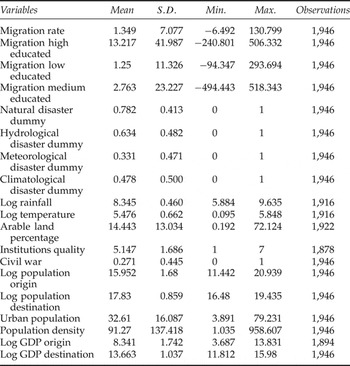
We control for the additional explanatory variables that can influence migration (see table 1 for the summary statistics).Footnote 6 These variables are considered as push or pull factors of migration. Therefore, we control for the GDP of the source countries, as well as that of the destination countries, measuring their development level. This also allows measurement of the economic conjuncture of the countries. In fact, this variable provides information about some economic indicators such as the unemployment rate or the fiscal deficit. Moreover, climate factors affect GDP (Dell et al., Reference Dell, Jones and Olken2009), which in turn can influence migration. Nonetheless, given that panel data are used in this study, the changes over time capture variation in the GDP and subsequently give an idea about the evolution of the economic performance. We also consider the dynamics of the population in terms of migration. The demographic pressure is measured through variables such as the population density, the total population of source and destination countries, which is another indicator of the country's size. Following previous studies such as Barrios et al. (Reference Barrios, Bertinelli and Strobl2006), Marchiori et al. (Reference Marchiori, Maystadt and Schumacher2012) and Beine and Parsons (Reference Beine and Parsons2012), we control for the internal migration by including the urbanization rate in our estimation. This is also useful to capture the migration of the poorest population and the low-skilled people who are more likely to migrate internally than internationally. We control for the availability of arable land, which captures the economic opportunities of a country, primarily in developing countries, where agriculture is the main activity. We include in our estimations the quality of the institutional situation in the country through political rights and civil war variables, which lead to the widespread displacement of population. Finally, we capture average rainfall and temperature variables to control for normal climatic conditions.Footnote 7
Summary statistics

4. Results
4.1. Natural disasters and migration rate
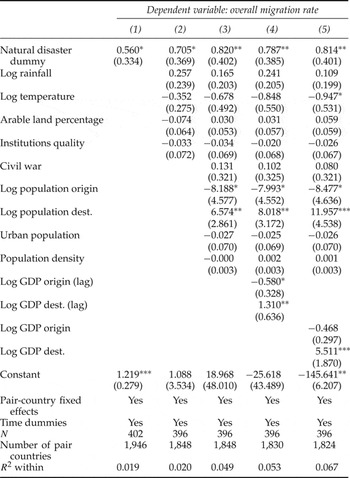
We conduct analysis for low and lower middle income countries.Footnote 8 Table 2 shows the results of the effect of natural disasters on the overall migration rate. All regressions include pair-country fixed effects and period dummies. Column 1 of table 2 shows the plain correlation between the natural disaster dummy and the migration rate without any control variable. Natural disaster is significant at the 10 per cent level and has a positive sign. In column 2 of table 2, we introduce the most exogenous control variables, namely the logarithm of the average rainfall and temperature, the percentage of arable land and the variable measuring the quality of a country's institutions. While none of these variables is significant, the effect of natural disasters on the migration rate remains significant and positive. Nonetheless, the magnitude of the coefficient significantly increases, from 0.560 to 0.705, indicating that weather variables, arable land and institutions' quality contribute to explaining the relationship between natural disaster and migration. In column 3, we control for the occurrence of a civil war over the period studied, the size of the population of origin and destination, the urban population and the population density in the origin country. The positive effect of natural disaster persists and it becomes significant at the 5 per cent level. In column 4 of table 2, we add as controls the lagged of the log GDP in the origin and the destination countries, because these variables are supposed to be more exogenous than the log of the current GDP.Footnote 9 The results are very similar to the previous one. Finally, the results also remain robust to the inclusion of the log GDP in the origin and the destination countries in column 5 of table 2.
Natural disasters and migration rate

Notes: Robust standard errors in parentheses. *p < 0.1; **p < 0.05; ***p < 0.01.
Similar results have been obtained in the literature with different indicators of natural disasters and migration variables. Using the logarithm of the total number of people affected by weather-related natural disasters in the origin country as the variable of interest and the logarithm of the number of people who migrated from the country of origin as the dependent variable, Reuveny and Moore (Reference Reuveny and Moore2009) found that natural disasters cause international migration with an elasticity ranging from 0.011 to 0.014. However, Beine and Parsons (Reference Beine and Parsons2012) find little or no support for any relationship between short- and long-run climatic factors on international migration. They recognize that their results do not necessarily imply that climate factors have no effect on migration. They also highlight that environmental events influence international migration through other channels such as wage differentials. Similarly, Naudé (Reference Naudé2010) found that the total number of natural disasters mainly affects international net migration through conflict and job opportunities.
4.2. The effect of natural disasters on migration according to the education level
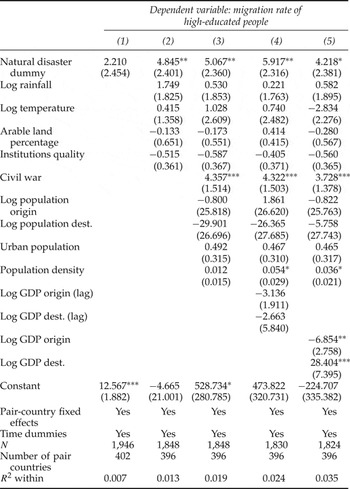
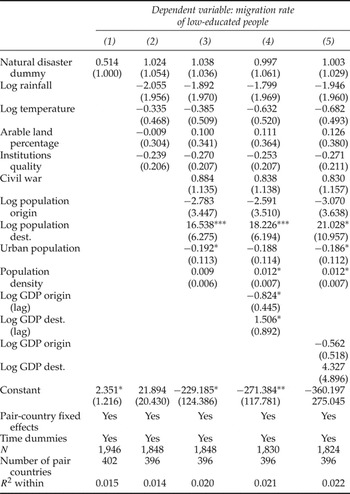
The effect of natural disasters on the migration of high-educated people is presented in table 3. We conduct the same analysis as those in table 2, albeit only for the high-educated people. The simple correlation between the natural disaster dummy and the emigration rate of highly educated people is positive but not significant. Once we control for the most exogenous variables (column 2 of table 3), namely the occurrence of the civil war and the population variables (column 3 of table 3) as well as the lagged GDP in the origin and the destination countries (column 4 of table 3), the coefficient becomes positive and significant at the 5 per cent level. The magnitude of the coefficient shows that over a five-year period, 5.917 per 1,000 inhabitants with a high education level each year leave a country that experienced natural disasters. The results are also robust when we control for the current GDP (column 5 of table 3). Tables 4 and 5 show the results of the same estimates as in table 2, but for the low- and medium-educated people, respectively. The sign of the natural disaster dummy variable remains positive in all estimates, except in column 1 of table 5, where it is negative. However, the coefficient is not significant in any of these estimates. Overall, our results suggest that only individuals with a high level of education migrate when a natural disaster occurs.
Natural disasters and migration of high-educated people

Notes: Robust standard errors in parentheses. *p < 0.1; **p < 0.05; ***p < 0.01.
Natural disasters and migration of low-educated people

Notes: Robust standard errors in parentheses. *p < 0.1; **p < 0.05; ***p < 0.01.
Natural disasters and migration of medium-educated people

Notes: Robust standard errors in parentheses. *p < 0.1; **p < 0.05; ***p < 0.01.
In table 2, the magnitude of the coefficient indicates that over a five-year period, between 0.56 and 0.814 per 1,000 inhabitants each year leave a country that experienced natural disasters for the overall population. Comparing the magnitude of the coefficients of natural disaster in column 4 to that of the population of origin, it appears that a 1 per cent increase in the population of origin will reduce the migration rate by about 0.08 per 1,000 inhabitants over a five-year period. The population of destination will increase the migration rate by a similar level. If we refer to the coefficients of the GDP, our results show that a 1 per cent increase in the GDP of destination increases the overall migration rate by 0.055 per 1,000 inhabitants. However, when the highly educated population is considered in table 3, the coefficient of natural disasters is multiplied by more than eight, while those of the population of origin and destination are not statistically significant. A 1 per cent rise in the GDP of origin reduces the migration rate by 0.069 per 1,000 inhabitants, while a 1 per cent rise in the GDP of destination increases the migration rate by 0.28 per 1,000 inhabitants. While we do not find any effect of civil war on the overall migration rate, our results show that the occurrence of a civil war increases the migration rate of those highly educated by between 3.7 and 4.3 per 1,000 inhabitants. Therefore, the effect of civil war on the highly educated migration is slightly smaller than the effect of natural disaster.
Why should natural disasters increase the migration of highly educated people, and not the migration of low- or medium-educated people? Our result can be explained by the cost of migration and the liquidity constraints faced by the less wealthy people, given that skilled people are less likely to be unemployed and thus can more easily support migration costs. For instance, Halliday (Reference Halliday2006) makes the link between natural disasters, wealth and migration, suggesting that even if earthquakes slow migration independently of the level of wealth, liquidity constraints remain an important factor because wealthier households have a higher probability of migration. If we refer to our analysis, this supports the assumption that the most educated people, who are supposedly also wealthier, would migrate more easily than those who are less educated. However, there is the counter-argument that less educated people are more vulnerable to the consequences of natural disasters and thus might use migration as a coping mechanism. We assume that even if less educated people migrate, they would migrate internally or to those countries closest to them (see, for instance, Beine and Parsons, Reference Beine and Parsons2012), and not necessarily toward the main OECD receiving countries. In our estimates, we control for the share of the urban population, which is a proxy of this internal migration, whereby the result of the natural disaster dummy for low- and medium-educated people remains non-significant. Moreover, we assume that, due to their skills, highly educated people can more easily obtain legitimate documents to enter host countries. Therefore, it is likely that migration policies could generally be more tolerant to skilled workers and migrants are integrated more easily in the job market of the receiving countries if they are qualified. This seems particularly true in the case of negative shocks such as natural disasters. Accordingly, natural disasters due to climate change may heighten the brain drain phenomenon in developing countries just when they need the most skilled and qualified people to deal with the damage caused. However, at the same time, our results suggest a consensus between the views that migration is a failure or an adaptive strategy. Since the most skilled people leave when the developing countries have to deal with negative climate shocks, this can be interpreted as a failure strategy. Nevertheless, if those people send remittances, it can mitigate the losses due to the brain drain, which can only be assimilated to an adaptive strategy if the effect of remittances truly compensates the costs of brain drain.
4.3. Robustness checks: GMM system estimates of the relationship between natural disasters and migration
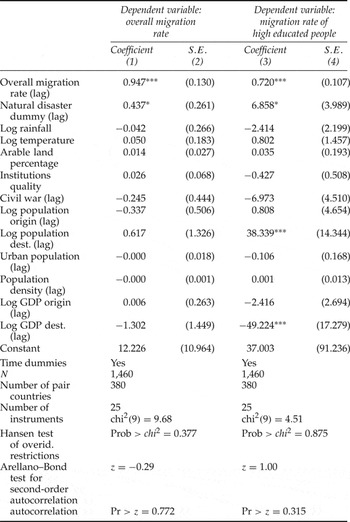
In order to test the robustness of our results, following Naudé (Reference Naudé2010), we use the GMM system estimator (Blundel and Bond, Reference Blundell and Bond1998) to estimate the relationship between the natural disaster dummy on the overall migration rate (columns 1 and 2 of table 6) and the migration rate of the highly educated people (columns 3 and 4 of table 6). We also use the two-step estimator which performs better than the one-step estimator, according to the literature (Windmeijer, Reference Windmeijer2005). The Hansen test of overidentification restrictions (p = 0.377 for columns 1 and 2 and p = 0.875 for columns 3 and 4 of table 6) and the Arellano–Bond test for second-order autocorrelation (p = 0.772 for columns 1 and 2 and p = 0.315 for columns 3 and 4 of table 6) do not allow rejection of the hypothesis concerning the validity of the lagged variables in level and in difference as instruments, nor the hypothesis of no second-order autocorrelation. The results regarding the natural disaster dummy are significant for both the overall migration rate and the migration rate of highly educated people. However, while the magnitude of the coefficient associated with the natural disaster dummy is close to that found in table 3 for highly educated people, the size of the coefficient associated with the natural disaster in the estimates regarding the overall migration rate is slightly smaller. Therefore, a more conservative approach would consider that over a five-year period, 0.437 per 1,000 inhabitants each year leave a country that has experienced natural disasters.
Robustness check: GMM system estimates of the relationship between natural disasters and migration

4.4. The effect of natural disasters migration rate according to the geographical location
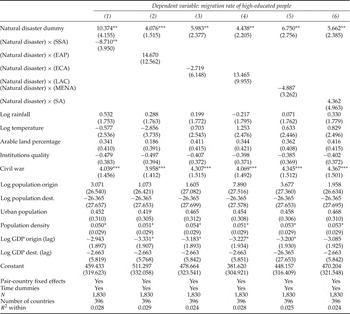
It has been shown in the literature that there is significant heterogeneity across regions in terms of the brain drain phenomenon (Docquier et al., Reference Docquier, Lowell and Marfouk2009). Moreover, even if natural disasters affect all countries, it is interesting to test whether people's behavior regarding migration depends on the country's geographical location. Table 7 presents the results for the overall population regardless of level of education, while table 8 details the results for the highly educated population. The variable of interest is the natural disaster dummy and some interaction terms between the natural disaster variable and geographical dummies.Footnote 10 Although we do not find any significant effect for the East Asia and the Pacific (EAP) (column 2 of table 7) and the Middle East and North Africa (MENA) (column 5 of table 7) regions, our results show that there is a negative relationship between the interaction term between the natural disaster dummy and the variables sub-Saharan Africa (SSA) (column 1 of table 7), Europe and Central Asia (ECA) (column 3 of table 7) and South Asia (SA) (column 6 of table 7) and the migration variable. These findings mean that people from these three regions will migrate less due to the occurrence of natural disasters compared to people from other regions. The effect is positive for Latin America and Caribbean (LAC) (column 4 of table 7), where we observe an increasing migration rate due to natural disasters, compared to other regions.
Natural disasters and migration according to the geographical level

Notes: Robust standard errors in parentheses. *p < 0.1; **p < 0.05; ***p < 0.01.
Natural disasters, migration and education according to the geographical level

Notes: Robust standard errors in parentheses. *p < 0.1; **p < 0.05; ***p < 0.01.
For the highly educated population, the results in table 8 show that there is no difference between regions in the relation linking natural disasters to migration, with the exception of SSA (column 1 of table 8). For this region, we find a significant and negative relationship between the interaction term between the natural disaster dummy and the variable SSA and the migration rate of high-educated people. This finding means that highly educated people from SSA will migrate less due to the occurrence of natural disasters, compared to people from the other regions.
4.5. Natural disasters and migration according to the type of disasters
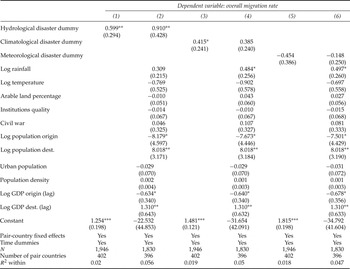
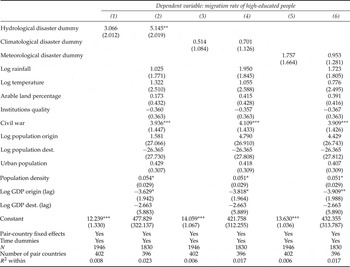
In tables 9 and 10, we use the subcomponents of natural disasters as variables of interest and conduct our analysis for the overall migration rate and the migration rate of the highly educated people, respectively. The variables of interest are the hydrological disaster dummy (columns 1 and 2 of tables 9 and 10), the climatological disaster dummy (columns 3 and 4 of tables 9 and 10) and the meteorological disaster dummy (columns 5 and 6 of tables 9 and 10), respectively. In table 9, we show the results of the effect of the disaggregated variables on the overall migration rate. We find that the hydrological disaster dummy has a significant and positive effect on migration in the estimates with and without controls. The climatological disaster dummy is positively correlated with the migration rate. Once we add the control variables to the estimates, the positive effect remains, although the parameter of interest is not precisely estimated. The meteorological disaster dummy has a negative sign, but the coefficients are not statistically significant in any of the estimates. Our results suggest that, for flood and mass movement included in hydrological events, people have fewer possibilities to stay and thus have to migrate. Put differently, other alternatives to deal with the environmental shocks are less available for hydrological disasters compared to other types of events. In table 10, the significant and positive relationship between the hydrological disaster dummy and the migration rate is also confirmed for the highly educated people (column 2 of table 10). The climatological and meteorological components of natural disasters are positive but not significant. To summarize, our findings suggest that the impacts of natural disasters on the migration rate of the overall population and for highly educated people are mainly driven by hydrological disasters.
Natural disasters and migration according to the type of disasters

Notes: Robust standard errors in parentheses. *p < 0.1; **p < 0.05; ***p < 0.01.
Natural disasters, migration and education according to the type of disasters

Notes: Robust standard errors in parentheses. *p < 0.1; **p < 0.05; ***p < 0.01.
5. Concluding remarks and implications
This paper assesses the relationship between natural disasters closely related to climate change and migration, by examining migration rates and levels of education. Results from a fixed effects estimator show that natural disasters have a significant and positive effect on migration rates. We also find that the effect differs according to educational levels, with natural disasters only having an effect on the migration of people with a high level of education. We find some differences in the migration behavior across regions, while a more detailed analysis also shows that the impacts of natural disaster on migration are mainly driven by the hydrological disasters. Our results are robust to various model specifications, estimators and measures of disasters.
Overall, our study highlights the fact that the relationship between environmental issue and migration is among the main challenges of the 21st century for all countries in general, and particularly for developing countries. The poorest countries have to cope with the economic consequences of climate change and natural disasters, which weaken states and reduce their ability to provide opportunities and services to help people to become less vulnerable, above all if those people already live in marginalized areas. As well as their poverty, developing countries are in a disadvantageous situation due to their rapid population growth, massive urbanization and geographical environment, which make them more vulnerable and less able to adapt to climate change (Stern, Reference Stern2007). Indeed, low adaptive capacity increases vulnerability and social and economic costs, which affect these areas' human capital and development levels, constituting transmission channels for migration. Therefore, the migration of highly educated people in this context may exaggerate or on the contrary attenuate the negative consequences of environmental shocks.
One of the important implications of our study is that the migration of high-skilled people due to natural disasters can be interpreted as both a failure strategy and an adaptive response to migration in this context. It is a failure strategy because, when developing countries are facing such events, they need all their financial and human resources to deal with the consequences. Therefore, developing countries may face equity issues due to the brain drain effect and the loss of qualifications and skills, just when they are at their most vulnerable. On the other hand, it can be interpreted as an adaptive response if these migrants send remittances that cover the costs of the brain drain. Therefore, this paper opens some avenues for future research to ascertain how remittances can compensate the negative consequences of the migration of high-skilled workers in a context of environmental shocks.
Supplementary materials and methods
The supplementary material referred to in this paper can be found online at journals.cambridge.org/EDE/.