Civilian populations often bear the brunt of violence in civil wars because both rebel groups and government forces commonly target civilians as a tactic. Since the end of the Cold War, efforts to protect civilians in conflict theaters have preoccupied government leaders and practitioners around the world. Yet scholars and policymakers remain divided on whether the international community's efforts to do so are effective, inconsequential, or even detrimental. While international interventions may lessen incentives to target civilians and provide barriers between civilians and combatants,Footnote 1 they may also cause opposed factions to step up civilian victimization as a result of changes in the balance of power.Footnote 2 Or warring populations may believe that humanitarian intervention is biased toward those who inflict the most severe abuses, leading them to commit ever greater crimes.Footnote 3 In tandem, policymakers’ views have also become divided, with many responding to calls for increased involvement with demands for cuts in the peacekeeping forces of the United Nations (UN) amid high levels of civilian atrocities.Footnote 4
We argue that these conflicting views are driven by pervasive and often intractable empirical difficulties, which we address by employing an instrumental variables research design. A central issue that scholars must contend with is that they do not observe what would have happened had the international community not intervened. In other words, it is impossible to compare the result of an intervention in a particular state to the outcome in the same state had no intervention occurred. Instead, since international intervention is not randomly assigned, the international community becomes involved in states’ domestic affairs as a result of factors that are not independent of the treatment of civilians in those states. States may require international assistance for a variety of reasons that make it appear that the international community's involvement does not protect civilians when it is actually very effective, or vice versa. For example, since states often send peacekeepers to help civilian populations in regions with the most casualties,Footnote 5 these policies may seem to lead to more deaths, when in fact higher levels of civilian abuse would have occurred otherwise. Further, since a variety of unobserved variables could confound the results, we cannot even know the direction of the bias ex ante. While randomized experiments can solve this problem, because randomly assigning the treatment ensures that—in expectation—other concerns are not driving the results, they are often impractical since governments and international institutions are typically reluctant to randomly assign their interventions.
However, international institutions often offer the next best approach: quasi-random variation. Because these institutions operate with predetermined rules and procedures, they may provide “as-if random” treatments. Through careful research into the inner workings of the UN Security Council, we identify an instrumental variables design using two exogenous rotation rules: the rotating Council presidency and the alternation of Council seats between geographic regions in Africa. When these African states assume power in this manner, they use their influence to increase the number of peacekeepers deployed to conflict areas within their region in order to minimize the negative externalities associated with these African civil wars.Footnote 6 These quasi-random rotation rules thus yield a compelling identification strategy for disentangling the causal effects of peacekeeping on the protection of civilians from rebel and government forces.
We use this new research design to help adjudicate the scholarly debate over peacekeepers’ effect on civilian casualties. Scholars have recognized the need for a method to overcome the problem of endogenous intervention, but have been largely unable to identify a plausible source of exogeneity. Although researchers have developed innovative methodological approaches and have controlled for a variety of factors that determine where peacekeepers are deployed, they have not found a random, or quasi-random source of variation. Fortna notes that “instrumental variable analysis is often used to evaluate the effect of a variable, in this case peacekeepers, that is itself affected by (or endogenous to) other variables in the model. Unfortunately, it is not possible here … Most of the variables that shape whether or not peacekeepers are deployed are likely to be directly related to the ease or difficulty of maintaining peace … These variables [are] unsuitable as instruments.”Footnote 7
Using our approach, we find that peacekeepers decrease civilian deaths in line with, for example, Hultman, Kathman, and Shannon, demonstrating the robustness of these existing results to a plausible identification strategy.Footnote 8 This approach should not be conflated with other empirical strategies that exploit variation in Council membership, as we do not require states’ selection onto the Council to be quasi-random; we need only the presidency to change hands in an as-if random fashion, and/or for African regions to rotate onto the council in such a manner. While other work has used interesting research designs that rely on variation in membership on the Security Council, the potential remains for these designs to feature unobserved heterogeneity because of incomplete knowledge of the assignment process for the composition of the set of states with a seat on the Council.Footnote 9 The Council membership of specific states, while interesting to examine,Footnote 10 is not exogenous since states are elected to these positions, and elections favor powerful, strategically important countries.Footnote 11
Our instrumental variables design thus helps to move this debate forward, and can also be applied to other diverse settings. For instance, many prominent institutions including ASEAN, APEC, the EU,Footnote 12 the UN General Assembly, and CARICOM feature exogenous leadership rotation, and many domestic institutions such as the geographic rotation of Bosnia and Herzegovina's presidency and the US Federal Reserve's Federal Open Market Committee mandate rotation in leadership positions among various groups. Exploiting these institutional design features could lead to a multitude of interesting and well-identified studies.
Peacekeeping and the Protection of Civilians
Targeting civilians in civil conflicts is a tactic commonly used by both government forces and rebel groups. Ambushing civilian convoys, shelling sites populated by civilians, ethnic cleansing, and other atrocities occur frequently during civil wars. Indeed, from the end of the Cold War to 2004, 572,767 people were intentionally killed in one-sided violence.Footnote 13 Rebel groups target civilians for a variety of reasons, including to secure civilians’ cooperation, resources, a more favorable bargaining position, and ethnic cohesion.Footnote 14 Governments, too, often target civilians to gain an upper hand in the conflict, punish them,Footnote 15 minimize their own military's fatalities, annex land held by civilians,Footnote 16 gain resources, or lessen the rebels’ abilities to hide among civilians for support.Footnote 17
UN peace operations perform a number of tasks to protect civilians from intentional harm by warring factions. Armed blue helmets provide a visible deterrent, establish checkpoints to control movement and access, provide armed escort, conduct cordon-and-search operations, patrol vulnerable locations (e.g., internally displaced person camps, markets), control crowds, confiscate weapons, and even attack perpetrators of violence against civilians.Footnote 18 Regardless of their mandate, “United Nations peacekeepers—troops or police—who witness violence against civilians should be presumed to be authorized to stop it, within their means,” according to the UN's landmark Brahimi Report.Footnote 19 The UN's standing rules of engagement for blue helmets clarify that the “use of force, up to, and including deadly force, to defend any civilian person who is in need of protection against a hostile act or hostile intent, when competent local authorities are not in a position to render immediate assistance, is authorized.”Footnote 20
However, despite the prevalence of civilian deaths at the hands of both rebels and governments, few scholars have focused on the impact of peace operations on civilian protection, which is surprising since protecting civilians has become the primary focus of contemporary UN peace operationsFootnote 21 and since civilian victimization affects the quality of peace.Footnote 22 Moreover, extant studies of this topic find divergent results. Some claim that peacekeeping missions can reduce intentional harm to civilians, particularly when the operations contain large numbers of police and military troops,Footnote 23 when the Security Council explicitly considers the nature of the threat to civilians,Footnote 24 when they directly confront the perpetrator or assist the target of the killings,Footnote 25 or when the effects of neutral interventions are looked at in the long term.Footnote 26 Others, however, argue that peacekeepers are ineffective or even increase violence against civilians. For example, a study commissioned by the UN Department of Peacekeeping Operations warns that “the ‘chain’ of events that lead from the Security Council to the field for delivering protection to civilians in peacekeeping missions is broken.”Footnote 27 Rebels may believe that peacekeepers tend to assist those who commit the most abhorrent violence, causing rebels to increase this behavior.Footnote 28 Or, intervention can alter the balance of power, leading the losing side to step up violence against civilians.Footnote 29 Armed groups might even deliberately attack civilians to undermine missions whose purpose is to protect them.Footnote 30
Exogenous Variation in Peacekeeping
We argue that these assessments remain inconclusive largely as a result of empirical issues because endogeneity needs to be addressed. To isolate the effect of peacekeeping on civilian protection, we must identify “as-if random” variation in the deployment of UN blue helmets. This is important because, as Diehl and Balas point out, correlations between UN peace operation size and success may be spurious: strong capabilities may enable a UN peace operation to successfully deter and punish violence against civilians, but also reflect the political willingness of UN Security Council members to provide what military experts regard as an adequately sized force.Footnote 31 The same lack of resolve that explains a mission's insufficient capabilities may also explain why perpetrators of violence do not feel international pressure (e.g., sanctions and less easily observable incentives such as private threats) independent of the peace operation. A larger concern is that peacekeepers may be sent to “hard” casesFootnote 32 so that mission sizes increase in response to violence and shrink in response to calm. If true, this would obscure their effectiveness, so that current estimates may understate the effect of these missions. Regressions of civilian violence on UNPO size typically rely on the assumption that the models include all observable and unobservable confounders, and therefore they have trouble adjudicating between these alternative explanations.
We tackle this issue by exploiting two sources of predetermined variation in which states hold power in the Security Council: the rotating presidency and the alternation of Council seats between geographic regions. We focus on representation on the Council because it is tasked with the maintenance of international peace and security and as such, it decides on the establishment, termination, mandate, staff composition, and authorized personnel size of UN peace operations. Once it has established a peace operation, the Council regularly reviews the size and mandate of the mission. It can form new UN peace operations or wind down existing ones at any moment. The only formal prerequisite for the establishment of a peace operation is that the Council considers a particular crisis as a present or likely future threat to international peace and security. In practice, this is often preceded by the conclusion of a cease-fire by warring factions. Our identification strategy accounts for such endogeneity by assessing the effect of those UN peacekeepers who are deployed solely as a function of two predetermined rotation rules in the Council.
The institutional rules of the UN Security Council yield exogenous variation in two ways. First, this variation exists in the composition of the ten nonpermanent Council members, who are elected to two-year terms with no immediate reelection, staggered such that five new members are elected each year. These ten seats are reserved for states from specific regions, and three of them are allocated to African states. Under a formula devised in the 1960s and observed without exception since the 1970s, a Central or North African state must rotate into one of these seats once every two years, and the second seat must alternate every two years between an Eastern and Southern African state; the third seat is always held by a Western African state.Footnote 33 Thus, while the same number of seats is always allocated to African states, we can use variation in the representation of regions, as we describe further subsequently. Since this strict rotation rule applies to only four African regions, we focus on states in these regions in particular. Once elected to the Council, these temporary members exert influence through several channels: they chair most sanctions committees and working groups, and their votes are both essential for unanimity (which is strongly desired because 89 percent of votes are unanimous) and to prevent the appearance of neocolonialism.Footnote 34
A second source of quasi-random variation lies in the position of the Council presidency as it rotates monthly among all Council members in alphabetical order of the member states’ English names. This ensures that the selection of the state holding the presidency bears no relationship to any political considerations, which is remarkable since the president holds considerable power. In particular, the president's responsibilities include calling and presiding over meetings, preparing the Council's agenda, determining the order of votes on amendments, issuing presidential and press statements, and communicating with UN member states and the UN Secretary-General on behalf of the Council.Footnote 35
However, it is not enough to identify exogenous variation in Council members’ influence; we must also show that states wield this power to affect peacekeeping missions. States have an interest in sending peacekeepers to their region in an attempt to stem their negative externalities.Footnote 36 Indeed, these conflicts cause refugee streams and arms proliferation, which in turn can lead to conflict contagion and political instability,Footnote 37 which states seek to avoid.
States often use the Council to pursue these national interests, rather than relying on their own national resources, because of the high costs associated with peacekeeping. Intervention by a single state is often seen as illegitimate or as a form of neocolonialism. It may involve high domestic casualties and blame falls squarely on the intervener if the mission fails. Countries can circumvent these problems by acting through the UN. Doing so also allows them to split the financial cost, which currently amounts to USD 7 billlion per year.
Even when resources are pooled, however, the high price tag ensures that peacekeepers cannot deploy to all civil wars. Instead, scholars have found that they are placed in militarily weaker states embroiled in more severe conflicts,Footnote 38 and states where powerful Council members have economic interests.Footnote 39 States thus use their leverage to pursue three complementary strategies to direct more peacekeepers to their region. First, they can weigh in on the Security Council's decision to deploy new peace operations in nearby conflict theaters. Second, they can secure an increase in the mandated size of existing missions. Third, they can attain more contributions within a given mandate by persuading troop and police contributors and the UN Secretariat to allocate more resources to peace operations in their region.
The empirical evidence, however, suggests that the effect primarily occurs through the second mechanism. Indeed, OLS models in Table A29 in the appendix confirm that the rotating presidency increases the mandated number of UN blue helmets in nearby conflict theaters whereas the other instrument's effect on the same outcome is weakly significant. Regarding the first mechanism, OLS models in Table A28 indicate that neither instrument systematically increases the likelihood that new peace operations are deployed in their region. Further, regarding the third mechanism, neither instrument systematically affects the size of the gap between the mandated and the actual size of peace operations (see Table A30), since they increase both the actual and the authorized number of peacekeepers.
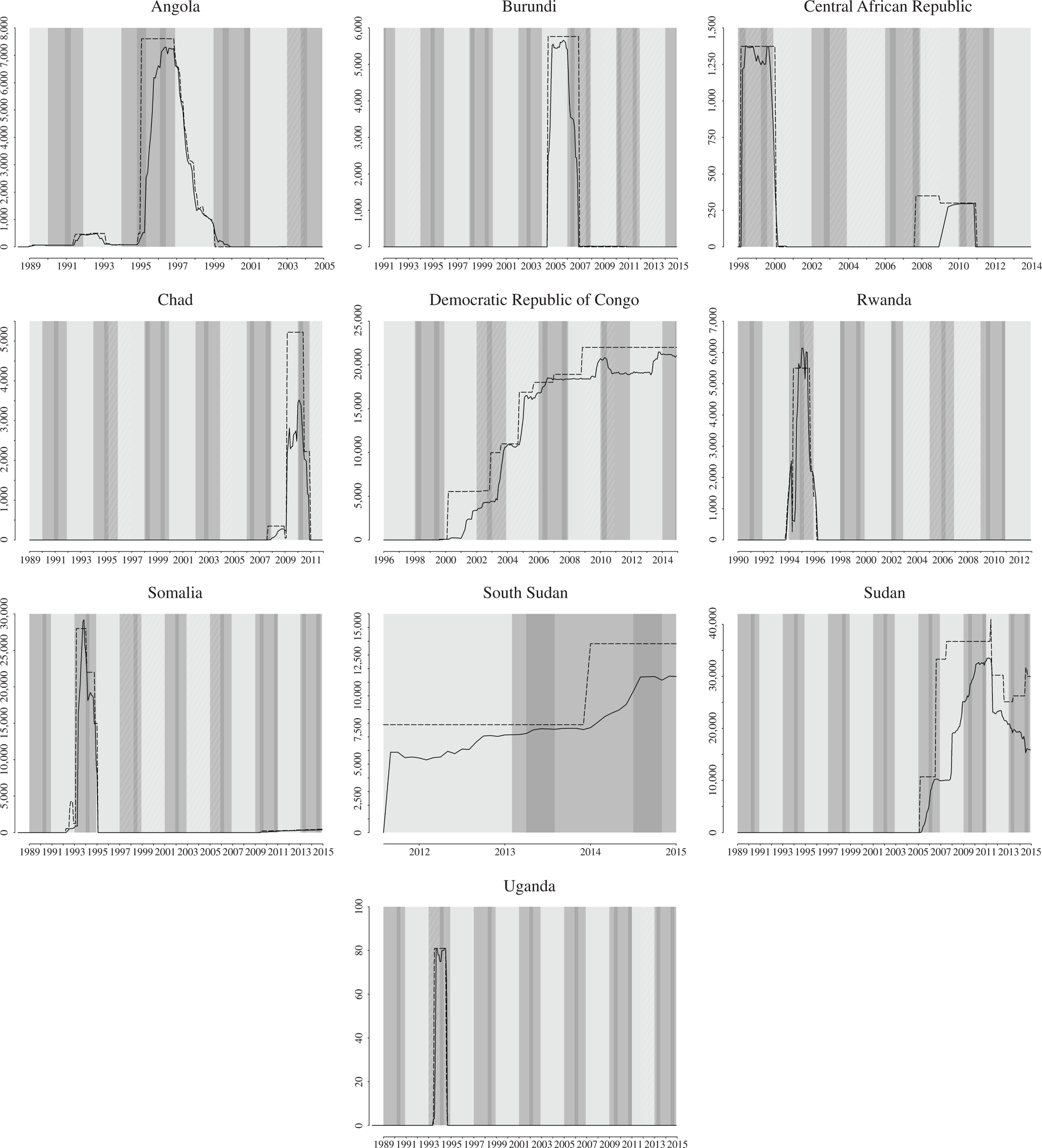
We investigate this further in Figure 1, which depicts the size of all eighteen UN peace operations in ten civil-conflict countries in four African regions with rotating representation on the Security Council, on the one hand, and the conflict-theaters’ representation on the Council, on the other. Periods when the country's region had a seat on the Council are depicted in gray. Dark gray indicates periods when a country from that region presided over the Council (±2 months to account for anticipation effects that increase the leverage of the incoming presidency and to account for delays in blue-helmet deployments shortly after the month-long presidency ends). The solid line indicates the number of staff that were actually deployed, while the dashed line shows the maximal number of personnel that was authorized by the Security Council. Each time series starts at the onset of civil conflict (twenty-five battle-related fatalities per year) and ends when the conflict is terminated or peters out (i.e., drops below this conflict-intensity threshold) and does not subsequently restart. Intermittent periods of peace are shaded in white.
Exogenous variation in African minor powers’ influence on the UN Security Council and UN peace operations in Africa

The dashed lines indicate that when an African region's representative on the Council had elevated influence due to its Council presidency, the Council was over five times more likely to authorize an increase rather than a decrease in the number of UN blue helmets in civil-conflict countries in the region of its president. When an African region was represented on the Council (but did not preside over this body) the Council authorized 44 percent more increases than decreases in the number of UN blue helmets in that region. In contrast, decreases in the authorized number of UN blue helmets in African conflict theaters were 22 percent more likely than increases whenever the region of the conflict theater was absent from the Council.
The solid lines indicate that battalion-size surges in the number of UN blue helmets that are actually deployed in civil-conflict countries were two thirds more likely than withdrawals of a similar number of blue helmets when the region's representative on the UN Security Council presided over the Council. Such battallion-size deployments (of at least 250 additional UN blue helmets) were almost twice as likely as the withdrawal of a similar number of blue helmets when the region of the conflict theater was represented on the Council. In contrast, these major new deployments were only one third more likely than were major withdrawals when no state in the region of the conflict theater served on the Council.
The actual staff size was coded for this study from records of the UN Department of Peace Operations, and the authorized staff size was recorded by Mikulaschek from UN Security Council resolutions and reports of the UN Secretary-General.Footnote 40 We can thus employ these two sources of quasi-random variation in influence on the UN Security Council as instruments for the actual number of UN peacekeepers.
Research Design
To estimate the effect of peacekeeping on the protection of civilians in civil conflict, we rely on a data set consisting of monthly observations of UN peacekeepers during civil wars between 1989 and 2014. All civil-conflict country-month observations are included in the sample, regardless of whether UN peacekeepers were deployed in the conflict theater at the time. Thus, we include conflict months where there was no peacekeeping operation and no mission in the sample as well.Footnote 41 We code civil conflict using the conventional definition from Themnér and Wallensteen and employ a measure of battle-related deaths from Harbom, Strand, and Nygard to operationalize it.Footnote 42 We focus on the post-Cold War period because prior to the end of the Cold War, the Security Council authorized few peacekeeping missions—and just one in Africa—because of superpower rivalry in the Council.Footnote 43 After the Cold War, however, UN peacekeeping dramatically expanded, such that the UN is now actively engaged in peace-making, peacekeeping, and peace-building activities in the majority of civil wars around the world. Today, more than two thirds of all UN blue helmets operate in contexts with ongoing violent conflict.Footnote 44
We measure the number of UN peacekeeping personnel (including troops, police, and military observers) using data collected from the website of the UN Department of Peace Operations, and we focus on UN missions with a military component as well as those sent to ongoing conflicts, thus excluding civilian missions and postconflict peace operations.Footnote 45 Our outcome variable, civilian protection, is coded as a monthly count of civilian deaths in civil conflicts and was compiled from the UCDP's Geo-referenced Event Dataset (GED v.1.5).Footnote 46 Following Hultman, Kathman, and Shannon we focus on intentional killings (as opposed to collateral casualties in the cross-fire) of civilians who were directly targeted by warring factions, excluding indirect fatalities caused, for example, by starvation.Footnote 47
Mikulaschek provides data on which African region was represented on the UN Security Council in a given month.Footnote 48 This binary variable takes a positive value for all civil conflicts that took place during months when a state from the region in which the civil conflict occurred was represented on the UN Security Council; it is lagged by one month. Data on the UN Security Council presidencies come from the UN meeting records. To take into account the elevated leverage of the incoming Council president as well as delays in the deployment of any additional UN blue helmets that the Council's president secures for civil-conflict theaters in her region, the Council presidency instrument takes a non-zero value during the month the president holds office and the preceding and three following months.The results are robust to operationalizing this instrument differently.
Some of our models control for several country and conflict characteristics that may influence whether a UN peace operation is begun in a civil-war setting, its size, and its prospects for success.Footnote 49 First, we include a variable that records whether a peace agreement that was signed during the prior five years stipulated the initiation of a peacekeeping mission using data from Hogbladh,Footnote 50 since the probability of a peace operation's deployment and success may be higher if the warring factions have formally agreed to multilateral peacekeeping.Footnote 51 Second, we use data from Sundberg to control for conflict duration, which may affect the establishment and success of peace operations.Footnote 52 Third, since the number of warring factions may affect the prospect of violence reduction,Footnote 53 we include the number of simultaneous conflicts in each civil-conflict country as recorded by the UCDP's GED. Further, we account for governments’ per capita military expendituresFootnote 54 because the likelihood of peacekeeping may be lower where government forces are strong,Footnote 55 and for pre-war political rightsFootnote 56 since these may influence conflict duration and peacekeeping deployments.Footnote 57 Finally, we include a time-varying measure of the percentage of land covered by forests to capture the difficulty of the terrain.Footnote 58 Appendix Table A1 presents descriptive statistics for all variables.
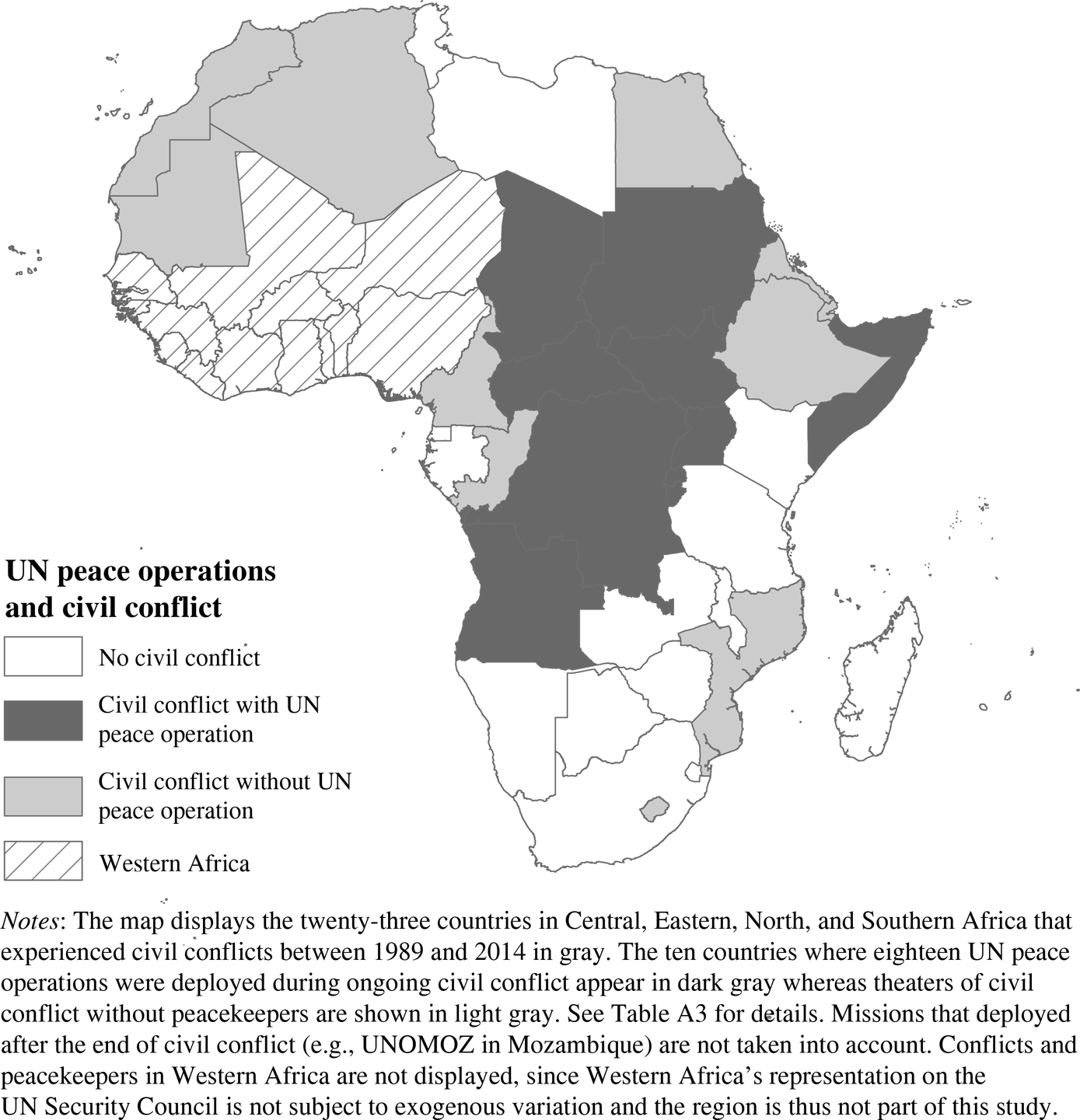
Although the geographic scope of the study is limited to Central, Eastern, Northern, and Southern Africa—which constitute the four regions that rotate onto two Council seats—our analyses capture a central part of the UN's peacekeeping efforts. Between 1989 and 2014, twenty-three countries in these regions suffered from civil conflict, as Figure 2 shows, and the UN Security Council deployed eighteen new peace operations to countries with ongoing civil wars in these areas. During this era, almost one in three blue helmets in the world were deployed to one of these countries.
Civil conflicts and UN peace operations in Africa, 1989–2014

Model Specification
We are interested in estimating the following model:
 $$ DV_{it} = \beta_0 + \beta _{1peacekeepers_{i(t-1)}} + \mathop \sum \limits_{k \in K} \beta _kI (i = k) + u_{it}$$
where DV it measures civilian casualties for country i in month t, peacekeepersi(t−1) is the number of UN peacekeepers in month t − 1, I( ⋅ ) is an indicator function such that the summation represents country and time fixed effects,Footnote 59 and u it represents the unobserved error term. If peacekeepersi(t−1) were randomly assigned (conditional on the fixed effects) we could estimate β 1, the marginal effect of a one-unit increase in the number of peacekeepers, consistently with ordinary least squares. However, this condition remains unsatisfied since peacekeepers are allocated such that they are systematically related to the intensity of violence in the host country. In other words, peacekeepersi is an endogenous variable.
To overcome this issue, we use an instrumental variables model, exploiting the as-if-randomly assigned rotation of African regions onto the Council along with the exogenously determined rotation of the presidency as instruments for peacekeepersi(t−1). This quasi-random variation allows us to generate predicted values from the first-stage regression, thereby purging peacekeepersi(t−1) of endogeneity:
 $$peacekeepers_{i\lpar {t-1} \rpar } = \gamma _0 + \gamma _1IV_{i\lpar {t-1} \rpar } + \mathop \sum \limits_{k \in K} \gamma _kI\lpar {i = k} \rpar + e_{it}\comma$$
where IV i(t−1) is the instrumental variable. Since we have two instruments, we employ three alternative model specifications that use both instruments individually and in combination.Footnote 60 We can now consistently estimate β 1 by regressing DV it on the predicted values of peacekeepingi(t−1), along with the fixed effects.
However, to obtain consistent results, our instruments must satisfy several assumptions. First, they need to meet the exclusion restriction; that is, they can affect the dependent variable only through their effect on the endogenous variable.Footnote 61 While it is impossible to prove that the exclusion restriction is satisfied, we argue that it likely holds and investigate possible violations empirically. The first potential challenge to this assumption concerns the effect of UN Security Council membership on aid receipts. A seat on the Council may be associated with additional aid and more loans,Footnote 62 which might in turn alter the trajectory of civil conflict. However, the vast majority of the civil conflicts that we examine are not located in states that served on the Council themselves. Thus, civil wars rarely occurred in states that were eligible for this additional aid. In fact, Council members which suffered from civil conflict account for only 6 percent of the observations, and excluding these observations does not substantially change the reported results.Footnote 63 Moreover, covariate balance analyses show that countries experiencing civil war did not receive more aid when their region was represented on the Security Council or when a state in their region held the Council's presidency than at other times.Footnote 64
A second potential challenge to the exclusion restriction concerns UN activities other than peacekeeping, such as sanctions and mediation, through which additional power in the Council could affect the targeting of civilians in civil-conflict theaters. However, it is implausible that these temporary exogenous shifts in influence significantly altered UN sanctions or mediation in countries with ongoing civil conflict. Irrespective of rotation in the presidency and in the representation of African regions on the Council, UN sanctions are hardly ever lifted before the end of a civil war, and this study investigates the targeting of civilians only during conflicts. Moreover, UN mediation is conducted by the UN Secretary-General and the Department of Political and Peacebuilding Affairs and not by the Security Council. Indeed, covariate balance analyses confirm that regional representation on the Council and its presidency did not have a significant impact on UN sanctions and mediation.Footnote 65
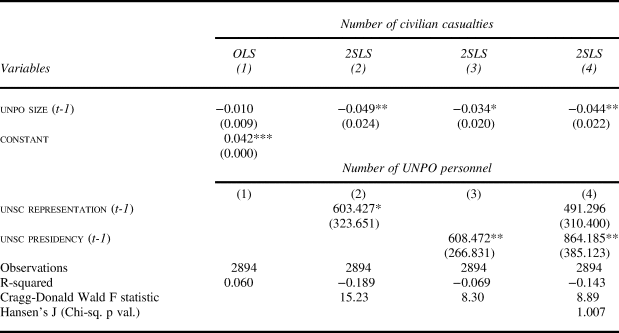
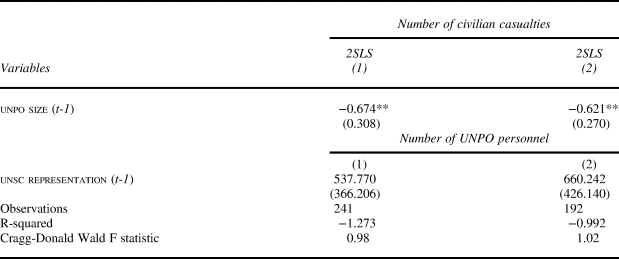
Besides likely satisfying the exclusion restriction, the instruments meet the requirement of not being “weak” in the statistical sense. Table 1 presents the results from a statistical test designed to probe the strength of the instrument. Critical values for the Donald-Cragg Wald F statistic test whether the nominal 5 percent two-stage least-squares t-test for the hypothesis that β = 0 potentially exceeds 15 percent.Footnote 66 In the model that includes the rotating UN Security Council representation the Donald-Cragg statistic exceeds this critical value; the rotating UN presidency as the sole instrument and both instruments combined exceed the 20 percent threshold. Thus, this instrument and the combination of both instruments are slightly weaker than the rotating regional representation. At the same time, all three model specifications (with both independent variables included separately and together) yield the same results, both in terms of the magnitude and significance of the peace operations’ effect, giving us additional confidence that our instruments do not suffer from this problem.Footnote 67
Effect of UNPO size on civilian casualties: Two-stage least squares and OLS models with country and time fixed effects

Notes: Heteroskedasticity consistent s.e. clustered by country in parentheses. Country and time fixed effects not shown. * p < .10; ** p < .05; *** p < .01.
Finally, all models that include both instruments pass Hansen's test of overidentification. The assumption that an instrument is not correlated with the error term in the second-stage model cannot be tested in 2SLS models with a single instrument. However, by fitting models with two instrumental variables, we are able to do so. The null hypothesis is that both instruments are valid—that is, they are uncorrelated with the error term—and that it is thus appropriate to exclude them from the second-stage model. The high p-values reported subsequently indicate that we cannot reject this null hypothesis. Therefore, Hansen's J statistic confirms that both instruments are valid.Footnote 68
Results
We analyze peacekeepers’ overall effect on civilian casualties and find that civilians are better protected when more blue helmets are present. Table 1 reports the results from three two-stage least squares (2SLS) models that support this finding. Models 2 to 4 include country and time fixed effects as well as the endogenous measure of UN peace operation size. Model 2 uses the rotation of Council seats between regions as an instrument. When a state in the regional neighborhood of the conflict theater serves on the Council, the UN tends to deploy additional peacekeepers to the conflict area, and thus the UN peace operation is larger (by 603 persons on average) than it is in other months. In turn, every 100 additional peacekeepers deployed as a function of the rotation of Council seats are associated with an average of five fewer civilian casualties per month and per country (p < 0.05).
Model 3 obtains a very similar result, finding that whenever a state in a given African region holds the Council's presidency, the UN increases the size of each peace operation in that region by 608 persons, on average. Every 100 additional peacekeepers deployed as a result of this exogenous variation tend to reduce the monthly number of civilian casualties in each conflict country in that region by three, on average. Model 4 uses both instrumental variables and confirms these results, indicating that UN peace operations in civil-conflict countries tend to have 491 more peacekeepers whenever the regional neighborhood of these countries is represented on the Council; when a state in the conflict theater's neighborhood holds the presidency, the personnel size of UN peace operations is higher by 864 people on average than it is during years when the region is absent from the Council. One hundred of these additional blue helmets are then associated with an average of four fewer civilian casualties by month (p < 0.05).
We complement our 2SLS models with a regression that does not instrument for UN peace operation size and is otherwise identical to models 2 to 4. The effect of UN peace operation size becomes insignificant in model 1. Its smaller coefficient is consistent with the proposition that UN peace operations tend to deploy to settings where they are least likely to succeed.Footnote 69
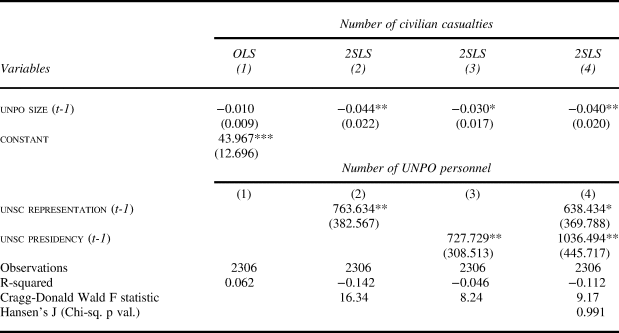
To avoid selecting on the dependent variable in the first stage of our 2SLS models, we include all conflict-month observations in our main models, regardless of whether a UN peace operation was deployed there or not. An additional test excludes countries where the UN never deployed a peace operation. Dropping those cases in which the instruments do not affect peacekeeping deployments strengthens the magnitude and significance of the instruments’ first-stage effect on the number of blue helmets, but it does not alter the impact of UN peace operation size on civilian casualties in the second stage (see Table 2 and model 2 in Table 3). We also conduct all robustness checks with this alternative model specification (see Appendix Tables A2–A3, etc.) and find that our results generally hold for this smaller subset.
Effect of UNPO size on civilian casualties in cases with a UN mission: Two-stage least squares and OLS models with country and time fixed effects

Notes: Heteroskedasticity consistent s.e. clustered by country in parentheses. Country and time fixed effects not shown. * p < .10; ** p < .05; *** p < .01.
Effect of UNPO size on civilian casualties (1) in all cases and (2) in cases with a mission: Two-stage least squares models of country-year data with country and time fixed effects

Notes: Heteroskedasticity consistent s.e. clustered by country in parentheses. Country and time fixed effects not shown. * p < .10; ** p < .05; *** p < .01.
To make sure that our results are not driven by serial correlation in the monthly size of UN peace operations, we replicate our analyses at the aggregate level of country-year observations. Since the Council's presidency varies by month, the country-year analyses rely on the instrument of rotating Council seats to account for the endogeneity of peace operations’ year-end size. Even though collapsing the monthly data by year shrinks the number of observations by 92 percent and thus greatly reduces the statistical power of the analyses, the effect of UN peace operation size on the number of civilian fatalities remains significant. The 2SLS models summarized in Table 3 confirm that this result holds for the full sample and for the subset of countries where a UN peace operation deployed.
Robustness Checks and Case Study
Since both instruments rely on predetermined rotation rules, they are exogenous to confounding variables in expectation. Thus, causal identification of UN peace operations’ effect does not require the inclusion of control variables in the model. The estimate of the effect of UN peace operation size on civilian casualties is robust to including controls. Appendix Tables A22 to A27 replicate our main models with these controls. These 2SLS models with controls show that larger UN peace operations significantly reduce civilian casualties in the full data set, in the subset of countries with a mission, and in analyses conducted at the country-month and country-year level (p < 0.1).
To verify that our results are not driven by our particular empirical specification, we conduct a number of robustness checks. We conduct all robustness checks for each of four model specifications: a model with all country-month observations, one that is restricted to cases where a UN mission deployed, and two analogous models of data that are aggregated into country-year observations. First, we show that our results are robust to clustering the standard errors by region, by region and year-month, or by country and year-month instead of country.Footnote 70 Second, we show that our results are robust to a different operationalization of our instrumental variable that exploits the Security Council's rotating presidency, which assigns a positive value to the presidency instrument during the three-month period that starts in the month of the presidency in order to account for lags in the arrival of UN blue helmets whose deployment was decided as a result of the president's influence.Footnote 71 Third, to verify that the results are not driven by civil wars that constitute outliers, we fit a series of models that exclude all observations that pertain to the same civil war in our sample; one country is dropped from each model. Regardless of which instrument is used, we find that UN peace operation size reduces the number of civilians.Footnote 72 Fourth, states contribute more blue helmets while they serve on the UN Security Council.Footnote 73 To show that our first-stage result on the effect of the rotation of Council seats between African regions is not simply a result of greater contributions by a temporary Council member in the region of the conflict theater, we net out contributions by this Council member and we find that our results hold.Footnote 74
Additionally, consistent with our argument that the Security Council's presidency and representation of African regions are as-if-randomly determined, the two instrumental variables are weakly predicted by almost all covariates.Footnote 75 Further covariate balance analyses confirm that the exclusion restriction is highly plausible because they show that a given civil-war country did not experience more UN sanctions, more mediation attempts, larger aid inflows, or more support from foreign combatants allied to warring parties when its region held greater power on the Council than that same civil-war country did otherwise.Footnote 76 Since neither instrument has a significant effect on aid flows, UN sanctions, mediation, or foreign troop support to warring factions (at the 90% confidence level), the exclusion restriction likely holds even if these policy interventions alter the number of civilian casualties.
We present a case study analysis of events unfolding over a single period of the Congolese civil war (from 2003 to 2006) in Ituri, one of the twenty-six districts of the Democratic Republic of the Congo (DRC). Because of space constraints, we summarize the findings and provide the full case in the appendix. The case illustrates several core aspects of our argument. First, it shows that both the rotating Council presidents and nonpermanent Council members from the DRC's region exercised influence over the peacekeeping mission, combating initial disinterest from other members. We provide specific examples of states promoting Security Council support for their region while serving on the Council, contrasting the responses of Gabon in 1998 and 1999 and Cameroon in 2002 and 2003—which are from the same region as the DRC—with Tunisia in 2000 and 2001, which is not. While Tunisia did not advocate for more peacekeeping in the DRC, Gabon and Cameroon actively supported it. Second, we demonstrate that the increased number of peacekeepers effectively reduced civilian casualties by stepping up patrols, checkpoint controls, and cordon-and-search operations.Footnote 77
Conclusion
This research note uses quasi-random variation in the size of multilateral peace operations to analyze whether peacekeeping protects civilians. While peacekeepers seek to promote this objective, the effect of their efforts remains the subject of extensive debate. This controversy is largely the product of empirical difficulties because endogeneity and selection bias have presented largely intractable problems for empirical examinations of peacekeepers’ effect. However, we address these issues by utilizing exogenous variation in which countries hold power in the UN Security Council. We demonstrate that when states hold more power, they deploy more peacekeepers to their preferred locations, and that these additional peacekeepers lower civilian casualties. Moreover, our independent variable estimates were larger than our OLS estimates, suggesting that selection effects in previous work tend to understate these missions’ effectiveness.
However, as with any analysis, it is important to consider the scope conditions of our study. While our empirical strategy necessitates a focus on four out of five African regions, the mechanisms driving our results are highly general and thus likely apply in a variety of settings. Our empirical strategy leverages two separate instruments, which allows us to estimate three local average treatment effects. The fact that these estimates are so similar gives us confidence in the generalizability of our findings.Footnote 78 While we analyze these dynamics over a specific time period, we expect that our main effect has become stronger over time, since almost all new peace missions now come with explicit mandates to protect civilians.
Our study has a number of scholarly and policy implications. From a scholarly perspective, in addition to its contribution to the literatures on peacekeeping and IO effectiveness, our findings speak to debates over who holds power in international organizations and the effects of these arrangements.Footnote 79 We document the influence obtained by temporary boosts in leverage within the Security Council, and show that states not only use these positions to try to benefit their own national considerations but also that their efforts strongly affect important humanitarian outcomes. This paper demonstrates the feasibility and importance of using quasi-random variation to study international institutions. Finally, from a policy standpoint, we call arguments to reduce peacekeeping budgets for efficacy concerns into question, since we determine that peacekeepers protect civilians from atrocities.
Data Availability Statement
Replication files for this research note may be found at <https://doi.org/10.7910/DVN/XJP8WL>.
Supplementary Material
Supplementary material for this research note is available at <https://doi.org/10.1017/S0020818320000442>.
Acknowledgments
We thank Peter Aronow, Stephen Chaudoin, Christina Davis, Thad Dunning, Page Fortna, Guy Grossman, Marina Henke, Michael Horowitz, Robert Keohane, Jacob Shapiro, Jack Snyder, Keren Yarhi-Milo, and the participants of the 2015 APSA conference, 2016 ISA conference, 2016 PEIO conference, 2016 EPSA conference, and seminars at Dartmouth, Harvard, Princeton, the University of Rochester, the University of Michigan, and the University of Texas at Austin for helpful comments. We thank Sadhna Naik for excellent research assistance. All remaining errors are our own.