1. Introduction
The growing concern about global warming, the maintenance of ecosystems and the protection of endangered species have renewed the urgency of taking necessary actions towards more sustainable development. While there is an increasing recognition of the role of social capital in the improvement of the collective management of natural resources, little is known about the effect of trust on pro-environment attitudes, especially in developing countries. Against this background, this study examines the effect of generalized trust on the willingness to contributeFootnote 1 to environmental goods in selected African countries.
The need to take into account environmental considerations in development projects, land management, agriculture or more generally in different areas of daily life is widely recognized (Roberts and Grimes, Reference Roberts and Grimes1997; Shani and Arad, Reference Shani and Arad2014). In richer countries, this awareness has contributed to national strategies for the rational use of resources. However, these strategies are very costly, especially for poor countries where a huge part of the population is unable to feed themselves (Udrescu and Man, Reference Udrescu and Man2010). Conventional wisdom in this regard is that the emergence of environmental awareness depends on the level of development (Broad, Reference Broad1994; Yang and Zhao, Reference Yang and Zhao2014). Therefore, in poor countries people are less likely to contribute money for better environmental quality. This view has recently been challenged by several papers showing that where social capital is well developed, people are able to make efficient collective management of natural resources (Ostrom, Reference Ostrom1990; Westerman et al., Reference Westerman, Ashby and Pretty2005; Jones, Reference Jones2010; Halkos and Jones, Reference Halkos and Jones2011; Calvacanti et al., Reference Calvacanti, Engel and Leibbrandt2013; Adrianzen, Reference Adrianzen2014). However, to the best of our knowledge, this literature has not yet been extended to Africa, which is characterized by the highest poverty levels in the world. Moreover, most of the studies related to the willingness to pay (WTP) for better environmental quality are country specific and cannot be easily generalized. Besides, it is difficult to find contributions considering an environmental damage perspective as a whole (Israel and Levinson, Reference Israel and Levinson2004). While the whole perspective has the disadvantage of excessive simplification which can lead to a downward bias of environmental WTP, with a general perspective, embedding effects which are usually linked to specific environmental commodities can be avoided (Torgler and Garcia-Valinas, Reference Torgler and Garcia-Valinas2005).
In light of this, the main objective of the paper is to provide an empirical assessment of the effect of trust on the willingness to contribute to environmental goods in selected African countries. We use generalized trust as our main indicator, although we also test several alternative measures (trust people you meet for the first time, trust people of another nationality, trust people of another religion). Two main reasons explain the choice of generalized trust as our interest variable. (1) Compared to other forms of trust (interpersonal trust or trust in institutions), generalized trust is more likely to be associated with pro-environmental attitudes (Durlauf and Fafchamps, Reference Durlauf and Fafchamps2004). In fact, people with a high level of generalized trust are more likely to exchange and cooperate with others, regardless of their origins, locations and social status. (2) Data on generalized trust are available for all the countries of our sample and for almost all the waves. The contribution of this paper is two-fold. First, using data from the World Values Survey (WVS) over the period 1981–2007 and mobilizing an ordered Logit model, we explore the effect of generalized trust on the willingness to contribute to the environmental good in 13 African countries. Secondly, we test the robustness of our result to possible endogeneity and measurement error biases using an instrumental variable (IV) approach. For this purpose, the estimated slave exports from African countries between 1400 and 1900 are used as an instrument of trust. In fact, Nunn and Wantchekon (Reference Nunn and Wantchekon2011) have shown on a sample of African countries that the slave trade is one of the historical sources of mistrust. Since we do not expect any direct effect of the slave trade on WTP, the former can be a good instrument.
The rest of the paper is as follows. Section 2 provides the theoretical background of the paper. Section 3 is centered on the empirical analysis. Section 4 presents the results and section 5 is the conclusion.
2. Literature review
This section provides a comprehensive overview of the existing literature on trust and the pro-environment attitude. We start by presenting a general background on the definition and measure of trust. This is followed by a review of the main determinants of WTP for environmental goods. Finally, we shed light on the recent findings on the relationship between trust and pro-environment attitudes.
2.1. The definition and measure of trust: a general background
The notion of trust is closely related to the general concept of social capital, which has proved to be one of the most studied concepts over the last two decades. The idea that social capital plays a key role in economic development has been widely documented in the literature. Over the past years, social capital has been successfully connected to a wide range of topics in economic development. Specifically, social capital has been associated with economic growth (Chou, Reference Chou2006; Sabatini, Reference Sabatini2009; Algan and Cahuc, Reference Algan and Cahuc2010), health (Rostila, Reference Rostila2007), and the environment (Pretty and Ward, Reference Pretty and Ward2001; Polyzou et al., Reference Polyzou, Jones, Evangelinos and Halvadakis2011; Calvacanti et al., Reference Calvacanti, Engel and Leibbrandt2013).
Despite this notable amount of research, a definition of social capital has remained elusive (Durlauf and Fafchamps, Reference Durlauf and Fafchamps2004). According to Putnam et al. (Reference Putnam, Leonardi and Nanetti1993), social capital refers to features of social organization, such as trust, norms and networks that can improve the efficiency of society. In the same light, Lin (Reference Lin2001) defines social capital as resources embedded in social networks, accessed and used by actors for actions. With regard to Durlauf and Fafchamps (Reference Durlauf and Fafchamps2004), one can distinguish three main underlying ideas: (1) social capital generates positive externalities for members of a group; (2) these externalities are achieved through shared trust, norms and values and their consequent effects on expectations and behavior; and (3) shared trust, norms and values arise from informal forms of organizations based on social networks and associations.
Four prominent dimensions of social capital have been identified in the literature (Coleman, Reference Coleman1990; Putnam et al., Reference Putnam, Leonardi and Nanetti1993; Sabatini, Reference Sabatini2009; Jones et al., Reference Jones, Evangelinos, Halvadakis, Losifides and Sophoulis2010; Polyzou et al., Reference Polyzou, Jones, Evangelinos and Halvadakis2011): (1) social or generalized trust, which refers to the propensity to trust people we do not know or people we meet for the first time (Uslaner and Conley, Reference Uslaner and Conley2003); (2) institutional trust, which relates to the trust in institutions (Paxton, Reference Paxton1999); (3) social networks and civic participation relating to the involvement of individuals in formal and informal networks and also their interest in collective issues of their community (Putnam, Reference Putnam2000); and finally, (4) compliance with social norms, hence the tendency of individuals to comply with formal or informal community rules aiming to protect the common good (Van Oorschot et al., Reference Van Oorschot, Arts and Gelissen2006).Footnote 2 Trust is considered one of the most important components of social capital,Footnote 3 with significant influence on norms and social networks (Polyzou et al., Reference Polyzou, Jones, Evangelinos and Halvadakis2011). According to Fafchamps (Reference Fafchamps2004), trust may be understood as an optimistic expectation or belief regarding other agents’ behavior. Trust could arise from repeated interpersonal interaction. In this case, reference can be made to personalized trust. In other cases, trust arises from general knowledge about population agents, incentives they face, and the upbringing they have received (Platteau, Reference Platteau1994a, Reference Platteau1994b). The latter relates to generalized trust. The main difference between the two is that the former takes time to establish, while the latter is instantaneous (Durlauf and Fafchamps, Reference Durlauf and Fafchamps2004). In this case, generalized trust generates larger efficiency gains than personalized trust.
Trust is an essential ingredient in fostering exchange and the delivery of public goods. In this case, trust helps set up collective action. Trust is also necessary for resolving conflicts among competing interests and for reducing fears of free riding. This is especially valuable for pro-environment attitudes, since trust enhances cooperation which, in turn, is a key ingredient in protecting the environment (Owen and Videras, Reference Owen and Videras2006).
2.2. Determinants of the willingness to pay for the protection of the natural environment
The existing literature highlights three main groups of determinants of the willingness to pay (WTP): (1) sociodemographic characteristics; (2) the attributes of the natural resources and perceptions about the quality of the environment; and (3) social capital.Footnote 4
Regarding sociodemographic characteristics, the WTP for the protection of the environment depends on gender, age, the level of income, and education. Studies suggest that women seem to be more concerned about environment preservation than men (McCright, Reference McCright2010). This is due to the fact that women follow a different process of socialization compared to men and care more about the future of their children. Similarly, Dupont (Reference Dupont2004) finds that after controlling for income, individuals with children care more about the environment than childless individuals. Likewise, the effect of age on concern for the environment is quite mixed. For instance, Meyer and Liebe (Reference Meyer and Liebe2010) and Owen and Videras (Reference Owen and Videras2006) do not find any significant effect of age, while Franzen and Vogl (Reference Franzen and Vogl2013) do. This difference in results can be explained by the fact that, unlike the two previous papers, Franzen and Vogl (Reference Franzen and Vogl2013) add a non-linearity (squared of age) in their specifications. Individuals with higher incomes exhibit higher WTP, since they have fewer economic problems to worry about and are more demanding of public goods (Franzen and Meyer, Reference Franzen and Meyer2010; Jones et al., Reference Jones, Evangelinos, Halvadakis, Losifides and Sophoulis2010). While the level of income is proved to be positively correlated to the WTP, this relationship can be questioned in relation to credit constraints, notably in low-income countries. In this vein, Guiteras et al. (Reference Guiteras, Levine, Polley and Quistorff2013) show that lifting credit constraints for poor households may increase the WTP, notably if time payment is allowed. More educated people are more likely to be aware of environmental issues and then more willing to pay for the protection of the environment (Owen and Videras, Reference Owen and Videras2006; Franzen and Vogl, Reference Franzen and Vogl2013). Another concern in the literature relates to the effect of religion on the WTP. Using latent class models, Owen and Videras (Reference Owen and Videras2007) find that religion affects environmental behavior. Specifically, individuals with religious beliefs are more likely to engage in pro-environment activities. Closely related, Cox et al. (Reference Cox, Villamayor-Tomas and Hartbert2014) suggest that religion could overcome the fundamental problem of cooperation and therefore promotes pro-environment attitudes.
The WTP for the protection of the environment may also be driven by certain attributes (prices and frequency of use) and the overall quality of the environment. Cai and Aguilar (Reference Cai and Aguilar2013) show that the product base price (the price of a non-certified product) influences the WTP in the sense that the relative price of an environment certified goodFootnote 5 becomes higher. In the same vein, the higher the purchasing frequency of the good, the higher the WTP. Besides, the overall quality of the environment affects the WTP. In fact, individuals who perceive the quality of the environment as lower are more likely to pay for its improvement.
2.3. Trust and the willingness to pay for environment protection
The literature has identified several channels through which social capital could affect the WTP for the protection of the environment. Although the strong focus of this paper is on trust, in this review we use a more general background.
Trust may be associated with high support for environmental quality since it leads to higher social cohesion which, in turn, reduces the possibility of free riding. In fact, people who trust their fellow citizens do not hesitate to contribute because they believe that others will act in a similar manner (Polyzou et al., Reference Polyzou, Jones, Evangelinos and Halvadakis2011). Likewise, Jones et al. (Reference Jones, Malesio and Botetzagias2009) find that a high level of trust is associated with a higher tendency to be willing to pay for a good quality of environment. In contrast, Halkos and Jones (Reference Halkos and Jones2011) find a negative effect of trust on the WTP for the protection of the environment. By way of explanation, they suggest that people with a low level of trust consider that the only way to resolve environmental issues is through their personal contribution. The literature has also highlighted the effect of institutional trust on the WTP for the protection of the environment. In fact, people who trust institutions are confident that the announced environmental policies will actually be implemented and therefore are more willing to contribute (Jones et al., Reference Jones, Malesio and Botetzagias2009).
Furthermore, recent evidence shows that a higher density of social networking is accompanied by a higher level of environmental awareness and willingness to contribute (Jones, Reference Jones2010). This effect occurs through the sharing of information and compliance with social norms. This effect of compliance with social norms is also highlighted by Pretty (Reference Pretty2003), who shows that people are more willing to assist in the protection of the environment if they believe that their fellow citizens will comply with social norms. Likewise, Calvacanti et al. (Reference Calvacanti, Engel and Leibbrandt2013) find that dense social networks enhance cooperation and willingness to participate in environmental protection programs.
Since Putnam's distinction between bonding social capitalFootnote 6 and bridging social capital,Footnote 7 there has been a wide recognition of their different impacts on economic development. As far as environmental quality is concerned, bonding social capital seems to matter more, especially in the African context. Bonding social capital (closed social network) limits the scope of information sharing and therefore undermines the learning process for innovative solutions for protecting the environment. In contrast, closed social networks may encourage compliance with local – sometimes implicit – rules and customs and reduce the need for formal monitoring. In this line, Adrianzen (Reference Adrianzen2014) finds that individuals are more responsive to pro-environment policies and actions if bonding links are very strong. Likewise, linking social capital in the form of citizens’ interaction with local government favors the rise of specific local environmental concerns and improves the effectiveness in addressing them. Similarly, linking social capital favors the ownership of environmental policies and therefore stimulates the willingness to pay or contribute.
Against this background, some studies argue that there is a bias associated with the WTP valuation. This may raise an issue of identification, since the intended effect on the WTP will be mistakenly attributed to trust. In this line, Murphy et al. (Reference Murphy, Allen, Stevens and Weatherhead2005) run a meta-analysis on 28 state preference valuation studies and find that the hypothetical bias is higher for higher values of the WTP. Besides, Owen and Videras (Reference Owen and Videras2007) suggest that the value of the WTP might be affected by the culture, which to some extent captures the heterogeneity of the individuals. Thus the identification strategy adopted should pay attention to the hypothetical bias associated with the valuation of non-market resources, such as environmental preservation.
3. Empirical analysis
The aim of this section is to test the hypothesis according to which trust may increase the WTP for the preservation of the environment in selected African countries. For this purpose, we first present the data. We follow with the empirical model and discuss the econometric issues related to the identification strategy.
3.1. Willingness to pay and trust data
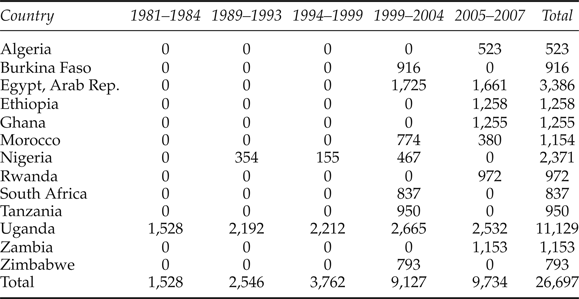
This paper makes use of five waves of the WVS merged over the years 1981–2007, for 13 countries in Sub-Saharan Africa (list of countries in Appendix table A3). This data is chosen because it contains several questions related to social capital, including various measures of trust. Besides, using this data set eases the comparison of our results with those of the existing literature, since this source is widely used for studies on trust.
Although several measures of trust are used in the literature, depending on data availability, two main measures are common: generalized trust and interpersonal trust. Generalized trust allows people to interact beyond the boundaries of face-to-face relationships, while interpersonal trust is more restricted and prevents individuals from cooperating with people they do not know. In this paper, we make use of generalized trust. This measure is derived from the following question: ‘Generally speaking, would you say that most people can be trusted or you can't be too careful when dealing with people?’ This question gives rise to a binary variable, which takes 1 if most people can be trusted and 0 otherwise. Two main reasons justify the choice of this measure. (1) The measure is available for almost all the waves and the countries under study. (2) As stated by Durlauf and Fafchamps (Reference Durlauf and Fafchamps2004), generalized trust leads to more efficiency gains and is strongly correlated with other dimensions of social capital, such as norms, civic engagement and social networks. Specifically, generalized trust leads to civic engagement through cooperation, since people with a high level of generalized trust are more likely to cooperate and exchange with others regardless of their origins, location and social status. Likewise, generalized trust is positively correlated with the establishment of social norms. In fact, in societies where the level of generalized trust is high, individuals act in favor of the respect of norms because they are convinced that their fellow citizens will act in a similar manner. In particular, people find themselves tied in a system of reciprocity which generates more coordination and collective action. Moreover, generalized trust induces more repeated interaction that leads to dense social networks.
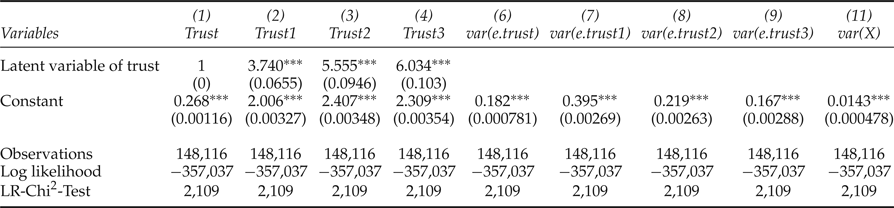
Nevertheless, it is worth mentioning that this measure remains controversial, despite being used in various studies (see Knack and Keefer, Reference Knack and Keefer1997; Dearmon and Grier, Reference Dearmon and Grier2009). The controversy lies in the bias associated with the measure of generalized trust on survey data. For instance, Baliamoune-Lutz (Reference Baliamoune-Lutz2011) reports two experimental studies conducted, respectively, by Glaeser et al. (Reference Glaeser, Laibson, Scheinkman and Soutter2000) and Anderson et al. (Reference Anderson, Mellor and Milyo2004) that led to opposite results. Glaeser et al. (Reference Glaeser, Laibson, Scheinkman and Soutter2000) compare the self-reported measure of trust drawn from the WVS and that of an experimental study. They find that only two survey-based measures predict the experiment-based trust. In contrast to these findings, Anderson et al. (Reference Anderson, Mellor and Milyo2004) assert that the most common attitudinal measure of trust used in the literature, which is based on the affirmative question ‘Do you think most people can be trusted’, is valuable. However, it remains that difference in culture, religion or other sociodemographic characteristics may affect the answers of the respondents to the specific question from which the measure of trust is derived (Owen and Videras, Reference Owen and Videras2007). Therefore, we will expect the estimates to be biased toward zero, since trust is measured with error. We deal with this issue in three different ways. (1) We add to our baseline measure (generalized trust) three more measures, namely, ‘trust people you meet the first time’, ‘trust people of another religion’ and ‘trust people of another nationality’. These measures are introduced in the model alongside the generalized trust measure. This approach has two advantages. First, it helps reveal which type of trust is actually relevant in explaining the WTP for environment goods. Secondly, it uses each measure of trust as a potential confounder of the other measures. Therefore, we expect that the only variables which will remain significant in the regression are actually those which capture the greatest part of the variability of the WTP that is explained by trust. (2) We use all the available information in the data. Specifically, we use all the modalities of the variables in order to see how sensitive the magnitude and the significance of the coefficients are to the change in the modalities. (3) Using confirmatory factor analysis (CFA), we build a composite index of trust which is introduced in regressions as an alternative specification. This index captures the biggest part of the explained variability stemming from the main measures presented above. By construction, this measure should be less biased than each of the previous ones. Table A1 in the Appendix presents the results of the CFA model.
WTP for the protection of the environment is captured by two alternative measures. The first captures the willingness to give a part of one's income to protect the environment. The question from which the measure is derived is the following: ‘Would you give part of your income if used to protect the environment?’ This variable is ordered around four modalities: 1 – strongly disagree; 2 – disagree; 3 – agree; and 4 – strongly agree. The second captures the willingness to accept an increase in taxes if it is used to prevent environmental pollution. This variable has the same modalities and the same order as the previous one. It is worth mentioning that the choice of these variables is mainly guided by data availability. It is well known that there is a hypothetical bias associated with the stated preference valuation (see Murphy et al., Reference Murphy, Allen, Stevens and Weatherhead2005; Loomis, Reference Loomis2011). The hypothetical bias arises when the respondent reports a WTP that exceeds what they actually pay in laboratory field experiments (Loomis, Reference Loomis2011). While there is no general agreement on the causes of the hypothetical bias and the way to reduce it, recent meta-regression analyses have provided important insights (List and Gallet, Reference List and Gallet2001; Murphy et al., Reference Murphy, Allen, Stevens and Weatherhead2005). For instance, Murphy et al. (Reference Murphy, Allen, Stevens and Weatherhead2005) find that the primary cause of the hypothetical bias is the magnitude of the hypothetical value. Also, they find weak evidence that the bias increases when public goods are valued and that some calibration methods may be effective in reducing the bias. Moreover, they noticed that their results are very sensitive to the specification. In order to deal with this issue, we adopt two strategies. First, based on the fact that the hypothetical bias is much higher when the hypothetical value is higher, we report the estimates for every level of the dependent variable. In fact, we suspect that the respondents that report the highest WTP are more likely to overestimate their willingness to give a part of their income. Since the question is general and no specific amount is revealed, the bias is less likely to be higher. Besides, we run an alternative specification with a more focused dependent variable that captures the WTP for the reduction of environmental pollution. Secondly, country dummies are introduced in each specification in order to control for unobserved country specificity, such as culture, which may drive the differences in the WTP answers. Nevertheless, we are aware of the fact that these cautions do not totally prevent us from biased estimates since differences in hypothetical bias across countries may still drive the differences in answers. We will discuss this possibility later in the paper.
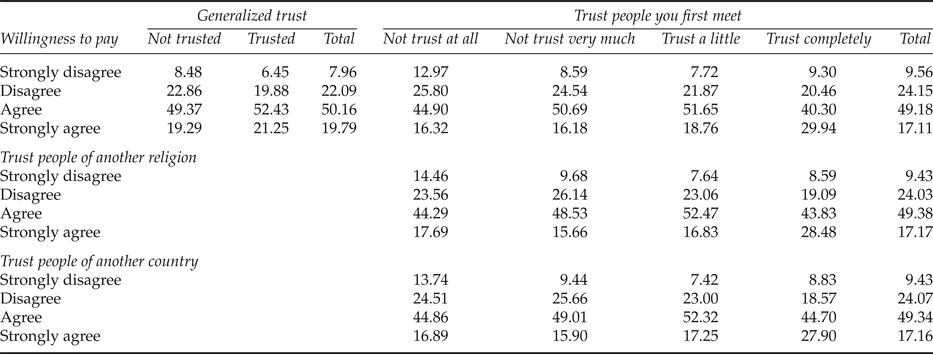
Table 1 presents the descriptive statistics of the variables described above. The table shows that 52.43 per cent of the respondents who asserted that ‘most people can be trusted’ also agree to give a part of their income to protect the environment, while only 21.25 per cent strongly agree. In addition, we can observe that the modality with the highest frequency is the modality ‘agree’.
Cross table between trust and the willingness to pay for environmental goods

3.2. Preliminary evidence and econometric model
In order to explore the link between generalized trust and the WTP for the protection of the environment, we propose a simple consumer choice model, which enables us to derive some theoretical prediction for the empirical specification. We consider an economic agent who is given the choice to either purchase more material goods at the expense of lower environmental quality or less material goods for better environmental quality. Let x be the quantity of the material good and e a measurable quality of the environment. This tradeoff can also be considered as a choice between an ecolabel product and a product which is harmful to the environment. The consumer choice behavior is then given by the following Cobb–Douglas utility function:
 $$U = U(x,e) = \varepsilon x^{a} e^{1-a}$$
where a ε]0 1[ is the utility elasticity of material goods and ε is a residual factor explaining the choice of the individual. We further assume that the material good x is purchased at price P x , while the ecolabel product is purchased at price P e . Moreover, we assume two types of behavior. First, the individual can decide to give up more material goods for better environmental quality without caring about what fellow citizens will do. In this case, the individual does not expect any benefit in terms of better quality of the environment, since this benefit accrues only if all citizens act similarly or cooperate. Secondly, the individual can anticipate that the other citizens will act like him. In this case, he expects a gain g stemming from better environmental quality.Footnote 8 We can think of, for example, better health that could lead to higher productivity and wages. Let p be the probability that the consumer assigns to the event that other citizens will cooperate. The maximization problem is the following:
 $$\matrix{\quad \quad{\rm Max} \hfill & U = U(x, e) = \varepsilon x^{a} e^{1-a}\hfill \cr {\rm subject\ to} \hfill & p (R+g)+(1-p)R= P_{x}{x}+P_{e}{e}}$$
where R is the total available income of the consumer. Solving (2) leads to the following demand for better environmental quality:
 $$e = {1\over{P_{e}}} (1-a)(R+g).$$
Equation (3) delivers four main predictions: (1) the demand for better environmental quality is positively associated with the level of income; (2) the higher the expected gain g, the higher is the demand for better environmental quality; (3) the higher the price of the environmental good, the lower is the demand for better environmental quality; and (4) the demand for better environmental quality is an increasing function of the utility elasticity of the environmental good. This elasticity actually reflects the preference for the environmental good. This preference may vary across individuals, depending on sociodemographic characteristics, such as age, sex, education and religion. Besides, since the expected gain g accrues only if people cooperate and because we assume that the cooperation is positively correlated with trust,Footnote 9 the latter enters into the econometric specification. Therefore, we have the following model:
 $$e_{ijt}^{\ast} =\beta_{0} + \beta_{1} {trust}_{ijt} + \beta_{2} R_{ijt} + X^{\prime}_{ijt\gamma} + u_{j} + \mu_{ijt}$$
where e* ijt is the unobserved WTP for the environmental good of individual i in country j at time t (wave). However, we can observe the modalities of response such that:
 $$e = \left\{\matrix{0 \hfill &{\rm if}\, e^{\ast} \leq t_{1} \hfill \cr 1 \hfill &{\rm if}\, t_{1} \lt e^{\ast} \leq t_{2} \hfill \cr 2 \hfill &{\rm if}\, t_{2} \lt e^{\ast} \leq t_{3} \hfill \cr 3 \hfill &{\rm if}\, t_{3} \lt e^{\ast} \hfill} \right.. $$
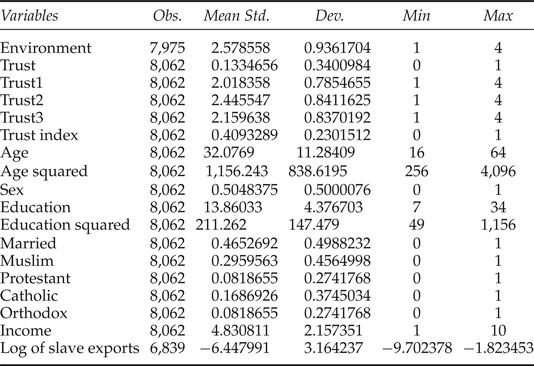
trust ijt is the measure of trust for individual i in country j at time t; R ijt is the level of income of individual i in country j at time t; X ′ ijtγ is the matrix of control variables including age, sex, education, marital status and religion; and u j is the country fixed effect. Equation (4) is estimated using the maximum likelihood technique. We expect a positive effect of trust and income on the WTP for environmental goods. In fact, trust may be associated with higher social cohesion, which in turn eases the implementation of environmental programs. Likewise, the higher the level of income, the more likely people are to support the cost of improving environmental quality. We expect a positive effect of the level of education on the WTP because more educated people are more informed about environmental issues and, therefore, are more likely to contribute. The effects of age, sex and marital status are less predictable. In fact, these effects largely depend on whether individuals have children or not (see Dupont Reference Dupont2004; Franzen and Vogl Reference Franzen and Vogl2013). Table A2 in the Appendix provides descriptive statistics of the main variables used in regression.
4. Results
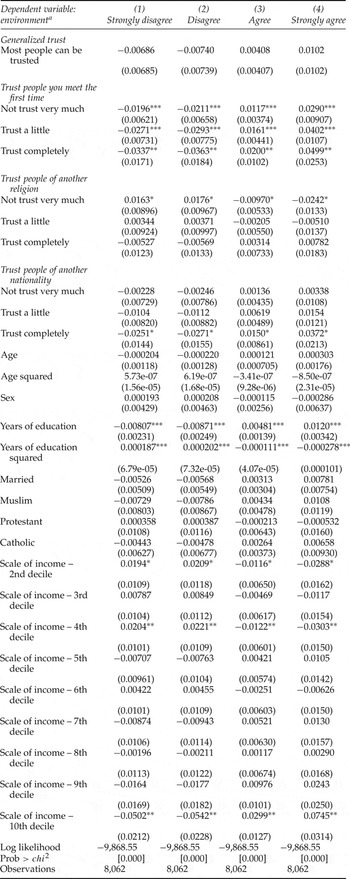
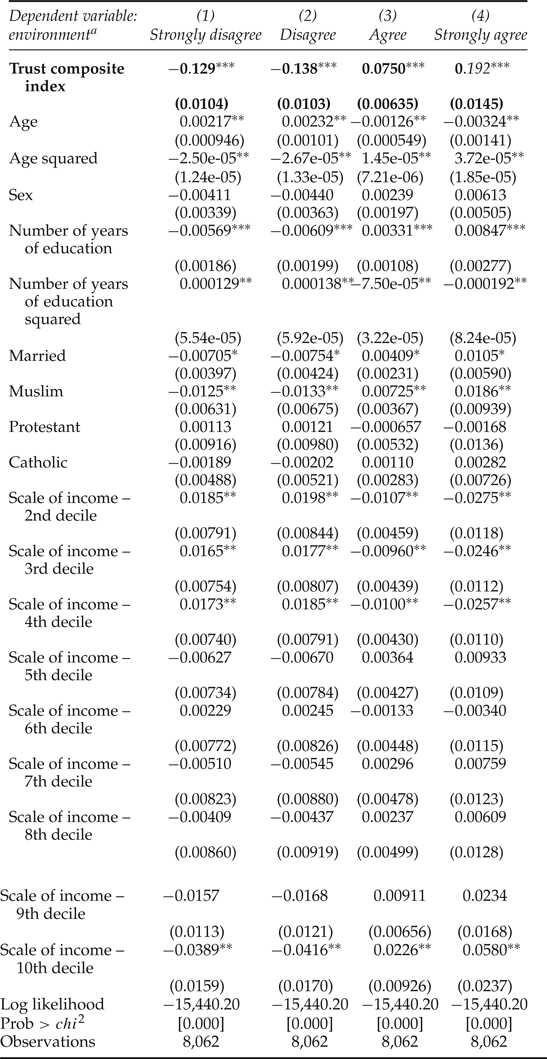
Table 2 shows the ordered Logit estimates of the effect of trust on the WTP for the protection of environmental goods. In this table, we present four specifications corresponding to the different modalities of the dependent variable. Additionally, we introduce in the model four different measures of trust.Footnote 10 The first one is the generalized trust which is our main interest variable. The remaining ones are: (1) trust people you meet for the first time; (2) trust people from another religion; and (3) trust people from another nationality. We are particularly interested in seeing whether those who report that they ‘trust completely’ also strongly agree to give part of their income to protect the environment. According to the results, there is no significant effect of the generalized trust on the WTP for better environmental quality. However, the table shows that the respondents who report that they completely trust people they meet for the first time or people from other nationalities are more likely to ‘strongly agree’ to give part of their income to protect the environment. The magnitude of this correlation is almost the same. The WTP increases by 4–5 per cent compared to the respondents who report a lower level of trust. The finding according to which there is no effect of the generalized trust on the WTP could be explained by the possibility that this measure is not a better approximation of the willingness to cooperate which actually drives the expected effect on environmental quality. Furthermore, it is more likely that all the potential effect of the generalized trust is fully captured by the two measures of trust which are significant in the regression. Based on this intuition, and in order to fully capture the available information on each measure, we build an index of trust using CFA. This new measure is regressed on the measure of the WTP. Table 3 presents the results of this estimation. The positive effect of trust is confirmed with an increased magnitude. In fact, the WTP increases by 19 per cent for any additional unit of trust. This result is in line with the literature highlighting the positive effect of trust on WTP (see Jones et al., Reference Jones, Malesio and Botetzagias2009; Polyzou et al., Reference Polyzou, Jones, Evangelinos and Halvadakis2011). Regarding the other covariates, we find a U-shaped relationship between age and WTP. This result contrasts with the literature, which suggests either no effect (Meyer and Liebe, Reference Meyer and Liebe2010) or a positive effect (Franzen and Vogl, Reference Franzen and Vogl2013). A plausible explanation is that younger people in Africa are struggling daily for a better life and are not therefore willing to pay any additional cost for something they find more relevant to the future. We did not find any gender effect, while the effect of education is positive. This positive effect of education is justified by the fact that more educated people are more informed about environmental issues and are therefore more willing to pay (see Owen and Videras Reference Owen and Videras2006; Franzen and Vogl Reference Franzen and Vogl2013). In addition, the results suggest a positive effect of income for the upper level of the distribution (10th decile) and a strongly negative effect at the bottom of the distribution (2nd, 3rd and 4th deciles). These observations show that, in Africa, environmental issues actually matter for the top of the income distribution. In fact, they have reached a certain level of consumption and do not lack basic needs. The effect of religion is only significant for the Muslims. This could be explained by the possibility that some types of religious beliefs influence pro-environmental behavior (see Owen and Videras Reference Owen and Videras2007). However, the result is puzzling because, as shown by these authors, religious beliefs could be independent of religious affiliation.
Ordered Logit estimates of the effects of trust on the willingness to pay for environmental goods

Notes: Standard errors in parentheses. ***p < 0.01; **p < 0.05; *p < 0.1. Country dummies are added as controls.
a Environment measures the willingness to give a part of income if used to protect the environment. Concerning religion, Orthodox is the reference group.
Ordered Logit estimates of the effects of composite index of trust on the willingness to pay for environmental goods

Notes: Standard errors in parentheses. ***p < 0.01; **p < 0.05; *p < 0.1. Country dummies are added as controls.
a Environment measures the willingness to give a part of income if used to protect the environment. Concerning religion, Orthodox is the reference group.
In order to test the robustness of our findings, we use as an alternative measure of the WTP the willingness to accept an increase in taxes if it is used to prevent environmental pollution. This measure is more precise, since it focuses on a specific environmental concern. Therefore, we expect that the respondents’ answers in this case are less biased.Footnote 11 The previous finding still holds. The effect of trust remains positive and significant, notably when we use the composite index.
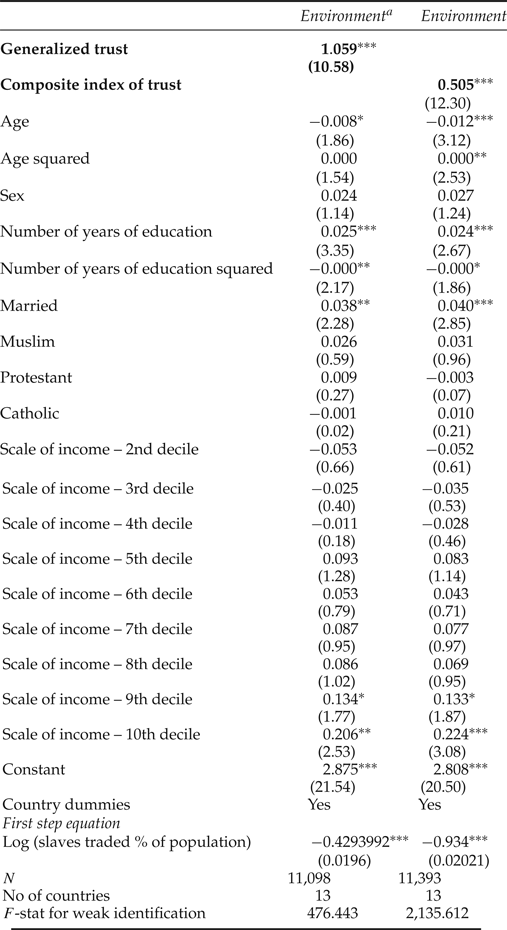
Although the ordered Logit estimates reveal a positive and significant relationship between trust and the WTP for environmental goods, it remains unclear whether this effect is causal. In fact, the WTP could be correlated with some unobservable factors, which in turn may affect trust. For instance, individuals with high WTP are more likely to have a dense social network, which in turn generates trust. In fact, to be informed about environmental issues, people should interact. This repeated interaction generates trust. Besides, some relevant explanatory variables, such as culture, which is very hard to measure, could have been omitted in the regression. Finally, as mentioned in the empirical section, the variable of trust is subject to measurement error. In this case the maximum likelihood estimates are downward biased. To obtain consistent estimates, we resort to an IV approach. Consequently, we use the slave exports from Africa between 1400 and 1900 as an instrument. Slave exports are weighted by the size of the labor force in each country in order to get a time-varying instrument. The rationale behind the choice of this instrument follows Nunn and Wantchekon (Reference Nunn and Wantchekon2011), who have shown that the slave trade is the historical source of mistrust in Africa. The IV estimates are reported in table 4 and confirm the results obtained with the ordered Logit model. The comparison of the Fisher test of the excluded restriction and the Stock and Yogo (Reference Stock, Yogo, Andrews and Stock2005) critical values suggest that the instrument is not weak. Moreover, we can notice that the magnitude of the coefficient increases from 0.19 in the ordered Logit model to 0.50 in the IV model. This confirms the fact that the ordered Logit estimates are downward biased and that the different approaches used so far to address the issue of measurement error are relevant.
Instrumental variable estimates of the effect of trust on the willingness to contribute to environmental goods

Notes: Standard errors in parentheses. ***p < 0.01; **p < 0.05; * p < 0.1.
a Environment measures the willingness to give a part of income if used to protect the environment.
5. Conclusion
Using four waves of the WVS over the period 1981–2007, this paper shows that the level of trust is positively associated with the willingness to contribute for environmental goods. This effect holds after controlling for the sociodemographic characteristics of the respondents and is robust to the use of various techniques aimed at dealing with measurement error and endogeneity bias. Furthermore, the findings are also robust to the use of various measures of trust and the WTP. These findings complement and extend the existing literature, as they provide evidence on the importance of trust in improving the collective management of natural resources in Africa.
Therefore, sound policies should promote community-based environmental management by providing the support that enables groups to form and mature. However, the implementation of these policies raises further questions. In this line, there is a need for more investigation on further mechanisms (other than cooperation) through which trust influences support for environmental quality. Another important issue is how to enhance trust in larger and very heterogeneous groups. Finally, does improvement of institutional quality help improve the efficiency of the management of these groups?
Appendix
Composite index of trust using confirmatory factor analysis

Descriptive statistics

List of countries per wave