1. INTRODUCTION
This article illustrates the process of creating a Finnish language FrameNet, henceforth FinnFN, based on the original English language FrameNet hosted at the International Computer Science Institute in Berkeley, California (Baker, Fillmore & Lowe Reference Baker, Fillmore and Lowe1998, Fontenelle Reference Fontenelle2003), henceforth BFN, and the goals and results relating to the Finnish project and to the creation of the FinnFrame corpus.Footnote 1 The main aim of the project was to test the universal applicability of frame semantics by annotating Finnish using the BFN annotation conventions, which are outlined below. Example sentences were automatically retrieved from Finnish newspaper corpora, and resulted in a total of 40,721 manually annotated sentences evoking one frame per sentence. In Berkeley FrameNet, collections of one frame per sentence are also referred to as Lexicographic Annotation Sets. This annotated collection of sentences became the FinnFrame corpus. Due to the structure of the Finnish language, applying the FrameNet annotation conventions to Finnish required some modifications, as Finnish needed a convention for annotating individual morphemes within words. Questions about cultural salience across the two languages arose during the project, but did not result in any major obstacles and for the vast majority of semantic frames established in the BFN project, it was fairly straightforward to find corresponding Finnish examples.
BFN is a database of annotated material organized around the principles of frame semantics, a theory of meaning developed by Charles J. Fillmore (Fillmore Reference Fillmore1976, Reference Fillmore1982), according to which all meaning is best understood as semantic frames – descriptions of events or entities and the participants in relation to them. These frames are thought to be universal to a certain extent, at least within the western cultural sphere. This hypothesis of universality is what the FinnFN project set out to test.
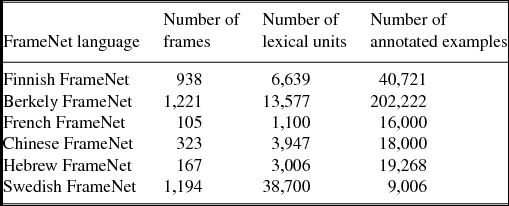
In addition to English and Finnish, FrameNet-related projects and FrameNet-inspired research also exists in German (Burchardt et al. Reference Burchardt, Erk, Frank, Kowalski, Padó and Pinkal2006), Spanish (Subirats & Petruck Reference Subirats and Petruck2003), Swedish (Borin et al. Reference Borin, Dannélls, Forsberg, Gronostaj and Kokkinakis2010), Brazilian Portuguese (Duran & Aluísio Reference Duran and Aluísio2011), Japanese (Ohara et al. Reference Ohara, Fujii, Ohori, Suzuki, Saito and Ishizaki2004), Chinese (You & Liu Reference You and Liu2005), Korean (Hahm et al. Reference Hahm, Kim, Won, Woo, Seo, Kim, Park and Hwang2014), French (Meurs et al. Reference Meurs, Duvert, Béchet, Lefèvre and de Mori2008), Danish (Bick Reference Bick2011), Polish (Zawisławska, Derwojedowa & Linde-Usiekniewicz Reference Zawisławska, Derwojedowa and Linde-Usiekniewicz2008), Italian (Tonelli & Pianta Reference Tonelli and Pianta2008, Lenci, Johnson & Lapesa Reference Lenci, Johnson and Lapesa2010), Slovenian (Lönneker-Rodman Reference Lönneker-Rodman2007a) and Hebrew (Hayoun & Elhadad Reference Hayoun and Elhadad2015). For a list of FrameNets in other languages, see Appendix. For an overview of different practices in creating FrameNet resources in various languages, see Lönneker-Rodman (Reference Lönneker-Rodman2007b). Table 1 presents a comparison of some FrameNet resources based on the FrameNet siteFootnote 2 for BFN, French and Chinese, and on presentations at the Language Resources and Evaluation Conference (LREC) 2016 for SwedishFootnote 3 and Hebrew.Footnote 4 The table shows that FinnFN is the second largest when looking at the number of annotated examples and third largest when looking at the number of frames and lexical units. See also Friberg Heppin & Friberg (Reference Friberg Heppin and Friberg2012) for a more comprehensive overview of FrameNet resources.
Overview of the size of the the Finnish FrameNet compared with the Berkeley, Chinese, French, Hebrew and Swedish FrameNets.

The rest of the article is structured as follows: Section 1 continues with an outline of Fillmore's theory and the BFN project. In Section 2, we discuss the creation of the FinnFN corpus and the annotation process. In Section 3, we consider annotation problems encountered in relation to the nature of the Finnish language and how we propose to solve them. In Section 4, we discuss the applicability of the original English language frames to Finnish data as well as some possibilities for further research and use of the data. In Section 5, we conclude the article.
1.1 Fillmore's frame semantics and FrameNet
The original FrameNet project is based on the theory of frame semantics developed by Charles J. Fillmore (Fillmore Reference Fillmore1976, Reference Fillmore1982). The basis of frame semantics within cognitive science is in the concept of cognitive frames by which language users interpret their experiences. Frame semantics is the study of how language users associate linguistic forms with these cognitive structures, i.e. frames (Fillmore & Baker Reference Fillmore, Baker, Heine and Narrog2010:313–314).
Using frames is a cognitive process to interpret information. At the core of the theory of frame semantics is the analysis of these processes (Fillmore & Baker Reference Fillmore, Baker, Heine and Narrog2010:316). All content words, such as verbs, adjectives and nouns, evoke a frame within which their meaning is interpreted (Fillmore & Baker Reference Fillmore, Baker, Heine and Narrog2010:318). The FrameNet project compiles lexical units into background frames, which can be described in terms of the common schematic properties of the lexical units evoking the frame. Lexical units are considered to evoke the same frame when their use triggers the same cognitive schema, i.e. they express similar real world situations and phenomena. The requirement for evoking the same frame is the ability to use the lexical units as semantic paraphrases or near-paraphrases of each other. However, the lexical units do not have be in the same lexical category. It is their common cognitive frame that is key.
1.2 Theory and annotation conventions of BFN
The BFN project is aiming to create an online lexical resource for English (Ruppenhofer et al Reference Ruppenhofer, Ellsworth, Petruck, Johnson and Scheffczyk2010:5). FrameNet focuses on analyzing and constructing semantic frames, for example situations, events, processes, states, physical and visual characteristics and a myriad of other phenomena. In theory, there can be a limitless number of different frames, and thus FrameNet will never be complete.
In FrameNet, the element that evokes a frame is called frame evoking element (FEE) also known as a lexical unit. In the food cooking frame, the verb denoting the act of preparing food will trigger the Cooking_creation frame. The semantic arguments and complements included in the event or phenomenon are called frame elements (FE). The frame elements are labelled according to their semantic role or content. In the Cooking_creation frame, the frame elements include the cook and the food that is being prepared. In the example sentence John fries eggs, the actor, John, is the Cook, fries the FEE that evokes the frame, and eggs the end product, Produced_food.
Frame elements are also divided into defining core elements and peripheral elements according to their relevance to the phenomenon described in the frame. In the cooking frame, for example, while the Cook is essential, an element indicating the time of the event is general and not a defining element of the frame. Core elements vary greatly from frame to frame, whereas peripheral elements, for example, Time and Place are more ubiquitous and therefore recurrent.
Frames vary greatly in their level of generality and abstractness, as well as in the number of frame elements they incorporate. Sometimes one frame has all the properties of another frame and elaborates on it in some way (Fillmore, Johnson & Petruck Reference Fillmore, Johnson and Petruck2003:239). A more fine-grained subframe inherits from a semantically more general frame. The relations between all the frames in FrameNet form a frame hierarchy. The same sentence can often be annotated as an example of a more general frame as well as an example of a more specific frame lower in the hierarchy. For example, the frames Fleeing and Travel inherit from the more general frame of Self_motion, which in turn evokes the semantic sphere of Motion. The word class of the FEE can also be a defining feature. In BFN, the word class sometimes functions as the distinguishing criterion between frames, as in the case of the frames Sounds and Make_noise covering nouns and verbs, respectively. Similar to the frames themselves, specific formal criteria may also apply to frame elements. The element Role in the frame Judgment_communication is syntactically defined as follows:
-
Role is used for the capacity in which the Evaluee is judged, and is expressed in as-PPs.Footnote 5
2. THE FINNISH LANGUAGE FRAMENET
FinnFN is entirely based on the frames outlined in BFN. In December 2015, there were 1,215 frames in BFN. New frames are created and divided into more detailed subcategories, and there will always be new points of views to consider. The primary objective of the FinnFN project was to test the hypothesis of language-independent frames and investigate how well the frames of BFN apply to Finnish. It was assumed that the frame elements defined by BFN would be applicable to Finnish as such.
To a certain extent, the frames are thought to be independent of specific languages within the western cultural sphere, and no frames tied specifically to Finnish cultural phenomena have been created in the FinnFN project. This approach is unlike the ones used in other projects, such as the Swedish, German and French FrameNet projects, where new frames were created and the existing English-based frames were in some cases merged or divided to adapt the set of frames to the languages in question. For example, in the Japanese FrameNet, new frames were constructed when the annotators found a frame that was necessary for either the Japanese or both the Japanese and English lexicons (Ohara Reference Ohara2012:1559–1560). The French FrameNet constructed new frames and remodeled existing ones (Candito et al. Reference Candito, Amsili, Barque, Benamara, de Chalendar, Djemaa, Haas, Huyghe, Mathieu, Muller, Sagot and Vieu2014). The Saarbrücken Lexical Semantics Acquisition (SALSA) project constructed so-called proto-frames for senses of German words or multi-word expressions that could not be matched with the frames existing in version 1.3 of BFN. For instance, the German verb gelten has a sense ‘be directed at’, predicated of actions. This sense is somewhat similar to the Aiming frame but crucially the verb does not allow the expression of the (core) FE Agent, precluding a straightforward inclusion of the verb in that frame. There currently is still no BFN frame available that this German lexical unit (LU) can be assigned to. However, this does not imply that there is no common shared frame for this phenomenon in English and German. It simply means that SALSA has not been actively maintained, so its final release may not reflect the progress in BFN.
In order to test the universality hypothesis of frames, the Finnish project adopted a frame-by-frame approach (detailed in Section 2.2 below) which followed the annotation system of the original English frames as closely as possible to test the cross-lingual applicability of BFN. The idea was also to gain time by not duplicating the many decades of lexicographical work invested in the original FrameNet effort getting a head start for the Finnish FrameNet while at the same time mastering the details of the original FrameNet to make informed extensions at a later stage.
2.1 Searching for Finnish language example sentences
For the FinnFN project, around 80,000 English sentences representing 866 frames were chosen from the FrameNet version 1.5 corpusFootnote 6 (https://framenet.icsi.berkeley.edu/), after which the annotated parts of the sentences were translated into Finnish by professional translators. The Finnish translations with their English original sentences constitute a separate corpus (the English–Finnish TransFrame corpus) which is further analyzed in a separate article (Lindén et al. to appear). The main finding of that article is that 92% of the frames were transferred with their meaning intact when the frame elements were translated from English to Finnish. However, in the current article, we focus on the frame universality hypothesis using attested natural language as our starting point. We also focus on the modifications needed in the FrameNet annotation conventions in order to annotate authentic Finnish example sentences.
After translating the English FEEs and the FEs into Finnish, the Finnish translations were used in an automated search for similar sentences in the National Library Newspaper corpus,Footnote 7 a corpus of Finnish newspapers and magazines compiled by the National Library of Finland comprising five billion words of running text.Footnote 8 The text was preprocessed with the Turku Dependency Parser.Footnote 9 The corpus search was carried out in order to find attested natural language examples of frame evoking sentences to ensure that the translated frames were not mere ‘translationese’. The goal was to find out whether there exist example sentences in Finnish for all the frames in BFN included in the parsed FrameNet 1.5. corpus. Because we sampled from authentic Finnish language, we could examine whether the frame elements defined by BFN also occurred in authentic Finnish sentences. In addition, it was possible to see if and how the syntax and semantics of the annotated Finnish sentences differed from English, for example, whether the annotated Finnish example sentences contained semantic roles that could not be covered by the frame elements of the original BFN frame.
In our attempt to find authentic Finnish example sentences, different search strategies were tried using Corpus Workbench queries in Korp (Borin, Forsberg & Roxendal Reference Borin, Forsberg and Roxendal2012) in order to find which automatic searches gave the best results. The best search strategy (in which 36.7% of the search results were accepted for manual frame annotation) was to use the word form, lemma and the syntactic dependence label of the FEE. The second best search strategy (in which less than 30% of the search results were accepted for manual frame annotation) was to determine the word form, lemma and the syntactic dependence label of the FEE as well as the dependence label of the FEs immediately to the right or left of the FEE. The worst search strategy (only 0.1% good examples) was to narrow down the search too much by using the word form, lemma and dependence labels of both the FEs and the FEE. Only for 14 frames did we have to manually retrieve example sentences as the automatic search strategies did not provide any suitable results. These problematic frames are further discussed in Section 4.
The low success rate of some of the search strategies mainly indicates that although five billion words is a big corpus, it is not big enough for fully automating the procedure to find authentic examples. The results of the automatic search strategies were therefore further pruned manually. All the search results were read and the best examples were selected for annotation. An example was considered good if it evoked the same frame as the original English example and preferably included the same frame elements. The main focus was on the FEE and other core elements. The discarded sentences are relevant examples of ambiguous lexemes as FEEs, which are disambiguated into specific frames by the core FEs in the context. Some of the discarded examples sentences were collected for future use as they are relevant negative examples when training a machine to automatically identify examples of frames in running text.
2.2 Annotating the FinnFN corpus
Each example sentence deemed to represent its intended frame was manually annotated with the corresponding FEE and FEs. The annotation method that was used in the FinnFN project can be described as a frame - by - frame approach as opposed to the full-text annotation or the lemma - by - lemma approach used for instance in the German SALSA project (Burchardt et al. Reference Burchardt, Erk, Frank, Kowalski, Padó and Pinkal2006) and Japanese FrameNet project (Ohara et al. Reference Ohara, Fujii, Ohori, Suzuki, Saito and Ishizaki2004, Ohara Reference Ohara2012). The frame-by-frame approach assumes that the sentences to be annotated contain a lexical unit evoking the intended frame, in contrast to the lemma-by-lemma approach, which takes a sentence and determines which frames its lemmas might evoke. If an FEE in a sentence context clearly evoked an unintended frame, the sentence was left unannotated. For more ambiguous cases, the adopted approach probably resulted in more varying FEEs for certain frames than the lemma-by-lemma approach would have yielded, as a large sample of sentences from different topics were evaluated. As stated above, we created no new frames at this point, instead the frame-by-frame approach made it easier to account for the diversity of FEEs that may evoke a frame. Because the FinnFN project used the frames and annotation conventions originally created for English, some special characteristics of the Finnish language became readily observable when applying the BFN annotation conventions to Finnish.
After an initial round of manual annotation, which was done by four linguists working in parallel on the automatically retrieved sentences representing all frames, a second round of annotation was carried out, in which one linguist checked all the sentences representing each frame. During this second round, with the experience of having annotated the full corpus, examples could be reassigned to more suitable frames, which resulted in example sentences representing 938 frames. Typically the examples would be assigned to more specific frames during the second round, as new frames had been added to BFN during the course of the FinnFN project.
The FinnFN corpus currently (June 2017) consists of 40,721 annotated example sentences (with approximately one million lexemes) that represent 938 frames. The FinnFrame corpus is thus one of the biggest FrameNet projects so far (together with the BFN and the Swedish and the German FrameNet projects) and can therefore readily be utilised in corpus-linguistics for frame semantic research. The applicability of the English frames and frame elements in Finnish will be further discussed in Section 4. In most cases, both the frames and the frame elements based on English apply to Finnish without modifications. Each FE and its use in the FinnFN corpus has been described in detail on the FinnFN wiki page.Footnote 10
As in BFN, in addition to semantic criteria, morphosyntactic criteria may also apply to frame elements in the FinnFN annotation. For example, in Finnish, the frame element Topic is often expressed with the elative suffix (-stA), and Message is typically a subordinate clause beginning with the conjunction että ‘that’. This is exemplified in examples (1) and (2).
-
(1)

-
(2)


The examples above demonstrate the notational conventions we have assumed in this paper: FEEs in example sentences are written in capital letters and the intended frame is stated after the example sentence in parentheses in a monospaced font. Other frame elements, when relevant, are enclosed in square brackets, annotated with the element's label in small capitals. If no language is specified, the examples are in Finnish or English.
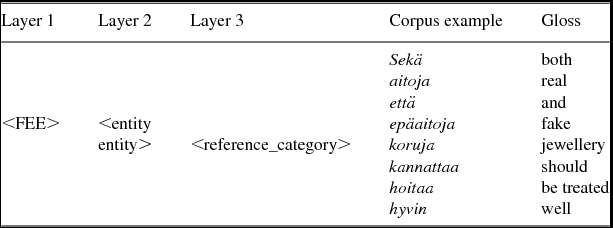
Table 2 provides an example of the annotation layout used in the FinnFN project. The table shows an example sentence annotated with the frame Artificiality, in which an entity is evaluated for whether it evokes a particular reference category. In our annotation work, we used a three-layered annotation layout with tags on separate layers in order to express all relevant frame elements for a word. The separate layers are numbered for clarity so that the FEE, is on Layer 1, other FEs on Layer 2 and, when frame elements overlap, additional FEs are on Layer 3. The FEE in this example is epäaitoja ‘fake’. The whole noun phrase epäaitoja koruja ‘fake jewellery’ is annotated as Entity since the adjective epäaito ‘fake’ is a dependent of the head (koruja ‘jewellery’) of the NP. On the third layer, koruja ‘jewellery’ is marked with the tag Reference_category as it also indicates the type relative to which the entity is evaluated. Not shown in Table 2 is the fact that the FinnFN corpus also provides morphosyntactic and dependency annotations on additional layers to make the corpus useful for researching the interface between syntax and semantics.
A corpus example Sekä aitoja että epäaitoja koruja kannattaa hoitaa hyvin ‘Both real and fake jewellery should be treated well’ with annotations for the frame Artificiality using epäaitoja ‘fake.a’ as FEE on Layer 1, the entity epäaitoja koruja ‘ARTIFICIAL jewellery’ on Layer 2 and koruja ‘jewellery’ as the reference category on Layer 3.

Annotation of so-called null instantiations is a feature of BFN that was not used in the FinnFN project. Null instantiation is a category for annotating absent semantic constituents or frame elements (Fillmore et al. Reference Fillmore, Johnson and Petruck2003:245). The term null refers to the fact that a core frame element is absent. Conceptually salient FEs are not always realized as lexical or phrasal material in a sentence, but they have nevertheless been annotated in BFN since they provide relevant insight into the omissibility of semantic material (Ruppenhofer et al. Reference Ruppenhofer, Ellsworth, Petruck, Johnson and Scheffczyk2010:24–26).
3. COMPOUNDS AND MORPHOLOGY IN FinnFN
In addition to examining the universal nature of the frames, one of the central aims of the FinnFN project has been to develop an annotation system that acknowledges the characteristics of the Finnish language, such as compounding and a more complex morphology. Since the parts of a compound may instantiate different frame elements, it was necessary to address the fact that in general all Finnish compounds are written as a single word, without spacing between free morphemes. In addition, in Finnish some frame elements often show up only as bound morphemes, a typical example being Agent, only appearing as a verbal suffix. These prominent characteristics of compounding and rich morphology needed to be taken into account when developing the annotation convention for Finnish.
3.1 Compounds in FinnFN
In English, the few compounds that are written as single words are handled in BFN as indivisible units. In example (3), the modifying part bath of bathrobe is not annotated with the semantic role Use, even though it denotes the use of the garment. We use a typographical convention for annotating an FEE with capital letters, as in BNF, but we also annotate a frame element, e.g. Garment, with a subscript in small caps, which is useful when the two overlap as in example (3).
-
(3)

Compounds consisting of a head noun and a relational modifying part that are not written as a single indivisible word have been annotated separately in BFN, e.g. as in example (4).
-
(4)

In Finnish, the matter is somewhat more complicated. In Finnish, compounds are practically always written as single indivisible words, and in theory an unlimited number of new compounds can be formed. In FinnFN, we sometimes need to label the parts of a compound with different semantic roles as the part of a compound that modifies the head most often carries a separate semantic meaning. In the FinnFN annotation, we therefore separated the modifying part from the head of the compound and annotated it as illustrated in examples (5) and (6) by the equivalent compounds riding helmet and ratsastuskypärä. Note the word spacing in English and the lack of spacing in Finnish, which is also reflected in the annotation.
-
(5)
-
(6)


The FinnFN database is not fully uniform in the annotation of compounds and exhibits some variation in what parts are deemed semantically important enough to be labelled separately. Parts are annotated separately in cases where one part of the compound is the FEE and the other is not, similar to the English head noun with a relational modifier as in examples (7) and (8).
-
(7)
-
(8)


Some lexicalized compounds have been annotated as a whole in Finnish: aluspaita lit.: ‘undershirt’, ‘camisole’; or rintaliivit, lit.: ‘breast vests’, ‘bra’ as in examples (9) and (10).
-
(9)
-
(10)


The part of the compound that evokes the frame is annotated as the FEE, and the other relevant parts of the compound are annotated according to their semantic roles. In example (11), only the head is annotated as the FEE.
-
(11)

The general idea has been to annotate all the relevant and clearly transparent frame elements of the compound. If the compound is opaque, it has been treated as a single unit. However, drawing the line between the two is not always straightforward. Ruppenhofer et al. (Reference Ruppenhofer, Ellsworth, Petruck, Johnson and Scheffczyk2010:41) admit that distinguishing between conventionalized and non-conventionalized compounds is not always clear in English either. Often it was left for the BFN annotator to decide and evaluate.
Finnish compounding resembles German and Swedish compounding more than that of English, so the comparison with German and Swedish FrameNet-related projects regarding how they have dealt with compound annotation is useful. In the German SALSA project, the compounds have been divided into two units and can thus be annotated separately.Footnote 11 In the frame Hostile_encounter the German word Machtkämpfe (lit.: ‘power struggles’, ‘struggles for power’) consists of the FEE Kämpfe and the part denoting the Topic of the encounter, Macht. The compound is structurally very similar in Finnish; the compound valtataistelut consists of lexemes with a similar meaning as in German (valta ‘power’, taistelut ‘struggles, battles’).
The Swedish FrameNet project has developed different strategies for annotating compounds.Footnote 12 As in Finnish, non-compositional, fully lexicalized compounds are not given any internal analysis in the lexical source database, which treats solid compounds, i.e. single orthographic words, just as it treats single-word items, and does not normally define their formal structure explicitly (Friberg Heppin & Petruck Reference Friberg Heppin and Petruck2014:68). However, in the Swedish FrameNet project compositional compounds are annotated as far as they are compatible with the frame they evoke. The compound parts are annotated separately especially in the cases where one of the parts is the FEE. Usually the whole compound and the compound head are FEEs evoking the same frame. In these cases, the whole Swedish compound is tagged as an FEE, while the modifier is tagged as the appropriate FE, as in example (12).
-
(12)

Like in the Swedish project, FinnFN treats the whole compound as an FEE when it has transparent compositional parts evoking the same frame.
A common compound type expresses an item and the material it is made of. In example (13) in Swedish illustrating the Accoutrements frame, guldring ‘gold ring’ has been separated into FEE (ring) and FE denoting Material (guld).
-
(13)

In Finnish, the compound villasukat ‘wool socks’ is also split into head and modifier, each part being annotated separately as in example (14) and only the head acts as the FEE.
-
(14)

We note that the Finnish compound annotation is crafted to be similar to that of German and Swedish extending some of the annotation conventions that were available in the BFN.
3.2 Finnish morphology
Agglutination, a central feature in Finnish, presented a challenge to be solved in FinnFN. To deal with morphemes attached to Finnish word stems, most typically possessive and verbal suffixes and comparatives, an annotation convention resembling that of compounding was further developed in which words were split into morphemes if needed. Morphemes have been annotated separately to apply a BFN frame when a core element of the frame would otherwise have been left out and the meaning of an FE was carried by a morpheme, e.g. in the case of the Possessor being marked only by a possessive suffix, see example (15). This convention allowed all the core elements of the frames to be accounted for when annotating Finnish.
Hebrew is another FrameNet language with rich morphology, but the Hebrew FrameNet has not annotated possessives and other bound morphemes as FEs. Instead, the elements have been marked as externally instantiated, i.e. no single word or phrase is marked as representing the frame (Hayoun & Elhadad Reference Hayoun and Elhadad2015) following the annotation conventions of the Spanish project, which did not mark semantic roles such as subject markers expressed by bound morphemes. The Finnish project, by contrast, decided to annotate some of the key morphological units because of the agglutinating nature of the language, i.e. the morphology was seen as too important to be omitted: sometimes the FEE, the most essential element evoking a frame, is expressed only by a suffix, which will be discussed later in this section. In Finnish, a suffix may, for example, correspond to an English preposition as the FEE. We also claim that in order to develop FrameNet into a truly universal semantic annotation system, semantic role labeling for agglutinative and polysynthetic languages should be further developed. The assumption that semantic content can only be carried by independent FEEs is rather limiting from a universal point of view, since semantic content can also be carried by bound morphemes as demonstrated by Finnish. If the FrameNet annotations had originally been developed for West Greenlandic, for instance, it would have been essential to account for bound morphemes typical for polysynthetic languages. This is a central point that we wish to emphasize and develop further in the future.
However, in our current project our annotation deals primarily with independent words and phrases: the annotation has been marked on an independent word if one is present, but on a bound morpheme if not. This is illustrated in examples (15) and (16) with regard to both a possessive suffix and a subject marker.
-
(15)
-
(16)


In at least some of the other languages for which a FrameNet currently exists, the agent is visible in the verb form. It seems, however, that in most of these languages it is not possible to leave the overt subject out, and a situation similar to example (16) above will never arise. One of the exceptions is Japanese, where the person is generally unmarked altogether, whereas in Spanish, Italian and Brazilian Portuguese there is often a person marker on the verb. The Japanese FrameNet has dealt with this by marking the agent as a null instantiation similar to the marking of an absent agent in passive sentences in English. In Finnish, where the subject is always visible (often only) on the verb form, it was deemed relevant to mark the FE on the particular morpheme.
Possessives and comparatives are among the relevant phenomena for some of the frames although they are not core elements. Of these, possessives as affixes can be found only in Finnish and Hebrew of the current FrameNet languages. Comparative and superlative endings, however, are used for indicating degree in other languages as well. In BFN, one can of course claim that the element Degree marks only the intensity of the comparison and not the comparison as such, so there is no need to mark the comparative ending -er alone. In example (17), the expression of Degree of comparison is only visible in the ending and has been left unmarked in BFN.
-
(17)

The element Degree of comparison is a peripheral element in almost every frame of BFN, so omitting its annotation does not leave out core information of the frame. In some individual cases, BFN has marked Degree on an entire word denoting comparison, as in example (18), in which the word older (earlier in the same sentence) contrasts with the word newer.
-
(18)

Note that the word ‘more’ is often annotated in BFN with Degree as in example (19) annotated with the Obscurity frame. In Finnish, it is mandatory to use comparative morphemes for expressing the phenomenon represented by the English word ‘more’, so if the Finnish comparative morphemes were left unannotated, this information would have to be omitted in the Finnish annotation. Comparative morphemes have therefore often been annotated in FinnFN.
-
(19)

Having introduced the annotation of a bound comparative morpheme for Degree, we can use this for annotating the comparative ending (-mpi) in ärsyttävämpi ‘more annoying’ along with tavallista ‘than usual’ as Degree in example (20), while the rest of the word (ärsyttävä-) is the FEE.
-
(20)

Not all Finnish endings, such as enclitic particles like the interrogative particle -kO, carry meanings that are relevant for a frame. Polarity or tense do not affect the frames, and for instance the negation verb did not have any particular role or meaning evoking a frame in FrameNet v1.5. Consequently, particles like -pAs/-hAn (various meanings; contradiction or mirative, among others) and -kin ‘too, also’ have not been annotated in any frame in FinnFN.
The original BFN database dealt only with lexical units (Fillmore & Baker Reference Fillmore, Baker, Heine and Narrog2010:338). However, there are also grammatical structures which evoke semantic, pragmatic or interactional frames on their own (Fillmore & Baker Reference Fillmore, Baker, Heine and Narrog2010:338), so the current BFN deals with much more than FEEs. The present study shows that in Finnish even the FEE itself can be a bound morpheme or a morphosyntactic structure, even though there are only a few examples of this kind in the current corpus. In the initial translations of annotated English examples, each English FE was matched by a Finnish one, so the meanings conveyed solely through a specific grammatical structure or bound morpheme are underrepresented. The following examples (21)–(23) demonstrate three instances in which FEEs might be annotated in grammatical structures or bound morphemes.
-
(21)
-
(22)
-
(23)


The annotation system created for annotating parts of compound words makes it possible to mark bound morphemes as FEEs in a similar way. We annotated text examples with the frame Partitive, as in example (23b) above. In this frame, the sought meaning in Finnish can only be conveyed through the elative suffix (-stA).
Altogether, the instances where the FinnFN corpus currently deviates from the BFN annotation are in the marking of FEs on personal, possessive and comparative markers, and the marking of the FEE on the case suffix in the sole case of the Partitive frame. In future development, it might be justified to expand the range of data to include more varied annotations for different types of morphologically encoded linguistic phenomena to the extent that they encode language-independent meanings.
4. DISCUSSION AND FUTURE WORK
Fillmore & Baker (Reference Fillmore, Baker, Heine and Narrog2010:337) mention that it is reasonable to assume that most of the frames are directly comparable between languages. Some frames, for instance the frames describing cooking and commercial transactions, are generally very similar events across cultures, even though differences in details do of course exist. Some frames, on the other hand, are more culture-specific. The main assumption behind frame semantics is that in order to understand a frame one must always have some amount of background information that helps in interpreting the frame (Fillmore & Baker Reference Fillmore, Baker, Heine and Narrog2010:318). For instance, to understand the weekdays and descriptions about the flow of time, one must have information about how time is seen and counted in Western cultures. Often this kind of culturally specific information is so thoroughly acquired and subconscious that processing it requires a dedicated and conscious cognitive effort. Many of the original frames are notably tied to Western, especially American, culture and its cultural characteristics.
One of our main goals for this research was to test the universality hypothesis of the frames and see how well the original BFN frames and frame elements apply to the Finnish language. In general, the original frame elements defined by BFN turned out to be suitable for annotating Finnish. However, in a few cases the original frame elements were found to be insufficient for describing certain expressions. For example, a phrase such as ampua laukaus (lit.: ‘shoot a shot’) would be a typical example of the frame Use_firearm or Shoot_projectiles (depending on the context), yet the word laukaus ‘a shot’ (as an event) could not be annotated with any of the pre-defined frame elements since the meaning of the word does not fit into the description of the FE Projectile: ‘The entity whose rapid, dangerous motion is caused by the Agent and/or Firearm’. However, it would be possible to annotate the noun laukaus as the FEE. Another more elaborate option, as pointed out by a reviewer, would be to prevent the EVENT element in the abstract frame Intentionally_affect from having the status Core_Unexpressed. The frame Use_firearm inherits from the frame Intentionally_affect through the Using frame. If the EVENT element was simply Core in Intentionally_affect, it would be inherited by Using and then by Use_firearm. In the FinnFN project, elements from other frames were sometimes used if they were deemed suitable and necessary for the annotation of the frame in Finnish. This is natural as the BFN only lists the FEs that have occurred during the annotation of examples with its current frames. In our data, there were only a few words or phrases that could not be annotated as any of the already defined frame elements.
Other environments, where a suitable way to annotate the data was not immediately obvious, were the various so-called colorative constructions (Jarva & Kytölä Reference Jarva and Kytölä2007, Hamunen Reference Hamunen, Herlin and Kotilainen2012), which are rather typical for Finnish. It is a verb structure consisting of a main verb describing the actual act and a companion verb which describes the manner in which the act is performed. The verb describing the manner or ‘style’ of the act is the one inflected for person and tense. The examples were retrieved from the newspaper corpus using a common verb in infinitive form (nauraa ‘to laugh’, juosta ‘to run’), and annotated as FEE with Manner as in (24).
-
(24)

This was done even though BFN normally has verbs in FEs only as part of longer expressions. In Finnish the second verb can be seen as a description of the manner in which the main act is performed. Another possible solution would have been to annotate the description verb as an FEE and leave the main infinitive verb without a tag.
While the frame elements of BFN proved to be rather suitable for annotating Finnish, some of the frames were slightly problematic. We encountered three types of obstacles for finding examples for the English frames in Finnish: (i) lack of suitable search results (caused by the limitations of the automated search method), (ii) linguistic incompatibility, and (iii) cultural specificity of the original frame. The first of the problems was rather easily solved by expanding the automatic search method to allow a round of manual search. There were 14 frames, for which we failed to get useful samples with an automated search method. However, for most of these frames it was easy to find Finnish examples by manually adjusting the searches, and eventually we found examples for all of them. There were two main reasons why we failed to find examples for the 14 frames automatically. First of all, some of the frames describe an event or phenomenon so rare or specific that our corpus simply did not have an example of it. For example the frame Bond_maturation uses special vocabulary that could not be found in our primary corpus, but searching the internet eventually yielded an example. Another reason for failing searches is polysemy: for instance, the FEE in the frame Exchange_currency is vaihtaa ‘to exchange’ in this case, but also ‘replace’ or simply ‘change (transitive)’, as in vaihtaa vaatteet ‘to change clothes’. The different meanings of vaihtaa occur with different frequency, and in our corpus vaihtaa in the meaning ‘exchange currency’ was rather infrequent. It is therefore not surprising that we ended up having automated search results primarily evoking the most frequent frames. Another example of polysemy is the elative suffix in the Partitive frame shown in example (23b). The elative suffix is used for many other purposes as well, so manual extraction was needed in order to include Finnish examples for the Partitive frame.
The second problem were frames that did not fit into Finnish as well as they do into English due to linguistic incompatibility, i.e. the expressions are so language-specific or idiomatic that translating them into another language is difficult without losing the original frame in the process, as shown in examples (25a) and (26a) with periphrastic translations (25b) and (26b).
-
(25)
-
(26)


The English examples (25a) and (26a) represent idiomatic expressions that are hard to translate into Finnish with the original frame intact, i.e. the Finnish translation evokes a different frame or, as in example (26b), currently lacks an appropriate frame altogether. Other FrameNet projects, such as the Slovenian one (Lönneker-Rodman Reference Lönneker-Rodman2007a:163), has reported similar cases in which the English frame is not suitable for the structure of the target language.
The third problem was cultural incompatibility of some frames. Going over the data, we only had difficulty finding Finnish correspondences for a few of the frames that had been found useful within the English-speaking cultural sphere. As BFN has developed through locally funded projects, connections between frames and the priorities set by the embedding culture are to be expected. Interestingly, cultural emphasis stands out within certain themes. Examples of this include the various frames describing law and legal proceedings in BFN as in example (27a) with the periphrastic translation (27b).
-
(27)

The English FEE in the sentence is bail, which translates quite awkwardly into Finnish, since there is no one word for this procedure as no corresponding procedure exists within the Finnish judicial system.
In the Japanese FrameNet project, the researchers also concluded that often the problems in annotating new text are not related to culturally specific aspects (Ohara Reference Ohara2012:1562). According to Ohara, usually when a suitable frame did not exist, a new frame was also needed in English. In other words, the problems may actually be related to the approach to semantics in general trying to list all phenomena and their combinations instead of isolating cross-cultural primitives from which the phenomena are generated. The same can be said about the Finnish project, as all the BFN frames had some equivalent in Finnish. Problems related to cultural differences are further described in articles by Bertoldi & Chishman (Reference Bertoldi and de Oliveira Chishman2011, Reference Bertoldi, de Oliveira Chishman, Palmirani, Pagallo, Casanovas and Sartor2012). A comparison is also found in Friberg Heppin & Friberg (Reference Friberg Heppin and Friberg2012) and Friberg Heppin & Toporowska Gronostaj (Reference Friberg Heppin and Gronostaj2014).
FrameNet has recently sparked an interest in the field of natural language processing (Petruck Reference Petruck, Fried and Nikiforidou2013:2), where it has inspired research in semantic parsing and deep semantic analysis. With growing evidence that frame semantics is largely language-independent, FrameNet provides a useful annotation convention for data mining and automatic question answering within and across languages. FrameNet annotations not only provide a framework for information extraction, but also for natural language generation, where data samples offer expressions and utterances that can be reused when generating a message with a specific frame, which has been tested by Dannélls (Reference Dannélls2010), for example.
5. CONCLUSION
The starting point and the main objective of the FinnFN project was to test the hypothesis of frame universality and to find out if the frames used in BFN would also be evoked in attested Finnish example sentences. As a result, we can conclude that the majority of frames were directly applicable across English and Finnish. Cultural differences, for example, did not pose a major problem. As a by-product of this research project, we have created the first version of FinnFN, documenting attested Finnish example sentences annotated in the same way as English examples in the original BFN project, with some extensions to the annotation convention for bound morphemes.
The main challenges resulted from the original example data and the approach used for finding Finnish examples for the BFN frames. However, the retrieved and annotated sentences served to corroborate the hypothesis that Finnish speakers evoke the same frames when using Finnish.
In the future, it is worthwhile to further develop the annotation conventions to make them even more suitable for central features of the Finnish language, including the agglutinative morphology. Since the main focus of frame semantics is semantic content, the issues that follow from the structural differences of languages can to some extent be considered secondary. The semantic content is clearly very transferable even between non-related languages, as can be seen from other FrameNet projects as well.
It would also be interesting to know whether any Finnish-specific frames were actually left out as a result of the method of data collection applied in the present study. However, some omissions are an inevitable consequence of using a limited set of frames regardless of whether they were created for Finnish or English. As noted before, the frame list of BFN is in no way comprehensive. Correspondingly, any FrameNet project inevitably ends up with similar limitations as the original BFN project for the simple reason that no lexically-oriented language description of finite length can ever be complete. A more systematic annotation of unrestricted Finnish text would shine a light on this aspect of the project. The incompleteness of BFN is not a problem that would pose difficulties for the development of FinnFN, but it does yield information on the types of frames that should be added in future development as has also been noted by, for example, Palmer & Sporleder (Reference Palmer and Sporleder2010). This direction is also pursued through full-text annotations at Berkeley and other FrameNet projects.
A possible follow-up project could be the annotation of examples from a large Finnish dictionary. The Swedish FrameNet (SweFN) project aimed to annotate examples from the entire Swedish SALDO dictionary, annotating every SALDO example with a frame they deemed suitable.Footnote 13 Therefore the Swedish project also ended up creating many new frames, including scenarios like Overcoming_misunderstanding and Compensating, along with several others.Footnote 14 This should be the next phase in the FinnFN project in order to ensure lexical coverage. Co-operation around the Swedish FrameNet project might prove to be especially fruitful, since the cultural differences should be even smaller than with BFN, and many of the necessary frames would be readily available.
As the semantic information conveyed by a frame can be extracted when an instance of a frame is identified, the FinnFN data is valuable as testing material for data mining and semantic annotation methods when developing automated Finnish information extraction and message generation.
ACKNOWLEDGEMENTS
We are grateful to FIN-CLARIN for supporting the production of this language resource and to the three anonymous NJL reviewers and editor for their insightful remarks.
APPENDIX
FrameNets in other languages
German
http://www.coli.uni-saarland.de/projects/salsa/ (accessed 26 October 2015)
Swedish
http://spraakbanken.gu.se/eng/swefn (accessed 26 October 2015)
http://spraakbanken.gu.se/eng/research/swefn/development-version (accessed 26 October 2015)
Japanese
http://jfn.st.hc.keio.ac.jp (accessed 26 October 2015)
Polish
http://www.ramki.uw.edu.pl/en/publikacje.html (accessed 26 October 2015)
French
https://sites.google.com/site/anrasfalda/ (accessed 26 October 2015)
Danish
http://framenet.dk/ (accessed 26 October 2015)
Korean
http://framenet.kaist.ac.kr/framenet/ (accessed 26 October 2015)
Chinese
http://sccfn.sxu.edu.cn/portal-en/home.aspx (accessed 26 October 2015)
Brazilian Portuguese
http://www.ufjf.br/framenetbr/ (accessed 26 October 2015)
Spanish
http://spanishfn.org/ (accessed 26 October 2015)
Slovenian
Birte Lönneker-Rodman, Collin F. Baker & Jisup Hong. 2008. The new FrameNet Desktop: A usage scenario for Slovenian. Proceedings of ICGL 2008, The First International Conference on Global Interoperability for Language Resources, 9–11 January 2008, Hong Kong, 147–154.
http://www.icsi.berkeley.edu/pubs/ai/ICSI_NewFrameNetDesktop08.pdf (accessed 26 October 2015)
Italian
Alessandro Lenci, Martina Johnson & Gabriella Lapesa. 2010. Building an Italian FrameNet through Semi-automatic Corpus Analysis. Proceedings of the Seventh International Conference on Language Resources and Evaluation (LREC 2010), Valetta, Malta. 12–19.
http://lexitron.nectec.or.th/public/LREC-2010_Malta/pdf/313_Paper.pdf (accessed 26 October 2015)
Hebrew
http://www.openu.ac.il/ISCOL2015/downloads/ISCOL2015_submission_30_c_18.pdf (accessed 26 October 2015)
http://www.icsi.berkeley.edu/pubs/ai/HFN.pdf (accessed 26 October 2015)