INTRODUCTION
Attention-deficit/hyperactivity disorder (ADHD) is a chronic and heterogeneous neurodevelopmental disorder that affects approximately 5% of school-age children (Polanczyk, de Lima, Horta, Biederman, & Rohde, Reference Polanczyk, de Lima, Horta, Biederman and Rohde2007; Polanczyk, Willcutt, Salum, Kieling, & Rohde, Reference Polanczyk, Willcutt, Salum, Kieling and Rohde2014). It has been proposed that underlying deficits in executive function(s) may drive ADHD’s phenotypic behavioral presentation for many, if not most, children with ADHD (Barkley, Reference Barkley1997; Chacko, Kofler, & Jarrett, Reference Chacko, Kofler and Jarrett2014; Kasper, Alderson, & Hudec, Reference Kasper, Alderson and Hudec2012; Mahone, Reference Mahone2011; Rapport et al., Reference Rapport, Bolden, Kofler, Sarver, Raiker and Alderson2009; Sonuga-Barke, Bitsakou, & Thompson, Reference Sonuga-Barke, Bitsakou and Thompson2010). Hyperactivity, or excess physical movement, is considered a core and impairing deficit in the clinical model of ADHD (APA, 2013). Recent meta-analytic evidence suggests that children with ADHD exhibit elevated motor activity compared to children without ADHD, regardless of subtype/current presentation, particularly during activities that challenge their underdeveloped executive functions (Kofler, Raiker, Sarver, Wells, & Soto, Reference Kofler, Raiker, Sarver, Wells and Soto2016; Mahone, Reference Mahone2011). However, the extent to which hyperactivity in ADHD is evoked by cognitively challenging tasks in general or by demands on specific executive functions remains unclear. The current study focuses primarily on one of the three core executive functions, set shifting (Miyake et al., Reference Miyake, Friedman, Emerson, Witzki, Howerter and Wager2000), and uses a carefully controlled, counterbalanced experimental manipulation to examine the effects of imposing set shifting demands on objectively measured activity level in children with and without ADHD. In addition, the experimental design included explicit manipulation of inhibitory control given prior evidence implicating this core executive function in performance on set shifting tasks (Irwin, Kofler, Soto, & Groves, Reference Irwin, Kofler, Soto and Groves2019).
Executive functions and hyperactivity
Meta-analytic and experimental evidence indicates that children with ADHD show disproportionate increases in hyperactivity/physical movement when environmental demands challenge their underdeveloped executive functions (Kofler et al., 2016, Reference Kofler, Spiegel, Austin, Irwin, Soto and Sarver2018; Rapport et al., Reference Rapport, Bolden, Kofler, Sarver, Raiker and Alderson2009). This pattern may suggest that hyperactivity in ADHD is a response to any type of cognitive/executive function demand. However, emerging experimental results suggest the potential for specificity in this link. For example, multiple studies have reported causal links between working memory demands and hyperactivity (e.g., Hudec et al., Reference Hudec, Alderson, Patros, Lea, Tarle and Kasper2015; Kofler, Sarver, & Wells, Reference Kofler, Sarver and Wells2015; Patros, Alderson, Hudec, Tarle, & Lea, Reference Patros, Alderson, Hudec, Tarle and Lea2017; Rapport et al., Reference Rapport, Bolden, Kofler, Sarver, Raiker and Alderson2009), such that children with ADHD show disproportionate increases in activity level as working memory demands are experimentally evoked. In contrast, emerging evidence suggests that experimentally increasing inhibition does not impact activity level for children with or without ADHD (Alderson, Rapport, Kasper, Sarver, & Kofler, Reference Alderson, Rapport, Kasper, Sarver and Kofler2012). Thus, the available evidence suggests that hyperactivity in ADHD may be linked with specific executive functions rather than cognitive demands in general.
Importantly, however, no study to date has experimentally examined this relation with set shifting – a critical omission given set shifting’s importance as the third core executive function alongside working memory and inhibition (Karr et al., Reference Karr, Areshenkoff, Rast, Hofer, Iverson and Garcia-Barrera2018; Miyake et al., Reference Miyake, Friedman, Emerson, Witzki, Howerter and Wager2000). Correlational studies suggest limited, mixed evidence for an association between set shifting abilities and hyperactivity in ADHD with evidence both supporting (McCandless & O’Laughlin, Reference McCandless and O’Laughlin2007) and failing to support this relation (Toplak, Bucciarelli, Jain, & Tannock, Reference Toplak, Bucciarelli, Jain and Tannock2008). However, the few studies that have examined this relation have been limited by the use of correlational methods and informant ratings of children’s hyperactive behavior that occurred in settings disconnected from the measurement of set shifting abilities (Mahone & Hoffman, Reference Mahone and Hoffman2007). To our knowledge, no study to date has conducted the experimental manipulations of set shifting demands and concurrent measurement of hyperactivity needed to provide evidence for or against a causal link between set shifting and ADHD-related hyperactivity.
Current study
The current study combined a validated experimental manipulation of set shifting and inhibitory control (Irwin et al., Reference Irwin, Kofler, Soto and Groves2019) with concurrent and objective measurement of hyperactivity (actigraphy) to test for a causal role of these executive functions on ADHD-related hyperactivity. We hypothesized that set shifting demands would be functionally related to hyperactivity as evidenced by significant increases in activity level for both ADHD and non-ADHD children during shifting relative to nonshifting task conditions. Evidence to support a causal role of set shifting demands on ADHD-related hyperactivity would require disproportionate increases in activity level when set shifting demands are increased (i.e., group × task interaction), indicating that set shifting demands specifically evoke or exacerbate differences in hyperactive behavior between children with and without ADHD. In contrast, we did not expect evidence to support main or interaction effects of the inhibitory control manipulation given previous evidence that experimentally increasing inhibition demands does not produce changes in actigraph-measured activity level for children with or without ADHD (Alderson et al., Reference Alderson, Rapport, Kasper, Sarver and Kofler2012).
METHOD
Participants
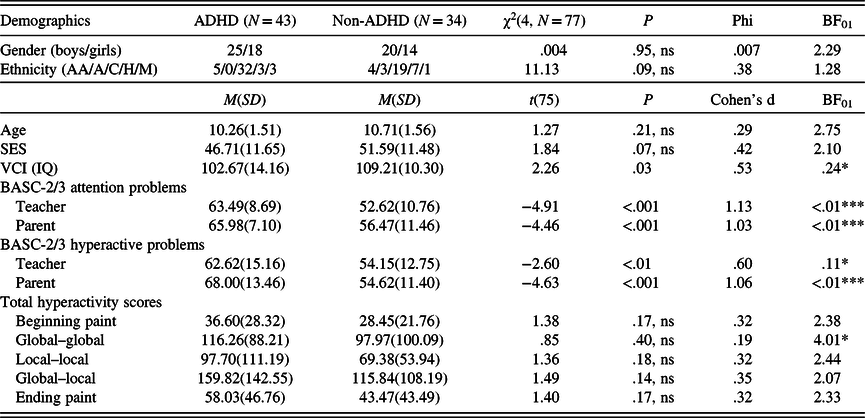
The sample included 77 children aged 8–13 years (M = 10.46, SD = 1.54; 32 girls) from the Southeastern US recruited through community resources from 2015 to 2018 for participation in a clinical research study of the neurocognitive mechanisms underlying pediatric attention and behavioral problems. Psychoeducational evaluations were provided to all caregivers. All parents and children gave informed consent/assent, and IRB approval was obtained/maintained. Sample ethnicity was mixed with 51 White/non-Hispanic (66.2%), 10 Hispanic/English-speaking (13.0%), 9 African-American (11.7%), 3 Asian (3.9%), and 4 multiracial children (5.2%; Table 1).
Descriptive statistics

Note. AA, African-American; A, Asian; BASC, Behavior Assessment System for Children; C, Caucasian/non-Hispanic; H, Hispanic/English-speaking; M, multiracial; SES, socioeconomic status; VCI (IQ), Verbal Comprehension Index (Intelligence Quotient).
*Moderate = BF01 < .33 or > 3.00; **strong = BF01 < .10 or > 10.00; ***extreme = BF01 < .01 or > 100.00.
All children and caregivers completed an identical, comprehensive evaluation that included detailed, semi-structured clinical interviewing and multiple norm-referenced parent and teacher questionnaires. Please refer to Irwin et al. (Reference Irwin, Kofler, Soto and Groves2019) for a detailed account of the comprehensive psychoeducational evaluation. The final sample included 43 children with ADHD and 34 children without ADHD (Table 1). Psychostimulants (N prescribed =13) were withheld ≥24 hr for neurocognitive testing. Children were excluded for gross neurological, sensory, or motor impairment; history of seizure disorder, psychosis, autism spectrum disorder, or intellectual disability; or nonstimulant medications that could not be withheld for testing.
Bayesian mixed-model ANOVA examining hyperactivity in both ADHD and non-ADHD groups across conditions

Note. ω2 = omega-squared (small = .01, medium = .06, large = .16); *moderate = BF01 < .33 or > 3.00; **strong = BF01 < .10 or > 10.00; ***extreme = BF01 < .01 or > 100.00.
Procedures
Children participated in two research sessions (3 hr each) following the baseline psychoeducational assessment. The set shifting and control tasks were administered as part of a larger battery of executive and nonexecutive laboratory tasks. The tasks were counterbalanced across participants to minimize order effects. Children were seated in a caster wheel swivel chair approximately .66 m from the computer monitor for all tasks. Performance was monitored at all times by the examiner, who was stationed just out of the child’s view to provide a structured setting while minimizing performance improvements associated with examiner demand characteristics (Gomez & Sanson, Reference Gomez and Sanson1994). All children received brief (2–3 min) breaks after each task and preset longer (10–15 min) breaks after every 2–3 tasks to minimize fatigue.
Experimental manipulation of set shifting
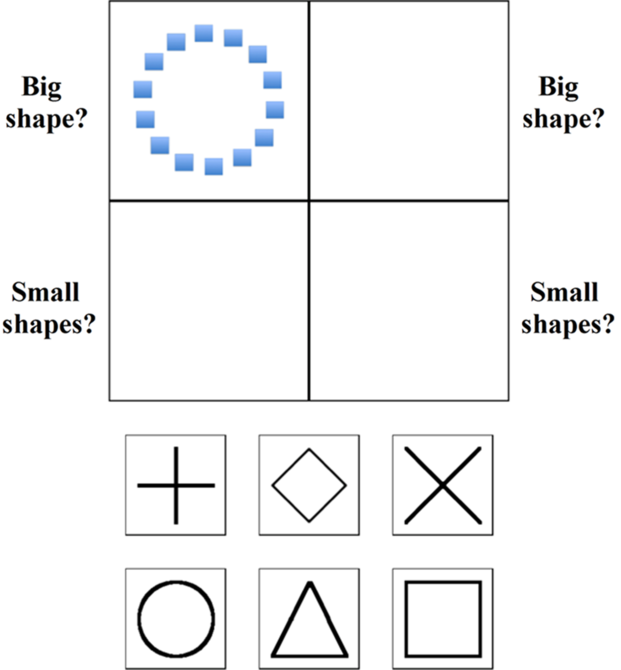
As described in Irwin et al. (Reference Irwin, Kofler, Soto and Groves2019), the current study adapted the Miyake et al. (Reference Miyake, Friedman, Emerson, Witzki, Howerter and Wager2000) global–local set shifting task for use with children. Three task variants were created to be identical in all aspects except our primary dependent variable (set shifting demands). In addition to the global–local set shifting task and two baseline (low cognitive demand) control conditions, we administered both global–global and local–local nonshifting variants to provide more precise control for both higher- and lower-order processes involved in successful performance on the global–local task. These computerized tasks use Navon (Reference Navon1977) figures, which feature a “global” shape (e.g., a circle) constructed using smaller, “local” figures (e.g., squares; Figure 1). To minimize memory demands, on-screen cues (“big shape”, “small shapes”) were positioned next to each quadrant (Figure 1). Sixty trials were administered following three blocks of 6–8 practice trials (100% correct required). Children responded via mouse click. Technical details regarding task parameters and administration are reported in Irwin et al. (Reference Irwin, Kofler, Soto and Groves2019). Importantly, there was strong evidence to support the integrity of the experimental manipulation for increasing set shifting demands with this sample, including large increases in speed shift costs relative to both control conditions (ω2 = .12, .14, both p < .001), which did not differ (ω2 = −.002, p = .62; Irwin et al., Reference Irwin, Kofler, Soto and Groves2019).
A sample trial from the global–local task. Children are instructed to click a response button (bottom) based on the presented stimulus (top) and rule set. Navon figures are presented sequentially in each quadrant in clockwise rotation. In this example, the Navon figure is a circle (global feature) comprised of squares (local features). Shift trials require children to inhibit the rule set from the previous trial and cognitively shift to the alternate rule set (top left and bottom right quadrants). Nonshift trials require children to apply to same rule set from the previous trial (top right and bottom left quadrants). The first trial of each task was excluded from analysis because it was neither a shift nor a nonshift trial. Figure adapted from Irwin et al. (Reference Irwin, Kofler, Soto and Groves2019).

Set shifting condition: global–local
As shown in Figure 1, children were required to shift their response between global and local features depending on which quadrant the figures appeared (top quadrants: global; bottom quadrants: local). Trials with stimuli in the top left or bottom right quadrants involved set shifting (shift trials) because responses required a different rule than the previous trial; trials with stimuli in the top right or bottom left quadrants did not require shifting because they featured the same rule as the previous trial (nonshift trials).
Choice-response control: global–global
The global–global task was identical to the global–local task described above except that children always responded to the prepotent global figure (i.e., no explicit shifting or inhibition demands). This control condition accounted for the well-established finding that children with ADHD make more errors and show slower/more variable reaction times on choice-response tasks compared to children without ADHD (Kofler et al., Reference Kofler, Rapport, Sarver, Raiker, Orban, Friedman and Kolomeyer2013; Klein, Wendling, Huettner, Ruder, & Peper, Reference Klein, Wendling, Huettner, Ruder and Peper2006).
Inhibition control: local–local
The local–local task was identical to the two previously described tasks except that children always responded to the local features (i.e., no explicit shifting demands). This control condition accounted for action-restraint inhibition demands required for children in the target age range to ignore a prepotent global figure and respond to the smaller (local) figures (i.e., Stroop effect; Lansbergen, Kenemans, & Van Engeland, Reference Lansbergen, Kenemans and Van Engeland2007; Poirel et al., Reference Poirel, Simon, Cassotti, Leroux, Perchey, Lanoe and Houde2011).
Baseline (low cognitive demand) controls: computerized painting tasks
Children used Microsoft® Paint for five consecutive minutes at the beginning (C1) and end (C2) of both research sessions. The Paint program served as pre- and post-conditions to assess and control for potential within-day fluctuations in activity level (e.g., fatigue effects). Children sat in the same chair and interacted with the same computer used for the set shifting tasks while interacting with a program that placed relatively modest demands on cognitive processes (i.e., the Paint program allows children to draw/paint anything they like on the monitor using a variety of interactive toolsFootnote 1 ). Following Rapport et al. (Reference Rapport, Bolden, Kofler, Sarver, Raiker and Alderson2009), the two C1 and two C2 control conditions were separately averaged to create beginning and end of session composite scores.
Activity level
Actigraph
An actigraph is an acceleration-sensitive device that measures motor activity. The estimated reliability for actigraphs placed at the same site on the same person ranges from .90 to .99 (Tryon, Pinto, & Morrison, Reference Tryon, Pinto and Morrison1991). Basic Motionlogger® (Ambulatory Monitoring, 2004) actigraphs were used to measure children’s activity level. The acceleration-sensitive devices resemble wristwatches and were set to Proportional Integrating Measure (low-PIM) mode, which measures the intensity of movement (i.e., quantifies gross activity level). Movement was sampled 16 times per second (16 Hz) and collapsed into 1 s epochs. Children were told that the actigraphs were “special watches” that let them play the computer learning games. Observer XT (Noldus, 2012) software was used to code start and stop times for each task, which were matched to the time stamps from the actigraphs. Actigraphs were placed on the child’s nondominant wrist and both ankles (i.e., three actigraph scores per child per task).
Dependent variables
Following Rapport et al. (Reference Rapport, Bolden, Kofler, Sarver, Raiker and Alderson2009), we computed total hyperactivity scores (THS) by summing activity level across the three actigraph sites to index overall movement, separately for each of the three tasks.
Intellectual functioning (IQ) and socioeconomic status
IQ was estimated using the Wechsler Intelligence Scale for Children (WISC–V; Wechsler, Reference Wechsler2014) Verbal Comprehension Index. Socioeconomic status (SES) was estimated using the Hollingshead (Reference Hollingshead1975) scoring based on caregiver(s)’ education and occupation.
Bayesian analyses
Bayesian analyses were selected because they allow stronger conclusions by estimating the magnitude of support for both the alternative and null hypotheses (Rouder, Morey, Speckman, & Province, Reference Rouder, Morey, Speckman and Province2012). That is, Bayesian methods can confirm the null hypothesis rather than just fail to reject it (Wagenmakers et al., Reference Wagenmakers, Morey and Lee2016b). Bayes factor mixed-model ANOVAs with JZS default prior scales (Rouder et al., Reference Rouder, Morey, Speckman and Province2012; Wagenmakers et al., Reference Wagenmakers, Love, Marsman, Jamil, Ly, Verhagen and Meerhoff2016a) were conducted using JASP 0.8.5 (JASP Team, 2017). Instead of a p-value, these analyses provide BF10, which is the Bayes factor of the alternative hypothesis (H1) against the null hypothesis (H0). BF10 is an odds ratio, where values above 3.0 are considered moderate evidence supporting the alternative hypothesis (conceptual equivalent of p < .05). BF10 values above 10 are considered strong (>30 = very strong, >100 = decisive/extreme support; Wagenmakers et al., Reference Wagenmakers, Morey and Lee2016b). A finding of BF10=10, for example, would indicate that the data are 10 times more likely under the alternative hypothesis than under the null hypothesis (i.e., strong support for an effect).
Conversely, BF01 is the Bayes factor of the null hypothesis (H0) against the alternative hypothesis (H1). BF01 is the inverse of BF10 (i.e., BF01=1/BF10) and is reported when the evidence indicates a lack of an effect (i.e., favors the null hypothesis; Rouder et al., Reference Rouder, Morey, Speckman and Province2012). BF01 values are interpreted identically to BF10 (>3 = moderate, >10 = strong, >100 = decisive/extreme support for the null hypothesis that the ADHD and non-ADHD groups are equivalent on an outcome; Rouder et al., Reference Rouder, Morey, Speckman and Province2012).
Notably, interpretation of results was unchanged when examining frequentist p-values instead of Bayes factors, except that nonsignificant p-values cannot be interpreted as evidence of between-group equivalence.
Data analysis overview
The evidence for a functional role of set shifting in ADHD-related hyperactivity was evaluated via a 2 (group: ADHD, non-ADHD) × 5 (task: C1 paint, global–global, local–local, global–local, C2 paint) Bayesian mixed-model ANOVA for actigraph-measured THS. A main effect of group in the absence of an interaction would indicate that any between-group differences in activity level during the set shifting condition cannot be specifically attributable to set shifting. A significant group × task interaction with post hoc tests indicating disproportionate increases in activity level in the ADHD group during the shift versus both nonshift cognitive task conditions would provide support for a causal role of set shifting demands in ADHD-related hyperactivity. Similarly, post hoc tests for this interaction indicating disproportionate hyperactivity increases for the ADHD group during the shift and nonshift cognitive tasks (but not the set shifting task specifically) would indicate that ADHD-related hyperactivity is caused at least in part by general cognitive demands rather than by shifting demands specifically. Finally, in the absence of an interaction, a main effect of task would provide preliminary support for a functional relation between hyperactivity and general cognitive, inhibition, and/or set shifting demands, depending on the pattern of post hoc results. Specifically, significant hyperactivity increases during the shift and nonshift cognitive tasks relative to the baseline painting tasks would indicate a functional link between cognitive demands in general and children’s activity level. An additional increase in hyperactivity between the choice-response control and inhibition control tasks would provide strong evidence for a functional relation between inhibition and children’s activity level, whereas an additional increase from the choice-response and inhibition control tasks to the set shifting task would support a functional relation between hyperactivity and set shifting specifically (albeit not ADHD-related hyperactivity specifically).
RESULTS
Preliminary analyses
Outliers beyond 3.00 SD were winsorized relative to the within-group distribution (ADHD, non-ADHD). This process affected 1.5% (ADHD group) to 0.6% (non-ADHD group) of all data points. Task performance data for the current sample was previously reported in Irwin et al. (Reference Irwin, Kofler, Soto and Groves2019). Hyperactivity data during these tasks have not been reported previously for any children in the current sample. There was no significant evidence to support ADHD versus non-ADHD group differences in age (BF01 = 2.75, p = .21), gender (BF01 = 2.29, p = .69), or SES (BF01 = 2.10, p = .14). All parent and teacher ADHD symptom ratings were higher for the ADHD than non-ADHD group as expected (all BF10 > 8.00, all p < .01; Table 1). There was moderate evidence suggesting a difference in IQ (BF10 = 4.13, p = .01). However, IQ was not included as a covariate based on compelling statistical, methodological, and conceptual rationale against covarying IQ when investigating cognitive processes in ADHD (Dennis et al., Reference Dennis, Francis, Cirino, Schachar, Barnes and Fletcher2009; Irwin et al., Reference Irwin, Kofler, Soto and Groves2019).
Experimental manipulation of set shifting demands
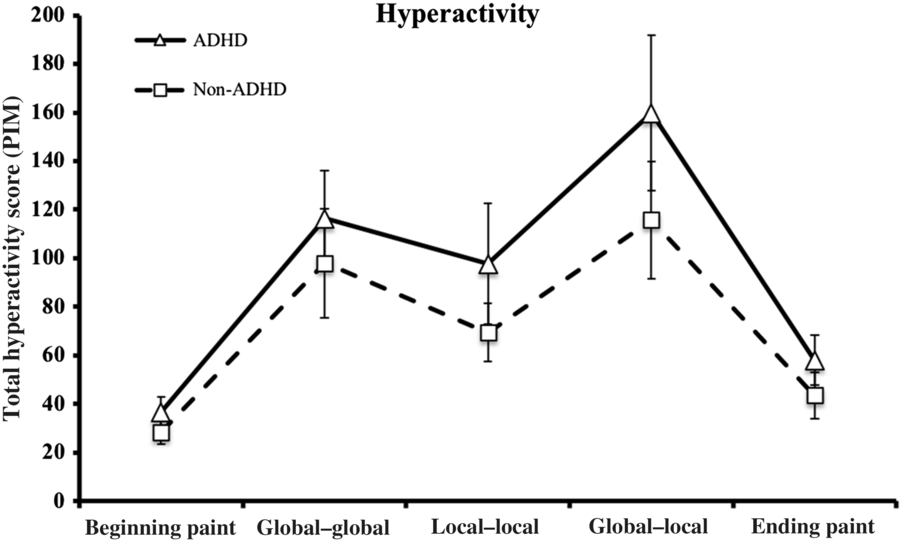
Results of the 2 (group: ADHD versus Non-ADHD) × 5 (task: C1 paint, global–global, local–local, global–local, C2 paint) Bayesian mixed-model ANOVA provided decisive support for a main effect of task (BF10 = 1.79 × 10¹⁸, p < .001, ω2 = .20) but no evidence to support a main effect of group (BF01 = 1.60, p = .10, ω2 = .02; Figure 2). Post hoc comparisons for the main effect of task (Table 2) indicated that children’s activity level significantly increased from both baseline control conditions (i.e., paint) to all three cognitive task conditions (i.e., choice response, inhibitory control, set shifting; all BF10 > 9.85, all p < .01, all d = .47–1.15), indicating that children upregulated their physical movement in response to the general cognitive demands common across the shift and nonshift cognitive tasks. However, children’s activity level did not increase significantly during the inhibition control (i.e., local–local) as compared to the choice-response control condition (i.e., global–global; BF01 = 1.30, p = .05, d = −.25), indicating that children’s physical activity level was not significantly affected when inhibitory control demands were evoked.Footnote 2 In contrast, there was decisive evidence indicating an additional increase between the inhibition control and set shifting conditions (BF10 = 20543.66, p < .001, d = .49), indicating that children specifically upregulated their motor movement in response to set shifting demands in their environment. This increase was also significant between the choice-response control and set shifting conditions based on null hypothesis testing but failed to demonstrate sufficient Bayesian evidentiary value (BF10 = 2.65, p = .02, d = .29).
Graph depicting group mean differences in total hyperactivity scores (THS) across the five task conditions. Error bars reflect 95% confidence intervals. The unit of measure on the y-axis is called Proportional Integrating Measure (PIM) and is a measure of movement intensity.

Importantly, there was strong evidence against the group × task interaction (BF01 = 18.21, p = .48, ω2 = .002; Table 2). This finding indicated that the functional links between hyperactivity and both general cognitive demands and specific set shifting demands occurred equivalently for children with ADHD and without ADHD. In other words, all children upregulate their physical activity in response to environmental demands that challenge their cognitive/set shifting abilities. However, set shifting, inhibitory control, and general cognitive demands in the environment do not appear to be viable explanations for ADHD-related hyperactivity because these increases occurred equivalently for children with and without ADHD in response to both general cognitive demands and specific cognitive processes required to shift between rule sets.
DISCUSSION
The current study was the first to test for a causal role of set shifting demands on ADHD-related hyperactivity by combining a validated, experimental manipulation of set shifting (Irwin et al., Reference Irwin, Kofler, Soto and Groves2019) with concurrent and objective measurement of hyperactivity (actigraphy) in a carefully phenotyped sample of children with and without ADHD. Results from the current study indicate that hyperactivity in children is functionally related to cognitive demands in general and set shifting demands specifically while providing strong evidence against a functional link between inhibitory control and increased hyperactivity in children (Alderson et al., Reference Alderson, Rapport, Kasper, Sarver and Kofler2012). Importantly, the current results indicate a functional if not causal role of set shifting demands on children’s physical movement, while providing strong evidence that set shifting demands cannot explain hyperactivity in ADHD given that children with and without ADHD increased their physical activity equivalently when set shifting demands were experimentally evoked.
The current findings provided strong evidence against our hypothesis that hyperactivity in ADHD would be functionally related to set shifting demands. Rather, the findings provided decisive evidence to indicate that children with and without ADHD increase their activity level equivalently in response to set shifting demands. The use of Bayesian statistics allowed stronger conclusions by providing significant support for the null hypothesis rather than just failing to reject it. These findings suggest that set shifting is not a viable explanation for ADHD-related hyperactivity and help to clarify the limited, mixed evidence by indicating that hyperactivity in ADHD is not linked specifically to set shifting demands (McCandless & O’Laughlin, Reference McCandless and O’Laughlin2007; Toplak et al., Reference Toplak, Bucciarelli, Jain and Tannock2008). The incongruence between our a priori hypothesis and our findings may be because the former was developed from mixed findings across correlational studies rather than from experimentally manipulated cognitive demands and objectively measured behavior. Additionally, these findings coincide with recent evidence, based on part on the current sample, indicating that children with ADHD likely do not have unique set shifting deficits (Irwin et al., Reference Irwin, Kofler, Soto and Groves2019), and that set shifting abilities do not covary with ADHD-related hyperactive/impulsive symptom severity (Kofler, Irwin et al., Reference Kofler, Irwin, Soto, Groves, Harmon and Sarver2019).
Although of secondary interest in the current study, the current findings were consistent with recent experimental evidence indicating that inhibitory control demands do not evoke hyperactive behavior in children with or without ADHD (Alderson et al., Reference Alderson, Rapport, Kasper, Sarver and Kofler2012). That is, there was strong evidence against an incremental increase in children’s physical activity from the choice-response control (i.e., global–global task) to the inhibition control (i.e., local–local task) condition and as such increasing inhibition demands did not increase hyperactivity in children. This pattern of results is consistent with the only other experimental study to date examining the functional role of inhibition on hyperactivity (Alderson et al., Reference Alderson, Rapport, Kasper, Sarver and Kofler2012) and extends previous findings by examining this pattern using an experimental manipulation of general cognitive demands, inhibition demands, and set shifting demands within a single study.
Despite clear evidence linking hyperactivity in ADHD with cognitive demands in the environment (for meta-analytic review, see Kofler et al., Reference Kofler, Raiker, Sarver, Wells and Soto2016), it was unclear whether hyperactivity in ADHD is evoked or exacerbated by any cognitive demands or whether this occurs specifically in response to specific executive function abilities. The current study helps clarify this emerging literature, while providing evidence for both possibilities. That is, the current findings indicate that children increase their activity level both in response to general cognitive demands as well as specifically in response to set shifting demands. Taken together, the literature at this time appears to indicate that of the three core executive functions (Miyake et al., Reference Miyake, Friedman, Emerson, Witzki, Howerter and Wager2000), inhibition demands do not cause children to upregulate their physical activity (current study; Alderson et al., Reference Alderson, Rapport, Kasper, Sarver and Kofler2012), whereas working memory (e.g., Kofler et al., Reference Kofler, Sarver and Wells2015) and set shifting demands (current study) both evoke hyperactive behavior in children. However, it appears that only working memory does so disproportionately for children with ADHD (Hudec et al., Reference Hudec, Alderson, Patros, Lea, Tarle and Kasper2015; Patros et al., Reference Patros, Alderson, Hudec, Tarle and Lea2017; Rapport et al., Reference Rapport, Bolden, Kofler, Sarver, Raiker and Alderson2009). In other words, there is consistent evidence that children become more physically active when faced with cognitively challenging tasks (Kofler et al., Reference Kofler, Raiker, Sarver, Wells and Soto2016), and emerging evidence that these increases may be linked specifically to two of the three core executive functions (i.e., working memory and set shifting). However, as shown in the current study, the functional link between set shifting and increased physical movement/hyperactivity is not likely to be a viable explanation for ADHD-related hyperactivity because these demands do not disproportionately affect children with ADHD. Taken together, the most parsimonious conclusion appears to be that set shifting affects hyperactivity in children over and above the effects of general cognitive demands, but cannot specifically explain why hyperactivity in children with ADHD appears to occur primarily in the context of environmental demands that challenge them cognitively (Kofler et al., Reference Kofler, Raiker, Sarver, Wells and Soto2016).
Limitations
Despite the experimental methodology and carefully phenotyped sample, the following limitations must be considered when interpreting results. Children with all ADHD current presentation specifiers were included in this sample based on meta-analytic evidence that children with ADHD inattentive and combined/hyperactive subtypes/current presentations do not differ in terms of actigraph-measured movement despite both subtypes/specifiers demonstrating elevated activity level versus neurotypical and clinical controls at the group and individual levels (Kofler et al., Reference Kofler, Raiker, Sarver, Wells and Soto2016). However, meta-analytic evidence suggests that ADHD symptom domains may differentially relate to neurocognitive functions and as such future work should collect larger samples of each ADHD presentation to investigate whether associations with hyperactivity remain the same or differ as a function of ADHD presentation (Willcutt et al., Reference Willcutt, Nigg, Pennington, Solanto, Rohde, Tannock and Lahey2012).
Despite the use of a carefully phenotyped sample and strong evidence for group differences in parent and teacher ratings of ADHD hyperactivity/impulsivity symptoms, there was no evidence to support a main effect of group differences in objectively assessed hyperactivity across the five experimental conditions. Although this finding was initially surprising, on close inspection it is consistent with meta-analytic findings indicating minimal differences between ADHD and non-ADHD groups during tasks with relatively low cognitive demands (d = .36; Kofler et al., Reference Kofler, Raiker, Sarver, Wells and Soto2016). Thus, it may be that the set shifting task, despite being cognitively challenging enough to evoke higher levels of hyperactivity versus the cognitive task controls, does not place sufficient demands on the specific cognitive processes known to disproportionately give rise to hyperactive behavior in ADHD (e.g., working memory; Hudec et al., Reference Hudec, Alderson, Patros, Lea, Tarle and Kasper2015; Kofler et al., Reference Kofler, Sarver and Wells2015; Patros et al., Reference Patros, Alderson, Hudec, Tarle and Lea2017; Rapport et al., Reference Rapport, Bolden, Kofler, Sarver, Raiker and Alderson2009). Additional research is needed to test this hypothesis, as to our knowledge no study to date has concurrently examined hyperactivity across conditions that systematically differ in all three of the core executive functions.
Finally, the current study evoked set shifting demands and observed effects on children’s hyperactive behavior. However, further clarifying the directionality of the set shifting/hyperactivity relation will require the opposite, namely, experimentally manipulating children’s activity level while concurrently measuring children’s set shifting performance. This line of work will be critical given evidence that increasing physical movement may facilitate performance on cognitive tests for children with ADHD (Hartanto, Krafft, Iosif, & Schweitzer, Reference Hartanto, Krafft, Iosif and Schweitzer2016; Sarver, Rapport, Kofler, Raiker, & Friedman, Reference Sarver, Rapport, Kofler, Raiker and Friedman2015), presumably because the physical activity serves as a physiological arousal mechanism that actuates cortical networks implicated in attention and executive function (Rapport et al., Reference Rapport, Bolden, Kofler, Sarver, Raiker and Alderson2009). Thus, despite the evidence for a functional relation detected herein, more work is needed to conclude that hyperactivity serves as a compensatory mechanism that actuates and augments cognitive functioning for children with ADHD while they are engaged in tasks that tax those underdeveloped cognitive processes (Rapport et al., Reference Rapport, Bolden, Kofler, Sarver, Raiker and Alderson2009).
Clinical and research implications
The current results indicate a functional relation between set shifting and hyperactivity, while also providing evidence against set shifting as a viable cause of hyperactive behavior in children with ADHD. Given the additional finding that general cognitive demands evoked higher levels of hyperactive behavior for both groups, it will be critical for future studies to include cognitive task control conditions to ensure specificity in their results. For example, if we had not included the choice-response control task, we would likely have erroneously concluded that there was a functional link between inhibitory control and hyperactivity. However, because we included a choice-response task with minimal inhibition demands, we were able to see that the increased hyperactivity during the inhibition task relative to baseline was not attributable specifically to the task’s inhibition demands (Alderson et al., Reference Alderson, Rapport, Kasper, Sarver and Kofler2012). Moreover, additional work is needed to test our hypothesis above that only working memory appears to disproportionately evoke hyperactivity in ADHD because to our knowledge no ADHD hyperactivity studies have included manipulations of all three core executive functions in a single experiment (working memory, inhibitory control, set shifting; Karr et al., Reference Karr, Areshenkoff, Rast, Hofer, Iverson and Garcia-Barrera2018).
ACKNOWLEDGMENTS
This work was supported in part by an NIH grant (R34 MH102499-01, PI: Kofler). The sponsor had no role in design and conduct of the study; collection, management, analysis, and interpretation of the data; or preparation, review, or approval of the manuscript.
CONFLICT OF INTEREST
The authors have no conflicts of interest to report.