Introduction
There is ample evidence that the acquisition of basic word order in a second language (L2) causes problems in speech production as seen across many language pairs, learner types, proficiency levels, learning situations, and across different clause types (main vs. subordinate) (Hyltenstam, Reference Hyltenstam1977; Klein & Perdue, Reference Klein and Perdue1992; Meisel, Clahsen & Pienemann, Reference Meisel, Clahsen and Pienemann1981). Many studies have focused on the acquisition of so-called verb-second (V2) word order, found in most Germanic languages. The term V2 refers to the fact that the finite verb in a main clause appears in second position regardless of whether the clause starts with a subject or with something else, such as an adverb. The second case is sometimes referred to as subject-verb inversion or XVS word order, as in the Swedish example in (1).
(1) Idag läste hon tidningen.
today read she paper.def
‘today she read the paper’
A key issue in this work has been to examine to what extent similarities – between the learners’ first language (L1) word order and the target word order – facilitate or hinder acquisition, probing issues of so-called crosslinguistic influence (CLI; Jarvis & Pavlenko, Reference Jarvis and Pavlenko2008; Kellerman & Sharwood Smith, Reference Kellerman and Sharwood Smith1986; Odlin, Reference Odlin1989). In the traditional L2 production literature it has sometimes been argued that the L1 has little influence on the acquisition of word order (Dulay & Burt, Reference Dulay and Burt1974; Fathman & LoCoco, Reference Fathman, LoCoco, Dechert and Raupach1989; Hyltenstam, Reference Hyltenstam1977; Rutherford, Reference Rutherford, Gass and Selinker1983; Zobl, Reference Zobl1986). For example, studies show that learners produce ungrammatical word orders irrespective of their L1, often so-called V3 sentences (e.g., a fronted adverbial followed by subject and the finite verb in third position), such as example (2) in Swedish.
(2) *Idag hon läste tidningen.
*today she read paper.def
‘today she read the paper’
Critically, even learners whose L1 also has V2 word order produce these structures in the L2 (Håkansson, Pienemann & Sayehli, Reference Håkansson, Pienemann and Sayehli2002; Sayehli, Reference Sayehli2013). It has therefore been suggested that V3 word order production is a general learning stage in the developmental route towards target V2 (Håkansson et al., Reference Håkansson, Pienemann and Sayehli2002; Meisel et al., Reference Meisel, Clahsen and Pienemann1981; Sayehli, Reference Sayehli2013; but see Bardel & Falk, Reference Bardel and Falk2007; Bohnacker, Reference Bohnacker2006). However, it has also been suggested that learners whose L1 has V2 may pass through the V3 stage more quickly than those who do not, leading to a moderate positive CLI effect on the rate if not the route of acquisition (Hyltenstam, Reference Hyltenstam1978; Pienemann & Håkansson, Reference Pienemann and Håkansson2007; Zobl, Reference Zobl1982).
Interestingly, despite the large body of production work, we know surprisingly little about how V2 word order is treated behaviourally and neurocognitively in comprehension, and what impact the L1 has on online comprehension. This study therefore sets out to examine how intermediate adult learners of Swedish process V2 in the L2 depending on whether their L1 has V2 (German) or not (English) in comparison to native speakers. Importantly, in a multi-task approach we compare written word order production, online comprehension as measured through event-related potentials (ERPs), and offline metalinguistic judgements in the same learners.
Background – V2 word order
Basic word order, defined by typologists as the distribution of subject, verb, and object (S, V, O) in declarative main clauses differs across languages (Greenberg, Reference Greenberg and Greenberg1966). Most Germanic languages display what is known as V2 word order (Dryer, Reference Dryer, Dryer and Haspelmath2013). The term V2 refers to the fact that the finite verb in a main clause appears in second position regardless of whether the clause starts with a subject or with another fronted element such as an adverbial, referred to as subject-verb inversion or XVS word order. We will refer to this structure as V2 word order throughout this paper.
Swedish is characterised as an SVO-dominant language with V2 (XVS) as a secondary pattern, and corpus studies show that V2 appears in approximately 40% of all spoken Swedish main clauses (Jörgensen, Reference Jörgensen1976; Westman, Reference Westman1974). Fronted elements (X) are often adverbials (Jörgensen, Reference Jörgensen1976; Josefsson, Reference Josefsson, Josefsson, Platzack and Håkansson2003, for child-directed speech).
In contrast to Swedish, German lacks a dominant word order since it displays SVO only in main clauses without auxiliaries, and SOV in subordinate clauses and main clauses with auxiliaries (Dryer, Reference Dryer, Dryer and Haspelmath2013). However, V2 (XVS) word order is also present. Corpus studies indicate that approximately 45% of German main clauses display XVS in spoken language (Engel, Reference Engel and Moser1974), slightly more than in Swedish (Bohnacker, Reference Bohnacker2006).
Contemporary English is generally described as an SVO language, but as lacking V2 (XVS), although V2 was present historically (Los, Reference Los, Meurman-Solin and López-Couso Los2012, Reference Los2015; van Kemenade & Westergaard, Reference van Kemenade, Westergaard, Meurman-Solin, López-Couso and Los2012). Some vestiges of V2 remain, for example in main clauses with some fronted locative expressions (here comes the sun), or restrictive/negative adverbials (no sooner had the bus come than the rain started pelting down), which often have the character of fixed expressions. Overall, however, V2 is productively absent in English.
In sum, even closely related Germanic languages display differences in word order, especially regarding the V2 phenomenon. These differences in word order have potential consequences for L2 processing and acquisition, especially for CLI effects.
Native word order processing
Basic word order processing is a fundamental part of sentence comprehension. Language users incrementally make very rapid use of incoming information using both bottom-up semantic and syntactic information and top-down pragmatic information to achieve interpretations. Studies typically probe difficulties or costs in processing as manifested behaviourally in longer reaction times or reading times, and neurocognitively in quantitatively or qualitatively different ERP effects. The literature has examined a range of different word order variations.
For example, studies have shown that language users generally find it easier to read the first noun phrase of a main or subordinate clause as a subject rather than any other part of speech. This phenomenon is known as the subject-first preference (Frazier, Reference Frazier and Coltheart1987; Kaan, Reference Kaan1997; MacWhinney, Bates & Kliegl, Reference MacWhinney, Bates and Kliegl1984; Schriefers, Friederici & Kuhn, Reference Schriefers, Friederici and Kuhn1995) and is found even when the language allows other constituents sentence-initially, such as Basque (Erdocia, Laka, Mestres-Missé & Rodriguez-Fornells, Reference Erdocia, Laka, Mestres-Missé and Rodriguez-Fornells2009). Comprehenders also prefer verbs to follow subjects (SVO) rather than objects (SOV) even if both word orders exist as in German and Dutch (Weyerts, Penke, Münte, Heinze & Clahsen, Reference Weyerts, Penke, Münte, Heinze and Clahsen2002). This preference is reflected in increased reading times behaviourally, and neurocognitively in an increased centro-parietal positivity (the P600) for ungrammatical SOV but not for ungrammatical SVO (Weyerts et al., Reference Weyerts, Penke, Münte, Heinze and Clahsen2002). Studies have also shown processing difficulties that language users experience when dealing with correct but less frequently occurring word orders (Fiebach, Schlesewsky & Friederici, Reference Fiebach, Schlesewsky and Friederici2002; Friederici, Hahne & Saddy, Reference Friederici, Hahne and Saddy2002; Friederici, Steinhauer, Mecklinger & Meyer, Reference Friederici, Steinhauer, Mecklinger and Meyer1998; Rösler, Pechmann, Streb, Röder & Hennighausen, Reference Rösler, Pechmann, Streb, Röder and Hennighausen1998; Vos, Gunter, Schriefers & Friederici, Reference Vos, Gunter, Schriefers and Friederici2001; but see Mishra, Pandey & Srinivasan, Reference Mishra, Pandey and Srinivasan2011; Yamashita, Reference Yamashita1997). Examples of such word orders include scrambling, such as German dislocations where an object can appear in a pre-subject position sentence-medially with overt case-marking, as in the sentence Maria glaubt, dass den Onkel[O] der Vater[S] schlägt. [Maria thinks that the uncle[O] the father[S] beats.] “Maria thinks that the father beats the uncle.” (Hopp, Reference Hopp2006, p. 372). Behaviourally the processing difficulties for scrambled sentences are reflected in longer reading times, which in turn are modulated by whether syntactic roles are indicated by agreement or case marking (Hopp, Reference Hopp2006; Meng & Bader, Reference Meng and Bader2000). Neurocognitively, some studies of grammatical but unusual structures have reported a stronger frontal P600 (Friederici, Hahne et al., Reference Friederici, Hahne and Saddy2002; Kaan, Harris, Gibson & Holcomb, Reference Kaan, Harris, Gibson and Holcomb2000; Kaan & Swaab, Reference Kaan and Swaab2003; Vos et al., Reference Vos, Gunter, Schriefers and Friederici2001; for a review see Friederici, Reference Friederici2002), and other studies a stronger centro-parietal P600 (Rösler et al., Reference Rösler, Pechmann, Streb, Röder and Hennighausen1998; Schlesewsky, Bornkessel & Frisch, Reference Schlesewsky, Bornkessel and Frisch2003), both effects critically suggesting processing costs.
Word order variation may also yield correct but temporarily ambiguous sentences, often referred to as garden path sentences (e.g., While the band played the song pleased all the customers, Roberts, Reference Roberts2012, p. 173). Incremental processing will lead to an erroneous interpretation that needs re-analysis and revision for successful interpretation to occur (e.g., re-analysing the song as a subject in the clause the song pleased all customers, rather than as a direct object in the clause While the band played). A vast literature indicates that re-analysis incurs processing costs behaviourally (Frazier, Reference Frazier and van Gompel2013) and neurocognitively as reflected in a larger centro-parietal P600 (e.g., Gouvea, Phillips, Kazanina & Poeppel, Reference Gouvea, Phillips, Kazanina and Poeppel2010; Osterhout & Holcomb, Reference Osterhout and Holcomb1992; Osterhout, Holcomb & Swinney, Reference Osterhout, Holcomb and Swinney1994; Pauker, Itzhak, Baum & Steinhauer, Reference Pauker, Itzhak, Baum and Steinhauer2011). These effects can be modulated by context (Spivey, Anderson & Farmer, Reference Spivey, Anderson, Farmer and van Gompel2013, for an overview) and prosody (Pauker et al., Reference Pauker, Itzhak, Baum and Steinhauer2011).
Finally, some studies expose language users to word order violations to test their processing of grammatical structures. In most such studies, these violations do not typically involve variations of basic word order, but are rather non-typical word orders violating phrase structure as in the example *The man admired Don's of sketch the landscape (Neville, Nicol, Barss, Forster & Garrett, Reference Neville, Nicol, Barss, Forster and Garrett1991, p. 153). Results from such studies usually suggest that phrase structure violations incur processing costs as reflected in lower acceptance rates in grammaticality judgement tasks (Almor, de Carvalho Maia, Cunha Lima, Vernice & Gelormini-Lezama, Reference Almor, de Carvalho Maia, Cunha Lima, Vernice and Gelormini-Lezama2017; Fanselow & Frisch, Reference Fanselow, Frisch, Fanselow, Vogel and Schlesewsky2006; Häussler, Grant, Fanselow & Frazier, Reference Häussler, Grant, Fanselow and Frazier2015). Electrophysiologically, these violations typically elicit a biphasic ERP response which includes an increased left anterior negativity (LAN) followed by an increased centro-parietal P600 in native speakers (e.g., Friederici, Hahne et al., Reference Friederici, Hahne and Saddy2002; Friederici, Pfeifer & Hahne, Reference Friederici, Pfeifer and Hahne1993; Hagoort, Brown & Groothusen, Reference Hagoort, Brown and Groothusen1993; Hahne & Friederici, Reference Hahne and Friederici2001; Isel, Hahne, Maess & Friederici, Reference Isel, Hahne, Maess and Friederici2007; Neville et al., Reference Neville, Nicol, Barss, Forster and Garrett1991; Steinhauer, Drury, Portner, Walenski & Ullman, Reference Steinhauer, Drury, Portner, Walenski and Ullman2010; Weber-Fox & Neville, Reference Weber-Fox and Neville1996; Yamada & Neville, Reference Yamada and Neville2007). While it has been suggested that the LAN effect is a reflection of more automatic processing, a larger P600 has been argued to reflect a revision of the initial parse of a sentence when a difficulty is encountered as induced by a violation (for a review, Van Petten & Luka, Reference Van Petten and Luka2012).
In sum, a large part of the native sentence processing literature has focused on processing costs that involve unusual word order variations, but we still know surprisingly little about the processing of basic word order involving simply S, V, and adverbials.
L2 word order processing
Studies of online L2 sentence processing have largely focused on the same areas as the literature on native processing. The aim has often been to explore if L2 sentence processing is qualitatively different from native processing reflecting different parsing procedures (e.g., the Shallow Structure Hypothesis by Clahsen and Felser, Reference Clahsen and Felser2006) or are related to limitations in proficiency, processing speed or working memory (see Roberts, Reference Roberts and van Gompel2013 for an overview).
Another line of work addresses issues of CLI, sometimes discussed in terms of positive and negative transfer, depending on whether facilitation or non-facilitation is observed. Such studies often examine effects of similarities and differences between L1 and L2 structures for processing in the L2. Structural similarity between L1 and L2 is typically assumed to facilitate processing (e.g., Hartsuiker & Moors, Reference Hartsuiker, Moors and Schmid2017; Hawkins & Chan, Reference Hawkins and Chan1997; Tokowicz & MacWhinney, Reference Tokowicz and MacWhinney2005; but for a different view, see e.g., Clahsen & Felser, Reference Clahsen and Felser2006). For example, if L1 has determiner-number agreement this structure will be processed in a nativelike fashion also in the L2 (Tokowicz & MacWhinney, Reference Tokowicz and MacWhinney2005). When structures differ, particularly when they are unique to the L2 (e.g., determiner-gender agreement), models diverge. Some suggest that native-like processing is possible (Schwartz & Sprouse, Reference Schwartz and Sprouse1996; Tokowicz & MacWhinney, Reference Tokowicz and MacWhinney2005), whereas others contest this option (Hawkins & Chan, Reference Hawkins and Chan1997).
Behavioural studies of CLI have also dealt with a range of word order phenomena. Hopp (Reference Hopp2006), for example, studied how Dutch and English L2 German learners of different proficiencies resolved local subject-object ambiguities using a self-paced reading task and a speeded acceptability task. Although the learners’ L1 differed in their similarity to the L2 (Dutch is more similar to German than English is to German), there was no evidence of CLI from the L1, but rather effects of proficiency. Irrespective of their L1, only the highly proficient learners showed reaction times and reading times similarly modulated by morphosyntactic cues as the native speakers. Other studies do report an L1 influence. For example, a study of Spanish and Korean learners of English targeting the processing of island constraints in wh-dependencies found that both learner groups, who were matched on proficiency, displayed knowledge of the structure (Kim, Baek & Tremblay, Reference Kim, Baek and Tremblay2015). However, the Spanish learners, whose L1 has a similar structure, showed an advantage in that they displayed shorter reading times than the Korean learners, whose L1 does not have a similar structure.
In the domain of morphosyntax, processing studies have also reported CLI effects (Franceschina, Reference Franceschina2005; Jiang, Reference Jiang2004; Jiang, Reference Jiang2007), sometimes modulated by L2 proficiency (Hopp, Reference Hopp2010). For example, studies of so-called ‘broken agreement’ processing, where modified noun phrases consisting of head and modifier nouns of different number are followed by verbs whose agreement match either the first or the second noun (e.g., The key to the cabinets was rusty), show that native speakers of English are slowed down when verbs agree with the first rather than the second noun (Bock & Miller, Reference Bock and Miller1991). In contrast, intermediate Chinese learners of English do not slow down as native speakers do, which is taken as reflecting the absence of a plural-agreement paradigm in L1 Chinese (Jiang, Reference Jiang2004).
Neurocognitive studies have also reported CLI effects in morphosyntactic L2 processing. These studies typically report that learners display nativelike processing in the L2 when structures in the L1 and L2 are similar (e.g., Alemán Bañón, Fiorentino & Gabriele, Reference Alemán Bañón, Fiorentino and Gabriele2014; Foucart & Frenck-Mestre, Reference Foucart and Frenck-Mestre2012; Dowens, Vergara, Barber & Carreiras, Reference Hopp2010; Sabourin & Stowe, Reference Sabourin and Stowe2008; Tokowicz & MacWhinney, Reference Tokowicz and MacWhinney2005), but show evidence of CLI when L1 and L2 differ (Chen, Shu, Liu, Zhao & Ping, Reference Chen, Shu, Liu, Zhao and Ping2007; Dowens, Guo, Guo, Barber & Carreiras, Reference Dowens, Guo, Guo, Barber and Carreiras2011). For example, learners whose L1 shared the morphosyntactic feature number agreement (English learners of Spanish) showed a nativelike ERP response (LAN/P600; Dowens et al., Reference Dowens, Vergara, Barber and Carreiras2010) whereas learners whose L1 did not have number agreement (Chinese learners of Spanish) only showed an increased P600 effect (Dowens et al., Reference Dowens, Guo, Guo, Barber and Carreiras2011). Importantly, the nativelike processing by learners with shared structures has been reported even when learners differ from native speakers on acceptability judgements for the structure (e.g., Foucart & Frenck-Mestre, Reference Foucart and Frenck-Mestre2012; Tokowicz & MacWhinney, Reference Tokowicz and MacWhinney2005).
Further refining the study of CLI effects and the impact of L1-L2 similarity, Tokowicz and MacWhinney (Reference Tokowicz and MacWhinney2005) examined how L2 users process features that are similar in L1-L2, unique to the L2, and features that exist in their L1 but are expressed differently in the target language. They found that English learners of Spanish showed a native-like effect in the P600 response to tense agreement violations (similar in English L1-Spanish L2) and to gender agreement violations (unique to the Spanish L2), but not to determiner-number violations (present but differently expressed in English L1 and Spanish L2). Thus, they found a similar neuronal processing of the construction when it was instantiated similarly in L1 and in L2 (potential positive transfer), even if explicit judgements of the structures were at chance. Similar results have been found for German learners of Dutch who showed nativelike neuronal effects for verbal dependency and gender agreement even when their proficiency was not nativelike (Foucart & Frenck-Mestre, Reference Foucart and Frenck-Mestre2012; Sabourin & Stowe, Reference Sabourin and Stowe2008). There is thus evidence that nativelike ERP responses are more likely for structures present and similar in L1 and L2, or unique to L2, than for structures that are present in the L1 but dissimilar (e.g., Dowens et al., Reference Dowens, Vergara, Barber and Carreiras2010; Sabourin & Stowe, Reference Sabourin and Stowe2008; Tokowicz & MacWhinney, Reference Tokowicz and MacWhinney2005; but for different results for L2 unique features, see Chen et al., Reference Chen, Shu, Liu, Zhao and Ping2007; Foucart & Frenck-Mestre, Reference Foucart and Frenck-Mestre2012; Ojima, Nakata & Kakigi, Reference Ojima, Nakata and Kakigi2005; Zawiszewski, Gutiérrez, Fernández & Laka, Reference Zawiszewski, Gutiérrez, Fernández and Laka2011).
Overall, the evidence for CLI effects in L2 morphosyntactic processing remains inconclusive. Despite the body of work on word order in online processing terms, it is still unclear 1) how native speakers process and judge simple basic word order; 2) how similarities and differences in basic L1 word order structures affect processing and judgements in L2.
The current study
The current study examines whether L2 learners at an intermediate proficiency level produce, judge, and comprehend word order differently from native speakers; and, if so, whether language background plays a role. Specifically, we investigate whether the presence of V2 in the L1 matters. Native speakers of Swedish are compared to adult L2 learners whose L1 either has V2 (German) or not (English). We examine the groups' performance on an offline written sentence completion task, an offline acceptability judgement task, and their online comprehension through event-related potentials (ERPs) recorded to visually presented sentences. In addition, possible correlations between the amplitude of the ERP effects and the behavioural results with demographic variables are explored. Importantly, to allow us to gauge CLI effects specifically, learners are matched for formal proficiency, age of acquisition (AoA), and socioeconomic status (SES) since these variables have been found to affect behavioural performance and ERP effects related to language processing (Abrahamsson & Hyltenstam, Reference Abrahamsson and Hyltenstam2009; Hart & Risley, Reference Hart and Risley1995; Hoff, Reference Hoff2003; Newport, Reference Newport1990; Pakulak & Neville, Reference Pakulak and Neville2010; Schwartz & Stiefel, Reference Schwartz and Stiefel2006; Weber-Fox & Neville, Reference Weber-Fox and Neville1996).
We compare the online processing of correct V2 word order to violations (i.e., incorrect V3 word order). Notably, although Swedish V3 word order is incorrect, it does occur frequently in Swedish second language users’ speech (Bolander, Reference Bolander1988; Hyltenstam, Reference Hyltenstam1977, Reference Hyltenstam1978; Salameh, Håkansson & Nettelbladt, Reference Salameh, Håkansson and Nettelbladt1996), and is part of ethnolects spoken in multi-ethnic neighbourhoods in Sweden among adolescents (Ganuza, Reference Ganuza2008; Kotsinas, Reference Kotsinas1988, Reference Kotsinas, Androutsopoulos and Scholz1998; Wiese, Reference Wiese2009). The present study thus examines incorrect word orders that are found in L2 language production and therefore represent a special case of word order violations not previously studied.
Predictions
Based on previous studies, we predict that in native speakers V2 word order violations will elicit a stronger posterior P600 in combination with a negative effect over anterior sites (LAN). Further, for L2 users we predict CLI effects (cf. Foucart & Frenck-Mestre, Reference Foucart and Frenck-Mestre2012; Dowens et al., Reference Dowens, Vergara, Barber and Carreiras2010; Sabourin & Stowe, Reference Sabourin and Stowe2008; Tokowicz & MacWhinney, Reference Tokowicz and MacWhinney2005), such that German learners with V2 in their L1 should be more Swedish-like in their processing of Swedish word order than English learners with no V2 in their L1. In the behavioural data this means expected lower accuracy in word order production and acceptability judgements in the learners than the Swedish native speakers, and lower accuracy in the English than the German learners. For the ERPs, German learners are expected to be more Swedish-like than English learners with regard to both the P600 effect and the anterior effect. Further, the anterior effect is predicted to be more sensitive than the P600 to L1 influence, such that differences between the groups are expected to be largest over anterior sites.
Method
In the current study, we examine how native Swedish speakers and German and English learners of Swedish produce, judge, and process grammatical V2 and ungrammatical V3 word orders in Swedish sentences with sentence-initial adverbials.
Participants
A total of 90 participants were recruited at Lund University (excluding students of linguistics) distributed across three groups: native Swedish speakers (Swe), and German (Ger) and English (Eng) learners of Swedish. All participants had normal or corrected to normal vision, reported normal hearing, and had no history of neurological or language disorders.
Screening and matching procedure
All participants filled in a language background questionnaire (Gullberg & Indefrey, Reference Gullberg and Indefrey2003), the Edinburgh handedness questionnaire (Oldfield, Reference Oldfield1971), and a questionnaire targeting socio-economic status (SES; Hollingshead, Reference Hollingshead1975). Based on the results from these screening tests, a number of participants were excluded: twelve L2 learners were early simultaneous bilinguals or had learned an L2 before age 6 (for maturational effects on ERP before age 6, see e.g., Weber Fox & Neville, Reference Weber-Fox and Neville2001); four native Swedish speakers had lived in an English speaking country before age 18; two had incomplete data sets; seven were older than 35 years (for age effects on ERP, see Payne, Grison, Gao, Christianson, Morrow & Stine-Morrow, Reference Payne, Grison, Gao, Christianson, Morrow and Stine-Morrow2014; Wlotko, Lee & Federmeier, Reference Wlotko, Lee and Federmeier2010); and two were left handed.
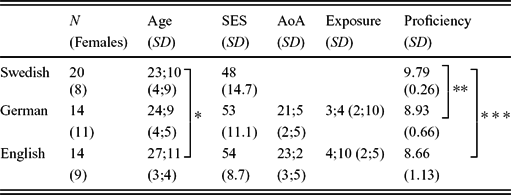
Further, participants completed a standardized language proficiency test for L2 Swedish (the Word and Grammar sub-test of Swedex, Swedex, 2012) targeting level B1 of the Common European Framework of Reference for Languages (Council of Europe, 2001). The two L2 learner groups were matched on formal Swedish proficiency (t(26) < 1), age of acquisition (t(26) = 1.54, p = .135), and length of exposure to Swedish (t(26) = 1.51, p = .143). The three groups did not differ in SES (F(2,45) < 1, Table 1). Swedish native speakers were significantly younger than native English speakers (Group: F(2,45) = 3.90, p < .05, Table 1) but not than the native German speakers (p = .1) and the learner groups did not differ in age (p = .166). Native speakers also performed better on the proficiency test than both learner groups (Group: F(2,45) = 11.41, p < .001).
Demographic and proficiency information

Note. Averages given in columns. Age, AoA (age of acquisition) and Exposure (length of exposure) given in Years;Months. SES, socioeconomic status according to Hollingshead (Reference Hollingshead1975, range 0-66), Proficiency refers to results on Swedex (range 0-10). p-values are corrected for multiple comparisons (Bonferroni).
* p < .05
** p < .01
*** p < .001
Experimental tasks and materials
Written sentence completion task (accuracy)
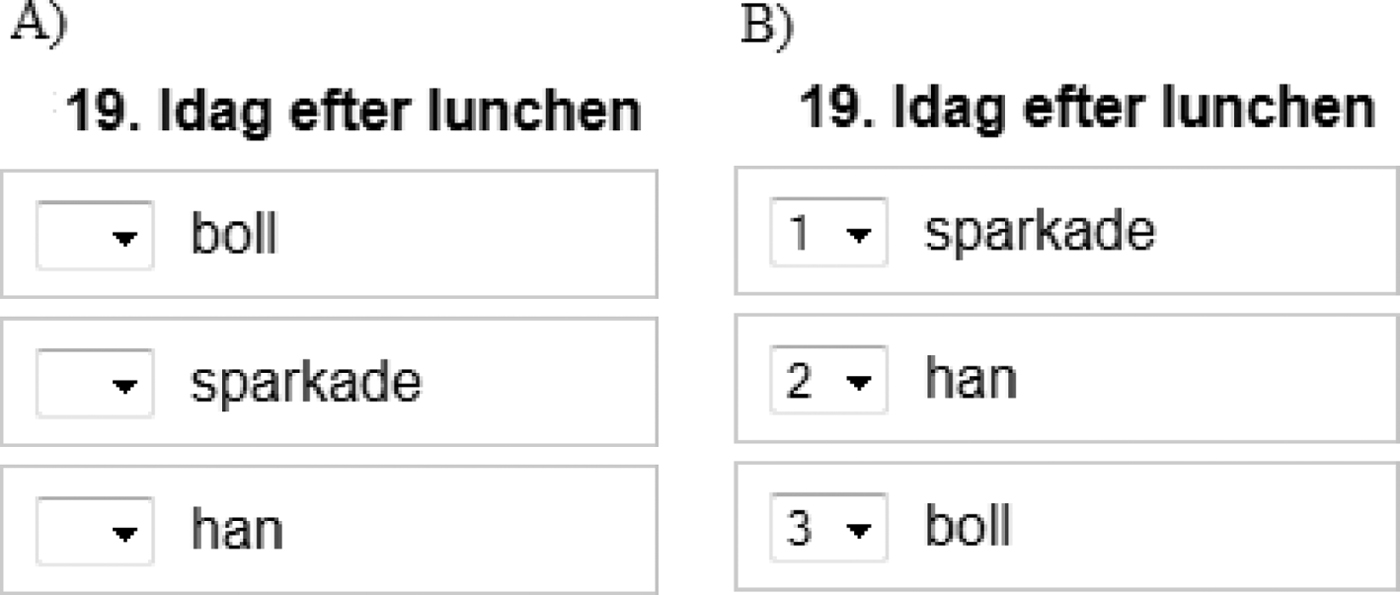
A computer based sentence completion task (SCT) was developed to test participants’ (written) production of word order. Each sentence consisted of a lead-in fragment followed by boxes with words or word combinations that had to be put in order by ranking them from “1” to “3” so that the sentence could be read from top to bottom (Figure 1).
Sentence completion task (SCT). Sentence number 19 is displayed as an example of in A) how sentences were presented and in B) how words changed order depending on the number inserted in the empty box. The lead-in fragment for sentence number 19 was Idag efter lunchen lit. ‘Today after the lunch’ which was followed by boxes with the words boll, sparkade, and han (‘ball’, ‘kicked’, ‘he’) that were put in the correct word order by adding the numbers 3, 1, and 2 as displayed in B).

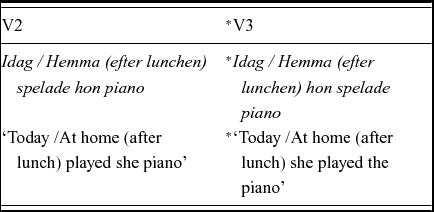
In the experimental sentences (60), the lead-in fragment consisted of one of two adverbials, the frequent idag, “today”, or the infrequent hemma, “at home”. Half of the sentences had long prefields with additional prepositional modifiers (e.g., idag efter lunchen, “today after lunch”) equally distributed across the two adverbials (Table 2). To complete the sentences participants had to order verbs in the simple past and grammatical subjects in third person singular (equally distributed over nouns, e.g., flickan, “the girl”, and personal pronouns, e.g., hon, “she”).
Examples of experimental sentences

The experimental sentences were intermingled with fillers (180), consisting of four sentence types: topicalizations (90), questions (30), SVX sentences (30), and negated sentences (30). Adverbials and verbs differed from the experimental items. Half of the adverbials were extended with prepositional modifiers. Verbs were highly frequent verbs, and were used across all four types of filler sentences. Subjects consisted of the first person singular personal pronoun jag “I” in addition to the subjects used in the experimental sentences. The total stimulus set thus consisted of 240 sentences presented to each participant (see Appendix). Sentences were pseudo randomised with the constraint that no more than three sentences from the same condition could appear in a sequence.
Acceptability judgement task
To probe offline comprehension, an acceptability judgement task (AJT) was administered. Each sentence was followed by a forced choice task where a left and right button press indicated if the sentence was “good” or “not so good” (side was counterbalanced across participants). During the stimulus presentation, the online ERP was measured in order to probe online processing (see below).
We presented grammatical sentences with V2 (160) and ungrammatical sentences with V3 word order (160), varying prefield length and adverbial frequency as in the SCT. The verbs and grammatical subjects were identical to those in the sentences in the SCT. To control for potential ERP wrap-up effects following the final word of the sentence (Hagoort et al., Reference Hagoort, Brown and Groothusen1993; Osterhout & Holcomb, Reference Osterhout and Holcomb1992, Reference Osterhout and Holcomb1993; Osterhout & Nicol, Reference Osterhout and Nicol1999), a final phrase was added that varied between 0–5 words. The experimental sentences were intermingled with fillers (160), yielding a total of 480 sentences presented to each participant. Two lists were created counterbalancing the distribution of sentences as V2 or V3. Each participant saw an item either as a V2 or a V3 sentence (see Appendix).
The sentences were visually presented word by word (white Arial, 22 pt. on black) in the centre of a computer screen 130 cm in front of the participant. Words were presented for 300 ms with an inter-stimulus interval (ISI) of 200 ms to reduce early ERP effects related to the word prior to the critical word (Steinhauer & Drury, Reference Steinhauer and Drury2012). Presentations of final words included full stops. No other punctuation was included. The final word was followed by a blank screen for 700 ms, after which three question marks appeared until the acceptability judgement was made.
ERP recordings
While participants read the sentences of the AJT, electrophysiological responses were recorded, time-locked to the grammatical subject (the critical point at which a word order violation could first be detected).
Electroencephalogram (EEG) was recorded from 29 electrodes mounted in an elastic cap (EASYCAP). These included three midline sites (Fz, Cz, and Pz) and 13 pairs of lateral sites (FP1/2, F7/8, FT7/8, F3/4, FC3/4, T7/8, TP7/8, C3/4, CP3/4, P7/8, P3/4, PO7/8, and O1/2). Four additional electrodes were placed beneath and above the left eye (VEOG) and the outer canthi of both eyes (HEOG) to monitor blinks and eye movements. Data from these sites, from midline sites and frontal pole sites were not included in analyses that were concentrated on sites where previous studies have shown larger effects in relation to word order violations. During recording, each scalp electrode was referenced to CZ; data were re-referenced to the averaged mastoids during offline processing. Eye-electrode impedances were maintained below 10 kΩ; mastoid- and scalp-electrode impedances below 5 kΩ. EEG was amplified with Neuroscan SynAmps2 (bandpass .05-100 Hz) and digitized at a sampling rate of 500 Hz. Off-line, ERPs time-locked to critical words (grammatical subjects) were segmented out of the continuous EEG separately for each participant at each electrode site over 1100 ms epochs, using a 100 ms pre-stimulus baseline. ERP processing was conducted using EEGLAB (Delorme & Makeig, Reference Delorme and Makeig2004).
Procedure
After signing consent forms, participants filled in the language background, handedness, and SES questionnaires (approximately 15 minutes) while the experimenters fitted the EEG cap onto participants’ heads. The experimental session started with a recording of ERP and AJT (approximately one hour). Directly following the ERP recording, participants performed the Swedish proficiency test (Swedex, 2012, approximately 10 minutes), the sentence completion task (SCT, approximately 30 minutes), and an English proficiency test (the Oxford placement test 2, approximately 10 min; Allen, Reference Allen1992). A complete session typically lasted for just over 2 hours. After the session participants were debriefed and awarded two movie tickets for their participation.
Data treatment and analyses
For the SCT production data, a Generalised Linear Mixed Model estimated the variance in the binary outcome variable word order (correct V2 vs. incorrect V3). Predictors were language group (Swe/Ger/Eng) with participants as random effect taking into account the repeated measures.
For the AJT data, response accuracy was measured by computing d-prime (d') scores (Wickens, Reference Wickens2002) such that d' = 0 indicated chance performance, and d' = 4 indicated near-perfect discrimination between V2 and V3 word orders. The d' scores were subjected to a one-way analysis of variance (ANOVA) with language group (Swe/Ger/Eng) as between subject-factor.
ERP analyses: Artefact rejection
Trials containing large artefacts were initially removed after which a digital, low-pass 40 Hz filter was applied to reduce high-frequency noise. Data was then subjected to the ‘runica’ routine of EEGLAB (Delorme & Makeig, Reference Delorme and Makeig2004). Ocular artefacts were identified from scalp topographies and the component time series, and removed. Any residual ocular artefacts were manually rejected at visual inspection. A minimum of 10 artefact-free trials per condition was imposed for each participant for data to be included in subsequent analyses.
ERP analyses: Statistical analyses
Mean amplitude was measured in the following time windows: 300–500, 500–700, 700–900, and 900–1000 ms. Time windows were chosen in reference to earlier studies targeting word order violations and from inspection of individual waveforms. Measures were subjected to repeated measures ANOVA with the following four within-subject factors: Word order (V2/V3), Hemisphere (right/left), Lateral position (lateral/medial), and Anterior/Posterior position aka Ant/Post (frontal/fronto-temporal/temporal/central/parietal/occipital). The between-subjects factor was language group (Swe/Ger/Eng). Following omnibus ANOVAs, additional analyses were performed in step-down fashion such that follow-up analyses were performed to isolate the location of any significant interactions. The Greenhouse-Geisser correction was applied to all measures with more than two levels. Corrected p-values and uncorrected degrees of freedoms are reported. Only significant effects will be presented.
In addition, to further explore any relationship between the scores on the behavioural task (AJT) and participant characteristics with the ERP data, for each participant the average difference amplitudes (V2-V3) were calculated for each electrode site in the time windows listed above. Pearson's correlations were then calculated to examine relationships between difference amplitude measures and behavioural measures (for all participants: AJT scores, participant age, Swedex proficiency scores, and in addition for the L2 groups: age of acquisition, and length of exposure). Pearson's correlations were conducted across all groups, and within L2 groups over electrode sites where significant main effects of word order were found, as well as over electrode sites where significant group differences were established.
Results
Behavioural results
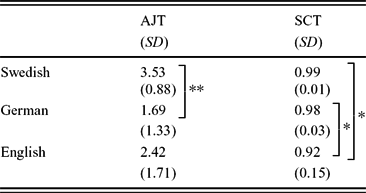
Table 3 summarises the behavioural results. In the sentence completion task, production accuracy (that is, the correct use of V2 word order) was close to ceiling for all participants. A Generalised Linear Mixed Model analysis suggested that Swedish native speakers and German learners, who did not differ from each other (Est. = −0.04, SE = 0.60, t = −0.06, p = .95), produced more correct sentences than English learners (Swedish–English: Est. = −1.22, SE = 0.55, t = −2.23, p < .05; German–English: Est. = 1.18, SE = 0.60, t = 1.97, p = .055). However, a closer inspection of the data revealed an outlier defined as a participant whose responses were more than two standard deviations from the mean in the English group. In a new analysis without the outlier the group difference disappeared (ps > .08).
Behavioural results

Note. Averages given in columns. AJT: Acceptability judgement task, SCT: Sentence completion task, SD: Standard deviation. Acceptability judgements in d-prime scores, analysed by an ANOVA. Sentence completion: proportion correct, analysed by Generalised Linear Mixed Models.
*p < .05
**p < .01
Turning to the acceptability judgement task, an analysis of variance showed a main effect of group (F(2,45) = 8.69, p < .01, ηp2 = .28). Since Levene's test of homogeneity was violated (F(2,45) = 5.54, p < .01), the conservative Bonferroni posthoc test was used for exploring simple effects. These showed that native Swedish speakers were significantly better at discriminating V2 and V3 word order than German learners (p < .01) and marginally better than English learners (p = .055). Crucially, the learner groups did not differ from each other (p = .419).
ERP results
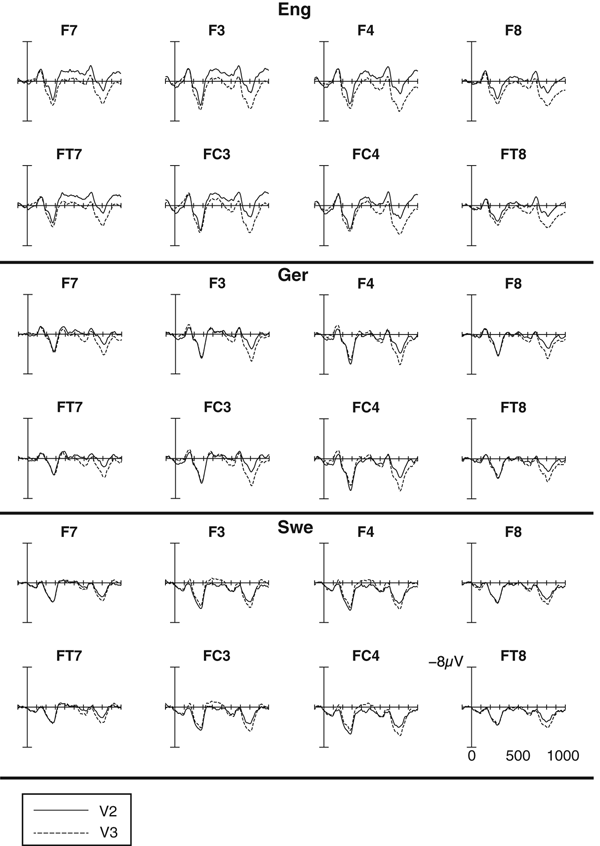
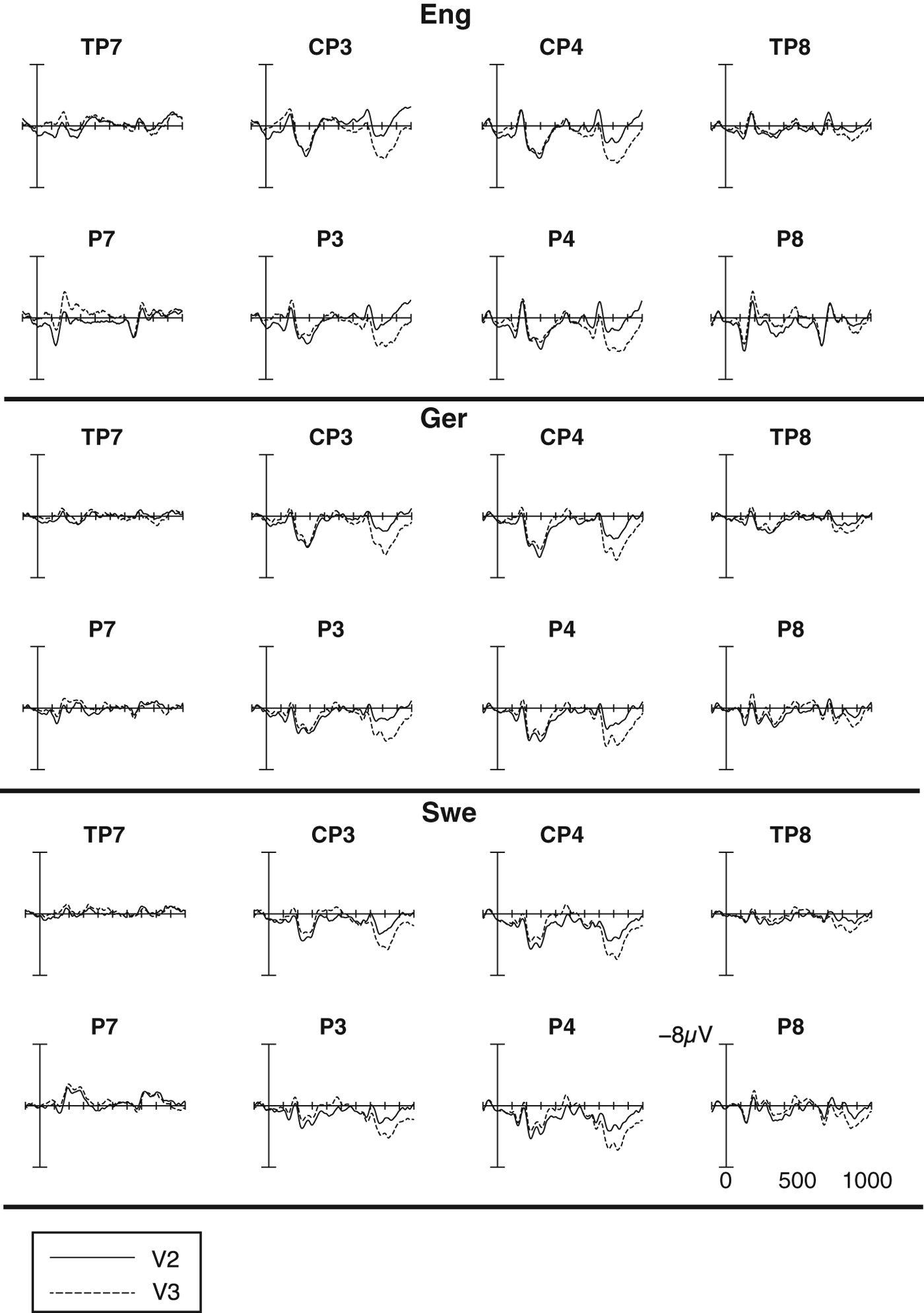
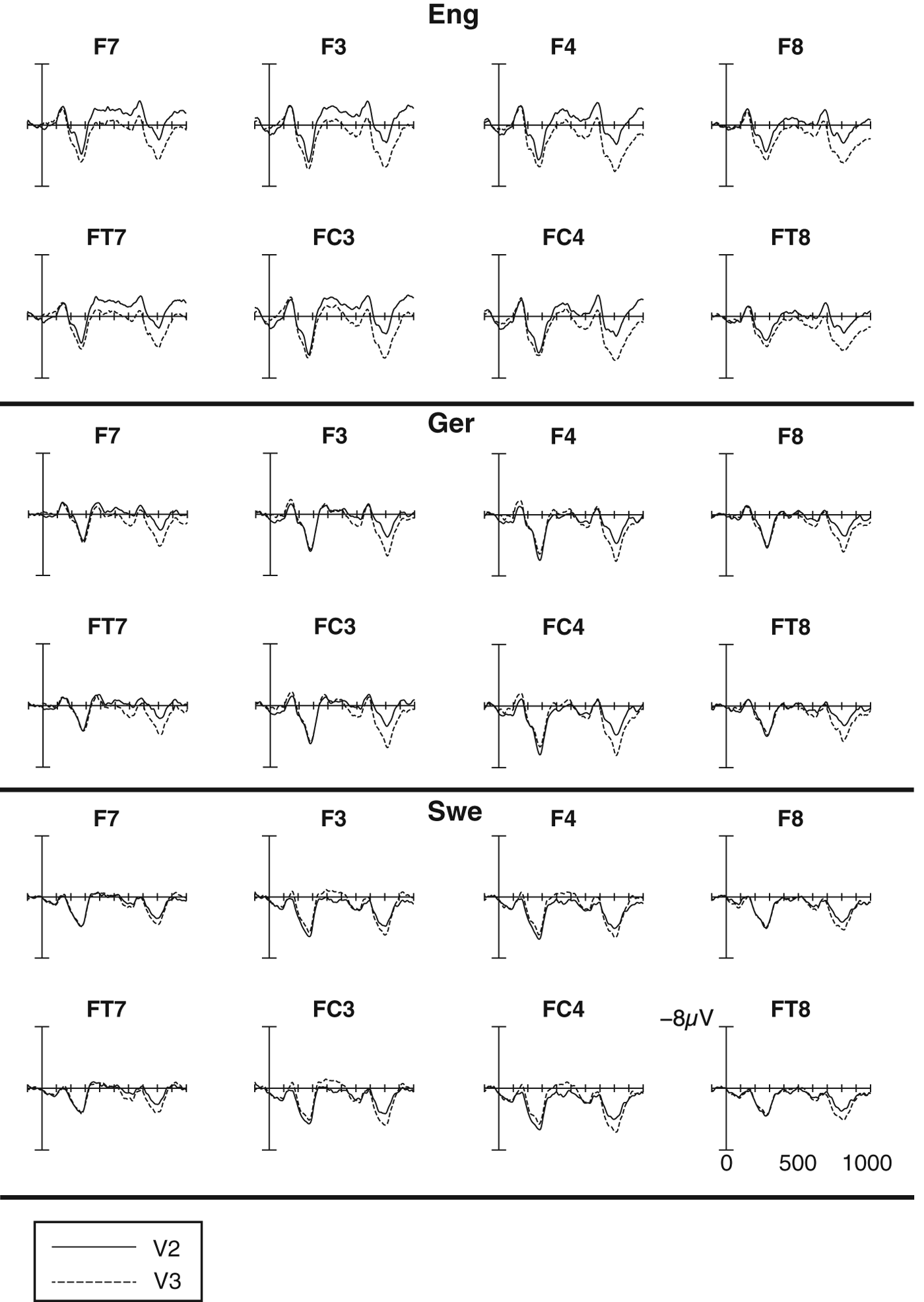
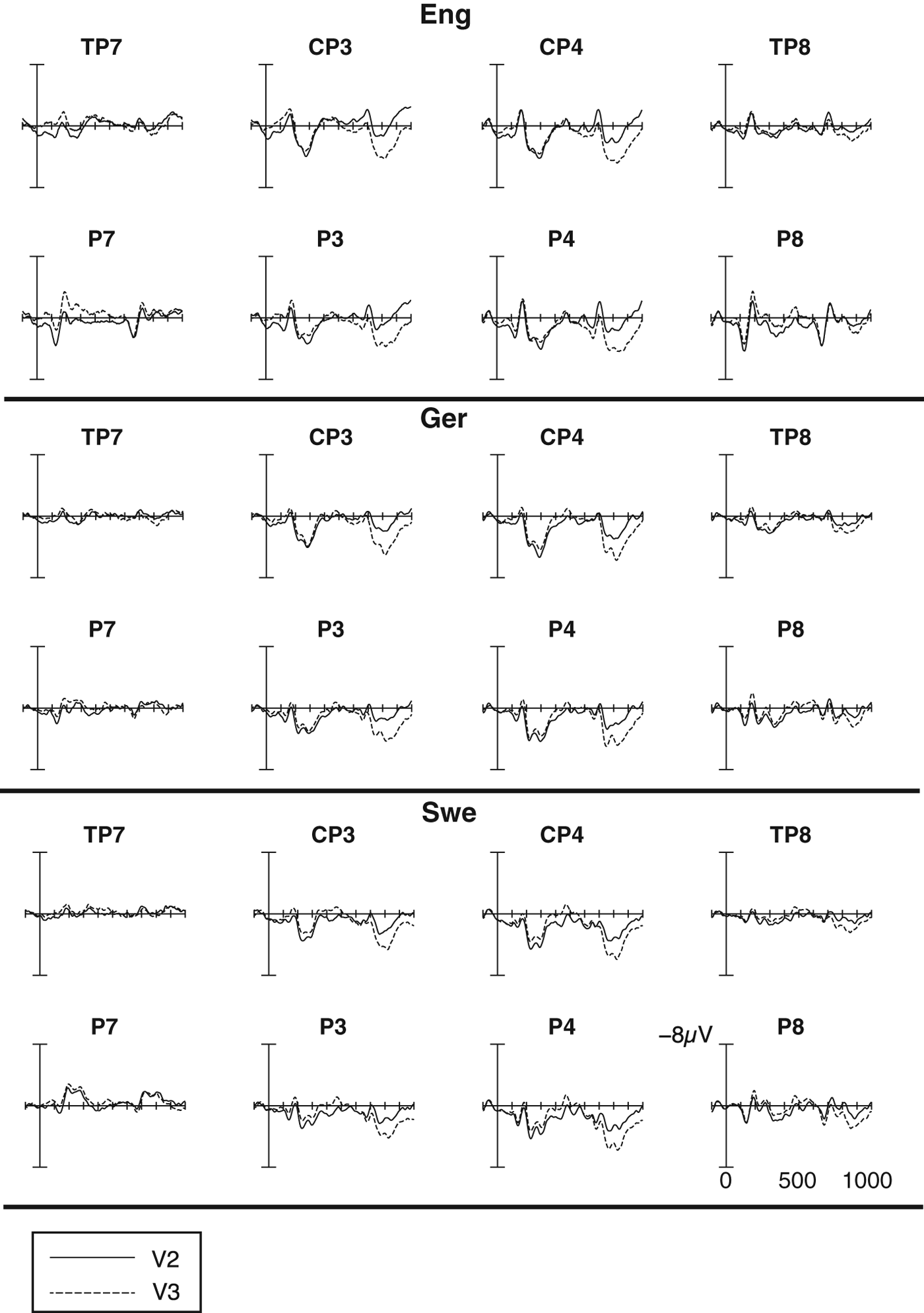
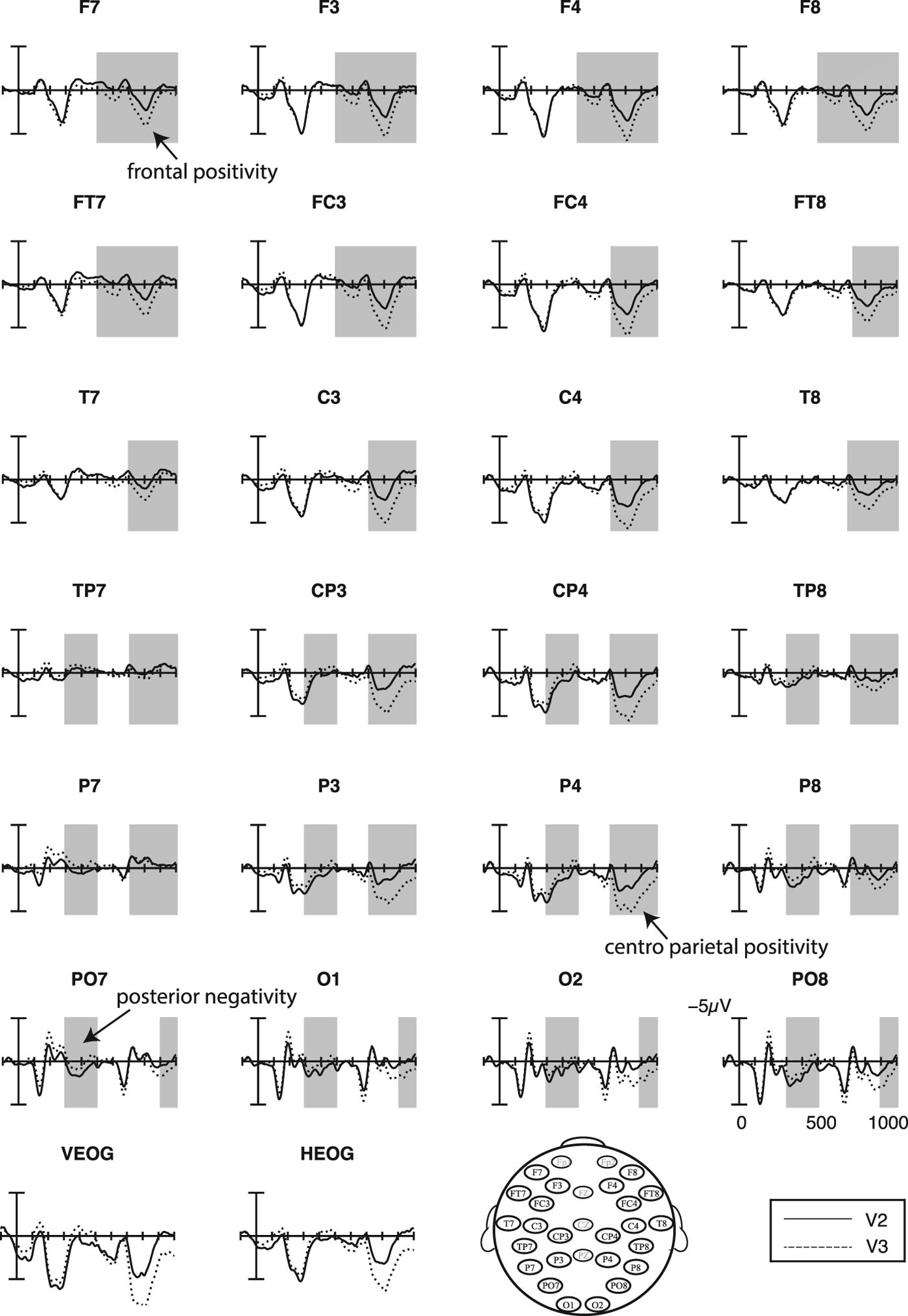
All groups showed an effect of word order violation. The general pattern was a larger frontal positivity restricted to learners of Swedish (Figure 2), and a larger posterior negativity followed by a larger central parietal positivity (P600) for V3 in comparison to V2 in all three groups (Figure 3).
Grand average waveforms, the ERPs to verb second word order (full line) and verb third word order (dashed line) over frontal and fronto-temporal sites in all three groups (English, German and Swedish native speakers). Note negative is plotted upward.
Grand average waveforms, the ERPs to verb second word order (full line) and verb third word order (dashed line) over central and parietal sites in all three groups (English, German and Swedish native speakers). Note negative is plotted upward.
Word order: V2/V3
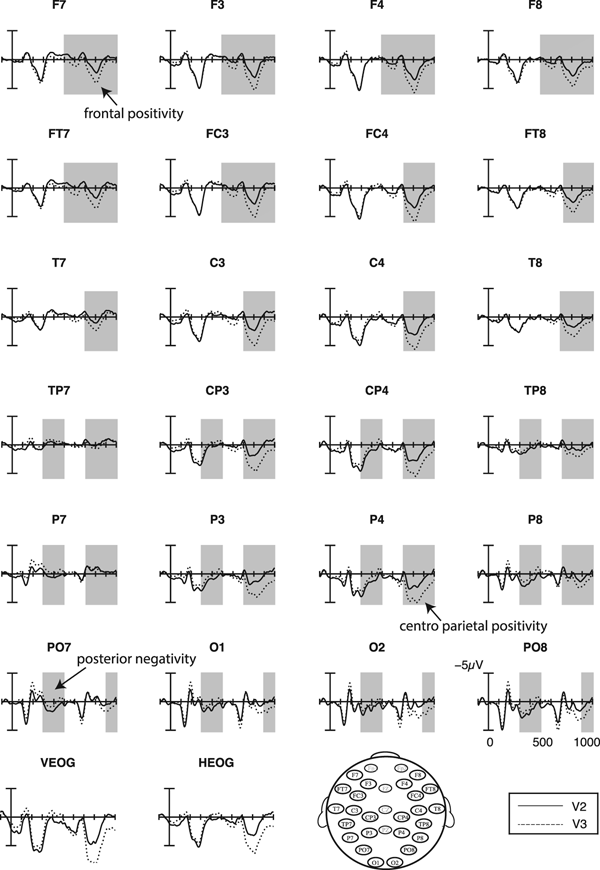
Across all participants (Figure 4) statistical analyses (Table 4) confirmed an increased posterior negativity 300–500 ms after critical word onset (Table 4). This negativity was followed by a frontal positivity (500-1000 ms) and a posterior positivity, strongest over centro-parietal sites (700-1000 ms; Table 4).
Grand average waveforms, the ERPs to verb second word order (full line) and verb third word order (dashed line) across all participants. Significant main effects of word order (Table 3) are highlighted in grey indicating a posterior negativity followed by a positivity strongest over centroparietal areas. Note negative is plotted upward.
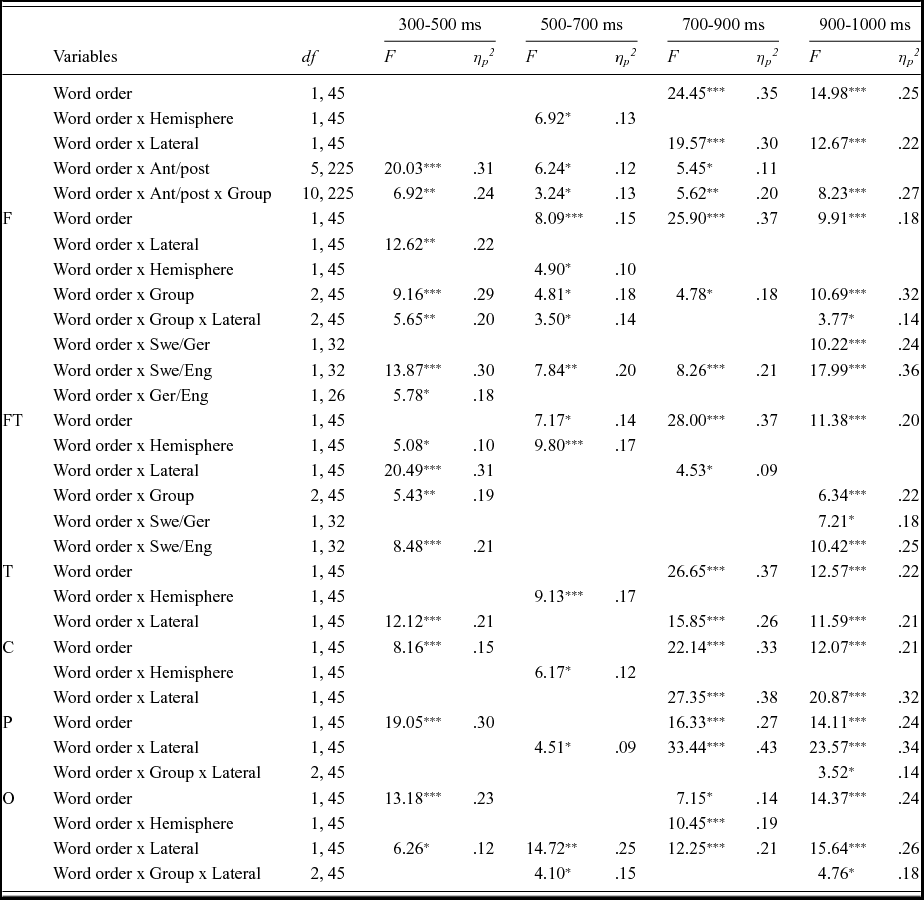
F-values for omnibus and follow up analyses of ERP effects to Swedish word order.

Note. Word order (condition effect, V2/V3), Hemisphere (left/right), Lateral (lateral/medial), Ant/post (anterior/posterior channels, up to 6 levels), Group (native speakers: Swedish/German/English), F: frontal, FT: fronto-temporal, T: temporal, C: central, P: parietal, O: occipital. Only significant and no more than 3-level interactions are reported. Only licensed follow ups are performed and reported. Bonferroni corrected ps .008.
*p < .05
**p < .01
***p < .008
The posterior negativity was significant over central, parietal and occipital sites 300–500 ms (Bonferroni corrected ps .008), and the frontal positivity was significant over left fronto-temporal sites 500–700 ms when corrected for multiple comparisons (Bonferroni corrected ps .004, FT7 FC3: F(1,45) = 10.48, p < .004, ηp2 = .19). These effects were followed by a broadly distributed positivity at 700–1000 ms. Follow up analyses of this later positivity showed that it was significant over frontal through parietal sites and posteriorly strongest over medial sites (Bonferroni corrected ps .008). Over occipital sites it was restricted to medial sites with Bonferroni corrected ps .004 at 700–900 ms (F(1,45) = 9.51, p < .004, ηp2 = .18). No other follow up analyses were significant.
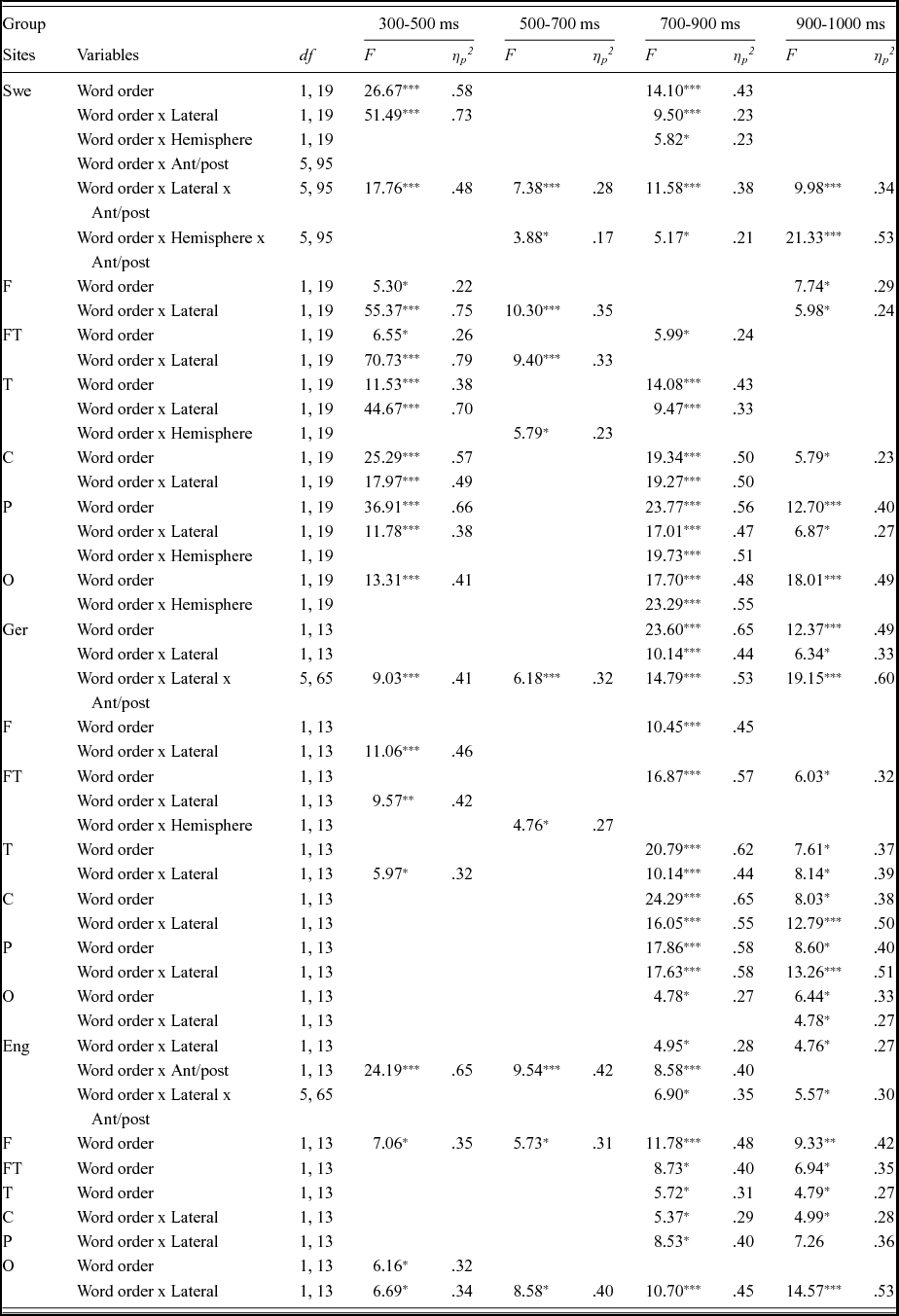
The exploratory analyses within groups (Table 5, Figure 5) showed a biphasic response in native Swedish speakers. More specifically, a fronto-medial negativity 300–500 ms (F3/4: F(1,19) = 14.47, p < .001, ηp2 = .43; FC3/4: F(1,19) = 18.43, p < .001, ηp2 = .49, Bonferroni corrected ps .004) followed by a posterior positivity that was strongest over medial sites (700-1000 ms). In German learners, the significant interactions of word order and electrode position factors on mean amplitude 300–700 ms reflected a fronto-lateral positivity and, as in Swedish native speakers, a medial negativity at 300–500 ms, followed by a stronger positivity over left sites at 500–700 ms. However, there were no significant effects at any subset of electrodes at 300–700 ms (ps > .067). The posterior positivity was significant with Bonferroni corrected ps (.008) at 700–900 ms, and approached significance over medial central (F(1,13) = 10.62, p = .006, ηp2 = .45) and medial parietal sites (F(1,13) = 11.24, p = .005, ηp2 = .46; Bonferroni corrected ps .004) in the subsequent time window, 900–1000 ms. In English learners, the significant interactions of word order and electrode position factors on mean amplitude 300–1000 ms reflected a frontal positivity and a posterior negativity that was followed by a positivity. The frontal positivity survived the conservative alpha correction (p = .008) at 700–900 ms only. The posterior negativity approached significance 300–500 ms over lateral occipital sites (F(1,13) = 9.20, p = .010, ηp2 = .42, Bonferroni corrected ps .004). In difference to responses in the other two groups, the posterior positivity that followed was not significant at any subset of electrode sites in English learners (ps > .072).
F-values for within group analyses of ERP effects

Note. Word order (condition effect, V2/V3), Hemisphere (left/right), Lateral (lateral/medial), Ant/post (anterior/posterior channels, up to 6 levels), Group (native speakers: Swedish/German/English), F: frontal, FT: fronto-temporal, T: temporal, C: central, P: parietal, O: occipital. Only significant and no more than 3-level interactions are reported. Bonferroni corrected ps .008.
*p < .05
**p < .01
***p < .008
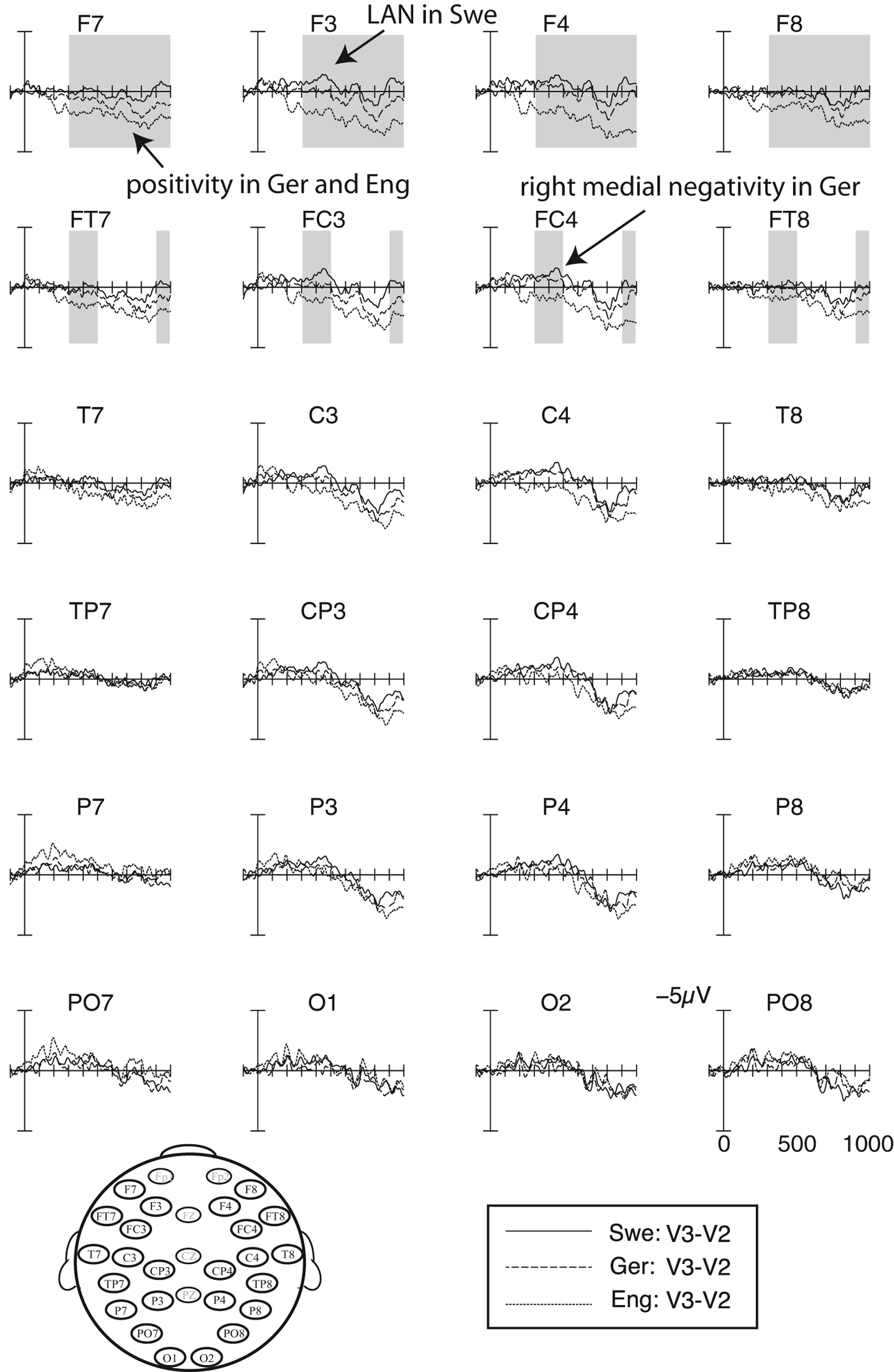
Difference waveforms, the ERPs to verb second word order subtracted from ERPs to verb third word order in Swedish (Swe, filled line), German (Ger, dashed line), and English native (Eng, dotted line) speakers. Significant main effects of group (Table 3) highlighted in grey indicating the group differences that were restricted to anterior sites. Some significant within group effects (Table 4) are indicated by denoted arrows. Note negative is plotted upward.
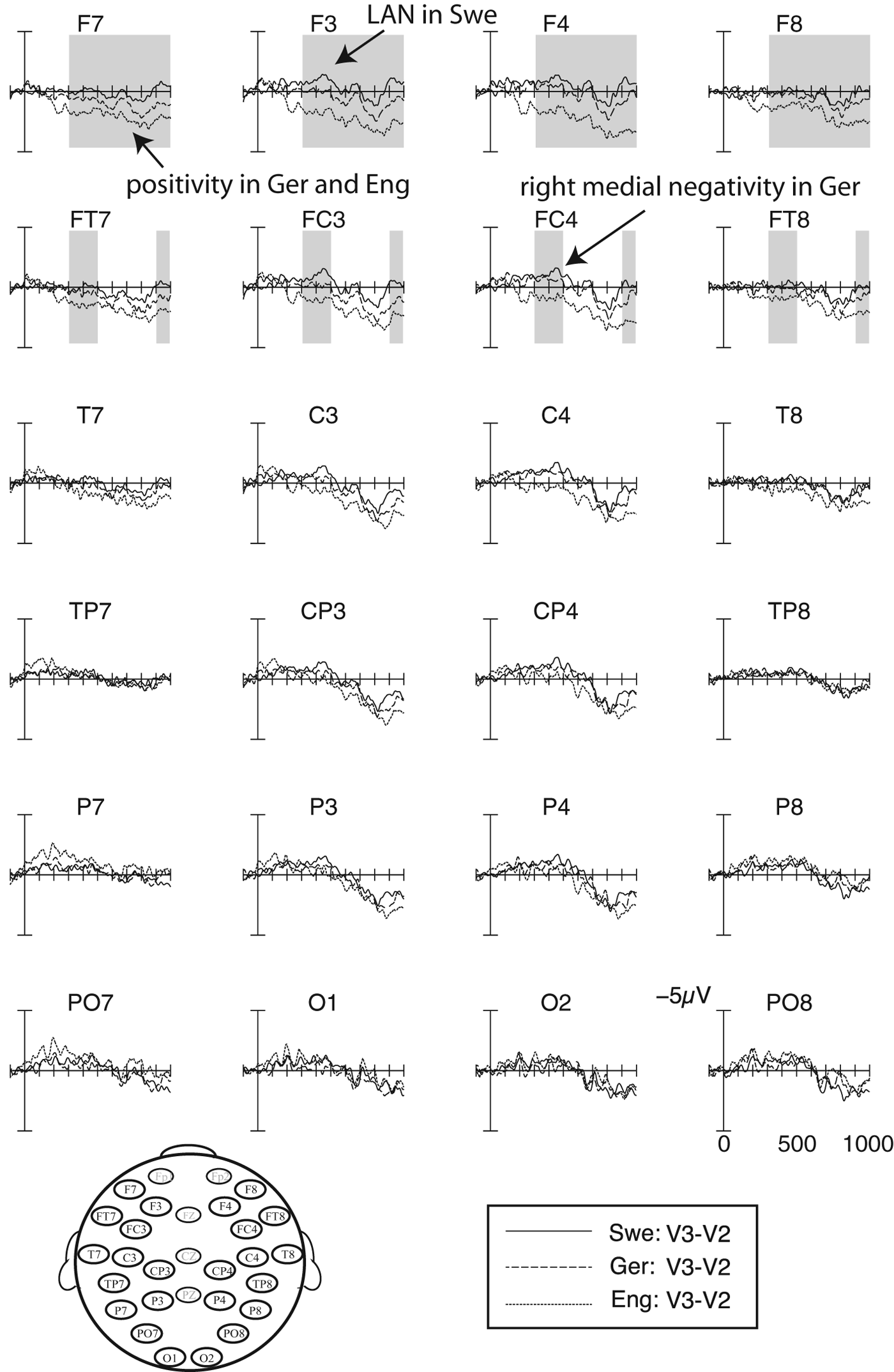
Planned contrasts revealed that differences in effects among the three groups (Swe/Ger/Eng) were restricted to frontal sites. Although the medial negativity in native Swedish speakers differed from the frontal positivity in English learners over anterior sites at 300–500 ms, it did not differ from the negativity in German learners (Table 4, Table 5, Figure 5). However, the medial negativity in German learners differed from the positivity in English learners. Between 500–700 ms and 700–900 ms the effect in native Swedish speakers differed from the positivity for English learners over frontal sites. The lateral positivity in German learners did not differ from either the suggested medial negativity in native Swedish speakers or the positivity in English learners. In the final time window, 900–1000 ms, an anterior group difference was established between native Swedish speakers, English and German learners. More specifically, the fronto-medial negativity in native Swedish speakers differed from the positivity in both German and English learners.
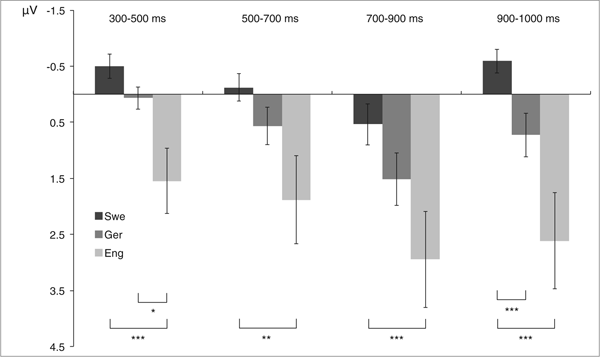
In summary, native Swedish speakers differed from English learners in the 300–1000 ms time window, whereas the difference with German learners was restricted to the final time window 900–1000 ms when they also differed from English learners (Figure 6). German learners differed from English learners only between 300–500 ms. Although visual inspections suggested a late difference in amplitude of the positivity distributed over all electrode sites, these group differences were significantly different only over anterior electrode sites.
Histogram of difference amplitudes over frontal sites. That is, ERPs to verb second word order subtracted from ERPs to verb third word order across Swedish, German, and English native speakers where significant group effects were established (Table 3). Significant differences between native Swedish (Swe), German (Ger), and English (Eng) speakers are marked by an asterisk (*p < .05, **p < .01, ***p < .008; Bonferroni corrected ps .008). Error bars indicate standard errors. Note negative is plotted upward.

It is important to acknowledge that the paradigm used in the current study includes a problematic issue concerning baseline comparisons (Steinhauer & Drury, Reference Steinhauer and Drury2012). When the word order changes from V2 to V3, the baseline of the critical word, the subject, will also change. That is to say that the baseline differs across conditions. To explore if these differences affect the results reported above, we performed additional analyses, comparing the ERP effects with three different baseline lengths (-100 to 0, -200 to 0, and 0–200). However, importantly, the same pattern of group differences as reported in the results section above remained. Please see the Supplementary Materials (Supplementary Materials, Tables S1-S4) for the additional analyses leading to these conclusions.
Relationships between ERP effects, behavioural scores and demographics
The Swedish proficiency measure (SWEDEX) and the behavioural measures (SCT and AJT) were not significantly related to the ERP effect in any time window. Moreover, when the correlations were explored within each group, none of the measures were related to the amplitude of the ERP effect. Further, within the learner groups neither age of acquisition nor length of exposure was related to the ERP effects.
Discussion
This study set out to examine whether L2 learners’ written production, offline judgements, and online processing of basic word order differ from that of native speakers, and, critically, whether the presence of a similar word order pattern in the L1 matters to processing in the target language. The results can be summarised in the following points. First, in production, the data showed ceiling effects. All groups produced predominantly correct word orders. Second, in offline acceptability judgements, we did find group differences such that native Swedish speakers were better at discriminating V2 and V3 word order than German and marginally better than English learners. Crucially, however, and contrary to our predictions, the L2 learner groups did not differ. Third, in the ERP results, all three groups showed an effect of word order violation. Although all groups showed an increased posterior negativity followed by a larger posterior positivity (P600), the negative effect over anterior sites was restricted to native Swedish speakers. Finally, as predicted, the learner groups patterned differently relative to the Swedes and to each other. English learners differed from the native Swedish speakers in all time windows, whereas the German learners did not. The German learners differed from native Swedish speakers only at the end of the analysed epoch, but also differed from the English learners at the beginning of the epoch. Consistent with the predictions, then, German learners were overall more Swedish-like than the English learners, and the differences were most pronounced over anterior sites.
In the production data, after the removal of an outlier, we found ceiling effects for all groups. Although this suggests that the learners were surprisingly proficient, it is probably an artefact of the design of the sentence completion task whereby all words were given, order options limited, and responses were untimed. In the acceptability judgements, contrary to our predictions, the German did not differ from the English learners, despite having a similar structure in their L1. Both learners did differ from the native speakers, even if only marginally so in the case of the English learners. The results might be due to the fact that the learner groups were matched on formal proficiency in order to allow us to pinpoint any crosslinguistic influence (CLI) effects in the ERP data.
The ERP results indicated that all participants, native speakers and learners alike, showed sensitivity to word order (violations) reflected in an increased P600. Our results thus indicate that, for word order, all learners of intermediate proficiency show nativelike P600 responses both when structures are shared (German learners) and when they are unique to the L2 (English learners). Similar native-like responses to morphosyntactic violations are attested in learners of low proficiency when the structures are shared between L1 and L2 (Davidson & Indefrey, Reference Davidson and Indefrey2009; McLaughlin, Tanner, Pitkänen, Frenck-Mestre, Inoue, Valentine & Osterhout, Reference McLaughlin, Tanner, Pitkänen, Frenck-Mestre, Inoue, Valentine and Osterhout2010; Pakulak & Neville, Reference Pakulak and Neville2011; Rossi, Gugler, Friederici & Hahne, Reference Rossi, Gugler, Friederici and Hahne2006; Tokowicz & MacWhinney, Reference Tokowicz and MacWhinney2005), and in learners of high proficiency even to L2-unique structures (Dowens et al., Reference Dowens, Guo, Guo, Barber and Carreiras2011; Dowens et al., Reference Dowens, Vergara, Barber and Carreiras2010; Morgan-Short, Sanz, Steinhauer & Ullman, Reference Morgan-Short, Sanz, Steinhauer and Ullman2010). However, in contrast to previous studies and our predictions, the amplitude of the P600 was not weaker in learners compared to native speakers (Hahne, Reference Hahne2001; Pakulak & Neville, Reference Pakulak and Neville2011; Weber-Fox & Neville, Reference Weber-Fox and Neville1996). The posterior negativity, present in all groups, has previously been reported in learners with low proficiency, in early stages of acquisition (Osterhout, McLaughlin, Pitkanen, Frenck-Mestre & Molinaro, Reference Osterhout, McLaughlin, Pitkanen, Frenck-Mestre and Molinaro2006; Osterhout, Poliakov, Inoue, McLaughlin, Valentine, Pitkanen, Frenck-Mestre & Hirschensohn, Reference Osterhout, Poliakov, Inoue, McLaughlin, Valentine, Pitkanen, Frenck-Mestre and Hirschensohn2008), and when the L1 does not share the feature (Chen et al., Reference Chen, Shu, Liu, Zhao and Ping2007; Neville, Coffey, Holcomb & Tallal, Reference Neville, Coffey, Holcomb and Tallal1993; Pakulak & Neville, Reference Pakulak and Neville2010, see Steinhauer, White & Drury, Reference Steinhauer, White and Drury2009 for a review). It is unclear why this negativity appears in all groups. This is possibly a topic for a separate study. Overall, the similarities across groups provide little evidence for any CLI effects in the general detection of violations as indicated by the posterior ERP effect.
Importantly, however, although all groups reacted to incorrect word order and showed similar posterior ERP effects, they differed in some details: German learners, whose L1 has V2 word order like Swedish, looked more Swedish-like than English learners, whose L1 does not. More specifically, the ERP effect of word order over left anterior sites in native Swedish speakers did not differ significantly from the negative effect over right medial sites in German learners, although both effects differed from the larger frontal positivity elicited in English learners. The anterior effect in native speakers was weaker than expected, in part replicating previous studies where the increases in the P600 has been more reliably evoked, whereas effects in the left anterior negativity (LAN) have not always been reported (den Ouden & Bastiaanse, Reference den Ouden and Bastiaanse2009; Ericsson, Olofsson, Nordin, Rudolfsson & Sandström, Reference Ericsson, Olofsson, Nordin, Rudolfsson and Sandström2008; Osterhout, Reference Osterhout1997; Weyerts et al., Reference Weyerts, Penke, Münte, Heinze and Clahsen2002). The right medial distribution of the anterior negative effect in German learners replicates the previously reported distribution for L2 processing (Friederici, Steinhauer & Pfeifer, Reference Friederici, Steinhauer and Pfeifer2002; Rossi et al., Reference Rossi, Gugler, Friederici and Hahne2006).
The frontal positivity elicited in English learners suggests a different type of processing of a syntactic structure absent from the L1 compared to when the structure is present and similar. It has been suggested that an anterior positive effect could be an indication that L2 learners devote more attentional resources than native speakers to a word that is unexpected in a constrained context (Federmeier et al., 2006; Kaan & Swaab, Reference Kaan and Swaab2003; Newman, Tremblay, Nichols, Neville & Ullman, Reference Newman, Tremblay, Nichols, Neville and Ullman2011). The absence of this anterior positive effect in the German learners therefore suggests a more efficient and less demanding type of processing for learners whose L1 has a similar structure (Hahne, Mueller & Clahsen, Reference Hahne, Mueller and Clahsen2006; Morgan-Short, Finger, Grey & Ullman, Reference Morgan-Short, Finger, Grey and Ullman2012). Similar results have been shown in fMRI studies where learners showed greater activity in left inferior frontal gyrus compared to native speakers when processing distinctions unique to the L2 (Hernandez & Li, Reference Hernandez and Li2007; Jeong, Sugiura, Sassa, Haji, Usui, Taira, Horie, Sato & Kawashima, Reference Jeong, Sugiura, Sassa, Haji, Usui, Taira, Horie, Sato and Kawashima2007; Jeong, Sugiura, Sassa, Yokoyama, Horie, Sato, Taira & Kawashima, Reference Jeong, Sugiura, Sassa, Yokoyama, Horie, Sato, Taira and Kawashima2007).
Interestingly, the results differ from those of Tokowicz and MacWhinney (Reference Tokowicz and MacWhinney2005) who found that English learners of Spanish at early stages of learning showed a nativelike P600 response to agreement violations (similar L1-L2) and to gender violations (unique to the L2), but not to article-noun number violations (present but differently expressed in L1 and L2). The current results indicate that word orders that are similar in L1 and L2 yield more nativelike patterns than L2-unique ones. Clearly, it will be important in future studies to further probe possible differences between morphosyntax and syntax proper (word order), as well as to consider how to gauge what is unique to the L2 versus present but dissimilar. Arguably, the current results suggest that, although V2 is technically a possibility in English, it is too rare to support English learners in the processing of Swedish V2 word order.
Overall, the current results suggest that basic L2 word order processing is open to crosslinguistic influence. Although there were no differences in the learner groups behaviourally (offline), the differences in the ERP effects (online) indicated that L2 learners whose L1 has a similar word order seem to use similar neurological substrates as native speakers to process the L2. Importantly, these findings extend the results from other ERP studies exploring effects of the L1 on L2 processing of morphosyntax (Dowens et al., Reference Dowens, Guo, Guo, Barber and Carreiras2011; Dowens et al., Reference Dowens, Vergara, Barber and Carreiras2010; Sabourin & Stowe, Reference Sabourin and Stowe2008) to syntactic structures showing that similarities in the L1 and L2 are more likely to yield similar ERP responses than structures that are not (for overviews see Caffarra, Molinaro, Davidson & Carreiras, Reference Caffarra, Molinaro, Davidson and Carreiras2015; Morgan-Short, Reference Morgan-Short2014; Tolentino & Tokowicz, Reference Tolentino and Tokowicz2011; van Hell & Tokowicz, Reference van Hell and Tokowicz2010). The findings therefore also suggest that the developmental trajectory of online word order processing in a second language may depend on whether the first and second language show similarities (more L1-L2 similarities should lead to faster nativelike processing), even if the development of offline comprehension shows no such influence.
Conclusions
This study has shown that the presence of a word order pattern in the L1 can facilitate online processing of a similar word order in an L2. Learners with similar syntactic structures in the L1 seem to rely on similar neural processing as native speakers. In contrast, learners whose L1 has dissimilar syntactic structures rely on partly different types of processing than native speakers. Importantly, this does not prevent them from reaching the same conclusions about word order appropriateness as native speakers offline, or indeed from detecting violations online. L2 acquisition and processing of different structures is thus not impossible and may yield the same behavioural end result, even if processed in a different manner neurologically.
Supplementary material
To view supplementary material for this article, please visit https://doi.org/10.1017/S1366728918000573
Appendix
List 1 without fillers.
1. Hemma flickan satt vid sin bänk
2. Hemma lekte hon ensam i köket
3. Idag på morgonen ringde han till sin pappa
4. Idag hon grät
5. Idag pojken sprang hem till Maria
6. Idag på rasten hon letade efter bollen nere vid sjön
7. Hemma i Lund städade hon hela dagen
8. Idag efter rasten flickan pratade med sin fröken
9. Hemma skrattade pojken
10. Idag på eftermiddagen han sov i gräset
11. Hemma i Malmö han joggade
12. Idag tittade flickan på alla de vackra blommorna
13. Idag på rasten flickan letade efter bollen nere vid sjön
14. Idag dansade han runt
15. Hemma i Malmö åt pojken godiset själv
16. Idag hon klättrade upp i trädet snabbt
17. Idag på eftermiddagen väntade flickan på Anna
18. Hemma i Sverige handlade pojken upp alla pengarna
19. Hemma pojken joggade
20. Idag vaknade pojken under filten
21. Hemma badade han gärna
22. Hemma i Sverige pojken hoppade högt
23. Idag efter skolan hon badade
24. Idag på morgonen dansade han runt
25. Hemma hos Anders tvättade flickan filten
26. Idag flickan väntade på Anna
27. Hemma hos Maria hon läste en bok för Sara
28. Hemma i Sverige hoppade han högt
29. Idag på rasten flickan läste tidningen utomhus
30. Hemma tystnade pojken för att lyssna på fåglarna
31. Hemma i Sverige han sprang till Sara
32. Idag läste hon tidningen
33. Idag på morgonen pojken tvättade
34. Hemma han tittade på Maria och log
35. Idag talade flickan med Eva och Maria
36. Idag efter rasten grät flickan
37. Hemma pojken letade efter sin bok
38. Idag han jobbade gärna
39. Hemma han skrattade
40. Idag efter skolan skrattade flickan åt Eric när han busade
41. Hemma i Lund skrattade han
42. Hemma flickan dansade hela dagen
43. Idag på rasten hon läste tidningen
44. Hemma i Lund flickan satt vid sin bänk
45. Hemma ringde han och alla gick in
46. Hemma i Sverige badade pojken gärna
47. Idag efter rasten svarade han snabbt
48. Idag på morgonen pojken dansade runt
49. Idag på morgonen han tvättade
50. Idag tvättade han
51. Hemma han sprang till Sara
52. Idag på rasten flickan åt sin mat
53. Hemma smakade pojken alla de nybakade kakorna
54. Idag på morgonen pojken sprang hem till Maria
55. Idag betalade han
56. Hemma talade hon med Erik
57. Hemma i Lund flickan drack saft
58. Idag efter rasten ramlade flickan
59. Idag pojken betalade
60. Hemma i Lund hon satt vid sin bänk
61. Hemma ringde pojken och alla gick in
62. Idag efter rasten flickan berättade om sin nya mössa
63. Hemma pojken sov på soffan
64. Hemma drack flickan saft
65. Idag på morgonen talade hon med Eva och Maria
66. Idag han sprang hem till Maria
67. Hemma flickan sjöng medan hon städade
68. Idag efter lunchen städade han undan sina kläder
69. Idag på morgonen pojken drack upp
70. Hemma hos Eric han tittade på Maria och log
71. Hemma ramlade flickan
72. Hemma i Lund lekte flickan ensam i köket
73. Hemma han skrev kortet med blommorna till Anna
74. Hemma hos Lars dansade flickan hela dagen
75. Idag han drack upp
76. Idag på eftermiddagen vilade hon
77. Hemma pojken handlade upp alla pengarna
78. Hemma hos Lars hon dansade hela dagen
79. Idag efter skolan arbetade pojken
80. Idag han ringde till sin pappa
81. Hemma flickan betalade för bollen
82. Hemma pojken hoppade högt
83. Hemma i Malmö åt han godiset själv
84. Idag joggade flickan hela vägen hem
85. Hemma i Malmö pojken skrev kortet med blommorna till Anna
86. Idag berättade hon om sin nya mössa
87. Hemma i Sverige hon ramlade
88. Idag flickan grät
89. Idag på eftermiddagen flickan kröp upp i soffan till Anna
90. Hemma svarade pojken på frågan
91. Hemma sparkade han
92. Hemma i Malmö pojken sov på soffan
93. Hemma i Malmö pojken smakade alla de nybakade kakorna
94. Hemma tvättade hon filten
95. Hemma i Sverige handlade han upp alla pengarna
96. Idag på morgonen drack han upp
97. Hemma hon satt vid sin bänk
98. Hemma i Lund han klättrade upp till skåpen
99. Idag flickan ramlade
100. Idag efter rasten satt hon
101. Hemma betalade hon för bollen
102. Idag ramlade hon
103. Idag på morgonen pojken ringde till sin pappa
104. Idag efter skolan klättrade hon upp i trädet snabbt
105. Hemma hos Eva jobbade han gärna
106. Hemma i Malmö målade han bänken
107. Idag efter skolan betalade pojken
108. Idag flickan badade
109. Idag efter skolan hon skrattade åt Eric när han busade
110. Hemma arbetade flickan medan Sara lekte
111. Hemma i Lund låg flickan på soffan och tänkte
112. Idag hon talade med Eva och Maria
113. Hemma han tystnade för att lyssna på fåglarna
114. Hemma hos Eric pojken tittade på Maria och log
115. Hemma sov han på soffan
116. Idag målade han en bild av en sjö
117. Hemma i Lund han kröp in under den varma filten
118. Hemma hos Eva pratade flickan med Eva och Maria
119. Idag skrattade flickan åt Eric när han busade
120. Hemma han åt godiset själv
121. Hemma i Lund pojken klättrade upp till skåpen
122. Hemma talade flickan med Erik
123. Idag på eftermiddagen pojken hoppade på studsmattan hela kvällen
124. Idag på rasten åt hon sin mat
125. Hemma flickan städade hela dagen
126. Hemma i Malmö han sov på soffan
127. Hemma i Malmö pojken målade bänken
128. Idag hon låg i soffan och läste
129. Idag läste flickan tidningen
130. Idag letade flickan efter bollen nere vid sjön
131. Hemma i Lund arbetade hon medan Sara lekte
132. Idag handlade han alla de nybakade kakorna
133. Hemma i Malmö han skrev kortet med blommorna till Anna
134. Hemma hon sjöng medan hon städade
135. Hemma hos Eric vaknade pojken
136. Idag på morgonen pojken målade en bild av en sjö
137. Idag hon väntade på Anna
138. Idag på morgonen vaknade pojken under filten
139. Idag hon tittade på alla de vackra blommorna
140. Hemma i Lund sjöng flickan medan hon städade
141. Hemma i Sverige sparkade pojken
142. Hemma badade pojken gärna
143. Hemma hos Anna berättade hon vad hon bakade hos Anna
144. Idag flickan satt
145. Hemma i Lund vilade hon länge
146. Hemma pojken vaknade
147. Hemma i Lund letade han efter sin bok
148. Idag badade hon
149. Idag efter rasten pratade hon med sin fröken
150. Idag på morgonen talade flickan med Eva och Maria
151. Idag hon sjöng hemma i köket
152. Idag klättrade flickan upp i trädet snabbt
153. Hemma i Malmö pojken joggade
154. Idag flickan åt sin mat
155. Hemma hon grät
156. Idag efter lunchen jobbade pojken gärna
157. Hemma i Lund hon låg på soffan och tänkte
158. Idag flickan skrev i sin dagbok
159. Idag lekte flickan med Anders och Erik
160. Hemma hos Eric han vaknade
161. Hemma han smakade alla de nybakade kakorna
162. Hemma i Lund sjöng hon medan hon städade
163. Idag efter rasten hon grät
164. Hemma målade pojken bänken
165. Idag på morgonen målade han en bild av en sjö
166. Idag på eftermiddagen vilade flickan
167. Hemma skrev pojken kortet med blommorna till Anna
168. Hemma flickan läste en bok för Sara
169. Idag tystnade hon när hon fick se hunden
170. Idag efter lunchen pojken spelade fotboll på gräsmattan
171. Idag svarade han snabbt
172. Idag på rasten hon tittade på alla de vackra blommorna
173. Idag berättade flickan om sin nya mössa
174. Hemma i Lund pojken skrattade
175. Idag på eftermiddagen sjöng flickan hemma i köket
176. Idag hon åt sin mat
177. Idag pojken spelade fotboll på gräsmattan
178. Hemma i Sverige väntade han på att Anna skulle komma
179. Hemma städade hon hela dagen
180. Idag efter skolan flickan klättrade upp i trädet snabbt
181. Idag han spelade fotboll på gräsmattan
182. Hemma i Malmö smakade han alla de nybakade kakorna
183. Hemma i Lund kröp pojken in under den varma filten
184. Hemma han jobbade gärna
185. Hemma vilade hon länge
186. Idag på morgonen hanvaknade under filten
187. Idag satt hon
188. Idag efter lunchen flickan skrev i sin dagbok
189. Hemma i Sverige badade han gärna
190. Idag pojken dansade runt
191. Hemma i Lund hon lekte ensam i köket
192. Idag han arbetade
193. Idag handlade pojken alla de nybakade kakorna
194. Idag efter skolan arbetade han
195. Hemma i Sverige pojken sprang till Sara
196. Hemma hos Maria flickan läste en bok för Sara
197. Hemma vilade flickan länge
198. Idag efter lunchen jobbade han gärna
199. Hemma i Sverige pojken ringde och alla gick in
200. Idag pojken jobbade gärna
201. Hemma i Sverige svarade han på frågan
202. Idag han vaknade under filten
203. Hemma handlade han upp alla pengarna
204. Idag efter lunchen skrev hon i sin dagbok
205. Hemma i Lund hon drack saft
206. Idag på eftermiddagen hoppade han på studsmattan hela kvällen
207. Hemma väntade pojken på att Anna skulle komma
208. Idag på eftermiddagen flickan lekte med Anders och Erik
209. Hemma han joggade
210. Hemma dansade hon hela dagen
211. Hemma hos Anna berättade flickan vad hon bakade hos Anna
212. Hemma flickan grät
213. Idag pratade hon med sin fröken
214. Idag städade han undan sina kläder
215. Idag på eftermiddagen hon kröp upp i soffan till Anna
216. Hemma tittade pojken på Maria och log
217. Hemma pojken jobbade gärna
218. Idag flickan sparade pengarna till kakorna
219. Idag efter lunchen han spelade fotboll på gräsmattan
220. Hemma åt pojken godiset själv
221. Hemma hos Anders tvättade hon filten
222. Hemma pratade hon med Eva och Maria
223. Hemma sprang pojken till Sara
224. Idag på eftermiddagen pojken handlade alla de nybakade kakorna
225. Idag flickan låg i soffan och läste
226. Idag lekte hon med Anders och Erik
227. Hemma i Sverige spelade pojken match
228. Idag pojken drack upp
229. Idag efter skolan badade flickan
230. Idag sjöng flickan hemma i köket
231. Idag efter skolan låg flickan i soffan och läste
232. Hemma hon drack saft
233. Hemma hon berättade vad hon bakade hos Anna
234. Hemma arbetade hon medan Sara lekte
235. Idag efter lunchen smakade pojken mjölken
236. Idag smakade pojken mjölken
237. Idag på eftermiddagen hon väntade på Anna
238. Idag ringde pojken till sin pappa
239. Hemma i Sverige flickan ramlade
240. Idag på eftermiddagen hon sjöng hemma i köket
241. Hemma pojken sparkade
242. Hemma hos Anna grät hon
243. Idag på eftermiddagen sov pojken i gräset
244. Hemma han målade bänken
245. Hemma klättrade pojken upp till skåpen
246. Idag efter rasten svarade pojken snabbt
247. Idag hon skrattade åt Eric när han busade
248. Idag efter rasten hon sparade pengarna till kakorna
249. Idag efter lunchen smakade han mjölken
250. Idag kröp flickan upp i soffan till Anna
251. Idag efter rasten ramlade hon
252. Hemma i Lund talade hon med Erik
253. Idag kröp hon upp i soffan till Anna
254. Idag pojken hoppade på studsmattan hela kvällen
255. Hemma i Sverige svarade pojken på frågan
256. Hemma flickan tvättade filten
257. Idag han hoppade på studsmattan hela kvällen
258. Hemma i Sverige väntade pojken på att Anna skulle komma
259. Hemma flickan pratade med Eva och Maria
260. Idag hon joggade hela vägen hem
261. Idag på eftermiddagen handlade han alla de nybakade kakorna
262. Idag pojken målade en bild av en sjö
263. Idag flickan vilade
264. Hemma hos Eva honpratade med Eva och Maria
265. Idag hon letade efter bollen nere vid sjön
266. Idag sparade hon pengarna till kakorna
267. Hemma hos Anna flickan grät
268. Hemma vaknade han
269. Hemma i Lund flickan vilade länge
270. Hemma i Malmö hantystnade för att lyssna på fåglarna
271. Hemma flickan låg på soffan och tänkte
272. Hemma läste hon en bok för Sara
273. Hemma hos Eric betalade hon för bollen
274. Idag skrev hon i sin dagbok
275. Hemma i Malmö pojken tystnade för att lyssna på fåglarna
276. Idag pojken städade undan sina kläder
277. Hemma spelade han match
278. Idag på eftermiddagen hon lekte med Anders och Erik
279. Hemma ramlade hon
280. Idag flickan pratade med sin fröken
281. Idag på rasten tittade flickan på alla de vackra blommorna
282. Hemma i Lund talade flickan med Erik
283. Hemma han kröp in under den varma filten
284. Idag efter lunchen pojken städade undan sina kläder
285. Hemma letade han efter sin bok
286. Idag arbetade pojken
287. Idag efter rasten flickan sparade pengarna till kakorna
288. Hemma han hoppade högt
289. Idag vilade hon
290. Hemma hos Eva pojken jobbade gärna
291. Hemma i Lund flickan städade hela dagen
292. Idag svarade pojken snabbt
293. Hemma han svarade på frågan
294. Hemma hos Eric betalade flickan för bollen
295. Hemma i Sverige hanspelade match
296. Hemma väntade han på att Anna skulle komma
297. Idag tystnade flickan när hon fick se hunden
298. Idag han sov i gräset
299. Idag efter rasten hon berättade om sin nya mössa
300. Hemma hon låg på soffan och tänkte
301. Idag tvättade pojken
302. Hemma pojken spelade match
303. Idag på morgonen tystnade flickan när hon fick se hunden
304. Hemma i Sverige han ringde och alla gick in
305. Idag på eftermiddagen joggade flickan hela vägen hem
306. Hemma i Lund arbetade flickan medan Sara lekte
307. Idag på eftermiddagen hon joggade hela vägen hem
308. Idag efter skolan han betalade
309. Idag smakade han mjölken
310. Idag sov pojken i gräset
311. Hemma i Lund letade pojken efter sin bok
312. Idag efter rasten satt flickan
313. Idag efter skolan låg hon i soffan och läste
314. Hemma han klättrade upp till skåpen
315. Hemma kröp pojken in under den varma filten
316. Hemma flickan berättade vad hon bakade hos Anna
317. Idag på morgonen hon tystnade när hon fick se hunden
318. Hemma lekte flickan ensam i köket
319. Hemma i Sverige hansparkade
320. Idag på morgonen han sprang hem till Maria