1. Introduction
Employees' actions create value in the hospitality industry. Therefore, managing employee attitudes and behaviors through leadership is critical for gaining a competitive advantage (Kusluvan, Reference Kusluvan2003). Effective leadership has been linked with various beneficial organizational and employee outcomes in the hospitality industry such as high organizational engagement and psychological empowerment (Huertas-Valdivia, Gallego-Burín, & Lloréns-Montes, Reference Huertas-Valdivia, Gallego-Burín and Lloréns-Montes2019; Lin, Ling, Luo, & Wu, Reference Lin, Ling, Luo and Wu2019), job performance (Elbaz & Haddoud, Reference Elbaz and Haddoud2017), well-being (Kara, Uysal, Sirgy, & Lee, Reference Kara, Uysal, Sirgy and Lee2013), and ethical climate (Demirtas & Akdogan, Reference Demirtas and Akdogan2015).
In recent decades, new leadership theories and styles, including servant leadership (Liden, Wayne, Meuser, Hu, Wu, & Liao, Reference Liden, Wayne, Meuser, Hu, Wu and Liao2015), have emerged as promising managerial approaches for the hospitality industry, with researchers recommending servant leadership as the ideal leadership style (Alexakis, Reference Alexakis2011; Brownell, Reference Brownell2010; Hunter, Neubert, Perry, Witt, Penney, & Weinberger, Reference Hunter, Neubert, Perry, Witt, Penney and Weinberger2013; Wu, Tse, Fu, Kwan, & Liu, Reference Wu, Tse, Fu, Kwan and Liu2013). Servant leadership, which is demonstrated by expressing humility and stewardship, provides a high-quality relationship and trust between leaders and followers (Van Dierendonck, Reference Van Dierendonck2011). This high-quality relationship has its roots in emotions and attitudes like empathy, respect, and loyalty.
Many leadership researchers agree that, beyond its many positive outcomes, servant leadership also significantly improves the ethical culture of organizations better than other leadership types (Brownell, Reference Brownell2010; Giampetro-Meyer, Brown, Browne, & Kubasek, Reference Giampetro-Meyer, Brown, Browne and Kubasek1998; Hunter et al., Reference Hunter, Neubert, Perry, Witt, Penney and Weinberger2013). One leading theoretical perspective for understanding the positive outcomes of servant leadership, including ethical culture, is social exchange theory (Blau, Reference Blau1986). According to social exchange theory, people tend to reciprocate the positive behaviors of others (Lambe, Wittmann, & Spekman, Reference Lambe, Wittmann and Spekman2008). Servant leaders influence others through reciprocity. In other words, the servant leader's altruistic and humble acts may be reciprocated through social exchange in which followers also display altruism. This may discourage the main motives for unethical behaviors, such as self-benefit (Greenberg, Reference Greenberg2002) or harming the organization or co-workers (Skarlicki & Folger, Reference Skarlicki and Folger1997; Thau, Aquino, & Poortvliet, Reference Thau, Aquino and Poortvliet2007).
As such, do servant leaders have the potential to lead the hospitality industry toward ethical conduct as Brownell (Reference Brownell2010: 375) has put forth, or is reaching such a conclusion premature? Recent studies have revealed acting in the best interest of others to be able to also lead to unethical behaviors (Babula, Tookey, Muschert, & Neal, Reference Babula, Tookey, Muschert and Neal2020; Lee, Schwarz, Newman, & Legood, Reference Lee, Schwarz, Newman and Legood2019; Matherne, Ring, & Farmer, Reference Matherne, Ring and Farmer2018). While conceptualizing this, Umphress, Bingham, and Mitchell (Reference Umphress, Bingham and Mitchell2010) presented the unethical pro-organizational behavior (UPB) phenomenon, addressing the acts undertaken to benefit the organization or other organizational members that violate moral values, social norms, or even the law. The phenomenon incorporates two key components according to the authors: the unethical behavior and the intention to benefit the organization or its members. Accordingly, employees may intentionally exhibit unethical behaviors in order to benefit their managers or organizations. For example, they may lie to customers in order to increase the sales or protect the image of their company. According to Umphress and Bingham (Reference Umphress and Bingham2011), high-quality relationship of social exchange with leaders (as in servant leadership) and the organization may promote UPB.
Drawing on this stream of research, and based on social exchange theory (Blau, Reference Blau1986; Cropanzano, Prehar, & Chen, Reference Cropanzano, Prehar and Chen2002), our study speculates that servant leadership may create favorable conditions for UPB. Past studies have indicated high-quality relationships between leaders and members to be able to lead to the emergence and strengthening of UPB (Gigol, Reference Gigol2020; Graham, Ziegert, & Capitano, Reference Graham, Ziegert and Capitano2015; Miao, Newman, Yu, & Xu, Reference Miao, Newman, Yu and Xu2013; Shaw & Liao, Reference Shaw and Liao2021). For example, ethical leadership (Hsieh, Hsu, Kao, & Wang, Reference Hsieh, Hsu, Kao and Wang2020; Miao et al., Reference Miao, Newman, Yu and Xu2013) and transformational leadership (Effelsberg, Solga, & Gurt, Reference Effelsberg, Solga and Gurt2014; Graham, Ziegert, & Capitano, Reference Graham, Ziegert and Capitano2015) are two positive leadership styles associated with UPB. As such, we propose that leaders who exhibit serving behaviors toward employees may also encourage employees to exhibit UPB to help the organization, particularly the leader.
This study aims to enhance the literature on social exchange theory, servant leadership, and UPB, in the hospitability industry by proposing a model to connect servant leadership, UPB, and individual-level factors like trust in manager and employees' positive reciprocity beliefs (PRB). If servant leadership encourages employees to display UPB, it can be proponed that it has a hidden dark side that can produce negative outcomes. To our knowledge, this would be the first research to examine the negative outcomes of servant leadership. Furthermore, this study has been conducted in Turkey, where high power distance and collectivist cultures prevail. In Turkey, leader–follower relationships are characterized by reciprocal support and deep emotions such as trust, loyalty, and altruism (Costigan, Insinga, Berman, Ilter, Kranas, & Kureshov, Reference Costigan, Insinga, Berman, Ilter, Kranas and Kureshov2006). As such, we believe that the Turkish managerial context may generate unique outcomes for servant leadership.
2. Literature review and hypotheses development
2.1 Theoretical background
UPB is defined as an act intended to help the organization and its members (such as managers) at the expense of violating social norms, laws, or ethical values (Umphress & Bingham, Reference Umphress and Bingham2011). Employees display UPB to help their leaders and/or organizations (Mishra, Ghosh, & Sharma, Reference Mishra, Ghosh and Sharma2021; Umphress, Bingham, & Mitchell, Reference Umphress, Bingham and Mitchell2010; Umphress, Gardner, Stoverink, & Leavitt, Reference Umphress, Gardner, Stoverink and Leavitt2020). However, such actions may in the long run ultimately harm the organization (e.g., hiding or manipulating critical information or documents from a ministry of tourism inspector could have devastating consequences). UPB can damage an organization's reputation and often causes money and customer losses. Lawsuits may even be filed against the organization and result in serious penalties, as in the VW emissions test scandal (Pinar, Reference Pinar2016).
Umphress and Bingham (Reference Umphress and Bingham2011) explain UPB in terms of social exchange theory in that an employee responds positively to a manager's positive behaviors or practices. The perceived exchange quality and intensity of the positive relationship between leaders and employees can encourage UPB (Bryant & Merritt, Reference Bryant and Merritt2019; Wang, Long, Zhang, & He, Reference Wang, Long, Zhang and He2019). Positive leadership styles, such as ethical leadership (Mayer, Kuenzi, & Greenbaum, Reference Mayer, Kuenzi and Greenbaum2010), transformational leadership (Effelsberg, Solga, & Gurt, Reference Effelsberg, Solga and Gurt2014; Graham, Ziegert, & Capitano, Reference Graham, Ziegert and Capitano2015), charismatic leadership (Graham, Ziegert, & Capitano, Reference Graham, Ziegert and Capitano2015), and identification with the manager (Miao et al., Reference Miao, Newman, Yu and Xu2013) may motivate subordinates to engage in UPB. Furthermore, subordinates who feel a strong identification with their manager tend to engage in UPB even when they know that their manager's decisions and behaviors were unethical (Fehr, Welsh, Yam, Baer, Weid, & Vaulont, Reference Fehr, Welsh, Yam, Baer, Weid and Vaulont2019).
Gouldner (Reference Gouldner1960) stated social exchange to be a social norm that shapes societal interactions, including employment relationships. The basic assumption of the theory is the exchange of resources between two parties. Accordingly, if one party provides a benefit to the other, the other party will repay it. In collectivist cultures in particular, employees tend to see their employers as their supporters and protectors and feel indebted to them (Cropanzano & Mitchell, Reference Cropanzano and Mitchell2005; Hofstede, Hofstede, & Minkov, Reference Hofstede, Hofstede and Minkov2010; Pellegrini & Scandura, Reference Pellegrini and Scandura2008). As a result, employees present their commitment and loyalty. In addition, employees who retain a strong feeling of loyalty can feel obliged to violate ethical codes to benefit their leaders or organizations (Wang et al., Reference Wang, Long, Zhang and He2019; Yan, Hu, & Wu, Reference Yan, Hu and Wu2021). In other words, social exchange can result in UPB (Graham, Ziegert, & Capitano, Reference Graham, Ziegert and Capitano2015; Miao et al., Reference Miao, Newman, Yu and Xu2013; Umphress & Bingham, Reference Umphress and Bingham2011).
Employees can adjust their attitudes and behaviors with the organization or the leader. Leaders affect employees' behaviors directly and indirectly through organizational commitment (Becker, Billings, Eveleth, & Gilbert, Reference Becker, Billings, Eveleth and Gilbert1996), organizational citizenship (Kim, Van Dyne, Kamdar, & Johnson, Reference Kim, Van Dyne, Kamdar and Johnson2013), psychological contracts (Alcover, Rico, Turnley, & Bolino, Reference Alcover, Rico, Turnley and Bolino2016), behaviors, and perceptions; leaders' positive behaviors; and employees' affective commitment (Chen, Chen, & Sheldon, Reference Chen, Chen and Sheldon2016; Matherne & Litchfield, Reference Matherne and Litchfield2012) and identification (Effelsberg, Solga, & Gurt, Reference Effelsberg, Solga and Gurt2014).
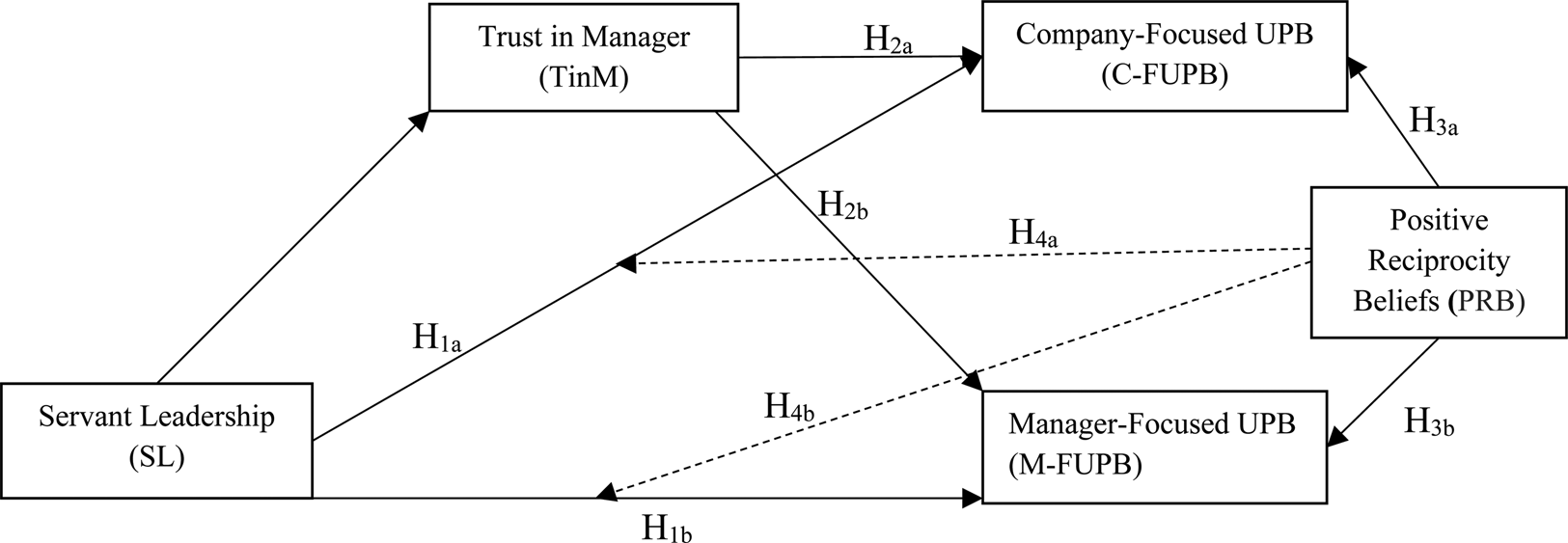
Umphress, Bingham, and Mitchell (Reference Umphress, Bingham and Mitchell2010) defined UPB as a positive response to the organization and its members. However, some studies have shown managers to only be seen as the representative of an organization (Connelly, Certo, Ireland, & Reutzel, Reference Connelly, Certo, Ireland and Reutzel2011), although employees may also view the organization and the manager as two separate reference points (Chen, Tsui, & Farh, Reference Chen, Tsui and Farh2002) and determine their attitudes and behaviors accordingly (Lavelle, Rupp, Manegold, & Thornton, Reference Lavelle, Rupp, Manegold, Thornton, Cropanzano and Ambrose2015). Thus, the manager's leadership style may encourage a unique form of employee behavior. Following Umphress, Bingham, and Mitchell (Reference Umphress, Bingham and Mitchell2010), this study accepts that UPB may emerge as a response to both the organization and the manager. Therefore, our proposed model includes two different types of UPB (i.e., company-focused, and manager-focused (Figure 1)).
The research model.

Because the model is based on social exchange theory, it integrates theoretical concepts from different research areas involving the literature on leadership, ethics, and trust. This integrative approach helps us comprehensively understand the impact servant leadership has on employee UPB. Few leadership studies in the hospitality industry have focused on the follower side of the leader–follower relationship for understanding its outcomes. Though few leadership studies have adopted a social exchange approach, these neglected the role of followers' individual characteristics (Zou, Tian, & Liu, Reference Zou, Tian and Liu2015). As a result, the study aims to focus both on leadership styles as well as the follower's individual characteristics that predict UPB. The following sections develop the model's hypotheses.
Based on this model, the study addresses three main research questions:
How much does managers' servant leadership encourage employees' company-focused and manager-focused UPB?
How does employees' trust in manager mediate the manager–employee relationship within the scope of social exchange theory?
What is the effect of PRB, which are conceptualized as a basic personality trait, as both an independent and a moderating variable?
2.2 Relationship between servant leadership and unethical pro-organizational behavior
The servant leadership phenomenon was presented to the literature by Greenleaf's cornerstone article, ‘The Servant as Leader’. Greenleaf's (Reference Greenleaf1998) servant leader is supportive and empathetic toward her/his followers. Servant leaders devote themselves to the advancement of the organization and its members (Page & Wong, Reference Page and Wong2000). From their review of 285 studies over the last 20 years, Eva, Robin, Sendjaya, Van Dierendonck, and Lidene (Reference Eva, Robin, Sendjaya, Van Dierendonck and Lidene2019) concluded that servant leadership is perceived predominantly as a positive leadership style. Accordingly, many studies find a positive influence of servant leadership on many positive employee outcomes, such as organizational citizenship (Liden, Wayne, Zhao, & Henderson, Reference Liden, Wayne, Zhao and Henderson2008) and commitment (Harwiki, Reference Harwiki2016; Kwak & Kim, Reference Kwak and Kim2015).
Servant leaders engage employees across multiple dimensions, such as relational, emotional, and spiritual. A core element of servant leadership is the stewardship behavior which encourages the leader to protect the long-term interests of all stakeholders (Van Dierendonck & Nuijten, Reference Van Dierendonck and Nuijten2011). While contributing to all stakeholders, servant leaders primarily improve the performance of employees and the organization, and make sure that the employees grow and achieve their well-being (Ling, Lin, & Wu, Reference Ling, Lin and Wu2016; Qiu, Dooley, & Xie, Reference Qiu, Dooley and Xie2020; Rachmawati & Lantu, Reference Rachmawati and Lantu2014). By acting as a servant to fulfill the needs of employees, the servant leader fosters positive organizational outcomes (Saleem, Zhang, Gopinath, & Adeel, Reference Saleem, Zhang, Gopinath and Adeel2020). However, although servant leadership is altruistic and ethically oriented (Greenleaf, Reference Greenleaf1998), solid financial results are also required. This may motivate employees to act unethically in favor of their leader's performance out of gratitude. Past research shows that in collective and high-power distance countries such as Turkey, the relationship between the manager and the employees is built on gratitude, trust, and self-sacrifice (Costigan et al., Reference Costigan, Insinga, Berman, Ilter, Kranas and Kureshov2006; Öner, Reference Öner2012; Wasti, Tan, & Erdil, Reference Wasti, Tan and ve Erdil2011). Employees who feel a strong commitment toward their beloved managers may violate the moral codes in order to help them. So, acting in favor of the leader may additionally include unethical behaviors such as lying or withholding information (Johnson & Umphress, Reference Johnson and Umphress2018). For example, Shaw and Liao (Reference Shaw and Liao2021) recently found that benevolent leadership promote UPB among employees in China which is also a collective and high-power distance country. Therefore, we expect to observe a positive relationship between servant leadership and employees' UPB. As stated before, we built our hypotheses for two types of UPB: company-focused and manager-focused.
H1a Servant leadership has a significant positive effect on employees' company-focused UPB.
H1b Servant leadership has a significant positive effect on employees' manager-focused UPB.
2.3 The mediating role of trust in manager
Trust is one's willingness to believe in another's words, acts, and decisions (Cook & Wall, Reference Cook and Wall1980; McAllister, Reference McAllister1995). According to Mayer, Davis, and ve Schoorman (Reference Mayer, Davis and ve Schoorman1995), interpersonal trust occurs when a person agrees to be vulnerable to another and doesn't consider it necessary to control the counter party. Leadership is an essential asset to build trust in the organization (Joseph & Winston, Reference Joseph and Winston2005). Institutional trust is created when the leader is perceived as a servant who understands the organization and cares for all the stakeholders (Greenleaf, Reference Greenleaf1998). Consequently, trust in manager is an outcome of servant leadership (Joseph & Winston, Reference Joseph and Winston2005).
Trust requires taking risks being vulnerable to others. Trust in manager encourages positive employee behaviors and emotions. When the trusted leader behaves as expected, employees experience greater job satisfaction (Bayarcelik & Findikli, Reference Bayarcelik and Findikli2016; Daley & Pope, Reference Daley and Pope2004), job involvement, engagement, organizational commitment (Lambert, Keena, Haynes, Ricciardelli, May, & Leone, Reference Lambert, Keena, Haynes, Ricciardelli, May and Leone2020; Shalini & Poornima, Reference Shalini and Poornima2016), organizational identification (Thomas, Reference Thomas2015), and well-being (Di Stefano, Venza, Cascio, & Gaudiino, Reference Di Stefano, Venza, Cascio and Gaudiino2018; Su & Swanson, Reference Su and Swanson2019). According to Bryant and Merritt (Reference Bryant and Merritt2019), trust deserves to be examined more explicitly because it may be a critical factor controlling employee UPB.
Trust shapes the relationships between managers and employees as well as the outcomes of these relationships, especially in collectivist cultures (Hofstede, Hofstede, & Minkov, Reference Hofstede, Hofstede and Minkov2010). Trust between individuals in collectivist cultures is built on mutual support, dedication, and loyalty (Branzei, Vertinsky, & Camp, Reference Branzei, Vertinsky and Camp2007; Triandis, Bontempo, Villareal, Asai, & Lucca, Reference Triandis, Bontempo, Villareal, Asai and Lucca1988). The leader's positive attitudes and behaviors create deep trust, commitment, and loyalty among employees (Ghosh, Reference Ghosh2011). These feelings can be so powerful that employees may behave unethically to protect the manager or business with which they are affiliated (Kim, Miao, & Park, Reference Kim, Miao and Park2015).
H2a Trust in manager mediates the positive relationship between servant leadership and employees' company-focused UPB.
H2b Trust in manager mediates the positive relationship between servant leadership and employees' manager-focused UPB.
2.4 Relationship between positive reciprocity beliefs and unethical pro-organizational behavior
As Clark and Mills (Reference Clark and Mills1979) argue, individuals have different levels of willingness to engage in exchange relationships, which is referred to as PRB in literature. PRB can be described as the level of positive response of people who see social relationships as a state of exchange (Eisenberger, Lynch, Aselage, & Rohdieck, Reference Eisenberger, Lynch, Aselage and Rohdieck2004). The basis of social exchange theory is the sense of obligation to return benefits to the exchange partner (Zou, Tian, & Liu, Reference Zou, Tian and Liu2015). Thus, individuals with strong PRB tend to feel indebted to reciprocate a favorable behavior. In business life, the counterpart of an exchange relationship is usually the employing organization. Thus, PRB increases the probability of acts to help the organization or the leader. Contrarily, individuals who have a low level of PRB barely feel any obligation to respond a positive behavior (Umphress, Bingham, & Mitchell, Reference Umphress, Bingham and Mitchell2010). PRB can be considered a basic personality trait or a norm (Blau, Reference Blau1986).
We therefore hypothesize that PRB increases employees' willingness to conduct company and/or manager-focused UPB.
H3a PRB have a significant positive impact on employees' company-focused UPB.
H3b PRB have a significant positive impact on employees' manager-focused UPB.
2.5 The moderator role of positive reciprocity beliefs
Past research indicated that PRB have moderating effect on leader–member relations and UPB. Umphress, Bingham, and Mitchell (Reference Umphress, Bingham and Mitchell2010) proposed that PRB moderates the relationship between organizational identification and UPB. According to Bryant and Merritt (Reference Bryant and Merritt2019) on the other hand, PRB have no moderating effect on the relationship between leader–member exchange and UPB. Lastly, Zou, Tian, and Liu (Reference Zou, Tian and Liu2015) indicated that PRB moderated the relationship between servant leadership and leader–member exchange and team–member exchange. Lastly, Vriend, Said, Janssen, and Jordan (Reference Vriend, Said, Janssen and Jordan2020) found that leader–member exchange relations motivate pro-leader unethical intention as a means to satisfy positive reciprocity motives. Therefore, besides its direct impact on the employees' UPB, we expect to observe PRB's moderating effect on the relationship between servant leadership and UPB.
H4a PRB moderates the relationship between servant leadership and employees' company-focused UPB.
H4b PRB moderates the relationship between servant leadership and employees' manager-focused UPB.
3. Method
3.1 Participants and procedure
A questionnaire has been used to measure the perceptions of full-time employees of resort hotels in Alanya, Turkey. The fieldwork is limited to Alanya because it has 82 five-star and 98 four-star resort hotels (ALTID, 2020), the greatest number of hotels for any Turkish city. The data were collected by seven research assistants through face-to-face surveys. Before starting data collection, hotel managers were informed about the research and their verbal consent was obtained. The participants are informed that the data will be used for only scientific purposes and their personal information will be kept as confidential. The face-to-face collection of the data by professionals helped the participants to trust the researchers and answer the questions honestly. The sampled hotels were selected using judgment sampling. In judgment sampling, which is a type of nonprobability sampling, the researcher uses their own judgment to select the most representative sample (Babbie, Reference Babbie2004). The prerequisites for selecting the sample are year-round employment in a year-round hotel and having been employed there for at least 1 year. Data have been collected from 441 employees working in hotels open during the winter season because we predict that year-round employees will provide more accurate data than seasonal employees. Employees who work year-round can best understand and evaluate management's attitudes and behaviors. Additionally, seasonal factors like tips or bonuses would have the least impact on employees' perceptions during the off-season. Of the 441 administered surveys, 49 were excluded due to being improperly completed. Thus, the analyses have been conducted using the data from the remaining 392 participants.
The sample includes 235 male and 157 female employees, most of whom (73%) are married; their average age is 31.2 years old. In total, 39% of the participants have a university degree, 49% have 2-year degrees, and 11% have high school diplomas. Only 15% of the sample hold a managerial position; 57% of the participants work in main operations and 27% work in assistance services.
3.2 Measures
Company-focused UPB have been measured using the original six-item UPB scale developed by Umphress, Bingham, and Mitchell (Reference Umphress, Bingham and Mitchell2010). To measure manager-focused UPB, the six original items have been modified to refer to the manager, not the organization. (e.g., ‘I have withheld negative information about my hotel or its products from customers and clients because it benefited my manager.’)
Van Dierendonck and Nuijten (Reference Van Dierendonck and Nuijten2011)'s 30-item Servant Leadership Survey is used to measure servant leadership.
Trust in manager is measured with the first 10 items from Hoy and Tschannen-Moran's (Reference Hoy, Tschannen-Moran, Hoy and Miskel2003) trust scale. The items referring to the principal have been revised to refer to the manager (e.g., ‘Employees in this hotel can rely on my manager,’ ‘Employees in this hotel have faith in the integrity of my manager,’ and ‘When my manager commits to something, employees can be sure it will get done’).
The 10-item Positive Reciprocity Norms Scale by Eisenberger et al. (Reference Eisenberger, Lynch, Aselage and Rohdieck2004) is used to measure employee PRB.
A 5-point Likert-type scale has been used to assess the items on servant leadership (1 = never; 5 = very frequently) and for the other scales (1 = strongly disagree; 5 = strongly agree).
3.3 Evaluating the measurement model
The study employs the hybrid analysis method. The hypothesized relationships among the variables are first tested with the structural equation model (SEM). SEM is basically an analysis method for analyzing the linear hypothesized relationships among the constructs defined in the research model. One disadvantage of using SEM is the risk of unpredicted relationships going unnoticed in the research model because SEMs only analyze defined relationships (Sharma, Sharma, & Dwivedi, Reference Sharma, Sharma and Dwivedi2019). Therefore, nonlinear relationships among variables are tested using an artificial neural network (ANN) to compensate for SEM's disadvantages. Using an ANN also allows for verifying the results from the SEM. Because developing a hypothesis according to the ANN method is difficult, using the hybrid model is recommended instead of solely using the ANN method (Chong, Reference Chong2013). The SEM analysis has been conducted using Smart PLS 3.2.9 and the ANN analysis using SPSS 24.
3.4 Evaluating the scales
As suggested by Hair, Hult, Ringle, and Sarstedt (Reference Hair, Hult, Ringle and Sarstedt2017), convergent validity, internal consistency, discriminant validity, and multicollinearity analyses have been, respectively, performed for the reflective and formative measurement models in the preliminary analyses of the research model.
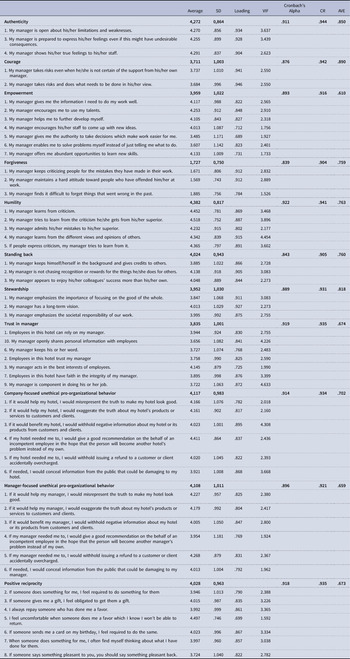
Performing an indicator reliability test is recommended for ensuring the convergent validity of the scales; the values of the outer loadings for the indicators should be >.70, and the values of the average variance extracted (AVE) for the constructs should be >.50 (Hair, Black, Babin, & Anderson, Reference Hair, Black, Babin and Anderson2010). For indicator reliability, the variables with factor loading values <.70 are analyzed first. The method suggested by Hair et al. (Reference Hair, Hult, Ringle and Sarstedt2017) has been preferred for this. The variables with factor loading values <.40 have been excluded from the analysis, while the variables with factor loading values >.70 have been kept. For the variables with factor loading values between .40 and .70, while being excluded from their own construct validity analyses, their effects have been examined with regard to AVE, Cronbach's α, and composite reliability (CR). Some indicators with outer loading values <.70 that meet the norm values have been left within the scope of analyzing the research model. The results from the analysis are shown in Table 1.
Averages, standard deviations, composite reliability, internal consistency, multicollinearity analysis results

As suggested, the variance inflation factor (VIF) values have been reviewed to check for multicollinearity. According to Hair et al. (Reference Hair, Black, Babin and Anderson2010), any VIF values >5 indicate that the model may be contaminated by common method bias. As shown in Table 1, the VIF values for the variables are between 1.526 and 4.633. Additionally, collinearity among the variables used in the analysis of the research model is considered to be non-problematic.
Values for Cronbach's α and CR that are higher than .70 suggest internal consistency to be acceptable (Urbach & Ahlemann, Reference Urbach and Ahlemann2010). Convergent validity has been measured by conducting AVE tests, with AVE values >.50 being defined as the threshold (Falk & Miller, Reference Falk and Miller1992; Fornell & Larcker, Reference Fornell and Larcker1981; Urbach & Ahlemann, Reference Urbach and Ahlemann2010).
The values obtained for Cronbach's α, CR, and AVE, which are the indicators of the internal consistency and convergent validity of the constructs, meet the requirements (see Table 1).
In addition to Cronbach's α analysis, Fornell and Larcker (Reference Fornell and Larcker1981) recommended that the CR value for each construct be ≥.70.
Table 1 shows the results from the convergent validity and internal consistency (reliability) tests. All variables and constructs meet the norm values. All AVE values are >.50, thus confirming convergent validity. The Cronbach's α values for each factor are >.70 and the CR values are >.70, both of which are above the norm values indicating the data to be internally consistent (Hair et al., Reference Hair, Hult, Ringle and Sarstedt2017).
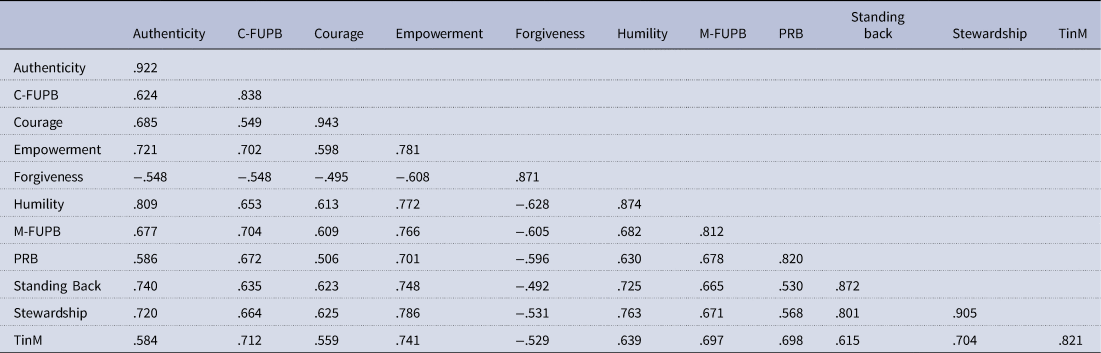
Fornell–Larcker's discriminant validity analysis was also conducted. According to Fornell and Larcker (Reference Fornell and Larcker1981), scores should be significantly higher than any other correlation coefficients among each construct. As Table 2 shows, the results indicate that all factors had discriminant validity.
Discriminant validity based on the Fornell–Larcker criterion

C-FUPB, company-focused unethical pro-organizational behavior; M-FUPB, manager-focused unethical pro-organizational behavior; PRB, positive reciprocity beliefs; TinM, trust in manager.
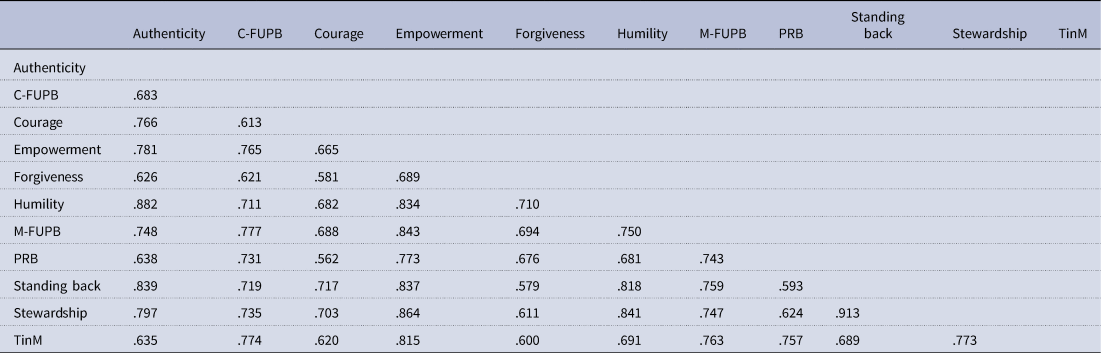
The heterotrait–monotrait ratio of correlations (HTMT) analysis has also been conducted (Henseler, Dijkstra, Sarstedt, Ringle, Diamantopoulos, & Straub, Reference Henseler, Dijkstra, Sarstedt, Ringle, Diamantopoulos and Straub2014). As Table 3 shows, the model has discriminant validity (Hair et al., Reference Hair, Hult, Ringle and Sarstedt2017) due to the HTMT ratios between the constructs being ≤.90.
Discriminant validity based on the heterotrait–monotrait ratio (HTMT)

C-FUPB, company-focused unethical pro-organizational behavior; M-FUPB, manager-focused unethical pro-organizational behavior; PRB, positive reciprocity beliefs; TinM, trust in manager.
3.5 Evaluating the model
Having established the validity and reliability of the scales, the R 2 measure of the endogenous constructs and the path coefficients have been determined for a preliminary assessment of the research model (Chin, Reference Chin and Marcoulides1998; Hair et al., Reference Hair, Hult, Ringle and Sarstedt2017).
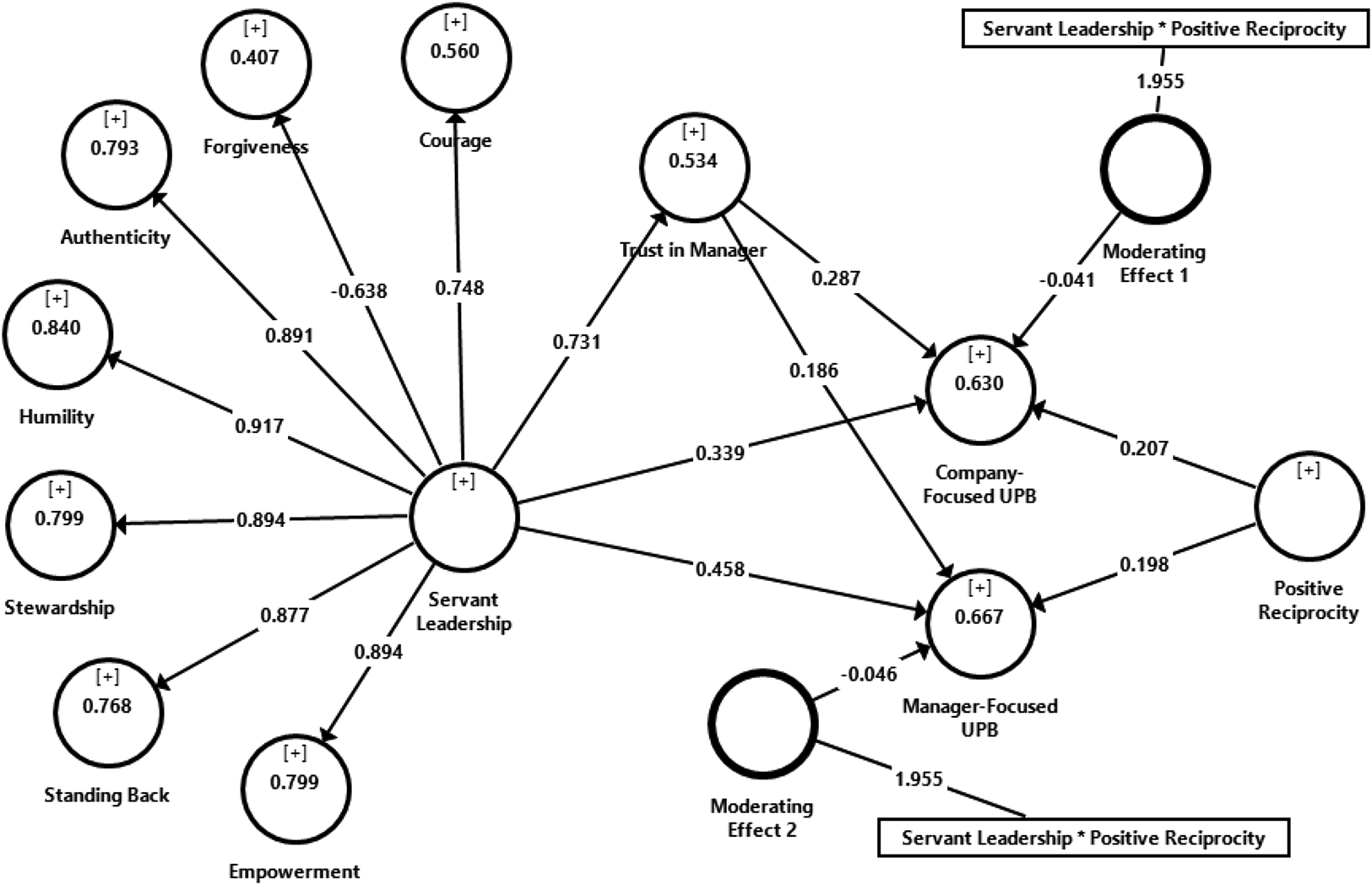
The R 2 values indicate the percentage of the variance each variable in the research model explains (Garson, Reference Garson2016). According to Henseler, Ringle, and Sinkovics (Reference Henseler, Ringle and Sinkovics2009), R 2 values of .67, .33, and .19 can, respectively, be identified as substantial, moderate, and weak. Figure 2 exhibits the R 2 values for almost all the model's endogenous constructs to be substantial except for courage, forgiveness, and trust in manager which have moderate R 2 values. Therefore, the model has an overall high level of predictive accuracy for the latent variables.
Research model path analyses.

The predictive power of the research model is assessed next. The standardized root mean square residual (SRMR) indicates the average magnitude of the divergences between observed and expected correlations (SmartPLS, 2020); this provides an absolute measure of the (model) fit criterion. A value of <.10 or .08 is considered to show good fit (Henseler et al., Reference Henseler, Dijkstra, Sarstedt, Ringle, Diamantopoulos and Straub2014). The research model's SRMR value is .071, indicating the model to be appropriate.
RMStheta is the root mean squared residual covariance matrix of the outer residuals of the model. RMStheta values less than .12 indicate a model with good fit (Henseler et al., Reference Henseler, Dijkstra, Sarstedt, Ringle, Diamantopoulos and Straub2014). The value for the model is .135, indicating the research model to have poor fit. However, the analysis is able to proceed as the other results indicate the model to be appropriate.
In addition to the SmartPLS algorithm, a bootstrap analysis using 5,000 sub-samples from the 391 cases has been performed to estimate direct, mediated, and moderated relationships (Hair, Sarstedt, Ringle, & Mena, Reference Hair, Sarstedt, Ringle and Mena2012).
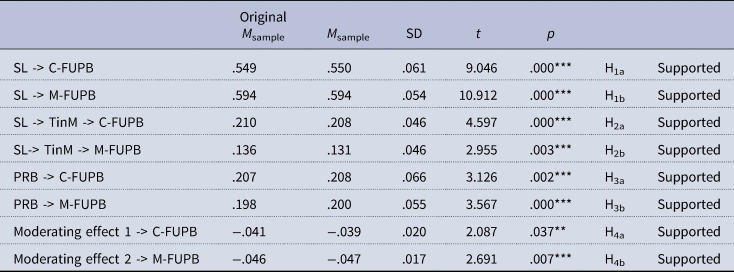
The t and p values in Table 4 indicate all the path coefficients of the model to be statistically significant. All the hypotheses have been confirmed at a 95% confidence level with t-statistics above the critical t-value of 1.96. In other words, the relationships (H1a, H1b, H3a, and H3b), mediator effects (H2a and H2b), and moderator effects (H4a and H4b) all have high significance.
Path coefficients, indirect, and moderating effects

SL, servant leadership; C-FUPB, company-focused unethical pro-organizational behavior; M-FUPB, manager-focused unethical pro-organizational behavior; PRB, positive reciprocity beliefs; TinM, trust in manager; *p < .1; **p < .05; ***p < .01.
Wetzels, Schröder, and Van Oppen (Reference Wetzels, Schröder and Van Oppen2009) proposed a global fit measure, the goodness of fit (GoF) of PLS path modeling for assessing model quality. GoF is measured using the following equation

The baseline GoF values of .1, .25, and .36 indicate low, medium, and high levels of fit for validating the globally defined PLS model (Tenenhaus, Vinzi, Chatelin, & Lauro, Reference Tenenhaus, Vinzi, Chatelin and Lauro2005; Wetzels, Schröder, & Van Oppen, Reference Wetzels, Schröder and Van Oppen2009). The GoF value for this research model is .755, indicating the quality of the research model to be high and globally defined.
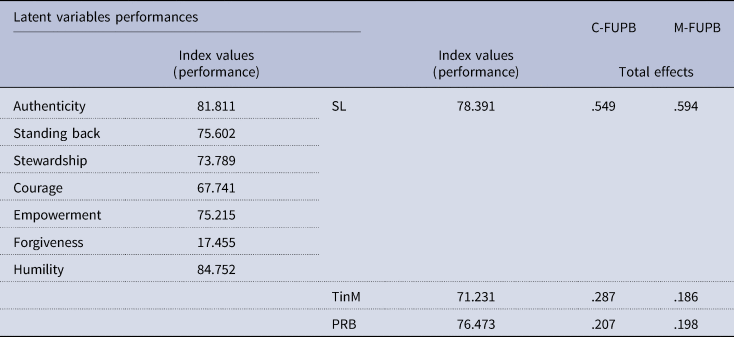
In the model, company-focused UPB and manager-focused UPB are target constructs predicted by three predecessors (i.e., servant leadership, trust in manager, and PRB). An importance-performance map analysis is performed for each construct (Hair et al., Reference Hair, Hult, Ringle and Sarstedt2017). The results presented in Table 5 reveal the performance and total effects of servant leadership to be stronger than trust in manager and PRB. Servant leadership is the most important construct for both company-focused and manager-focused UPB. Table 5 shows a full list of the importance-performance values.
Significance-performance map analysis for C-FUPB and M-FUPB

C-FUPB, company-focused unethical pro-organizational behavior; M-FUPB, manager-focused unethical pro-organizational behavior; PRB, positive reciprocity beliefs; TinM, trust in manager.
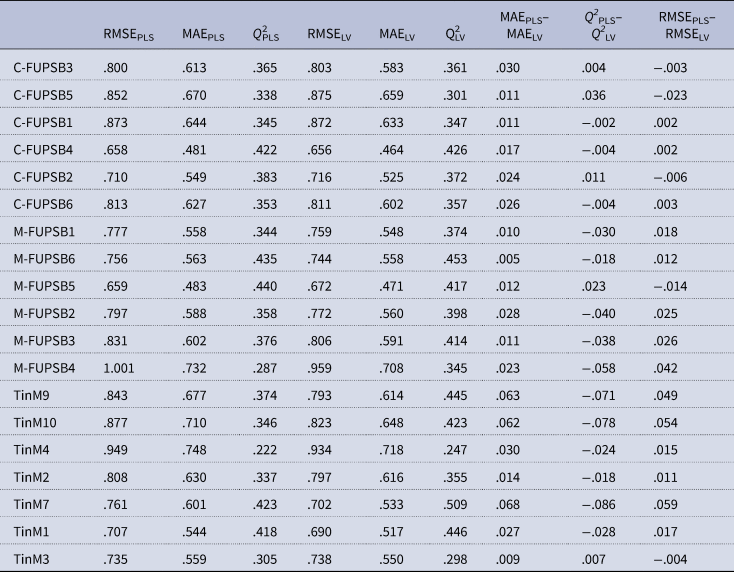
The SmartPLS algorithm's feature PLSpredict examines the manifest variables of the research model for assessing the PLS path models and their predictive performance. The majority (or equal number) of variables in the PLS-SEM analysis having smaller prediction errors than the linear model (LM) shows the research model to have medium predictive power (Shmueli et al., Reference Shmueli, Sarstedt, Hair, Cheah, Ting, Vaithilingam and Ringle2019). As seen in Table 6, TinM3 and TinM1 have respective RMSE values of .735 and .707, whereas the LM produces respective RMSE values of .738 and .690 for these variables. The variables' mean bias is very small (TinM3 = −.004; TinM1 = .017); therefore, the model does not strongly predict TinM3 or TinM1 while the other variables for TinM are acceptable. C-FUPB3 and C-FUPB5 have respective RMSE values of .800 and .852, whereas the LM produces respective RMSE values of .803 and .875 for these variables. The variables' mean bias is very small (C-FUPB3 = −.003 and C-FUPB5 = −.023); therefore, the model does not strongly predict C-FUPB3 or C-FUPB5. The remaining variables for company-focused UPB are acceptable. Similarly, the variables of manager-focused UPB have small mean biases. The variables are sufficient and have high predictive power.
PLSpredict assessment of the research model's manifest variables

C-FUPB, company-focused unethical pro-organizational behavior; M-FUPB, manager-focused unethical pro-organizational behavior; TinM, trust in manager.
3.6 Artificial neural network analysis
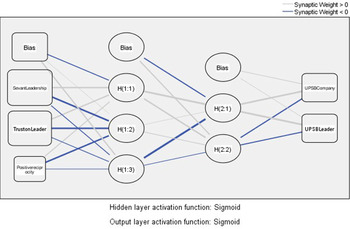
A neural network analysis determines the form of the relationships through a learning process. If nonlinear relationships are more appropriate, the neural network automatically approximates the correct model structure (SPSS, 2018). This study's neural network analysis is conducted using SPSS 24. The input layer contains the predictors, which are the significant variables in the SEM (i.e., servant leadership, trust in manager, and PRB). The output layer, meanwhile, contains two variables (i.e., company-focused UPB and manager-focused UPB). Tenfold cross-validation has been performed to avoid over-fitting. In accordance with Chong (Reference Chong2013) and Akgul (Reference Akgul and Tufekci2017), the neural network has been trained using 90% of the data, and the predictive accuracy of the trained data has been measured using the remaining 10%. The number of nodes in one hidden layer has been set to 2. The sigmoid function was selected as the activation function for the neurons in both the hidden and output layers.
The neural network model in Figure 3 shows the relationships among the variables with the synaptic lines' weights indicating the strength of the relationships.
Multilayered feedforward network.

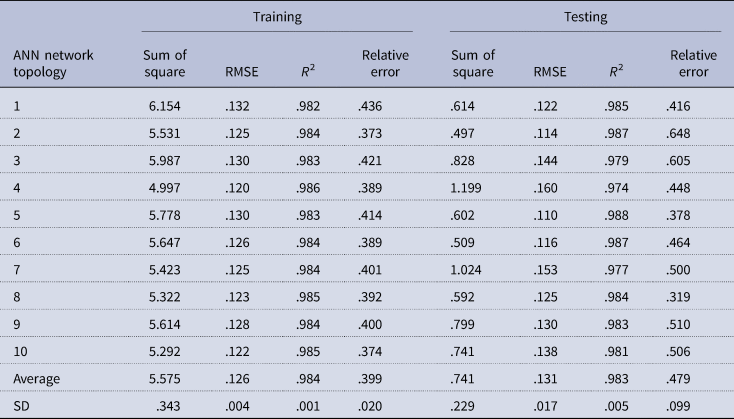
RMSE helps to quantify the accuracy of the approximated solution compared to the simulated data. A small RMSE indicates the estimated model to resemble the real value (Ait-Amir, Pougnet, & El Hami, Reference Ait-Amir, Pougnet, El Hami, El Hami and Pougnet2015). R 2 values approaching 1 indicate the ANN model to be able to accurately predict the dependent variable with respect to the actual values (Miles, Reference Miles, Everitt and Howell2005).
Table 7 shows the model results acquired for the data set in terms of R 2 (coefficient of determination) and RMSE. The fifth algorithm model is seen to provide the best prediction.
Performance of the multilayer neural network

The tested values for the models highly correlate to the actual values. The R 2 values are between .983 and .988, indicating the ANN models to be able to accurately predict the dependent variables (company-focused UPB and manager-focused UPB) with respect to the actual values.
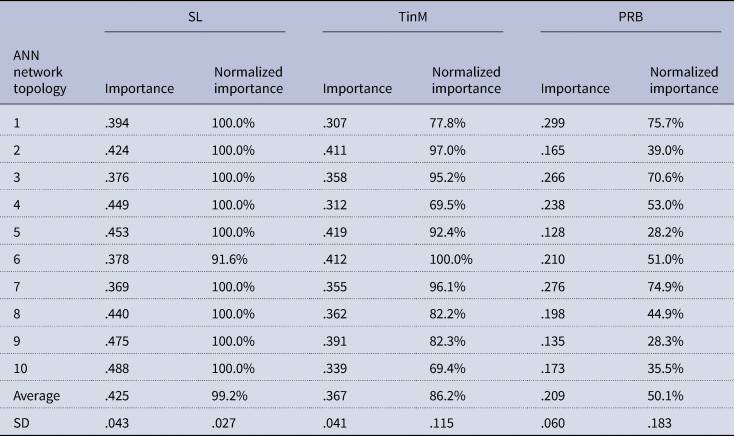
As seen in Tables 5 and 8, the variables affecting UPB in order of importance are: servant leadership (.549 in the LM, .425 in the non-LM), trust in manager (.287 in the LM, .367 in the non-LM), and PRB (.207 in the LM, .209 in the non-LM). The results for the ANN model (nonlinear) and SEM analysis (linear) overlap and support each other.
Significance of the constructs

SL, servant leadership; TinM, trust in manager; PRB, positive reciprocity beliefs.
4. Discussion and conclusion
This study analyzes the relationships servant leadership has with employee UPB (company and manager-focused) through the mediation of trust in manager and moderated PRB; it also analyzes the direct effects that PRB have on employee UPB. The empirical results indicate servant leadership to have direct and indirect impacts on employee UPB through trust in manager. Specifically, trust in manager and PRB strengthen the relationship servant leadership has with employee UPB. Furthermore, PRB directly affect both leader- and company-focused employee UPB. Thus, the results support the proposed model.
Remembering that Turkey is the context of the study is important while discussing the findings. In Turkey, the collectivist culture (Hofstede, Reference Hofstede2001) places importance on relationships and loyalty (Sullivan, Mitchell, & Uhl-Bien, Reference Sullivan, Mitchell, Uhl-Bien and Graen2003) and has a critical role in shaping manager/employee relationships. According to Wasti (Reference Wasti2003), relationships in Turkey have a normative component, so Turkish employees tend to culturally feel more obliged to preserve a sufficient exchange relationship with their managers (Pellegrini & Scandura, Reference Pellegrini and Scandura2006). Employees in Turkey expect care and compassion from their managers; in exchange, they agree to serve with deep respect and loyalty. In this context, servant leadership may feed the sense of obligation among employees. Moreover, Turkish people tend to cooperate with members of their in-groups (e.g., family members, religious group members, colleagues; Triandis, Reference Triandis, Verma and Bagley1988) while competing with others (Sargut, Reference Sargut2001). This may create favorable conditions for UPB.
A specific number of studies are found to have actually defined culture as an important factor shaping the outcomes of servant leadership (Kiker, Callahan, & Kiker, Reference Kiker, Callahan and Kiker2019; Mittal & Dorfman, Reference Mittal and Dorfman2012; Pekerti & Sendjaya, Reference Pekerti and Sendjaya2010; Trompenaars & Voerman, Reference Trompenaars and Voerman2009; Zhang, Zheng, Zhang, Xu, Liu, & Chen, Reference Zhang, Zheng, Zhang, Xu, Liu and Chen2021). Mittal and Dorfman's (Reference Mittal and Dorfman2012) study indicated a negative correlation to exist between high-power distance cultures and servant leadership's dimension of moral integrity. According to the authors, more research is needed to explain this complex negative correlation. As a high-power distance country, Turkey may not endorse servant leadership's dimension of moral integrity (Hofstede, Reference Hofstede2001); this is compatible with our findings. According to Pekerti and Sendjaya (Reference Pekerti and Sendjaya2010), leaders in countries of Eastern culture are furthermore less likely to raise ethical awareness among their followers in comparison to leaders in Anglo countries. The authors explained their point through the in-group favoritism that is present in collectivist Eastern culture. People in in-group collectivist countries such as Turkey (House, Hanges, Javidan, Dorfman, & Gupta, Reference House, Hanges, Javidan, Dorfman and Gupta2004) tend to favor and protect their in-group members, which may promote unethical behaviors. The loyalty expected from members leads them to sacrifice their own well-being and even moral values (Kim, Reference Kim1994).
Culture also has a powerful effect on the social exchange relations in a society. According to Kuwabara, Willer, Macy, Mashima, Terai, and Yamagishi (Reference Kuwabara, Willer, Macy, Mashima, Terai and Yamagishi2007), people from Eastern cultures tend to build stronger and durable social exchange relationships compared to people from Western cultures. These ‘sticky’ relationships (Jung, Hall, Hong, Goh, Ong, & Tan, Reference Jung, Hall, Hong, Goh, Ong and Tan2014) observed in collectivist societies come with a high degree of altruistic reciprocity (Yamagishi, Hashimoto, & Schug, Reference Yamagishi, Hashimoto and Schug2008). Altruistic reciprocity and self-sacrifice seem to be necessary for social approval in collectivist cultures (Zhang et al., Reference Zhang, Zheng, Zhang, Xu, Liu and Chen2021). Therefore, altruistic behaviors in collectivist countries like Turkey are encouraged even if they cause unethical actions (Babula et al., Reference Babula, Tookey, Muschert and Neal2020). Furthermore, unethical actions may be justified and even taken as a sign of loyalty if they benefit the counter party (Gino, Ayal, & Ariely, Reference Gino, Ayal and Ariely2013; Kalshoven, van Dijk, & Boon, Reference Kalshoven, van Dijk and Boon2016). This may explain how employees in Turkey tend to use unethical pro-social behaviors to reciprocate their managers' serving behaviors. The theoretical and practical implications of these findings are discussed below.
4.1 Theoretical implications
The findings provide specific contributions to the literature. Firstly, they advance the literature by showing that servant leadership may precede employee UPB in certain contexts (i.e., the hospitality industry in Turkey). While servant leadership has commonly accepted benefits, this study claims that servant leadership may also lead to increased willingness to behave unethically in order to benefit the leader/organization. We believe ours is the first study to predict this negative outcome from servant leadership. This certainly does not imply that servant leaders intentionally encourage unethical behaviors. On the contrary, it may be an unexpected consequence of trying to promote employee well-being and pro-organizational behaviors. Still, understanding the dark sides or potential harmful consequences of leadership styles remains critical. This study has also answered the calls to examine the outcomes of servant leadership in the tourism and hospitality industry (Brownell, Reference Brownell2010; Chon & Zoltan, Reference Chon and Zoltan2019; Gui, Zhang, Zou, & Ouyang, Reference Gui, Zhang, Zou and Ouyang2021; Kaya & Karatepe, Reference Kaya and Karatepe2020; Van Dierendonck, Reference Van Dierendonck2011; Van Dierendonck & Nuijten, Reference Van Dierendonck and Nuijten2011).
Secondly, this study's findings contribute to the UPB literature. Past studies have focused on the impacts different leadership styles such as charismatic leadership (Graham, Ziegert, & Capitano, Reference Graham, Ziegert and Capitano2015), transformational leadership (Effelsberg, Solga, & Gurt, Reference Effelsberg, Solga and Gurt2014), and ethical leadership (Miao et al., Reference Miao, Newman, Yu and Xu2013) have on UPB. However, our study is the first to investigate the relationship between servant leadership and UPB through social exchange theory. The empirical findings also prove social exchange theory to have a significant role in revealing the decisive process UPB have (Umphress & Bingham, Reference Umphress and Bingham2011; Wang et al., Reference Wang, Long, Zhang and He2019). Moreover, past research has shown that, apart from leadership style, UPB has other various individual and conditional antecedents such as employee–organization relationships, personality, values, affective commitment, and moral identification (Castille, Buckner, & Christian, Reference Castille, Buckner and Christian2016; Chen, Chen, & Sheldon, Reference Chen, Chen and Sheldon2016; Matherne & Litchfield, Reference Matherne and Litchfield2012; Umphress & Bingham, Reference Umphress and Bingham2011; Wang et al., Reference Wang, Long, Zhang and He2019). Our study identifies PRB as another individual factor able to affect UPB directly or shape the effect leadership style has on it. The moderating roles of PRB and the mediating roles of trust in manager on the relationship between servant leadership and UPB also advance the UPB literature by presenting a model that combines the influences that conditional (servant leadership) and individual (PRB and trust in manager) factors have. Thus, this study tries to illuminate the antecedents of UPB, which Umphress, Bingham, and Mitchell (Reference Umphress, Bingham and Mitchell2010) have suggested.
Lastly, this study presents statistical evidence on the role PRB have as an independent variable of UPB and as a moderator of the relationship between servant leaders and their subordinates. The findings reveal employees' PRB to shape how they respond to the serving behaviors of the leader. This contributes to the literature by revealing how subordinates' individual differences affect the outcomes of servant leadership (Zou, Tian, & Liu, Reference Zou, Tian and Liu2015).
4.2 Practical implications
The results suggest that servant leadership and PRB, which are expected to foster positive employee behaviors, may also generate employee UPB, which may be detrimental for the organization in the long run. This study suggests certain practical implications for hotel managers to be able to reduce employee UPB.
The main challenge for managers is to find ways to manage loyal employees' willingness to engage in unethical activities without harming the positive nature of their relationship. Organizations should therefore make their employees understand the long-run detrimental consequences of UPB. Organizations can also present ethical strategies to their employees for supporting favored leaders and colleagues who are in need (Bryant & Merritt, Reference Bryant and Merritt2019). The main objective should be emphasizing the employee ethical behaviors that are in favor of both the organization and the supervisor. In this manner, employee training programs and realistic case studies may be useful. This way, employees may clearly understand what the management does and does not expect from them. Training managers on how to emphasize ethical conduct in their departments would also be beneficial.
According to Bandura's (Reference Bandura1991) social learning theory, people can learn what behaviors are acceptable by watching role models. As such, managers should set an example for their followers and form a culture that rewards only ethical behaviors, no matter what the consequences are (Umphress, Bingham, & Mitchell, Reference Umphress, Bingham and Mitchell2010). Rewarded UPB may encourage other employees to engage in similar behaviors. This study clearly indicates that culture is able to shape employees' responses to servant leaders; therefore, managers should be aware of employees' cultural backgrounds and communicate with employees accordingly. With the support of human resources management, all managers should emphasize to employees what the moral boundary lines are. Having managers discuss these moral boundaries with employees would also be useful for diminishing any misinterpretations. Furthermore, selecting and promoting high-performing employees in terms of their ethical conduct would be very effective for encouraging ethical behaviors across the organization.
4.3 Limitations and implications for future research
Of course, this study has its limitations. First, the proposed model only differentiates between a limited number of causalities. To understand more comprehensively the outcomes and antecedents of servant leadership and UPB in the hospitality industry, future research may adopt experimental or qualitative research designs.
Secondly, this study was carried out within the Turkish hospitality industry; therefore, the generalizability of these findings may be limited. Past studies show that Turkish people may have a deep loyalty to their leaders and strong altruism toward in-group members of their own community (Sargut, Reference Sargut2001). Thus, Turkish culture may provide particularly suitable conditions for the model proposed here. Future research should therefore focus on the potential positive and negative results of servant leadership in the hospitality industry in different contexts. In particular, cultural factors should be studied in detail to understand how they affect the relationship between servant leaders and employees. Our study exemplifies how servant leadership may produce unexpected outcomes in collectivist and high-context cultures like Turkey's.
Lastly, social desirability may cause employees to report socially undesirable behaviors like UPB inaccurately (Randall & Fernandes, Reference Randall and Fernandes1991). Longitudinal, experimental, and phenomenological studies could be helpful for better understanding UPB. A more comprehensive approach to the internal cognitive process of UPB would also make a significant contribution to the literature.
Author contributions
Ali Osman Uymaz: conceptualization, methodology, data curation, formal analysis, writing, review and editing. Serdar Arslan: conceptualization, writing, review and editing.
Financial support
None.
Conflict of interest
None.