China is among a small minority of regimes classified as “politically closed,” lacking “any of the architecture of political competition and pluralism.”Footnote 1 Certainly, this characterization ignores nuanced political changes analysed by contemporary China scholars in recent years.Footnote 2 Yet, even relative to the most common variant of authoritarianism today, where opposition parties regularly compete against a ruling party in elections that are organized to prevent alternation of power,Footnote 3 Chinese electoral and congressional institutions largely do reflect this architectural deficit. A single Communist Party enforces a ban on political organizations outside the Party and on political factions within it. Party-led committees vet candidates for congresses and decide which names appear on ballots. Only township and county congresses emerge from popular elections; others are elected by congresses one level down: county congresses elect municipal congresses, municipal congresses elect provincial congresses, and provincial congresses elect the National People's Congress. Communists numerically dominate congresses, from top to bottom. The congresses are mostly amateur congresses, which meet briefly and infrequently. They typically ratify policies already worked out by a small governing elite that prominently includes the Communist Party.
Despite all this, China is no exception to the widespread adaptation of democratic institutions to the authoritarian setting. This is only barely evident at the national level, however. Nor do congress meetings themselves reveal much in the way of substantive representation. If we are interested in congressional representation in China, our best strategy is to shift the analytical focus downward and outward: downward, to township and county congresses, because only these congresses are popularly elected, and outward, beyond congress meetings, because these meetings are only brief and infrequent. This is the strategy I adopt here to describe and explain congressional representation in China.
I present three arguments. First, popularly elected local congresses that in the Maoist era only mechanically stood in for the Chinese mass public, through demographically descriptive and politically symbolic representation, now work as substantively representative institutions. In the terminology of Hannah Pitkin's classic study of representation,Footnote 4 Chinese local congressmen and women view themselves and act as “delegates,” not as Burkean trustees or Leninist party agents – and I refer to them as such. Second, this congressional representation is not commonly expressed in the quintessentially legislative activities familiar in other regime types, including electoral authoritarian regimes. Rather, it is an extra-legislative variant of (also familiar) pork-barrel politics: parochial activity by delegates to deliver targeted public goods to the geographic constituency. Third, this authoritarian parochialism is due to institutional arrangements and regime priorities, some common to single-party dictatorships and some distinct to Chinese authoritarianism.
These are new arguments. First, they are new in the sense that they are not a main focus of the existing scholarship on post-Mao local congresses. That scholarship mostly investigates the relationship between the congresses and other state players.Footnote 5 Three empirical investigations that consider the relationship between the congresses and ordinary Chinese do include descriptions of the delegate activities highlighted here. These studies use different methods, focus on congresses at and above the municipal level, and derive their conclusions from research conducted at an earlier period. Only Tomoki Kamo and Hiroki Takeuchi, analysing bills submitted by Yangzhou municipal delegates in the 1998–2002 period, characterize the activities as representation. They conclude that the delegates “represent the interests of the constituency of their electoral districts,” sometimes in opposition to the local Party committee.Footnote 6 Second, these arguments are likely also about an empirically new (not just newly observed) relationship between local congresses and their constituents. It is difficult to know for sure without strictly comparable evidence for earlier periods, but Chinese congress scholars certainly identify a new delegate consciousness of representation. Moreover, delegates link their sense of representation to the new electoral rules. Evidence on both these points is provided below. Finally, I borrow from a literature in American politics that treats pork-barrel politics as representation.Footnote 7 Although some studies of local China do describe parochial activities, they either do not treat these as representation or congresses are not the players of interest.Footnote 8 Instead, when the focus is Chinese congressional representation, the usual impulse is to search for policy representation.Footnote 9 This seems to ignore fundamentals of Chinese “normal politics”: if we look hard enough, we may find evidence of policy representation – but the argument here is that parochial activities, not policy, are the mainstream forms of local congressional representation in China today.
In making my arguments, I draw on: (1) qualitative evidence from loosely structured interviews I conducted with 65 congress delegates, officials and scholars across five provinces,Footnote 10 and (2) data from original probability sample surveys of 5,130 delegates in 49 township, county and (for contrast) municipal congresses in Zhejiang, Hunan and Anhui provinces.Footnote 11 Appendix A describes the surveys. Counties have powerful, fully developed governance structures as well as boundaries (and identities) that date roughly back to imperial times. Townships have weaker governance structures and have undergone major boundary changes since their restoration in the late 1970s. Differences in scale are also worth noting. Average size masks huge variation within categories, of course, but a county is typically an order of magnitude bigger than a township: a population of about 467,000 compared to 39,000, on average.Footnote 12 A municipality is yet an order of magnitude bigger: on average, 4.25 million people. If representation is anywhere, it should be most evident in the popularly elected township and county congresses. Municipal congresses are included for contrast. Representation is a less likely prospect there, with delegates distanced from constituents by both scale and electoral institutions.
In constructing the questionnaires, I worked with my Chinese colleagues to avoid offering delegates “politically correct” response choices that constitute easy opportunities to dissemble.Footnote 13 In addition, I conducted a reliability check on delegate self-reports, based on responses to a question about constituent contacting asked of constituents in a probabilistically selected subsample of surveyed townships. I found that township delegates and constituents roughly agree on frequency of contacts. This suggests that delegate self-reports about behaviours are reasonably reliable, even if (as I conclude below) delegates have an exaggerated view of their own importance.
The article is structured as follows. Section 1 briefly introduces political and institutional context. Section 2 presents the institutional foundations of authoritarian parochialism. Section 3 is the descriptive core of the article. It presents qualitative and quantitative evidence that congress delegates view themselves as delegates and that the activity of representation is mostly parochial responsiveness. Section 4 describes how Chinese congressional pork-barrel politics works and explains the institutional basis of its distinctive form. I conclude with reflections on the adaptation of concepts of congressional representation to China and speculate about the implications of authoritarian parochialism for regime stability.
Political and Institutional Context
Chinese congresses disappeared in 1966, a result of the radical institutional nihilism of the Cultural Revolution engineered by Mao Zedong. After Mao's death in 1976, top Party rulers officially repudiated the disruption of mass campaigns and began to restore institutions and rebuild officially acceptable channels of political participation, as one response to the excessive concentration of power in the Maoist era. Reforming the local congresses is part of a broad strategy to channel interest articulation at the grass roots. In the past decade of rapid socioeconomic change, the exacerbation of social grievances has laid bare the need for credible channels of interest articulation. As is well known, mass protests and petitions to express discontent with local officials and local circumstances are now part of the normal political landscape in China. In official Chinese rhetoric, the popularly elected local congresses are intended as “bridges” between the grass roots and governments, bringing the grievances of ordinary Chinese to the governance agenda to contain a potentially explosive “social volcano” and promote authoritarian stability. This formidable challenge now constitutes the underlying rationale for local congressional representation.
Institutional Foundations of Authoritarian Parochialism
In American politics, geographic parochialism is a serious challenge to good congressional policymaking. Indeed, Frances Lee argues, simply to structure representation by geographic district, the common practice nearly everywhere, is to make of parochialism a normative ideal: “Legislators see serving the particular interests of their narrow constituencies as an appropriate and fundamentally important part of their role.”Footnote 14 Congressional parochialism can take the form of constituency service, which delivers private goods to individuals.Footnote 15 Assistance in solving problems of constituents with the government bureaucracy is an example of this. Of consequence for more constituents is parochialism that delivers highly divisible, geographically targeted distributive benefits, which political scientists refer to as “pork.”Footnote 16 Parochial appeals are a way for incumbent congressmen and women to cultivate a personal reputation, distinct from the Party reputation. In liberal democracies, the point of parochialism is to reap electoral benefits. Empirically, democracies vary a great deal in the extent to which politicians invest in a personal reputation through parochial appeals, and this variation has everything to do with political institutions. Institutional arrangements offer Party leaders more or fewer instruments to sanction politicians who cultivate a personal reputation distinct from the Party reputation.Footnote 17
In China, as practically everywhere, geographically structured representation makes congressional parochialism normative, especially for township and county delegates, who owe their congress seats to electoral support in the voting district. The scholarly literature on liberal democracies associates the incentive to cultivate a personal reputation with institutionally weak parties,Footnote 18 but it doesn't work this way in China. Instead, Chinese political institutions drive local congress delegates towards mainly (if not exclusively) parochial representation. Fundamentally, this is because the public face of Chinese political power is the organizational unity of a single hierarchical authoritarian party. The Leninist doctrine of democratic centralism, still officially embraced, requires Party members (not only Party-member politicians) to observe discipline by refraining from publicly observable support for views that conflict with official Party decisions. Different from multiparty democracies (or, for that matter, electoral authoritarian regimes), Chinese politics does not reveal itself in public contests between different interests or policy preferences aggregated along political party or any other lines. Within the Party too, although “intraparty democracy” is the Party's new watchword,Footnote 19 organized opinion groups remain prohibited as open factions. In this institutional setting, congressional politics has little to do with reconciliation of conflicting claims by organized proponents of different ideas or interests, reflected in open political competition. Not only does the Communist Party numerically dominate the congresses,Footnote 20 but also non-communist congress delegates do not represent any evident ideological, policy, or other alternative to the Party.Footnote 21 Ideological debates are internal communist Party matters, shrouded in as much secrecy as possible – definitely not the stuff of congress meetings. This limits how and how much congress delegates can engage in representation.
First, the institutions do not permit congress delegates to engage in ideological or policy contests, whether during elections or at congress meetings. However, delegates can engage in constituency service to individuals and can supply geographically targeted public goods. More to the point, these parochial activities are core components of what amateur congress delegates are supposed to do, not the subversion of congressional representation. The Law on Congress Delegates, initially passed in 1992 and revised as recently as 2010,Footnote 22 requires congress delegates to maintain close links with their constituents and permits delegates to use any means to listen to and “reflect” (fanying 反映) up the needs and requests of constituents in the voting district. Moreover, article 18 of the law requires that delegate proposals, criticisms and suggestions be “clear and concrete, with a focus on reflecting practical problems and circumstances.” In short, congressional parochialism is the core of the official job description. As the Communist Party monopolizes opportunities for political career advancement in China, such parochialism can help ambitious politicians get along and ahead. In principle, then, investing effort in a personal reputation through constituency service and pork-barrel projects is not at odds with observing Communist Party discipline.
A second implication of Communist Party power has to do with constituent monitoring. Basic premises of the classic sanctioning model of liberal democracy are not met. In the single-party context, a party label conveys no information as an organizing category to help constituents sanction delegates for governance outcomes. Nor are individual delegate actions in congress easily distinguishable to constituents. In official congress reports and in the mass media, the public record does not attach delegate identities to congressional actions. For example, individual delegate votes on all but personnel matters are observable – often a show of hands, not secret ballot. However, the public record aggregates across delegates, only recording and reporting numbers for, against and abstaining. Congress delegates are supposed to report back to their constituents after congress meetings – but these sorts of reports are still not very widespread.Footnote 23 Even in the United States, where ordinary citizens can easily track individual votes in the US Congress and even more easily sort legislators by political party label, congressmen and women work to deliver local public goods because constituents can more readily credit them for the effort. In China, where constituents cannot easily credit their delegates for congressional policy actions, investing effort in parochialism makes all the more sense as a signal of attentiveness to constituents.
Institutions other than Communist Party power also promote parochialism in local congresses. In its formal arrangements, the Chinese system is only quasi-parliamentary,Footnote 24 but as in parliamentary systems, governance features a strong executive, relative to the congress. The executive, not the congress, formulates policy; the congress mainly approves it. This is executive-led governance with a difference, however: local governments work with organizationally distinct Communist Party committees. Party committees integrate executive power by including local heads of government as members.Footnote 25 There is little role in policymaking for local congresses. Additionally, budgeted and actual expenditures are not normally transparent in government reports: local governments are reluctant to release budgetary details even to congress standing committees.Footnote 26 Moreover, as a provincial congress standing committee member complained to me: “Congress only has the authority to review the government report on budgetary items, not extra-budgetary items, but the latter are more important.”Footnote 27 In short, local congressional policymaking authority is highly limited. In the Chinese congressional context, parochialism is not only the most readily available expression of representation, but also it does not conflict with Communist Party-defined obligations of local congress delegates.Footnote 28
Representation as Parochial Responsiveness
In this section, I present evidence that delegates at all congress levels, but somewhat more so at lower congress levels, widely view congressional representation as parochial responsiveness to constituents. The main activities of representation for popularly elected township and county delegates are supply of private and local public goods in response to constituent contacting. As noted above, without strictly comparable evidence for earlier periods, such as an earlier survey, we cannot know for sure that this delegate consciousness of representation is empirically new. Two pieces of interview evidence suggest it is new, however. First, Chinese congress scholars identify it as new, reporting a transformation of congresses in recent decades, from the merely honorary status of descriptive representation to substantive representation. Second, congress delegates link their sense of representation to the new electoral rules. The 1979 Electoral Law mandated three new building blocks of electoral legitimacy for township and county congresses: secret ballots, electoral contestation and voter nomination of candidates.Footnote 29 Communist Party-led election committees vet all nominees and decide who ends up on the ballot, and most congress delegates are Party members, but neither ballots nor congresses are saturated with Communist Party nominees.Footnote 30
Below are some illustrative quotes from a few interview subjects: a provincial congress delegate, a congress scholar and a township congress chair, respectively. The view that a new congressional legitimacy derives from electoral contestation is also evident in notes from many of my interviews, here voiced by the township congress chair.
In previous years, delegates thought of congress membership mainly as an honour. It was for model labourers, peasants and workers. Now there is some progress: at least there is a notion that we should be acting as representatives (Interview 62-0830).
[Delegates] have a consciousness of being representatives. Compare this to the first congresses in the late 1970s or early 1980s: when journalists interviewed delegates and asked them what it meant to be delegates, they merely spouted inane phrases such as “what an honour it is.” They had no concept of what they were really supposed to be doing. This is very different now (Interview 61-0829).
The main difference [from the Maoist era] has to do with elections. Before the 1980s, we were not elected by ordinary people, we were selected or designated to be delegates as an honorary status. Whoever the leaders wanted to be delegates would be delegates. This is different from now: now we win elections. We used to do whatever the Party or government told us to do, but now we work with the Party and government – and we represent the people's interests (Interview 45-0813).
A “Mandate” View of Representation
In her classic study, Pitkin distinguishes between the two poles of “mandate” and “independence” in theories of representation. The mandate theorist sees the representative as a “mere” agent or delegate; the independence theorist sees the representative as a free agent or trustee. Pitkin argues that these poles set the limits of what we are willing to recognize as representation:
If a state of affairs deviates too much in one direction or another, we shall say that it is no longer representation at all (he is simply an oligarch; he is simply a tool). But within the limits of what is no longer representation at all, there is room for a variety of views on what a good representative should and should not do.Footnote 31
We commonly associate Edmund Burke with the view of representation as trusteeship, where representatives act fairly autonomously. Modern representation has largely rejected the assumptions underlying trusteeship for a view better reflected in works by liberal democratic theorists, such as James Madison. Pitkin contrasts the quintessentially unresponsive Burkean trustee with the quintessentially responsive Madisonian delegate:
Unlike the Burkean representative, … Madison's representative does not know his constituents' interests better than they do themselves; if anything, he is in this respect roughly their equal. His furtherance of their interests is conceived of as fairly responsive.Footnote 32
As a representative, the Burkean trustee is not inclined toward geographic parochialism; the Madisonian delegate is not in principle disinclined toward it.
Even as Chinese political institutions are not conducive to citizen monitoring of congresses, the 1992 Law on Congress Delegates describes an agency relationship, with ordinary Chinese as principals of the delegates they elect. For example, article 6 specifies that delegates work under the supervision of their constituents, and articles 45 through 52 are all about constituent supervision of delegates. In interviews, delegates fluently speak a language that suggests an agency relationship, with ordinary voters as principals. They routinely and frequently use the new terms “voting district” (xuanqu 选区), “constituency” (xuanmin 选民) and “constituent interests” (xuanmin de liyi 选民的利益). Popularly elected delegates have a sense of a geographic constituency, to which they are accountable. The illustrative quotes below are from a county congress chair and a county (and concurrently municipal) congress delegate, respectively:
We represent our constituents. If we know the situation in the entire county, then we can represent it – but we really know the situation in our voting districts. Also, these are the people who elected us, so actually we represent the interests of our constituents.Footnote 33
Delegates are supposed to represent the people's interests in the entire county and also the voting district. If they can't represent the interests of their constituents in the voting district, they will not be elected. They have to represent their constituents.Footnote 34
For delegates in the higher-level congresses that are indirectly (not popularly) elected, the notion of representation seems less clearly accompanied by the sense of an agency relationship with ordinary Chinese. The illustrative quote below is from a provincial congress delegate:
I do not think of my constituency as the locality that elected me. I think of my constituency as the province. Because I understand the world of enterprises, perhaps I can better represent enterprises than some other delegates; I am a woman so perhaps I can better represent women on issues than some other delegates. But this is not the same as constituency.Footnote 35
To be sure, even as Chinese leaders have adopted rhetoric and some design features to promote congressional responsiveness to constituents, they also explicitly repudiate institutions designed to promote responsiveness in liberal democracies – multiparty democracy and separation of powers, for example.Footnote 36 More to the point, even as they increasingly point to economic success in their claims to legitimacy, they continue to embrace an antidemocratic, elitist view of representation as a normative underpinning for the Chinese Party-state: Leninist theory, reflected in the theory and organization of the Communist Party. Lenin conceived of political legitimacy in ways that justify a monopoly of power by a communist party elite that is neither popularly elected nor specifically responsive to popular preferences. In Leninist theory, preferences are distinguished from historical class interests. Ordinary citizens are incapable of understanding their own real (i.e. historical, class) interests; ipso facto, elite responsiveness to the expressed preferences of the majority does not advance society. Instead, Leninist representation is guardianship by a revolutionary vanguard party, which is organized hierarchically and possessed of superior understanding of the historical laws of development discovered by Marx.Footnote 37 As the communist party is the sole organization with the politically correct knowledge to lead society, it is also the authoritative arbiter of society's interests.
Following up on my qualitative interviews and with these perspectives in mind, I investigated more systematically how Chinese delegates understand congressional representation. To what degree do responsive or elitist notions of representation resonate? Specifically, the survey asked delegates about their level of agreement or disagreement with three statements reflecting different views of the relationship between delegates and constituents. These are intended to reflect mandate, Leninist and trustee views of congressional representation, respectively:
Congress delegates should side with (baochi yi zhi 保持一致) the majority of their constituents, because constituents best understand their own interests.
Congress delegates should obey the decisions of the [Communist] Party organization because the Party best represents the interests of constituents, and constituents do not always understand their own interests.
Congress delegates are able to represent the interests of their constituents, even if this means not always siding with their constituents.
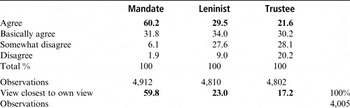
The survey also asked a follow-up question: “Which of these views is closest to your own view?” Tables 1 and 2 report findings.
Delegate Views of Congressional Representation

Source:
Author's surveys
Notes:
Percentages may not add up to 100 due to rounding.
Percentages for agree–disagree items are categories chosen in response to each of the following statements, respectively by column: “Congress delegates should side with the majority of their constituents, because constituents best understand their own interests.” “Congress delegates should obey the decisions of the [communist] party organization because the party best represents the interests of constituents, and constituents do not always understand their own interests.” “Congress delegates are able to represent the interests of their constituents, even if this means not always siding with their constituents.” Percentages in the penultimate row are responses to a follow-up question: “Which of these views is closest to your own view?”
Delegate Support for “Mandate” View of Representation, by Congress Level and Source of Nomination

Source:
Author's surveys
Notes:
Percentages may not add up to 100 due to rounding.
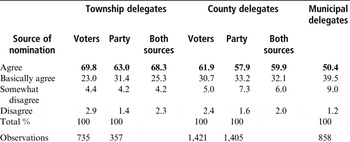
Pearson chi-square for differences by congress level: 79.8545, p = .000
Pearson chi-square for differences by source of nomination: 10.3405, p = .016 for township delegates, 11.3032, p = .010 for county delegates
Percentages are categories chosen in response to the following statement: “Congress delegates should side with the majority of their constituents, because constituents best understand their own interests.”
Overwhelmingly, as reported in Table 1, respondents support a mandate view of congressional representation: 60 per cent agree and 32 per cent basically agree with the statement reflecting this notion. A Leninist view elicits only 30 per cent agreement, trusteeship only 22 per cent. Differences are even more evident when respondents are forced to choose among the three views: 60 per cent view themselves most as delegates, 23 per cent as Leninist party agents, 17 per cent as trustees.Footnote 38 Table 2 presents support for a mandate view of representation by congress level and source of nomination. Obviously, even as these simple bivariate results point to statistically significant differences, more important is the perspective they provide on the even simpler picture reflected in Table 1: namely, support for a mandate view of representation is quite widespread, even among indirectly elected municipal delegates and Party nominees.Footnote 39
Even so, as shown in Table 2, agreement with a mandate view of representation drops monotonically by congress level: 68 per cent of township delegates, 60 per cent of county delegates, and 50 per cent of municipal delegates agree with this view. These differences suggest that scale (and probably institutions too) matters to an understanding of congressional representation. That is, popularly elected township delegates, formally accountable to a small community, have a stronger sense of themselves as agents of ordinary constituents than do municipal delegates, indirectly elected by a congress representing tens of thousands of constituents. Agreement with a mandate view of representation also varies significantly by nomination source: in township congresses, 70 per cent of voter nominees and 63 per cent of Party nominees agree with this view; in county congresses, 62 per cent of voter nominees and 58 per cent of Party nominees agree with this view.
Parochial Responsiveness: Congressional Representation in Action
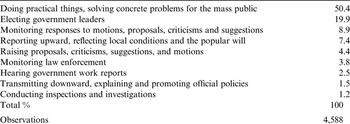
As shown above, by and large, delegates view themselves as delegates. How do they act as delegates? New laws and regulations set out a number of formal responsibilities for congress delegates. After consulting these documents and conducting qualitative interviews, I settled on nine commonly recognized responsibilities. The survey asked delegates to identify the one they consider most important. Results are presented in Table 3.Footnote 40
Delegate Views of Most Important Responsibility

Source:
Author's survey
Note:
Percentages are categories chosen in response to the following question: “Congress delegates have many responsibilities. Which do you think is the most important responsibility for a municipal [county, township] congress delegate?”
As shown in Table 3, over 50 per cent of delegates surveyed understand their most important responsibility as “doing practical things for the mass public or solving concrete problems” (wei qunzhong banshishi, jiejue shiji kunnan 为群众办实事, 解决实际困难) – a sort of parochial everyday responsiveness to constituents. This choice greatly exceeds the next largest category: electing government leaders, ranked as most important by 20 per cent.Footnote 41 Qualitative interviews yield numerous illustrative examples of the content of parochial everyday responsiveness. It includes help with individual or family needs (such as employment, health care and education) and, most commonly, action to provide local public goods. Airing constituent complaints about industrial pollution and all manner of problems involving local roads (such as the need for a new road, opposition to plans to widen a road, unfair allocation of fees for road maintenance, timing of ongoing road construction) figure most prominently in delegate stories. In sum, congressional representation is mostly about providing private and local public goods.
What local congress delegates soundly reject in Table 3 is nearly as illuminating as what they affirm. In the Maoist era, day-to-day responsibilities of congress delegates were summed up in the paired stock phrases “reporting upward” (shang chuan 上传) the practical problems experienced by ordinary Chinese in the locality and “transmitting downward” (xia da 下达) the official policies of the Party-state. The responsibilities, if not the rhetoric, remain part of the formal–legal description of what delegates do today.Footnote 42 Indeed, on the basis of 39 interviews conducted in the late 1980s and early 1990s, many with congress delegates, Kevin O'Brien describes this latter responsibility as the dominant role identity for delegates.Footnote 43 He concludes that delegates see themselves mainly as state agents, representing the government to ordinary Chinese by faithfully explaining and promoting official policies. More than 20 years later, I did not find this sentiment in my interviews with delegates. Moreover, as shown in Table 3, the responsibility to “transmit downward” resonates little among delegates surveyed: less than 2 per cent of delegates rank it as most important, which places it nearly last. The problem is evidently not the rhetoric per se, but its poor fit with contemporary notions of congressional representation: some 30 years into the post-Mao era, the responsibility to “report upward” still resonates with delegates, with more than 7 per cent identifying it as their most important responsibility, albeit phrased in the newer terminology – to “reflect” up. O'Brien's interviews were probably too early to capture the effect of the 1992 Law on Congress Delegates and subsequent Communist Party work conferences across the country that raised the status of congresses vis-à-vis local governments.
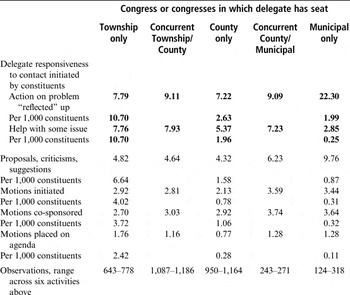
A second perspective on how delegates act as delegates is presented in Table 4. It summarizes yearly averages for a number of delegate activities, aggregated by congress level.Footnote 44 One complication in making these comparisons is concurrent seats, which are quite common at and above the county congress level.Footnote 45 To make valid comparisons across congress delegates along a dimension on which constituents figure explicitly in the measure, as is (particularly) the case with the first two activities, I separate out delegates with and without concurrent congress seats. This yields five, not three, congress categories. In addition to simple averages for each activity, for delegates without concurrent seats I compute activity per 1,000 constituents. On average, a township delegate in the sample represents 726 people, a county delegate 2,742 people, and a municipal delegate 11,203 people; these are the figures I use to compute activity per 1,000 delegates for delegates without concurrent seats. While the simple averages capture variation in how busy delegates are at the different congress levels, the adjusted figures reflect how and how much delegates represent their constituents.
Activity as Congress Delegate, Yearly Averages by Congress Level

Source:
Author's surveys
Note:
See text for variable construction.
Consider first the simple yearly averages based on delegate responses to questions about the number of their proposals, criticisms, suggestions and motions. The main distinction among these activities is between motions (yi an 议案) and the other three (proposals, criticisms and suggestions; piping jianyi 批评建议), which are appropriately grouped together in the survey question. Motions are formal, written documents, with a higher threshold for collective action. They are raised only at annual congress meetings and require at least ten delegate signatories. Motions supply a rationale and evidence to support a plan of action to address a general issue within the competence of the congress. Most delegate efforts at motions fail to advance to the congress agenda: congress leaders, who control the agenda, reject them. On average, among delegates surveyed, only about 20 per cent of motions initiated or co-sponsored made it onto the congress agenda. Once on the agenda, however, motions routinely obtain sufficient congress support to ensure passage; indeed, advancement to the agenda carries a strong presumption of passage.Footnote 46 All this distinguishes motions from proposals, criticisms and suggestions, for which the threshold is much lower.
As noted above, article 18 of the Law on Congress Delegates describes proposals, criticisms and suggestions as “clear and concrete, with a focus on reflecting practical problems and circumstances.” Individual delegates or any number of delegates together voice these items, which can address shortcomings in any aspect of government work. These activities occur at and between annual congress meetings. At congress meetings, delegates raise proposals, criticisms and suggestions during small group discussion sessions. This activity can be quite superficial. For example, in 1999, as a member of a Carter Center delegation, I observed a township congress meeting and sat in on the small group discussion meeting of 17 delegates from eight voting districts, about one-third of the delegates for the township congress. A congress official and a township government official, both sitting in on the discussion, spoke for about a half-hour each. Most ordinary delegates also spoke, but most only briefly. Nonetheless, they raised a great number of proposals, criticisms and suggestions, roughly one for every two minutes of speaking time. Needless to say, these were quite superficial, even if sometimes quite pointed. The illustrations below are in fact more contextually rich than the simple enumeration of issues by most other ordinary delegates:
Infrastructure is needed for agricultural development. My township is in a hilly area, prone to drought. Lacking water conservancy, we were unable to deal with natural disasters such as last year's droughts. The government has completed only small water conservancy projects. We need large-scale reservoirs. In emergencies we can use the water; when there is no emergency, we can use the reservoirs as ponds to cultivate fish. … Transportation network: lots of problems here. Three villages of the four mentioned [by a previous speaker] are connected to one another but not to the town centre. The government should link the four villages with the town centre.
We planned to build a bridge, but we had never done it before. We had a lot of difficulties. So we turned to the township government, but we couldn't find anyone to help us. We complained about this work style of the government. Even though we spent days looking for someone to help us, no one came to our aid. If this work style doesn't improve, we will have more problems. We should consider candidates [i.e. for government leadership] carefully. Work style is very important. Leaders should be at the office during working hours.
Each of the two delegates quoted above spoke for less than five minutes, but the sum total of their contributions amounts to three criticisms and three proposals in the congress tally of proposals, criticisms and suggestions. As I discuss in the next section, proposals, criticisms and suggestions are not always so superficial. However, the snippets above illustrate what distinguishes them most from motions: they are about highly specific, geographically targeted public goods.
The first two activities, highlighted in bold in Table 4, are of greater interest here. They best measure the sort of parochial responsiveness to constituents described above. They are based on delegate responses to questions about different types of constituent contacting. We have some evidence that this sort of constituent contacting is more common than before: in surveys conducted in Beijing in 1988 and 1996, the percentage of residents making requests to congress delegates increased from 9 to 14 per cent.Footnote 47 The measures in bold in Table 4 reflect constituent contacting and delegate response. Although not comparable in construction to the activities discussed above, the combination of these two pieces of information is precisely what we want in order to measure parochial responsiveness. In this sense, these two activities are most relevant to the question studied here. The first activity focuses on local conditions “reflected” up by constituents to delegates:
Since you were elected this term as a delegate to this township [county, municipal] congress, about how many constituents have contacted you in your capacity as congress delegate to “reflect” problems up (fanying wenti 反映问题)? This includes written contact, spoken contact, telephone calls, and any other methods of reporting problems. Response categories for county and township delegates: none, 1–2 people, 3–5 people, 6–10 people, 11–20 people, more than 20 people. Response categories for municipal delegates: none, 1–5 people, 6–10 people, 11–20 people, 21–30 people, 31–50 people, more than 50 people. How many of the problems reported to you were you able to take action on, for example, contacting the relevant department, raising criticisms and proposals, et cetera? Response categories: all, most, half, a minority, none.
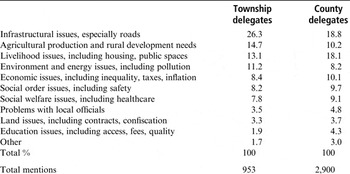
In the next section, I analyse these activities as supply of “pork.” Although the survey question does not specify local public goods, the term “reflect” certainly implies it. Moreover, as shown in Table 5, responses to an open-ended follow-up question reveal that conditions reflected up in constituent-contacting do indeed mostly concern classic local public goods problems. Infrastructural issues, especially roads, are by far the most common reason for constituents to contact congress delegates; they make up 26 per cent of constituent complaints to township delegates and 19 per cent of constituent complaints to county delegates, for example. Other common complaints include rural development needs, environmental pollution and social order problems.
Content of Problems “Reflected” Up (Delegate Mentions, Up to Three Mentions Coded)

Source:
Author's surveys
Note:
Percentages may not add up to 100 due to rounding.
About 7 per cent of delegates report no constituent contact to reflect local problems at all; as the concept of interest here is delegate responsiveness (i.e. conditional on some constituent report), I remove these observations from the sample. The first row of figures in Table 4 presents averages, by congress level, of contacts weighted by responsive action.Footnote 48 As constructed, the value for any individual delegate depends partly on number of constituent contacts. Conceptually, this is appropriate: if constituents selectively contact delegates whom they guess will be more responsive, this is reflected in the measure.Footnote 49
I constructed the measure for the second activity in the same way, but based on responses to the following questions:
Since you were elected this term as a delegate to this township [county, municipal] congress, about how many constituents have sought you out in your capacity as congress delegate for help with some issue (zhao nin bangzhu tamen banshi 找您帮助他们办事) – including help on public matters, private matters, and any sort of matters? Response categories for county and township delegates: none, 1–2 people, 3–5 people, 6–10 people, 11–20 people, more than 20 people. Response categories for municipal delegates: none, 1–5 people, 6–10 people, 11–20 people, 21–30 people, 31–50 people, more than 50 people. Of all those who sought your help, how many were you able to help? Response categories: all, most, half, a minority, none
This activity also captures constituency service, that is, delivery of private goods to constituents.Footnote 50
Of course, aggregated by congress level, variation on both measures of responsiveness shown in Table 4 largely reflects mechanical differences in scale: a municipal delegate has thousands of constituents, a township delegate merely hundreds. Other things equal, delegates with more constituents will experience more contacting. For example, in constructing the measures of responsiveness for Table 4, I found constituent contacting about local problems for municipal delegates averages about three times that for township and county delegates: 29 contacts per year, compared to 10. On average, however, municipal delegates act on less than half of these contacts, township and county delegates on more than three-quarters of contacts. Standardizing delegate responsiveness per 1,000 constituents gives better perspective.
Two patterns are conspicuous in Table 4, both of them consistent with interview evidence and the descriptive survey results reported above. First, it seems that scale matters in the causal, not simply mechanical, sense. In absolute terms, township delegates average nearly as much help with issues (7.76 actions) as do county and municipal delegates combined! In particular, municipal delegates supply exceedingly little help (2.85 actions), even in absolute terms. This is unsurprising: as indirectly elected delegates, they are institutionally distant from their constituents; they are also geographically distant from most of them. Moreover, when standardized per 1,000 constituents, township delegate activity far surpasses county delegate activity and county delegate activity far surpasses municipal delegate activity – for every activity. Second, parochial everyday responsiveness dominates delegate activity. At no congress level does the sum total of proposals, criticisms, suggestions and motions initiated and co-sponsored exceed delegate responsiveness to constituents.Footnote 51 The two sets of measures are not constructed in comparable ways, of course – but their construction should bias downward (not upward) the explicitly responsive activities, as responsive action is conditional on constituent initiative. Taking all this into account yields the following conclusions: at each congress level, everyday responsiveness to constituents dominates delegate activity, and this mainly (although not exclusively) consists of extra-legislative responsiveness, that is, activity outside of congress sessions.
Pork-barrel Politics with Chinese Characteristics
As described above, the biggest component of representation in Chinese local congresses is geographically parochial responsiveness. A big component of this responsiveness (except in municipal congresses) is “help with some issue,” activity that includes constituency service (provision of private goods), but the biggest component is delegate action on some problem constituents “reflect” up, which mostly concern local public goods. Here, I use the term “pork” for these goods and “pork-barrel politics” for delegate actions to provide them. Public goods infrastructure is a large spending category at the grass roots, about 43 per cent of village fiscal expenditures, for example,Footnote 52 and most of the funding comes in the form of township or county government allocations. This puts pressure on congress delegates to use the congress seat to orchestrate allocation of pork-barrel projects. The framework in the previous section set out the institutional underpinnings of why parochialism is the common face of Chinese congressional representation; in this section, I describe Chinese pork-barrel politics in practice and set out the institutional underpinnings of how it works.
Three institutional features are particularly consequential. First, as noted above, Chinese local congress meetings are brief and infrequent: the congresses meet once a year, for a few days at most. Second, also noted above, this is not a system of checks and balances. Instead, political arrangements feature executive-led governance enhanced by single Communist Party dominance. Third, although local congresses have the authority to approve (or not) the government's annual economic development plan and its annual report on expenditures, congress meetings are normally not structured so as to permit delegate debate on issues. For that matter, government reports are normally not transparent enough to permit meaningful assessment of budgets or expenditures. The best way to understand the consequences of these institutions is through a description of how pork-barrel politics works.
Qualitative interview evidence suggests that pork-barrel politics is played out most often between (not at) congress sessions. The survey data also imply that extra-legislative responsiveness is most common. Wherever it takes place, it is essentially an interaction between two players: congress delegates advocating on behalf of a geographic constituency (or congress leaders on their behalf) and the government (or a government department). This is in stark contrast to pork-barrel politics in American politics, which takes place in the US Congress itself and is structured by congressional committee membership.
In Chinese pork-barrel politics, delegates may themselves seek out government leaders or officials in functionally specialized government departments to engage in direct advocacy. This is illustrated in the following example, recounted by a county delegate. Note that congress delegates seek out government department officials on their own, but the congress deputy secretary acts as gatekeeper to government leaders.
Widening the road would increase fees in our township. We were unhappy with the plan to widen the road so we went to the highway department in the county government, then to the transportation department. Both departments simply responded that the road must be widened. The congress standing committee deputy secretary said we could go to the county [government] deputy magistrate to make our case. We went to him and explained the rationale behind our opposition to widening the road. We had a reasonable public rationale. He was persuaded, so the road was not widened.Footnote 53
More often, however, delegates raise requests to congress leaders, who may agree to present the issue to the local government, as in the example below from a township delegate:
A road was built through our village. We paid for our part of the road with fees. This is not the problem. But this road is widely used not only by vehicles from other villages and towns in the county but also from outside the county. We do not think we should be responsible for maintaining the road when it is used by so many from outside the village. This sort of issue requires the congress to address it. We went through the presidium to raise this issue to the government to deal with the problem. Then the government invested in maintenance of the road.Footnote 54
In the quote above, the delegate wants to distinguish clearly between the sorts of problems that village leaders can solve on their own and the road issue, which “requires the congress to address it.” Clearly, however, the congress does not solve the problem in this or in the preceding example. Instead, congress delegates or congress leaders present the case to the government, which acts (or not) to respond to the problem.
At congress meetings, pork-barrel politics works only a little differently. Delegates may coordinate legislative activity to advocate for common local public goods across voting districts. There are some advantages to coordination. Legislative proposals to allocate local public goods are more public than advocacy between congress sessions. Also, if delegates manage to coordinate support among greater numbers spanning more districts, this helps to elicit government attention, as suggested by the county (concurrently municipal) delegate quoted below:
In our delegation of 21 delegates [at the county congress], we see if the problems we want to raise have any common interest for other townships, other delegations. If so, then more delegates and delegations sign on to the proposals. We do this sort of organizing across delegations before the congress meeting and also at the meeting. At the congress meeting, even if we don't know the members of other delegations, our delegation head probably knows them. We can also connect with them informally, at mealtimes and in the evenings. If a proposal is raised by more delegates and spans delegations, then it is more powerful – the government knows it really has to take account of it because it is a general problem, not just particular to one township.Footnote 55
As suggested in the quote above, the structure of congress meetings discourages coordination across localities: delegate discussion is organized by geographic proximity or administrative identity (e.g. by townships in county congresses). This severely curtails formal opportunities for contention or compromise among the entire assembled congress of delegates representing the parochial interests of heterogeneous districts.
Whether pork-barrel politics takes place between congress sessions or at congress meetings, the player with decision-making power actually to distribute pork to localities is the government, which manages local expenditures. Congresses have no independent authority whatsoever to earmark allocations, decide on formulas for distribution of pork across localities, or otherwise deliver materially on any of their proposals, criticisms, or suggestions. Chinese congressional pork-barrel politics is thus best understood as advocacy or special pleading to the government. Even when delegates coordinate proposals at congress sessions, with delegates in several discussion groups raising the same issues, the audience is the government official assigned to sit in on the discussions and report to government leaders.
Pork normally has implications for government budgetary allocations and expenditures. Congresses vote on the government economic development plan for the coming year and the report on the budget for the preceding year. Yet, as described above, government financial reports are not transparent, even to congress standing committees. For example, at the township congress discussions I observed in 1999, a delegate raised the following complaint about the opacity of the financial reports presented to the congress: “So much detail – but no numbers.”
The discussion above presents a picture of a highly lopsided pork-barrel politics. Indeed, the politics seems mostly absent. There is little opportunity for congress delegates to engage in bargaining among themselves. Nor is there a sense that local congresses and local governments are on opposite sides. Given this evident congressional impotence, delegates somewhat surprised me in interviews with a self-important rhetoric of institutional power. Citing congressional legal authority to recall and interpellate government leaders, they implied that governments dare not ignore congresses. The illustration below, from a township delegate, is typical of this sentiment:
The government has to take the opinions of congress seriously. We can recall government leaders. Also, it helps the government do its job. [Probe from me: Have any government leaders been recalled around here?] No – but by law we can recall them. … Before the congress meeting, if there is broad consensus [among delegates] on some issue, then they raise this issue with government [leaders] to be integrated into the government work plan. If it doesn't show up in the government work plan, then it may be difficult for the government to gain approval for the plan [i.e. by congress]. So the issue does appear in the plan – and in the government work report when the year is up. We have had no problem here with the government not taking the congress seriously.Footnote 56
Similarly, among surveyed delegates, some 87 per cent think the government is basically or very attentive to congresses.
This presents a puzzle: why do governments respond, when they do respond, to delegate advocacy on behalf of constituents? Given Communist Party powers over personnel, it seems they need not strategically guard against change in government through congressional vote. Here, I argue that governments condition their responses on the value of the local knowledge delegates provide. Through its nomenklatura system, the Communist Party controls the appointment, promotion, transfer and removal of officials in all positions of importance, from the grass roots up.Footnote 57 This includes local congress, government and Party leaders. The system is the linchpin of Party power. It allows Party leaders in Beijing to impose standards for career mobility across China, working through the hierarchy of Party committees that evaluate leaders and approve personnel actions. Since the late 1980s, standards for local government leaders have been defined in the “target responsibility system,” which assesses local leaders and assigns them points distributed across dimensions that reflect the broad goals of the Party centre.Footnote 58 Local economic growth is of paramount importance in this point system. However, social stability is usually a “veto target”: failure to perform well on this dimension nullifies performance achievements on all other dimensions. For this reason, local government leaders assign high priority to local social stability. Moreover, as noted in the first section, they have cause for concern. Certainly, they cannot take social stability for granted.
All this suggests that insofar as local congress delegates are imbued with confidence in their congressional power derived from formal instruments to make local governments pay attention, they probably flatter themselves. Instead, it seems more likely that the Party's nomenklatura system gives local government leaders reason to care about social stability – and that this is the incentive for government leaders to pay attention (when they do pay attention) to reports of discontent reflected up to township and county delegates, who live and work among their constituents.
Conclusion
Institutional arrangements are my point of departure and analytical referent throughout this article, as I unravel the design and practice of congressional representation in contemporary China. These arrangements dictate my turn from National People's Congress sessions to popularly elected township and county congresses and to activities outside of brief and infrequent congress meetings. I argue that political institutions drive local congresses to forms of congressional representation that reflect geographic parochialism. Congress delegates view representation as parochial everyday responsiveness to constituents. The biggest component of this responsiveness is delegate activity to deliver local public goods – activities that resemble pork-barrel politics. In Chinese congresses, this politics is mainly extra-legislative, pursued as advocacy to local governments.
A corollary to this argument that congressional representation unfolds as authoritarian parochialism is an argument about governments, the targets of advocacy efforts. Authority to address the problems that delegates bring to the attention of governments rests with governments, not congresses. I argue that governments condition their own responsiveness on the value of the local knowledge that delegates provide in their advocacy efforts. By and large, local government officials seek most of all to avoid explosions of community discontent in social unrest. This has everything to do with the preferences of top Party rulers, expressed in the point system by which hierarchically organized Communist Party committees evaluate and promote officials: local unrest counts heavily against local officials. Insofar as congress delegates are imbued with a confidence in congressional power derived from formal instruments to make governments pay attention, they probably flatter themselves. At the same time, a self-important misunderstanding of why governments respond helps make congressional representation work, when it does work. Congress delegates give local governments the opportunity to act pre-emptively to address community complaints that might otherwise spark petitions and protests. That petitions and protests abound in China indicates that congressional representation is not the only routine channel for ordinary Chinese to articulate grievances.
In liberal democracies, political scientists look for representation in legislative output. Even particularistic appeals, viewed as an obstacle to good congressional policymaking but recognized nonetheless as representation, unfold as legislative activity. The adaptation of the concept of pork-barrel politics to the politically closed Chinese polity demonstrates not how fluidly concepts travel across fundamentally different political systems but rather how careful we must be in looking for representation in familiar political spaces. Decades before the advent of electoral authoritarianism, Seweryn Bialer described the “low politics” of political participation in the post-Stalinist Soviet Union – citizen contacting of public officials to obtain specific private goods.Footnote 59 Years later, Tianjin Shi described political participation in China in the 1980s in similar terms.Footnote 60 The authoritarian parochialism described in this article is different, however. For one thing, it mainly focuses on local public (not private) goods. Moreover, for rulers in Beijing, authoritarian parochialism is a congressional design feature, not a flaw. The design is also incentive compatible: there are no losers when Chinese congress delegates place the “practical problems and circumstances” of ordinary citizens on the local governance agenda and local governments respond. The argument here is not that the design is democratic or even proto-democratic. Indeed, in the longer term, to the extent that geographically parochial congressional representation works as designed, it props up a politically authoritarian regime.
Appendix A
For the surveys, I partnered with the Research Center on Contemporary China (RCCC) at Peking University, the most professional and innovative social science survey research agency in the country. We selected Zhejiang, Anhui and Hunan provinces mainly for feasibility of implementation, within a group of provinces that varied along dimensions of interest. Municipalities, counties and townships are probability samples, selected with probability proportionate to population size. The sample is nested: counties within selected municipalities, and townships within selected counties. Within each province we probabilistically selected two large municipalities, with (county-level) urban districts within them. We probabilistically selected one urban district and two counties or county-level cities under the governance of each of the selected municipalities. Within each of the selected counties or county-level cities (but not urban districts), we probabilistically selected two townships or towns. The result is a representative unbiased sample of congresses across the three provinces. For a variety of reasons, not all local authorities were willing to permit or facilitate surveys of congresses in all probabilistically selected localities. At the same time, we were unwilling to compromise on the fundamental issue of probability sampling. Ultimately, we successfully completed surveys in 49 congresses in our sample: 4 municipal congresses, 19 county congresses and 26 township congresses. Response rate was 53 per cent.
We conducted the surveys over a period of 26 months, from September 2007 through October 2009. There are two practical ways to survey congress delegates systematically: at congress meetings that bring them to a single site at the same time or with a self-administered questionnaire that delegates complete and mail back. We used both, adapting our method to local circumstances. As no regular congress meeting provides enough time for face-to-face interviews with a substantial number of delegates, we designed the survey instrument as a self-administered questionnaire. For elite respondents, who are generally more literate than the mass public, we judged this method acceptable. Our strong preference was to administer the survey at congress meetings. This was possible for 29 congresses, accounting for 52 per cent of delegates surveyed.